
CUET Physical Education Question Paper 2024 Download Solutions and Answer Key pdf May 17 Shift 1 ZPYP


| Updated On - Dec 7, 2024
CUET Question Papers are the most important study material for effective exam preparation. We at Zollege have provided all CUET Previous Year Papers with Solution PDFs here. CUET 2024 Physical Education was conducted successfully on May 17 by NTA.
Students can freely download the CUET previous year's question paper PDFs along with their solutions here. We strongly encourage cuet aspirants to scan through all the CUET Question Paper to know the overall difficulty level, CUET Syllabus and understand the changes in CUET Exam Pattern over the years.
CUET 2024 Physical Education Question Paper with Answer Key PDF
| CUET 2024 Physical Education Question Paper with Answer Key SET A |  Download Download |
Check Solutions |
| CUET 2024 Physical Education Question Paper with Answer Key SET B | Download |
Check Solutions |
| CUET 2024 Physical Education Question Paper with Answer Key SET C | Download |
Check Solutions |
| CUET 2024 Physical Education Question Paper with Answer Key SET D | Download |
Check Solutions |
CUET 2024 Physical Education Question Paper with Solution Set A
| Question | Answer | Detailed Solution |
|---|---|---|
| Question 1: Which of the following statements is/are true? (A) Lakshmibai National Institute of Physical Education is the oldest pioneer institute of Physical Education in India. (B) Y.M.C.A. College of Physical Education (Chennai) was established in 1920. (C) Sports Authority of India implements various schemes of Ministry of Youth Affairs and Sports. (D) N.S.N.I.S. facilitates training of coaches and raising technical competence of existing coaches in the country. |
(1) (A), (B), (C) | Statements A, B, and C are true regarding the institutions and authorities related to physical education in India. |
| Question 2: Arrange the following postural deformities in a sequential order from toe to head: (A) Hump Back/Kyphosis (B) Genu Varum (C) Pes Planus (D) Hollow Back |
(3) (B), (D), (A), (C) | The correct sequence of postural deformities from toe to head starts with Genu Varum (bow legs), followed by Hollow Back, then Hump Back/Kyphosis, and finally Pes Planus (flat feet). |
| Question 3: Arrange the following fitness tests as per their time requirements of conducting the test in a sequential order from minimum to maximum: (A) Walk Test (Rikli and Jones) (B) 50 mtrs Run Test (Motor Fitness) (C) Harvard Step Test (D) Partial Curl Up Test (Motor Fitness) |
(3) (D), (B), (C), (A) | The correct order of fitness tests based on time required for administration is the Partial Curl Up Test, followed by the 50 m Run Test, then the Harvard Step Test, and finally the Walk Test. |
| Question 4: Causes of disabilities can be broadly classified into which of the following categories? (A) Pre-Natal (B) Post-Natal (C) Pro-Natal (D) Perinatal |
(A), (B), and (D) only | Disabilities can arise during the pre-natal stage (before birth), post-natal stage (after birth), and perinatal stage (around the time of birth). "Pro-natal" is unrelated to disabilities. |
| Question 5: Which of the following are the characteristics of Endomorph body type? (A) Narrow Hips (B) Round, Fat and Thick (C) Pear-Shaped (D) Thin (E) Under-developed muscles |
(B), (C), and (E) | Endomorphs are characterized by higher body fat, a rounder physique, and underdeveloped muscles. They often have a pear-shaped body structure. |
| Question 6: Match the sportspersons listed in List-I with their associated games listed in List-II: List-I: (A) Manpreet Singh, (B) Anup Kumar, (C) Sunil Chhetri, (D) Bajrang Punia List-II: (I) Football, (II) Wrestling, (III) Hockey, (IV) Kabaddi |
(1) (A) - (III), (B) - (II), (C) - (I), (D) - (IV) | Manpreet Singh - Hockey, Anup Kumar - Wrestling, Sunil Chhetri - Football, Bajrang Punia - Kabaddi |
| Question 7: Match the postural deformities listed in List-I with their corrective measures listed in List-II. List-I: (A) Knock Knees, (B) Round Shoulders, (C) Kyphosis, (D) Bow Legs List-II: (I) Walking on inner edge of feet, (II) Horse Riding, (III) Wall stretch, Pull Ups, (IV) Swimming, Gym ball exercises |
(4) (A) - (I), (B) - (II), (C) - (IV), (D) - (III) | Each deformity has specific corrective measures that help improve posture and alleviate discomfort. |
| Question 8: Match the traits listed in List-I with their explanation listed in List-II. List-I: (A) Cardinal Traits, (B) Central Traits, (C) Assessment of Traits, (D) Secondary Traits List-II: (I) Based on 3 factors, (II) That reflect only in certain circumstances, (III) Building blocks that shape most of our behaviour, (IV) Dominant behaviour |
(1) (A) - (IV), (B) - (III), (C) - (I), (D) - (II) | Cardinal traits are dominant behaviors, central traits characterize individuals, secondary traits are situational, and assessment of traits is based on various factors. |
| Question 9: Which training method is another variation of variable pace method? (1) Fartlek method (2) Interval method (3) Repetition method (4) Continuous method |
(1) Fartlek method | The Fartlek method incorporates variable pace and distance. |
| Question 10: Identify the movement of the exercise shown in the picture given below: *(Image of an isometric ankle plantar flexion exercise is missing here)* (1) Isometric ankle plantar flexion (2) Isometric ankle flexion (3) Isotonic ankle flexion (4) Isotonic ankle plantar flexion |
(1) Isometric ankle plantar flexion | The movement involves maintaining a static position of the ankle in plantar flexion, characteristic of isometric exercises. |
| Question 11: Maintenance of plank position is an example of which type of strength development exercise? (1) Isometric (2) Isotonic (3) Isokinetic (4) Isonomic |
(1) Isometric | The plank position is an isometric exercise that strengthens core muscles by maintaining a position without movement. |
| Question 12: The venue of the Olympic Games is decided by which of the following body? (1) International Olympic Academy (2) International Sports Association (3) International Olympic Committee (4) International Olympic Association |
(3) International Olympic Committee | The International Olympic Committee (IOC) is responsible for selecting the host city for the Olympic Games. |
| Question 13: Which is the governing body responsible for Deaflympics? (1) World Deaf Committee (WDC) (2) International Paralympic Committee (IPC) (3) International Committee of Sports for the Deaf (ICSD) (4) Special Olympic Committee (SOC) |
(3) International Committee of Sports for the Deaf (ICSD) | The ICSD oversees the Deaflympics, promoting sports for the deaf community worldwide. |
| Question 14: Identify the correct type of postural disorder from the picture given below: *(Image of a knock-knee postural disorder is missing here)* (1) Knock Knee (2) Bow leg (3) Scoliosis (4) Lordosis |
(1) Knock Knee | Knock knees refer to a condition where the knees touch while the ankles remain apart. |
| Question 15: Which of the following is not a cause of sports injury during training? (1) Sudden increase of load (2) Lack of proper sports facilities (3) Poor exercise technique (4) Proper Warm-Up |
(4) Proper Warm-Up | Proper warm-up is essential for preventing injuries, unlike the other options which are common causes. |
| Question 16: Which of the following is not a soft tissue injury? (1) Contusion (2) Sprain (3) Dislocation (4) Strain |
(3) Dislocation | A dislocation involves the displacement of a bone from its joint, not a soft tissue. |
| Question 17: Which of the following is not a symptom of a dislocated shoulder joint? (1) Pain (2) Swelling (3) Instability of joint (4) Visible bleeding |
(4) Visible bleeding | Symptoms of a dislocated shoulder typically include pain, swelling, and instability; visible bleeding is not common. |
| Question 18: A tear-like wound caused by either the skin hitting an adjacent object or an object hitting the skin with force will be called? (1) Abrasion (2) Contusion (3) Incision (4) Laceration |
(4) Laceration | A laceration is a tear-like wound resulting from blunt trauma to the skin. |
| Question 19: What is the weight of the medicine ball for boys in the Barrow Motor Ability Test? (1) 2 kg (2) 3 kg (3) 6 kg (4) 1 kg |
(2) 3 kg | The standard weight of the medicine ball used for boys in the Barrow Motor Ability Test is 3 kg. |
| Question 20: Identify the test item of the Senior Citizen's Fitness Test in the picture given below: *(Image of the Chair sit and reach test is missing here)* (1) Chair sit and reach test (2) Back Scratch test (3) Arm curl test (4) 30 second Chair stand test |
(1) Chair sit and reach test | The Chair sit and reach test is a common assessment used in senior fitness testing. |
| Question 21: Which of the following will be called the study of the motion of the body with respect to time, displacement, velocity, and speed of movement either in a straight line or in a rotary direction? (1) Statics (2) Dynamics (3) Kinematics (4) Kinetics |
(3) Kinematics | Kinematics focuses on motion without considering the forces causing it. |
| Question 22: Which of the following options is not the importance of Sports Biomechanics? (1) Performance enhancement (2) Technique improvement (3) Equipment improvement (4) Tactical enhancement |
(4) Tactical enhancement | Biomechanics enhances performance, technique, and equipment, but not directly tactics. |
| Question 23: What will be the correct sequence of the management of abrasion? (A) Visit a doctor (B) Use sterilized gauze to wipe the dirt and clean the affected area (C) Application of ointment (D) Cover the injured part |
(2) (B), (C), (D), (A) | Clean the wound, apply ointment, cover it, then see a doctor if needed. |
| Question 24: Arrange the following procedural steps to conduct the Harvard Step Test in sequential order from first to last: (A) Start at command Go (B) Stepping up and down in a four-count sequence on the bench (C) Measure heart rate from one to one and a half minutes (D) Compute fitness index score (E) Sit down after the completion of exercise |
(1) (A), (B), (C), (D), (E) | The correct order is: Start, exercise, measure heart rate, compute score, sit down. |
| Question 25: Which of the following postural deformities are not related to the spine? (A) Pes Planus (B) Kyphosis (C) Genu Valgum (D) Lordosis (E) Genu Varum |
(3) (A), (C), and (E) only | Pes Planus, Genu Valgum, and Genu Varum relate to foot and knee alignment, not the spine. |
| Question 26: Which of these personality traits were proposed by modern trait theorist Gordon Allport in 1936? (A) Central traits (B) Primary traits (C) Cardinal traits (D) Approach traits (E) Secondary traits |
(1) (A), (C), and (E) only | Allport identified central, cardinal, and secondary traits in his theory of personality. |
| Question 27: Match the types/steps involved in organising a tournament listed in List-I with their correct associations listed in List-II. List-I: (A) Bye, (B) Knock-out, (C) Number of byes, (D) Number of teams in upper knock-out tournament when number of teams are odd List-II: (I) Number of teams + 1, (II) Next highest power of 2 number of teams, (III) Team once defeated is out of tournament, (IV) Advantage given to team in which team will not play first round and directly reaches next round |
(3) (A) - (III), (B) - (I), (C) - (II), (D) - (IV) | The correct matching is based on the definitions of each tournament type and step. |
| Question 28: When did the dramatic rise of female sports participation occur? *(Based on a passage about the history of women in sports in India)* | (2) Last quarter of 20th century | The passage states that female participation and popularity increased dramatically in the last quarter of the 20th century. |
| Question 29: Which of the following is not a psychological constraint for women's participation in sports? (1) Self-confidence (2) Positive Reinforcement (3) Stress and Anxiety (4) Self-Esteem |
(2) Positive Reinforcement | Positive reinforcement is motivational, not a constraint. |
| Question 30: What may be the hindrance of equality in sports among women and men? (1) Increase of popularity of women in sports (2) Increase of women sports officials (3) Institutions and programs are conservative (4) Promotion of women's participation in India |
(3) Institutions and programs are conservative | Conservative institutions and programs limit women's equal participation. |
| Question 31: Which of the following is a physiological reason for women's non-participation in sports? (1) Pear-shaped body (2) Heavy limbs (3) Smaller hearts and lungs (4) Oblique femur bone |
(1) Pear-shaped body | A pear-shaped body can be a factor affecting women's participation due to societal perceptions. |
| Question 32: What kind of record does India have in participation of women in sports? (1) Below average (2) Rich (3) Low (4) Intermediate |
(3) Low | India has a low record in women's sports participation, highlighting the need for greater investment. |
| Question 33: What kind of proposal was forwarded by the committees in order to provide exposure to potential athletes? *(Based on a passage describing a physical education committee meeting)* (1) Hosting state-level inter-school competition at school (2) Hosting annual day (3) Hosting intramural (4) Hosting cultural programme in school |
(1) Hosting state-level inter-school competition at school | The proposal aimed to provide exposure and experience in a competitive environment. |
| Question 34: In what manner is the situation of unsportsman-like behaviour can be avoided? (1) Guidelines (2) Systematic behaviour (3) Systematic process (4) Instruction |
(3) Systematic process | A systematic process can identify and address unsportsmanlike behavior. |
| Question 35: On what basis were the various sub-committees recommended? *(Based on a passage describing a physical education committee meeting)* (1) Economic status (2) Interest and capabilities (3) Seniority (4) Potential |
(2) Interest and capabilities | Sub-committees were based on assessing the interests and capabilities of participants. |
| Question 36: What was the agenda of discussion in the physical education committee meeting? *(Based on a passage describing a physical education committee meeting)* (1) To organise annual day (2) To plan a comprehensive program (3) Finalized guidelines for sports meet (4) To promote extramural activity |
(2) To plan a comprehensive program | The primary agenda was to establish a comprehensive program for physical education. |
| Question 37: In which meeting were the school principal, teachers and alumni included? *(Based on a passage describing a physical education committee meeting)* (1) Physical education committee (2) Academic planning (3) Intramural (4) Extramural |
(2) Academic planning | The meeting focused on academic planning, ensuring alignment with educational goals. |
| Question 38: Which Motor Fitness component can be developed by working out with sufficient speed for a duration to take heart rate up to 180 bpm and take a short break before starting the workout again? (1) Speed (2) Strength (3) Endurance (4) Agility |
(1) Speed | Working out at sufficient speed to reach a high heart rate primarily develops speed. |
| Question 39: Identify the incorrect statement listed below about sports training: (1) Based on scientific principles (2) Helps in improving higher performance (3) Aims to provide multi sports experience (4) Aims to identify individual's best potential |
(3) Aims to provide multi sports experience | Sports training focuses on specialized training, not multi-sports experience. |
| Question 40: Motto of which of the following games includes the words 'Faster, Higher, Stronger, Together'? (1) Asian Games (2) Commonwealth Games (3) Olympic Games (4) South Asian Games |
(3) Olympic Games | The Olympic motto is "Citius, Altius, Fortius" (Faster, Higher, Stronger). |
| Question 41: Which of the following Physical Education/Sports institution was established in 1920? (1) S.A.I. (2) I.O.A. (3) N.S.N.I.S., Patiala (4) Y.M.C.A. (Chennai) |
(3) N.S.N.I.S., Patiala | The National Sports Academy (N.S.N.I.S.) in Patiala was established in 1920. |
| Question 42: Roland Garros is related to which of the following tournament? (1) Wimbledon (2) Australian Open (3) U.S. Open (4) French Open |
(4) French Open | Roland Garros is the name of the stadium where the French Open is held. |
| Question 43: How many Byes will be given if 19 teams are participating in a Knock-Out Tournament? (1) 11 (2) 13 (3) 15 (4) 17 |
(2) 13 | 13 byes are necessary to balance the number of matches in a knockout tournament with 19 teams. |
| Question 44: Which of the following is not a stimulant? (1) Cocaine (2) Caffeine (3) Diampromine (4) Strain |
(4) Strain | Strain refers to physical or emotional stress, not a stimulant. |
| Question 45: What type of fracture occurs when there is a straight break across the bone? (1) Greenstick (2) Strain (3) Transverse (4) Comminuted |
(3) Transverse | A transverse fracture is characterized by a straight break across the bone. |
| Question 46: Friction works in _______ direction of the moving object. (1) Diagonal (2) Opposite (3) Same (4) Forward |
(2) Opposite | Friction opposes the direction of motion. |
| Question 47: Flexion is a movement, which occurs in _______ plane. (1) Sagittal (2) Frontal (3) Transverse (4) Horizontal |
(1) Sagittal | Flexion occurs in the sagittal plane, involving bending movements. |
| Question 48: In an instrumental aggression, the main aim is to _______. (1) Cause harm to the opponent physically (2) Attain non-aggressive goals (3) Express your feeling of jealousy (4) Cause harm to the opponent psychologically |
(2) Attain non-aggressive goals | Instrumental aggression is characterized by the pursuit of goals without intent to cause harm. |
| Question 49: Arrange the following stretching exercises in a sequential order from toe to head. (A) Pectoral stretch (B) Quadriceps stretch (C) Thoracic extension stretch (D) Lumbar extension stretch |
(4) (B), (D), (C), (A) | The proper sequence is from lower body to upper body. |
| Question 50: Arrange the following number of teams in a sequential order from less to more with respect to allotment of byes in a Knock-out Tournament: (A) 05 (B) 14 (C) 32 (D) 12 (E) 63 |
(2) (A), (D), (B), (C), (E) | The order is based on the number of byes needed for each number of teams in a knockout tournament. |
CUET 2024 Physical Education Question (SET B) Paper with Solutions
| Question | Answer | Solution |
|---|---|---|
| Question 1: Match the traits listed in List-I with their explanation listed in List-II: List-I (Traits): (A) Cardinal Traits (B) Central Traits (C) Assessment of Traits (D) Secondary Traits List-II (Explanation): (I) Based on 3 factors (II) That reflect only in certain circumstances (III) Building blocks that shape most of our behavior (IV) Dominant behavior |
(1) (A) - (IV), (B) - (III), (C) - (I), (D) - (II). | Three elements govern the appraisal of qualities: central traits are like building blocks, secondary traits only appear in specific contexts, and cardinal traits represent dominant behavior. |
|
Question 2: Which training method is another variation of variable pace method? |
(1) Fartlek method. | Despite being an interval training approach, the Fartlek method—also known as "speed play"—varies so closely with the variable pace method that it takes pace fluctuations into account. |
| Question 3: Match the postural deformities listed in List-I with their corrective measures listed in List-II: List-I (Postural Deformities): (A) Knock Knees (B) Round Shoulders (C) Kyphosis (D) Bow Legs List-II (Corrective Measures): (I) Walking on inner edge of feet (II) Horse Riding (III) Wall stretch, Pull Ups (IV) Swimming, Gym ball exercises |
(1) (A) - (II), (B) - (III), (C) - (IV), (D) - (I). | You may straighten your round shoulders by doing pull-ups and wall stretches, straighten your knock knees by riding a horse, straighten your kyphosis by swimming or using a gym ball, and straighten your bow legs by stepping on the inside of your feet. |
|
Question 4: Identify the movement of the exercise shown in the picture given below: (The image is available for viewing in the document.) |
(4) Isotonic ankle plantar flexion. | Plantar flexion, which is defined as moving the toes downward, typically entails the use of calf muscles. Isotonic exercises are movement-based. |
| Question 5: Maintenance of plank position is an example of which type of strength development exercise? (1) Isometric (2) Isotonic (3) Isokinetic (4) Isonomic |
(1) Isometric. | When performing an isometric exercise, such as a plank, the person maintains a position and never moves in a way that changes the length of their muscles or the angles of their joints. |
| Question 6: Venue of Olympic Games is decided by which of the following body? (1) International Olympic Academy (2) International Sports Association (3) International Olympic Committee (4) International Olympic Association |
(3) International Olympic Committee. | Therefore, the International Olympic Committee is the body tasked with choosing the Olympic Games' location. |
| Question 7: Which is the governing body responsible for Deaflympics? (1) World Deaf Committee (WDC) (2) International Paralympic Committee (IPC) (3) International Committee of Sports for the Deaf (ICSD) (4) Special Olympic Committee (SOC) |
(3) International Committee of Sports for the Deaf (ICSD). | The governing organization in charge of the Deaflympics is the ICSD. Its primary duty is to plan athletic events for athletes who are deaf. |
| Question 8: Identify the correct type of postural disorder from the picture given below: (1) Knock Knee (2) Bow leg (3) Scoliosis (4) Lordosis |
(2) Bow leg. | Bow legs, as shown in the photo, is a condition in which the knees are widely spaced when the person stands with their feet and ankles together. |
| Question 9: Which of the following is not a cause of sports injury during training? (1) Sudden increase of load (2) Lack of proper sports facilities (3) Poor exercise technique (4) Proper Warm-Up |
(4) Proper Warm-Up. | Injuries in sports are often caused by abrupt increases in load, poor tactics, and inadequate facilities; only a good warm-up can prevent injuries during a game. |
| Question 10: Which of the following is not a soft tissue injury? (1) Contusion (2) Sprain (3) Dislocation (4) Strain |
(3) Dislocation. | A dislocation is an injury to the joint that does not affect the soft tissue. Strains, sprains, and contusions are a few types of soft tissue injuries. |
| Question 11: Which one of the following is not a symptom of a dislocated shoulder joint? (1) Pain (2) Swelling (3) Instability of joint (4) Visible bleeding |
(4) Visible bleeding. | Although joint instability, discomfort, and swelling are frequent complaints after shoulder dislocation, there is usually no visible bleeding. |
|
Question 12: A tear-like wound caused by either the skin hitting an adjacent object or an object hitting the skin with force will be called ______________. |
(4) Laceration. | In contrast to an abrasion or contusion, a laceration is a jagged tear in the skin that is brought on by a sharp object or strong force. |
| Question 13: What is the weight of the medicine ball for boys in the Barrow Motor Ability Test? (1) 2 kg (2) 3 kg (3) 6 kg (4) 1 kg |
(2) 3 kg. | A 3 kg medicine ball is used in the Barrow Motor Ability Test to assess the boys' motor fitness through a series of exercises. |
|
Question 14: Identify the test item of the Senior Citizen’s Fitness Test in the picture given below: |
(4) 30 second Chair stand test. | The 30-second chair stand test counts the number of times an elderly person can get up from a seated posture in 30 seconds, hence assessing their lower body strength. |
| Question 15: Which of the following will be called the study of motion of the body with respect to the time, displacement, velocity, and speed of movement either in a straight line or in a rotary direction? (1) Statics (2) Dynamics (3) Kinematics (4) Kinetics |
(3) Kinematics. | Thus, kinematics studies motion without taking into account the forces that create it, instead focusing on time, displacement, velocity, and speed. |
| Question 16: Which of the following options is not the importance of Sports Biomechanics? (1) Performance enhancement (2) Technique improvement (3) Equipment improvement (4) Tactical enhancement |
(4) Tactical enhancement. | Performance, technique, and equipment improvement are all impacted by sports biomechanics. Tactical augmentation is therefore unrelated to biomechanics. |
| Question 17: What will be the correct sequence of the management of abrasion? (A) Visit a doctor (B) Use sterilized gauze to wipe the dirt and clean the affected area (C) Application of ointment (D) Cover the injured part |
(2) (B), (C), (D), (A). | Following a diagnosis of an abrasion, appropriate therapy consists of washing the area, using topical ointment, covering, and, if required, seeking medical advice. |
| Question 18: Arrange the following procedural steps to conduct the Harvard Step Test in a sequential order from first to last: (A) Start at command Go (B) Stepping up and down in a four-count sequence on the bench (C) Measure heartbeat from one to one and a half minutes (D) Compute fitness index score (E) Sit down after completion of exercise |
(4) (A), (B), (E), (C), (D). | The correct procedure starts by stepping on command, then exercise, followed by rest, measure the heart rate, then calculation of the fitness index score. |
| Question 19: Which of the following postural deformities are not related to the spine? (A) Pes Planus (B) Kyphosis (C) Genu Valgum (D) Lordosis (E) Genu Varum |
(3) (A), (C) and (E) only. | Those which are not of the spine are Pes Planus (flat feet), Genu Valgum (knock knees), and Genu Varum (bow legs). Spinal deformity, on the other hand, is Kyphosis and Lordosis. |
| Question 20: Which of these personality traits were proposed by modern trait theorist Gordon Allport in 1936? (A) Central traits (B) Primary traits (C) Cardinal traits (D) Approach traits (E) Secondary traits |
(1) (A), (C) and (E) only. | He developed the theory of personality with central traits, cardinal traits, and even what are termed as secondary traits, all being propounded by Gordon Allport. |
| Question 21: Match the types/steps involved in organizing a tournament listed in List-I with their correct associations listed in List-II: List-I (Types/Steps involved in organizing a tournament): (A) Bye (B) Knock-out (C) Number of byes (D) Number of teams in upper half of a knock-out tournament when the number of teams is odd List-II (Associations): (I) Number of teams + 1 ÷ 2 (II) Next highest power of 2 – number of teams (III) Team once defeated is out of the tournament (IV) Advantage given to team in which team will not play first round and directly reaches next round |
(2) (A) - (II), (B) - (IV), (C) - (III), (D) - (I). | The correct term matching should be understood as: Tournament structures are how the tournaments are set up with byes, knock-out procedures, and divisions of the team numbers. |
| Question 22: When did the dramatic rise of female sports participation occur? (1) First quarter of 21st century (2) Last quarter of 20th century (3) Last decade of 18th century (4) Beginning of 17th century |
(2) Last quarter of 20th century. | A notable upsurge in participation by women in sports was witnessed in the last quarter of the 20th century, and that solely signifies changes toward gender parity in sports. |
| Question 23: Which of the following is not a psychological constraint for women’s participation in sports? (1) Self-confidence (2) Positive Reinforcement (3) Stress and Anxiety (4) Self-Esteem |
(2) Positive Reinforcement. | Positive reinforcement encourages participation, whereas psychological constraints such as low self-confidence, stress, and self-esteem can inhibit participation in sports. |
| Question 24: What may be the hindrance of equality in sports among women and men? (1) Increase of popularity of women in sports (2) Increase of women sports officials (3) Institutions and programmes are conservative (4) Promotion of women’s participation in India |
(3) Institutions and programmes are conservative. | The conservative structures and programs still enforce inequalities between men's and women's involvement in sports, which therefore does not allow for fair play. |
| Question 25: Which of the following is a physiological reason for women’s non-participation in sports? (1) Pear-shaped body (2) Heavy limbs (3) Smaller hearts and lungs (4) Oblique femur bone |
(3) Smaller hearts and lungs. | Physiological factors, for instance, a smaller heart and lungs in women may prevent their full participation in sporting activities. |
| Question 26: What kind of record does India have in participation of women in sports? (1) Below average (2) Rich (3) Low (4) Intermediate |
(2) Rich. | Indian history boasts excellent records of women's participation in sports, although it varied with the changing constraints of society. |
| Question 27: What kind of proposal was forwarded by the committees in order to provide exposure to potential athletes? (1) Hosting state-level inter-school competition at school (2) Hosting annual day (3) Hosting intramural (4) Hosting cultural programme in school |
(1) Hosting state-level inter-school competition at school. | The committees further mooted organizing a state-level inter-school competition where such latent athletes could be exposed and given opportunities. |
| Question 28: In what manner can the situation of unsportsman-like behavior be avoided? (1) Guidelines (2) Systematic behaviour (3) Systematic process (4) Instruction |
(3) Systematic process. | A well-organized, systematic process about events coupled with inherent self-control helps avoid unsportsman-like behavior. |
| Question 29: On what basis were the various sub-committees recommended? (1) Economic status (2) Interest and capabilites (3) Seniority (4) Potential |
(2) Interest and capabilities. | The sub-committees were thus constituted according to the interests and capabilities of students and teachers in order to ensure that the organization was effective. |
| Question 30: What was the agenda of discussion in the physical education committee meeting? (1) To organise annual day (2) To plan a comprehensive program (3) Finalized guidelines for sports meet (4) To promote extramural activity |
(2) To plan a comprehensive program. | The agenda in this meeting was to work out a comprehensive plan for physical education and sports for the entire academic year. |
| Question 31: In which meeting were the school principal, teachers, and alumni included? (1) Physical education committee (2) Academic planning (3) Intramural (4) Extramural |
(1) Physical education committee. | The physical education committee, which included the principal, instructors, students, alumni, and parents, attended the meeting. |
| Question 32: Which Motor Fitness component can be developed by working out with sufficient speed for a duration to take heart rate up to 180 bpm and take a short break before starting the workout again? (1) Speed (2) Strength (3) Endurance (4) Agility |
(3) Endurance. | By raising the heart rate to extremely high levels, this type of exercise, which included short rest periods in between strong bursts, improves endurance. |
| Question 33: Identify the incorrect statement listed below about sports training: (1) Based on scientific principles (2) Helps in improving higher performance (3) Aims to provide multi sports experience (4) Aims to identify individual's best potential |
(3) Aims to provide multi sports experience. | Sports training often concentrates on improving performance in a single sport and does not even permit participation in other sports. |
|
Question 34: Motto of which of the following games includes the words ‘Faster, Higher, Stronger, Together’? |
(3) Olympic Games. | The Olympic motto, "Faster, Higher, Stronger, Together," embodies both togetherness and athletic prowess. |
| Question 35: Which of the following Physical Education/Sports institution was established in 1920? (1) S.A.I. (2) I.O.A. (3) N.S.N.I.S., Patiala (4) Y.M.C.A. (Chennai) |
(4) Y.M.C.A. (Chennai). | Among these, the Y.M.C.A. College of Physical Education stands out as one of the pioneers of physical education in India, having been established in Chennai in 1920. |
| Question 36: Roland Garros is related to which of the following tournaments? (1) Wimbledon (2) Australian Open (3) U.S. Open (4) French Open |
(4) French Open. | The only one of the four Grand Slam tennis championships held on clay courts, the French Open is held at the Roland Garros stadium, named for one of France's aviators. |
| Question 37: How many Byes will be given if 19 teams are participating in a Knock-Out Tournament? (1) 11 (2) 13 (3) 15 (4) 17 |
(1) 11. | For a knockout competition with 19 teams to be appropriately organized and balanced in terms of the matches played, 11 byes were necessary. |
| Question 38: Which of the following is not a stimulant? (1) Amphetamines (2) Cocaine (3) Diamorphine (4) Caffeine |
(3) Diamorphine. | Despite not being a stimulant, diamorphine is an opioid. However, other drugs, such as amphetamines, cocaine, and caffeine, are also recognized as stimulants. |
| Question 39:___________ fracture occurs when there is a straight break right across the bone. (1) Greenstick (2) Strain (3) Transverse (4) Comminuted |
(3) Transverse. | A transverse fracture, which typically results from a direct blow or significant force, breaks the bone directly across. |
| Question 40: Friction works in ___________ direction of the moving object. (1) Diagonal (2) Opposite (3) Same (4) Forward |
(2) Opposite. | Friction always acts in opposition to an object's motion because it always resists it. |
| Question 41: Flexion is a movement, which occurs in ____________ plane. (1) Sagittal (2) Frontal (3) Transverse (4) Horizontal |
(1) Sagittal. | The term "flexion" describes the process of bending a joint. The sagittal plane, which separates the left and right halves of the body, is where this happens. |
| Question 42: In an instrumental aggression, the main aim is to ______________. (1) Cause harm to the opponent physically (2) Attain non-aggressive goals (3) Express your feeling of jealousy (4) Cause harm to the opponent psychologically |
(2) Attain non-aggressive goals. | Instrumental aggression is not motivated by a desire to harm an opponent, but rather by a specific purpose that is desired, such as beating or receiving a prize. |
| Question 43: Arrange the following stretching exercises in a sequential order from toe to head: (A) Pectoral stretch (B) Quadriceps stretch (C) Thoracic extension stretch (D) Lumbar extension stretch |
(2) (B), (D), (C), (A). | The lower extremities' quadriceps (thighs), lumbar (lower back), thoracic (upper back), and pectoral (chest) limbs should be arranged correctly from toe to head. |
| Question 44: Arrange the following number of teams in a sequential order from less to more with respect to allotment of byes in a Knock-out Tournament: (A) 05 (B) 14 (C) 32 (D) 12 (E) 63 |
(2) (E), (C), (B), (D), (A). | Byes are decided by the number of competitors for the benefit of the knockout teams. It lists 63, 32, 14, 12, and 5 in order of least to most. |
| Question 45: Arrange the following postural deformities in a sequential order from toe to head: (A) Hump Back/Kyphosis (B) Genu Varum (C) Pes Planus (D) Hollow Back |
(3) (C), (B), (D), (A). | From toe to head, the following are examples of postural abnormalities: kyphosis, or hunchback; hollow back, or lordosis; bow legs, or genu varum; and flat feet, or pes planus. |
| Question 46: Arrange the following fitness tests as per their time requirements of conducting the test in a sequential order from minimum to maximum: (A) Walk Test (Rikli and Jones) (B) 50 mtrs Run Test (Motor Fitness) (C) Harvard Step Test (D) Partial Curl Up Test (Motor Fitness) |
(1) (B), (D), (C), (A). | The tests should be completed in the following order, from shortest to longest: Walk Test, Partial Curl Up, Harvard Step Test, and 50 mtr Run Test (short sprint). |
| Question 47: Which of the following statements is/are true? (A) Lakshmibai National Institute of Physical Education is the oldest pioneer institute of Physical Education in India. (B) Y.M.C.A. College of Physical Education (Chennai) was established in 1920. (C) Sports Authority of India implements various schemes of Ministry of Youth Affairs and Sports. (D) N.S.N.I.S. facilitates training of coaches and raising technical competence of existing coaches in the country. |
(2) (B), (C) and (D) only. | It's not the oldest. In actuality, Y.M.C.A. College of Physical Education was founded in 1920. N.S.N.I.S. and the Sports Authority of India carry out their separate responsibilities exactly as outlined. |
| Question 48: Causes of disabilities can be broadly classified into which of the following categories? (A) Pre-Natal (B) Post-Natal (C) Pro-Natal (D) Perinatal |
(4) (A), (B) and (D) only. | Prenatal, which describes events that take place prior to birth, postnatal, which describes events that take place following delivery, and perinatal, which describes events that take place around the time of birth, are among the different classifications that are included. This term does not apply to pro-natalists. |
| Question 49: Which of the following are the characteristics of Endomorph body type? (A) Narrow Hips (B) Round, Fat and Thick (C) Pear-Shaped (D) Thin (E) Underdeveloped Muscles |
(3) (B), (C) and (E) only. | This body type is called an endomorph, and it is characterized by a full or rounded body that is often pear-shaped, underdeveloped muscles, a thin figure, and narrow hips. |
| Question 50: Match the sportspersons listed in List-I with their associated games listed in List-II: List-I (Sportspersons): (A) Manpreet Singh (B) Anup Kumar (C) Sunil Chhetri (D) Bajrang Punia List-II (Associated Games): (I) Football (II) Wrestling (III) Hockey (IV) Kabaddi |
(3) (A) - (III), (B) - (IV), (C) - (I), (D) - (II). | Indian hockey player Manpreet Singh, Kabaddi player Anup Kumar, football player Sunil Chhetri, and wrestling champion Bajrang Punia are all involved. |
CUET Physical Education Question Paper with Solution Set C
| Question | Answer | Solution |
|---|---|---|
| 1. Which of these personality traits were proposed by modern trait theorist Gordon Allport in 1936? (A) Central traits (B) Primary traits (C) Cardinal traits (D) Approach traits (E) Secondary traits |
(A), (C) and (E) only | He developed the theory of personality with central traits, cardinal traits, and even what are termed as secondary traits, all being propounded by Gordon Allport. |
| 2. Arrange the following procedural steps to conduct the Harvard Step Test in a sequential order from first to last: (A) Start at command Go (B) Stepping up and down in a four-count sequence on the bench (C) Measure heart beat from one to one and a half minutes (D) Compute fitness index score (E) Sit down after completion of exercise |
(A), (B), (E), (C), (D) | The correct procedure starts by stepping on command, then exercise, followed by rest, measure the heart rate, then calculation of the fitness index score. |
| 3. Which of the following postural deformities are not related to the spine? (A) Pes Planus (B) Kyphosis (C) Genu Valgum (D) Lordosis (E) Genu Varum |
(A), (C) and (E) only | Those which are not of the spine are Pes Planus (flat feet), Genu Valgum (knock knees), and Genu Varum (bow legs). Spinal deformity, on the other hand, is Kyphosis and Lordosis. |
| 4. Match the types/steps involved in organizing a tournament listed in List-I with their correct associations listed in List-II: List-I (Types/Steps involved in organizing a tournament): (A) Bye (B) Knock-out (C) Number of byes (D) Number of teams in upper half of a knock-out tournament when the number of teams is odd List-II (Associations): (I) Number of teams + 1 ÷ 2 (II) Next highest power of 2 – number of teams (III) Team once defeated is out of the tournament (IV) Advantage given to team in which team will not play first round and directly reaches next round A |
(A) - (II), (B) - (IV), (C) - (III), (D) - (I) | The correct term matching should be understood as: Tournament structures are how the tournaments are set up with byes, knock-out procedures, and divisions of the team numbers. |
| 5. When did the dramatic rise of female sports participation occur? (1) First quarter of 21st century (2) Last quarter of 20th century (3) Last decade of 18th century (4) Beginning of 17th century |
(2) Last quarter of 20th century | A notable upsurge in participation by women in sports was witnessed in the last quarter of the 20th century, and that solely signifies changes toward gender parity in sports. |
| 6. Which of the following is not a psychological constraint for women’s participation in sports? (1) Self-confidence (2) Positive Reinforcement (3) Stress and Anxiety (4) Self-Esteem |
(2) Positive Reinforcement | Positive reinforcement encourages participation, whereas psychological constraints such as low self-confidence, stress, and self-esteem can inhibit participation in sports. |
| 7. What may be the hindrance of equality in sports among women and men? (1) Increase in the popularity of women in sports (2) Increase of women sports officials (3) Institutions and programs are conservative (4) Promotion of women’s participation in India |
(3) Institutions and programmes are conservative | The conservative structures and programs still enforce inequalities between men's and women's involvement in sports, which therefore does not allow for fair play. |
| 8. Which of the following is a physiological reason for women’s non-participation in sports? (1) Pear-shaped body (2) Heavy limbs (3) Smaller hearts and lungs (4) Oblique femur bone |
(3) Smaller hearts and lungs | Physiological factors, for instance, a smaller heart and lungs in women may prevent their full participation in the sporting activities. |
| 9. What kind of record does India have in participation of women in sports? (1) Below average (2) Rich (3) Low (4) Intermediate |
(2) Rich | Indian history boasts excellent records of women's participation in sports, although it varied with the changing constraints of society. |
| 10. What kind of proposal was forwarded by the committees in order to provide exposure to potential athletes? (1) Hosting state-level inter-school competition at school (2) Hosting annual day (3) Hosting intramural (4) Hosting cultural program in school |
(1) Hosting state-level inter-school competition at school | The committees further mooted organizing a state-level inter-school competition where such latent athletes could be exposed and given opportunities. |
| 11. In what manner can the situation of unsportsman-like behavior be avoided? (1) Guidelines (2) Systematic behavior (3) Systematic process (4) Instruction |
(3) Systematic process | A well-organized, systematic process about events coupled with inherent self-control helps remain away from unsportsman-like behavior. |
| 12. On what basis were the various sub-committees recommended? (1) Economic status (2) Interest and capabilities (3) Seniority (4) Potential |
(2) Interest and capabilities | The sub-committees were thus constituted according to the interests and capabilities of students and teachers in order to ensure that the organization was effective. |
| 13. What was the agenda of discussion in the physical education committee meeting? (1) To organize annual day (2) To plan a comprehensive program (3) Finalized guidelines for sports meet (4) To promote extramural activity |
(2) To plan a comprehensive program | The agenda in this meeting was to work out a comprehensive plan for physical education and sports for the entire academic year. |
| 14. In which meeting were the school principal, teachers, and alumni included? (1) Physical education committee (2) Academic planning (3) Intramural (4) Extramural |
(1) Physical education committee | The meeting consisted of the school principal, teachers, students, alumni, and parents as the physical education committee. |
| 15. Which Motor Fitness component can be developed by working out with sufficient speed for a duration to take heart rate up to 180 bpm and take a short break before starting the workout again? (1) Speed (2) Strength (3) Endurance (D) Agility |
(3) Endurance | This kind of workout, which comprised intense intervals interspersed with short rests, enhances endurance by elevating the heart rate to very high levels. |
| 16. Identify the incorrect statement listed below about sports training: (1) Based on scientific principles (2) Helps in improving higher performance (3) Aims to provide multi-sports experience (4) Aims to identify individual’s best potential |
(3) Aims to provide multi sports experience | Normally, sports training focuses on building performance in one particular sport and does not even allow multi-sport experiences. |
| 17. Motto of which of the following games includes the words ‘Faster, Higher, Stronger, Together’? (1) Asian Games (2) Commonwealth Games (3) Olympic Games (4) South Asian Games |
(3) Olympic Games | "Faster, Higher, Stronger, Together" becomes the Olympic Games motto, expressing both athletic excellence and unity. |
| 18. Which of the following Physical Education/Sports institution was established in 1920? (1) S.A.I. (2) I.O.A. (3) N.S.N.I.S., Patiala (4) Y.M.C.A. (Chennai) |
(4) Y.M.C.A. (Chennai) | Of these institutions notable is the Y.M.C.A. College of Physical Education that came into existence at Chennai in 1920 and was one of the first institutions for physical education in India. |
| 19. Roland Garros is related to which of the following tournaments? (1) Wimbledon (2) Australian Open (3) U.S. Open (4) French Open |
(4) French Open | The French Open is played on the stadium named Roland Garros after one of France's aviators and the only of the four Grand Slam tennis tournaments played on clay courts. |
| 20. How many Byes will be given if 19 teams are participating in a Knock-Out Tournament? (1) 11 (2) 13 (3) 15 (4) 17 |
(1) 11 | It required 11 byes for a knock-out tournament with 19 teams for the tournament to be properly structured and well-balanced in terms of the matches played. |
| 21. Which of the following is not a stimulant? (1) Amphetamines (2) Cocaine (3) Diamorphine (4) Caffeine |
(3) Diamorphine | Diamorphine is an opioid, though not a stimulant. On the other hand, there are other substances known to be stimulants: amphetamines, cocaine, caffeine, among others. |
| 22. ___________ fracture occurs when there is a straight break right across the bone. (1) Greenstick (2) Strain (3) Transverse (4) Comminuted |
(3) Transverse | In a transverse fracture, the bone is broken straight across it, which usually happens due to a direct blow or considerable force. |
| 23. Friction works in ___________ direction of the moving object. (1) Diagonal (2) Opposite (3) Same (4) Forward |
(2) Opposite | Friction always opposes an object's motion, so it always acts opposite to the motion of an object. |
| 24. Flexion is a movement, which occurs in ____________ plane. (1) Sagittal (2) Frontal (3) Transverse (4) Horizontal |
(1) Sagittal | Flexion refers to the act of bending a joint. This occurs in the sagittal plane that divides the body into the left and right halves. |
| 25. In an instrumental aggression, the main aim is to ______________. (1) Cause harm to the opponent physically (2) Attain non-aggressive goals (3) Express your feeling of jealousy (4) Cause harm to the opponent psychologically |
(2) Attain non-aggressive goals | Instrumental aggression works because of a specific goal that is desired such as beating or getting some kind of reward, not because one wants to hurt an opponent. |
| 26. Arrange the following stretching exercises in a sequential order from toe to head: (A) Pectoral stretch (B) Quadriceps stretch (C) Thoracic extension stretch (D) Lumbar extension stretch |
(B), (D), (C), (A) | The limbs of the lower extremities should be correctly ordered from toe to head as the quadriceps (thighs), the lumbar (lower back), thoracic (upper back), and pectoral (chest) respectively. |
| 27. Arrange the following number of teams in a sequential order from less to more with respect to allotment of byes in a Knock-out Tournament: (A) 05 (B) 14 (C) 32 (D) 12 (E) 63 |
(E), (C), (B), (D), (A) | For the sake of the knock-out teams, byes are determined based on the number of participants. Starting from the most to the least, it lists: 63, 32, 14, 12 and 5. |
| 28. Arrange the following postural deformities in a sequential order from toe to head: (A) Hump Back/Kyphosis (B) Genu Varum (C) Pes Planus (D) Hollow Back Choose the correct answer from the options given below: (1) (D), (C), (B), (A) (2) (A), (C), (D), (B) (3) (C), (B), (D), (A) (4) (B), (C), (D), (A) |
(C), (B), (D), (A) | Postural deformities in that order from toe to head include: flat feet, Pes Planus; bow legs, Genu Varum; Hollow Back, lordosis; and Kyphosis, or hunchback. |
| 29. Arrange the following fitness tests as per their time requirements of conducting the test in a sequential order from minimum to maximum: (A) Walk Test (Rikli and Jones) (B) 50 mtrs Run Test (Motor Fitness) (C) Harvard Step Test (D) Partial Curl Up Test (Motor Fitness) |
(B), (D), (C), (A) | The order of the proper sequence from shortest to longest completion time of the tests is as follows: Walk Test, Partial Curl Up, Harvard Step Test, and 50 mtrs Run Test (short sprint). |
| 30. Which of the following statements is/are true? (A) Lakshmibai National Institute of Physical Education is the oldest pioneer institute of Physical Education in India. (B) Y.M.C.A. College of Physical Education (Chennai) was established in 1920. (C) Sports Authority of India implements various schemes of Ministry of Youth Affairs and Sports. (D) N.S.N.I.S. facilitates training of coaches and raising technical competence of existing coaches in the country. |
(B), (C) and (D) only | It is not the oldest. Y.M.C.A. College of Physical Education was actually established in 1920. Sports Authority of India and N.S.N.I.S. play their respective roles precisely as described. |
| 31. Causes of disabilities can be broadly classified into which of the following categories? (A) Pre-Natal (B) Post-Natal (C) Pro-Natal (D) Perinatal |
(A), (B) and (D) only | The various classes incorporated include Pre-Natal-which refers to events that occur before birth, Post-Natal refers to events that occur after birth, and Perinatal that refers to events occurring around the period of birth. Pro-Natal does not fit in this definition. |
| 32. Which of the following are the characteristics of Endomorph body type? (A) Narrow Hips (B) Round, Fat and Thick (C) Pear-Shaped (D) Thin (E) Under-developed muscles |
(B), (C) and (E) only | This body type is known as an endomorph, which is when someone has a rounded or full body type that most of the times is pear-shaped and underdeveloped muscles without a thin figure and narrow hips. |
| 33. Match the sportspersons listed in List-I with their associated games listed in List-II: List-I (Sportspersons) (A) Manpreet Singh (I) Football (B) Anup Kumar (II) Wrestling (C) Sunil Chhetri (III) Hockey (D) Bajrang Punia (IV) Kabaddi |
(A) - (III), (B) - (IV), (C) - (I), (D) - (II) | Manpreet Singh is an Indian hockey player, Anup Kumar belongs to Kabaddi, Sunil Chhetri is a footballer, and Bajrang Punia is a wrestling champion. |
| 34. Match the postural deformities listed in List-I with their corrective measures listed in List-II: List-I (Postural Deformities) (A) Knock Knees (I) Walking on inner edge of feet (B) Round Shoulders (III) Wall stretch, Pull Ups (C) Kyphosis (IV) Swimming, Gym ball exercises (D) Bow Legs (II) Horse Riding |
(A) - (II), (B) - (III), (C) - (IV), (D) - (I) | Horse riding may straighten Knock Knees; Round Shoulders can be corrected by doing wall stretches and pull-ups; swimming or gym ball exercises will straighten Kyphosis; and walking on the inner edge of one's feet can straighten Bow Legs. |
| 35. Match the traits listed in List-I with their explanation listed in List-II: List-I (Traits) (A) Cardinal Traits (I) Dominant behavior (B) Central Traits (II) Building blocks that shape most of our behavior (C) Assessment of Traits (III) Based on 3 factors (D) Secondary Traits (IV) Reflect only in certain circumstances Choose the correct answer from the options given below: (1) (A) - (IV), (B) - (III), (C) - (I), (D) - (II) (2) (A) - (IV), (B) - (II), (C) - (I), (D) - (III) (3) (A) - (III), (B) - (I), (C) - (II), (D) - (IV) (4) (A) - (I), (B) - (II), (C) - (III), (D) - (IV) |
(A) - (IV), (B) - (III), (C) - (I), (D) - (II) | Cardinal traits are dominant behavior, central traits are like building blocks, traits appraisal is determined by 3 factors, and secondary traits only manifest in certain situations. |
| 36. Which training method is another variation of the variable pace method? (1) Fartlek method (2) Interval method (3) Repetition method (4) Continuous method |
(1) Fartlek method | The Fartlek method is sometimes referred to as "speed play" and, though an interval training method, varies so closely with the variable pace method that it incorporates variations in pace. |
| 37. Identify the movement of the exercise shown in the picture given below: (1) Isometric ankle plantar flexion (2) Isometric ankle flexion (3) Isotonic ankle flexion (4) Isotonic ankle plantar flexion |
(4) Isotonic ankle plantar flexion | Isotonic exercises are movement-based, and plantar flexion means pushing the toes downwards, a concept which generally implies the involvement of calf muscles. |
| 38. Maintenance of plank position is an example of which type of strength development exercise? (1) Isometric (2) Isotonic (3) Isokinetic (4) Isonomic |
(1) Isometric | In the case of isometric exercise, the individual holds a position and never undergoes any movement that's visible in terms of muscle length or joint angles, such as in a plank. |
| 39. Venue of Olympic Games is decided by which of the following body? (1) International Olympic Academy (2) International Sports Association (3) International Olympic Committee (4) International Olympic Association |
(3) International Olympic Committee | The International Olympic Committee is therefore the organization mandated to decide on the venue for Olympic Games. |
| 40. Which is the governing body responsible for Deaflympics? (1) World Deaf Committee (WDC) (2) International Paralympic Committee (IPC) (3) International Committee of Sports for the Deaf (ICSD) (4) Special Olympic Committee (SOC) |
(3) International Committee of Sports for the Deaf (ICSD) | The ICSD is the governing body responsible for the Deaflympics. Its main function is organizing sports events designed specifically for deaf athletes. |
| 41. Identify the correct type of postural disorder from the picture given below: (1) Knock Knee (2) Bow Leg (3) Scoliosis (4) Lordosis |
(2) Bow Leg | Bow legs is a condition whereby the knees are wide apart when the person stands with the feet and ankles together as marked in the picture as the proper postural deformity. |
| 42. Which of the following is not a cause of sports injury during training? (1) Sudden increase of load (2) Lack of proper sports facilities (3) Poor exercise technique (4) Proper Warm-Up |
(4) Proper Warm-Up | Only proper warm-up can prevent injuries in a game; sudden increase in load, inappropriate techniques, and improper facilities tend to cause injuries in sports. |
| 43. Which of the following is not a soft tissue injury? (1) Contusion (2) Sprain (3) Dislocation (4) Strain |
(3) Dislocation | An injury to the joint but not to the soft tissue is a dislocation. Examples of soft tissue injuries are sprains, strains, and contusions. |
| 44. Which one of the following is not a symptom of a dislocated shoulder joint? (1) Pain (2) Swelling (3) Instability of joint (4) Visible bleeding |
(4) Visible Bleeding | While joint instability and pain and swelling may be common complaints following the dislocation of the shoulder, it does not typically bring visible bleeding with it. |
| 45. A tear-like wound caused by either the skin hitting an adjacent object or an object hitting the skin with force will be called ______________. (1) Abrasion (2) Contusion (3) Incision (4) Laceration |
(4) Laceration | A laceration is a tear in the skin that is jagged in appearance and caused by a sharp object or significant force; it is not like an abrasion or contusion. |
| 46. What is the weight of the medicine ball for boys in the Barrow Motor Ability Test? (1) 2 kg (2) 3 kg (3) 6 kg (4) 1 kg |
(2) 3 kg | The Barrow Motor Ability Test uses a 3 kg medicine ball for the boys' performance in exercises that are supposed to test the boys' motor fitness. |
| 47. Identify the test item of the Senior Citizen’s Fitness Test in the picture given below: (1) Chair sit and reach test (2) Back Scratch test (3) Arm curl test (4) 30-second Chair stand test |
(4) 30-second Chair stand test | The 30-second chair stand test measures the lower body strength of elderly people by counting how many times they can stand up from a seated position within 30 seconds. |
| 48. Which of the following will be called the study of motion of the body with respect to the time, displacement, velocity, and speed of movement either in a straight line or in a rotary direction? (1) Statics (2) Dynamics (3) Kinematics (4) Kinetics |
(3) Kinematics | Kinematics thus centers on time, displacement, velocity, and speed while studying the motion without considering the forces that cause this movement. |
| 49. Which of the following options is not the importance of Sports Biomechanics? (1) Performance enhancement (2) Technique improvement (3) Equipment improvement (4) Tactical enhancement |
(4) Tactical enhancement | Sports biomechanics is applied to performance enhancement, technique improvement, and equipment improvement. As such, tactical enhancement is not biomechanically related. |
| 50. What will be the correct sequence of the management of abrasion? (A) Visit a doctor (B) Use sterilized gauze to wipe the dirt and clean the affected area (C) Application of ointment (D) Cover the injured part |
(B), (C), (D), (A) | Once an abrasion is diagnosed, a proper treatment ensues in the order of cleaning the site, followed by topical ointment application, covering, and consultation with a doctor when necessary. |
CUET Physical Education Question Paper with Solution Set D
| Question | Answer | Solution |
|---|---|---|
| 1. Which Motor Fitness component can be developed by working out with sufficient speed for a duration to take heart rate up to 180 bpm and take a short break before starting the workout again? (1) Speed (2) Strength (3) Endurance (4) Agility |
(3) Endurance | This kind of workout, which comprised intense intervals interspersed with short rests, enhances endurance by elevating the heart rate to very high levels. |
| 2. Identify the incorrect statement listed below about sports training: (1) Based on scientific principles (2) Helps in improving higher performance (3) Aims to provide multi-sports experience (4) Aims to identify individual’s best potential |
(3) Aims to provide multi sports experience | Normally, sports training focuses on building performance in one particular sport and does not even allow multi-sport experiences. |
| 3. Motto of which of the following games includes the words ‘Faster, Higher, Stronger, Together’? (1) Asian Games (2) Commonwealth Games (3) Olympic Games (4) South Asian Games |
(3) Olympic Games | "Faster, Higher, Stronger, Together" becomes the Olympic Games motto, expressing both athletic excellence and unity. |
| 4. Which of the following Physical Education/Sports institution was established in 1920? (1) S.A.I. (2) I.O.A. (3) N.S.N.I.S., Patiala (4) Y.M.C.A. (Chennai) |
(4) Y.M.C.A. (Chennai) | Of these institutions notable is the Y.M.C.A. College of Physical Education that came into existence at Chennai in 1920 and was one of the first institutions for physical education in India. |
| 5. Roland Garros is related to which of the following tournaments? (1) Wimbledon (2) Australian Open (3) U.S. Open (4) French Open |
(4) French Open | The French Open is played on the stadium named Roland Garros after one of France's aviators and the only of the four Grand Slam tennis tournaments played on clay courts. |
| 6. How many Byes will be given if 19 teams are participating in a Knock-Out Tournament? (1) 11 (2) 13 (3) 15 (4) 17 |
(1) 11 | It required 11 byes for a knock-out tournament with 19 teams for the tournament to be properly structured and well-balanced in terms of the matches played. |
| 7. Which of the following is not a stimulant? (1) Amphetamines (2) Cocaine (3) Diamorphine (4) Caffeine |
(3) Diamorphine | Diamorphine is an opioid, though not a stimulant. On the other hand, there are other substances known to be stimulants: amphetamines, cocaine, caffeine, among others. |
| 8. ___________ fracture occurs when there is a straight break right across the bone. (1) Greenstick (2) Strain (3) Transverse (4) Comminuted |
(3) Transverse | In a transverse fracture, the bone is broken straight across it, which usually happens due to a direct blow or considerable force. |
| 9. Friction works in ___________ direction of the moving object. (1) Diagonal (2) Opposite (3) Same (4) Forward |
(2) Opposite | Friction always opposes an object's motion, so it always acts opposite to the motion of an object. |
| 10. Flexion is a movement, which occurs in ____________ plane. (1) Sagittal (2) Frontal (3) Transverse (4) Horizontal |
(1) Sagittal | Flexion refers to the act of bending a joint. This occurs in the sagittal plane that divides the body into the left and right halves. |
| 11. In an instrumental aggression, the main aim is to ______________. (1) Cause harm to the opponent physically (2) Attain non-aggressive goals (3) Express your feeling of jealousy (4) Cause harm to the opponent psychologically |
(2) Attain non-aggressive goals | Instrumental aggression works because of a specific goal that is desired such as beating or getting some kind of reward, not because one wants to hurt an opponent. |
| 12. Arrange the following stretching exercises in a sequential order from toe to head: (1) Pectoral stretch (2) Quadriceps stretch (3) Thoracic extension stretch (4) Lumbar extension stretch |
(B), (D), (C), (A) | The limbs of the lower extremities should be correctly ordered from toe to head as the quadriceps (thighs), the lumbar (lower back), thoracic (upper back), and pectoral (chest) respectively. |
| 13. Arrange the following number of teams in a sequential order from less to more with respect to allotment of byes in a Knock-out Tournament: (A) 05 (B) 14 (C) 32 (D) 12 (E) 63 |
(E), (C), (B), (D), (A) | For the sake of the knock-out teams, byes are determined based on the number of participants. Starting from the most to the least, it lists: 63, 32, 14, 12 and 5. |
| 14. Arrange the following postural deformities in a sequential order from toe to head: (A) Hump Back/Kyphosis (B) Genu Varum (C) Pes Planus (D) Hollow Back Choose the correct answer from the options given below: (1) (D), (C), (B), (A) (2) (A), (C), (D), (B) (3) (C), (B), (D), (A) (4) (B), (C), (D), (A) |
(3) (C), (B), (D), (A) | Postural deformities in that order from toe to head include: flat feet, Pes Planus; bow legs, Genu Varum; Hollow Back, lordosis; and Kyphosis, or hunchback. |
| 15. Arrange the following fitness tests as per their time requirements of conducting the test in a sequential order from minimum to maximum: (1) Walk Test (Rikli and Jones) (2) 50 mtrs Run Test (Motor Fitness) (3) Harvard Step Test (4) Partial Curl Up Test (Motor Fitness) |
(B), (D), (C), (A) | The order of the proper sequence from shortest to longest completion time of the tests is as follows: Walk Test, Partial Curl Up, Harvard Step Test, and 50 mtrs Run Test (short sprint). |
| 16. Which of the following statements is/are true? (1) Lakshmibai National Institute of Physical Education is the oldest pioneer institute of Physical Education in India. (2) Y.M.C.A. College of Physical Education (Chennai) was established in 1920. (3) Sports Authority of India implements various schemes of Ministry of Youth Affairs and Sports. (4) N.S.N.I.S. facilitates training of coaches and raising technical competence of existing coaches in the country. |
(B), (C) and (D) only | It is not the oldest. Y.M.C.A. College of Physical Education was actually established in 1920. Sports Authority of India and N.S.N.I.S. play their respective roles precisely as described. |
| 17. Causes of disabilities can be broadly classified into which of the following categories? (1) Pre-Natal (2) Post-Natal (3) Pro-Natal (4) Perinatal |
(A), (B) and (D) only | The various classes incorporated include Pre-Natal-which refers to events that occur before birth, Post-Natal refers to events that occur after birth, and Perinatal that refers to events occurring around the period of birth. Pro-Natal does not fit in this definition. |
| 18. Which of the following are the characteristics of Endomorph body type? (A) Narrow Hips (B) Round, Fat and Thick (C) Pear-Shaped (D) Thin (E) Under-developed muscles |
(B), (C) and (E) only | This body type is known as an endomorph, which is when someone has a rounded or full body type that most of the times is pear-shaped and underdeveloped muscles without a thin figure and narrow hips. |
| 19. Match the sportspersons listed in List-I with their associated games listed in List-II: List-I (Sportspersons) List-II (games) (A) Manpreet Singh (I) Football (B) Anup Kumar (II) Wrestling (C) Sunil Chhetri (III) Hockey (D) Bajrang Punia (IV) Kabaddi |
(A) - (III), (B) - (IV), (C) - (I), (D) - (II) | Manpreet Singh is an Indian hockey player, Anup Kumar belongs to Kabaddi, Sunil Chhetri is a footballer, and Bajrang Punia is a wrestling champion. |
| 20. Match the postural deformities listed in List-I with their corrective measures listed in List-II: List-I (Postural Deformities) (A) Knock Knees (I) Walking on inner edge of feet (B) Round Shoulders (III) Wall stretch, Pull Ups (C) Kyphosis (IV) Swimming, Gym ball exercises (D) Bow Legs (II) Horse Riding |
(A) - (II), (B) - (III), (C) - (IV), (D) - (I) | Horse riding may straighten Knock Knees; Round Shoulders can be corrected by doing wall stretches and pull-ups; swimming or gym ball exercises will straighten Kyphosis; and walking on the inner edge of one's feet can straighten Bow Legs. |
| 21. Match the traits listed in List-I with their explanation listed in List-II: List-I (Traits) (A) Cardinal Traits (I) Dominant behavior (B) Central Traits (II) Building blocks that shape most of our behavior (C) Assessment of Traits (III) Based on 3 factors (D) Secondary Traits (IV) Reflect only in certain circumstances Choose the correct answer from the options given below: (1) (A) - (IV), (B) - (III), (C) - (I), (D) - (II) (2) (A) - (IV), (B) - (II), (C) - (I), (D) - (III) (3) (A) - (III), (B) - (I), (C) - (II), (D) - (IV) (4) (A) - (I), (B) - (II), (C) - (III), (D) - (IV) |
(A) - (IV), (B) - (III), (C) - (I), (D) - (II) | Cardinal traits are dominant behavior, central traits are like building blocks, traits appraisal is determined by 3 factors, and secondary traits only manifest in certain situations. |
| 22. Which training method is another variation of the variable pace method? (1) Fartlek method (2) Interval method (3) Repetition method (4) Continuous method |
(1) Fartlek method | The Fartlek method is sometimes referred to as "speed play" and, though an interval training method, varies so closely with the variable pace method that it incorporates variations in pace. |
| 23. Identify the movement of the exercise shown in the picture given below: (1) Isometric ankle plantar flexion (2) Isometric ankle flexion (3) Isotonic ankle flexion (4) Isotonic ankle plantar flexion |
(4) Isotonic ankle plantar flexion | Isotonic exercises are movement-based, and plantar flexion means pushing the toes downwards, a concept which generally implies the involvement of calf muscles. |
| 24. Maintenance of plank position is an example of which type of strength development exercise? (1) Isometric (2) Isotonic (3) Isokinetic (4) Isonomic |
(1) Isometric | In the case of isometric exercise, the individual holds a position and never undergoes any movement that's visible in terms of muscle length or joint angles, such as in a plank. |
| 25. Venue of Olympic Games is decided by which of the following body? (1) International Olympic Academy (2) International Sports Association (3) International Olympic Committee (4) International Olympic Association |
(3) International Olympic Committee | The International Olympic Committee is therefore the organization mandated to decide on the venue for Olympic Games. |
| 26. Which is the governing body responsible for Deaflympics? (1) World Deaf Committee (WDC) (2) International Paralympic Committee (IPC) (3) International Committee of Sports for the Deaf (ICSD) (4) Special Olympic Committee (SOC) |
(3) International Committee of Sports for the Deaf (ICSD) | The ICSD is the governing body responsible for the Deaflympics. Its main function is organizing sports events designed specifically for deaf athletes. |
| 27. Identify the correct type of postural disorder from the picture given below: (1) Knock Knee (2) Bow Leg (3) Scoliosis (4) Lordosis |
(2) Bow Leg | Bow legs is a condition whereby the knees are wide apart when the person stands with the feet and ankles together as marked in the picture as the proper postural deformity. |
| 28. Which of the following is not a cause of sports injury during training? (1) Sudden increase of load (2) Lack of proper sports facilities (3) Poor exercise technique (4) Proper Warm-Up |
(4) Proper Warm-Up | Only proper warm-up can prevent injuries in a game; sudden increase in load, inappropriate techniques, and improper facilities tend to cause injuries in sports. |
| 29. Which of the following is not a soft tissue injury? (1) Contusion (2) Sprain (3) Dislocation (4) Strain |
(3) Dislocation | An injury to the joint but not to the soft tissue is a dislocation. Examples of soft tissue injuries are sprains, strains, and contusions. |
| 30. Which one of the following is not a symptom of a dislocated shoulder joint? (1) Pain (2) Swelling (3) Instability of joint (4) Visible bleeding |
(4) Visible Bleeding | While joint instability and pain and swelling may be common complaints following the dislocation of the shoulder, it does not typically bring visible bleeding with it. |
| 31. A tear-like wound caused by either the skin hitting an adjacent object or an object hitting the skin with force will be called ______________. (1) Abrasion (2) Contusion (3) Incision (4) Laceration |
(4) Laceration | A laceration is a tear in the skin that is jagged in appearance and caused by a sharp object or significant force; it is not like an abrasion or contusion. |
| 32. What is the weight of the medicine ball for boys in the Barrow Motor Ability Test? (1) 2 kg (2) 3 kg (3) 6 kg (4) 1 kg |
(2) 3 kg | The Barrow Motor Ability Test uses a 3 kg medicine ball for the boys' performance in exercises that are supposed to test the boys' motor fitness. |
| 33. Identify the test item of the Senior Citizen’s Fitness Test in the picture given below: (1) Chair sit and reach test (2) Back Scratch test (3) Arm curl test (4) 30-second Chair stand test |
(4) 30-second Chair stand test | The 30-second chair stand test measures the lower body strength of elderly people by counting how many times they can stand up from a seated position within 30 seconds. |
| 34. Which of the following will be called the study of motion of the body with respect to the time, displacement, velocity, and speed of movement either in a straight line or in a rotary direction? (1) Statics (2) Dynamics (3) Kinematics (4) Kinetics |
(3) Kinematics | Kinematics thus centers on time, displacement, velocity, and speed while studying the motion without considering the forces that cause this movement. |
| 35. Which of the following options is not the importance of Sports Biomechanics? (1) Performance enhancement (2) Technique improvement (3) Equipment improvement (4) Tactical enhancement |
(4) Tactical enhancement | Sports biomechanics is applied to performance enhancement, technique improvement, and equipment improvement. As such, tactical enhancement is not biomechanically related. |
| 36. What will be the correct sequence of the management of abrasion? (A) Visit a doctor (B) Use sterilized gauze to wipe the dirt and clean the affected area (C) Application of ointment (D) Cover the injured part |
(B), (C), (D), (A) | Once an abrasion is diagnosed, a proper treatment ensues in the order of cleaning the site, followed by topical ointment application, covering, and consultation with a doctor when necessary. |
| 37. Arrange the following procedural steps to conduct the Harvard Step Test in a sequential order from first to last: (A) Start at command "Go" (B) Stepping up and down in a four-count sequence on the bench (C) Measure heart rate from one to one and a half minutes (D) Compute fitness index score (E) Sit down after completion of the exercise |
(A), (B), (E), (C), (D) | The correct procedure starts by stepping on command, then exercise, followed by rest, measure the heart rate, then calculation of the fitness index score. |
| 38. Which of the following postural deformities are not related to the spine? (A) Pes Planus (B) Kyphosis (C) Genu Valgum (D) Lordosis (E) Genu Varum |
(A), (C) and (E) only | Those which are not of the spine are Pes Planus (flat feet), Genu Valgum (knock knees), and Genu Varum (bow legs). Spinal deformity, on the other hand, is Kyphosis and Lordosis. |
| 39. Which of these personality traits were proposed by modern trait theorist Gordon Allport in 1936? (A) Central traits (B) Primary traits (C) Cardinal traits (D) Approach traits (E) Secondary traits |
(A), (C) and (E) only | He developed the theory of personality with central traits, cardinal traits, and even what are termed as secondary traits, all being propounded by Gordon Allport. |
| 40. Match the types/steps involved in organizing a tournament listed in List-I with their correct associations listed in List-II: List-I (Tournament Types) List-II (Associations) (A) Bye (I) Advantage given to team not playing the first round (B) Knock-out (II) Team eliminated after first defeat (C) Number of byes (III) Next highest power of 2 – number of teams (D) Number of teams in upper half (odd teams) (IV) (Number of teams + 1)/2 Choose the correct answer from the options given below: (1) (A) - (I), (B) - (II), (C) - (III), (D) - (IV) (2) (A) - (II), (B) - (IV), (C) - (III), (D) - (I) (3) (A) - (III), (B) - (I), (C) - (II), (D) - (IV) (4) (A) - (IV), (B) - (III), (C) - (II), (D) - (I) |
(A) - (II), (B) - (IV), (C) - (III), (D) - (I) | The correct term matching should be understood as: Tournament structures are how the tournaments are set up with byes, knock-out procedures, and divisions of the team numbers. |
| 41. When did the dramatic rise of female sports participation occur? (1) First quarter of 21st century (2) Last quarter of 20th century (3) Last decade of 18th century (4) Beginning of 17th century |
Last quarter of 20th century | A notable upsurge in participation by women in sports was witnessed in the last quarter of the 20th century, and that solely signifies changes toward gender parity in sports. |
| 42. Which of the following is not a psychological constraint for women’s participation in sports? (1) Self-confidence (2) Positive Reinforcement (3) Stress and Anxiety (4) Self-Esteem |
(2) Positive Reinforcement | Positive reinforcement encourages participation, whereas psychological constraints such as low self-confidence, stress, and self-esteem can inhibit participation in sports. |
| 43. What may be the hindrance of equality in sports among women and men? (1) Increase in the popularity of women in sports (2) Increase of women sports officials (3) Institutions and programs are conservative (4) Promotion of women’s participation in India |
(3) Institutions and programmes are conservative | The conservative structures and programs still enforce inequalities between men's and women's involvement in sports, which therefore does not allow for fair play. |
| 44. Which of the following is a physiological reason for women’s non-participation in sports? (1) Pear-shaped body (2) Heavy limbs (3) Smaller hearts and lungs (4) Oblique femur bone |
(3) Smaller hearts and lungs | Physiological factors, for instance, a smaller heart and lungs in women may prevent their full participation in the sporting activities. |
| 45. What kind of record does India have in participation of women in sports? (1) Below average (2) Rich (3) Low (4) Intermediate |
(2) Rich | Indian history boasts excellent records of women's participation in sports, although it varied with the changing constraints of society. |
| 46. What kind of proposal was forwarded by the committees in order to provide exposure to potential athletes? (1) Hosting state-level inter-school competition at school (2) Hosting annual day (3) Hosting intramural (4) Hosting cultural program in school |
(1) Hosting state-level inter-school competition at school | The committees further mooted organizing a state-level inter-school competition where such latent athletes could be exposed and given opportunities. |
| 47. In what manner can the situation of unsportsman-like behavior be avoided? (1) Guidelines (2) Systematic behavior (3) Systematic process (4) Instruction |
(3) Systematic process | A well-organized, systematic process about events coupled with inherent self-control helps remain away from unsportsman-like behavior. |
| 48. On what basis were the various sub-committees recommended? (1) Economic status (2) Interest and capabilities (3) Seniority (4) Potential |
(2) Interest and capabilities | The sub-committees were thus constituted according to the interests and capabilities of students and teachers in order to ensure that the organization was effective. |
| 49. What was the agenda of discussion in the physical education committee meeting? (1) To organize annual day (2) To plan a comprehensive program (3) Finalized guidelines for sports meet (4) To promote extramural activity |
(2) To plan a comprehensive program | The agenda in this meeting was to work out a comprehensive plan for physical education and sports for the entire academic year. |
| 50. In which meeting were the school principal, teachers, and alumni included? (1) Physical education committee (2) Academic planning (3) Intramural (4) Extramural |
(1) Physical education committee | The meeting consisted of the school principal, teachers, students, alumni, and parents as the physical education committee. |




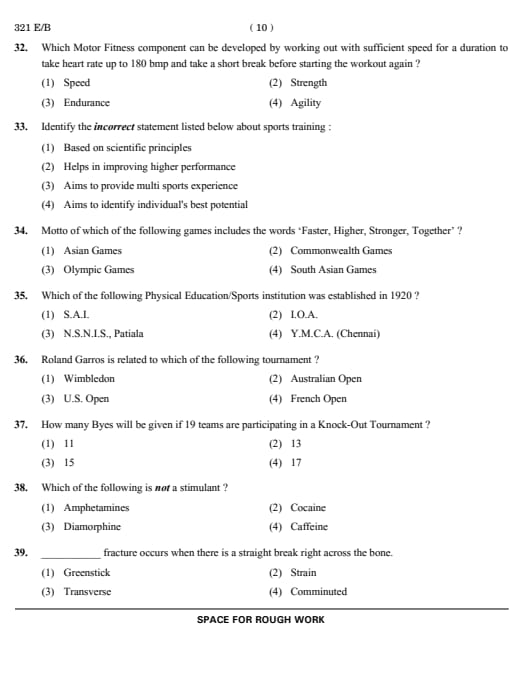
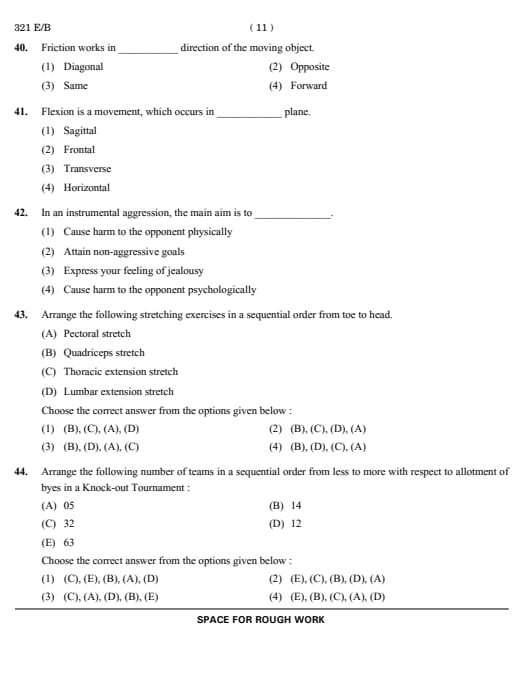
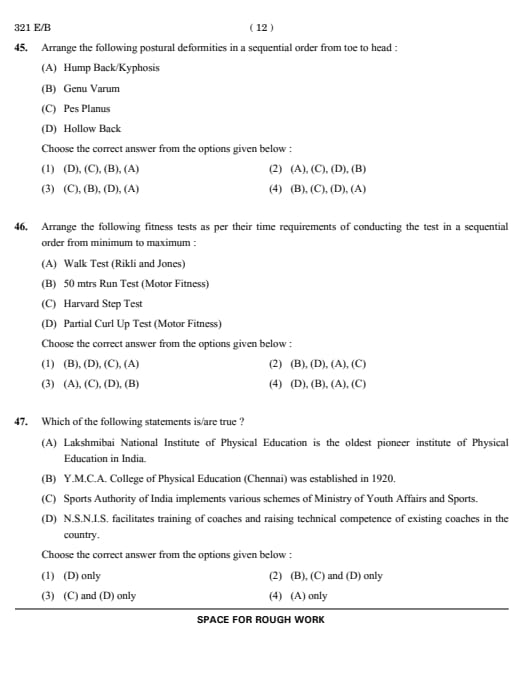
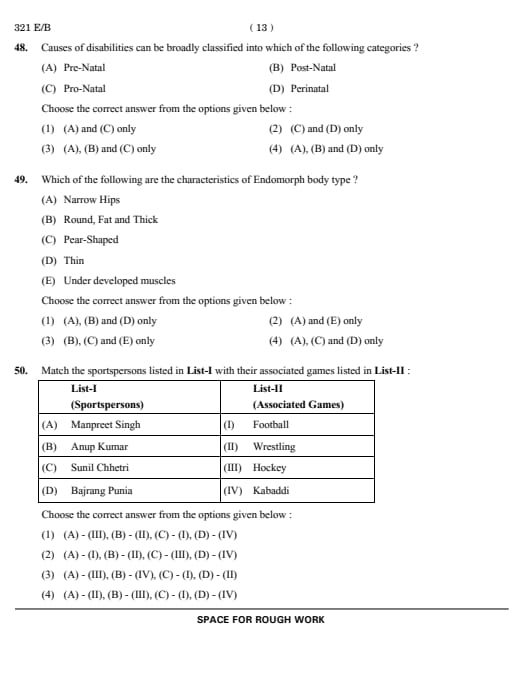
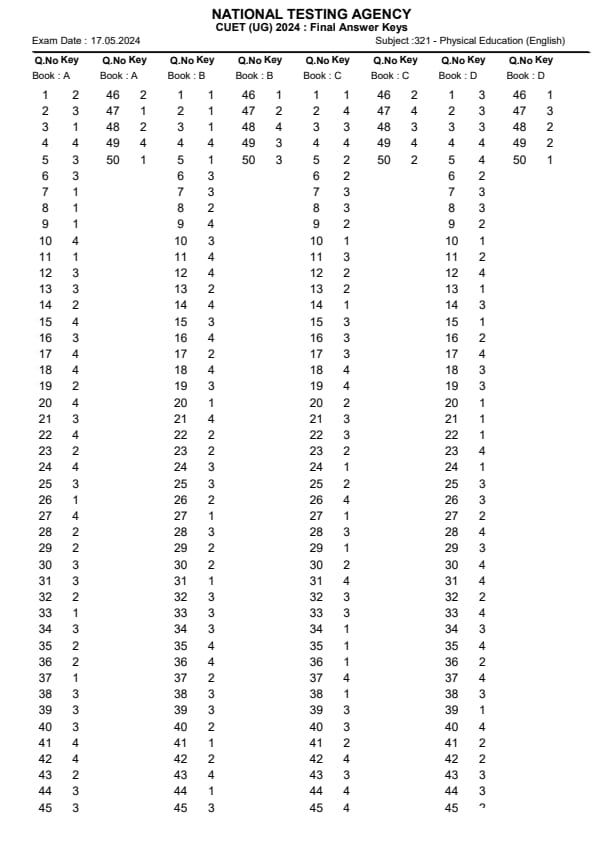

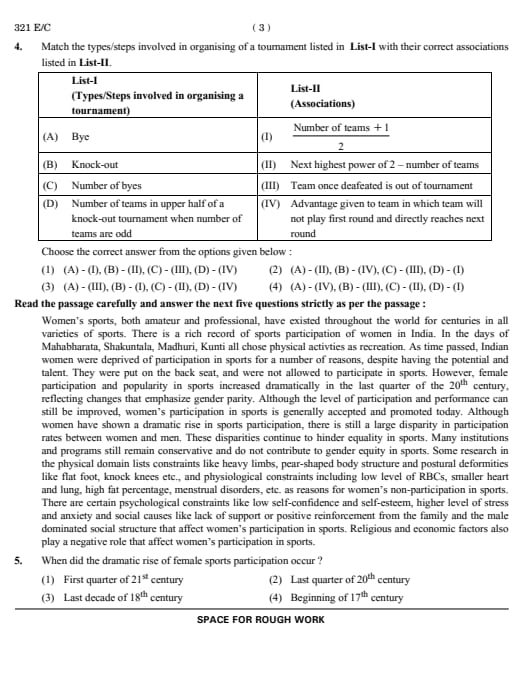
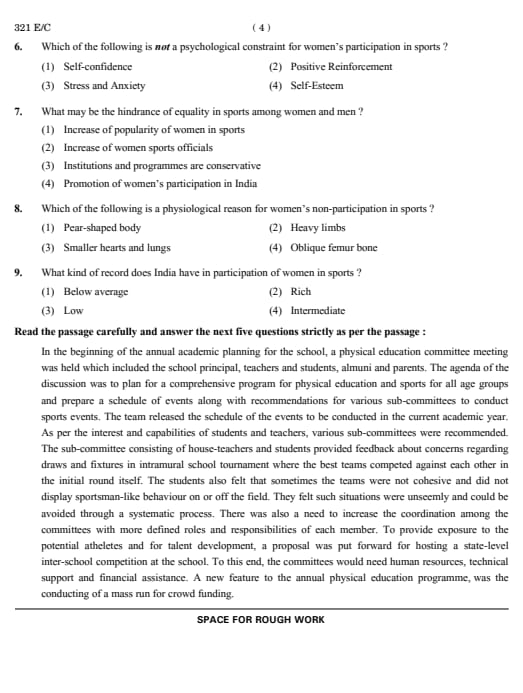
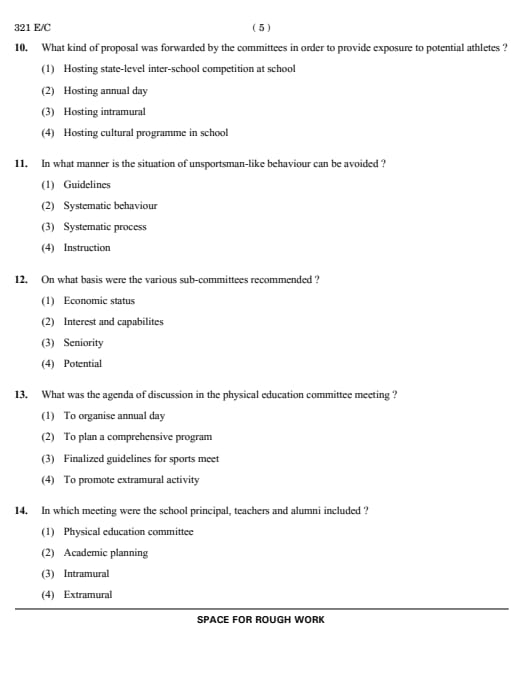
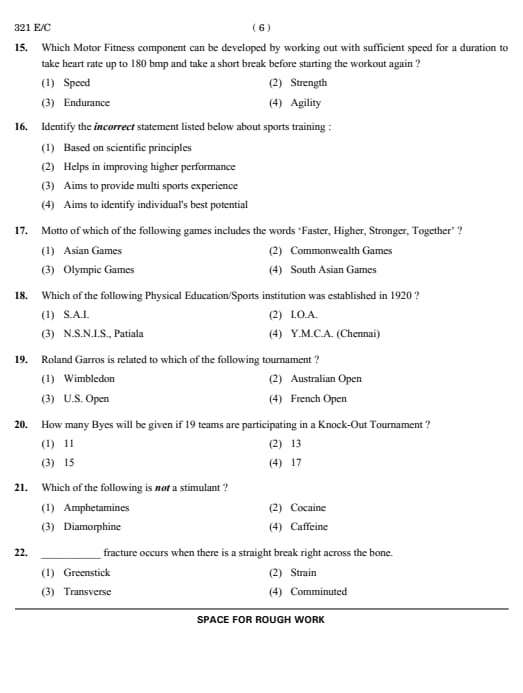
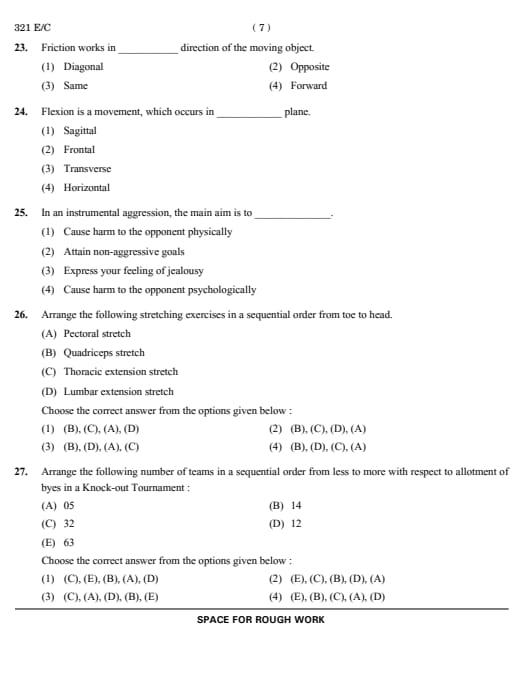
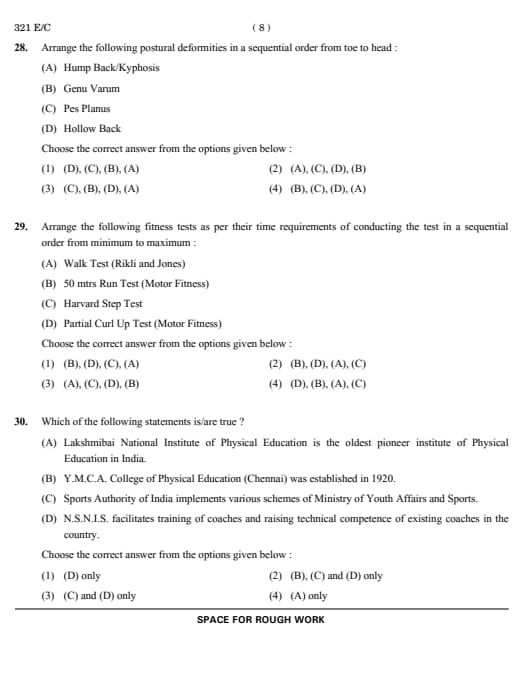
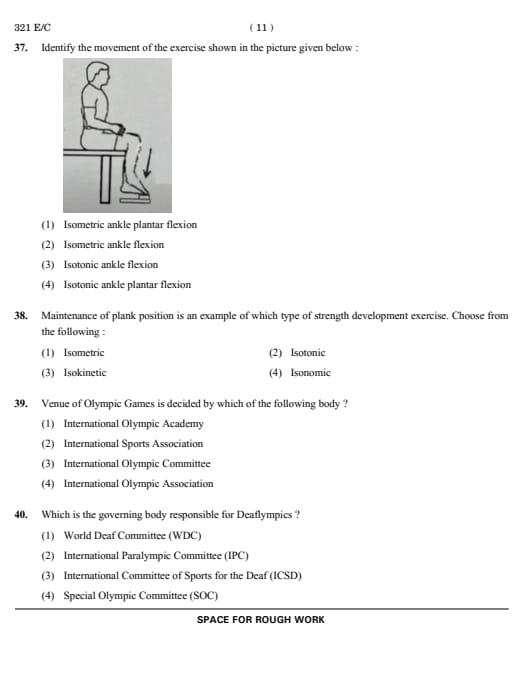
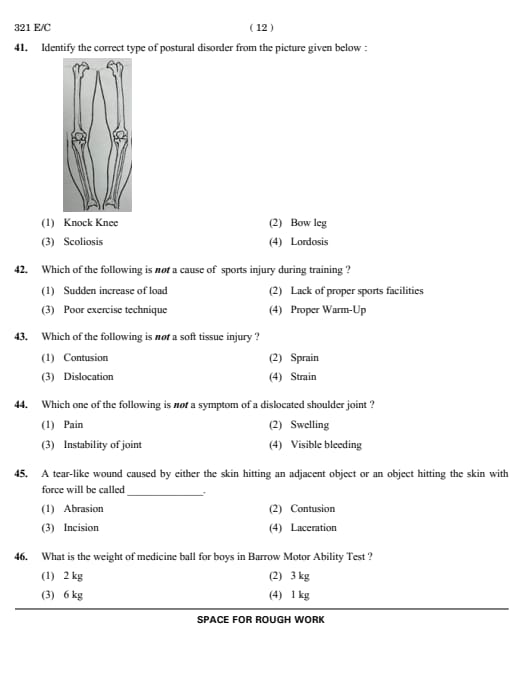
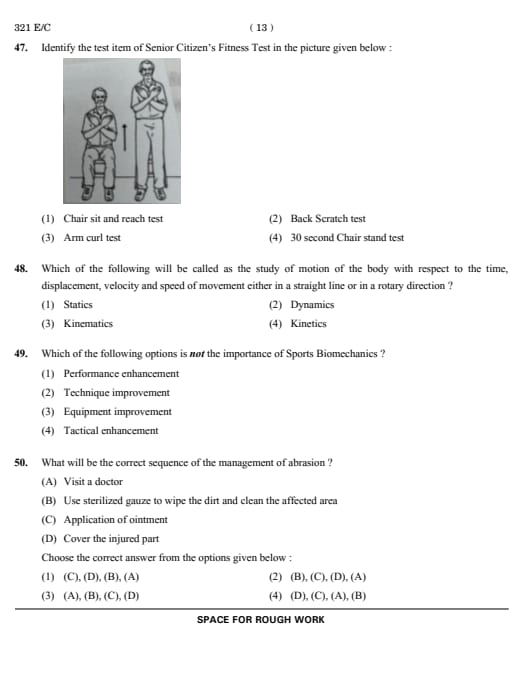
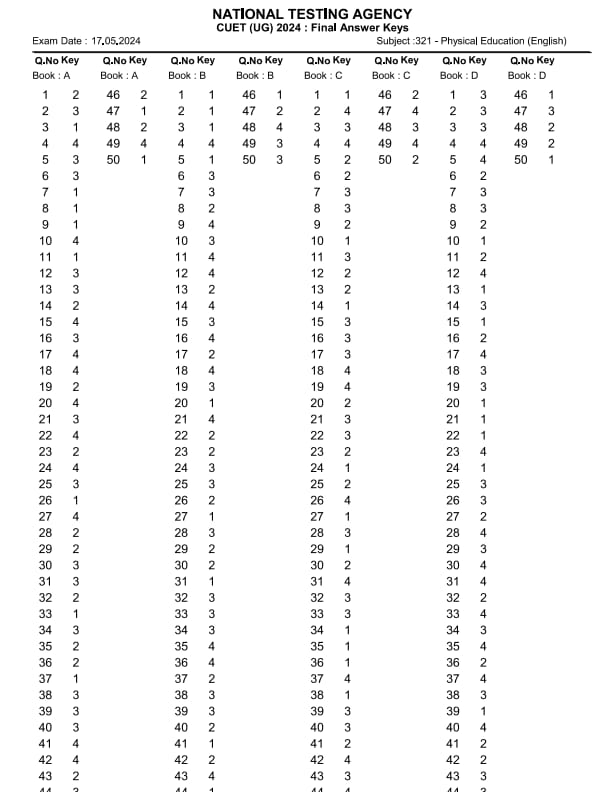


*The article might have information for the previous academic years, please refer the official website of the exam.