
CUET 2024 Question Paper with Answer Key and Solution PDF for Sociology (May 18 - Shift 2)


Content Curator | Updated On - Dec 7, 2024
CUET Question Papers are the most important study material for effective exam preparation. We at Zollege have provided all CUET Previous Year Papers with Solution PDFs here. CUET 2024 Sociology was conducted successfully on May 18 by NTA.
Students can freely download the CUET previous year's question paper PDFs along with their solutions here. We strongly encourage cuet aspirants to scan through all the CUET Question Paper to know the overall difficulty level, CUET Syllabus and understand the changes in CUET Exam Pattern over the years.
CUET 2024 Sociology Question Paper with Solution PDF
| CUET 2024 Sociology Question Paper (SET-A) |  Download Download |
Check Solution |
| CUET 2024 Sociology Question Paper (SET-B) | Download |
Check Solution |
| CUET 2024 Sociology Question Paper (SET-C) | Download |
Check Solution |
| CUET 2024 Sociology Question Paper (SET-D) | Download |
Check Solution |
| CUET 2024 Sociology Online Question Paper | Download |
Check Solution |
CUET 2024 Sociology Question Paper Set-A with Solution
| Question | Answer | Solution |
|
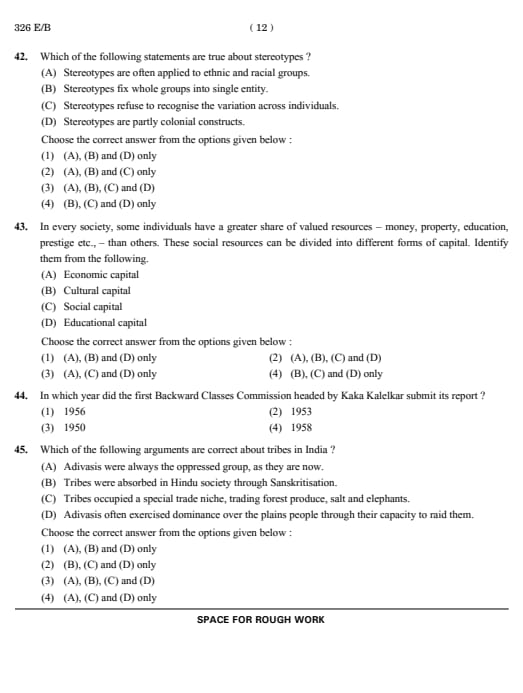
Q1. Which of the following arguments are correct about tribes in India? (A) Adivasis were always the oppressed group, as they are now. Choose the correct answer from the options given below: |
(2) (B), (C) and (D) only | Tribes in India were assimilated into Hindu society through the process of Sanskritization, occupied a special trade niche by trading forest produce, salt, and elephants, and often exercised dominance over the plains people through their raiding capacity. |
|
Q2. In which year did the first Backward Classes Commission headed by Kaka Kalelkar submit its report? (1) 1956 |
(1) 1956 | The first Backward Classes Commission led by Kaka Kalelkar submitted his report in 1956. |
|
Q3. In every society, some individuals have a greater share of valued resources – money, property, education, prestige etc., – than others. These social resources can be divided into different forms of capital. Identify them from the following. (A) Economic capital Choose the correct answer from the options given below: (1) (A), (B) and (D) only |
(2) (A), (B), (C) and (D) | Social resources include economic capital, cultural capital, social capital, and educational capital. |
|
Q4. Which of the following statements are true about stereotypes? (A) Stereotypes are often applied to ethnic and racial groups Choose the correct answer from the options given below: (1) (A), (B) and (D) only |
(3) (A), (B), (C) and (D) | Stereotypes are often applied to ethnic and racial groups, fix whole groups into a single entity, refuse to recognize individual variations, and are partly colonial constructs. |
|
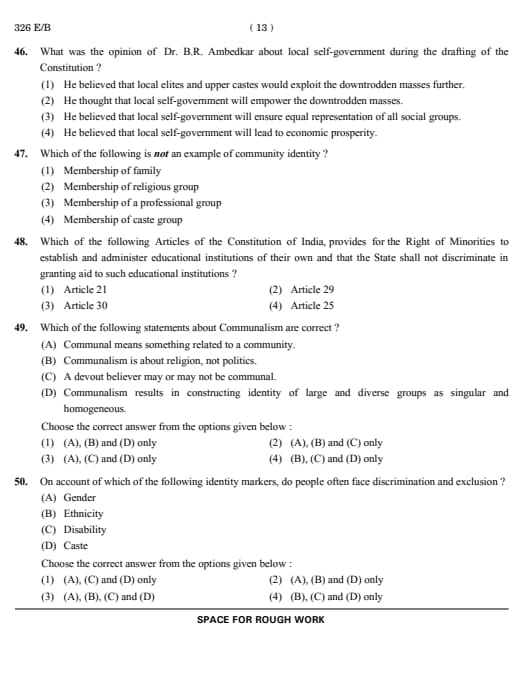
Q5. What was the opinion of Dr. B.R. Ambedkar about local self-government during the drafting of the Constitution? (1) He believed that local elites and upper castes would exploit the downtrodden masses further. |
(1) He believed that local elites and upper castes would exploit the downtrodden masses further. | Dr. B.R. Ambedkar believed that further exploitation of the downtrodden masses would be done by local elites and upper castes if local self-government is given. |
|
Q6. Which of the following is not an example of community identity? (1) Membership of family |
(3) Membership of a professional group | Community identity includes family, religious group, and caste group, however, a professional group is not regarded as community identity. |
|
Q7. Which of the following Articles of the Constitution of India, provides for the Right of Minorities to establish and administer educational institutions of their own and that the State shall not discriminate in granting aid to such educational institutions?\ (1) Article 21 |
(3) Article 30 | Article 30 of the Constitution of India grants the right to minorities to establish and administer educational institutions of their choice and ensures the State shall not discriminate in granting aid to such institutions. |
|
Q8. Which of the following statements about Communalism are correct? (A) Communal means something related to a community. Choose the correct answer from the options given below: |
(3) (A), (C) and (D) only | Communalism refers to something related to a community, a devout believer may or may not be communal, and it leads to building the identity of big and heterogeneous groups as single and monolithic. Communalism involves both religion and politics. |
|
Q9. On account of which of the following identity markers, do people often face discrimination and exclusion? (A) Gender Choose the correct answer from the options given below: |
(3) (A), (B), (C) and (D) | People generally face gender, ethnic, disability, and caste-based discriminations and exclusion. |
|
Q10. Which of the following are true about Gram Sabha in Panchayati Raj? (A) The Gram Sabha collects central taxes from the village. Choose the correct answer from the options given below: |
(4) (B), (C) and (D) only | The Gram Sabha is the entire body of citizens in a village, it is the general body that elects local government, and it participates in the developmental activities of the village level. It does not collect central taxes from the village. |
|
Q11. How did the Supreme Court enhance Fundamental Rights, particularly relating to the Right to Life under Article 21? (1) By restricting individual liberty. |
(3) By expanding the interpretation to include various aspects of a quality life. | The Supreme Court expanded the Fundamental Rights under Article 21 by interpreting it to include various aspects of a quality of life. |
|
Q12. Who amongst the following Sociologists remarked that tribal institutions in themselves need not necessarily be democratic in their structure and functioning? (1) Tiplut Nongbri |
(2) Virginius Xaxa | Virginius Xaxa commented that tribal institutions in themselves need not necessarily be democratic in their structure and functioning. |
|
Q13. Match List-I with List-II. List-I (Dominant Caste)(A) Rajputs(B) Lingayats(C) Jat Sikhs(D) Kammas List-II (Region)(I) Andhra Pradesh(II) Punjab(III) Karnataka(IV) Uttar Pradesh Choose the correct answer from the options given below: (1) (A) - (IV), (B) - (III), (C) - (II), (D) - (I) |
(1) (A) - (IV), (B) - (III), (C) - (II), (D) - (I) | Rajputs are dominant in Uttar Pradesh, Lingayats in Karnataka, Jat Sikhs in Punjab, and Kammas in Andhra Pradesh. |
|
Q14. Who has coined the term 'ethnic democracy'? (1) Michael Mann |
(4) Gavriel Ben-Dor | Gavriel Ben-Dor coined the term 'ethnic democracy'. |
|
Q15. How many seats are currently reserved for Scheduled Castes in the Lok Sabha? (1) 75 |
(2) 84 | Currently, 84 seats in the Lok Sabha are reserved for Scheduled Castes. |
|
Q16. Which of the following is not a religious minority in India? (1) Muslims |
(4) Hindus | Hindus are not a religious minority in India; Muslims, Parsis, and Sikhs are religious minorities. |
|
Q17. What was the number of languages recognised in the Eighth Schedule of the Constitution of India initially? (1) 22 |
(2) 14 | Initially, the Eighth Schedule of the Constitution of India recognized 14 languages. |
|
Q18. Who among the following is the author of the book 'Hind Swaraj'? (1) Jawaharlal Nehru |
(3) Mahatma Gandhi | Mahatma Gandhi authored the book 'Hind Swaraj'. |
|
Q19. Who among the following was associated with the concept of 'dominant caste'? (1) G.S. Ghurye |
(2) M.N. Srinivas | M.N. Srinivas was associated with the concept of 'dominant caste'. |
|
Q20. Which of the following terms were included by the 42nd Amendment of the Constitution in the Preamble of the Constitution? (A) Socialist Choose the correct answer from the options given below: (1) (A) and (C) only |
(2) (A) and (D) only | The terms 'Socialist' and 'Secular' were included in the Preamble by the 42nd Amendment of the Constitution. |
|
Q21. In South Bihar, the locals have a common resentment against migrant traders and moneylenders. What are these migrant groups known as? (1) Nakarattars |
(3) Dikus | In South Bihar, the migrant traders and moneylenders whom the locality resents are called Dikus. |
|
Q22. According to one of the theories of social movements, social conflict arises when a social group feels that it is worse off than others around it. What is this theory known as? (1) Theory of Relative Deprivation |
(1) Theory of Relative Deprivation | Theory of Relative Deprivation According to this theory, social conflict occurs when a group of people perceives that it is worse than the others surrounding it in some respect. |
|
Q23. Which of the following characteristics are associated with the Women's Movement of post-1947? (A) Involvement of women in nation building task Choose the correct answer from the options given below: |
(1) (A), (B) and (D) only | The traits that characterize the post-1947 women's movement are involvement of women in nation building activities, development of independent women's movement, and shift in ideology and strategy of organizations. Not all women face discrimination on the same plane. |
|
Q24. Match List-I with List-II: List-I (Name of Sociologists) List-II (Work) Choose the correct answer from the options given below: |
(3) (A) - (III), (B) - (II), (C) - (I), (D) - (IV) | The correct match is: (A) Nicholas Dirks- Castes of Mind: Colonialism and the Making of Modern India (B) Louis Dumont- Homo-Hierarchicus-The Caste System and its Implications (C) Patricia Uberoi- Family, Kinship and Marriage in India (D) Andre Beteille - The Reproduction of Inequality: Occupation, Caste and Family |
|
Q25. Match the following concepts (List-I) with their appropriate description (List-II): List-I (Concepts) (A) Fertility Rate (B) Total Fertility Rate (C) Infant Mortality Rate (D) Maternal Mortality Rate List-II (Definition) (I) Number of live births per 1000 women in the childbearing age group Choose the correct answer from the options given below: (1) (A) - (I), (B) - (II), (C) - (III), (D) - (IV) |
(3) (A) - (I), (B) - (II), (C) - (IV), (D) - (III) | Right matching is: (A) Fertility Rate - Number of live births per 1000 women in the child bearing age group (B) Total Fertility Rate - Total number of live births a hypothetical woman would have in all her reproductive years (C) Infant Mortality Rate - Deaths of babies under one year of age per 1000 live births (D) Maternal Mortality Rate - Total number of women who die in childbirth per 1000 live births |
|
Q26. The statement "The changes brought about in Indian society and culture as a result of over 150 years of British Rule, the term subsuming changes occurring at different levels...technology, institutions, ideology and values" refers to the process of ________________. Fill in the blank with the correct answer from the options given below: (1) Sanskritisation |
(3) Westernisation | The statement talks about the process of Westernisation that has involved technological changes and associated institutional, ideological, and value changes during the British rule in India. |
|
Q27. In Begum Rokeya Sakhawat’s book ‘‘Sultana’s Dream’’ we find the following excerpt, ‘‘Where are the men ?..., where they ought to be...we shut our men indoors...just as we are kept in the zenana ?’’ What do these lines describe? (1) Double standard imposed by male dominated society |
(3) Reversal of roles of Gender | The lines refer to the reversal of gender roles, as evident in Begum Rokeya Sakhawat's novel 'Sultana's Dream'. |
|
Q28. For which of the following social reasons is the city preferred over village? (A) Decline of common resources in villages Choose the correct answer from the options given below: |
(3) (A), (B), (C) and (D) | The social reasons for preferring the city over the village are decline of common resources in villages, opportunity for earning cash income, sufficient work opportunity, and relative anonymity. |
|
Q29. Which of the following factors was not responsible for unification of India under Colonial rule? (1) Socio-Cultural |
(1) Socio-Cultural | The socio-cultural factors did not help in bringing about India's integration under Colonial rule, though economic, political, and administrative factors did play a crucial role. |
|
Q30. Which of the following factors was not considered significant during industrialisation in independent India? (1) Development of heavy and machine-making industries |
(3) Presence of a large cooperative sector | The presence of a large cooperative sector was not a significant factor during industrialization in independent India, whereas growth in heavy and machine-making industries, expansion of the public sector, and coastal cities for trading purposes are significant. |
|
Q31. In which of the following States is Birhor tribe found? (1) Assam |
(2) Bihar | The Birhor tribe is present in the state of Bihar. |
|
Q32. The term ‘‘prejudice’’ refers to ________________. Fill in the blank with the correct answer from the options given below: (1) Community identity |
(3) Pre-judgement | The term 'prejudice' refers to pre-judgement, which means forming an opinion without adequate knowledge or evidence. |
|
Q33. Which of the following leaders is not associated with AITUC? (1) M.N. Roy |
(4) Jayprakash Narayan | Jayprakash Narayan is not among those who have affiliations with AITUC, but M.N. Roy, S.A. Dange, and V.V. Giri has an affinity with it. |
|
Q34. What does the term ‘liberalization’ in economic context mean? (1) Lessening of government rules and regulations |
(1) Lessening of government rules and regulations | Liberalization in the economic sphere means loosening government rules and regulations on economic activities. |
|
Q35. Fill in the blank in the following statement with the correct answer: The approach which emphasizes the mutual interdependence of the individual and society is known as ________________. (1) Hermeneutical Approach |
(4) Structuralist Approach | The approach stressing the reciprocal reliance of individual and society is called the Structuralist Approach. |
|
Q36. The term ‘Age Structure’ refers to the proportion of persons ________________. (1) In different age groups relative to total population |
(1) In different age groups relative to total population | Age Structure' refers to the percentage of people in various age categories compared to the entire population. |
|
Q37. Which of the following organizations is associated with women's issues? (1) Tata Steel |
(3) SEWA | SEWA (Self-Employed Women's Association) is a body dedicated to women's concerns. |
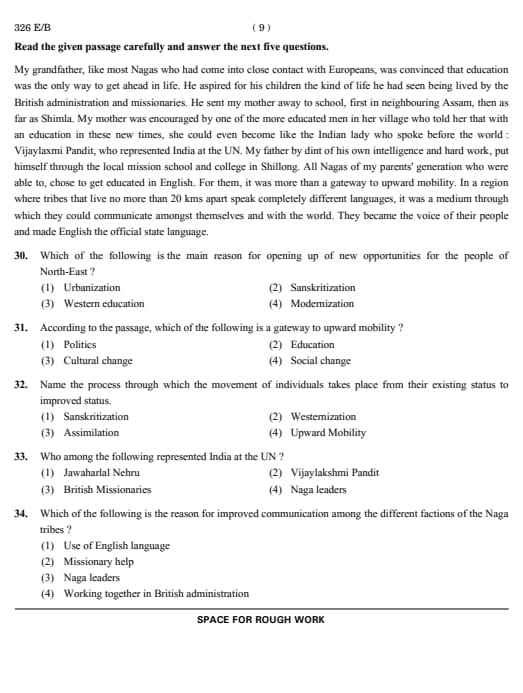
| Q38. Which of the following thinkers is not associated with the concept of ‘‘Structural Functionalism’’? (1) Emile Durkheim (2) Talcott Parsons (3) Robert K. Merton (4) Karl Marx |
(4) Karl Marx | Karl Marx is not tied to 'Structural Functionalism', but Emile Durkheim, Talcott Parsons, and Robert K. Merton are. |
|
Q39. Who among the following thinkers emphasizes the role of ‘power’ in society? (1) Herbert Spencer |
(3) Max Weber | Max Weber highlights 'power's' function in society. |
|
Q40. The largest religious minority in India is ________________. (1) Jains |
(2) Muslims | The biggest religious minority in India are Muslims. |
|
Q41. Name the process through which the movement of individuals takes place from their existing status to improved status. (1) Sanskritization |
(4) Upward Mobility | The movement of people from their existing status to improved status occurs in a process called upward mobility. |
|
Q42. Who among the following represented India at the UN? (1) Jawaharlal Nehru |
(2) Vijaylakshmi Pandit | Vijaylakshmi Pandit was India's representative to the United Nations. |
|
Q43. Which of the following is the reason for improved communication among the different factions of the Naga tribes? (1) Use of English language |
(1) Use of English language | The use of the English language improved communication among the different factions of the Naga tribes. |
|
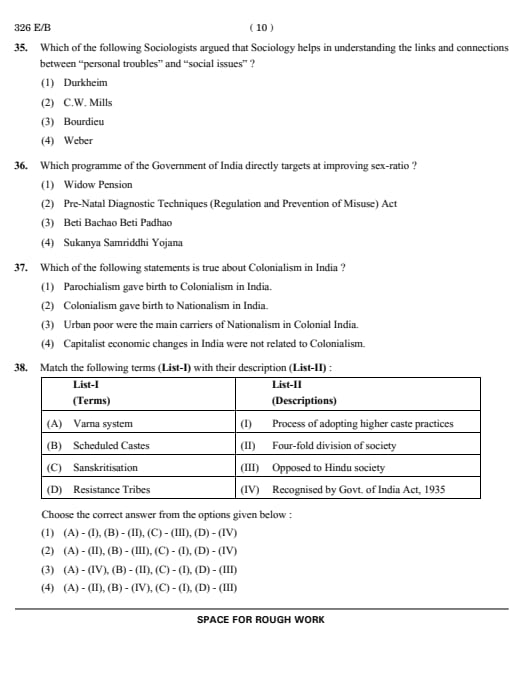
Q44. Which of the following Sociologists argued that Sociology helps in understanding the links and connections between “personal troubles” and “social issues”? (1) Durkheim |
(2) C.W. Mills | C.W. Mills argued that sociology helps in understanding the links and connections between "personal troubles" and "social issues." |
|
Q45. Which programme of the Government of India directly targets at improving sex-ratio? (1) Widow Pension |
(3) Beti Bachao Beti Padhao | The Beti Bachao Beti Padhao scheme of the Government of India directly aims for betterment in the female-male ratio. |
|
Q46. Which of the following statements is true about Colonialism in India? (1) Parochialism gave birth to Colonialism in India. |
(2) Colonialism gave birth to Nationalism in India. | Colonialism gave rise to Nationalism in India as it united people against a foreign oppressor. |
|
Q47. Match the following terms (List-I) with their description (List-II): List-I (Terms) List-II (Descriptions) Choose the correct answer from the options given below: (1) (A) - (I), (B) - (II), (C) - (III), (D) - (IV) |
(4) (A) - (II), (B) - (IV), (C) - (I), (D) - (III) | The correct match is: (A) Varna system - Four-fold division of society (B) Scheduled Castes - Recognised by Govt. of India Act, 1935 (C) Sanskritisation - Process of adopting higher caste practices (D) Resistance Tribes - Opposed to Hindu society |
|
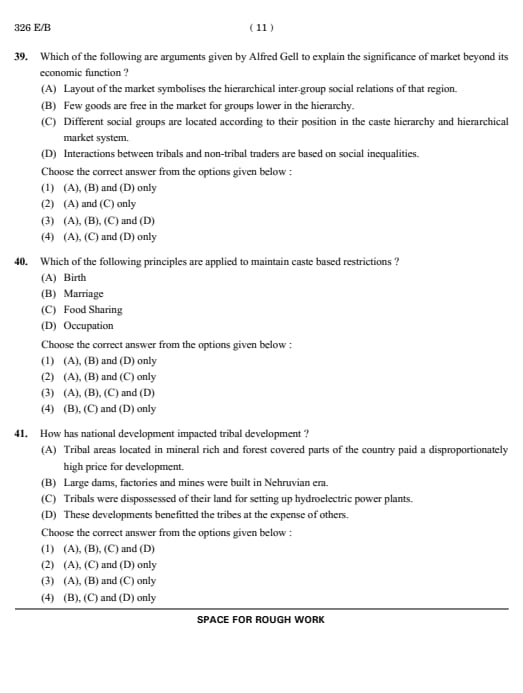
Q48. Which of the following are arguments given by Alfred Gell to explain the significance of the market beyond its economic function? (A) Layout of the market symbolises the hierarchical inter-group social relations of that region. \Choose the correct answer from the options given below: |
(4) (A), (C) and (D) only | The reasons why the market is important and goes beyond its economic function are: According to Alfred Gell, the layout of the market symbolizes the hierarchical intergroup social relations of that region. Different social groups are located according to their position in the caste hierarchy and hierarchical market system. Tribal and non-tribal trade is based on social inequalities. |
|
Q49. Which of the following principles are applied to maintain caste-based restrictions? (A) Birth Choose the correct answer from the options given below: (1) (A), (B) and (D) only |
(3) (A), (B), (C) and (D) | The principles applied to maintain caste-based restrictions include birth, marriage, food sharing, and occupation. |
|
Q50. How has national development impacted tribal development? (A) Tribal areas located in mineral-rich and forest-covered parts of the country paid a disproportionately high price for development. Choose the correct answer from the options given below: |
(3) (A), (B) and (C) only | National development affected tribal development by making the tribal areas present in mineral-rich and forest-covered parts of the country bear a disproportionately heavy price for development, building large dams, factories, and mines during the Nehruvian era, and dispossessing tribals of their land for setting up hydroelectric power plants. All these developments were not done at the cost of others for the benefit of the tribes. |
CUET 2024 Sociology Question Paper (Set-B) with Solution
| Question | Answer | Detailed Solution |
|---|---|---|
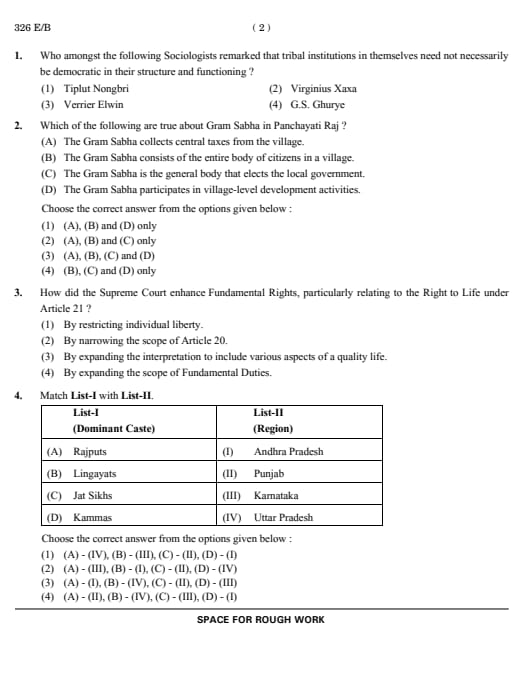
| Question 1: Who among the following Sociologists remarked that tribal institutions in themselves need not necessarily be democratic in their structure and functioning? (1) Tiplut Nongbri (2) Verrier Elwin (3) Virginius Xaxa (4) G.S. Ghurye |
(2) Verrier Elwin | Verrier Elwin highlighted the diversity and complexity of tribal governance, noting that democratic structures aren't guaranteed. |
| Question 2: Which of the following are true about Gram Sabha in Panchayati Raj? (A) The Gram Sabha collects central taxes from the village. (B) The Gram Sabha consists of the entire body of citizens in a village. (C) The Gram Sabha is the general body that elects the local government. (D) The Gram Sabha participates in village-level development activities. |
(B), (C), and (D) only | The Gram Sabha comprises all village citizens, elects the local government, and participates in development; it does *not* collect central taxes. |
| Question 3: How did the Supreme Court enhance Fundamental Rights, particularly relating to the Right to Life under Article 21? (1) By restricting individual liberty. (2) By narrowing the scope of Article 20. (3) By expanding the interpretation to include various aspects of a quality life. (4) By expanding the scope of Fundamental Duties. |
(3) By expanding the interpretation to include various aspects of a quality life. | The Supreme Court broadened the interpretation of Article 21's Right to Life to encompass various aspects of a quality life. |
| Question 4: Match List-I with List-II: List-I (Dominant Caste): (A) Rajputs, (B) Lingayats, (C) Jat Sikhs, (D) Kammas List-II (Region): (I) Andhra Pradesh, (II) Punjab, (III) Karnataka, (IV) Uttar Pradesh |
(A) - (IV), (B) - (III), (C) - (II), (D) - (I) | The correct matches are based on the dominant caste's geographical presence in India: Rajputs (Uttar Pradesh), Lingayats (Karnataka), Jat Sikhs (Punjab), and Kammas (Andhra Pradesh). |
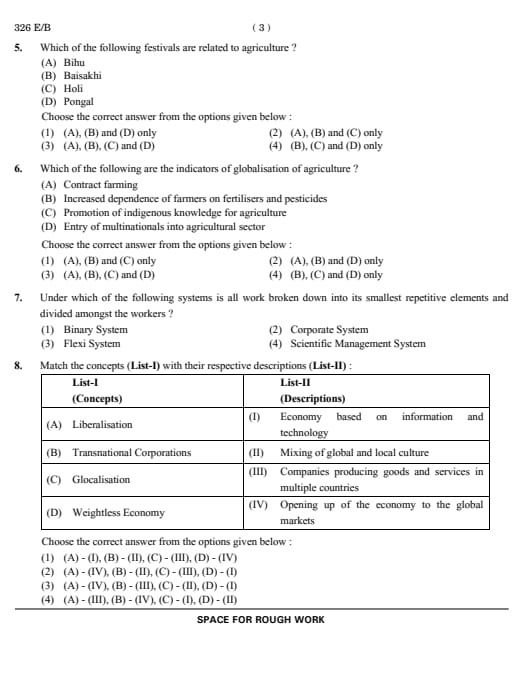
| Question 5: Which of the following festivals are related to agriculture? (A) Bihu (B) Baisakhi (C) Holi (D) Pongal |
(A), (B), and (D) only | Bihu, Baisakhi, and Pongal are agricultural festivals; Holi is a spring festival not directly tied to agriculture. |
| Question 6: Which of the following are the indicators of globalization of agriculture? (A) Contract farming (B) Increased dependence of farmers on fertilizers and pesticides (C) Promotion of indigenous knowledge for agriculture (D) Entry of multinationals into the agricultural sector |
(A), (B), and (D) only | Contract farming, increased dependence on fertilizers/pesticides, and multinational entry are indicators of agricultural globalization. Promotion of indigenous knowledge is not a direct indicator. |
| Question 7: Under which of the following systems is all work broken down into its smallest repetitive elements and divided among the workers? 1. Binary System 2. Corporate System 3. Flexi System |
1. Binary System | The Binary System describes a work system where tasks are broken down into the smallest repetitive elements and divided among workers for efficiency. |
| Question 8: Match the concepts (List-I) with their respective descriptions (List-II): List-I (Concepts): (A) Liberalisation, (B) Transnational Corporations, (C) Glocalisation, (D) Weightless Economy List-II (Descriptions): (I) Economy based on information and technology, (II) Mixing of global and local culture, (III) Companies producing goods and services in multiple countries, (IV) Opening up of the economy to the global markets |
(A) - (IV), (B) - (III), (C) - (II), (D) - (I) | The matches reflect the definitions of each concept in economics and globalization. |
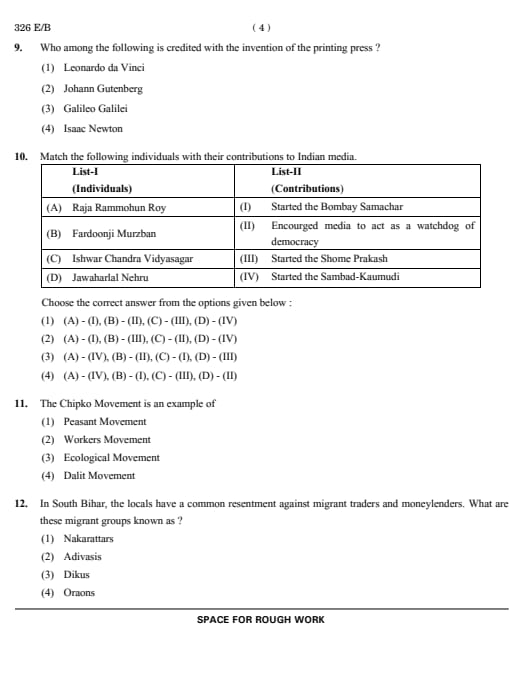
| Question 9: Who among the following is credited with the invention of the printing press? 1. Leonardo da Vinci 2. Johann Gutenberg 3. Galileo Galilei 4. Isaac Newton |
2. Johann Gutenberg | Johann Gutenberg is credited with inventing the printing press around 1440. |
| Question 10: Match the following individuals with their contributions to Indian media: List-I (Individuals): (A) Raja Rammohun Roy, (B) Fardoongi Murzban, (C) Ishwar Chandra Vidyasagar, (D) Jawaharlal Nehru List-II (Contributions): (I) Started the Bombay Samachar, (II) Encouraged media to act as a watchdog of democracy, (III) Started the Shome Prakash, (IV) Started the Sambad-Kaumudi |
(A) - (I), (B) - (IV), (C) - (III), (D) - (II) | The matches link the individuals to their respective contributions to the development of Indian media. |
| Question 11: The Chipko Movement is an example of: 1. Peasant Movement 2. Workers Movement 3. Ecological Movement 4. Dalit Movement |
3. Ecological Movement | The Chipko Movement is primarily known for its focus on forest conservation and environmental protection. |
| Question 12: In South Bihar, the locals have a common resentment against migrant traders and moneylenders. What are these migrant groups known as? 1. Nakaratars 2. Adivasis 3. Dikus 4. Orans |
3. Dikus | In South Bihar, the term "Dikus" is used to refer to migrant traders and moneylenders. |
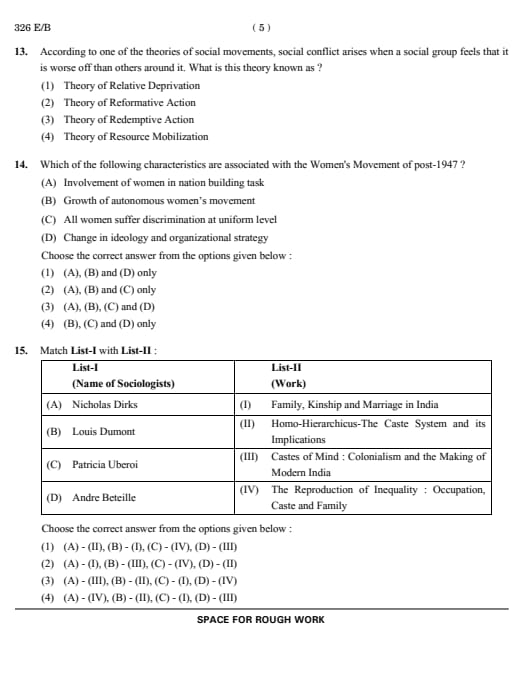
| Question 13: According to one of the theories of social movements, social conflict arises when a social group feels that it is worse off than others around it. What is this theory known as? 1. Theory of Relative Deprivation 2. Theory of Reformative Action 3. Theory of Redemptive Action 4. Theory of Resource Mobilization |
1. Theory of Relative Deprivation | The Theory of Relative Deprivation explains social conflict arising from a group's perception of being worse off than others. |
| Question 14: Which of the following characteristics are associated with the Women's Movement of post-1947? (A) Involvement of women in nation-building tasks (B) Growth of autonomous women's movements (C) All women suffer discrimination at a uniform level (D) Change in ideology and organizational strategy |
(A), (B), and (D) only | The post-1947 Women's Movement involved women in nation-building, saw the growth of autonomous movements, and involved changes in ideology and strategies. (C) is incorrect as discrimination varies. |
| Question 15: Match List-I with List-II: List-I (Names of Sociologists): (A) Nicholas Dirks, (B) Louis Dumont, (C) Patricia Uberoi, (D) Andre Beteille List-II (Work): (I) Family, Kinship and Marriage in India, (II) Homo-Hierarchicus: The Caste System and its Implications, (III) Castes of Mind: Colonialism and the Making of Modern India, (IV) The Reproduction of Inequality: Occupation, Caste and Family |
(A) - (II), (B) - (I), (C) - (III), (D) - (IV) | The matches link each sociologist to their known works in sociology. |
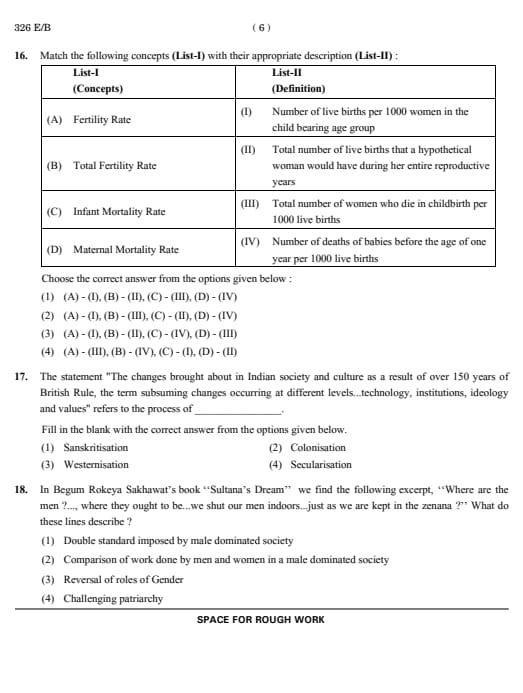
| Question 16: Match the following concepts (List-I) with their appropriate description (List-II): List-I (Concepts): (A) Fertility Rate, (B) Total Fertility Rate, (C) Infant Mortality Rate, (D) Maternal Mortality Rate List-II (Definition): (I) Number of live births per 1000 women in the child-bearing age group, (II) Total number of live births that a hypothetical woman would have during her entire reproductive years, (III) Total number of women who die in childbirth per 1000 live births, (IV) Number of deaths of babies before the age of one year per 1000 live births |
(A) - (I), (B) - (II), (C) - (IV), (D) - (III) | The correct matches link each demographic concept to its definition. |
| Question 17: The statement “The changes brought about in Indian society and culture as a result of over 150 years of British Rule, has been the surrounding changes occurring at different levels…technology, institutions, ideology, and values” refers to the process of: 1. Sanskritization 2. Colonization 3. Globalization 4. Modernization |
2. Colonization | The statement describes the profound and multifaceted impact of British colonial rule on Indian society and culture. |
| Question 18: In Begum Rokeya Sakhawat's book “Sultana's Dream,” we find the following excerpt, “Where are the men?...where they ought to be...with our men indoors...just as we are kept in the zenana?” What do these lines describe? 1. Comparison of work done by men and women in a male-dominated society 2. The traditional roles of men in a male-dominated society 3. Challenging patriarchy |
1. Comparison of work done by men and women in a male-dominated society | The excerpt highlights the gendered division of labor and the confinement of women in a patriarchal society. |
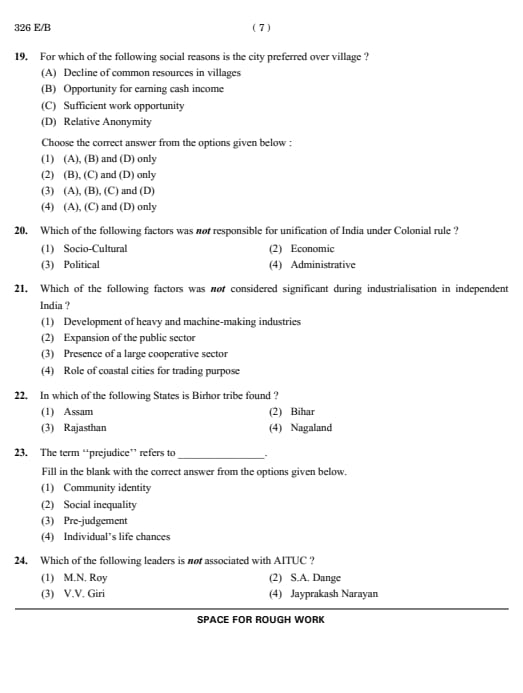
| Question 19: For which of the following social reasons is the city preferred over village? (A) Decline of common resources in villages (B) Opportunity for earning cash income (C) Sufficient work opportunity (D) Relative Anonymity |
(A), (B), (C), and (D) | All options represent social reasons why cities are preferred over villages. |
| Question 20: Which of the following factors was not responsible for unification of India under Colonial rule? 1. Socio-Cultural 2. Economic 3. Political 4. Administrative |
1. Socio-Cultural | While socio-cultural factors played a role, the primary drivers of unification were economic, political, and administrative measures implemented by the colonial government. |
| Question 21: Which of the following factors was not considered significant during industrialisation in independent India? 1. Development of heavy and machine-making industries 2. Expansion of the public sector 3. Presence of a large cooperative sector 4. Role of coastal cities for trading purposes |
3. Presence of a large cooperative sector | The focus of industrialization in independent India was on heavy industries and the public sector, not the cooperative sector. |
| Question 22: In which of the following States is the Birhor tribe found? 1. Assam 2. Bihar 3. Rajasthan 4. Nagaland |
2. Bihar | The Birhor tribe is primarily located in Bihar, India. |
| Question 23: The term “prejudice” refers to: 1. Gender identity 2. Social inequality 3. Pre-judgement 4. Individual’s life chances |
3. Pre-judgement | Prejudice primarily refers to pre-judgment, which often leads to biased attitudes. |
| Question 24: Which of the following leaders is not associated with AITUC? 1. M.N. Roy 2. S.A. Dange 3. V.V. Giri 4. Jayaprakash Narayan |
4. Jayaprakash Narayan | Jayaprakash Narayan was more involved in the socialist movement and politics than in trade unions. |
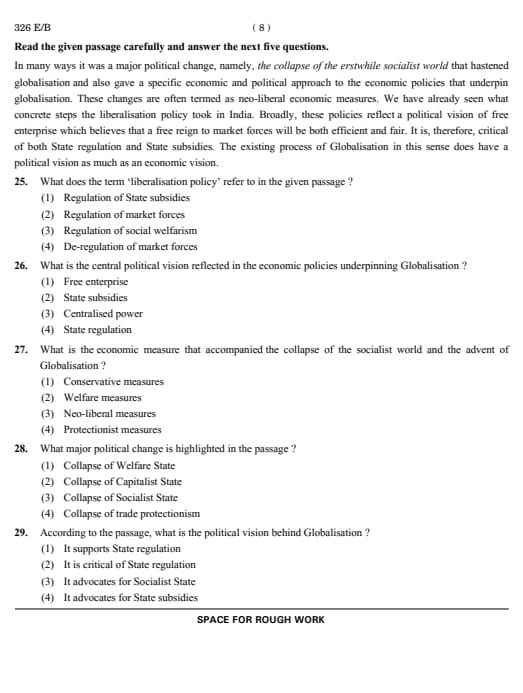
| Question 25: What does the term ‘liberalisation policy’ refer to in the given passage? *(This question references a passage about globalization and economic policy)* 1. Regulation of State subsidies 2. Regulation of market forces 3. Regulation of social welfare 4. De-regulation of market forces |
4. De-regulation of market forces | The passage defines liberalization policy as the de-regulation of market forces, allowing free reign to market dynamics. |
| Question 26: What is the central political vision reflected in the economic policies underpinning Globalization? 1. Free enterprises 2. State subsidies 3. Centralised power 4. State regulation |
1. Free enterprises | The central political vision is that of free enterprises, minimizing state intervention in the market. |
| Question 27: What is the economic measure that accompanied the collapse of the socialist world and the advent of Globalization? 1. Conservative measures 2. Welfare measures 3. Neo-liberal measures 4. Protectionist measures |
3. Neo-liberal measures | The collapse of the socialist world and the rise of globalization were accompanied by neo-liberal economic measures emphasizing free markets and reduced state intervention. |
| Question 28: What major political change is highlighted in the passage? *(This question references a passage about globalization and economic policy)* 1. Collapse of Socialist State 2. Collapse of Capitalist State 3. Collapse of Mixed Economy 4. Collapse of trade protectionism |
1. Collapse of Socialist State | The passage emphasizes the collapse of the socialist state as a major political change that facilitated globalization. |
| Question 29: According to the passage, what is the political vision behind Globalization? *(This question references a passage about globalization and economic policy)* 1. It supports State regulation 2. It challenges State regulation 3. It advocates for a Socialist State 4. It advocates for State subsidies |
2. It challenges State regulation | The passage indicates that globalization's political vision challenges state regulation in favor of market-driven approaches. |
| Question 30: Which of the following is the main reason for opening up of new opportunities for the people of North-East? *(This question references a passage about the impact of Western education on the lives of people in Northeast India)* 1. Urbanization 2. Western education 3. Sanskritization 4. Modernization |
2. Western education | The passage explicitly states that Western education was the primary catalyst for opening up new opportunities for people in Northeast India. |
| Question 31: According to the passage, which of the following is a gateway to upward mobility? *(This question references a passage about the impact of Western education on the lives of people in Northeast India)* 1. Politics 2. Education 3. Social change 4. Cultural change |
2. Education | The passage highlights Western education as a key means of upward mobility for people in the Northeast. |
| Question 32: Name the process through which the movement of individuals takes place from their existing status to improved status. 1. Sanskritization 2. Westernization 3. Assimilation 4. Upward Mobility |
4. Upward Mobility | Upward mobility refers to the movement of individuals from a lower to a higher social status. |
| Question 33: Who among the following represented India at the UN? *(This question references a passage about the impact of Western education on the lives of people in Northeast India)* 1. Jawaharlal Nehru 2. Vijaylakshmi Pandit 3. British Missionaries 4. Indian Officials |
2. Vijaylakshmi Pandit | The passage mentions Vijaylakshmi Pandit as an example of an Indian woman who achieved international recognition through education and represented India at the UN. |
| Question 34: Which of the following is the reason for improved communication among the different factions of the Naga tribes? *(This question references a passage about the impact of Western education on the lives of people in Northeast India)* 1. Use of English language 2. Strong leaders 3. Naga leaders 4. Working together in British administration |
1. Use of English language | The passage highlights English as a common language that facilitated communication among diverse Naga tribes. |
| Question 35: Which of the following Sociologists argued that Sociology helps in understanding the links and connections between “personal troubles” and “social issues”? 1. Durkheim 2. C.W. Mills 3. Bourdieu 4. Weber |
2. C.W. Mills | C. Wright Mills is known for his concept of the "sociological imagination," which connects personal experiences to broader social issues. |
| Question 36: Which programme of the Government of India directly targets improving sex-ratio? 1. Widow Pension 2. Pre-Natal Diagnostic Techniques (Regulation and Prevention of Misuse) Act 3. Beti Bachao Beti Padhao 4. Sukanya Samriddhi Yojana |
3. Beti Bachao Beti Padhao | The Beti Bachao Beti Padhao scheme specifically aims to improve the sex ratio by promoting girls' education and empowerment. |
| Question 37: Which of the following statements is true about Colonialism in India? 1. Parochialism gave birth to Colonialism in India. 2. Colonialism gave birth to Nationalism in India. 3. Urban poor were the main carriers of Nationalism in Colonial India. 4. Capitalist economic changes in India were not related to Colonialism. |
2. Colonialism gave birth to Nationalism in India. | Colonial rule in India led to the rise of nationalist movements and sentiments. |
| Question 38: Match the following terms (List-I) with their description (List-II): List-I (Terms): (A) Varna system, (B) Scheduled Castes, (C) Sanskritization, (D) Resistance Tribes List-II (Descriptions): (I) Process of adopting higher caste practices, (II) Four-fold division of society, (III) Opposed to Hindu society, (IV) Recognized by Govt. of India Act, 1935 |
(A) - (II), (B) - (IV), (C) - (I), (D) - (III) | This question requires matching terms related to Indian social structure with their descriptions. |
| Question 39: Which of the following are arguments given by Alfred Gell to explain the significance of market beyond its economic function? (A) Layout of the market symbolizes the hierarchical inter-group social relations of that region. (B) Few goods are free in the market for groups lower in the hierarchy. (C) Different social groups are located according to their position in the caste hierarchy and hierarchical market system. (D) Interactions between tribals and non-tribal traders are based on social inequalities. |
(A), (B), (C), and (D) | Alfred Gell's arguments highlight the social and hierarchical aspects of markets beyond their purely economic functions. |
| Question 40: Which of the following principles are applied to maintain caste-based restrictions? (A) Birth (B) Marriage (C) Food Sharing (D) Occupation |
(A), (B), (C), and (D) | All four principles play a significant role in maintaining caste-based restrictions in India's social structure. |
| Question 41: How has national development impacted tribal development? (A) Tribal areas located in mineral-rich and forest-covered parts of the country paid a disproportionately high price for development. (B) Large dams, factories, and mines were built in the Nehruvian era. (C) Tribals were dispossessed of their land for setting up hydropower projects. (D) These developments benefited the tribes at the expense of others. |
(A), (B), (C) only | Options A, B, and C highlight the negative impacts of national development on tribal communities, showing dispossession and inequality. Option D is incorrect as it states the opposite. |
| Question 42: Which of the following statements are true about stereotypes? 1. Stereotypes are often applied to ethnic and racial groups. 2. Stereotypes fix whole groups into a single entity. 3. Stereotypes serve to reproduce the variation across individuals. 4. Stereotypes are partly colonial constructs. |
(A), (B), and (D) only | Statements A, B, and D accurately describe stereotypes. Statement C is incorrect; stereotypes *reduce* variation, not reproduce it. |
| Question 43: In every society, some individuals have a greater share of valued resources—money, property, education, prestige, etc., than others. These social resources can be divided into different forms of capital. Identify them from the following. (A) Economic capital (B) Cultural capital (C) Social capital (D) Educational capital |
(A), (B), (C), and (D) | All options represent forms of social capital recognized in sociology. |
| Question 44: In which year did the first Backward Classes Commission headed by Kaka Kalelkar submit its report? 1. 1956 2. 1953 3. 1950 4. 1958 |
1. 1956 | The first Backward Classes Commission submitted its report in 1956. |
| Question 45: Which of the following arguments are correct about tribes in India? (A) Adivasis were always the oppressed group, as they are now. (B) Tribes were absorbed into Hindu society through Sanskritization. (C) Tribes occupied a special trade niche, trading forest produce, salt, and elephants. (D) Adivasis often exercised dominance over the plains people through their capacity to raid them. |
(A), (B), (C), and (D) | All statements provide valid arguments about the historical and social experiences of Adivasi tribes in India. |
| Question 46: What was the opinion of Dr. B.R. Ambedkar about local self-government during the drafting of the Constitution? (1) He believed that local elites and upper castes would exploit the downtrodden masses further. (2) He thought that local self-government would empower the downtrodden masses. (3) He believed that local self-government would ensure equal representation of all social groups. (4) He believed that local self-government would lead to economic prosperity. |
(1) He believed that local elites and upper castes would exploit the downtrodden masses further. | Ambedkar expressed concern that local self-government might lead to further exploitation of the downtrodden. |
| Question 47: Which of the following is not an example of community identity? (1) Membership of family (2) Membership of religious group (3) Membership of a professional group (4) Membership of caste group |
(3) Membership of a professional group | Membership in a professional group doesn't typically reflect community identity in the same way as family, religion, or caste. |
| Question 48: Which of the following Articles of the Constitution of India provides for the Right of Minorities to establish and administer educational institutions of their own and that the State shall not discriminate in granting aid to such educational institutions? (1) Article 21 (2) Article 29 (3) Article 30 (4) Article 25 |
(3) Article 30 | Article 30 of the Indian Constitution addresses the rights of minorities to establish and administer educational institutions and ensures non-discriminatory aid. |
| Question 49: Which of the following statements about Communalism are correct? (A) Communalism means something related to a community. (B) Communalism is about religion, not politics. (C) A devout believer may or may not be communal. (D) Communalism results in constructing identity of large and diverse groups as singular and homogeneous. |
(A), (C), and (D) only | Statement B is incorrect; communalism can intersect with politics. A, C, and D are accurate descriptions. |
| Question 50: On account of which of the following identity markers, do people often face discrimination and exclusion? (1) Gender (2) Ethnicity (3) Class (4) Caste |
(A), (B), (C), and (D) | All listed identity markers can lead to discrimination and exclusion. |
CUET Sociology Question Paper with Solution
| Question | Answer | Detailed Solution | ||
|---|---|---|---|---|
| Question 1: The Chipko Movement is an example of: 1. Peasant Movement 2. Workers Movement 3. Ecological Movement 4. Dalit Movement |
3. Ecological Movement | The Chipko movement primarily focused on forest conservation. | ||
| Question 2: Match the following individuals with their contributions to Indian media: List-I (Individuals) (A) Raja Rammohun Roy (B) Fardoonji Murzban (C) Ishwar Chandra Vidyasagar (D) Jawaharlal Nehru List-II (Contributions) (I) Started the Bombay Samachar (II) Encouraged media to act as a watchdog of democracy (III) Started the Shome Prakash (IV) Started the Sambad-Kaumudi |
A-(IV), B-(I), C-(III), D-(II) | Match the individuals with their contributions to Indian media. | ||
| Question 3: Who among the following is credited with the invention of the printing press? 1. Leonardo da Vinci 2. Johann Gutenberg 3. Galileo Galilei 4. Isaac Newton |
2. Johann Gutenberg | Johann Gutenberg is credited with the invention of the printing press. | ||
| Question 4: In South Bihar, the locals have a common resentment against migrant traders and moneylenders. What are these migrant groups known as? 1. Nakaratars 2. Adivasis 3. Dikus 4. Orans |
3. Dikus | In South Bihar, migrant traders and moneylenders are referred to as Dikus. | ||
| Question 5: According to one of the theories of social movements, social conflict arises when a social group feels that it is worse off than others around it. What is this theory known as? 1. Theory of Relative Deprivation 2. Theory of Reformative Action 3. Theory of Redemptive Action 4. Theory of Resource Mobilization |
1. Theory of Relative Deprivation | The Theory of Relative Deprivation explains social conflict arising from a perceived relative disadvantage. | ||
| Question 6: Which of the following characteristics are associated with the Women's Movement of post-1947? (A) Involvement of women in nation-building task (B) Growth of autonomous women's movement (C) All women suffer discrimination at a uniform level (D) Change in ideology and organizational strategy |
(A), (B), and (D) only |
|
||
| Question 7: Match List-I with List-II: List-I (Name of Sociologists) (A) Nicholas Dirks (B) Louis Dumont (C) Patricia Uberoi (D) Andre Beteille List-II (Work) (I) Family, Kinship and Marriage in India (II) Homo-Hierarchicus: The Caste System and its Implications (III) Castes of Mind: Colonialism and the Making of Modern India (IV) The Reproduction of Inequality: Occupation, Caste and Family |
A-(III), B-(II), C-(I), D-(IV) | Match the sociologists with their works. | ||
| Question 8: Match the following concepts (List-I) with their appropriate description (List-II): List-I (Concepts) (A) Fertility Rate (B) Total Fertility Rate (C) Infant Mortality Rate (D) Maternal Mortality Rate List-II (Definition) (I) Number of live births per 1000 women in the childbearing age group (II) Total number of live births that a hypothetical woman would have during her entire reproductive years (III) Number of deaths of babies before the age of one year per 1000 live births (IV) Total number of women who die in childbirth per 1000 live births |
(A) - (I), (B) - (II), (C) - (IV), (D) - (III) | Match the demographic concepts with their definitions. | ||
| Question 9: The statement ”The changes brought about in Indian society and culture as a result of over 150 years of British Rule, has been the surrounding changes occurring at different levels...technology, institutions, ideology and values" refers to the process of ______. 1. Sanskritisation 2. Colonisation 3. Globalisation 4. Modernisation |
(3) Westernisation | Westernization describes the process of adopting Western culture, technology, and values, often as a result of colonization. | ||
| Question 10: In Begum Rokeya Sakhawat's book “Sultana's Dream,” we find the following excerpt, “Where are the men?...where they ought to be...with our men indoors...just as we are kept in the zenana?” What do these lines describe? (1) Double standard imposed by male-dominated society (2) Comparison of work done by men and women in a male-dominated society (3) Reversal of roles of Gender (4) Challenging patriarchy |
(3) Reversal of roles of Gender | The lines from Rokeya's "Sultana's Dream" describe a utopian society where traditional gender roles are reversed. | ||
| Question 11: For which of the following social reasons is the city preferred over village? (A) Decline of common resources in villages (B) Opportunity for earning cash income (C) Sufficient work opportunity (D) Relative Anonymity |
(A), (B), (C), and (D) | All the options given are social reasons why people prefer cities over villages. People may prefer cities over villages due to greater access to resources, job opportunities, and anonymity. | ||
| Question 12: Which of the following factors was not responsible for unification of India under Colonial rule? 1. Socio-Cultural 2. Economic 3. Political 4. Administrative |
1. Socio-Cultural | Economic, political, and administrative factors were more significant in unifying India under colonial rule than socio-cultural factors. | ||
| Question 13: Which of the following factors was not considered significant during industrialisation in independent India? 1. Development of heavy and machine-making industries 2. Expansion of the public sector 3. Presence of a large cooperative sector 4. Role of coastal cities for trading purposes |
3. Presence of a large cooperative sector | The cooperative sector wasn't a primary driver of industrialization in independent India. | ||
| Question 14: In which of the following States is Birhor tribe found? 1. Assam 2. Bihar 3. Rajasthan 4. Nagaland |
2. Bihar | The Birhor tribe is primarily found in Bihar. | ||
| Question 15: The term “prejudice” refers to ______. 1. Gender identity 2. Social inequality 3. Pre-judgement 4. Individual's life chances |
3. Pre-judgement | Prejudice is primarily defined as pre-judgement. | ||
| Question 16: Which of the following leaders is not associated with AITUC? 1. M.N. Roy 2. S.A. Dange 3. V.V. Giri 4. Jayaprakash Narayan |
4. Jayaprakash Narayan | Jayaprakash Narayan was less involved with AITUC than other leaders listed. | ||
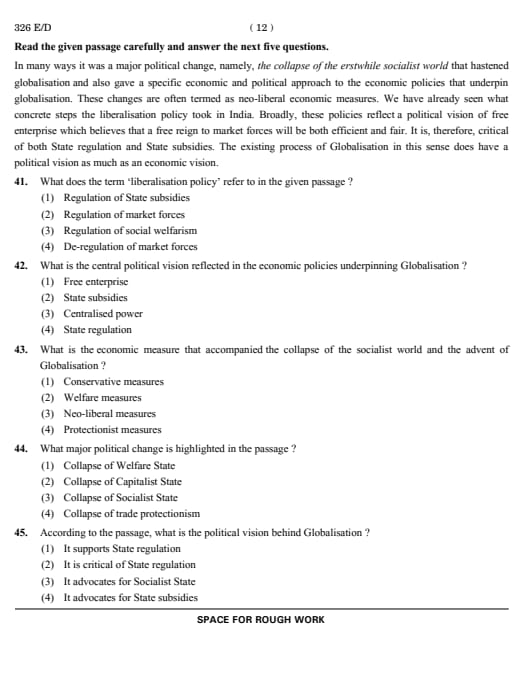
| Question 17: What does the term ‘liberalisation policy' refer to in the given passage? (Passage provided in PDF) 1. Regulation of State subsidies 2. Regulation of market forces 3. Regulation of social welfare 4. De-regulation of market forces |
4. De-regulation of market forces | In this context, liberalization refers to the removal of government regulation of market forces. | ||
| Question 18: What is the central political vision reflected in the economic policies underpinning Globalisation? 1. Free enterprises 2. State subsidies 3. Centralised power 4. State regulation |
1. Free enterprises | Globalization's central political vision is free enterprise with minimal state intervention. | ||
| Question 19: What is the economic measure that accompanied the collapse of the socialist world and the advent of Globalisation? 1. Conservative measures 2. Welfare measures 3. Neo-liberal measures 4. Protectionist measures |
3. Neo-liberal measures | The collapse of the socialist world and the rise of globalization were accompanied by neo-liberal economic policies. | ||
| Question 20: What major political change is highlighted in the passage? (Passage provided in PDF) 1. Collapse of Socialist State 2. Collapse of Capitalist State 3. Collapse of Mixed Economy 4. Collapse of trade protectionism |
1. Collapse of Socialist State | The passage emphasizes the collapse of the socialist state as a major political change. | ||
| Question 21: According to the passage, what is the political vision behind Globalisation? (Passage provided in PDF) 1. It supports State regulation 2. It challenges State regulation 3. It advocates for Socialist State 4. It advocates for State subsidies |
2. It challenges State regulation | Globalization's political vision is a market-oriented approach that challenges state regulation. | ||
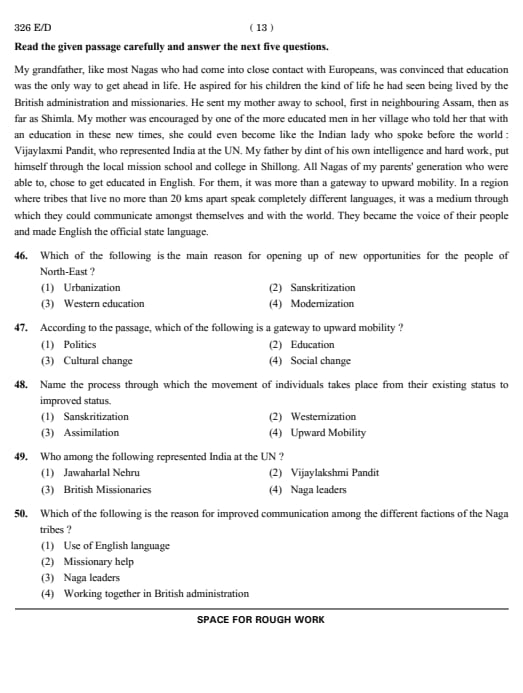
| Question 22: Which of the following is the main reason for opening up of new opportunities for the people of North-East? (Passage provided in PDF) 1. Urbanization 2. Western education 3. Sanskritization 4. Modernization |
2. Western education | The passage highlights Western education as a key factor in opening new opportunities for people in the Northeast. | ||
| Question 23: According to the passage, which of the following is a gateway to upward mobility? (Passage provided in PDF) 1. Politics 2. Education 3. Social change 4. Cultural change |
2. Education | The passage identifies education as a key pathway to upward mobility. | ||
| Question 24: Name the process through which the movement of individuals takes place from their existing status to improved status. 1. Sanskritization 2. Westernization 3. Assimilation 4. Upward Mobility |
4. Upward Mobility | Upward mobility describes the movement of individuals from a lower to a higher social status. | ||
| Question 25: Who among the following represented India at the UN? (Passage provided in PDF) 1. Jawaharlal Nehru 2. Vijaylakshmi Pandit 3. British Missionaries 4. Indian Officials |
2. Vijaylakshmi Pandit | Vijaylakshmi Pandit represented India at the UN. | ||
| Question 26: Which of the following is the reason for improved communication among the different factions of the Naga tribes? (Passage provided in PDF) 1. Use of English language 2. Strong leaders 3. Naga leaders 4. Working together in British administration |
1. Use of English language | The passage highlights the role of English in improving communication among different Naga groups. | ||
| Question 27: Which of the following Sociologists argued that Sociology helps in understanding the links and connections between “personal troubles” and “social issues”? 1. Durkheim 2. C.W. Mills 3. Bourdieu 4. Weber |
2. C.W. Mills | C. Wright Mills is known for his concept of the "sociological imagination," which connects personal troubles to broader social issues. | ||
| Question 28: Which programme of the Government of India directly targets improving sex-ratio? 1. Widow Pension 2. Pre-Natal Diagnostic Techniques (Regulation and Prevention of Misuse) Act 3. Beti Bachao Beti Padhao 4. Sukanya Samriddhi Yojana |
3. Beti Bachao Beti Padhao | The Beti Bachao Beti Padhao program is aimed at improving the sex ratio. | ||
| Question 29: Which of the following statements is true about Colonialism in India? 1. Parochialism gave birth to Colonialism in India. 2. Colonialism gave birth to Nationalism in India. 3. Urban poor were the main carriers of Nationalism in Colonial India. 4. Capitalist economic changes in India were not related to Colonialism. |
2. Colonialism gave birth to Nationalism in India. | Colonial rule in India created a unified opposition to foreign domination, fostering the growth of Indian nationalism. | ||
| Question 30: Match the following terms (List-I) with their description (List-II): List-I (Terms) (A) Varna system (B) Scheduled Castes (C) Sanskritisation (D) Resistance Tribes List-II (Descriptions) (I) Process of adopting higher caste practices (II) Four-fold division of society (III) Opposed to Hindu society (IV) Recognised by Govt. of India Act, 1935 Choose the correct answer from the options given below : (1) (A) - (I), (B) - (II), (C) - (III), (D) - (IV) (2) (A) - (II), (B) - (III), (C) - (I), (D) - (IV) (3) (A) - (IV), (B) - (II), (C) - (I), (D) - (III) (4) (A) - (II), (B) - (IV), (C) - (I), (D) - (III) |
(4) (A) - (II), (B) - (IV), (C) - (I), (D) - (III) | The Varna system is a four-fold social division in Hindu society. Scheduled Castes gained legal recognition through the Govt. of India Act, 1935. Sanskritization is the process of adopting upper-caste practices. Resistance tribes historically opposed Hindu society. |
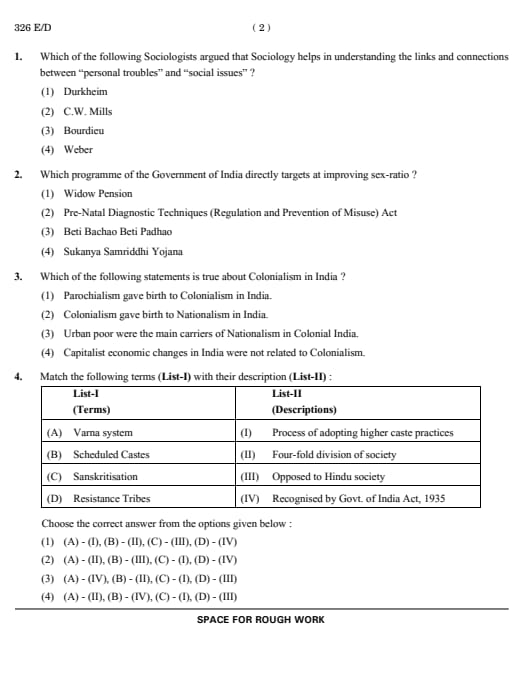
CUET 2024 Sociology Question Paper (SET D) with Solution
| Question | Answer | Solution |
|---|---|---|
| Question 1. Which of the following Sociologists argued that Sociology helps in understanding the links and connections between “personal troubles” and “social issues"? (1) Durkheim (2) C.W. Mills (3) Bourdieu (4) Weber |
(2) C.W. Mills | C. Wright Mills is known for his work on the sociological imagination, which emphasizes the connection between personal experiences and broader societal forces. His concept highlights how "personal troubles" can be understood within the context of larger "social issues." |
| Question 2. Which programme of the Government of India directly targets at improving sex-ratio? (1) Widow Pension (2) Pre-Natal Diagnostic Techniques (Regulation and Prevention of Misuse) Act (3) Beti Bachao Beti Padhao (4) Sukanya Samriddhi Yojana |
(3) Beti Bachao Beti Padhao | The "Beti Bachao Beti Padhao" (Save the Girl Child, Educate the Girl Child) campaign is a flagship program of the Indian government specifically designed to address the issue of declining sex ratio and promote the value of girls. |
| Question 3. Which of the following statements is true about Colonialism in India? (1) Parochialism gave birth to Colonialism in India. (2) Colonialism gave birth to Nationalism in India. (3) Urban poor were the main carriers of Nationalism in Colonial India. (4) Capitalist economic changes in India were not related to Colonialism. |
(2) Colonialism gave birth to Nationalism in India. | Colonial rule in India created a unified opposition to foreign domination, fostering the growth of Indian nationalism. |
| Question 4. Match the following terms (List-I) with their description (List-II): List-I (Terms) (A) Varna system (B) Scheduled Castes (C) Sanskritisation (D) Resistance Tribes List-II (Descriptions) (I) Process of adopting higher caste practices (II) Four-fold division of society (III) Opposed to Hindu society (IV) Recognised by Govt. of India Act, 1935 |
A-(II), B-(IV), C-(I), D-(III) | The Varna system is a four-fold social division in Hindu society. Scheduled Castes gained legal recognition through the Govt. of India Act, 1935. Sanskritization is the process of adopting upper-caste practices. Resistance tribes historically opposed Hindu society. |
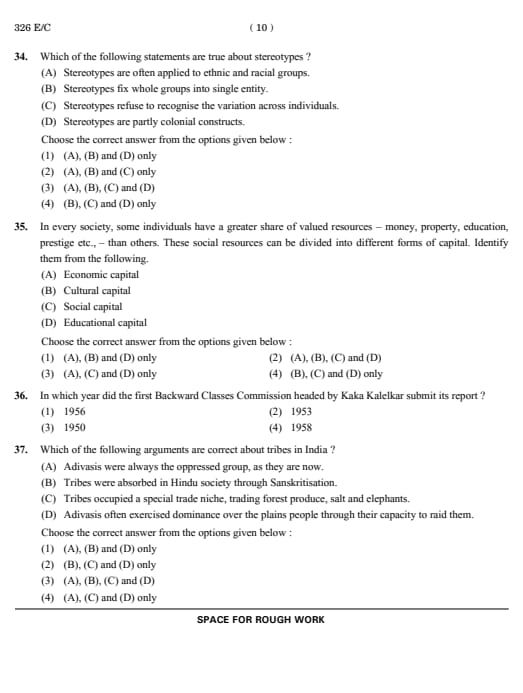
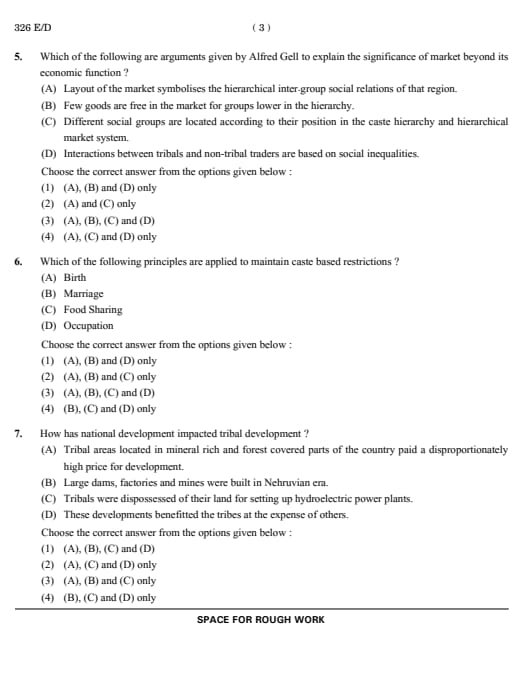
| Question 5. Which of the following are arguments given by Alfred Gell to explain the significance of the market beyond its economic function? (A) Layout of the market symbolises the hierarchical inter-group social relations of that region. (B) Few goods are free in the market for groups lower in the hierarchy. (C) Different social groups are located according to their position in the caste hierarchy and hierarchical market system. (D) Interactions between tribals and non-tribal traders are based on social inequalities. |
(A), (C), and (D) only | Alfred Gell's work on the social significance of markets highlights how market structure reflects social hierarchy and inequality. He emphasized the symbolic nature of market layouts and the unequal access to resources. |
| Question 6. Which of the following principles are applied to maintain caste-based restrictions? (A) Birth (B) Marriage (C) Food Sharing (D) Occupation |
(A), (B), (C), and (D) | Caste systems traditionally enforce endogamy (marriage within the caste), restrict food sharing across castes, and limit occupational choices, all based on birth. |
| Question 7. How has national development impacted tribal development? (A) Tribal areas located in mineral-rich and forest-covered parts of the country paid a disproportionately high price for development. (B) Large dams, factories and mines were built in the Nehruvian era. (C) Tribals were dispossessed of their land for setting up hydroelectric power plants. (D) These developments benefited the tribes at the expense of others. |
(A), (B), and (C) only | National development projects, particularly during the Nehruvian era, often negatively impacted tribal communities through displacement, loss of land and resources, and environmental damage. |
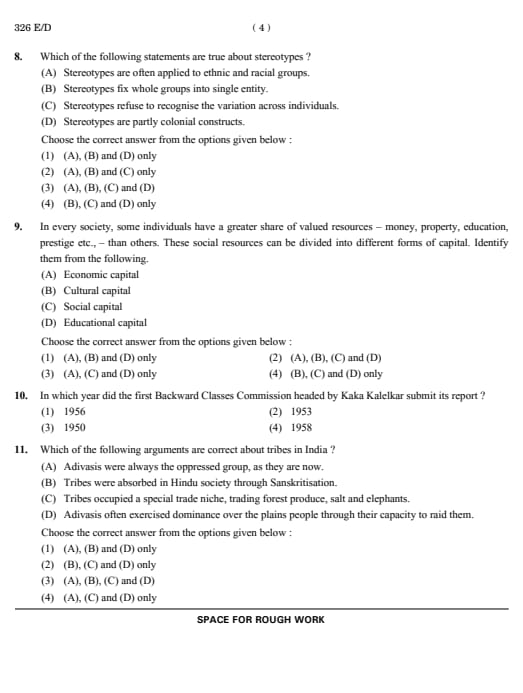
| Question 8. Which of the following statements are true about stereotypes? (A) Stereotypes are often applied to ethnic and racial groups. (B) Stereotypes fix whole groups into a single entity. (C) Stereotypes refuse to recognise the variation across individuals. (D) Stereotypes are partly colonial constructs. |
(A), (B), (C), and (D) | Stereotypes are oversimplified generalizations about groups of people, often based on ethnicity or race, ignoring individual differences. They are frequently rooted in historical power dynamics and colonialism. |
| Question 9. In every society, some individuals have a greater share of valued resources – money, property, education, prestige etc., – than others. These social resources can be divided into different forms of capital. Identify them from the following. (A) Economic capital (B) Cultural capital (C) Social capital (D) Educational capital |
(A), (B), (C), and (D) | Pierre Bourdieu's concept of capital includes economic, cultural, social, and educational capital, representing different forms of resources that contribute to social status and power. |
| Question 10. In which year did the first Backward Classes Commission headed by Kaka Kalelkar submit its report? (1) 1956 (2) 1953 (3) 1950 (4) 1958 |
(1) 1956 | The first Backward Classes Commission, chaired by Kaka Kalelkar, submitted its report in 1956. |
| Question 11. Which of the following arguments are correct about tribes in India? (A) Adivasis were always the oppressed group, as they are now. (B) Tribes were absorbed in Hindu society through Sanskritisation. (C) Tribes occupied a special trade niche, trading forest produce, salt and elephants. (D) Adivasis often exercised dominance over the plains people through their capacity to raid them. |
(B), (C), and (D) only | While Adivasi groups have faced oppression, their historical relationship with dominant groups has been complex, including periods of dominance. Sanskritization, specialized trade, and raiding were aspects of tribal life. |
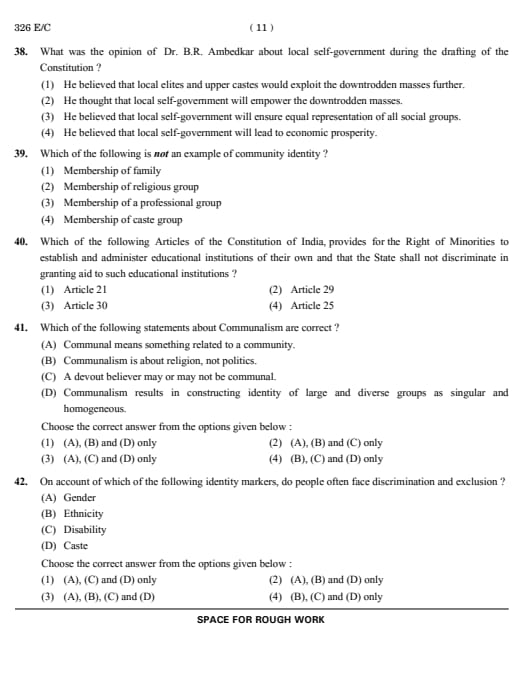
| Question 12. What was the opinion of Dr. B.R. Ambedkar about local self-government during the drafting of the Constitution? (1) He believed that local elites and upper castes would exploit the downtrodden masses further. (2) He thought that local self-government will empower the downtrodden masses. (3) He believed that local self-government will ensure equal representation of all social groups. (4) He believed that local self-government will lead to economic prosperity. |
(1) He believed that local elites and upper castes would exploit the downtrodden masses further. | Dr. B.R. Ambedkar was concerned that local self-government might lead to increased exploitation of marginalized groups by dominant castes and elites. |
| Question 13. Which of the following is not an example of community identity? (1) Membership of family (2) Membership of religious group (3) Membership of a professional group (4) Membership of caste group |
(3) Membership of a professional group | Community identity is typically associated with shared ancestry, culture, religion, or region, not a professional affiliation. |
| Question 14. Which of the following Articles of the Constitution of India, provides for the Right of Minorities to establish and administer educational institutions of their own and that the State shall not discriminate in granting aid to such educational institutions? (1) Article 21 (2) Article 29 (3) Article 30 (4) Article 25 |
(3) Article 30 | Article 30 of the Indian Constitution guarantees the right of minorities to establish and administer educational institutions of their choice without discrimination. |
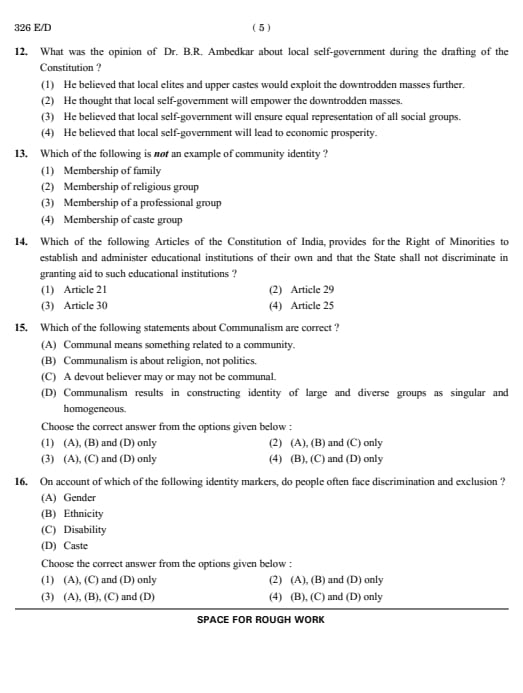
| Question 15. Which of the following statements about Communalism are correct? (A) Communal means something related to a community. (B) Communalism is about religion, not politics. (C) A devout believer may or may not be communal. (D) Communalism results in constructing identity of large and diverse groups as singular and homogeneous. |
(A), (C), and (D) only | Communalism is related to community identity but often involves politics. Religious devotion doesn't automatically equal communal attitudes. Communalism simplifies diverse groups into homogenous entities. |
| Question 16. On account of which of the following identity markers, do people often face discrimination and exclusion? (A) Gender (B) Ethnicity (C) Disability (D) Caste |
(A), (B), (C), and (D) | Discrimination and exclusion can stem from various identity markers such as gender, ethnicity, disability, and caste. |
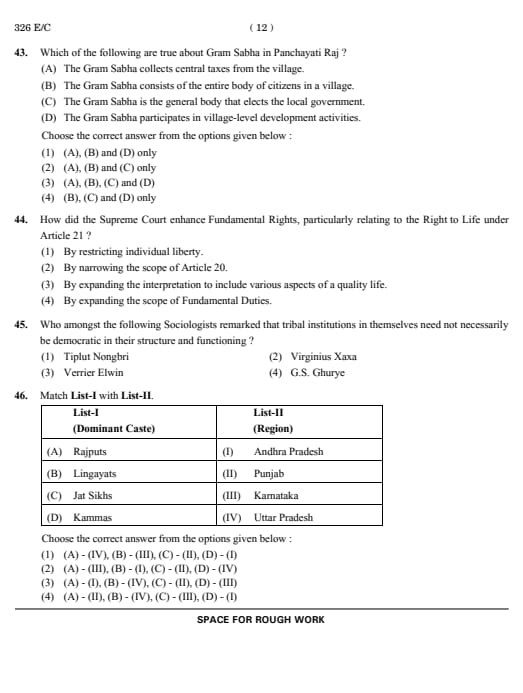
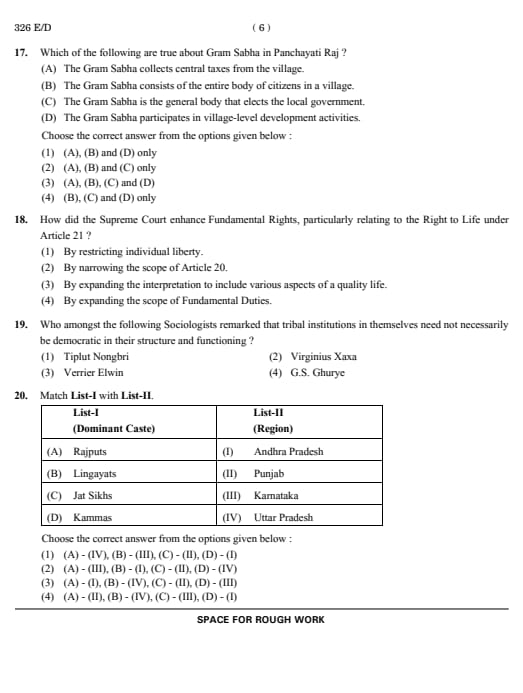
| Question 17. Which of the following are true about Gram Sabha in Panchayati Raj? (A) The Gram Sabha collects central taxes from the village. (B) The Gram Sabha consists of the entire body of citizens in a village. (C) The Gram Sabha is the general body that elects the local government. (D) The Gram Sabha participates in village-level development activities. |
(B), (C), and (D) only | The Gram Sabha includes all village residents. It elects the local government and participates in village-level development. It does not collect central taxes. |
| Question 18. How did the Supreme Court enhance Fundamental Rights, particularly relating to the Right to Life under Article 21? (1) By restricting individual liberty. (2) By narrowing the scope of Article 20. (3) By expanding the interpretation to include various aspects of a quality life. (4) By expanding the scope of Fundamental Duties. |
(3) By expanding the interpretation to include various aspects of a quality life. | The Supreme Court's interpretation of Article 21 has broadened the Right to Life to encompass various aspects of a dignified and meaningful existence. |
| Question 19. Who amongst the following Sociologists remarked that tribal institutions in themselves need not necessarily be democratic in their structure and functioning? (1) Tiplut Nongbri (2) Virginius Xaxa (3) Verrier Elwin (4) G.S. Ghurye |
(2) Virginius Xaxa | Virginius Xaxa has written extensively on tribal governance and has argued that tribal institutions might not always align with Western notions of democracy. |
| Question 20. Match List-I with List-II: List-I (Dominant Caste) (A) Rajputs (B) Lingayats (C) Jat Sikhs (D) Kammas List-II (Region) (I) Andhra Pradesh (II) Punjab (III) Karnataka (IV) Uttar Pradesh |
A-(IV), B-(III), C-(II), D-(I) | This question matches dominant castes with their regions of concentration in India. |
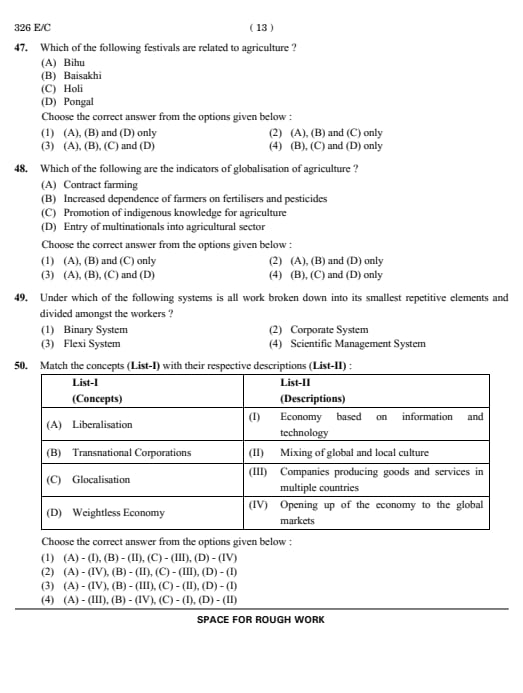
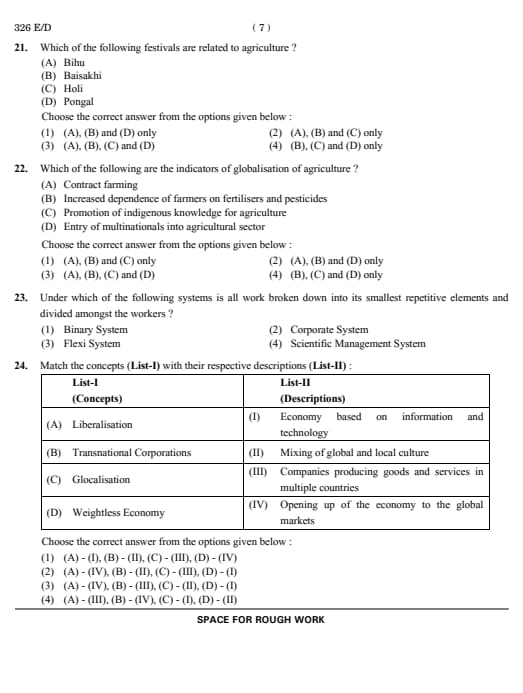
| Question 21. Which of the following festivals are related to agriculture? (A) Bihu (B) Baisakhi (C) Holi (D) Pongal |
(A), (B), and (D) only | Bihu, Baisakhi, and Pongal are festivals associated with the harvest and agricultural cycles. Holi is not directly related to agriculture. |
| Question 22. Which of the following are the indicators of globalization of agriculture? (A) Contract farming (B) Increased dependence of farmers on fertilizers and pesticides (C) Promotion of indigenous knowledge for agriculture (D) Entry of multinationals into the agricultural sector |
(A), (B), and (D) only | Globalization in agriculture is marked by contract farming, increased use of chemical inputs, and the growing influence of multinational corporations. |
| Question 23. Under which of the following systems is all work broken down into its smallest repetitive elements and divided amongst the workers? (1) Binary System (2) Corporate System (3) Flexi System (4) Scientific Management System |
(4) Scientific Management System | Scientific Management, or Taylorism, emphasizes breaking down tasks into their smallest components for efficiency. |
| Question 24. Match the concepts (List-I) with their respective descriptions (List-II): List-I (Concepts) (A) Liberalization (B) Transnational Corporations (C) Glocalisation (D) Weightless Economy List-II (Descriptions) (I) Economy based on information and technology (II) Mixing of global and local culture (III) Companies producing goods and services in multiple countries (IV) Opening up of the economy to the global markets |
A-(IV), B-(III), C-(II), D-(I) | Match the economic concepts with their definitions. |
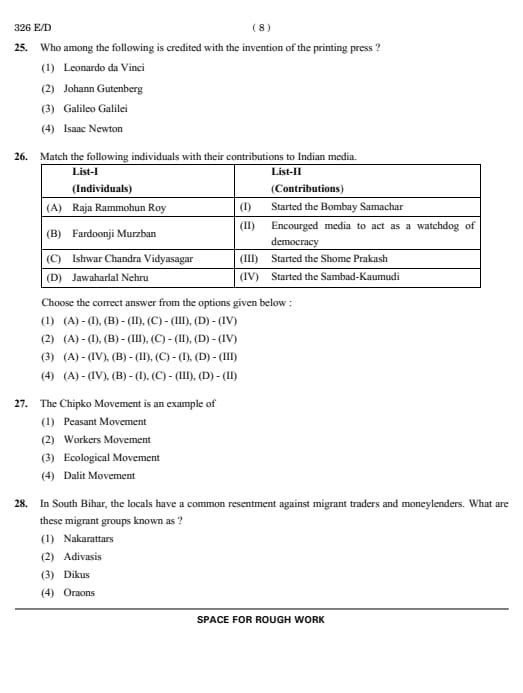
| Question 25. Who among the following is credited with the invention of the printing press? (1) Leonardo da Vinci (2) Johann Gutenberg (3) Galileo Galilei (4) Isaac Newton |
(2) Johann Gutenberg | Johann Gutenberg is credited with the invention of the movable-type printing press. |
| Question 26. Match the following individuals with their contributions to Indian media. List-I (Individuals) (A) Raja Rammohun Roy (B) Fardoonji Murzban (C) Ishwar Chandra Vidyasagar (D) Jawaharlal Nehru List-II (Contributions) (I) Started the Bombay Samachar (II) Encouraged media to act as a watchdog of democracy (III) Started the Shome Prakash (IV) Started the Sambad-Kaumudi |
A-(IV), B-(I), C-(III), D-(II) | Match the individuals with their contributions to the development of Indian Media. |
| Question 27. The Chipko Movement is an example of (1) Peasant Movement (2) Workers Movement (3) Ecological Movement (4) Dalit Movement |
(3) Ecological Movement | The Chipko movement was an environmental movement focusing on the protection of forests. |
| Question 28. In South Bihar, the locals have a common resentment against migrant traders and moneylenders. What are these migrant groups known as? (1) Nakarattars (2) Adivasis (3) Dikus (4) Oraons |
(3) Dikus | In South Bihar, the term "Dikus" is used to refer to the migrant traders and moneylenders who are often the target of local resentment. |
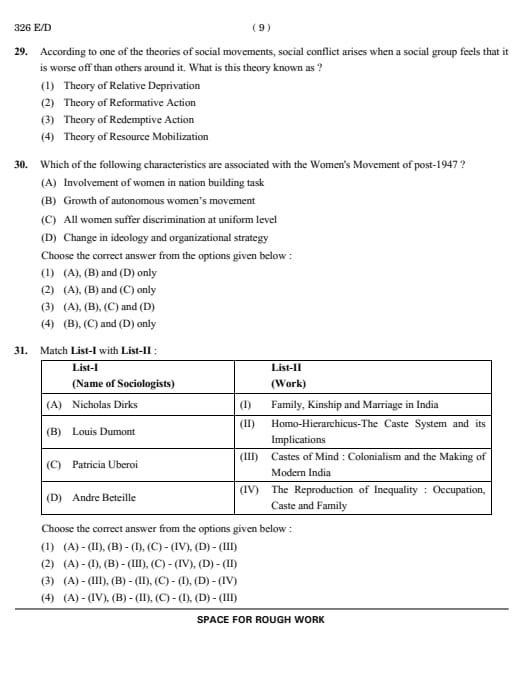
| Question 29. According to one of the theories of social movements, social conflict arises when a social group feels that it is worse off than others around it. What is this theory known as? (1) Theory of Relative Deprivation (2) Theory of Reformative Action (3) Theory of Redemptive Action (4) Theory of Resource Mobilization |
(1) Theory of Relative Deprivation | The Theory of Relative Deprivation explains social movements by focusing on the perceived gap between a group's expectations and their actual achievements compared to others. |
| Question 30. Which of the following characteristics are associated with the Women's Movement of post-1947? (A) Involvement of women in nation-building task (B) Growth of autonomous women's movement (C) All women suffer discrimination at a uniform level (D) Change in ideology and organizational strategy |
(A), (B), and (D) only | The post-1947 Women's Movement is characterized by women's participation in nation-building, the rise of independent women's movements, and shifts in ideology and organizational approaches. Not all women experience discrimination uniformly. |
| Question 31. Match List-I with List-II: List-I (Name of Sociologists) (A) Nicholas Dirks (B) Louis Dumont (C) Patricia Uberoi (D) Andre Beteille List-II (Work) (I) Family, Kinship and Marriage in India (II) Homo-Hierarchicus: The Caste System and its Implications (III) Castes of Mind: Colonialism and the Making of Modern India (IV) The Reproduction of Inequality: Occupation, Caste and Family |
A-(III), B-(II), C-(I), D-(IV) | Match the sociologists with their major works. |
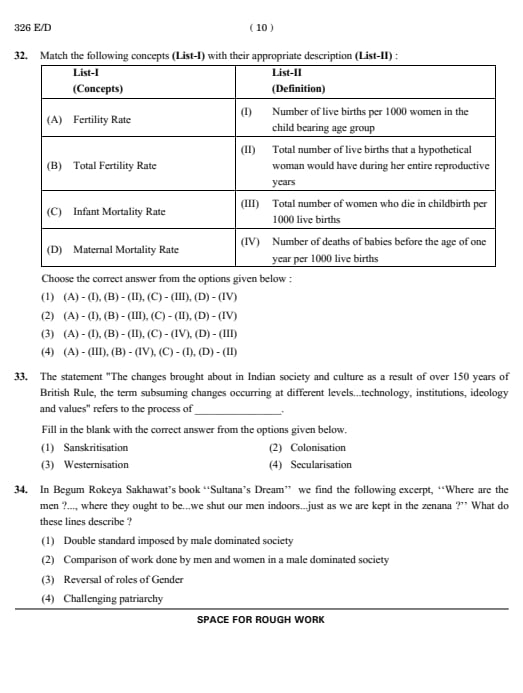
| Question 32. Match the following concepts (List-I) with their appropriate description (List-II): List-I (Concepts) (A) Fertility Rate (B) Total Fertility Rate (C) Infant Mortality Rate (D) Maternal Mortality Rate List-II (Definition) (I) Number of live births per 1000 women in the childbearing age group (II) Total number of live births that a hypothetical woman would have during her entire reproductive years (III) Number of deaths of babies before the age of one year per 1000 live births (IV) Total number of women who die in childbirth per 1000 live births |
A-(I), B-(II), C-(IV), D-(III) | Match the demographic terms with their definitions. |
| Question 33. The statement "The changes brought about in Indian society and culture as a result of over 150 years of British Rule, the term subsuming changes occurring at different levels...technology, institutions, ideology and values" refers to the process of (1) Sanskritisation (2) Colonisation (3) Westernisation (4) Secularisation |
(3) Westernisation | Westernization describes the process of adopting Western culture, technology, and values, often as a result of colonization. |
| Question 34. In Begum Rokeya Sakhawat's book “Sultana's Dream" we find the following excerpt, “Where are the men ?..., where they ought to be...we shut our men indoors...just as we are kept in the zenana?" What do these lines describe? (1) Double standard imposed by male-dominated society (2) Comparison of work done by men and women in a male-dominated society (3) Reversal of roles of Gender (4) Challenging patriarchy |
(3) Reversal of roles of Gender | The lines from Rokeya's "Sultana's Dream" describe a utopian society where traditional gender roles are reversed. |
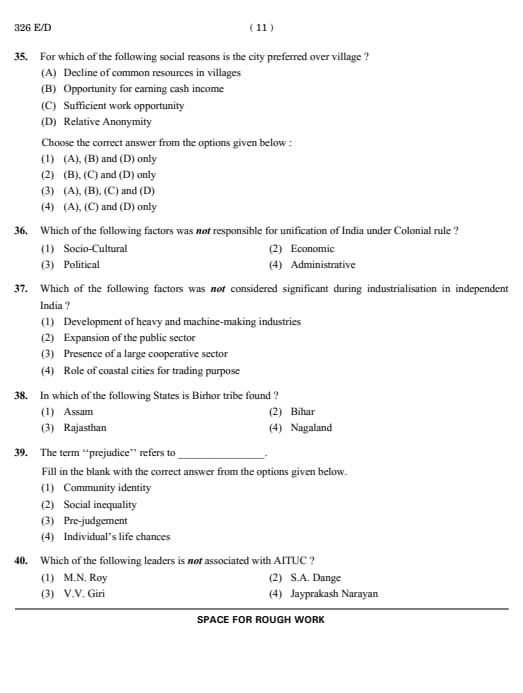
| Question 35. For which of the following social reasons is the city preferred over village? (A) Decline of common resources in villages (B) Opportunity for earning cash income (C) Sufficient work opportunity (D) Relative Anonymity |
(A), (B), (C), and (D) | People may prefer cities over villages due to greater access to resources, job opportunities, and anonymity. |
| Question 36. Which of the following factors was not responsible for unification of India under Colonial rule? (1) Socio-Cultural (2) Economic (3) Political (4) Administrative |
(1) Socio-Cultural | While economic, political, and administrative factors contributed significantly to the unification of India under colonial rule, socio-cultural factors played a less direct role. |
| Question 37. Which of the following factors was not considered significant during industrialisation in independent India? (1) Development of heavy and machine-making industries (2) Expansion of the public sector (3) Presence of a large cooperative sector (4) Role of coastal cities for trading purpose |
(3) Presence of a large cooperative sector | While the other factors were crucial for industrialization in India, the presence of a large cooperative sector was less significant. |
| Question 38. In which of the following States is the Birhor tribe found? (1) Assam (2) Bihar (3) Rajasthan (4) Nagaland |
(2) Bihar | The Birhor are an indigenous tribe primarily located in the state of Bihar, India. |
| Question 39. The term “prejudice” refers to (1) Community identity (2) Social inequality (3) Pre-judgement (4) Individual's life chances |
(3) Pre-judgement | Prejudice is defined as pre-judgment, making an opinion before having adequate knowledge or evidence. |
| Question 40. Which of the following leaders is not associated with AITUC? (1) M.N. Roy (2) S.A. Dange (3) V.V. Giri (4) Jayprakash Narayan |
(4) Jayprakash Narayan | Jayprakash Narayan's affiliations were primarily with other socialist and Sarvodaya movements, not the AITUC (All India Trade Union Congress). |
| Question 41. What does the term 'liberalisation policy' refer to in the given passage? (1) Regulation of State subsidies (2) Regulation of market forces (3) Regulation of social welfarism (4) De-regulation of market forces |
(4) De-regulation of market forces | In the context of the passage, liberalization policy refers to the removal of government controls and regulations from the market. |
| Question 42. What is the central political vision reflected in the economic policies underpinning Globalisation? (1) Free enterprise (2) State subsidies (3) Centralised power (4) State regulation |
(1) Free enterprise | The passage suggests that the core political ideology driving globalization's economic policies is free enterprise, minimizing state intervention. |
| Question 43. What is the economic measure that accompanied the collapse of the socialist world and the advent of Globalisation? (1) Conservative measures (2) Welfare measures (3) Neo-liberal measures (4) Protectionist measures |
(3) Neo-liberal measures | The passage connects the fall of socialist states with the rise of neo-liberal economic policies, which are central to globalization. |
| Question 44. What major political change is highlighted in the passage? (1) Collapse of Welfare State (2) Collapse of Capitalist State (3) Collapse of Socialist State (4) Collapse of trade protectionism |
(3) Collapse of Socialist State | The passage emphasizes the collapse of the socialist world as a significant political event that paved the way for globalization. |
| Question 45. According to the passage, what is the political vision behind Globalisation? (1) It supports State regulation (2) It is critical of State regulation (3) It advocates for Socialist State (4) It advocates for State subsidies |
(2) It is critical of State regulation | The passage highlights that the political vision behind globalization is critical of state regulation and intervention in favor of free markets. |
| Question 46. Which of the following is the main reason for opening up of new opportunities for the people of North-East? (1) Urbanization (2) Sanskritization (3) Western education (4) Modernization |
(3) Western education | The passage emphasizes Western education as a key factor in creating new opportunities and upward mobility for people in the Northeast of India. |
| Question 47. According to the passage, which of the following is a gateway to upward mobility? (1) Politics (2) Education (3) Cultural change (4) Social change |
(2) Education | The passage explicitly states that education was the primary means of upward mobility for the people of the Northeast. |
| Question 48. Name the process through which the movement of individuals takes place from their existing status to improved status. (1) Sanskritization (2) Westernization (3) Assimilation (4) Upward Mobility |
(4) Upward Mobility | Upward mobility refers to the movement of individuals from a lower social status to a higher one. |
| Question 49. Who among the following represented India at the UN? (1) Jawaharlal Nehru (2) Vijaylakshmi Pandit (3) British Missionaries (4) Naga leaders |
(2) Vijaylakshmi Pandit | Vijaylakshmi Pandit served as an Indian representative to the United Nations. |
| Question 50. Which of the following is the reason for improved communication among the different factions of the Naga tribes? (1) Use of English language (2) Missionary help (3) Naga leaders (4) Working together in British administration |
(1) Use of English language | The passage states that English served as a common language, facilitating communication among diverse Naga tribes. |










*The article might have information for the previous academic years, please refer the official website of the exam.