
CUET 2025 English Question Paper- Download Answer Key and Solution PDF


Content Curator | Updated On - Jun 25, 2025
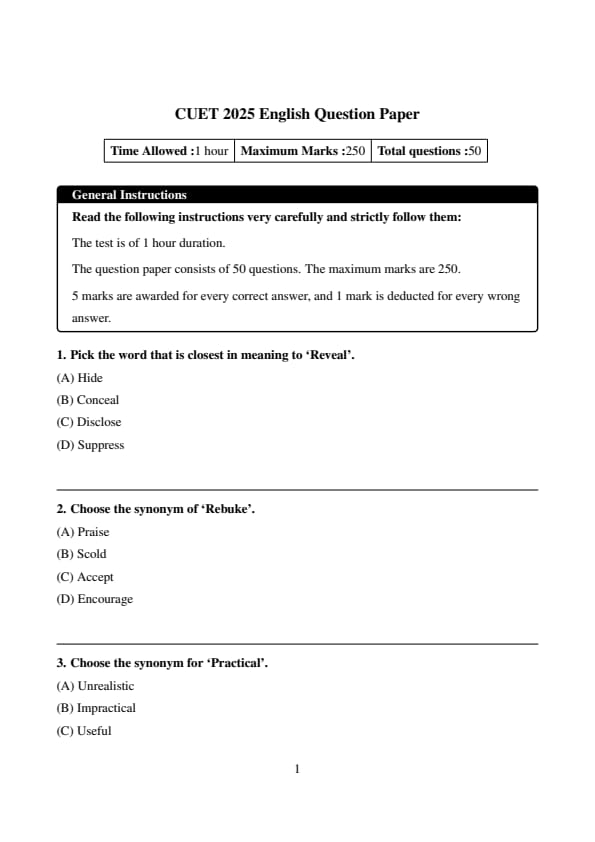
The CUET 2025 exam was conducted from 13th May to 3rd June. The CUET English Question Paper 2025 with Answer Key and Solution PDF is available here. The CUET English was moderate to difficult in the difficulty level.
As per the exam pattern, the CUET English exam consists of 50 questions for 250 marks to be attempted in 60 minutes. 5 marks are awarded for each correct answer, and 1 mark is deducted for incorrect answer.
CUET English Question Paper 2025 with Answer Key
| CUET English Question Paper 2025 with Solutions | Download PDF | Check Solution |

Pick the word that is closest in meaning to ‘Reveal’.
View Solution
The word ‘Reveal’ means to make something known that was previously secret or unknown. Among the options, ‘Disclose’ means to make information known or public, which is closest in meaning to ‘Reveal’.
‘Hide’, ‘Conceal’, and ‘Suppress’ mean to keep something secret or not let it be known, which are opposites of ‘Reveal’. Quick Tip: Words with similar meanings are called synonyms. ‘Reveal’ and ‘Disclose’ both mean to make something known.
Choose the synonym of ‘Rebuke’.
View Solution
‘Rebuke’ means to express sharp disapproval or criticism of someone because of their behavior or actions. The synonym is ‘Scold’, which also means to reprimand or criticize someone angrily.
‘Praise’ and ‘Encourage’ are positive reactions, opposite to rebuke. ‘Accept’ means to agree or approve, which is unrelated. Quick Tip: Synonyms share similar meanings. ‘Rebuke’ and ‘Scold’ both mean to criticize someone.
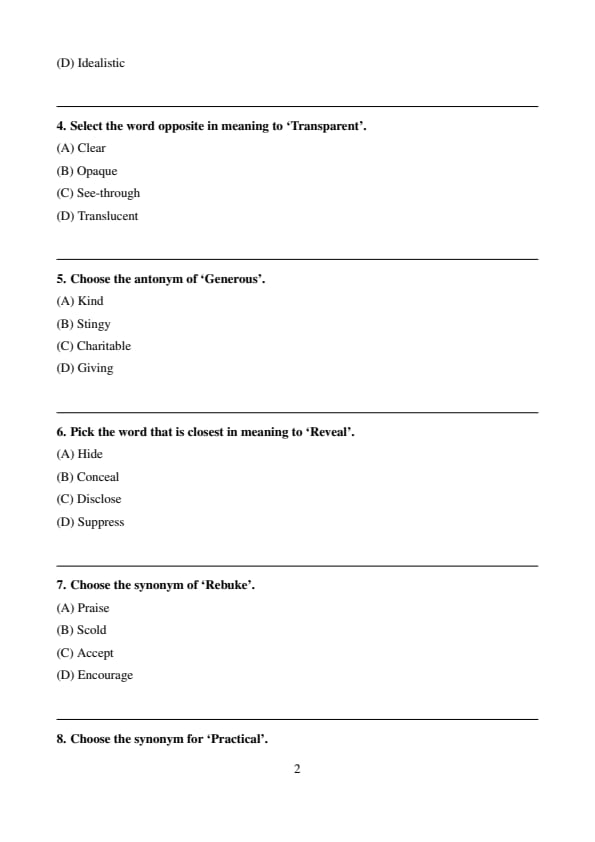
Choose the synonym for ‘Practical’.
View Solution
‘Practical’ means concerned with actual use or practice rather than theory or ideas; something that is useful or realistic. Among the options, ‘Useful’ best matches the meaning of ‘Practical’.
‘Unrealistic’, ‘Impractical’, and ‘Idealistic’ imply the opposite, focusing on ideas or theories rather than practical use. Quick Tip: ‘Practical’ relates to usefulness or real-world application. Synonyms often include ‘Useful’ and ‘Realistic’.
Select the word opposite in meaning to ‘Transparent’.
View Solution
‘Transparent’ means allowing light to pass through so that objects behind can be distinctly seen. The opposite is ‘Opaque’, meaning not transparent or translucent; not allowing light through.
‘Clear’, ‘See-through’, and ‘Translucent’ are similar in meaning to transparent or partially so. Quick Tip: Antonyms are words with opposite meanings. The antonym of ‘Transparent’ is ‘Opaque’.
Choose the antonym of ‘Generous’.
View Solution
‘Generous’ means willing to give more of something, especially money, than is strictly necessary or expected. The opposite (antonym) is ‘Stingy’, meaning unwilling to give or spend; ungenerous.
‘Kind’, ‘Charitable’, and ‘Giving’ have meanings similar to ‘Generous’. Quick Tip: Antonyms have opposite meanings. ‘Generous’ and ‘Stingy’ are opposites.
Pick the word that is closest in meaning to ‘Reveal’.
View Solution
The word ‘Reveal’ means to make something known that was previously secret or unknown. Among the options, ‘Disclose’ means to make information known or public, which is closest in meaning to ‘Reveal’.
‘Hide’, ‘Conceal’, and ‘Suppress’ mean to keep something secret or not let it be known, which are opposites of ‘Reveal’. Quick Tip: Words with similar meanings are called synonyms. ‘Reveal’ and ‘Disclose’ both mean to make something known.
Choose the synonym of ‘Rebuke’.
View Solution
‘Rebuke’ means to express sharp disapproval or criticism of someone because of their behavior or actions. The synonym is ‘Scold’, which also means to reprimand or criticize someone angrily.
‘Praise’ and ‘Encourage’ are positive reactions, opposite to rebuke. ‘Accept’ means to agree or approve, which is unrelated. Quick Tip: Synonyms share similar meanings. ‘Rebuke’ and ‘Scold’ both mean to criticize someone.
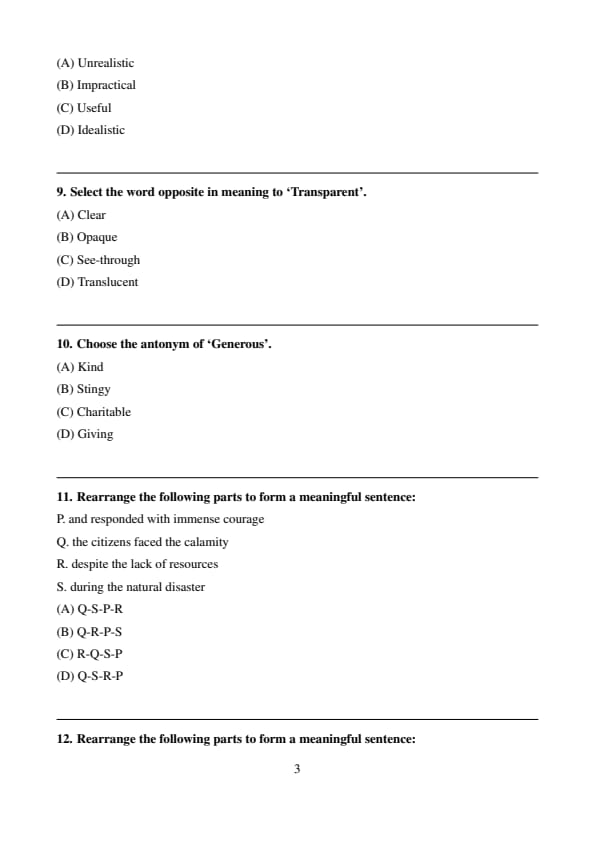
Choose the synonym for ‘Practical’.
View Solution
‘Practical’ means concerned with actual use or practice rather than theory or ideas; something that is useful or realistic. Among the options, ‘Useful’ best matches the meaning of ‘Practical’.
‘Unrealistic’, ‘Impractical’, and ‘Idealistic’ imply the opposite, focusing on ideas or theories rather than practical use. Quick Tip: ‘Practical’ relates to usefulness or real-world application. Synonyms often include ‘Useful’ and ‘Realistic’.
Select the word opposite in meaning to ‘Transparent’.
View Solution
‘Transparent’ means allowing light to pass through so that objects behind can be distinctly seen. The opposite is ‘Opaque’, meaning not transparent or translucent; not allowing light through.
‘Clear’, ‘See-through’, and ‘Translucent’ are similar in meaning to transparent or partially so. Quick Tip: Antonyms are words with opposite meanings. The antonym of ‘Transparent’ is ‘Opaque’.
Choose the antonym of ‘Generous’.
View Solution
‘Generous’ means willing to give more of something, especially money, than is strictly necessary or expected. The opposite (antonym) is ‘Stingy’, meaning unwilling to give or spend; ungenerous.
‘Kind’, ‘Charitable’, and ‘Giving’ have meanings similar to ‘Generous’. Quick Tip: Antonyms have opposite meanings. ‘Generous’ and ‘Stingy’ are opposites.
Rearrange the following parts to form a meaningful sentence:
P. and responded with immense courage
Q. the citizens faced the calamity
R. despite the lack of resources
S. during the natural disaster
View Solution
To form a meaningful sentence, first identify the main clause and modifiers:
- Q: "the citizens faced the calamity" (main clause)
- S: "during the natural disaster" (time modifier)
- R: "despite the lack of resources" (contrast clause)
- P: "and responded with immense courage" (additional action)
The correct order is: Q-S-R-P
Complete sentence: "The citizens faced the calamity during the natural disaster despite the lack of resources and responded with immense courage." Quick Tip: In sentence rearrangement, start with the main clause and then add time, contrast, and additional details to form a logical, coherent sentence.
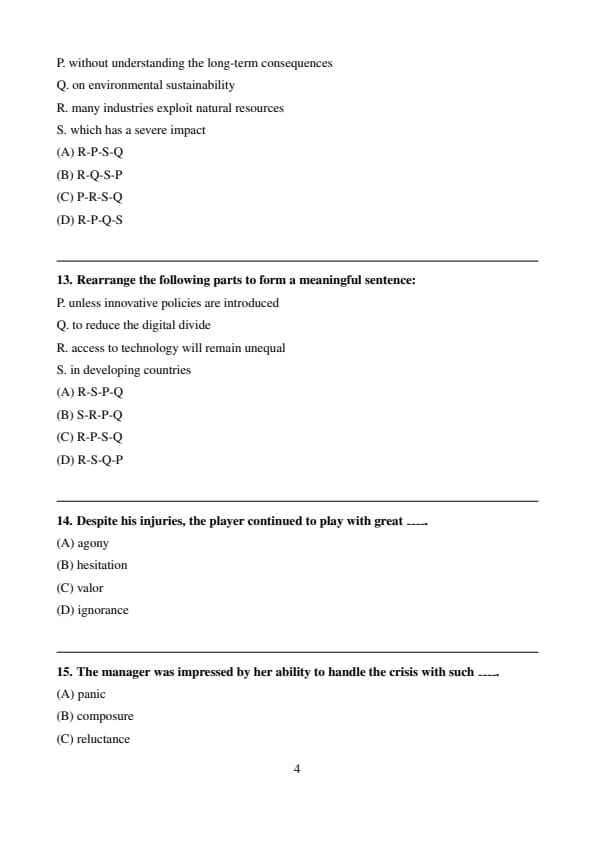
Rearrange the following parts to form a meaningful sentence:
P. without understanding the long-term consequences
Q. on environmental sustainability
R. many industries exploit natural resources
S. which has a severe impact
View Solution
Identify the main clause and modifiers:
- R: "many industries exploit natural resources" (main clause)
- P: "without understanding the long-term consequences" (reason or condition)
- S: "which has a severe impact" (relative clause referring to the exploitation)
- Q: "on environmental sustainability" (object of impact)
The correct order is: R-P-S-Q
Complete sentence: "Many industries exploit natural resources without understanding the long-term consequences which has a severe impact on environmental sustainability." Quick Tip: In sentence rearrangement, identify the subject and verb first, then place modifiers and relative clauses logically to maintain sentence coherence.
Rearrange the following parts to form a meaningful sentence:
P. unless innovative policies are introduced
Q. to reduce the digital divide
R. access to technology will remain unequal
S. in developing countries
View Solution
The main clause is about the unequal access to technology (R). Next, it specifies the location (S), then the purpose (Q), and finally the condition (P). The sentence formed is:
\textit{"Access to technology will remain unequal in developing countries to reduce the digital divide unless innovative policies are introduced."
Hence, the correct sequence is R-S-Q-P. Quick Tip: Start with the main idea, then add context such as location or time, followed by purpose and conditions to form coherent sentences.
Despite his injuries, the player continued to play with great ____.
View Solution
The sentence indicates that the player played despite injuries, which shows bravery. ‘Valor’ means courage or bravery, which fits the context perfectly.
‘Agony’ means pain, ‘hesitation’ means doubt, and ‘ignorance’ means lack of knowledge — none suit the meaning here. Quick Tip: Look for words that express positive qualities like courage or bravery when the sentence shows persistence despite difficulty.
The manager was impressed by her ability to handle the crisis with such ____.
View Solution
‘Composure’ means calmness and self-control, which is admirable when handling a crisis.
‘Panic’ and ‘anxiety’ mean fear and nervousness, while ‘reluctance’ means unwillingness, none of which are positive traits in a crisis. Quick Tip: Words showing calmness and control are the right choice when describing handling difficult situations positively.
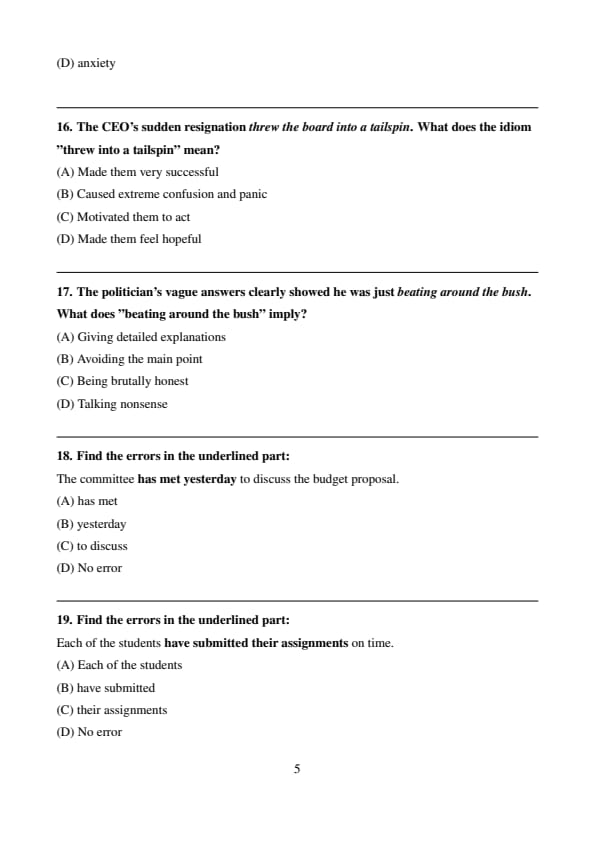
The CEO's sudden resignation threw the board into a tailspin. What does the idiom "threw into a tailspin" mean?
View Solution
The idiom "threw into a tailspin" means to cause someone or a group to become confused, anxious, or panicked due to sudden unexpected events. Here, the CEO's sudden resignation caused the board members to panic and become disoriented.
Other options do not fit the context as the idiom conveys chaos or confusion, not success, motivation, or hopefulness. Quick Tip: Idioms often use vivid imagery to describe emotions; "tailspin" is a term from aviation describing a loss of control, metaphorically meaning confusion or panic.
The politician’s vague answers clearly showed he was just beating around the bush. What does "beating around the bush" imply?
View Solution
The phrase "beating around the bush" means avoiding talking directly about the main issue or point. Politicians often do this to evade answering tough questions clearly.
Other options such as giving detailed explanations or being honest are opposite in meaning, while "talking nonsense" is unrelated. Quick Tip: Remember idioms like "beating around the bush" to understand indirect or evasive communication, which is common in formal and informal English.
Find the errors in the underlined part:
The committee has met yesterday to discuss the budget proposal.
View Solution
The error is in the use of "has met" with the time expression "yesterday". The present perfect tense ("has met") should not be used with definite past time markers like "yesterday". The correct sentence should use simple past tense: "The committee \textit{met yesterday to discuss the budget proposal."
Options B and C are correct as they stand, and option D is incorrect because there is an error. Quick Tip: Use present perfect tense for actions without specific past time, and simple past tense when the past time (e.g., yesterday) is mentioned.
Find the errors in the underlined part:
Each of the students have submitted their assignments on time.
View Solution
The phrase "Each of the students" is singular and should be followed by a singular verb. Here, "have submitted" is plural, which causes subject-verb disagreement. The correct verb should be "has submitted".
The correct sentence would be: "Each of the students \textit{has submitted their assignments on time."
Options (A) and (C) are correct as they stand, and (D) is incorrect because there is an error in (B). Quick Tip: When the subject starts with "Each of", it is always singular and must take a singular verb, even if the object following "of" is plural.
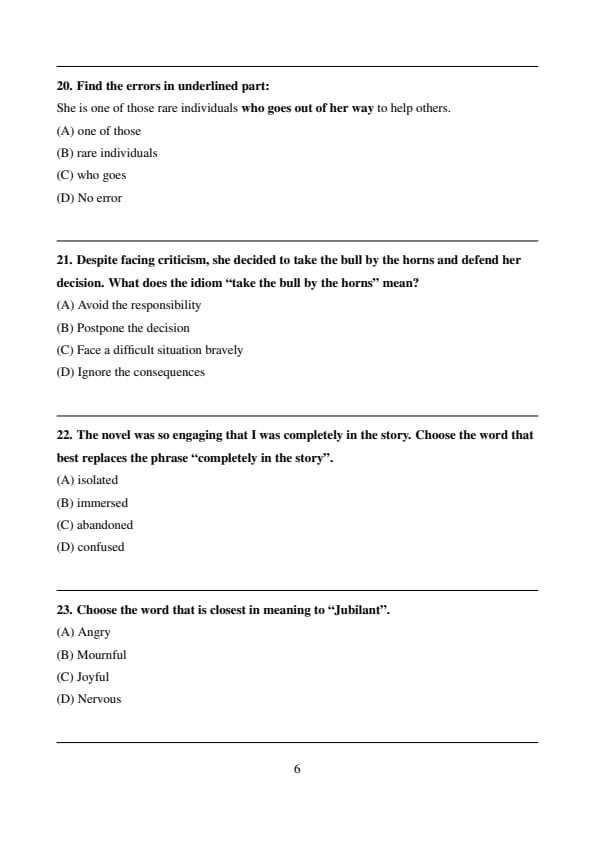
Find the errors in underlined part:
She is one of those rare individuals who goes out of her way to help others.
View Solution
The phrase “one of those rare individuals” refers to a plural subject “individuals.” Therefore, the relative pronoun “who” refers to plural and must take the plural verb form.
Incorrect: “who goes out of her way” (singular verb ‘goes’)
Correct: “who go out of their way” (plural verb ‘go’ and plural pronoun ‘their’).
Hence, the error is in the verb “goes.” Quick Tip: When the subject is plural, use plural verbs and pronouns after relative pronouns like “who.”
Despite facing criticism, she decided to take the bull by the horns and defend her decision. What does the idiom “take the bull by the horns” mean?
View Solution
The idiom “take the bull by the horns” means to confront a difficult or dangerous situation directly and courageously. Here, despite criticism, she chooses to face the problem bravely and defend her decision.
Other options like avoiding responsibility, postponing decisions, or ignoring consequences do not match the idiom’s meaning. Quick Tip: Idioms are fixed expressions whose meanings differ from the literal words. “Take the bull by the horns” means to tackle a problem courageously.
The novel was so engaging that I was completely in the story. Choose the word that best replaces the phrase “completely in the story”.
View Solution
The phrase “completely in the story” means to be deeply involved or absorbed in something. The word “immersed” means to be deeply engaged or involved in an activity or interest, which fits perfectly here.
“Isolated” means separated from others, “Abandoned” means left behind, and “Confused” means unable to think clearly, none of which match the meaning in the context. Quick Tip: “Immersed” means deeply involved or absorbed, often used to describe full attention or engagement.
Choose the word that is closest in meaning to “Jubilant”.
View Solution
“Jubilant” means feeling or expressing great happiness and triumph. The word “Joyful” is a synonym, meaning very happy or delighted.
The other options, “Angry,” “Mournful,” and “Nervous,” have meanings opposite or unrelated to “Jubilant.” Quick Tip: Synonyms are words with similar meanings. “Jubilant” and “Joyful” both express happiness and excitement.
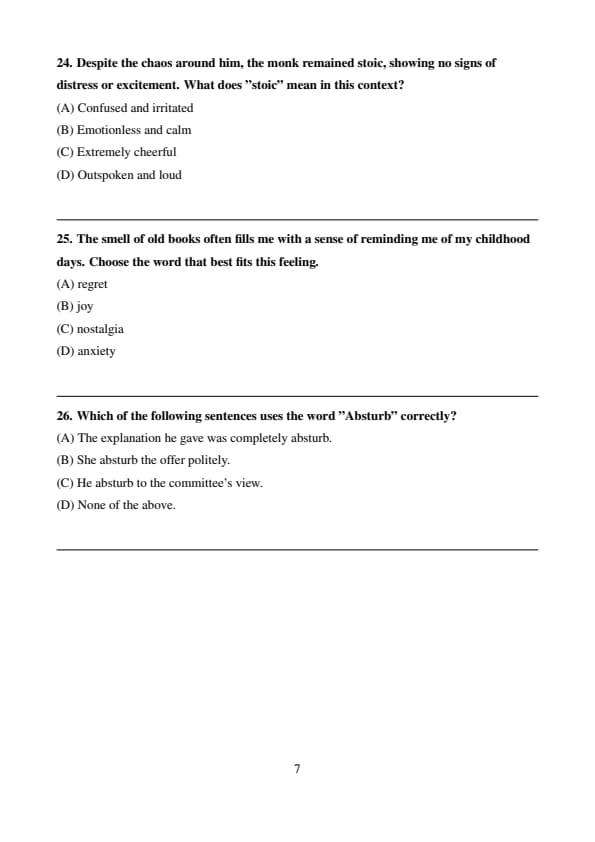
Despite the chaos around him, the monk remained stoic, showing no signs of distress or excitement. What does "stoic" mean in this context?
View Solution
The word “stoic” refers to a person who remains calm and does not show or feel emotion, especially in difficult situations. Here, despite chaos, the monk shows no distress or excitement, indicating he is calm and emotionless.
Options like “Confused and irritated,” “Extremely cheerful,” or “Outspoken and loud” contradict the context. Quick Tip: “Stoic” means showing endurance and calmness without complaint, especially under pressure or distress.
The smell of old books often fills me with a sense of reminding me of my childhood days. Choose the word that best fits this feeling.
View Solution
The phrase describes a feeling connected to memories of the past (childhood days). “Nostalgia” is the sentimental longing or wistful affection for the past, which fits perfectly.
“Regret” is sorrow about the past, “Joy” is happiness but not necessarily linked to memory, and “Anxiety” is worry or nervousness, which does not fit here. Quick Tip: “Nostalgia” refers to a sentimental or emotional longing for the past.
Which of the following sentences uses the word "Absturb" correctly?
View Solution
The word “Absturb” is not a correct English word and does not exist in standard English dictionaries. Therefore, none of the sentences use the word correctly.
If the intended word was “absurd,” meaning ridiculous or unreasonable, only option (A) would make sense with correction: “The explanation he gave was completely absurd.”
Options (B) and (C) do not form grammatically correct or meaningful sentences with the word “Absturb.” Quick Tip: Always verify the spelling and meaning of words before usage. “Absturb” is not a valid English word.
*The article might have information for the previous academic years, please refer the official website of the exam.