
CUET 2026 Chemistry Question Paper May 19 Shift 1 with Solution Pdf


| Updated On - May 19, 2026
CUET 2026 May 19 Shift 1 Chemistry Question Paper with Solution PDF is available here for download. NTA conducted CUET 2026 on May 19, Shift 1, from 9 AM to 12 PM in CBT Mode.
The CUET 2026 Chemistry Question Paper includes questions from Organic, Physical and Inorganic Chemistry, with 50 Questions carrying a total of 250 marks. As per the CUET marking scheme, +5 marks are awarded for every correct answer, and -1 mark is deducted for every wrong answer.
CUET 2026 Chemistry Question Paper May 19 Shift 1 with Solution PDF
| CUET 2026 Chemistry Question Paper | Download PDF | Check Solutions |
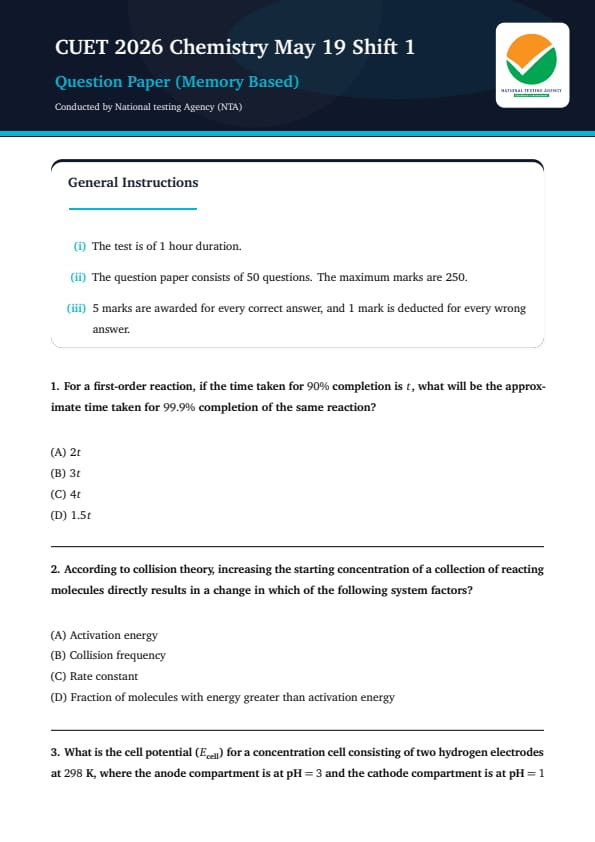
For a first-order reaction, if the time taken for \(90%\) completion is \(t\), what will be the approximate time taken for \(99.9%\) completion of the same reaction?
View Solution
Step 1 : Understanding the Question:
The topic of this question is Chemical Kinetics, specifically the integrated rate laws for first-order reactions. In a first-order reaction, the rate of the reaction is directly proportional to the concentration of only one reactant. This means that the time required to complete a certain percentage of the reaction is independent of the initial concentration. The question asks us to compare two different time intervals: one for 90% completion and another for 99.9% completion, and find a mathematical relationship between them.
Step 2 : Key Formulas and approach:
For a first-order reaction, the integrated rate equation is:
\[ k = \frac{2.303}{T} \log \frac{[A]_0}{[A]_t} \]
Alternatively, we can express time as:
\[ T = \frac{2.303}{k} \log \frac{[A]_0}{[A]_t} \]
Where:
- \(k\) is the rate constant for the reaction.
- \([A]_0\) is the initial concentration of the reactant.
- \([A]_t\) is the concentration remaining at time \(T\).
Our approach will be to calculate \(t_{90%}\) and \(t_{99.9%}\) separately and then find their ratio.
Step 3 : Detailed Explanation:
For 90% completion, let the initial concentration \([A]_0\) be 100 units. Since 90 units have reacted, the remaining concentration \([A]_t\) is \(100 - 90 = 10\) units.
Substituting these values into the first-order equation: \(t = \frac{2.303}{k} \log \frac{100}{10} = \frac{2.303}{k} \log(10)\).
Since \(\log(10) = 1\), we get the expression: \(t = \frac{2.303}{k} \times 1\). Let this be Equation 1.
For 99.9% completion, let the initial concentration \([A]_0\) again be 100 units. Since 99.9 units have reacted, the remaining concentration \([A]_t\) is \(100 - 99.9 = 0.1\) units.
Substituting these into the formula: \(t_{99.9%} = \frac{2.303}{k} \log \frac{100}{0.1} = \frac{2.303}{k} \log(1000)\).
Since \(\log(1000) = \log(10^3) = 3 \log(10) = 3\), the expression becomes: \(t_{99.9%} = \frac{2.303}{k} \times 3\). Let this be Equation 2.
By comparing Equation 1 and Equation 2, it is evident that \(t_{99.9%} = 3 \times (\frac{2.303}{k})\).
Since we know from Equation 1 that \(t = \frac{2.303}{k}\), we can substitute this value into Equation 2.
This yields the final relationship: \(t_{99.9%} = 3t\).
Step 4 : Final Answer:
The time taken for 99.9% completion is approximately three times the time taken for 90% completion. Thus, the correct option is (B).
Quick Tip: In first-order kinetics, powers of 10 in the denominator of the log ratio translate to multipliers. 90% complete means \(1/10\) left (\(\log 10 = 1\)), 99% means \(1/100\) left (\(\log 100 = 2\)), and 99.9% means \(1/1000\) left (\(\log 1000 = 3\)). Hence, the times are in the ratio 1:2:3!
According to collision theory, increasing the starting concentration of a collection of reacting molecules directly results in a change in which of the following system factors?
View Solution
Step 1 : Understanding the Question:
The topic of this question is Collision Theory in Chemical Kinetics. Collision theory explains how chemical reactions occur and why reaction rates differ for different reactions. It states that for a reaction to occur, reactant molecules must collide with each other with a minimum kinetic energy (activation energy) and proper orientation. The question asks which specific physical factor changes when we increase the concentration of the reactants within the framework of this theory.
Step 2 : Key Formulas and approach:
According to collision theory, the rate of a reaction is given by:
\[ Rate = Z_{AB} \cdot e^{-E_a/RT} \cdot P \]
Where:
- \(Z_{AB}\) is the collision frequency (number of collisions per unit volume per unit time).
- \(e^{-E_a/RT}\) represents the fraction of molecules that possess energy equal to or greater than the activation energy (\(E_a\)).
- \(P\) is the probability or steric factor.
The approach is to identify which of these variables is density-dependent.
Step 3 : Detailed Explanation:
Concentration refers to the number of molecules present in a given volume. When we increase the concentration, we are effectively crowding more particles into the same amount of space.
In a more crowded environment, the probability of molecules bumping into each other increases significantly. This results in a higher number of total collisions occurring per second.
This specific parameter—the total number of collisions per unit volume per unit time—is known as the "Collision Frequency" (\(Z\)). Therefore, increasing concentration directly increases collision frequency.
Activation Energy (\(E_a\)) is a characteristic property of the reaction path and the nature of the reactants. It does not change simply by adding more molecules; it is only altered by catalysts.
The rate constant (\(k\)) is dependent on temperature and the nature of the reaction, but it is defined as the rate when concentrations are unity, so it is independent of initial concentration changes.
The fraction of molecules with energy greater than \(E_a\) is determined by the Maxwell-Boltzmann distribution, which depends purely on the Temperature (\(T\)) of the system, not the concentration.
Since increasing concentration only increases the rate by providing more opportunities for collisions, "Collision Frequency" is the only correct choice.
Step 4 : Final Answer:
Increasing concentration increases the number of molecular encounters, thereby increasing the collision frequency. The correct option is (B).
Quick Tip: Think of a crowded dance floor. If you add more people (increase concentration), the number of times people bump into each other (collision frequency) goes up, even if everyone is still moving at the same speed!
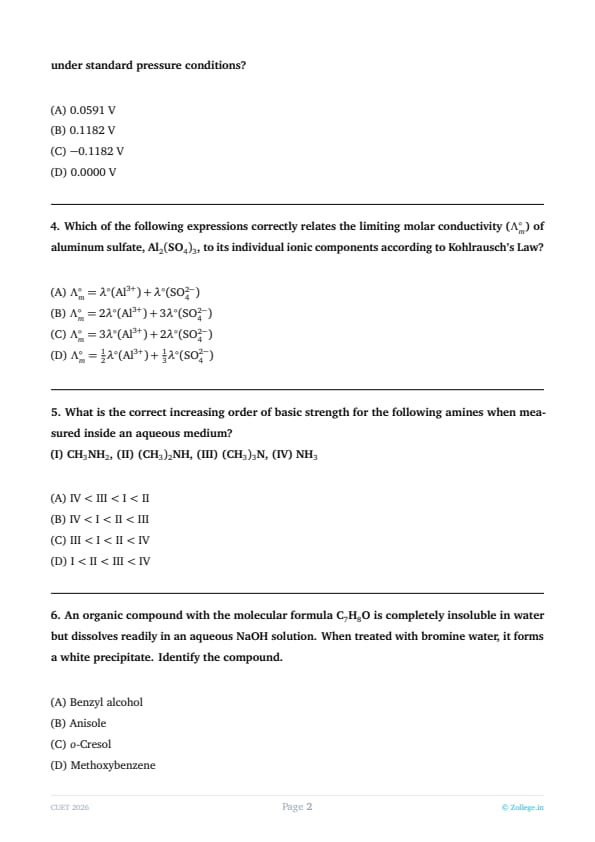
What is the cell potential (\(E_{cell}\)) for a concentration cell consisting of two hydrogen electrodes at \(298 K\), where the anode compartment is at \(pH = 3\) and the cathode compartment is at \(pH = 1\) under standard pressure conditions?
View Solution
Step 1 : Understanding the Question:
The topic of this question is Electrochemistry, specifically Concentration Cells. A concentration cell is an electrolytic cell that consists of two half-cells with identical electrodes but different concentrations of the same electrolyte. Because the electrodes are the same, the standard cell potential (\(E^\circ_{cell}\)) is zero. The electrical potential is generated entirely by the difference in concentration (or pH) between the two compartments. We need to calculate the cell potential using the Nernst equation for a hydrogen electrode system.
Step 2 : Key Formulas and approach:
The approach involves three main steps:
1. Converting pH to \([H^+]\) concentration using: \([H^+] = 10^{-pH}\).
2. Identifying the number of electrons transferred (\(n = 1\) for \(H^+ \rightarrow \frac{1}{2}H_2\)).
3. Applying the Nernst equation at \(298 K\):
\[ E_{cell} = E^\circ_{cell} - \frac{0.0591}{n} \log \frac{[H^+]_{anode}}{[H^+]_{cathode}} \]
Since \(E^\circ_{cell} = 0\) for concentration cells, the formula simplifies significantly.
Step 3 : Detailed Explanation:
First, we calculate the concentrations of hydrogen ions in both compartments. For the anode, \(pH = 3\), so \([H^+]_{anode} = 10^{-3} M\). For the cathode, \(pH = 1\), so \([H^+]_{cathode} = 10^{-1} M\).
The reaction at each electrode is \(H^+ + e^- \rightarrow \frac{1}{2}H_2\). Therefore, the number of electrons exchanged (\(n\)) is 1.
We now substitute these values into the simplified Nernst equation: \(E_{cell} = -0.0591 \log \frac{10^{-3}}{10^{-1}}\).
Simplifying the fraction inside the log: \(\frac{10^{-3}}{10^{-1}} = 10^{-3 - (-1)} = 10^{-2}\).
The equation becomes: \(E_{cell} = -0.0591 \times \log(10^{-2})\).
Using the property of logarithms (\(\log a^b = b \log a\)), we get: \(E_{cell} = -0.0591 \times (-2) \times \log(10)\).
Since \(\log(10) = 1\), the final calculation is: \(E_{cell} = +0.1182 V\).
The positive value indicates that the cell reaction is spontaneous in the direction calculated, with the higher concentration of \(H^+\) at the cathode pulling electrons from the lower concentration anode.
Step 4 : Final Answer:
The cell potential for the given hydrogen concentration cell is 0.1182 V. Thus, the correct option is (B).
Quick Tip: For any hydrogen concentration cell at 298 K, use the super-fast formula: \(E_{cell} = 0.0591 \times (pH_{anode} - pH_{cathode})\). Here, \(0.0591 \times (3 - 1) = 0.0591 \times 2 = 0.1182 V\)!
Which of the following expressions correctly relates the limiting molar conductivity (\(\Lambda_m^\circ\)) of aluminum sulfate, \(Al_2(SO_4)_3\), to its individual ionic components according to Kohlrausch's Law?
View Solution
Step 1 : Understanding the Question:
The topic of this question is Electrolytic Conductance, specifically Kohlrausch's Law of Independent Migration of Ions. This law states that at infinite dilution (limiting molar conductivity), each ion makes a definite contribution towards the total molar conductivity of an electrolyte, regardless of the nature of the other ion with which it is associated. The question asks us to identify the correct mathematical summation for Aluminum Sulfate based on its stoichiometric dissociation.
Step 2 : Key Formulas and approach:
Kohlrausch’s law is mathematically expressed as:
\[ \Lambda_m^\circ = \nu_+ \lambda^\circ_+ + \nu_- \lambda^\circ_- \]
Where:
- \(\Lambda_m^\circ\) is the limiting molar conductivity of the electrolyte.
- \(\lambda^\circ_+\) and \(\lambda^\circ_-\) are the limiting molar conductivities of the individual cation and anion.
- \(\nu_+\) and \(\nu_-\) are the stoichiometric coefficients (number of ions) produced per formula unit of the electrolyte.
The approach is to correctly write the dissociation equation for Aluminum Sulfate and identify the coefficients.
Step 3 : Detailed Explanation:
First, we must write the balanced dissociation equation for Aluminum Sulfate, \(Al_2(SO_4)_3\), in an aqueous solution.
When one mole of \(Al_2(SO_4)_3\) dissolves, it dissociates completely into its constituent ions: \(Al_2(SO_4)_3 \rightarrow 2Al^{3+} + 3SO_4^{2-}\).
From this equation, we can see that:
- Number of Aluminum cations (\(\nu_+\)) = 2.
- Number of Sulfate anions (\(\nu_-\)) = 3.
According to Kohlrausch's Law, the total molar conductivity is the sum of the conductivities of all individual ions produced.
Therefore, we multiply the limiting molar conductivity of \(Al^{3+}\) by its coefficient (2) and the limiting molar conductivity of \(SO_4^{2-}\) by its coefficient (3).
Summing these together gives: \(\Lambda_m^\circ = 2\lambda^\circ(Al^{3+}) + 3\lambda^\circ(SO_4^{2-})\).
This matches exactly with option (B). Option (A) is wrong because it ignores stoichiometry, while Option (C) swaps the coefficients incorrectly.
Step 4 : Final Answer:
Based on the dissociation stoichiometry of Aluminum Sulfate, the correct expression is option (B).
Quick Tip: Always "balance the formula" first! If the formula is \(A_x B_y\), the molar conductivity is always \(x \cdot \lambda(A) + y \cdot \lambda(B)\). Molar conductivity cares about the total number of particles moving in the solution!
What is the correct increasing order of basic strength for the following amines when measured inside an aqueous medium?
\((I) CH_3NH_2\), \((II) (CH_3)_2NH\), \((III) (CH_3)_3N\), \((IV) NH_3\)
View Solution
Step 1 : Understanding the Question:
The topic of this question is the Basic Strength of Amines. In the gaseous phase, basicity simply follows the \(+I\) (inductive) effect of alkyl groups. However, in an aqueous medium, the trend becomes much more complex due to the interplay of three different factors: the inductive effect, steric hindrance, and solvation (hydration) effects. The question specifically asks for the increasing order of basicity for ammonia and methyl-substituted amines in water.
Step 2 : Key Formulas and approach:
To solve this, we must balance three effects:
1. Inductive Effect (\(+I\)): Increases basicity as more alkyl groups donate electron density to the Nitrogen (\(3^\circ > 2^\circ > 1^\circ\)).
2. Solvation Effect: Water stabilizes the conjugate acid (\(RNH_3^+\)) via hydrogen bonding. Smaller ions with more hydrogens are better solvated (\(1^\circ > 2^\circ > 3^\circ\)).
3. Steric Effect: Bulky alkyl groups block the approach of water molecules or protons (\(1^\circ > 2^\circ > 3^\circ\)).
The combination of these factors results in a specific order for different alkyl groups.
Step 3 : Detailed Explanation:
Let's evaluate the methyl-substituted amines: Ammonia (\(IV\)), Methylamine (\(I\) - \(1^\circ\)), Dimethylamine (\(II\) - \(2^\circ\)), and Trimethylamine (\(III\) - \(3^\circ\)).
Ammonia (IV) is always the weakest base because it lacks any electron-donating alkyl groups to stabilize the positive charge on Nitrogen.
In the case of methyl groups, the small size of the methyl group allows for a unique balance. Secondary amine (II) is the strongest because it has two donating groups and is still well-solvated.
For the primary (I) and tertiary (III) amines, the competition between solvation and inductive effects is intense. In the case of methyl groups, the solvation of the primary amine's cation is so significant that it outweighs the \(+I\) effect of the tertiary amine.
Therefore, Trimethylamine (\(3^\circ\)) is actually less basic than Methylamine (\(1^\circ\)) in water.
Combining these results, the overall order of increasing basicity is: \(Ammonia (IV) < Trimethylamine (III) < Methylamine (I) < Dimethylamine (II)\).
This corresponds to the sequence \(IV < III < I < II\), which matches option (A).
Step 4 : Final Answer:
In an aqueous medium, methyl amines follow the 2-1-3 order of basicity, with ammonia being the weakest. The correct option is (A).
Quick Tip: Memorize the "213" and "231" rules for aqueous basicity! For Methyl groups, the order is Secondary > Primary > Tertiary (213). For Ethyl groups, it is Secondary > Tertiary > Primary (231). Secondary is always the winner!
An organic compound with the molecular formula \(C_7H_8O\) is completely insoluble in water but dissolves readily in an aqueous \(NaOH\) solution. When treated with bromine water, it forms a white precipitate. Identify the compound.
View Solution
Step 1 : Understanding the Question:
The topic of this question is the Identification of Organic Compounds, specifically focusing on the chemical properties of Phenols versus Alcohols and Ethers. We are given a molecular formula and three specific observations: water insolubility, solubility in \(NaOH\), and reaction with bromine water to form a white precipitate. These "chemical clues" allow us to narrow down the functional group and the specific isomer involved.
Step 2 : Key Formulas and approach:
The approach involves analyzing each experimental observation:
1. Formula \(C_7H_8O\): Indicates a high degree of unsaturation, likely an aromatic ring.
2. Solubility in \(NaOH\): This is a classic test for acidity. Carboxylic acids and phenols dissolve in \(NaOH\) by forming salts, while alcohols and ethers do not.
3. Bromine Water Test: Formation of a white precipitate is characteristic of highly activated aromatic rings (like phenols or amines) undergoing electrophilic substitution.
Step 3 : Detailed Explanation:
The molecular formula \(C_7H_8O\) can represent several isomers, including Benzyl Alcohol, Anisole (Methoxybenzene), and the three Cresols (\(o, m, p\)).
Observation 1: Solubility in aqueous \(NaOH\). Benzyl Alcohol (Option A) is a neutral alcohol and does not react with \(NaOH\). Anisole/Methoxybenzene (Options B and D) are ethers, which are also non-acidic and insoluble in \(NaOH\).
Cresols are phenolic compounds. Phenols are acidic (\(pKa \approx 10\)) and react with \(NaOH\) to form sodium phenoxides, which are ionic and soluble in water. This identifies the compound as a Cresol.
Observation 2: Bromine water reaction. Phenols have a strongly activating \(-OH\) group that makes the benzene ring highly reactive toward electrophiles like Bromine.
When a phenol (like \(o\)-Cresol) is treated with bromine water, it undergoes polybromination at the available ortho and para positions, resulting in the formation of a brominated derivative that appears as a white precipitate.
Since \(o\)-Cresol (\(C_7H_8O\)) is a phenol and exhibits all these properties, it fits the description perfectly.
Step 4 : Final Answer:
The acidic nature and reaction with bromine water identify the compound as a phenolic derivative, specifically \(o\)-Cresol. The correct option is (C).
Quick Tip: Remember the "Phenol Signature": If it dissolves in \(NaOH\) but NOT in \(NaHCO_3\), and it turns bromine water into a white precipitate, you are almost certainly looking at a Phenol!
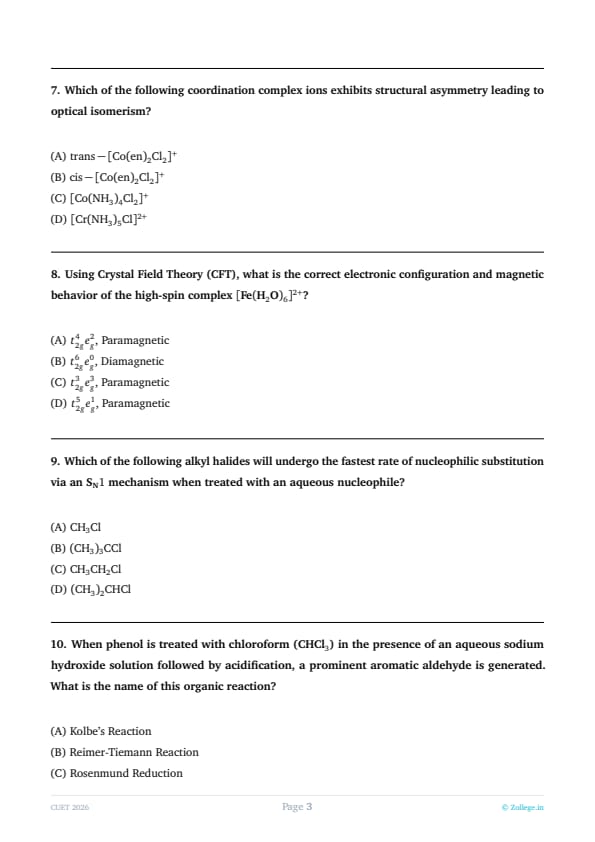
Which of the following coordination complex ions exhibits structural asymmetry leading to optical isomerism?
View Solution
Step 1 : Understanding the Question:
The topic of this question is Isomerism in Coordination Compounds, specifically focusing on Optical Isomerism. Optical isomers (enantiomers) are molecules that are non-superimposable mirror images of each other. In coordination chemistry, this typically happens when a complex lacks a plane of symmetry or a center of inversion. The question asks us to identify which coordination complex among the choices is chiral and thus optically active.
Step 2 : Key Formulas and approach:
The approach involves checking the symmetry elements of each complex:
1. Identify the geometry: All provided complexes are octahedral (coordination number 6).
2. Check for Plane of Symmetry (\(\sigma\)): If a plane can divide the molecule into two identical halves, it is achiral (optically inactive).
3. Focus on Chelating Ligands: Optical isomerism is very common in octahedral complexes containing bidentate ligands like ethylenediamine (en).
Step 3 : Detailed Explanation:
Option (A): \(trans-[Co(en)_2Cl_2]^+\). In the trans isomer, the two Chlorine ligands are opposite each other (180 degrees), and the two 'en' rings are also opposite. This molecule has a horizontal plane of symmetry passing through the Cobalt and the 'en' ligands. Therefore, it is achiral and optically inactive.
Option (B): \(cis-[Co(en)_2Cl_2]^+\). In the cis isomer, the two Chlorine ligands are adjacent (90 degrees), and the 'en' rings are also forced into a specific corner of the octahedron. This arrangement has no plane of symmetry or center of inversion. Consequently, it forms two non-superimposable mirror images (d- and l-forms). It is chiral and exhibits optical isomerism.
Option (C): \([Co(NH_3)_4Cl_2]^+\). This complex has only unidentate ligands. Even its cis-isomer has a plane of symmetry passing through the central metal. Thus, it does not show optical isomerism.
Option (D): \([Cr(NH_3)_5Cl]^{2+}\). This is an \(MA_5B\) type complex, which is highly symmetrical and possesses multiple planes of symmetry. It is optically inactive.
Comparing all options, only the cis configuration of a bis-chelating complex provides the necessary asymmetry for chirality.
Step 4 : Final Answer:
The cis isomer of \([Co(en)_2Cl_2]^+\) is the only complex in the list that lacks symmetry and shows optical isomerism. The correct option is (B).
Quick Tip: A quick rule for Octahedral complexes: "Trans is almost always Symmetrical (Inactive), while Cis with chelating ligands is almost always Asymmetrical (Active)." Look for 'en' or 'ox' in a cis position to find chirality!
Using Crystal Field Theory (CFT), what is the correct electronic configuration and magnetic behavior of the high-spin complex \([Fe(H_2O)_6]^{2+}\)?
View Solution
Step 1 : Understanding the Question:
The topic of this question is Crystal Field Theory (CFT). CFT explains the bonding and properties of coordination complexes by considering the electrostatic interactions between the central metal ion's \(d\)-orbitals and the surrounding ligands. In an octahedral field, the five degenerate \(d\)-orbitals split into two sets: \(t_{2g}\) (lower energy) and \(e_g\) (higher energy). The question asks for the electron distribution and magnetic nature of a specific Iron(II) complex.
Step 2 : Key Formulas and approach:
The approach involves these logical steps:
1. Determine the oxidation state of the metal: \(Fe + 6(0) = +2 \implies Fe^{2+}\).
2. Find the \(d\)-electron count: \(Fe\) is \([Ar]3d^6 4s^2\), so \(Fe^{2+}\) is \(3d^6\).
3. Assess ligand strength: \(H_2O\) is a weak-field ligand (from the spectrochemical series).
4. Apply the High-Spin vs. Low-Spin rule: For weak-field ligands, \(\Delta_o < P\) (pairing energy), resulting in a "High-Spin" complex.
Step 3 : Detailed Explanation:
We have an \(Fe^{2+}\) ion which has a \(d^6\) configuration. These 6 electrons need to be distributed among the \(t_{2g}\) and \(e_g\) levels.
Because \(H_2O\) is a weak-field ligand, the energy gap (\(\Delta_o\)) between the \(t_{2g}\) and \(e_g\) levels is relatively small. It is energetically "cheaper" for an electron to jump to the \(e_g\) level than to pair up in the \(t_{2g}\) level.
Following Hund's Rule of maximum multiplicity, we fill the orbitals one by one:
- Electrons 1, 2, and 3 go into the three \(t_{2g}\) orbitals.
- Electrons 4 and 5 go into the two \(e_g\) orbitals (instead of pairing).
- The 6th electron must now pair up in one of the \(t_{2g}\) orbitals.
This results in the configuration: \(t_{2g}^4 e_g^2\).
To determine the magnetic behavior, we look for unpaired electrons. In this configuration, there are 4 unpaired electrons (two in \(t_{2g}\) and two in \(e_g\)).
Any substance with one or more unpaired electrons is "Paramagnetic" (attracted by a magnetic field).
Thus, the complex is high-spin, paramagnetic, and has a \(t_{2g}^4 e_g^2\) configuration.
Step 4 : Final Answer:
The weak-field ligand results in a \(t_{2g}^4 e_g^2\) high-spin paramagnetic configuration. The correct option is (A).
Quick Tip: Remember the "Weak-Field, High-Spin" mantra! If the ligand is weak (like \(H_2O\), \(F^-\), \(Cl^-\)), electrons fill all the boxes singly before they start pairing up. This always leads to more unpaired electrons and stronger paramagnetism!
Which of the following alkyl halides will undergo the fastest rate of nucleophilic substitution via an \(S_{N}1\) mechanism when treated with an aqueous nucleophile?
View Solution
Step 1 : Understanding the Question:
The topic of this question is Nucleophilic Substitution Reactions, specifically the \(S_N1\) mechanism. The \(S_N1\) (Substitution Nucleophilic Unimolecular) reaction occurs in two steps, where the first and slowest step is the formation of a carbocation intermediate. The question asks which of the given alkyl halides will react the fastest. Since the rate-determining step depends on the stability of the carbocation, we need to compare the stability of the cations formed by each halide.
Step 2 : Key Formulas and approach:
The approach follows the carbocation stability trend:
1. Identify the carbocation formed by removing the leaving group (\(Cl^-\)) from each option.
2. Rank them by stability: \(Tertiary (3^\circ) > Secondary (2^\circ) > Primary (1^\circ) > Methyl\).
3. Stability is increased by \(+I\) (inductive effect) and hyperconjugation from adjacent alkyl groups.
The halide that forms the most stable carbocation will have the lowest activation energy for the first step and thus the fastest overall rate.
Step 3 : Detailed Explanation:
Let's analyze the carbocations produced by each option:
- Option (A): \(CH_3Cl \rightarrow CH_3^+\) (Methyl carbocation). This is the least stable possible carbocation.
- Option (C): \(CH_3CH_2Cl \rightarrow CH_3CH_2^+\) (Primary carbocation). It is slightly stabilized by one ethyl group.
- Option (D): \((CH_3)_2CHCl \rightarrow (CH_3)_2CH^+\) (Secondary carbocation). It is stabilized by two methyl groups.
- Option (B): \((CH_3)_3CCl \rightarrow (CH_3)_3C^+\) (Tertiary carbocation).
The tertiary carbocation (tert-butyl cation) is exceptionally stable compared to the others. It has three electron-donating methyl groups that spread out the positive charge via the inductive effect.
Additionally, it has 9 \(\alpha\)-hydrogens available for hyperconjugation, which significantly lowers the energy of the intermediate.
In \(S_N1\) reactions, the transition state for the rate-determining step resembles the carbocation. Therefore, the more stable the carbocation, the faster the reaction proceeds.
Tertiary alkyl halides like \((CH_3)_3CCl\) react almost exclusively via \(S_N1\) in polar protic solvents, while primary halides like \(CH_3Cl\) almost never do.
Step 4 : Final Answer:
The tertiary alkyl halide forms the most stable carbocation, leading to the fastest \(S_N1\) reaction rate. The correct option is (B).
Quick Tip: Think of carbocations as being "helped" by their neighbors. A tertiary Carbon has 3 neighbors to share its burden, while a Primary has only 1. More neighbors = More stability = Faster \(S_N1\)!
When phenol is treated with chloroform (\(CHCl_3\)) in the presence of an aqueous sodium hydroxide solution followed by acidification, a prominent aromatic aldehyde is generated. What is the name of this organic reaction?
View Solution
Step 1 : Understanding the Question:
The topic of this question is Named Organic Reactions involving Phenols. Phenols are highly reactive toward electrophilic aromatic substitution due to the strongly activating \(-OH\) group. There are several famous named reactions that introduce different functional groups onto the phenol ring. The question describes a specific reaction using chloroform and sodium hydroxide to produce an aromatic aldehyde and asks us to identify the name of this process.
Step 2 : Key Formulas and approach:
The approach is to match the reagents and products to known named reactions:
1. Phenol + Chloroform (\(CHCl_3\)) + \(NaOH \rightarrow\) Salicylaldehyde (\(o\)-hydroxybenzaldehyde).
2. Identify the active intermediate: Dichlorocarbene (\(:CCl_2\)).
3. Distinguish from similar reactions: For example, using \(CO_2\) instead of \(CHCl_3\) would lead to a different reaction.
Step 3 : Detailed Explanation:
The reaction described is the Reimer-Tiemann Reaction. It is a classic method for the ortho-formylation of phenols.
In the first step, Chloroform (\(CHCl_3\)) reacts with the base (\(NaOH\)) to produce a highly reactive, neutral electrophile called dichlorocarbene (\(:CCl_2\)).
This dichlorocarbene attacks the electron-rich phenoxide ion (formed by phenol and \(NaOH\)) at the ortho position.
After subsequent hydrolysis of the intermediate and final acidification, a \(-CHO\) (formyl) group is successfully attached to the ring, producing Salicylaldehyde.
Let's evaluate the other options:
- Kolbe's Reaction (Option A) uses \(NaOH\) and Carbon Dioxide (\(CO_2\)) to produce Salicyllic Acid (not an aldehyde).
- Rosenmund Reduction (Option C) involves the hydrogenation of acyl chlorides to aldehydes using a poisoned catalyst.
- Friedel-Crafts Acylation (Option D) uses acyl halides and \(AlCl_3\) to add ketone groups to an aromatic ring.
Since the reagents are \(CHCl_3\) and \(NaOH\), the reaction is uniquely identified as the Reimer-Tiemann Reaction.
Step 4 : Final Answer:
The introduction of a formyl group using chloroform and alkali is known as the Reimer-Tiemann Reaction. The correct option is (B).
Quick Tip: A quick way to tell the two Phenol reactions apart: 1. Reimer-Tiemann uses Chloroform and makes an Aldehyde (Salicylaldehyde). 2. Kolbe's uses \(CO_2\) and makes an Acid (Salicylic acid). Just remember: "Chloroform \(\rightarrow\) Carbene \(\rightarrow\) Choice Aldehyde!"
CUET 2026 Complete Chemistry Revision
*The article might have information for the previous academic years, please refer the official website of the exam.