
CUET 2026 English Question Paper May 18 Shift 1 with Solution Pdf


| Updated On - May 18, 2026
CUET 2026 May 18 Shift 1 English Question Paper with Solution PDF is available here for download. NTA conducted CUET 2026 on May 18, Shift 1, from 9 AM to 12 PM in CBT Mode.
The CUET 2026 English Question Paper includes three sections: Reading Comprehension, Verbal Ability & Grammar and Usage, with 50 Questions carrying a total of 250 marks. As per the CUET marking scheme, +5 marks are awarded for every correct answer, and -1 mark is deducted for every wrong answer.
CUET 2026 English Question Paper May 18 Shift 1 with Solution PDF
| CUET 2026 English Question Paper | Download PDF | Check Solutions |
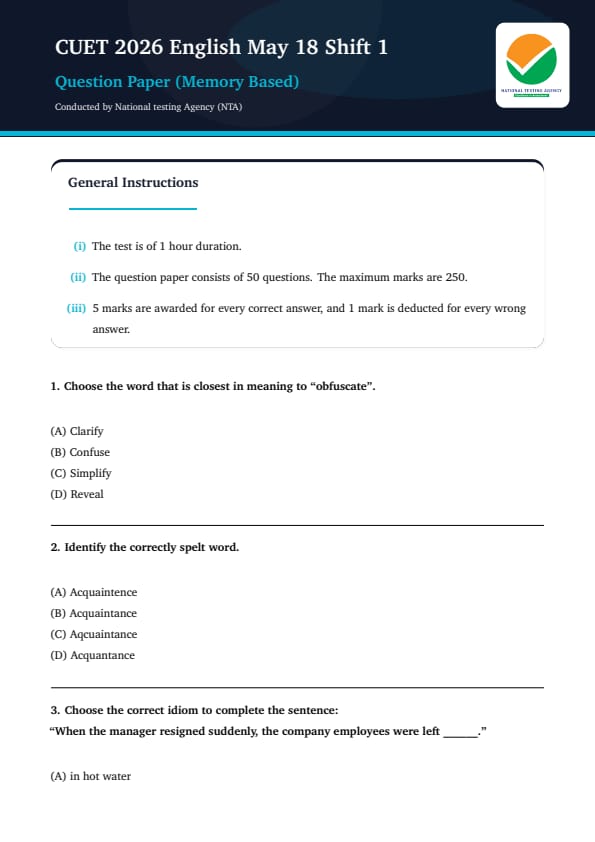
Choose the word that is closest in meaning to “obfuscate”.
View Solution
Topic: English Vocabulary (Synonyms)
Step 1 : Understanding the Question:
The objective of this question is to identify the synonym for the word "obfuscate." In linguistic assessments, synonyms are words that share a nearly identical meaning within a specific context. The word "obfuscate" is often used in professional or academic writing to describe a lack of clarity.
Step 2 : Key Formulas and approach:
The primary approach involves defining the root word and evaluating the nuance of each provided option. The word "obfuscate" originates from the Latin "obfuscare," meaning to darken. In modern English, it refers to the act of making something difficult to perceive or understand.
Step 3 : Detailed Explanation:
Obfuscate: This verb is used when someone deliberately makes a subject or statement unclear to hide the truth or avoid a direct answer. For example, a politician might obfuscate their actual stance on a policy using complex jargon.
(A) Clarify: This is the direct antonym. To clarify means to make something easier to understand by providing more details or a simpler explanation.
(B) Confuse: This word is the closest synonym. To confuse means to cause someone to become bewildered or to make a situation unclear. It perfectly captures the essence of "obfuscating" a point.
(C) Simplify: This is another antonym. Simplifying involves removing complexity to increase understanding, which is the opposite of obfuscation.
(D) Reveal: This means to make something known that was previously secret. While obfuscation hides the truth, revealing brings it to light.
Step 4 : Final Answer:
The word that is closest in meaning to “obfuscate” is (B) Confuse.
Quick Tip: Associate "obfuscate" with "obscure." Both start with "ob-" and relate to things that are hidden or not easily seen. If you see "ob-" in a word about understanding, think of a barrier or a cloud blocking the view!
Identify the correctly spelt word.
View Solution
Topic: English Vocabulary (Spelling)
Step 1 : Understanding the Question:
This question tests the candidate's ability to recognize the standard spelling of a common but frequently misspelled English noun. Spelling mastery requires knowledge of prefix-root-suffix combinations and silent letter patterns.
Step 2 : Key Formulas and approach:
The most effective approach is the syllabic breakdown method. By dividing the word into its constituent parts—prefix, root, and suffix—one can identify the correct morphological structure. The word is composed of "ac-" (prefix), "quaint" (the root), and "-ance" (the suffix).
Step 3 : Detailed Explanation:
The Root Word: The core of the word is "quaint," which relates to something familiar or known. This requires the "q-u-a-i-n-t" sequence. Option (C) is eliminated because it places the 'c' before the 'q'.
The Prefix: The prefix "ac-" is added to the beginning. Option (D) "Acquantance" is incorrect because it misses the "i" that is essential to the "quaint" root.
The Suffix (-ance vs -ence): A common error in English is confusing the suffixes "-ance" and "-ence." For "acquaintance," the noun is derived from the Old French "acointance," which dictates the use of an 'a' in the final syllable.
Final Construction: When we assemble ac + quaint + ance, we arrive at the spelling "Acquaintance," which refers to a person one knows slightly but is not a close friend.
Step 4 : Final Answer:
The correctly spelt word among the choices is (B) Acquaintance.
Quick Tip: To remember this spelling, focus on the word "quaint" in the middle. Tell yourself: "I am ACquainted with a QUAINT person named ANCE." This mnemonic helps you remember the 'i' and the 'a' at the end!
Choose the correct idiom to complete the sentence:
“When the manager resigned suddenly, the company employees were left ______.”
View Solution
Topic: English Grammar (Idioms and Phrases)
Step 1 : Understanding the Question:
This question requires selecting an idiomatic expression that logically fits the context of being abandoned or left in a difficult situation following a sudden resignation. Idioms are phrases where the meaning is figurative rather than literal.
Step 2 : Key Formulas and approach:
The approach involves a "Context-Match" analysis. First, define the situation: A leader has left unexpectedly, creating a vacuum of support. Next, define each idiom to see which one describes "helplessness due to abandonment."
Step 3 : Detailed Explanation:
(A) In hot water: This means to be in trouble or facing potential punishment. While the employees might be stressed, the sentence doesn't imply they did anything wrong to be in trouble.
(B) Under the weather: This refers specifically to feeling ill or sick. It has no logical connection to a professional resignation.
(C) High and dry: This idiom means to be left in a difficult position without help or resources. It originates from ships being stranded on the shore when the tide goes out. This perfectly describes employees left without a manager to guide them.
(D) At sixes and sevens: This means to be in a state of confusion or disagreement. While the employees might be confused, "high and dry" more accurately emphasizes the lack of support caused by the manager's departure.
Step 4 : Final Answer:
The most fitting idiom for the context of abandonment is (C) high and dry.
Quick Tip: Think of a boat stranded on a beach when the water disappears. It is "high" on the sand and "dry" because the water is gone. Similarly, a team is "high and dry" when their leader leaves them stranded!
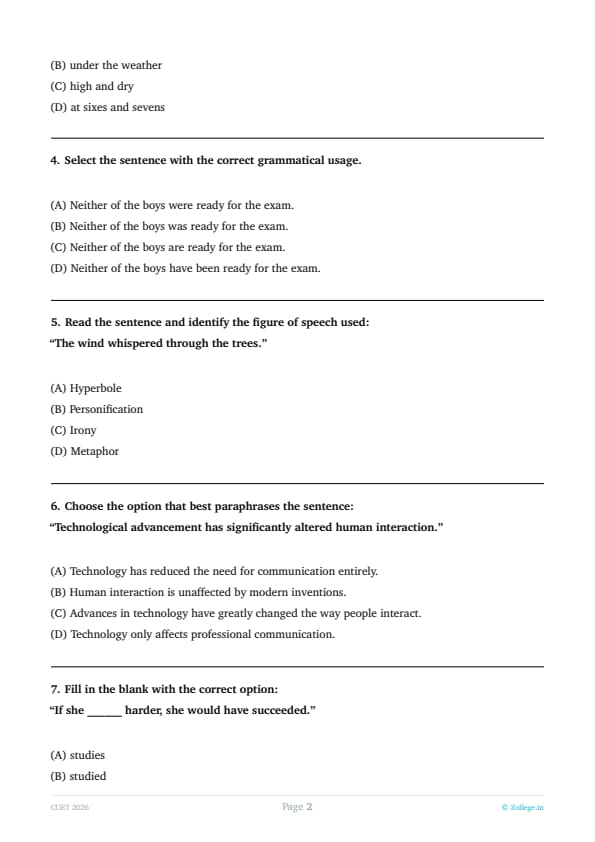
Select the sentence with the correct grammatical usage.
View Solution
Topic: English Grammar (Subject-Verb Agreement)
Step 1 : Understanding the Question:
The focus of this question is Subject-Verb Agreement involving distributive pronouns. The goal is to determine whether the subject "Neither" requires a singular or plural verb form in formal English.
Step 2 : Key Formulas and approach:
The "Rule of Distributive Pronouns" states that words like "each," "either," and "neither" refer to individuals within a group one at a time. Therefore, they are grammatically singular. The formula is: [Singular Pronoun] + [Prepositional Phrase] + [Singular Verb].
Step 3 : Detailed Explanation:
Subject Identification: In the phrase "Neither of the boys," the word "boys" is the object of the preposition "of." The actual subject is "Neither." Beginners often mistakenly use the plural verb because of the word "boys."
Singular vs Plural Verb: Since "Neither" means "not one and not the other," it functions as a singular entity. In the past tense, the singular verb is "was" and the plural is "were."
Analysis of Options: Options (A), (C), and (D) all use plural verbs—"were," "are," and "have been," respectively. These are grammatically incorrect in formal writing when paired with "neither."
Correct Application: Option (B) uses "was," which correctly matches the singular nature of the subject "Neither."
Step 4 : Final Answer:
The grammatically accurate sentence is (B) Neither of the boys was ready for the exam.
Quick Tip: Ignore the "of the [plural]" part. If you read the sentence as "Neither \_\_\_\_ ready," your ear will naturally want to say "Neither WAS ready." The phrase in the middle is just a distractor!
Read the sentence and identify the figure of speech used:
“The wind whispered through the trees.”
View Solution
Topic: English Literature (Figures of Speech)
Step 1 : Understanding the Question:
This question asks for the identification of a literary device where a non-human entity is described as having human attributes. Figures of speech enhance the imagery and emotional impact of a sentence.
Step 2 : Key Formulas and approach:
The approach involves "Attributive Analysis." Identify the subject (the wind) and the action (whispered). Check if the action is a biological or intentional human trait. If a human trait is assigned to an inanimate object, it is personification.
Step 3 : Detailed Explanation:
Identifying the Subject: The subject "wind" is an atmospheric phenomenon. It does not possess a voice, vocal cords, or the consciousness required to "whisper."
Analyzing the Verb: "Whispering" is a human mode of communication used to convey secrets or quiet thoughts. By saying the wind whispered, the author is giving the wind a human personality.
Eliminating Other Figures:
Hyperbole: This is extreme exaggeration (e.g., "I'm so hungry I could eat a horse").
Irony: This involves a contradiction between expectation and reality.
Metaphor: This is a direct comparison (e.g., "The wind was a ghostly singer"). While similar, personification is more specific to human actions.
Conclusion: Because a human action is given to a natural element, the device is Personification.
Step 4 : Final Answer:
The figure of speech utilized here is (B) Personification.
Quick Tip: Personification contains the word "Person." If you see an object (like a cloud, a chair, or the wind) acting like a "Person," you have found your answer!
Choose the option that best paraphrases the sentence:
“Technological advancement has significantly altered human interaction.”
View Solution
Topic: English Comprehension (Paraphrasing Skills)
Step 1 : Understanding the Question:
Paraphrasing is the process of restating a sentence using different vocabulary while maintaining the original meaning, intent, and scope. This question tests the ability to recognize synonymous phrases and logical consistency.
Step 2 : Key Formulas and approach:
Use the "Synonym Substitution and Logic Check" approach. Identify key components: 1. Subject (Technological advancement), 2. Action (significantly altered), 3. Object (human interaction). A correct paraphrase must reflect all three without adding or removing information.
Step 3 : Detailed Explanation:
Component 1: "Technological advancement" is synonymous with "Advances in technology." Both terms describe the progression of tools and digital systems.
Component 2: "Significantly altered" means the same as "greatly changed." "Significantly" implies a large degree, and "altered" means modified.
Component 3: "Human interaction" refers to "the way people interact." This covers both social and professional communication.
Evaluating Options:
(A) uses "entirely," which is too extreme and not in the original text.
(B) contradicts the original sentence entirely.
(D) limits the scope to "professional" only, which the original sentence did not do.
Selection: Option (C) maintains the same scope and meaning using different but equivalent wording.
Step 4 : Final Answer:
The best paraphrase for the given sentence is (C).
Quick Tip: When paraphrasing, watch out for "limiters" or "extremes" like only, always, never, or entirely. If the original sentence doesn't use them, the correct answer shouldn't either!
Fill in the blank with the correct option:
“If she ______ harder, she would have succeeded.”
View Solution
Topic: English Grammar (Conditionals)
Step 1 : Understanding the Question:
The sentence requires the correct tense to complete a conditional structure. This specific sentence describes a hypothetical past situation that did not happen and its imagined result.
Step 2 : Key Formulas and approach:
This follows the "Third Conditional" formula. The structure for Third Conditionals is: If + Subject + Past Perfect (had + \(V_3\)), Subject + would have + Past Participle (\(V_3\)). This formula is used to talk about "impossible" past conditions.
Step 3 : Detailed Explanation:
Identifying the Clue: The second part of the sentence says "she would have succeeded." This "would have + \(V_3\)" structure is the definitive marker for a third conditional result clause.
Determining the Tense: According to grammatical rules, the "If" clause in a third conditional sentence must be in the Past Perfect tense. The Past Perfect is formed using the auxiliary "had" followed by the past participle of the verb.
Evaluating Verb Forms:
(A) "studies" is Simple Present (First Conditional).
(B) "studied" is Simple Past (Second Conditional).
(D) "has studied" is Present Perfect, which is not used in "If" clauses.
Conclusion: Option (C) "had studied" is the only form that correctly completes the Past Perfect requirement.
Step 4 : Final Answer:
The correct grammatical choice is (C) had studied.
Quick Tip: Remember the "Double Had/Would" rule of thumb: If you see "would have" in one half, you almost certainly need "had" (Past Perfect) in the other half to balance the sentence!
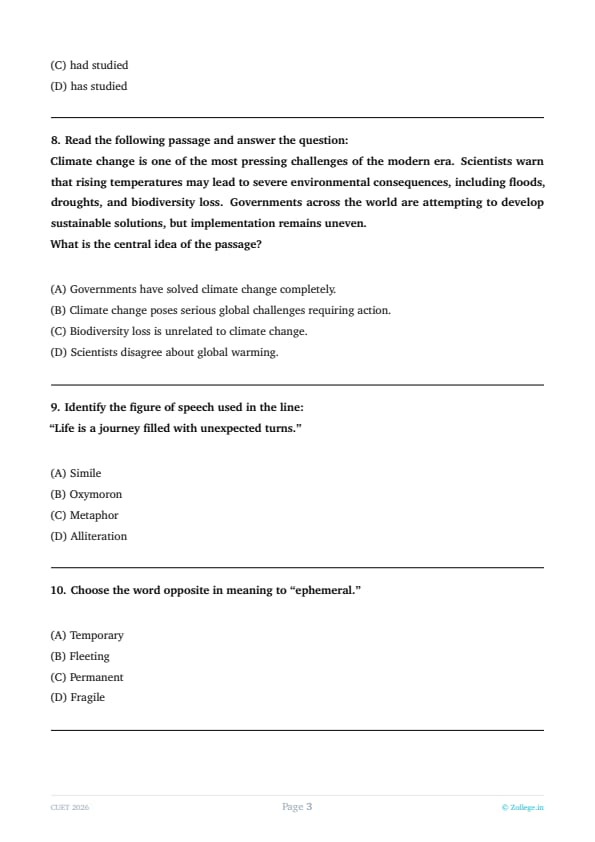
Read the following passage and answer the question:
Climate change is one of the most pressing challenges of the modern era. Scientists warn that rising temperatures may lead to severe environmental consequences, including floods, droughts, and biodiversity loss. Governments across the world are attempting to develop sustainable solutions, but implementation remains uneven.
What is the central idea of the passage?
View Solution
Topic: Reading Comprehension
Step 1 : Understanding the Question:
The objective is to identify the "Central Idea," which is the primary message or overarching theme of the text. It must be a statement that encompasses the majority of the information provided in the passage.
Step 2 : Key Formulas and approach:
Use the "Gist Extraction" method. Break the passage into three parts: The Topic (Climate Change), The Problem (environmental consequences), and The Response (government attempts/challenges). The central idea must bridge all three parts.
Step 3 : Detailed Explanation:
Sentence 1 Analysis: Sets the stage by calling climate change a "pressing challenge." This indicates the serious nature of the topic.
Sentence 2 Analysis: Details the specific threats (floods, droughts). This supports the idea that it is a "serious challenge."
Sentence 3 Analysis: Mentions governments developing solutions. This implies that "action" is being attempted, though it is difficult.
Critiquing Options:
(A) is factually incorrect based on the text ("implementation remains uneven").
(C) contradicts the text, which lists biodiversity loss as a consequence.
(D) is not mentioned; the text says "Scientists warn" (general agreement), not that they disagree.
Conclusion: Option (B) captures the urgency (serious challenges) and the need for a response (requiring action).
Step 4 : Final Answer:
The central idea is accurately reflected in option (B).
Quick Tip: To find the central idea, ask yourself: "If I had to summarize this whole paragraph in just one sentence for a friend, what would I say?" Usually, the first or last sentence of a short paragraph gives you the best hint!
Identify the figure of speech used in the line:
“Life is a journey filled with unexpected turns.”
View Solution
Topic: Poetic Devices / Figures of Speech
Step 1 : Understanding the Question:
The question asks to identify the specific poetic device used to compare life to a journey. Understanding how comparisons are constructed is key to identifying different figures of speech.
Step 2 : Key Formulas and approach:
Compare the "Simile vs. Metaphor" formulas. A Simile uses "like" or "as" (\(A\) is like \(B\)). A Metaphor makes a direct assertion (\(A\) is \(B\)). If the comparison is direct and equates two unlike things, it is a Metaphor.
Step 3 : Detailed Explanation:
Identifying the Comparison: The sentence compares "Life" (an abstract concept of existence) to a "journey" (a physical act of traveling from one place to another).
Analyzing the Structure: The sentence does not say "Life is LIKE a journey." Instead, it says "Life IS a journey." This direct equation is the hallmark of a metaphor.
Reviewing Other Options:
(A) Simile: Incorrect because "like" or "as" is missing.
(B) Oxymoron: Incorrect because there are no contradictory terms used together (like "bittersweet").
(D) Alliteration: Incorrect because there is no significant repetition of initial consonant sounds.
Significance: The metaphor suggests that life involves progress, destinations, and obstacles, just like a road trip or a voyage.
Step 4 : Final Answer:
The figure of speech used in the statement is (C) Metaphor.
Quick Tip: A Metaphor is a "Direct Comparison." Think of the 'M' in Metaphor standing for "Mapping" one thing directly onto another. If there's no "like" or "as," it's a Metaphor!
Choose the word opposite in meaning to “ephemeral.”
View Solution
Topic: English Vocabulary (Antonyms)
Step 1 : Understanding the Question:
This question focuses on identifying an "Antonym," which is a word with the opposite meaning of the target word "ephemeral." Antonym questions require a precise understanding of the word's duration or quality.
Step 2 : Key Formulas and approach:
The approach involves "Duration Mapping." First, define the duration associated with "ephemeral." Then, look for an option that represents the opposite extreme of that duration (infinite vs. short-lived).
Step 3 : Detailed Explanation:
Defining Ephemeral: This word describes something that lasts for a very short time. It is often used to describe things like a sunset, a mayfly's life, or a passing fashion trend.
Analyzing Synonyms (A and B):
"Temporary" means lasting for a limited time.
"Fleeting" means lasting for a very short time. Both are synonyms of ephemeral, not opposites.
Analyzing the Distractor (D): "Fragile" refers to something easily broken. While ephemeral things (like bubbles) are often fragile, the words describe different qualities (time vs. strength).
Analyzing the Antonym (C): "Permanent" means intended to last or remain unchanged indefinitely. This is the exact logical opposite of a short-lived or ephemeral state.
Step 4 : Final Answer:
The word opposite in meaning to “ephemeral” is (C) Permanent.
Quick Tip: Think of "Ephemeral" as a "Flash" of light—it's there and then it's gone. Think of "Permanent" as a "Stone Mountain"—it stays there forever. The flash and the mountain are opposites in time!
CUET 2026 English Revision Marathon
*The article might have information for the previous academic years, please refer the official website of the exam.