
CUET 2026 English Question Paper May 19 Shift 1 with Solution Pdf


| Updated On - May 19, 2026
CUET 2026 May 19 Shift 1 English Question Paper with Solution PDF is available here for download. NTA conducted CUET 2026 on May 19, Shift 1, from 9 AM to 12 PM in CBT Mode.
The CUET 2026 English Question Paper includes three sections: Reading Comprehension, Verbal Ability & Grammar and Usage, with 50 Questions carrying a total of 250 marks. As per the CUET marking scheme, +5 marks are awarded for every correct answer, and -1 mark is deducted for every wrong answer.
CUET 2026 English Question Paper May 19 Shift 1 with Solution PDF
| CUET 2026 English Question Paper | Download PDF | Check Solutions |
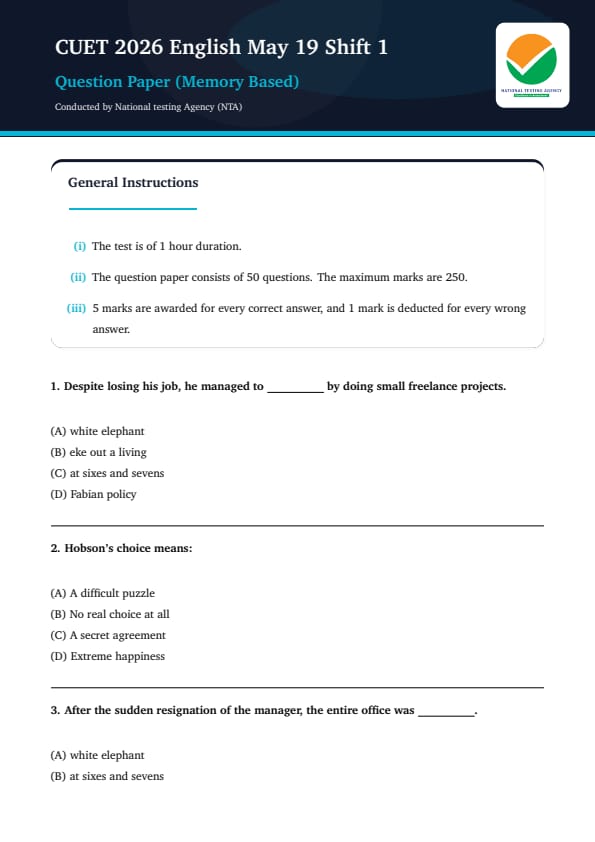
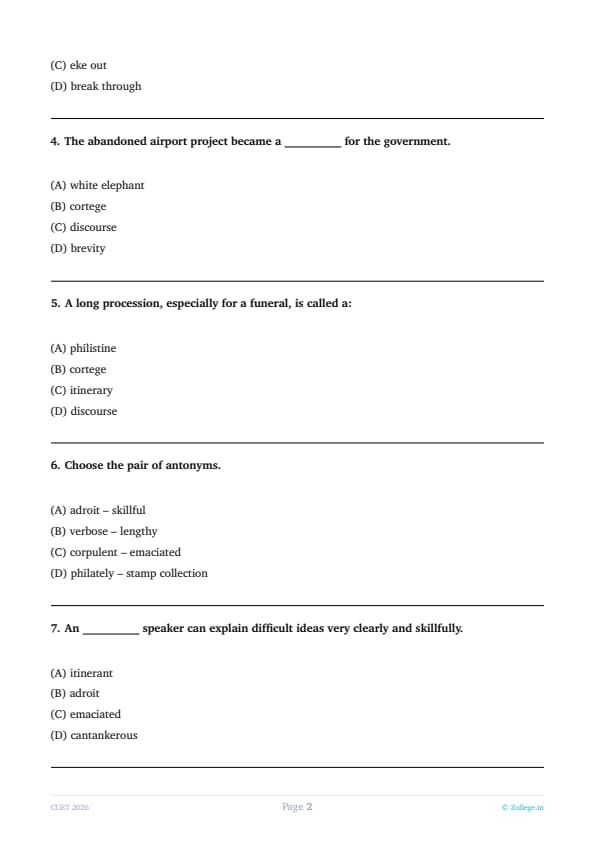
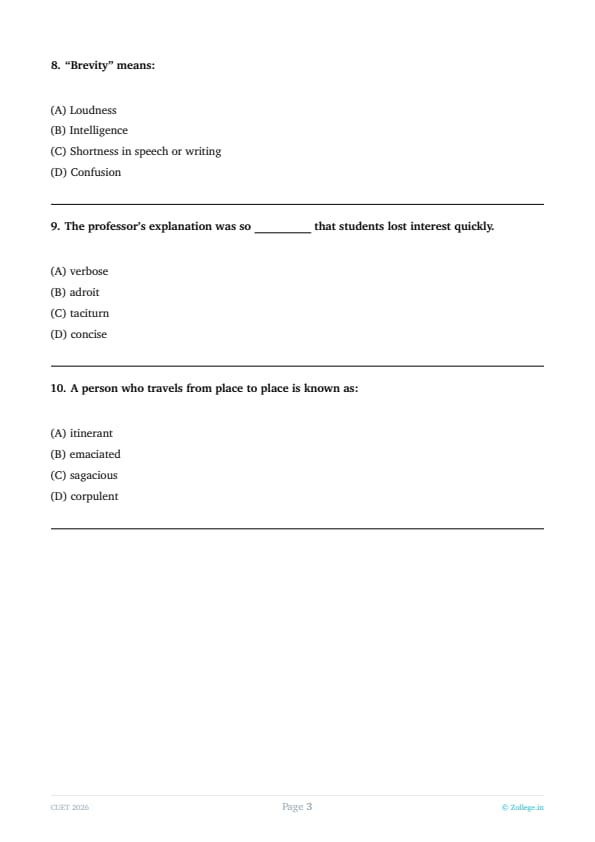
Despite losing his job, he managed to \hspace{2cm} by doing small freelance projects.
View Solution
Step 1 : Understanding the Question:
The subject of this question is English Vocabulary, specifically focusing on the usage of idiomatic expressions within a given context. The sentence describes a person who has suffered a financial setback (losing a job) but is finding a way to survive through supplemental work. We are looking for an idiom that fits the act of maintaining one's existence or livelihood with difficulty or through minimal means.
Step 2 : Key Formulas and approach:
The primary approach for solving this is contextual analysis combined with the process of elimination.
1. Context identification: The sentence requires a verb phrase that describes survival under pressure.
2. Semantic matching: Compare the literal and figurative meanings of the idioms to the scenario of earning just enough money to get by.
3. Grammatical check: Ensure the idiom functions as a verb phrase following the infinitive "to."
Step 3 : Detailed Explanation:
Option (A) "white elephant" refers to a noun—specifically an object that is more trouble than it is worth or very expensive to maintain without providing any use. It does not fit the grammatical requirement of the sentence.
Option (B) "eke out a living" is the correct choice. To "eke out" something means to supplement it or to make a meager amount last. In this context, it refers to the person using small projects to barely make enough money to survive after losing a steady salary.
Option (C) "at sixes and sevens" is an adjective phrase describing a state of confusion, disorder, or disagreement. While a person might feel this way after losing a job, the phrase does not work as an action for "managing to" do something regarding freelance work.
Option (D) "Fabian policy" refers to a strategy of caution and delay. This is usually applied in political or military contexts and has no relevance to the daily struggle of earning a basic income through freelance projects.
Step 4 : Final Answer:
After evaluating the definitions, "eke out a living" is the only idiom that captures the struggle for survival mentioned in the prompt, making Option (B) the correct choice.
Quick Tip: Visualize "eking" as "squeezing." When you eke out a living, you are squeezing every bit of value or money out of your resources to make sure you can stay afloat during hard times!
Hobson’s choice means:
View Solution
Step 1 : Understanding the Question:
This question deals with English Idioms and Phrases, particularly those derived from historical figures or specific cultural events. The term "Hobson's choice" is an idiomatic expression used to describe a situation where an individual is presented with a choice that is essentially forced or restricted to just one possibility. We must identify the definition that reflects this "take it or leave it" scenario.
Step 2 : Key Formulas and approach:
The approach involves understanding the etymological roots of common idioms.
1. Identify the origin: Many idioms have stories behind them (like Hobson's stable).
2. Analyze the paradox: "Choice" usually implies multiple options, but this idiom represents the opposite.
3. Compare definitions: Evaluate the provided options against the concept of a restricted selection.
Step 3 : Detailed Explanation:
The phrase originates from Thomas Hobson, a stable owner in the 16th century who rented out horses. To prevent his best horses from being overworked, he told his customers they could have the horse in the stall nearest the door or no horse at all. This meant they had no real selection.
Option (A) "A difficult puzzle" refers to a "conundrum" or "enigma." This does not match the theme of making a decision between available options.
Option (B) "No real choice at all" is the correct answer. It perfectly encapsulates the "Hobson" scenario where the alternative to the single offered option is simply to have nothing, thus removing the actual element of choice.
Option (C) "A secret agreement" is better described by the word "collusion" or "cabal." This relates to group dynamics rather than an individual choice.
Option (D) "Extreme happiness" refers to states like "bliss" or "euphoria," which have no logical connection to the logistics of picking a horse or an item.
Step 4 : Final Answer:
Given the historical context of a restricted "take it or leave it" offer, Option (B) is the accurate definition of "Hobson's choice."
Quick Tip: To remember "Hobson's choice," think of a restaurant that only has one dish left on the menu. You can either eat that specific dish or not eat at all—that is the illusion of choice!
After the sudden resignation of the manager, the entire office was \hspace{2cm}.
View Solution
Step 1 : Understanding the Question:
This problem falls under the topic of English Idioms and Phrases. The sentence provides a specific context: a workplace where leadership has suddenly disappeared due to a resignation. Such an event typically causes a breakdown in organization, leading to confusion among staff. We need to find the idiom that best describes a state of total disorder or lack of coordination.
Step 2 : Key Formulas and approach:
The approach for this question involves contextual sentiment analysis.
1. Evaluate the scenario: A sudden resignation is a disruptive event.
2. Identify the required state: The blank should be filled with a phrase describing chaos or lack of organization.
3. Linguistic check: Ensure the phrase can act as a complement to the verb "was."
Step 3 : Detailed Explanation:
Option (A) "white elephant" refers to an expensive and useless object. While an office could be a white elephant if it were costly and empty, the phrase doesn't describe the "state" of the people or the environment after a resignation.
Option (B) "at sixes and sevens" is the correct idiom. It originated from a dispute between London livery companies but evolved to mean a state of confusion, disorder, or disagreement. In the absence of a manager, the office would naturally be in this state of disarray.
Option (C) "eke out" is a verb meaning to survive with difficulty. It is grammatically incorrect to say the "office was eke out."
Option (D) "break through" refers to a significant success or discovery. This contradicts the negative or disruptive tone set by the "sudden resignation" of a key leader.
Step 4 : Final Answer:
Because "at sixes and sevens" describes the exact state of confusion expected in a leaderless office, Option (B) is the correct answer.
Quick Tip: Imagine a game where two people are shouting different numbers (like 6 and 7) and nobody can agree on the rules. That’s why "at sixes and sevens" means everything is a mess and nothing is organized!
The abandoned airport project became a \hspace{2cm} for the government.
View Solution
Step 1 : Understanding the Question:
The topic of this question is English Vocabulary and Idiomatic Usage. The sentence refers to a large-scale government infrastructure project (an airport) that has been "abandoned." For a government, such a project represents a massive waste of taxpayer money and a site that is expensive to maintain without providing any public benefit. We need a word or idiom that describes this specific type of burden.
Step 2 : Key Formulas and approach:
The approach involves identifying the relationship between "cost" and "utility."
1. Define the object: High cost, low or zero utility.
2. Search for specialized idioms: Find the term that specifically describes useless and expensive possessions.
3. Eliminate non-idiomatic or irrelevant nouns.
Step 3 : Detailed Explanation:
Option (A) "white elephant" is the correct answer. This idiom is used to describe a possession that its owner cannot dispose of and whose cost, particularly that of maintenance, is out of proportion to its usefulness. It perfectly describes a failed, expensive airport project.
Option (B) "cortege" refers to a solemn funeral procession. It has no logical connection to an engineering or financial project.
Option (C) "discourse" means written or spoken communication or debate. While the government might have a discourse *about* the project, the project itself is an object, not a conversation.
Option (D) "brevity" refers to the quality of being short in duration or concise in speech. It does not fit the description of a large physical structure or a financial disaster.
Step 4 : Final Answer:
The phrase "white elephant" is the standard idiomatic term for a costly, failed project, making Option (A) the correct choice.
Quick Tip: In ancient Thailand, kings would gift a white elephant to people they hated. The elephant was sacred (so it couldn't be worked) but huge (so it was expensive to feed). It was a gift designed to ruin the person!
A long procession, especially for a funeral, is called a:
View Solution
Step 1 : Understanding the Question:
This is a One Word Substitution question within the English Vocabulary section. We are provided with a definition: "a long procession, especially for a funeral." The goal is to identify which single word from the options accurately represents this specific collective noun or event description.
Step 2 : Key Formulas and approach:
The approach is based on lexical precision and definition matching.
1. Identify keywords: "Procession" and "Funeral."
2. Differentiate between similar concepts: Distinguish between a plan for a trip and a physical line of people.
3. Validate choice: Ensure the chosen word is specifically associated with the solemn nature of a funeral.
Step 3 : Detailed Explanation:
Option (A) "philistine" is a term for a person who is hostile or indifferent to culture and the arts. This is a behavioral or personality trait and is unrelated to a group of people at a funeral.
Option (B) "cortege" is the correct term. It specifically refers to a train of attendants, a procession, or a formal line of people and vehicles following a casket or moving as part of a funeral ceremony.
Option (C) "itinerary" refers to a detailed plan or route for a journey. While a procession moves along a route, the "itinerary" is the paper or plan itself, not the physical group of people.
Option (D) "discourse" means a formal discussion, speech, or piece of writing on a particular subject. It belongs to the realm of language and communication, not physical movement or ceremonies.
Step 4 : Final Answer:
The word that perfectly substitutes the given phrase is "cortege," which corresponds to Option (B).
Quick Tip: Think of "Cortege" as a "Courtly" procession. Just as a king’s court follows him in a formal line, a cortege is a formal line that follows a casket or a mourner.
Choose the pair of antonyms.
View Solution
Step 1 : Understanding the Question:
This question focuses on Antonyms and Word Relationships. An antonym is a word that has the exact opposite meaning of another word. The task is to examine each pair provided in the options and determine which pair represents a "Fat vs. Thin" or "High vs. Low" relationship, while the others might be synonyms or definitions.
Step 2 : Key Formulas and approach:
The approach involves a semantic audit of each word pair.
1. Define Word 1 and Word 2 in each option.
2. Determine relationship: Are they same (synonym), opposite (antonym), or descriptive (definition)?
3. Target the opposites: Isolate the pair that cannot exist as the same state simultaneously.
Step 3 : Detailed Explanation:
Option (A) "adroit – skillful": Adroit is defined as being clever or skillful in using the hands or mind. Since both words have the same meaning, they are synonyms.
Option (B) "verbose – lengthy": Verbose means using more words than necessary. A verbose document is inherently lengthy. These are synonymous in the context of describing communication.
Option (C) "corpulent – emaciated": Corpulent means excessively fat or having a large, bulky body. Emaciated means abnormally thin or weak, especially because of illness or lack of food. Because one means "very fat" and the other means "very thin," they are perfect antonyms. This is the correct choice.
Option (D) "philately – stamp collection": Philately is the actual study and collection of postage stamps. This is a word followed by its direct definition, not an opposite.
Step 4 : Final Answer:
By identifying the opposing physical states of being fat and thin, we conclude that "corpulent – emaciated" (Option C) is the correct pair of antonyms.
Quick Tip: To remember "Corpulent," think of a "Corpus" (body) that is very large. For "Emaciated," think of someone who is "Empty" of weight or mass. They are as opposite as they can be!
An \hspace{2cm} speaker can explain difficult ideas very clearly and skillfully.
View Solution
Step 1 : Understanding the Question:
The topic here is Vocabulary in Context (Sentence Completion). The sentence describes a speaker who possesses a high level of skill in communication, particularly in the ability to simplify complex concepts. We need an adjective that characterizes this mental dexterity and aptitude for effective expression.
Step 2 : Key Formulas and approach:
The approach involves matching the adjective to the specific ability described in the predicate.
1. Analyze the clue: "Explain difficult ideas clearly and skillfully."
2. Tone check: The word must be positive and related to competence.
3. Vocabulary mapping: Compare the definitions of the adjectives to the concept of "skillfulness."
Step 3 : Detailed Explanation:
Option (A) "itinerant" describes someone who travels from place to place. While a speaker might travel, the word "itinerant" doesn't explain *how* they speak or how clear they are; it only explains where they go.
Option (B) "adroit" is the correct answer. It means clever or skillful in using the hands or mind. When applied to a speaker, it suggests they are mentally quick and capable of handling difficult language or concepts with grace and skill.
Option (C) "emaciated" means abnormally thin. It is a physical descriptor and has absolutely no bearing on a person's intellectual or communicative abilities.
Option (D) "cantankerous" means bad-tempered, argumentative, and uncooperative. A cantankerous speaker would likely be difficult to listen to and would not be praised for their clear or skillful explanations.
Step 4 : Final Answer:
Because "adroit" is the only adjective that denotes high skill and mental cleverness, Option (B) is the correct word to fill the blank.
Quick Tip: Think of the word "A-deft" when you see "Adroit." An adroit person is "deft" (quick and neat in action). Both words mean someone is a pro at what they do!
“Brevity” means:
View Solution
Step 1 : Understanding the Question:
This question focuses on Basic Vocabulary Definitions. It asks for the meaning of the abstract noun "Brevity." This word is frequently used in literary and formal contexts to describe the quality of a message, speech, or period of time. Our task is to identify the definition that correctly identifies its core property.
Step 2 : Key Formulas and approach:
The approach relies on etymological recognition and linguistic roots.
1. Identify the root: The root "brev" or "brief" comes from the Latin "brevis," meaning short.
2. Analyze related words: Think of "abbreviate" (to make short) or "briefing" (a short meeting).
3. Match definition: Find the option that mentions "shortness" or "conciseness."
Step 3 : Detailed Explanation:
Option (A) "Loudness" refers to the volume of sound. While a short speech could be loud, "brevity" does not inherently mean loud.
Option (B) "Intelligence" refers to mental capacity. While an intelligent person might value brevity (as in "Brevity is the soul of wit"), the two words are not synonymous.
Option (C) "Shortness in speech or writing" is the correct answer. Brevity is the quality of expressing much in few words. It is the noun form of being "brief." It emphasizes getting to the point quickly without unnecessary filler.
Option (D) "Confusion" is a state of being unclear or bewildered. Brevity is actually the opposite of confusion, as it aims for clarity through simplicity.
Step 4 : Final Answer:
Based on the Latin root "brevis," the word "brevity" refers to "shortness in speech or writing," which is Option (C).
Quick Tip: Just remember: "Brevity" is the noun form of "Brief." If you keep your emails brief, you are practicing brevity. Short and sweet is the key!
The professor’s explanation was so \hspace{2cm} that students lost interest quickly.
View Solution
Step 1 : Understanding the Question:
This is a Sentence Completion question focusing on Vocabulary. The key to solving this is the cause-and-effect relationship in the sentence: the professor's style of explanation caused the students to "lose interest quickly." This implies that the explanation had a negative quality related to being boring, long-winded, or repetitive. We need to find the adjective that describes this "wordy" behavior.
Step 2 : Key Formulas and approach:
The approach uses contextual clues to determine the "charge" (positive or negative) of the missing word.
1. Identify the effect: Losing interest.
2. Infer the cause: The explanation must have been too long or tedious.
3. Evaluate the adjectives: Which word means "using too many words"?
Step 3 : Detailed Explanation:
Option (A) "verbose" is the correct choice. It means using or expressed in more words than are needed. A verbose explanation is "wordy" and often repetitive, which is exactly why students would find it boring and lose interest.
Option (B) "adroit" means skillful and clever. A skillful explanation would usually keep students engaged, not make them lose interest.
Option (C) "taciturn" describes a person who says very little. If a professor were taciturn, they wouldn't give a long enough explanation for students to "lose interest" in the middle of it; they would simply be quiet.
Option (D) "concise" means giving a lot of information clearly and in a few words. This is a positive trait and would help students stay focused, rather than causing them to lose interest.
Step 4 : Final Answer:
The word "verbose" describes the excessive wordiness that causes boredom, making Option (A) the logical fit for the sentence.
Quick Tip: Think of "Verbose" as being "Verbal-ly obese." Just like "obese" means too much weight, "verbose" means too many words!
A person who travels from place to place is known as:
View Solution
Step 1 : Understanding the Question:
This is a One Word Substitution question. We are asked to identify a single word that describes the lifestyle or behavior of moving frequently from one location to another. This is often used to describe workers, preachers, or nomadic individuals who do not have a fixed base of operations.
Step 2 : Key Formulas and approach:
The approach involves identifying the root of the word related to "travel" or "path."
1. Search for Latin roots: The root "itiner-" is found in words like "itinerary" (a travel plan).
2. Categorize the options: Separate words into physical traits, personality traits, and lifestyle traits.
3. Confirm the definition: Select the word that literally means "traveling."
Step 3 : Detailed Explanation:
Option (A) "itinerant" is the correct answer. It is derived from the Latin "iter," meaning "journey." It accurately describes a person who travels from place to place, especially one who does so to find work or perform duties (like an itinerant laborer).
Option (B) "emaciated" describes a person who is abnormally thin due to hunger or disease. It describes their body, not their movement.
Option (C) "sagacious" means having or showing keen mental discernment and good judgment; wise. This is a mental trait and has nothing to do with travel.
Option (D) "corpulent" means fat or bulky. Similar to emaciated, it is a physical descriptor of body size and not a behavioral descriptor of travel habits.
Step 4 : Final Answer:
Based on the linguistic connection to "itinerary" and the literal meaning of the Latin root, Option (A) "itinerant" is the correct term for someone who travels from place to place.
Quick Tip: To remember "itinerant," think of your "itinerary" for a vacation. Since an itinerary is a map of your travel, an itinerant person is someone who is always "on the itinerary"!
CUET 2026 English Revision Marathon
*The article might have information for the previous academic years, please refer the official website of the exam.