
CUET 2026 Fine Arts Question Paper May 21 Shift 2 with Solution PDF


| Updated On - May 27, 2026
CUET 2026 May 21 Shift 2 Fine Arts Question Paper with Solution PDF is available here for download. NTA conducted CUET 2026 on May 21, Shift 2, from 2 PM to 5 PM in CBT Mode.
The CUET 2026 Fine Arts Question Paper includes questions from The Rajasthani and Pahari Schools of Miniature Painting, The Mughal and Deccan Schools of Miniature Painting, The Bengal School and Cultural Nationalism, The Modern Trends in Indian Art with 50 Questions carrying a total of 250 marks. As per the CUET marking scheme, +5 marks are awarded for every correct answer, and -1 mark is deducted for every wrong answer.
CUET 2026 Fine Arts Question Paper May 21 Shift 2 with Solution PDF
| CUET 2026 Fine Arts Question Paper | Download PDF | Check Solutions |
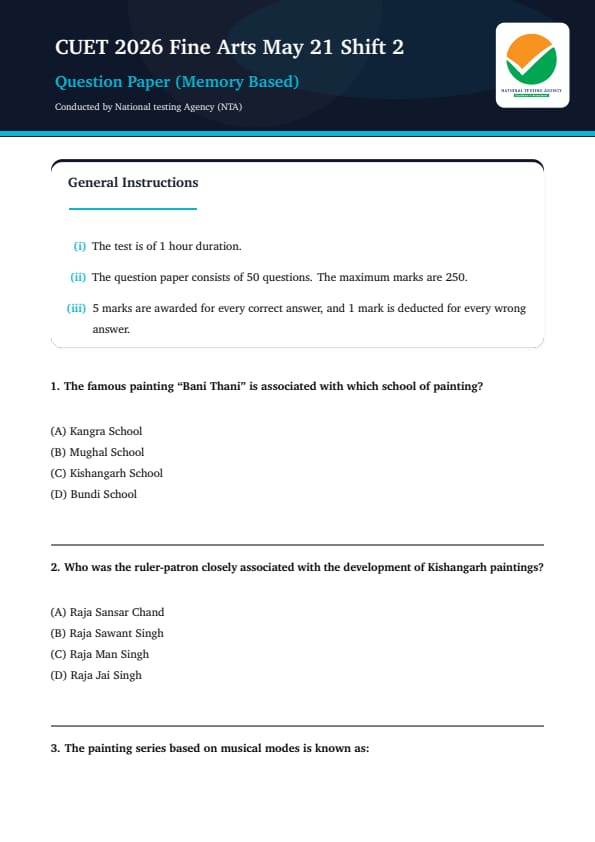
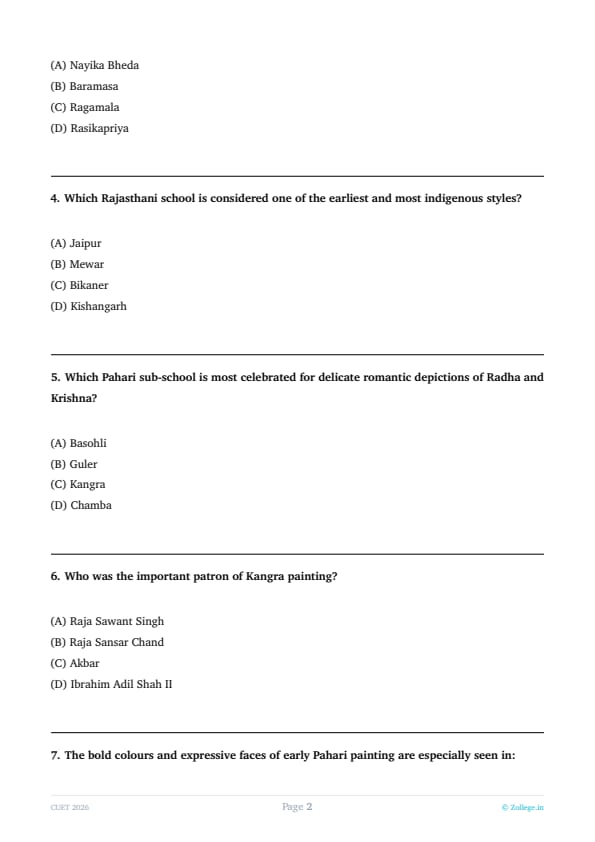
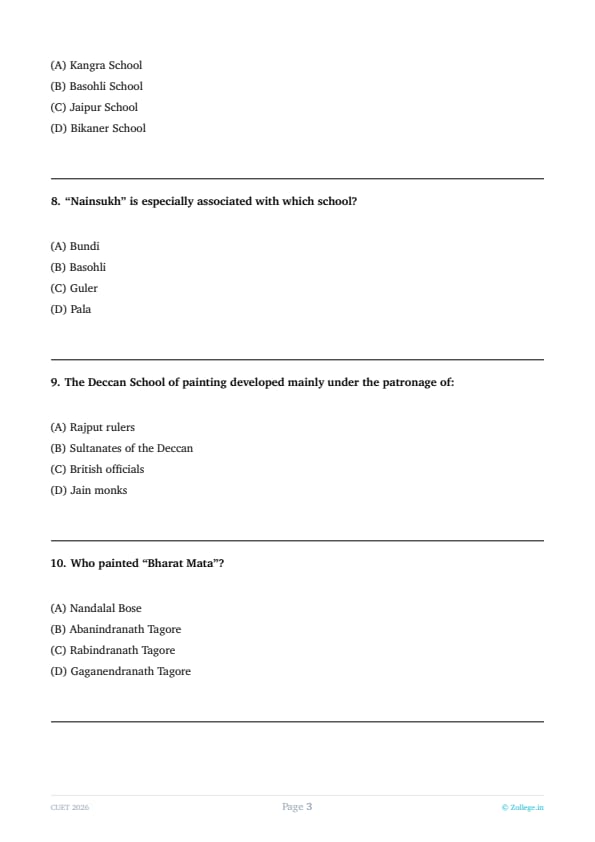
The famous painting “Bani Thani” is associated with which school of painting?
View Solution
Step 1: Understanding the Concept:
The Kishangarh School of Painting is a distinctive and highly sophisticated sub-style of the Rajasthani School of miniature painting.
It emerged in the 18th century within the small princely state of Kishangarh, located in present-day Rajasthan, India.
This school is uniquely defined by its lyrical beauty, mystical atmosphere, and a highly stylized representation of the human figure, particularly women.
The artistic vision of this school was deeply intertwined with the religious devotion and poetic sensibilities of its patron, Raja Sawant Singh.
The painting "Bani Thani" is the most iconic masterpiece of this tradition and serves as the visual signature of the Kishangarh style.
Step 2: Detailed Explanation:
The painting "Bani Thani" (meaning 'The Smartly Dressed' or 'The Adorned One') was created by the master artist Nihal Chand around 1750.
It is a portrait of a woman who was a singer and poetess in the court of Raja Sawant Singh, and who later became his beloved consort.
Historically, this painting represents the synthesis of courtly portraiture and religious allegory.
The subject is depicted with extraordinary features that became the hallmark of the Kishangarh School:
1. **The Eyes:** They are elongated, curved, and almond-shaped, resembling lotus petals (Kamal-nayan), stretching dramatically toward the temples.
2. **The Eyebrows:** They are depicted as thin, sharp, and perfectly arched, like a bow.
3. **The Profile:** The face shows a sharp, pointed nose, a receding forehead, and an elongated chin, creating an elegant and otherworldly appearance.
4. **Artistic Elegance:** She is shown holding two lotus buds, symbolizing purity and divinity, while wearing a transparent, gold-embroidered dupatta (veil).
The painting is often referred to as the "Mona Lisa of India" because of its enigmatic expression and timeless aesthetic appeal.
Culturally, "Bani Thani" is not just a woman but is visualized as Radha, the divine consort of Krishna.
Raja Sawant Singh, who wrote poetry under the name 'Nagari Das,' was a devotee of the Vallabha Sampradaya, and he saw in Bani Thani the earthly embodiment of Radha.
Comparing this to other schools:
- The Kangra School (Pahari) focuses on soft, rhythmic lines and naturalistic landscapes.
- The Mughal School is noted for its realism, historical documentation, and Persian influence.
- The Bundi School is famous for its vibrant colors and lush vegetation.
None of these schools possess the specific elongated, stylized facial features found in "Bani Thani," making Kishangarh the definitive answer.
Step 3: Final Answer:
The painting "Bani Thani" belongs to the Kishangarh School of Painting, which is a part of the Rajput style of miniature paintings.
Quick Tip: To remember Kishangarh, link it to the "Long Eyes" and "Raja Sawant Singh."
The phrase "Mona Lisa of India" is a frequent keyword in competitive exams for this specific painting.
Who was the ruler-patron closely associated with the development of Kishangarh paintings?
View Solution
Step 1: Understanding the Concept:
The development of Indian miniature painting schools was almost always dependent on the personal interests and religious inclinations of the ruling monarchs.
In Kishangarh, the school did not just receive financial support but was shaped by the spiritual and romantic life of Raja Sawant Singh (reigned 1748–1757).
He was a visionary who merged his identity as a king with his identity as a poet and a devotee.
Step 2: Detailed Explanation:
Raja Sawant Singh was the eldest son of Raja Raj Singh of Kishangarh.
He was a scholar of several languages and a gifted poet who wrote under the pen name "Nagari Das" (the servant of the city of Krishna).
His life took a dramatic turn when he fell in love with a court singer-poetess nicknamed "Bani Thani."
Their mutual love for Krishna and poetry became the creative engine for the Kishangarh court artists.
Sawant Singh was a follower of the Vallabha sect of Vaishnavism, which emphasizes the "Pushtimarg" or the path of divine grace through devotion to Krishna.
He commissioned his chief painter, Nihal Chand, to depict the themes of his poetry.
In these paintings, the King was often depicted as Krishna and Bani Thani as Radha, moving through the idyllic landscapes of Kishangarh, which were portrayed as the mystical woods of Vrindavan.
This divine-romantic allegory is what gives Kishangarh art its unique emotional depth.
In his later years, Sawant Singh grew weary of political struggles and the interference of the Marathas and his own family members.
He eventually abdicated his throne and retired to the holy city of Vrindavan with Bani Thani to lead a life of prayer and meditation.
Comparing other rulers:
- Raja Sansar Chand was the greatest patron of the Kangra (Pahari) School.
- Raja Man Singh of Amber was a key figure in early Rajput-Mughal cultural exchange.
- Raja Jai Singh II is primarily known for the city planning of Jaipur and his interest in astronomy.
Thus, the specific, transcendental style of Kishangarh is purely the legacy of Raja Sawant Singh.
Step 3: Final Answer:
Raja Sawant Singh, also known as the poet Nagari Das, was the crucial patron who inspired and developed the Kishangarh School of painting.
Quick Tip: Always associate the name "Nagari Das" with "Raja Sawant Singh."
If a question mentions a ruler who became a hermit in Vrindavan, the answer is Sawant Singh.
The painting series based on musical modes is known as:
View Solution
Step 1: Understanding the Concept:
Indian classical art is deeply interdisciplinary, where music, poetry, and painting often converge.
The term "Ragamala" literally translates to a "Garland of Ragas."
A Raga is a melodic framework in Indian classical music associated with specific times of the day, seasons, and emotional moods.
The Ragamala series represents a unique attempt by medieval Indian painters to give a visual form to these abstract musical sounds.
Step 2: Detailed Explanation:
In a Ragamala series, each painting personifies a specific musical mode.
Traditional musicology classifies Ragas into families: usually six "male" Ragas, each having five or six "Raginis" (wives) and sometimes "Ragaputras" (sons).
Each painting depicts a scene that evokes the "Rasa" (emotional essence) of the music.
For example:
1. **Raga Bhairava:** Often depicted as Lord Shiva sitting on a tiger skin, representing the solemnity of early morning.
2. **Ragini Todi:** Shown as a woman playing a veena in a forest, attracting deer, which symbolizes the loneliness and beauty of the morning.
3. **Raga Megha:** Depicted with dark clouds, lightning, and dancing figures, symbolizing the joy of the monsoon rains.
4. **Raga Deepak:** Associated with fire and intensity, often shown with lamps.
These paintings typically feature a poetic inscription at the top in Sanskrit, Braj Bhasha, or Persian, describing the situation.
Distinguishing from other themes:
- **Nayika Bheda:** Focuses on the classification of heroines based on their romantic status (e.g., the woman waiting for her lover, or the woman angry with her lover).
- **Baramasa:** Focuses on the "Twelve Months" of the year, showing how nature and human emotions change with the seasons.
- **Rasikapriya:** A literary work by the poet Keshav Das that explores the nuances of love, often illustrated using Krishna and Radha.
Since the question specifically refers to "musical modes," Ragamala is the only appropriate term.
Step 3: Final Answer:
The "Ragamala" series refers to paintings that provide visual representations of Indian musical modes (Ragas and Raginis).
Quick Tip: Keyword: "Garland of Ragas."
Ragamala paintings are common in all Indian schools, but the Deccani and Rajasthani versions are particularly famous for their rich iconography.
Which Rajasthani school is considered one of the earliest and most indigenous styles?
View Solution
Step 1: Understanding the Concept:
The Mewar School of Painting is regarded as the most traditional and foundational school of the Rajasthani tradition.
While other Rajput states like Jaipur and Bikaner quickly adopted the refined naturalism and techniques of the Mughal court, Mewar remained conservative.
This school flourished in the kingdom of Mewar (centered in Udaipur) and is known for its strong resistance to foreign aesthetic influences.
Step 2: Detailed Explanation:
The Mewar School grew out of the earlier "Western Indian" or "Apabhramsa" style of manuscript painting, which was used for Jain texts.
Historical Context: The rulers of Mewar, such as Rana Pratap and Rana Amar Singh, were in constant conflict with the Mughals, which limited cultural exchange and preserved the indigenous character of their art.
Characteristics of the Mewar School:
1. **Bold Color Palette:** It uses intense, vibrant primary colors, especially deep reds, yellows, and oranges. Often, a single flat color is used for the background to highlight the figures.
2. **Simple Composition:** The scenes are usually divided into horizontal compartments. The perspective is flat and two-dimensional, rather than naturalistic.
3. **Stylized Figures:** Figures have large, expressive eyes, pointed noses, and are often depicted in profile. Men wear traditional Rajput turbans and jama.
4. **Themes:** The school focused heavily on religious texts and epics. Famous examples include the "Chawand Ragamala" (1605) by Nisardin and the massive "Ramayana" series commissioned by Rana Jagat Singh I.
Other Schools:
- **Jaipur School:** Highly influenced by the Mughal style due to the close political alliance between the Kachwaha Rajputs and the Mughal emperors.
- **Bikaner School:** Developed by Muslim artists from the Mughal atelier, resulting in a very delicate and refined style.
- **Kishangarh School:** Developed much later (18th century) and is a highly specialized romantic sub-style.
Because Mewar retained its folk-like, traditional qualities the longest, it is termed the most "indigenous."
Step 3: Final Answer:
The Mewar School is recognized as the earliest and most indigenous style of Rajasthani miniature painting due to its traditional roots and bold artistic language.
Quick Tip: Remember Mewar = Traditional / Bold Colors.
Key artists to remember for Mewar: Sahibdin and Nisardin.
Which Pahari sub-school is most celebrated for delicate romantic depictions of Radha and Krishna?
View Solution
Step 1: Understanding the Concept:
The "Pahari" (meaning 'of the hills') school developed in the various princely states of the Himalayan foothills.
Among the diverse sub-schools like Basohli, Guler, and Chamba, the Kangra School stands out as the pinnacle of refinement.
It is globally renowned for its poetic beauty, soft colors, and the graceful depiction of the feminine form.
Step 2: Detailed Explanation:
The Kangra School reached its height in the late 18th century. It inherited the technical finesse of the Guler School but added a new layer of emotional lyricism.
Distinctive Features of Kangra Painting:
1. **The Line:** The line in Kangra art is fluid, rhythmic, and incredibly fine. It defines the contours of the body with great sensitivity.
2. **Feminine Beauty:** Women are depicted with delicate, oval faces, slender necks, and long, tapering fingers. Their expressions are often shy, modest, and full of devotion.
3. **Landscape:** For the first time in Indian miniature art, the background became as important as the subject. Painters depicted the rolling hills of the Kangra valley, flowering creepers, and the river Beas with great naturalism.
4. **Themes of Love:** The primary theme is the love between Radha and Krishna, viewed as a metaphor for the soul's relationship with God. This is often based on the "Gita Govinda" or the "Rasikapriya."
5. **Coloring:** The school used a palette of soft, cool colors (pastels) which differed from the hot, fiery colors of the Rajasthani schools.
Comparison with other Pahari schools:
- **Basohli:** Known for bold, primitive vigor and intense colors, not "delicate" romanticism.
- **Guler:** The precursor to Kangra; it has similar refinement but lacks the full-blown romanticism of the Kangra peak.
- **Chamba:** Known for its distinct folk influence and connection to the famous Chamba Rumals (embroidered cloths).
Therefore, the description of "delicate romantic depictions" fits Kangra perfectly.
Step 3: Final Answer:
The Kangra School of Painting is the most celebrated Pahari sub-school for its lyrical and romantic portrayals of Radha and Krishna.
Quick Tip: Keywords for Kangra: "Lyrical," "Soft Colors," "Natural Landscapes," "Radha-Krishna."
It is often called the "most feminine" style of Indian art due to its extreme delicacy.
Who was the important patron of Kangra painting?
View Solution
Step 1: Understanding the Concept:
The "Golden Age" of Pahari painting is synonymous with the reign of Raja Sansar Chand (1775–1823) of Kangra.
A patron's role was to provide not just money, but a creative environment. Sansar Chand was a connoisseur who invited talented artists to his court and commissioned vast series of paintings based on classical literature.
Step 2: Detailed Explanation:
Raja Sansar Chand came to the throne as a young man and established a powerful kingdom in the hills.
He was a deep devotee of Krishna, which influenced the thematic direction of the art produced during his time.
Under his patronage, the Kangra School achieved several milestones:
1. **Vast Commissions:** He commissioned legendary series of illustrations for the "Bhagavata Purana," the "Gita Govinda," and the "Bihari Satsai."
2. **Technical Mastery:** Artists like those from the family of Nainsukh and Manaku reached their creative peak under his support, perfecting the soft "Kangra line."
3. **Cultural Center:** His courts at Tira Sujanpur and Alampur became centers of art, music, and dance. It is said that thousands of people visited his court to witness the cultural splendor.
4. **Portraiture:** While religious themes dominated, numerous portraits of the King himself were painted, showing him in various courtly and religious activities.
Analysis of other patrons:
- **Raja Sawant Singh:** Patron of the Kishangarh School (Rajasthan).
- **Akbar:** The Great Mughal Emperor who founded the Mughal School.
- **Ibrahim Adil Shah II:** The Sultan of Bijapur who patronized the Deccan School.
Because the question asks for the "Kangra" patron, Raja Sansar Chand is the only correct historical figure.
Step 3: Final Answer:
Raja Sansar Chand was the preeminent patron of the Kangra School, during whose reign the school attained its greatest heights of artistic excellence.
Quick Tip: Remember the pair: "Sansar Chand" and "Kangra Valley."
His patronage is what allowed the soft, poetic style to become the dominant aesthetic of the Himalayan region.
The bold colours and expressive faces of early Pahari painting are especially seen in:
View Solution
Step 1: Understanding the Concept:
Basohli was the first sub-school of Pahari painting to emerge in the late 17th century.
It is radically different from the later Kangra style. While Kangra is known for "softness," Basohli is famous for its "intensity," "primitive vigor," and "boldness."
This style is often compared to the early Malwa or Mewar styles of Rajasthan due to its use of vibrant colors and flat backgrounds.
Step 2: Detailed Explanation:
The Basohli School flourished under the patronage of Raja Kirpal Pal (1678–1693).
The characteristics mentioned in the question—bold colors and expressive faces—are its defining traits:
1. **Intense Coloration:** The artists used bright, contrasting primary colors. Deep chocolate brown, brilliant red, and mustard yellow are frequently used for backgrounds to make the figures "pop."
2. **Expressive Facial Features:** Faces are depicted with very large, protruding, lotus-shaped eyes that convey high emotional intensity. The noses are prominent and the foreheads are receding.
3. **Use of Beetle Wings:** A unique technical feature of Basohli painting is the use of real green beetle wings (the shiny elytra) to represent emerald jewelry in the paintings. This gave the artwork a three-dimensional, glowing effect.
4. **Bold Outlines:** Figures are defined by thick, strong outlines, giving them a sturdy and energetic appearance.
5. **Architectural Details:** Buildings are often shown with painted wood-work and heavy, patterned textiles.
Themes: The most famous work of this school is the "Rasamanjari" series (dealing with the classification of lovers) and early versions of the "Gita Govinda."
- **Kangra:** Is the "later" style, known for soft, delicate features.
- **Jaipur/Bikaner:** Are Rajasthani schools.
Thus, the "early Pahari" description firmly points to Basohli.
Step 3: Final Answer:
The Basohli School is characterized by its bold use of color and intense, expressive facial features, representing the earliest phase of Pahari miniature painting.
Quick Tip: Key identifier: "Beetle wings" and "Protruding eyes."
Basohli is the most "vigorous" of all the hill schools.
“Nainsukh” is especially associated with which school?
View Solution
Step 1: Understanding the Concept:
Nainsukh (c. 1710–1778) is arguably the most famous individual artist in the history of Indian miniature painting.
He belonged to a family of artists (the son of Pandit Seu and younger brother of Manaku) who were responsible for revolutionizing Pahari art.
The transition from the bold, stylized Basohli style to the refined, naturalistic Kangra style was pioneered by Nainsukh at the Guler court.
Step 2: Detailed Explanation:
Nainsukh's artistic journey is well-documented. He was born in Guler, a state that acted as a "cradle" for new artistic ideas in the hills.
His style was influenced by the naturalism of Mughal painting (which he likely saw in the plains) but he infused it with a unique poetic sensitivity.
Key contributions of Nainsukh:
1. **Naturalism:** He moved away from the idealized, "type" faces of earlier traditions to create realistic, individualistic portraits.
2. **Candid Depictions:** He is famous for his "intimate" paintings of his patron, Raja Balwant Singh of Jammu. He showed the king in very human situations—getting his beard trimmed, smoking a hookah, or watching a dance performance.
3. **Delicate Line-work:** His use of line is extremely precise yet soft, allowing for subtle shading and anatomical accuracy.
4. **Spatial Depth:** He introduced a better sense of perspective and landscape compared to the flat backgrounds of the Basohli school.
Historical Context: Nainsukh later migrated to the court of Jasrota and Jammu, but his artistic roots and the formative years of his style are tied to the Guler tradition.
- **Bundi:** A Rajasthani school (not associated with Nainsukh).
- **Basohli:** The older Pahari style that Nainsukh helped move away from.
- **Pala:** An ancient Buddhist manuscript style from the 8th–12th century (completely different era).
Therefore, Nainsukh is the legendary master of the Guler School.
Step 3: Final Answer:
The master artist Nainsukh is primarily associated with the Guler School, where he introduced a new level of naturalism to Pahari painting.
Quick Tip: Remember the artist family: Pandit Seu (father) \(\rightarrow\) Manaku (elder son) and Nainsukh (younger son).
Nainsukh is the bridge between the old (Basohli) and the new (Kangra) styles.
The Deccan School of painting developed mainly under the patronage of:
View Solution
Step 1: Understanding the Concept:
The Deccan School of painting is a distinct branch of Indian art that flourished in the plateau region of South-Central India from the 16th to the 19th centuries.
It developed independently of the Mughal School, although it later interacted with it.
The primary patrons were the Muslim rulers of the five Deccan Sultanates that emerged after the collapse of the Bahmani Empire.
Step 2: Detailed Explanation:
The major centers of Deccan painting were:
1. **Bijapur:** Under the Adil Shahi Sultans, particularly Ibrahim Adil Shah II. This center is known for its lush, magical landscapes and rich use of gold.
2. **Golconda:** Under the Qutb Shahi Sultans. It was a wealthy center (due to diamond mines) and produced very refined, elegant portraits.
3. **Ahmadnagar:** Under the Nizam Shahi Sultans. It produced some of the earliest Deccani works like the "Tarif-i-Hussain Shahi."
Characteristics of the Deccan School:
- **Persian Influence:** Due to strong sea trade and cultural links with Iran, Deccani art has a strong Persian flavor, seen in high horizons and stylized clouds.
- **Vibrant Colors:** It uses more intense and jewel-like colors compared to the more naturalistic Mughal palette.
- **Indigenous Elements:** It incorporates South Indian flora, fauna, and jewelry styles, as well as influences from the Vijayanagara Empire.
- **Elongated Figures:** The human figures are often shown as tall and slender with graceful poses.
Comparing other patrons:
- **Rajput rulers:** Patronized the various schools of Rajasthan and the Pahari region.
- **British officials:** Patronized the "Company School" (Kampani Qalam) during the colonial period.
- **Jain monks:** Supported the early manuscript traditions of Gujarat and Rajasthan.
Thus, the "Sultanates of the Deccan" is the historically accurate answer.
Step 3: Final Answer:
The Deccan School of painting was primarily patronized by the Sultans of Bijapur, Golconda, and Ahmadnagar, resulting in a unique fusion of Persian and Indian styles.
Quick Tip: Remember the three major centers: Bijapur, Golconda, and Ahmadnagar.
If you see "Rich gold" and "Mystical landscapes," think of the Deccan School.
Who painted “Bharat Mata”?
View Solution
Step 1: Understanding the Concept:
"Bharat Mata" (Mother India) is a seminal painting in the history of modern Indian art.
It was created in 1905 during the peak of the Swadeshi Movement, which was a response to the British partition of Bengal.
The painting aimed to provide a visual symbol for the national identity and to move away from Western "academic" styles toward a truly Indian aesthetic.
Step 2: Detailed Explanation:
Abanindranath Tagore (1871–1951), the founder of the Bengal School of Art, was the creator of this masterpiece.
Analysis of the painting:
1. **Iconography:** "Bharat Mata" is depicted as a saffron-clad woman, resembling a Hindu ascetic or Sanyasini. She stands calmly, holding four objects that represent the basic needs of a nation.
2. **Four Symbols:**
- **Vedas:** Representing spiritual and secular knowledge.
- **Sheaves of Paddy:** Representing agricultural prosperity and food security.
- **Rosary (Japamala):** Representing spiritual strength and meditation.
- **White Cloth:** Representing self-reliance in clothing (linked to the Swadeshi boycott of British textiles).
3. **The Wash Technique:** Abanindranath used a unique technique he learned from Japanese artists called the "Wash technique." This involves applying multiple layers of thin watercolor and washing them off, creating a soft, misty, and ethereal atmosphere.
4. **Political Significance:** The painting was used widely in nationalist rallies. It helped transform the abstract idea of a "nation" into a tangible, maternal figure that citizens could love and defend.
Other Artists:
- **Nandalal Bose:** A student of Abanindranath who later became the principal of Shantiniketan and illustrated the Constitution of India.
- **Rabindranath Tagore:** The Nobel laureate poet who began painting in his late 60s, using a very different, modernistic style.
- **Gaganendranath Tagore:** Abanindranath's brother, who was famous for his cubist experiments and satirical caricatures.
Therefore, the artist of "Bharat Mata" is definitively Abanindranath Tagore.
Step 3: Final Answer:
Abanindranath Tagore is the artist who painted the iconic "Bharat Mata" in 1905, establishing it as a symbol of the Bengal School and Indian nationalism.
Quick Tip: Associate "Abanindranath Tagore" with the "Wash Technique" and the "Swadeshi Movement."
The painting was originally titled "Banga Mata" (Mother Bengal) but was later renamed to "Bharat Mata" to reflect a broader national appeal.
CUET UG 2026 Paper Analysis
*The article might have information for the previous academic years, please refer the official website of the exam.