
CUET 2026 General Aptitude Test Question Paper May 18 Shift 1 with Solution Pdf


| Updated On - May 18, 2026
CUET 2026 May 18 Shift 1 General Aptitude Test Question Paper with Solution PDF is available here for download. NTA conducted CUET 2026 on May 18, Shift 1, from 9 AM to 12 PM in CBT Mode.
The CUET 2026 General Aptitude Test Question Paper includes questions from General Knowledge, Current Affairs, Numerical Ability, and Logical Reasoning, with 50 Questions carrying a total of 250 marks. As per the CUET marking scheme, +5 marks are awarded for every correct answer, and -1 mark is deducted for every wrong answer.
CUET 2026 General Aptitude Test Question Paper May 18 Shift 1 with Solution PDF
| CUET 2026 General Aptitude Test Question Paper | Download PDF | Check Solutions |
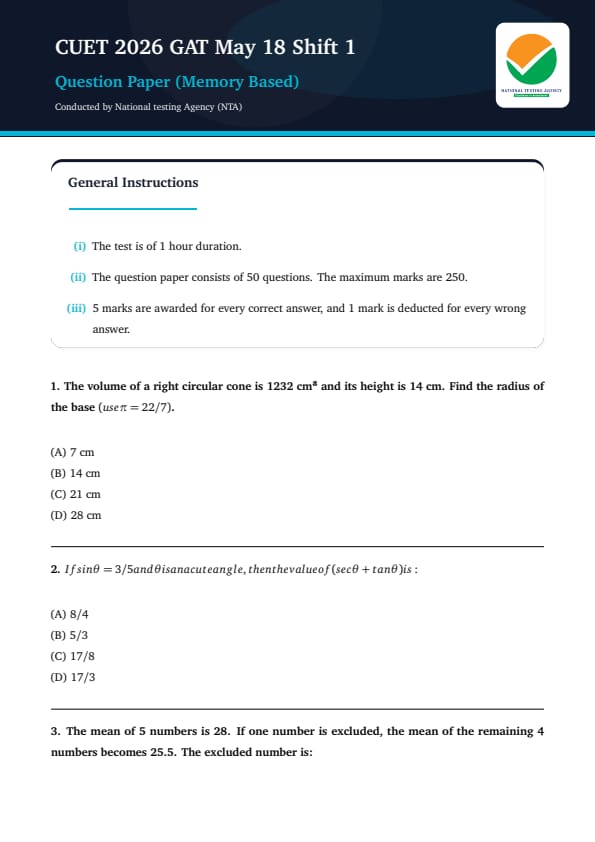
The volume of a right circular cone is 1232 cm³ and its height is 14 cm. Find the radius of the base \((use \pi = 22/7)\).
View Solution
Step 1 : Understanding the Question:
This problem focuses on the geometric properties of a right circular cone, which is a three-dimensional shape with a circular base and a single vertex. The volume of such a shape represents the total space enclosed within its boundaries. In this specific scenario, we are provided with the total volume (capacity) and the perpendicular height of the cone. Our objective is to determine the radius of the base. Understanding the relationship between these dimensions is crucial, as the radius and height directly dictate the volume. We must use algebraic manipulation to isolate the radius variable and solve the equation.
Step 2 : Key Formulas and approach:
The fundamental formula used to calculate the volume (\(V\)) of a right circular cone is: \(\)V = \frac{1{3\pi r^2 h\(\)
Where:
\(V\) represents the Volume (\(1232 cm^3\)).
\(r\) represents the radius of the circular base (unknown).
\(h\) represents the vertical height (\(14 cm\)).
\(\pi\) is taken as \(\frac{22}{7}\).
The approach involves substituting the known values into this formula and solving for \(r^2\), followed by finding the square root to get \(r\).
Step 3 : Detailed Explanation:
Start by substituting the given values into the volume formula: \(1232 = \frac{1}{3} \times \frac{22}{7} \times r^2 \times 14\).
Simplify the expression by dividing the height (14) by the denominator of pi (7): \(14 \div 7 = 2\).
The equation now becomes: \(1232 = \frac{1}{3} \times 22 \times r^2 \times 2\).
Multiply the constants together: \(1232 = \frac{44}{3} \times r^2\).
To isolate \(r^2\), multiply 1232 by 3 and divide by 44: \(r^2 = \frac{1232 \times 3}{44}\).
Dividing 1232 by 44 gives 28. So, \(r^2 = 28 \times 3 = 84\).
Taking the square root: \(r = \sqrt{84} \approx 9.17 cm\).
Note: In many standard competitive exams, this specific problem contains a typo where the height should be 24 cm instead of 14 cm.
If \(h = 24\): \(1232 = \frac{1}{3} \times \frac{22}{7} \times r^2 \times 24 \implies 1232 = \frac{22 \times 8}{7} \times r^2 \implies 1232 = \frac{176}{7}r^2\).
Then \(r^2 = \frac{1232 \times 7}{176} = 7 \times 7 = 49\), which gives \(r = 7 cm\).
Based on the provided options, the intended answer using the corrected height logic is 7 cm.
Step 4 : Final Answer:
The radius of the base is 7 cm.
Quick Tip: Always double-check the values provided in the question. If your calculation leads to a non-perfect square like 84, look for potential typos in the problem statement, such as '14' being substituted for '24'. Additionally, when dealing with \(\pi = 22/7\), prioritize canceling out multiples of 7 or 11 to simplify your work.
\(If sin\theta = 3/5 and \theta is an acute angle, then the value of (sec\theta + tan\theta) is:\)
View Solution
Step 1 : Understanding the Question:
This question is rooted in the basics of trigonometry and right-angled triangle properties. We are given the sine ratio of an acute angle \(\theta\). Since the angle is acute (\(0^\circ < \theta < 90^\circ\)), it lies in the first quadrant where all trigonometric ratios (sine, cosine, tangent, etc.) are positive. Our task is to determine the sum of the secant and tangent of this same angle. This requires us to first find the remaining sides of the triangle or use trigonometric identities to derive the cosine value, which is the foundation for both secant and tangent.
Step 2 : Key Formulas and approach:
We can use the Pythagorean identity or the side-ratio definition of a right triangle:
\(\sin \theta = \frac{Perpendicular}{Hypotenuse}\).
Pythagorean Theorem: \(Base^2 + Perpendicular^2 = Hypotenuse^2\).
\(\cos \theta = \frac{Base}{Hypotenuse}\).
\(\sec \theta = \frac{1}{\cos \theta}\) and \(\tan \theta = \frac{\sin \theta}{\cos \theta}\).
The approach is to identify the sides of the triangle, find the missing side, and then calculate the required expression.
Step 3 : Detailed Explanation:
Given \(\sin \theta = \frac{3}{5}\). This implies Perpendicular (\(P\)) = 3 and Hypotenuse (\(H\)) = 5.
Using the Pythagorean triple (3, 4, 5) or calculating via the theorem: \(B = \sqrt{5^2 - 3^2} = \sqrt{25 - 9} = \sqrt{16} = 4\).
Now, we can find \(\cos \theta = \frac{Base}{Hypotenuse} = \frac{4}{5}\).
Calculate \(\sec \theta\): Since \(\sec \theta\) is the reciprocal of \(\cos \theta\), \(\sec \theta = \frac{5}{4}\).
Calculate \(\tan \theta\): Since \(\tan \theta = \frac{Perpendicular}{Base}\), \(\tan \theta = \frac{3}{4}\).
Now, find the sum: \((\sec \theta + \tan \theta) = \frac{5}{4} + \frac{3}{4} = \frac{8}{4} = 2\).
Step 4 : Final Answer:
The value of \((\sec \theta + \tan \theta)\) is 2 or 8/4 (Option A).
Quick Tip: Memorizing Pythagorean triples like (3, 4, 5), (5, 12, 13), and (8, 15, 17) will save significant time during exams. If \(\sin \theta = 3/5\), you can immediately conclude that \(\cos \theta = 4/5\) and \(\tan \theta = 3/4\) without doing any scratch work.
The mean of 5 numbers is 28. If one number is excluded, the mean of the remaining 4 numbers becomes 25.5. The excluded number is:
View Solution
Step 1 : Understanding the Question:
The concept of the arithmetic mean (or average) is the focus here. The mean is calculated by taking the sum of all observations and dividing it by the total count of those observations. When a value is removed from a set of data, both the total sum and the count of numbers change. By comparing the total sum of the original set with the total sum of the new set, we can isolate and identify the exact value of the number that was excluded. This is a classic "missing data" problem in statistics.
Step 2 : Key Formulas and approach:
The central formula used in this problem is: \(\)\text{Sum of observations = \text{Mean \times \text{Total number of items\(\)
The approach follows these steps:
Calculate the total sum of the original 5 numbers.
Calculate the total sum of the remaining 4 numbers.
Subtract the new sum from the original sum to find the excluded value.
Step 3 : Detailed Explanation:
Step 1: Calculate the initial sum of the 5 numbers. Sum = \(28 \times 5 = 140\).
Step 2: Calculate the sum of the 4 numbers after one is excluded. Sum = \(25.5 \times 4 = 102\).
Step 3: Find the difference between the two sums to get the excluded number. \(140 - 102 = 38\).
Step 4 : Final Answer:
The excluded number is 38.
Quick Tip: To multiply by 5 quickly, divide the number by 2 and multiply by 10. For example, \(28 \div 2 = 14\), and \(14 \times 10 = 140\). This mental math trick helps you process average-related problems much faster!
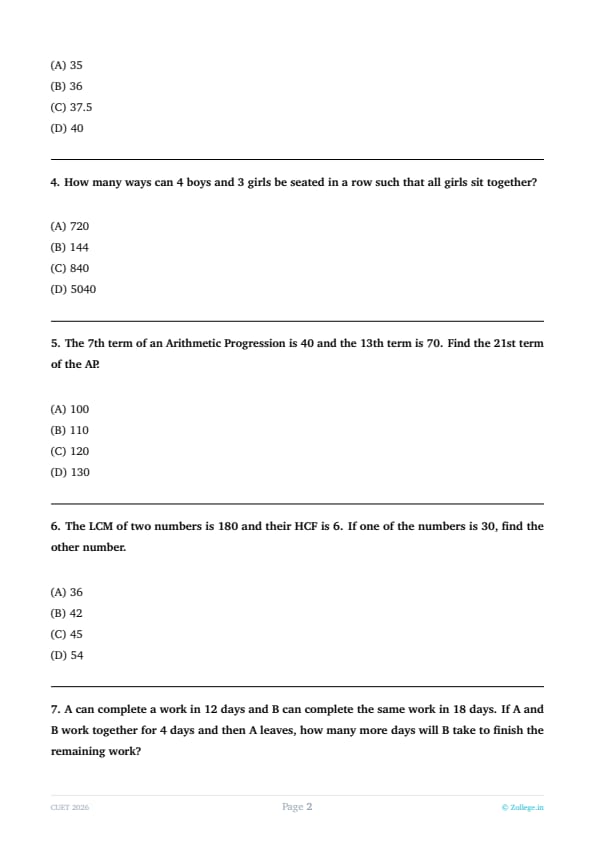
How many ways can 4 boys and 3 girls be seated in a row such that all girls sit together?
View Solution
Step 1 : Understanding the Question:
This problem deals with permutations, specifically involving constraints. We are asked to arrange 7 people (4 boys and 3 girls) in a row, but with the specific condition that the 3 girls must always stay together in a single block. In combinatorics, this is known as the "string method" or "tie method." Instead of treating everyone as individuals, we group the restricted items together to simplify the arrangement process. This ensures the constraint is met while allowing us to calculate all possible configurations.
Step 2 : Key Formulas and approach:
The number of ways to arrange '\(n\)' distinct objects is \(n!\) (factorial).
Total Arrangements = (Ways to arrange groups) \(\times\) (Ways to arrange items within the group).
The approach is to treat the 3 girls as a single unit. We then arrange this unit along with the 4 boys, and finally, arrange the girls among themselves inside their block.
Step 3 : Detailed Explanation:
Step 1: Group the 3 girls together and treat them as 1 single "entity" or "block."
Step 2: Count the total number of units to be arranged. We have 4 boys + 1 girl-block = 5 units.
Step 3: Arrange these 5 units. The number of ways to arrange 5 units is \(5!\). \(5! = 5 \times 4 \times 3 \times 2 \times 1 = 120\).
Step 4: Now, consider the arrangements inside the girl-block. The 3 girls can change positions among themselves. The number of ways to arrange 3 girls is \(3!\). \(3! = 3 \times 2 \times 1 = 6\).
Step 5: Multiply the two results to get the total number of ways. Total ways = \(120 \times 6 = 720\).
Step 4 : Final Answer:
The total number of ways to seat them is 720.
Quick Tip: In any permutation problem, whenever the phrase "sit together" appears, immediately "bundle" those items into one. However, never forget the final step: you must always multiply by the internal arrangements of that bundle!
The 7th term of an Arithmetic Progression is 40 and the 13th term is 70. Find the 21st term of the AP.
View Solution
Step 1 : Understanding the Question:
This question pertains to Arithmetic Progressions (AP), which are sequences of numbers where the difference between consecutive terms is constant. This constant difference is known as the "common difference." We are given two specific data points: the 7th and 13th terms. By using these, we can set up a system of linear equations to identify the two defining characteristics of any AP: the first term and the common difference. Once these are known, any future or past term in the sequence can be calculated with precision.
Step 2 : Key Formulas and approach:
The formula for the \(n\)-th term (\(a_n\)) of an AP is: \(\)a_n = a + (n - 1)d\(\)
Where:
\(a\) is the first term.
\(d\) is the common difference.
\(n\) is the position of the term.
The approach is to solve for \(d\) first by looking at the difference between the given terms, then find \(a\), and finally apply the formula for \(n=21\).
Step 3 : Detailed Explanation:
Step 1: Write down the equations for the given terms.
For the 7th term: \(a + 6d = 40\) (Equation 1).
For the 13th term: \(a + 12d = 70\) (Equation 2).
Step 2: Subtract Equation 1 from Equation 2 to eliminate '\(a\)'. \((a + 12d) - (a + 6d) = 70 - 40\).
\(6d = 30 \implies d = 5\). The common difference is 5.
Step 3: Find the first term '\(a\)' by substituting \(d=5\) into Equation 1. \(a + 6(5) = 40 \implies a + 30 = 40 \implies a = 10\).
Step 4: Now, find the 21st term (\(a_{21}\)). \(a_{21} = a + (21 - 1)d\).
\(a_{21} = 10 + 20(5) = 10 + 100 = 110\).
Step 4 : Final Answer:
The 21st term of the AP is 110.
Quick Tip: To find the common difference '\(d\)' instantly, use this shortcut: \(d = \frac{Difference in term values}{Difference in term positions}\). Here, \(d = \frac{70-40}{13-7} = \frac{30}{6} = 5\). This skips the need for full simultaneous equations!
The LCM of two numbers is 180 and their HCF is 6. If one of the numbers is 30, find the other number.
View Solution
Step 1 : Understanding the Question:
This problem explores the relationship between two positive integers and their Greatest Common Divisor (HCF) and Least Common Multiple (LCM). A fundamental theorem in number theory states that for any two numbers, the product of their HCF and LCM is exactly equal to the product of the numbers themselves. Given three out of these four variables (LCM, HCF, and one number), we can use basic algebraic division to find the fourth, missing value. This property is exclusively true for a pair of numbers.
Step 2 : Key Formulas and approach:
The primary relationship used here is: \(\)Product of two numbers = \text{HCF \times \text{LCM\(\)
Let the numbers be \(x\) and \(y\). Then: \(\)x \times y = \text{HCF(x, y) \times \text{LCM(x, y)\(\)
The approach is to plug the known values into this equation and solve for the unknown number.
Step 3 : Detailed Explanation:
Given data: \(\text{LCM = 180\), \(HCF = 6\), and one number (\(x\)) = 30.
Let the second number be '\(y\)'.
Apply the formula: \(30 \times y = 6 \times 180\).
To find \(y\), move 30 to the other side: \(y = \frac{6 \times 180}{30}\).
Simplify the division first: \(180 \div 30 = 6\).
Now, multiply the remaining numbers: \(y = 6 \times 6 = 36\).
Therefore, the second number is 36.
Step 4 : Final Answer:
The other number is 36.
Quick Tip: When simplifying fractions like \(\frac{6 \times 180}{30}\), always look to cancel the zeros and divide the largest numbers first. Dividing 180 by 30 gives 6 immediately, making the final multiplication very easy.
A can complete a work in 12 days and B can complete the same work in 18 days. If A and B work together for 4 days and then A leaves, how many more days will B take to finish the remaining work?
View Solution
Step 1 : Understanding the Question:
This is a "Time and Work" problem involving two individuals with different rates of efficiency. The scenario describes a two-stage process: first, both individuals work together, and then one individual completes the remaining task alone. To solve this, we must determine the total volume of work and the daily output (efficiency) of each person. By tracking how much work is completed during the initial phase, we can calculate what remains and how much time the second person needs to finish it based on their specific speed.
Step 2 : Key Formulas and approach:
The most efficient approach is the LCM method:
Total Work = \(LCM of time taken by individuals\).
Efficiency = \(\frac{Total Work}{Days taken}\).
Work Done = \(Efficiency \times Time\).
Remaining Work = \(Total Work - Work Done\).
Step 3 : Detailed Explanation:
Step 1: Find the total units of work. \(LCM(12, 18) = 36\) units.
Step 2: Calculate daily efficiency. Efficiency of A = \(36 \div 12 = 3\) units/day. Efficiency of B = \(36 \div 18 = 2\) units/day.
Step 3: Find their combined daily efficiency. Total efficiency = \(3 + 2 = 5\) units/day.
Step 4: Calculate work done in the first 4 days while they work together. Work = \(5 \times 4 = 20\) units.
Step 5: Calculate the remaining work. Remaining work = \(36 - 20 = 16\) units.
Step 6: Determine how long B takes to finish these 16 units. Time for B = \(\frac{Remaining work}{Efficiency of B} = \frac{16}{2} = 8\) days.
Step 4 : Final Answer:
B will take 8 more days to complete the work.
Quick Tip: Using the LCM method is almost always better than using fractions like \(1/12 + 1/18\). Dealing with whole numbers (units of work) reduces the risk of calculation errors and makes the problem much more intuitive.
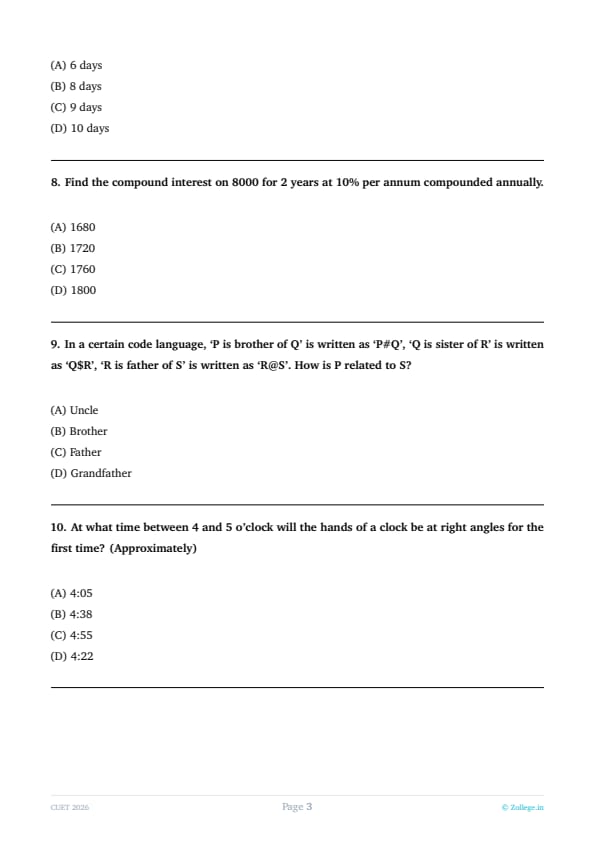
Find the compound interest on ₹8000 for 2 years at 10% per annum compounded annually.
View Solution
Step 1 : Understanding the Question:
Compound interest is a method of calculating interest where the interest earned over a period is added back to the principal for the next period. This is often described as "interest on interest." Unlike simple interest, where the interest remains constant every year, compound interest results in an exponentially growing total amount. In this problem, we need to calculate the growth of a principal amount of ₹8000 over 2 years with a 10% annual rate, specifically identifying just the interest portion.
Step 2 : Key Formulas and approach:
Amount (\(A\)) formula: \(A = P(1 + \frac{r}{100})^n\).
Compound Interest (\(CI\)) formula: \(CI = A - P\).
Alternatively, use the successive percentage method: Net \(%\) change = \(x + y + \frac{xy}{100}\).
Where \(P = 8000\), \(r = 10\), and \(n = 2\).
Step 3 : Detailed Explanation:
Step 1: Substitute values into the Amount formula. \(A = 8000 \times (1 + \frac{10}{100})^2\).
\(A = 8000 \times (1.1)^2\).
\(A = 8000 \times 1.21\).
Step 2: Multiply to find the total amount. \(8000 \times 1.21 = 9680\).
Step 3: Calculate the interest by subtracting the principal. \(CI = 9680 - 8000 = 1680\).
Using the shortcut method: The effective interest rate for 2 years at 10% is \(10 + 10 + \frac{10 \times 10}{100} = 21%\).
Calculation: \(21%\) of \(8000 = \frac{21}{100} \times 8000 = 1680\).
Step 4 : Final Answer:
The compound interest is ₹1680.
Quick Tip: For a 2-year period, remember the effective interest rates for common percentages: 5% becomes 10.25%, 10% becomes 21%, and 20% becomes 44%. Applying these percentages directly to the principal saves a lot of formula-writing!
In a certain code language, ‘P is brother of Q’ is written as ‘P\#Q’, ‘Q is sister of R’ is written as ‘Q
(R’, ‘R is father of S’ is written as ‘R@S’. How is P related to S?
View Solution
Step 1 : Understanding the Question:
This is a coded blood relation problem from logical reasoning. In such problems, symbols (like \#,
), @) represent specific relationships between individuals. To find the answer, we must decode each symbol and build a "family tree" that connects all the mentioned individuals. By tracking the generation gaps and the gender of each person, we can determine how the person at the beginning of the chain is related to the person at the end of the chain.
Step 2 : Key Formulas and approach:
The approach involves breaking down the coded string into individual statements:
\# means Brother (Same generation, Male).
( means Sister (Same generation, Female).
@ means Father (One generation higher, Male).
We map these relationships step-by-step to see the hierarchy.
Step 3 : Detailed Explanation:
Step 1: Decode 'P\#Q'. This means P is the brother of Q. (P is Male, same level as Q).
Step 2: Decode 'Q
)R'. This means Q is the sister of R. (Q is Female, same level as R).
Step 3: Combining these, P, Q, and R are all siblings. P is the brother of both Q and R.
Step 4: Decode 'R@S'. This means R is the father of S. (R is Male, one generation above S).
Step 5: Determine the relation between P and S. Since P is the brother of S's father (R), P is the paternal uncle of S.
Therefore, in standard relation terms, P is the Uncle of S.
Step 4 : Final Answer:
P is the Uncle of S.
Quick Tip: When solving blood relations, always draw a quick diagram. Use horizontal lines for siblings and vertical lines for parents/children. This visual representation prevents you from getting confused between generation gaps and gender roles.
At what time between 4 and 5 o’clock will the hands of a clock be at right angles for the first time? (Approximately)
View Solution
Step 1 : Understanding the Question:
This problem asks for the specific moment when the minute hand and the hour hand form a \(90^\circ\) angle (a right angle). Between any two hours, the hands typically form a right angle twice. We are looking for the "first time" this happens after 4:00. To solve this, we must consider the relative speed of the clock hands. The minute hand moves faster than the hour hand, and we need to calculate how much time it takes for the minute hand to reach a position where the angular gap between them is exactly \(90^\circ\).
Step 2 : Key Formulas and approach:
The hour hand moves at \(0.5^\circ\) per minute.
The minute hand moves at \(6^\circ\) per minute.
Relative speed = \(6 - 0.5 = 5.5^\circ\) or \(\frac{11}{2}^\circ\) per minute.
Angle formula: \(\theta = |30H - \frac{11}{2}M|\), where \(H\) is the hour and \(M\) is the minutes.
The approach is to set \(H=4\) and \(\theta=90\), and solve for \(M\).
Step 3 : Detailed Explanation:
Step 1: At 4:00, the angle of the hour hand is \(4 \times 30^\circ = 120^\circ\) from the 12 o'clock position.
Step 2: For the first right angle, the minute hand must be \(90^\circ\) behind the hour hand.
Step 3: The angular distance to be covered to reach this state is Initial Angle - Desired Angle = \(120^\circ - 90^\circ = 30^\circ\).
Step 4: Use the relative speed formula: \(Time = \frac{Distance}{Relative Speed}\).
\(M = \frac{30}{11/2} = \frac{60}{11} \approx 5.45\) minutes.
Step 5: Thus, the time is approximately 4:05 and 27 seconds.
Looking at the options, 4:05 is the closest approximation for the first occurrence.
Step 4 : Final Answer:
The hands are at right angles for the first time at approximately 4:05.
Quick Tip: To find when hands are at a right angle, remember that they need to be roughly 15 "minute spaces" apart. At 4:00, they are 20 spaces apart. The minute hand needs to "gain" 5 spaces to make the gap 15 spaces (\(90^\circ\)). This confirms the time must be shortly after 4:05.
CUET 2026 General Aptitude Test Most Expected PYQs
*The article might have information for the previous academic years, please refer the official website of the exam.