
CUET 2026 General Aptitude Test Question Paper May 19 Shift 1 with Solution Pdf


| Updated On - May 19, 2026
CUET 2026 May 19 Shift 1 General Aptitude Test Question Paper with Solution PDF is available here for download. NTA conducted CUET 2026 on May 19, Shift 1, from 9 AM to 12 PM in CBT Mode.
The CUET 2026 General Aptitude Test Question Paper includes questions from General Knowledge, Current Affairs, Numerical Ability, and Logical Reasoning, with 50 Questions carrying a total of 250 marks. As per the CUET marking scheme, +5 marks are awarded for every correct answer, and -1 mark is deducted for every wrong answer.
CUET 2026 General Aptitude Test Question Paper May 19 Shift 1 with Solution PDF
| CUET 2026 General Aptitude Test Question Paper | Download PDF | Check Solutions |
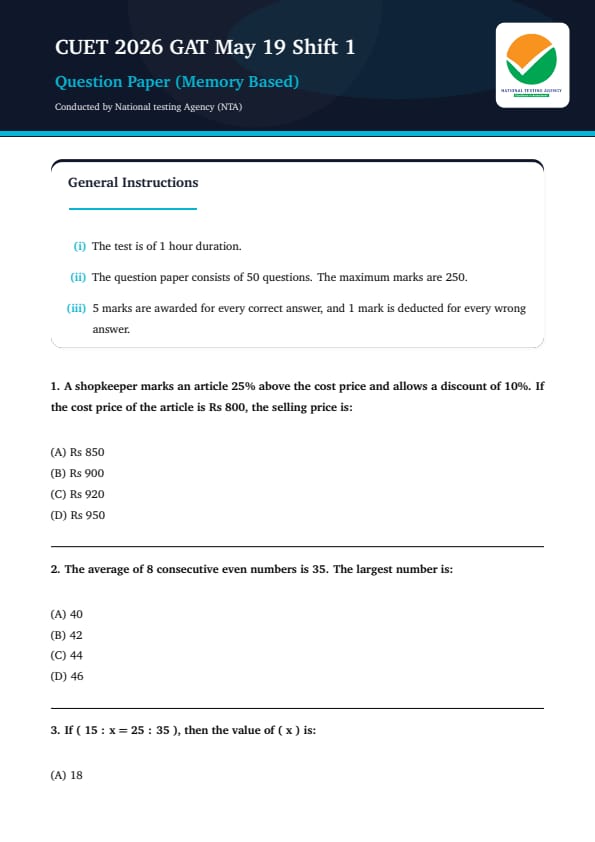
A shopkeeper marks an article 25% above the cost price and allows a discount of 10%. If the cost price of the article is Rs 800, the selling price is:
View Solution
Step 1: Understanding the Question:
This problem falls under the mathematical topic of Commercial Arithmetic, specifically Profit and Loss involving Markup and Discounts. The objective is to determine the final Selling Price (SP) of an item by navigating through two pricing stages: the first is the transition from Cost Price (CP) to Marked Price (MP) via a markup, and the second is the transition from Marked Price to Selling Price via a percentage reduction known as a discount. We are provided with a starting capital amount of Rs 800 and two distinct percentage modifiers that must be applied sequentially.
Step 2 : Key Formulas and approach:
To solve this, we utilize the sequential relationship between the three price types:
1. Marked Price Formula: \(MP = CP \times \left(1 + \frac{Markup %}{100}\right)\)
2. Selling Price Formula: \(SP = MP \times \left(1 - \frac{Discount %}{100}\right)\)
The approach involves a step-by-step calculation where the result of the markup becomes the base for the discount calculation.
Step 3 : Detailed Explanation:
We begin by identifying the initial investment or Cost Price (CP) given as Rs 800. The shopkeeper intends to raise the price to create a profit margin, so he marks it up by 25%.
To find the amount added to the CP, we calculate 25% of 800. Since 25% is equivalent to one-fourth, we divide 800 by 4, which yields Rs 200. Alternatively, \(\frac{25}{100} \times 800 = 200\).
The first milestone is the Marked Price (MP). By adding the markup amount to the original cost, we get \(MP = 800 + 200 = Rs 1000\). This is the price displayed on the tag before any negotiations or sales.
Next, we address the consumer incentive, which is a 10% discount. It is crucial to remember that a discount is always calculated on the Marked Price, not the Cost Price. We calculate 10% of our new base, which is Rs 1000.
The discount amount is determined as \(\frac{10}{100} \times 1000 = Rs 100\). This represents the reduction in price offered to the buyer from the tag price.
Finally, we derive the Selling Price (SP) by subtracting this discount from the Marked Price. So, \(SP = 1000 - 100 = Rs 900\).
This confirms that even after a 10% discount, the shopkeeper sells the item for Rs 100 more than the original cost, representing a profit of Rs 100.
Step 4 : Final Answer:
The final selling price of the article after the markup and discount is Rs 900, which corresponds to option (B).
Quick Tip: For successive percentage changes like markup and discount, you can find the net profit percentage using the formula: \(x - y - \frac{xy}{100}\). Here, \(25 - 10 - \frac{250}{100} = 15 - 2.5 = 12.5%\). You can directly calculate the SP by finding 112.5% of Rs 800, which gives Rs 900 in one step!
The average of 8 consecutive even numbers is 35. The largest number is:
View Solution
Step 1: Understanding the Question:
The topic of this problem is Averages (Mean) of Arithmetic Progressions. In this case, the series consists of "consecutive even numbers," which implies a sequence of numbers where each term is exactly 2 units greater than the preceding one. We are dealing with a set of 8 such numbers, and we know that their mathematical average is 35. The goal is to determine the highest value in this specific set.
Step 2 : Key Formulas and approach:
There are two primary ways to approach this:
1. Algebraic Method: Represent the numbers as \(x, x+2, x+4, \dots, x+14\). The sum divided by the count equals the average.
2. Properties of Symmetry: In an arithmetic sequence with an even number of terms, the average is the exact midpoint between the two central terms.
The approach involves locating the "middle" of the sequence and counting forward to the last term.
Step 3 : Detailed Explanation:
First, we recognize that the sequence contains 8 terms. In a symmetric sequence, the average always sits at the geometric center. For 8 numbers, the center is the space between the 4th and the 5th number.
Since the average is 35, and we are looking for even numbers, 35 must be the exact midpoint between the 4th even number and the 5th even number.
The even integer immediately below 35 is 34 (the 4th number), and the even integer immediately above 35 is 36 (the 5th number). This confirms our sequence is balanced around 35.
Now, we can list the sequence by moving outward from these central points. If the 5th number is 36, then the 6th number is \(36 + 2 = 38\).
Continuing this pattern, the 7th number is \(38 + 2 = 40\).
Finally, the 8th and largest number is \(40 + 2 = 42\). We can also verify the lower half: if the 4th is 34, then the 3rd is 32, the 2nd is 30, and the 1st is 28.
To verify algebraically: \(Sum = 28+30+32+34+36+38+40+42 = 280\). \(Average = \frac{280}{8} = 35\). The calculation is consistent with the given data.
Step 4 : Final Answer:
The largest even number in this sequence is 42, which matches option (B).
Quick Tip: For \(n\) consecutive even/odd numbers with average \(A\), the largest number is always \(A + (n - 1)\) and the smallest is \(A - (n - 1)\). Here, \(35 + (8 - 1) = 35 + 7 = 42\). This simple formula works because the "gap" from the center to the edge is always \(n-1\) for even counts!
If ( 15 : x = 25 : 35 ), then the value of ( x ) is:
View Solution
Step 1: Understanding the Question:
This problem belongs to the topic of Ratio and Proportion. A proportion is a mathematical statement that asserts the equality of two ratios. In the expression \(15 : x = 25 : 35\), we are given four terms (two antecedents and two consequents) where one of the values is an unknown variable \(x\). Solving for \(x\) requires us to find a value that maintains the same fractional relationship on the left side as exists on the right side.
Step 2 : Key Formulas and approach:
1. Fractional representation: A ratio \(a : b\) is the same as the fraction \(\frac{a}{b}\). Therefore, \(a : b = c : d\) becomes \(\frac{a}{b} = \frac{c}{d}\).
2. Product of Extremes and Means: In any proportion, the product of the outer terms (extremes) equals the product of the inner terms (means): \(a \times d = b \times c\).
The approach involves setting up an equation using cross-multiplication to isolate the variable.
Step 3 : Detailed Explanation:
We start by rewriting the given proportion in a standard algebraic fractional format: \(\frac{15}{x} = \frac{25}{35}\).
Before proceeding with large multiplications, it is often easier to simplify the known ratio. Looking at the right side, \(\frac{25}{35}\) can be reduced. Both 25 and 35 are divisible by 5. Dividing both by 5, we get \(\frac{5}{7}\).
Our updated equation is \(\frac{15}{x} = \frac{5}{7}\). This simplification makes the subsequent steps much more manageable.
Next, we use the property of cross-multiplication. We multiply the numerator of the first fraction by the denominator of the second, and vice-versa: \(15 \times 7 = 5 \times x\).
Calculating the left side, \(15 \times 7 = 105\). So, our equation becomes \(105 = 5x\).
To isolate \(x\), we divide both sides by 5: \(x = \frac{105}{5}\).
Performing the division, \(105\) divided by \(5\) equals \(21\). This means that \(15 : 21\) is the same ratio as \(5 : 7\) (since \(15/3=5\) and \(21/3=7\)), which matches our simplified original ratio.
Step 4 : Final Answer:
The value of the unknown variable \(x\) is 21, which corresponds to option (C).
Quick Tip: Use the "scale factor" method! Simplify 25:35 to 5:7. Now, look at the first terms: how does 5 become 15? It is multiplied by 3. Simply apply the same logic to the second terms: \(7 \times 3 = 21\). This horizontal comparison is often faster than cross-multiplication!
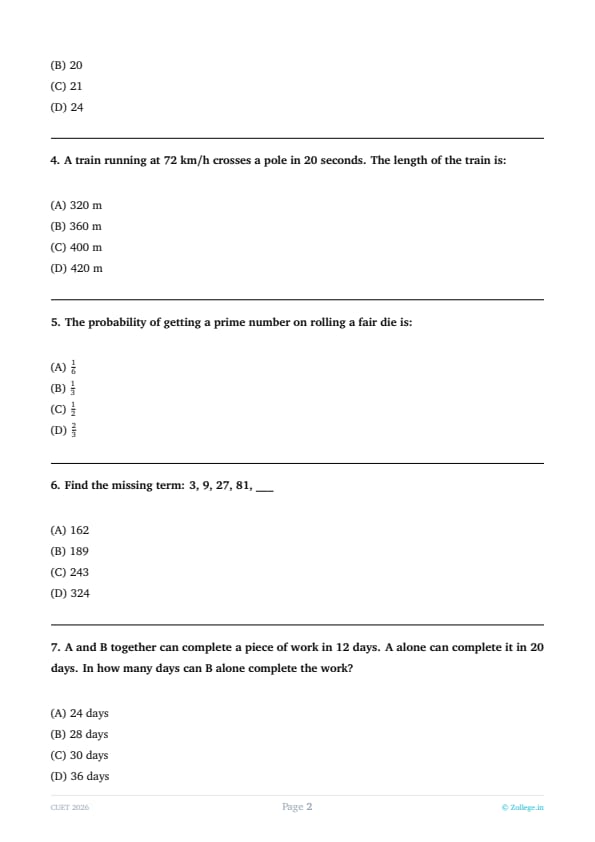
A train running at 72 km/h crosses a pole in 20 seconds. The length of the train is:
View Solution
Step 1: Understanding the Question:
This problem falls under the topic of Time, Speed, and Distance, specifically focusing on "train problems." When a train crosses a point object like a pole, a tree, or a standing man, the distance it covers is equal to its own length. The challenge here lies in the units provided: the speed is in kilometers per hour (km/h), while the time is in seconds and the required distance is in meters.
Step 2 : Key Formulas and approach:
1. Speed Conversion: To convert km/h to m/s, multiply the speed by \(\frac{5}{18}\).
2. Distance Formula: \(Distance = Speed \times Time\).
3. Concept Rule: \(Length of Train = Distance covered while crossing a point object\).
The approach involves converting the speed to the correct units first and then applying the basic distance formula.
Step 3 : Detailed Explanation:
First, we note the given speed of the train, which is \(72 km/h\). Since the time is given in seconds, we cannot use km/h directly. We must transform this into meters per second (m/s).
Using the conversion factor, \(Speed in m/s = 72 \times \frac{5}{18}\). Dividing 72 by 18, we get 4. Then, \(4 \times 5 = 20 m/s\). This means the train travels 20 meters every single second.
The time taken to cross the pole is 20 seconds. During these 20 seconds, the train must move forward by its entire length to completely clear the pole.
We now apply the distance formula: \(Distance = 20 m/s \times 20 s\).
Calculating the product, \(20 \times 20 = 400\). Since the units are m/s and seconds, the result is in meters.
Therefore, the distance covered in 20 seconds is 400 meters, which by definition is the physical length of the train.
If the train were crossing a platform, we would have added the platform length to the train length, but since a pole has no significant length, the distance is purely the train's length.
Step 4 : Final Answer:
The length of the train is 400 meters, which corresponds to option (C).
Quick Tip: Memorize the "18-to-5" table for quick conversions! \(18 km/h = 5 m/s\), \(36 km/h = 10 m/s\), \(54 km/h = 15 m/s\), and \(72 km/h = 20 m/s\). Recognizing these multiples will save you from doing manual multiplication during the exam!
The probability of getting a prime number on rolling a fair die is:
View Solution
Step 1: Understanding the Question:
The topic for this question is Probability. Specifically, it involves a "Single Event" experiment: rolling a six-sided fair die. Probability represents the likelihood of a specific event occurring compared to all possible outcomes. In this case, the target event is landing on a "prime number." To solve this, we need to correctly identify which integers on a die are prime.
Step 2 : Key Formulas and approach:
1. Probability Formula: \(P(E) = \frac{n(E)}{n(S)}\), where \(n(E)\) is the number of favorable outcomes and \(n(S)\) is the total number of possible outcomes.
2. Prime Number Definition: A number greater than 1 that has exactly two divisors: 1 and itself.
The approach involves listing the sample space, filtering for primes, and simplifying the resulting fraction.
Step 3 : Detailed Explanation:
A standard fair die has six faces numbered 1, 2, 3, 4, 5, and 6. Therefore, our total sample space \(S = \{1, 2, 3, 4, 5, 6\}\). This gives us \(n(S) = 6\).
Next, we examine each number to see if it is a prime number.
The number 1 is a special case; it is neither prime nor composite because it only has one divisor. Many students mistakenly include 1 as a prime.
The number 2 is prime (divisible by 1 and 2). In fact, it is the only even prime number.
The number 3 is prime (divisible by 1 and 3).
The number 4 is composite (\(2 \times 2 = 4\)).
The number 5 is prime (divisible by 1 and 5).
The number 6 is composite (\(2 \times 3 = 6\)).
Based on this check, our set of favorable outcomes is \(E = \{2, 3, 5\}\). Thus, the number of favorable outcomes \(n(E) = 3\).
Now we apply the probability formula: \(P = \frac{3}{6}\).
Simplifying the fraction by dividing both the numerator and denominator by 3, we get \(\frac{1}{2}\). This means there is a 50% chance of rolling a prime number.
Step 4 : Final Answer:
The probability of rolling a prime number is \(\frac{1}{2}\), which is represented by option (C).
Quick Tip: Avoid the "1-Trap"! Always remember that the first prime number is 2. On a die, there are exactly 3 primes (2, 3, 5), 2 composites (4, 6), and the number 1 which is neither. This 3 out of 6 split always results in a probability of 1/2.
Find the missing term: 3, 9, 27, 81, ___
View Solution
Step 1: Understanding the Question:
The topic for this problem is Number Series, which is a sub-section of Logical Reasoning and Quantitative Aptitude. A number series is a sequence of numbers following a specific mathematical pattern. To find the missing term, we must analyze the relationship between consecutive numbers (3, 9, 27, 81) to determine the rule that governs the growth of the sequence.
Step 2 : Key Formulas and approach:
1. Geometric Progression (GP) Rule: Each term is obtained by multiplying the previous term by a constant value called the common ratio (\(r\)).
2. Power Rule: Sometimes series represent sequential powers of a specific base number (\(n^1, n^2, n^3 \dots\)).
The approach involves checking for an addition pattern first, and if that fails, checking for a multiplication or exponential pattern.
Step 3 : Detailed Explanation:
Let's look at the gap between the terms. \(9 - 3 = 6\), \(27 - 9 = 18\), \(81 - 27 = 54\). Since the difference is increasing rapidly, it is likely not an addition-based series.
Now, let's look for a multiplicative relationship. To get from 3 to 9, we multiply by 3 (\(3 \times 3 = 9\)).
To get from 9 to 27, we check \(9 \times 3\), which indeed equals 27.
To get from 27 to 81, we check \(27 \times 3\), which equals 81. This confirms that the common ratio (\(r\)) is 3.
This sequence also represents the powers of 3: \(3^1 = 3\), \(3^2 = 9\), \(3^3 = 27\), and \(3^4 = 81\).
To find the next term, we simply follow the established rule. We must calculate \(81 \times 3\) or find the value of \(3^5\).
Calculating the product: \(80 \times 3 = 240\) and \(1 \times 3 = 3\). Adding them together, \(240 + 3 = 243\).
This fits perfectly with the exponential progression. The next number in the sequence after 243 would be \(243 \times 3 = 729\), but the question only asks for the immediate next term.
Step 4 : Final Answer:
The missing term in the geometric series is 243, which corresponds to option (C).
Quick Tip: Being familiar with the powers of small numbers (2, 3, 5) up to the 5th power can help you solve series questions in seconds! Knowing \(3^5 = 243\) instantly gives you the answer without having to perform manual multiplication of \(81 \times 3\).
A and B together can complete a piece of work in 12 days. A alone can complete it in 20 days. In how many days can B alone complete the work?
View Solution
Step 1: Understanding the Question:
The topic for this problem is Time and Work. In such problems, work is considered a constant whole (usually represented as 1). The time taken to complete the work is inversely proportional to the efficiency or the "rate" of the person. We are given the combined rate of two people (A and B) and the individual rate of one (A). We need to isolate and find the individual rate of the second person (B) to determine how long it takes them to finish the task alone.
Step 2 : Key Formulas and approach:
1. Work Rate Formula: \(Rate = \frac{1}{Time taken}\).
2. Individual Rate Isolation: \(Rate of B = Combined Rate (A+B) - Rate of A\).
3. Time Recovery: \(Time for B = \frac{1}{Rate of B}\).
The approach involves subtracting fractions to find the individual daily work capacity of person B.
Step 3 : Detailed Explanation:
First, we find the daily work done by A and B together. If they finish the work in 12 days, they complete \(\frac{1}{12}\) of the work in a single day.
Next, we find the daily work done by A alone. Since A takes 20 days, A completes \(\frac{1}{20}\) of the work in a single day.
To find B's daily work, we subtract A's contribution from the total daily progress: \(B's daily work = \frac{1}{12} - \frac{1}{20}\).
To perform the subtraction, we need a Least Common Multiple (LCM) for 12 and 20. The LCM of 12 and 20 is 60.
We convert the fractions: \(\frac{1}{12} = \frac{5}{60}\) and \(\frac{1}{20} = \frac{3}{60}\).
Now subtract the numerators: \(\frac{5}{60} - \frac{3}{60} = \frac{2}{60}\).
Simplifying \(\frac{2}{60}\), we get \(\frac{1}{30}\). This means B completes \(\frac{1}{30}\) of the total task in one day.
To find the total number of days B needs to complete the whole task (1 unit), we take the reciprocal of the daily rate. So, \(1 \div \frac{1}{30} = 30\) days.
This confirms that B is slightly slower than A, as 30 days is longer than A's 20 days, which makes sense given that their combined speed is 12 days.
Step 4 : Final Answer:
B alone can complete the work in 30 days, which matches option (C).
Quick Tip: Use the LCM (Unit) method to avoid fractions! Assume the total work is 60 units (LCM of 12 and 20). - A+B efficiency = \(60/12 = 5\) units/day. - A efficiency = \(60/20 = 3\) units/day. - B efficiency = \(5 - 3 = 2\) units/day. - B's time = \(60/2 = 30\) days. Much faster!
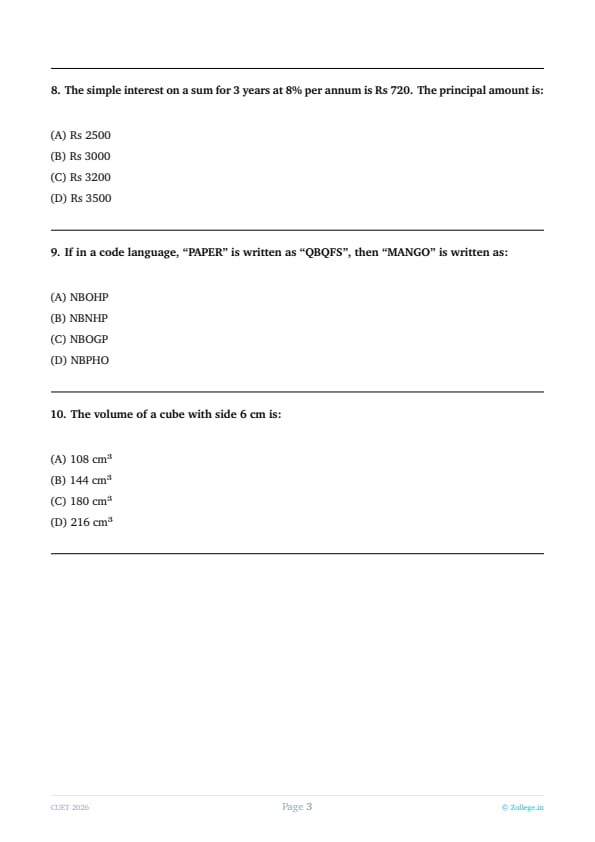
The simple interest on a sum for 3 years at 8% per annum is Rs 720. The principal amount is:
View Solution
Step 1: Understanding the Question:
The topic for this question is Simple Interest (SI). In simple interest, the interest is calculated only on the initial amount borrowed or invested, known as the Principal (P). Unlike compound interest, the interest amount remains the same every year for a given rate and principal. We are given the total interest earned over 3 years at an 8% annual rate, and we need to work backward to find the original Principal amount.
Step 2 : Key Formulas and approach:
1. Simple Interest Formula: \(SI = \frac{P \times R \times T}{100}\), where P is Principal, R is Rate, and T is Time.
2. Rearranged Formula for Principal: \(P = \frac{SI \times 100}{R \times T}\).
The approach involves substituting the known values into the equation and solving for the unknown variable P.
Step 3 : Detailed Explanation:
We start by listing the known parameters: \(Simple Interest (SI) = Rs 720\), \(Rate (R) = 8%\), and \(Time (T) = 3 years\).
We use the formula \(P = \frac{SI \times 100}{R \times T}\).
Substituting the values: \(P = \frac{720 \times 100}{8 \times 3}\).
First, simplify the denominator: \(8 \times 3 = 24\). So, \(P = \frac{720 \times 100}{24}\).
Next, we divide 720 by 24. Since \(24 \times 3 = 72\), we know that \(720 \div 24 = 30\).
Now we are left with \(P = 30 \times 100\).
Calculating the final product, we get \(P = Rs 3000\).
To verify, we can calculate the interest back: 8% of 3000 is 240. For 3 years, \(240 \times 3 = 720\). This perfectly matches the interest given in the question.
This calculation shows that for every Rs 100 of the principal, the person earned Rs 24 in interest over 3 years. Since they earned Rs 720, the principal must be 30 times larger than Rs 100.
Step 4 : Final Answer:
The principal amount is Rs 3000, which corresponds to option (B).
Quick Tip: Calculate the "Effective Percentage"! If the rate is 8% per year for 3 years, the total interest is simply \(8% \times 3 = 24%\) of the principal. If 24% equals Rs 720, then 1% equals \(720/24 = Rs 30\). Since the principal is always 100%, just multiply Rs 30 by 100 to get Rs 3000!
If in a code language, “PAPER” is written as “QBQFS”, then “MANGO” is written as:
View Solution
Step 1 : Understanding the Question:
The topic of this question is Logical Reasoning, specifically focusing on the sub-topic of Coding-Decoding. In these types of problems, a specific rule or transformation is applied to a word to convert it into a code. The student must identify the pattern by analyzing the relationship between the letters of the given word and its corresponding code. Once the logic is established, the same rule must be applied to a new target word to find its coded version among the given options.
Step 2 : Key Formulas and approach:
The approach for solving letter-based coding involves identifying the alphabetical displacement (shift) of each character. If we represent the position of a letter in the English alphabet as \(P\) (where \(A=1, B=2, \dots\)), the transformation rule can be expressed as:
\(\)\text{Coded Letter = \text{Position(P + n)\(\)
Where \(n\) represents the numerical shift. For this problem, the approach is:
1. Map each letter of the word "PAPER" to its corresponding letter in "QBQFS".
2. Determine if the shift \(n\) is constant or variable.
3. Apply the identified shift to the letters of the word "MANGO" sequentially.
Step 3 : Detailed Explanation:
We start by examining the word "PAPER" and its code "QBQFS" to find the underlying logic. Let's compare them letter by letter:
The first letter 'P' in the original word is transformed into 'Q'. In the English alphabet, 'Q' comes immediately after 'P', indicating a shift of \(+1\).
The second letter 'A' is transformed into 'B'. Since 'B' is the next letter after 'A', the shift remains \(+1\).
The third letter 'P' is again transformed into 'Q', maintaining the \(+1\) alphabetical displacement.
The fourth letter 'E' is transformed into 'F'. Counting one step forward from 'E' gives 'F', confirming the \(+1\) shift.
The fifth letter 'R' is transformed into 'S'. Following the pattern, 'S' is the letter immediately following 'R', completing the \(+1\) logic for the entire word.
Now that we have established the rule is a constant \(+1\) shift for every character, we apply it to the target word "MANGO".
For 'M': The next letter in the alphabet is 'N'.
For 'A': The next letter in the alphabet is 'B'.
For 'N': The next letter in the alphabet is 'O'.
For 'G': The next letter in the alphabet is 'H'.
For 'O': The next letter in the alphabet is 'P'.
Combining these results, the coded word for "MANGO" becomes "NBOHP".
Looking at the options provided: (A) NBOHP, (B) NBNHP, (C) NBOGP, and (D) NBPHO, only option (A) perfectly matches our derived code.
Step 4 : Final Answer:
By applying the constant +1 alphabetical shift to each letter of the word "MANGO," we obtain the code NBOHP, which is Option (A).
Quick Tip: To solve Coding-Decoding questions faster, try the "First and Last" technique! For MANGO, the code must start with the letter after M (which is N) and end with the letter after O (which is P). A quick scan of the options shows that only Option (A) starts with N and ends with P, allowing you to find the answer without decoding every letter!
The volume of a cube with side 6 cm is:
View Solution
Step 1: Understanding the Question:
The topic for this problem is Mensuration, specifically 3D Geometry involving a Cube. A cube is a three-dimensional solid object bounded by six square faces, where all edges have the same length. The "volume" of a cube represents the total space occupied by the object. To solve this, we simply need to understand the relationship between the side length and the space contained within the cube's boundaries.
Step 2 : Key Formulas and approach:
1. Volume of a Cube: \(V = s^3\) or \(V = side \times side \times side\).
2. Side Length (s): Given as 6 cm.
The approach is a direct substitution of the side length into the volume formula and performing the cube calculation.
Step 3 : Detailed Explanation:
We are given that the side of the cube is \(6 cm\). In a cube, length = width = height = 6 cm.
The formula for volume is \(V = side^3\). Substituting our value, we get \(V = 6 \times 6 \times 6\).
First, we calculate the area of the base (side squared): \(6 \times 6 = 36 cm^2\).
Then, we multiply this base area by the height (the third side): \(36 \times 6\).
To calculate \(36 \times 6\): \(30 \times 6 = 180\) and \(6 \times 6 = 36\). Adding them, \(180 + 36 = 216\).
The units for side length are in centimeters (cm), so the units for volume will be cubic centimeters (\(cm^3\)).
Therefore, the total space occupied by the cube is 216 cubic centimeters.
It is interesting to note that for a cube of side 6, the numerical value of its Volume (\(6^3 = 216\)) is exactly equal to the numerical value of its Total Surface Area (\(6 \times 6^2 = 216\)), though the units differ (\(cm^3\) vs \(cm^2\)).
Step 4 : Final Answer:
The volume of the cube is 216 cm³, which matches option (D).
Quick Tip: Memorize the cubes of the first 10 natural numbers to save time in geometry and number series questions! \(1^3=1, 2^3=8, 3^3=27, 4^3=64, 5^3=125, \mathbf{6^3=216}, 7^3=343, 8^3=512, 9^3=729, 10^3=1000\). Knowing \(6^3\) would have allowed you to solve this instantly!
CUET 2026 General Aptitude Test Most Expected PYQs
*The article might have information for the previous academic years, please refer the official website of the exam.