
CUET 2026 History Question Paper May 21 Shift 1 with Solution PDF


| Updated On - May 27, 2026
CUET 2026 May 21 Shift 1 History Question Paper with Solution PDF is available here for download. NTA conducted CUET 2026 on May 21, Shift 1, from 9 AM to 12 PM in CBT Mode.
The CUET 2026 History Question Paper includes questions from Ancient Indian History, Medieval Indian History and Modern Indian Histrory, with 50 Questions carrying a total of 250 marks. As per the CUET marking scheme, +5 marks are awarded for every correct answer, and -1 mark is deducted for every wrong answer.
CUET 2026 History Question Paper May 21 Shift 1 with Solution PDF
| CUET 2026 History Question Paper | Download PDF | Check Solutions |
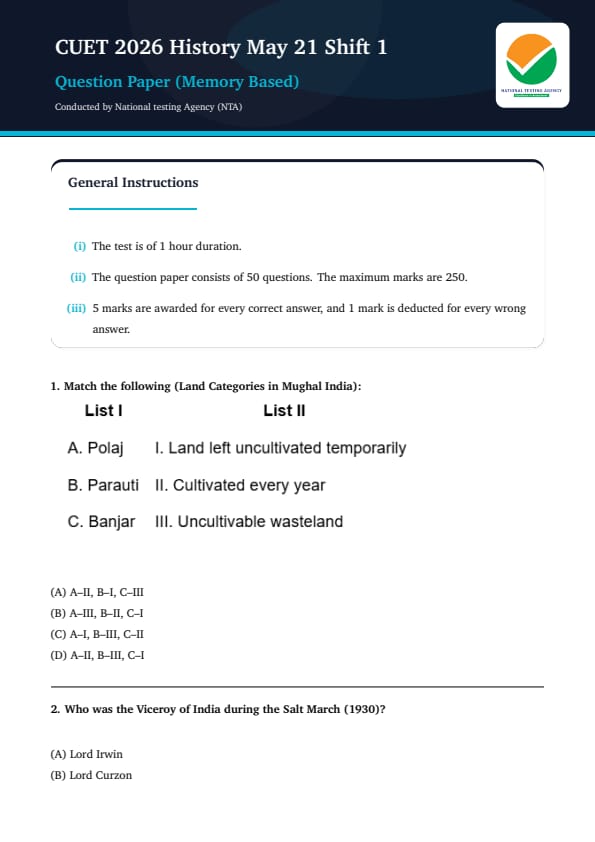
Match the following (Land Categories in Mughal India):

View Solution
Step 1: Understanding the Concept:
The Mughal land revenue system reached its zenith under Emperor Akbar with the assistance of his finance minister, Raja Todar Mal.
To ensure a stable and fair taxation system, the empire needed to assess the productivity of the land accurately.
The Ain-i-Akbari, authored by Abu'l Fazl, provides a comprehensive classification of land based on the continuity of cultivation.
This classification was vital for the {Dahsala system, where revenue was calculated based on the average yield of the past ten years.
The state categorized land into four distinct types: Polaj, Parauti, Chachar, and Banjar.
Step 2: Detailed Explanation:
Each category had a specific meaning based on how frequently the soil was used and its inherent fertility:
1. Polaj: This was the highest grade of land in the empire.
It was land that was cultivated for every crop in succession without ever being left fallow.
Because it was "cultivated every year," it was the most productive and consequently subject to the highest revenue rates.
The state expected consistent output from Polaj land, making it the backbone of the Mughal agrarian economy.
Thus, A matches with II.
2. Parauti: This land was of high quality but required periodic rest to maintain its nutrient levels.
It was "land left uncultivated temporarily" so that the soil could recover its strength naturally.
By letting the land lie fallow for a season or a year, the farmers ensured that future yields remained high.
Revenue was charged on Parauti land only when it was actually under cultivation.
Thus, B matches with I.
3. Banjar: This term refers to land that was essentially barren or had not been cultivated for five years or more.
It was categorized as "uncultivable wasteland" or extremely marginal land.
The Mughal state encouraged the reclamation of Banjar land by offering low revenue rates or tax holidays to farmers who brought it under the plow.
However, in its primary state, it yielded nothing for the treasury.
Thus, C matches with III.
4. Chachar: Though not in the provided list, Chachar was land that had lain fallow for three to four years.
It sat between Parauti and Banjar in terms of productivity and rest periods.
Step 3: Final Answer:
The correct matching based on historical definitions is Polaj to II, Parauti to I, and Banjar to III.
This sequence is represented by Option (A).
Quick Tip: To remember these terms for the exam, use this mnemonic:
{Polaj = {P}rolific (always growing).
{P}arauti = {P}ause (needs a break).
{B}anjar = {B}arren (wasteland).
This classification ensured that the state did not overtax poor land or undertax rich land.
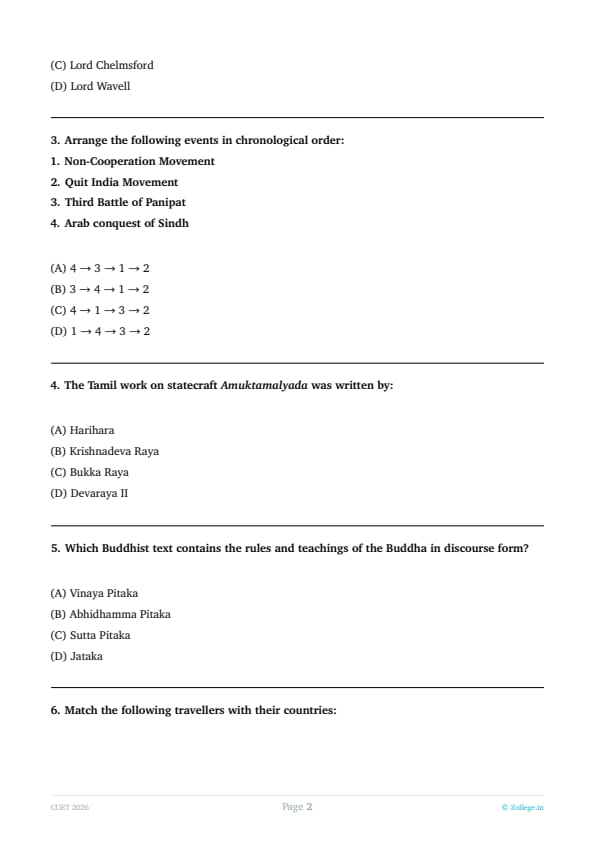
Who was the Viceroy of India during the Salt March (1930)?
View Solution
Step 1: Understanding the Concept:
The Salt March (Dandi March) of 1930 was a defining moment in the Indian Freedom Struggle, signaling the start of the Civil Disobedience Movement.
Identifying the Viceroy is essential because the British administration's response to Gandhi's demands dictated the course of the movement.
At this time, the relationship between the Indian National Congress and the British Crown was at a breaking point due to the demand for 'Purna Swaraj' (Complete Independence).
Step 2: Detailed Explanation:
Lord Irwin served as the Viceroy and Governor-General of India from April 1926 to April 1931.
His tenure was a period of intense political activity and confrontation.
Before launching the march, Mahatma Gandhi sent a letter to Lord Irwin on March 2, 1930, detailing 11 demands.
These demands included the abolition of the salt tax, reduction of land revenue, and protective tariffs on foreign cloth.
When Lord Irwin ignored these demands and refused to meet Gandhi, the Salt Satyagraha began on March 12, 1930.
Irwin was the administrator who had to manage the massive scale of civil disobedience that followed, leading to the arrest of over 60,000 people, including Gandhi himself.
Eventually, realizing the stalemate, Irwin initiated negotiations, leading to the "Gandhi-Irwin Pact" in 1931.
Let's review the other options for clarity:
- Lord Curzon (1899–1905): He is famous for the Partition of Bengal in 1905 and the educational reforms of 1904.
- Lord Chelmsford (1916–1921): He was the Viceroy during the Jallianwala Bagh massacre (1919) and the Non-Cooperation Movement (1920-22).
- Lord Wavell (1943–1947): He managed India during the final years of WWII and the initial negotiations for the transfer of power.
Step 3: Final Answer:
As the Salt March took place in 1930, Lord Irwin was the presiding Viceroy.
Therefore, the correct answer is (A).
Quick Tip: Remember that the "Gandhi-Irwin Pact" is the direct aftermath of the Salt March.
If you know the pact happened in 1931, you can easily identify Irwin as the Viceroy during the 1930 march.
Always link major treaties or pacts to the movements they ended.
Arrange the following events in chronological order:
1. Non-Cooperation Movement
2. Quit India Movement
3. Third Battle of Panipat
4. Arab conquest of Sindh
View Solution
Step 1: Understanding the Concept:
Chronological questions require an understanding of broad historical eras.
In this list, we have an event from the Early Medieval period, the Late Medieval period, and two from the Modern period.
Arranging them requires identifying the exact years these transformative events took place.
Step 2: Detailed Explanation:
Let us analyze each event in detail:
1. Arab conquest of Sindh (712 CE): This is the earliest event on the list.
Led by Muhammad bin Qasim, the Arab forces of the Umayyad Caliphate invaded the Sindh region (modern-day Pakistan).
They defeated Raja Dahir, marking the first significant Islamic expansion into the Indian subcontinent.
2. Third Battle of Panipat (1761): This occurred in the mid-18th century.
It was a conflict between the Maratha Empire and the invading Afghan army of Ahmad Shah Abdali.
The Marathas were defeated, which checked their expansion and allowed British power to grow more easily in the vacuum that followed.
3. Non-Cooperation Movement (1920): This was the first major mass movement led by Mahatma Gandhi against British rule.
It was launched in protest against the Jallianwala Bagh massacre and the Rowlatt Act, and was supported by the Khilafat Movement.
4. Quit India Movement (1942): This was the final major mass struggle before independence.
Launched in August 1942 during World War II, Gandhi gave the "Do or Die" call to force the British to leave India immediately.
Step 3: Final Answer:
The order is 712 CE \(\rightarrow\) 1761 \(\rightarrow\) 1920 \(\rightarrow\) 1942.
This corresponds to the sequence 4 \(\rightarrow\) 3 \(\rightarrow\) 1 \(\rightarrow\) 2.
Hence, the correct option is (A).
Quick Tip: For chronology, always identify the "anchor" events.
The Arab conquest is the only early medieval event, and Quit India is the most recent.
Identifying these two (first and last) often reveals the correct answer immediately in multiple-choice questions.
The Tamil work on statecraft Amuktamalyada was written by:
View Solution
Step 1: Understanding the Concept:
The Vijayanagara Empire was a center for high culture and literature.
Its most famous ruler, Krishnadeva Raya (1509–1529), was a great patron of the arts and a scholar himself.
He is often referred to as 'Andhra Bhoja' due to his immense contributions to literature.
Step 2: Detailed Explanation:
Krishnadeva Raya was the author of Amuktamalyada.
While the question describes it as a work on statecraft, it is primarily an epic poem written in Telugu (though it deals with a Tamil subject).
The poem tells the story of the Tamil Alvar saint Andal (Goda Devi) and her devotion to Lord Ranganatha.
Embedded within this religious narrative is a significant section on "Rajaneeti" or the art of governance.
In these verses, the King describes how a monarch should treat his subjects, manage the treasury, and maintain a strong spy network.
He emphasizes that a king's primary duty is the protection of the weak and the patronage of religion and culture.
His court was also famous for the 'Ashtadiggajas', or the eight great poets, including Tenali Rama.
- Harihara and Bukka were the founders of the empire in 1336.
- Devaraya II was a powerful Sangama ruler known for expanding the empire but was not the author of this specific text.
Step 3: Final Answer:
The work {Amuktamalyada was written by the Tuluva king Krishnadeva Raya.
Thus, option (B) is correct.
Quick Tip: Note: {Amuktamalyada is actually a Telugu masterpiece, even though the story is about a Tamil saint.
Krishnadeva Raya also wrote a Sanskrit play titled Jambavati Kalyanam.
Keep these two works associated with his name for competitive exams.
Which Buddhist text contains the rules and teachings of the Buddha in discourse form?
View Solution
Step 1: Understanding the Concept:
The sacred scriptures of Buddhism are collectively called the Tripitaka (Three Baskets).
These were compiled after the death of the Buddha to preserve his message.
The three baskets are the Sutta Pitaka, the Vinaya Pitaka, and the Abhidhamma Pitaka.
Each serves a specific function in Buddhist practice and philosophy.
Step 2: Detailed Explanation:
Let's distinguish between the three Pitakas:
1. Sutta Pitaka: This is the collection of the Buddha's actual sermons and teachings.
It is written in the form of "discourses" or dialogues (Suttas).
It contains the core doctrines like the Four Noble Truths and the Eightfold Path, explained through stories and conversations between the Buddha and his disciples.
Hence, it perfectly fits the question's requirement.
2. Vinaya Pitaka: This basket contains the "rules of discipline" for the monks (Bhikkhus) and nuns (Bhikkhunis).
It outlines how the monastic community (Sangha) should live, the offenses they might commit, and the punishments for those offenses.
3. Abhidhamma Pitaka: This is a philosophical and systematic analysis of the teachings.
It deals with metaphysics, psychology, and logic, rather than narrative discourses.
4. Jataka: These are stories of the Buddha's previous lives.
While very important, they are considered a part of the {Khuddaka Nikaya within the Sutta Pitaka, but they are not the general "discourse" collection itself.
Step 3: Final Answer:
The Sutta Pitaka is the text that contains teachings in discourse form.
Therefore, the correct answer is (C).
Quick Tip: To remember:
{Vinaya = {V}ules (Rules for Monks).
{S}utta = {S}ermons (Discourses of Buddha).
{A}bhidhamma = {A}nalytical philosophy.
This simple association helps you avoid confusion during the exam.
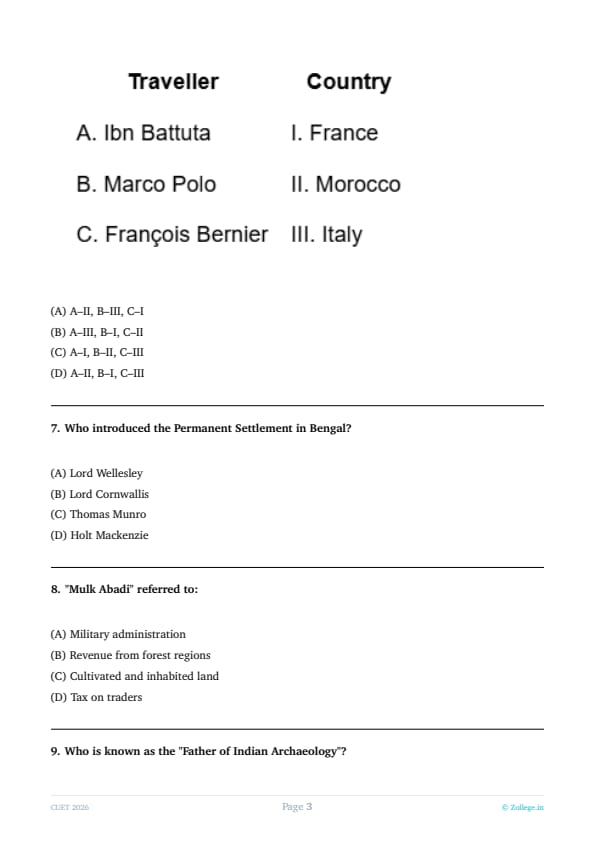
Match the following travellers with their countries:

View Solution
Step 1: Understanding the Concept:
Travellers from across the globe visited India throughout history, leaving behind detailed accounts of their journeys.
These accounts are primary sources for understanding the social, economic, and political conditions of the times.
Knowing the origins of these travellers is fundamental to contextualizing their perspectives.
Step 2: Detailed Explanation:
Let's match each traveller to their home country:
1. Ibn Battuta: He was one of the most prolific travellers in world history.
He was born in Tangier, Morocco.
He arrived in India in 1333 during the reign of Muhammad bin Tughlaq and served as a Qazi in Delhi. His book {Rihla is a classic account of 14th-century India.
So, A matches with II.
2. Marco Polo: Known as the "Prince of Medieval Travellers," he was a merchant from Venice, Italy.
He visited the southern coasts of India (the Pandya kingdom) in the late 13th century on his way back from China.
His accounts of Indian pearl fisheries and trade were widely read in Europe.
So, B matches with III.
3. François Bernier: He was a physician and philosopher from France.
He lived in India for 12 years (1656–1668) during the Mughal period.
He was a personal physician to Prince Dara Shikoh and later Aurangzeb. His book {Travels in the Mughal Empire is famous for comparing Mughal India unfavorably with Europe.
So, C matches with I.
Step 3: Final Answer:
The correct matches are A-II, B-III, and C-I.
This combination is found in Option (A).
Quick Tip: Always associate the traveller with the reigning monarch:
Ibn Battuta \(\rightarrow\) Tughlaq.
Bernier \(\rightarrow\) Aurangzeb.
Niccolò de' Conti \(\rightarrow\) Devaraya II.
Knowing the era helps you narrow down their country of origin.
Who introduced the Permanent Settlement in Bengal?
View Solution
Step 1: Understanding the Concept:
The Permanent Settlement was an agreement between the East India Company and Bengali landlords (Zamindars) to fix revenues to be raised from land.
It was the first major land revenue system introduced by the British in India.
The objective was to create a stable income for the Company and a loyal class of supporters (the Zamindars).
Step 2: Detailed Explanation:
Lord Cornwallis introduced the Permanent Settlement in 1793 in the provinces of Bengal, Bihar, and Odisha.
Under this system:
- The Zamindars were recognized as the legal owners of the land.
- The amount of revenue to be paid by them to the government was fixed permanently.
- If the Zamindars failed to pay the fixed revenue on time, their land was auctioned (the Sunset Law).
While it secured revenue for the British, it was disastrous for the peasants, who lost their traditional rights and became tenants at the mercy of the Zamindars.
Other land systems:
- Thomas Munro introduced the Ryotwari System in Madras, where the government dealt directly with the cultivators (Ryots).
- Holt Mackenzie is associated with the Mahalwari System in North India, where the village community (Mahal) was the unit of assessment.
- Lord Wellesley is known for the Subsidiary Alliance, not a land revenue system.
Step 3: Final Answer:
The person responsible for the Permanent Settlement is Lord Cornwallis.
Thus, option (B) is the correct answer.
Quick Tip: Permanent Settlement = Bengal = Cornwallis.
Ryotwari = Madras/Bombay = Munro.
Mahalwari = NW Provinces/Punjab = Mackenzie.
Linking the "Region-Person-System" is the best way to master these revenue reforms.
"Mulk Abadi" referred to:
View Solution
Step 1: Understanding the Concept:
In the administrative records of the Mughal and later periods, terms derived from Persian and Arabic were used to describe land and its usage.
Understanding these terms is key to deciphering historical documents related to agrarian history.
Step 2: Detailed Explanation:
The term "Mulk Abadi" can be broken down:
- "Mulk" usually means a territory or country.
- "Abadi" comes from "Abad," meaning populated, settled, or cultivated.
In historical context, "Mulk Abadi" specifically referred to the areas of a province or kingdom that were actively "cultivated and inhabited."
These were the areas that provided the bulk of the land revenue (Mal) to the state because they were populated by taxpayers and produced crops.
This stood in contrast to forest areas or wild frontier regions that were not yet brought under the administration's settled revenue system.
- Option (A) is wrong as military administration was usually under the 'Mansabdari' system.
- Option (B) is wrong as forest revenue had different nomenclatures.
- Option (D) is wrong as taxes on traders were called 'Zakat' or 'Sair'.
Step 3: Final Answer:
Thus, "Mulk Abadi" refers to land that is settled and farmed.
The correct answer is (C).
Quick Tip: "Abad" in Hindi/Urdu/Persian always relates to population or prosperity (like Hyderabad or Allahabad).
Therefore, "Abadi" will always relate to settled areas rather than wild forests or military camps.
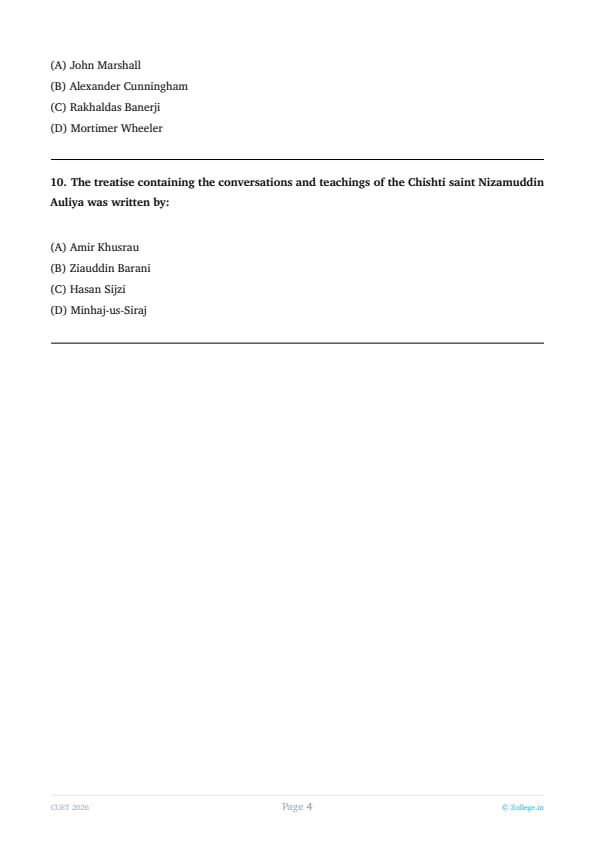
Who is known as the "Father of Indian Archaeology"?
View Solution
Step 1: Understanding the Concept:
Archaeology in India began as a systematic study in the mid-19th century.
The Archaeological Survey of India (ASI) was established to preserve the vast ruins and monuments of the subcontinent.
The person who pioneered this institutional framework is given the title of "Father."
Step 2: Detailed Explanation:
Alexander Cunningham was a British army officer who became deeply interested in Indian history.
In 1861, he was appointed as the first Director-General of the Archaeological Survey of India.
Cunningham's methodology involved using the travel accounts of ancient Chinese Buddhist pilgrims (like Fa-Hien and Xuanzang) to locate historical sites.
He conducted extensive surveys and excavations at Sanchi, Sarnath, and various Buddhist monuments.
His foundational work provided the first organized map of India's archaeological landscape.
Other figures:
- John Marshall was the DG of ASI when Harappa and Mohenjo-daro were discovered (1920s).
- R.D. Banerji is the Indian archaeologist who discovered Mohenjo-daro.
- Mortimer Wheeler brought scientific stratification methods to Indian archaeology in the 1940s.
Step 3: Final Answer:
Because he was the first Director-General and the founder of ASI, Alexander Cunningham is known as the Father of Indian Archaeology.
The correct option is (B).
Quick Tip: Remember:
Cunningham = Founder/Father (1860s).
John Marshall = Indus Valley Revelation (1920s).
Wheeler = Stratigraphy (1940s).
Focusing on the time periods helps distinguish their roles.
The treatise containing the conversations and teachings of the Chishti saint Nizamuddin Auliya was written by:
View Solution
Step 1: Understanding the Concept:
Sufi literature includes a specific genre called Malfuzat, which records the spoken words and conversations of a saint.
Nizamuddin Auliya (d. 1325) was the most famous Chishti saint of Delhi.
His teachings were not written down by himself but by his devoted disciples.
Step 2: Detailed Explanation:
The work that contains the teachings of Nizamuddin Auliya is titled {Fawaid-ul-Fuad (Morals for the Heart).
It was compiled by Amir Hasan Sijzi Dehlavi (Hasan Sijzi), a famous poet and contemporary of Amir Khusrau.
Hasan Sijzi attended the saint's gatherings (majlis) and meticulously recorded the questions asked by visitors and the saint's wise responses.
The book provides insights into Sufi ethics, social life in Delhi, and the spiritual path of the Chishti order.
It is considered a masterpiece of Persian literature and a model for all future Malfuzat texts.
- Amir Khusrau was the saint's most beloved disciple, but he is more famous for his poetry and music.
- Ziauddin Barani was a historian who wrote {Tarikh-i-Firoz Shahi.
- Minhaj-us-Siraj wrote {Tabaqat-i-Nasiri, a political history.
Step 3: Final Answer:
The recorder of Nizamuddin Auliya's discourses in {Fawaid-ul-Fuad is Hasan Sijzi.
Hence, the correct answer is (C).
Quick Tip: {Fawaid-ul-Fuad is the most important source for the life of Nizamuddin Auliya.
Think of it as the "interviews" or "transcripts" of the saint's court.
Always link Hasan Sijzi to this specific book for Sufi history questions.
CUET 2026 Complete History Revision
*The article might have information for the previous academic years, please refer the official website of the exam.