
CUET 2026 Physical Education Question Paper May 21 Shift 1 with Solution PDF


| Updated On - May 27, 2026
CUET 2026 May 21 Shift 1 Physical Education Question Paper with Solution PDF is available here for download. NTA conducted CUET 2026 on May 21, Shift 1, from 9 AM to 12 PM in CBT Mode.
The CUET 2026 Physical Education Question Paper includes questions from both theoretical and applied fitness concepts. Candidates reported the overall difficulty to be manageable, drawing extensively on NCERT-based principles such as sports sociology, physiology, and health education. with 50 Questions carrying a total of 250 marks. As per the CUET marking scheme, +5 marks are awarded for every correct answer, and -1 mark is deducted for every wrong answer.
CUET 2026 Physical Education Question Paper May 21 Shift 1 with Solution PDF
| CUET 2026 Physical Education Question Paper | Download PDF | Check Solutions |
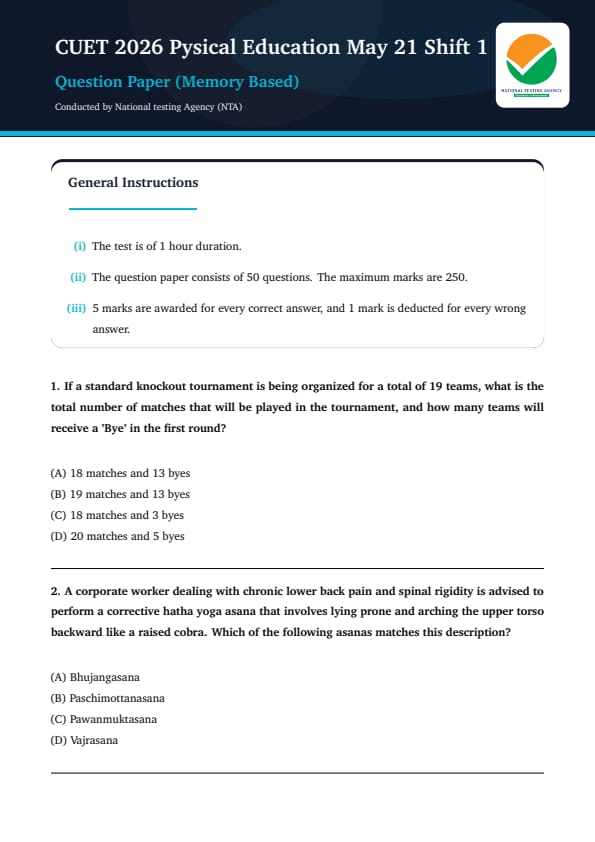

If a standard knockout tournament is being organized for a total of 19 teams, what is the total number of matches that will be played in the tournament, and how many teams will receive a 'Bye' in the first round?
View Solution
Step 1: Understanding the Concept:
Tournament planning is a critical administrative task in physical education and sports management.
A knockout tournament, also referred to as a single-elimination tournament, is a format where the loser of each bracket is immediately eliminated from the competition.
This structure is favored for its efficiency, especially when time and resources are limited, as it requires fewer matches to determine a winner compared to a league format.
The organization of a knockout fixture requires two fundamental calculations: determining the total matches to schedule and calculating "Byes."
A "Bye" is a privilege given to certain teams to skip the first round of competition.
This is necessary when the number of participating teams is not an exact power of two (\(2, 4, 8, 16, 32, \dots\)), ensuring that subsequent rounds have a perfect pairing of teams.
Step 2: Key Formula or Approach:
To find the total matches (\(M\)) for a knockout tournament involving \(N\) teams:
\[ M = N - 1 \]
To determine the number of Byes (\(B\)), we identify the next highest power of two (\(2^n\)) that is greater than or equal to \(N\):
\[ B = 2^n - N \]
Step 3: Detailed Explanation:
In this scenario, the number of teams \(N\) is 19.
1. Calculation of Total Matches:
The logic for \(N-1\) is straightforward: in a knockout system, every team except the champion must lose exactly once.
Since only one team can be the winner, 18 teams must be eliminated.
Each elimination requires one match.
Therefore, \(M = 19 - 1 = 18\) matches.
2. Calculation of Byes:
Standard brackets work best when the number of teams is a power of 2 (\(2^1=2, 2^2=4, 2^3=8, 2^4=16, 2^5=32\)).
Since 19 is greater than 16 but less than 32, the "next power of two" is 32.
Byes are given to fill the gap between the actual number of teams and this ideal power of two.
Calculating Byes: \(32 - 19 = 13\) byes.
These 13 byes will be distributed between the upper and lower halves of the fixture.
Specifically, in a first round of 19 teams, 6 teams will actually play (\(19 - 13 = 6\)).
These 6 teams will play 3 matches, resulting in 3 winners.
In the second round, these 3 winners will join the 13 teams that had byes, resulting in \(13 + 3 = 16\) teams.
Now that the number of teams is 16 (a perfect power of 2), the tournament can proceed without any more byes through the Quarter-finals, Semi-finals, and Final.
Step 4: Final Answer:
The tournament will consist of 18 matches in total, and 13 teams will receive a bye in the first round to balance the fixture.
This aligns perfectly with option (A).
Quick Tip: To save time on the exam:
1. If the question asks for matches in a knockout, simply subtract 1 from the total teams.
2. Memorize the powers of two: 2, 4, 8, 16, 32, 64.
3. If \(N = 19\), the next power is 32. The difference (\(32-19\)) is your answer for byes.
This logic ensures you don't even need to draw a fixture to find the answer.
A corporate worker dealing with chronic lower back pain and spinal rigidity is advised to perform a corrective hatha yoga asana that involves lying prone and arching the upper torso backward like a raised cobra. Which of the following asanas matches this description?
View Solution
Step 1: Understanding the Concept:
Yoga is increasingly recognized as a therapeutic tool for managing "lifestyle disorders" resulting from sedentary work environments.
Corporate employees often spend 8-10 hours sitting in front of computers, leading to a condition known as "Kyphosis" or "Upper Cross Syndrome," where the shoulders round forward and the lower back becomes stiff.
Spinal rigidity and chronic back pain are common symptoms of this prolonged flexion.
Corrective Hatha Yoga focuses on counter-movements to restore the natural curvature of the spine.
Asanas are classified by their starting position: Prone (on the stomach), Supine (on the back), Seated, or Standing.
Step 2: Detailed Explanation:
The description provided contains specific anatomical cues: "lying prone" and "arching the upper torso backward like a raised cobra."
1. Analysis of Bhujangasana (Cobra Pose):
In Sanskrit, 'Bhujanga' means "Snake" or "Cobra" and 'Asana' means "Pose."
Technique: The practitioner lies flat on their stomach (prone). The palms are placed under the shoulders.
During inhalation, the chest is lifted off the ground by engaging the erector spinae muscles of the back.
The final position resembles a cobra with its hood raised.
Therapeutic Benefits: This asana provides a deep stretch to the anterior abdominal muscles and the chest while strengthening the muscles that support the spine.
It is highly effective for reducing spinal rigidity and relieving lower back pain caused by slouching.
2. Evaluation of Alternatives:
- Paschimottanasana: This is a seated forward bend. It involves stretching the back but requires "flexion" (bending forward), which is the opposite of the "arch" described.
- Pawanmuktasana: This is a "supine" pose (on the back). It is used primarily for relieving digestive gases and involves pulling the knees to the chest.
- Vajrasana: This is a seated "kneeling" pose. It is used for meditation and improving digestion after meals, but it does not involve lying on the stomach or arching the back.
Step 3: Final Answer:
Bhujangasana is the only asana among the options that is performed in a prone position and mimics the backward-arching movement of a cobra.
Quick Tip: Associate Sanskrit roots with English meanings to solve yoga questions instantly:
- Bhujanga = Cobra (Snake).
- Pawan = Wind (Gas-relieving).
- Paschima = Back/West (referring to the back of the body).
- Vajra = Thunderbolt (firm kneeling position).
The name "Cobra" in the question is the biggest clue pointing to Bhujangasana.
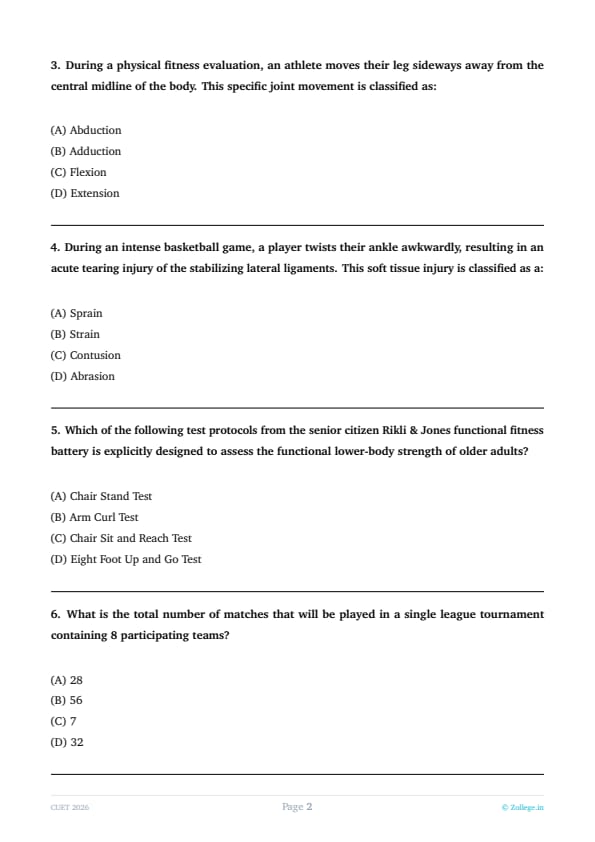
During a physical fitness evaluation, an athlete moves their leg sideways away from the central midline of the body. This specific joint movement is classified as:
View Solution
Step 1: Understanding the Concept:
Kinesiology is the study of human movement, and it relies on a standardized set of anatomical terms to describe how limbs move relative to the body's axes and planes.
The body is typically divided by three planes: Sagittal (left/right), Frontal (front/back), and Transverse (top/bottom).
The "midline" is an imaginary vertical line that divides the body into symmetrical left and right halves.
Movement classification depends entirely on the direction of the limb relative to this midline and the change in the joint angle.
Step 2: Detailed Explanation:
The movement described is "moving the leg sideways away from the central midline."
1. Abduction:
The term "Abduction" comes from the Latin "ab" (away) and "ducere" (to lead).
It refers to movements in the frontal plane where a limb is moved laterally away from the midline of the body.
Examples include raising your arms out to the sides (like a bird's wings) or moving your leg outward during a jumping jack.
In this question, the athlete's sideways movement of the leg away from the center is the definition of Abduction.
2. Adduction:
This is the opposite of abduction. It involves moving a limb toward the midline ("adding" it back to the center).
3. Flexion and Extension:
Flexion involves a movement that decreases the angle between two body parts (e.g., bending the elbow).
Extension involves a movement that increases the angle (e.g., straightening the elbow).
These movements generally occur in the sagittal plane (forward and backward), not sideways.
Step 3: Final Answer:
The movement of the leg laterally away from the body's vertical axis is classified as Abduction.
Quick Tip: Use these linguistic memory aids:
- {AB}duction: To {AB}duct someone is to take them {away}. So, Abduction is moving a limb {away} from the body.
- {AD}duction: Think of {AD}ding. You are {AD}ding the limb back to the {midline} of the body.
This simple trick ensures you never confuse the two during a high-pressure exam.
During an intense basketball game, a player twists their ankle awkwardly, resulting in an acute tearing injury of the stabilizing lateral ligaments. This soft tissue injury is classified as a:
View Solution
Step 1: Understanding the Concept:
Sports injuries are systematically categorized based on the specific anatomical tissue that sustains damage during the trauma.
Soft tissue injuries involve the skin, muscles, tendons, or ligaments, whereas hard tissue injuries involve bones (fractures) and joints (dislocations).
The two most commonly confused soft tissue injuries are "Sprains" and "Strains."
The key to distinguishing them lies in knowing which connective tissue is involved: ligaments or tendons/muscles.
Step 2: Detailed Explanation:
The question specifies an "acute tearing injury of the stabilizing lateral ligaments" caused by an ankle twist.
1. Definition of a Sprain:
A sprain is an injury to a ligament—the tough, fibrous tissue that connects two bones together at a joint.
Ligaments provide stability to joints. When a joint is forced beyond its normal range of motion (like an "ankle roll"), the ligaments are overstretched or torn.
Symptoms include localized pain, swelling, bruising, and joint instability.
Since the question mentions ligaments, "Sprain" is the correct classification.
2. Definition of a Strain:
A strain is an injury to a muscle or a tendon (the tissue connecting muscle to bone).
Strains are often called "pulled muscles" and usually occur due to overexertion or sudden contraction.
3. Other options:
- Contusion: This is a medical term for a bruise caused by a direct blow that crushes underlying capillaries without breaking the skin.
- Abrasion: This is a superficial scrape on the skin surface caused by friction (e.g., sliding on a court).
Step 3: Final Answer:
Because the injury specifically involves the ligaments of the ankle, it is medically classified as a Sprain.
Quick Tip: Remember the "alphabet rule" or "structural pairing":
- {S}prain \(\rightarrow\) {L}igament (Both involve the letter 'L' if you think of 'sprain' as a 'link' injury).
- {S}train \(\rightarrow\) {T}endon (Both contain the letter 'T').
Alternatively, remember: {L}igaments {L}ink bones (Sprain). {T}endons {T}ie muscles to bones (Strain).
Which of the following test protocols from the senior citizen Rikli & Jones functional fitness battery is explicitly designed to assess the functional lower-body strength of older adults?
View Solution
Step 1: Understanding the Concept:
The Rikli & Jones Senior Citizen Fitness Test (also known as the Fullerton Functional Fitness Test) is a comprehensive assessment battery designed specifically for older adults.
Unlike fitness tests for younger athletes which might measure maximum strength or peak speed, this battery focuses on "functional fitness"—the physical capacity to perform normal everyday activities safely and independently.
Key components include lower and upper body strength, aerobic endurance, flexibility, and dynamic balance.
Step 2: Detailed Explanation:
Each test in the Rikli & Jones battery has a specific purpose:
1. Chair Stand Test (30-second):
This test involves sitting in the middle of a chair with feet flat on the floor and arms crossed over the chest.
The participant must stand up and sit back down as many times as possible in 30 seconds.
This movement evaluates the power and endurance of the lower body muscles, specifically the quadriceps and glutes.
Lower body strength is vital for seniors to perform tasks like getting out of a car or climbing stairs.
2. Arm Curl Test:
This measures upper body muscular strength and endurance by counting the number of bicep curls performed in 30 seconds with a dumbbell (5 lbs for women, 8 lbs for men).
3. Chair Sit and Reach Test:
This measures lower body flexibility, particularly the hamstrings, by reaching toward the toes while sitting on the edge of a chair.
4. Eight Foot Up and Go Test:
This measures speed, agility, and dynamic balance by timing how long it takes to stand from a chair, walk 8 feet, turn around, and sit back down.
Step 3: Final Answer:
The "Chair Stand Test" is the specific protocol used to evaluate the functional strength of the lower body in the elderly population.
Quick Tip: To remember senior fitness tests, think of the "action":
- Standing up from a chair = {Leg power} (Lower Body Strength).
- Curling a weight = {Arm power} (Upper Body Strength).
- Reaching for toes = {Stretch} (Flexibility).
- Walking and turning = {Agility/Balance}.
What is the total number of matches that will be played in a single league tournament containing 8 participating teams?
View Solution
Step 1: Understanding the Concept:
A league tournament, or Round-Robin tournament, is a competition format where every participant plays against every other participant.
In a "Single League" format, each team meets every other team exactly once.
This format is widely considered the fairest way to determine a champion because it eliminates the element of luck associated with a single bad game (as in knockout tournaments).
The number of matches required increases significantly as the number of teams grows, following the mathematical principle of combinations.
Step 2: Key Formula or Approach:
The number of matches (\(M\)) in a single league tournament with \(N\) teams is calculated using the formula:
\[ M = \frac{N(N - 1)}{2} \]
If the tournament were a "Double League" (where teams play each other twice, home and away), the formula would be:
\[ M = N(N - 1) \]
Step 3: Detailed Explanation:
In this question, \(N = 8\).
Using the single league formula:
\[ M = \frac{8(8 - 1)}{2} \]
\[ M = \frac{8 \times 7}{2} \]
\[ M = \frac{56}{2} \]
\[ M = 28 matches \]
The reason we divide by 2 is because a match between Team A and Team B is the same match as Team B vs. Team A. We don't want to count the same match twice.
Another way to think about it is:
Team 1 plays 7 matches.
Team 2 plays 6 matches (we already counted the match against Team 1).
Team 3 plays 5 matches... and so on.
Sum = \(7 + 6 + 5 + 4 + 3 + 2 + 1 = 28\).
Step 4: Final Answer:
For 8 teams in a single league rotation, 28 matches must be scheduled.
Quick Tip: Be careful with the wording!
- "Single League": Use \(\frac{N(N-1)}{2}\).
- "Double League": Use \(N(N-1)\).
- "Knockout": Use \(N-1\).
Always verify which type of tournament the question is asking for before doing the math.
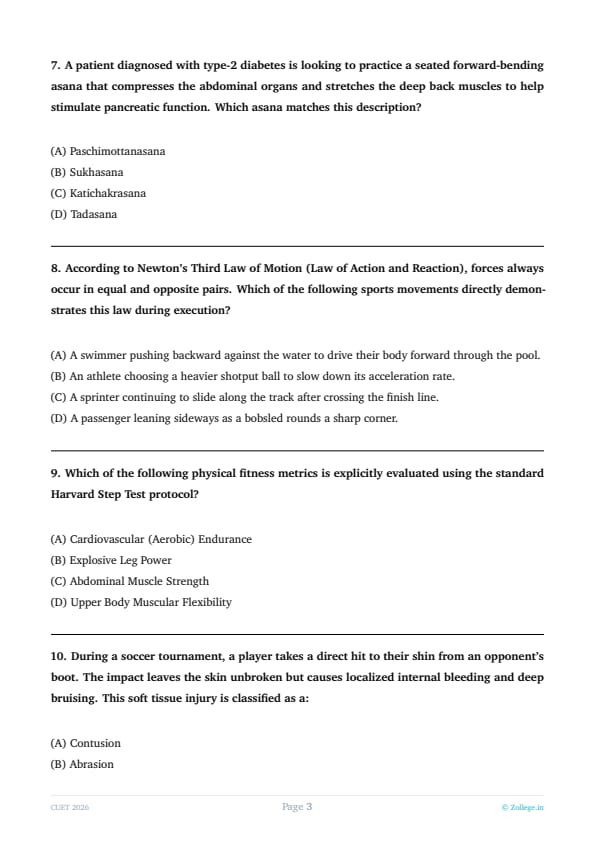
A patient diagnosed with type-2 diabetes is looking to practice a seated forward-bending asana that compresses the abdominal organs and stretches the deep back muscles to help stimulate pancreatic function. Which asana matches this description?
View Solution
Step 1: Understanding the Concept:
Type-2 Diabetes Mellitus is a metabolic disorder where the body either resists the effects of insulin or doesn't produce enough insulin to maintain a normal glucose level.
In Yoga therapy, certain poses are used to "massage" the internal organs through physical compression.
The pancreas, located behind the stomach in the upper abdomen, can be stimulated by intra-abdominal pressure.
This pressure is thought to improve blood flow to the endocrine glands, potentially assisting in the regulation of insulin.
Step 2: Detailed Explanation:
The question asks for a "seated forward-bending asana" with "abdominal compression."
1. Paschimottanasana (Seated Forward Fold):
In this pose, the practitioner sits with legs stretched forward and bends from the hip to touch the toes.
The abdomen is pressed firmly against the thighs. This "deep fold" creates the specific compression required to stimulate the pancreas and liver.
It also provides an intense stretch to the entire posterior chain (hamstrings, calves, and deep muscles of the spine).
It is a classic "corrective" pose for diabetes and digestive issues.
2. Analysis of other options:
- Sukhasana: A simple cross-legged meditative pose. It offers no abdominal compression.
- Katichakrasana: A standing waist-twisting pose. While it helps with spinal mobility, it is not a "seated forward bend."
- Tadasana: The standing mountain pose. It involves vertical stretching but no abdominal pressure or forward bending.
Step 3: Final Answer:
Paschimottanasana fits all criteria: it is seated, involves forward bending, and provides the abdominal compression necessary for pancreatic stimulation.
Quick Tip: For Diabetes-related questions, look for "Abdominal Pressure" or "Twisting" poses.
- {Forward Bends:} Paschimottanasana, Padahastasana.
- {Twists:} Ardha Matsyendrasana (the "King" of diabetes poses).
- {Supine:} Pawanmuktasana.
If the question says "Seated Forward Bend," the answer is almost always Paschimottanasana.
According to Newton’s Third Law of Motion (Law of Action and Reaction), forces always occur in equal and opposite pairs. Which of the following sports movements directly demonstrates this law during execution?
View Solution
Step 1: Understanding the Concept:
Isaac Newton’s Third Law of Motion states: "For every action, there is an equal and opposite reaction."
Crucially, these forces act on {different bodies. If Object A exerts a force on Object B, Object B exerts a force of equal magnitude but opposite direction back on Object A.
In sports, this law is fundamental to locomotion. We move forward by pushing {against something else (the ground, water, or a starting block).
Step 2: Detailed Explanation:
1. Swimming Mechanics (Newton's 3rd Law):
When a swimmer performs a stroke, they apply a force by pushing the water backward with their palms or feet. This is the Action.
According to the 3rd Law, the water exerts an equal and opposite force on the swimmer's body, pushing them forward. This is the Reaction.
Without this reaction force from the water, the swimmer would remain stationary.
2. Evaluating other options:
- Option (B): Relating mass to acceleration (\(F=ma\)) is a direct application of Newton's Second Law.
- Option (C): A sprinter sliding past the finish line is demonstrating Inertia—the tendency of an object in motion to stay in motion. This is Newton's First Law.
- Option (D): Centrifugal force and the tendency to lean relate to inertia and circular motion, falling primarily under the First and Second laws.
Step 3: Final Answer:
The swimming example perfectly illustrates the duality of action and reaction forces between two mediums (the athlete and the water).
Quick Tip: To identify the 3rd Law on an exam, look for "interaction" between two things:
- Foot pushing ground \(\rightarrow\) Ground pushing athlete.
- Hand pushing water \(\rightarrow\) Water pushing swimmer.
- Ball hitting bat \(\rightarrow\) Bat hitting ball.
If you see a "push" against a surface to generate movement, it's the Third Law!
Which of the following physical fitness metrics is explicitly evaluated using the standard Harvard Step Test protocol?
View Solution
Step 1: Understanding the Concept:
The Harvard Step Test was developed by Lucien Brouha and his associates in 1943 to assess the aerobic fitness of soldiers.
Cardiovascular (Aerobic) endurance is the ability of the heart, lungs, and blood vessels to deliver oxygen to tissues during sustained physical activity.
The test is based on the principle of "cardiac recovery": a person with a more efficient cardiovascular system will have a heart rate that returns to its resting level much faster after exertion than a person who is less fit.
Step 2: Detailed Explanation:
1. The Protocol:
The test requires the athlete to step up and down on a stable bench (20 inches high for men, 16 inches for women) at a fixed cadence of 30 steps per minute.
This rhythmic movement is continued for 5 minutes (or until the athlete can no longer keep pace).
2. Measurement:
The primary data collected is the heart rate during the recovery phase (at 1-1.5 min, 2-2.5 min, and 3-3.5 min after stopping).
A "Fitness Index" is calculated. A higher score indicates superior cardiovascular endurance.
3. Why not other options?
- Leg Power: Measured by explosive movements like the Standing Broad Jump. The Step Test is too long and rhythmic to measure "explosive" power.
- Abdominal Strength: Measured by the Partial Curl-up test.
- Flexibility: Measured by the Sit and Reach test.
Step 3: Final Answer:
The Harvard Step Test is specifically designed to measure the efficiency of the circulatory system under load, making it a test of Cardiovascular Endurance.
Quick Tip: Any test that lasts {several minutes} (like the Harvard Step Test or the Cooper 12-minute run) is always measuring {Endurance}.
Any test that lasts {seconds} (like a 50m sprint or vertical jump) is measuring {Speed or Power}.
The Step Test involves 5 minutes of continuous work, clearly placing it in the endurance category.
During a soccer tournament, a player takes a direct hit to their shin from an opponent’s boot. The impact leaves the skin unbroken but causes localized internal bleeding and deep bruising. This soft tissue injury is classified as a:
View Solution
Step 1: Understanding the Concept:
Soft tissue injuries are broadly classified as either "Open" or "Closed" wounds.
In an "Open Wound," the skin barrier is breached, leading to external bleeding and an increased risk of infection. Examples include Abrasions, Lacerations, and Incisions.
In a "Closed Wound," the trauma occurs beneath the skin surface, leaving the outer layer intact. The most common closed soft tissue injury in sports is a Contusion.
Step 2: Detailed Explanation:
The scenario describes a "direct hit" resulting in "unbroken skin" and "internal bleeding/bruising."
1. Contusion (Bruise):
A contusion is caused by a blunt force impact (like a kick or a fall).
The force crushes the underlying muscle fibers and small blood vessels (capillaries) against the bone.
Because the skin doesn't break, the blood leaks into the surrounding tissue, causing the characteristic purple, blue, or yellow discoloration.
It is common in contact sports like soccer (shin) and football (thigh).
2. Comparison with Open Wounds:
- Abrasion: A "scrape" caused by friction against a surface. The skin is broken superficially.
- Laceration: A jagged, irregular tear in the skin often caused by a sharp force. The skin is broken deeply.
- Incision: A clean-edged cut caused by a sharp object like a blade. The skin is broken cleanly.
Step 3: Final Answer:
Because the skin remains intact while the internal tissue is damaged, the injury is a Contusion.
Quick Tip: Think of the "Skin Barrier" as your guide:
- Skin {Unbroken} + Bruise = {Contusion}.
- Skin {Scraped} = {Abrasion}.
- Skin {Torn} (Jagged) = {Laceration}.
- Skin {Cut} (Straight) = {Incision}.
CUET UG 2026 Paper Analysis
*The article might have information for the previous academic years, please refer the official website of the exam.