
CUET 2026 Physical Education Question Paper May 21 Shift 2 with Solution PDF


| Updated On - May 27, 2026
CUET 2026 May 21 Shift 2 Physical Education Question Paper with Solution PDF is available here for download. NTA conducted CUET 2026 on May 21, Shift 2, from 2 PM to 5 PM in CBT Mode.
The CUET 2026 Physical Education Question Paper includes questions from both theoretical and applied fitness concepts. Candidates reported the overall difficulty to be manageable, drawing extensively on NCERT-based principles such as sports sociology, physiology, and health education. with 50 Questions carrying a total of 250 marks. As per the CUET marking scheme, +5 marks are awarded for every correct answer, and -1 mark is deducted for every wrong answer.
CUET 2026 Physical Education Question Paper May 21 Shift 2 with Solution PDF
| CUET 2026 Physical Education Question Paper | Download PDF | Check Solutions |
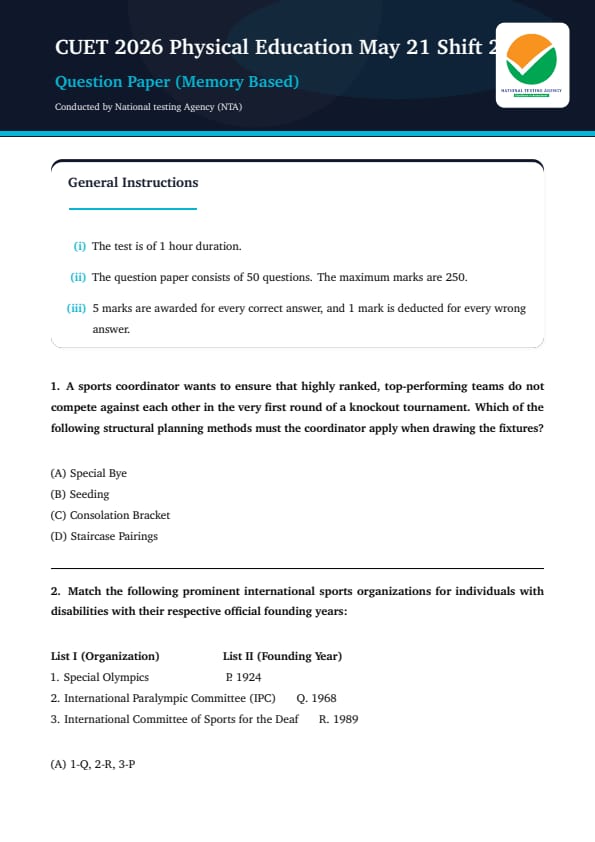
A sports coordinator wants to ensure that highly ranked, top-performing teams do not compete against each other in the very first round of a knockout tournament. Which of the following structural planning methods must the coordinator apply when drawing the fixtures?
View Solution
Step 1: Understanding the Concept:
In the organization of sports tournaments, specifically the knockout (single-elimination) format, the "draw" or the "fixture" determines the path each team takes toward the championship.
A purely random draw is statistically blind to the quality or rank of the participants.
This randomness creates a risk where the two strongest teams in the tournament could be paired against each other in the very first match.
If this happens, one of the elite teams is eliminated immediately, which is often considered "unfair" to a team that has performed well throughout the season to earn a high ranking.
Furthermore, from a commercial and spectator perspective, having the best teams eliminated early reduces the excitement and quality of the semi-finals and finals.
To prevent this, tournament planners use "Seeding," which is the process of arranging the bracket so that the strongest teams are kept apart until the later stages of the competition.
Step 2: Detailed Explanation:
The operational mechanism of seeding involves placing high-ranked teams in specific, non-random positions within the tournament bracket.
Usually, the number of seeds is a power of two (2, 4, 8, or 16).
In a standard 16-team knockout tournament, the #1 seed is typically placed at the top of the upper half (Position 1), and the #2 seed is placed at the bottom of the lower half (Position 16).
This ensures that the #1 and #2 seeds cannot meet until the Final match.
Seeds #3 and #4 are then placed in the opposite quarters of the bracket so that they cannot meet the #1 and #2 seeds until the Semi-Finals.
This distribution ensures a "balanced" bracket where the difficulty of opponents increases as a team progresses.
Let us analyze why the other options provided do not satisfy the coordinator's requirement:
(A) Special Bye: A "Bye" is a privilege given to a team to skip the first round without playing, usually because the total number of teams is not a power of two.
While a "Special Bye" is often given to seeded players to allow them to enter the tournament at a later stage (like the Quarter-Finals), the fundamental method of ensuring top teams don't meet each other in the first round is the act of Seeding itself.
(C) Consolation Bracket: This is a secondary tournament for teams that have already lost their first match. It does not affect the initial pairing of top-ranked teams.
(D) Staircase Pairings: This is a visual method used for league (round-robin) tournaments, not knockout tournaments, and it does not involve the strategic separation of high-ranked teams based on performance.
Therefore, Seeding is the only method focused on the relative placement of teams based on their rank to preserve the competitive integrity of the tournament's final rounds.
Step 3: Final Answer:
The structural planning method that prevents highly ranked teams from meeting in the early rounds is Seeding.
Quick Tip: Think of Seeding as "Strategic Separation." The goal is to keep the "sharks" away from each other in the "shallow water" (early rounds) so they only meet in the "deep water" (Finals).
Match the following prominent international sports organizations for individuals with disabilities with their respective official founding years:
List I (Organization) List II (Founding Year)
1. Special Olympics P. 1924
2. International Paralympic Committee (IPC) Q. 1968
3. International Committee of Sports for the Deaf R. 1989
View Solution
Step 1: Understanding the Concept:
The history of "Adaptive Sports" or "Sports for CWSN" (Children with Special Needs) is marked by the establishment of governing bodies that cater to specific types of disabilities.
The timeline of these organizations reflects the global shift in perception toward disability, moving from a medical/rehabilitative focus to an athletic/competitive focus.
Step 2: Detailed Explanation:
To correctly match these organizations, we must look at their individual historical backgrounds:
1. Special Olympics (1968):
Founded by Eunice Kennedy Shriver, the sister of US President John F. Kennedy.
The organization grew out of a backyard summer camp she started for people with intellectual disabilities.
The first International Special Olympics Summer Games were held in July 1968 at Soldier Field in Chicago.
The focus is specifically on individuals with intellectual disabilities.
Therefore, 1 matches with Q.
2. International Paralympic Committee - IPC (1989):
While the Paralympic movement began in 1948 (Stoke Mandeville Games), the IPC was established much later to serve as a unified global governing body.
It was founded on September 22, 1989, in Dusseldorf, Germany.
The IPC organizes the Summer and Winter Paralympic Games and acts as the International Federation for several sports.
Its focus is on athletes with physical, vision, and some intellectual impairments.
Therefore, 2 matches with R.
3. International Committee of Sports for the Deaf - CISS (1924):
This is the oldest international disability sports organization.
It was founded in Paris in 1924 by Gabriel Caulin and Eugène Rubens-Alcais.
It governs the "Deaflympics."
It is unique because athletes must have a hearing loss of at least 55 decibels in their better ear and are not allowed to use hearing aids during competition.
Therefore, 3 matches with P.
By evaluating the matches (1-Q, 2-R, 3-P), we see that Option (A) is the correct sequence.
Understanding this chronology is essential because it highlights that the Deaf community was the first to organize internationally, followed by the movement for intellectual disabilities in the 60s, and finally, the formalization of the Paralympic administrative body in the late 80s.
Step 3: Final Answer:
The correct matching is: Special Olympics (1968), IPC (1989), and Committee of Sports for the Deaf (1924), which corresponds to (A).
Quick Tip: Use the "Oldest to Newest" memory ladder:
1. Deaf (1924 - Early 20th Century)
2. Special (1968 - Civil Rights Era)
3. Paralympic Committee (1989 - Modern Era)
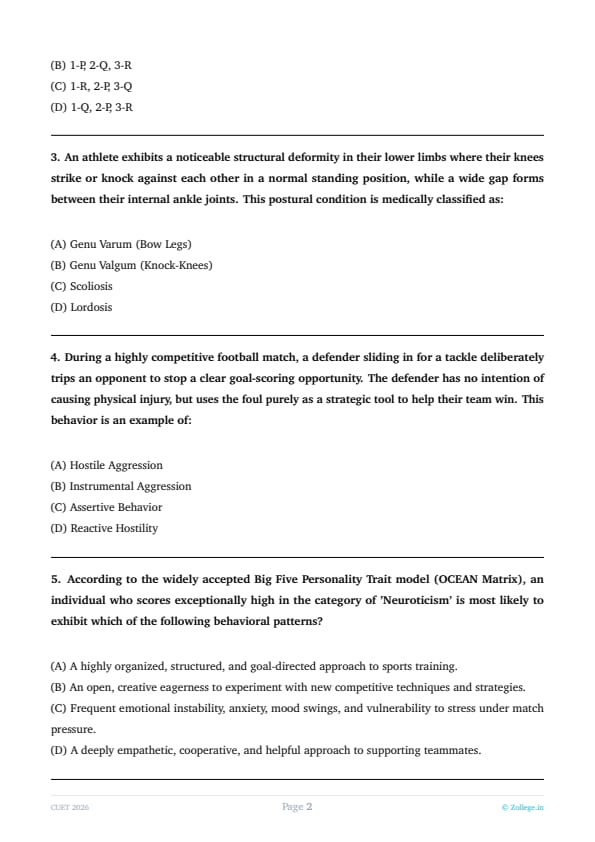
An athlete exhibits a noticeable structural deformity in their lower limbs where their knees strike or knock against each other in a normal standing position, while a wide gap forms between their internal ankle joints. This postural condition is medically classified as:
View Solution
Step 1: Understanding the Concept:
Postural deformities are deviations from the normal anatomical alignment of the body.
In the lower limbs, the alignment between the femur (thigh bone) and the tibia (shin bone) determines the relationship between the knees and the ankles.
When this alignment is skewed, it affects the athlete's gait, balance, and mechanical efficiency, and it can lead to long-term joint pain or injury.
Step 2: Detailed Explanation:
The specific condition described is characterized by inward angulation of the lower distal femur.
In this state, when the individual stands with their thighs together, the knees touch (or "knock"), but the medial malleoli (inner ankle bones) cannot touch.
This is medically known as Genu Valgum, commonly referred to as "Knock-Knees."
Biomechanical impacts of Genu Valgum:
1. Q-Angle: It significantly increases the Q-angle (the angle between the quadriceps and the patellar tendon), which can lead to patellar tracking issues and knee pain.
2. Foot Mechanics: It is often associated with "flat feet" (over-pronation) because the weight of the body is shifted to the inner edges of the feet.
3. Movement: Athletes with this condition may experience difficulty in running fast as their knees interfere with each other's path.
Let's contrast this with the other options:
(A) Genu Varum (Bow Legs): This is the opposite. The knees stay wide apart while the ankles touch. The legs look like an outward-facing bow.
(C) Scoliosis: This is a lateral curvature of the spine, which causes an 'S' or 'C' shape in the back. It is not a leg deformity.
(D) Lordosis: This is an exaggerated inward curve of the lower back (lumbar spine).
Causes of Genu Valgum can include obesity during childhood, Vitamin D deficiency (Rickets), or weak ligaments.
Corrective measures usually include strengthening the hip abductors and using specialized footwear or braces.
Step 3: Final Answer:
The condition where knees knock together and ankles stay apart is Genu Valgum (Knock-Knees).
Quick Tip: To remember the difference: Genu Val{GUM} makes the knees stick together like {GUM}. Genu Va{RUM} makes the legs bowed out like a round barrel of {RUM}.
During a highly competitive football match, a defender sliding in for a tackle deliberately trips an opponent to stop a clear goal-scoring opportunity. The defender has no intention of causing physical injury, but uses the foul purely as a strategic tool to help their team win. This behavior is an example of:
View Solution
Step 1: Understanding the Concept:
In sports psychology, aggression is defined as any behavior intended to harm another living being who is motivated to avoid such treatment.
However, psychologists distinguish between types of aggression based on the primary intent and the emotional state of the athlete.
The two main categories are Hostile Aggression and Instrumental Aggression.
Step 2: Detailed Explanation:
The scenario described is a classic "tactical foul" or "professional foul."
The key phrases in the question are "no intention of causing physical injury" and "purely as a strategic tool."
This indicates that the harm (the trip) is not the end goal, but rather a means to an end (stopping the goal and helping the team win).
This is the definition of Instrumental Aggression.
Characteristics of Instrumental Aggression:
1. Non-Emotional: The athlete is not usually "angry" or "frustrated." The act is cold, calculated, and cognitive.
2. Goal-Oriented: The primary reinforcement sought is a tangible victory, a point, or a strategic advantage.
3. Lack of Malice: While the act is illegal (a foul), the intent is not to cause pain or long-term injury to the opponent.
Let's look at the other choices:
- Hostile Aggression / Reactive Hostility: This is driven by anger. The primary goal is to inflict pain or injury. For example, if a player punches an opponent after being insulted, that is Hostile Aggression.
- Assertive Behavior: This involves high intensity and physical force within the rules of the game. Since a deliberate trip is a foul (outside the rules), it cannot be called assertive behavior.
In professional football, coaches sometimes quietly encourage instrumental aggression as a "necessary evil," though it is still penalized with yellow or red cards to maintain the spirit of the game.
Step 3: Final Answer:
Since the act is a calculated, non-angry strategy to achieve a competitive goal, it is classified as Instrumental Aggression.
Quick Tip: Ask yourself: Is the athlete's goal to {Hurt} or to {Win}?
Goal = Hurt \(\rightarrow\) Hostile Aggression.
Goal = Win (via a calculated act) \(\rightarrow\) Instrumental Aggression.
According to the widely accepted Big Five Personality Trait model (OCEAN Matrix), an individual who scores exceptionally high in the category of ’Neuroticism’ is most likely to exhibit which of the following behavioral patterns?
View Solution
Step 1: Understanding the Concept:
The Big Five model (OCEAN) is a comprehensive framework used by psychologists to describe human personality across five broad dimensions:
Openness to Experience
Conscientiousness
Extraversion
Agreeableness
Neuroticism
Each trait exists on a spectrum from low to high, and these traits significantly influence how an athlete prepares for and performs during competition.
Step 2: Detailed Explanation:
Neuroticism is a measure of emotional stability and the tendency to experience negative emotions.
Individuals who score high in Neuroticism often view the world as threatening or distressing.
In the context of sports, a high-neuroticism score is associated with:
1. Anxiety: These athletes often suffer from high levels of "state anxiety" before a big game.
2. Emotional Volatility: They may experience rapid mood swings, moving from extreme confidence to deep despair based on a single mistake.
3. Stress Vulnerability: They are more likely to "choke" under pressure because they become overwhelmed by their internal emotional state rather than focusing on the task at hand.
4. Negative Affectivity: They tend to dwell on failures and find it harder to "bounce back" after a loss.
Analyzing the other options:
- Option (A): Describes Conscientiousness. These athletes are disciplined, follow their diets perfectly, and are highly reliable.
- Option (B): Describes Openness to Experience. These athletes are often the ones trying new training gadgets or unconventional techniques.
- Option (D): Describes Agreeableness. These are the "glue" players in a team who prioritize team harmony over personal ego.
For coaches, identifying a high-neuroticism athlete is crucial so they can provide mental skills training, such as relaxation, positive self-talk, and mindfulness, to help them manage their emotional responses during matches.
Step 3: Final Answer:
The characteristic behavioral pattern of high Neuroticism is emotional instability and anxiety, which matches Option (C).
Quick Tip: Remember {OCEAN}.
O = Curiosity, C = Discipline, E = Social energy, A = Kindness, {N = Emotional Ups and Downs}.
High Neuroticism = Low Stability.
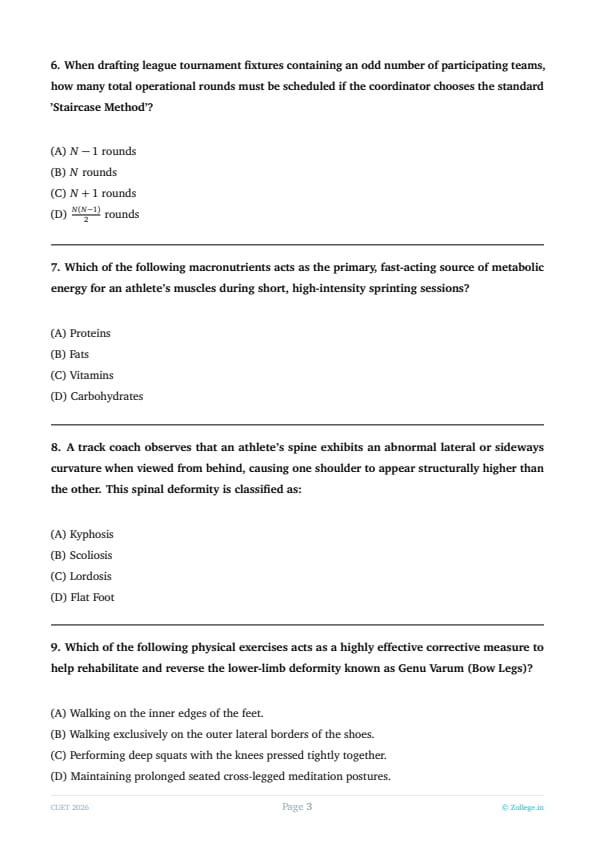
When drafting league tournament fixtures containing an odd number of participating teams, how many total operational rounds must be scheduled if the coordinator chooses the standard ’Staircase Method’?
View Solution
Step 1: Understanding the Concept:
A league (or round-robin) tournament ensures that every team plays against every other team.
There are three main methods to draw these fixtures:
1. Cyclic Method: Teams rotate around a fixed point.
2. Tabular Method: Pairs are drawn using a grid/table.
3. Staircase Method: Matches are arranged in a descending step-like visual sequence.
Key Formula or Approach:
In the Cyclic and Tabular methods, the number of rounds depends on whether \( N \) is even or odd:
- If \( N \) is even, rounds = \( N - 1 \).
- If \( N \) is odd, rounds = \( N \).
However, the Staircase method is an exception to this general rule.
Step 2: Detailed Explanation:
In the Staircase Method, the fixtures are arranged such that you start with one team and pair it with all others in a vertical column, then move to the next team and do the same, omitting previously scheduled pairs.
For example, if \( N = 5 \) (Teams A, B, C, D, E):
Step 1: A-B, A-C, A-D, A-E (4 matches)
B-C, B-D, B-E (3 matches)
Step 2: C-D, C-E (2 matches)
Step 3: D-E (1 match)
The number of vertical columns (steps) used to organize these matches is \( 5 - 1 = 4 \).
Each "Step" in the staircase represents an operational round of scheduling.
The Staircase method is popular because it is the easiest to draw and it does not require the calculation of "Byes" for odd numbers of teams.
The structural logic remains that to connect \( N \) points to every other point exactly once without repetition, you need \( N - 1 \) logical layers of pairings.
Option (D) \( \frac{N(N-1)}{2} \) is the formula for the total number of matches, not the number of rounds.
Step 3: Final Answer:
For the Staircase method, regardless of whether the number of teams is even or odd, the number of rounds is always \( N - 1 \).
Quick Tip: The Staircase Method is the "consistent" one.
While Cyclic/Tabular change for odd numbers, Staircase always stays at \( N-1 \). It simplifies the coordinator's job!
Which of the following macronutrients acts as the primary, fast-acting source of metabolic energy for an athlete’s muscles during short, high-intensity sprinting sessions?
View Solution
Step 1: Understanding the Concept:
The human body utilizes three main macronutrients for energy: Carbohydrates, Fats, and Proteins.
However, the "bioenergetics" (how the body converts food to energy) differs based on the intensity and duration of the exercise.
During high-intensity, short-duration activities (like a 100m sprint), the body needs energy that can be released almost instantaneously.
Step 2: Detailed Explanation:
Carbohydrates are the only macronutrient that can be broken down rapidly enough to sustain high-intensity work.
1. Storage: Carbohydrates are stored in the muscles and liver as glycogen.
2. Pathway: During a sprint, the body primarily uses the "Anaerobic Glycolytic System." This system breaks down glycogen into glucose and then into ATP (the energy molecule) without the immediate need for oxygen.
3. Speed: This chemical breakdown is significantly faster than the breakdown of fats.
Let's look at why the other options are incorrect for this specific scenario:
- Fats: While fats provide more calories per gram (9 kcal/g vs 4 kcal/g for carbs), they require a complex, oxygen-heavy process (beta-oxidation) to convert into energy. This is far too slow for a sprint. Fats are the primary fuel for low-intensity, long-duration endurance events like walking or marathons.
- Proteins: These are "building blocks" for muscle repair. The body only burns protein for energy during extreme starvation or ultra-endurance states when carb and fat stores are depleted. Using protein for energy is inefficient.
- Vitamins: These are micronutrients. They contain zero calories and provide no energy themselves; they only help facilitate the reactions that release energy from macronutrients.
For a sprinter, having full glycogen stores through a high-carbohydrate diet is essential for peak performance.
Step 3: Final Answer:
Because they are mobilized rapidly for high-intensity anaerobic work, Carbohydrates are the primary fast-acting fuel source.
Quick Tip: Intensity Scale:
High Intensity (Sprints) \(\rightarrow\) Carbs (Fast fuel).
Low Intensity (Marathons) \(\rightarrow\) Fats (Long-lasting fuel).
A track coach observes that an athlete’s spine exhibits an abnormal lateral or sideways curvature when viewed from behind, causing one shoulder to appear structurally higher than the other. This spinal deformity is classified as:
View Solution
Step 1: Understanding the Concept:
The vertebral column (spine) has natural curves in the sagittal plane (front-to-back), but when viewed from the posterior (behind), it should appear perfectly straight.
Any deviation from this vertical straight line is a spinal deformity.
Step 2: Detailed Explanation:
The question describes a lateral (sideways) curvature.
When the spine bends to the side, it often takes an "S" or "C" shape.
This shift causes the following visible symptoms:
1. Uneven Shoulders: One scapula (shoulder blade) appears higher or more prominent than the other.
2. Uneven Waist: One hip may appear higher than the other.
3. Rib Hump: When the athlete leans forward, one side of the rib cage may protrude more than the other (Adam's Forward Bend Test).
This condition is called Scoliosis.
Comparison with other spinal deformities:
- Kyphosis (Hunchback): This is an excessive outward curve of the upper (thoracic) spine. It makes the person look hunched over.
- Lordosis (Swayback): This is an excessive inward curve of the lower (lumbar) spine. It causes the stomach to stick out and the tailbone to stick back.
- Flat Foot: This is a collapse of the arches of the feet and has nothing to do with the spine directly, though it can cause secondary back pain.
Scoliosis can be caused by unequal leg length, carrying heavy bags on one shoulder, or congenital issues. It is often treated with physiotherapy, swimming, or in severe cases, bracing or surgery.
Step 3: Final Answer:
The lateral (sideways) curvature causing uneven shoulders is known as Scoliosis.
Quick Tip: Mnemonic: {S}coliosis causes an "{S}" shaped curve in the {S}pine.
{K}yphosis makes you look like a {K}irby (hunchback).
Which of the following physical exercises acts as a highly effective corrective measure to help rehabilitate and reverse the lower-limb deformity known as Genu Varum (Bow Legs)?
View Solution
Step 1: Understanding the Concept:
Corrective physical therapy for skeletal deformities relies on the principle of counter-alignment.
You must perform movements that apply mechanical pressure in the opposite direction of the deformity to stretch tight structures and strengthen weak ones.
Step 2: Detailed Explanation:
In Genu Varum (Bow Legs), the legs are curved outward.
This causes the weight of the body to fall heavily on the outer edges of the feet during a normal gait.
To correct this outward bowing, we need to shift the mechanical load inward.
- Walking on the inner edges: By walking on the medial (inner) borders of the feet, the athlete forces the ankles and knees to move toward the midline. This "inward" pressure helps to gradually reduce the wide gap between the knees over time.
- Evaluating other options:
- (B) Walking on the outer borders would worsen the bowing because it reinforces the outward lean.
- (D) Cross-legged sitting (like Padmasana) actually puts outward pressure on the knee joint and is usually avoided for people with bow legs.
- (C) While squats are good for strength, they don't provide the specific medial loading that inner-edge walking provides for bone realignment.
Other fixes for Genu Varum include Vitamin D supplementation (to strengthen bones) and using specialized orthopedic shoes or braces that pull the knees together.
Step 3: Final Answer:
The specific corrective exercise for Bow Legs (Genu Varum) is walking on the inner edges of the feet, as it counteracts the outward curvature.
Quick Tip: Think of it as a mirror:
Bow Legs (Bowed {Out}) \(\rightarrow\) Fix by walking {In} (inner edges).
Knock Knees (Knocked {In}) \(\rightarrow\) Fix by walking {Out} (outer edges).
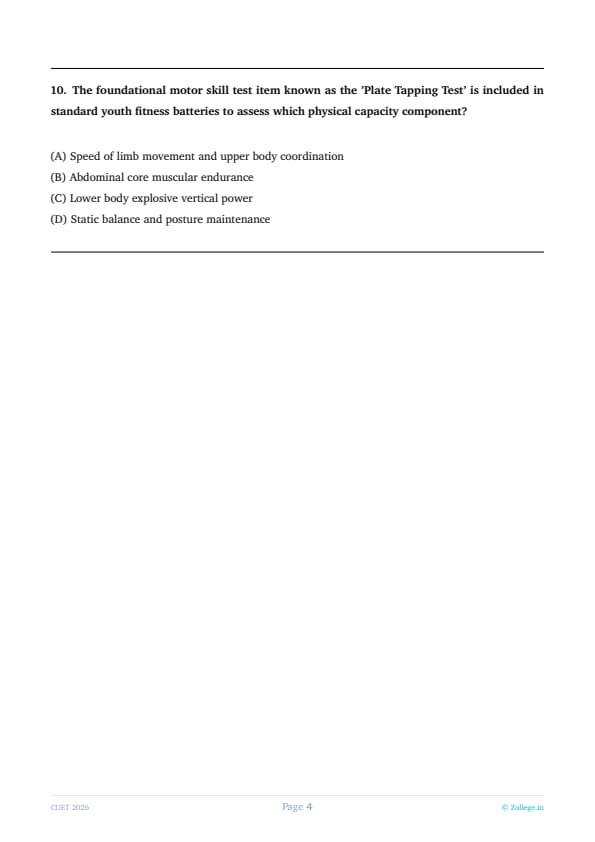
The foundational motor skill test item known as the ’Plate Tapping Test’ is included in standard youth fitness batteries to assess which physical capacity component?
View Solution
Step 1: Understanding the Concept:
Fitness testing batteries (like Eurofit or AAPHERD) use specific standardized tasks to isolate and measure different components of physical fitness.
Some tests measure "health-related" fitness (like endurance), while others measure "skill-related" fitness (like speed and coordination).
Step 2: Detailed Explanation:
The Plate Tapping Test works as follows:
1. The participant stands in front of a table with two discs (plates) fixed 80cm apart.
2. They place their non-dominant hand on a central rectangular plate.
3. They use their dominant hand to tap the two discs alternately as fast as possible for a set number of cycles (usually 25).
4. The score is the time (in seconds) it takes to finish.
What does this measure?
- Limb Speed: Because the distance between the plates is fixed, the only variable is how fast the athlete can move their arm back and forth.
- Upper Body Coordination: It requires the brain to rapidly switch muscle firing between the biceps, triceps, and deltoids while maintaining accuracy to hit the plates. It is a measure of the speed of the nervous system.
Why other options are wrong:
- (B) Abdominal endurance is measured by the Partial Curl-Up.
- (C) Explosive power is measured by the Standing Broad Jump or Vertical Jump.
- (D) Static balance is measured by the Flamingo Balance Test or Stork Stand.
Plate tapping is a crucial test for sports requiring fast hand reactions, such as fencing, boxing, or wicket-keeping in cricket.
Step 3: Final Answer:
The Plate Tapping test is designed to measure speed of limb movement and coordination, making Option (A) the correct choice.
Quick Tip: Tapping = Speed.
Whenever you see a test involving "rapid tapping" or "hand speed," it is always assessing coordination and movement speed.
CUET UG 2026 Paper Analysis
*The article might have information for the previous academic years, please refer the official website of the exam.