
CUET 2026 Political Science Question Paper May 21 Shift 1 with Solution PDF


| Updated On - May 27, 2026
CUET 2026 May 21 Shift 1 Political Science Question Paper with Solution PDF is available here for download. NTA conducted CUET 2026 on May 21, Shift 1, from 9 AM to 12 PM in CBT Mode.
The CUET 2026 Political Science Question Paper includes questions from topics like Contemporary World Politics & Politics in India Since Independence, with 50 Questions carrying a total of 250 marks. As per the CUET marking scheme, +5 marks are awarded for every correct answer, and -1 mark is deducted for every wrong answer.
CUET 2026 Political Science Question Paper May 21 Shift 1 with Solution PDF
| CUET 2026 Political Science Question Paper | Download PDF | Check Solutions |
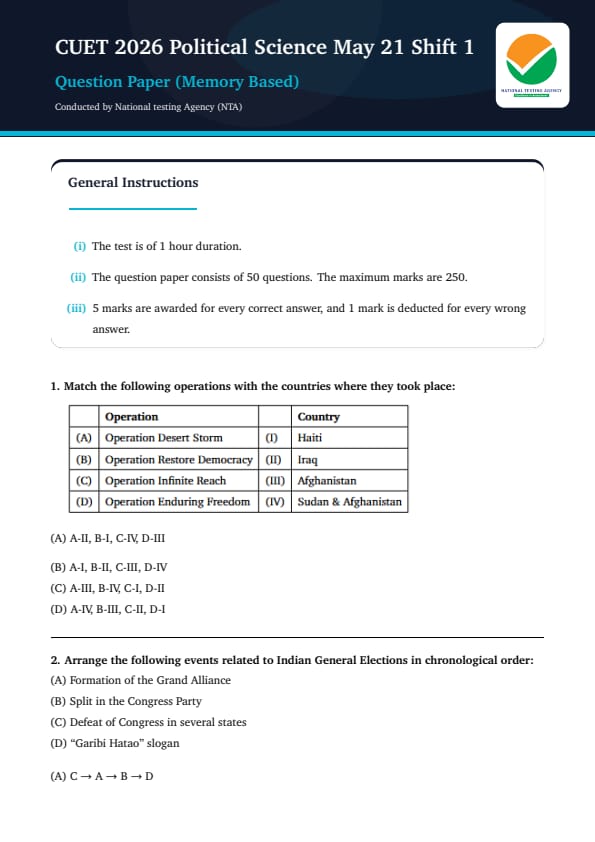
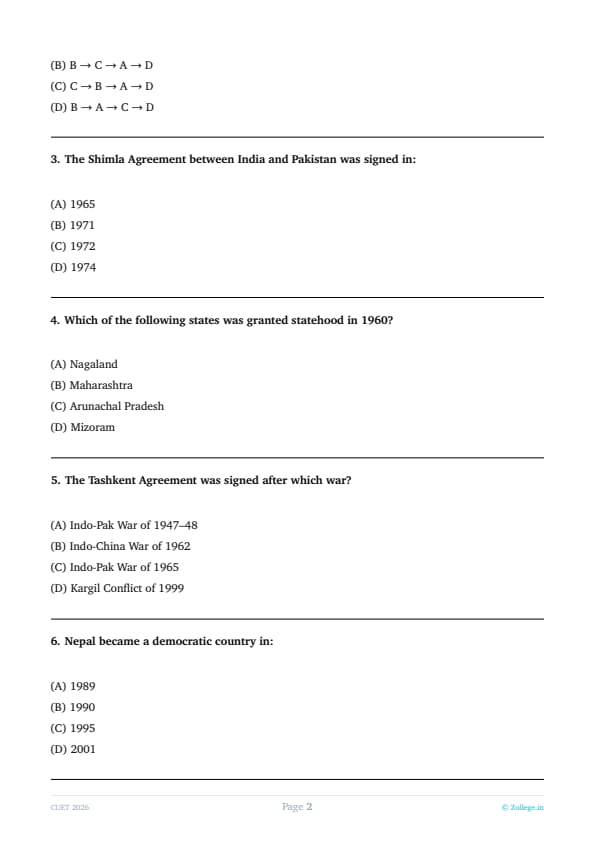
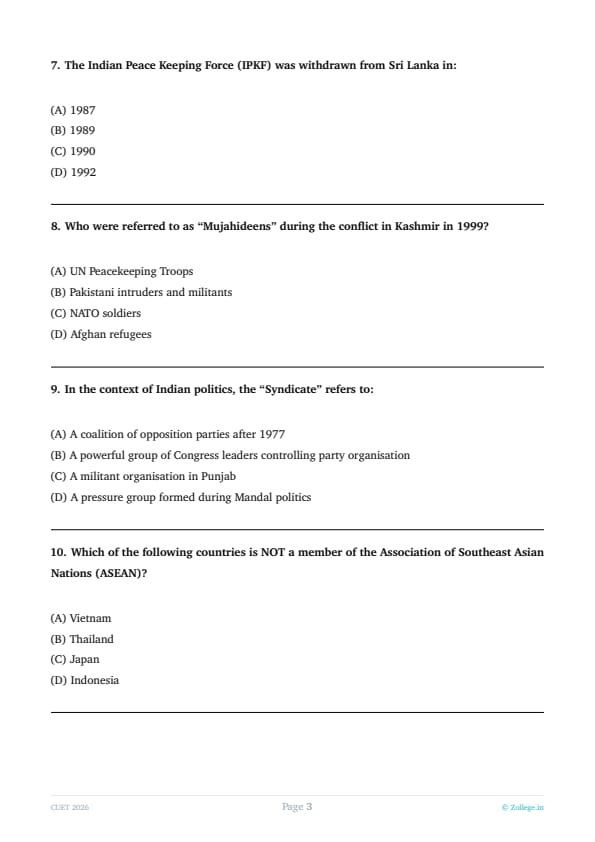
Match the following operations with the countries where they took place:

View Solution
Step 1: Understanding the Concept:
This question requires an understanding of the military history and foreign policy of the United States during the era of unipolarity following the end of the Cold War.
The period from 1990 to 2001 saw the United States assert its status as the world's sole superpower through various military interventions, often under the banner of the "New World Order" or the "Global War on Terror."
Each of these operations represents a specific response to a geopolitical crisis or a direct threat to American interests and international security.
Step 2: Detailed Explanation:
Let us analyze the historical context of each match:
1. Operation Desert Storm (A matches with II - Iraq):
In August 1990, Iraq, under the leadership of Saddam Hussein, invaded its oil-rich neighbor, Kuwait.
This act of aggression was condemned by the international community, and the UN Security Council issued several resolutions demanding Iraq's withdrawal.
When diplomacy failed, the UN authorized the use of force to liberate Kuwait.
"Operation Desert Storm" was the codename for the massive military campaign led by a U.S.-led coalition of 34 nations.
Launched in early 1991, the operation showcased overwhelming military technology, including precision-guided munitions and stealth aircraft.
The coalition successfully liberated Kuwait in a matter of weeks, though Saddam Hussein remained in power in Iraq.
2. Operation Restore Democracy (B matches with I - Haiti):
Haiti faced a political crisis in 1991 when the democratically elected President Jean-Bertrand Aristide was overthrown in a military coup.
The resulting military regime was marked by significant human rights abuses and economic instability.
In 1994, the U.S. government, with UN authorization, launched "Operation Restore Democracy."
The objective was to remove the military junta and reinstate the democratically elected leadership.
The operation was largely successful, leading to the peaceful return of Aristide and a temporary stabilization of the country.
3. Operation Infinite Reach (C matches with IV - Sudan & Afghanistan):
In August 1998, U.S. embassies in Nairobi, Kenya, and Dar es Salaam, Tanzania, were devastated by simultaneous truck bombings.
The attacks were attributed to the Al-Qaeda terrorist network led by Osama bin Laden.
In response, the Clinton administration launched "Operation Infinite Reach," which involved cruise missile strikes.
The targets were Al-Qaeda training camps in Khost, Afghanistan, and the Al-Shifa pharmaceutical factory in Khartoum, Sudan, which was suspected of producing chemical weapons components.
4. Operation Enduring Freedom (D matches with III - Afghanistan):
Following the catastrophic terrorist attacks on the United States on September 11, 2001, the George W. Bush administration declared a "Global War on Terror."
The primary target was the Al-Qaeda network and its host, the Taliban regime in Afghanistan.
"Operation Enduring Freedom" was launched in October 2001 to destroy terrorist networks and remove the Taliban from power.
This operation marked the beginning of a two-decade-long U.S. military involvement in Afghanistan.
Step 3: Final Answer:
Matching the operations: (A) with II, (B) with I, (C) with IV, and (D) with III.
This matches Option (A).
Quick Tip: To distinguish between operations in Afghanistan:
- Infinite Reach (1998) was a {missile strike} under Clinton.
- Enduring Freedom (2001) was a {full-scale invasion} post-9/11 under Bush.
- Remember "Storm" refers to the desert war in Iraq.
Arrange the following events related to Indian General Elections in chronological order:
(A) Formation of the Grand Alliance
(B) Split in the Congress Party
(C) Defeat of Congress in several states
(D) “Garibi Hatao” slogan
View Solution
Step 1: Understanding the Concept:
This question deals with the pivotal years of Indian politics from 1967 to 1971, characterized by the decline of the "Congress System" and the consolidation of power by Indira Gandhi.
During this period, the Congress party faced significant internal and external challenges, leading to major structural changes in the Indian political landscape.
Step 2: Detailed Explanation:
Let us establish the exact timeline for each event to determine the correct order:
Event (C): Defeat of Congress in several states (1967):
The Fourth General Elections held in February 1967 are often described as a "political earthquake."
For the first time since independence, the Congress party saw a drastic decline in its dominance.
While it barely held on to power at the Centre, it lost its majority in nine states, including major ones like Uttar Pradesh, Bihar, and West Bengal.
This period saw the rise of the first non-Congress coalition governments (Samyukta Vidhayak Dal) in many states.
Event (B): Split in the Congress Party (1969):
Internal tensions between Indira Gandhi and the senior leadership (the Syndicate) grew throughout the late 60s.
The final breaking point was the 1969 Presidential election following the death of Zakir Hussain.
Indira Gandhi encouraged an "open conscience vote" and supported V.V. Giri against the official party candidate, N. Sanjiva Reddy.
After Giri's victory, the party formally split into Congress (O) led by the Syndicate and Congress (R) led by Indira Gandhi.
Event (A): Formation of the Grand Alliance (Late 1970 - Early 1971):
As the 1971 midterm elections approached, major opposition parties realized they needed to unite to defeat Indira Gandhi.
Non-communist and non-Congress opposition parties, including the SSP, PSP, Jana Sangh, Swatantra Party, and even Congress (O), formed a coalition known as the "Grand Alliance."
Their primary platform was a negative one: "Indira Hatao" (Remove Indira).
Event (D): “Garibi Hatao” slogan (1971 Campaign):
In direct response to the Grand Alliance, Indira Gandhi launched a masterstroke of political branding.
She bypassed the traditional party machinery and reached out directly to the people with the slogan "Garibi Hatao" (Abolish Poverty).
This populist slogan, promising socio-economic reform, resonated with the rural poor, minorities, and women, leading to her landslide victory in 1971.
Step 3: Final Answer:
The chronological sequence is 1967 (C) \(\rightarrow\) 1969 (B) \(\rightarrow\) 1970/71 Alliance (A) \(\rightarrow\) 1971 Slogan (D).
The correct order is C \(\rightarrow\) B \(\rightarrow\) A \(\rightarrow\) D.
This corresponds to Option (C).
Quick Tip: Chronology questions in political science often follow the logic of "Crisis \(\rightarrow\) Response \(\rightarrow\) Change."
The 1967 defeat (Crisis) led to the 1969 split (Internal Change), which resulted in the 1971 Grand Alliance (External Response) and the Garibi Hatao slogan (Political Masterstroke).
The Shimla Agreement between India and Pakistan was signed in:
View Solution
Step 1: Understanding the Concept:
The Shimla Agreement is a historic bilateral treaty between India and Pakistan intended to establish a durable peace following the 1971 war.
The 1971 conflict was one of the most decisive in South Asian history, resulting in the birth of the independent nation of Bangladesh.
Step 2: Detailed Explanation:
The 1971 Indo-Pakistani War concluded in December with the surrender of the Pakistani military in Dhaka.
Post-war, both nations needed a framework to address several critical issues: the repatriation of over 90,000 Pakistani prisoners of war (POWs), the return of captured territories, and the long-standing Kashmir dispute.
The Conference:
Peace talks were held in Shimla, Himachal Pradesh, between Indian Prime Minister Indira Gandhi and the new Pakistani President Zulfikar Ali Bhutto.
The negotiations were intense, as India held a position of overwhelming strength but sought a sustainable peace rather than a humiliating one.
The Agreement:
The treaty was signed on July 2, 1972.
The core principles of the Shimla Agreement included:
1. Bilateralism: Both countries pledged to resolve their disputes through bilateral negotiations without the interference of third parties or international organizations.
2. Respect for the Line of Control (LoC): The ceasefire line in Jammu and Kashmir from December 1971 was converted into the Line of Control, which both sides agreed to respect.
3. Non-Aggression: A commitment to refrain from the threat or use of force against the territorial integrity or political independence of each other.
Significance:
The agreement is considered a milestone in South Asian diplomacy because it established the "bilateral framework" as the primary method for dealing with Indo-Pak issues, a stance that India continues to maintain today.
Step 3: Final Answer:
The Shimla Agreement was signed on July 2, 1972.
Thus, the correct option is (C).
Quick Tip: Remember the progression: War ends in Dec 1971 \(\rightarrow\) Treaty signed in July 1972.
Key Figures: Indira Gandhi (India) and Zulfikar Ali Bhutto (Pakistan).
Key Town: Shimla.
This followed the earlier Tashkent Agreement of 1966.
Which of the following states was granted statehood in 1960?
View Solution
Step 1: Understanding the Concept:
This question focuses on the linguistic reorganization of Indian states post-independence.
Following the States Reorganisation Act of 1956, which created 14 states and 6 union territories, regional linguistic movements continued to demand separate political identities for various linguistic groups.
Step 2: Detailed Explanation:
Under the 1956 Act, a large bilingual state called "Bombay State" was created.
It consisted of Marathi-speaking and Gujarati-speaking populations.
This bilingual arrangement was not successful and led to widespread popular movements in both regions.
The Movements:
1. Samyukta Maharashtra Movement: A mass movement demanding a separate state for Marathi speakers with Bombay (now Mumbai) as its capital.
2. Mahagujarat Movement: A parallel movement demanding a separate state for the Gujarati-speaking population.
The Creation of Maharashtra and Gujarat:
Recognizing the intensity of the demand and the potential for prolonged instability, the Central Government agreed to split the Bombay State.
On May 1, 1960, the Bombay Reorganisation Act came into effect.
This resulted in the creation of two separate states: Maharashtra and Gujarat.
Timeline of other options:
- Nagaland (1963): It was carved out of Assam in 1963 following years of Naga insurgency.
- Arunachal Pradesh (1987): It was a Union Territory until 1987, when it was elevated to full statehood.
- Mizoram (1987): It became a state in 1987 after the Mizo Peace Accord was signed between the government and the MNF in 1986.
Step 3: Final Answer:
Maharashtra was formed in 1960 along with Gujarat.
Therefore, the correct answer is Option (B).
Quick Tip: May 1st is celebrated as Maharashtra Day and Gujarat Day.
The year 1960 marks the end of the bilingual "Bombay State."
Linguistic identity was the primary driver for state reorganization during this era.
The Tashkent Agreement was signed after which war?
View Solution
Step 1: Understanding the Concept:
The Tashkent Agreement was a peace treaty mediated by the Soviet Union to end the hostilities of the 1965 war between India and Pakistan.
This event is significant as it showcased the Soviet Union's role as a regional mediator in South Asia.
Step 2: Detailed Explanation:
The Indo-Pakistani War of 1965 was a culmination of skirmishes that took place between April and September 1965.
It primarily concerned the status of Jammu and Kashmir.
After the UN-mandated ceasefire, the Soviet Premier, Alexei Kosygin, invited the leaders of both nations to Tashkent (modern-day Uzbekistan).
The Agreement:
The meeting took place in January 1966 between:
- Lal Bahadur Shastri, the Prime Minister of India.
- Ayub Khan, the President of Pakistan.
The agreement was signed on January 10, 1966.
Key Clauses:
1. Both nations agreed to withdraw their forces to the positions they held before August 5, 1965 (the Status Quo Ante).
2. Both sides pledged to resolve their differences through peaceful means and non-interference in internal affairs.
3. Plans to restore diplomatic and economic relations were established.
Aftermath:
The agreement was controversial in both countries.
In India, many were unhappy about returning the strategic Haji Pir Pass.
Tragically, Prime Minister Lal Bahadur Shastri died of a heart attack in Tashkent just a few hours after the signing, leading to a political crisis in India and the eventual succession of Indira Gandhi.
Step 3: Final Answer:
The agreement was a direct outcome of the 1965 war.
Hence, the correct answer is Option (C).
Quick Tip: Match the Peace Treaty to the War:
1965 War \(\rightarrow\) Tashkent Agreement (1966).
1971 War \(\rightarrow\) Shimla Agreement (1972).
Tashkent was mediated by the USSR; Shimla was purely bilateral.
Nepal became a democratic country in:
View Solution
Step 1: Understanding the Concept:
Nepal’s journey toward democracy has been a complex process involving multiple "Jana Andolans" (People’s Movements) and transitions from absolute monarchy to constitutional monarchy and eventually to a republic.
Step 2: Detailed Explanation:
For much of the 20th century, Nepal was ruled by an absolute monarch under the Panchayat system, which banned political parties.
The 1990 Transformation:
In early 1990, a massive pro-democracy movement known as the "Jana Andolan I" was launched.
It was led by the Nepali Congress and the United Left Front.
The movement involved strikes, protests, and civil disobedience across the country.
Under intense domestic and international pressure, King Birendra conceded to the demands.
He lifted the ban on political parties and promulgated a new constitution in November 1990.
This transformed Nepal from an absolute monarchy into a Constitutional Monarchy with a multi-party parliamentary system.
Later Transitions:
While 1990 was the birth of democracy, it was not the end of political turmoil.
A Maoist insurgency lasted from 1996 to 2006.
In 2002, King Gyanendra dismissed the government and restored absolute rule.
This led to the "Second Jana Andolan" in 2006, which stripped the king of his powers.
Finally, in 2008, Nepal became a Federal Democratic Republic, and the monarchy was abolished entirely.
Step 3: Final Answer:
The initial transition to a democratic, multi-party system occurred in 1990.
The correct option is (B).
Quick Tip: The year 1990 is the "First Wave" of democracy in Nepal.
The year 2006/2008 is the "Second Wave" and the end of the Monarchy.
Think of 1990 as the start of constitutional multi-party politics.
The Indian Peace Keeping Force (IPKF) was withdrawn from Sri Lanka in:
View Solution
Step 1: Understanding the Concept:
The intervention of the Indian Peace Keeping Force (IPKF) in Sri Lanka represents one of India's most significant and debated foreign military operations.
It was part of India's efforts to mediate the ethnic conflict between the Sinhalese majority government and the Tamil minority seeking a separate state (Eelam).
Step 2: Detailed Explanation:
In July 1987, Indian PM Rajiv Gandhi and Sri Lankan President J.R. Jayewardene signed the Indo-Sri Lanka Accord.
India agreed to send troops (the IPKF) to help implement the accord, which promised devolution of power to Tamil regions.
The IPKF's mission was to maintain peace and disarm various militant groups, including the LTTE (Liberation Tigers of Tamil Eelam).
The Quagmire:
The mission quickly turned sour. The LTTE refused to surrender their arms and entered into a brutal guerilla war with the Indian Army.
Furthermore, the Sri Lankan government itself became hostile to the presence of Indian troops, seeing it as an infringement on their sovereignty.
By 1989, there was a growing consensus in India that the mission was a failure and was costing too many lives and resources.
The Withdrawal:
When the National Front government under V.P. Singh came to power in India in late 1989, they prioritized the withdrawal of troops.
The last units of the IPKF left Sri Lankan shores in March 1990.
The operation ended without achieving its primary goals of peace and disarmament, and it left a lasting impact on Indo-Sri Lanka relations.
Step 3: Final Answer:
The IPKF was withdrawn in the year 1990.
The correct answer is Option (C).
Quick Tip: Timeline of IPKF:
- Arrived: 1987 (Rajiv Gandhi govt).
- Withdrawn: 1990 (V.P. Singh govt).
- Consequence: Assassination of Rajiv Gandhi by LTTE in 1991.
Who were referred to as “Mujahideens” during the conflict in Kashmir in 1999?
View Solution
Step 1: Understanding the Concept:
The term "Mujahideen" (meaning holy warriors) was central to the narrative surrounding the 1999 Kargil War.
The conflict was a high-altitude mountain war between India and Pakistan in the Kargil district of Jammu and Kashmir.
Step 2: Detailed Explanation:
In early 1999, the Indian Army discovered that several strategic mountain peaks on the Indian side of the Line of Control (LoC) had been occupied by armed infiltrators.
These peaks overlooked the crucial Srinagar-Leh highway, threatening India’s supply lines to Ladakh.
Pakistan's Claim:
Pakistan's official stance was that the intruders were independent Kashmiri "freedom fighters" or "Mujahideens" acting on their own initiative to liberate Kashmir.
They denied any direct involvement of the Pakistani Army.
The Reality:
As India launched "Operation Vijay" to recapture the peaks, clear evidence emerged that the "Mujahideens" were actually regular soldiers of the Northern Light Infantry of the Pakistan Army, supported by militant groups.
Recovered documents, ID cards, and logistical trails confirmed that this was a planned military operation sanctioned by the Pakistani top brass.
Global Reaction:
The international community, led by the U.S., largely sided with India, calling for the maintenance of the sanctity of the LoC and demanding that Pakistan withdraw the intruders.
By July 1999, the Indian Army had successfully cleared the peaks, and the surviving infiltrators retreated to the Pakistani side.
Step 3: Final Answer:
The term "Mujahideens" was the label used by Pakistan for the intruders and militants who occupied Kargil.
Option (B) is the correct choice.
Quick Tip: The 1999 Kargil War followed the Lahore Declaration.
It was a "limited war" because it stayed within a specific sector and didn't expand to a full-scale war across the entire border.
Mujahideens was the "cover" used by the Pakistani military.
In the context of Indian politics, the “Syndicate” refers to:
View Solution
Step 1: Understanding the Concept:
The "Syndicate" is a term used to describe the internal power dynamics of the Indian National Congress during the transitional years of the 1960s, specifically between the death of Nehru (1964) and the party split (1969).
Step 2: Detailed Explanation:
The Syndicate was an informal group of senior, influential leaders within the Congress party who managed the organizational machinery and held sway over state units.
Key Figures:
The group included figures like K. Kamraj (Madras), S.K. Patil (Bombay), S. Nijalingappa (Mysore), N. Sanjiva Reddy (Andhra Pradesh), and Atulya Ghosh (West Bengal).
Their Influence:
After the death of Jawaharlal Nehru, the Syndicate acted as "kingmakers."
They were instrumental in the selection of Lal Bahadur Shastri as the next PM.
Later, in 1966, they supported Indira Gandhi for the Prime Ministership, believing that as a younger and seemingly inexperienced leader, she would remain dependent on their guidance and allow them to maintain their control over the party.
The Clash with Indira Gandhi:
Indira Gandhi soon began to assert her independence. She adopted a radical socialist agenda and a populist style of politics that sidelined the senior leaders.
She built her own support base among the poor and marginalized, bypassing the party organization.
This power struggle culminated in the 1969 split, where the Syndicate remained with the "Congress (O)" (Organization), while Indira Gandhi led the "Congress (R)" (Requisitionists).
In the subsequent 1971 elections, Indira's Congress decimated the Syndicate-led faction.
Step 3: Final Answer:
The Syndicate was a group of senior Congress organizational leaders.
The correct option is (B).
Quick Tip: Syndicate = Organization.
Indira = Populism.
They were the primary target of Indira Gandhi’s "internal struggle" to establish her supremacy within the Congress party.
Which of the following countries is NOT a member of the Association of Southeast Asian Nations (ASEAN)?
View Solution
Step 1: Understanding the Concept:
ASEAN is a regional organization that promotes economic, political, and security cooperation among its ten members in Southeast Asia.
Regionalism is a key theme in contemporary world politics, where geographically contiguous countries form blocs to enhance their collective strength.
Step 2: Detailed Explanation:
ASEAN was established on August 8, 1967, in Bangkok, Thailand, with the signing of the ASEAN Declaration (Bangkok Declaration).
The Founding Members:
The five original members were Indonesia, Malaysia, Philippines, Singapore, and Thailand.
Expansion of ASEAN:
Over the years, the organization expanded to include other nations in the Southeast Asian region:
- Brunei (1984)
- Vietnam (1995)
- Laos (1997)
- Myanmar (1997)
- Cambodia (1999)
Analysis of the Options:
- Vietnam (A): Is a member, having joined in 1995.
- Thailand (B): Is a founding member.
- Indonesia (D): Is a founding member and the largest economy in the bloc.
- Japan (C): Japan is a major East Asian power. While Japan is a significant economic partner of ASEAN and participates in dialogues like "ASEAN+3" (with China and South Korea), it is not a member of ASEAN itself. ASEAN is strictly limited to nations within the Southeast Asian sub-region.
Significance of ASEAN:
ASEAN is known for the "ASEAN Way," which emphasizes consensus-building, non-interference in internal affairs, and informal diplomacy.
Step 3: Final Answer:
Japan is an East Asian nation and not a member of ASEAN.
The correct option is (C).
Quick Tip: Always remember: ASEAN = Southeast Asia.
Major East Asian powers (Japan, China, South Korea) are {Partners}, not {Members}.
Similarly, India and Australia are important dialogue partners but are not part of the core 10-member ASEAN group.
CUET 2026 Complete Political Science Revision
*The article might have information for the previous academic years, please refer the official website of the exam.