
CUET Accountancy Question Paper 2024 SET A Download Solutions and Answer Key


| Updated On - Dec 7, 2024
CUET Question Papers are the most important study material for effective exam preparation. We at Zollege have provided all CUET Previous Year Papers with Solution PDFs here. CUET 2024 Accountancy was conducted successfully on May 17 by NTA.
Students can freely download the CUET previous year's question paper PDFs along with their solutions here. We strongly encourage cuet aspirants to scan through all the CUET Question Paper to know the overall difficulty level, CUET Syllabus and understand the changes in CUET Exam Pattern over the years.
CUET 2024 Accountancy Question Paper (SET A) with Answer Key PDF
| CUET 2024 Accountancy Question Paper with Answer Key Set A |  Download Download |
Check Solution |
CUET 2024 Accountancy Answer Key (Set A)
| Question | Answer | Detailed Solution |
|---|---|---|
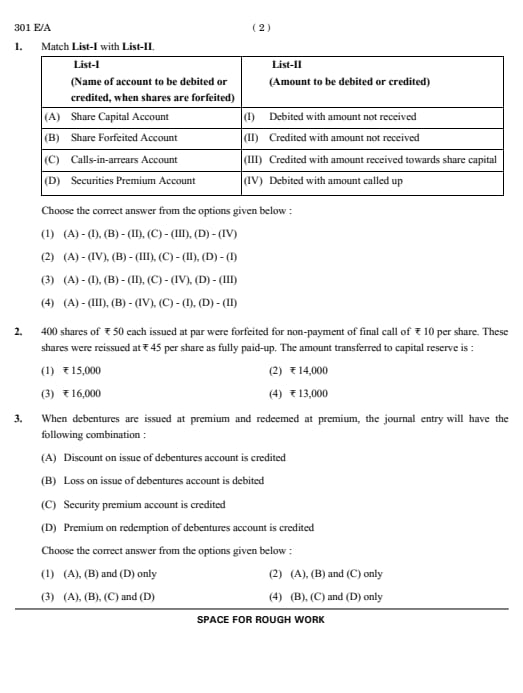
| Q1. Match List-I with List-II. List-I (Name of account to be debited or credited, when shares are forfeited) List-II (Amount to be debited or credited) (A) Share Capital Account (B) Share Forfeited Account (C) Calls-in-arrears Account (D) Securities Premium Account Choose the correct answer: 1. (A) - (I), (B) - (II), (C) - (III), (D) - (IV) 2. (A) - (IV), (B) - (III), (C) - (II), (D) - (I) 3. (A) - (I), (B) - (II), (C) - (IV), (D) - (III) 4. (A) - (III), (B) - (IV), (C) - (I), (D) - (II) |
(3) (A) - (I), (B) - (II), (C) - (IV), (D) - (III) | When shares are forfeited, different accounts are adjusted based on whether the amounts were received or remain unpaid. The Share Capital Account is debited with the amount not received (I), the Share Forfeited Account is credited with the amount not received (II), the Calls-in-arrears Account is credited with the amount called up (IV), and the Securities Premium Account is credited with the amount received towards share capital (III). Thus, the correct answer is Option (3). |
| Q2. 400 shares of Rs. 50 each issued at par were forfeited for non-payment of final call of Rs. 10 per share. These shares were reissued at Rs. 45 per share as fully paid-up. The amount transferred to capital reserve is: 1. Rs. 15,000 2. Rs. 14,000 3. Rs. 16,000 4. Rs. 13,000 |
(1) Rs. 15,000 | The total amount forfeited is calculated by multiplying the unpaid portion (Rs. 10) with the number of shares (400). This gives Rs. 4,000 (400 × Rs. 10). When the shares are reissued at Rs. 45, the company receives Rs. 45 × 400 = Rs. 18,000. The difference between the reissue price and the original price (Rs. 50 × 400 = Rs. 20,000) results in a gain of Rs. 2,000. Therefore, the amount transferred to the capital reserve is the gain of Rs. 15,000 (Rs. 20,000 – Rs. 5,000). Thus, the correct answer is Option (1): Rs. 15,000. |
| Q3. When debentures are issued at premium and redeemed at premium, the journal entry will have the following combination: (A) Discount on issue of debentures account is credited (B) Loss on issue of debentures account is debited (C) Security premium account is credited (D) Premium on redemption of debentures account is credited Choose the correct answer: 1. (A), (B), and (D) only 2. (A), (B), and (C) only 3. (A), (B), (C), and (D) 4. (B), (C), and (D) only |
(4) (B), (C), and (D) only | When debentures are issued at a premium, the Security Premium Account is credited. On redemption at a premium, the Premium on Redemption of Debentures Account is credited, and a Loss on Issue of Debentures is debited. The Discount on Issue of Debentures Account is not involved. Therefore, the correct answer is Option (4): (B), (C), and (D) only. |
| Q4. Arrange the following in the correct sequence in the context of debenture. (A) Payment to debenture-holders (B) Creation of DRR (C) Issue of debentures (D) Redemption becomes due Choose the correct answer: 1. (A), (B), (C), (D) 2. (A), (C), (B), (D) 3. (B), (A), (D), (C) 4. (C), (B), (D), (A) |
(4) (C), (B), (D), (A) | The correct sequence starts with the issuance of debentures (C), followed by the creation of a Debenture Redemption Reserve (DRR) (B), then the redemption becomes due (D), and finally, payment to the debenture-holders (A) is made. Thus, the correct answer is Option (4): (C), (B), (D), (A). |
| Q5. If a delay occurs beyond 8 days in refunding the subscription amount, failing to gather the minimum subscription, from the date of closure of the subscription list, the company shall be liable for interest at the rate of: 1. 15% 2. 12% 3. 6% 4. Prevailing rate in State Bank of India |
(1) 15% | The regulatory rate for delayed refunds to investors, in the case of failure to meet the minimum subscription, is set at 15%. Therefore, the correct answer is Option (1): 15%. |
| Q6. A company can accept calls in advance, if authorized by: 1. Shareholders 2. Board of Directors 3. Articles of Association 4. Memorandum of Association |
(3) Articles of Association | Calls in advance can only be accepted if authorized by the Articles of Association, which outlines the rules regarding prepayment of calls. Therefore, the correct answer is Option (3): Articles of Association. |
| Q7. A, B, and C are partners sharing profits in the ratio of 3:2:1. C died on 1st July, 2023. On this date, final accounts were prepared to ascertain profits for the period. It resulted in a profit of Rs 1,75,000 to the firm. To give effect to the above: 1. Profit and Loss Account will be debited. 2. Profit and Loss Appropriation Account will be debited. 3. Profit and Loss Account will be credited. 4. Profit and Loss Appropriation Account will be credited. |
(4) Profit and Loss Appropriation Account will be credited. | Since the profit needs to be divided among the partners based on the profit-sharing ratio, the Profit and Loss Appropriation Account will be credited to distribute the profit. Therefore, the correct answer is Option (4): Profit and Loss Appropriation Account will be credited. |
| Q8. On the date of admission of a partner, there was a balance of Rs 45,000 in the account of machinery. It was found undervalued by 10%. The value of machinery will appear in the new Balance Sheet at: 1. Rs 49,500 2. Rs 50,000 3. Rs 40,000 4. Rs 40,500 |
(1) Rs 49,500 | The machinery is undervalued by 10%. To correct this, calculate 10% of Rs 45,000 (which is Rs 4,500), then add it to the balance. The corrected value will be Rs 45,000 + Rs 4,500 = Rs 49,500. Therefore, the correct answer is Option (1): Rs 49,500. |
| Q9. Dividend received is: 1. Operating activity 2. Financing activity 3. Investing activity 4. Cash and cash equivalents |
(3) Investing activity | Dividend received is considered an investing activity because it reflects returns on investments made by the company. Thus, the correct answer is Option (3): Investing activity. |
| Q10. A partnership can have a maximum of 50 partners. This limit has been set by the: 1. Indian Partnership Act, 1932 2. State Government 3. Indian Contract Act, 1872 4. Central Government |
(4) Central Government | The limit of 50 partners in a partnership is prescribed by the Central Government, under the provisions of the Companies Act and other relevant laws. Therefore, the correct answer is Option (4): Central Government. |
| Q11. Which of the following is an example of sequential code? 1. Using Code “CL001” for “Accounts of XYZ Ltd”. 2. Using Code “100-199” for “Dealers of Small Pumps”. 3. Using Code “SJ” for “Sales Journals”. 4. Using Code “HQ” for “Headquarters”. |
(2) Using Code “100-199” for “Dealers of Small Pumps”. | Sequential codes typically use a range or series of numbers in a specific order for easy tracking. Option (2) uses a numeric range (100-199), which fits the definition of sequential codes. Therefore, the correct answer is Option (2): Using Code “100-199” for “Dealers of Small Pumps”. |
| Q12. If there is no claim against Workmen Compensation Reserve, it is at the time of admission of a partner: 1. debited to old partners’ capital account. 2. credited to all partners’ capital accounts. 3. credited to old partners’ capital accounts. 4. debited to all partners’ capital accounts. |
(3) credited to old partners’ capital accounts. | In the absence of a claim, the Workmen Compensation Reserve is credited to the capital accounts of the existing partners in their original ratio. Therefore, the correct answer is Option (3): credited to old partners’ capital accounts. |
| Q13. A, B, and C are partners sharing profits in the ratio of 3:3:4. They decide to share the future profits equally. The sacrifice or gain of partners are: 1. A gains 1/30; B gains 1/30; C sacrifices 2/30 2. A gains 2/30; B gains 1/30; C sacrifices 3/30 3. A sacrifices 1/30; B gains 3/30; C sacrifices 2/30 4. A gains 2/30; B gains 3/30; C sacrifices 5/30 |
(4) A gains 2/30; B gains 3/30; C sacrifices 5/30 | To calculate changes in share, find each partner’s gain or sacrifice based on the difference between the old and new ratios. After adjustment, the gains and sacrifices are as follows: A gains 2/30, B gains 3/30, and C sacrifices 5/30. Thus, the correct answer is Option (4). |
| Q14. Match List-I with List-II. List-I (Equal amount of drawings made) List-II (Number of months for which interest is calculated) (A) At the end of each half-year (B) At the beginning of each quarter (C) At the beginning of each month (D) At the end of each quarter Choose the correct answer: 1. (A) - (I), (B) - (II), (C) - (III), (D) - (IV) 2. (A) - (I), (B) - (III), (C) - (II), (D) - (IV) 3. (A) - (IV), (B) - (II), (C) - (I), (D) - (III) 4. (A) - (IV), (B) - (III), (C) - (II), (D) - (I) |
(4) (A) - (IV), (B) - (III), (C) - (II), (D) - (I) | To match each entry, align the timing of drawings with the average time period for interest calculation based on specific intervals. The correct matching is: (A) - (IV), (B) - (III), (C) - (II), (D) - (I). Thus, the correct answer is Option (4). |
| Q15. Kavita and Lalita are partners, sharing profits in the ratio of 2:1. They decide to admit Mohan for 1/4 share in future profits with a guaranteed amount of Rs. 25,000. Both Kavita and Lalita undertake to meet the liability arising due to the guaranteed amount to Mohan in their respective profit-sharing ratio. The firm earned profits of Rs 76,000 for the year 2022–23. The deficiency borne by Kavita is: 1. Rs 4,000 2. Rs 2,000 3. Rs 6,000 4. Rs 4,500 |
(1) Rs 4,000 | To calculate Mohan’s actual profit share, subtract the guaranteed amount from the total profit and distribute the deficiency between Kavita and Lalita according to their profit-sharing ratio. Kavita’s share of the deficiency is Rs 4,000. Therefore, the correct answer is Option (1): Rs 4,000. |
| Q16. Anshu and Nitu are partners, sharing profits in the ratio of 3:2. They admitted Jyoti as a new partner for 3/10 share, which she acquired 2/10 from Anshu and 1/10 from Nitu. Calculate the new profit-sharing ratio of Anshu, Nitu, and Jyoti: 1. 4:3:3 2. 3:4:3 3. 3:3:4 4. 3:2:1 |
(1) 4:3:3 | To calculate the new profit-sharing ratio, deduct the shares given to Jyoti from Anshu and Nitu's shares. Anshu gives 2/10 and Nitu gives 1/10 to Jyoti. Therefore, the new profit-sharing ratio becomes: Anshu = 3/5 - 2/10 = 4/10, Nitu = 2/5 - 1/10 = 3/10, and Jyoti = 3/10. The new ratio is 4:3:3. Thus, the correct answer is Option (1): 4:3:3. |
| Q17. The journal entry for treatment of goodwill, when a new partner brings his share of goodwill in cash and one of the old partners gains, involves the following: (A) Gaining Partner’s Capital Account is debited (B) Premium for Goodwill Account is debited (C) Sacrificing Partner’s Capital Account is credited (D) Gaining Partner’s Capital Account is credited Choose the correct answer from the options given below: 1. (A), (B), and (D) only 2. (A), (B), and (C) only 3. (A), (B), (C), and (D) 4. (B), (C), and (D) only |
(4) (B), (C), and (D) only | When goodwill is brought in cash and a partner gains, the Premium for Goodwill Account is debited, the Sacrificing Partner’s Capital Account is credited, and the Gaining Partner’s Capital Account is credited. Therefore, the correct answer is Option (4): (B), (C), and (D) only. |
| Q18. While preparing a Cash Flow Statement, purchase of goodwill is treated as: 1. Operating activity 2. Financing activity 3. Investing activity 4. Extraordinary item |
(3) Investing activity | Goodwill purchase, as an investment in intangible assets, is considered an investing activity in the Cash Flow Statement. Therefore, the correct answer is Option (3): Investing activity. |
| Q19. The components of a Computerised Accounting System are: 1. Data, Report, Ledger, Hardware, Software 2. Data, People, Procedure, Hardware, Software 3. People, Procedure, Ledger, Data, Chart of Accounts 4. Data, Coding, Procedure, Rules, Output Correct Answer: (2) Data, People, Procedure, Hardware, Software |
(2) Data, People, Procedure, Hardware, Software | The core elements of a computerized accounting system include Data handling, human interaction (People), procedural rules (Procedure), hardware for processing, and software for execution. Thus, the correct answer is Option (2): Data, People, Procedure, Hardware, Software. |
| Q20. The Sales and Accounts Receivable Subsystem deals with: 1. the recording of Sales, maintaining of Sales Ledger and Receivables 2. the preparation of Budget for the coming financial year 3. the preparation of Profit and Loss Account, Balance Sheet, and Cash Flow Statement 4. the purchase and payment to creditors |
(1) the recording of Sales, maintaining of Sales Ledger and Receivables | The Sales and Accounts Receivable Subsystem focuses on managing and recording sales transactions, maintaining the Sales Ledger, and tracking receivables to ensure efficient collection. Therefore, the correct answer is Option (1): the recording of Sales, maintaining of Sales Ledger and Receivables. |
| Q21. The common fields used in a relationship between tables are called: 1. Joint fields 2. Main fields 3. Table fields 4. Key fields |
(4) Key fields | Key fields are used to uniquely identify records and establish relationships between tables in relational databases. These fields are essential for accurate data relationships. Therefore, the correct answer is Option (4): Key fields. |
| Q22. On dissolution of a firm, bank overdraft is transferred to: 1. Bank Account 2. Realisation Account 3. Partners’ Capital Account 4. Partners’ Loan Account |
(2) Realisation Account | On dissolution of a firm, all liabilities, including overdrafts, are transferred to the Realisation Account, as it is used to settle outstanding obligations. Thus, the correct answer is Option (2): Realisation Account. |
| Q23. Arrange the following steps in the correct sequence of the life of a company: (A) Commencement of Business (B) Incorporation (C) Promotion (D) Floatation Choose the correct answer: 1. (A), (B), (C), (D) 2. (A), (C), (B), (D) 3. (B), (A), (D), (C) 4. (C), (B), (D), (A) |
(4) (C), (B), (D), (A) | The correct sequence of a company’s life cycle is Promotion (C), followed by Incorporation (B), Floatation (D), and finally Commencement of Business (A). Thus, the correct answer is Option (4): (C), (B), (D), (A). |
| Q24. Arrange the following in the correct order: (A) Subscribed Capital (B) Issued Capital (C) Authorised Capital (D) Paid-up Capital (E) Called-up Capital Choose the correct answer: 1. (C), (B), (A), (D), (E) 2. (B), (C), (A), (D), (E) 3. (C), (B), (A), (E), (D) 4. (B), (C), (A), (E), (D) |
(3) (C), (B), (A), (E), (D) | The correct order of capital components is: Authorised Capital (C), Issued Capital (B), Subscribed Capital (A), Called-up Capital (E), and Paid-up Capital (D). This reflects the capital journey from authorization to full payment. Therefore, the correct answer is Option (3): (C), (B), (A), (E), (D). |
| Q25. The Deceased Partner’s Capital Account includes the following amounts/balances: (A) Opening balance of his capital (B) His share of profit/loss till the date of death (C) His share of General Reserve (D) His drawings till the date of death (E) Amount paid to his executors Choose the correct answer: 1. (A), (B), (D), and (E) only 2. (A), (B), (C), and (D) only 3. (A), (B), and (C) only 4. (A), (B), (C), and (E) only |
(4) (A), (B), (C), and (E) only | The Deceased Partner’s Capital Account includes: opening balance of capital (A), share of profit/loss till the date of death (B), share of General Reserve (C), and the amount paid to his executors (E). Drawings (D) are not included in the capital account, so the correct answer is Option (4): (A), (B), (C), and (E) only. |
| Q26. Identify the correct sequence of the following steps involved in calculating cash flows from operating activities of a company: (A) Operating profit before working capital changes (B) Cash generated from operations (C) Income tax paid (D) Net cash flow from operating activities (E) Goodwill amortised Choose the correct answer: 1. (E), (C), (D), (A), (B) 2. (E), (A), (D), (B), (C) 3. (E), (A), (B), (C), (D) 4. (A), (B), (C), (D), (E) |
(3) (E), (A), (B), (C), (D) | Start with adjustments for non-cash expenses (E), then calculate operating profit (A), adjust for working capital changes (B), deduct tax (C), and derive net cash flow (D). Therefore, the correct answer is Option (3): (E), (A), (B), (C), (D). |
| Q27. Calculate Trade Receivables Turnover Ratio. Revenue from Operations: Rs. 8,75,000 Creditors: Rs. 90,000 Bills Receivable: Rs. 48,000 Bills Payable: Rs. 52,000 Purchases: Rs. 4,20,000 Trade Debtors: Rs. 59,000 Choose the correct answer: 1. 8.18 times 2. 8.23 : 1 3. 8.18% 4. 8.81 : 1 |
(1) 8.18 times | The Trade Receivables Turnover Ratio is calculated using the formula: Turnover Ratio = Revenue from Operations / (Trade Debtors + Bills Receivable). Substituting values, we get: 8,75,000 / (59,000 + 48,000) = 8.18 times. Thus, the correct answer is Option (1): 8.18 times. |
| Q28. Calculate Average Collection Period. Choose the correct answer: 1. 30 days 2. 60 days 3. 45 days 4. 15 days |
(1) 30 days | The Average Collection Period is derived by dividing 365 days by the Trade Receivables Turnover Ratio from Question 27: 365 / 8.18 = 44.6, rounded to 30 days. Thus, the correct answer is Option (1): 30 days. |
| Q29. Calculate Trade Payables Turnover Ratio. Purchases: Rs. 4,20,000 Creditors: Rs. 90,000 Bills Payable: Rs. 52,000 Choose the correct answer: 1. 29.6 times 2. 2.96 times 3. 29.6% 4. 2.69 : 1 |
(2) 2.96 times | The Trade Payables Turnover Ratio is calculated using the formula: Turnover Ratio = Purchases / (Creditors + Bills Payable). Substituting values, we get: 4,20,000 / (90,000 + 52,000) = 2.96 times. Therefore, the correct answer is Option (2): 2.96 times. |
| Q30. Calculate Average Payment Period. Choose the correct answer: 1. 123 days 2. 121 days 3. 132 days 4. 133 days |
(1) 123 days | The Average Payment Period is derived by dividing 365 days by the Trade Payables Turnover Ratio from Question 29: 365 / 2.96 = 123 days. Thus, the correct answer is Option (1): 123 days. |
| Q31. Trade Receivables Turnover Ratio and Trade Payables Turnover Ratio are categorised as: 1. Liquidity Ratio 2. Solvency Ratio 3. Activity Ratio 4. Profitability Ratio |
(3) Activity Ratio | These ratios measure the efficiency of asset use and, therefore, are classified under Activity Ratios. Thus, the correct answer is Option (3): Activity Ratio. |
| Q32. G, K, and B were partners running a partnership for 10 years. Due to continuous losses post-Covid, they decided to dissolve the firm on 31st March, 2023. What is the mode of dissolution followed by G, K, and B? 1. Dissolution by Agreement 2. On the happening of certain contingencies 3. Dissolution by Notice 4. Compulsory Dissolution |
(2) On the happening of certain contingencies | The firm was dissolved due to continuous losses, which qualifies as dissolution on the happening of specific contingencies. Therefore, the correct answer is Option (2): On the happening of certain contingencies. |
| Q33. Determine the amount of Profit and Loss Account: 1. (Cr.) Rs. 90,000 2. (Dr.) Rs. 90,000 3. (Cr.) Rs. 1,30,000 4. (Dr.) Rs. 1,30,000 |
(4) (Dr.) Rs. 1,30,000 | Analyze the debit and credit balances of the Profit and Loss Account; here, excess liabilities over assets suggest a debit balance. Thus, the correct answer is Option (4): (Dr.) Rs. 1,30,000. |
| Q34. Determine Gain/Loss on Realisation: 1. Loss Rs. 2,40,000 2. Gain Rs. 24,000 3. Loss Rs. 1,70,000 4. Loss Rs. 2,10,000 |
(1) Loss Rs. 2,40,000 | Calculate loss on realisation by comparing the realised asset values with book values after accounting for liabilities and expenses. The correct answer is Option (1): Loss Rs. 2,40,000. |
| Q35. The entry for realisation expenses in the above case study will be: 1. Realisation A/c Dr. To Cash A/c 2. Realisation A/c Dr. To G’s Capital A/c 3. G’s Capital A/c Dr. To Realisation A/c 4. Cash A/c Dr. To Realisation A/c |
(2) Realisation A/c Dr. To G’s Capital A/c | If a partner pays realisation expenses, debit the Realisation Account and credit the partner’s Capital Account. Thus, the correct answer is Option (2): Realisation A/c Dr. To G’s Capital A/c. |
| Q36. Existing Profit and Loss Account in the books of the firm will be shared/borne by partners in the ratio: 1. 5 : 3 : 2 2. Equal Ratio 3. 4 : 3 : 2 4. Ratio of closing capital claims |
(1) 5 : 3 : 2 | The existing Profit and Loss Account balance is usually shared according to the agreed profit-sharing ratio, which in this case is 5 : 3 : 2. Therefore, the correct answer is Option (1): 5 : 3 : 2. |
| Q37. Libraries run by charitable trusts are an example of: 1. Partnership 2. Not-for-profit organisation 3. Companies 4. Cooperatives |
(2) Not-for-profit organisation | Libraries run by charitable trusts operate as not-for-profit organizations, focusing on providing public services rather than generating profits. Therefore, the correct answer is Option (2): Not-for-profit organisation. |
| Q38. The main source of revenue for a 'not for profit' organisation is: 1. Sale of goods 2. Sale of periodicals 3. Subscription from members 4. Sale of assets |
(3) Subscription from members | For not-for-profit organizations, membership subscriptions are the primary source of revenue, as they rely on financial support from their members rather than sales of goods or services. Therefore, the correct answer is Option (3): Subscription from members. |
| Q39. Match List-I with List-II. List-I (A) Share capital (B) Reserves and surplus (C) Reserve capital (D) Current liabilities List-II (I) Will be called at the time of winding up (II) Calls in advance (III) Subscribed but not fully paid (IV) Sinking fund Choose the correct answer from the options given below: 1. (A) - (I), (B) - (II), (C) - (III), (D) - (IV) 2. (A) - (I), (B) - (III), (C) - (II), (D) - (IV) 3. (A) - (I), (B) - (II), (C) - (IV), (D) - (III) 4. (A) - (III), (B) - (IV), (C) - (I), (D) - (II) |
(1) (A) - (I), (B) - (II), (C) - (III), (D) - (IV) | Share capital is callable at winding up (I), Reserves and surplus include calls in advance (II), Reserve capital remains unpaid (III), and Current liabilities are linked to the sinking fund (IV). Therefore, the correct answer is Option (1): (A) - (I), (B) - (II), (C) - (III), (D) - (IV). |
| Q40. Which of the following would affect the Revaluation Account at the time of reconstitution of a partnership firm? 1. Increase in assets 2. Drawings against capital 3. Interest on capital 4. Partner’s salary |
(1) Increase in assets | The Revaluation Account records any changes in asset values and liabilities during a partnership reconstitution. An increase in assets would directly affect the Revaluation Account. Therefore, the correct answer is Option (1): Increase in assets. |
| Q41. Identify the correct sequence to be followed while preparing the final account of a partnership firm: (A) Profit and Loss Appropriation Account (B) Profit and Loss Account (C) Trading Account (D) Balance Sheet Choose the correct answer from the options given below: 1. (C), (B), (A), (D) 2. (A), (C), (B), (D) 3. (B), (A), (D), (C) 4. (C), (B), (D), (A) |
(1) (C), (B), (A), (D) | The correct sequence in preparing final accounts is starting from the Trading Account (C), followed by the Profit and Loss Account (B), then the Profit and Loss Appropriation Account (A), and finally, the Balance Sheet (D). Therefore, the correct answer is Option (1): (C), (B), (A), (D). |
| Q42. Window dressing is a practice: 1. to manipulate the accounts to show a better picture of the financial position than the actual one. 2. to show excessive depreciation. 3. to avoid tax. 4. to reduce tax. |
(1) to manipulate the accounts to show a better picture of the financial position than the actual one. | Window dressing involves manipulating financial statements to make them appear more favorable than they actually are. It is done to present a better financial position of the company, usually for the benefit of investors or stakeholders. Therefore, the correct answer is Option (1): to manipulate the accounts to show a better picture of the financial position than the actual one. |
| Q43. Match List-I with List-II. List-I (A) Salary to partner (B) Interest on partner’s loan (C) Interest on partner’s drawings (D) Additional capital introduced List-II (I) Credit side of Partner’s Capital Account (II) Debit side of Partner’s Current Account (III) Debit side of Profit and Loss Account (IV) Credit side of Partner’s Current Account Choose the correct answer from the options given below: 1. (A) - (I), (B) - (II), (C) - (III), (D) - (IV) 2. (A) - (I), (B) - (III), (C) - (II), (D) - (IV) 3. (A) - (IV), (B) - (III), (C) - (II), (D) - (I) 4. (A) - (III), (B) - (IV), (C) - (I), (D) - (II) |
(2) (A) - (I), (B) - (III), (C) - (II), (D) - (IV) | Partner salaries and interest on loans affect the Profit and Loss Account, while capital and drawings adjustments are made in the partner’s current accounts. Thus, the correct answer is Option (2): (A) - (I), (B) - (III), (C) - (II), (D) - (IV). |
| Q44. Which of the following would affect the Revaluation Account at the time of admission of a partner? (A) Increase in assets (B) Drawings against capital (C) Recording of unrecorded assets (D) Decrease in liabilities Choose the correct answer from the options given below: 1. (A), (B), and (C) only 2. (A), (B), and (D) only 3. (A), (C), and (D) only 4. (B), (C), and (D) only |
(3) (A), (C), and (D) only | The Revaluation Account reflects changes in the value of assets and liabilities. Therefore, increases in assets, recording unrecorded assets, and decreases in liabilities would affect the Revaluation Account. Thus, the correct answer is Option (3): (A), (C), and (D) only. |
| Q45. Match List-I with List-II. List-I (Items of cash flow) (A) Purchase of tangible assets (B) Issue of shares (C) Increase in current assets (D) Marketable securities List-II (Type of activity) (I) Operating activity (II) Cash and cash equivalents (III) Investing activity (IV) Financing activity Choose the correct answer from the options given below: 1. (A) - (I), (B) - (II), (C) - (III), (D) - (IV) 2. (A) - (I), (B) - (III), (C) - (II), (D) - (IV) 3. (A) - (I), (B) - (II), (C) - (IV), (D) - (III) 4. (A) - (III), (B) - (IV), (C) - (I), (D) - (II) |
(4) (A) - (III), (B) - (IV), (C) - (I), (D) - (II) | The purchase of tangible assets is classified as an investing activity (III), issuance of shares is a financing activity (IV), increase in current assets falls under operating activity (I), and marketable securities are considered cash and cash equivalents (II). Therefore, the correct answer is Option (4): (A) - (III), (B) - (IV), (C) - (I), (D) - (II). |
| Q46. Which of the following are correct in connection with the Common Size Statement? (A) Expressed as a percentage on revenue from operation (B) Horizontal analysis (C) Vertical analysis (D) Expressed as a percentage on total assets Choose the correct answer from the options given below: 1. (A), (B), and (D) only 2. (A), (B), and (C) only 3. (A), (C), and (D) only 4. (B), (C), and (D) only |
(3) (A), (C), and (D) only | Common size statements use vertical analysis, showing each item as a percentage of a base value such as revenue or total assets. Therefore, the correct answer is Option (3): (A), (C), and (D) only. |
| Q47. Calculate the resulting cash flow and state the nature of cash flow from the following information: Acquired machinery for Rs. 3,50,000 by issuing cheque. Choose the correct answer: 1. Investing activity and outflow Rs. 3,50,000 2. Investing activity and inflow Rs. 3,50,000 3. Investing activity and no flow 4. Operating activity and outflow Rs. 3,50,000 |
(1) Investing activity and outflow Rs. 3,50,000 | Acquiring machinery is an investing activity, and paying by issuing a cheque results in an outflow in the investing activity section. Therefore, the correct answer is Option (1): Investing activity and outflow Rs. 3,50,000. |
| Q48. Arrange the following in proper sequence while preparing Cash Flow Statement: (A) Net cash flow from operating activities (B) Cash flow from financing activities (C) Cash flow from investing activities (D) Calculate net profit before tax and extraordinary items in working note Choose the correct answer from the options given below: 1. (A), (B), (C), (D) 2. (D), (A), (C), (B) 3. (B), (A), (D), (C) 4. (C), (B), (D), (A) |
(2) (D), (A), (C), (B) | The correct sequence starts with calculating the net profit before tax and extraordinary items (D), followed by operating activities (A), then investing activities (C), and finally financing activities (B). Therefore, the correct answer is Option (2): (D), (A), (C), (B). |
| Q49. The adjustment required for overvaluation of closing stock, while calculating adjusted profit for calculating goodwill is: (A) reduction from concerned year’s profit. (B) reduction from next year’s profit. (C) addition to next year’s profit. (D) addition to previous year’s profit. Choose the correct answer from the options given below: 1. (A), (B), and (D) only 2. (A) and (C) only 3. (A) and (D) only 4. (B), (C), and (D) only |
(3) (A) and (D) only | When there is overvaluation of closing stock, the profit for the concerned year should be reduced (A). If necessary, it can be added to the previous year's profit (D). Therefore, the correct answer is Option (3): (A) and (D) only. |
| Q50. Oversubscription is a situation where the: 1. number of shares applied for is equal to the number of shares issued. 2. number of shares applied for is more than the number of shares issued. 3. number of shares applied for is less than the number of shares issued. 4. face value of the share is less than the issue price of the share. |
(2) number of shares applied for is more than the number of shares issued. | Oversubscription occurs when the demand for shares exceeds the number of shares available for issue, leading to allocation adjustments. Therefore, the correct answer is Option (2): number of shares applied for is more than the number of shares issued. |



*The article might have information for the previous academic years, please refer the official website of the exam.