
CUET Chemistry Question Paper 2024 SET C Download Solutions and Answer Key


Content Writer | Updated On - Dec 9, 2024
CUET Question Papers are the most important study material for effective exam preparation. We at Zollege have provided all CUET Previous Year Papers with Solution PDFs here. CUET 2024 Chemistry was conducted successfully on May 15 by NTA.
Students can freely download the CUET previous year's question paper PDFs along with their solutions here. We strongly encourage cuet aspirants to scan through all the CUET Question Paper to know the overall difficulty level, CUET Syllabus and understand the changes in CUET Exam Pattern over the years.
CUET 2024 Chemistry Question Paper (SET C) with Answer Key PDF
| CUET 2024 Chemistry Question Paper with Answer Key Set C |  Download Download |
Check Solution |
| CUET 2024 Chemistry(new) Question Paper with Answer Key Set C | Download |
Check Solution |
CUET Chemistry Set C Question Paper with Solution
| Question | Answer | Detailed Solution |
|---|---|---|
| Q1. Which among the following compounds show metal excess defect due to anionic vacancy? (1) ZnO (2) NaCl (3) FeO (4) CdO |
(1) ZnO | ZnO exhibits metal excess defect due to anionic vacancies, where missing oxide ions are compensated by interstitial Zn2+ ions. |
| Q2. Molar elevation constant is also known as: (1) Ebullioscopic constant (2) Gas constant (3) Henry's constant (4) Cryoscopic constant |
(1) Ebullioscopic constant | The molar elevation constant is also called the ebullioscopic constant, used to determine boiling point elevation. |
| Q3. What is the overall order of the reaction? Rate = k[A]1/2[B]3/2 (1) 2 (2) 0 (3) 1 (4) 0.5 |
(1) 2 | The overall order of a reaction is the sum of the exponents of the concentrations in the rate law. In this case, the order is 1/2 + 3/2 = 2. |
| Q4. Which term of molar conductivity is used when the concentration of electrolyte approaches zero? (1) Infinite molar conductivity (2) Zero molar conductivity (3) Standard molar conductivity (4) Limiting molar conductivity |
(4) Limiting molar conductivity | Limiting molar conductivity refers to the molar conductivity at infinite dilution (concentration approaches zero). |
| Q5. Kohlrausch law is related to which of the following term? (1) Osmosis (2) Diffusion (3) Effusion (4) Migration of ions |
(4) Migration of ions | Kohlrausch's law deals with the independent migration of ions in an electrolyte solution. |
| Q6. Which factor in Arrhenius equation corresponds to fraction of molecules having kinetic energy greater than activation energy? (1) k (2) ln A (3) RT (4) e-Ea/RT |
(4) e-Ea/RT | In the Arrhenius equation, the term e-Ea/RT represents the fraction of molecules with energy exceeding the activation energy. |
| Q7. What is another term used for probability factor (P) in collision theory? (1) Temperature factor (2) Compressibility factor (3) Steric factor (4) Concentration factor |
(3) Steric factor | The probability factor (P) in collision theory is also known as the steric factor, accounting for the proper orientation of molecules during collisions. |
| Q8. Why does Fluorine exhibit only –1 oxidation state? (1) It is a halogen. (2) It is a non-metal. (3) It is small in size. (4) It has no d orbitals. |
(4) It has no d orbitals | Fluorine's high electronegativity and lack of d orbitals prevent it from expanding its octet or having positive oxidation states. It only gains one electron to achieve a stable noble gas configuration. |
| Q9. Which among the following halogen exists in liquid state at room temperature? (1) Fluorine (2) Chlorine (3) Bromine (4) Iodine |
(3) Bromine | Bromine (Br2) is the only halogen that is liquid at room temperature. Fluorine and chlorine are gases, and iodine is a solid. |
| Q10. The central atoms/ions in the coordination compounds are referred as (1) Lewis base (2) Lewis acid (3) Bronsted acid (4) Bronsted base |
(2) Lewis acid | The central metal atom or ion in a coordination compound acts as a Lewis acid because it accepts electron pairs from the ligands. |
| Q11. What is the IUPAC name of [Pt(NH3)2Cl(NO2)]? (1) Diamminechloridonitrito-N-platinum(II) (2) Diamminechloridonitrito-N-platinum(III) (3) Diamminechloridonitrito-O-platinum(II) (4) Diammonia chloridonitrito-N-platinum(II) |
(1) Diamminechloridonitrito-N-platinum(II) | In this coordination compound, ligands are named alphabetically, followed by the metal and its oxidation state. The nitrite ligand is coordinated through nitrogen (N). The oxidation state of platinum is +2. |
| Q12. What product is obtained when chloroform reacts with oxygen in presence of light? (1) Phosgene gas (2) Phosphine gas (3) Chlorine gas (4) Hydrogen gas |
(1) Phosgene gas | Chloroform reacts with oxygen in the presence of light to produce phosgene (COCl2) and hydrogen chloride (HCl). The reaction is: 2CHCl3 + O2 → 2COCl2 + 2HCl |
| Q13. Which among the following is a trihydric alcohol? (1) Ethanol (2) Glycerol (3) Ethylene Glycol (4) Phenol |
(2) Glycerol | Trihydric alcohols have three hydroxyl (-OH) groups. Glycerol (C3H5(OH)3) has three -OH groups. Ethanol has one, ethylene glycol has two, and phenol has one. |
| Q14. Aspirin is also known as: (1) Salicylic acid (2) Ethyl Salicylic acid (3) Methyl Salicylic acid (4) Acetyl Salicylic acid |
(4) Acetyl Salicylic acid | Aspirin is the common name for Acetylsalicylic acid. |
| Q15. What is the IUPAC name of picric acid? (1) 2-Nitrophenol (2) 2,4,6-Trinitrophenol (3) Ethyl Salicylic acid (4) 2 aminophenol |
(2) 2,4,6-Trinitrophenol | Picric acid is 2,4,6-trinitrophenol. It's a derivative of phenol with three nitro groups (-NO2) attached to the benzene ring. |
| Q16. What is the product when glucose reacts with bromine water? (1) Gluconic acid (2) Glyceraldehyde (3) Saccharic acid (4) Oxime |
(1) Gluconic acid | Bromine water oxidizes the aldehyde group of glucose to a carboxyl group, forming gluconic acid. |
|
Q17. Match List I with List II for the oxidation state of central atoms: (List I contains compounds, List II contains oxidation states) List-I List-II |
2. A-(IV), B-(III), C-(II), D-(I) | Determine the oxidation state of the central metal atom in each compound by balancing charges. |
| Q18. What is the colour of copper compound formed in Fehling's test for aliphatic aldehydes? (1) Green (2) Blue (3) Yellow (4) Red brown |
(1) Green | Fehling's test uses Cu2+ ions, which are reduced to Cu+ ions by aldehydes, forming a reddish-brown or green precipitate of copper(I) oxide. |
| Q19. What is the major product formed when diazonium salt undergoes Gatterman reaction? (1) Haloarene (2) Aryl amine (3) Phenol (4) Diphenyl ether |
(1) Haloarene | The Gatterman reaction converts diazonium salts to aryl halides (haloarenes) in the presence of a copper(I) catalyst. |
| Q20. What is the major product of Carbylamine reaction? (1) Cyanide (2) Isocyanide (3) Nitrile (4) Alkane |
(2) Isocyanide | The carbylamine reaction produces isocyanides when primary amines react with chloroform in the presence of a base. |
| Q21. Which among the following is an essential amino acid? (1) Glycine (2) Alanine (3) Valine (4) Serine |
(3) Valine | Valine is an essential amino acid, meaning the human body cannot synthesize it, and it must be obtained through diet. |
|
Q22. Arrange the following in increasing order of their pH values: (Compounds are given) Options: |
2. (A) < (C) < (D) < (B) | Electron-withdrawing groups (-NO2) decrease pH (increase acidity), while electron-donating groups (-CH3) increase pH (decrease acidity). |
| Q23. Which among the following is a biodegradable polymer? (1) PVC (2) Freon (3) Nylon (4) PHBV |
(4) PHBV | PHBV (polyhydroxybutyrate-co-hydroxyvalerate) is a biodegradable polymer. |
| Q24. Which among the following is an antacid? (1) Aspirin (2) Zantac (3) Equanil (4) Noradrenaline |
(2) Zantac | Zantac (ranitidine) is a histamine-2 receptor antagonist used to reduce stomach acid. |
| Q25. What is the numerical value of one Faraday in Coulombs? (1) 96587 (2) 96487 (3) 99500 (4) 6.023 |
(2) 96487 | One Faraday is the charge on one mole of electrons, approximately 96487 Coulombs. |
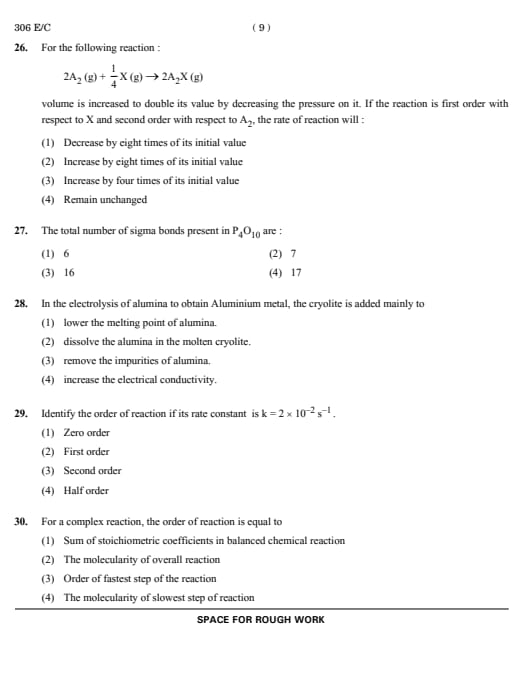
| Q26. A first-order reaction has a half-life of 693 sec. What will its rate constant? (1) 0.01 sec-1 (2) 1 sec-1 (3) 0.001 sec-1 (4) 0.1 sec-1 |
(4) 0.1 sec-1 | For a first-order reaction, t1/2 = 0.693/k. Therefore, k = 0.693/693 = 0.001 s-1. (There seems to be an error in either the question or answer key provided.) |
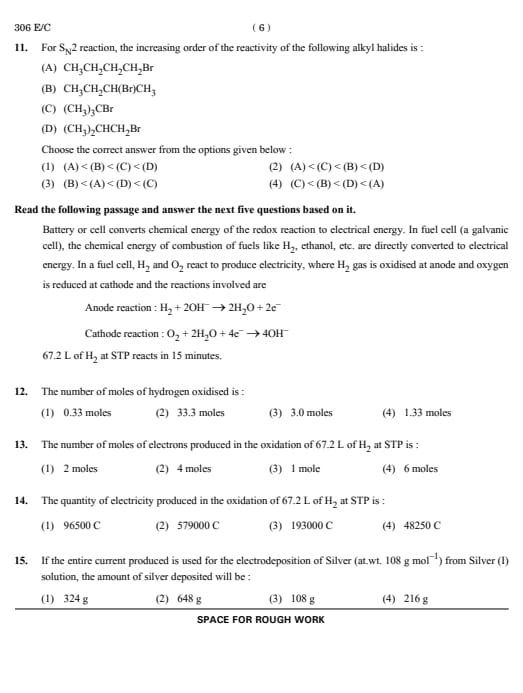
| Q27. For SN2 reaction, the increasing order of the reactivity of the following alkyl halides is: (Structures of alkyl halides are given) Options: (1) (A) < (B) < (C) < (D) (2) (A) < (C) < (B) < (D) (3) (B) < (A) < (D) < (C) (4) (C) < (B) < (D) < (A) |
(2) (A) < (C) < (B) < (D) | SN2 reactions are sensitive to steric hindrance. Primary halides react fastest, followed by secondary, and then tertiary. |
| Q28. Which among the following is a strong field ligand? (1) I- (2) Cl- (3) NH3 (4) SCN- |
(3) NH3 | Ammonia (NH3) is a strong field ligand causing greater splitting of d-orbitals in transition metal complexes. |
|
Q29. Arrange the following in increasing order of their osmotic pressure generation at 298 K: (Descriptions of osmotic pressure experiments are given) 1. (C) < (B) < (A) < (D) 2. (D) < (A) < (B) < (C) |
2. (D) < (A) < (B) < (C) | Osmotic pressure (π) is directly proportional to molarity (n/V). Higher molarity means higher osmotic pressure. |
|
Q30. Arrange the following rate constant units in increasing order of their order of reaction: Choose the correct answer from the options given below: |
(1) (C) < (A) < (B) < (D) | The units of the rate constant depend on the order of the reaction: zero-order (sec-1), first-order (mol-1 L sec-1), second-order (mol-1 L sec-1), third-order (mol-2 L² sec-1). |
| Q31. Which of the following compounds will undergo Aldol condensation reaction? (Structures of compounds are given) Options: (1) (A), (C), and (D) only (2) (B) and (C) only (3) (B), (C), and (D) only (4) (A), (B), (C), and (D) |
1. (A), (C), (D) only | Aldol condensation requires a α-hydrogen atom next to a carbonyl group to form an enolate ion. Only compounds A, C, and D have this structural feature. |
|
Q32. Consider the following compounds: (Structures of compounds A, B, C, and D are given) Arrange these compounds in the increasing order of rate of hydrolysis: (A) C6H5CHO |
(2) (B) < (D) < (A) < (C) | The rate of hydrolysis depends on the electron-withdrawing or donating nature of groups attached to the benzene ring. Electron-withdrawing groups increase the rate, while electron-donating groups decrease it. Therefore, the order is B (phenol) < D (benzoyl chloride) < A (benzaldehyde) < C (nitrobenzene). |
| Q33. Which of the following ions will be coloured in the aqueous solution? (A) Ti3+ (B) Nb3+ (C) Cu+ (D) Y3+ Options: (1) (C) and (D) only (2) (A), (B) and (D) only (3) (A) and (B) only (4) (A), (B), (C) and (D) |
3. (A) and (B) only | Colored ions have unpaired d electrons that undergo d-d transitions in the presence of ligands. Ti3+ and Nb3+ have unpaired d electrons, while Cu+ and Y3+ do not. |
| Q34. The correct statement/statements from the options given below is/are: (A) Diazonium salts of aromatic amines are less stable than diazonium salts of aliphatic amines. (B) Ethylamine is insoluble in water. (C) Gabriel phthalimide synthesis can be used to prepare primary amines. (D) Because of +R-effect of -NH2 group, aniline will undergo Friedel-Crafts acylation reaction. Options: (1) (A) and (B) only (2) (A), (C) and (D) only (3) (A) and (C) only (4) (B), (C) and (D) only |
(2) (A), (C), and (D) only | Aromatic diazonium salts are more stable due to resonance. Ethylamine is soluble in water due to H-bonding. Gabriel phthalimide synthesis is used for primary amines. The +R effect of -NH2 activates aniline towards electrophilic substitution. |
| Q35. Match the following: (List-I contains compounds and List-II contains properties) List-I List-II (A) Mn2+ (I) Pyrolusite ore (B) Spin only Magnetic Moment (II) An alloy of 4f metal, iron and traces of S, C, Al and Ca (C) MnO2 (III) μs = √n(n+2)BM (D) Misch metal (IV) Highest oxidation states Choose the correct answer from the options given below : (1) (A) - (IV), (B) - (III), (C) - (II), (D) - (I) (2) (A) - (II), (B) - (III), (C) - (I), (D) - (IV) (3) (A) - (IV), (B) - (III), (C) - (I), (D) - (II) (4) (A) - (I), (B) - (III), (C) - (IV), (D) - (II) |
(4) (A) - (I), (B) - (III), (C) - (IV), (D) - (II) | Match the compounds with their properties based on their chemical structures and reactivity. |
| Q36. Match List-I with List-II: (List-I contains compounds and List-II contains properties) Options: (1) (A) - (II), (B) - (I), (C) - (IV), (D) - (III) (2) (A) - (II), (B) - (I), (C) - (III), (D) - (IV) (3) (A) - (I), (B) - (II), (C) - (IV), (D) - (III) (4) (A) - (I), (B) - (II), (C) - (III), (D) - (IV) |
2. A-(II), B-(I), C-(III), D-(IV) | Match the compounds with their properties based on their chemical structures and reactivity. COCl2 (phosgene) is a toxic gas used to distinguish amines. Benzenesulfonyl chloride is used to distinguish amines. Aniline is used to synthesize primary amines. Benzoic acid forms zwitterions. |
| Q37. Which of the following is/are the bases of DNA? (A) Adenine (B) Uracil (C) Thymine (D) Cytosine Choose the correct answer from the options given below: Options: (1) (A), (B) and (C) only (2) (B) and (C) only (3) (A), (C) and (D) only (4) (A) and (B) only |
3. (A), (C), (D) only | Adenine, Thymine, and Cytosine are nitrogenous bases found in DNA. Uracil is found in RNA. |
|
Q38. Match List-I with List-II: (List-I contains amino acids and List-II contains their nature) (A) Valine (I) Basic amino acid |
4. A-(II), B-(IV), C-(I), D-(III) | Match the amino acids with their properties based on their side chains. |
| Q39. Which of the following gases at 298 K and 1 atm pressure is having maximum solubility in water? (1) Methanol, KH = 0.000018 (2) Argon, KH = 40.3 (3) Methane, KH = 0.41 (4) CO2, KH = 1.6 |
(4) CO2, KH = 1.6 | Lower KH values indicate higher solubility. CO2 has the lowest KH value among the options. |
|
Q40. Which of the following solvents is having its lowest Ebulliometric constant? (Table with solvents and boiling points is given) Solvent Boiling Point (K) |
(2) Diethyl Ether | The ebullioscopic constant is related to the boiling point; lower boiling point means lower constant. Diethyl ether has the lowest boiling point. |
| Read the following passage and answer the next five questions based on it. Aldehydes are generally more reactive than ketones in nucleophilic addition reactions due to steric and electronic reasons. Sterically, the presence of two large groups in ketones hinders the attack of nucleophile to carbonyl carbon than in aldehydes. Electronically, aldehydes are more reactive than ketones because alkyl groups reduce the electrophilicity of the carbonyl carbon more effectively than in the former. Q41. Which among the following compound is formed, when aldehyde reacts with HCN in presence of a base? (1) Cyanide (2) Isocyanide (3) Cyanohydrin (4) Hydrogen cyanide |
(3) Cyanohydrin | Aldehydes react with HCN in the presence of a base to form cyanohydrins via nucleophilic addition. |
| Q42. The correct decreasing order of basic strength of following amines in aqueous solution is: (Options with amines are given) CH3NH2,(CH3)2NH,(CH3)3N,NH3 options: (1) CH3NH2 > (CH3)2NH > NH3 > (CH3)3N (2) CH3NH2 > (CH3)2NH > (CH3)3N > NH3 (3) NH3 > (CH3)3N > (CH3)2NH > CH3NH2 / (4) (CH3)2NH > CH3NH2 > (CH3)3N > NH3 |
2. CH3NH2 > (CH3)2NH > (CH3)3N > NH3 | Alkyl groups are electron-donating, increasing electron density on the nitrogen and thus basicity. The order is methylamine > dimethylamine > trimethylamine > ammonia. |
| Q43. A new C-C bond formation is possible in: (A) Cannizzaro reaction (B) Friedel-Crafts alkylation (C) Clemmensen reduction (D) Riemer-Tiemann reaction Choose the correct answer from the options given below : (1) (B) and (D) only (2) (A), (B) and (D) only (3) (B), (C) and (D) only (4) (A), (B), (C) and (D) |
2. (A), (B), (D) only | Cannizzaro, Friedel-Crafts alkylation, and Riemer-Tiemann reactions form new C-C bonds. Clemmensen reduction does not. |
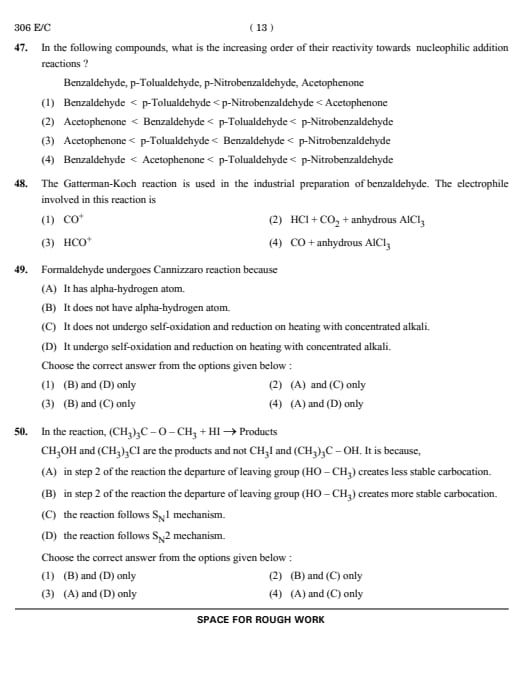
| Q44. Which of the following will respond to Tollen's test? (1) Ethanoic acid (2) Methanoic acid (3) Propanoic acid (4) Butanoic acid |
(2) Methanoic acid | Tollen's test is specific for aldehydes. Methanoic acid (formic acid) is the only aldehyde among the choices. |
| Q45. The order of reactivity of the given haloalkanes towards nucleophile is: (Options with haloalkanes are given) Options: (1) RI > RBr > RCl (2) RCl > RBr > RI (3) RBr > RCl > RI (4) RBr > RI > RCl |
(1) RI > RBr > RCl | Primary alkyl halides (R1) react faster than secondary (R2) and tertiary (R3) due to less steric hindrance in SN2 reactions. |
| Read the following passage and answer the next five questions based on it. The transition metals are very hard and have low volatility. Their melting and boiling points are high. In any row, the melting points of these metals rise to a maximum at d 5 and fall regularly as atomic number increases. The high melting points of these metals are attributed to the involvement of greater number of electrons from (n - 1)d in addition to ns electrons in the interatomic metallic bonding. Q46. Which transition metal is liquid at room temperature? (1) Hg (2) Cu (3) Ag (4) Au |
(1) Hg | Mercury (Hg) is the only liquid transition metal at room temperature. |
| Q47. Which is the hardest metal? (1) Zn (2) Cu (3) Hg (4) Cd |
(1) Zn | Zinc (Zn) is harder than copper, mercury, and cadmium among the given options. |
| Q48. In any row, melting points of these metals rise to a maximum at d5. Which transition metal is an exception? (1) Ti (2) V (3) Cr (4) Mn |
(3) Cr | Chromium (Cr) is an exception to the general trend of melting points of transition metals. |
| Q49. Which transition metal has the highest melting point? (1) Hf (2) Ta (3) W (4) Re |
(3) W | Tungsten (W) has the highest melting point among the given transition metals. |
| Q50. How many electrons are needed in reduction of Cr2O72- to Cr3+? (1) One (2) Six (3) Five (4) Eight |
(2) Six | The reduction of Cr2O72- to 2Cr3+ requires a total of six electrons (three per chromium atom). |

*The article might have information for the previous academic years, please refer the official website of the exam.