
CUET English Question Paper 2024 SET B Download Solutions and Answer Key


Content Writer | Updated On - Jan 13, 2025
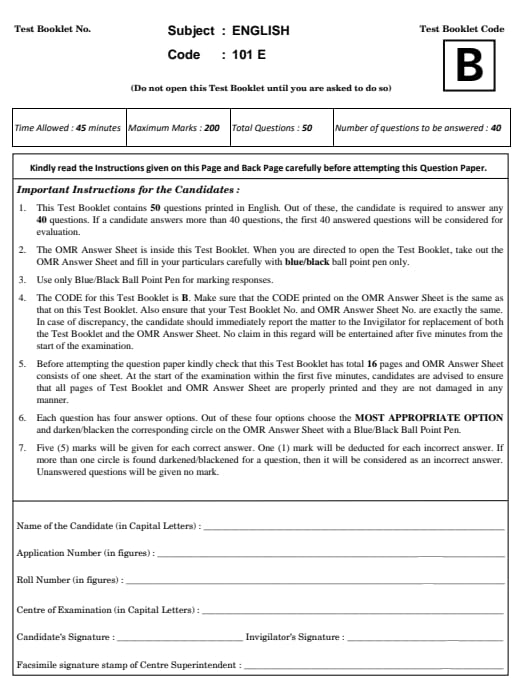
CUET Question Papers are the most important study material for effective exam preparation. We at Zollege have provided all CUET Previous Year Papers with Solution PDFs here. CUET 2024 English was conducted successfully on May 15 by NTA.
Students can freely download the CUET previous year's question paper PDFs along with their solutions here. We strongly encourage cuet aspirants to scan through all the CUET Question Paper to know the overall difficulty level, CUET Syllabus and understand the changes in CUET Exam Pattern over the years.
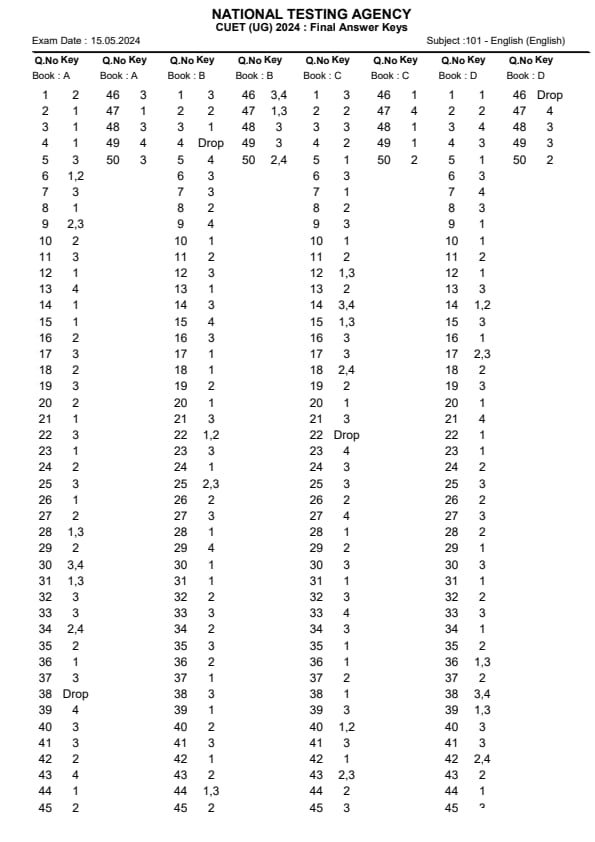
CUET 2024 English Question Paper (SET B) with Answer Key PDF
| CUET 2024 English Question Paper with Answer Key Set B |  Download Download |
Check Solutions |
| CUET 2024 English(new) Question Paper with Answer Key Set B | Download |
Check Solutions |
CUET 2024 English Question Paper with Solutions Set B
| Question | Answer | Detailed Solution |
|---|---|---|
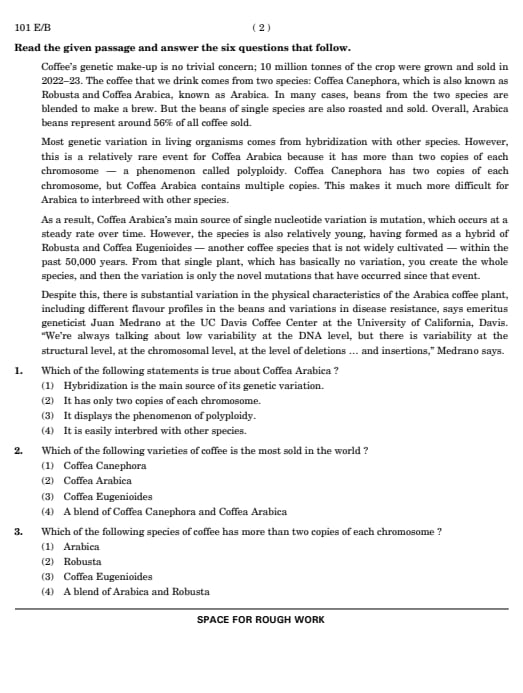
| 1. Which of the following statements is true about Coffea Arabica? (a) Hybridization is the main source of its genetic variation. (b) It has only two copies of each chromosome. (c) It displays the phenomenon of polyploidy. (d) It is easily interbred with other species. |
3 It displays the phenomenon of polyploidy. | Coffea Arabica is a polyploid species, which is a rare trait that contributes to its genetic diversity and unique flavor. |
| 2. Which of the following varieties of coffee is the most sold in the world? (a) Coffea Canephora (b) Coffea Arabica (c) Coffea Eugenioides (d) A blend of Coffea Canephora and Coffea Arabica. |
2 Coffea Arabica | Coffea Arabica is the most popular variety of coffee sold worldwide due to its smooth flavor and lower caffeine content compared to other varieties. |
| 3. Which of the following species of coffee has more than two copies of each chromosome? (a) Arabica (b) Robusta (c) Coffea Eugenioides (d) A blend of Arabica and Robusta. |
1 Arabica | Coffea Arabica is a polyploid species, meaning it has more than two sets of chromosomes, making it genetically distinct from other coffee species. |
| 4. Which of the following species of coffee developed only in the last 50,000 years? (a) Coffea Canephora (b) Coffea Eugenioides (c) Arabica (d) Robusta. |
3 Arabica | Coffea Arabica is a relatively recent species that developed through natural hybridization within the last 50,000 years. |
| 5. Which of the following types of variability is not very high for Coffea Arabica? (a) Variability at the structural level. (b) Variability at the chromosomal level. (c) Variability at the level of deletions and insertions. (d) Variability at the DNA level. |
4 Variability at the DNA level | Coffea Arabica is known for its low genetic variability at the DNA level, despite its polyploid nature. |
| 6. Choose the statement that is factually incorrect from the options given below. (a) It is possible to roast the beans of a single species of coffee. (b) Two species of coffee can be blended to make a brew. (c) Due to its genetic make-up, novel mutations do not occur in the species Coffea Arabica. (d) Variations in disease resistance can be seen in the Arabica coffee plant. |
3 Due to its genetic make-up, novel mutations do not occur in the species Coffea Arabica. | While Coffea Arabica may have lower DNA variability, mutations can still occur in the species. |
| 7. Re-arrange the following phrases in the correct sequence to form a meaningful sentence. (A) created by human (B) collective cultural heritage (C) all languages (D) communities are our (a) (A), (B), (D), (C) (b) (B), (A), (D), (C) (c) (C), (A), (D), (B) (d) (D), (B), (C), (A) |
3 (C), (A), (D), (B) | The full sentence is: "All languages created by human communities are our collective cultural heritage." |
| 8. Fill in the blank with the correct option to form a meaningful sentence. The Principal addressed us in the assembly and ______ the rumors of an early summer break. (a) defended (b) quashed (c) cleared (d) rebuked |
2 quashed | The Principal "quashed" the rumors, meaning he put an end to or dismissed the false information about an early summer break. |
| 9. Complete the sentences given in List-I with the appropriate phrasal verbs given in List-II. List-I (Sentences): (A) She was very ______ with him for his offensive remarks on women in politics. (B) I have plenty of interesting books to ______ to book lovers. (C) Strange that people easily ______ to temptation and ruin their reputation! (D) Rahul is trying to ______ on his smoking. List-II (Phrasal Verbs): (I) give away (II) cut down (III) cut up (IV) give in (a) (A) - (III), (B) - (I), (C) - (IV), (D) - (II) (b) (A) - (II), (B) - (IV), (C) - (I), (D) - (III) (c) (A) - (I), (B) - (II), (C) - (IV), (D) - (III) (d) (A) - (III), (B) - (I), (C) - (IV), (D) - (II) |
1 (A) - (III), (B) - (I), (C) - (IV), (D) - (II) | - (A) "Cut up" means to be deeply upset or angry. - (B) "Give away" means to share or distribute freely. - (C) "Give in" means to surrender to something, such as temptation. - (D) "Cut down" means to reduce something, like smoking. |
| 10. Complete the sentences given in List-I with the appropriate adverbs given in List-II. List-I (Sentences): (A) I thought the restaurant would be expensive but it was ______ affordable. (B) It was a serious accident. But the car was ______ damaged. (C) The meeting was a disaster as it was very ______ organized. (D) Mira is gifted; she has the ability to learn any language ______. List-II (Adverbs): (I) badly (II) reasonably (III) quickly (IV) hardly (a) (A) - (II), (B) - (IV), (C) - (I), (D) - (III) (b) (A) - (IV), (B) - (II), (C) - (III), (D) - (I) (c) (A) - (I), (B) - (II), (C) - (IV), (D) - (III) (d) (A) - (III), (B) - (IV), (C) - (I), (D) - (II) |
1 (A) - (II), (B) - (IV), (C) - (I), (D) - (III) | - (A) "Reasonably" means fairly affordable. - (B) "Hardly" means barely damaged. - (C) "Badly" indicates poor organization. - (D) "Quickly" describes fast learning. |
| 11. Choose the appropriate word pair to complete the sentence. I didn’t know Rahul was in the hospital. If I ______, I would ______ him. (a) knew, go (b) had known, have visited (c) have known, be going (d) know, had gone |
2 had known, have visited | The past perfect tense "had known" and "would have visited" form the correct conditional sentence. |
| 12. Identify the option closest in meaning to the underlined word. The movie star’s biography is a glossy, sycophantic portrayal. (a) cowardly (b) domineering (c) flattering (d) insolent |
3 flattering | "Sycophantic" means excessively flattering or submissive, often to gain favor. |
| 13. Choose the correct antonym of the underlined word. The Minister unleashed a compliment against the newspaper for its biased editorial on illiteracy among women in his constituency. (a) denunciation (b) endorsement (c) regulation (d) speculation |
1 denunciation | A "denunciation" is the opposite of a "compliment," as it means public condemnation of something. |
| 14. Choose the correct synonym for "redoubtable" from the options given below. (a) flimsy (b) perplexing (c) formidable (d) voluble |
3 formidable | "Redoubtable" means inspiring fear or respect, often due to being formidable. |
| 15. Choose the correct antonym for "sullen" from the options given below. (a) morose (b) reticent (c) timid (d) genial |
4 genial | "Sullen" means gloomy or sulky, and the opposite of this is "genial," which means cheerful and friendly. |
| 16. Rearrange the following parts in the correct sequence to make a meaningful sentence. (A) are inborn but our (B) constituents of flavor, are learned (C) our responses to basic tastes (D) perceptions of smells, the main (a) (B), (D), (A), (C) (b) (A), (C), (B), (D) (c) (C), (A), (D), (B) (d) (C), (B), (D), (A) |
3 (C), (A), (D), (B) | The sentence is: "Our responses to basic tastes are inborn, but our perceptions of smells, the main constituents of flavor, are learned." |
| 17. Match the words in List-I with their definitions in List-II. List-I (Words): (A) Theocracy (B) Megalomania (C) Apothecary (D) Antiquarian List-II (Definitions): (I) One who keeps drugs for sale and puts up prescriptions (II) One who collects and studies objects or artistic works from the distant past (III) A government by divine guidance or religious leaders (IV) A morbid delusion of one’s power, importance, or godliness (a) (A) - (III), (B) - (IV), (C) - (I), (D) - (II) (b) (A) - (IV), (B) - (III), (C) - (II), (D) - (I) (c) (A) - (I), (B) - (III), (C) - (IV), (D) - (II) (d) (A) - (III), (B) - (IV), (C) - (II), (D) - (I) |
1 (A) - (III), (B) - (IV), (C) - (I), (D) - (II) | - (A) "Theocracy" means a government ruled by divine guidance or religious leaders. - (B) "Megalomania" is a morbid delusion of one’s power or importance. - (C) "Apothecary" refers to a person who prepares and sells medicines. - (D) "Antiquarian" relates to studying or collecting objects from the distant past. |
| 18. Fill in the blank with the correct option. A small ______ between two children ended up as a group fight. (a) altercation (b) match (c) contest (d) race |
1 altercation | An "altercation" is a heated argument or disagreement, which makes sense in the context of a group fight. |
| 19. Re-arrange the following phrases in the right sequence to form a meaningful sentence. (A) for seven hours but was hardly (B) because of the absence of any motivation (C) able to decide who the murderer was (D) she worked on the case (a) (A), (C), (D), (B) (b) (D), (A), (C), (B) (c) (D), (C), (B), (A) (d) (A), (B), (C), (D) |
2 (D), (A), (C), (B) | The sentence would be: "She worked on the case for seven hours but was hardly able to decide who the murderer was because of the absence of any motivation." |
| 20. Fill in the blank with the correct option. The candidate assured the interviewers that the dip in her grades during her second semester was an ______ since she had always been a top scorer in the first semester. (a) anomaly (b) allay (c) adage (d) abatement |
1 anomaly | "Anomaly" means something that deviates from the norm. The candidate is explaining that the dip in her grades was an unusual occurrence. |
| 21. Replace the underlined word with the most appropriate SYNONYM. For some time now, we’ve been toying with the idea of transferring all our business from physical to online sales only. (a) launch (b) showing (c) considering (d) careful |
3 considering | "Toying with" in this context means thinking or considering an idea. The word "launch" means to start something, and "showing" and "careful" do not fit in this context. |
| 22. Select the word opposite in meaning to the underlined word. At first the workers were agreeable to the proposals of their Manager, but later they were reconciled to the new proposals. (a) resistant (b) estranged (c) cooperate (d) agreed |
1 resistant | "Agreeable" means willing to agree or accept something. The opposite of this would be "resistant," meaning unwilling to accept. |
| 23. Complete the sentences given in List-I with the appropriate words given in List-II. List-I (Sentences): (A) She was able to give a ______ explanation in the court for her presence near the crime scene. (B) The Rockland Hospital ______ with AIIMS to conduct a free cancer screening camp. (C) Though she has shown only 4% improvement in achieving her target yet her efforts are ______. (D) The doctors give the prognosis by ______ their diagnosis with several tests. List-II (Words): (I) collaborated (II) corroborated (III) credible (IV) creditable (a) (A) - (III), (B) - (I), (C) - (IV), (D) - (II) (b) (A) - (I), (B) - (II), (C) - (III), (D) - (IV) (c) (A) - (III), (B) - (II), (C) - (IV), (D) - (I) (d) (A) - (II), (B) - (III), (C) - (I), (D) - (IV) |
1 (A) - (III), (B) - (I), (C) - (IV), (D) - (II) | - (A) "Credible" refers to an explanation that is believable. - (B) "Collaborated" means worked together with AIIMS. - (C) "Creditable" refers to an effort that deserves praise. - (D) "Corroborated" refers to confirming the diagnosis with tests. |
| 24. Fill in the blank with the correct option. Most of the guests arrived ______ the concert bus. (a) by (b) with (c) from (d) through |
1 by | The preposition "by" is used to indicate the means of transportation. Therefore, "by bus" is the correct phrasing. |
| 25. Choose the word closest in meaning to the underlined word. Why did you make that flippant remark about her choice of clothes? (a) sarcastic (b) disrespectful (c) casual (d) indifferent |
2 disrespectful | "Flippant" refers to a remark that shows a lack of respect or seriousness. While "casual" and "indifferent" might seem similar, "disrespectful" best matches the tone implied by "flippant." |
| 26. Select the word opposite in meaning to the underlined word. The thief showed his disbelief when informed that his partner had been arrested. (a) displayed (b) concealed (c) battled (d) marked |
2 concealed | "Disbelief" means expressing doubt or surprise, and the opposite would be "concealed," which means hiding one’s emotions. |
| 27. Fill in the blank with the correct option. The President finally had to ______ the demands of the public for his resignation. (a) ignore (b) initiate (c) accede to (d) condone |
3 accede to | "Accede to" means to give in to or accept something, often after resistance. The President eventually had to agree to the public’s demands for his resignation. |
| 28. Re-arrange the following parts of a sentence in their correct sequence to form a meaningful sentence. (A) for organizations which provide (B) services to customers on a face-to-face basis, (C) employees with whom they deal is very important (D) the quality of the relationship between customers and (a) (A), (B), (D), (C) (b) (C), (A), (B), (D) (c) (B), (D), (A), (C) (d) (D), (A), (C), (B) |
4 (D), (A), (C), (B) | The complete sentence is: "The quality of the relationship between customers and employees with whom they deal is very important for organizations which provide services to customers on a face-to-face basis." |
| 29. Re-arrange the following parts of a sentence in their correct sequence to form a meaningful sentence. (A) as a concept fundamental to (B) especially with the injunction to treat equals equally (C) justice is associated with the notion of equity and equality, (D) ethical theory and political philosophy, (a) (D), (B), (C), (A) (b) (C), (A), (B), (D) (c) (B), (A), (D), (C) (d) (A), (D), (C), (B) |
2 (C), (A), (B), (D) | The sentence would be: "Justice is associated with the notion of equity and equality, especially with the injunction to treat equals equally as a concept fundamental to ethical theory and political philosophy." |
| 30. Match the idioms in List-I with their meanings in List-II. List-I (Idioms): (A) blow the gaff (B) at the end of your tether (C) be full of beans (D) want to curl up and die List-II (Meanings): (I) feel unable to deal with something (II) feel terribly ashamed and embarrassed (III) divulge a secret (IV) be full of energy (a) (A) - (III), (B) - (I), (C) - (IV), (D) - (II) (b) (A) - (II), (B) - (IV), (C) - (I), (D) - (III) (c) (A) - (IV), (B) - (I), (C) - (II), (D) - (III) (d) (A) - (III), (B) - (IV), (C) - (I), (D) - (II) |
1 (A) - (III), (B) - (I), (C) - (IV), (D) - (II) | - (A) "Blow the gaff" means to reveal a secret. - (B) "At the end of your tether" means feeling unable to cope anymore. - (C) "Be full of beans" means to be full of energy. - (D) "Want to curl up and die" means feeling extreme embarrassment or shame. |
| 31. Match the blanks in List-I with the prepositions in List-II. List-I (Sentences): (A) The edited version of her article is indistinguishable ______ her first version. (B) I just don’t feel any affinity ______ his prose style. It’s too caustic. (C) Her ideas are not all that dissimilar ______ mine. (D) It would be wrong to mistake his diffidence ______ his arrogance or coldness. List-II (Prepositions): (I) with (II) to (III) for (IV) from (a) (A) - (IV), (B) - (II), (C) - (I), (D) - (III) (b) (A) - (I), (B) - (III), (C) - (II), (D) - (IV) (c) (A) - (IV), (B) - (I), (C) - (III), (D) - (II) (d) (A) - (III), (B) - (IV), (C) - (I), (D) - (II) |
1 (A) - (IV), (B) - (II), (C) - (I), (D) - (III) | - (A) "Indistinguishable from" means it is hard to tell the difference between two things. - (B) "Affinity to" refers to a connection or attraction towards something. - (C) "Dissimilar with" refers to a lack of similarity between two things. - (D) "Mistake for" means to incorrectly assume something. |
| 32. Re-arrange the parts in their correct sequence to form a meaningful sentence. (A) students with tools for critical thinking (B) cooperative learning is an (C) that enhances creativity and provides (D) eclectic and unique teaching method (a) (A), (C), (B), (D) (b) (B), (D), (C), (A) (c) (B), (A), (D), (C) (d) (C), (B), (D), (A) |
2 (B), (D), (C), (A) | The full sentence is: "Cooperative learning is an eclectic and unique teaching method that enhances creativity and provides students with tools for critical thinking." |
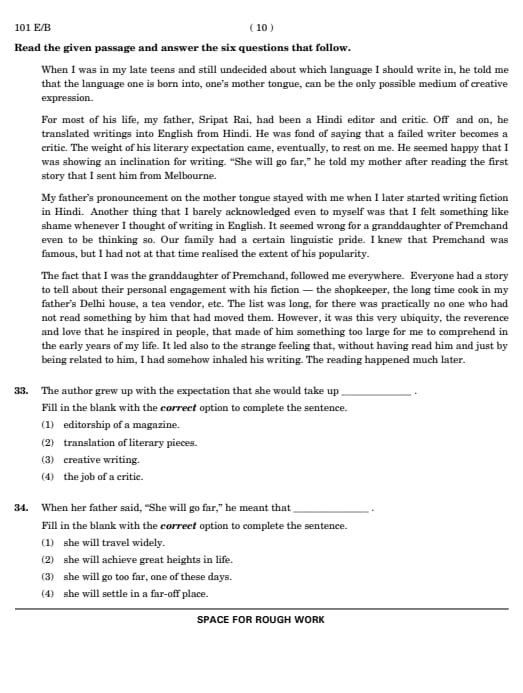
| 33. The author grew up with the expectation that she would take up ______. (a) editorship of a magazine (b) translation of literary pieces (c) creative writing (d) the job of a critic |
3 creative writing | The context of the passage suggests that the author had familial and cultural expectations pushing her toward creative writing. |
| 34. When her father said, "She will go far," he meant that ______. (a) she will travel widely (b) she will achieve great heights in life (c) she will go too far, one of these days (d) she will settle in a far-off place |
2 she will achieve great heights in life | The phrase "go far" in this context is a metaphor for achieving success and greatness. |
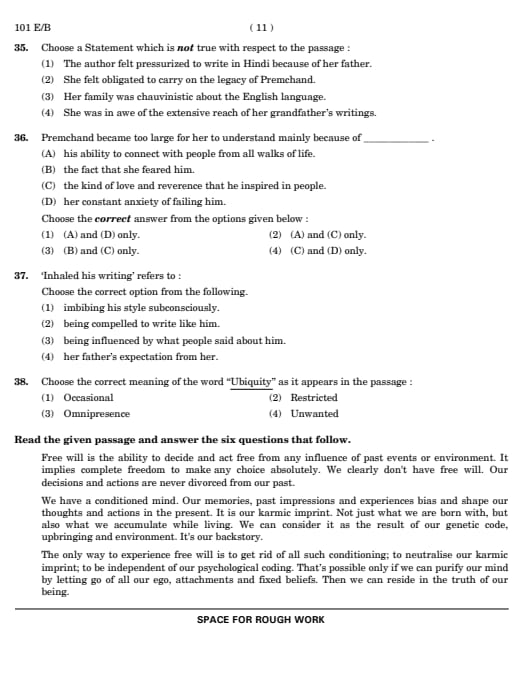
| 35. Choose a statement which is not true with respect to the passage: (a) The author felt pressurized to write in Hindi because of her father. (b) She felt obligated to carry on the legacy of Premchand. (c) Her family was chauvinistic about the English language. (d) She was in awe of the extensive reach of her grandfather’s writings. |
3 Her family was chauvinistic about the English language. | There is no indication in the passage that her family was chauvinistic about English. The passage focuses on her struggle with Hindi and carrying on the family legacy. |
| 36. Premchand became too large for her to understand mainly because of ______. (a) the societal expectations around his legacy. (b) the complex language in his works. (c) his far-reaching influence and impact. (d) her emotional connection to his work. |
3 his far-reaching influence and impact. | The passage describes how Premchand’s wide influence made it difficult for the author to fully grasp his significance. |
| 37. "Inhaled his writing" refers to ______. (a) imbibing his style subconsciously (b) being compelled to write like him (c) being influenced by what people said about him (d) her father’s expectation from her |
1 imbibing his style subconsciously | "Inhaled his writing" is a metaphorical way of saying that the author absorbed her grandfather’s style of writing naturally. |
| 38. Choose the correct meaning of the word "Ubiquity" as it appears in the passage: (a) Occasional (b) Restricted (c) Omnipresence (d) Unwanted |
3 Omnipresence | "Ubiquity" refers to the state of being everywhere or widespread, which is how the word is used in the passage. |
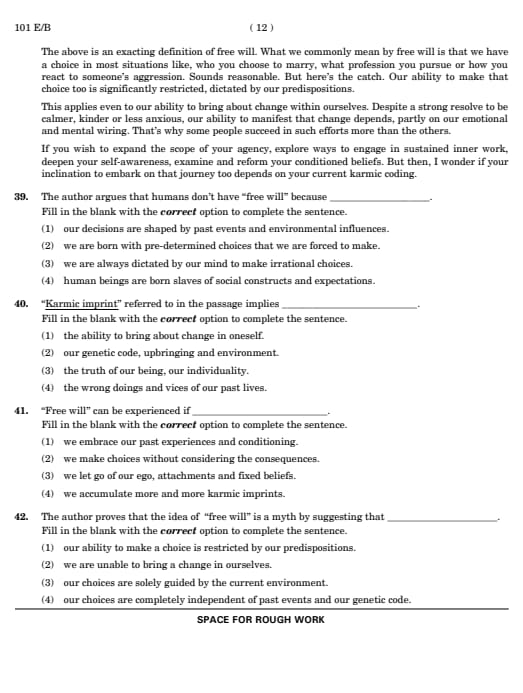
| 39. The author argues that humans don’t have "free will" because ______. (a) our decisions are shaped by past events and environmental influences. (b) we are born with pre-determined choices that we are forced to make. (c) we are always dictated by our mind to make irrational choices. (d) human beings are born slaves of social constructs and expectations. |
1 our decisions are shaped by past events and environmental influences. | The author explains that free will is limited because our actions are influenced by prior experiences and the environment around us. |
| 40. "Karmic imprint" referred to in the passage implies ______. (a) the ability to bring about change in oneself. (b) our genetic code, upbringing, and environment. (c) the truth of our being, our individuality. (d) the wrongdoings and vices of our past lives. |
2 our genetic code, upbringing, and environment. | The "karmic imprint" in the passage refers to the influences that shape who we are, including genetics and upbringing. |
| 41. "Free will" can be experienced if ______. (a) we embrace our past experiences and conditioning. (b) we make choices without considering the consequences. (c) we let go of our ego, attachments, and fixed beliefs. (d) we accumulate more and more karmic imprints. |
3 we let go of our ego, attachments, and fixed beliefs. | According to the passage, free will can only be experienced when one detaches from external influences and internal biases. |
| 42. The author proves that the idea of "free will" is a myth by suggesting that ______. (a) our ability to make a choice is restricted by our predispositions. (b) we are unable to bring a change in ourselves. (c) our choices are solely guided by the current environment. (d) our choices are completely independent of past events and our genetic code. |
1 our ability to make a choice is restricted by our predispositions. | The author argues that free will is limited because people are guided by their past experiences, genetics, and environment. |
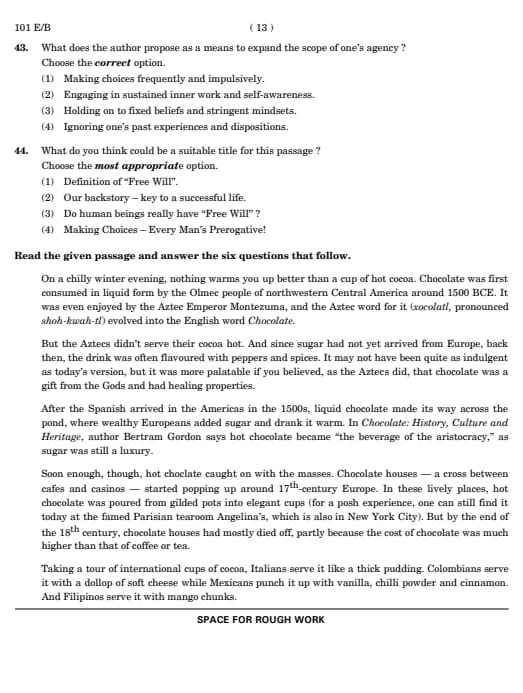
| 43. What does the author propose as a means to expand the scope of one’s agency? (a) Making choices frequently and impulsively. (b) Engaging in sustained inner work and self-awareness. (c) Holding on to fixed beliefs and stringent mindsets. (d) Ignoring one’s past experiences and dispositions. |
2 Engaging in sustained inner work and self-awareness. | The passage suggests that self-awareness and introspection allow individuals to expand their sense of agency. |
| 44. What do you think could be a suitable title for this passage? (a) Definition of "Free Will". (b) Our backstory – key to a successful life. (c) Do human beings really have "Free Will"? (d) Making Choices – Every Man’s Prerogative! |
3 Do human beings really have "Free Will"? | This title reflects the main theme of the passage, which questions the existence of true free will. |
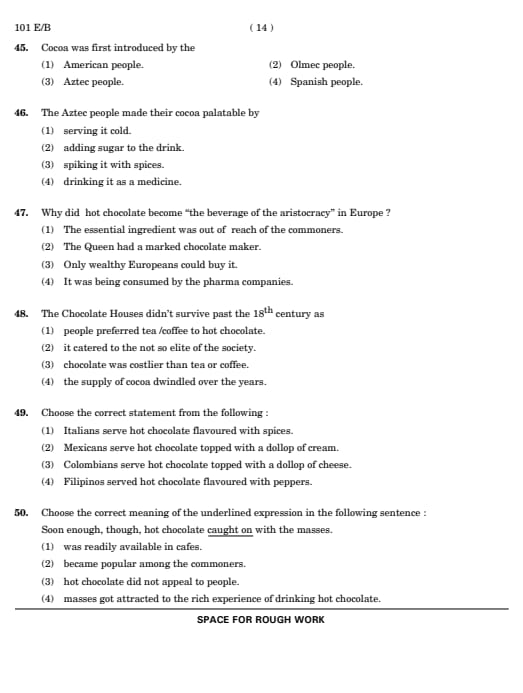
| 45. Cocoa was first introduced by the ______. (a) American people. (b) Olmec people. (c) Aztec people. (d) Spanish people. |
2 Olmec people. | Cocoa was first introduced by the Olmec civilization, who are considered the first to cultivate the cacao plant. |
| 46. The Aztec people made their cocoa palatable by ______. (a) serving it cold. (b) adding sugar to the drink. (c) spiking it with spices. (d) drinking it as a medicine. |
3 spiking it with spices. | The Aztec people made their cocoa drink more flavorful by adding various spices, including chili, to make it more palatable. |
| 47. Why did hot chocolate become "the beverage of the aristocracy" in Europe? (a) The essential ingredient was out of reach of the commoners. (b) The Queen had a marked chocolate maker. (c) Only wealthy Europeans could buy it. (d) It was being consumed by the pharma companies. |
1 The essential ingredient was out of reach of the commoners. | Cocoa was expensive and difficult to acquire, making hot chocolate a luxury item that was only available to the wealthy elite in Europe. |
| 48. The Chocolate Houses didn’t survive past the 18th century as ______. (a) people preferred tea/coffee to hot chocolate. (b) it catered to the not-so-elite of society. (c) chocolate was costlier than tea or coffee. (d) the supply of cocoa dwindled over the years. |
3 chocolate was costlier than tea or coffee. | The high cost of chocolate, compared to other beverages like tea or coffee, contributed to the decline of Chocolate Houses. |
| 49. Choose the correct statement from the following. (a) Italians serve hot chocolate flavored with spices. (b) Mexicans serve hot chocolate topped with a dollop of cream. (c) Colombians serve hot chocolate topped with a dollop of cheese. (d) Filipinos serve hot chocolate flavored with peppers. |
3 Colombians serve hot chocolate topped with a dollop of cheese. | In Colombia, it is common to serve hot chocolate with cheese, which melts into the drink for a unique flavor combination. |
| 50. Choose the correct meaning of the underlined expression in the following sentence: "Soon enough, though, hot chocolate caught on with the masses." (a) was readily available in cafes. (b) became popular among the commoners. (c) hot chocolate did not appeal to people. (d) masses got attracted to the rich experience of drinking hot chocolate. |
2 became popular among the commoners. | The phrase "caught on" means that hot chocolate became popular, especially among people who previously could not afford it. |



*The article might have information for the previous academic years, please refer the official website of the exam.