
CUET General Test Question Paper 2024 SET A Download Solutions and Answer Key


Content Writer | Updated On - Jan 13, 2025
CUET Question Papers are the most important study material for effective exam preparation. We at Zollege have provided all CUET Previous Year Papers with Solution PDFs here. CUET 2024 Geography was conducted successfully on May 17 by NTA.
Students can freely download the CUET previous year's question paper PDFs along with their solutions here. We strongly encourage cuet aspirants to scan through all the CUET Question Paper to know the overall difficulty level, CUET Syllabus and understand the changes in CUET Exam Pattern over the years.
CUET 2024 General Test Question Paper (SET A) with Answer Key PDF
| CUET 2024 General Test Question Paper with Answer Key Set A |  Download Download |
Check Solution |
CUET 2024 General Test Question Paper with Solution
| Question | Answer | Detailed Solution |
|---|---|---|
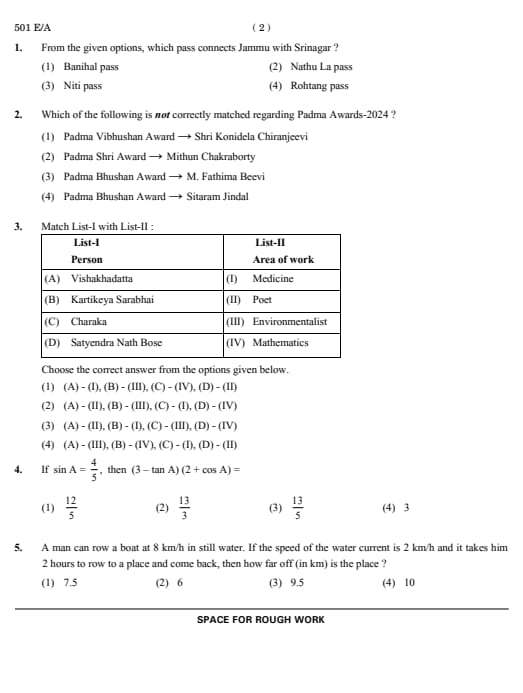
| Q1: Which pass connects Jammu with Srinagar? (1) Banihal Pass (2) Nathu La Pass (3) Niti Pass (4) Rohtang Pass |
(1) Banihal Pass | Jammu and Srinagar are connected by the Banihal Pass. - This pass is a part of the Pir Panjal mountain range. - It is a crucial point for road connectivity between these regions. |
| Q2: Which of the following is not correctly matched regarding Padma Awards 2024? (1) Padma Vibhushan → Konidela Chiranjeevi (2) Padma Shri → Mithun Chakraborty (3) Padma Bhushan → M. Fathima Beevi (4) Padma Bhushan → Sitaram Jindal |
(2) Padma Shri → Mithun Chakraborty | Option (2) is not correctly matched. - Mithun Chakraborty has not received the Padma Shri Award in 2024. |
| Q3: Match List-I with List-II: List-I (Person) List-II (Area of Work) (A) Vishakhadatta → Poet (B) Kartikeya Sarabhai → Environmentalist (C) Charaka → Medicine (D) Satyendra Nath Bose → Mathematics |
(2) (A)-(II), (B)-(III), (C)-(I), (D)-(IV) | - Vishakhadatta was a poet, so he matches with Poet. - Kartikeya Sarabhai is known for environmental work. - Charaka was a pioneer in medicine. - Satyendra Nath Bose made significant contributions to mathematics. |
| Q4: If sin A = 5/13, then (3 − tan A)(2 + cos A) is: (1) 12/13 (2) 13/3 (3) 13/4 (4) 3 |
(2) 13/3 | - Using sin A = 5/13, calculate cos A: cos A = √(1 − sin² A) = 12/13. - Calculate tan A: tan A = sin A / cos A = 5/12. - Substitute into the expression: (3 − tan A)(2 + cos A) = (3 − 5/12)(2 + 12/13) = 13/3. |
| Q5: A man can row a boat at 8 km/h in still water. If the speed of the water current is 2 km/h and it takes him 2 hours to row to a place and come back, how far off (in km) is the place? (1) 7.5 (2) 6 (3) 9.5 (4) 10 |
(1) 7.5 | - Speed downstream = 8 + 2 = 10 km/h. - Speed upstream = 8 − 2 = 6 km/h. - Total time = 2 hours. Solving: d/10 + d/6 = 2. Distance = 7.5 km. |
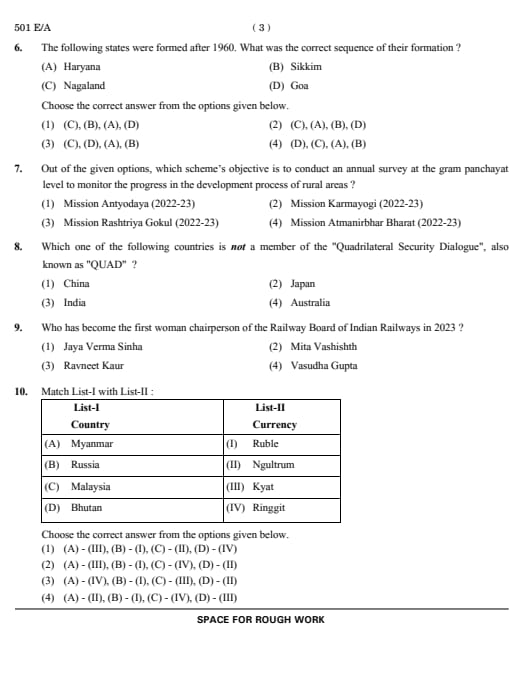
| Q6: The following states were formed after 1960. What was the correct sequence of their formation? (A) Haryana (B) Sikkim (C) Nagaland (D) Goa (1) (C), (B), (A), (D) (2) (C), (A), (B), (D) (3) (C), (D), (A), (B) (4) (D), (C), (A), (B) |
(2) (C), (A), (B), (D) | The correct sequence of state formation: - Nagaland was formed in 1963. - Haryana was formed in 1966. - Sikkim was formed in 1975. - Goa was formed in 1987. |
| Q7: Out of the given options, which scheme’s objective is to conduct an annual survey at the gram panchayat level to monitor the progress in the development process of rural areas? (1) Mission Antyodaya (2022-23) (2) Mission Karmayogi (2022-23) (3) Mission Rashtriya Gokul (2022-23) (4) Mission Atmanirbhar Bharat (2022-23) |
(1) Mission Antyodaya (2022-23) | Mission Antyodaya aims to improve rural infrastructure through annual surveys at the gram panchayat level. |
| Q8: Which one of the following countries is not a member of the "Quadrilateral Security Dialogue", also known as "QUAD"? (1) China (2) Japan (3) India (4) Australia |
(1) China | The QUAD is a strategic alliance including the United States, Japan, India, and Australia. China is not a member. |
| Q9: Who has become the first woman chairperson of the Railway Board of Indian Railways in 2023? (1) Jaya Verma Sinha (2) Mita Vashishth (3) Ravneet Kaur (4) Vasudha Gupta |
(1) Jaya Verma Sinha | Jaya Verma Sinha became the first woman chairperson of the Railway Board in 2023. |
| Q10: Match List-I with List-II: List-I (Country) List-II (Currency) (A) Myanmar → Kyat (B) Russia → Ruble (C) Malaysia → Ringgit (D) Bhutan → Ngultrum |
(2) (A)-(III), (B)-(I), (C)-(IV), (D)-(II) | - Myanmar uses the Kyat. - Russia uses the Ruble. - Malaysia uses the Ringgit. - Bhutan uses the Ngultrum. |
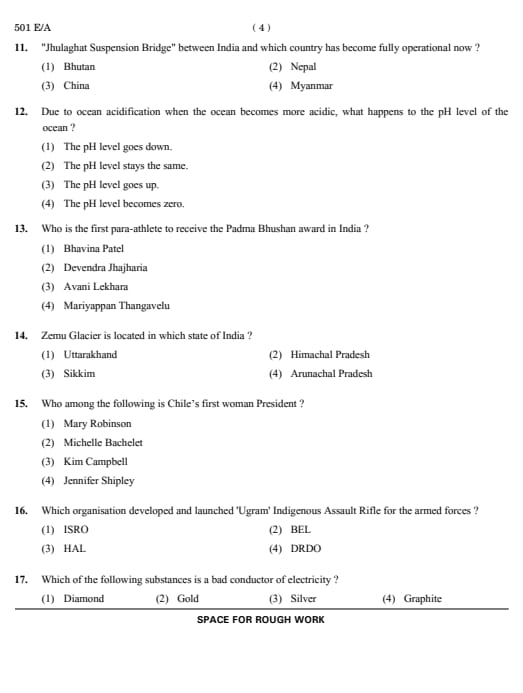
| Q11: “JhulaGhat Suspension Bridge” between India and which country has become fully operational now? (1) Bhutan (2) Nepal (3) China (4) Myanmar |
(2) Nepal | 1. The JhulaGhat Suspension Bridge connects India and Nepal and is now fully operational. Quick Tip: Important border infrastructure developments like bridges should be noted. |
| Q12: Due to ocean acidification, when the ocean becomes more acidic, what happens to the pH level of the ocean? (1) The pH level goes down. (2) The pH level stays the same. (3) The pH level goes up. (4) The pH level becomes zero. |
(1) The pH level goes down | 1. Ocean acidification occurs due to an increase in carbon dioxide absorption, forming carbonic acid. 2. This leads to a decrease in the pH level, making the ocean more acidic. Quick Tip: Understand the impact of environmental changes like ocean acidification on pH levels for ecology-related questions. |
| Q13: Who is the first para-athlete to receive the Padma Bhushan award in India? (1) Bhavina Patel (2) Devendra Jhajharia (3) Avani Lekhara (4) Mariyappan Thangavelu |
(2) Devendra Jhajharia | 1. Devendra Jhajharia, a javelin thrower, is the first para-athlete to receive the prestigious Padma Bhushan award in India for his exceptional contribution to sports. Quick Tip: Keep track of significant awardees in sports and their achievements. |
| Q14: Zemu Glacier is located in which state of India? (1) Uttarakhand (2) Himachal Pradesh (3) Sikkim (4) Arunachal Pradesh |
(3) Sikkim | 1. Zemu Glacier is located in Sikkim, in the northeastern part of India. Quick Tip: Familiarize yourself with famous glaciers and their locations to help with geography-related questions. |
| Q15: Who among the following is Chile’s first woman President? (1) Mary Robinson (2) Michelle Bachelet (3) Kim Campbell (4) Jennifer Shipley |
(2) Michelle Bachelet | 1. Michelle Bachelet was elected as the first female President of Chile in 2006, marking a significant milestone in the country’s political history. Quick Tip: Stay updated on notable political figures and their contributions globally. |
| Q16: Which organization developed and launched the ‘Ugram’ Indigenous Assault Rifle for the armed forces? (1) ISRO (2) BEL (3) HAL (4) DRDO |
(4) DRDO | 1. DRDO (Defence Research and Development Organisation) developed the Ugram Indigenous Assault Rifle, which is designed for use by the Indian Armed Forces. Quick Tip: Keep track of important defense technologies and their developers. |
| Q17: Which of the following substances is a bad conductor of electricity? (1) Diamond (2) Gold (3) Silver (4) Graphite |
(1) Diamond | 1. Diamond is a bad conductor of electricity because it lacks free electrons. Its rigid crystal structure does not allow the flow of electric current. Quick Tip: Learn the electrical conductivity properties of common materials for science-related questions. |
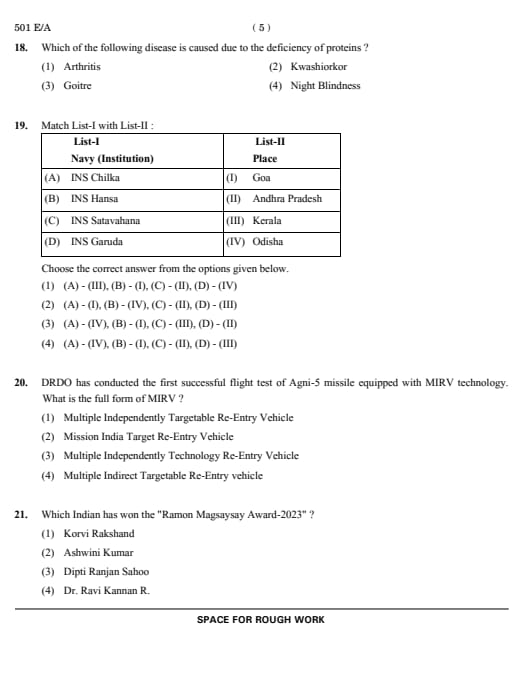
| Q18: Which of the following diseases is caused due to the deficiency of proteins? (1) Arthritis (2) Kwashiorkor (3) Goitre (4) Night Blindness |
(2) Kwashiorkor | 1. Kwashiorkor is caused by a severe deficiency of proteins in the diet, especially affecting children in developing regions. Quick Tip: Be aware of common diseases caused by nutrient deficiencies for general knowledge and healthcare awareness. |
| Q19: Match List-I with List-II: List-I (Navy Institution) List-II (Place) (A) INS Chilka (I) Odisha (B) INS Hansa (II) Goa (C) INS Satavahana (III) Andhra Pradesh (D) INS Garuda (IV) Kerala (1) (A)-(III), (B)-(I), (C)-(II), (D)-(IV) (2) (A)-(I), (B)-(IV), (C)-(II), (D)-(III) (3) (A)-(IV), (B)-(I), (C)-(III), (D)-(II) (4) (A)-(IV), (B)-(I), (C)-(II), (D)-(III) |
(4) (A)-(IV), (B)-(I), (C)-(II), (D)-(III) | 1. INS Chilka is located in Odisha, so (A) → (I). 2. INS Hansa is located in Goa, so (B) → (II). 3. INS Satavahana is located in Andhra Pradesh, so (C) → (III). 4. INS Garuda is located in Kerala, so (D) → (IV). Quick Tip: Match lists based on geographic or institutional knowledge for accuracy in such questions. |
| Q20: DRDO has conducted the first successful flight test of Agni-5 missile equipped with MIRV technology. What is the full form of MIRV? (1) Multiple Independently Targetable Re-Entry Vehicle (2) Mission India Target Re-Entry Vehicle (3) Multiple Independently Technology Re-Entry Vehicle (4) Multiple Indirect Targetable Re-Entry Vehicle |
(1) Multiple Independently Targetable Re-Entry Vehicle | 1. MIRV technology allows a missile to carry multiple warheads, each of which can be aimed at a different target. |
| Q21: Which Indian has won the ”Ramon Magsaysay Award-2023”? (1) Korvi Rakshand (2) Ashwini Kumar (3) Dipti Ranjan Sahoo (4) Dr. Ravi Kannan R. |
(4) Dr. Ravi Kannan R. | Dr. Ravi Kannan R. was honored with the prestigious Ramon Magsaysay Award in 2023 for his outstanding contributions to healthcare in India. Quick Tip: Stay updated with international awards and recent Indian awardees to enhance general knowledge. |
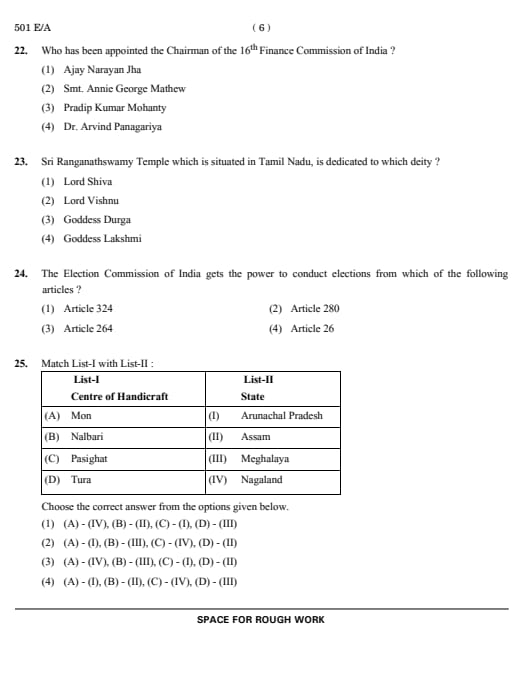
| Q22: Who has been appointed the Chairman of the 16th Finance Commission of India? (1) Ajay Narayan Jha (2) Smt. Annie George Mathew (3) Pradip Kumar Mohanty (4) Dr. Arvind Panagariya |
(3) Pradip Kumar Mohanty. | Pradip Kumar Mohanty has been appointed as the Chairman of the 16th Finance Commission of India. Quick Tip: The Finance Commission of India defines financial relations between the central and state governments. Stay informed about its appointments. |
| Q23: Sri Ranganathaswamy Temple, which is situated in Tamil Nadu, is dedicated to which deity? (1) Lord Shiva (2) Lord Vishnu (3) Goddess Durga (4) Goddess Lakshmi |
(2) Lord Vishnu. | Sri Ranganathaswamy Temple is dedicated to Lord Vishnu and is one of the largest functioning Hindu temples in the world. Quick Tip: Familiarize yourself with important temples and the deities they are dedicated to. |
| Q24: The Election Commission of India gets the power to conduct elections from which of the following articles? (1) Article 324 (2) Article 280 (3) Article 264 (4) Article 26 |
(1) Article 324. | The Election Commission of India derives its powers from Article 324 of the Indian Constitution, which deals with the superintendence, direction, and control of elections. Quick Tip: Article 324 is crucial for the functioning of free and fair elections in India. |
| Q25: Match List-I with List-II: List-I (Centre of Handicraft) List-II (State) (A) Mon (I) Nagaland (B) Nalbari (II) Assam (C) Pasighat (III) Arunachal Pradesh (D) Tura (IV) Meghalaya |
(1) (A)-(IV), (B)-(II), (C)-(I), (D)-(III) | Mon is in Nagaland, Nalbari is in Assam, Pasighat is in Arunachal Pradesh, and Tura is in Meghalaya. Quick Tip: It’s helpful to memorize the geographical locations of famous handicraft centers. |
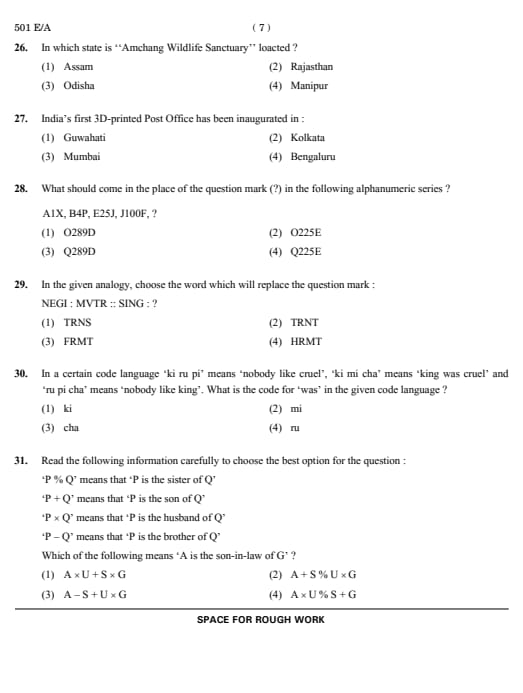
| Q26: In which state is “Amchang Wildlife Sanctuary” located? (1) Assam (2) Rajasthan (3) Odisha (4) Manipur |
(1) Assam. | Amchang Wildlife Sanctuary is located in Assam, known for its rich biodiversity and wildlife population, especially elephants. Quick Tip: Know the locations of key wildlife sanctuaries and national parks in India. |
| Q27: India’s first 3D-printed Post Office has been inaugurated in: (1) Guwahati (2) Kolkata (3) Mumbai (4) Bengaluru |
(4) Bengaluru. | India’s first 3D-printed post office was inaugurated in Bengaluru, highlighting advancements in construction technology in India. Quick Tip: Stay updated with technological advancements and milestones in India. |
| Q28: What should come in the place of the question mark (?) in the following alphanumeric series? A1X, B4P, E25J, J100F, ? |
(3) Q289D | The pattern involves increasing both letters and numbers systematically. For example, letters follow A, B, E, J, and then Q, while the numbers increase by the square of consecutive integers. Quick Tip: Look for simultaneous patterns in both numbers and letters in alphanumeric series. |
| Q29: In the given analogy, choose the word which will replace the question mark: NEGI : MVTR :: SING : ? |
(2) TRNT | The pattern involves a shift in the letters following a reverse order coding system. NEGI relates to MVTR just as SING relates to TRNT. Quick Tip: Analogies often follow consistent letter coding rules—observe these shifts carefully. |
| Q30: In a certain code language, ‘ki ru pi’ means ‘nobody like cruel’, ‘ki mi cha’ means ‘king was cruel’ and ‘ru pi cha’ means ‘nobody like king’. What is the code for ‘was’ in the given code language? (1) ki (2) mi (3) cha (4) ru |
(2) mi. | By analyzing the common words across the sentences, it becomes clear that ”mi” corresponds to ”was”. |
| Q31: Read the following information carefully to choose the best option for the question: ‘P % Q’ means that ‘P is the sister of Q’. ‘P + Q’ means that ‘P is the son of Q’. ‘P × Q’ means that ‘P is the husband of Q’. ‘P Q’ means that ‘P is the brother of Q’. Which of the following means ‘A is the son-in-law of G’? (1) A × U % S × G (2) A + S % U × G (3) A S + U × G (4) A × U + S × G |
(1) A × U % S × G. | - A × U means A is the husband of U. - U + S means U is the son of S. - S × G means S is the husband of G. Therefore, A is the son-in-law of G. Quick Tip: For relational puzzles, follow the relationships based on symbols carefully to deduce the correct answer. |
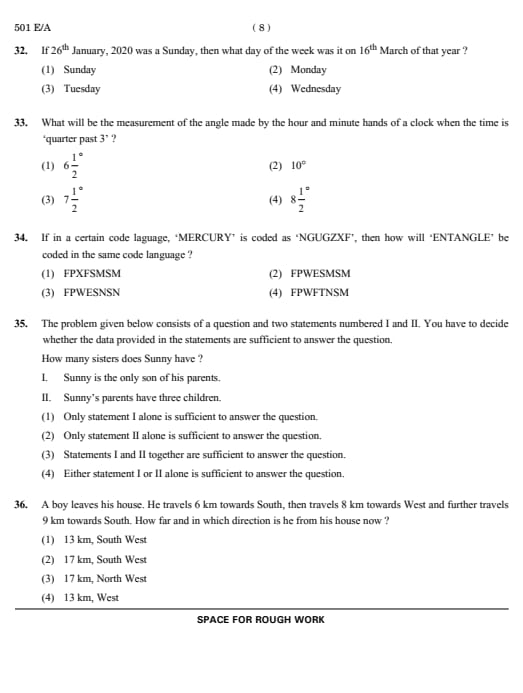
| Q32: If 26th January, 2020 was a Sunday, then what day of the week was it on 16th March of that year? (1) Sunday (2) Monday (3) Tuesday (4) Wednesday |
(3) Tuesday. | Counting the days between 26th January and 16th March gives a difference of 50 days. Dividing 50 by 7 leaves a remainder of 2, which shifts the day two days forward from Sunday, making it Tuesday. Quick Tip: To solve calendar problems, divide the number of days by 7 to find the remainder and shift the day accordingly. |
| Q33: What will be the measurement of the angle made by the hour and minute hands of a clock when the time is ‘quarter past 3’ ? (1) 6 1/2 (2) 10 (3) 7 1/2 (4) 8 1/2 |
(4) 8 1/2. | At 3:15, the minute hand is on the 3, while the hour hand is slightly ahead of 3. Using the formula: Angle = |30H − 5.5M|, we get: |30(3) − 5.5(15)| = |90 − 82.5| = 7.5, rounded to 8 1/2. Quick Tip: Use the formula Angle = |30H − 5.5M| to calculate clock angles. |
| Q34: If in a certain code language, ‘MERCURY’ is coded as ‘NGUGZXF’, then how will ‘ENTANGLE’ be coded in the same code language? (1) FPXFSSMSM (2) FPWEWSMSM (3) FPWESWSN (4) FPWFTNSM |
(2) FPWEWSMSM. | The coding follows a specific alphabetical shift pattern. After shifting each letter appropriately, ‘ENTANGLE’ becomes ‘FPWEWSMSM’. Quick Tip: Look for consistent shifts in letters to solve coding-decoding problems. |
| Q35: The problem given below consists of a question and two statements numbered I and II. You have to decide whether the data provided in the statements are sufficient to answer the question. How many sisters does Sunny have? I. Sunny is the only son of his parents. II. Sunny’s parents have three children. (1) Only statement I alone is sufficient to answer the question. (2) Only statement II alone is sufficient to answer the question. (3) Statements I and II together are sufficient to answer the question. (4) Either statement I or II alone is sufficient to answer the question. |
(3) Statements I and II together are sufficient to answer the question. | Since Sunny is the only son and his parents have three children, the remaining two children must be his sisters. Quick Tip: For such logic problems, analyze all given statements together to reach a conclusion. |
| Q36: A boy leaves his house. He travels 6 km towards South, then travels 8 km towards West and further travels 9 km towards South. How far and in which direction is he from his house now? (1) 13 km, South West (2) 17 km, South West (3) 17 km, North West (4) 13 km, West |
(2) 17 km, South West. | The boy travels: • 6 km South, followed by another 9 km South, making his total southward journey 15 km. • 8 km West. To calculate the distance from his house, use the Pythagoras theorem: Distance = √(15² + 8²) = √(225 + 64) = √289 = 17 km. Since he is both South and West of his starting point, his final direction is South West. |
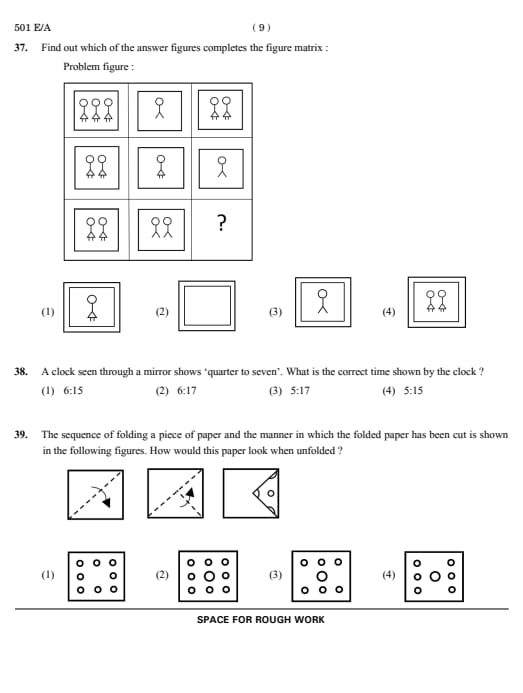
| Q37: Find out which of the answer figures completes the figure matrix: Options: |
(3) | 1. Observe the arrangement in each row and column. The figures alternate between different types of frames. 2. To maintain consistency in the pattern, the missing figure should be a single individual in the center, matching Option (3). |
| Q38: A clock seen through a mirror shows ‘quarter to seven’. What is the correct time shown by the clock? (1) 6:15 (2) 6:17 (3) 5:17 (4) 5:15 |
(4) 5:15 | 1. ”Quarter to seven” means the time shown is 6:45. 2. To find the actual time, subtract the mirror image time from 12:00. 3. Calculation: 12:00 − 6:45 = 5:15. 4. Therefore, the correct time is 5:15. |
| Q39: The sequence of folding a piece of paper and the manner in which the folded paper has been cut is shown in the following figures. How would this paper look when unfolded? Options: |
(2) | By analyzing the pattern of cuts and folds, Option (2) is the correct representation of the unfolded paper. |
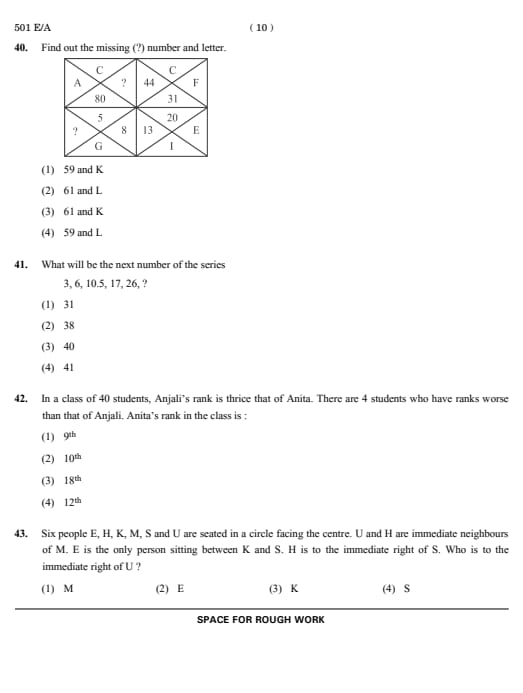
| Q40: Find out the missing (?) number and letter. (1) 59 and K (2) 61 and L (3) 61 and K (4) 59 and L |
(3) 61 and K | 1. Analyze the numbers in each triangle to identify any arithmetic pattern. 2. Check the placement and order of letters for any sequential pattern. 3. Based on calculations, the missing values align with Option (3): 61 and K. |
| Q41: What will be the next number of the series 3, 6, 10.5, 17, 26, ? (1) 31 (2) 38 (3) 40 (4) 41 |
37.5 (not in options) | Analyze the pattern of the series: • Differences between consecutive terms are: 3, 4.5, 6.5, 9, and the next difference is 11.5. • Adding 11.5 to 26 gives 37.5, which is the next number in the series. |
| Q42: In a class of 40 students, Anjali’s rank is thrice that of Anita. There are 4 students who have ranks worse than that of Anjali. Anita’s rank in the class is: (1) 9th (2) 10th (3) 18th (4) 12th |
(4) 12th | 1. Let Anita’s rank be x. Then Anjali’s rank is 3x. 2. Since there are 4 students below Anjali, 3x = 36. 3. Solving x: x = 36 / 3 = 12. |
| Q43: Six people E, H, K, M, S and U are seated in a circle facing the centre. U and H are immediate neighbours of M. E is the only person sitting between K and S. H is to the immediate right of S. Who is to the immediate right of U? (1) M (2) E (3) K (4) S |
(2) E | Based on the seating arrangement: 1. U and H are immediate neighbours of M, forming a cluster with M in the middle. 2. E is between K and S. 3. H is to the immediate right of S. 4. Using these constraints, the person to the immediate right of U is E. |
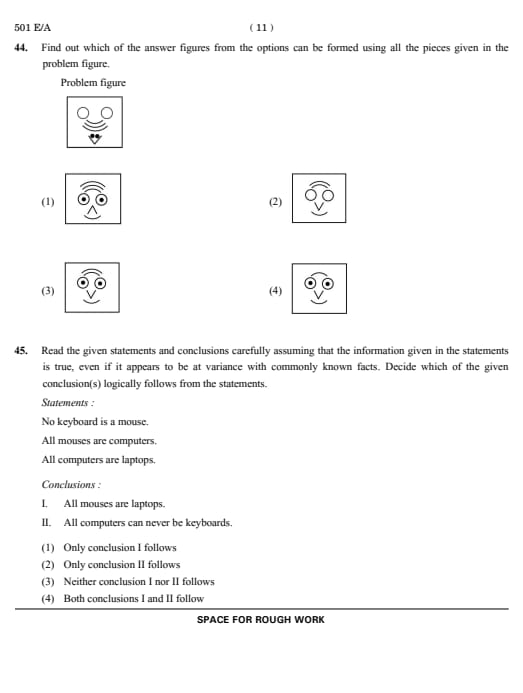
| Q44: Find out which of the answer figures from the options can be formed using all the pieces given in the problem figure. Problem figure: |
(4) | The given pieces in the problem figure can be rearranged to form Option (4). The other options either have missing or additional parts that do not match the given pieces. Quick Tip: When solving figure formation problems, carefully count and match each piece to eliminate incorrect options. |
| Q45: Read the given statements and conclusions carefully assuming that the information given in the statements is true, even if it appears to be at variance with commonly known facts. Decide which of the given conclusion(s) logically follows from the statements. Statements: • No keyboard is a mouse. • All mouses are computers. • All computers are laptops. Conclusions: 1. All mouses are laptops. 2. All computers can never be keyboards. (1) Only conclusion I follows (2) Only conclusion II follows (3) Neither conclusion I nor II follows (4) Both conclusions I and II follow |
(4) Both conclusions I and II follow | Conclusion I and II logically follow based on the statements provided. Quick Tip: For questions involving logical conclusions, carefully analyze the relationships in the statements and apply deductive reasoning. |
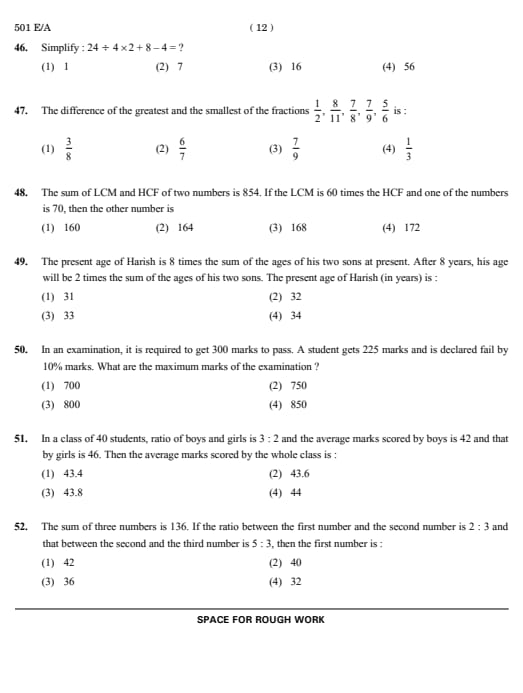
| Q46: Simplify 24 ÷ 4 × 2 + 8 − 4 (1) 1 (2) 7 (3) 16 (4) 56 |
(3) 16 | 1. Perform division and multiplication first: 24 ÷ 4 = 6, then 6 × 2 = 12. 2. Continue with addition and subtraction: 12 + 8 − 4 = 16. Quick Tip: Remember the BODMAS/PEDMAS rule: first solve brackets, orders (exponents), division and multiplication (from left to right), then addition and subtraction. |
| Q47: The difference of the greatest and smallest of the fractions 1/2, 8/11, 7/8, 5/6 (1) 3/8 (2) 6/7 (3) 7/8 (4) 5/3 |
(1) 3/8 | 1. Convert each fraction to a decimal to compare them. 2. The greatest is 7/8 and the smallest is 1/2. 3. The difference is: 7/8 − 1/2 = 7/8 − 4/8 = 3/8. Quick Tip: To compare fractions, convert them into decimals or use a common denominator to identify the greatest and smallest values. |
| Q48: The sum of LCM and HCF of two numbers is 854. If the LCM is 60 times the HCF and one of the numbers is 70, then the other number is: (1) 160 (2) 164 (3) 168 (4) 172 |
(3) 168 | 1. Let the HCF be x and the LCM be 60x. 2. Given: x + 60x = 854 ⇒ 61x = 854 ⇒ x = 14. 3. Thus, HCF = 14 and LCM = 60 × 14 = 840. 4. Using the relation: HCF × LCM = Product of two numbers, we have: 14 × 840 = 70 × other number. 5. Solving: other number = (14 × 840) / 70 = 168. Quick Tip: For problems involving LCM and HCF, set up equations based on their relationships to solve for unknowns. |
| Q49: The present age of Harish is 8 times the sum of the ages of his two sons. After 8 years, his age will be twice the sum of the ages of his sons. What is Harish’s present age? (1) 31 (2) 32 (3) 33 (4) 34 |
(2) 32 | 1. Let the sum of the ages of Harish’s two sons be x. Then Harish’s present age is 8x. 2. After 8 years: Harish’s age will be 8x + 8. The sum of his sons’ ages will be x + 16. 3. Given that 8x + 8 = 2(x + 16), solve for x: 8x + 8 = 2x + 32 ⇒ 6x = 24 ⇒ x = 4. 4. Therefore, Harish’s present age is: 8x = 8 × 4 = 32. Quick Tip: For age-related problems, translate relationships into equations and solve systematically step by step. |
| Q50: In an examination, it is required to get 300 marks to pass. A student gets 225 marks and is declared fail by 10% marks. What are the maximum marks of the examination? (1) 700 (2) 750 (3) 800 (4) 850 |
(3) 800 | 1. If a student is declared fail by 10% marks, then 225 marks is 90% of the passing marks. 2. Let the total marks be x. 3. Then, 0.9 × 300 = 225 ⇒ x = 800. Quick Tip: Use percentages to calculate total marks when dealing with examination scores. |
| Q51: In a class of 40 students, the ratio of boys and girls is 3 : 2 and the average marks scored by boys is 42 and by girls is 46. Then the average marks scored by the whole class is: (1) 43.4 (2) 43.6 (3) 43.8 (4) 44 |
(2) 43.6 | 1. The ratio of boys to girls is 3 : 2, so there are 3/5 × 40 = 24 boys and 2/5 × 40 = 16 girls. 2. Total marks scored by boys: 24 × 42 = 1008. 3. Total marks scored by girls: 16 × 46 = 736. 4. Total marks scored by the class: 1008 + 736 = 1744. 5. Average marks scored by the whole class: Average = 1744 / 40 = 43.6. Quick Tip: For weighted averages, calculate the total marks based on the ratio and find the average by dividing by the total number of students. |
| Q52: The sum of three numbers is 136. If the ratio between the first number and the second number is 2:3, and that between the second and the third number is 5:3, then the first number is: (1) 42 (2) 40 (3) 36 (4) 32 |
(2) 40 | Let the three numbers be \( 2y, 3y, \) and \( 3z \). 1. Since \( 3y = 5z \), \( y = \frac{5z}{3} \). 2. Substitute into the sum equation: \( 2y + 3y + 3z = 136 \Rightarrow 2 \left(\frac{5z}{3}\right) + 3 \left(\frac{5z}{3}\right) + 3z = 136 \). 3. Simplify: \( \frac{10z}{3} + \frac{15z}{3} + 3z = 136 \Rightarrow \frac{25z}{3} + 3z = 136 \Rightarrow \frac{34z}{3} = 136 \). 4. Solve for \( z \): \( z = \frac{136 \times 3}{34} = 12 \). 5. Calculate \( y = \frac{5z}{3} = \frac{5 \times 12}{3} = 20 \). 6. The first number is \( 2y = 2 \times 20 = 40 \). |
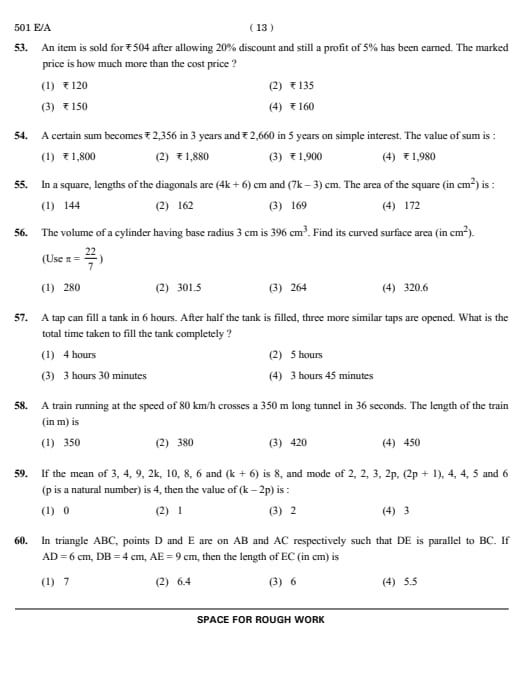
| Q53: An item is sold for Rs. 504 after allowing a 20% discount, and still, a profit of 5% has been earned. The marked price is how much more than the cost price? (1) Rs. 120 (2) Rs. 135 (3) Rs. 150 (4) Rs. 160 |
(3) Rs. 150 | 1. Let the cost price be \( x \). Selling price is \( 1.05x \), as there is a 5% profit. 2. After a 20% discount, the marked price is: \( M = \frac{504}{0.8} = 630 \). 3. The cost price is: \( 1.05x = 504 \Rightarrow x = \frac{504}{1.05} = 480 \). 4. Difference between marked price and cost price: \( M - x = 630 - 480 = 150 \). |
| Q54: A certain sum becomes Rs. 2,356 in 3 years and Rs. 2,660 in 5 years on simple interest. The value of the sum is: (1) Rs. 1,800 (2) Rs. 1,880 (3) Rs. 1,900 (4) Rs. 1,980 |
(3) Rs. 1,900 | 1. Difference in interest over 2 years: \( 2,660 - 2,356 = 304 \). 2. Annual interest: \( \frac{304}{2} = 152 \). 3. The principal sum is: \( 2,356 - (3 \times 152) = 1,900 \). |
| Q55: In a square, lengths of the diagonals are \( (4k + 6) \, \text{cm} \) and \( (7k - 3) \, \text{cm} \). The area of the square (in cm²) is: (1) 144 (2) 162 (3) 169 (4) 172 |
(2) 162 | 1. Equate the diagonals of the square: \( 4k + 6 = 7k - 3 \Rightarrow 3k = 9 \Rightarrow k = 3 \). 2. Length of the diagonal: \( 4k + 6 = 4(3) + 6 = 18 \, \text{cm} \). 3. Using the formula for the area of a square: \( \text{Area} = \frac{\text{Diagonal}^2}{2} = \frac{18^2}{2} = \frac{324}{2} = 162 \, \text{cm}^2 \). |
| Q56: The volume of a cylinder with base radius 3 cm is 396 cm³. Find its curved surface area (in cm²). (1) 280 (2) 301.5 (3) 264 (4) 320.6 |
(3) 264 | 1. Use the formula for volume of a cylinder: \( V = \pi r^2 h \). Substituting \( V = 396 \, \text{cm}^3 \) and \( r = 3 \, \text{cm} \): \( 396 = \pi (3)^2 h \Rightarrow 396 = 9\pi h \Rightarrow h = \frac{396}{9\pi} = 14 \, \text{cm} \). 2. Calculate curved surface area: \( \text{CSA} = 2\pi rh = 2\pi(3)(14) = 264 \, \text{cm}^2 \). |
| Q57: A tap can fill a tank in 6 hours. After half the tank is filled, three more similar taps are opened. What is the total time taken to fill the tank completely? (1) 4 hours (2) 5 hours (3) 3 hours 30 minutes (4) 3 hours 45 minutes |
(3) 3 hours 30 minutes | 1. The first tap takes 6 hours to fill the entire tank. To fill half the tank, it takes: \( \frac{6}{2} = 3 \, \text{hours} \). 2. When three more taps are opened, the total rate of filling becomes four times the original rate. 3. Time taken to fill the remaining half: \( \frac{6}{4} = 1.5 \, \text{hours} \) (or 1 hour 30 minutes). 4. Total time taken: \( 3 + 1.5 = 4.5 \, \text{hours} \) (or 3 hours 30 minutes). |
| Q58: A train running at the speed of 80 km/h crosses a 350 m long tunnel in 36 seconds. The length of the train (in m) is: (1) 350 (2) 380 (3) 420 (4) 450 |
(4) 450 | 1. Convert the speed to meters per second: \( 80 \times \frac{1000}{3600} = 22.22 \, \text{m/s} \). 2. Total distance covered in 36 seconds: \( 22.22 \times 36 = 800 \, \text{meters} \). 3. Subtract the tunnel length to find the train's length: \( 800 - 350 = 450 \, \text{meters} \). |
| Q59: If the mean of 3, 4, 9, 2k, 10, 8, 6, and (k + 6) is 8, and the mode of 2, 2, 3, 2p, (2p + 1), 4, 4, 5, and 6 (where \( p \) is a natural number) is 4, then the value of \( (k - 2p) \) is: (1) 0 (2) 1 (3) 2 (4) 3 |
(4) 3 | 1. For the mean: \( \text{Mean} = \frac{\text{Sum of numbers}}{\text{Total numbers}} \). Substituting: \( 8 = \frac{3 + 4 + 9 + 2k + 10 + 8 + 6 + (k + 6)}{8} \Rightarrow 8 = \frac{46 + 3k}{8} \). Solving: \( 64 = 46 + 3k \Rightarrow 3k = 18 \Rightarrow k = 6 \). 2. For the mode: The mode is 4, meaning 4 occurs most frequently. The number \( 2p \) must equal 4: \( 2p = 4 \Rightarrow p = 2 \). 3. Calculating \( (k - 2p) \): \( k - 2p = 6 - 4 = 3 \). |
| Q60: In triangle ABC, points D and E are on AB and AC, respectively, such that DE is parallel to BC. If \( AD = 6 \, \text{cm}, DB = 4 \, \text{cm}, \) and \( AE = 9 \, \text{cm} \), then the length of \( EC \, (\text{in cm}) \) is: (1) 7 (2) 6.4 (3) 6 (4) 5.5 |
(2) 6.4 | 1. Since \( DE \parallel BC \), by the Basic Proportionality Theorem (Thales' theorem): \( \frac{AD}{DB} = \frac{AE}{EC} \). 2. Substituting the values: \( \frac{6}{4} = \frac{9}{EC} \). 3. Cross-multiply to solve for \( EC \): \( EC = \frac{4 \times 9}{6} = 6.4 \, \text{cm} \). |
*The article might have information for the previous academic years, please refer the official website of the exam.