
CUET Geography Question Paper 2024 SET C Download Solutions and Answer Key


Content Writer | Updated On - Dec 9, 2024
CUET Question Papers are the most important study material for effective exam preparation. We at Zollege have provided all CUET Previous Year Papers with Solution PDFs here. CUET 2024 Geography was conducted successfully on May 17 by NTA.
Students can freely download the CUET previous year's question paper PDFs along with their solutions here. We strongly encourage cuet aspirants to scan through all the CUET Question Paper to know the overall difficulty level, CUET Syllabus and understand the changes in CUET Exam Pattern over the years.
CUET 2024 Geography Question Paper (SET C) with Answer Key PDF
| CUET 2024 Geography Question Paper with Answer Key SET C |  Download Download |
Check Solution |
|---|
CUET 2024 Geography Question Paper with Solution
| Question | Correct Answer | Solution |
|---|---|---|
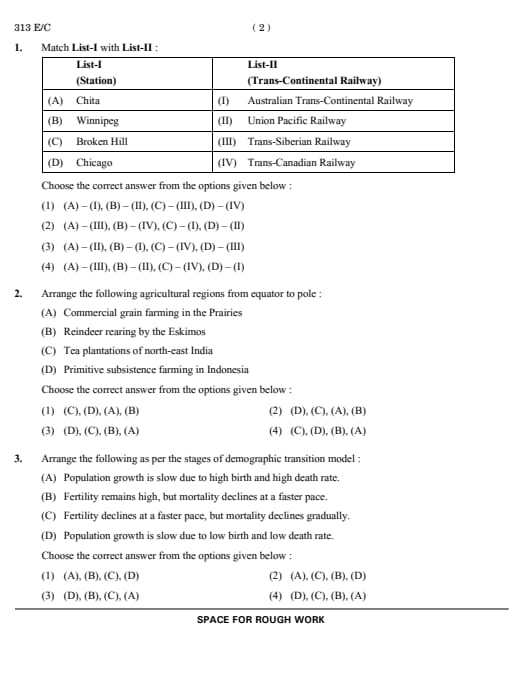
| Q1: Match List-I with List-II: Choose the correct answer from the options given below: (1) (A) - (I), (B) - (II), (C) - (III), (D) - (IV) (2) (A) - (III), (B) - (IV), (C) - (I), (D) - (II) (3) (A) - (II), (B) - (I), (C) - (IV), (D) - (III) (4) (A) - (III), (B) - (II), (C) - (IV), (D) - (I) |
(2) (A) - (III), (B) - (IV), (C) - (I), (D) - (II) | Chita corresponds to the Trans-Siberian Railway, Winnipeg to the Trans-Canadian Railway, Broken Hill to the Australian Trans-Continental Railway, and Chicago to the Union Pacific Railway. Each station is associated with its corresponding railway based on location and transport routes. |
| Q2: Arrange the following agricultural regions from equator to pole: (A) Commercial grain farming in the Prairies (B) Reindeer rearing by the Eskimos (C) Tea plantations of north-east India (D) Primitive subsistence farming in Indonesia Choose the correct answer from the options given below: (1) (C), (D), (A), (B) (2) (D), (C), (A), (B) (3) (D), (C), (B), (A) (4) (C), (D), (B), (A) |
(2) (D), (C), (A), (B) | Starting from the equator, Primitive subsistence farming in Indonesia is the closest, followed by Tea plantations of north-east India, Commercial grain farming in the Prairies, and finally Reindeer rearing by the Eskimos near the poles. |
| Q3: Arrange the following as per the stages of the demographic transition model: (A) Population growth is slow due to high birth and high death rate. (B) Fertility remains high, but mortality declines at a faster pace. (C) Fertility declines at a faster pace, but mortality declines gradually. (D) Population growth is slow due to low birth and low death rate. Choose the correct answer from the options given below: (1) (A), (B), (C), (D) (2) (A), (C), (B), (D) (3) (D), (B), (C), (A) (4) (D), (C), (B), (A) |
(1) (A), (B), (C), (D) | The demographic transition model describes the following stages: - Stage 1: High birth and high death rates lead to slow population growth. - Stage 2: Mortality begins to decline faster than fertility, causing population growth to increase. - Stage 3: Fertility declines rapidly, while mortality decreases gradually, slowing population growth. - Stage 4: Both birth and death rates are low, resulting in stable or slow population growth. |
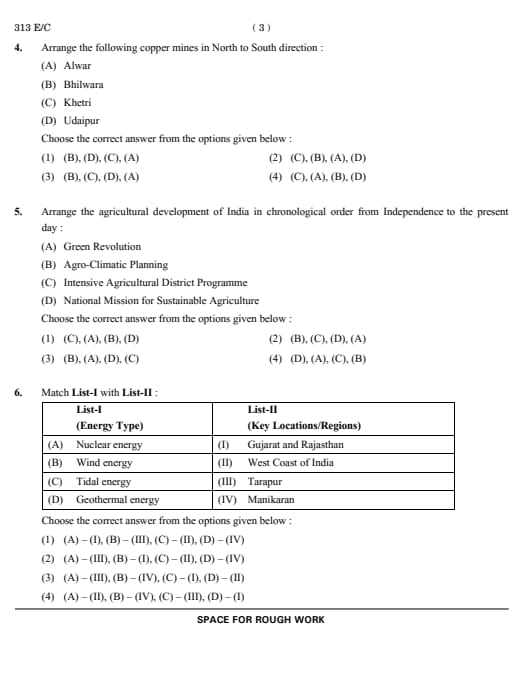
| Q4: Arrange the following copper mines in North to South direction: (A) Alwar (B) Bhilwara (C) Khetri (D) Udaipur |
(C), (B), (A), (D) | The correct order is Khetri in the north, followed by Bhilwara, Alwar, and Udaipur in the south. This sequence is based on their geographic locations. |
| Q5: Arrange the agricultural development of India in chronological order: (A) Green Revolution (B) Agro-Climatic Planning (C) Intensive Agricultural District Programme (D) National Mission for Sustainable Agriculture Choose the correct answer from the options given below: (1) (C), (A), (B), (D) (2) (B), (C), (D), (A) (3) (B), (A), (D), (C) (4) (D), (A), (C), (B) |
(3) (B), (A), (D), (C) | The chronological sequence is: 1. Agro-Climatic Planning 2. Green Revolution 3. National Mission for Sustainable Agriculture 4. Intensive Agricultural District Programme |
| Q6: Match List-I with List-II: Choose the correct answer from the options given below: (1) (A) - (I), (B) - (III), (C) - (II), (D) - (IV) (2) (A) - (III), (B) - (I), (C) - (II), (D) - (IV) (3) (A) - (III), (B) - (IV), (C) - (I), (D) - (II) (4) (A) - (II), (B) - (IV), (C) - (III), (D) - (I) |
(2) (A) - (III), (B) - (I), (C) - (II), (D) - (IV) | Nuclear energy is concentrated in Tarapur, wind energy in Gujarat and Rajasthan, tidal energy along the West Coast, and geothermal energy near Manikaran. |
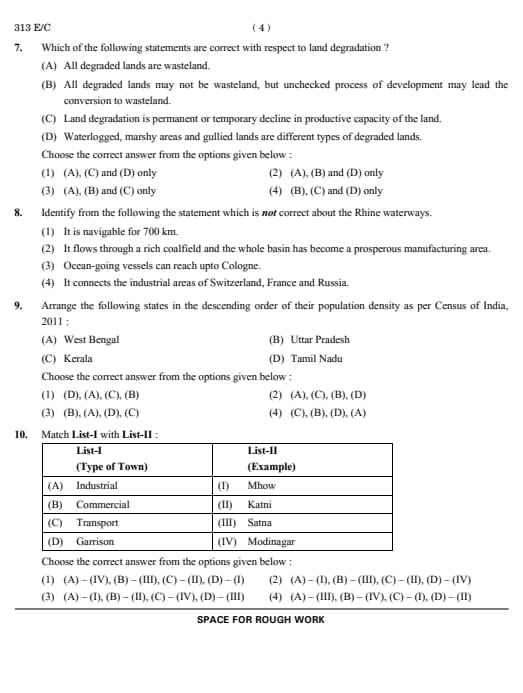
| Q7: Which of the following statements are correct with respect to land degradation? (A) All degraded lands are wasteland. (B) All degraded lands may not be wasteland, but unchecked development processes may lead to conversion into wasteland. (C) Land degradation is a permanent or temporary decline in productive capacity of the land. (D) Waterlogged, marshy areas, and gullied lands are different types of degraded lands. Choose the correct answer from the options given below: (1) (A), (C) and (D) only (2) (A), (B) and (D) only (3) (A), (B) and (C) only (4) (B), (C) and (D) only |
(4) (B), (C), and (D) only | Statement (A) is incorrect as not all degraded lands are wastelands. Statements (B), (C), and (D) correctly explain the characteristics and effects of land degradation. |
| Q8: Identify from the following the statement which is not correct about the Rhine waterways: 1. It is navigable for 700 km. 2. It flows through a rich coalfield, and the whole basin has become a prosperous manufacturing area. 3. Ocean-going vessels can reach up to Cologne. 4. It connects the industrial areas of Switzerland, France, and Russia. |
(4) It connects the industrial areas of Switzerland, France, and Russia. | The Rhine connects industrial areas of Switzerland, France, and Germany, not Russia. |
| Q9: Arrange the following states in descending order of their population density as per Census of India, 2011: (A) West Bengal (B) Uttar Pradesh (C) Kerala (D) Tamil Nadu Choose the correct answer from the options given below: (1) (D), (A), (C), (B) (2) (A), (C), (B), (D) (3) (B), (A), (D), (C) (4) (C), (B), (D), (A) |
(2) (A), (C), (B), (D) | Population density in descending order is: - West Bengal (A) - Kerala (C) - Uttar Pradesh (B) - Tamil Nadu (D) |
| Q10: Match List-I with List-II: List-I (Type of Town) List-II (Example) (A) Industrial (I) Mhow (B) Commercial (II) Katni (C) Transport (III) Modinagar (D) Garrison (IV) Satna Choose the correct answer from the options given below: (1) (A)-(IV), (B)-(III), (C)-(II), (D)-(I) (2) (A)-(I), (B)-(III), (C)-(II), (D)-(IV) (3) (A)-(I), (B)-(II), (C)-(IV), (D)-(III) (4) (A)-(III), (B)-(IV), (C)-(I), (D)-(II) |
(3) (A)-(I), (B)-(II), (C)-(IV), (D)-(III) | Mhow (Industrial), Katni (Commercial), Modinagar (Transport), Satna (Garrison). |
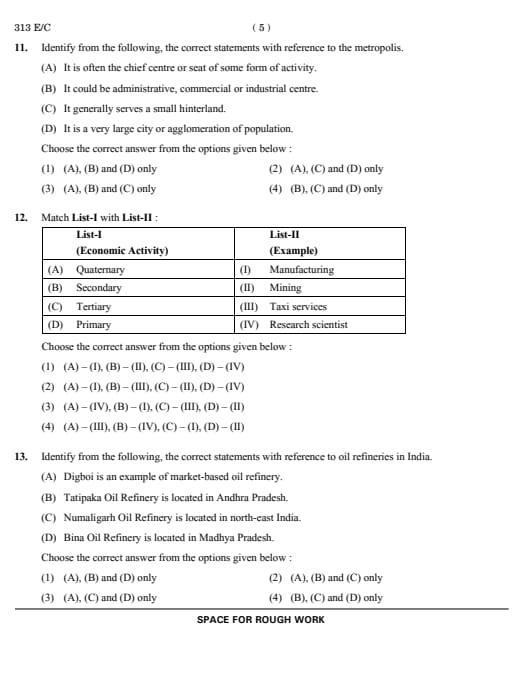
| Q11: Identify from the following, the correct statements with reference to the metropolis. 1. It is often the chief centre or seat of some form of activity. 2. It could be administrative, commercial or industrial centre. 3. It generally serves a small hinterland. 4. It is a very large city or agglomeration of population. Choose the correct answer from the options given below: (1) (A), (B), and (D) only (2) (A), (B), and (C) only (3) (A), (C), and (D) only (4) (B), (C), and (D) only |
(1) (A), (B), and (D) only | Metropolises are large cities or urban agglomerations that serve as key centres of administrative, commercial, or industrial activity. Statement (C) is incorrect as metropolises serve large hinterlands. |
| Q12: Match List-I with List-II: Choose the correct answer from the options given below: (1) (A) - (I), (B) - (II), (C) - (III), (D) - (IV) (2) (A) - (I), (B) - (III), (C) - (II), (D) - (IV) (3) (A) - (IV), (B) - (I), (C) - (III), (D) - (II) (4) (A) - (III), (B) - (IV), (C) - (I), (D) - (II) |
(3) (A) - (IV), (B) - (I), (C) - (III), (D) - (II) | The correct matches are: (A) Quaternary: Research scientist (IV) (B) Secondary: Manufacturing (I) (C) Tertiary: Taxi services (III) (D) Primary: Mining (II) |
| Q13: Identify from the following, the correct statements with reference to oil refineries in India: (A) Digboi is an example of market-based oil refinery. (B) Tatipaka Oil Refinery is located in Andhra Pradesh. (C) Numaligarh Oil Refinery is located in northeast India. (D) Bina Oil Refinery is located in Madhya Pradesh. Choose the correct answer from the options given below: (1) (A), (B), and (D) only (2) (A), (B), and (C) only (3) (A), (C), and (D) only (4) (B), (C), and (D) only |
(3) (A), (C), and (D) only | Digboi, located in Assam, is a market-based oil refinery. Numaligarh Refinery is situated in Assam, northeast India. Bina Refinery is in Madhya Pradesh. Tatipaka Refinery is incorrectly placed as a market-based refinery. |
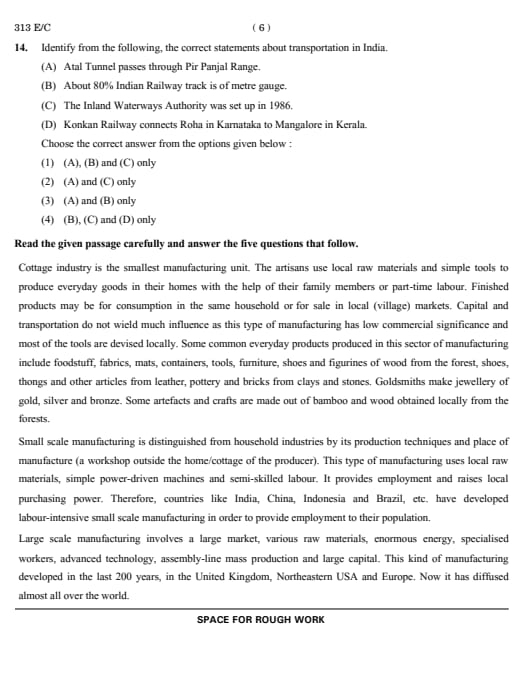
| Q14: Identify from the following, the correct statements about transportation in India: (A) Atal Tunnel passes through Pir Panjal Range. (B) About 80% of the railway network is broad gauge. (C) The Inland Waterways Authority was set up in 1986. (D) Konkan Railway connects Roha in Karnataka to Mangalore in Kerala. Choose the correct answer from the options given below: (1) (A), (B), and (C) only (2) (A) and (C) only (3) (A) and (B) only (4) (B), (C), and (D) only |
(2) (A) and (C) only | Atal Tunnel passes through the Pir Panjal Range. The Inland Waterways Authority was established in 1986. Statements (B) and (D) are incorrect as the railway network is mostly broad gauge, and Roha is in Maharashtra, not Karnataka. |
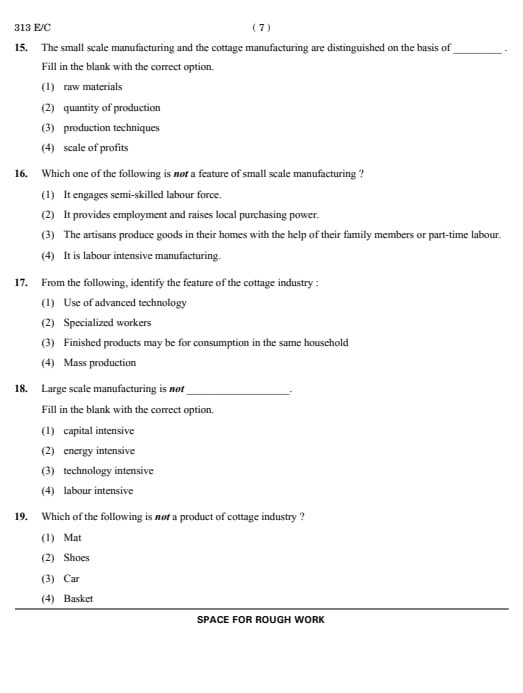
| Q15: The small-scale manufacturing and the cottage manufacturing are distinguished on the basis of: 1. Raw materials 2. Quantity of production 3. Production techniques 4. Scale of profits Correct Answer: (3) Solution: Cottage industries use traditional home-based methods, while small-scale manufacturing involves workshops with power-driven machines. |
(3) | Differentiating industry types is critical for classification questions. |
| Q16: Which one of the following is not a feature of small-scale manufacturing? 1. It engages semi-skilled labour force. 2. It provides employment and raises local purchasing power. 3. The artisans produce goods in their homes with the help of family members. 4. It is labour-intensive manufacturing. Correct Answer: (3) Solution: Small-scale manufacturing is workshop-based, while cottage industries are home-based. |
(3) | Industry features depend on production setup and workforce. |
| Q17: From the following, identify the feature of the cottage industry: 1. Use of advanced technology 2. Specialized workers 3. Finished products may be for consumption in the same household 4. Mass production Correct Answer: (3) Solution: Cottage industries are characterized by traditional, small-scale production for local use. |
(3) | Look for key indicators like traditional methods and local consumption. |
| Q18: Large-scale manufacturing is not: 1. Capital-intensive 2. Energy-intensive 3. Technology-intensive 4. Labour-intensive Correct Answer: (4) Labour-intensive Solution: Large-scale manufacturing relies on automation and efficiency rather than manual labour. |
(4) | Large-scale setups prioritize technology over labour. |
| Q19: Which of the following is not a product of the cottage industry? (1) Mat (2) Shoes (3) Car (4) Basket Correct Answer: (3) Car Solution: Cottage industries specialize in producing small, simple goods like mats and baskets. Manufacturing complex products like cars requires advanced technology and large-scale setups. |
(3) | Cottage industries produce everyday items using traditional methods, not sophisticated manufactured goods. |
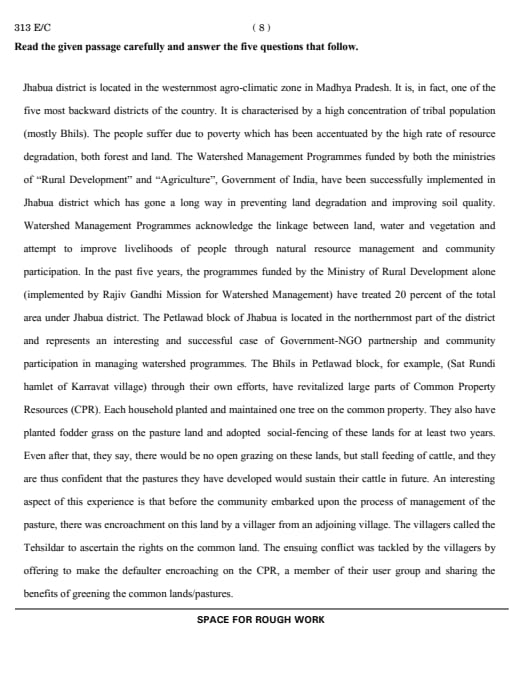
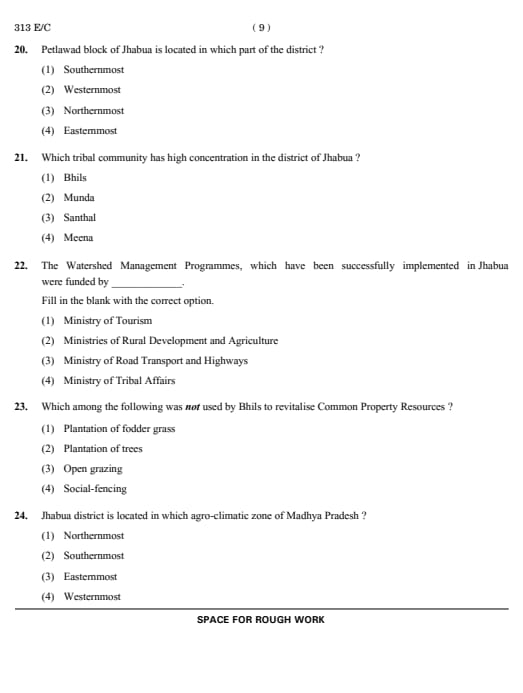
| Q20: Petlawad block of Jhabua is located in which part of the district? (1) Southernmost (2) Westernmost (3) Northernmost (4) Easternmost Correct Answer: (3) Northernmost Solution: The passage states that the Petlawad block is located in the northernmost part of Jhabua district, Madhya Pradesh. |
(3) | The Petlawad block is located in the northernmost part of Jhabua district. |
| Q21: Which tribal community has a high concentration in the district of Jhabua? (1) Bhils (2) Munda (3) Santhal (4) Meena |
(1) Bhils | The Bhils are the dominant tribal community in Jhabua district as per the passage provided. |
| Q22: The Watershed Management Programmes, which have been successfully implemented in Jhabua, were funded by: (1) Ministry of Tourism (2) Ministries of Rural Development and Agriculture (3) Ministry of Road Transport and Highways (4) Ministry of Tribal Affairs |
(2) Ministries of Rural Development and Agriculture | The Watershed Management Programmes in Jhabua were funded by the Ministries of Rural Development and Agriculture, focusing on improving soil quality and preventing degradation. |
| Q23: Which among the following was not used by Bhils to revitalize Common Property Resources? (1) Plantation of fodder grass (2) Plantation of trees (3) Open grazing (4) Social fencing |
(3) Open grazing | The Bhils adopted stall feeding instead of open grazing to preserve pastures and ensure sustainability, as highlighted in the passage. |
| Q24: Jhabua district is located in which agro-climatic zone of Madhya Pradesh? (1) Northernmost (2) Southernmost (3) Easternmost (4) Westernmost |
(4) Westernmost | Jhabua is situated in the westernmost agro-climatic zone of Madhya Pradesh, as clearly mentioned in the passage. |
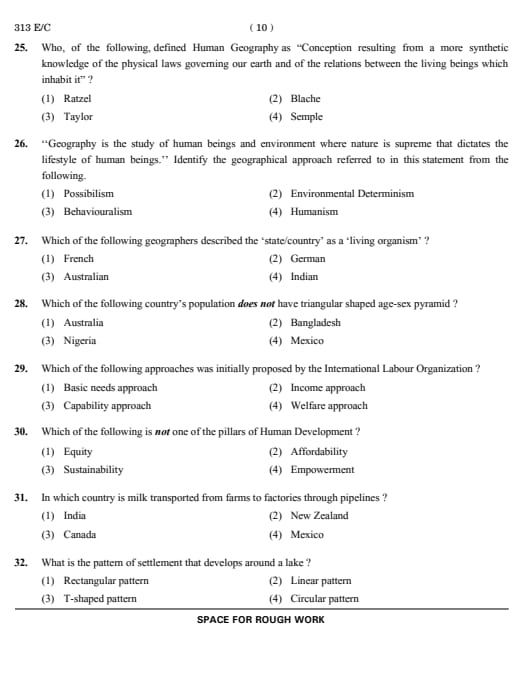
| Q25: Who, among the following, defined Human Geography as “Conception resulting from a more synthetic knowledge of the physical laws governing our earth and of the relations between the living beings which inhabit it”? (1) Ratzel (2) Blache (3) Taylor (4) Semple |
(1) Ratzel | Friedrich Ratzel, a German geographer, is recognized for defining Human Geography through a focus on the interconnectedness between the physical and human aspects of Earth. |
| Q26: “Geography is the study of human beings and environment where nature is supreme that dictates the lifestyle of human beings.” Identify the geographical approach referred to in this statement. (1) Possibilism (2) Environmental Determinism (3) Behaviouralism (4) Humanism |
(2) Environmental Determinism | Environmental Determinism emphasizes the influence of natural factors in shaping human behavior and societal development. This perspective suggests that humans adapt their lifestyles primarily in response to the environment’s constraints. |
| Q27: Which of the following geographers described the ‘state/country’ as a ‘living organism’? (1) French (2) German (3) Australian (4) Indian |
(2) German | This concept, known as the “organic theory,” was introduced by German geographers, particularly Friedrich Ratzel, who viewed the state as a living entity that requires space and resources to grow. |
| Q28: Which of the following country’s population does not have a triangular-shaped age-sex pyramid? (1) Australia (2) Bangladesh (3) Nigeria (4) Mexico |
(1) Australia | Australia’s age-sex pyramid reflects a more stable or aging population, unlike developing countries like Bangladesh or Nigeria, which exhibit triangular pyramids typical of high birth rates and younger populations. |
| Q29: Which of the following approaches was initially proposed by the International Labour Organization? (1) Basic needs approach (2) Income approach (3) Capability approach (4) Welfare approach |
(1) Basic needs approach | The Basic Needs Approach was proposed by the International Labour Organization (ILO) to emphasize the provision of basic services and goods necessary for human well-being, such as food, shelter, education, and healthcare. |
| Q30: Which of the following is not one of the pillars of Human Development? (1) Equity (2) Affordability (3) Sustainability (4) Empowerment |
(2) Affordability | Human Development focuses on equity, sustainability, and empowerment, but affordability is not considered one of its main pillars. |
| Q31: In which country is milk transported from farms to factories through pipelines? (A) India (B) New Zealand (C) Canada (D) Mexico |
(C) Canada | In Canada, pipelines are used in specific regions to transport milk directly from farms to factories, an innovative practice to enhance efficiency in the dairy industry. |
| Q32: What is the pattern of settlement that develops around a lake? (A) Rectangular pattern (B) Linear pattern (C) T-shaped pattern (D) Circular pattern |
(D) Circular pattern | Circular settlements are common around lakes as they offer access to water from all directions, making it convenient for communities. |
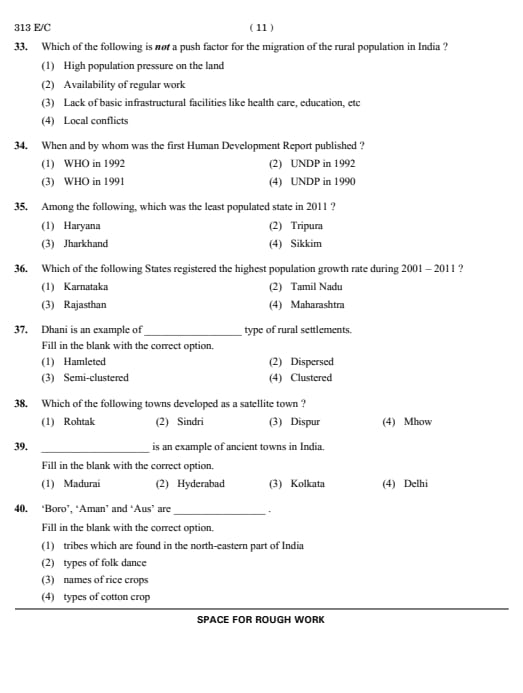
| Q33: Which of the following is not a push factor for rural migration in India? (A) High population pressure on the land (B) Availability of regular work (C) Lack of basic infrastructural facilities like health care, education, etc. (D) Local conflicts |
(B) Availability of regular work | Availability of regular work is a pull factor, not a push factor, as it attracts people to urban areas for stable employment opportunities. |
| Q34: When and by whom was the first Human Development Report published? (A) WHO in 1992 (B) UNDP in 1992 (C) WHO in 1991 (D) UNDP in 1990 |
(D) UNDP in 1990 | The first Human Development Report was published by the UNDP in 1990, introducing the Human Development Index (HDI) to focus on human well-being and development. |
| Q35: Among the following, which was the least populated state in Census 2011? (A) Haryana (B) Tripura (C) Jharkhand (D) Sikkim |
(D) Sikkim | Sikkim had the smallest population among the listed states as per the 2011 Census. This is due to its small geographic area and low population density compared to other states. |
| Q36: Which of the following states registered the highest population growth during 2001–2011? (A) Karnataka (B) Tamil Nadu (C) Rajasthan (D) Maharashtra |
(C) Rajasthan | Rajasthan recorded the highest population growth rate during the 2001–2011 period due to rapid urbanization and natural population increase. |
| Q37: Dhani is an example of which type of rural settlement? (A) Hamleted (B) Dispersed (C) Semi-clustered (D) Clustered |
(B) Dispersed | Dhani settlements are found in arid regions like Rajasthan. Homes are widely scattered due to water scarcity and land constraints, making them an example of dispersed settlements. |
| Q38: Which of the following towns developed as a satellite town? (A) Rohtak (B) Sindri (C) Dispur (D) Mhow |
(D) Mhow | Mhow developed as a satellite town to support the urban center of Indore. It provides resources and housing to ease the burden on the main city. |
| Q39: Which of the following is an example of an ancient Indian town? (A) Madurai (B) Hyderabad (C) Kolkata (D) Delhi |
(A) Madurai | Madurai, known for its ancient temples and cultural heritage, is one of the oldest towns in India with a history that dates back thousands of years. |
| Q40: ‘Boro’, ‘Aman’, and ‘Aus’ are: (A) Tribes found in the north-eastern part of India (B) Types of folk dance (C) Names of rice crops (D) Types of cotton crop |
(C) Names of rice crops | ‘Boro’, ‘Aman’, and ‘Aus’ are rice varieties grown in different seasons, particularly in eastern India and Bangladesh. |
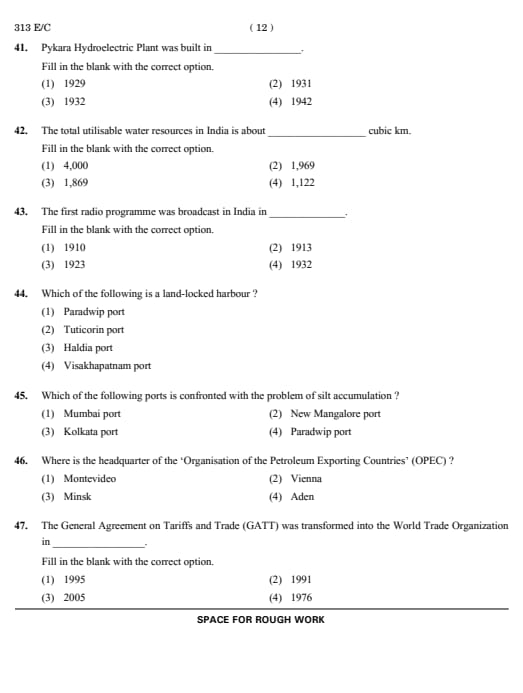
| Q41: Pykara Hydroelectric Plant was built in: (A) 1929 (B) 1931 (C) 1932 (D) 1942 |
(B) 1931 | The Pykara Hydroelectric Plant in Tamil Nadu is one of India’s earliest hydroelectric projects, commissioned in 1931. |
| Q42: The total utilisable water resources in India is about: (A) 4,000 cubic km (B) 1,969 cubic km (C) 1,869 cubic km (D) 1,122 cubic km |
(B) 1,969 cubic km | India’s utilisable water resources are estimated at 1,969 cubic kilometers, combining surface and groundwater availability. |
| Q43: The first radio programme was broadcast in India in: (A) 1910 (B) 1913 (C) 1923 (D) 1932 |
(C) 1923 | The first radio programme in India was broadcast in 1923 by the Radio Club of Bombay, marking the start of radio communication. |
| Q44: Which of the following is a land-locked harbour? (A) Paradip port (B) Tuticorin port (C) Haldia port (D) Visakhapatnam port |
(C) Haldia port | Haldia port is a riverine port located inland and relies on river routes, making it land-locked compared to coastal ports. |
| Q45: Which of the following ports is confronted with the problem of silt accumulation? (A) Mumbai port (B) New Mangalore port (C) Kolkata port (D) Paradip port |
(C) Kolkata port | Kolkata port faces silt accumulation due to its location on the Hooghly River, requiring regular dredging to maintain navigability. |
| Q46: Where is the headquarters of the Organisation of the Petroleum Exporting Countries (OPEC)? (A) Montevideo (B) Vienna (C) Minsk (D) Aden |
(B) Vienna | The headquarters of OPEC has been located in Vienna, Austria, since 1965, making it a central hub for global petroleum discussions. |
| Q47: The General Agreement on Tariffs and Trade (GATT) was transformed into the World Trade Organization in: (A) 1995 (B) 1991 (C) 2005 (D) 1976 |
(A) 1995 | The World Trade Organization (WTO) replaced GATT in 1995 after the Uruguay Round of trade negotiations. |
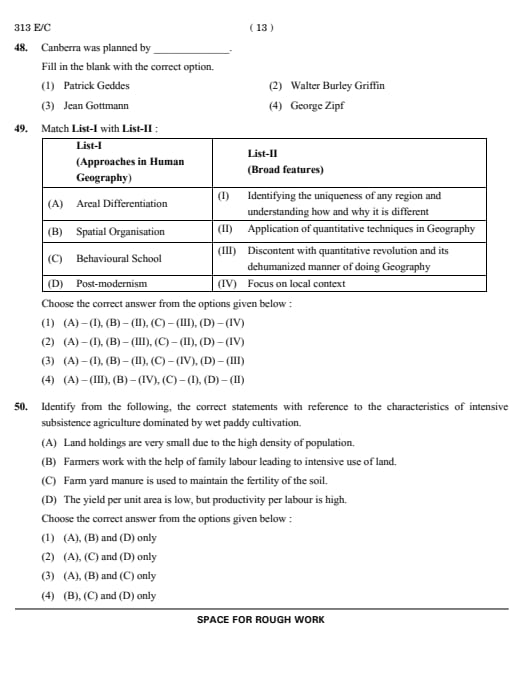
| Q48: Canberra was planned by: (A) Patrick Geddes (B) Walter Burley Griffin (C) Jean Gottmann (D) George Zipf |
(B) Walter Burley Griffin | The Australian capital city, Canberra, was designed by American architect Walter Burley Griffin in 1912 after winning an international competition. |
| Q49: Match List-I with List-II: Choose the correct answer from the options given below: (1) (A) - (I), (B) - (II), (C) - (III), (D) - (IV) (2) (A) - (I), (B) - (III), (C) - (II), (D) - (IV) (3) (A) - (I), (B) - (II), (C) - (IV), (D) - (III) (4) (A) - (III), (B) - (IV), (C) - (I), (D) - (II) |
(2) (A) - (I), (B) - (III), (C) - (II), (D) - (IV) | - (A) Areal Differentiation: Identifies uniqueness of regions. - (B) Spatial Organisation: Applies quantitative techniques. - (C) Behavioural School: Critiques quantitative revolution. - (D) Post-modernism: Focuses on local context. |
| Q50: Identify from the following, the correct statements with reference to the characteristics of intensive subsistence agriculture dominated by wet paddy cultivation: (A) Land holdings are very small due to the high density of population. (B) Farmers work with the help of family labour leading to intensive use of land. (C) Farm yard manure is used to maintain the fertility of the soil. (D) The yield per unit area is low, but productivity per labour is high. Choose the correct answer from the options given below: (1) (A), (B) and (D) only (2) (A), (C) and (D) only (3) (A), (B) and (C) only (4) (B), (C) and (D) only |
(3) (A), (B) and (C) only | In intensive subsistence agriculture, particularly in wet paddy cultivation: - Land holdings are generally very small due to high population density. - Family labour is commonly used, leading to intensive land use. - Organic fertilizers like farmyard manure are applied to maintain soil fertility. Statement (D) is incorrect as the yield per unit area is usually high, but the productivity per labour is relatively lower. |



*The article might have information for the previous academic years, please refer the official website of the exam.