
CUET Physics Question Paper 2024 SET A Download Solutions and Answer Key


Content Writer | Updated On - Mar 18, 2025
CUET Question Papers are the most important study material for effective exam preparation. We at Zollege have provided all CUET Previous Year Papers with Solution PDFs here. CUET 2024 Physics was conducted successfully on May 16 by NTA.
Students can freely download the CUET previous year's question paper PDFs along with their solutions here. We strongly encourage cuet aspirants to scan through all the CUET Question Paper to know the overall difficulty level, CUET Syllabus and understand the changes in CUET Exam Pattern over the years.
CUET 2024 Physics Question Paper (SET A) with Answer Key PDF
| CUET 2024 Physics Question Paper with Answer Key Set A |  Download Download |
Check Solutions |
CUET Physics Questions with Solution
Question 1:
Two charged particles, placed at a distance d apart in vacuum, exert a force F on each other. Now, each of the charges is doubled. To keep the force unchanged, the distance between the charges should be changed to ______.
View Solution
Solution: Using Coulomb's Law: F=k(q1q2)/r². When both charges are doubled, the force becomes 4F. To maintain the same force, the distance must increase by a factor of 2. Therefore, r' = 2d.
Quick Tip: To keep the force constant when charges are doubled, the distance between them should be increased by a factor of 2.
Question 2:
Two parallel plate capacitors of capacitances 2 μF and 3 µF are joined in series and the combination is connected to a battery of V volts. The values of potential across the two capacitors V1 and V2 and energy stored in the two capacitors U1 and U2 respectively are related as ______.
View Solution
Solution: In a series combination, the same charge Q flows through both capacitors. The potential difference divides inversely proportional to capacitance: V₁/V₂ = C₂/C₁ = 3/2. For capacitors in series, since Q is the same, U₁/U₂ = C₂/C₁ = 3/2.
Quick Tip: For capacitors in series, the potential across each capacitor is inversely proportional to the capacitance, and the energy stored is proportional to C × V2.
Question 3:
Two large plane parallel sheets shown in the figure have equal but opposite surface charge densities +σ and –σ. A point charge q placed at points P1, P2, and P3 experiences forces F1, F2, and F3 respectively. Then, ______.
![[Insert Image of Parallel Sheets and Charges]](https://assets.collegedunia.com/public/image/1_fc9c0a778276036440aa8122c5447d94.png?tr=w-285,h-210,c-force)
View Solution
Solution:The electric field is zero outside the parallel plates (at P₁ and P₃) because the fields cancel. Inside the plates (at P₂), the electric field is uniform, and q experiences a force F₂ ≠ 0.
Quick Tip: When two parallel plates have equal and opposite charge densities, the electric field inside the plates is uniform, but outside the plates, the field cancels out.
Question 4:
Two charged metallic spheres with radii R1 and R2 are brought in contact and then separated. The ratio of final charges Q1 and Q2 on the two spheres respectively will be ______.
View Solution
Solution:When the spheres are brought into contact, charge redistributes in proportion to their capacitances. Capacitance of a sphere is proportional to its radius: Q₁/Q₂ = R₁/R₂
Quick Tip: When metallic spheres are brought into contact, the charge distribution results in a ratio of charges proportional to the radii of the spheres.
Question 5:
Two resistances of 100 Ω and 200 Ω are connected in series across a 20 V battery as shown in the figure below. The reading in a 200 Ω voltmeter connected across the 200 Ω resistance is ______.
![[Insert Circuit Diagram]](https://assets.collegedunia.com/public/image/5_3a2e79a1dbbe2c7441a77f532bee353a.png?tr=w-316,h-205,c-force)
View Solution
Solution:
Total resistance = 300Ω. Current = 20V/300Ω = 1/15 A. Voltage across the 200Ω resistor = (1/15 A) * 200Ω = 10 V. The voltmeter reading is equal to the voltage drop across the 200Ω resistor. The voltage across the 200 Ω resistance is V = IR = 1⁄15 × 200 = 20⁄3V.
Quick Tip: When resistors are connected in series, the total resistance is the sum of the individual resistances, and the same current flows through both resistors.
Question 6:
The current through a 4⁄3 Ω external resistance connected to a parallel combination of two cells of 2 V and 1 V emf and internal resistances of 1 Ω and 2 Ω respectively is ______.
View Solution
Solution: Equivalent emf = (2*2 + 1*1)/(1+2) = 5/3 V. Equivalent resistance = (1*2)/(1+2) = 2/3 Ω. Total resistance = 2/3Ω + 4/3Ω = 2Ω. Current = (5/3 V) / (2Ω) = 5/6 A.
Quick Tip: When cells are connected in parallel, the total emf and internal resistance are calculated using reciprocal sums.
Question 7:
A metallic wire of uniform area of cross-section has a resistance R, resistivity ρ, and power rating P at V volts. The wire is uniformly stretched to reduce the radius to half the original radius. The values of resistance, resistivity, and power rating at V volts are now denoted by R', ρ', and P' respectively. The corresponding values are correctly related as ______.
View Solution
Solution:Stretching the wire reduces its radius to half, increasing its length to four times. R' = ρ(4L)/[π(r/2)²] = 16R. Resistivity does not change (ρ' = ρ). Power rating at constant voltage: P' = V²/R' = (V²/R)/16 = P/16.
Quick Tip: Stretching a wire increases its resistance by the square of the ratio of the new length to the original length, while resistivity remains unchanged.
Question 8:
Three magnetic materials are listed below:
(A) Paramagnetics
(B) Diamagnetics
(C) Ferromagnetics
Choose the correct order of the materials in increasing order of magnetic susceptibility.
View Solution
Solution: Diamagnetic materials have the lowest susceptibility, followed by paramagnetic, and ferromagnetic with the highest.
Quick Tip: Magnetic susceptibility increases from diamagnetic to paramagnetic to ferromagnetic materials.
Question 9:
Two infinitely long straight parallel conductors carrying currents I1 and I2 are held at a distance d apart in vacuum. The force F on a length L of one of the conductors due to the other is ______.
View Solution
Solution:The force per unit length between two parallel current-carrying conductors is given by: F/L = (μ₀I₁I₂)/(2πd). For a length L, the force is: F = (μ₀I₁I₂L)/(2πd). The force is directly proportional to I₁, I₂, and L.
Quick Tip: The force between two parallel current-carrying conductors depends on the product of the currents, the length of the conductors, and the distance between them.
Question 10:
In the circuit shown below, a current 3I enters at A. The semicircular parts ABC and ADC have equal radii r but resistances 2R and R respectively. The magnetic field at the center of the circular loop ABCD is ______.
![[Insert Circuit Diagram]](https://assets.collegedunia.com/public/image/10_275882e15933300b54edcc7be322b421.png?tr=w-251,h-137,c-force)
View Solution
Solution: Current splits inversely proportional to resistances: I_ABC = I, I_ADC = 2I. Magnetic field at the center for a semicircular wire is (μ₀I)/(4r). Fields add vectorially; since currents are in opposite directions, they add up: B_net = (μ₀I)/(4r) + (2μ₀I)/(4r) = (3μ₀I)/(4r). Direction is out of the plane using the right-hand rule.
Quick Tip: The direction of the magnetic field is determined by the right-hand rule, with the net magnetic field pointing into the plane of the loop.
Question 11:
A square loop with each side 1 cm, carrying a current of 10 A, is placed in a magnetic field of 0.2 T. The direction of the magnetic field is parallel to the plane of the loop. The torque experienced by the loop is ______.
View Solution
Solution:Torque (τ) = NIABsinθ, where N=1, I=10A, A=(0.01m)²=10⁻⁴m², B=0.2T, and θ=90° (since the field is parallel to the plane). τ = 1 * 10 * 10⁻⁴ * 0.2 * sin90° = 2 × 10⁻⁴ Nm.
Quick Tip: If the magnetic field is parallel to the plane of a current-carrying loop, the torque on the loop is zero.
Question 12:
In an AC circuit, the current leads the voltage by π/2. The circuit is ______.
View Solution
Solution: In a purely capacitive circuit, the current leads the voltage by 90° (π/2).
Quick Tip: In a purely capacitive circuit, the current leads the voltage by 90°.
Question 13:
In a pair of adjacent coils, for a change of current in one of the coils from 0 A to 10 A in 0.25 s, the magnetic flux in the adjacent coil changes by 15 Wb. The mutual inductance of the coils is ______.
View Solution
Solution: Mutual inductance (M) = ΔΦ/ΔI = 15Wb / 10A = 1.5 H.
Quick Tip: Mutual inductance is the ratio of the change in magnetic flux to the change in current in a pair of coupled coils.
Question 14:
A wire of irregular shape in figure (a) and a circular loop of wire in figure (b) are placed in different uniform magnetic fields as shown in the figures below. In figure (a), the magnetic field is perpendicular into the plane. In figure (b), the magnetic field is perpendicular out of the plane.
![[Insert Figures (a) and (b)]](https://assets.collegedunia.com/public/image/1_e6dc6545ee5f0064b12ae96b028eb046.png?tr=w-353,h-174,c-force)
The wire in figure (a) is turning into a circular loop and that in figure (b) into a narrow straight wire. The direction of induced current will be ______.
View Solution
Solution: According to Lenz's law, the induced current will oppose the change in magnetic flux. In figure (a), as the wire turns into a circular loop, the area of the loop increases, increasing the magnetic flux into the plane. To oppose this increase, the induced current will be clockwise. In figure (b), the wire is turning into a straight line, decreasing the area and the magnetic flux out of the plane, so the induced current will be anticlockwise to oppose this change.
Quick Tip: Lenz's law states that the direction of induced current will always oppose the change in magnetic flux.
Question 15:
Match List-I has four graphs showing variation of opposition to flow of ac versus frequency with circuit characteristic in List-II.
![[Insert Tables for List-I and List-II]](https://assets.collegedunia.com/public/image/15_fa6c2742ed345e237b5e00022b469943.png?tr=w-452,h-519,c-force)
Choose the correct answer from the options given below.
View Solution
Solution: Impedance depends on both reactance and resistance. Capacitive reactance decreases with frequency; inductive reactance increases with frequency; resistance is frequency independent.
Quick Tip: Remember that resonance occurs when inductive and capacitive reactances cancel out, and the opposition to AC is determined by the reactance and resistance in the circuit.
Question 16:
In an electromagnetic wave, the ratio of energy densities of electric and magnetic fields is ______.
View Solution
Solution: The energy density of an electromagnetic wave is equal for the electric and magnetic fields because E = cB.
Quick Tip: In electromagnetic waves, the energy is equally divided between the electric and magnetic fields, and their energy densities are in a 1:1 ratio.
Question 17:
Of the following, the correct arrangement of electromagnetic spectrum in decreasing order of wavelength is ______.
View Solution
Solution: The electromagnetic spectrum is ordered by wavelength from radio to gamma rays.
Quick Tip: Remember: As wavelength decreases, the energy of the electromagnetic wave increases. X-rays have shorter wavelengths and higher energy compared to visible light and microwaves.
Remember the acronym "Raging Martians Invaded Venus Using X-ray Guns" to recall the order of the electromagnetic spectrum.
Question 18:
Match Electromagnetic waves listed in Column I with Production method/device in Column II.
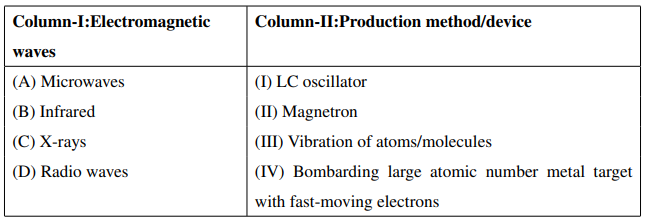
The correctly matched combination is as in option: ______.
View Solution
Solution:Microwaves are produced by magnetrons. Infrared waves arise from vibrations of atoms/molecules. X-rays are generated by bombarding heavy nuclei with electrons. Radio waves are created by LC oscillators.
Quick Tip: Different electromagnetic waves have distinct production mechanisms: microwaves by a magnetron, X-rays by bombarding heavy metal targets, and radio waves by oscillators.
Question 19:
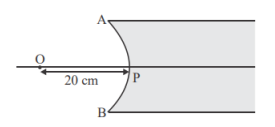
In the figure given below, APB is a curved surface of radius of curvature 10 cm separating air and a transparent material (μ = 4⁄3). A point object O is placed in air on the principal axis of the surface 20 cm from P. The distance of the image of O from P will be ______.
View Solution
Solution: Using the refraction formula for curved surfaces: (μ₂/v) - (μ₁/u) = (μ₂ - μ₁)/R. Substituting the values, v = -16 cm, indicating the image is 16 cm to the left of P in air.
Quick Tip: To solve refraction problems at curved surfaces, use the formula for spherical refraction, and remember that a negative value of 'v' indicates that the image is on the same side as the object.
Question 20:
For fixed values of radii of curvature of lens, power of the lens will be ______.
View Solution
Solution: Lens power (P) = (μ - 1)[(1/R₁) + (1/R₂)]. For fixed radii, power is directly proportional to (μ - 1).
Quick Tip: In lens formulas, the power depends on the refractive index μ and the shape of the lens. For a given shape (fixed radii of curvature), the refractive index primarily determines the lens's power.
Question 21:
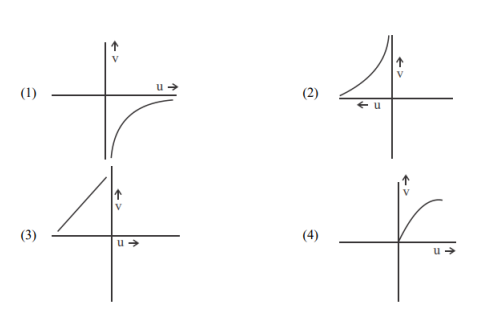
The graph correctly representing the variation of image distance 'v' for a convex lens of focal length 'f' versus object distance 'u' is ______.
View Solution
Solution: The lens equation (1/v) - (1/u) = 1/f produces a hyperbolic relation between v and u, with asymptotes along the axes.
Quick Tip: For a convex lens, the image distance *v* increases as the object distance *u* decreases, and the relationship follows a hyperbolic-like curve. The focal point *f* is the limit.
Question 22:
Using light from a monochromatic source to study diffraction in a single slit of width 0.1 mm, the linear width of central maxima is measured to be 5 mm on a screen held 50 cm away. The wavelength of light used is ______.
View Solution
Solution: Linear width of central maximum (Δx) = 2λL/a, where λ is wavelength, L is distance to screen, and a is slit width. Solving for λ: λ = (Δx * a)/(2L) = (5 × 10⁻³ m * 0.1 × 10⁻³ m) / (2 * 0.5 m) = 5 × 10⁻⁷ m.
Quick Tip: In single-slit diffraction, the width of the central maximum depends on the wavelength, slit width, and distance to the screen. Use w = 2λD⁄a for calculations.
Question 23:
Radiation of frequency 2v0 is incident on a metal with threshold frequency v0. The correct statement of the following is ______.
View Solution
Solution:Photoelectric equation: Kmax = hf - hν₀. Since f = 2ν₀, Kmax = 2hν₀ - hν₀ = hν₀.
Quick Tip: In the photoelectric effect, the maximum kinetic energy of photoelectrons depends on the difference between the frequency of the incident light and the threshold frequency.
Question 24:
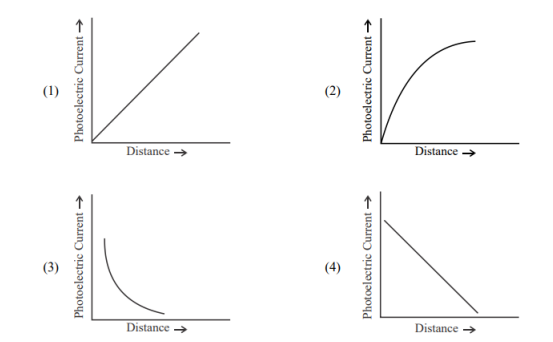
A point source causing photoelectric emission from a metallic plate is moved away from the plate. The variation of photoelectric current with distance from the source is correctly represented by the graph ______.
View Solution
Solution: Photoelectric current depends on light intensity, which follows the inverse square law (I ∝ 1/d²). However, at saturation, all emitted electrons are collected, making the current independent of distance (as long as intensity is above the threshold).
Quick Tip: The photoelectric current decreases as the distance from the light source increases, following the inverse square law of intensity. As the light weakens, the emission stops.
Question 25:
A proton accelerated through a potential difference V has a de Broglie wavelength λ. On doubling the accelerating potential, de Broglie wavelength of the proton ______.
View Solution
Solution: de Broglie wavelength (λ) = h/(√2mpV), where mp is proton mass and V is potential difference. Doubling V reduces λ by a factor of √2.
Quick Tip: For charged particles like protons, the de Broglie wavelength is inversely proportional to the square root of the accelerating potential, so increasing the potential decreases the wavelength.
Question 26:
The kinetic energy of an electron in the ground level of a hydrogen atom is K units. The values of its potential energy and total energy respectively are ______.
View Solution
Solution: In the Bohr model, total energy (E) = -K (negative because it's a bound state). Potential energy (U) = 2E = -2K. Kinetic energy (K) = -E = K.
Quick Tip: For an electron in a hydrogen atom, the potential energy is -2 times the kinetic energy, and the total energy is equal to the negative of the kinetic energy.
Question 27:
Two nuclei have mass numbers A and B respectively. The density ratio of the nuclei is ______.
View Solution
Solution: Nuclear density is constant and independent of mass number because volume is proportional to A1/3 and mass is proportional to A.
Quick Tip: The density of nuclei is nearly constant and does not depend on the mass number A, leading to the ratio of 1:1 for different nuclei.
Question 28:
The shortest wavelengths emitted in hydrogen spectrum corresponding to different spectral series are as under:
(A) Pfund series
(B) Balmer series
(C) Brackett series
(D) Lyman series
The wavelengths arranged correctly in decreasing order are ______.
View Solution
Solution: Shortest wavelength corresponds to the transition to the lowest energy level. The order of series in decreasing wavelength is Pfund (n=5), Brackett (n=4), Balmer (n=2), Lyman (n=1).
Quick Tip: For hydrogen spectral series, Lyman emits the shortest wavelengths (UV region), followed by Balmer (visible), Brackett, and Pfund (infrared region).
Question 29:
Silicon can be doped using one of the following elements as dopant:
(A) Arsenic
(B) Indium
(C) Phosphorus
(D) Boron
To get n-type semiconductor, the dopants that can be used are ______.
View Solution
Solution:For n-type semiconductors, dopants from group 15 (Arsenic and Phosphorus) are used as they have one more valence electron than silicon.
Quick Tip: To form n-type semiconductors, silicon is doped with Group V elements (like arsenic and phosphorus), which donate extra electrons, making the material negatively charged.
Question 30:
Given below are V versus I graphs for different types of p-n junction diodes marked A, B, C, and D.
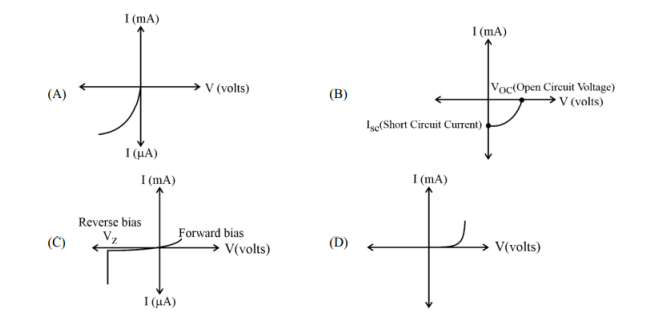
The correct sequence of graphs corresponding to forward biased p-n junction; Zener diode; Photo diode and Solar cell in order is ______.
View Solution
Solution:
- Graph (A) represents a forward-biased p-n junction, showing an exponential increase in current with forward voltage.
- Graph (C) represents a Zener diode, showing sharp breakdown in reverse bias.
- Graph (D) represents a photodiode, where current increases after a threshold voltage under illumination.
- Graph (B) represents a solar cell with open circuit voltage (Voc) and short circuit current (Isc).
Quick Tip: For understanding different diode characteristics, remember:
- Forward-biased p-n junctions have exponential curves.
- Zener diodes exhibit breakdown in reverse bias.
- Photodiodes show an increase in current when exposed to light.
- Solar cells have open circuit voltage and short circuit current characteristics.
Question 31:
A wire carrying current I, bent as shown in the figure, is placed in a uniform magnetic field B that emerges normally out from the plane of the figure. The force on this wire is ______.
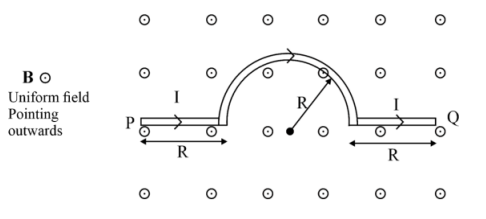
View Solution
Solution: Force (F) = IL x B. For straight segments, F = ILB sinθ = ILB (θ = 90°). For the semicircular segment, the force is equivalent to that on a straight wire of length 2R. Total force = 2(ILB) + 2(ILB) = 4BIR, vertically downward.
Quick Tip: The net force on a wire bent in a semicircular shape in a uniform magnetic field is proportional to the radius R and the current I. The straight sections cancel each other out, and the force is directed downward.
Question 32:
The refractive index of the material of an equilateral prism is √2. The angle of minimum deviation of that prism is ______.
View Solution
Solution: The formula for the angle of minimum deviation (δmin) of a prism is given by: μ = sin(A+δmin⁄2)⁄sin(A⁄2)
where A is the angle of the prism and μ is the refractive index of the material. For an equilateral prism, A = 60°. Given μ = √2, solving the equation results in the angle of minimum deviation being δmin = 60°.
Quick Tip: For equilateral prisms, use the formula involving the refractive index μ and the prism angle A to calculate the minimum deviation angle.
Question 33:
The transfer of integral number of ______ is one of the evidence of quantization of electric charge.
View Solution
Solution:
Electric charge is quantized in integral multiples of the elementary charge (e), carried by electrons.
Quick Tip: Electric charge is quantized, meaning it exists in integer multiples of the elementary charge carried by electrons.
Question 34:
When a slab of insulating material 4 mm thick is introduced between the plates of a parallel plate capacitor of separation 4 mm, it is found that the distance between the plates has to be increased by 3.2 mm to restore the capacity to its original value. The dielectric constant of the material is ______.
View Solution
Solution: With dielectric, effective separation (deff) = d - t + t/K, where d is initial separation, t is dielectric thickness, and K is dielectric constant. deff = 7.2 mm, d = 4 mm, t = 4 mm. Solving for K gives K = 5.
Quick Tip: The dielectric constant *K* reduces the effective separation between capacitor plates, affecting capacitance.
Question 35:
A copper ball of density 8.0 g/cc and 1 cm in diameter is immersed in oil of density 0.8 g/cc. The charge on the ball if it remains just suspended in oil in an electric field of intensity 600π V/m acting in the upward direction is ______. (Take g = 10 m/s²)
View Solution
Solution: The condition for the ball to be suspended is that the electric force must balance the gravitational force. By solving using Fe = Fg, we get the charge as 1 × 10⁻⁵ C.
Quick Tip: The electric force acting on a charged object in an electric field is Fe = Q · E, where Q is the charge and E is the electric field.
Question 36:
A metal wire is subjected to a constant potential difference. When the temperature of the metal wire increases, the drift velocity of the electron in it ______.
View Solution
Solution: Drift velocity (vd) = (eEτ)/m, where τ is relaxation time. τ decreases with increasing temperature due to increased scattering, thus decreasing vd. Thermal velocity increases with temperature.
Quick Tip: In metals, increasing temperature increases the resistance and reduces the drift velocity of electrons, while thermal agitation increases.
Question 37:
For the given mixed combination of resistors calculate the total resistance between points A and B.
![[Circuit Diagram]](https://assets.collegedunia.com/public/image/3_2732780ab964a4fa3756d4a526ac7ecb.png?tr=w-323,h-239,c-force)
View Solution
Solution: Simplify the circuit step-by-step, combining parallel resistors first, then adding series resistances. The equivalent resistance between A and B is 18Ω.
Quick Tip: For complex resistor combinations, simplify the circuit step-by-step by reducing series and parallel connections.
Question 38:
A cell of emf 1.1 V and internal resistance 0.5 Ω is connected to a wire of resistance 0.5 Ω. Another cell of the same emf is now connected in series with the intention of increasing the current, but the current in the wire remains the same. The internal resistance of the second cell is ______.
View Solution
Solution: Initially, I = 1.1V/(0.5Ω + 0.5Ω) = 1.1A. After adding the second cell, total emf = 2.2V. For the current to remain 1.1A, total resistance must be 2Ω. Therefore, 0.5Ω + 0.5Ω + r = 2Ω, where r is the internal resistance of the second cell; r = 1Ω.
Quick Tip: For cells in series, the total internal resistance and emf should be considered when analyzing the current through a circuit.
Question 39:
P, Q, R, and S are four wires of resistances 3, 3, 3, and 4 Ω respectively. They are connected to form the four arms of a Wheatstone bridge circuit. The resistance with which S must be shunted in order that the bridge may be balanced is ______.
View Solution
Solution: To balance the Wheatstone bridge, the ratio of the resistances must be equal. By solving for the required shunt resistance, we get 7 Ω.
Quick Tip: For a balanced Wheatstone bridge, the ratio of resistances in both branches must be equal.
Question 40:
Magnetic moment of a thin bar magnet is 'M'. If it is bent into a semicircular form, its new magnetic moment will be ______.
View Solution
Solution: Magnetic moment (M) = m * l, where m is pole strength and l is length. When bent into a semicircle, effective length becomes 2r/π (where r is the radius). Therefore M' = m * (2r/π) = (2M)/π.
Quick Tip: The magnetic moment of a bar magnet is given by the product of its pole strength and the effective length between the poles. Bending the magnet changes the effective length.
Question 41:
Ferromagnetic material used in transformers must have ______.
View Solution
Solution: Ferromagnetic materials in transformers must have high permeability to increase magnetic flux and low hysteresis loss to minimize energy loss during magnetization cycles.
Quick Tip: Ferromagnetic cores in transformers should exhibit low energy loss and high magnetic permeability to improve efficiency.
Question 42:
A conducting ring of radius 'r' is placed in a varying magnetic field perpendicular to the plane of the ring. If the rate at which the magnetic field varies is 'x', the electric field intensity at any point of the ring is ______.
View Solution
Solution: The electric field induced in a conducting loop is proportional to the rate of change of the magnetic flux through the loop. In this case, the electric field intensity E = rx.
Quick Tip: Faraday's law of electromagnetic induction states that the induced electric field is proportional to the rate of change of magnetic flux.
Question 43:
A 50 Hz AC current of crest value 1 A flows through the primary of a transformer. If the mutual inductance between the primary and secondary be 0.5 H, the crest voltage induced in the secondary is ______.
View Solution
Solution: The voltage induced in the secondary is given by V = MdI⁄dt, where M is the mutual inductance and dI⁄dt is the rate of change of current. Using the given values and solving, the crest voltage induced in the secondary is 150 V.
Quick Tip: The induced voltage in the secondary of a transformer depends on the mutual inductance and the rate of change of current in the primary.
Question 44:
A long solenoid of diameter 0.1 m has 2 × 10⁴ turns per meter. At the center of the solenoid, a coil of 100 turns and radius 0.01 m is placed with its axis coinciding with the solenoid axis. The current in the solenoid reduces at a constant rate to 0 A from 4 A in 0.05 s. If the resistance of the coil is 10π² Ω, then the total charge flowing through the coil during this time is ______.
View Solution
Solution: The induced emf in the coil is given by Faraday's law: E = -NdΦ⁄dt
where N = 100 is the number of turns in the coil and Φ = B⋅A is the magnetic flux. The magnetic field B inside the solenoid is given by: B = μ0nI
where n = 2 × 10⁴ turns/m and I is the current in the solenoid. The change in magnetic flux is due to the reduction in current, and the total charge Q flowing through the coil is related to the induced emf and resistance by: Q = EΔt⁄R
Substituting the given values and solving, the total charge flowing through the coil is 32π μC.
Quick Tip: Use Faraday's law to calculate the induced emf in a coil, and relate the emf to the total charge using Q = EΔt⁄R.
Question 45:
Lower half of a convex lens is made opaque. Which of the following statement describes the image of the object placed in front of the lens?
(A) No change in image
(B) Image will show only half of the object
(C) Intensity of image gets reduced
Choose the correct answer from the options given below.
View Solution
Solution: When half of a convex lens is blocked, the entire image can still be formed, but the intensity of the image is reduced. The image will appear less bright because fewer rays reach the image.
Quick Tip: Blocking part of a lens reduces the number of rays forming the image, lowering the intensity but still producing a complete image.
Question 46:
Two slits are made 0.1 mm apart and the screen is placed 2 m away. The fringe separation when a light of wavelength 500 nm is used is ______.
View Solution
Solution: The fringe separation Δy in a double-slit experiment is given by: Δy = λD⁄d
where λ = 500 nm = 500 × 10-9 m, D = 2 m, and d = 0.1 mm = 1 × 10⁻⁴ m. Substituting these values, we get Δy = 1.5 cm.
Quick Tip: The fringe separation in a double-slit experiment increases with wavelength and screen distance and decreases with slit separation.
Question 47:
For an astronomical telescope having an objective lens of focal length 10 m and eyepiece lens of focal length 10 cm, the tube length and magnification respectively are ______.
View Solution
Solution: The tube length of an astronomical telescope is the sum of the focal lengths of the objective and the eyepiece: L = fobjective + feyepiece = 10 m + 0.1 m = 10.1 m = 1010 cm.
The magnification is given by: M = fobjective⁄feyepiece = 10⁄0.1 = 100.
Quick Tip: For astronomical telescopes, magnification is given by the ratio of the focal lengths of the objective and eyepiece lenses.
Question 48:
According to Bohr's Model
(A) The radius of the orbiting electron is directly proportional to 'n'.
(B) The speed of the orbiting electron is directly proportional to 1⁄n.
(C) The magnitude of the total energy of the orbiting electron is directly proportional to 1⁄n2.
(D) The radius of the orbiting electron is directly proportional to n².
Choose the correct answer from the options given below.
View Solution
Solution: In Bohr's model:
- (A) is incorrect because the radius is proportional to n², not n.
- (B) is correct because the speed of the electron is inversely proportional to 1⁄n.
- (C) is correct because the total energy is proportional to 1⁄n2.
- (D) is correct because the radius of the orbit is proportional to n².
Quick Tip: In Bohr's model, the radius of the electron's orbit is proportional to n², the speed of the electron is inversely proportional to n, and the total energy is inversely proportional to 1⁄n2.
Question 49:
For a full wave rectifier, if the input frequency is 50 Hz, the output frequency will be ______.
View Solution
Solution: In a full-wave rectifier, the frequency of the output is double the input frequency because both halves of the AC waveform are utilized. So, if the input frequency is 50 Hz, the output frequency will be 100 Hz.
Quick Tip: A full-wave rectifier doubles the input frequency because it rectifies both halves of the AC waveform.
Question 50:
For an electric dipole in a non-uniform electric field with dipole moment parallel to direction of the field, the force F and torque τ on the dipole respectively are ______.
View Solution
Solution: In a non-uniform field, there's a net force due to varying field strength, but no torque if the dipole is aligned with the field (τ = pEsinθ, θ = 0).
Quick Tip: For an electric dipole in a non-uniform electric field, a net force arises if the field is non-uniform, but the torque is zero if the dipole moment is aligned with the field.


*The article might have information for the previous academic years, please refer the official website of the exam.