
CUET Political Science Question Paper 2024 SET B Download Solutions and Answer Key


Content Writer | Updated On - Dec 7, 2024
CUET Question Papers are the most important study material for effective exam preparation. We at Zollege have provided all CUET Previous Year Papers with Solution PDFs here. CUET 2024 Political Science was conducted successfully on May 18 by NTA.
Students can freely download the CUET previous year's question paper PDFs along with their solutions here. We strongly encourage cuet aspirants to scan through all the CUET Question Paper to know the overall difficulty level, CUET Syllabus and understand the changes in CUET Exam Pattern over the years.
CUET 2024 Political Science Question Paper (SET B) with Answer Key PDF
| CUET 2024 Political Science Question Paper with Answer Key SET B |  Download Download |
Check Solution |
CUET 2024 Political Science Question Paper (SET B) with Solutions
| Question | Answer | Solution |
|---|---|---|
| Question 1: Which of the following nations adopted an ‘Open Door’ policy and economic reforms in 1978? 1. South Korea 2. China 3. USA 4. Japan |
2. China | China's adoption of the Open Door policy in 1978 under Deng Xiaoping marked the beginning of significant economic reforms, shifting the country towards a market-oriented economy. |
| Question 2: In 1966, who made the six-point proposal for the greater autonomy of East Pakistan? 1. Jawaharlal Nehru 2. Sheikh Mujib-ur-Rahman 3. General Yahya Khan 4. Zulfikar Ali Bhutto |
2. Sheikh Mujib-ur-Rahman | Sheikh Mujibur Rahman's Six-Point Movement in 1966 was a crucial step towards the eventual independence of Bangladesh. |
| Question 3: In which year was Mikhail Gorbachev elected as the General Secretary of the Communist Party of the Soviet Union? 1. 1982 2. 1983 3. 1984 4. 1985 |
4. 1985 | Mikhail Gorbachev's election in 1985 marked a turning point in Soviet history, leading to significant reforms (Perestroika and Glasnost) and ultimately the dissolution of the USSR. |
| Question 4: Which of the following countries have not accepted the Euro as the common currency? 1. Denmark and Sweden 2. Spain and Portugal 3. Greece and Germany 4. France and Austria |
1. Denmark and Sweden | Denmark and Sweden are EU member states that have not adopted the Euro as their official currency. |
| Question 5: The ASEAN Regional Forum (ARF), established in 1994, is the organization that carries out the coordination of: 1. Trade and Finance 2. Friendship and Solidarity 3. Security and Foreign Policy 4. Investment and Labour |
3. Security and Foreign Policy | The ARF primarily focuses on security and foreign policy cooperation among its members. |
| Question 6: Which of the following countries joined SAARC in the year 2007? 1. Bhutan 2. Nepal 3. Afghanistan 4. Bangladesh |
3. Afghanistan | Afghanistan became the 8th member of SAARC in 2007. |
| Question 7: Which of the following countries is not included in South Asia? 1. Pakistan 2. China 3. Bangladesh 4. Nepal |
2. China | China is geographically located in East Asia, not South Asia. |
| Question 8: At the Yalta Conference, the ‘Big Three’ decided to organize a United Nations Conference on the proposed world organization. The ‘Big Three’ stood for: 1. Roosevelt, Churchill, and Krushchev 2. Roosevelt, Churchill, and Stalin 3. Deng Xiaoping, Churchill, and Stalin 4. Kennedy, Attlee, and Stalin |
2. Roosevelt, Churchill, and Stalin | The Big Three at the Yalta Conference were Roosevelt (USA), Churchill (UK), and Stalin (USSR). |
| Question 9: The International Atomic Energy Agency (IAEA) was established in: 1. 1951 2. 1953 3. 1955 4. 1957 |
4. 1957 | The IAEA was established in 1957 to promote the peaceful use of nuclear energy and prevent its military use. |
| Question 10: Which of the following organizations provides loans and grants to member countries for human development (education and health), agriculture and rural development, infrastructure, and environment protection? 1. WTO 2. World Bank 3. IMF 4. UNO |
2. World Bank | The World Bank is a major international financial institution that provides funding for various development projects. |
| Question 11: What is the full form of START? 1. Strategic Arms Reduction Toll 2. Strategic Arms Reduction Treaty 3. Strategic Arms Reduction Tactics 4. Strategic Arms Reduction Tax |
2. Strategic Arms Reduction Treaty | START stands for Strategic Arms Reduction Treaty, a significant arms control agreement between the US and the Soviet Union (later Russia). |
| Question 12: Which of the following is a threat to global security? 1. Human Rights 2. Arms Control 3. Terrorism 4. Disarmament |
3. Terrorism | Terrorism is widely recognized as a major threat to global security due to its destabilizing effects and violence. |
| Question 13: Match List-I with List-II: List-I (Indigenous People): (A) Mapuche, (B) Kuna Tribe, (C) Indigenous people of Cordillera Region, (D) Tribal people of the Chittagong Hill Tracts List-II (Region): (I) East of Panama Canal, (II) Bangladesh, (III) Chile, (IV) Philippines |
(A) - (III), (B) - (I), (C) - (IV), (D) - (II) | This question requires matching indigenous groups with their regions of origin. |
| Question 14: When was the Kyoto Protocol signed? 1. 1992 2. 1995 3. 1997 4. 1999 |
3. 1997 | The Kyoto Protocol, an international treaty on climate change, was signed in 1997. |
| Question 15: When was the Energy Conservation Act passed? 1. 1998 2. 1999 3. 2001 4. 2005 |
3. 2001 | The Energy Conservation Act in India was passed in 2001. |
| Question 16: Which of the following global platforms brings together Human Rights activists, environmentalists, labour, youth, and women activists opposed to neoliberal globalization? 1. World Economic Forum 2. World Social Forum 3. World Cultural Forum 4. G-20 |
2. World Social Forum | The World Social Forum (WSF) is a prominent platform for activists opposing neoliberal globalization. |
| Question 17: Which of the statements is true about globalization? 1. Globalization is purely an economic phenomenon. 2. Globalization is purely a cultural phenomenon. 3. Globalization is a multi-dimensional phenomenon. 4. Globalization has had a universal impact on all states and societies. |
3. Globalization is a multi-dimensional phenomenon. | Globalization encompasses economic, political, social, and cultural aspects, making it multi-dimensional. |
| Question 18: When is ‘Ambedkar Jayanti’ observed in India? 1. January 14 2. February 14 3. March 14 4. April 14 |
4. April 14 | Ambedkar Jayanti, commemorating B.R. Ambedkar's birth anniversary, is observed on April 14th in India. |
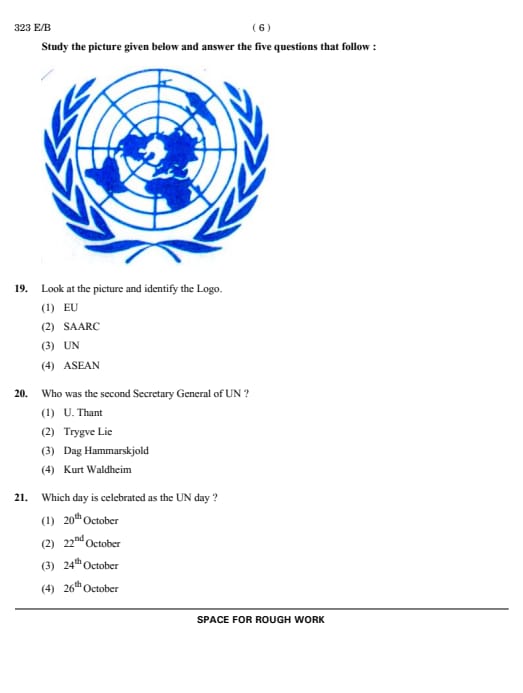
| Question 19: Look at the picture and identify the Logo. *(Image of the UN logo is assumed here)* 1. EU 2. SAARC 3. UN 4. ASEAN |
3. UN | The image is assumed to be the logo of the United Nations (UN). |
| Question 20: Who was the second Secretary General of UN? 1. U. Thant 2. Trygve Lie 3. Dag Hammarskjold 4. Kurt Waldheim |
3. Dag Hammarskjold | Dag Hammarskjold served as the second Secretary-General of the United Nations. |
| Question 21: Which day is celebrated as the UN Day? 1. 20th October 2. 22nd October 3. 24th October 4. 26th October |
3. 24th October | UN Day is celebrated annually on October 24th, commemorating the entry into force of the UN Charter in 1945. |
| Question 22: The UN was founded as a successor to which of the following? 1. League of Nations 2. Concert of Europe 3. Council of Europe 4. Hague Conference |
1. League of Nations | The UN was created after World War II, largely as a response to the perceived failures of the League of Nations in preventing World War I. |
| Question 23: Write the full form of UNDP. 1. United Nations Development Planning 2. United Nations Development Programme 3. United Nations Design Programme 4. United News Development Programme |
2. United Nations Development Programme | UNDP stands for the United Nations Development Programme. |
| Question 24: North-East region consists of seven States called _______. *(This question is based on a passage about the North-East region of India)* 1. Seven Sisters 2. Seven Stars 3. Seven Seas 4. Seven Brothers |
1. Seven Sisters | The seven states of Northeast India are commonly referred to as the "Seven Sisters." |
| Question 25: Which of the following countries does the North-East region share its boundaries with? *(This question is based on a passage about the North-East region of India)* 1. China, Nepal, and Bangladesh 2. China, Bhutan, and Bangladesh 3. China, Myanmar, and Bangladesh 4. China, Sri Lanka, and Bangladesh |
3. China, Myanmar, and Bangladesh | The Northeast region of India shares its international borders with China, Myanmar, and Bangladesh. |
| Question 26: In which year was the State of Nagaland created? 1. 1961 2. 1963 3. 1965 4. 1967 |
2. 1963 | Nagaland was officially formed as a state in India in 1963. |
| Question 27: Khasi tribes, an ethnic group, are the inhabitants of which of the following States? 1. Manipur 2. Mizoram 3. Nagaland 4. Meghalaya |
4. Meghalaya | The Khasi tribe is indigenous to Meghalaya, one of the seven sister states of Northeast India. |
| Question 28: The North-East serves as a gateway to which of the regions mentioned below? 1. South-East Asia 2. South Asia 3. West Asia 4. Europe |
1. South-East Asia | Due to its geographical location and proximity to several Southeast Asian countries, the Northeast region of India acts as a gateway to Southeast Asia. |
| Question 29: Who among the following entered into the Standstill Agreement with India in November 1947? 1. Maharaja of Manipur 2. Nizam of Hyderabad 3. Nawab of Junagadh 4. Maharaja of Kashmir |
2. Nizam of Hyderabad | The Nizam of Hyderabad signed a Standstill Agreement with India in November 1947, a temporary arrangement to maintain the status quo before deciding on accession. |
| Question 30: Which of the following Princely States were reluctant to sign the Instrument of Accession with India? 1. Tamil Nadu, Gujarat, Punjab 2. Kerala, Hyderabad, Bombay 3. Assam, Goa, Tripura 4. Hyderabad, Junagadh, Kashmir |
4. Hyderabad, Junagadh, Kashmir | Hyderabad, Junagadh, and Kashmir were among the princely states that were hesitant or reluctant to accede to either India or Pakistan after independence. |
| Question 31: The ‘two-nation theory’ was advanced by which of the following party? 1. Janata Dal 2. Muslim League 3. Socialist Party 4. Swatantra Party |
2. Muslim League | The "two-nation theory," which proposed that Muslims and Hindus were two distinct nations, was primarily advocated by the Muslim League. This theory played a significant role in the partition of India. |
| Question 32: Who was known as ‘Frontier Gandhi’? 1. Mahatma Gandhi 2. Sardar Patel 3. Khan Abdul Ghaffar Khan 4. Potti Sriramulu |
3. Khan Abdul Ghaffar Khan | Khan Abdul Ghaffar Khan, a prominent leader in the Indian independence movement, was known as the "Frontier Gandhi" for his non-violent resistance against British rule in the Northwest Frontier Province. |
| Question 33: Match List-I with List-II: List-I: (A) S.A. Dange, (B) Shyama Prasad Mukherjee, (C) Minoo Masani, (D) Ashok Mehta List-II: (I) Bharatiya Jana Sangh, (II) Swatantra Party, (III) Praja Socialist Party, (IV) Communist Party of India |
(A) - (IV), (B) - (I), (C) - (II), (D) - (III) | This question requires matching Indian political figures with the political parties they were associated with. |
| Question 34: Who was the leader of the anti-caste movement and the founder of Independent Labour Party? 1. Acharya Narendra Dev 2. Rafi Ahmed Kidwai 3. A.K. Gopalan 4. Babasaheb Bhimrao Ambedkar |
4. Babasaheb Bhimrao Ambedkar | B.R. Ambedkar was a prominent leader of the anti-caste movement and founded the Independent Labour Party. |
| Question 35: Who among the following was known as the “Milkman of India”? 1. Arun Krishna 2. Muljibhai Patel 3. Verghese Kurien 4. M.S. Swaminathan |
3. Verghese Kurien | Verghese Kurien is credited with leading India's White Revolution, significantly increasing milk production. |
| Question 36: Statement I: The Second Five Year Plan stressed on heavy industries. Statement II: A bulk of industries like electricity, railways, steel could be developed by the private sector. 1. Both Statement I and Statement II are correct 2. Both Statement I and Statement II are incorrect 3. Statement I is correct, but Statement II is incorrect 4. Statement I is incorrect, but Statement II is correct |
3. Statement I is correct, but Statement II is incorrect | The Second Five Year Plan prioritized heavy industries under a socialist model; the private sector's role was limited. |
| Question 37: The Second Five Year Plan was drafted under the leadership of _______. 1. K.N. Raj 2. P.C. Mahalanobis 3. J.C. Kumarappa 4. P.C. Mahapatra |
2. P.C. Mahalanobis | P.C. Mahalanobis played a key role in designing the Second Five Year Plan, particularly in its emphasis on heavy industries. |
| Question 38: Which of the following treaty was rejected by India as discriminatory as it prevented only non-nuclear countries from acquiring nuclear weapons? 1. Intermediate Range Nuclear Force Treaty 2. Non-Proliferation Treaty 3. Strategic Arms Reduction Treaty 4. Strategic Offensive Reduction Treaty |
2. Non-Proliferation Treaty | India viewed the NPT as discriminatory because it only restricted non-nuclear states from acquiring nuclear weapons. |
| Question 39: Where was the first summit of the NAM (Non-Alignment Movement) held? 1. Bengaluru 2. Belgrade 3. Belgium 4. Belarus |
2. Belgrade | The first summit of the Non-Aligned Movement (NAM) was held in Belgrade, Yugoslavia (now Serbia), in 1961. |
| Question 40: The Shimla Agreement of 1972 was signed between India and which of the following countries? 1. Nepal 2. Pakistan 3. China 4. Bangladesh |
2. Pakistan | The Shimla Agreement, signed in 1972, aimed to normalize relations between India and Pakistan after the 1971 war. |
| Question 41: Who proposed in 1963 that all senior Congressmen should resign from office to make way for younger party workers? 1. S. Nijalingappa 2. V.V. Giri 3. K. Kamaraj 4. Indira Gandhi |
3. K. Kamaraj | K. Kamaraj's proposal in 1963, known as the Kamaraj Plan, aimed at rejuvenating the Congress party by bringing in younger leaders. |
| Question 42: Who gave the strategy of ‘Non-Congressism’? 1. Ram Manohar Lohia 2. C. Natarajan Annadurai 3. K. Kamaraj 4. Karpoori Thakur |
1. Ram Manohar Lohia | Ram Manohar Lohia is credited with the strategy of "Non-Congressism," which aimed to unite opposition parties against the Congress. |
| Question 43: The Mandal Commission was appointed by which Government at the Centre? (1) Indian National Congress Party (2) Bharatiya Janata Party (3) Janata Party (4) Samajwadi Party |
(3) Janata Party | The Mandal Commission, which investigated the status of Other Backward Classes (OBCs), was appointed by the Janata Party government. |
| Question 44: In 1974, the nationwide strike by all the employees of the Railways was led by which of the following leaders? (1) Jayaprakash Narayan (2) Charu Majumdar (3) George Fernandes (4) Indira Gandhi |
(3) George Fernandes | George Fernandes, a prominent trade union leader, led the 1974 nationwide railway strike. |
| Question 45: Which of the following political party led the movement for the formation of Punjabi Suba? (1) Congress (2) Lok Dal (3) Akali Dal (4) CPI |
(3) Akali Dal | The Akali Dal was the main political party leading the movement for the creation of a Punjabi-speaking state (Punjabi Suba) in India. |
| Question 46: Who among the following led the Anti-Brahmin movement, worked for the Justice Party, and also founded Dravidar Kazhagam? (1) A.K. Gopalan (2) E.V. Ramasami Naicker (3) K. Kamaraj (4) Potti Sriramulu |
(2) E.V. Ramasami Naicker | E.V. Ramasami Naicker, also known as Periyar, was a key figure in the Dravidian movement in South India. |
| Question 47: What does BAMCEF stand for? (1) Backward and Muslim Communities Employees Federation (2) Backward and Minority Communities Education Federation (3) Backward and Minority Communities Employees Federation (4) Backward and Majority Communities Employees Federation |
(3) Backward and Minority Communities Employees Federation | BAMCEF stands for Backward and Minority Communities Employees Federation. |
| Question 48: Match List-I with List-II: List-I (Prime Minister): (A) H.D. Deve Gowda, (B) I.K. Gujral, (C) V.P. Singh, (D) Manmohan Singh List-II (Period): (I) May 2004 – May 2014, (II) That reflect only in certain circumstances, (III) April 1997 – March 1998, (IV) December 1989 – November 1990 |
(A) - (III), (B) - (IV), (C) - (II), (D) - (I) | This question involves matching Indian Prime Ministers with their tenures. |
| Question 49: Who was the founder of Bahujan Samaj Party? (1) Mayawati (2) B.R. Ambedkar (3) Jagjivan Ram (4) Kanshi Ram |
(4) Kanshi Ram | Kanshi Ram founded the Bahujan Samaj Party (BSP). |
| Question 50: The model of transition in Russia, Central Asia, and East Europe that was influenced by the World Bank and the IMF came to be known as: (1) Current Therapy (2) Shock Therapy (3) Fiscal Therapy (4) Glasnost |
(2) Shock Therapy | The rapid market-oriented reforms implemented in post-Soviet states were referred to as "Shock Therapy." |




*The article might have information for the previous academic years, please refer the official website of the exam.