
Only 60 Days Left for CUET UG 2026: 8-Week Crash Course Strategy to Score 700+


| Updated On - Mar 16, 2026
CUET UG 2026 will be conducted from May 11 to May 31, 2026, which means candidates starting today have roughly 60 days, or 8 weeks, left. Scoring 700+ across three papers (Language + Domain + General Aptitude Test) means clearing 140+ correct answers with near-zero errors, given the +5/-1 marking scheme. With around 60 days left, you can work on accuracy, speed, and question selection.
-
Weeks 1-2: Map the syllabus using PYQs, identify the top 8-10 chapters per subject that repeat most, and cover only those first before touching anything else.
- Weeks 3-4: Solve 30-40 PYQs daily by chapter; finish at least 2 full subject-wise mock tests per paper by the end of Week 4 to benchmark where accuracy is dropping.
- Weeks 5-6: Shift to 1 full 3-paper mock daily track marks per paper, identify which question types are time-consuming, and re-cover only the weak chapters from that data.
- Weeks 7-8: No new topics, 2 full mocks per day, rapid revision of top chapters only, and a daily 15-minute current affairs drill for the General Aptitude Test.

| CUET Exam Year | CUET Question Papers |
|---|---|
| CUET 2025 | Download PDF |
| CUET 2024 | Download PDF |
| CUET 2023 | Download PDF |
| CUET 2022 | Download PDF |
| CUET 2021 | Download PDF |
Related Articles:
- CUET UG 2026 Exam Pattern: Sections, Marks & Marking Scheme
- CUET UG 2026 Syllabus: Subject-Wise Topics and PDF Download
Key Summary:
|
|---|
CUET UG 2026 Language Test 8-Week Preparation Strategy
The Language Test is the most underestimated of the three papers. It is entirely reading-and-reasoning-based no NCERT chapters, no formulae. Candidates who practice reading comprehension daily from Week 1 can lock 220-235 in this paper with minimal additional effort.
| Phase | Weeks | Focus Topics (High Yield) | Resources and Tips | Daily Time |
|---|---|---|---|---|
| Foundation + Coverage | Week 1-2 | Reading comprehension (factual, literary, narrative); basic grammar rules; vocabulary lists | NCERT English Flamingo/Vistas; any RC practice set; past CUET language papers | 45-60 min |
| Practice and Weak Areas | Week 3-4 | Vocabulary in context; grammar application (tenses, articles, prepositions); literary aptitude passages | CUET PYQs 2022-2025; timed RC practice; one RC passage per day under 8 minutes | 60 min + PYQ sets |
| Revision and Mocks | Week 5-8 | Full paper simulation; speed building on comprehension; error analysis for grammar traps | Full mock language tests; review wrong attempts only; 50 questions in under 55 minutes target | 45-60 min in mock sessions |
Three types of passages appear consistently in the Language Test: factual, literary, and narrative. Factual RC questions are answered directly from the text with the highest accuracy rate. Narrative and literary passages need 20-30 seconds more per question. Prioritise factual RCs first during the exam.
Read More:
CUET UG 2026 Domain Subject 8-Week Preparation Strategy
The Domain Subject is where most candidates lose marks, not because they do not know the content, but because they prepare it as a board exam rather than a speed-based elimination test. CUET domain questions are directly mapped to Class 12 NCERT. However, the question types test application, not recall.
This table uses the example of a science-stream candidate (Physics/Chemistry/Biology). Commerce and humanities students should map the same phase structure to their respective domain subjects.
| Phase | Weeks | Resources and Tips | Daily Time |
|---|---|---|---|
| Foundation + Coverage | Week 1-2 | NCERT Class 12 (primary); NCERT exemplar for application questions; highlight CUET-style phrasing | 2.5-3 hours |
| Practice and Weak Areas | Week 3-4 | CUET PYQs 2022-2025 by chapter; solve 30 domain questions daily under timed conditions | 2.5 hours + PYQ sets |
| Revision and Mocks | Week 5-8 | Domain-specific mock tests; mark-per-minute analysis; aim for 46+ correct in 60 minutes | 2 hours in mock sessions |
Most candidates make the error of preparing 100% of the syllabus in 60 days. Do not. CUET domain papers show strong chapter clustering. Roughly 70-75% of questions come from 40-50% of the syllabus across streams. Spend Weeks 1-2 mapping that cluster using PYQs, then cover it first.
CUET UG Domain Subjects: Topic-wise Weightage
| Subject/Domain | Syllabus and Topic-Wise Weightage |
|---|---|
| Mathematics | Check Here |
| Accountancy | Check Here |
| CSE | Check Here |
| Science | Check Here |
| Physics | Check Here |
| Chemistry | Check Here |
| Business Studies | Check Here |
| Environmental | Check Here |
| Political Science | Check Here |
| Biology | Check Here |
| Agriculture | Check Here |
CUET UG 2026 General Aptitude Test 8-Week Preparation Strategy
The GAT is the highest-return paper for most candidates who treat it seriously from Day 1. All 50 questions are compulsory, and the content is Class 8-level mathematics, standard reasoning patterns, and current affairs. There is no Class 12 NCERT dependence here.
| Phase | Weeks | Focus Topics (High Yield) | Resources and Tips | Daily Time |
|---|---|---|---|---|
| Foundation + Coverage | Week 1-2 | Quantitative Aptitude: percentages, ratios, SI/CI, time-work, speed-distanceGK: Indian history, polity, geography, awardsReasoning: blood relations, number series | RS Aggarwal (Quantitative Aptitude); Lucent's General Knowledge; CUET GAT PYQ sets | 1.5-2 hours |
| Practice and Weak Areas | Week 3-4 | Logical Reasoning: coding-decoding, sitting arrangement, direction sense, analogiesCurrent Affairs: last 6-12 monthsNumerical Ability: algebra, mensuration, data interpretation | Topic-wise PYQ sets; newspaper or monthly GK digest for current affairs; 40 GAT questions daily under timed conditions | 1.5-2 hours + PYQs |
| Revision and Mocks | Week 5-8 | Full GAT mock simulations; high-frequency static GK; mental ability and series problems for speed | Full-length GAT mocks; aim for 47-48 correct in 60 minutes; current affairs revision every alternate morning | 1 hour in mock sessions |
GAT has the highest ceiling for score improvement in 60 days. A candidate scoring 180 in Week 1 can reasonably hit 235-245 by Week 8 with daily practice. That improvement is not possible in the domain subject in the same timeframe. Plan your effort allocation accordingly.
Read More:
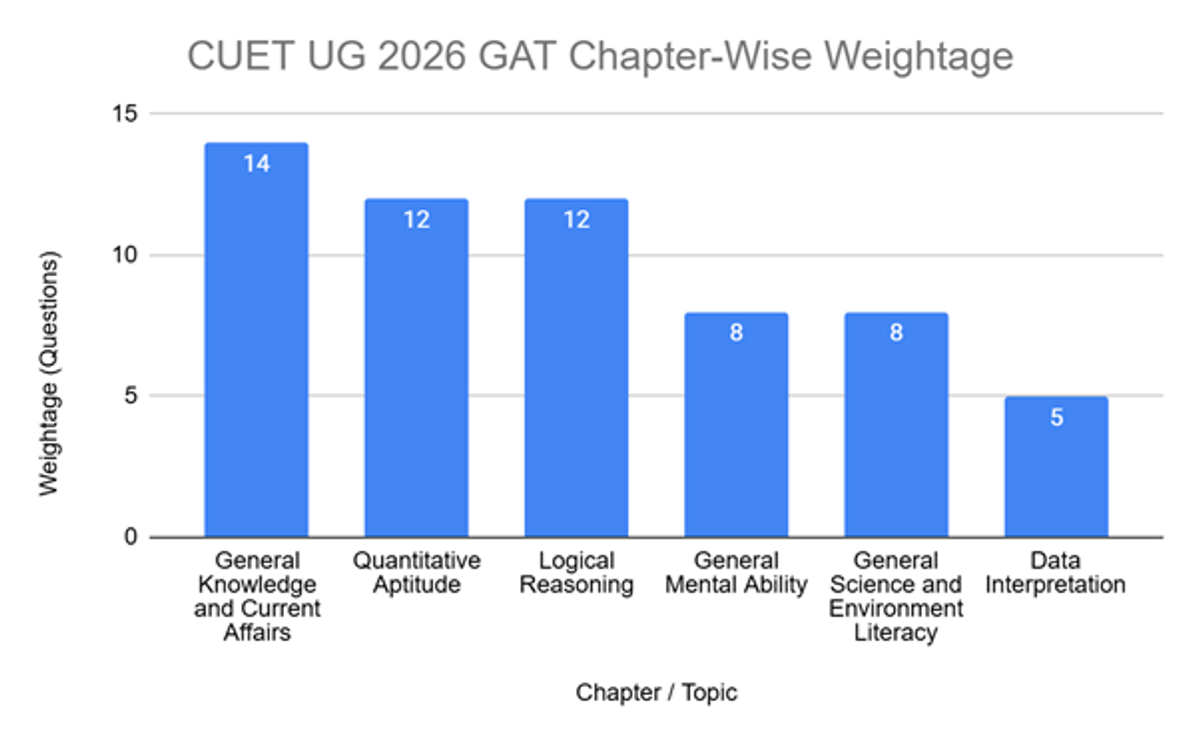
CUET UG 2026 General Aptitude Test: Chapter-Wise Weightage
| Chapter / Topic | Weightage (Questions) | Priority |
|---|---|---|
| General Knowledge and Current Affairs | 12-14 | Must-Cover |
| Quantitative Aptitude (Arithmetic, Algebra, Mensuration) | 10-12 | Must-Cover |
| Logical and Analytical Reasoning (Series, Coding, Direction) | 10-12 | Must-Cover |
| General Mental Ability (Blood Relations, Analogies, Classification) | 8-10 | High |
| General Science and Environment Literacy | 6-8 | High |
| Data Interpretation | 3-5 | Medium |
Also Check:
CUET UG 2026 Resources
| Subject | Primary Resources | Purpose |
| Language Test | NCERT English Flamingo and Vistas; CUET PYQ papers 2022-2025 | Passage types practice; grammar application |
| Domain Subject (Science) | NCERT Class 12 Physics, Chemistry, Biology; NCERT Exemplar | Concept coverage; application-level questions |
| Domain Subject (Commerce) | NCERT Class 12 Accountancy, Business Studies, Economics | Direct NCERT-mapped questions |
| Domain Subject (Humanities) | NCERT Class 12 History, Political Science, Geography, Sociology | Factual and conceptual mapping |
| General Aptitude Test | RS Aggarwal (Quantitative Aptitude); Lucent's General Knowledge | Arithmetic and static GK coverage |
| Current Affairs (GAT) | Monthly current affairs digest; national daily newspaper | Last 6-12 months events coverage |
| All Papers | CUET PYQ papers 2022-2025; NTA official mock test portal | Exam-pattern familiarity; accuracy benchmarking |
CUET UG 2026 60-Day Crash Course Strategy FAQs
Ques. Is it realistic to score 700+ in CUET UG 2026 starting from scratch in 60 days?
Ans. It is achievable, but it depends on which domain subject a candidate chooses and how disciplined the mock schedule is. Candidates with a strong Class 12 NCERT foundation in their domain subject can close the gap faster. The General Aptitude Test is the most reliable paper for a score jump in 60 days given its skill-based nature.
Ques. Which is the easiest of the three CUET UG papers to improve in 60 days?
Ans. The General Aptitude Test typically gives the highest improvement rate in a short time. Its content, arithmetic, reasoning, and current affairs respond directly to daily practice without depending on a specific board background. Language Test is second. Domain Subject improvement depends heavily on how well the Class 12 foundation was built.
Ques. Should a CUET UG 2026 aspirant start any new topics in the last two weeks?
Ans. No. Weeks 7-8 must be entirely revision and mock-based. Starting a new chapter after Week 6 introduces confusion rather than adding marks. The highest-yield activity in the final two weeks is solving PYQs from high-frequency chapters and analysing wrong answers from recent mocks.
Ques. Does CUET UG 2026 have optional questions within each paper?
Ans. No. From CUET 2025 onwards, NTA removed the optional question format. All 50 questions in every paper are compulsory. This makes accuracy more important than ever unattempted questions give 0 marks, but a wrong answer costs -1. Blind guessing on uncertain questions is not a viable strategy.
*The article might have information for the previous academic years, please refer the official website of the exam.