![KIET Group of Institutions - [KIET]](https://static.zollege.in/public/college_data/images/logos/1580882202logo.jpeg?tr=h-94,w-94,c-force)


On Thursday, 9th November 2023, KIET Group of Institutions, Delhi-NCR, Ghaziabad hosted a pivotal National workshop titled "Implementation of National Education Policy (NEP) 2020, Challenges and Solutions" in collaboration with All India Council for Technical Education (AICTE) and Shiksha Sanskriti Utthan Nyas, New Delhi.
The event drew eminent academics, policymakers, and educators from around the country, including Punjab, Haryana, Uttar Pradesh, and Delhi. Participants were eager to study and debate the complexities of the National Education Policy (NEP) 2020, which promises to transform the educational system and pave the path for a future-ready India. At this event, hon'ble KIET management members, Shri Sarish Agarwal Ji, Chairman, Shri Sunil P. Gupta Ji, General Secretary, Shri G.D. Jain Ji, Treasurer were present along with Dr Amik Garg, Director, Dr Manoj Goel Joint Director, Dr Vibhav Kumar Sachan, Dean R&D, and Dr Anil K Ahlawat, Dean Academics.
The event started with a welcome address by Dr Amik Garg, who elaborated on NEP 2020, and its importance.
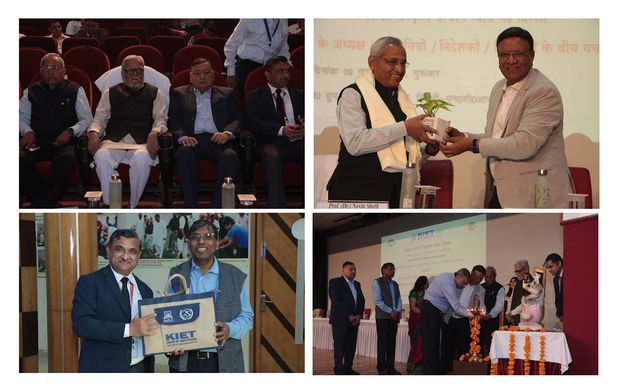
The workshop commenced with the chief guest, Dr Atul Kothari, (National Secretary, Shiksha Sanskriti Utthan Nyas, New Delhi), who set the stage with his insights on the NEP's holistic approach to development. He advocated for a paradigm shift from a job-centric education to one that emphasizes creativity, critical thinking, and adaptability to meet the challenges of the 21st century. He talked about the role of students, parents, and teachers in the implementation of NEP 2020. The workshop underscored NEP 2020's focus on holistic development and character building, with Dr Atul Kothari emphasizing the policy's shift from Eurocentric models to one ingrained in Indian ethos and values.
Prof. R.P. Tiwari, National Project Advisor at MERITE, Ministry of Education, Govt. of India, added depth to the discourse with his elaboration on the policy's framework, ensuring inclusivity and flexibility to cater to a diverse population. Prof. Madhusudan Singh, Registrar, of Delhi Technological University, emphasized the NEP's goal of increasing educational reach and retention through a revamped structure, moving from the traditional 10+2 system to a more comprehensive 5+3+3+4 credit-based format.
The discussions took a deeper dive as Prof. (Dr) Navin Sheth, former (Vice Chancellor of Gujarat Technological University, Ahmedabad), spoke on integrating the rich Indian Knowledge System with modern academic disciplines. Dr Parul Bhatnagar from Dayalbagh University, Agra, highlighted the imperative for Moral Education and Social Concerns to be woven into the fabric of our education system. Moreover, Dr Buddha Chandrasekhar, Chief Coordinating Officer at AICTE, Ministry of Education, New Delhi, addressed the significant move towards Technical Education in Indian languages, aiming to bridge the gap between vernacular mediums and technical prowess. The day progressed with engaging discussions on NEP 2020's innovative strategies for education, including a credit system adaptable to various quality platforms, a thrust on mental well-being, and the incorporation of vocational training into mainstream education.
Dr Vivek Kumar stressed the integral role of industry in shaping academic syllabuses, advocating for continuous skill development and the need for a focused learning environment free from mobile distractions. Dr Rajive Kumar shed light on the potential of a skill-based curriculum to be part of mainstream education through the Digital Skill India Portal. He discussed the NEP's introduction of minor degrees that offer students the flexibility to tailor their education. Dr Rajive Kumar also echoed the sentiment which outlines how the policy's innovative framework is designed to foster a well-rounded character in students, equipping them to meet the demands of a global ecosystem while retaining their cultural roots.
The event concluded with a valedictory session where Shri Atul Kothari Ji reiterated the need for proactive innovation and community involvement in education. He underscored the importance of parent engagement and emphasized reaching out to rural areas to ground the policy in the reality of the Indian populace.
This workshop at KIET Group of Institutions marked not just a discussion on educational policies but also ignited a collective commitment to act and adapt to the changing educational landscape, ensuring that NEP 2020 is not just a policy document but a blueprint for action in the years to come.

![Inderprastha Engineering College - [IPEC]](https://static.zollege.in/public/college_data/images/appImage/13781_p19hnnkfu2mn5v61aelvo5pqd7.jpg?tr=h-100,w-200,c-force)
![Institute of Engineering and Technology - [IET]](https://static.zollege.in/public/college_data/images/appImage/1647341024IETLucknow.jpg?tr=h-100,w-200,c-force)
![Institute of Engineering and Rural Technology - [IERT]](https://static.zollege.in/public/college_data/images/appImage/13836_IERT_APP.jpg?tr=h-100,w-200,c-force)
![Harcourt Butler Technological University - [HBTU]](https://static.zollege.in/public/college_data/images/appImage/16472554031497943540cvr.png?tr=h-100,w-200,c-force)
![Ajay Kumar Garg Engineering College - [AKGEC]](https://static.zollege.in/public/college_data/images/appImage/1499925698mb02.jpg?tr=h-100,w-200,c-force)
![Kamla Nehru Institute of Technology - [KNIT]](https://static.zollege.in/public/college_data/images/appImage/1500266282cfhgjk.jpg?tr=h-100,w-200,c-force)
![Noida Institute of Engineering and Technology - [NIET]](https://static.zollege.in/public/college_data/images/appImage/16473281261579768182phpGpR05q.jpeg?tr=h-100,w-200,c-force)
![Galgotias College of Engineering and Technology - [GCET]](https://static.zollege.in/public/college_data/images/appImage/16493247975.jpg?tr=h-100,w-200,c-force)
![Bundelkhand Institute of Engineering & Technology - [BIET]](https://static.zollege.in/public/college_data/images/appImage/1647344446download1.jpg?tr=h-100,w-200,c-force)
![IMS Engineering College - [IMSEC]](https://static.zollege.in/public/college_data/images/appImage/1648042820IMSEngineeringCollegeGhaziabad9.jpg?tr=h-100,w-200,c-force)
![Krishna Engineering College - [KEC]](https://static.zollege.in/public/college_data/images/appImage/16481049321552722144php0iIzPm.png?tr=h-100,w-200,c-force)
![JSS Academy of Technical Education - [JSSATE]](https://static.zollege.in/public/college_data/images/appImage/1668489881Screenshot20221115105141.png?tr=h-100,w-200,c-force)
![Raj Kumar Goel Institute of Technology - [RKGIT]](https://static.zollege.in/public/college_data/images/appImage/1647496126CollegeViewofRajKumarGoelInstituteofTechnologyandManagementGhaziabadCampusView.jpg?tr=h-100,w-200,c-force)

![ABES Institute of Technology - [ABESIT]](https://static.zollege.in/public/college_data/images/appImage/1499679948p19jg11841enu3a61q2ersn1gpob.jpg?tr=h-100,w-200,c-force)

![Inderprastha Engineering College - [IPEC]](https://static.zollege.in/public/college_data/images/logos/1416639966logo1.jpg?tr=h-40,w-40,c-force)
![Institute of Engineering and Technology - [IET]](https://static.zollege.in/public/college_data/images/logos/1589796803Logo.png?tr=h-40,w-40,c-force)
![Institute of Engineering and Rural Technology - [IERT]](https://static.zollege.in/public/college_data/images/logos/1417262789logo.jpg?tr=h-40,w-40,c-force)
![Harcourt Butler Technological University - [HBTU]](https://static.zollege.in/public/college_data/images/logos/1497943540hbtulogo.png?tr=h-40,w-40,c-force)
![Ajay Kumar Garg Engineering College - [AKGEC]](https://static.zollege.in/public/college_data/images/logos/1499925698AjayKumarGargEngineeringCollege.png?tr=h-40,w-40,c-force)