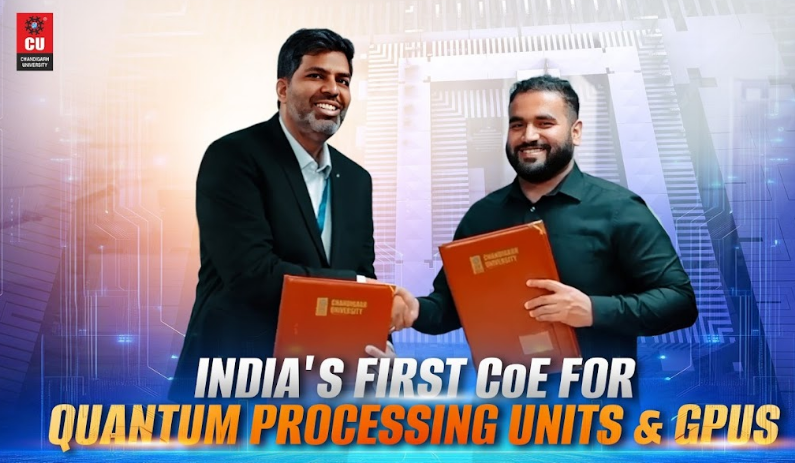
Chandigarh University has announced the establishment of a Center of Excellence (COE) for Quantum Processing Units (QPUs) and Graphics Processing Units (GPUs), alongside North India’s first Quantum Reference Facility. The initiative is positioned as a strategic step toward strengthening India’s deep-technology infrastructure and workforce readiness in quantum computing.
The project is being developed in collaboration with quantum technology firms QBIT Force and Qubitech, with Chandigarh University Mohali playing a central role in driving the initiative, and is aligned with the Government of India’s National Quantum Mission, which aims to accelerate domestic capabilities in advanced computing and secure technologies.
Core Infrastructure Components
| Component | Function | Output Focus |
|---|---|---|
| Center of Excellence (COE) | Research and technical training | Development of quantum and high-performance computing skills |
| Quantum Reference Facility | Controlled experimentation environment | Testing, simulation, and validation of quantum applications |
| Industry Partnership | Technical collaboration | Applied research and workforce preparation |
Operational Capabilities
The facility is designed to support practical development and experimentation in high-performance computing environments.
- Access to quantum hardware and GPU-based computing systems
- Development of algorithms and simulation models
- Training programs focused on emerging computing technologies
- Collaboration between academic researchers and industry engineers
- Testing of scalable computing solutions
Technology Domains Supported
| Domain | Functional Objective | Sector Impact |
|---|---|---|
| Cryptography | Secure data transmission systems | Banking, defense, digital infrastructure |
| Optimization | Resource and route planning models | Logistics, manufacturing |
| Artificial Intelligence | Processing large datasets efficiently | Technology and analytics |
| Scientific Simulation | Modeling complex systems | Research and engineering |
Workforce and Research Implications
The initiative is structured to produce technical capability rather than promotional outcomes. Its effectiveness will depend on sustained research output, infrastructure reliability, and industry engagement.
Expected outcomes include:
- Skilled professionals trained in quantum and high-performance computing
- Industry-linked research projects
- Prototype development and testing
- Expansion of computational research capacity