The global shift toward automation is no longer theoretical. Industries are replacing repetitive human tasks with intelligent machines to improve speed, precision, and safety. From factory floors to hospitals and logistics hubs, robotics systems are becoming operational infrastructure rather than experimental technology. This transition is being driven by engineers trained specifically in robotics and automation.
Market projections show the robotics and automation sector growing at an estimated 14%-16% compound annual growth rate (CAGR), with industry value expected to rise from roughly USD 50 billion in 2025 to more than USD 110 billion by 2030. The demand for skilled professionals is increasing across manufacturing, healthcare, energy, and logistics.
Against this backdrop, Chandigarh University, Uttar Pradesh has introduced a structured B.Tech in Robotics & Automation program designed to prepare students for technical roles in automation-driven industries.
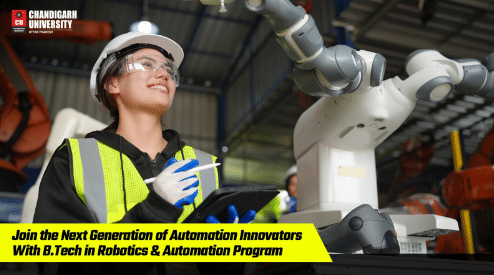
Program Overview: B.Tech in Robotics & Automation at Chandigarh University, Uttar Pradesh
The four-year undergraduate program integrates multiple engineering disciplines rather than focusing on a single specialization. Students study the core technologies used to design, program, and operate automated systems in industrial environments.
Key Academic Components
| Component | Focus Area | Outcome |
|---|---|---|
| Mechanical Systems | Machine design and motion control | Understanding physical system behavior |
| Electrical & Electronics | Circuits, sensors, and actuators | System control and signal processing |
| Computer Engineering | Programming and automation software | System integration and logic development |
| Embedded Systems | Hardware-software interaction | Real-time automation capability |
The curriculum emphasizes operational skills, system reliability, and safety standards commonly required in industrial settings.
Why Robotics & Automation Is Expanding Across Industries
Automation adoption is being driven by measurable operational benefits rather than technological novelty. Organizations are implementing robotics to reduce production errors, improve consistency, and maintain output under labor shortages.
Examples of Current Industry Use
- Automotive Manufacturing: Robotic arms handle welding, assembly, and inspection processes
- Healthcare: Surgeons use robotic-assisted systems for precision procedures
- Logistics: Automated sorting and storage systems manage high-volume deliveries
- Energy & Utilities: Remote-controlled inspection robots monitor hazardous environments
These applications demonstrate that robotics has moved from specialized environments into routine operations.
Program Highlights at Chandigarh University, Uttar Pradesh
The program structure focuses on practical exposure and industry alignment rather than theoretical-only instruction.
Core Features
- Multidisciplinary Curriculum combining mechanical, electronics, and computing technologies
- Hands-on Lab Work Each Semester involving system design and testing
- Industry-Oriented Training aligned with automation and AI-driven workflows
- Faculty with Technical and Industrial Experience
- Skill Development for Operational Roles in automation and manufacturing sectors
Learning Approach
Students participate in structured technical activities designed to mirror workplace scenarios.
Typical Practical Activities
- Building automated control systems
- Programming robotic devices
- Designing sensor-based applications
- Testing embedded hardware platforms
- Troubleshooting mechanical and electrical faults
The objective is to ensure graduates can operate and maintain automation systems immediately after employment.
Career Opportunities After Graduation
Graduates from the B.Tech in Robotics & Automation at Chandigarh University, Uttar Pradesh can pursue technical roles across several industrial sectors.
Common Job Roles
- Robotics Engineer
- Automation Engineer
- Control Systems Engineer
- Mechatronics Engineer
- Embedded Systems Engineer
- Manufacturing Engineer
- Maintenance Engineer
Industries Hiring Robotics & Automation Professionals
- Automotive manufacturing
- Aerospace and defense
- Consumer electronics
- Healthcare equipment
- Logistics and supply chain
- Industrial manufacturing
Potential Recruiters
Engineering graduates from Chandigarh University, Uttar Pradesh may find employment opportunities with organizations across public and private sectors.
Representative Employers
- NTPC
- DRDO
- BHEL
- Siemens
- ABB
- Adani Group
- Deloitte
- GE HealthCare
- Larsen & Toubro (L&T)
- Philips
- Schneider Electric
- Tata Motors
- Reliance Industries
- IBM
- TCS
- Infosys
- Wipro
Placement outcomes depend on individual performance, technical skills, and market demand.
Admission Process: Chandigarh University, Uttar Pradesh
Admission to the program is conducted through the CUCET (Chandigarh University Common Entrance Test).
Steps to Apply
- Register on the CUCET portal using basic personal details
- Complete the application form for the Robotics & Automation program
- Take the entrance test to determine eligibility and scholarship consideration
- Confirm admission after result declaration
Scholarship Information
- Merit-based scholarships are available
- Awards may cover up to 100% tuition, subject to eligibility criteria
Infrastructure and Learning Environment
Chandigarh University, Uttar Pradesh operates with technology-enabled academic infrastructure designed to support engineering education.
Available Facilities
- Robotics and automation laboratories
- AI-enabled learning platforms
- Simulation and testing environments
- Project-based learning spaces
- Industry-oriented training modules
The institution positions its infrastructure to support practical engineering training rather than purely academic study.
Conclusion
Automation is expanding because industries require consistent output, operational efficiency, and reduced risk. The workforce demand is shifting toward engineers capable of designing, operating, and maintaining intelligent systems.
The B.Tech in Robotics & Automation at Chandigarh University, Uttar Pradesh is structured to address that demand through technical training, multidisciplinary education, and industry-focused skill development. Students entering this field are preparing for roles in sectors where automation is becoming a standard operational requirement rather than a future possibility.