
XAT 2006 Question Paper with Solutions PDF


| Updated On - Jul 16, 2026
The XAT 2006 question paper is available here with detailed solutions for free download. XAT is conducted every year by XLRI Jamshedpur, and the 2006 paper ran for 2 hours with 170 questions across English & Reading Comprehension, General Awareness, and Quantitative & Analytical Ability.
| XAT 2006 Question Paper with Solutions | Download PDF | Check Solutions |
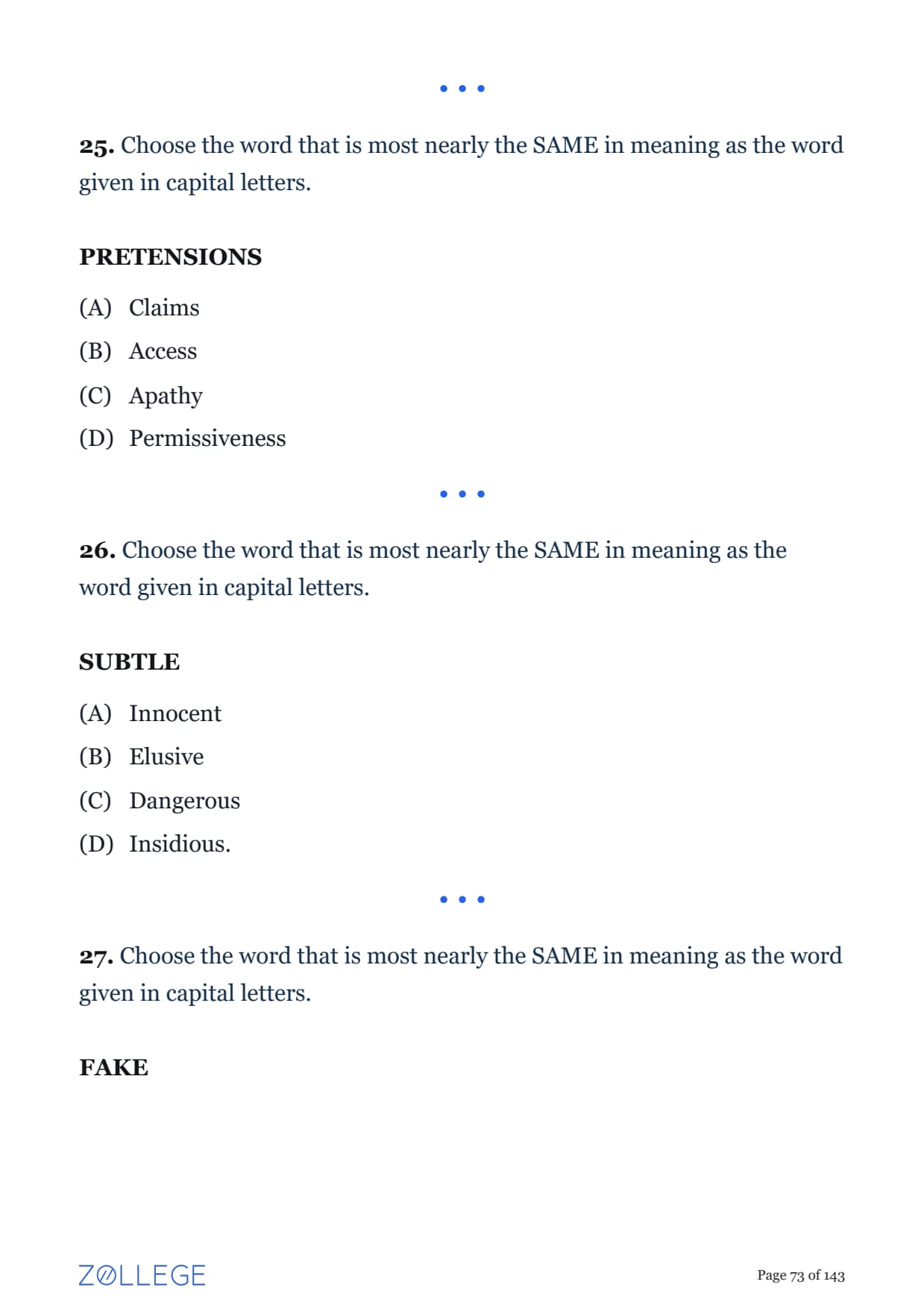
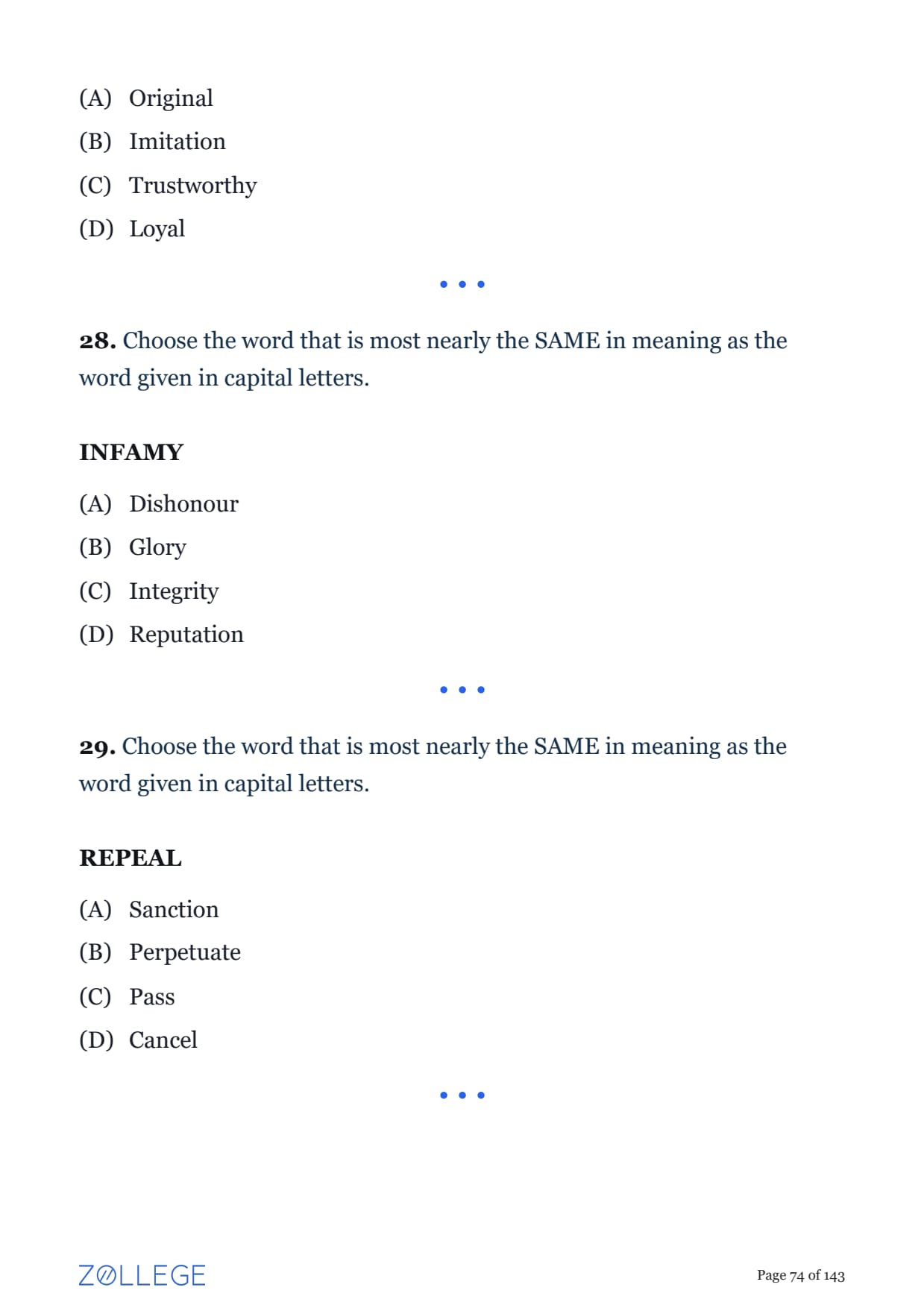
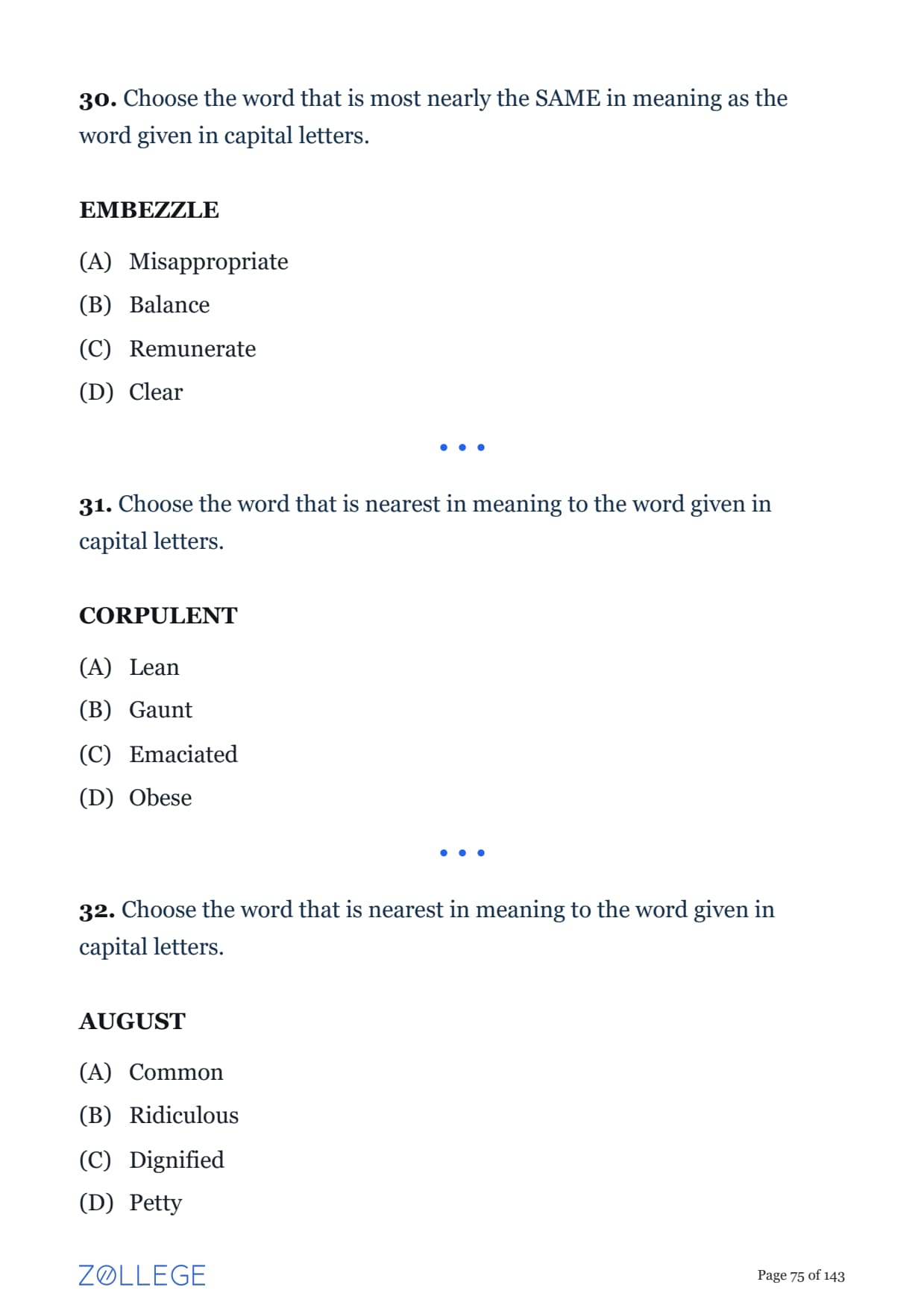
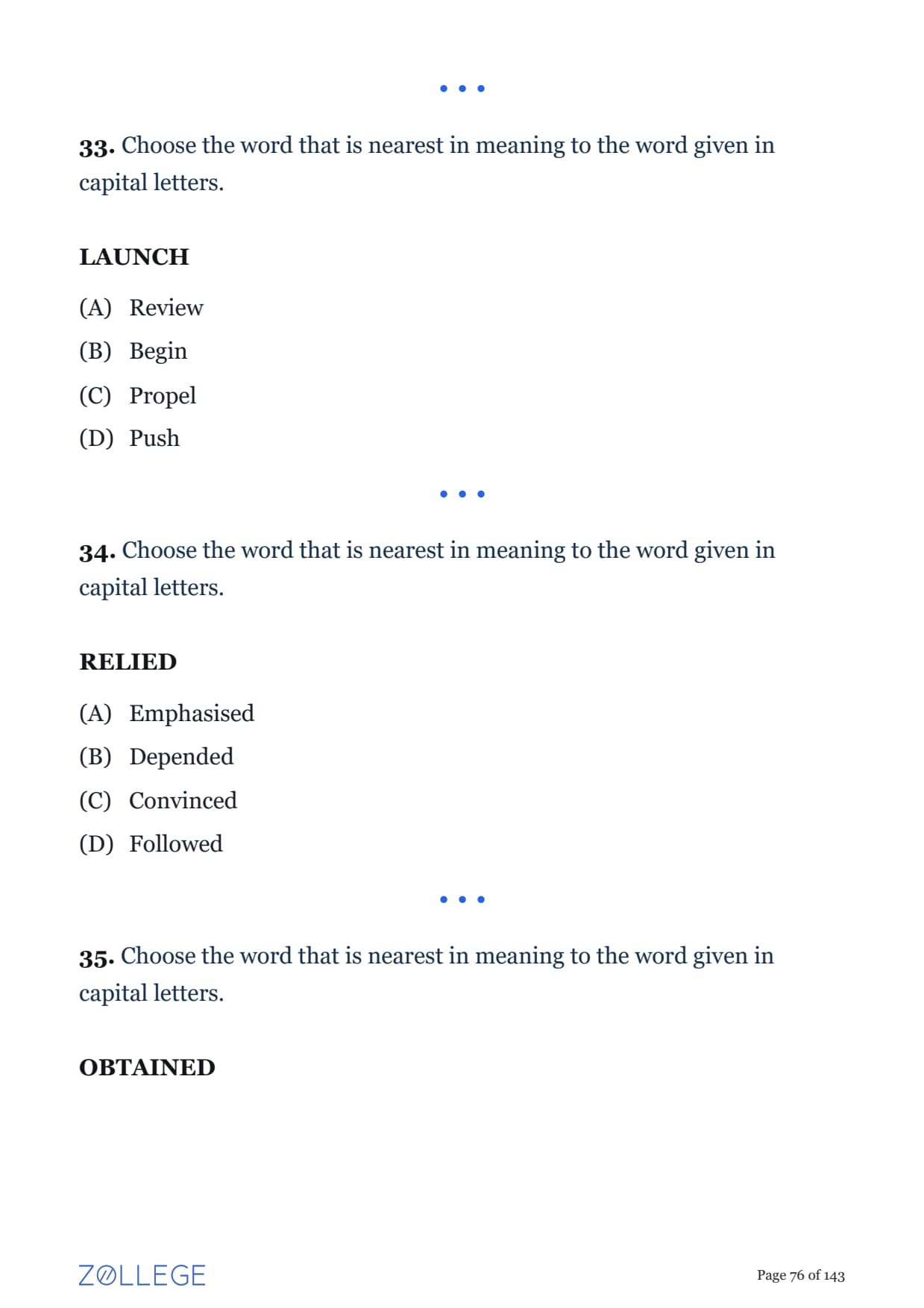
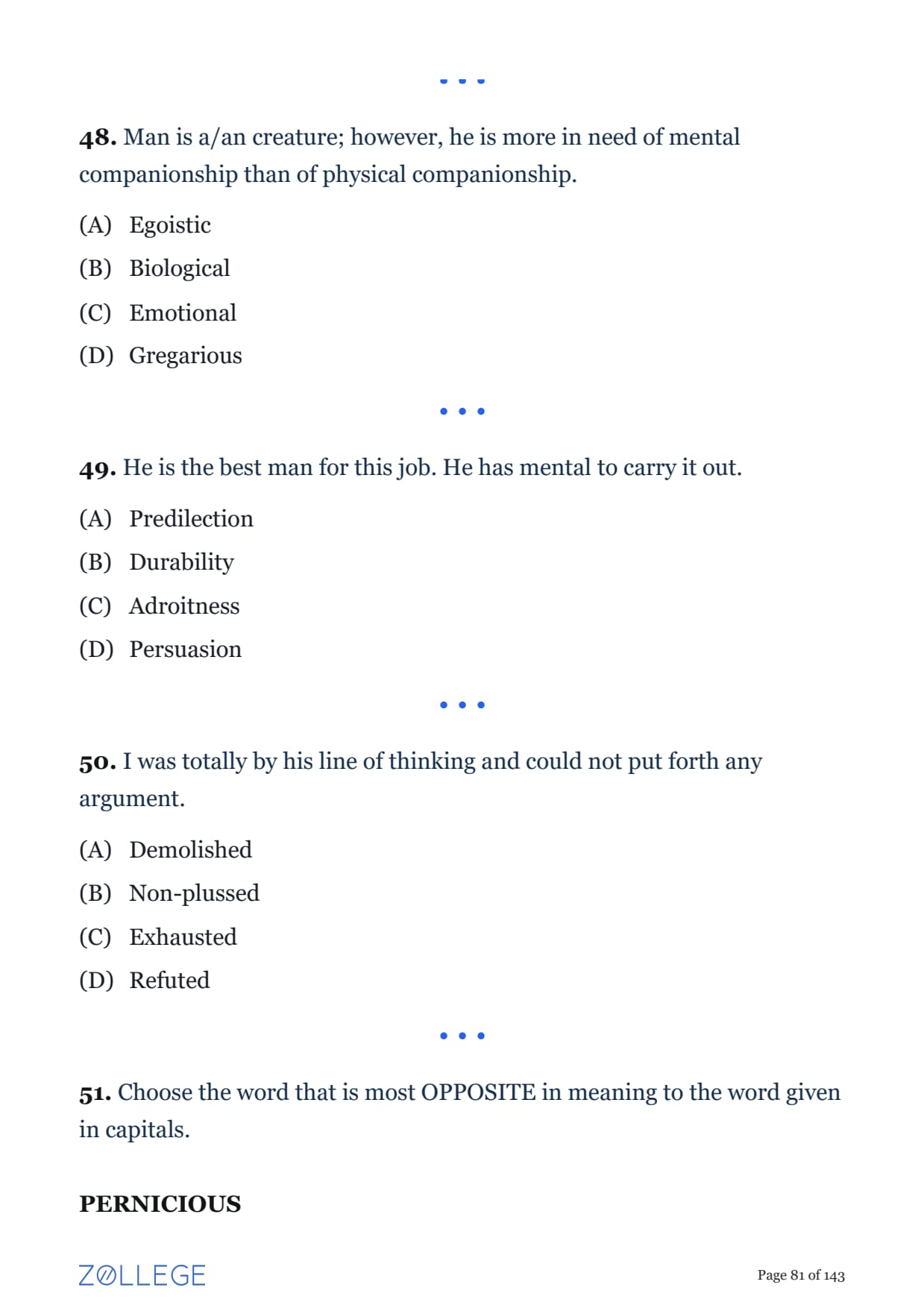
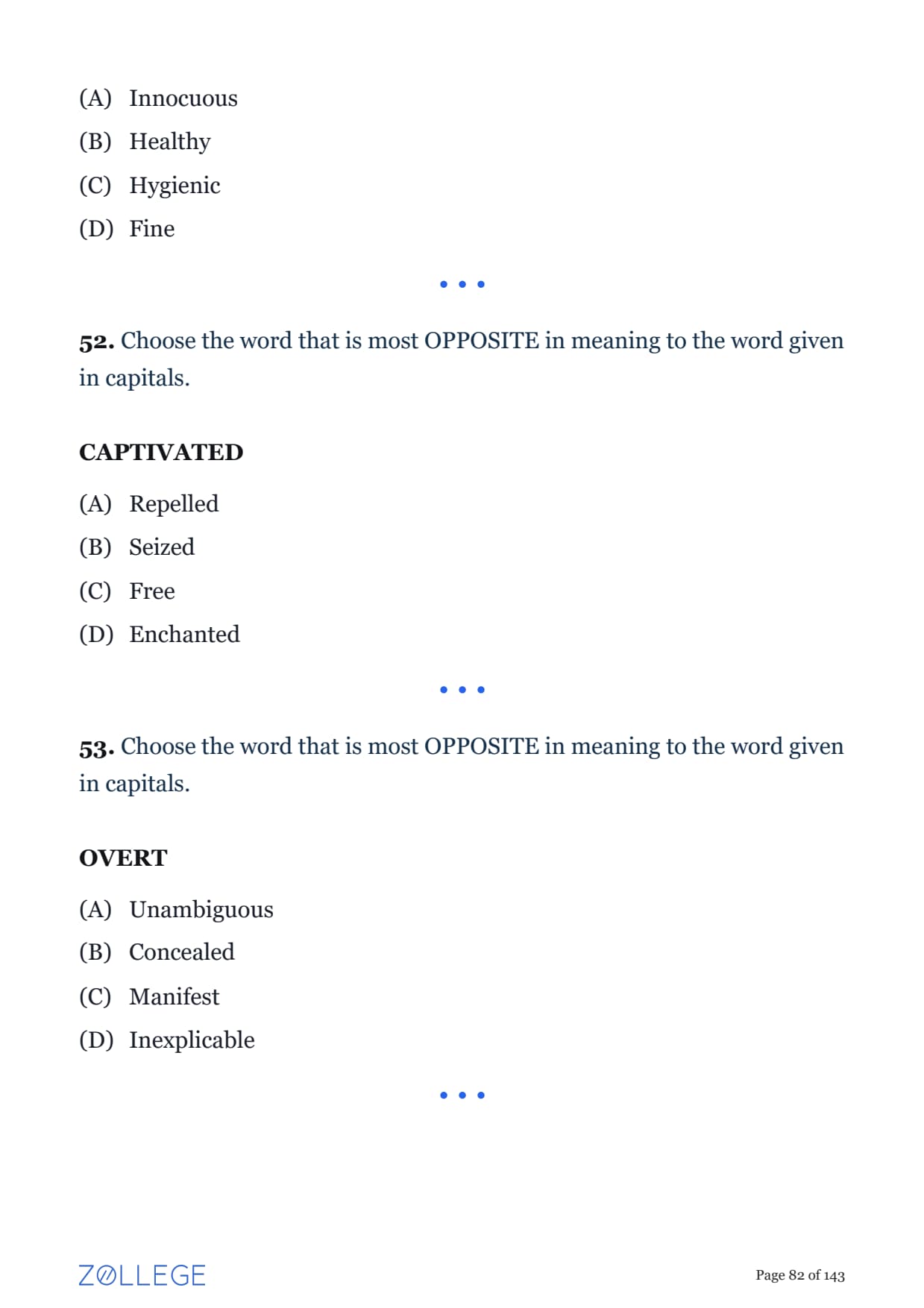
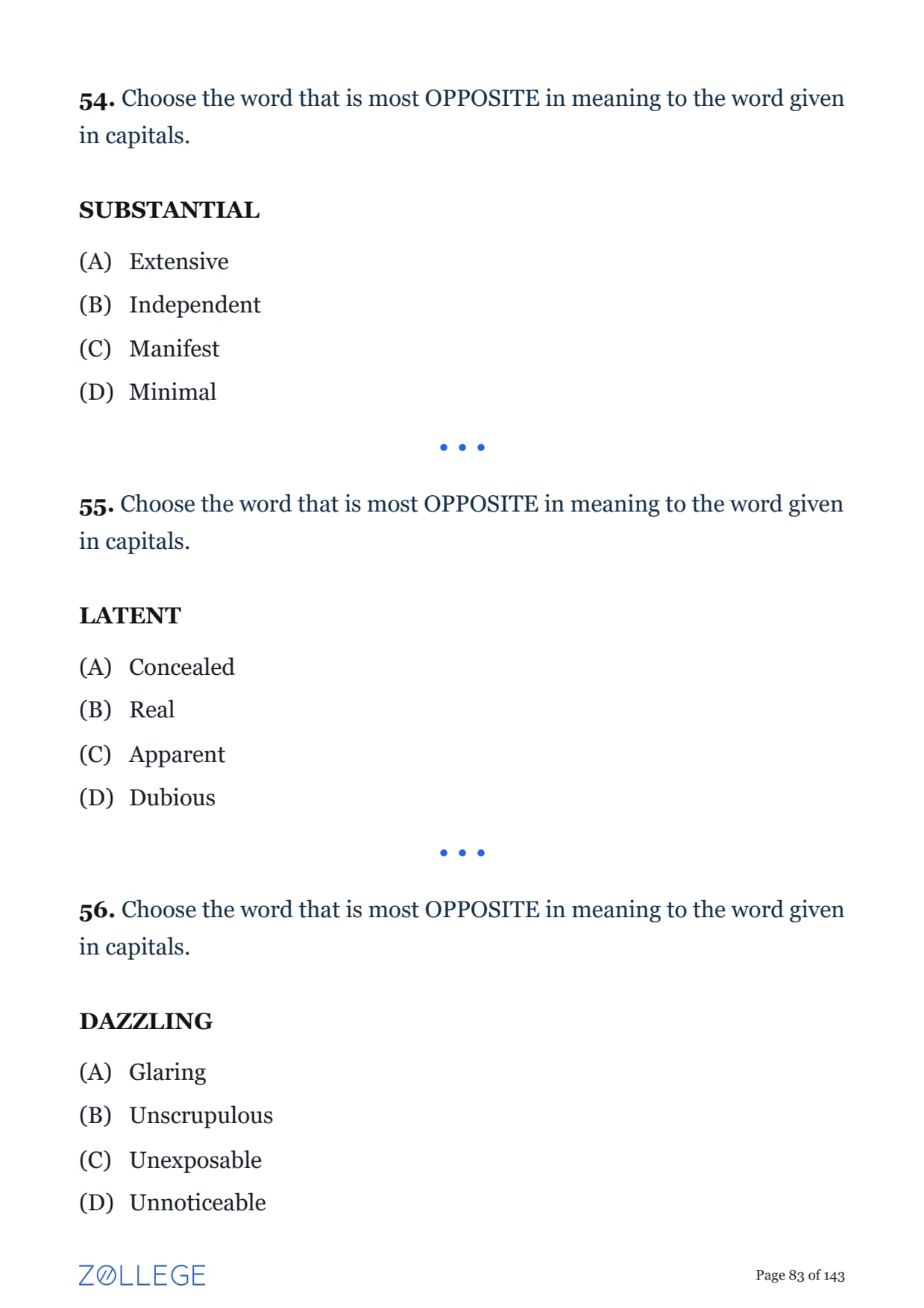
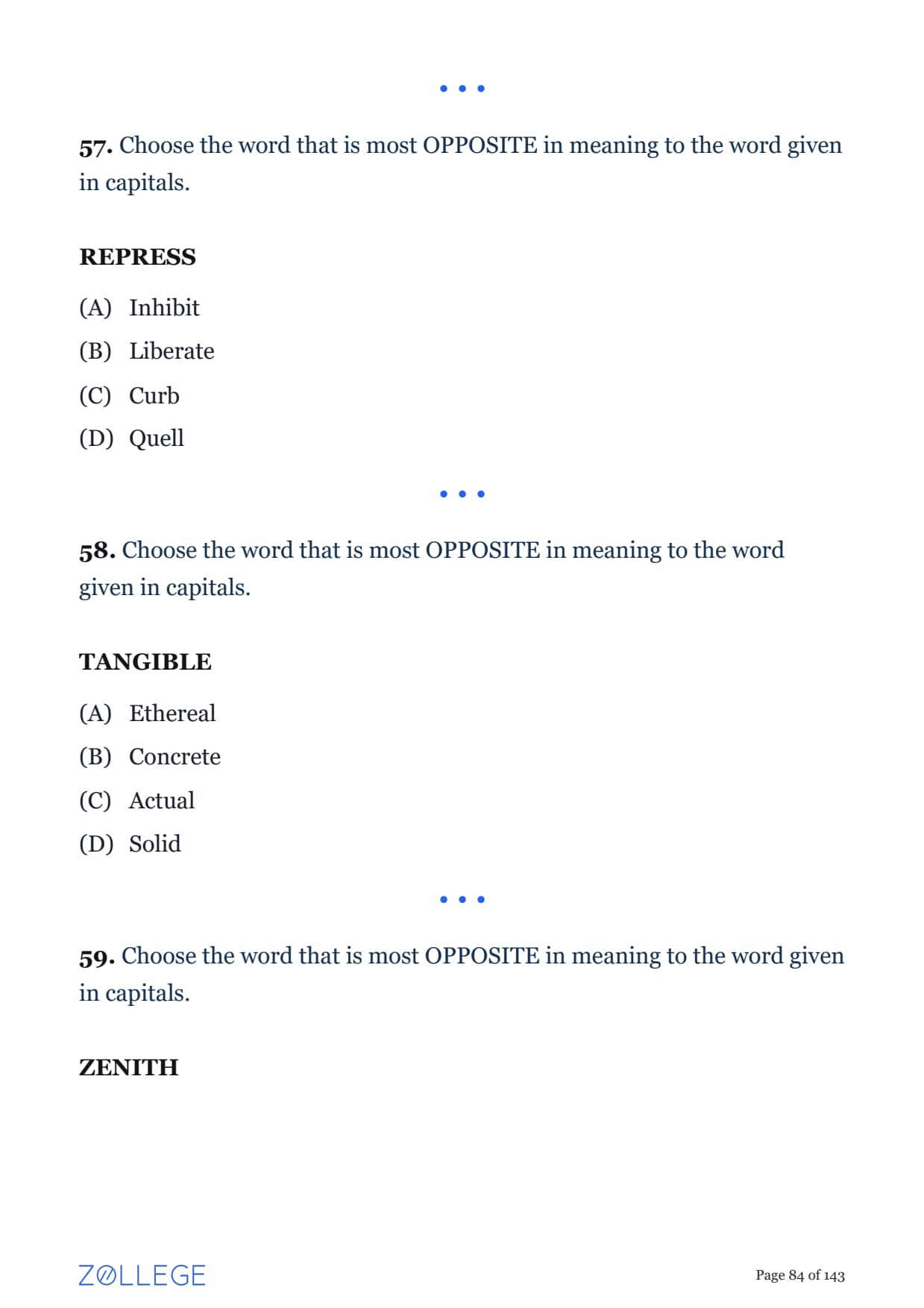
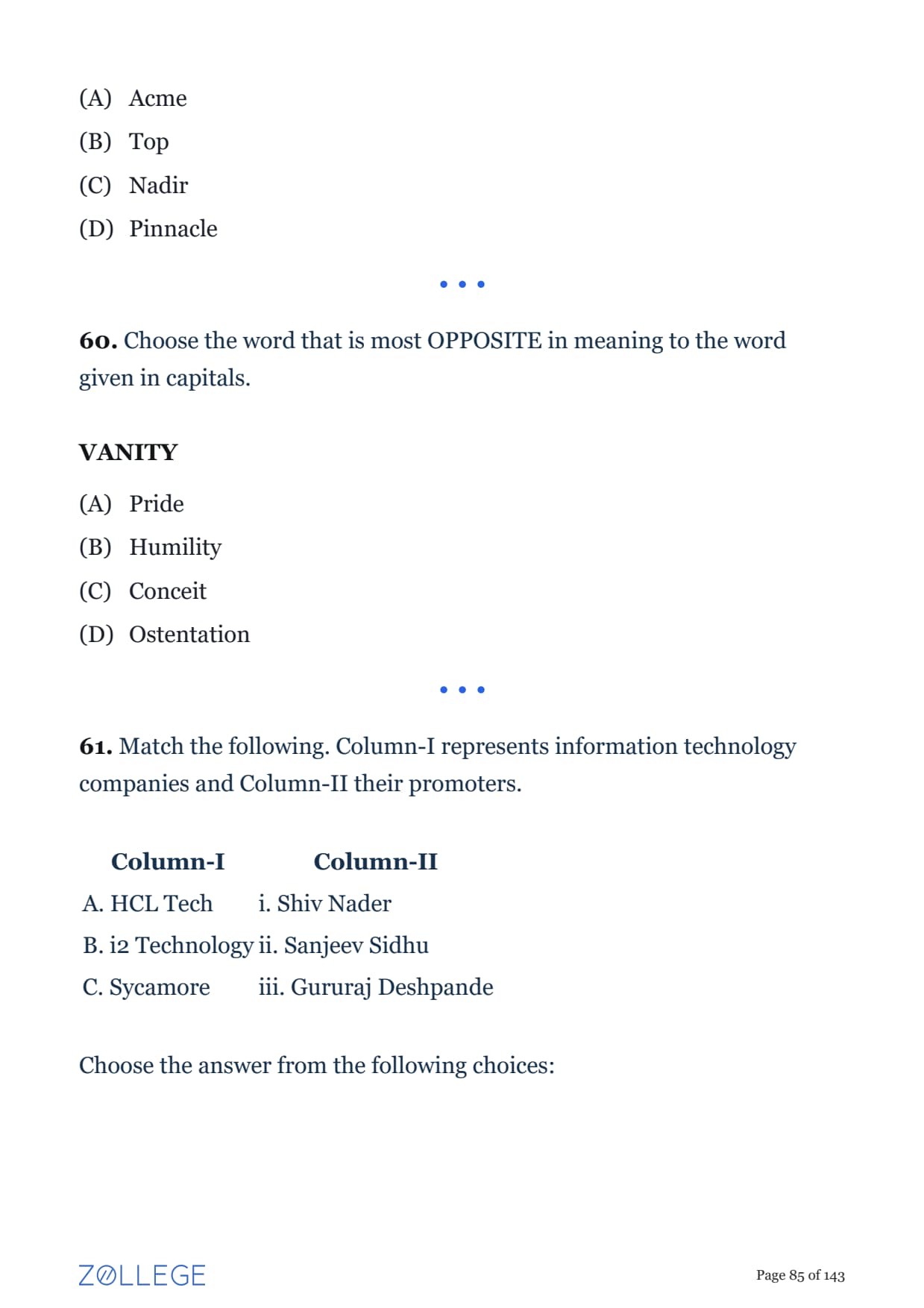
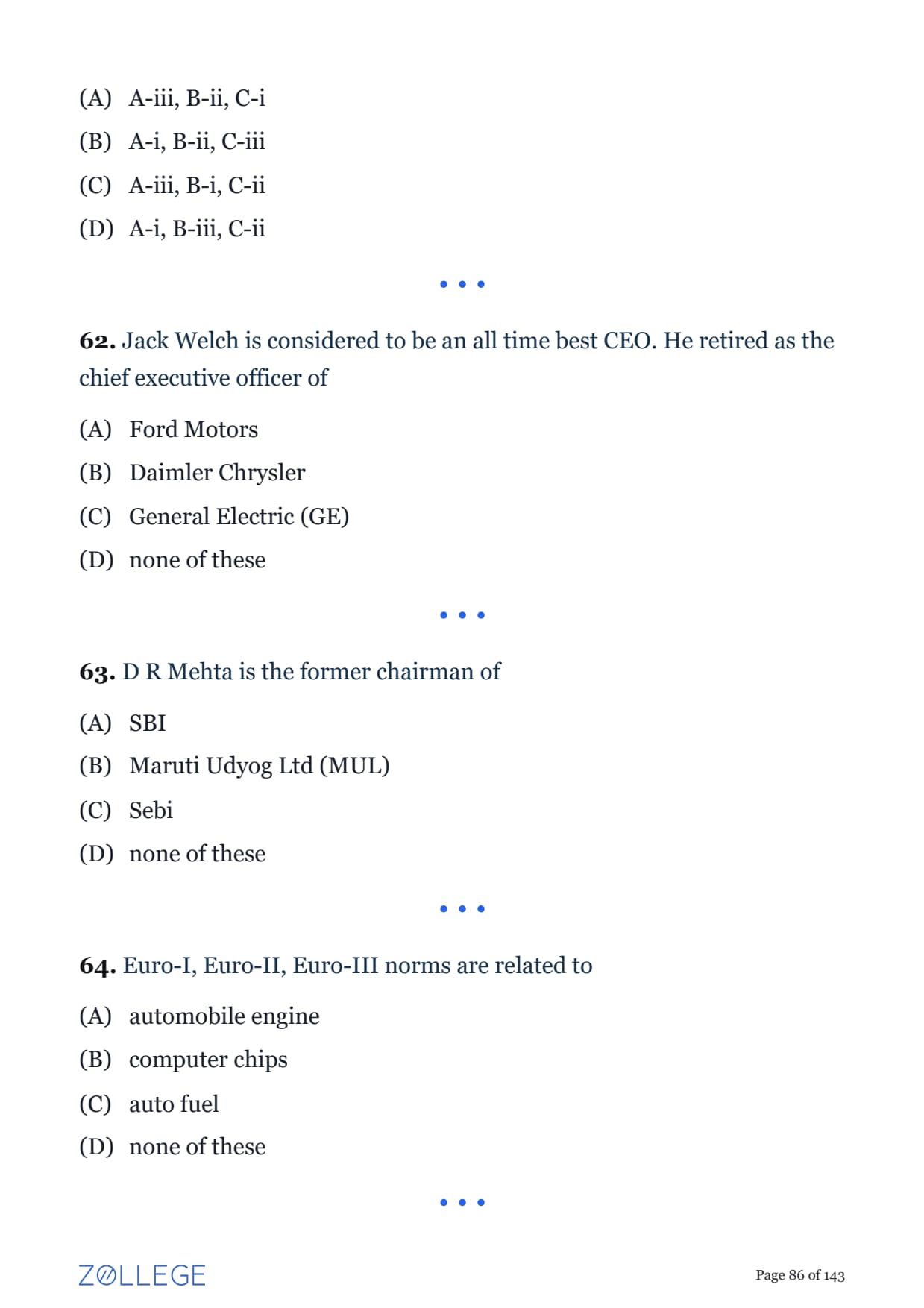
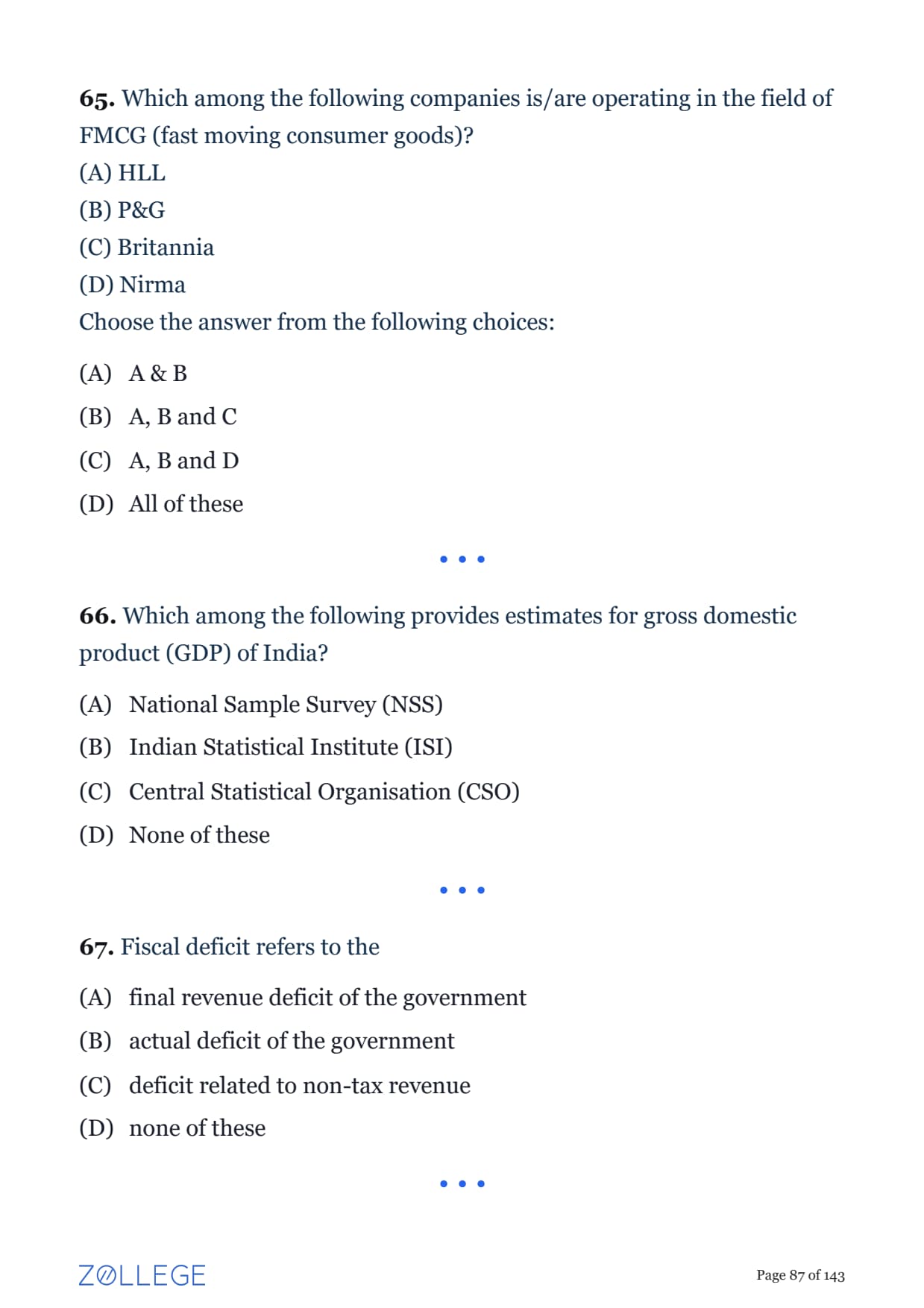
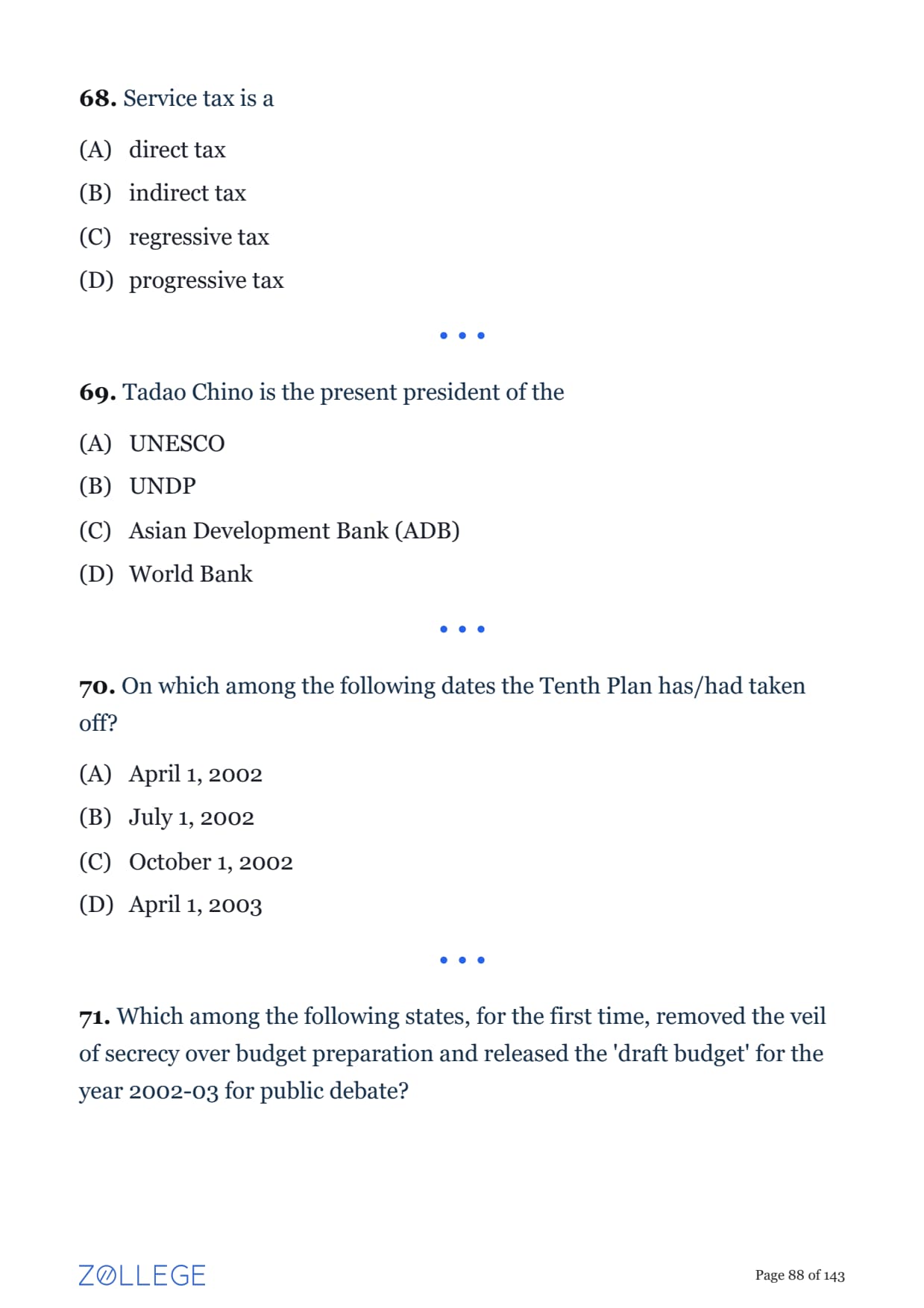
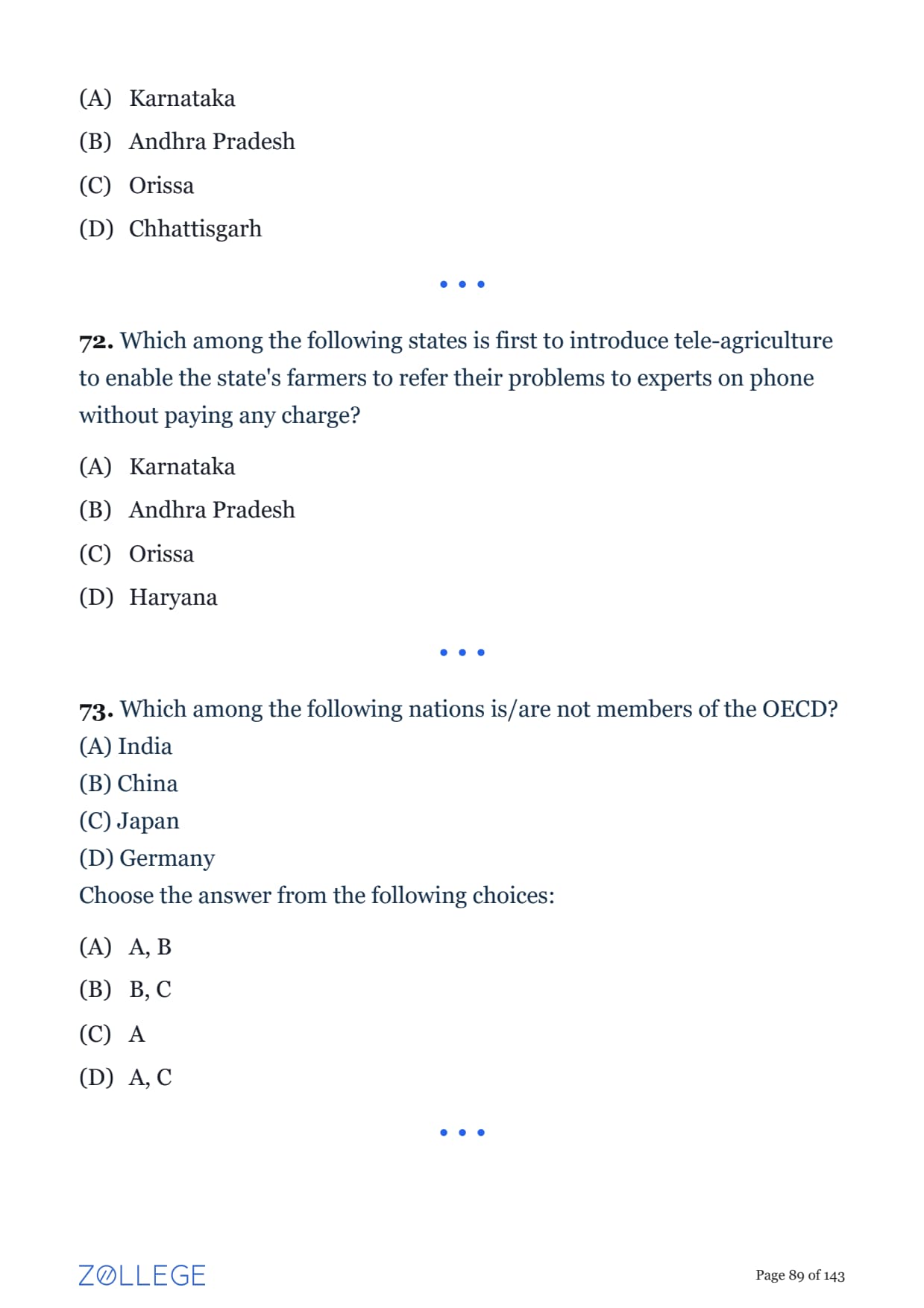
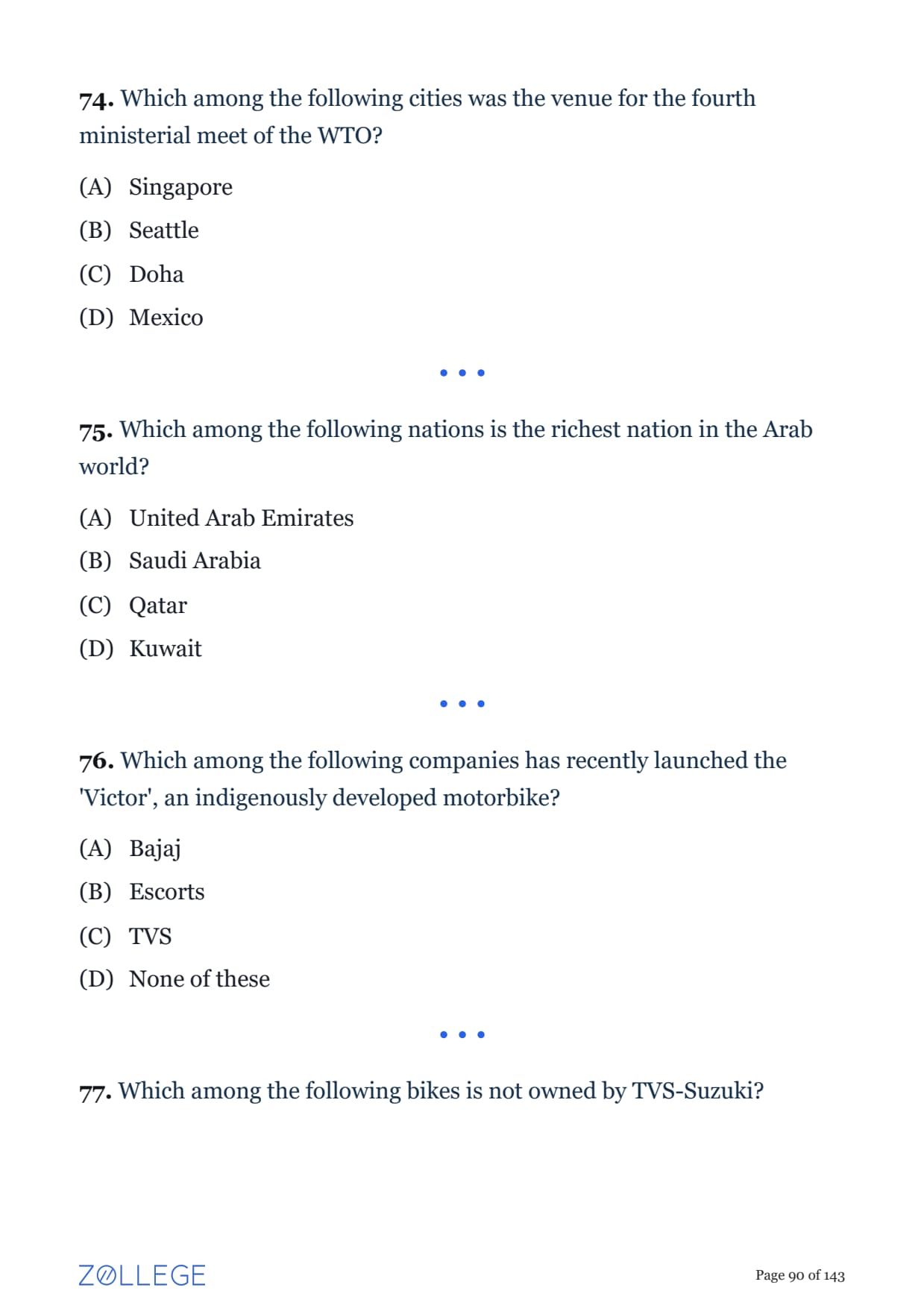
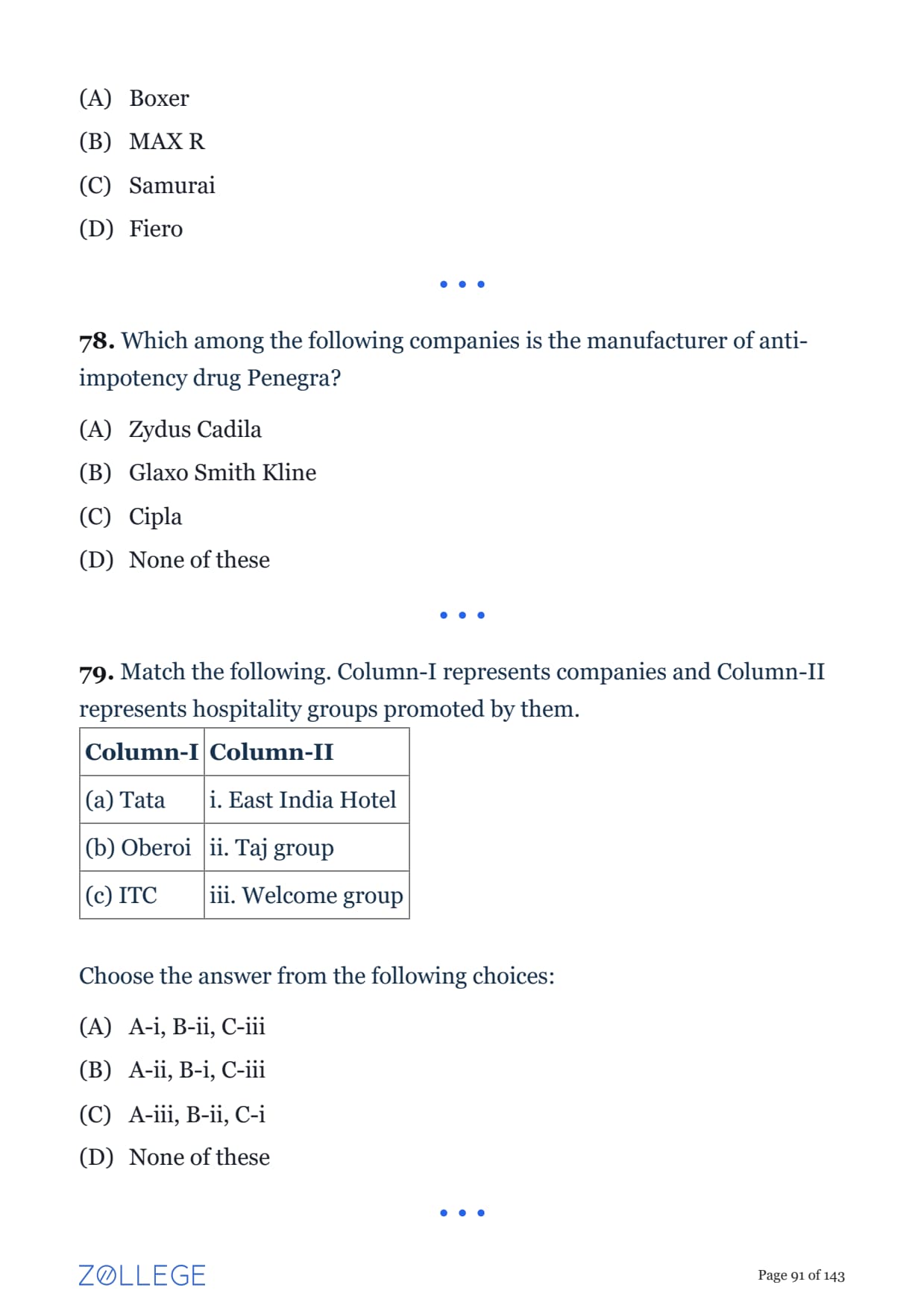
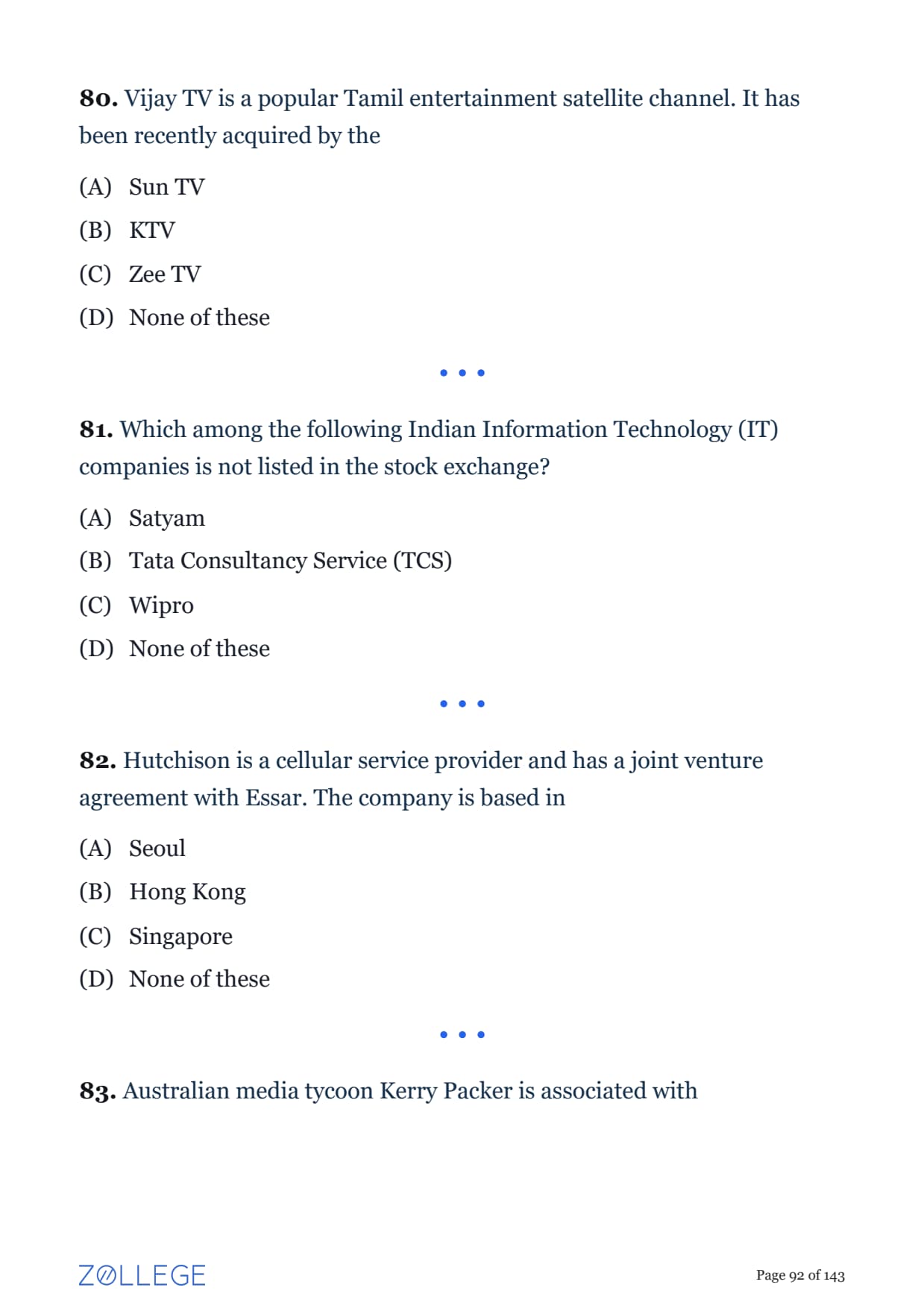
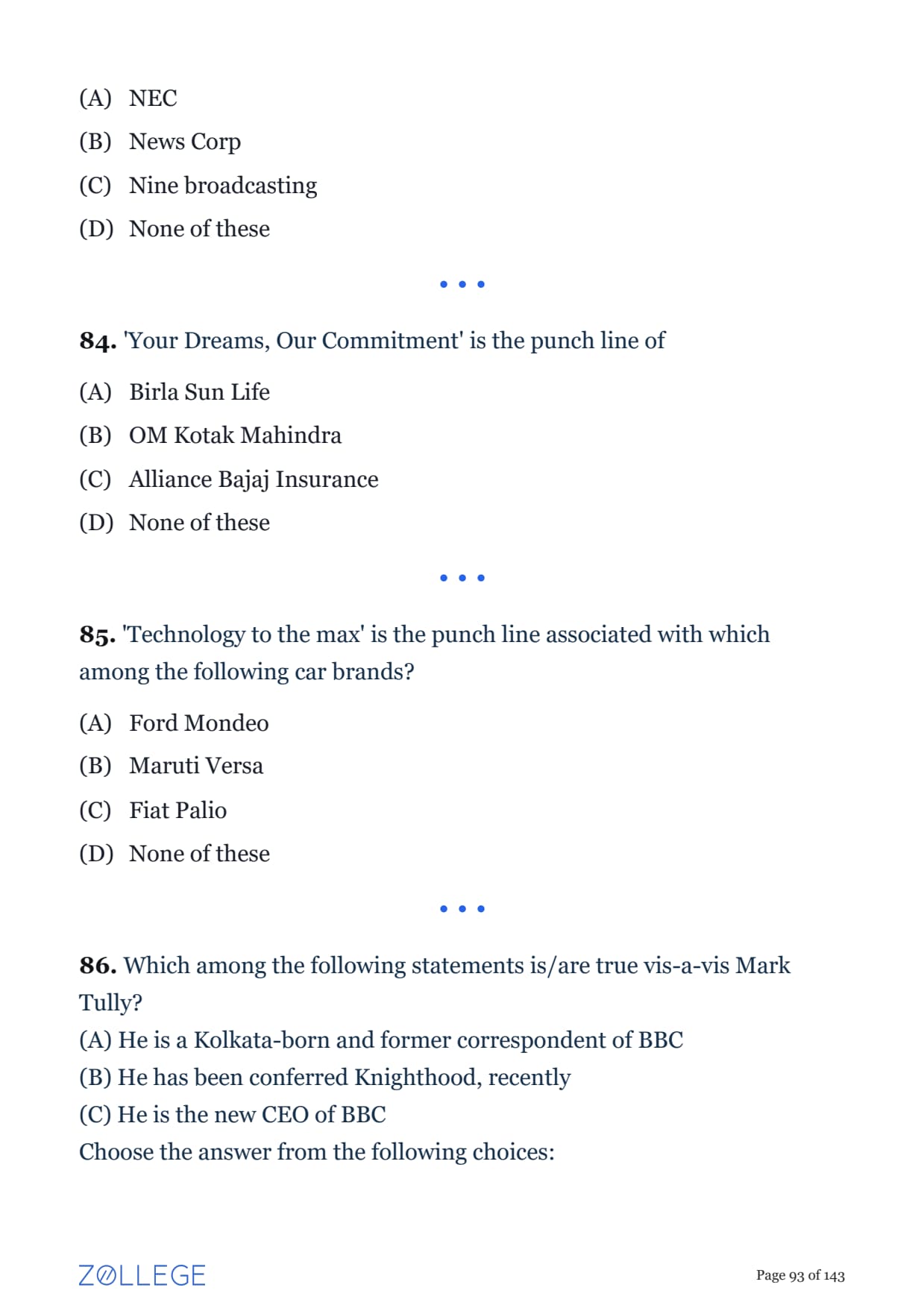
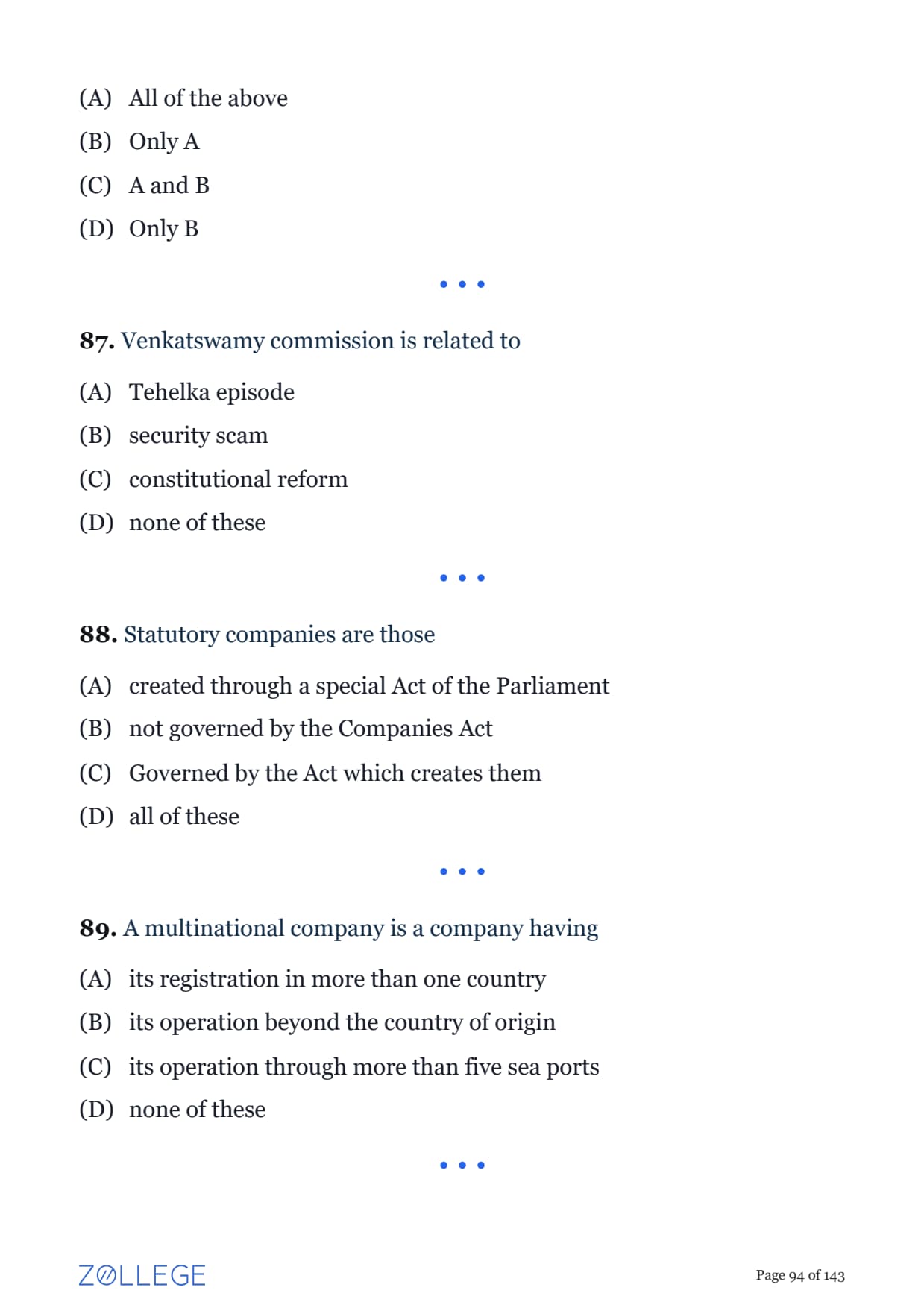
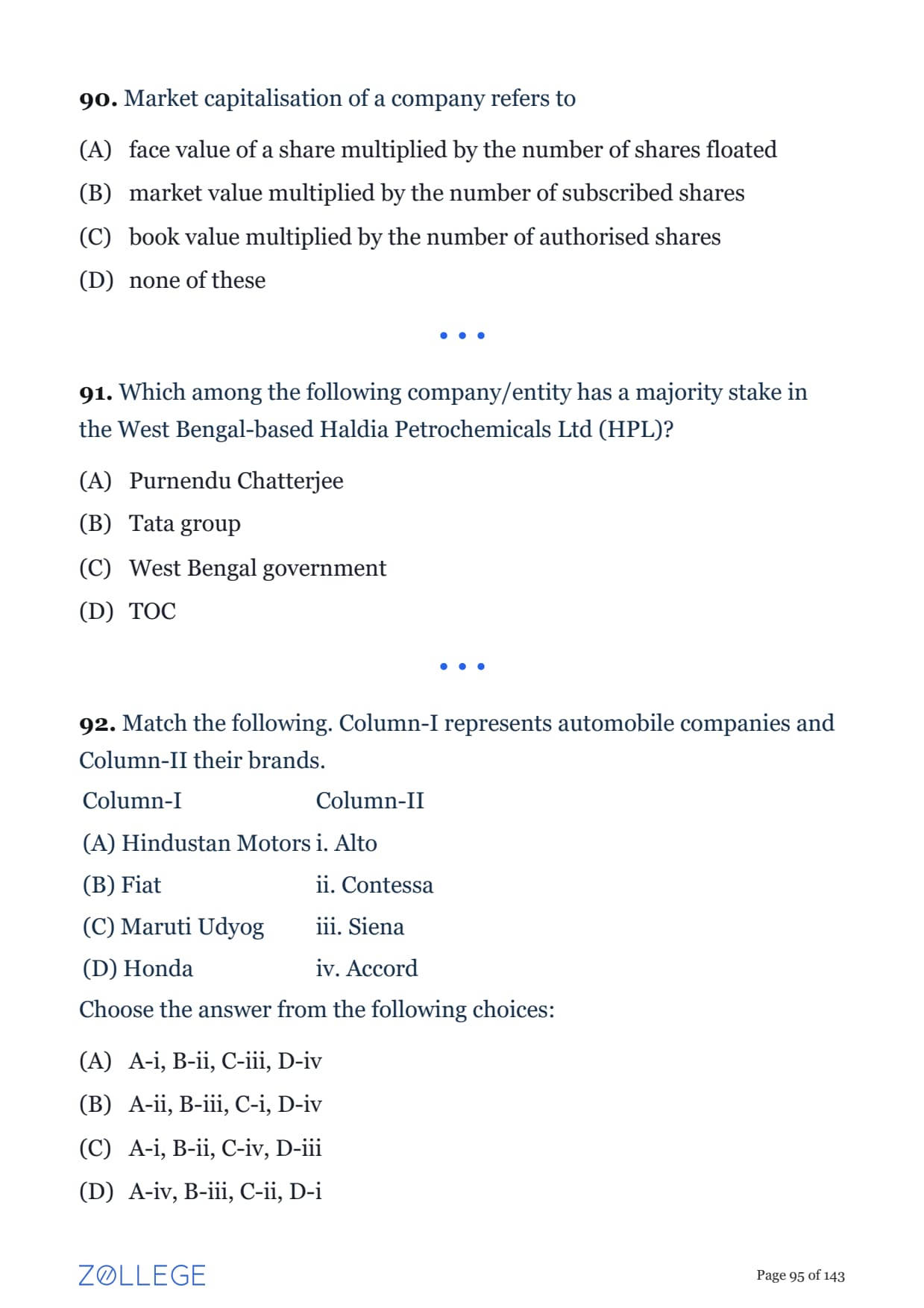
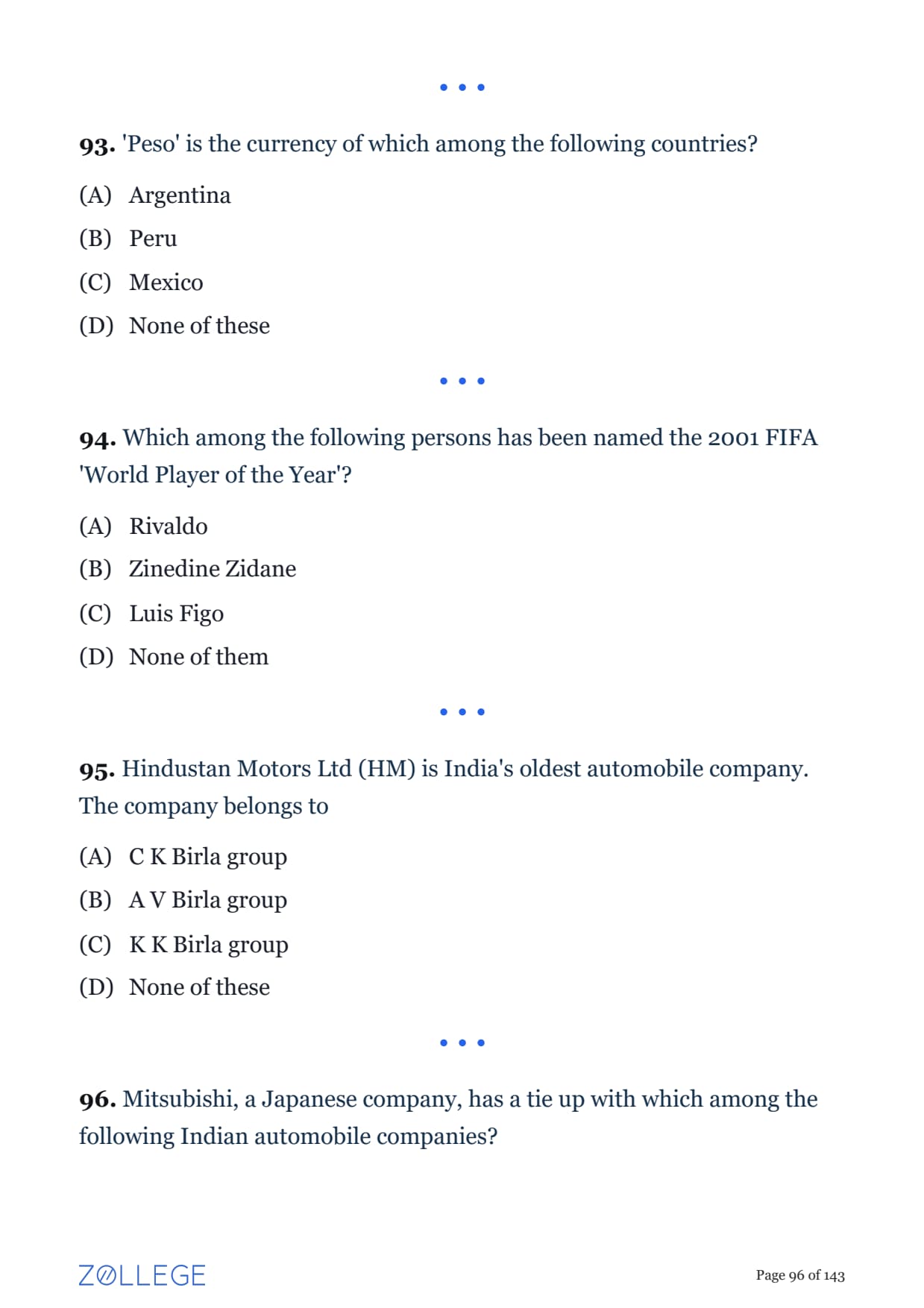
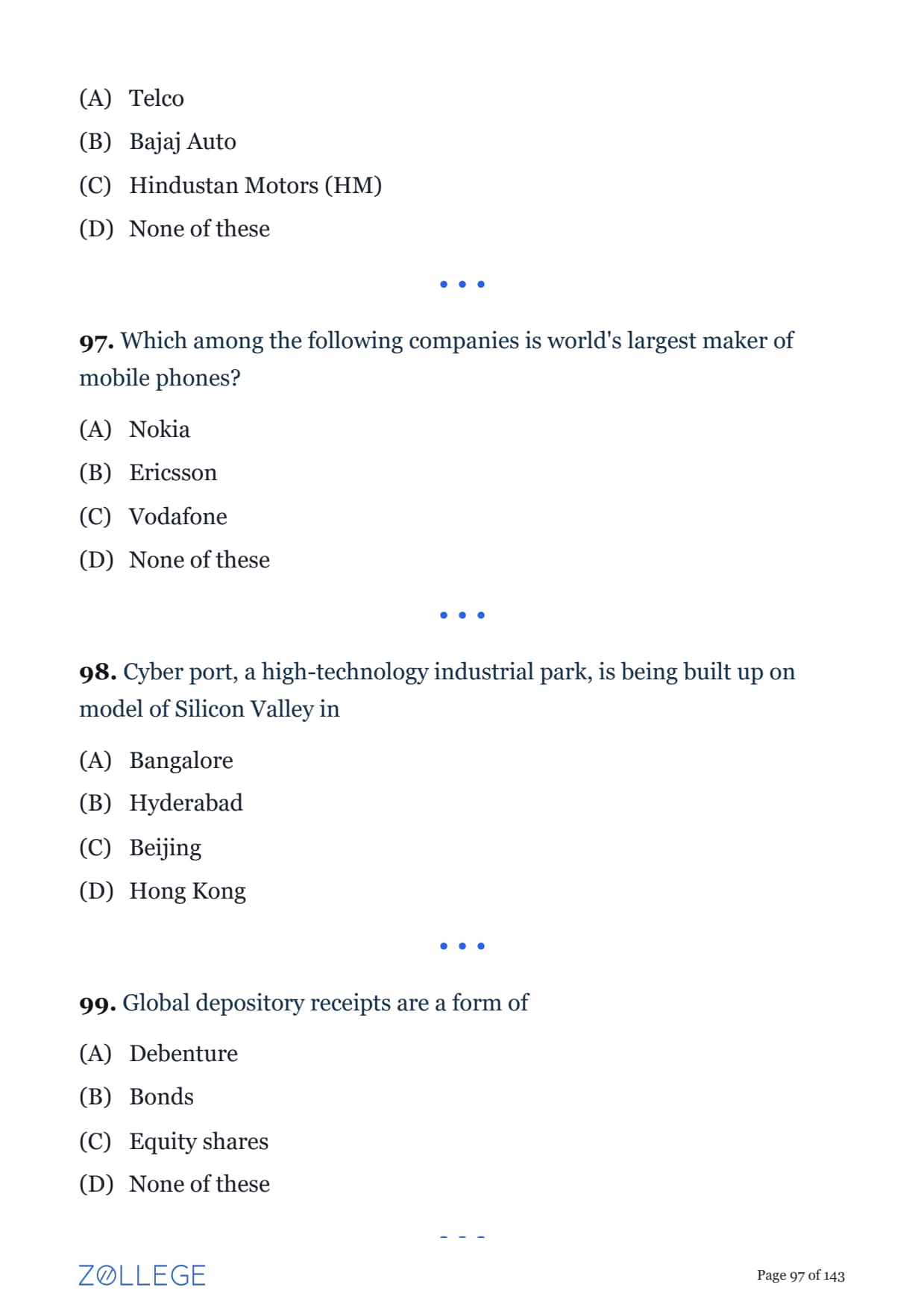
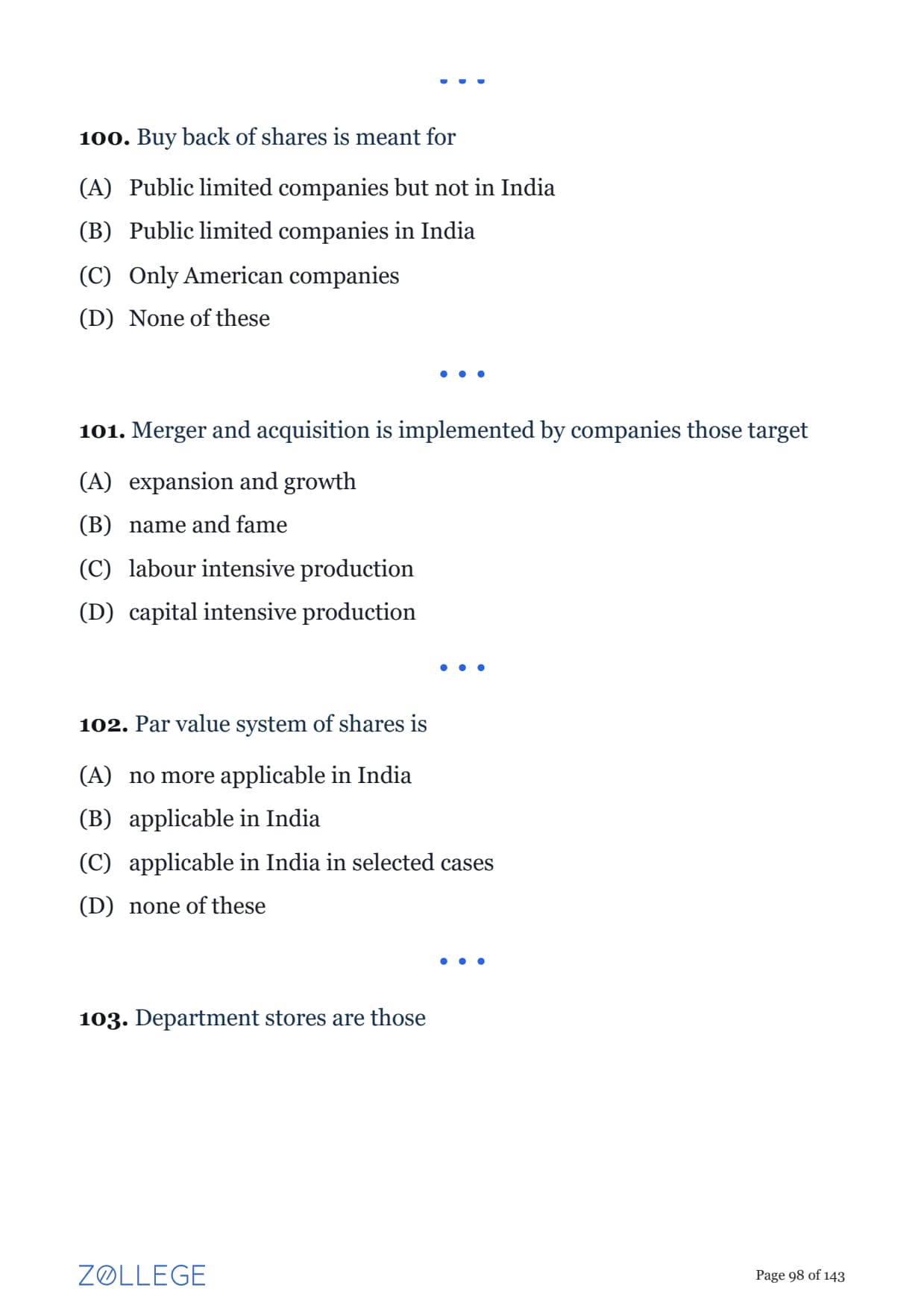
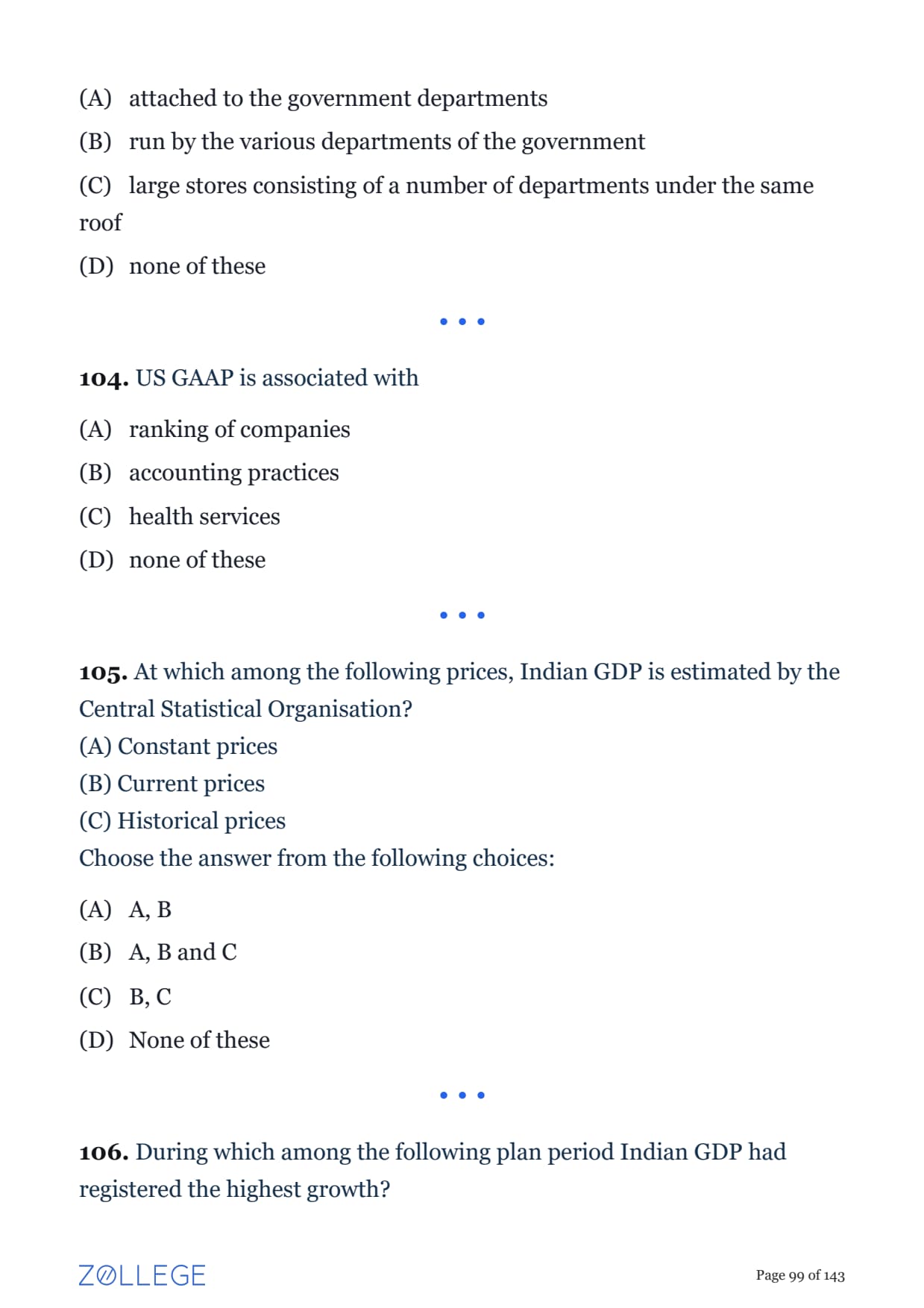
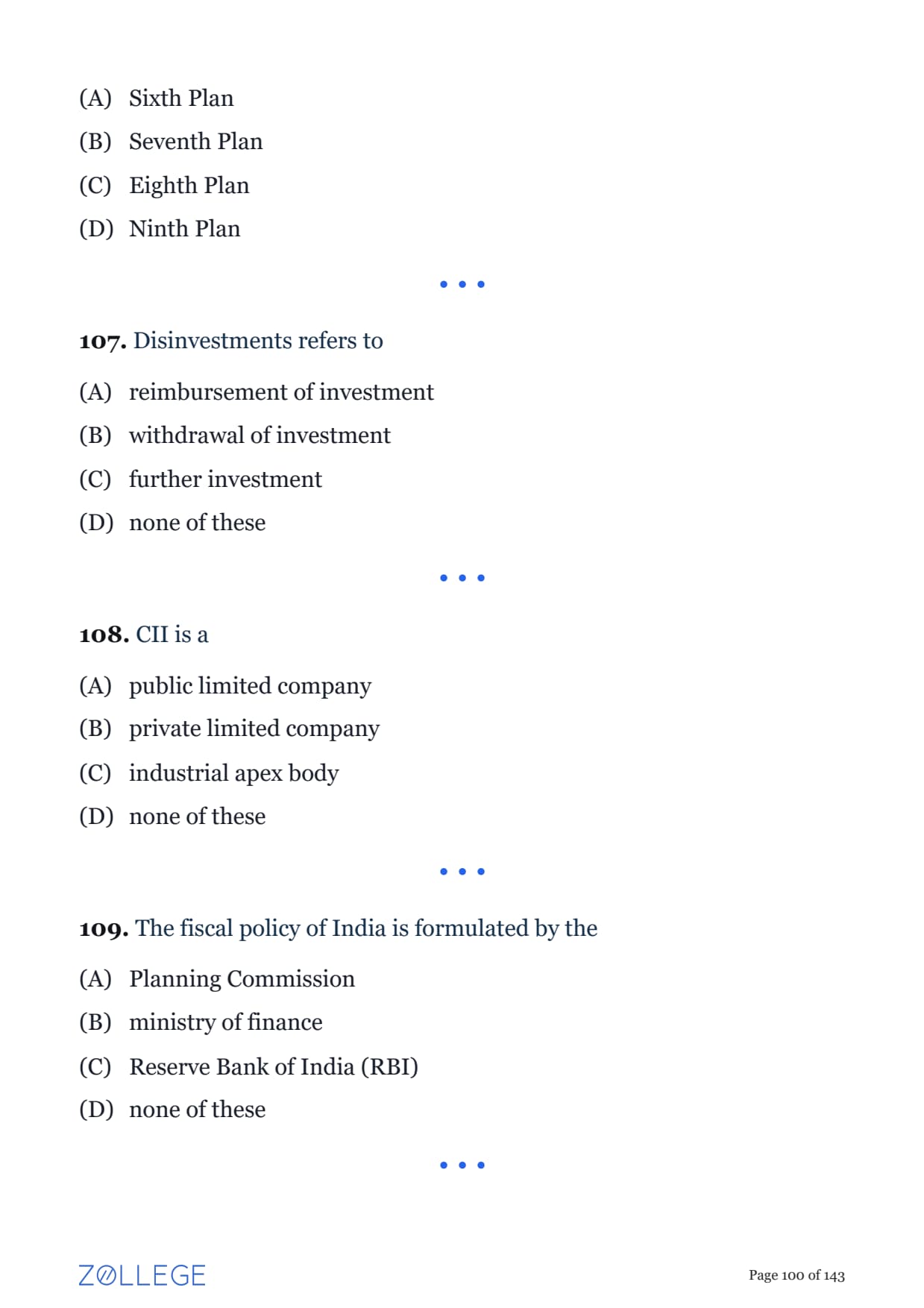

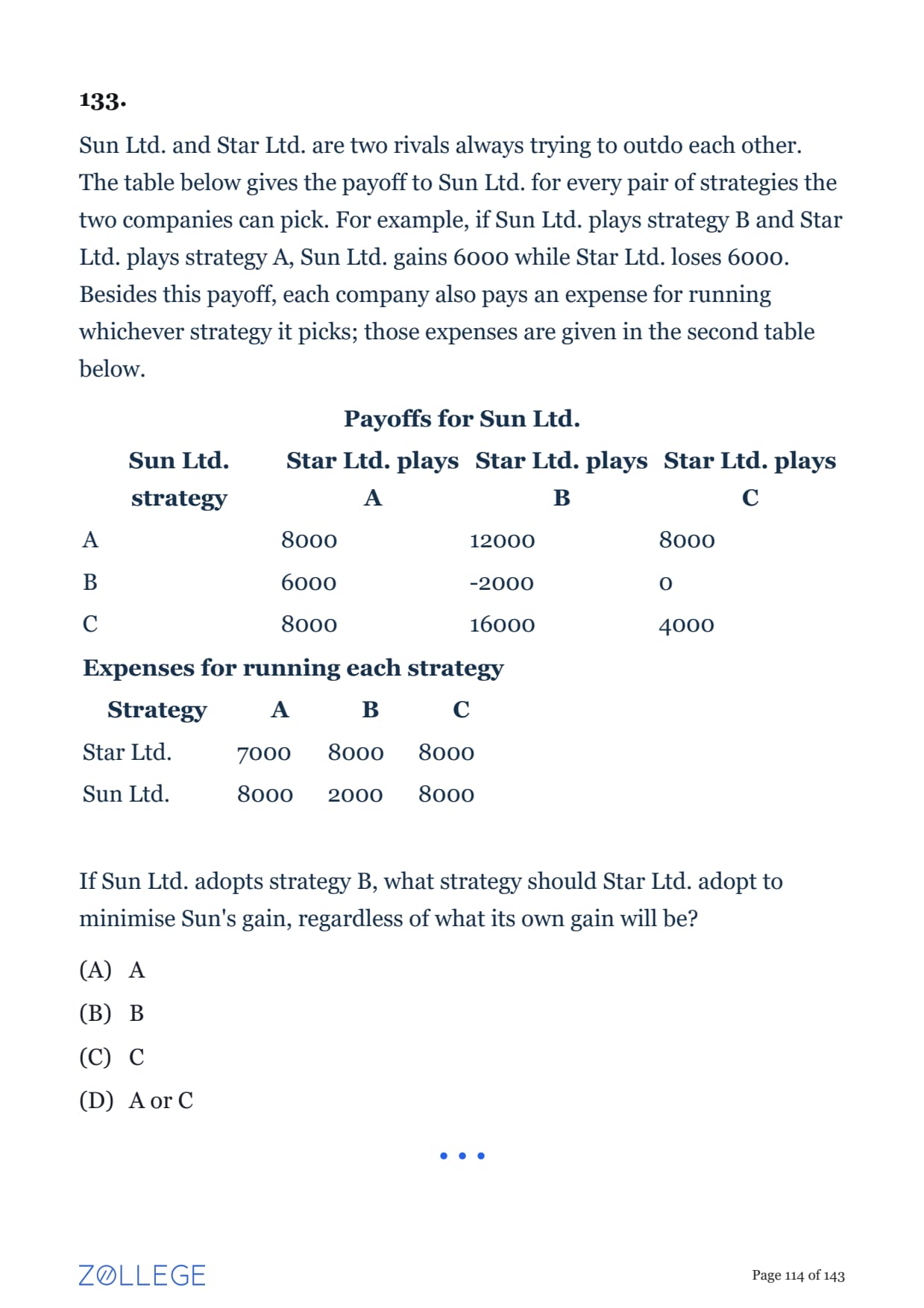
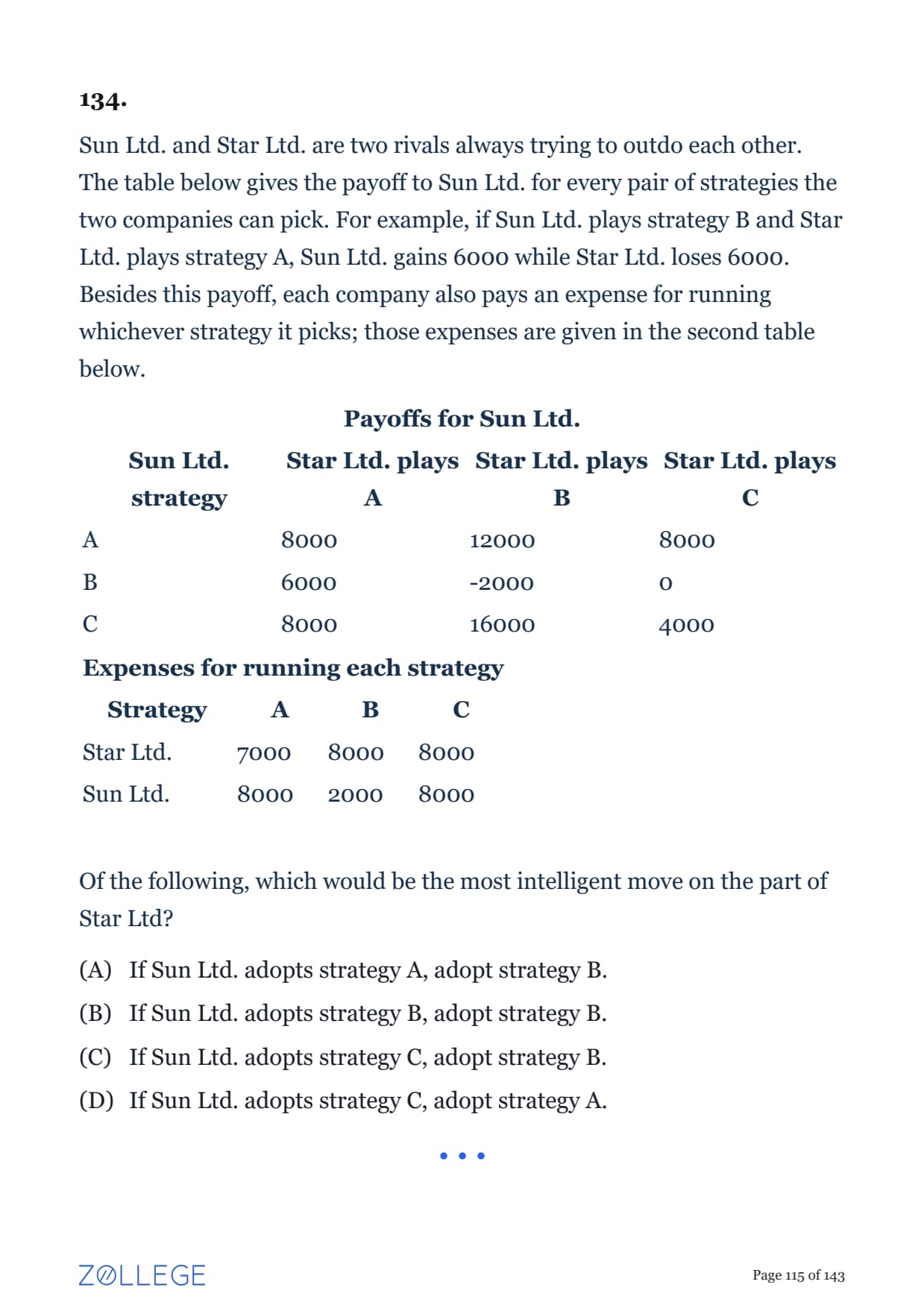
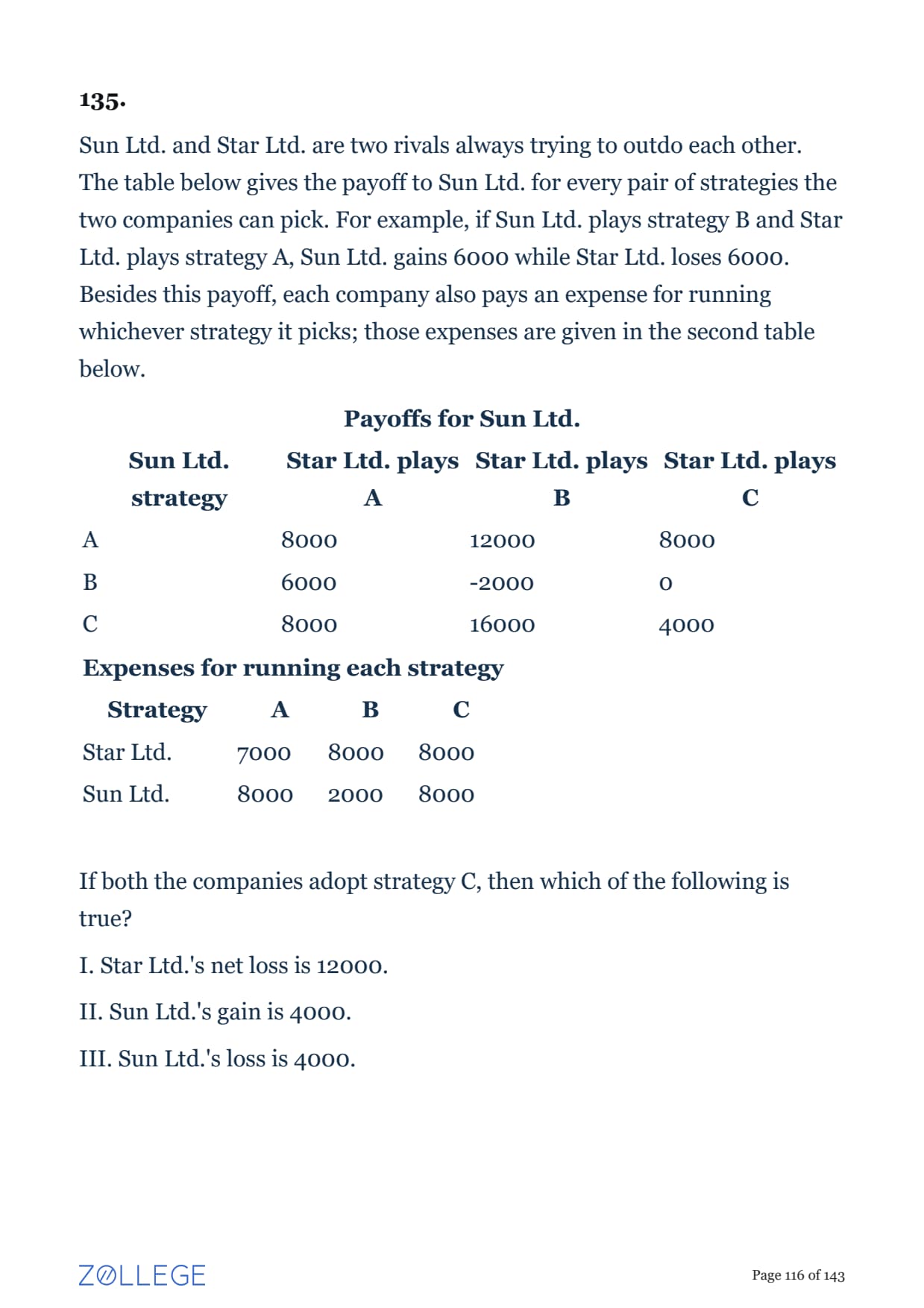
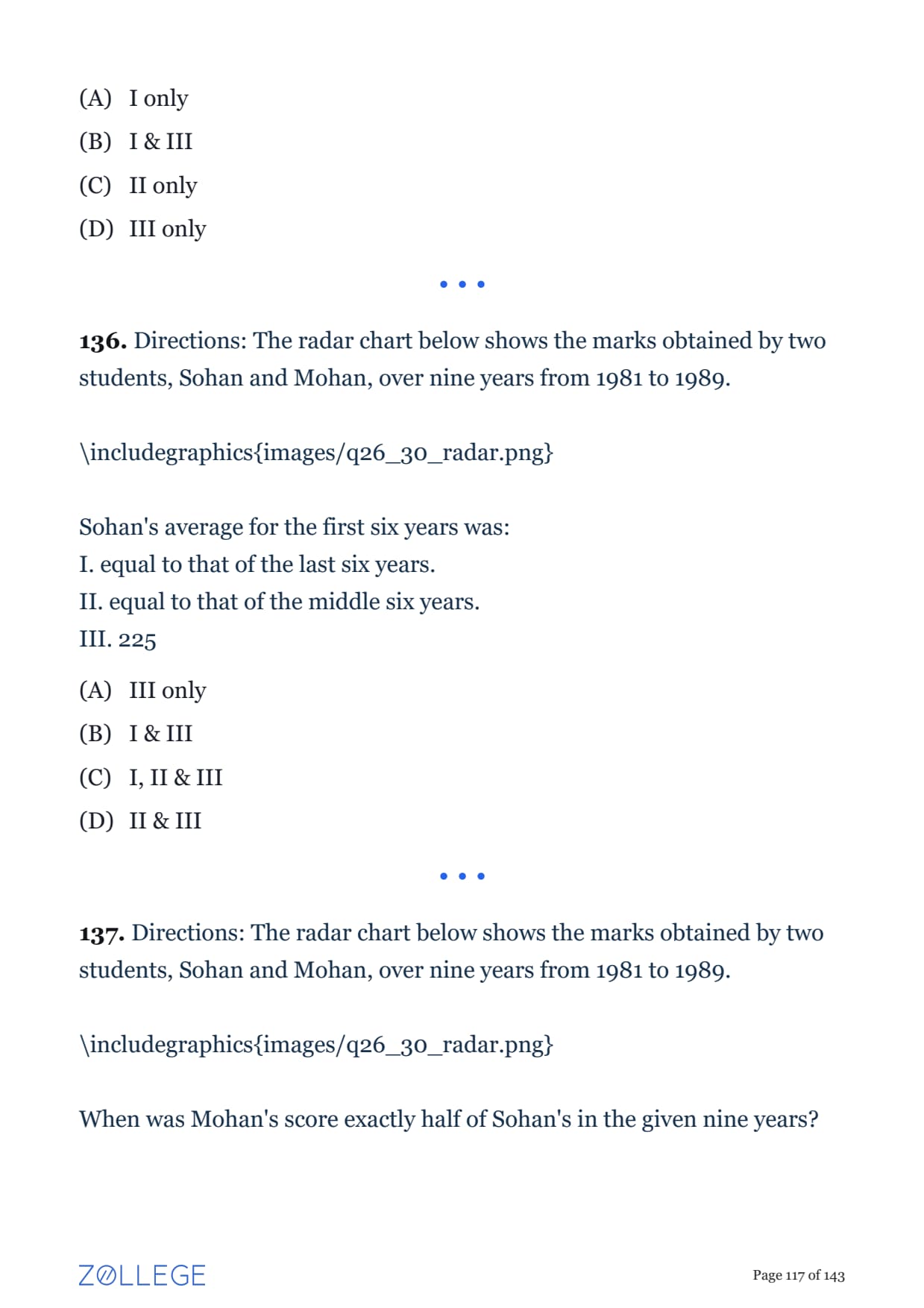
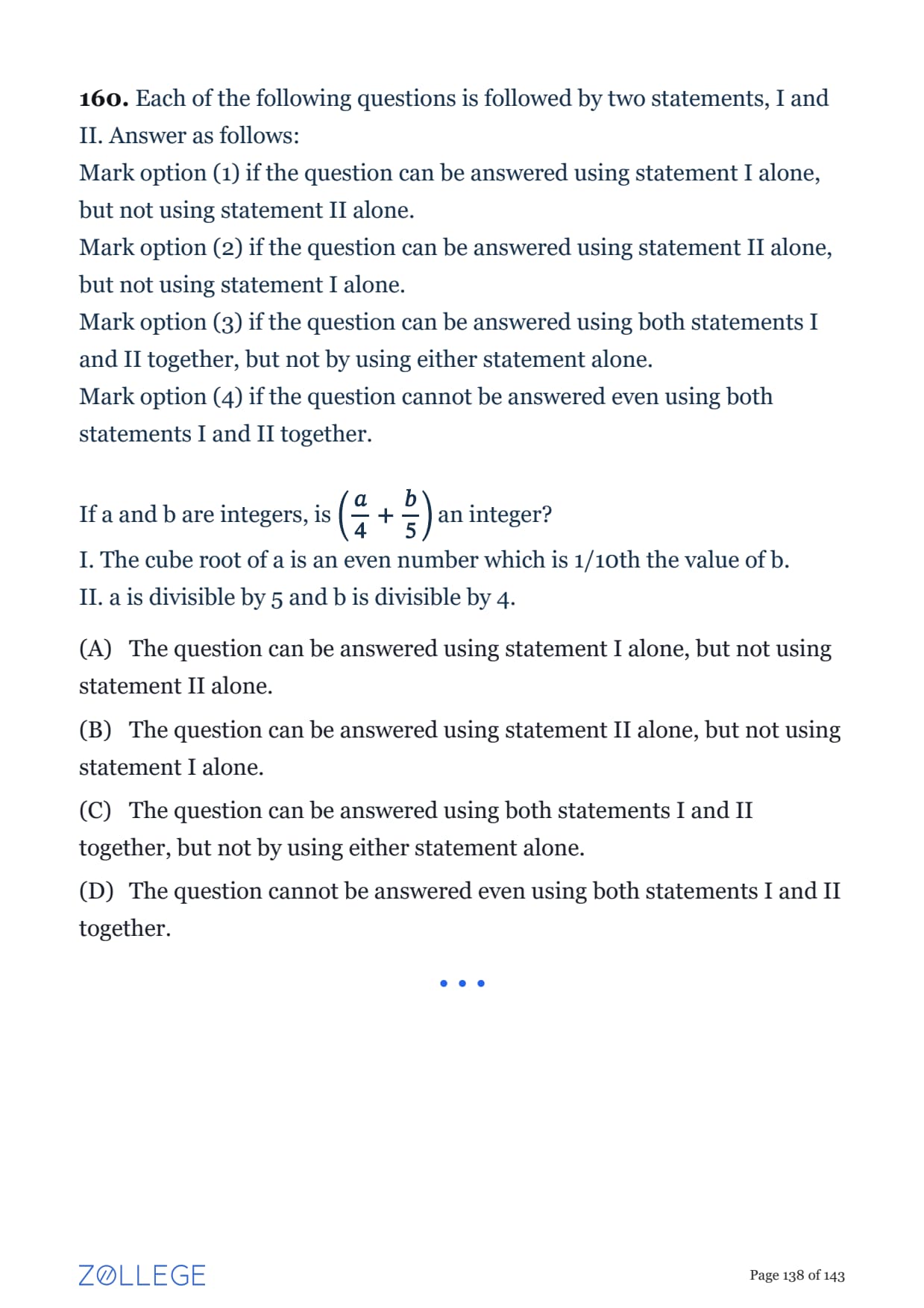
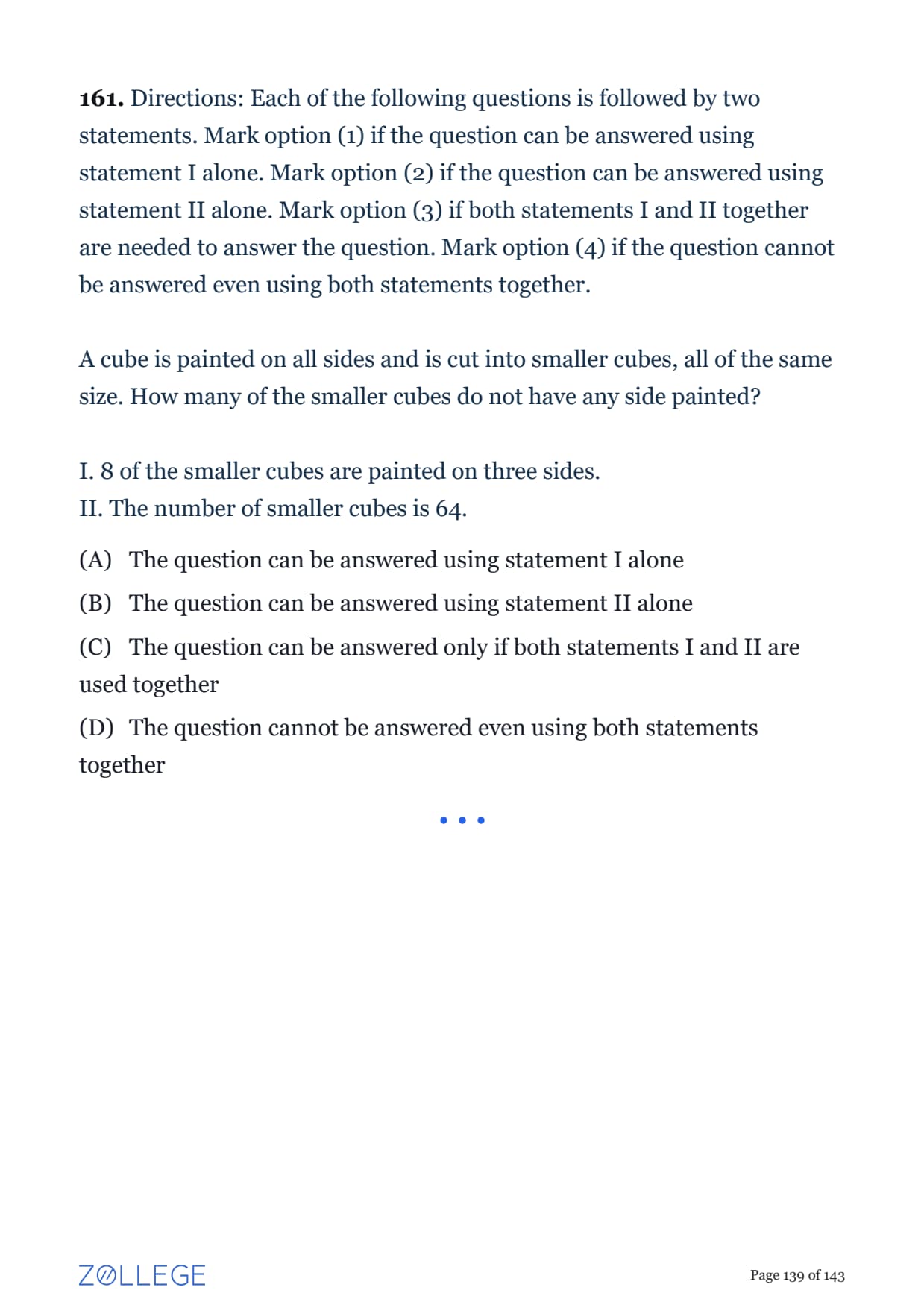
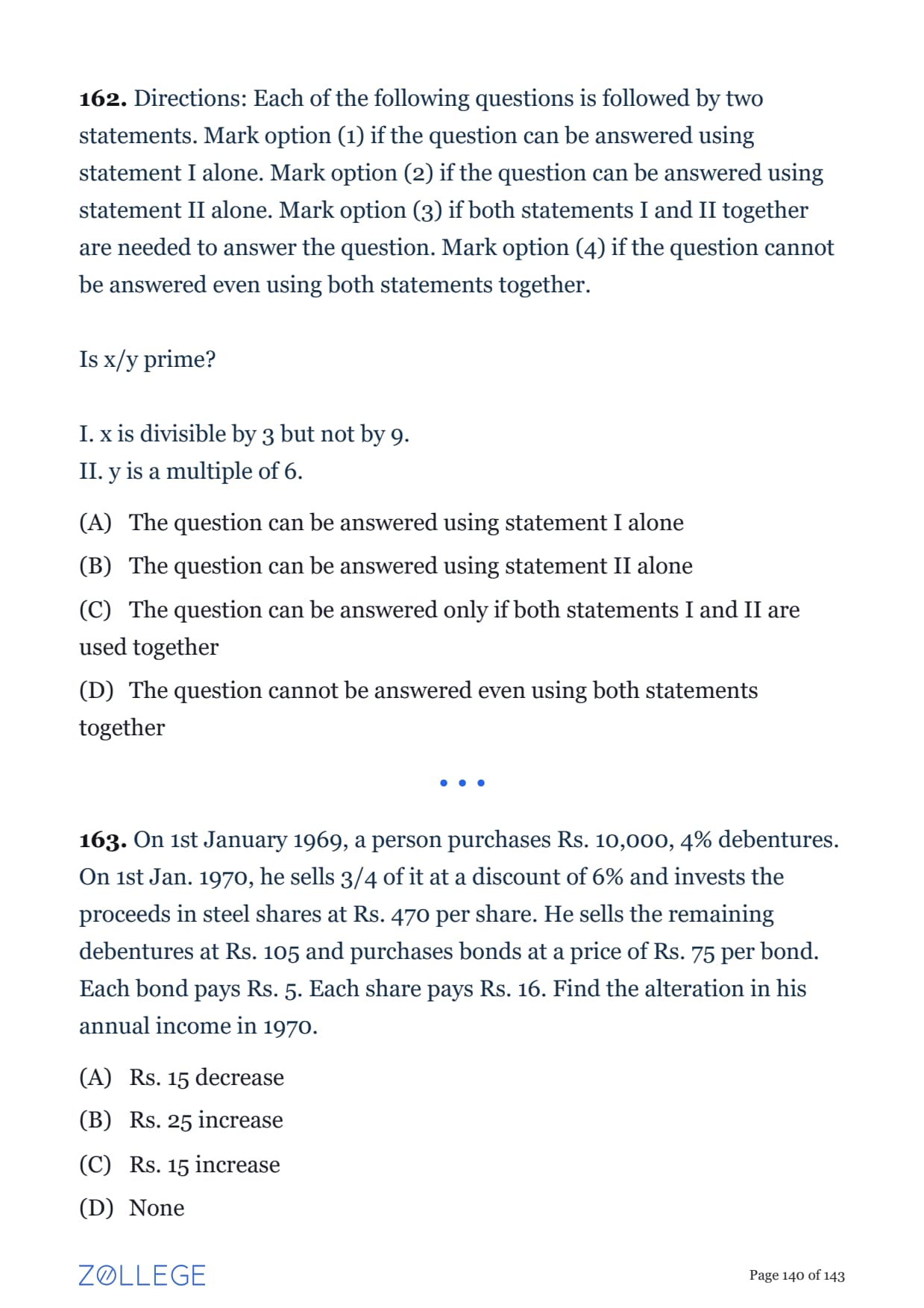
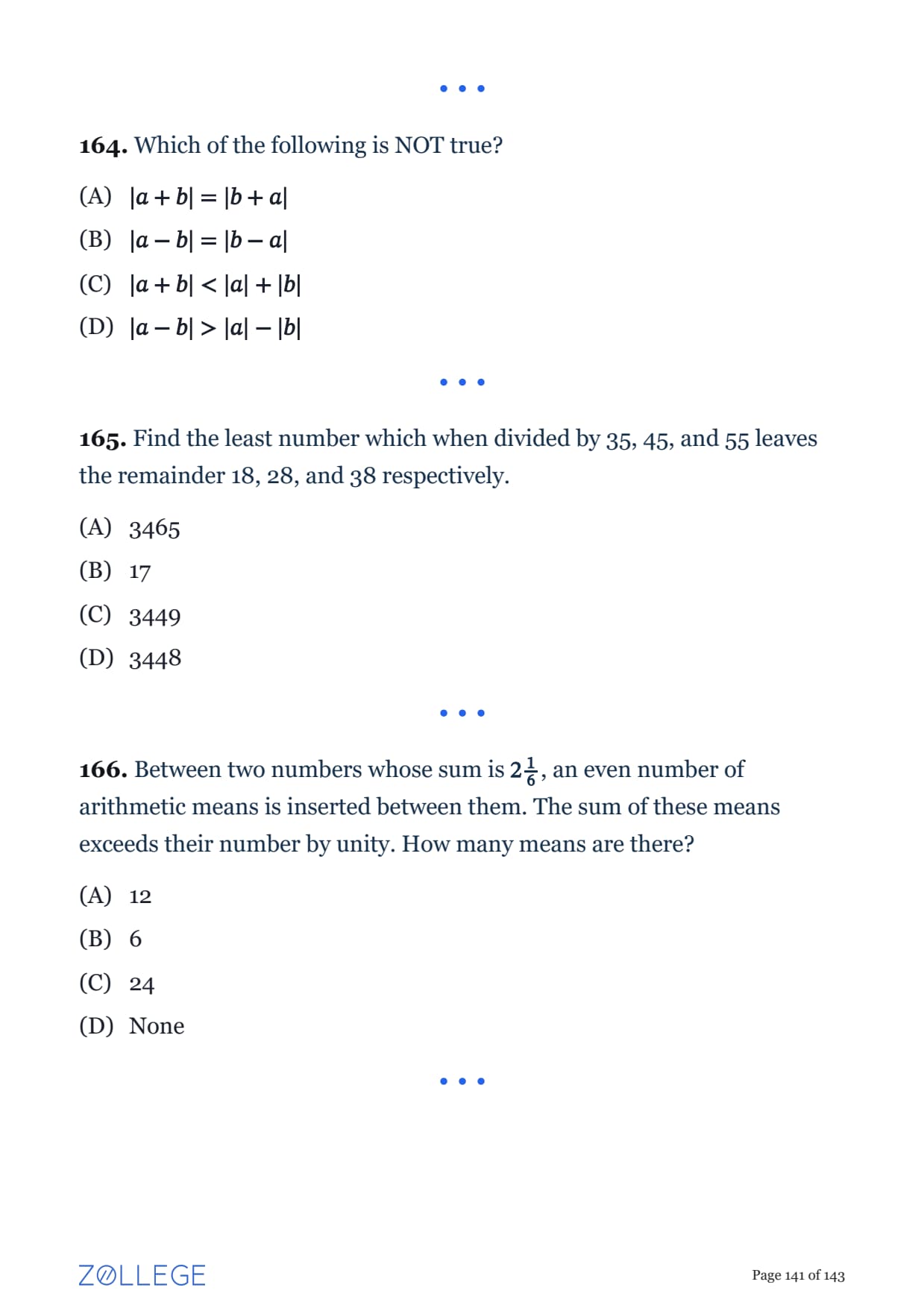
XAT 2006 Questions with Solutions
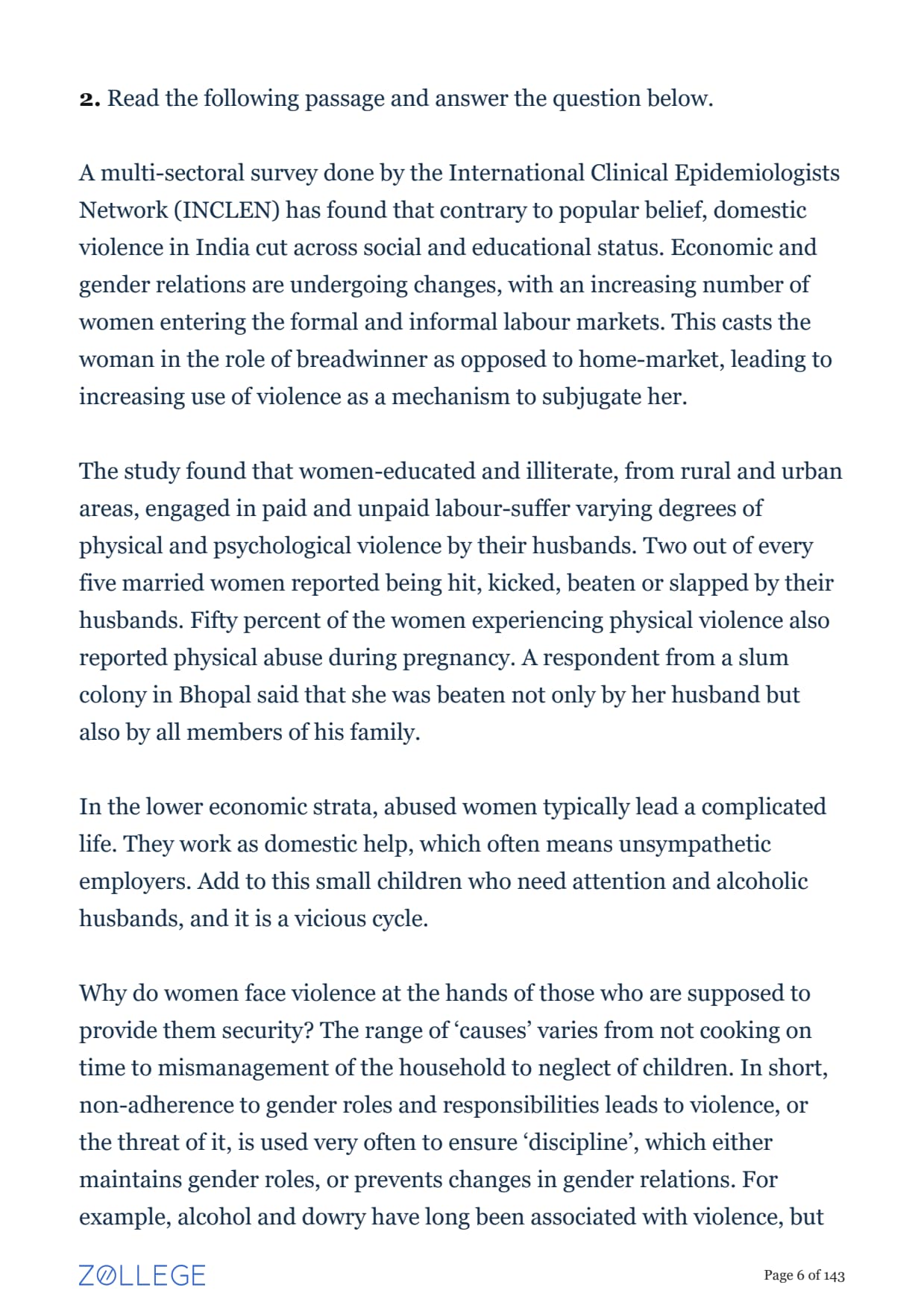
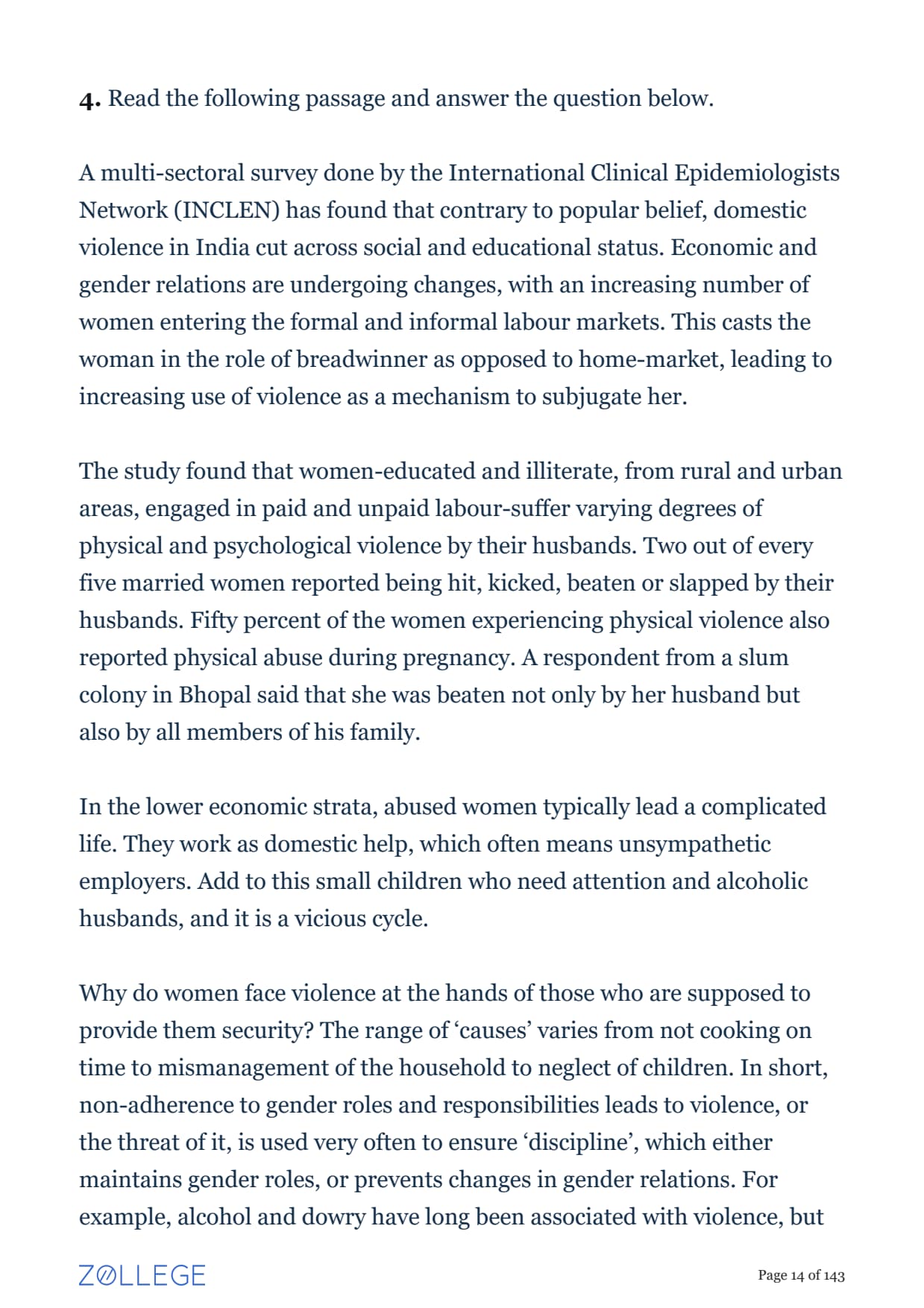
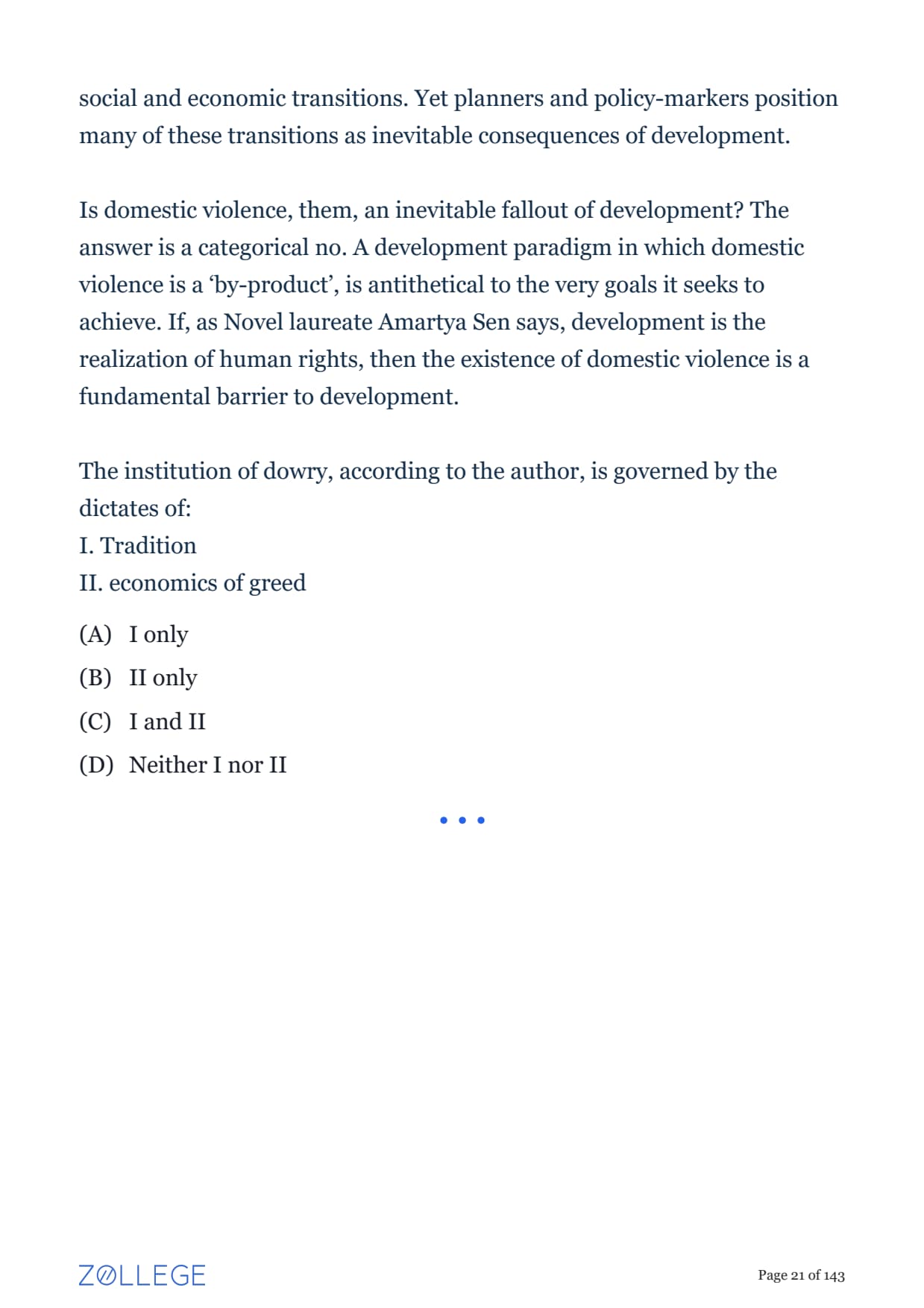
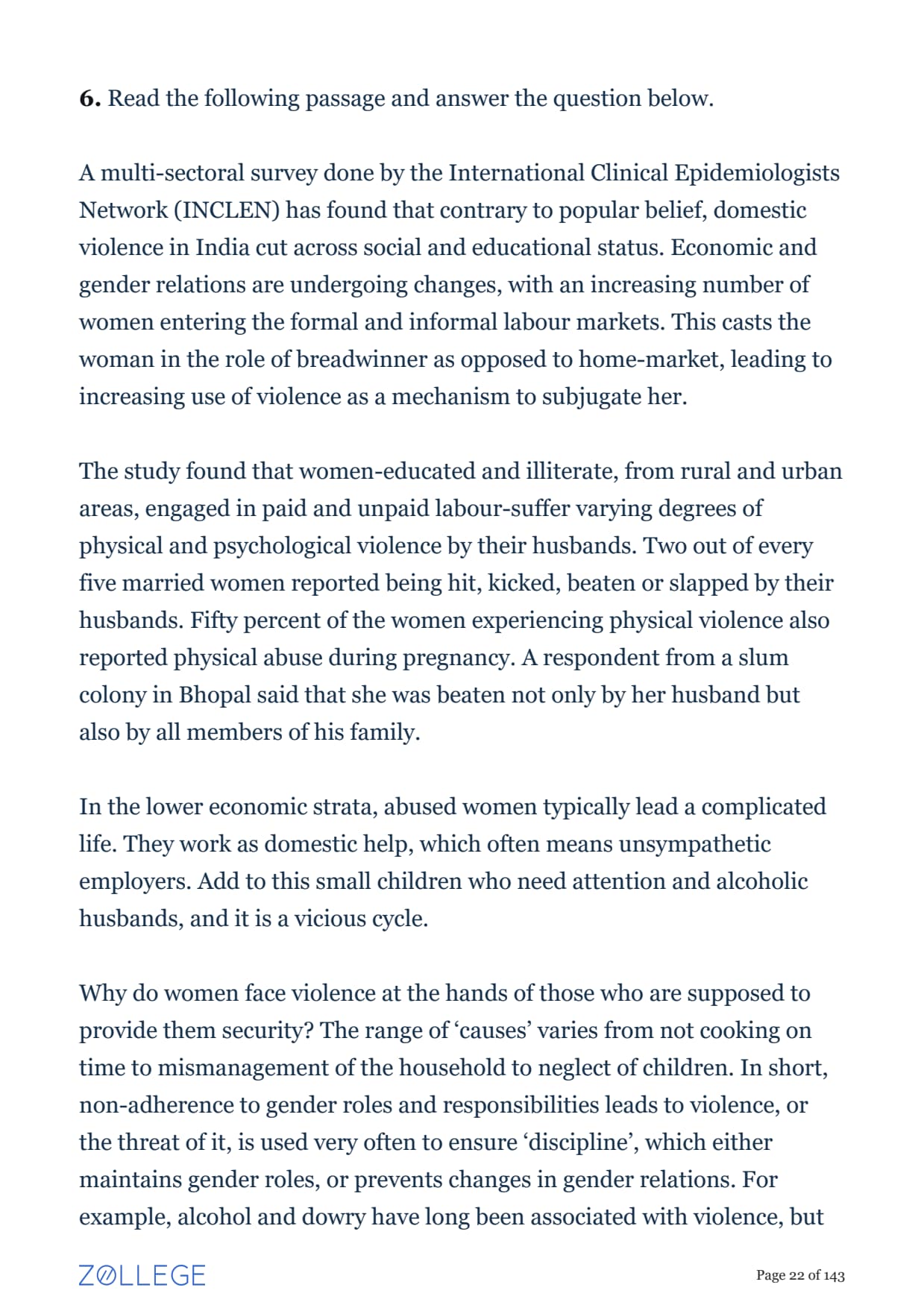
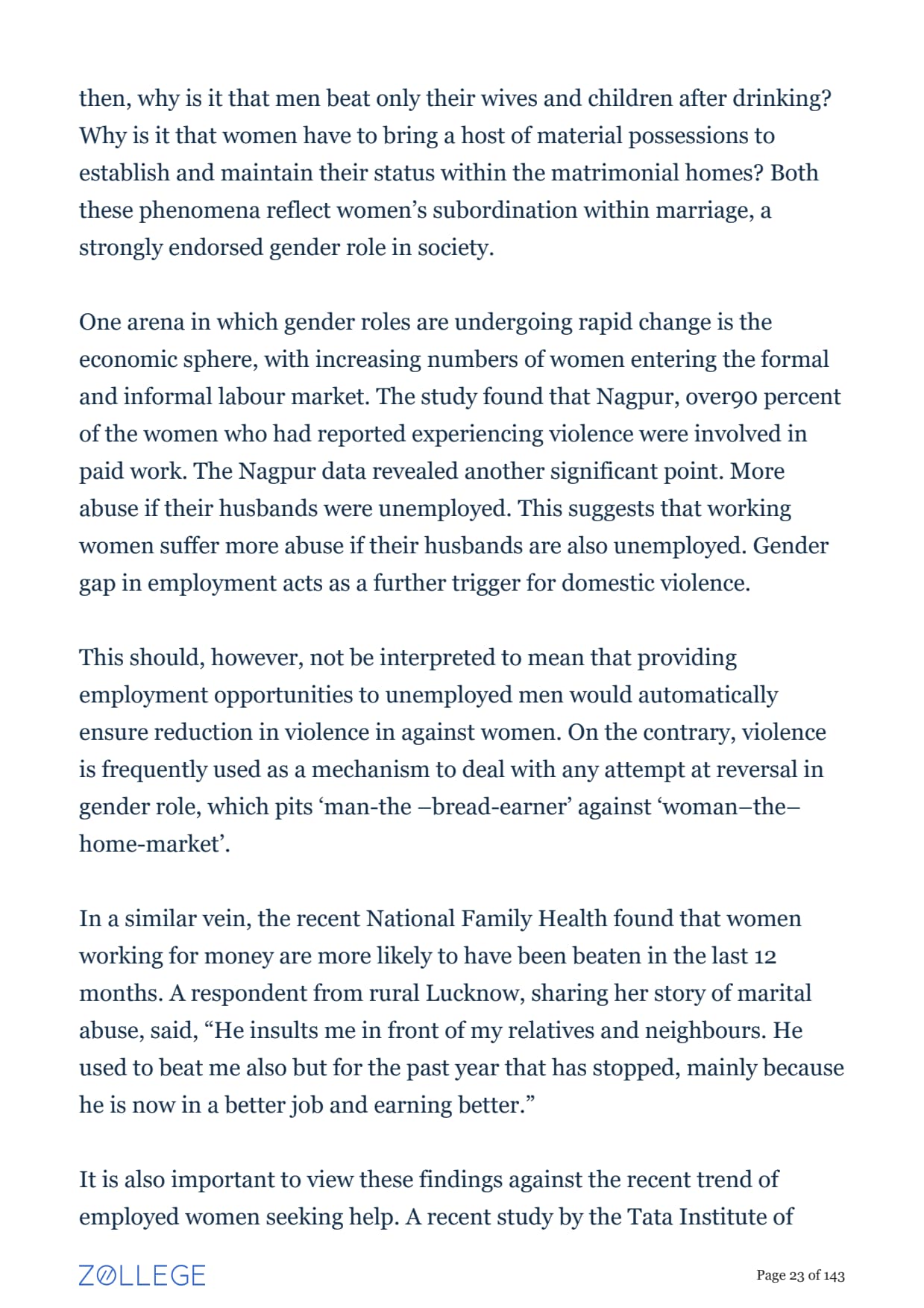
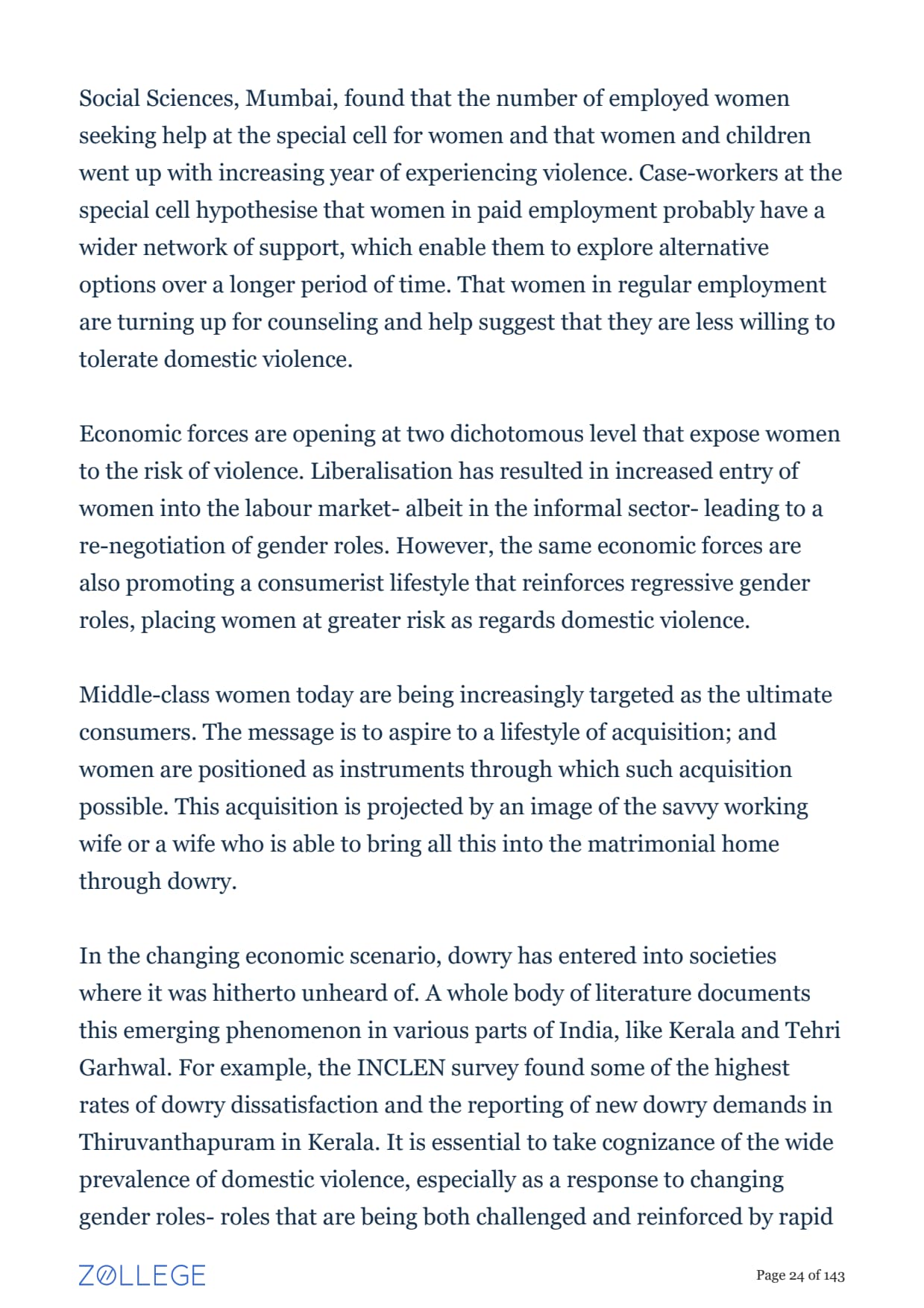
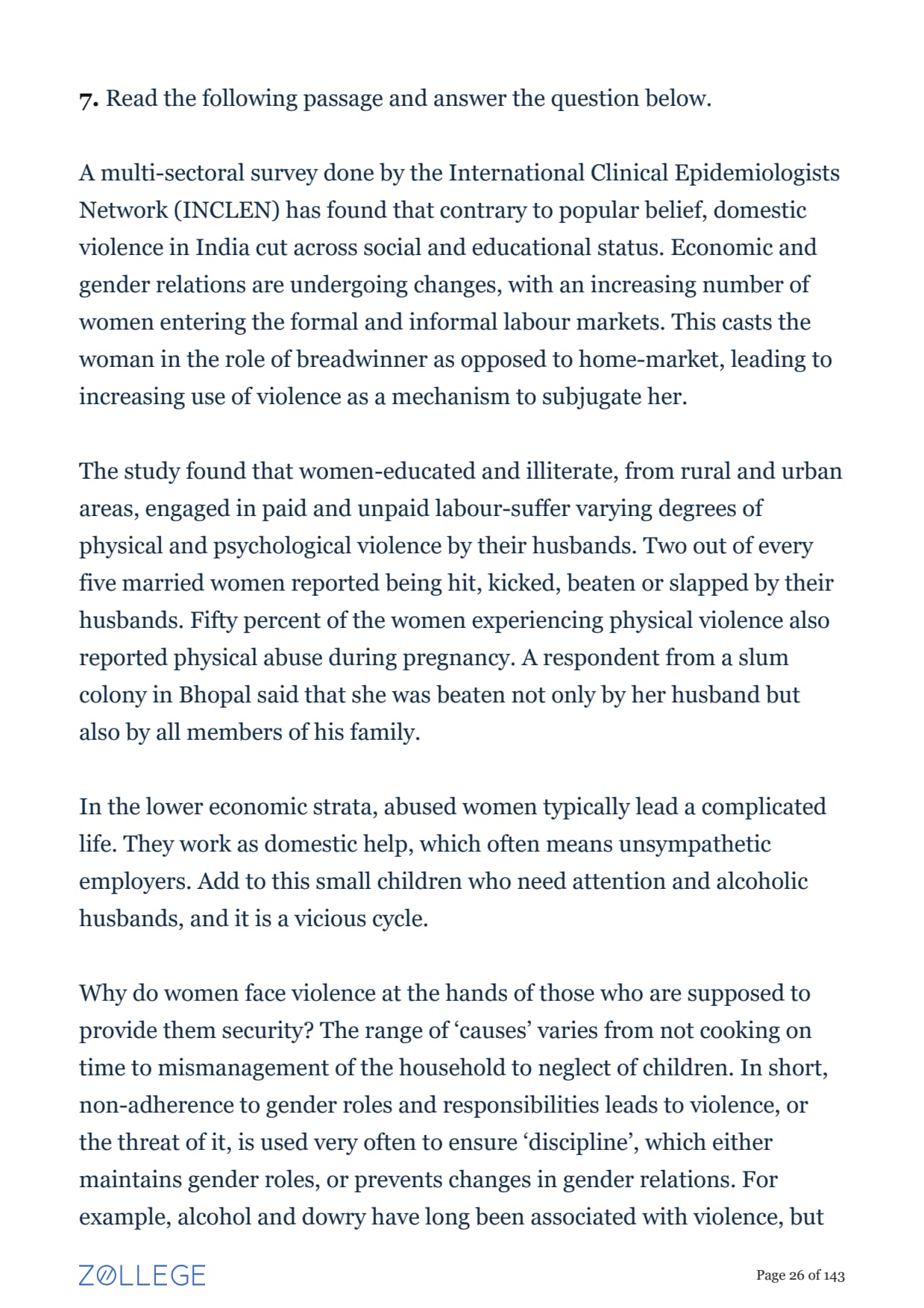
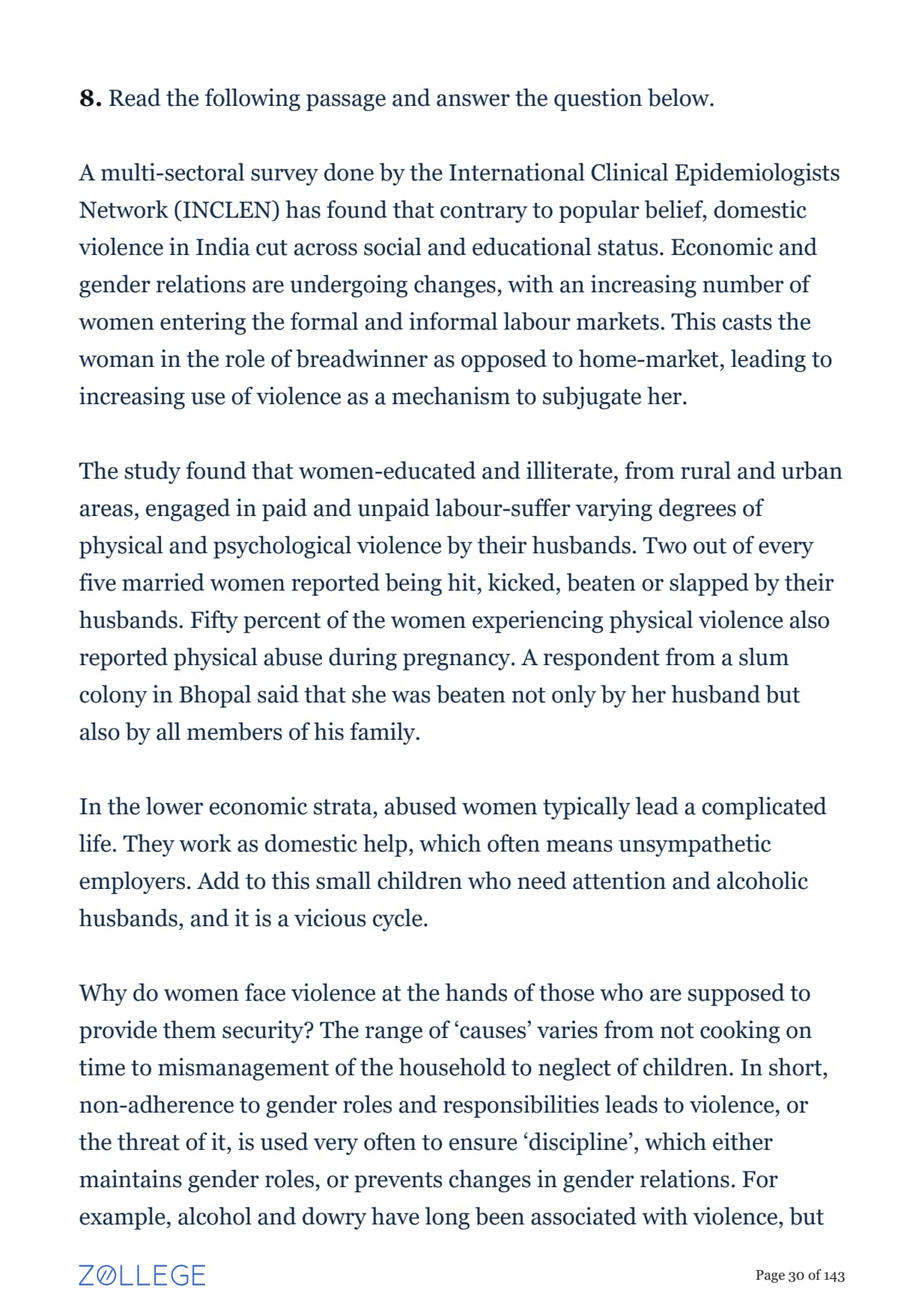
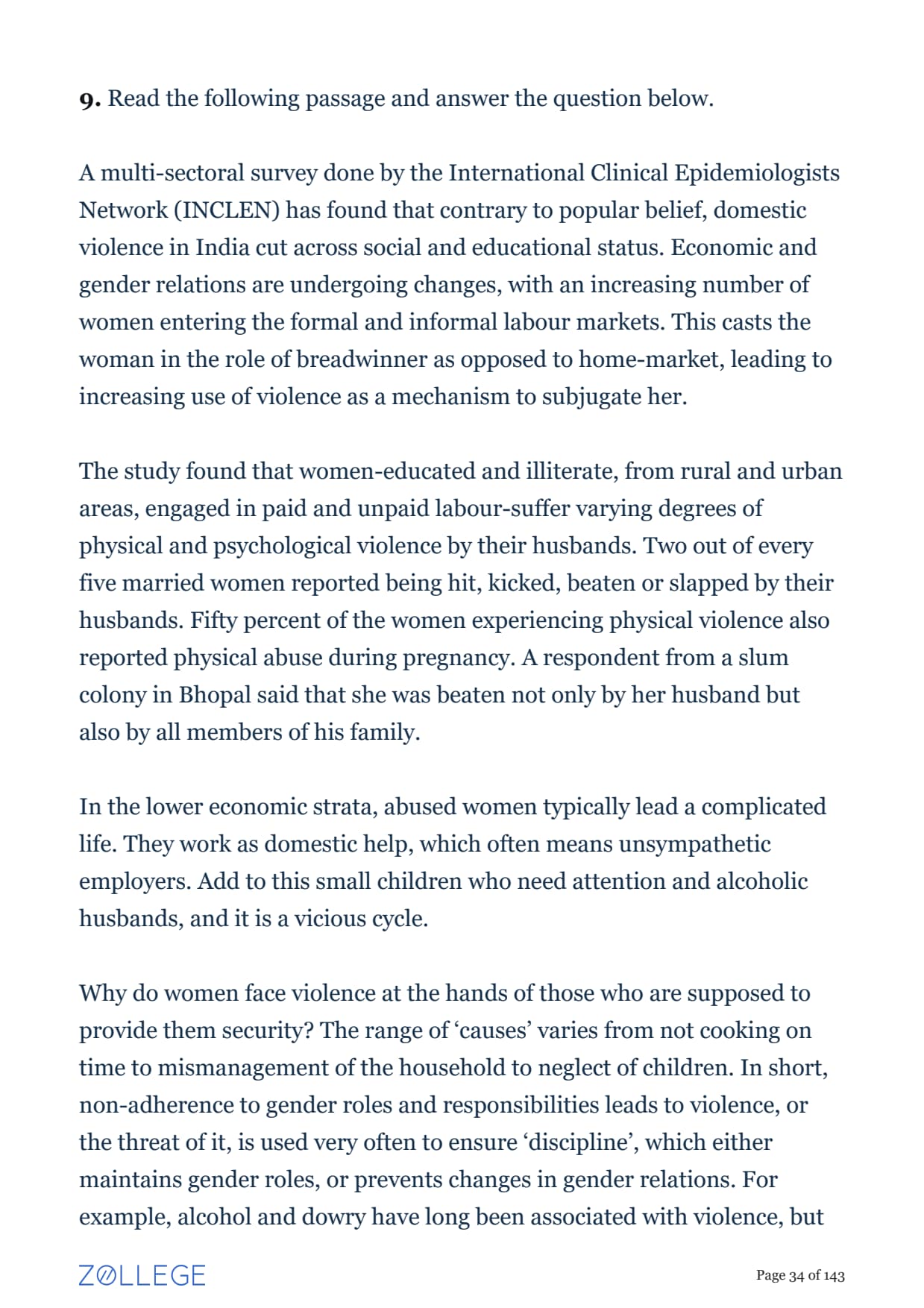
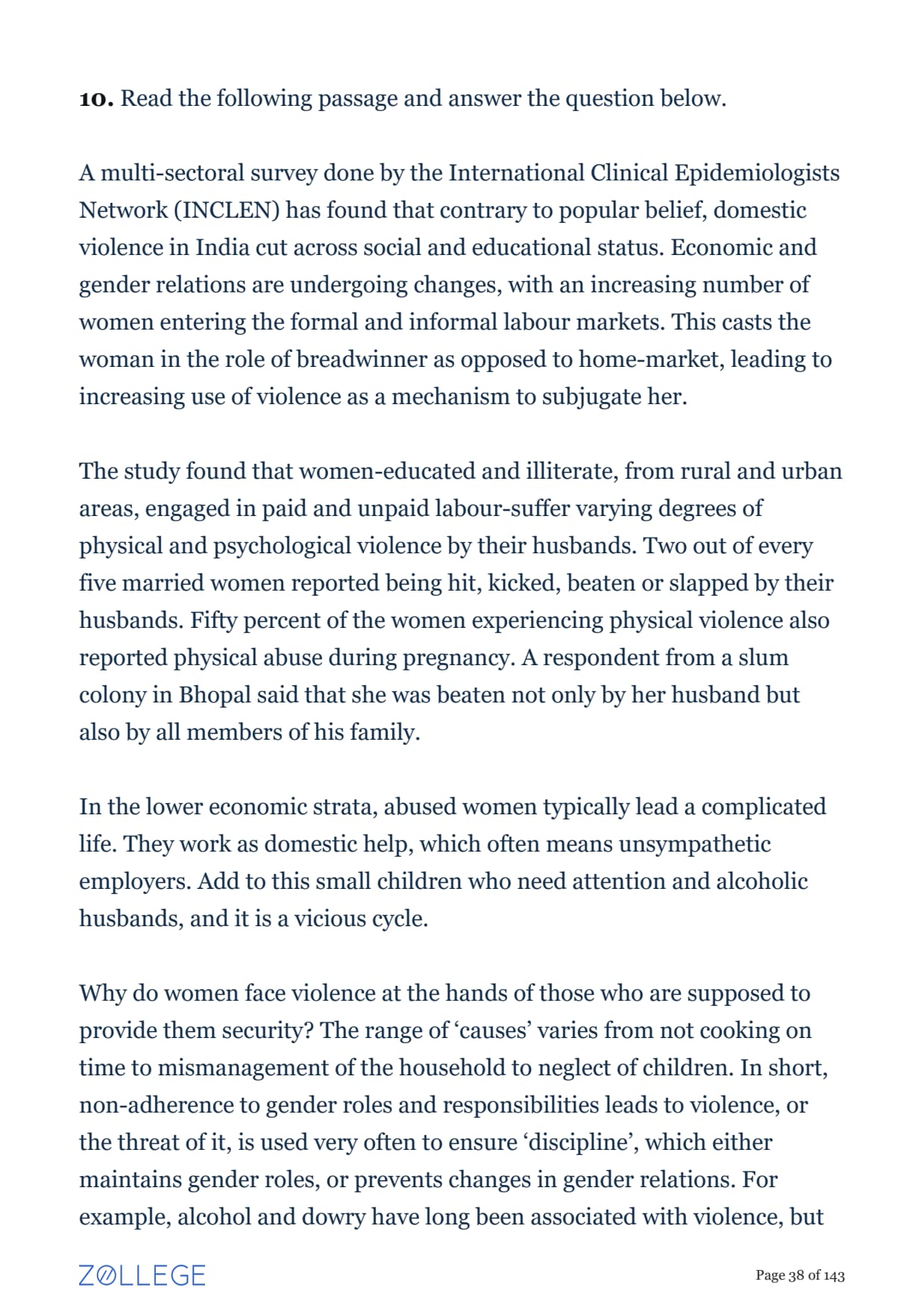
Read the following passage and answer the question below.
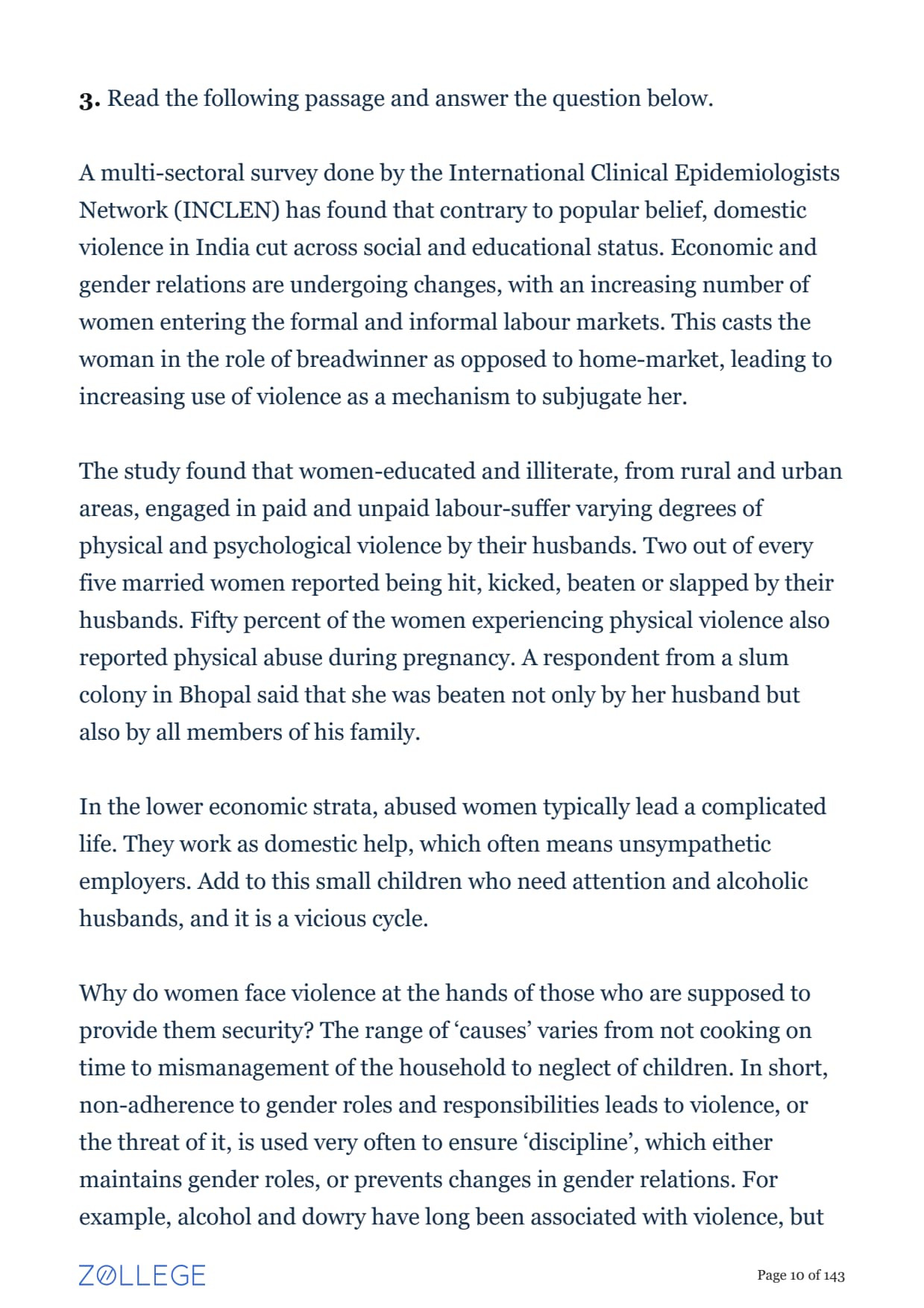
A multi-sectoral survey done by the International Clinical Epidemiologists Network (INCLEN) has found that contrary to popular belief, domestic violence in India cut across social and educational status. Economic and gender relations are undergoing changes, with an increasing number of women entering the formal and informal labour markets. This casts the woman in the role of breadwinner as opposed to home-market, leading to increasing use of violence as a mechanism to subjugate her.
The study found that women-educated and illiterate, from rural and urban areas, engaged in paid and unpaid labour-suffer varying degrees of physical and psychological violence by their husbands. Two out of every five married women reported being hit, kicked, beaten or slapped by their husbands. Fifty percent of the women experiencing physical violence also reported physical abuse during pregnancy. A respondent from a slum colony in Bhopal said that she was beaten not only by her husband but also by all members of his family.
In the lower economic strata, abused women typically lead a complicated life. They work as domestic help, which often means unsympathetic employers. Add to this small children who need attention and alcoholic husbands, and it is a vicious cycle.
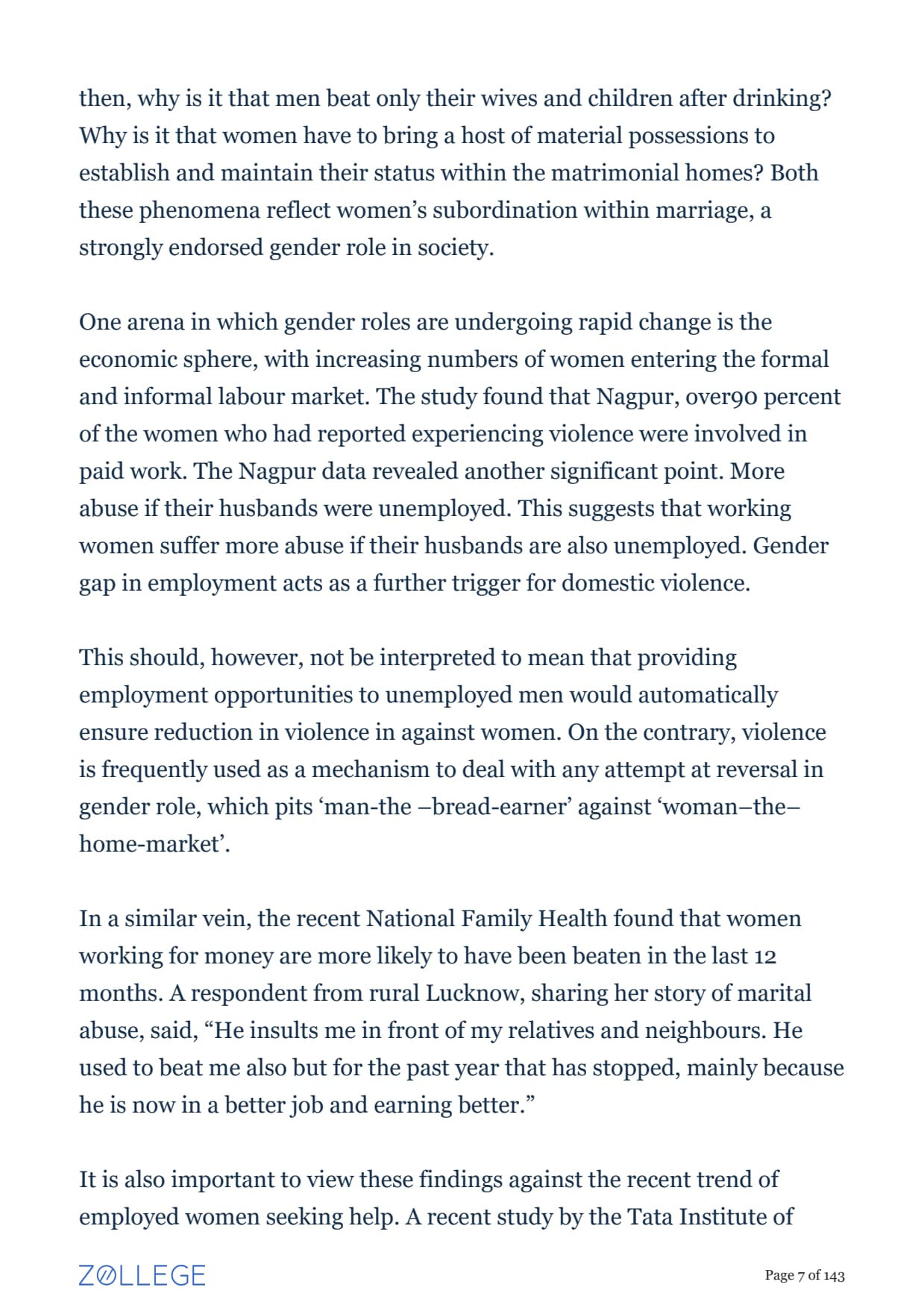
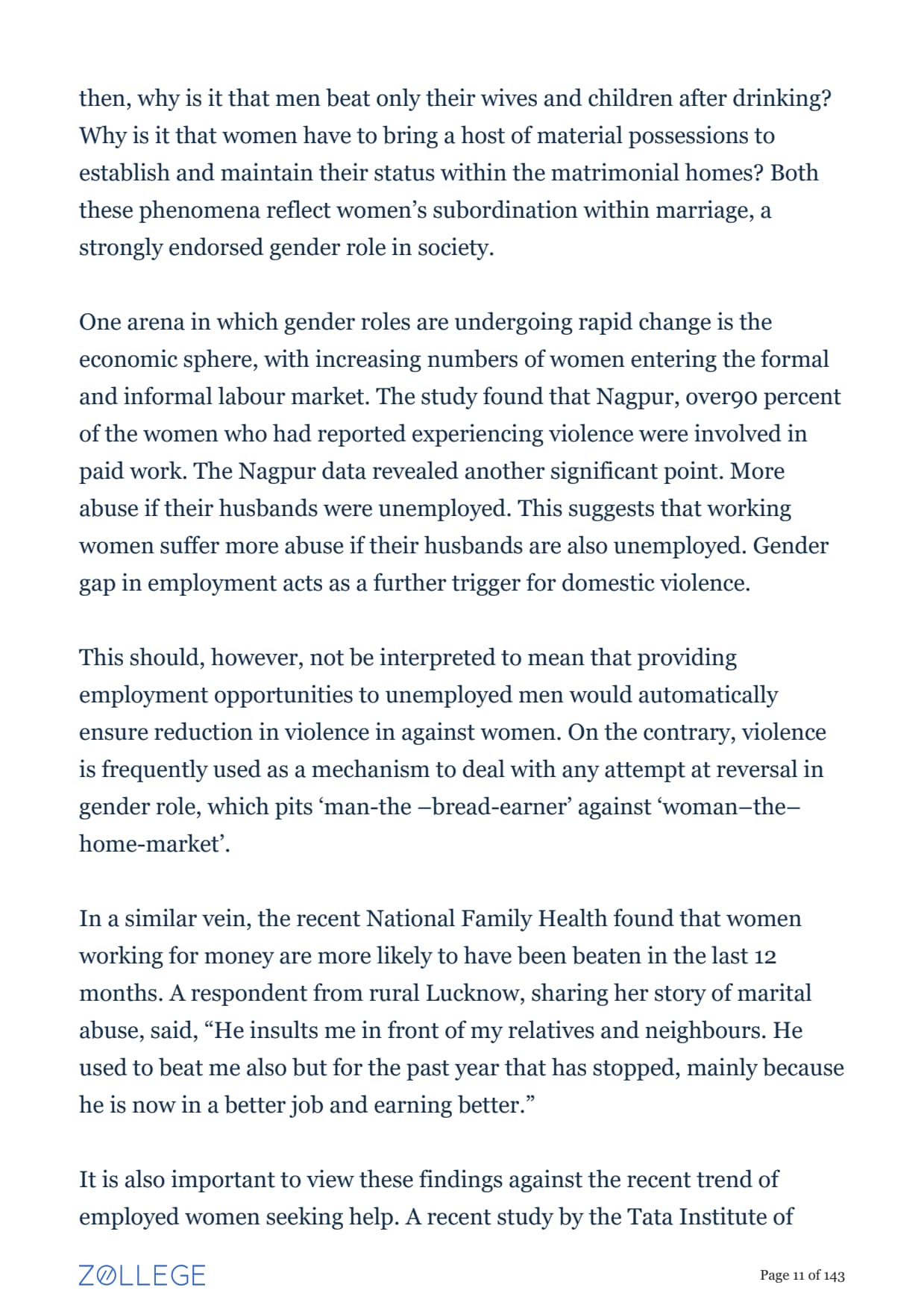
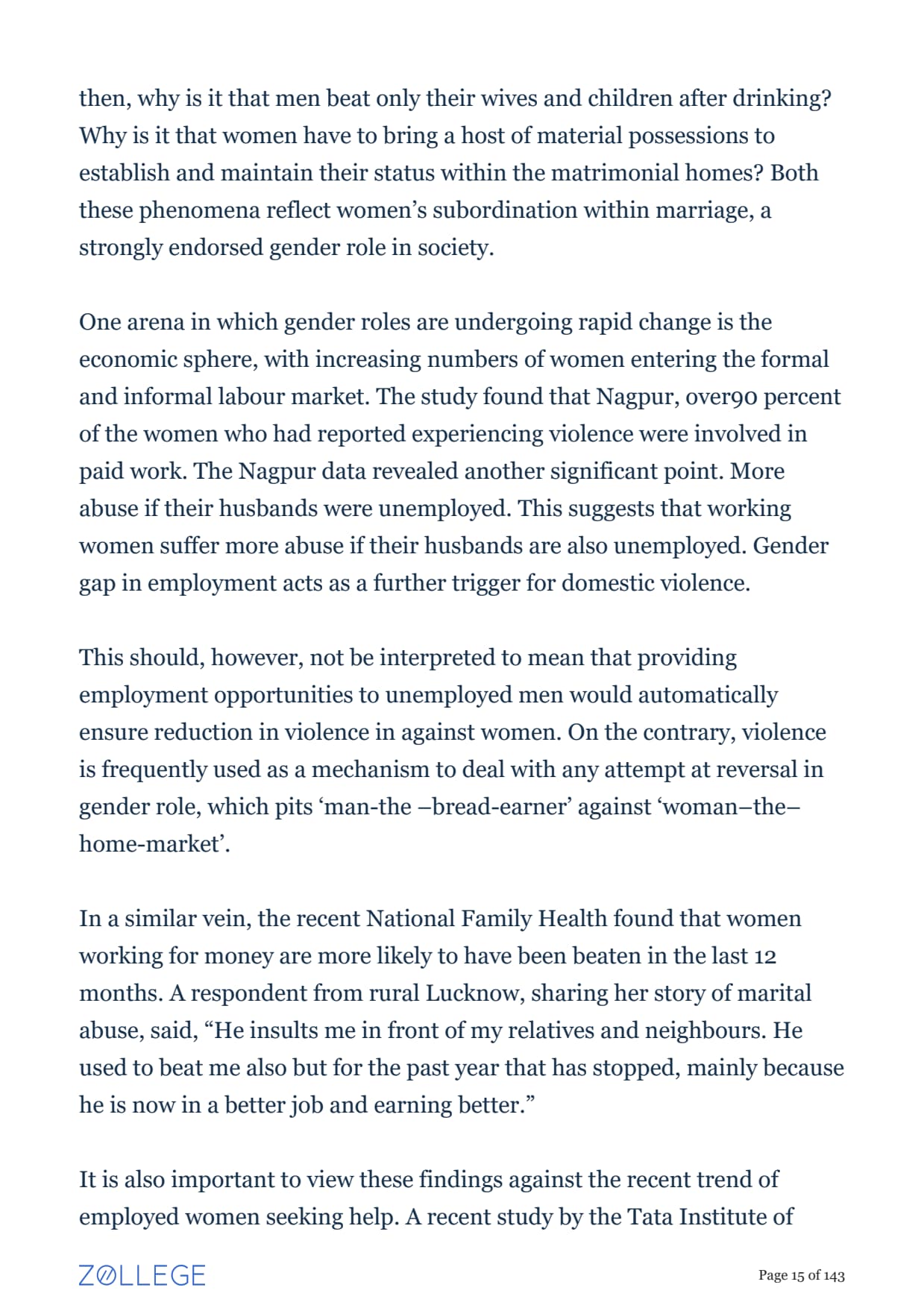
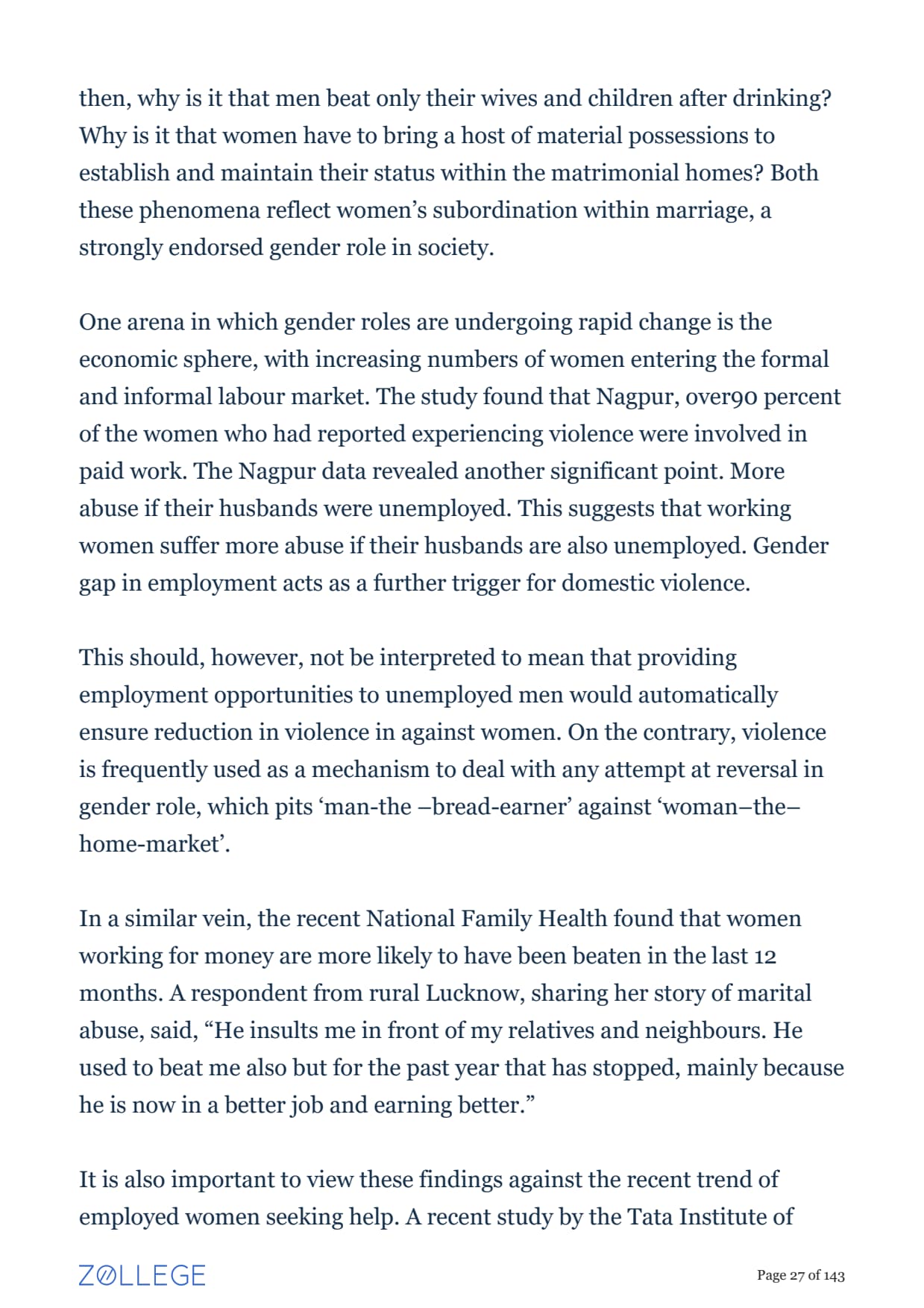
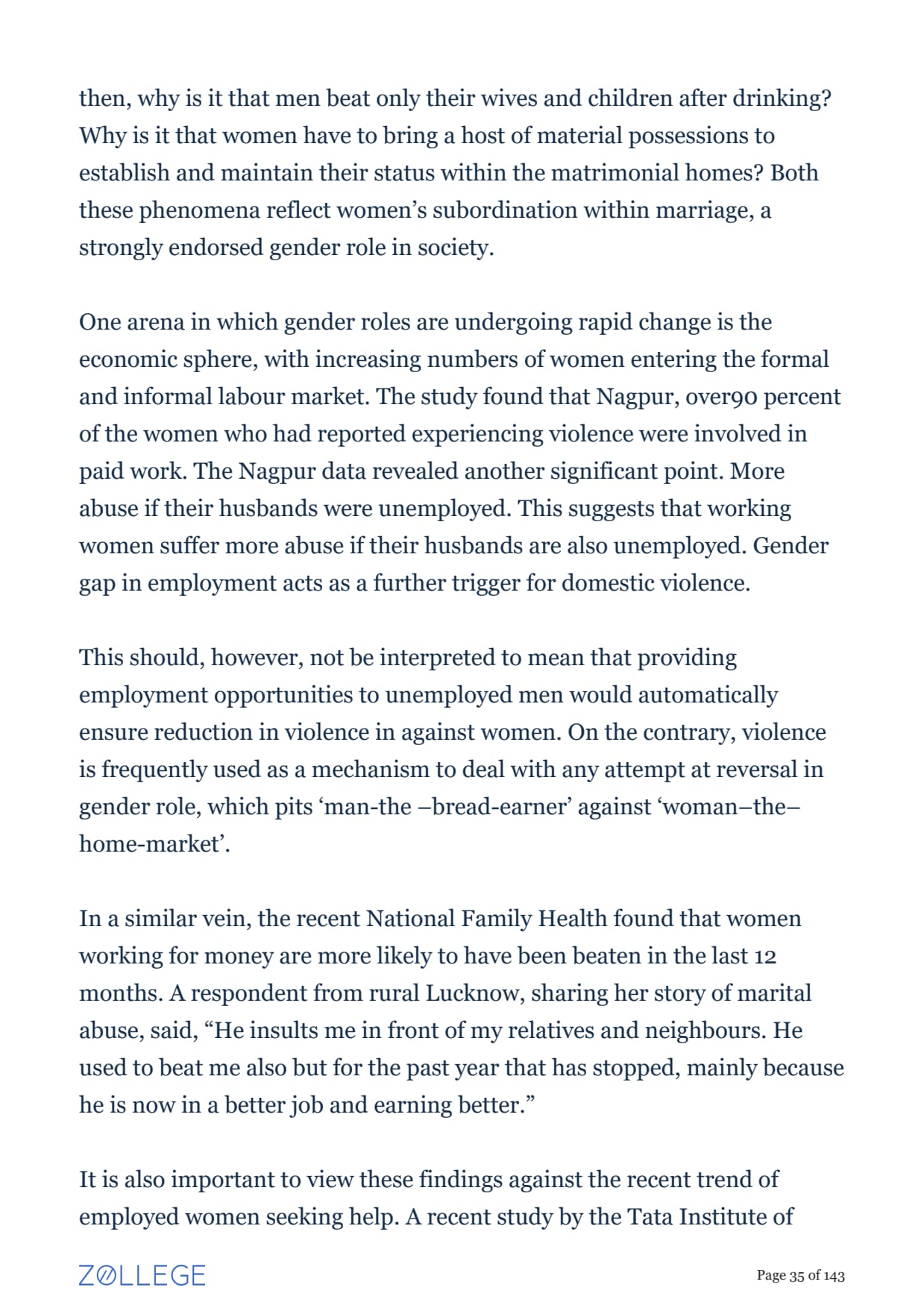
Why do women face violence at the hands of those who are supposed to provide them security? The range of ‘causes’ varies from not cooking on time to mismanagement of the household to neglect of children. In short, non-adherence to gender roles and responsibilities leads to violence, or the threat of it, is used very often to ensure ‘discipline’, which either maintains gender roles, or prevents changes in gender relations. For example, alcohol and dowry have long been associated with violence, but then, why is it that men beat only their wives and children after drinking? Why is it that women have to bring a host of material possessions to establish and maintain their status within the matrimonial homes? Both these phenomena reflect women’s subordination within marriage, a strongly endorsed gender role in society.
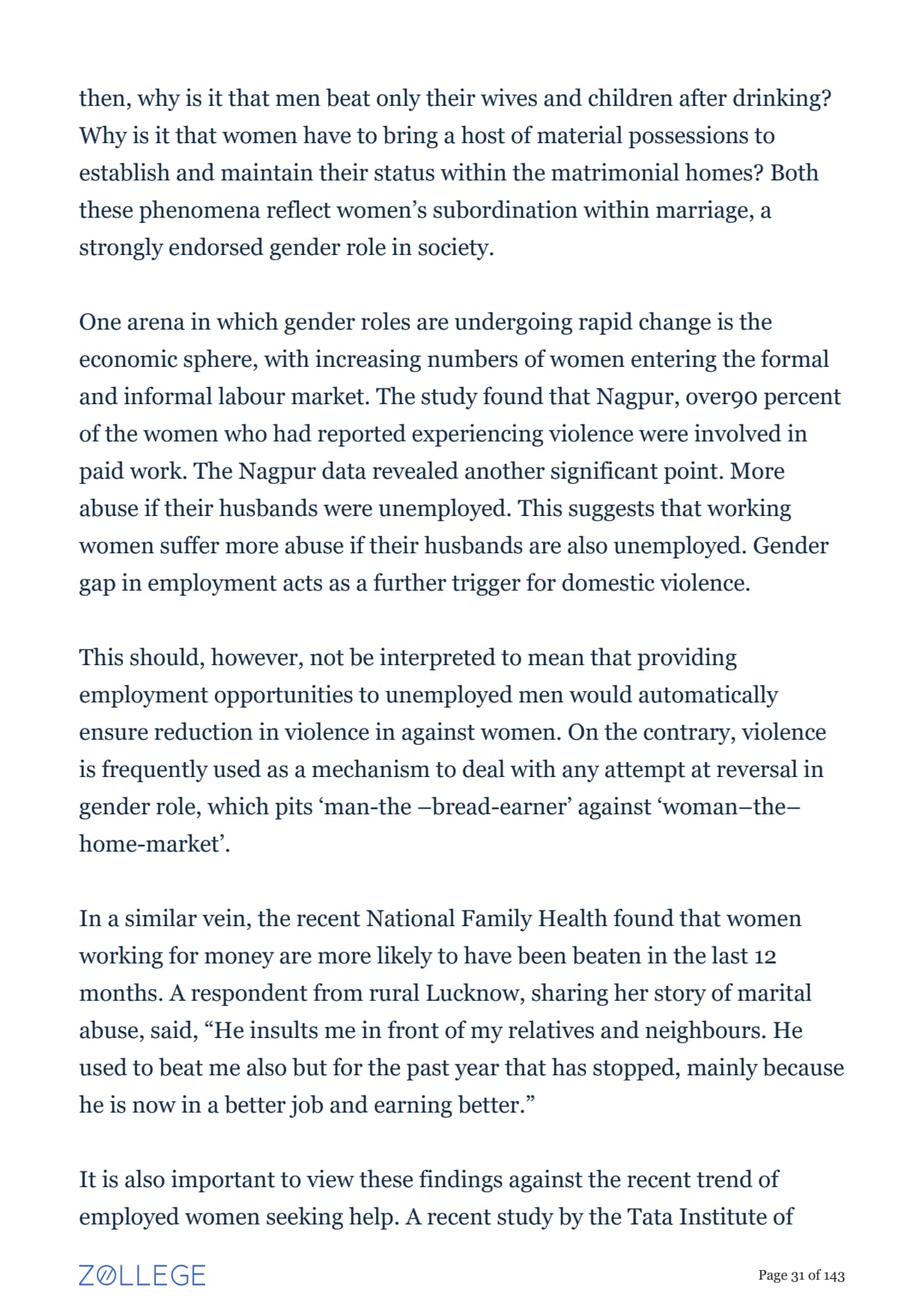
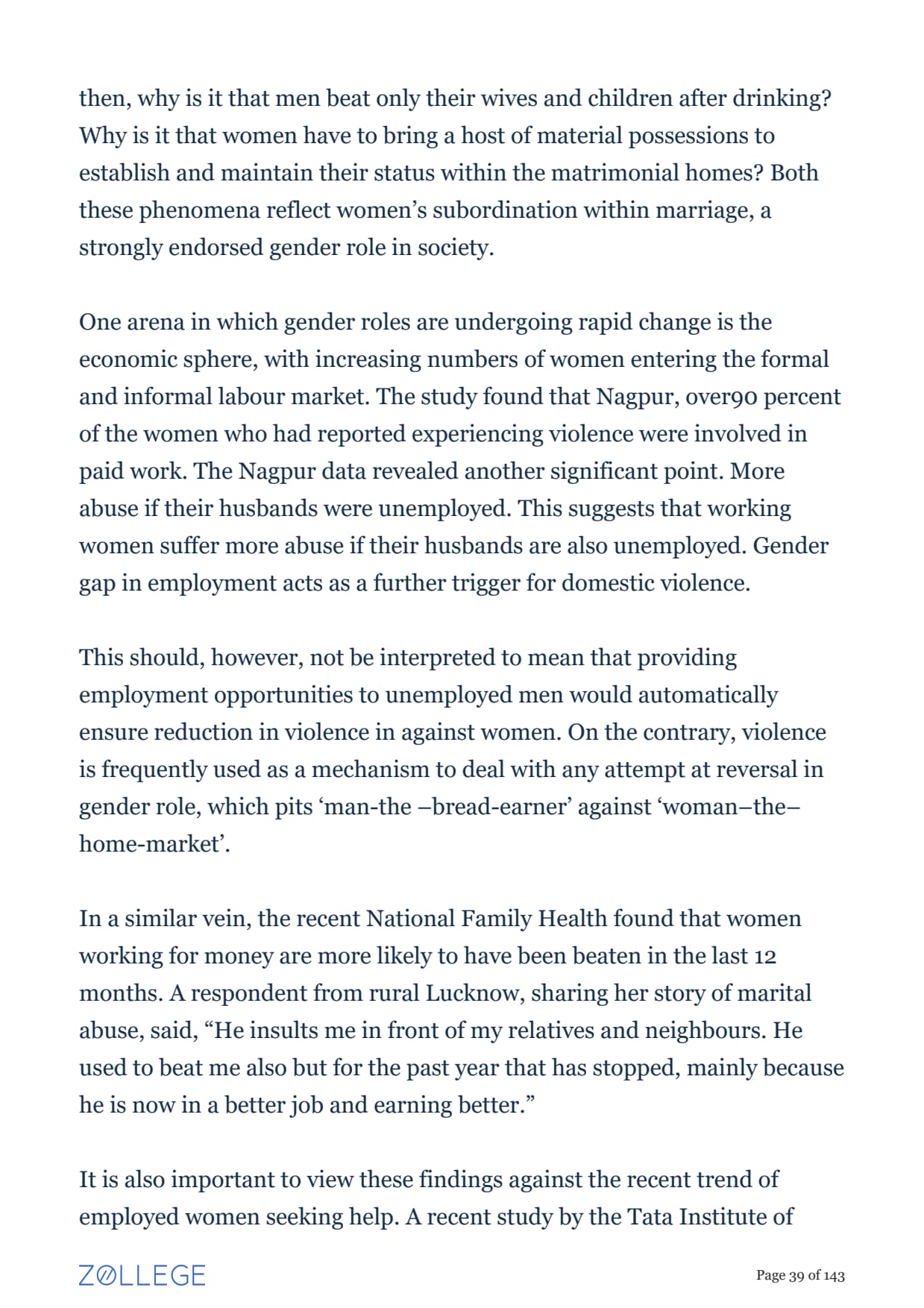
One arena in which gender roles are undergoing rapid change is the economic sphere, with increasing numbers of women entering the formal and informal labour market. The study found that Nagpur, over90 percent of the women who had reported experiencing violence were involved in paid work. The Nagpur data revealed another significant point. More abuse if their husbands were unemployed. This suggests that working women suffer more abuse if their husbands are also unemployed. Gender gap in employment acts as a further trigger for domestic violence.
This should, however, not be interpreted to mean that providing employment opportunities to unemployed men would automatically ensure reduction in violence in against women. On the contrary, violence is frequently used as a mechanism to deal with any attempt at reversal in gender role, which pits ‘man-the –bread-earner’ against ‘woman–the–home-market’.
In a similar vein, the recent National Family Health found that women working for money are more likely to have been beaten in the last 12 months. A respondent from rural Lucknow, sharing her story of marital abuse, said, “He insults me in front of my relatives and neighbours. He used to beat me also but for the past year that has stopped, mainly because he is now in a better job and earning better.”
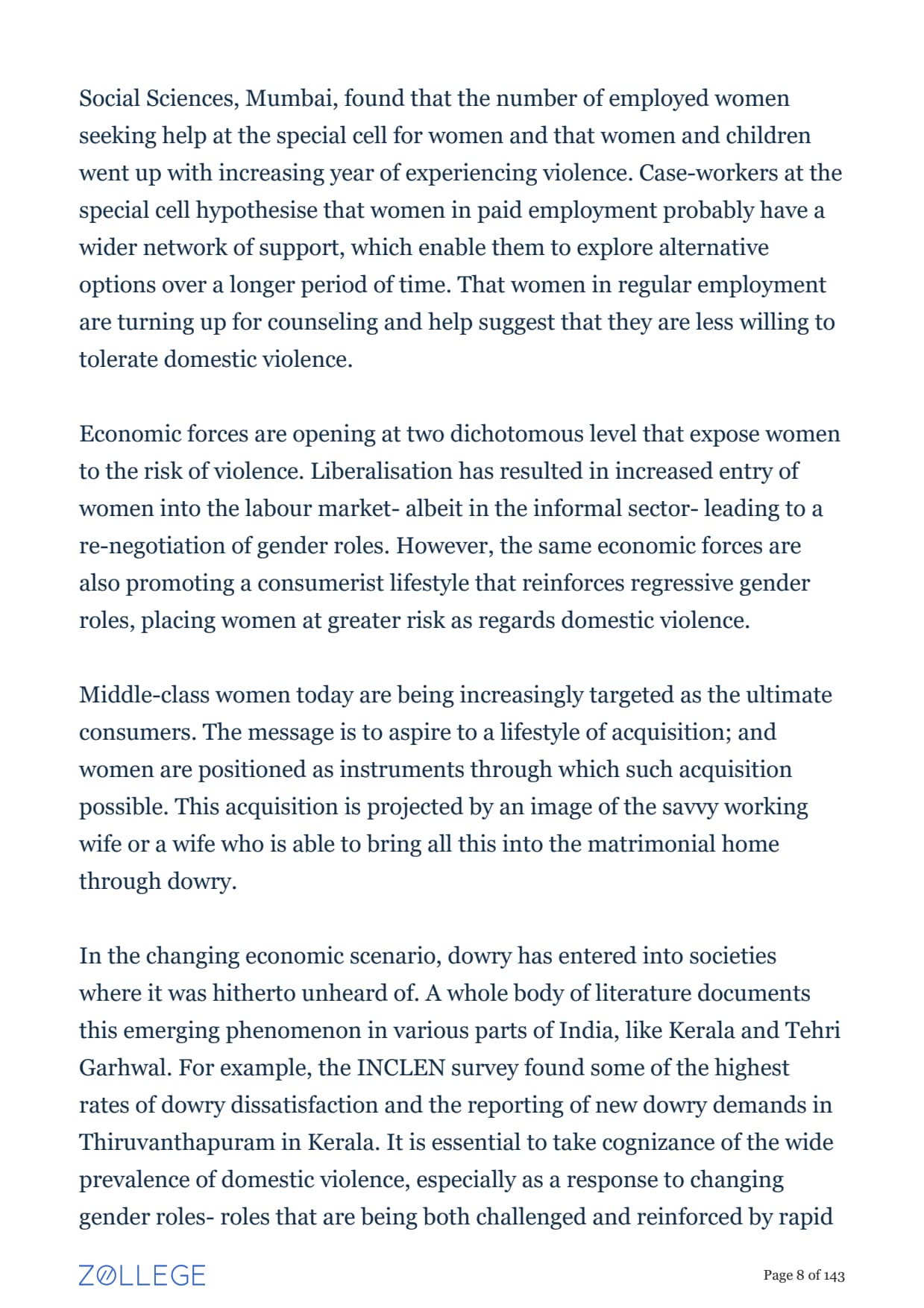
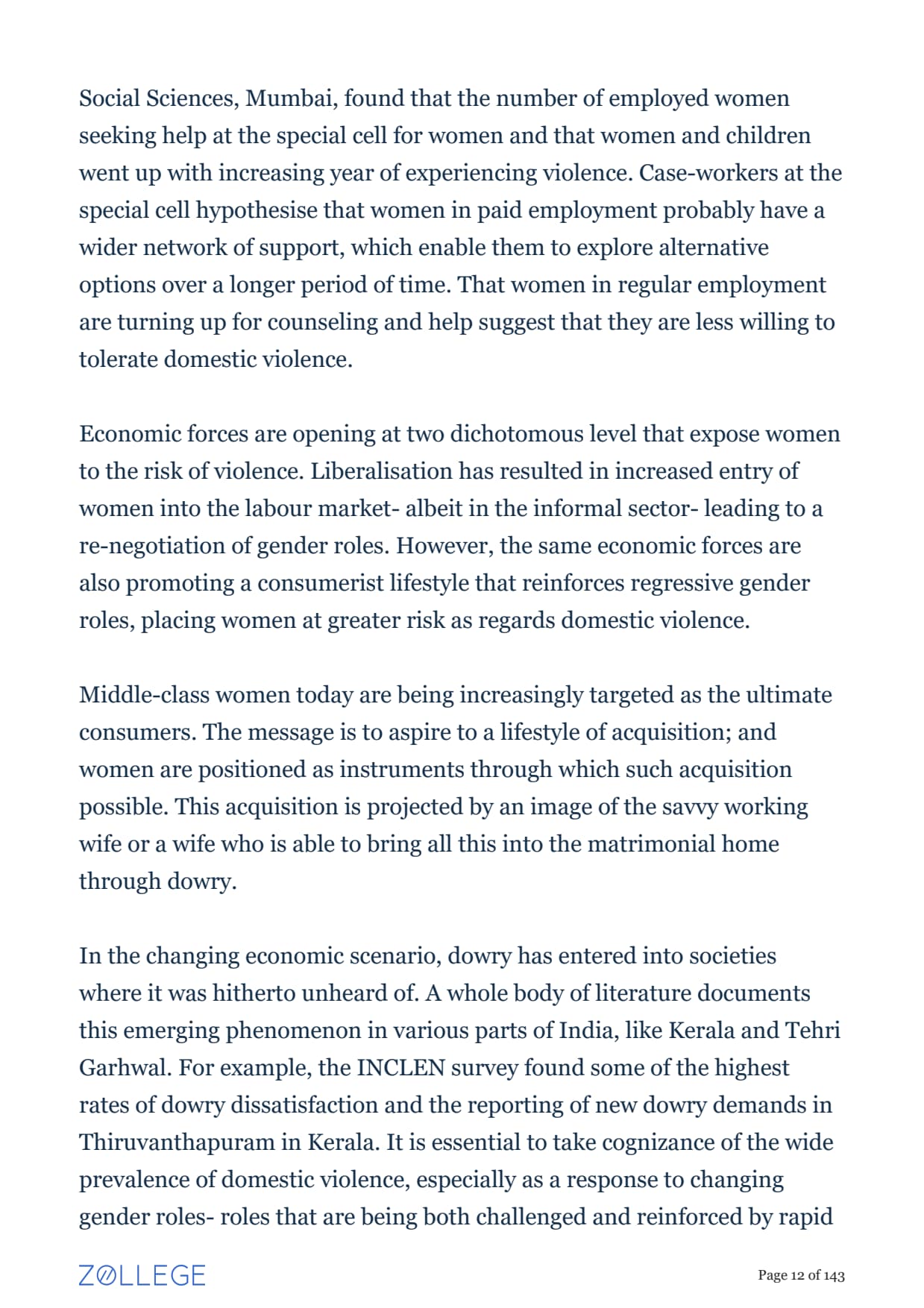
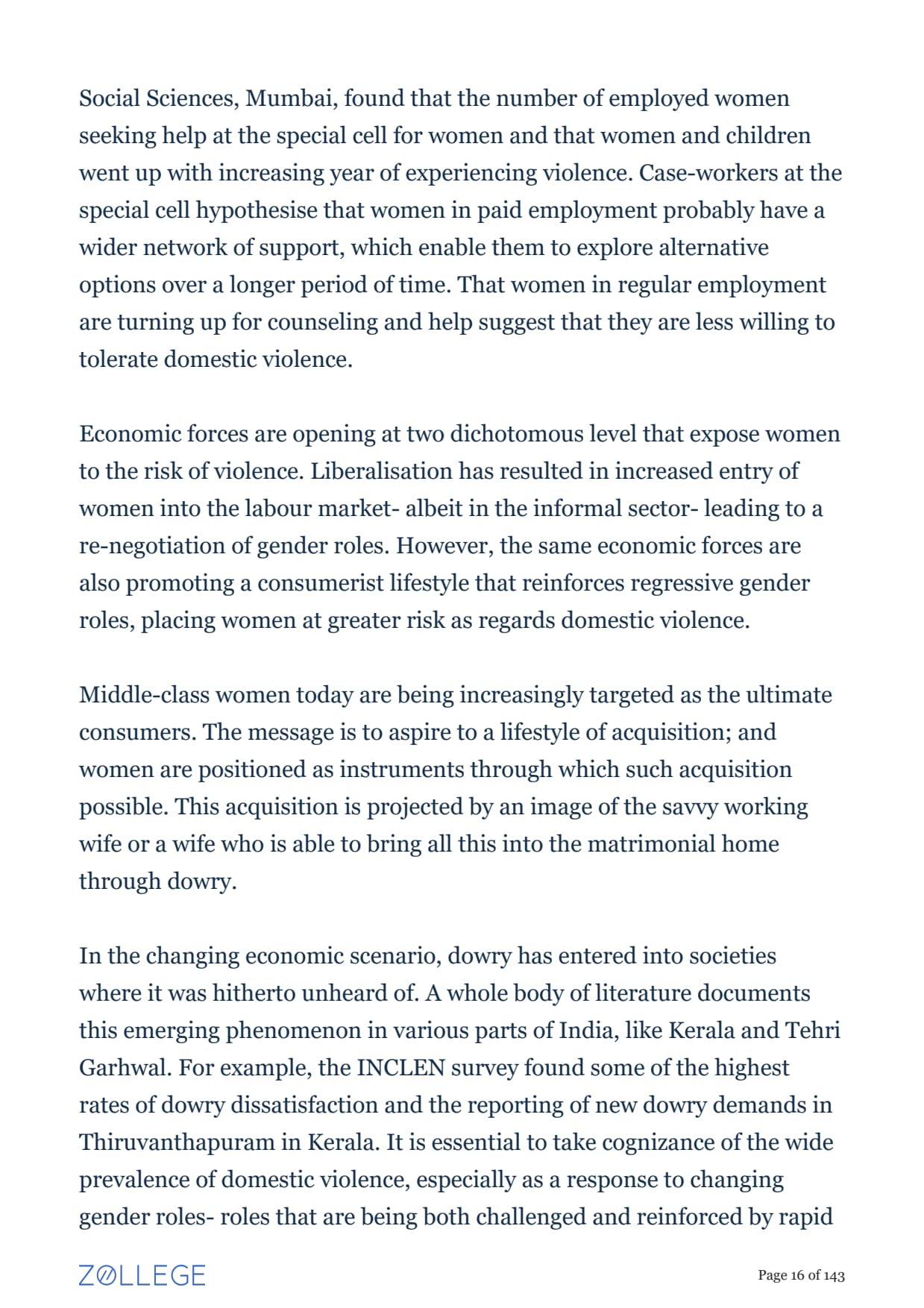
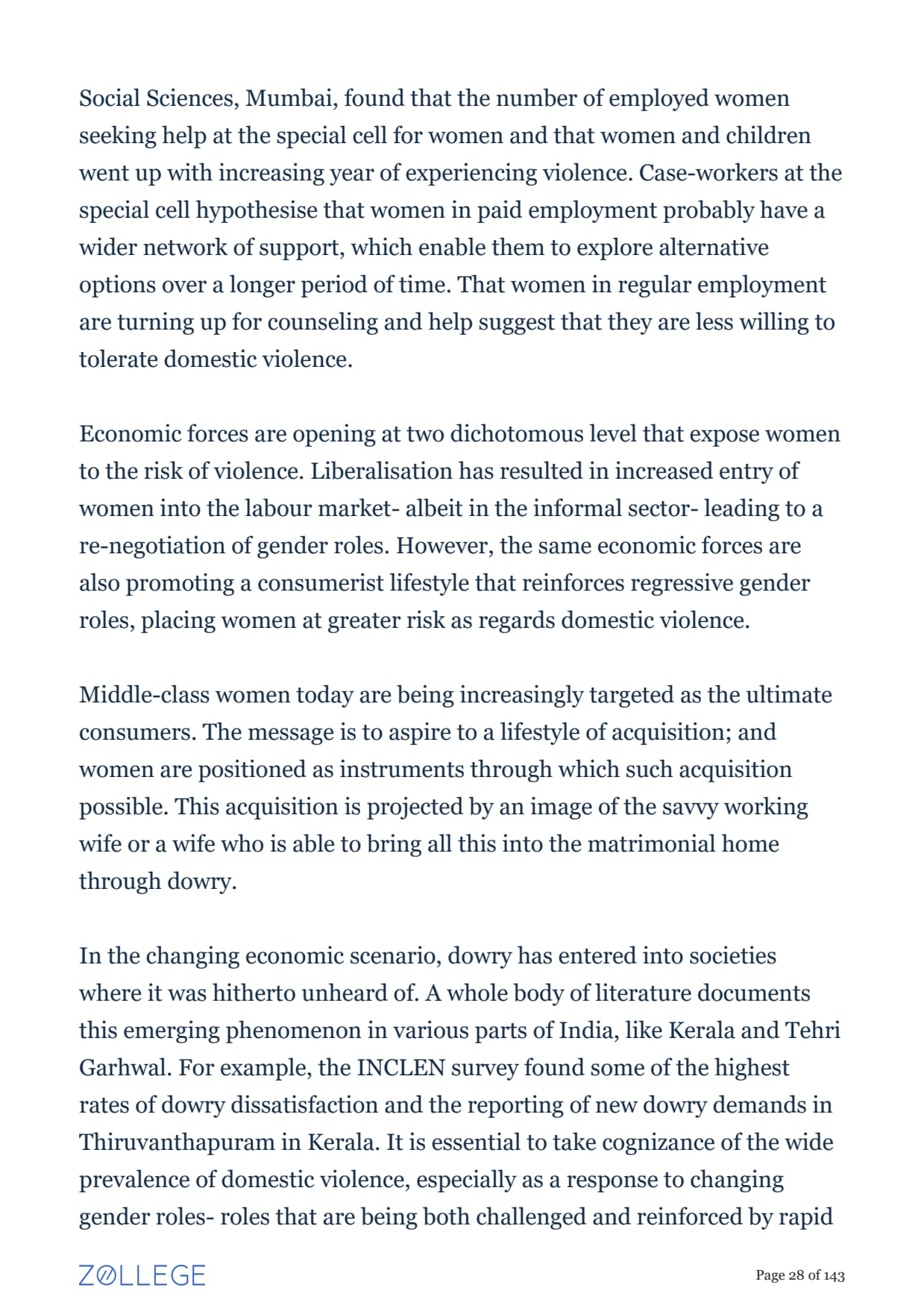
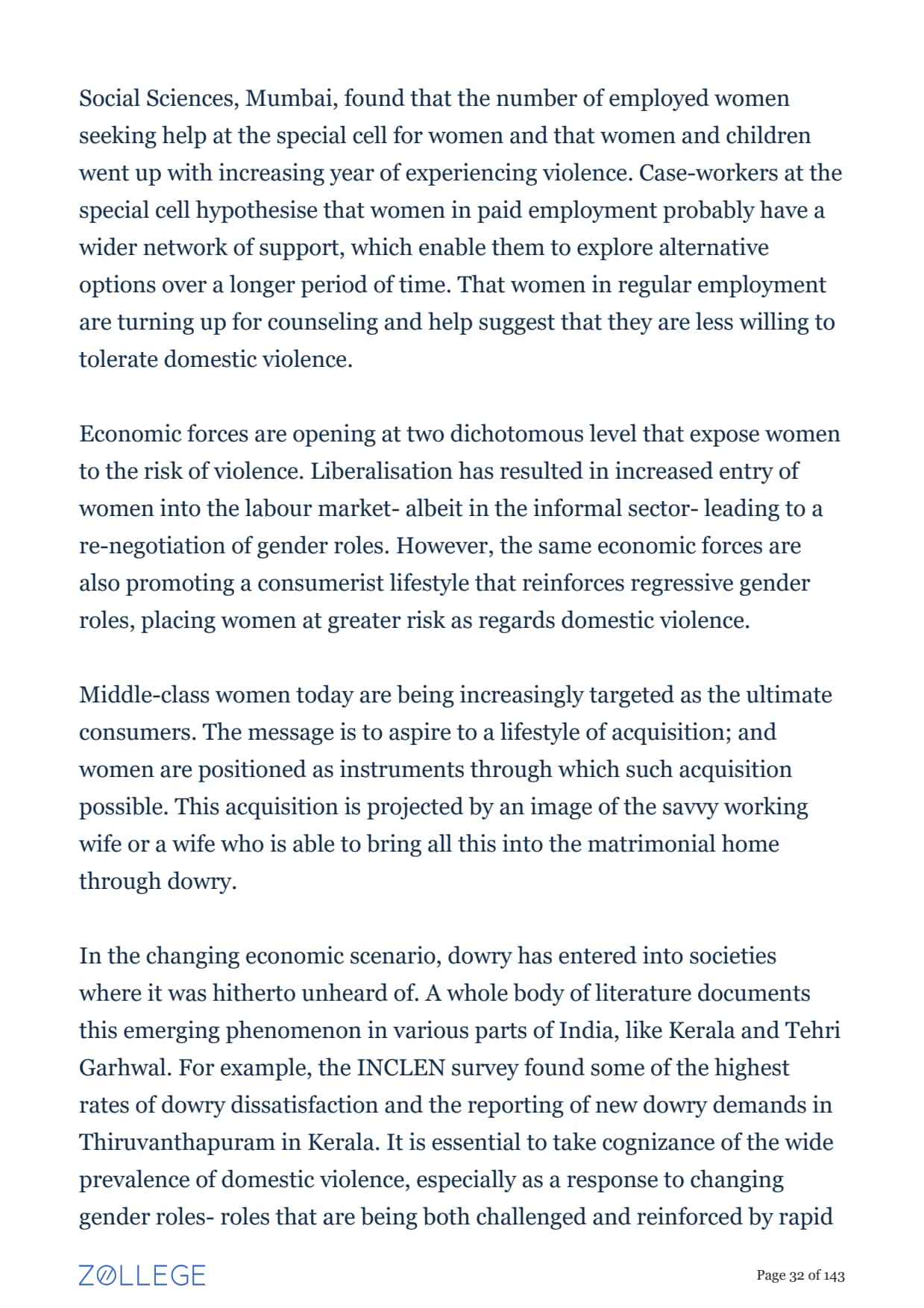
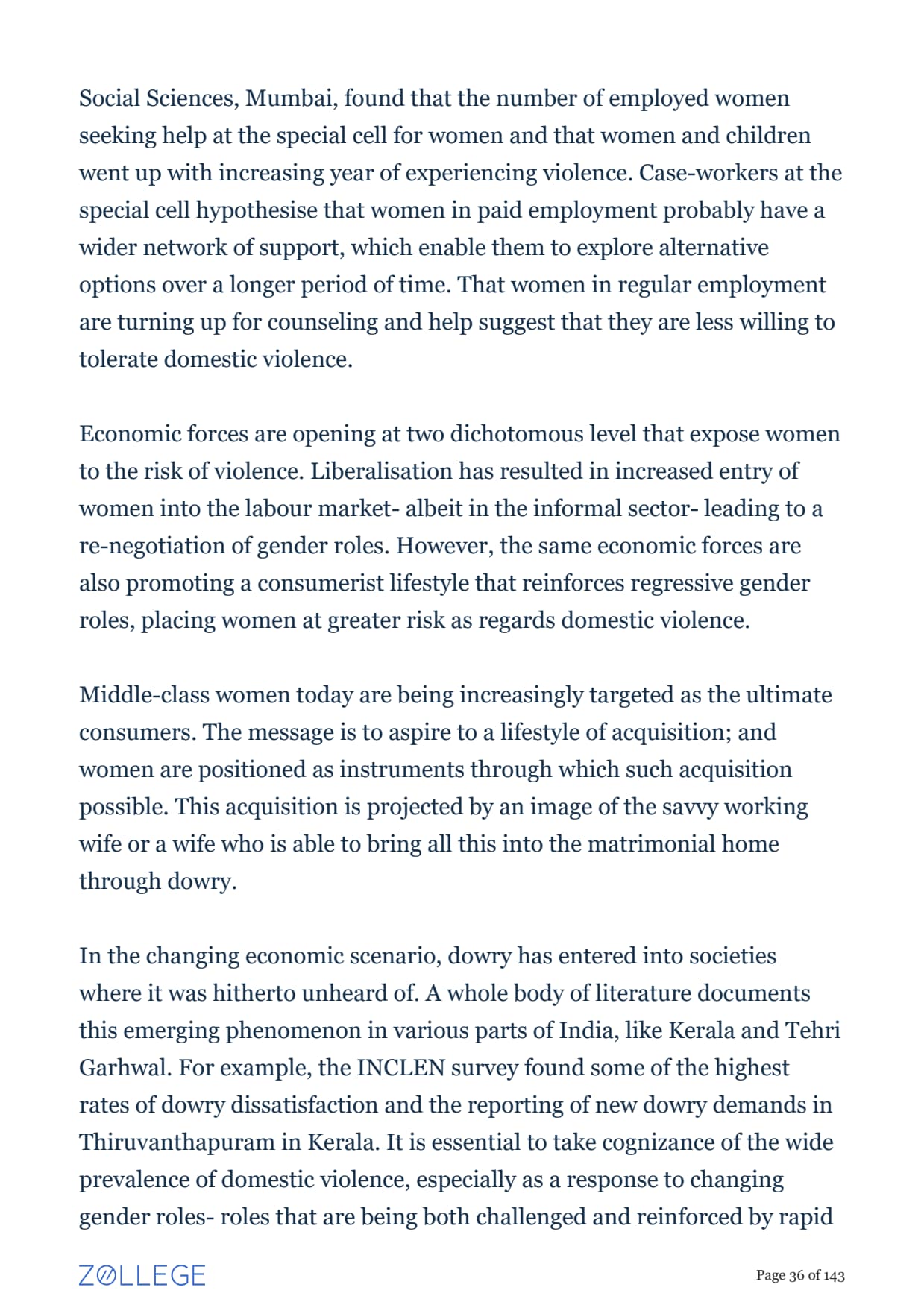
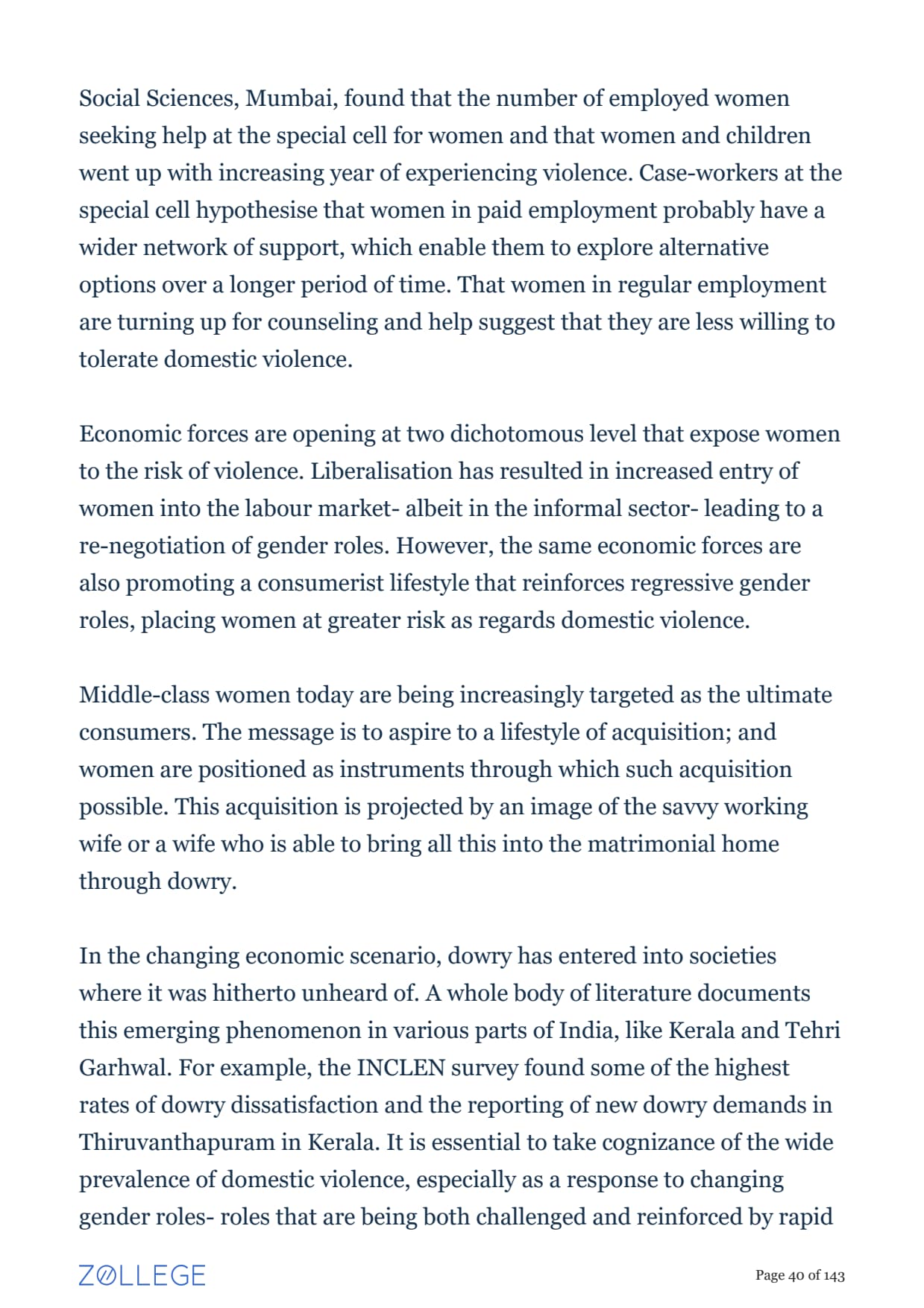
It is also important to view these findings against the recent trend of employed women seeking help. A recent study by the Tata Institute of Social Sciences, Mumbai, found that the number of employed women seeking help at the special cell for women and that women and children went up with increasing year of experiencing violence. Case-workers at the special cell hypothesise that women in paid employment probably have a wider network of support, which enable them to explore alternative options over a longer period of time. That women in regular employment are turning up for counseling and help suggest that they are less willing to tolerate domestic violence.
Economic forces are opening at two dichotomous level that expose women to the risk of violence. Liberalisation has resulted in increased entry of women into the labour market- albeit in the informal sector- leading to a re-negotiation of gender roles. However, the same economic forces are also promoting a consumerist lifestyle that reinforces regressive gender roles, placing women at greater risk as regards domestic violence.
Middle-class women today are being increasingly targeted as the ultimate consumers. The message is to aspire to a lifestyle of acquisition; and women are positioned as instruments through which such acquisition possible. This acquisition is projected by an image of the savvy working wife or a wife who is able to bring all this into the matrimonial home through dowry.
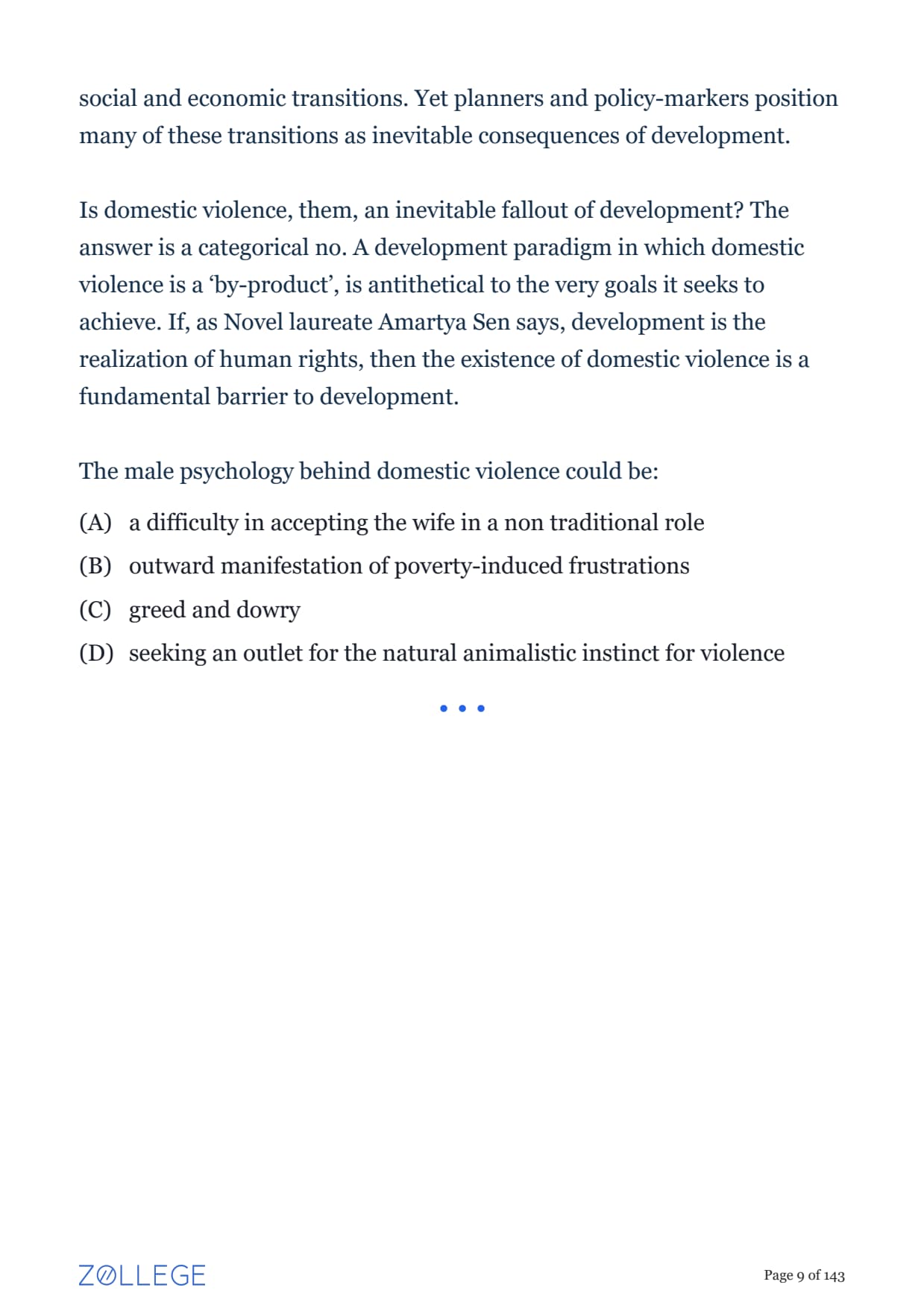
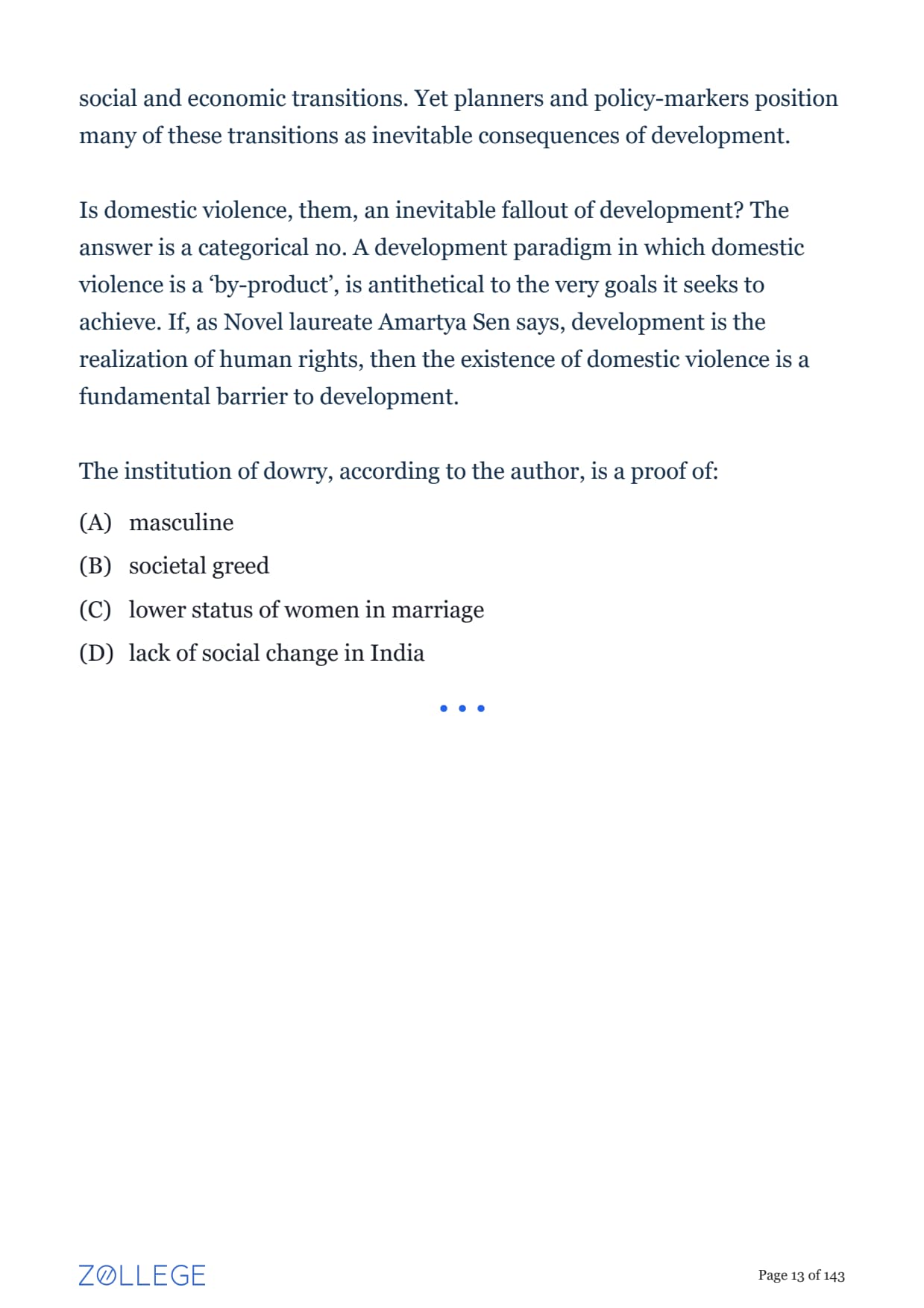
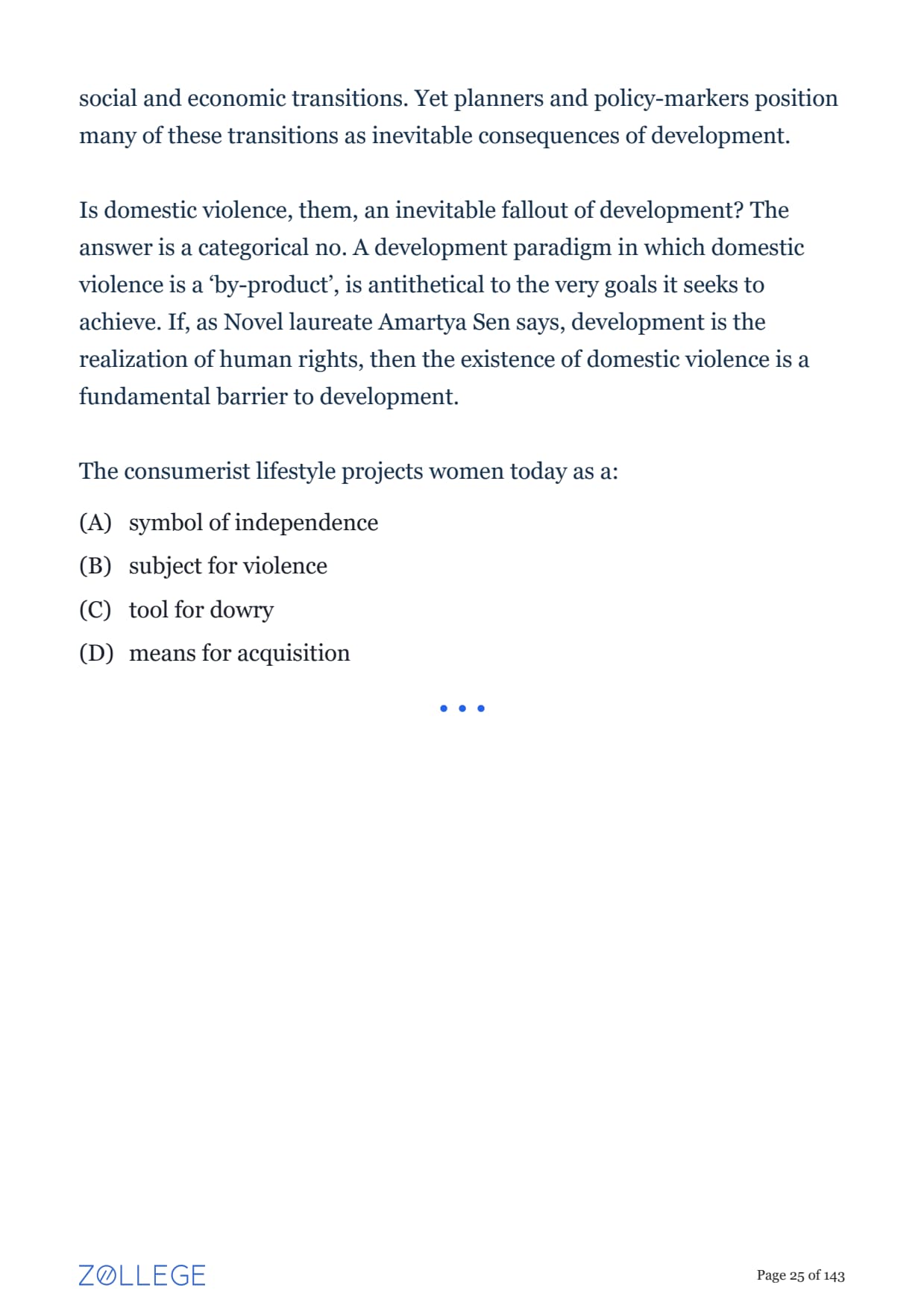
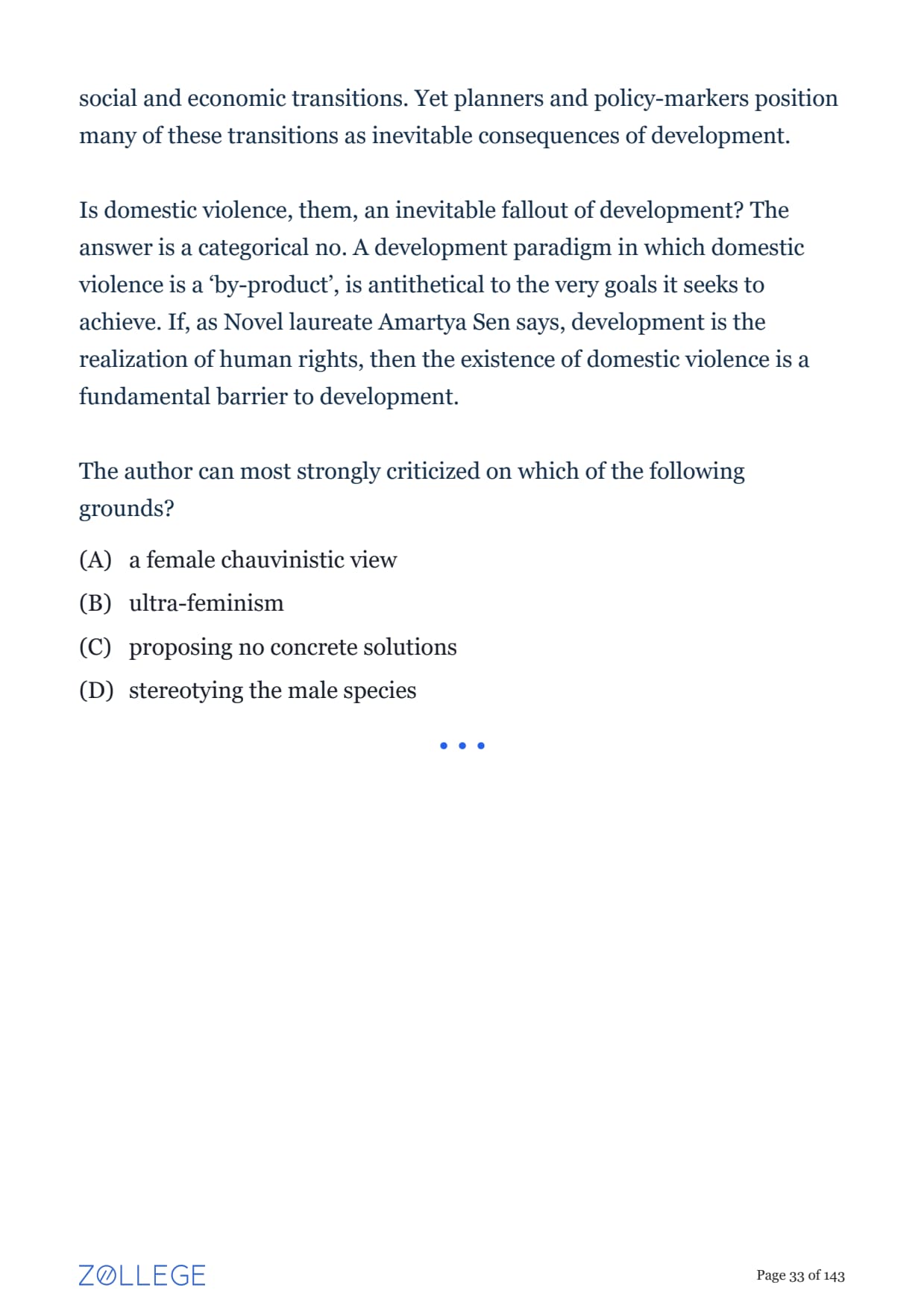
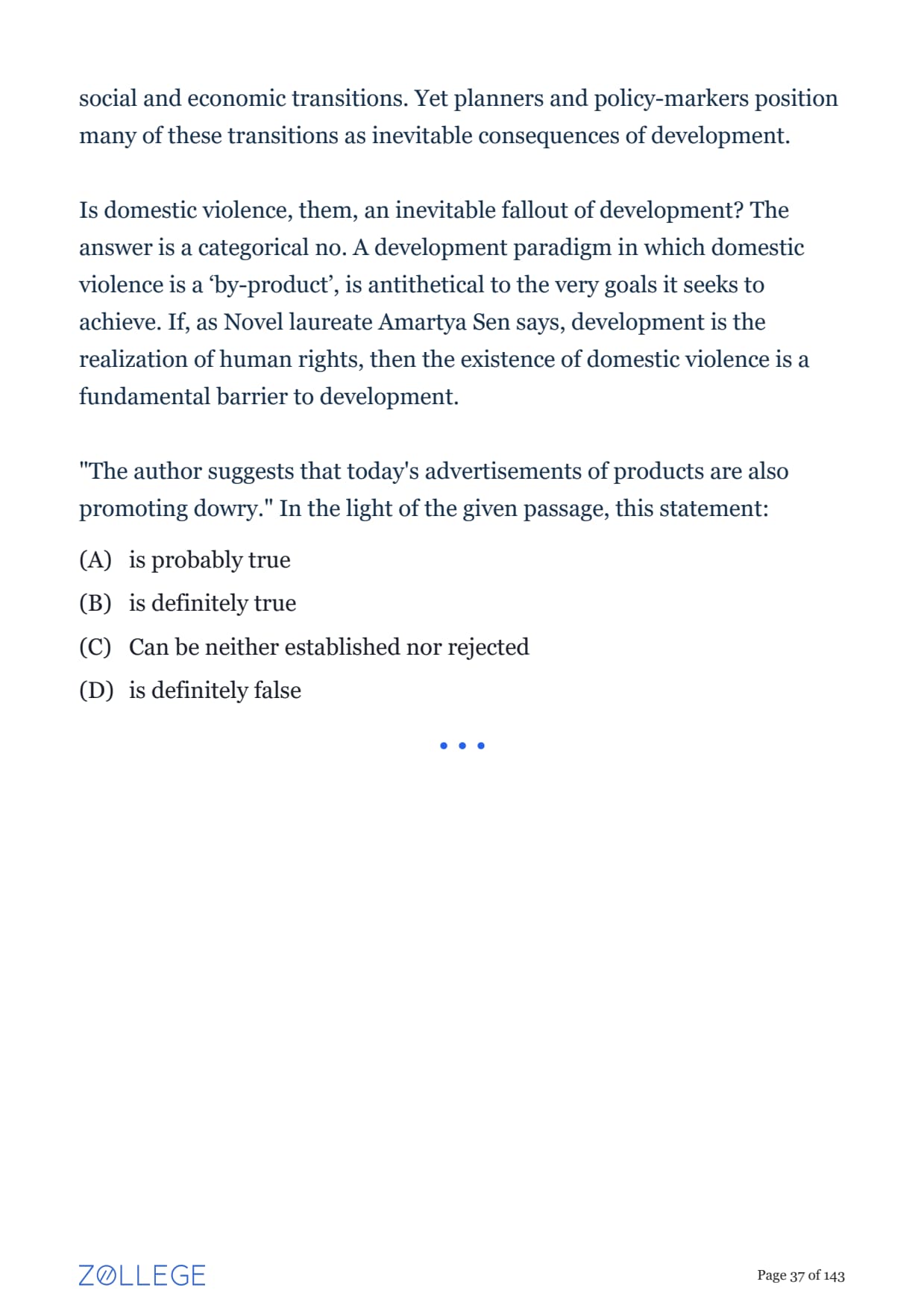
In the changing economic scenario, dowry has entered into societies where it was hitherto unheard of. A whole body of literature documents this emerging phenomenon in various parts of India, like Kerala and Tehri Garhwal. For example, the INCLEN survey found some of the highest rates of dowry dissatisfaction and the reporting of new dowry demands in Thiruvanthapuram in Kerala. It is essential to take cognizance of the wide prevalence of domestic violence, especially as a response to changing gender roles- roles that are being both challenged and reinforced by rapid social and economic transitions. Yet planners and policy-markers position many of these transitions as inevitable consequences of development.
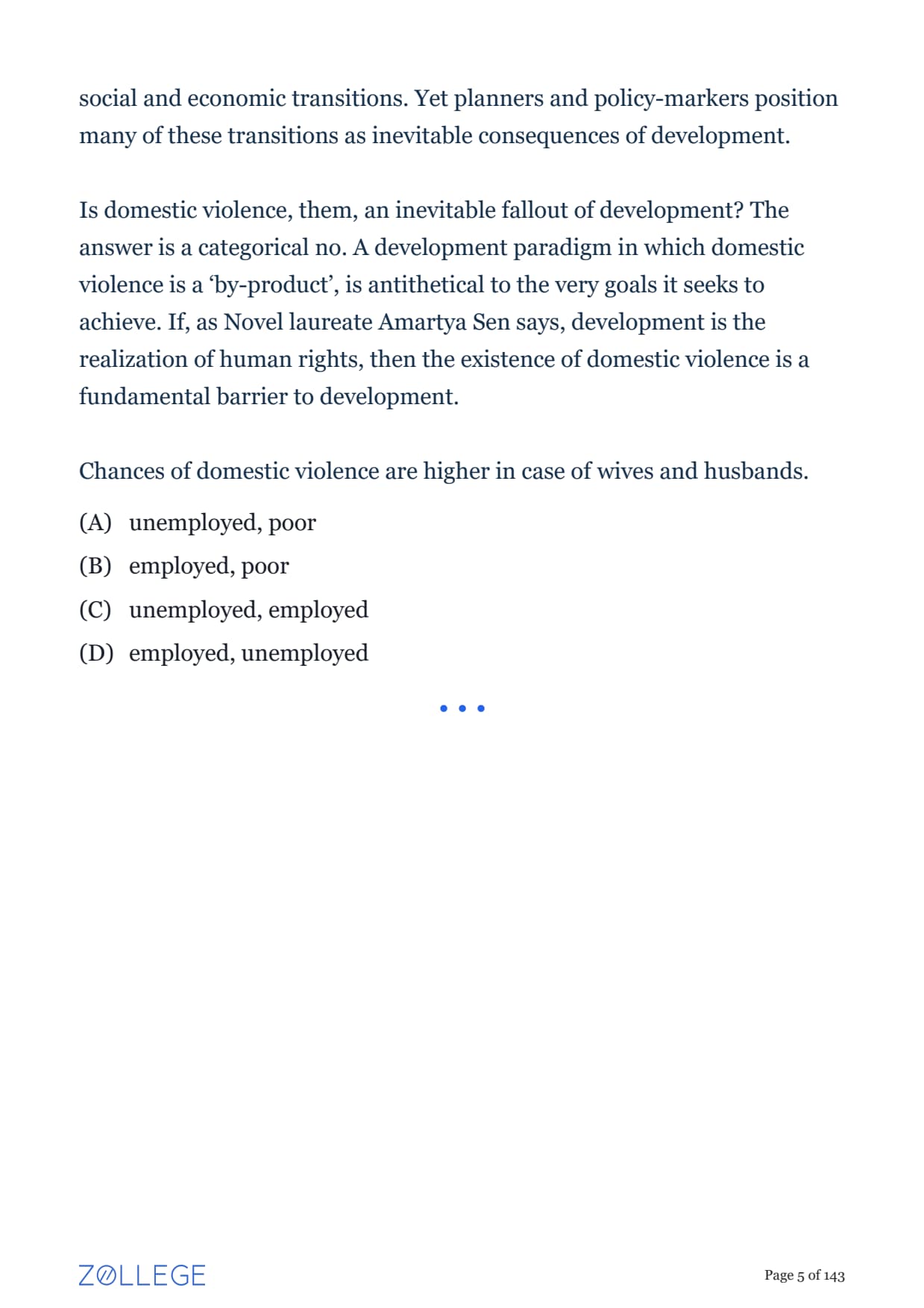
Is domestic violence, them, an inevitable fallout of development? The answer is a categorical no. A development paradigm in which domestic violence is a ‘by-product’, is antithetical to the very goals it seeks to achieve. If, as Novel laureate Amartya Sen says, development is the realization of human rights, then the existence of domestic violence is a fundamental barrier to development.
Chances of domestic violence are higher in case of wives and husbands.
Read the following passage and answer the question below.
A multi-sectoral survey done by the International Clinical Epidemiologists Network (INCLEN) has found that contrary to popular belief, domestic violence in India cut across social and educational status. Economic and gender relations are undergoing changes, with an increasing number of women entering the formal and informal labour markets. This casts the woman in the role of breadwinner as opposed to home-market, leading to increasing use of violence as a mechanism to subjugate her.
The study found that women-educated and illiterate, from rural and urban areas, engaged in paid and unpaid labour-suffer varying degrees of physical and psychological violence by their husbands. Two out of every five married women reported being hit, kicked, beaten or slapped by their husbands. Fifty percent of the women experiencing physical violence also reported physical abuse during pregnancy. A respondent from a slum colony in Bhopal said that she was beaten not only by her husband but also by all members of his family.
In the lower economic strata, abused women typically lead a complicated life. They work as domestic help, which often means unsympathetic employers. Add to this small children who need attention and alcoholic husbands, and it is a vicious cycle.
Why do women face violence at the hands of those who are supposed to provide them security? The range of ‘causes’ varies from not cooking on time to mismanagement of the household to neglect of children. In short, non-adherence to gender roles and responsibilities leads to violence, or the threat of it, is used very often to ensure ‘discipline’, which either maintains gender roles, or prevents changes in gender relations. For example, alcohol and dowry have long been associated with violence, but then, why is it that men beat only their wives and children after drinking? Why is it that women have to bring a host of material possessions to establish and maintain their status within the matrimonial homes? Both these phenomena reflect women’s subordination within marriage, a strongly endorsed gender role in society.
One arena in which gender roles are undergoing rapid change is the economic sphere, with increasing numbers of women entering the formal and informal labour market. The study found that Nagpur, over90 percent of the women who had reported experiencing violence were involved in paid work. The Nagpur data revealed another significant point. More abuse if their husbands were unemployed. This suggests that working women suffer more abuse if their husbands are also unemployed. Gender gap in employment acts as a further trigger for domestic violence.
This should, however, not be interpreted to mean that providing employment opportunities to unemployed men would automatically ensure reduction in violence in against women. On the contrary, violence is frequently used as a mechanism to deal with any attempt at reversal in gender role, which pits ‘man-the –bread-earner’ against ‘woman–the–home-market’.
In a similar vein, the recent National Family Health found that women working for money are more likely to have been beaten in the last 12 months. A respondent from rural Lucknow, sharing her story of marital abuse, said, “He insults me in front of my relatives and neighbours. He used to beat me also but for the past year that has stopped, mainly because he is now in a better job and earning better.”
It is also important to view these findings against the recent trend of employed women seeking help. A recent study by the Tata Institute of Social Sciences, Mumbai, found that the number of employed women seeking help at the special cell for women and that women and children went up with increasing year of experiencing violence. Case-workers at the special cell hypothesise that women in paid employment probably have a wider network of support, which enable them to explore alternative options over a longer period of time. That women in regular employment are turning up for counseling and help suggest that they are less willing to tolerate domestic violence.
Economic forces are opening at two dichotomous level that expose women to the risk of violence. Liberalisation has resulted in increased entry of women into the labour market- albeit in the informal sector- leading to a re-negotiation of gender roles. However, the same economic forces are also promoting a consumerist lifestyle that reinforces regressive gender roles, placing women at greater risk as regards domestic violence.
Middle-class women today are being increasingly targeted as the ultimate consumers. The message is to aspire to a lifestyle of acquisition; and women are positioned as instruments through which such acquisition possible. This acquisition is projected by an image of the savvy working wife or a wife who is able to bring all this into the matrimonial home through dowry.
In the changing economic scenario, dowry has entered into societies where it was hitherto unheard of. A whole body of literature documents this emerging phenomenon in various parts of India, like Kerala and Tehri Garhwal. For example, the INCLEN survey found some of the highest rates of dowry dissatisfaction and the reporting of new dowry demands in Thiruvanthapuram in Kerala. It is essential to take cognizance of the wide prevalence of domestic violence, especially as a response to changing gender roles- roles that are being both challenged and reinforced by rapid social and economic transitions. Yet planners and policy-markers position many of these transitions as inevitable consequences of development.
Is domestic violence, them, an inevitable fallout of development? The answer is a categorical no. A development paradigm in which domestic violence is a ‘by-product’, is antithetical to the very goals it seeks to achieve. If, as Novel laureate Amartya Sen says, development is the realization of human rights, then the existence of domestic violence is a fundamental barrier to development.
The male psychology behind domestic violence could be:
Read the following passage and answer the question below.
A multi-sectoral survey done by the International Clinical Epidemiologists Network (INCLEN) has found that contrary to popular belief, domestic violence in India cut across social and educational status. Economic and gender relations are undergoing changes, with an increasing number of women entering the formal and informal labour markets. This casts the woman in the role of breadwinner as opposed to home-market, leading to increasing use of violence as a mechanism to subjugate her.
The study found that women-educated and illiterate, from rural and urban areas, engaged in paid and unpaid labour-suffer varying degrees of physical and psychological violence by their husbands. Two out of every five married women reported being hit, kicked, beaten or slapped by their husbands. Fifty percent of the women experiencing physical violence also reported physical abuse during pregnancy. A respondent from a slum colony in Bhopal said that she was beaten not only by her husband but also by all members of his family.
In the lower economic strata, abused women typically lead a complicated life. They work as domestic help, which often means unsympathetic employers. Add to this small children who need attention and alcoholic husbands, and it is a vicious cycle.
Why do women face violence at the hands of those who are supposed to provide them security? The range of ‘causes’ varies from not cooking on time to mismanagement of the household to neglect of children. In short, non-adherence to gender roles and responsibilities leads to violence, or the threat of it, is used very often to ensure ‘discipline’, which either maintains gender roles, or prevents changes in gender relations. For example, alcohol and dowry have long been associated with violence, but then, why is it that men beat only their wives and children after drinking? Why is it that women have to bring a host of material possessions to establish and maintain their status within the matrimonial homes? Both these phenomena reflect women’s subordination within marriage, a strongly endorsed gender role in society.
One arena in which gender roles are undergoing rapid change is the economic sphere, with increasing numbers of women entering the formal and informal labour market. The study found that Nagpur, over90 percent of the women who had reported experiencing violence were involved in paid work. The Nagpur data revealed another significant point. More abuse if their husbands were unemployed. This suggests that working women suffer more abuse if their husbands are also unemployed. Gender gap in employment acts as a further trigger for domestic violence.
This should, however, not be interpreted to mean that providing employment opportunities to unemployed men would automatically ensure reduction in violence in against women. On the contrary, violence is frequently used as a mechanism to deal with any attempt at reversal in gender role, which pits ‘man-the –bread-earner’ against ‘woman–the–home-market’.
In a similar vein, the recent National Family Health found that women working for money are more likely to have been beaten in the last 12 months. A respondent from rural Lucknow, sharing her story of marital abuse, said, “He insults me in front of my relatives and neighbours. He used to beat me also but for the past year that has stopped, mainly because he is now in a better job and earning better.”
It is also important to view these findings against the recent trend of employed women seeking help. A recent study by the Tata Institute of Social Sciences, Mumbai, found that the number of employed women seeking help at the special cell for women and that women and children went up with increasing year of experiencing violence. Case-workers at the special cell hypothesise that women in paid employment probably have a wider network of support, which enable them to explore alternative options over a longer period of time. That women in regular employment are turning up for counseling and help suggest that they are less willing to tolerate domestic violence.
Economic forces are opening at two dichotomous level that expose women to the risk of violence. Liberalisation has resulted in increased entry of women into the labour market- albeit in the informal sector- leading to a re-negotiation of gender roles. However, the same economic forces are also promoting a consumerist lifestyle that reinforces regressive gender roles, placing women at greater risk as regards domestic violence.
Middle-class women today are being increasingly targeted as the ultimate consumers. The message is to aspire to a lifestyle of acquisition; and women are positioned as instruments through which such acquisition possible. This acquisition is projected by an image of the savvy working wife or a wife who is able to bring all this into the matrimonial home through dowry.
In the changing economic scenario, dowry has entered into societies where it was hitherto unheard of. A whole body of literature documents this emerging phenomenon in various parts of India, like Kerala and Tehri Garhwal. For example, the INCLEN survey found some of the highest rates of dowry dissatisfaction and the reporting of new dowry demands in Thiruvanthapuram in Kerala. It is essential to take cognizance of the wide prevalence of domestic violence, especially as a response to changing gender roles- roles that are being both challenged and reinforced by rapid social and economic transitions. Yet planners and policy-markers position many of these transitions as inevitable consequences of development.
Is domestic violence, them, an inevitable fallout of development? The answer is a categorical no. A development paradigm in which domestic violence is a ‘by-product’, is antithetical to the very goals it seeks to achieve. If, as Novel laureate Amartya Sen says, development is the realization of human rights, then the existence of domestic violence is a fundamental barrier to development.
The institution of dowry, according to the author, is a proof of:
Read the following passage and answer the question below.
A multi-sectoral survey done by the International Clinical Epidemiologists Network (INCLEN) has found that contrary to popular belief, domestic violence in India cut across social and educational status. Economic and gender relations are undergoing changes, with an increasing number of women entering the formal and informal labour markets. This casts the woman in the role of breadwinner as opposed to home-market, leading to increasing use of violence as a mechanism to subjugate her.
The study found that women-educated and illiterate, from rural and urban areas, engaged in paid and unpaid labour-suffer varying degrees of physical and psychological violence by their husbands. Two out of every five married women reported being hit, kicked, beaten or slapped by their husbands. Fifty percent of the women experiencing physical violence also reported physical abuse during pregnancy. A respondent from a slum colony in Bhopal said that she was beaten not only by her husband but also by all members of his family.
In the lower economic strata, abused women typically lead a complicated life. They work as domestic help, which often means unsympathetic employers. Add to this small children who need attention and alcoholic husbands, and it is a vicious cycle.
Why do women face violence at the hands of those who are supposed to provide them security? The range of ‘causes’ varies from not cooking on time to mismanagement of the household to neglect of children. In short, non-adherence to gender roles and responsibilities leads to violence, or the threat of it, is used very often to ensure ‘discipline’, which either maintains gender roles, or prevents changes in gender relations. For example, alcohol and dowry have long been associated with violence, but then, why is it that men beat only their wives and children after drinking? Why is it that women have to bring a host of material possessions to establish and maintain their status within the matrimonial homes? Both these phenomena reflect women’s subordination within marriage, a strongly endorsed gender role in society.
One arena in which gender roles are undergoing rapid change is the economic sphere, with increasing numbers of women entering the formal and informal labour market. The study found that Nagpur, over90 percent of the women who had reported experiencing violence were involved in paid work. The Nagpur data revealed another significant point. More abuse if their husbands were unemployed. This suggests that working women suffer more abuse if their husbands are also unemployed. Gender gap in employment acts as a further trigger for domestic violence.
This should, however, not be interpreted to mean that providing employment opportunities to unemployed men would automatically ensure reduction in violence in against women. On the contrary, violence is frequently used as a mechanism to deal with any attempt at reversal in gender role, which pits ‘man-the –bread-earner’ against ‘woman–the–home-market’.
In a similar vein, the recent National Family Health found that women working for money are more likely to have been beaten in the last 12 months. A respondent from rural Lucknow, sharing her story of marital abuse, said, “He insults me in front of my relatives and neighbours. He used to beat me also but for the past year that has stopped, mainly because he is now in a better job and earning better.”
It is also important to view these findings against the recent trend of employed women seeking help. A recent study by the Tata Institute of Social Sciences, Mumbai, found that the number of employed women seeking help at the special cell for women and that women and children went up with increasing year of experiencing violence. Case-workers at the special cell hypothesise that women in paid employment probably have a wider network of support, which enable them to explore alternative options over a longer period of time. That women in regular employment are turning up for counseling and help suggest that they are less willing to tolerate domestic violence.
Economic forces are opening at two dichotomous level that expose women to the risk of violence. Liberalisation has resulted in increased entry of women into the labour market- albeit in the informal sector- leading to a re-negotiation of gender roles. However, the same economic forces are also promoting a consumerist lifestyle that reinforces regressive gender roles, placing women at greater risk as regards domestic violence.
Middle-class women today are being increasingly targeted as the ultimate consumers. The message is to aspire to a lifestyle of acquisition; and women are positioned as instruments through which such acquisition possible. This acquisition is projected by an image of the savvy working wife or a wife who is able to bring all this into the matrimonial home through dowry.
In the changing economic scenario, dowry has entered into societies where it was hitherto unheard of. A whole body of literature documents this emerging phenomenon in various parts of India, like Kerala and Tehri Garhwal. For example, the INCLEN survey found some of the highest rates of dowry dissatisfaction and the reporting of new dowry demands in Thiruvanthapuram in Kerala. It is essential to take cognizance of the wide prevalence of domestic violence, especially as a response to changing gender roles- roles that are being both challenged and reinforced by rapid social and economic transitions. Yet planners and policy-markers position many of these transitions as inevitable consequences of development.
Is domestic violence, them, an inevitable fallout of development? The answer is a categorical no. A development paradigm in which domestic violence is a ‘by-product’, is antithetical to the very goals it seeks to achieve. If, as Novel laureate Amartya Sen says, development is the realization of human rights, then the existence of domestic violence is a fundamental barrier to development.
Why, according to the author, improvement in employment situation for the males will still not solve the problem?
Read the following passage and answer the question below.
A multi-sectoral survey done by the International Clinical Epidemiologists Network (INCLEN) has found that contrary to popular belief, domestic violence in India cut across social and educational status. Economic and gender relations are undergoing changes, with an increasing number of women entering the formal and informal labour markets. This casts the woman in the role of breadwinner as opposed to home-market, leading to increasing use of violence as a mechanism to subjugate her.
The study found that women-educated and illiterate, from rural and urban areas, engaged in paid and unpaid labour-suffer varying degrees of physical and psychological violence by their husbands. Two out of every five married women reported being hit, kicked, beaten or slapped by their husbands. Fifty percent of the women experiencing physical violence also reported physical abuse during pregnancy. A respondent from a slum colony in Bhopal said that she was beaten not only by her husband but also by all members of his family.
In the lower economic strata, abused women typically lead a complicated life. They work as domestic help, which often means unsympathetic employers. Add to this small children who need attention and alcoholic husbands, and it is a vicious cycle.
Why do women face violence at the hands of those who are supposed to provide them security? The range of ‘causes’ varies from not cooking on time to mismanagement of the household to neglect of children. In short, non-adherence to gender roles and responsibilities leads to violence, or the threat of it, is used very often to ensure ‘discipline’, which either maintains gender roles, or prevents changes in gender relations. For example, alcohol and dowry have long been associated with violence, but then, why is it that men beat only their wives and children after drinking? Why is it that women have to bring a host of material possessions to establish and maintain their status within the matrimonial homes? Both these phenomena reflect women’s subordination within marriage, a strongly endorsed gender role in society.
One arena in which gender roles are undergoing rapid change is the economic sphere, with increasing numbers of women entering the formal and informal labour market. The study found that Nagpur, over90 percent of the women who had reported experiencing violence were involved in paid work. The Nagpur data revealed another significant point. More abuse if their husbands were unemployed. This suggests that working women suffer more abuse if their husbands are also unemployed. Gender gap in employment acts as a further trigger for domestic violence.
This should, however, not be interpreted to mean that providing employment opportunities to unemployed men would automatically ensure reduction in violence in against women. On the contrary, violence is frequently used as a mechanism to deal with any attempt at reversal in gender role, which pits ‘man-the –bread-earner’ against ‘woman–the–home-market’.
In a similar vein, the recent National Family Health found that women working for money are more likely to have been beaten in the last 12 months. A respondent from rural Lucknow, sharing her story of marital abuse, said, “He insults me in front of my relatives and neighbours. He used to beat me also but for the past year that has stopped, mainly because he is now in a better job and earning better.”
It is also important to view these findings against the recent trend of employed women seeking help. A recent study by the Tata Institute of Social Sciences, Mumbai, found that the number of employed women seeking help at the special cell for women and that women and children went up with increasing year of experiencing violence. Case-workers at the special cell hypothesise that women in paid employment probably have a wider network of support, which enable them to explore alternative options over a longer period of time. That women in regular employment are turning up for counseling and help suggest that they are less willing to tolerate domestic violence.
Economic forces are opening at two dichotomous level that expose women to the risk of violence. Liberalisation has resulted in increased entry of women into the labour market- albeit in the informal sector- leading to a re-negotiation of gender roles. However, the same economic forces are also promoting a consumerist lifestyle that reinforces regressive gender roles, placing women at greater risk as regards domestic violence.
Middle-class women today are being increasingly targeted as the ultimate consumers. The message is to aspire to a lifestyle of acquisition; and women are positioned as instruments through which such acquisition possible. This acquisition is projected by an image of the savvy working wife or a wife who is able to bring all this into the matrimonial home through dowry.
In the changing economic scenario, dowry has entered into societies where it was hitherto unheard of. A whole body of literature documents this emerging phenomenon in various parts of India, like Kerala and Tehri Garhwal. For example, the INCLEN survey found some of the highest rates of dowry dissatisfaction and the reporting of new dowry demands in Thiruvanthapuram in Kerala. It is essential to take cognizance of the wide prevalence of domestic violence, especially as a response to changing gender roles- roles that are being both challenged and reinforced by rapid social and economic transitions. Yet planners and policy-markers position many of these transitions as inevitable consequences of development.
Is domestic violence, them, an inevitable fallout of development? The answer is a categorical no. A development paradigm in which domestic violence is a ‘by-product’, is antithetical to the very goals it seeks to achieve. If, as Novel laureate Amartya Sen says, development is the realization of human rights, then the existence of domestic violence is a fundamental barrier to development.
The institution of dowry, according to the author, is governed by the dictates of:
I. Tradition
II. economics of greed
Read the following passage and answer the question below.
A multi-sectoral survey done by the International Clinical Epidemiologists Network (INCLEN) has found that contrary to popular belief, domestic violence in India cut across social and educational status. Economic and gender relations are undergoing changes, with an increasing number of women entering the formal and informal labour markets. This casts the woman in the role of breadwinner as opposed to home-market, leading to increasing use of violence as a mechanism to subjugate her.
The study found that women-educated and illiterate, from rural and urban areas, engaged in paid and unpaid labour-suffer varying degrees of physical and psychological violence by their husbands. Two out of every five married women reported being hit, kicked, beaten or slapped by their husbands. Fifty percent of the women experiencing physical violence also reported physical abuse during pregnancy. A respondent from a slum colony in Bhopal said that she was beaten not only by her husband but also by all members of his family.
In the lower economic strata, abused women typically lead a complicated life. They work as domestic help, which often means unsympathetic employers. Add to this small children who need attention and alcoholic husbands, and it is a vicious cycle.
Why do women face violence at the hands of those who are supposed to provide them security? The range of ‘causes’ varies from not cooking on time to mismanagement of the household to neglect of children. In short, non-adherence to gender roles and responsibilities leads to violence, or the threat of it, is used very often to ensure ‘discipline’, which either maintains gender roles, or prevents changes in gender relations. For example, alcohol and dowry have long been associated with violence, but then, why is it that men beat only their wives and children after drinking? Why is it that women have to bring a host of material possessions to establish and maintain their status within the matrimonial homes? Both these phenomena reflect women’s subordination within marriage, a strongly endorsed gender role in society.
One arena in which gender roles are undergoing rapid change is the economic sphere, with increasing numbers of women entering the formal and informal labour market. The study found that Nagpur, over90 percent of the women who had reported experiencing violence were involved in paid work. The Nagpur data revealed another significant point. More abuse if their husbands were unemployed. This suggests that working women suffer more abuse if their husbands are also unemployed. Gender gap in employment acts as a further trigger for domestic violence.
This should, however, not be interpreted to mean that providing employment opportunities to unemployed men would automatically ensure reduction in violence in against women. On the contrary, violence is frequently used as a mechanism to deal with any attempt at reversal in gender role, which pits ‘man-the –bread-earner’ against ‘woman–the–home-market’.
In a similar vein, the recent National Family Health found that women working for money are more likely to have been beaten in the last 12 months. A respondent from rural Lucknow, sharing her story of marital abuse, said, “He insults me in front of my relatives and neighbours. He used to beat me also but for the past year that has stopped, mainly because he is now in a better job and earning better.”
It is also important to view these findings against the recent trend of employed women seeking help. A recent study by the Tata Institute of Social Sciences, Mumbai, found that the number of employed women seeking help at the special cell for women and that women and children went up with increasing year of experiencing violence. Case-workers at the special cell hypothesise that women in paid employment probably have a wider network of support, which enable them to explore alternative options over a longer period of time. That women in regular employment are turning up for counseling and help suggest that they are less willing to tolerate domestic violence.
Economic forces are opening at two dichotomous level that expose women to the risk of violence. Liberalisation has resulted in increased entry of women into the labour market- albeit in the informal sector- leading to a re-negotiation of gender roles. However, the same economic forces are also promoting a consumerist lifestyle that reinforces regressive gender roles, placing women at greater risk as regards domestic violence.
Middle-class women today are being increasingly targeted as the ultimate consumers. The message is to aspire to a lifestyle of acquisition; and women are positioned as instruments through which such acquisition possible. This acquisition is projected by an image of the savvy working wife or a wife who is able to bring all this into the matrimonial home through dowry.
In the changing economic scenario, dowry has entered into societies where it was hitherto unheard of. A whole body of literature documents this emerging phenomenon in various parts of India, like Kerala and Tehri Garhwal. For example, the INCLEN survey found some of the highest rates of dowry dissatisfaction and the reporting of new dowry demands in Thiruvanthapuram in Kerala. It is essential to take cognizance of the wide prevalence of domestic violence, especially as a response to changing gender roles- roles that are being both challenged and reinforced by rapid social and economic transitions. Yet planners and policy-markers position many of these transitions as inevitable consequences of development.
Is domestic violence, them, an inevitable fallout of development? The answer is a categorical no. A development paradigm in which domestic violence is a ‘by-product’, is antithetical to the very goals it seeks to achieve. If, as Novel laureate Amartya Sen says, development is the realization of human rights, then the existence of domestic violence is a fundamental barrier to development.
The consumerist lifestyle projects women today as a:
Read the following passage and answer the question below.
A multi-sectoral survey done by the International Clinical Epidemiologists Network (INCLEN) has found that contrary to popular belief, domestic violence in India cut across social and educational status. Economic and gender relations are undergoing changes, with an increasing number of women entering the formal and informal labour markets. This casts the woman in the role of breadwinner as opposed to home-market, leading to increasing use of violence as a mechanism to subjugate her.
The study found that women-educated and illiterate, from rural and urban areas, engaged in paid and unpaid labour-suffer varying degrees of physical and psychological violence by their husbands. Two out of every five married women reported being hit, kicked, beaten or slapped by their husbands. Fifty percent of the women experiencing physical violence also reported physical abuse during pregnancy. A respondent from a slum colony in Bhopal said that she was beaten not only by her husband but also by all members of his family.
In the lower economic strata, abused women typically lead a complicated life. They work as domestic help, which often means unsympathetic employers. Add to this small children who need attention and alcoholic husbands, and it is a vicious cycle.
Why do women face violence at the hands of those who are supposed to provide them security? The range of ‘causes’ varies from not cooking on time to mismanagement of the household to neglect of children. In short, non-adherence to gender roles and responsibilities leads to violence, or the threat of it, is used very often to ensure ‘discipline’, which either maintains gender roles, or prevents changes in gender relations. For example, alcohol and dowry have long been associated with violence, but then, why is it that men beat only their wives and children after drinking? Why is it that women have to bring a host of material possessions to establish and maintain their status within the matrimonial homes? Both these phenomena reflect women’s subordination within marriage, a strongly endorsed gender role in society.
One arena in which gender roles are undergoing rapid change is the economic sphere, with increasing numbers of women entering the formal and informal labour market. The study found that Nagpur, over90 percent of the women who had reported experiencing violence were involved in paid work. The Nagpur data revealed another significant point. More abuse if their husbands were unemployed. This suggests that working women suffer more abuse if their husbands are also unemployed. Gender gap in employment acts as a further trigger for domestic violence.
This should, however, not be interpreted to mean that providing employment opportunities to unemployed men would automatically ensure reduction in violence in against women. On the contrary, violence is frequently used as a mechanism to deal with any attempt at reversal in gender role, which pits ‘man-the –bread-earner’ against ‘woman–the–home-market’.
In a similar vein, the recent National Family Health found that women working for money are more likely to have been beaten in the last 12 months. A respondent from rural Lucknow, sharing her story of marital abuse, said, “He insults me in front of my relatives and neighbours. He used to beat me also but for the past year that has stopped, mainly because he is now in a better job and earning better.”
It is also important to view these findings against the recent trend of employed women seeking help. A recent study by the Tata Institute of Social Sciences, Mumbai, found that the number of employed women seeking help at the special cell for women and that women and children went up with increasing year of experiencing violence. Case-workers at the special cell hypothesise that women in paid employment probably have a wider network of support, which enable them to explore alternative options over a longer period of time. That women in regular employment are turning up for counseling and help suggest that they are less willing to tolerate domestic violence.
Economic forces are opening at two dichotomous level that expose women to the risk of violence. Liberalisation has resulted in increased entry of women into the labour market- albeit in the informal sector- leading to a re-negotiation of gender roles. However, the same economic forces are also promoting a consumerist lifestyle that reinforces regressive gender roles, placing women at greater risk as regards domestic violence.
Middle-class women today are being increasingly targeted as the ultimate consumers. The message is to aspire to a lifestyle of acquisition; and women are positioned as instruments through which such acquisition possible. This acquisition is projected by an image of the savvy working wife or a wife who is able to bring all this into the matrimonial home through dowry.
In the changing economic scenario, dowry has entered into societies where it was hitherto unheard of. A whole body of literature documents this emerging phenomenon in various parts of India, like Kerala and Tehri Garhwal. For example, the INCLEN survey found some of the highest rates of dowry dissatisfaction and the reporting of new dowry demands in Thiruvanthapuram in Kerala. It is essential to take cognizance of the wide prevalence of domestic violence, especially as a response to changing gender roles- roles that are being both challenged and reinforced by rapid social and economic transitions. Yet planners and policy-markers position many of these transitions as inevitable consequences of development.
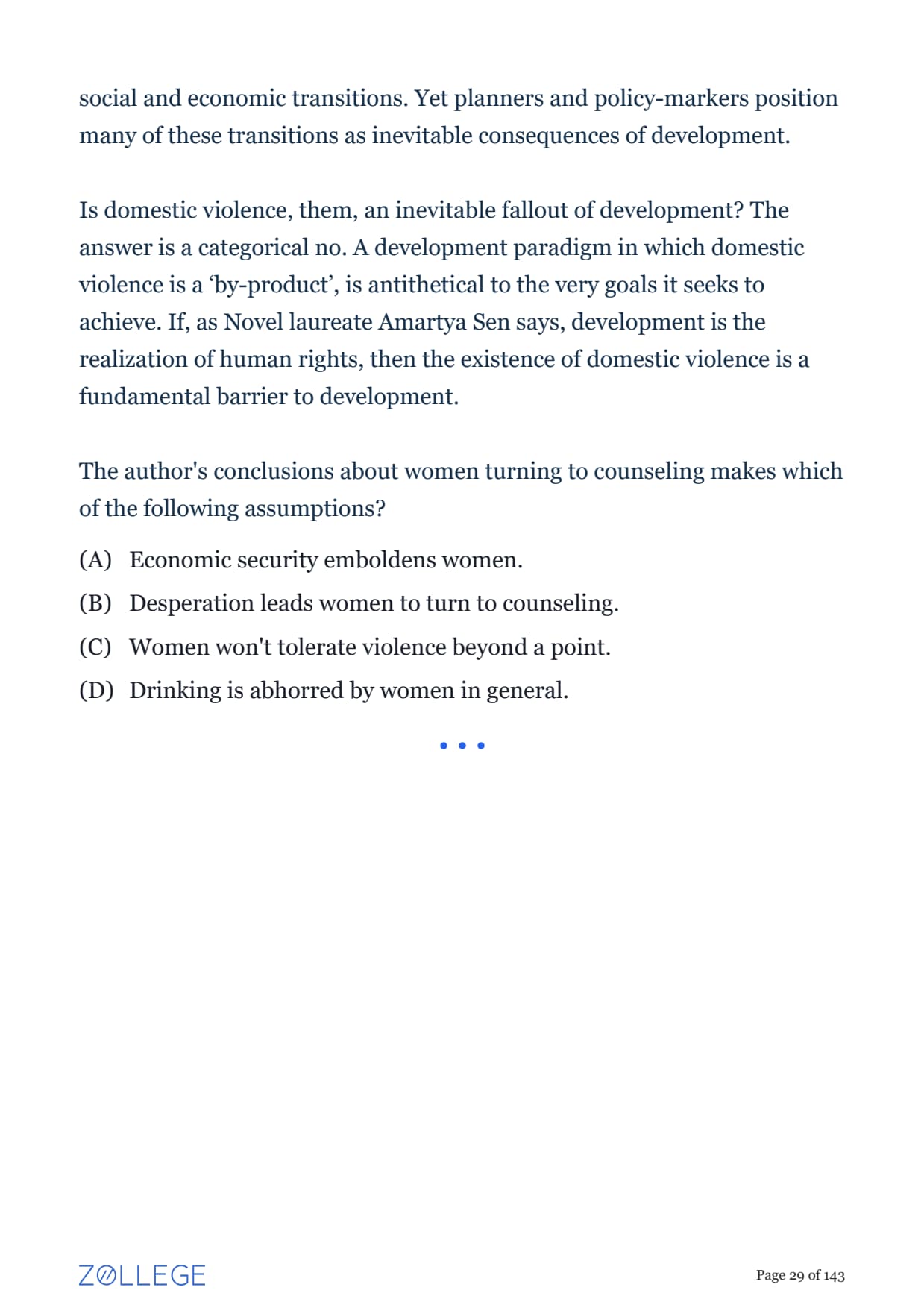
Is domestic violence, them, an inevitable fallout of development? The answer is a categorical no. A development paradigm in which domestic violence is a ‘by-product’, is antithetical to the very goals it seeks to achieve. If, as Novel laureate Amartya Sen says, development is the realization of human rights, then the existence of domestic violence is a fundamental barrier to development.
The author's conclusions about women turning to counseling makes which of the following assumptions?
Read the following passage and answer the question below.
A multi-sectoral survey done by the International Clinical Epidemiologists Network (INCLEN) has found that contrary to popular belief, domestic violence in India cut across social and educational status. Economic and gender relations are undergoing changes, with an increasing number of women entering the formal and informal labour markets. This casts the woman in the role of breadwinner as opposed to home-market, leading to increasing use of violence as a mechanism to subjugate her.
The study found that women-educated and illiterate, from rural and urban areas, engaged in paid and unpaid labour-suffer varying degrees of physical and psychological violence by their husbands. Two out of every five married women reported being hit, kicked, beaten or slapped by their husbands. Fifty percent of the women experiencing physical violence also reported physical abuse during pregnancy. A respondent from a slum colony in Bhopal said that she was beaten not only by her husband but also by all members of his family.
In the lower economic strata, abused women typically lead a complicated life. They work as domestic help, which often means unsympathetic employers. Add to this small children who need attention and alcoholic husbands, and it is a vicious cycle.
Why do women face violence at the hands of those who are supposed to provide them security? The range of ‘causes’ varies from not cooking on time to mismanagement of the household to neglect of children. In short, non-adherence to gender roles and responsibilities leads to violence, or the threat of it, is used very often to ensure ‘discipline’, which either maintains gender roles, or prevents changes in gender relations. For example, alcohol and dowry have long been associated with violence, but then, why is it that men beat only their wives and children after drinking? Why is it that women have to bring a host of material possessions to establish and maintain their status within the matrimonial homes? Both these phenomena reflect women’s subordination within marriage, a strongly endorsed gender role in society.
One arena in which gender roles are undergoing rapid change is the economic sphere, with increasing numbers of women entering the formal and informal labour market. The study found that Nagpur, over90 percent of the women who had reported experiencing violence were involved in paid work. The Nagpur data revealed another significant point. More abuse if their husbands were unemployed. This suggests that working women suffer more abuse if their husbands are also unemployed. Gender gap in employment acts as a further trigger for domestic violence.
This should, however, not be interpreted to mean that providing employment opportunities to unemployed men would automatically ensure reduction in violence in against women. On the contrary, violence is frequently used as a mechanism to deal with any attempt at reversal in gender role, which pits ‘man-the –bread-earner’ against ‘woman–the–home-market’.
In a similar vein, the recent National Family Health found that women working for money are more likely to have been beaten in the last 12 months. A respondent from rural Lucknow, sharing her story of marital abuse, said, “He insults me in front of my relatives and neighbours. He used to beat me also but for the past year that has stopped, mainly because he is now in a better job and earning better.”
It is also important to view these findings against the recent trend of employed women seeking help. A recent study by the Tata Institute of Social Sciences, Mumbai, found that the number of employed women seeking help at the special cell for women and that women and children went up with increasing year of experiencing violence. Case-workers at the special cell hypothesise that women in paid employment probably have a wider network of support, which enable them to explore alternative options over a longer period of time. That women in regular employment are turning up for counseling and help suggest that they are less willing to tolerate domestic violence.
Economic forces are opening at two dichotomous level that expose women to the risk of violence. Liberalisation has resulted in increased entry of women into the labour market- albeit in the informal sector- leading to a re-negotiation of gender roles. However, the same economic forces are also promoting a consumerist lifestyle that reinforces regressive gender roles, placing women at greater risk as regards domestic violence.
Middle-class women today are being increasingly targeted as the ultimate consumers. The message is to aspire to a lifestyle of acquisition; and women are positioned as instruments through which such acquisition possible. This acquisition is projected by an image of the savvy working wife or a wife who is able to bring all this into the matrimonial home through dowry.
In the changing economic scenario, dowry has entered into societies where it was hitherto unheard of. A whole body of literature documents this emerging phenomenon in various parts of India, like Kerala and Tehri Garhwal. For example, the INCLEN survey found some of the highest rates of dowry dissatisfaction and the reporting of new dowry demands in Thiruvanthapuram in Kerala. It is essential to take cognizance of the wide prevalence of domestic violence, especially as a response to changing gender roles- roles that are being both challenged and reinforced by rapid social and economic transitions. Yet planners and policy-markers position many of these transitions as inevitable consequences of development.
Is domestic violence, them, an inevitable fallout of development? The answer is a categorical no. A development paradigm in which domestic violence is a ‘by-product’, is antithetical to the very goals it seeks to achieve. If, as Novel laureate Amartya Sen says, development is the realization of human rights, then the existence of domestic violence is a fundamental barrier to development.
The author can most strongly criticized on which of the following grounds?
Read the following passage and answer the question below.
A multi-sectoral survey done by the International Clinical Epidemiologists Network (INCLEN) has found that contrary to popular belief, domestic violence in India cut across social and educational status. Economic and gender relations are undergoing changes, with an increasing number of women entering the formal and informal labour markets. This casts the woman in the role of breadwinner as opposed to home-market, leading to increasing use of violence as a mechanism to subjugate her.
The study found that women-educated and illiterate, from rural and urban areas, engaged in paid and unpaid labour-suffer varying degrees of physical and psychological violence by their husbands. Two out of every five married women reported being hit, kicked, beaten or slapped by their husbands. Fifty percent of the women experiencing physical violence also reported physical abuse during pregnancy. A respondent from a slum colony in Bhopal said that she was beaten not only by her husband but also by all members of his family.
In the lower economic strata, abused women typically lead a complicated life. They work as domestic help, which often means unsympathetic employers. Add to this small children who need attention and alcoholic husbands, and it is a vicious cycle.
Why do women face violence at the hands of those who are supposed to provide them security? The range of ‘causes’ varies from not cooking on time to mismanagement of the household to neglect of children. In short, non-adherence to gender roles and responsibilities leads to violence, or the threat of it, is used very often to ensure ‘discipline’, which either maintains gender roles, or prevents changes in gender relations. For example, alcohol and dowry have long been associated with violence, but then, why is it that men beat only their wives and children after drinking? Why is it that women have to bring a host of material possessions to establish and maintain their status within the matrimonial homes? Both these phenomena reflect women’s subordination within marriage, a strongly endorsed gender role in society.
One arena in which gender roles are undergoing rapid change is the economic sphere, with increasing numbers of women entering the formal and informal labour market. The study found that Nagpur, over90 percent of the women who had reported experiencing violence were involved in paid work. The Nagpur data revealed another significant point. More abuse if their husbands were unemployed. This suggests that working women suffer more abuse if their husbands are also unemployed. Gender gap in employment acts as a further trigger for domestic violence.
This should, however, not be interpreted to mean that providing employment opportunities to unemployed men would automatically ensure reduction in violence in against women. On the contrary, violence is frequently used as a mechanism to deal with any attempt at reversal in gender role, which pits ‘man-the –bread-earner’ against ‘woman–the–home-market’.
In a similar vein, the recent National Family Health found that women working for money are more likely to have been beaten in the last 12 months. A respondent from rural Lucknow, sharing her story of marital abuse, said, “He insults me in front of my relatives and neighbours. He used to beat me also but for the past year that has stopped, mainly because he is now in a better job and earning better.”
It is also important to view these findings against the recent trend of employed women seeking help. A recent study by the Tata Institute of Social Sciences, Mumbai, found that the number of employed women seeking help at the special cell for women and that women and children went up with increasing year of experiencing violence. Case-workers at the special cell hypothesise that women in paid employment probably have a wider network of support, which enable them to explore alternative options over a longer period of time. That women in regular employment are turning up for counseling and help suggest that they are less willing to tolerate domestic violence.
Economic forces are opening at two dichotomous level that expose women to the risk of violence. Liberalisation has resulted in increased entry of women into the labour market- albeit in the informal sector- leading to a re-negotiation of gender roles. However, the same economic forces are also promoting a consumerist lifestyle that reinforces regressive gender roles, placing women at greater risk as regards domestic violence.
Middle-class women today are being increasingly targeted as the ultimate consumers. The message is to aspire to a lifestyle of acquisition; and women are positioned as instruments through which such acquisition possible. This acquisition is projected by an image of the savvy working wife or a wife who is able to bring all this into the matrimonial home through dowry.
In the changing economic scenario, dowry has entered into societies where it was hitherto unheard of. A whole body of literature documents this emerging phenomenon in various parts of India, like Kerala and Tehri Garhwal. For example, the INCLEN survey found some of the highest rates of dowry dissatisfaction and the reporting of new dowry demands in Thiruvanthapuram in Kerala. It is essential to take cognizance of the wide prevalence of domestic violence, especially as a response to changing gender roles- roles that are being both challenged and reinforced by rapid social and economic transitions. Yet planners and policy-markers position many of these transitions as inevitable consequences of development.
Is domestic violence, them, an inevitable fallout of development? The answer is a categorical no. A development paradigm in which domestic violence is a ‘by-product’, is antithetical to the very goals it seeks to achieve. If, as Novel laureate Amartya Sen says, development is the realization of human rights, then the existence of domestic violence is a fundamental barrier to development.
"The author suggests that today's advertisements of products are also promoting dowry." In the light of the given passage, this statement:
Read the following passage and answer the question below.
A multi-sectoral survey done by the International Clinical Epidemiologists Network (INCLEN) has found that contrary to popular belief, domestic violence in India cut across social and educational status. Economic and gender relations are undergoing changes, with an increasing number of women entering the formal and informal labour markets. This casts the woman in the role of breadwinner as opposed to home-market, leading to increasing use of violence as a mechanism to subjugate her.
The study found that women-educated and illiterate, from rural and urban areas, engaged in paid and unpaid labour-suffer varying degrees of physical and psychological violence by their husbands. Two out of every five married women reported being hit, kicked, beaten or slapped by their husbands. Fifty percent of the women experiencing physical violence also reported physical abuse during pregnancy. A respondent from a slum colony in Bhopal said that she was beaten not only by her husband but also by all members of his family.
In the lower economic strata, abused women typically lead a complicated life. They work as domestic help, which often means unsympathetic employers. Add to this small children who need attention and alcoholic husbands, and it is a vicious cycle.
Why do women face violence at the hands of those who are supposed to provide them security? The range of ‘causes’ varies from not cooking on time to mismanagement of the household to neglect of children. In short, non-adherence to gender roles and responsibilities leads to violence, or the threat of it, is used very often to ensure ‘discipline’, which either maintains gender roles, or prevents changes in gender relations. For example, alcohol and dowry have long been associated with violence, but then, why is it that men beat only their wives and children after drinking? Why is it that women have to bring a host of material possessions to establish and maintain their status within the matrimonial homes? Both these phenomena reflect women’s subordination within marriage, a strongly endorsed gender role in society.
One arena in which gender roles are undergoing rapid change is the economic sphere, with increasing numbers of women entering the formal and informal labour market. The study found that Nagpur, over90 percent of the women who had reported experiencing violence were involved in paid work. The Nagpur data revealed another significant point. More abuse if their husbands were unemployed. This suggests that working women suffer more abuse if their husbands are also unemployed. Gender gap in employment acts as a further trigger for domestic violence.
This should, however, not be interpreted to mean that providing employment opportunities to unemployed men would automatically ensure reduction in violence in against women. On the contrary, violence is frequently used as a mechanism to deal with any attempt at reversal in gender role, which pits ‘man-the –bread-earner’ against ‘woman–the–home-market’.
In a similar vein, the recent National Family Health found that women working for money are more likely to have been beaten in the last 12 months. A respondent from rural Lucknow, sharing her story of marital abuse, said, “He insults me in front of my relatives and neighbours. He used to beat me also but for the past year that has stopped, mainly because he is now in a better job and earning better.”
It is also important to view these findings against the recent trend of employed women seeking help. A recent study by the Tata Institute of Social Sciences, Mumbai, found that the number of employed women seeking help at the special cell for women and that women and children went up with increasing year of experiencing violence. Case-workers at the special cell hypothesise that women in paid employment probably have a wider network of support, which enable them to explore alternative options over a longer period of time. That women in regular employment are turning up for counseling and help suggest that they are less willing to tolerate domestic violence.
Economic forces are opening at two dichotomous level that expose women to the risk of violence. Liberalisation has resulted in increased entry of women into the labour market- albeit in the informal sector- leading to a re-negotiation of gender roles. However, the same economic forces are also promoting a consumerist lifestyle that reinforces regressive gender roles, placing women at greater risk as regards domestic violence.
Middle-class women today are being increasingly targeted as the ultimate consumers. The message is to aspire to a lifestyle of acquisition; and women are positioned as instruments through which such acquisition possible. This acquisition is projected by an image of the savvy working wife or a wife who is able to bring all this into the matrimonial home through dowry.
In the changing economic scenario, dowry has entered into societies where it was hitherto unheard of. A whole body of literature documents this emerging phenomenon in various parts of India, like Kerala and Tehri Garhwal. For example, the INCLEN survey found some of the highest rates of dowry dissatisfaction and the reporting of new dowry demands in Thiruvanthapuram in Kerala. It is essential to take cognizance of the wide prevalence of domestic violence, especially as a response to changing gender roles- roles that are being both challenged and reinforced by rapid social and economic transitions. Yet planners and policy-markers position many of these transitions as inevitable consequences of development.
Is domestic violence, them, an inevitable fallout of development? The answer is a categorical no. A development paradigm in which domestic violence is a ‘by-product’, is antithetical to the very goals it seeks to achieve. If, as Novel laureate Amartya Sen says, development is the realization of human rights, then the existence of domestic violence is a fundamental barrier to development.
According to the author, domestic violence cuts across women:
Read the following passage and answer the question below.
No effort is made to understand the reasons for these recurring disasters. Nobody has the time or the inclination to understand the reasons. Unless and until we make an effort to understand these disasters will continue year after year with ever-increasing intensity.
The paramount need of day is “information, education, and planning”. Information would mean gathering data from all over the world about environmental degradation, loss of forest cover or mangroves, and pollution of all kinds.
Education would mean informing the rules the mankind the reasons for these distressed.
People must be made aware of the phenomenon of global warming. The vaporous by products of human activities create gas, like carbon dioxide-CO2 – which traps vast amount of heat resulting in the increase of earth’s temperature, which boosts sea-level, shifts seasons. Unseasonal floods, rains, droughts etc. are the direct pattern of seasons but not so under E1 Nino. Increase of two degrees in global warming can cause a havoc.
Greenhouse effect is another phenomenon, which haunts us, incoming sunlight has an energy equivalent to about 3,100 watts bulbs per sq yard. Lower air layers, which contain a number of gases, water vapour, CO2 and many others, trap the heat when these gases warm up, some of the heat is radiated back to earth ‘s surface. This is broadly known as green effect.
CO2 emission accounts for 60 percent of warming and has a life span of about 100 years in the atmosphere. Water vapour in contrast has a life span of eight days only.
Ozone-level depletion is another cause of series concern as it causes killer cancer for which as yet there is no cure.
Once we understand the causes, it is easy to take to remedial measures. This brings us to planning.
Effluent management planning is the dire need of the day. There should be steering committee of governmental ministers, scientists, industries, NGOs, to devise means to develop and install machineries to prevent major cause of polluting effluents mentioned earlier. Within a time-bound framework, these devices must be installed, failing which the erring industries must be closed down. No new industries should be permitted without efficient effluent management and treatment. Chemical pesticides should be phased out gradually. Indian farmer for centuries depended upon organic fertilizers. Let us opt for them again.
Recently, studies showed that mother ‘s milk has DDT contents, obviously from consuming food having agrochemicals or pesticides. The indiscriminate use of pesticides kills both predatory and beneficial insects also. Let us bring back use of Neem for pesticides, which kills only predatory insects, or Tulsi for cleaning the atmosphere from suffocating pollution. Planting these trees on war footing in the urgent need of the day. A country needs more than 30 percent forest cover. Trees retain water in soil and act as buffers against the waves. They are necessary for maintaining the regular cycle of seasons. India has less than 20 percent of forest cover.
All this is possible if we opt for information technology. Vast sources of information are available. Let us use them to bring the knowledge to the doorstep of a common man, the executive, the politicians and the judiciary.
Environment is a finely-tuned and extremely well –balanced ecological mechanism. Flora and fauna, birds, animals and, of course, humans play a vital role. Touch one adversely and all suffer. We are courting irreversible disaster.
We have turned our back on Nature. Let us go back to Nature- at least for our survival.
According to the author, the various constituents of the environment are
Read the following passage and answer the question below.
No effort is made to understand the reasons for these recurring disasters. Nobody has the time or the inclination to understand the reasons. Unless and until we make an effort to understand these disasters will continue year after year with ever-increasing intensity.
The paramount need of day is “information, education, and planning”. Information would mean gathering data from all over the world about environmental degradation, loss of forest cover or mangroves, and pollution of all kinds.
Education would mean informing the rules the mankind the reasons for these distressed.
People must be made aware of the phenomenon of global warming. The vaporous by products of human activities create gas, like carbon dioxide-CO2 – which traps vast amount of heat resulting in the increase of earth’s temperature, which boosts sea-level, shifts seasons. Unseasonal floods, rains, droughts etc. are the direct pattern of seasons but not so under E1 Nino. Increase of two degrees in global warming can cause a havoc.
Greenhouse effect is another phenomenon, which haunts us, incoming sunlight has an energy equivalent to about 3,100 watts bulbs per sq yard. Lower air layers, which contain a number of gases, water vapour, CO2 and many others, trap the heat when these gases warm up, some of the heat is radiated back to earth ‘s surface. This is broadly known as green effect.
CO2 emission accounts for 60 percent of warming and has a life span of about 100 years in the atmosphere. Water vapour in contrast has a life span of eight days only.
Ozone-level depletion is another cause of series concern as it causes killer cancer for which as yet there is no cure.
Once we understand the causes, it is easy to take to remedial measures. This brings us to planning.
Effluent management planning is the dire need of the day. There should be steering committee of governmental ministers, scientists, industries, NGOs, to devise means to develop and install machineries to prevent major cause of polluting effluents mentioned earlier. Within a time-bound framework, these devices must be installed, failing which the erring industries must be closed down. No new industries should be permitted without efficient effluent management and treatment. Chemical pesticides should be phased out gradually. Indian farmer for centuries depended upon organic fertilizers. Let us opt for them again.
Recently, studies showed that mother ‘s milk has DDT contents, obviously from consuming food having agrochemicals or pesticides. The indiscriminate use of pesticides kills both predatory and beneficial insects also. Let us bring back use of Neem for pesticides, which kills only predatory insects, or Tulsi for cleaning the atmosphere from suffocating pollution. Planting these trees on war footing in the urgent need of the day. A country needs more than 30 percent forest cover. Trees retain water in soil and act as buffers against the waves. They are necessary for maintaining the regular cycle of seasons. India has less than 20 percent of forest cover.
All this is possible if we opt for information technology. Vast sources of information are available. Let us use them to bring the knowledge to the doorstep of a common man, the executive, the politicians and the judiciary.
Environment is a finely-tuned and extremely well –balanced ecological mechanism. Flora and fauna, birds, animals and, of course, humans play a vital role. Touch one adversely and all suffer. We are courting irreversible disaster.
We have turned our back on Nature. Let us go back to Nature- at least for our survival.
According to the author, the first step toward any remedy is
Read the following passage and answer the question below.
No effort is made to understand the reasons for these recurring disasters. Nobody has the time or the inclination to understand the reasons. Unless and until we make an effort to understand these disasters will continue year after year with ever-increasing intensity.
The paramount need of day is “information, education, and planning”. Information would mean gathering data from all over the world about environmental degradation, loss of forest cover or mangroves, and pollution of all kinds.
Education would mean informing the rules the mankind the reasons for these distressed.
People must be made aware of the phenomenon of global warming. The vaporous by products of human activities create gas, like carbon dioxide-CO2 – which traps vast amount of heat resulting in the increase of earth’s temperature, which boosts sea-level, shifts seasons. Unseasonal floods, rains, droughts etc. are the direct pattern of seasons but not so under E1 Nino. Increase of two degrees in global warming can cause a havoc.
Greenhouse effect is another phenomenon, which haunts us, incoming sunlight has an energy equivalent to about 3,100 watts bulbs per sq yard. Lower air layers, which contain a number of gases, water vapour, CO2 and many others, trap the heat when these gases warm up, some of the heat is radiated back to earth ‘s surface. This is broadly known as green effect.
CO2 emission accounts for 60 percent of warming and has a life span of about 100 years in the atmosphere. Water vapour in contrast has a life span of eight days only.
Ozone-level depletion is another cause of series concern as it causes killer cancer for which as yet there is no cure.
Once we understand the causes, it is easy to take to remedial measures. This brings us to planning.
Effluent management planning is the dire need of the day. There should be steering committee of governmental ministers, scientists, industries, NGOs, to devise means to develop and install machineries to prevent major cause of polluting effluents mentioned earlier. Within a time-bound framework, these devices must be installed, failing which the erring industries must be closed down. No new industries should be permitted without efficient effluent management and treatment. Chemical pesticides should be phased out gradually. Indian farmer for centuries depended upon organic fertilizers. Let us opt for them again.
Recently, studies showed that mother ‘s milk has DDT contents, obviously from consuming food having agrochemicals or pesticides. The indiscriminate use of pesticides kills both predatory and beneficial insects also. Let us bring back use of Neem for pesticides, which kills only predatory insects, or Tulsi for cleaning the atmosphere from suffocating pollution. Planting these trees on war footing in the urgent need of the day. A country needs more than 30 percent forest cover. Trees retain water in soil and act as buffers against the waves. They are necessary for maintaining the regular cycle of seasons. India has less than 20 percent of forest cover.
All this is possible if we opt for information technology. Vast sources of information are available. Let us use them to bring the knowledge to the doorstep of a common man, the executive, the politicians and the judiciary.
Environment is a finely-tuned and extremely well –balanced ecological mechanism. Flora and fauna, birds, animals and, of course, humans play a vital role. Touch one adversely and all suffer. We are courting irreversible disaster.
We have turned our back on Nature. Let us go back to Nature- at least for our survival.
Which of the following is not inferable from the passage?
I. Cancer is Incurable.
II. The present nature of men's interaction is unsustainable.
III. Mother's milk is not advisable.
Read the following passage and answer the question below.
No effort is made to understand the reasons for these recurring disasters. Nobody has the time or the inclination to understand the reasons. Unless and until we make an effort to understand these disasters will continue year after year with ever-increasing intensity.
The paramount need of day is “information, education, and planning”. Information would mean gathering data from all over the world about environmental degradation, loss of forest cover or mangroves, and pollution of all kinds.
Education would mean informing the rules the mankind the reasons for these distressed.
People must be made aware of the phenomenon of global warming. The vaporous by products of human activities create gas, like carbon dioxide-CO2 – which traps vast amount of heat resulting in the increase of earth’s temperature, which boosts sea-level, shifts seasons. Unseasonal floods, rains, droughts etc. are the direct pattern of seasons but not so under E1 Nino. Increase of two degrees in global warming can cause a havoc.
Greenhouse effect is another phenomenon, which haunts us, incoming sunlight has an energy equivalent to about 3,100 watts bulbs per sq yard. Lower air layers, which contain a number of gases, water vapour, CO2 and many others, trap the heat when these gases warm up, some of the heat is radiated back to earth ‘s surface. This is broadly known as green effect.
CO2 emission accounts for 60 percent of warming and has a life span of about 100 years in the atmosphere. Water vapour in contrast has a life span of eight days only.
Ozone-level depletion is another cause of series concern as it causes killer cancer for which as yet there is no cure.
Once we understand the causes, it is easy to take to remedial measures. This brings us to planning.
Effluent management planning is the dire need of the day. There should be steering committee of governmental ministers, scientists, industries, NGOs, to devise means to develop and install machineries to prevent major cause of polluting effluents mentioned earlier. Within a time-bound framework, these devices must be installed, failing which the erring industries must be closed down. No new industries should be permitted without efficient effluent management and treatment. Chemical pesticides should be phased out gradually. Indian farmer for centuries depended upon organic fertilizers. Let us opt for them again.
Recently, studies showed that mother ‘s milk has DDT contents, obviously from consuming food having agrochemicals or pesticides. The indiscriminate use of pesticides kills both predatory and beneficial insects also. Let us bring back use of Neem for pesticides, which kills only predatory insects, or Tulsi for cleaning the atmosphere from suffocating pollution. Planting these trees on war footing in the urgent need of the day. A country needs more than 30 percent forest cover. Trees retain water in soil and act as buffers against the waves. They are necessary for maintaining the regular cycle of seasons. India has less than 20 percent of forest cover.
All this is possible if we opt for information technology. Vast sources of information are available. Let us use them to bring the knowledge to the doorstep of a common man, the executive, the politicians and the judiciary.
Environment is a finely-tuned and extremely well –balanced ecological mechanism. Flora and fauna, birds, animals and, of course, humans play a vital role. Touch one adversely and all suffer. We are courting irreversible disaster.
We have turned our back on Nature. Let us go back to Nature- at least for our survival.
Which is the main culprit that causes greenhouse effect?
Read the following passage and answer the question below.
No effort is made to understand the reasons for these recurring disasters. Nobody has the time or the inclination to understand the reasons. Unless and until we make an effort to understand these disasters will continue year after year with ever-increasing intensity.
The paramount need of day is “information, education, and planning”. Information would mean gathering data from all over the world about environmental degradation, loss of forest cover or mangroves, and pollution of all kinds.
Education would mean informing the rules the mankind the reasons for these distressed.
People must be made aware of the phenomenon of global warming. The vaporous by products of human activities create gas, like carbon dioxide-CO2 – which traps vast amount of heat resulting in the increase of earth’s temperature, which boosts sea-level, shifts seasons. Unseasonal floods, rains, droughts etc. are the direct pattern of seasons but not so under E1 Nino. Increase of two degrees in global warming can cause a havoc.
Greenhouse effect is another phenomenon, which haunts us, incoming sunlight has an energy equivalent to about 3,100 watts bulbs per sq yard. Lower air layers, which contain a number of gases, water vapour, CO2 and many others, trap the heat when these gases warm up, some of the heat is radiated back to earth ‘s surface. This is broadly known as green effect.
CO2 emission accounts for 60 percent of warming and has a life span of about 100 years in the atmosphere. Water vapour in contrast has a life span of eight days only.
Ozone-level depletion is another cause of series concern as it causes killer cancer for which as yet there is no cure.
Once we understand the causes, it is easy to take to remedial measures. This brings us to planning.
Effluent management planning is the dire need of the day. There should be steering committee of governmental ministers, scientists, industries, NGOs, to devise means to develop and install machineries to prevent major cause of polluting effluents mentioned earlier. Within a time-bound framework, these devices must be installed, failing which the erring industries must be closed down. No new industries should be permitted without efficient effluent management and treatment. Chemical pesticides should be phased out gradually. Indian farmer for centuries depended upon organic fertilizers. Let us opt for them again.
Recently, studies showed that mother ‘s milk has DDT contents, obviously from consuming food having agrochemicals or pesticides. The indiscriminate use of pesticides kills both predatory and beneficial insects also. Let us bring back use of Neem for pesticides, which kills only predatory insects, or Tulsi for cleaning the atmosphere from suffocating pollution. Planting these trees on war footing in the urgent need of the day. A country needs more than 30 percent forest cover. Trees retain water in soil and act as buffers against the waves. They are necessary for maintaining the regular cycle of seasons. India has less than 20 percent of forest cover.
All this is possible if we opt for information technology. Vast sources of information are available. Let us use them to bring the knowledge to the doorstep of a common man, the executive, the politicians and the judiciary.
Environment is a finely-tuned and extremely well –balanced ecological mechanism. Flora and fauna, birds, animals and, of course, humans play a vital role. Touch one adversely and all suffer. We are courting irreversible disaster.
We have turned our back on Nature. Let us go back to Nature- at least for our survival.
India's forest cover is roughly
Read the following passage and answer the question below.
No effort is made to understand the reasons for these recurring disasters. Nobody has the time or the inclination to understand the reasons. Unless and until we make an effort to understand these disasters will continue year after year with ever-increasing intensity.
The paramount need of day is “information, education, and planning”. Information would mean gathering data from all over the world about environmental degradation, loss of forest cover or mangroves, and pollution of all kinds.
Education would mean informing the rules the mankind the reasons for these distressed.
People must be made aware of the phenomenon of global warming. The vaporous by products of human activities create gas, like carbon dioxide-CO2 – which traps vast amount of heat resulting in the increase of earth’s temperature, which boosts sea-level, shifts seasons. Unseasonal floods, rains, droughts etc. are the direct pattern of seasons but not so under E1 Nino. Increase of two degrees in global warming can cause a havoc.
Greenhouse effect is another phenomenon, which haunts us, incoming sunlight has an energy equivalent to about 3,100 watts bulbs per sq yard. Lower air layers, which contain a number of gases, water vapour, CO2 and many others, trap the heat when these gases warm up, some of the heat is radiated back to earth ‘s surface. This is broadly known as green effect.
CO2 emission accounts for 60 percent of warming and has a life span of about 100 years in the atmosphere. Water vapour in contrast has a life span of eight days only.
Ozone-level depletion is another cause of series concern as it causes killer cancer for which as yet there is no cure.
Once we understand the causes, it is easy to take to remedial measures. This brings us to planning.
Effluent management planning is the dire need of the day. There should be steering committee of governmental ministers, scientists, industries, NGOs, to devise means to develop and install machineries to prevent major cause of polluting effluents mentioned earlier. Within a time-bound framework, these devices must be installed, failing which the erring industries must be closed down. No new industries should be permitted without efficient effluent management and treatment. Chemical pesticides should be phased out gradually. Indian farmer for centuries depended upon organic fertilizers. Let us opt for them again.
Recently, studies showed that mother ‘s milk has DDT contents, obviously from consuming food having agrochemicals or pesticides. The indiscriminate use of pesticides kills both predatory and beneficial insects also. Let us bring back use of Neem for pesticides, which kills only predatory insects, or Tulsi for cleaning the atmosphere from suffocating pollution. Planting these trees on war footing in the urgent need of the day. A country needs more than 30 percent forest cover. Trees retain water in soil and act as buffers against the waves. They are necessary for maintaining the regular cycle of seasons. India has less than 20 percent of forest cover.
All this is possible if we opt for information technology. Vast sources of information are available. Let us use them to bring the knowledge to the doorstep of a common man, the executive, the politicians and the judiciary.
Environment is a finely-tuned and extremely well –balanced ecological mechanism. Flora and fauna, birds, animals and, of course, humans play a vital role. Touch one adversely and all suffer. We are courting irreversible disaster.
We have turned our back on Nature. Let us go back to Nature- at least for our survival.
Which of the following would not get the author's support, in your view?
Read the following passage and answer the question below.
No effort is made to understand the reasons for these recurring disasters. Nobody has the time or the inclination to understand the reasons. Unless and until we make an effort to understand these disasters will continue year after year with ever-increasing intensity.
The paramount need of day is “information, education, and planning”. Information would mean gathering data from all over the world about environmental degradation, loss of forest cover or mangroves, and pollution of all kinds.
Education would mean informing the rules the mankind the reasons for these distressed.
People must be made aware of the phenomenon of global warming. The vaporous by products of human activities create gas, like carbon dioxide-CO2 – which traps vast amount of heat resulting in the increase of earth’s temperature, which boosts sea-level, shifts seasons. Unseasonal floods, rains, droughts etc. are the direct pattern of seasons but not so under E1 Nino. Increase of two degrees in global warming can cause a havoc.
Greenhouse effect is another phenomenon, which haunts us, incoming sunlight has an energy equivalent to about 3,100 watts bulbs per sq yard. Lower air layers, which contain a number of gases, water vapour, CO2 and many others, trap the heat when these gases warm up, some of the heat is radiated back to earth ‘s surface. This is broadly known as green effect.
CO2 emission accounts for 60 percent of warming and has a life span of about 100 years in the atmosphere. Water vapour in contrast has a life span of eight days only.
Ozone-level depletion is another cause of series concern as it causes killer cancer for which as yet there is no cure.
Once we understand the causes, it is easy to take to remedial measures. This brings us to planning.
Effluent management planning is the dire need of the day. There should be steering committee of governmental ministers, scientists, industries, NGOs, to devise means to develop and install machineries to prevent major cause of polluting effluents mentioned earlier. Within a time-bound framework, these devices must be installed, failing which the erring industries must be closed down. No new industries should be permitted without efficient effluent management and treatment. Chemical pesticides should be phased out gradually. Indian farmer for centuries depended upon organic fertilizers. Let us opt for them again.
Recently, studies showed that mother ‘s milk has DDT contents, obviously from consuming food having agrochemicals or pesticides. The indiscriminate use of pesticides kills both predatory and beneficial insects also. Let us bring back use of Neem for pesticides, which kills only predatory insects, or Tulsi for cleaning the atmosphere from suffocating pollution. Planting these trees on war footing in the urgent need of the day. A country needs more than 30 percent forest cover. Trees retain water in soil and act as buffers against the waves. They are necessary for maintaining the regular cycle of seasons. India has less than 20 percent of forest cover.
All this is possible if we opt for information technology. Vast sources of information are available. Let us use them to bring the knowledge to the doorstep of a common man, the executive, the politicians and the judiciary.
Environment is a finely-tuned and extremely well –balanced ecological mechanism. Flora and fauna, birds, animals and, of course, humans play a vital role. Touch one adversely and all suffer. We are courting irreversible disaster.
We have turned our back on Nature. Let us go back to Nature- at least for our survival.
The superiority of neem as a pesticide is based upon the fact that neem products
Read the following passage and answer the question below.
No effort is made to understand the reasons for these recurring disasters. Nobody has the time or the inclination to understand the reasons. Unless and until we make an effort to understand these disasters will continue year after year with ever-increasing intensity.
The paramount need of day is “information, education, and planning”. Information would mean gathering data from all over the world about environmental degradation, loss of forest cover or mangroves, and pollution of all kinds.
Education would mean informing the rules the mankind the reasons for these distressed.
People must be made aware of the phenomenon of global warming. The vaporous by products of human activities create gas, like carbon dioxide-CO2 – which traps vast amount of heat resulting in the increase of earth’s temperature, which boosts sea-level, shifts seasons. Unseasonal floods, rains, droughts etc. are the direct pattern of seasons but not so under E1 Nino. Increase of two degrees in global warming can cause a havoc.
Greenhouse effect is another phenomenon, which haunts us, incoming sunlight has an energy equivalent to about 3,100 watts bulbs per sq yard. Lower air layers, which contain a number of gases, water vapour, CO2 and many others, trap the heat when these gases warm up, some of the heat is radiated back to earth ‘s surface. This is broadly known as green effect.
CO2 emission accounts for 60 percent of warming and has a life span of about 100 years in the atmosphere. Water vapour in contrast has a life span of eight days only.
Ozone-level depletion is another cause of series concern as it causes killer cancer for which as yet there is no cure.
Once we understand the causes, it is easy to take to remedial measures. This brings us to planning.
Effluent management planning is the dire need of the day. There should be steering committee of governmental ministers, scientists, industries, NGOs, to devise means to develop and install machineries to prevent major cause of polluting effluents mentioned earlier. Within a time-bound framework, these devices must be installed, failing which the erring industries must be closed down. No new industries should be permitted without efficient effluent management and treatment. Chemical pesticides should be phased out gradually. Indian farmer for centuries depended upon organic fertilizers. Let us opt for them again.
Recently, studies showed that mother ‘s milk has DDT contents, obviously from consuming food having agrochemicals or pesticides. The indiscriminate use of pesticides kills both predatory and beneficial insects also. Let us bring back use of Neem for pesticides, which kills only predatory insects, or Tulsi for cleaning the atmosphere from suffocating pollution. Planting these trees on war footing in the urgent need of the day. A country needs more than 30 percent forest cover. Trees retain water in soil and act as buffers against the waves. They are necessary for maintaining the regular cycle of seasons. India has less than 20 percent of forest cover.
All this is possible if we opt for information technology. Vast sources of information are available. Let us use them to bring the knowledge to the doorstep of a common man, the executive, the politicians and the judiciary.
Environment is a finely-tuned and extremely well –balanced ecological mechanism. Flora and fauna, birds, animals and, of course, humans play a vital role. Touch one adversely and all suffer. We are courting irreversible disaster.
We have turned our back on Nature. Let us go back to Nature- at least for our survival.
The author's ecological perspective on industries postulates that
Read the following passage and answer the question below.
No effort is made to understand the reasons for these recurring disasters. Nobody has the time or the inclination to understand the reasons. Unless and until we make an effort to understand these disasters will continue year after year with ever-increasing intensity.
The paramount need of day is “information, education, and planning”. Information would mean gathering data from all over the world about environmental degradation, loss of forest cover or mangroves, and pollution of all kinds.
Education would mean informing the rules the mankind the reasons for these distressed.
People must be made aware of the phenomenon of global warming. The vaporous by products of human activities create gas, like carbon dioxide-CO2 – which traps vast amount of heat resulting in the increase of earth’s temperature, which boosts sea-level, shifts seasons. Unseasonal floods, rains, droughts etc. are the direct pattern of seasons but not so under E1 Nino. Increase of two degrees in global warming can cause a havoc.
Greenhouse effect is another phenomenon, which haunts us, incoming sunlight has an energy equivalent to about 3,100 watts bulbs per sq yard. Lower air layers, which contain a number of gases, water vapour, CO2 and many others, trap the heat when these gases warm up, some of the heat is radiated back to earth ‘s surface. This is broadly known as green effect.
CO2 emission accounts for 60 percent of warming and has a life span of about 100 years in the atmosphere. Water vapour in contrast has a life span of eight days only.
Ozone-level depletion is another cause of series concern as it causes killer cancer for which as yet there is no cure.
Once we understand the causes, it is easy to take to remedial measures. This brings us to planning.
Effluent management planning is the dire need of the day. There should be steering committee of governmental ministers, scientists, industries, NGOs, to devise means to develop and install machineries to prevent major cause of polluting effluents mentioned earlier. Within a time-bound framework, these devices must be installed, failing which the erring industries must be closed down. No new industries should be permitted without efficient effluent management and treatment. Chemical pesticides should be phased out gradually. Indian farmer for centuries depended upon organic fertilizers. Let us opt for them again.
Recently, studies showed that mother ‘s milk has DDT contents, obviously from consuming food having agrochemicals or pesticides. The indiscriminate use of pesticides kills both predatory and beneficial insects also. Let us bring back use of Neem for pesticides, which kills only predatory insects, or Tulsi for cleaning the atmosphere from suffocating pollution. Planting these trees on war footing in the urgent need of the day. A country needs more than 30 percent forest cover. Trees retain water in soil and act as buffers against the waves. They are necessary for maintaining the regular cycle of seasons. India has less than 20 percent of forest cover.
All this is possible if we opt for information technology. Vast sources of information are available. Let us use them to bring the knowledge to the doorstep of a common man, the executive, the politicians and the judiciary.
Environment is a finely-tuned and extremely well –balanced ecological mechanism. Flora and fauna, birds, animals and, of course, humans play a vital role. Touch one adversely and all suffer. We are courting irreversible disaster.
We have turned our back on Nature. Let us go back to Nature- at least for our survival.
Which of the following has not been covered by the author?
I. global warming
II. noise pollution
III. water pollution
Read the following passage and answer the question below.
No effort is made to understand the reasons for these recurring disasters. Nobody has the time or the inclination to understand the reasons. Unless and until we make an effort to understand these disasters will continue year after year with ever-increasing intensity.
The paramount need of day is “information, education, and planning”. Information would mean gathering data from all over the world about environmental degradation, loss of forest cover or mangroves, and pollution of all kinds.
Education would mean informing the rules the mankind the reasons for these distressed.
People must be made aware of the phenomenon of global warming. The vaporous by products of human activities create gas, like carbon dioxide-CO2 – which traps vast amount of heat resulting in the increase of earth’s temperature, which boosts sea-level, shifts seasons. Unseasonal floods, rains, droughts etc. are the direct pattern of seasons but not so under E1 Nino. Increase of two degrees in global warming can cause a havoc.
Greenhouse effect is another phenomenon, which haunts us, incoming sunlight has an energy equivalent to about 3,100 watts bulbs per sq yard. Lower air layers, which contain a number of gases, water vapour, CO2 and many others, trap the heat when these gases warm up, some of the heat is radiated back to earth ‘s surface. This is broadly known as green effect.
CO2 emission accounts for 60 percent of warming and has a life span of about 100 years in the atmosphere. Water vapour in contrast has a life span of eight days only.
Ozone-level depletion is another cause of series concern as it causes killer cancer for which as yet there is no cure.
Once we understand the causes, it is easy to take to remedial measures. This brings us to planning.
Effluent management planning is the dire need of the day. There should be steering committee of governmental ministers, scientists, industries, NGOs, to devise means to develop and install machineries to prevent major cause of polluting effluents mentioned earlier. Within a time-bound framework, these devices must be installed, failing which the erring industries must be closed down. No new industries should be permitted without efficient effluent management and treatment. Chemical pesticides should be phased out gradually. Indian farmer for centuries depended upon organic fertilizers. Let us opt for them again.
Recently, studies showed that mother ‘s milk has DDT contents, obviously from consuming food having agrochemicals or pesticides. The indiscriminate use of pesticides kills both predatory and beneficial insects also. Let us bring back use of Neem for pesticides, which kills only predatory insects, or Tulsi for cleaning the atmosphere from suffocating pollution. Planting these trees on war footing in the urgent need of the day. A country needs more than 30 percent forest cover. Trees retain water in soil and act as buffers against the waves. They are necessary for maintaining the regular cycle of seasons. India has less than 20 percent of forest cover.
All this is possible if we opt for information technology. Vast sources of information are available. Let us use them to bring the knowledge to the doorstep of a common man, the executive, the politicians and the judiciary.
Environment is a finely-tuned and extremely well –balanced ecological mechanism. Flora and fauna, birds, animals and, of course, humans play a vital role. Touch one adversely and all suffer. We are courting irreversible disaster.
We have turned our back on Nature. Let us go back to Nature- at least for our survival.
The author's passage can be said to be an attempt at
Choose the word that is most nearly the SAME in meaning as the word given in capital letters.
STABLE
Choose the word that is most nearly the SAME in meaning as the word given in capital letters.
EXPLICIT
Choose the word that is most nearly the SAME in meaning as the word given in capital letters.
ADVOCATES
Choose the word that is most nearly the SAME in meaning as the word given in capital letters.
MANAGED
Choose the word that is most nearly the SAME in meaning as the word given in capital letters.
PRETENSIONS
Choose the word that is most nearly the SAME in meaning as the word given in capital letters.
SUBTLE
Choose the word that is most nearly the SAME in meaning as the word given in capital letters.
FAKE
Choose the word that is most nearly the SAME in meaning as the word given in capital letters.
INFAMY
Choose the word that is most nearly the SAME in meaning as the word given in capital letters.
REPEAL
Choose the word that is most nearly the SAME in meaning as the word given in capital letters.
EMBEZZLE
Choose the word that is nearest in meaning to the word given in capital letters.
CORPULENT
Choose the word that is nearest in meaning to the word given in capital letters.
AUGUST
Choose the word that is nearest in meaning to the word given in capital letters.
LAUNCH
Choose the word that is nearest in meaning to the word given in capital letters.
RELIED
Choose the word that is nearest in meaning to the word given in capital letters.
OBTAINED
Choose the word that is nearest in meaning to the word given in capital letters.
GARNISH
Choose the word that is nearest in meaning to the word given in capital letters.
FRUGALITY
Choose the word that is nearest in meaning to the word given in capital letters.
FORAY
Choose the word that is nearest in meaning to the word given in capital letters.
GARRULITY
Choose the word that is nearest in meaning to the word given in capital letters.
FURORE
Indications are that the Government is to the prospect of granting bonus to the striking employees.
Shivalal classical music. He always prefers Bhimsen Joshi to Asha Bhosale and Pundit Jasraj to Kumar Sanu.
As a general rule, politicians do not centrestage.
The study on import of natural gas from Iran through a pipeline would be completed shortly.
His party is solely to be blamed for the political in the country.
We still have not given our to conduct the survey of natural resources in our state.
We cannot go on strike every year. Now that we have gone on strike we must this issue.
Man is a/an creature; however, he is more in need of mental companionship than of physical companionship.
He is the best man for this job. He has mental to carry it out.
I was totally by his line of thinking and could not put forth any argument.
Choose the word that is most OPPOSITE in meaning to the word given in capitals.
PERNICIOUS
Choose the word that is most OPPOSITE in meaning to the word given in capitals.
CAPTIVATED
Choose the word that is most OPPOSITE in meaning to the word given in capitals.
OVERT
Choose the word that is most OPPOSITE in meaning to the word given in capitals.
SUBSTANTIAL
Choose the word that is most OPPOSITE in meaning to the word given in capitals.
LATENT
Choose the word that is most OPPOSITE in meaning to the word given in capitals.
DAZZLING
Choose the word that is most OPPOSITE in meaning to the word given in capitals.
REPRESS
Choose the word that is most OPPOSITE in meaning to the word given in capitals.
TANGIBLE
Choose the word that is most OPPOSITE in meaning to the word given in capitals.
ZENITH
Choose the word that is most OPPOSITE in meaning to the word given in capitals.
VANITY
Match the following. Column-I represents information technology companies and Column-II their promoters.
| Column-I | Column-II |
|---|---|
| A. HCL Tech | i. Shiv Nader |
| B. i2 Technology | ii. Sanjeev Sidhu |
| C. Sycamore | iii. Gururaj Deshpande |
Choose the answer from the following choices:
Jack Welch is considered to be an all time best CEO. He retired as the chief executive officer of
D R Mehta is the former chairman of
Euro-I, Euro-II, Euro-III norms are related to
Which among the following companies is/are operating in the field of FMCG (fast moving consumer goods)?
(A) HLL
(B) P&G
(C) Britannia
(D) Nirma
Choose the answer from the following choices:
Which among the following provides estimates for gross domestic product (GDP) of India?
Fiscal deficit refers to the
Service tax is a
Tadao Chino is the present president of the
On which among the following dates the Tenth Plan has/had taken off?
Which among the following states, for the first time, removed the veil of secrecy over budget preparation and released the 'draft budget' for the year 2002-03 for public debate?
Which among the following states is first to introduce tele-agriculture to enable the state's farmers to refer their problems to experts on phone without paying any charge?
Which among the following nations is/are not members of the OECD?
(A) India
(B) China
(C) Japan
(D) Germany
Choose the answer from the following choices:
Which among the following cities was the venue for the fourth ministerial meet of the WTO?
Which among the following nations is the richest nation in the Arab world?
Which among the following companies has recently launched the 'Victor', an indigenously developed motorbike?
Which among the following bikes is not owned by TVS-Suzuki?
Which among the following companies is the manufacturer of anti-impotency drug Penegra?
Match the following. Column-I represents companies and Column-II represents hospitality groups promoted by them.
| Column-I | Column-II |
|---|---|
| (a) Tata | i. East India Hotel |
| (b) Oberoi | ii. Taj group |
| (c) ITC | iii. Welcome group |
Choose the answer from the following choices:
Vijay TV is a popular Tamil entertainment satellite channel. It has been recently acquired by the
Which among the following Indian Information Technology (IT) companies is not listed in the stock exchange?
Hutchison is a cellular service provider and has a joint venture agreement with Essar. The company is based in
Australian media tycoon Kerry Packer is associated with
'Your Dreams, Our Commitment' is the punch line of
'Technology to the max' is the punch line associated with which among the following car brands?
Which among the following statements is/are true vis-a-vis Mark Tully?
(A) He is a Kolkata-born and former correspondent of BBC
(B) He has been conferred Knighthood, recently
(C) He is the new CEO of BBC
Choose the answer from the following choices:
Venkatswamy commission is related to
Statutory companies are those
A multinational company is a company having
Market capitalisation of a company refers to
Which among the following company/entity has a majority stake in the West Bengal-based Haldia Petrochemicals Ltd (HPL)?
Match the following. Column-I represents automobile companies and Column-II their brands.
| Column-I | Column-II |
| (A) Hindustan Motors | i. Alto |
| (B) Fiat | ii. Contessa |
| (C) Maruti Udyog | iii. Siena |
| (D) Honda | iv. Accord |
'Peso' is the currency of which among the following countries?
Which among the following persons has been named the 2001 FIFA 'World Player of the Year'?
Hindustan Motors Ltd (HM) is India's oldest automobile company. The company belongs to
Mitsubishi, a Japanese company, has a tie up with which among the following Indian automobile companies?
Which among the following companies is world's largest maker of mobile phones?
Cyber port, a high-technology industrial park, is being built up on model of Silicon Valley in
Global depository receipts are a form of
Buy back of shares is meant for
Merger and acquisition is implemented by companies those target
Par value system of shares is
Department stores are those
US GAAP is associated with
At which among the following prices, Indian GDP is estimated by the Central Statistical Organisation?
(A) Constant prices
(B) Current prices
(C) Historical prices
Choose the answer from the following choices:
During which among the following plan period Indian GDP had registered the highest growth?
Disinvestments refers to
CII is a
The fiscal policy of India is formulated by the
The monetary policy of India is formulated by the
A spherical balloon is inflated and its radius is increasing at 4 cm/second. At what rate would the volume be increasing when its radius is 14 cm?
When \((629)^{24}\) is divided by 21, find the remainder.
If \(\dfrac{a-b}{a+b} = \dfrac{(a-b)^3}{(a+b)^3}\), what set(s) of \(a\) and \(b\) is/are correct?
A. \(S_1 = \{a = \text{any real value}, b = 0\}\)
B. \(S_2 = \{a = 0, b = \text{any real value}\}\)
C. \(S_3 = \{a = 0, b = 0\}\)
Which of the following is the lowest?
\(a\), \(b\) and \(c\) are the sides of a triangle. The equations \(ax^2 + bx + c = 0\) and \(3x^2 + 4x + 5 = 0\) have a common root. Then angle C is equal to
Sum of all prime numbers less than 50 is
N = abc is a three-digit number, where a, b and c are its digits. N is a perfect square of an even number. To find N, which of the following information(s) is/are necessary and sufficient?
A. a, b, c are three consecutive digits but not in order.
B. N is divisible by 18.
C. The units digit of \(N^2\) is c.
Let x, y and z be three positive integers satisfying \(y = 3x\), \(z = 4x\), and \(x + y + z = 3k\), where k is an integer. Which of the following is the smallest value of k for which x, y and z are even numbers?
N = aebfcg is a six digit number where a, b, c, e, f, g are its six digits. If \(a = e\), \(b = f\) and \(c = g\), which of the given statements is NOT correct?
N = abcd is a four digit number and M = xyz is a three digit number. \(N \times M\) is:
N = \((A7A)^{17}\) is a perfect square, where A7A is the three digit number with hundreds digit A, tens digit 7 and units digit A. Which of the following statements is FALSE?
The following diagram is based on a survey conducted among students of a class in the month of February. It shows how many students liked Tea, Coffee (hot drinks) and Coke (a cold drink), including the overlaps between the three.
\includegraphics{images/q12_13_venn.png}
When another survey was conducted in June among the same students, the result was different. All of them liked Coke. 12 liked Tea, but no one liked Coffee. How many students liked only Coke?
The following diagram is based on a survey conducted among students of a class in the month of February. It shows how many students liked Tea, Coffee (hot drinks) and Coke (a cold drink), including the overlaps between the three.
\includegraphics{images/q12_13_venn.png}
When another survey was conducted in December among the same students, the result was again different. All of them liked at least one hot drink. 16 liked Coke. No one liked all the three drinks. Which of the following conclusions is true?
A mother bought three shirts of the same colour but of different sizes, one each for her three sons. All three shirts were kept together in a box in a dark room. Each of the three boys took one shirt at random from the box. What is the probability that none of the boys ends up with his own shirt?
The product of three consecutive numbers is 2730. What is the sum of the three numbers?
Directions (Qs. 16-18): Read the following information carefully and answer the questions given below.
The figure below shows the roadmap plan of 5 towns A, B, C, D and E. The computerised car has the software of this roadmap plan in its computer. To follow the route, the driver has to feed instructions, not necessarily all at one time, into the computer. One instruction can be used more than once in a single set of instructions. The three types of instructions are as follows:
| Instruction Type | Explanation of instruction |
| GOTO (X, Y) | The car is instructed to move from X to Y through the shortest route. |
| ROUTE (X, Y, Z) | The car is instructed to move from X to Z via the town Y; Y is situated on the shortest route from X to Z. |
| BACK (X, Y) | The car is instructed to go from X to Y and back to X through the shortest route. |
\includegraphics{images/q16_18_roadmap.png}
The distances (in km) between directly connected towns are: A-D = 12, D-E = 18, A-B = 10, B-E = 15, D-B = 8, A-C = 8, C-E = 21.
A person lives in town A. He has to reach E. He wants to visit all the other three towns. What set of instructions should he feed into the computer so that he travels the minimum distance?
Directions (Qs. 16-18): Read the following information carefully and answer the questions given below.
The figure below shows the roadmap plan of 5 towns A, B, C, D and E. The computerised car has the software of this roadmap plan in its computer. To follow the route, the driver has to feed instructions, not necessarily all at one time, into the computer. One instruction can be used more than once in a single set of instructions. The three types of instructions are as follows:
| Instruction Type | Explanation of instruction |
| GOTO (X, Y) | The car is instructed to move from X to Y through the shortest route. |
| ROUTE (X, Y, Z) | The car is instructed to move from X to Z via the town Y; Y is situated on the shortest route from X to Z. |
| BACK (X, Y) | The car is instructed to go from X to Y and back to X through the shortest route. |
\includegraphics{images/q16_18_roadmap.png}
The distances (in km) between directly connected towns are: A-D = 12, D-E = 18, A-B = 10, B-E = 15, D-B = 8, A-C = 8, C-E = 21.
Mr. Goswami lives in town B. He has to go to town C. He wants to visit all the other three towns. He plans his route such that he can travel the minimum distance. Find the minimum number of instructions to be fed into the computer.
Directions (Qs. 16-18): Read the following information carefully and answer the questions given below.
The figure below shows the roadmap plan of 5 towns A, B, C, D and E. The computerised car has the software of this roadmap plan in its computer. To follow the route, the driver has to feed instructions, not necessarily all at one time, into the computer. One instruction can be used more than once in a single set of instructions. The three types of instructions are as follows:
| Instruction Type | Explanation of instruction |
| GOTO (X, Y) | The car is instructed to move from X to Y through the shortest route. |
| ROUTE (X, Y, Z) | The car is instructed to move from X to Z via the town Y; Y is situated on the shortest route from X to Z. |
| BACK (X, Y) | The car is instructed to go from X to Y and back to X through the shortest route. |
\includegraphics{images/q16_18_roadmap.png}
The distances (in km) between directly connected towns are: A-D = 12, D-E = 18, A-B = 10, B-E = 15, D-B = 8, A-C = 8, C-E = 21.
The direct road from A to D is destroyed by floods. A person wants to use the computerised car to go from A to D. Which of the following three sets of instructions can't be used by him?
A circle is inscribed in a regular octagon. The same circle circumscribes a regular hexagon. Find the ratio of the areas of the circle, the hexagon and the octagon.
Find the remainder when \(N = 1821 \times 1823 \times 1827\) is divided by 12.
Sun Ltd. and Star Ltd. are two rivals always trying to outdo each other. The table below gives the payoff to Sun Ltd. for every pair of strategies the two companies can pick. For example, if Sun Ltd. plays strategy B and Star Ltd. plays strategy A, Sun Ltd. gains 6000 while Star Ltd. loses 6000. Besides this payoff, each company also pays an expense for running whichever strategy it picks; those expenses are given in the second table below.
| Payoffs for Sun Ltd. | |||
|---|---|---|---|
| Sun Ltd. strategy | Star Ltd. plays A | Star Ltd. plays B | Star Ltd. plays C |
| A | 8000 | 12000 | 8000 |
| B | 6000 | -2000 | 0 |
| C | 8000 | 16000 | 4000 |
| Expenses for running each strategy | |||
|---|---|---|---|
| Strategy | A | B | C |
| Star Ltd. | 7000 | 8000 | 8000 |
| Sun Ltd. | 8000 | 2000 | 8000 |
If Star Ltd. adopts strategy A, which strategy should Sun Ltd. adopt for maximum gain?
Sun Ltd. and Star Ltd. are two rivals always trying to outdo each other. The table below gives the payoff to Sun Ltd. for every pair of strategies the two companies can pick. For example, if Sun Ltd. plays strategy B and Star Ltd. plays strategy A, Sun Ltd. gains 6000 while Star Ltd. loses 6000. Besides this payoff, each company also pays an expense for running whichever strategy it picks; those expenses are given in the second table below.
| Payoffs for Sun Ltd. | |||
|---|---|---|---|
| Sun Ltd. strategy | Star Ltd. plays A | Star Ltd. plays B | Star Ltd. plays C |
| A | 8000 | 12000 | 8000 |
| B | 6000 | -2000 | 0 |
| C | 8000 | 16000 | 4000 |
| Expenses for running each strategy | |||
|---|---|---|---|
| Strategy | A | B | C |
| Star Ltd. | 7000 | 8000 | 8000 |
| Sun Ltd. | 8000 | 2000 | 8000 |
If Star Ltd. adopts strategy B, what is Sun Ltd.'s maximum possible gain?
Sun Ltd. and Star Ltd. are two rivals always trying to outdo each other. The table below gives the payoff to Sun Ltd. for every pair of strategies the two companies can pick. For example, if Sun Ltd. plays strategy B and Star Ltd. plays strategy A, Sun Ltd. gains 6000 while Star Ltd. loses 6000. Besides this payoff, each company also pays an expense for running whichever strategy it picks; those expenses are given in the second table below.
| Payoffs for Sun Ltd. | |||
|---|---|---|---|
| Sun Ltd. strategy | Star Ltd. plays A | Star Ltd. plays B | Star Ltd. plays C |
| A | 8000 | 12000 | 8000 |
| B | 6000 | -2000 | 0 |
| C | 8000 | 16000 | 4000 |
| Expenses for running each strategy | |||
|---|---|---|---|
| Strategy | A | B | C |
| Star Ltd. | 7000 | 8000 | 8000 |
| Sun Ltd. | 8000 | 2000 | 8000 |
If Sun Ltd. adopts strategy B, what strategy should Star Ltd. adopt to minimise Sun's gain, regardless of what its own gain will be?
Sun Ltd. and Star Ltd. are two rivals always trying to outdo each other. The table below gives the payoff to Sun Ltd. for every pair of strategies the two companies can pick. For example, if Sun Ltd. plays strategy B and Star Ltd. plays strategy A, Sun Ltd. gains 6000 while Star Ltd. loses 6000. Besides this payoff, each company also pays an expense for running whichever strategy it picks; those expenses are given in the second table below.
| Payoffs for Sun Ltd. | |||
|---|---|---|---|
| Sun Ltd. strategy | Star Ltd. plays A | Star Ltd. plays B | Star Ltd. plays C |
| A | 8000 | 12000 | 8000 |
| B | 6000 | -2000 | 0 |
| C | 8000 | 16000 | 4000 |
| Expenses for running each strategy | |||
|---|---|---|---|
| Strategy | A | B | C |
| Star Ltd. | 7000 | 8000 | 8000 |
| Sun Ltd. | 8000 | 2000 | 8000 |
Of the following, which would be the most intelligent move on the part of Star Ltd?
Sun Ltd. and Star Ltd. are two rivals always trying to outdo each other. The table below gives the payoff to Sun Ltd. for every pair of strategies the two companies can pick. For example, if Sun Ltd. plays strategy B and Star Ltd. plays strategy A, Sun Ltd. gains 6000 while Star Ltd. loses 6000. Besides this payoff, each company also pays an expense for running whichever strategy it picks; those expenses are given in the second table below.
| Payoffs for Sun Ltd. | |||
|---|---|---|---|
| Sun Ltd. strategy | Star Ltd. plays A | Star Ltd. plays B | Star Ltd. plays C |
| A | 8000 | 12000 | 8000 |
| B | 6000 | -2000 | 0 |
| C | 8000 | 16000 | 4000 |
| Expenses for running each strategy | |||
|---|---|---|---|
| Strategy | A | B | C |
| Star Ltd. | 7000 | 8000 | 8000 |
| Sun Ltd. | 8000 | 2000 | 8000 |
If both the companies adopt strategy C, then which of the following is true?
I. Star Ltd.'s net loss is 12000.
II. Sun Ltd.'s gain is 4000.
III. Sun Ltd.'s loss is 4000.
Directions: The radar chart below shows the marks obtained by two students, Sohan and Mohan, over nine years from 1981 to 1989.
\includegraphics{images/q26_30_radar.png}
Sohan's average for the first six years was:
I. equal to that of the last six years.
II. equal to that of the middle six years.
III. 225
Directions: The radar chart below shows the marks obtained by two students, Sohan and Mohan, over nine years from 1981 to 1989.
\includegraphics{images/q26_30_radar.png}
When was Mohan's score exactly half of Sohan's in the given nine years?
Directions: The radar chart below shows the marks obtained by two students, Sohan and Mohan, over nine years from 1981 to 1989.
\includegraphics{images/q26_30_radar.png}
How can Mohan's scoring pattern be best described?
Directions: The radar chart below shows the marks obtained by two students, Sohan and Mohan, over nine years from 1981 to 1989.
\includegraphics{images/q26_30_radar.png}
What is the difference between the total scores of Mohan and Sohan?
Directions: The radar chart below shows the marks obtained by two students, Sohan and Mohan, over nine years from 1981 to 1989.
\includegraphics{images/q26_30_radar.png}
In how many of the given years was Sohan's score exactly thrice that of Mohan's score?
The table below shows the raw material requirement (in units) for a crank-shaft machining line of a major automobile manufacturer based in western India. Company policy requires that raw material be kept in stock at least one day in advance, so an order placed on a given day is delivered and ready for use only from the next day onward, unless a delay is stated.
| Day | 1 | 2 | 3 | 4 | 5 | 6 | 7 | 8 | 9 | 10 | 11 | 12 | 13 | 14 | 15 |
| Units | 50 | 25 | 30 | 20 | 5 | 6 | 2 | 10 | 15 | 20 | 25 | 10 | 5 | 20 | 10 |
If the raw material inventory on Day 0 was 165 units, the manager needs to place an order latest by which day?
The table below shows the raw material requirement (in units) for a crank-shaft machining line of a major automobile manufacturer based in western India. Company policy requires that raw material be kept in stock at least one day in advance, so an order placed on a given day is delivered and ready for use only from the next day onward, unless a delay is stated.
| Day | 1 | 2 | 3 | 4 | 5 | 6 | 7 | 8 | 9 | 10 | 11 | 12 | 13 | 14 | 15 |
| Units | 50 | 25 | 30 | 20 | 5 | 6 | 2 | 10 | 15 | 20 | 25 | 10 | 5 | 20 | 10 |
If the raw material inventory on Day 0 was 73 units and the manager orders 17, 53 and 86 units on the first, second and fourth day respectively, when does he need to order next?
The table below shows the raw material requirement (in units) for a crank-shaft machining line of a major automobile manufacturer based in western India. Company policy requires that raw material be kept in stock at least one day in advance, so an order placed on a given day is delivered and ready for use only from the next day onward, unless a delay is stated.
| Day | 1 | 2 | 3 | 4 | 5 | 6 | 7 | 8 | 9 | 10 | 11 | 12 | 13 | 14 | 15 |
| Units | 50 | 25 | 30 | 20 | 5 | 6 | 2 | 10 | 15 | 20 | 25 | 10 | 5 | 20 | 10 |
If the raw material supplier starts acting unreliable and delays deliveries by 48 hours, which day's production will be hit if the starting inventory on Day 0 is 163 units and an order is placed on the morning of Day 7?
The table below shows the raw material requirement (in units) for a crank-shaft machining line of a major automobile manufacturer based in western India. Company policy requires that raw material be kept in stock at least one day in advance, so an order placed on a given day is delivered and ready for use only from the next day onward, unless a delay is stated.
| Day | 1 | 2 | 3 | 4 | 5 | 6 | 7 | 8 | 9 | 10 | 11 | 12 | 13 | 14 | 15 |
| Units | 50 | 25 | 30 | 20 | 5 | 6 | 2 | 10 | 15 | 20 | 25 | 10 | 5 | 20 | 10 |
Suppose the raw material inventory on Day 0 was 73 units and the manager orders 17, 53 and 86 units on the first, second and fourth day respectively, so that the next order falls due on Day 13. If the cost of placing an order is Rs. 650 per order, find the minimum cost incurred over the whole 15 day cycle.
The table below shows the raw material requirement (in units) for a crank-shaft machining line of a major automobile manufacturer based in western India. Company policy requires that raw material be kept in stock at least one day in advance, so an order placed on a given day is delivered and ready for use only from the next day onward, unless a delay is stated.
| Day | 1 | 2 | 3 | 4 | 5 | 6 | 7 | 8 | 9 | 10 | 11 | 12 | 13 | 14 | 15 |
| Units | 50 | 25 | 30 | 20 | 5 | 6 | 2 | 10 | 15 | 20 | 25 | 10 | 5 | 20 | 10 |
If the daily pilferage is 5 units, find the minimum number of units that need to be ordered through the whole cycle, given that the inventory on Day 0 is 100 units and the inventory ends at zero after Day 15.
Directions Q. 36 to 40 are based on the following information.
The table below shows the percentage of students who passed an examination from different parts of the country in 1999.
| Region | Percentage of Total Passed (1999) |
|---|---|
| Bihar | 38% |
| UP | 16% |
| Orissa | 11% |
| WB | 10% |
| Others | 25% |
The line graph below shows the percentage of freshers (students who passed their graduation in the same year) among the passed candidates from each region in 1999.
\includegraphics{images/q36_40_linegraph.png}
If in 1999 the total passed candidates from different parts of the country was 650, then how many non fresher candidates from Bihar passed the examination in 1999?
Directions Q. 36 to 40 are based on the following information.
The table below shows the percentage of students who passed an examination from different parts of the country in 1999.
| Region | Percentage of Total Passed (1999) |
|---|---|
| Bihar | 38% |
| UP | 16% |
| Orissa | 11% |
| WB | 10% |
| Others | 25% |
The line graph below shows the percentage of freshers (students who passed their graduation in the same year) among the passed candidates from each region in 1999.
\includegraphics{images/q36_40_linegraph.png}
If in 1999 the total number of freshers from WB was 160, then how many non fresher candidates passed the exam from Others?
Directions Q. 36 to 40 are based on the following information.
The table below shows the percentage of students who passed an examination from different parts of the country in 1999.
| Region | Percentage of Total Passed (1999) |
|---|---|
| Bihar | 38% |
| UP | 16% |
| Orissa | 11% |
| WB | 10% |
| Others | 25% |
The line graph below shows the percentage of freshers (students who passed their graduation in the same year) among the passed candidates from each region in 1999.
\includegraphics{images/q36_40_linegraph.png}
If total passed candidates from UP in 1999 was 112, what is the ratio between the number of freshers from Bihar and that of non fresher candidates from Orissa?
Directions Q. 36 to 40 are based on the following information.
The table below shows the percentage of students who passed an examination from different parts of the country in 1999.
| Region | Percentage of Total Passed (1999) |
|---|---|
| Bihar | 38% |
| UP | 16% |
| Orissa | 11% |
| WB | 10% |
| Others | 25% |
The line graph below shows the percentage of freshers (students who passed their graduation in the same year) among the passed candidates from each region in 1999.
\includegraphics{images/q36_40_linegraph.png}
If there is an increase of 10% and 20% candidates from Bihar and Others in the year 2000 respectively, and the number of total passed candidates from Orissa in 1999 was 77, what would be the approximate total passed candidates from Bihar and Others in 2000?
Directions Q. 36 to 40 are based on the following information.
The table below shows the percentage of students who passed an examination from different parts of the country in 1999.
| Region | Percentage of Total Passed (1999) |
|---|---|
| Bihar | 38% |
| UP | 16% |
| Orissa | 11% |
| WB | 10% |
| Others | 25% |
The line graph below shows the percentage of freshers (students who passed their graduation in the same year) among the passed candidates from each region in 1999.
\includegraphics{images/q36_40_linegraph.png}
If the non fresher candidates from UP in 1999 was 60, how many candidates passed the exam from all parts of the country?
Directions for questions 41 to 44: Ghosh Babu's new interest is psychology. He has identified various personality patterns and given them names. These personality patterns are inter-related as follows:
- All Alessandras, Belissimas, Cassandras, Desdemonas, Elissimas and Firdauses are Queens.
- All Alessandras are Belissimas.
- No Belissima that is not an Alessandra is a Firdaus.
- Some Cassandras are Alessandras.
- All Desdemonas are Cassandras.
- Some Cassandras are not Belissimas.
- No Desdemona is an Alessandra.
- All Queens and only Queens that are neither Belissimas nor Cassandras are Elissimas.
Which of the following is true?
Directions for questions 41 to 44: Ghosh Babu's new interest is psychology. He has identified various personality patterns and given them names. These personality patterns are inter-related as follows:
- All Alessandras, Belissimas, Cassandras, Desdemonas, Elissimas and Firdauses are Queens.
- All Alessandras are Belissimas.
- No Belissima that is not an Alessandra is a Firdaus.
- Some Cassandras are Alessandras.
- All Desdemonas are Cassandras.
- Some Cassandras are not Belissimas.
- No Desdemona is an Alessandra.
- All Queens and only Queens that are neither Belissimas nor Cassandras are Elissimas.
Which of the following is not true?
Directions for questions 41 to 44: Ghosh Babu's new interest is psychology. He has identified various personality patterns and given them names. These personality patterns are inter-related as follows:
- All Alessandras, Belissimas, Cassandras, Desdemonas, Elissimas and Firdauses are Queens.
- All Alessandras are Belissimas.
- No Belissima that is not an Alessandra is a Firdaus.
- Some Cassandras are Alessandras.
- All Desdemonas are Cassandras.
- Some Cassandras are not Belissimas.
- No Desdemona is an Alessandra.
- All Queens and only Queens that are neither Belissimas nor Cassandras are Elissimas.
Which of the following cannot be said to be true or false?
I. No Belissima or Cassandra is an Elissima.
II. Some Cassandras are Belissimas but not Alessandras.
III. No Belissima is both an Alessandra and a Desdemona.
Directions for questions 41 to 44: Ghosh Babu's new interest is psychology. He has identified various personality patterns and given them names. These personality patterns are inter-related as follows:
- All Alessandras, Belissimas, Cassandras, Desdemonas, Elissimas and Firdauses are Queens.
- All Alessandras are Belissimas.
- No Belissima that is not an Alessandra is a Firdaus.
- Some Cassandras are Alessandras.
- All Desdemonas are Cassandras.
- Some Cassandras are not Belissimas.
- No Desdemona is an Alessandra.
- All Queens and only Queens that are neither Belissimas nor Cassandras are Elissimas.
Peter is not a Belissima, therefore,
Directions: Each of the following questions is followed by two statements. As the answer, mark (1) if the question can be answered with the help of statement I alone, mark (2) if the question can be answered with the help of statement II alone, mark (3) if both statement I and statement II together are needed to answer the question, and mark (4) if the question cannot be answered even with the help of both the statements.
Is line MN perpendicular to the X-axis?
I. M = (5, 12)
II. N lies on the X-axis at a distance of 5 units from the origin.
Each of the following questions is followed by two statements, I and II. Answer as follows:
Mark option (1) if the question can be answered using statement I alone, but not using statement II alone.
Mark option (2) if the question can be answered using statement II alone, but not using statement I alone.
Mark option (3) if the question can be answered using both statements I and II together, but not by using either statement alone.
Mark option (4) if the question cannot be answered even using both statements I and II together.
What is the value of \(x\)?
I. \( \log_2 2^x = x \)
II. \( \log_3 x = 0 \)
Each of the following questions is followed by two statements, I and II. Answer as follows:
Mark option (1) if the question can be answered using statement I alone, but not using statement II alone.
Mark option (2) if the question can be answered using statement II alone, but not using statement I alone.
Mark option (3) if the question can be answered using both statements I and II together, but not by using either statement alone.
Mark option (4) if the question cannot be answered even using both statements I and II together.
How much tax did Mrs. X pay?
I. Gauri paid twice the amount that Rajat did last year.
II. Rajat paid Rs. 9800 as tax this year.
Each of the following questions is followed by two statements, I and II. Answer as follows:
Mark option (1) if the question can be answered using statement I alone, but not using statement II alone.
Mark option (2) if the question can be answered using statement II alone, but not using statement I alone.
Mark option (3) if the question can be answered using both statements I and II together, but not by using either statement alone.
Mark option (4) if the question cannot be answered even using both statements I and II together.
A, B, C and D are points on a straight line. Is AB = BC = CD?
I. AC = 2 CD
II. AB = BC
Each of the following questions is followed by two statements, I and II. Answer as follows:
Mark option (1) if the question can be answered using statement I alone, but not using statement II alone.
Mark option (2) if the question can be answered using statement II alone, but not using statement I alone.
Mark option (3) if the question can be answered using both statements I and II together, but not by using either statement alone.
Mark option (4) if the question cannot be answered even using both statements I and II together.
What is the area of the isosceles trapezium?
I. Of the two parallel sides, one is 6 cm smaller than the other.
II. The line joining the midpoints of the non-parallel sides is 13 cm in length and is at a distance of 2 cm from the base.
Each of the following questions is followed by two statements, I and II. Answer as follows:
Mark option (1) if the question can be answered using statement I alone, but not using statement II alone.
Mark option (2) if the question can be answered using statement II alone, but not using statement I alone.
Mark option (3) if the question can be answered using both statements I and II together, but not by using either statement alone.
Mark option (4) if the question cannot be answered even using both statements I and II together.
If a and b are integers, is \( \left(\dfrac{a}{4} + \dfrac{b}{5}\right) \) an integer?
I. The cube root of a is an even number which is 1/10th the value of b.
II. a is divisible by 5 and b is divisible by 4.
Directions: Each of the following questions is followed by two statements. Mark option (1) if the question can be answered using statement I alone. Mark option (2) if the question can be answered using statement II alone. Mark option (3) if both statements I and II together are needed to answer the question. Mark option (4) if the question cannot be answered even using both statements together.
A cube is painted on all sides and is cut into smaller cubes, all of the same size. How many of the smaller cubes do not have any side painted?
I. 8 of the smaller cubes are painted on three sides.
II. The number of smaller cubes is 64.
Directions: Each of the following questions is followed by two statements. Mark option (1) if the question can be answered using statement I alone. Mark option (2) if the question can be answered using statement II alone. Mark option (3) if both statements I and II together are needed to answer the question. Mark option (4) if the question cannot be answered even using both statements together.
Is x/y prime?
I. x is divisible by 3 but not by 9.
II. y is a multiple of 6.
On 1st January 1969, a person purchases Rs. 10,000, 4% debentures. On 1st Jan. 1970, he sells 3/4 of it at a discount of 6% and invests the proceeds in steel shares at Rs. 470 per share. He sells the remaining debentures at Rs. 105 and purchases bonds at a price of Rs. 75 per bond. Each bond pays Rs. 5. Each share pays Rs. 16. Find the alteration in his annual income in 1970.
Which of the following is NOT true?
Find the least number which when divided by 35, 45, and 55 leaves the remainder 18, 28, and 38 respectively.
Between two numbers whose sum is \(2\frac{1}{6}\), an even number of arithmetic means is inserted between them. The sum of these means exceeds their number by unity. How many means are there?
A trader buys goods from Delhi to sell in Bombay, where he gets a price realisation \(20\%\) higher than the Delhi price. In each journey, he spends Rs. 2000 on travelling and Rs. 2500 as a bribe to the parcel authority, and still makes a net profit of Rs. 20,000. Find the total value of goods purchased by the dealer in 7 journeys to Delhi.
A family consists of the father, the mother, two sons and the youngest daughter. The father's age is four times the age of the second son. The first son's age is in the ratio \(3:1\) with that of his sister. The mother is \(3.5\) times as old as the second son. The second son's age is \(\frac{2}{3}\) of the first son's age. The youngest daughter is 5 years old. Find the sum of all their ages.
A can finish a piece of work in 36 days, B can finish it in 54 days, and C can finish it in 72 days. All three start the work together, but A leaves 8 days before the work is completed, and B leaves 12 days before the work is completed. For how many days in all did C work, till the entire work was finished?
A person travels through 5 cities, A, B, C, D and E. City E is 2 km west of D. D is 3 km north-east of A. C is 5 km north of B and 4 km west of A. If this person visits these cities in the sequence B - C - A - E - D, what is the effective distance covered between cities B and D?
XAT 2006 Exam Pattern and Marking Scheme Explained
The instructions printed on the XAT 2006 paper itself lay out a straightforward, no-sectional-limit format that XLRI used before Decision Making was added to the exam.
- Total questions: 170, split into English & Reading Comprehension (60), General Awareness (50), and Quantitative & Analytical Ability (60)
- Duration: 2 hours for the objective paper, plus 20 minutes for an essay right after
- Sectional time limit: none - you could move between sections freely as long as you finished in 2 hours
- Marking scheme: +1 for a correct answer, -0.25 for a wrong one, on every section including General Awareness
- Question types: straight 4-option MCQs, with a few data-sufficiency and caselet-based sets in the quant section
High-Weightage Topics in XAT 2006 to Focus On First
The paper leaned heavily on reading comprehension and caselet-based data interpretation rather than isolated one-line questions.
- Reading Comprehension: 2 full passages (20 questions) - one on domestic violence and gender roles, one on environmental policy
- Vocabulary and Fill in the Blanks: 40 questions across synonym, antonym, and sentence-completion sets
- General Awareness: 50 questions covering business, economy, and current affairs from 2005-06
- DI Caselets: a payoff-and-expenses matrix, a raw-material inventory table, a radar chart, and a line graph, each carrying 4-5 questions
- Logical Reasoning: a roadmap-and-routing puzzle and a multi-clue syllogism set, both multi-question caselets rather than standalone items
- Number System and Arithmetic: the remaining quant questions, several needing 2-3 steps of working rather than a direct formula
XAT 2006 Question Paper Analysis Video
Source: ExamNest
How to Use the XAT 2006 Question Paper for Practice
Treat this as a timed mock before you check a single answer - the 2-hour, no-sectional-limit format is exactly what XAT still uses today, minus the Decision Making section added later.
- Attempt all 170 questions in 2 hours, sticking to the paper's own instruction to skip a hard question rather than get stuck on it
- Review with the solutions PDF section by section, not all at once, so you can see where time actually went
- Redo the DI caselets (payoff matrix, raw-material table, radar chart, line graph) on their own - these repeat in structure across XAT years even when the numbers change
- Re-attempt the General Awareness section separately, since its content is time-bound to 2005-06 and won't repeat, but the question style still matches current GK sets
XAT 2006 vs the Current XAT Pattern
- 2006 had no Decision Making section - that was added later and now sits alongside Verbal and Quant in Part 1
- 2006's General Awareness carried the same negative marking as the other sections; today's GK section has no negative marking
- The 2-hour, no-sectional-cap format is gone - the current exam locks you into fixed section-wise timing
XAT 2006 Question Paper FAQs
Ques. Who conducts the XAT exam and where can I check the official pattern?
Ans. XAT is conducted by XLRI Jamshedpur, which has run the exam since 1953. The official pattern and admission details are published at xlri.ac.in.
Ques. Where can I download the XAT 2006 question paper with solutions PDF for free?
Ans. Use the download table above on Collegedunia for the free question paper and solutions PDF. For the official current-year paper, check the XLRI admissions page directly.
Ques. Did XAT 2006 have a Decision Making section like the current exam?
Ans. No. XAT 2006 had 3 sections - English & Reading Comprehension, General Awareness, and Quantitative & Analytical Ability. Decision Making was introduced in a later year and now runs alongside Verbal and Quant in Part 1 of the exam.
Ques. Was there negative marking in the XAT 2006 General Awareness section?
Ans. Yes - unlike the current exam, where GK carries no negative marking, XAT 2006 applied the same +1/-0.25 scheme to General Awareness as it did to the other two sections.
Ques. Are XAT question types from 2006 still useful for practice today?
Ans. Yes for Verbal and Quant - the RC, vocabulary, and DI-caselet formats in the 2006 paper match how XAT still builds these sections. The General Awareness content itself is dated to 2005-06 and won't repeat, but the question style is a fair practice reference.
Ques. How many institutes accept XAT scores for MBA admission?
Ans. XAT scores are currently accepted by 150+ MBA and PGDM institutes across India, including XLRI's own programmes, in addition to XLRI's direct intake.
*The article might have information for the previous academic years, please refer the official website of the exam.