
XAT 2026 Syllabus: Topics, Exam Pattern, Books, and Study Plan


Content Writer | Updated On - Nov 11, 2025
The XAT syllabus 2026 has been announced by XLRI Jamshedpur and is designed to test candidate’s ability in problem solving, analytical thinking, decision-making, and general awareness around them. There will be no essay writing in the written exam. The essay will only be evaluated during the interview process.
- The XAT syllabus for MBA is divided into 2 parts - Part 1 is Verbal & Logical Ability, Decision Making and Quantitative Ability & Data Interpretation. And part 2 is General Knowledge.
- The XAT exam duration is 180 minutes in total, commonly split as Part A - 170 minutes and Part B - 10 minutes for GK.
- The key changes in the XAT syllabus 2026 include the removal of the Analytical Essay Writing section. Now, this section has been shifted to the GD/PI stage.
- GK score is not used in percentile calculation, but it is used in institute shortlistings.
- The exam is known for its high difficulty level, especially in the Decision Making and Verbal Ability test.
- In last year’s paper, Decision Making was the trickiest section. Verbal Ability had short but intense RCs, and Quantitative questions were calculation-heavy. These trends are expected to continue in XAT 2026.
Year after year, over 100,000 candidates sign up for the exam, which makes it one of the biggest MBA entrance exams in the country after the CAT exam. It is important to study the detailed XAT syllabus 2026, section-wise topics, and previous year’s questions to ace this highly competitive exam.
Key Summary
|
- XAT Syllabus 2026 : Highlights
- XAT Syllabus 2026 : Detailed Overview
- XAT 2026 Exam Pattern
- Preparation Tips for XAT Syllabus 2026
- XAT Previous Year Question Paper Analysis (2019–2025).
- XAT Previous Year Question Paper
- Best Books for XAT Syllabus 202
- Decision Making Preparation
- Frequently Asked Questions
XAT Syllabus 2026 : Highlights
XAT syllabus is designed to evaluate a candidate’s aptitude for business management studies. It assesses analytical ability, decision making, quantitative aptitude, verbal proficiency, and general awareness, all of which are crucial for success in top B- schools. The XAT syllabus 2026 is divided into major sections -
- Verbal and Logical Ability (VALR)
- Decision Making (DM)
- Quantitative Ability and Data Interpretation (QA & DI)
- General Knowledge (GK)
| Section | Important Topics | Number of Questions (Approx) | Time (minutes) |
|---|---|---|---|
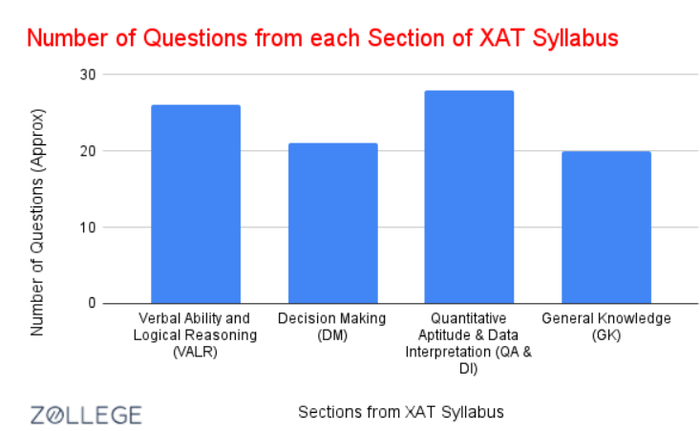
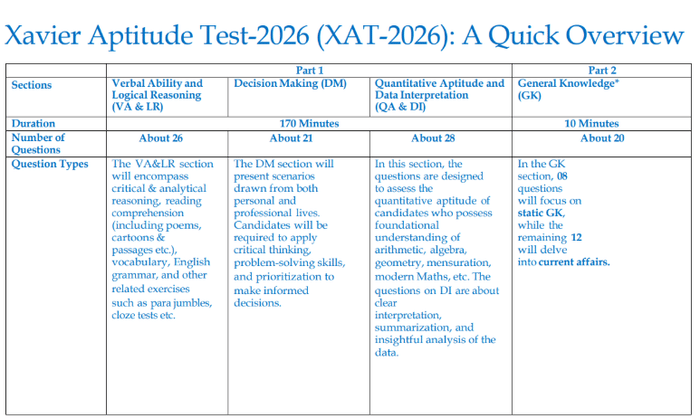
| Verbal Ability and Logical Reasoning (VALR) | The VA&LR section will encompass critical & analytical reasoning, reading comprehension (including poems, cartoons & passages etc.), vocabulary, English grammar, and other related exercises such as para jumbles, cloze tests etc. | 26 | 170 |
| Decision Making (DM) | The DM section will present scenarios drawn from both personal and professional lives. Candidates will be required to apply critical thinking, problem-solving skills, and prioritization to make informed decisions. | 21 | |
| Quantitative Aptitude & Data Interpretation (QA & DI) | In this section, the questions are designed to assess the quantitative aptitude of candidates who possess foundational understanding of arithmetic, algebra, geometry, mensuration, modern Maths, etc. The questions on DI are about clear interpretation, summarization, and insightful analysis of the data. | 28 | |
| General Knowledge (GK) | In the GK section, 08 questions will focus on static GK, while the remaining 12 will delve into current affairs. | 20 | 10 |
| Total | 95 | 180 |
Ques. Are there any changes in the XAT syllabus 2026?
Ans. XAT exam comes with several updates to make exam flow smoother. Last year some changes were made and the XAT syllabus 2026 is likely to remain the same as the previous year.
| Particulars | XAT Syllabus 2026 Details |
|---|---|
| Total Sections | 4 |
| Sections Included | 1. Verbal & Logical Ability 2. Quantitative Aptitude and Data Interpretation 3. Decision Making 4. General Awareness |
| Total Questions (Overall) | 95 |
| Essay Evaluation | Essay will be evaluated during the GD/PI (Group Discussion/Personal Interview) round. |
| Negative Marking (Part 1) | 0.25 marks deducted for every incorrect answer in 75 questions. |
| Negative Marking (Part 2 - GK) | No negative marking for the 20 GK questions. |
Ques. Is the CAT exam syllabus and XAT syllabus the same?
Ans. The XAT syllabus for sections like Quantitative Aptitude, Data Interpretation, and Verbal and Logical Ability is almost similar to the CAT syllabus. But, the XAT syllabus also includes two additional sections, Decision Making and General Knowledge, which are not part of the CAT exam.
Also Check:
XAT Syllabus 2026 : Detailed Overview
The XAT syllabus 2026 is not officially prescribed by XLRI, but it can be understood based on the previous year papers’ trend analysis. The exam puts emphasis on conceptual understanding, time management, and analytical skills. Each section of the syllabus carries a distinct importance. Candidates can check the section-wise XAT syllabus 2026 and identify the topics and sub-topics thoroughly to prepare effectively.
| Section | Topic / Type | Subtopics / Details |
|---|---|---|
| XAT Verbal Ability & Logical Reasoning (VALR) | Reading Comprehension | Fact-based, opinion-based, abstract RCs |
| Critical Reasoning | Assumptions, Inference, Strengthen/Weaken | |
| Vocabulary | Word usage, Fill in the Blanks, Synonyms/Antonyms | |
| Grammar & Sentence Correction | Error spotting, Sentence rearrangement | |
| Para-jumbles | Logical sequencing of sentences | |
| XAT Decision Making (DM) | Ethical Dilemmas | Business or personal situations with moral choices |
| Analytical Reasoning | Situational caselets, cause-effect, prioritisation | |
| Data-Based Decision Making | Tables, charts with decision-oriented questions | |
| Managerial Judgement | Scenarios involving teams, conflict, and targets | |
| Quantitative Ability & Data Interpretation (QA-DI) | Arithmetic | Percentages, Profit & Loss, Time-Speed-Distance |
| Algebra | Equations, Inequalities, Functions | |
| Geometry & Mensuration | Lines, Angles, Circles, Triangles, 3D figures | |
| Number Systems | LCM, HCF, Remainders, Factors | |
| Modern Math | Permutations & Combinations, Probability, Set Theory | |
| Data Interpretation | Pie charts, Tables, Graphs, Caselets | |
| General Knowledge (GK) | Static GK | History, Polity, Geography, Art & Culture |
| Current Affairs | National & International News (last 6–8 months) | |
| Business & Economy | Government schemes, GDP, Budget, Monetary policies | |
| Awards & Sports | Nobel, Olympics, National Awards | |
| Miscellaneous | Books & Authors, Important Days, Environment |
XAT 2026 Section-wise Syllabus Breakdown
1. Decision Making (DM) - XAT’s Unique Section :
The Decision Making section is different from the rest of the MBA entrance exam syllabus because it focuses on the candidate's ability to make judgments, ethical reasoning, rational thinking, and weighing all the pros and cons before reaching a conclusion in an ambiguous scenario. This section carries a lot of importance for XLRI Jamsedhpur and the other XAMI institutions, as they place a lot of emphasis on the DM scores for the shortlisting process.
- It evaluates a candidate's ability to make decisions in real-life situations.
- It also does not have a defined syllabus like Math or English. You will get 21 questions in this section.
- Each question will briefly describe a situation, and for each question, you have to choose the most rational and ethical answer from the options provided.
- All questions are based on brief case studies, usually in the areas of business, management or everyday situations.
Below is a table outlining the core topic areas to cover XAT 2026 Decision Making Syllabus -
| Core Topic Area | DM - Subtopics / Areas of Focus |
|---|---|
| Ethical Dilemmas & Managerial Decisions | Questions involving conflicts of interest, moral choices, and organizational decisions requiring fairness and integrity. |
| Data-Based Decision Making | Caselets using small tables or figures that require interpreting data to choose the most logical decision. |
| Logical Puzzles with Constraints | Problems involving grouping, sequencing, or assignment logic to test reasoning ability under constraints. |
| Situational Judgment | Questions asking you to identify appropriate or inappropriate actions in professional or ethical contexts. |
| Inference from Short Passages | Analyze short texts to infer assumptions, conclusions, or hidden motives influencing the decision. |
| Prioritization & Resource Allocation | Cases requiring selection of the best use of limited time, money, or human resources. |
| Basic Probability & Expected Value | Simple quantitative reasoning to estimate risk and reward in decision contexts. |
2. Verbal Ability & Logical Reasoning (VALR):
The Verbal Ability & Logical Reasoning (VALR) section of XAT syllabus 2026 is made to evaluate a candidate’s comprehension skills, reasoning ability, and english grammar and vocabulary knowledge. Unlike any other MBA entrance exam, XAT’s verbal section is known for its dense and conceptual reading comprehension along with reasoning-based verbal questions. The important topic areas from the VALR section is tabulated below:
| Topic Area | VALR - Subtopics / Areas of Focus |
|---|---|
| Reading Comprehension (RC) | Both long and short passages based on business, philosophy, social sciences, technology, or environment. Questions test inference, tone, and idea understanding. |
| Para-jumbles & Paragraph Completion | Rearrange sentences or fill missing lines logically to create coherent passages. |
| Vocabulary (Analogies, Synonyms, Antonyms) | Test contextual understanding of words rather than rare vocabulary; focus on relationships between word meanings. |
| Grammar & Sentence Correction | Identify grammatical or structural errors, and fill in blanks based on grammar and meaning consistency. |
| Critical Reasoning | Evaluate assumptions, strengthen or weaken arguments, and identify logical flaws. |
| Logical Reasoning (Verbal Type) | Includes syllogisms, logical sequences, and inference-based questions from short statements. |
3. Quantitative Ability and Data Interpretation (QA & DI):
The QA & DI section evaluates a candidate’s numerical aptitude, analytical skills, reasoning, and data-handling skills. This section demands a strong grasp of mathematical fundamentals and the ability to apply concepts quickly and accurately. A comprehensive table summarizing the key topics under QA and DI is mentioned below:
| Topic Category | QA 7 DI - Subtopics / Areas of Focus |
|---|---|
| Arithmetic & Number Theory | Percentages, Ratio & Proportion, Averages, Time & Work, Speed-Time-Distance, Profit & Loss, Simple & Compound Interest, Number properties. |
| Algebra & Functions | Linear & Quadratic Equations, Inequalities, Progressions (AP, GP, HP), Logarithms, Surds & Indices, Permutation & Combination (basic), Probability. |
| Geometry & Mensuration | Triangles, Circles, Coordinate Geometry, Mensuration formulas, Area and Volume, Basic Trigonometry. |
| Data Interpretation (DI) | Bar Graphs, Line Charts, Pie Charts, Stacked Graphs, Tables, Mixed DI Caselets, Data Sufficiency, and Multi-source DI (combining multiple data sets). |
4. General Knowledge (GK) - Static + Current Affairs:
The General Knowledge section has 20 questions. As per recent pattern, there will be 12 current affairs questions and 8 static questions in this section. This section plays an important role in evaluating a candidate's awareness of national and international developments. This section is not counted for the overall percentile, but it is important during the final selection process at many top colleges like XLRI. The table below summarizes the key areas to cover while preparing for the GK section of XAT 2026:
| Category | GK - Important Topics / Areas to Focus On |
|---|---|
| Current Affairs | Economy and business updates, major government policies, international relations, and global events in the last 12 months. |
| Static GK | Indian Constitution basics, geography (rivers, mountains), awards and honors, books & authors, founders of key institutions. |
| Business & Economy | Union and state budgets, mergers & acquisitions, RBI and US Fed policy decisions, new startups and unicorns. |
| Science & Technology | Major scientific breakthroughs, space missions, vaccine developments, and other innovations covered in national media. |
Also Read: Top colleges accepting XAT scores
XAT 2026 Exam Pattern
XAT is a computer-based test having multiple choice questions across four sections, Verbal and Logical Ability, Decision Making, Quantitative Ability & Data Interpretation and General Knowledge.
- XAT Marking Scheme - Each question carries 1 mark, with 95 questions. There is a negative marking i.e. 0.25 mark will be deducted for every incorrect answer.
- Penalty for Skipping Questions - Candidates can skip up to 8 questions without any penalty. After the 8th question, there will be a penalty of 0.1 marks per question.
- General Knowledge Section - The GK section has no negative markings. Also, it will not contribute to a candidate's overall percentile or score. But, it will be considered in the selection process for XLRI programmes only.
Also Read: XAT 2026 Exam Pattern
Source - XAT Syllabus 2026 Overview
Preparation Tips for XAT Syllabus 2026
Understanding the need for each segment XAT 2026 and building up precision with revisions and sessions is geared toward a smart preparation strategy. The table below targets each segment of XAT syllabus 2026 with the preparation recommendations.
| Section | Preparation Tips for XAT Syllabus 2026 |
|---|---|
| Decision Making (DM) |
|
| Verbal & Logical Ability (VALR) |
|
| Quantitative Aptitude & Data Interpretation (QA & DI) |
|
| General Knowledge (GK) |
|
XAT Previous Year Question Paper Analysis (2019–2025)
To better understand the level and pattern of the XAT exam, it is necessary to understand the evolution of the exam papers during the last few years. Below is a section-wise and year-wise overview of the XAT exam from 2019 to 2025.
| Year | Total Questions | DM | VALR | QA & DI | GK | Overall Difficulty |
|---|---|---|---|---|---|---|
| 2025 | 95 | 21 | 26 | 28 | 20 | Moderate to Difficult |
| 2024 | 101 | 22 | 26 | 27 | 25 | Difficult |
| 2023 | 101 | 22 | 26 | 27 | 25 | Moderate |
| 2022 | 100 | 21 | 26 | 28 | 25 | Moderate |
| 2021 | 100 | 21 | 26 | 28 | 25 | Moderate |
| 2020 | 99 | 21 | 26 | 27 | 25 | Difficult |
| 2019 | 99 | 21 | 26 | 27 | 25 | Moderate to Difficult |
XAT Previous Year Question Paper
| XAT 2024 Question Paper | Download PDF |
|---|---|
| XAT 2023 Question Paper | Download PDF |
| XAT 2022 Question Paper | Download PDF |
| XAT 2021 Question Paper | Download PDF |
| XAT 2020 Question Paper | Download PDF |
| XAT 2019 Question Paper | Download PDF |
| XAT 2018 Question Paper | Download PDF |
Best Books for XAT Syllabus 2026
Choosing the right books is very important for scoring well in XAT 2026. The syllabus of XAT is wide, and it needs a smart strategy with well-planned resources. Here is a list of the most trusted books for each section that can help you prepare well.
These books cover the full range of topics needed for XAT. Apart from books, solve mock tests and previous year question papers regularly. That helps you understand the exam pattern and improve your speed and accuracy.
| Section | Book Name | Author / Publisher |
|---|---|---|
| Quantitative Ability and Data Interpretation | How to Prepare for Quantitative Aptitude | Arun Sharma |
| Quantitative Aptitude for Competitive Examinations | R. S. Aggarwal | |
| Data Interpretation and Data Sufficiency | Ananta Ashisha | |
| Quantitative Aptitude Quantum CAT | Sarvesh Verma | |
| Verbal and Logical Ability | Word Power Made Easy | Norman Lewis |
| High School English Grammar and Composition | Wren and Martin | |
| Objective General English | S. P. Bakshi | |
| The Students’ Companion | Wilfred D. Best | |
| Decision Making | Analytical and Logical Reasoning for CAT and Other MBA Exams | Peeyush Bharadwaj |
| Target XAT Decision Making | Disha Experts | |
| Data Interpretation and Logical Reasoning | Gautam Puri | |
| General Knowledge | Lucent’s General Knowledge | Lucent Publications |
| Manorama Year Book | Mammen Mathew | |
| Daily Newspapers for Current Affairs | The Hindu, Indian Express | |
| Monthly Current Affairs Magazines | Various Publishers |
Frequently Asked Questions
Ques. How can I access the XAT Syllabus PDF?
Ans. Candidates can download the section-wise XAT syllabus PDF with question types samples from here - XAT 2026 Overview.
Ques. Are GK scores counted in the XAT exam?
Ans. No. GK score is not counted for percentile calculation but it is used later by XLRI and some other institutes in final shortlisting and interviews. Candidates must aim for accuracy in GK rather than blind attempts, revise static GK and stay aware with current affairs of the last 6-12 months of major national and global events.
Ques. What is the importance of Decision Making in XAT?
Ans. The most unique part of the XAT syllabus is Decision Making, which makes it different from other entrance exams. The Decision Making section tests ethical challenges, conflicting interests, and managerial problems. It is a key differentiator that reflects real-world corporate scenarios.
Ques: How is XAT score calculated
Ans: As per XAT exam pattern 2026,
- For every correct answer in the XAT Question Paper, candidates are credited 1 mark.
- A deduction of 0.25 is made for every incorrect answer and a further 0.10 is deducted for consecutive 8 plus unattempted questions. XAT score is calculated by taking the marks of Quantitative Aptitude, Verbal and Logical reasoning and Decision-making sections. GK score is not considered for final score.
Ques. How is the XAT essay evaluated? Does it affect the net score?
Ans. The Essay writing plays a crucial role in the final admission process. Though it is not included in the percentile score, the essay writing part is assessed during the Personal Interview phase. The purpose of the essay writing part is to evaluate clarity of thoughts, structure, grammar, and originality. Therefore, a well- written essay can strengthen a candidate's overall profile and enhance the final selection chances.
Ques. Was XAT 2025 tougher than XAT 2024?
Ans. XAT 2025 was relatively easier than XAT 2024 as per candidate’s review and other analysis. The primary reason for this was a simple question related to Decision-making and VALR sections.
| Year | Difficulty Level |
|---|---|
| XAT 2025 | The QA section was a bit tough but was balanced too. Reduced number of questions and shorter duration. |
| XAT 2024 | Higher difficulty level in DI and QA. The paper was more lengthy. |
*The article might have information for the previous academic years, please refer the official website of the exam.
Ask your question
Upcoming exams

Loyola Institute of Business Administration - [LIBA]
Chennai, Tamil NaduDepartment of Management, BITS
Pilani, RajasthanSardar Vallabhbhai National Institute of Technology - [SVNIT]
Surat, GujaratIndian Institute of Social Welfare and Business Management - [IISWBM]
Kolkata, West BengalIBS
Hyderabad, Telangana


