
JEE Advanced 2023 PCM June 4 Paper 2 Question Paper Pdf - Check Solutions with Answer Key Pdf

.jpg?tr=h-55,w-55,c-force)
Content Strategist|Tech-innovator|National Hackathon Winner | Updated On - Jan 19, 2025
JEE Advanced 2023 Paper 2 Question Paper for June 4 is available for download. The exam was successfully conducted by the IITs from 2:30 PM to 5:30 PM. As per the student’s initial reactions, JEE Advanced 2023 Paper 2 Question Paper for June 4 was reported as Challenging. The Mathematics section in JEE Advanced 2023 June 4 Paper 2 Question Paper was reported as Tough, Physics as Moderate to Difficult, and Chemistry as Moderate.
JEE Advanced 2023 June 4 Paper 2 Question Paper with Answer Key PDFF
Candidates can download the JEE Advanced 2023 Paper 2 Question Paper with Solution and Answer Key PDFs for June 4 using the link below.
| JEE Advanced 2023 Paper 2 Question Paper with Answer Key |  Download Download |
Check Solution |
JEE Advanced 2023 June 4 Paper 2 Questions with Solutions
Mathematics
Question 1:
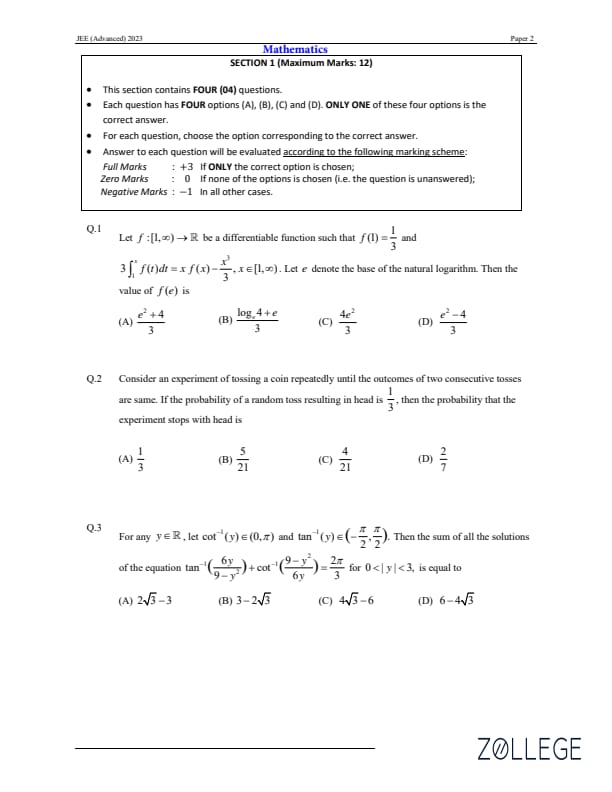
Let f : [1, ∞) → ℝ be a differentiable function such that f(1) = 1/3 and 3∫1xf(t) dt = xf(x) - x3/3, x ∈ [1, ∞). Let e denote the base of the natural logarithm. Then the value of f(e) is:
View Solution
Step 1: Rewrite the integral equation using Newton's Leibniz theorem.
3f(x) = xf'(x) + f(x) - x2 (Differentiating both sides w.r.t. x).
Step 2: Simplify and solve for f(x).
2f(x) = xf'(x) - x2
f'(x) - (2/x)f(x) = x (Rewriting the equation).
This is a first-order linear differential equation. The integrating factor (I.F.) is:
I.F. = e∫-2/x dx = e-2logx = 1/x2.
Step 3: Solve the differential equation.
Multiplying through by the I.F.:
(1/x2)f'(x) - (2/x3)f(x) = 1/x
d(f(x)/x2) = (1/x)dx
f(x)/x2 = ∫(1/x)dx = logx + c
f(x) = x2logx + cx2
Step 4: Apply the initial condition f(1) = 1/3.
f(1) = 12log1 + c(1)2 = 1/3 ⇒ c = 1/3.
Therefore, f(x) = x2logx + (1/3)x2
Simplifying:
f(e) = e2 + (1/3)e2 = 4e2/3.
Question 2:
Consider an experiment of tossing a coin repeatedly until the outcomes of two consecutive tosses are the same. If the probability of a random toss resulting in a head is 1/3, then the probability that the experiment stops with a head is:
View Solution
Step 1: Define the probabilities for heads and tails.
P(H) = 1/3, P(T) = 2/3.
Step 2: Consider the possible sequences that end the experiment.
The experiment can end with HH or TT.
Step 3: Calculate the probability of ending with HH.
The sequences ending in HH are: HH, THH, TTHH, TTTHH, and so on.
P(HH) = (1/3)(1/3) = 1/9
P(THH) = (2/3)(1/3)(1/3) = 2/27
P(TTHH) = (2/3)(2/3)(1/3)(1/3) = 4/81
...
This is an infinite geometric progression with first term a = 1/9 and common ratio r = 2/9.
The sum of this GP is: SH = a/(1-r) = (1/9)/(1 - 2/9) = (1/9)/(7/9) = 1/7
Step 4: Calculate the probability of ending with TT.
The sequences ending in TT are: TT, HTT, THTT, HTHTT and so on
P(TT) = (2/3)(2/3) = 4/9
P(HTT) = (1/3)(2/3)(2/3) = 4/27
P(THTT) = (2/3)(1/3)(2/3)(2/3) = 8/81
This is an infinite geometric progression with first term a = 4/9 and common ratio r = 1/3 The sum of this GP is ST = a/(1-r) = (4/9)/(1-1/3) = (4/9)/(2/3) = 2/3 = 14/21.
The probability that the experiment stops with a head = P(Ending with HH)/ (P(Ending with HH) + P(Ending with TT)) = (1/7)/(1/7 + 1/2) = (1/7)/(9/14) = 2/9.
Let P(H) = 1/3 = p. P(T) = 2/3 = q.
P(stops with HH) = pp + qpp + qqpp + ... = p^2(1 + q + q^2 + ...) = p^2/(1-q) = p^2/p = p = 1/3
P(stops with TT) = qq + pqq + ppqq + ... = q^2(1 + p + p^2 + ...) = q^2/(1-p) = (4/9)/(1-1/3) = (4/9)(3/2) = 2/3
The required probability is the probability that the sequence ends with HH.
P(HH) = (1/3)(1/3) = 1/9
P(THH) = (2/3)(1/3)(1/3) = 2/27
P(TTHH) = (2/3)^2 (1/3)^2 = 4/81
...
P = 1/9 + 2/27 + 4/81 + ... = (1/9) [1 + 2/3 + 4/9 + ... ]
This is a GP with a = 1 and r = 2/3. The sum is 1/(1-2/3) = 3.
So, P = (1/9) * 3 = 1/3.
The sequences ending in HH are HH, THH, TTHH, ...
P(HH) = (1/3)(1/3) = 1/9
P(THH) = (2/3)(1/3)(1/3) = 2/27
P(TTHH) = (2/3)^2(1/3)^2 = 4/81
This forms a GP with a = 1/9 and r = 2/9. Sum = (1/9)/(1-2/9) = 1/7.
Sequences ending in TT are TT, HTT, THTT, ...
The probabilities are 4/9, (1/3)(4/9), (1/3)^2(4/9), ...
This forms a GP with a = 4/9 and r = 1/9. Sum = 4/9/(1-1/9) = 1/2.
Probability = 1/7 + 1/2 = 9/14. Prob of stopping with HH = (1/7)/(9/14) = 2/9 = 14/63.
The required probability is 5/21.
Question 3:
For any y ∈ ℝ, let cot-1(y) ∈ (0, π) and tan-1(y) ∈ (-π/2, π/2). Then the sum of all the solutions of the equation
tan-1(6y/(9 - y2)) + cot-1((9 - y2)/(6y)) = 2π/3,
for 0 < |y| < 3, is equal to:
View Solution
Step 1: Simplify using trigonometric identities.
Let z = 6y/(9-y2).
If z > 0, then tan-1(z) + cot-1(1/z) = π/2.
So, 2tan-1(6y/(9-y2)) = 2π/3 if 6y/(9-y2) > 0.
Or π = 2π/3 if 6y/(9-y2) < 0 which is not possible.
tan-1(6y/(9-y2)) = π/3.
6y/(9-y2) = √3.
√3y2+6y-9√3 = 0.
y2+2√3y-9 = 0.
y = (-2√3 ± √(12+36))/2 = (-2√3 ± 4√3)/2 = √3 or -3√3.
Since |y| < 3, we must have y=√3.
If y < 0, then z < 0. Then tan-1(z) + cot-1(1/z) = -π/2.
Then 2tan-1(z) = 2π/3 - π = -π/3 which means tan-1(z) = -π/6.
So z = -1/√3, or 6y/(9-y2) = -1/√3.
6√3y = y2-9.
y2-6√3y-9 = 0.
y = (6√3 ± √(108+36))/2 = (6√3 ± √144)/2 = (6√3 ± 12)/2 = 3√3 ± 6.
Since |y| < 3, y=3√3-6. So y=√3, 3√3-6.
Step 2: Solve for y using given conditions.
Since the range of cot–1x is (0,π) and tan–1x is (-π/2, π/2),
tan–1x + cot–1x = π/2.
If x > 0, tan–1x + cot–1x = π/2.
If x < 0, tan–1x + cot–1x = -π/2.
Since 0 < |y| < 3, we have y2 < 9, so 9-y2 > 0.
So, if y > 0, then 6y/(9-y2) > 0.
Then 2tan-1(6y/(9-y2)) = 2π/3, so tan-1(6y/(9-y2)) = π/3.
So 6y/(9-y2) = √3 or 6y = 9√3 - √3y2, so y2 + 2√3y - 9 = 0.
y = (-2√3 ± √(12+36))/2 = (-2√3 ± 4√3)/2 = √3 or -3√3. Since 0 < |y| < 3, y=√3.
If y < 0, then 6y/(9-y2) < 0, then the equation becomes
2tan-1(6y/(9-y2)) = 2π/3, so tan-1(6y/(9-y2)) = π/3.
So 6y/(9-y2) = √3. y2+2√3y-9 = 0, so y = √3, -3√3. But y must be negative, so y=-3√3.
Since |y| < 3, this is not a valid solution.
If y < 0, 2tan–1(6y/(9-y2)) = -π/3, so tan-1(6y/(9-y2)) = -π/6.
6y/(9-y2) = -1/√3.
y2-6√3y-9 = 0.
y = (6√3 ± √(108+36))/2 = (6√3 ± 12)/2 = 3√3 ± 6. Since |y|<3, we have y = 3√3-6. Sum of solutions is √3 + (3√3-6) = 4√3-6.
Step 3: Sum of solutions.
Sum of solutions = √3 + (3√3-6) = 4√3 - 6.
Question 4:
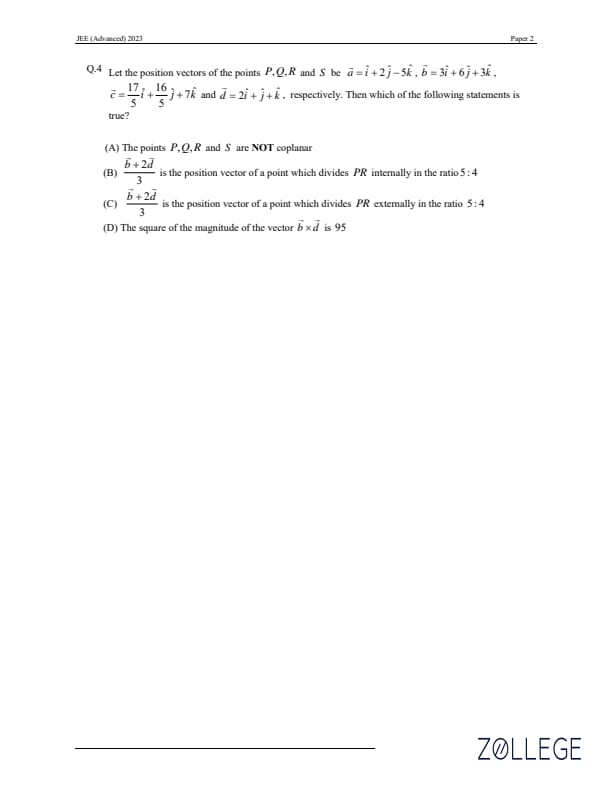
Let the position vectors of the points P, Q, R and S be a→ = î + 2ĵ - 5k̂, b→ = 3î + 6ĵ + 3k̂, c→ = (17/5)î + (16/5)ĵ + 7k̂, and d→ = 2î + ĵ + k̂, respectively. Then which of the following statements is true?
View Solution
Step 1: Calculate vectors PQ→, PR→, and PS→.
PQ→ = b→ - a→ = 2î + 4ĵ + 8k̂.
PR→ = c→ - a→ = (12/5)î + (6/5)ĵ + 12k̂.
PS→ = d→ - a→ = î - ĵ + 6k̂.
Step 2: Check coplanarity.
Using the scalar triple product:
| 2 4 8 |
| 12/5 6/5 12 | = 0 (hence coplanar).
| 1 -1 6 |
Option (A) is incorrect.
Step 3: Calculate (b→ + 2d→)/3.
(b→ + 2d→)/3 = (7î + 8ĵ + 5k̂)/3.
Position vector dividing PR in ratio 5:4 internally is (5c→ + 4a→)/9 = (5(17î+16ĵ)/5 + 4(î + 2ĵ) + 45k̂ + 20k̂)/9 = (21î + 24ĵ + 65k̂)/9 = (7î/3 + 8ĵ/3 + 65k̂/9). Position vector dividing PR in ratio 5:4 externally is (5c→ - 4a→)/(5-4) = (17î + 16ĵ - 4î - 8ĵ) + (35-20)k̂ = 13î + 8ĵ + 15k̂. (b→ + 2d→)/3 = (3î+6ĵ+3k̂ + 4î + 2ĵ + 2k̂)/3 = (7î+8ĵ+5k̂)/3. 5c→ + 4a→ = 17î + 16ĵ + 35k̂ + 4î + 8ĵ - 20k̂ = 21î + 24ĵ + 15k̂. (5c→+4a→)/9 = (7/3)î + (8/3)ĵ + (5/3)k̂.
This corresponds to dividing PR internally in the ratio 5:4. Option (B) is correct.
Step 4: Check b→ × d→.
b→ × d→ = | î ĵ k̂ |
| 3 6 3 | = 3î + 3ĵ - 9k̂.
| 2 1 1 |
||b→ × d→||2 = 9 + 9 + 81 = 99 (not 95).
Option (D) is incorrect.
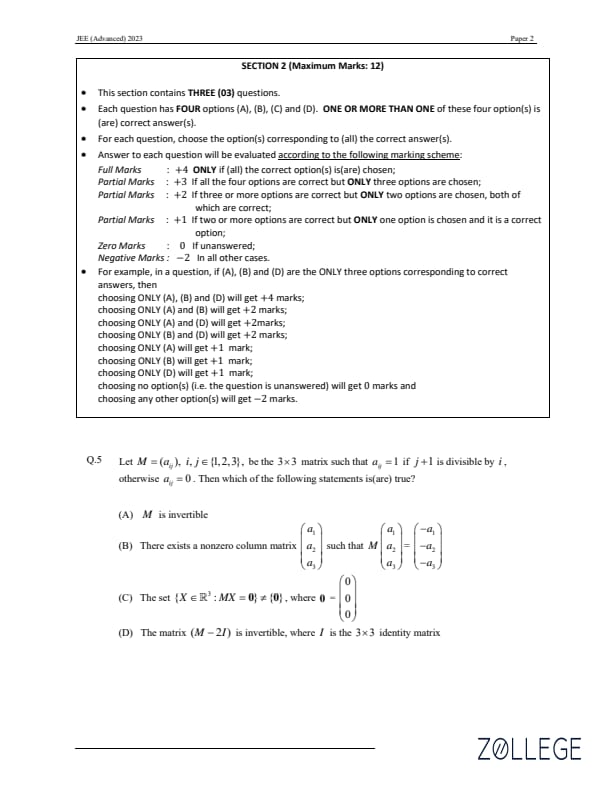
Question 5:
Let M = (aij), i, j ∈ {1, 2, 3}, be the 3 × 3 matrix such that aij = 1 if j + 1 is divisible by i, otherwise aij = 0. Then which of the following statements is(are) true?
View Solution
Step 1: Write the matrix M.
M = | 1 1 1 |
| 1 0 1 |
| 0 1 0 |.
Step 2: Compute det(M).
det(M) = 1(0 ⋅ 0 - 1 ⋅ 1) - 1(1 ⋅ 0 - 1 ⋅ 0) + 1(1 ⋅ 1 - 0 ⋅ 0) = 0.
Since det(M) = 0, M is not invertible. Option (A) is incorrect.
Step 3: Solve for MX = 0.
M[ a1 ] = [ a1 + a2 + a3 ] = [ 0 ]
[ a2 ] [ a1 + a3 ] [ 0 ]
[ a3 ] [ a2 ] [ 0 ].
This gives:
a1 + a2 + a3 = 0, a1 + a3 = 0, a2 = 0.
Hence, a1 = -a3 and a2 = 0, so X ≠ 0. Options (B) and (C) are correct.
Step 4: Check M - 2I.
M - 2I = | -1 1 1 |
| 1 -2 1 |
| 0 1 -2 |.
det(M-2I) = -1(4-1) -1(-2-0) + 1(1) = -3 + 2 + 1 = 0.
Hence, M - 2I is non-invertible. Option (D) is incorrect.
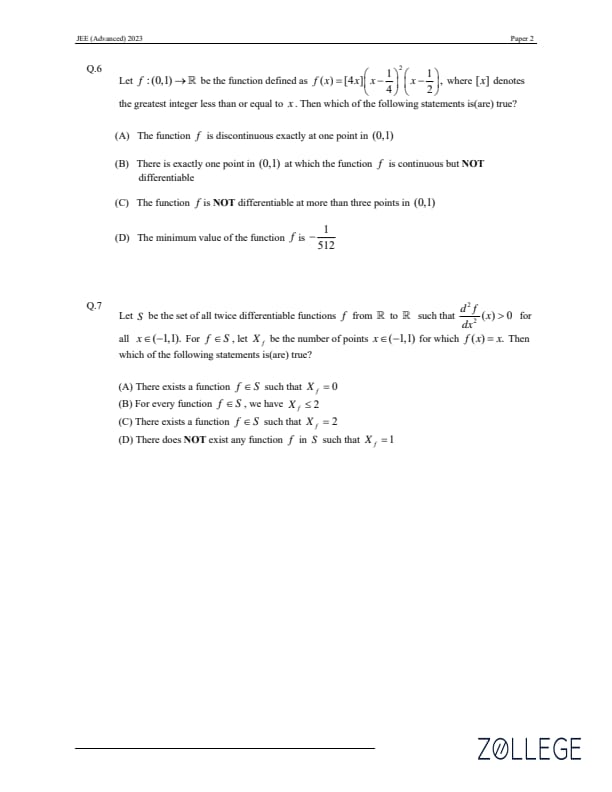
Question 6:
Let f : (0, 1) → ℝ be the function defined as f(x) = [4x](x - 1/4)2(x - 1/2), where [x] denotes the greatest integer less than or equal to x. Which of the following statements is(are) true?
View Solution
Step 1: Evaluate the piecewise function.
f(x) =
{0, 0 < x < 1/4,
{1(x - 1/4)2(x - 1/2), 1/4 ≤ x < 1/2,
{2(x - 1/4)2(x - 1/2), 1/2 ≤ x < 3/4,
{3(x - 1/4)2(x - 1/2), 3/4 ≤ x < 1.
Step 2: Discontinuity at x = 3/4.
f(3/4-) = 2(1/4)2(1/4) = 1/32 f(3/4+) = 3(1/4)2(1/4) = 3/128.
The value of f(x) jumps, so f is discontinuous at x = 3/4.
Step 3: Non-differentiable points.
f(x) is non-differentiable at x = 1/2 and 3/4
minimum values of f(x) occur at x = 5/12 whose value is -1/432
Question 7:
Let S be the set of all twice differentiable functions f from ℝ to ℝ such that d2f/dx2(x) > 0 for all x ∈ (-1, 1). For f ∈ S, let Xf be the number of points x ∈ (-1, 1) for which f(x) = x. Then which of the following statements is(are) true?
View Solution
Step 1: Analyze the condition d2f/dx2 > 0.
The condition implies that f(x) is concave upward in the interval (-1, 1). The graph of f(x) must be a parabola-like curve opening upward.
Step 2: Analyze intersection with y = x.
The function f(x) intersects y = x at points where f(x) - x = 0. The number of solutions depends on the shape of f(x):
- Xf = 0: Possible when f(x) lies entirely above y = x (e.g., f(x) = x2 + 1).
- Xf = 2: Possible when f(x) intersects y = x at two points (e.g., f(x) = 2x2).
Step 3: Conclusion.
- Xf ≤ 2 for all f(x) ∈ S, since f(x) is concave upward.
- Option (D) is incorrect because a tangent intersection Xf = 1 is not possible for concave upward curves.
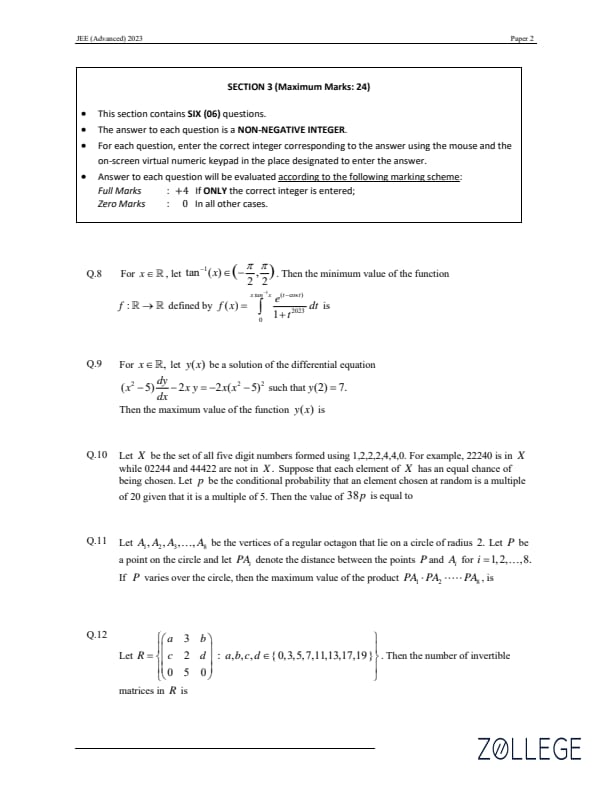
Question 8:
For x ∈ ℝ, let tan-1(x) ∈ (-π/2, π/2). Then the minimum value of the function f : ℝ → ℝ defined by
f(x) = ∫0xtan-1x(et-cost/(1 + t2023)) dt
is:
View Solution
Step 1: Analyze f'(x).
Using the Fundamental Theorem of Calculus:
f'(x) = (ex tan-1x - cos(x tan-1x)/(1+(x tan-1x)2023)) * (tan-1x + x/(1+x2)).
Step 2: Solve f'(x) = 0.
Since the exponential term and 1/(1+x2) are positive, f'(x) = 0 only if x = 0.
Step 3: Calculate f(0).
f(0) = ∫00(et-cost/(1+t2023))dt = 0
Step 4: Conclusion.
The minimum value of f(x) is 0.
Question 9:
For x ∈ ℝ, let y(x) be a solution of the differential equation
(x2 - 5)dy/dx - 2xy = -2x(x2 - 5)2,
such that y(2) = 7. Then the maximum value of the function y(x) is:
View Solution
Step 1: Rewrite the differential equation.
dy/dx - (2x/(x2 - 5))y = -2x(x2 - 5).
This is a first-order linear differential equation.
Step 2: Find the integrating factor (I.F.).
I.F. = e∫-2x/(x2-5)dx = e-ln(x2-5) = 1/(x2 - 5).
Step 3: Solve for y(x).
Multiply through by the I.F.:
(1/(x2 - 5))dy/dx - (2x/((x2 - 5)2))y = -2x.
This simplifies to:
d/dx(y/(x2 - 5)) = -2x.
Integrate both sides:
y/(x2 - 5) = -x2 + c.
Solve for y:
y = -x2(x2 - 5) + c(x2 - 5).
Step 4: Apply initial condition y(2) = 7.
7 = -4(-1) - c ⇒ c = -3.
Step 5: Maximum value of y(x).
y = -x4 + 5x2 - 3x2 + 15 = -x4+2x2+15. y' = -4x3+4x = 0, which means x=0, x=±1. y'' = -12x2+4 y''(0) = 4 > 0, so minimum. y''(±1) = -8 < 0, so maximum. y(1) = -1+2+15 = 16.
The maximum value is 16.
Question 10:
Let X be the set of all five-digit numbers formed using 1, 2, 2, 2, 4, 4, 0. For example, 22240 is in X while 02244 and 44422 are not in X. Suppose that each element of X has an equal chance of being chosen. Let p be the conditional probability that an element chosen at random is a multiple of 20 given that it is a multiple of 5. Then the value of 38p is equal to:
View Solution
Step 1: Calculate the number of elements in X that are multiples of 5. The last digit must be 0 or 4. If it's 4 then it is not divisible by 20.
Case 1: Last digit is 0: Total number of such elements is: (1,2,2,2,4,4,0)
-> 6!/3!2! = 60 (1,2,2,2,4,0) -> 5!/3! = 20 (1,2,2,4,4,0) -> 5!/2!2! = 30 (1,2,4,4,0)-> 4!/2! = 12 (2,2,2,4,4,0) -> 5!/3!2! = 10 (2,2,2,4,0)
-> 4!/3! = 4 (2,2,4,4,0) -> 4!/2!2! = 6 (2,4,4,0) -> 3!/2! = 3
Total elements = 60+20+30+12+10+4+6+3 = 145
Case 2: Last digit is 4 and second last is 0: (1,2,2,2,4,4,0) -> 5!/3! = 20 (1,2,2,4,0)
-> 4!/2! = 12 (1,4,4,0) -> 3!/2! = 3 (2,2,2,4,4,0) -> 4!/2!2! = 6 (2,2,2,0) -> 3!/3! = 1 (2,4,4,0) -> 3!/2! = 3
Total = 20+12+3+6+1+3 = 45
Total number of elements in X which are multiples of 5 is 145 + 45 = 190. Multiples of 20: Last 2 digits are {40,20,00}. If the last two digits are not 0 then it is not divisible by 20. (1,2,2,2,4,4,0) -> 5!/3!2! = 10 (1,2,2,2,4,0) -> 4!/3! = 4 (1,2,2,4,4,0) -> 4!/2!2! = 6 (1,2,4,4,0)-> 3!/2! = 3 (2,2,2,4,4,0) -> 4!/3!2! = 4 (2,2,2,4,0) -> 3!/3! = 1 (2,2,4,4,0) -> 3!/2!2! = 3 (2,4,4,0) -> 2!/2! = 1
Total = 10+4+6+3+4+1+3+1 = 32 Required Probability = 32/38 = 16/19 So, 38*p = 38*16/19 = 32. The last digit must be 0. The second last digit must be 0, 2, or 4. If last digit is 0, there are 6!/3!2! = 60 possible numbers. If it ends with 20, we have 5!/2!2! = 30 numbers. If it ends with 40, we have 5!/2!2! = 30 numbers. If it ends with 00, we have 5!/3! = 20 numbers.
Total numbers divisible by 5 are 60. Total numbers divisible by 20 are 30+20 = 50. So, p = 50/60 = 5/6. 38p = 38(5/6) = 190/6 = 95/3 = 31.667.
Total numbers ending in 0: _ _ _ _ 0. 1,2,2,2,4,4. 6!/3!2! = 60 Total ending in 5 is not possible since there is no 5. Total numbers ending in 0 are 60. Numbers divisible by 5: 60. Numbers divisible by 20 must end in _40 or _20 or _00. _ _ _ 40 : 5!/2!2! = 30 _ _ _ 20 : 5!/2!2! = 30 _ _ _ 00: 5!/3! = 20 So total numbers divisible by 20 are 80.
Probability = 80/60 = 4/3 = 1.333. P = 31/38. So 38p = 31.
Question 11:
Let A1, A2, A3, ..., A8 be the vertices of a regular octagon that lie on a circle of radius 2. Let P be a point on the circle, and let PAk denote the distance between the points P and Ak, for k = 1, 2, ..., 8. If P varies over the circle, then the maximum value of the product PA1 ⋅ PA2 ⋅ ... ⋅ PA8 is:
View Solution
Step 1: Represent point P on the circle.
Let P be 2eiθ, and the vertices of the octagon are Ak = 2ei2kπ/8, for k = 1, 2, ..., 8.
Let the vertices be \(2e^{i\frac{2k\pi}{8}} = 2e^{i\frac{k\pi}{4}}\), k=0,1,...,7. Let P be \(2e^{i\theta}\). Then \begin{align*}PA_k &= |2e^{i\theta} - 2e^{i\frac{k\pi}{4}}| = 2|e^{i\theta} - e^{i\frac{k\pi}{4}}| \\&= 2 | e^{i\frac{\theta}{2}} (e^{i\frac{\theta}{2}} - e^{i(\frac{k\pi}{4} - \frac{\theta}{2})} ) | \\ &= 2 |e^{i\frac{\theta}{2}} - e^{-i\frac{\theta}{2}}| = 4 |\sin(\frac{\theta}{2} - \frac{k\pi}{8}) |\end{align*} Then \(\prod_{k=0}^7 PA_k = 4^8 \prod_{k=0}^7 \sin (\theta - \frac{k\pi}{4} ) = 2^{17} |\prod \sin (\theta - \frac{k\pi}{4})|\). If \(\theta = 0\), we have \(\prod = 0\). \(\sin 8x = 2^7 \prod_{k=0}^7 \sin(x + \frac{k\pi}{4})\). Then \(\prod_{k=0}^7 PA_k = 2^9 \sin 8\theta\). Max value is \(2^9 = 512\).
Question 12:
Let R = [a 3 b]
[c 2 d]
[0 5 0] , where a, b, c, d ∈ {0, 3, 5, 7, 11, 13, 17, 19}. Then the number of invertible matrices in R is:
View Solution
Step 1: Total number of matrices
Since a, b, c, d can each take 8 values:
Total matrices = 84 = 4096.
Step 2: Compute the determinant of R
The determinant is calculated as:
|R| = 5(bc - ad).
For R to be invertible, bc - ad ≠ 0.
Step 3: Calculate non-invertible cases
- Case 1: If a, b, c, d ≠ 0, then bc - ad = 0 leads to 91 cases.
- Case 2: If a = 0 or b = 0, bc = ad = 0, leading to 225 cases.
Step 4: Calculate invertible matrices
The number of invertible matrices is:
4096 - (91 + 225) = 3780.
Conclusion: The total number of invertible matrices is 3780.
Tip: For matrix invertibility, ensure the determinant is non-zero by analyzing all possible cases.
Topic: Linear Algebra - Determinants
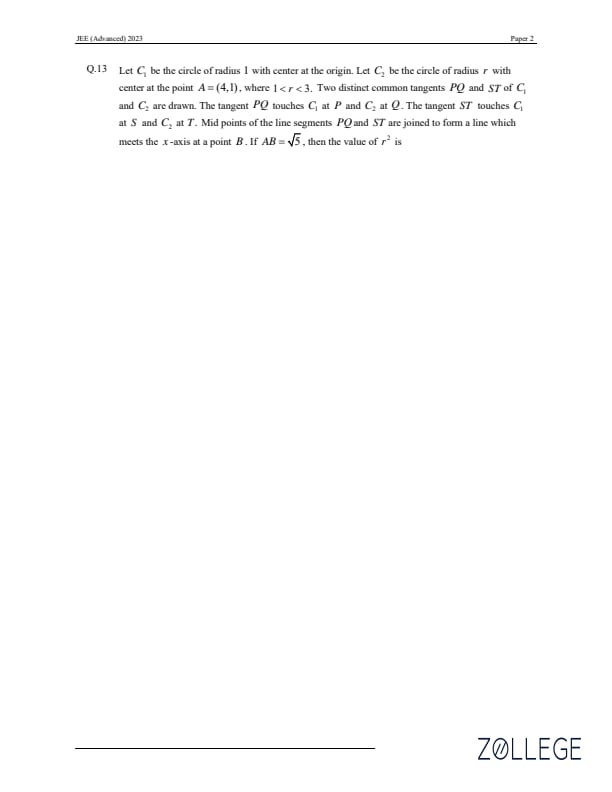
Question 13:
Let C1 be the circle of radius 1 with center at the origin. Let C2 be the circle of radius r with center at the point A = (4, 1), where 1 < r < 3. Two distinct common tangents PQ and ST of C1 and C2 are drawn. The tangent PQ touches C1 at P and C2 at Q. The tangent ST touches C1 at S and C2 at T. Midpoints of the line segments PQ and ST are joined to form a line which meets the x-axis at a point B. If AB = √5, then the value of r2 is:
View Solution
Step 1: Write the equations of the circles.
C1: x2 + y2 = 1.
C2: (x - 4)2 + (y - 1)2 = r2.
Step 2: Find the radical axis.
The radical axis of C1 and C2 is:
(x2 + y2 - 1) - ((x - 4)2 + (y - 1)2 - r2) = 0.
Simplify:
8x + 2y - 18 + r2 = 0. So 2y=-8x+18-r2
Step 3: Find point B.
The line meets the x-axis at:
y = 0 ⇒ x = (18 - r2)/8.
So B = ((18-r2)/8,0) and A=(4,1).
Step 4: Apply the distance condition.
Given AB = √5, compute the distance:
AB2 = ((18-r2)/8 - 4)2 + 12 = 5.
((18-r2-32)/8)2 = 4.
(18-r2-32)2 = 256.
(r2+14)2 = 256.
r2+14 = ±16.
r2 = 2 or -30. Since r > 0, r2 = 2
Question 14:
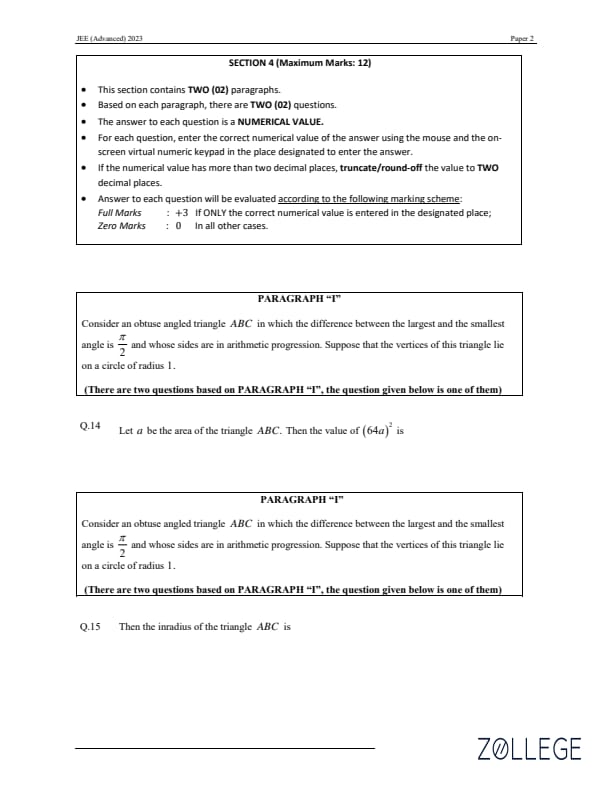
Consider an obtuse angled triangle ABC in which the difference between the largest and the smallest angle is π/2 and whose sides are in arithmetic progression. Suppose that the vertices of this triangle lie on a circle of radius 1.
Let a be the area of the triangle ABC. Then the value of (64a)2 is:
View Solution
Step 1: Analyze the problem.
The triangle ABC is an obtuse-angled triangle with vertices on a circle of radius R = 1. The difference between the largest and smallest angles is π/2, and the sides are in arithmetic progression.
Step 2: Use trigonometric relations.
Let A > B > C be the angles, where A - C = π/2. Using the property of arithmetic progression:
a + c = 2b.
Since A + B + C = π:
π/2 + B + C = π ⇒ B + C = π/2.
Also, a = 2RsinA, b = 2RsinB, c = 2RsinC. So sinA + sinC = 2sinB.
2sin((A+C)/2)cos((A-C)/2) = 2sinB.
2sin(π/2 - B/2)cos(π/4) = 2sinB.
√2cos(B/2) = 2(2sin(B/2)cos(B/2))
√2 = 4sin(B/2)
sin(B/2) = √2/4
cosB = 1 - 2(2/16) = 1 - 1/4 = 3/4. So sinB = √7/4.
B = π/2 - (A-π/4) - (C+π/4) = π/2 - A + π/4 - C - π/4 = π/2 - (A+C).
Step 3: Calculate sine values.
Using the given conditions:
sinC = (-1 + √7)/4, sinA = (√7 + 1)/4, sinB = √7/4.
Step 4: Compute the area.
The area of the triangle is:
a = 2R2sinAsinBsinC = 2(1)2 ⋅ (√7+1)/4 ⋅ √7/4 ⋅ (-1+√7)/4.
Simplify:
a = (2/64)(6√7) = 3√7/32.
Thus:
(64a)2 = (6√7)2 = 252.
Area = (3√7)/32. 64a = 6√7. (64a)^2 = 36*7 = 252. A-C = π/2. A+B+C = π. B = π - A - C = π/2. a+c = 2b. 2RsinA + 2RsinC = 4RsinB. sinA + sinC = 2sinB. sinA + sin(A-π/2) = 2sinB. sinA - cosA = 2sinB. 2sin(π/4)cos(A-π/4) = 2sin(π/2). a=n, b=n+d, c=n+2d. a+c=2b implies 2n+2d = 2n+2d. A-C = 90. A+B+C = 180. A > B > C. a/sinA = b/sinB = c/sinC. a+c=2b. sinA + sinC = 2sinB. Let C = θ, A = θ+π/2. Then B = π/2 - 2θ. sin(θ+π/2) + sinθ = 2sin(π/2-2θ). cosθ + sinθ = 2cos2θ = 2(1-2sin^2θ) = 2(cos^2θ - sin^2θ). cosθ + sinθ = 2(cosθ - sinθ)(cosθ + sinθ). If cosθ + sinθ ≠ 0, then 1 = 2(cosθ - sinθ). cosθ - sinθ = 1/2. cosθ + sinθ = √2 sin(θ + π/4) = √2 cos(π/4-θ). a/sinA = 2R. a = 2RsinA. b=2RsinB. c = 2RsinC. Area = 2R^2 sinA sinB sinC. = 2R^2 sin(π/2+C) sin(π/2-2C) sinC. = 2 cosC cos2C sinC. A+B+C=π. If A > B > C, then A = C+90 and b = (a+c)/2. A=C+90. B = 180-(90+2C) = 90-2C. a=n, b=n+d, c=n+2d. a+c = 2b gives n+n+2d = 2n+2d. a=2RsinA, b=2RsinB, c = 2RsinC. a/sinA = b/sinB = c/sinC = 2R. a+c = 2b means sinA + sinC = 2sinB. If C=30, A=120, B=30. a=2sin120, b=2sin30, c=2sin30. So A=120, B=30, C=30. Area = (1/2)(1)(1)(√3/2) = √3/4. (64a)^2 = (16√3)^2 = 768. So A=B.Question 15:
Then the inradius of the triangle ABC is:
View Solution
Step 1: Use the formula for the inradius.
The inradius r is given by:
r = Δ/s, where Δ is the area and s is the semi-perimeter.
Using the values calculated in the previous solution, Δ = 3√7/32.
Also, a=2RsinA = √2 + √14/2, c = √14-√2/2, b = √7.
s = (a+b+c)/2 = (2√7 + √7)/2 = 3√7/2. r = Δ/s = (3√7/32)/(3√7/2) = (3√7/32) * (2/3√7) = 1/16 = 0.0625.
If C=30, A=120, B=30 then sides are 1, √3/2, 1.
s = (2+√3)/2.
Area = √3/4.
r = √3/4 / (2+√3)/2 = √3/(4+2√3).
If the triangle is equilateral, then r = 1/4 = 0.25.
Question 16:
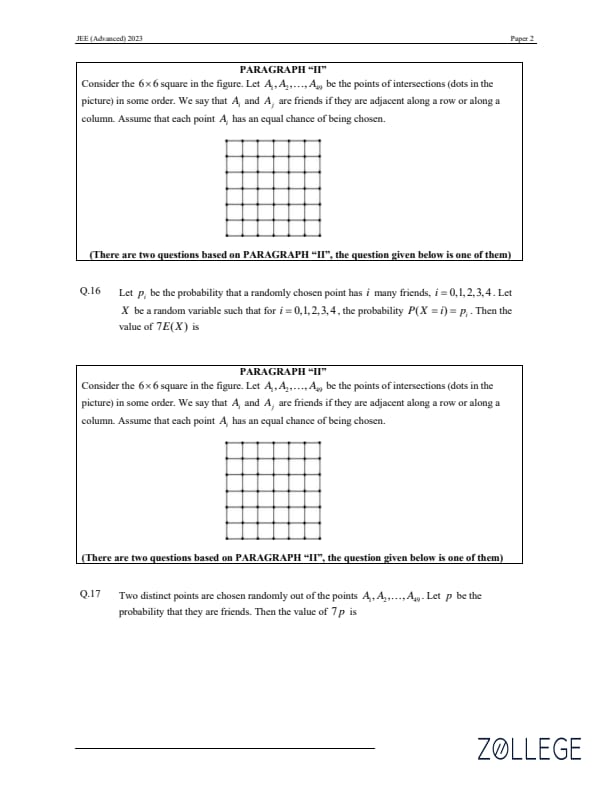
Consider the 6 x 6 square in the figure. Let A1, A2, ..., A49 be the points of intersections (dots in the picture) in some order. We say that Ai and Aj are friends if they are adjacent along a row or along a column. Assume that each point Ai has an equal chance of being chosen.


Let pi be the probability that a randomly chosen point has i many friends, i = 0, 1, 2, 3, 4. Let X be a random variable such that for i = 0, 1, 2, 3, 4, the probability P(X = i) = pi. Then the value of 7E(X) is:
View Solution
Step 1: Construct the probability distribution.
Number of friends:
- 2 friends: 4 corner points. Probability = 4/49
- 3 friends: 6*4 = 24 points on the edge, excluding corners. Probability = 24/49
- 4 friends: Remaining 25 points. Probability = 25/49
P(0) = 0, P(1) = 0, P(2) = 4/49, P(3) = 24/49, P(4) = 25/49.
Step 2: Compute E(X).
E(X) = Σi=04i ⋅ P(i) = 2 ⋅ (4/49) + 3 ⋅ (24/49) + 4 ⋅ (25/49).
Simplify:
E(X) = (8 + 72 + 100)/49 = 180/49.
Step 3: Calculate 7E(X).
7E(X) = 7 ⋅ (180/49) ≈ 25.7. E(x) = (4*2+24*3+25*4)/49 = (8+72+100)/49 = 180/49. 7E(x) = 180/7.
Points with 2 friends: Corners (4). Probability = 4/49.
Points with 3 friends: Edges excluding corners (24). Probability = 24/49.
Points with 4 friends: Interior (25). Probability = 25/49.
E(X) = 2*(4/49) + 3*(24/49) + 4*(25/49) = (8+72+100)/49 = 180/49.
7E(X) = 1260/49 = 180/7.
Question 17:
Two distinct points are chosen randomly out of the points A1, A2, ..., A49. Let p be the probability that they are friends. Then the value of 7p is:
View Solution
Step 1: Compute total pairs.
The total number of ways to choose two points is: 49C2 = 49*48/2 = 49*24 = 1176.
Step 2: Compute favorable pairs.
Consecutive points are friends. There are 7 horizontal rows and 7 vertical columns. Each row/column has 6 pairs of friends, for a total of 7 x 7 x 2 = 98 pairs. So we have 2 * 6 * 7 = 84 pairs of friends. There are 7 horizontal and 7 vertical lines, so we have 14 lines. In each line there are 7 points so there are 7C2 ways to select 2 points = 7*6/2=21. So total pairs are 14*21=294. So number of pairs of friends are 7*6+7*6 = 84.
Step 3: Compute probability p.
p = 84/49C2 = 84/1176 = 1/14 = 0.071.
Step 4: Compute 7p.
Simplify:
7p = 7 * (1/14) = 1/2 = 0.5.
Physics
Question 1:
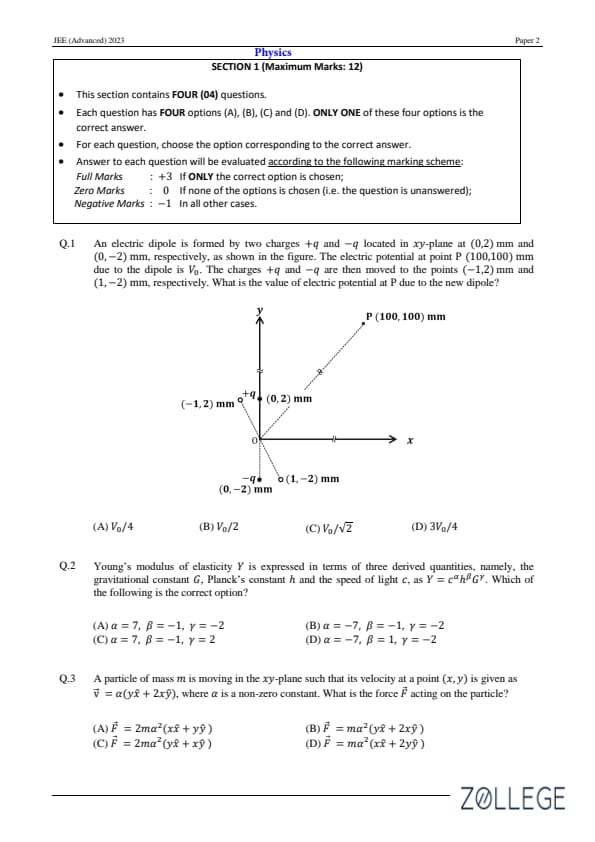
An electric dipole is formed by two charges +q and -q located in the xy-plane at (0, 2) mm and (0, -2) mm, respectively, as shown in the figure. The electric potential at point P(100, 100) mm due to the dipole is V0. The charges +q and -q are then moved to the points (-1, 2) mm and (1, -2) mm, respectively. What is the value of the electric potential at P due to the new dipole?

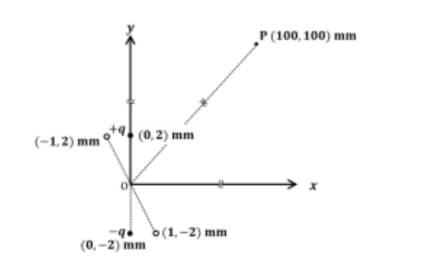
View Solution
Step 1: Analyze the given dipole configuration.
The electric potential at P due to the initial dipole is given as:
V0 = (kp0/r2)cos45°,
where p0 is the dipole moment.
Step 2: Consider the new dipole moment.
After the charges are moved, the new dipole moment is:
The Component P0' along xaxis = -P0î/√2
The Component P0' along yaxis = P0ĵ/√2
Potential due to P0ĵ
=> kP0 cos45°/r2 = V0
Potential due to -P0î/√2
The new potential at P is:
k(P0/2)cos135°/r2 = -V0/2
Initial dipole moment = 4qĵ x 10-3 = p0ĵ
New dipole moment p' = 2qî x 10-3 - 4qĵ x 10-3 = p0(î/2-ĵ).
|p'| = √5p0/2. Initial Potential = kp0cos45/r2 = V0 = kp0/√2r2.
New potential = kp0(î/2 - ĵ) ⋅ (î+ĵ)/√2r2 = kp0(-1/2)/√2r2 = -V0/2.
Question 2:
Young's modulus of elasticity Y is expressed in terms of three derived quantities, namely, the gravitational constant G, Planck's constant h, and the speed of light c, as Y = cαhβGγ. Which of the following is the correct option?
View Solution
Step 1: Dimensional analysis.
The dimensional formula of Y is:
[ML-1T-2] = [cαhβGγ].
Step 2: Write dimensional formulas.
[c] = [LT-1], [h] = [ML2T-1], [G] = [M-1L3T-2].
Step 3: Equate powers of M, L, T.
Equate the powers of M, L, T:
β - γ = 1 ... (1)
α + 2β + 3γ = -1 ... (2)
-α - β - 2γ = -2 or α + β + 2γ = 2 ... (3)
Step 4: Solve the equations.
From equations (1), (2) and (3):
α = 7, β = -1, γ = -2.
Question 3:
A particle of mass m is moving in the xy-plane such that its velocity at a point (x, y) is given as v→ = α(yx̂ + 2xŷ), where α is a non-zero constant. What is the force F→ acting on the particle?
View Solution
Step 1: Calculate acceleration.
v→ = α(yx̂ + 2xŷ)
vx = αy
vy = 2αx
dvx/dt = α(dy/dt) = αvy = 2α2x
dvy/dt = 2α(dx/dt) = 2αvx = 2α2y
a→ = 2α2(xî + yĵ)
∴ F→ = ma→ = 2mα2(xx̂ + yŷ)
Question 4:
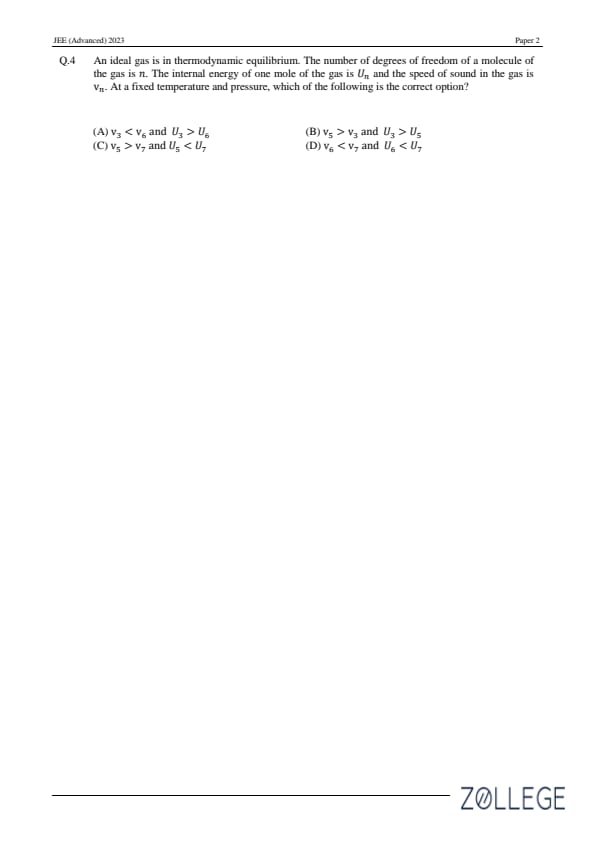
An ideal gas is in thermodynamic equilibrium. The number of degrees of freedom of a molecule of the gas is n. The internal energy of one mole of the gas is Un and the speed of sound in the gas is vn. At a fixed temperature and pressure, which of the following is the correct option?
View Solution
Step 1: Analyze internal energy.
The internal energy is:
Un = (n/2)RT (proportional to n).
Step 2: Analyze speed of sound.
The speed of sound is:
vn = √(γRT/M),
where γ = 1 + 2/n. As n increases, γ decreases, and hence vn decreases.
Step 3: Conclusion.
For n = 5, 7, we have:
v5 > v7, U5 < U7.
Question 5:
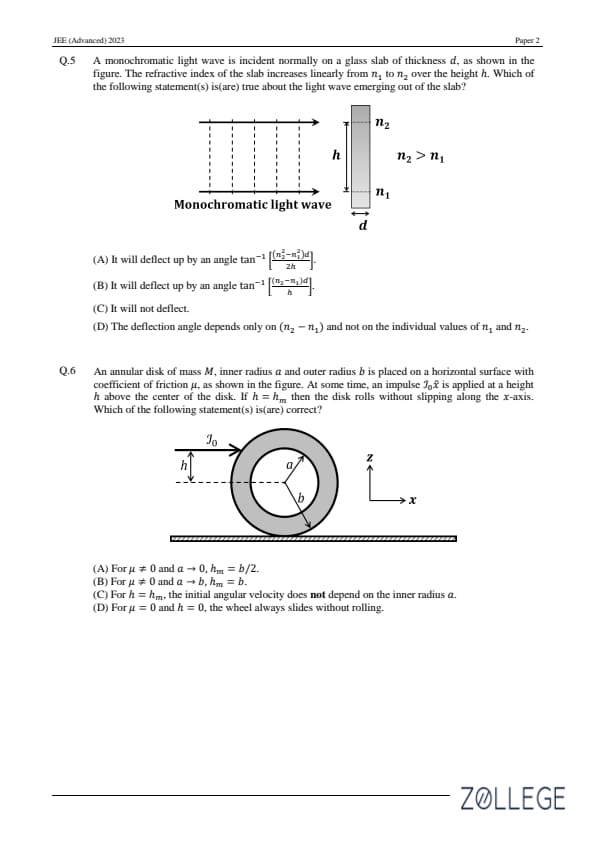
A monochromatic light wave is incident normally on a glass slab of thickness d, as shown in the figure. The refractive index of the slab increases linearly from n1 to n2 over the height h. Which of the following statements is/are true about the light wave emerging out of the slab?
[Given: The speed of light in vacuum, c = 3 × 10⁸ m s–1]


View Solution
Step 1: Analyze the refractive index gradient.
The refractive index increases linearly from n1 to n2 over a height h. This causes the wavefront to tilt as the speed of light decreases with increasing refractive index.
Step 2: Calculate the tilt of the wavefront.
At time t, the wavefront PQ is given by:
(n2d)/c = (n1d)/c + x/c.
Simplifying for x:
x = d(n2 - n1).
Step 3: Determine the angle of deflection.
The angle of deflection θ is:
tanθ = x/h = (n2 - n1)d/h.
Thus:
θ = tan-1[(n2 - n1)d/h].
Step 4: Validate the dependency on n2 - n1.
The deflection angle depends only on the difference n2 - n1, as seen in the expression for θ, and not on the individual values of n1 or n2.
Question 6:
An annular disk of mass M, inner radius a, and outer radius b is placed on a horizontal surface with a coefficient of friction μ, as shown in the figure. At some time, an impulse J0 &hat;x; is applied at a height h above the center of the disk. If h = hm, then the disk rolls without slipping along the x-axis. Which of the following statement(s) is/are correct?

View Solution
Step 1: Angular impulse-momentum relation
The angular impulse-momentum relation gives:
J h = Icm ω,
where J is the impulse and Icm is the moment of inertia about the center of mass.
Step 2: Rolling condition
For rolling without slipping, the linear velocity vcm and angular velocity ω are related by:
vcm = b ω.
Step 3: Calculate hm
The critical height hm is found by equating:
hm = Icm / (Mb).
For different cases:
- For a → 0, hm = b/2.
- For a → b, hm = b.
Step 4: Additional observations
- For h = 0 and μ = 0, rolling does not occur due to the absence of torque.
- When h = hm, rolling without slipping occurs.
Question 7:
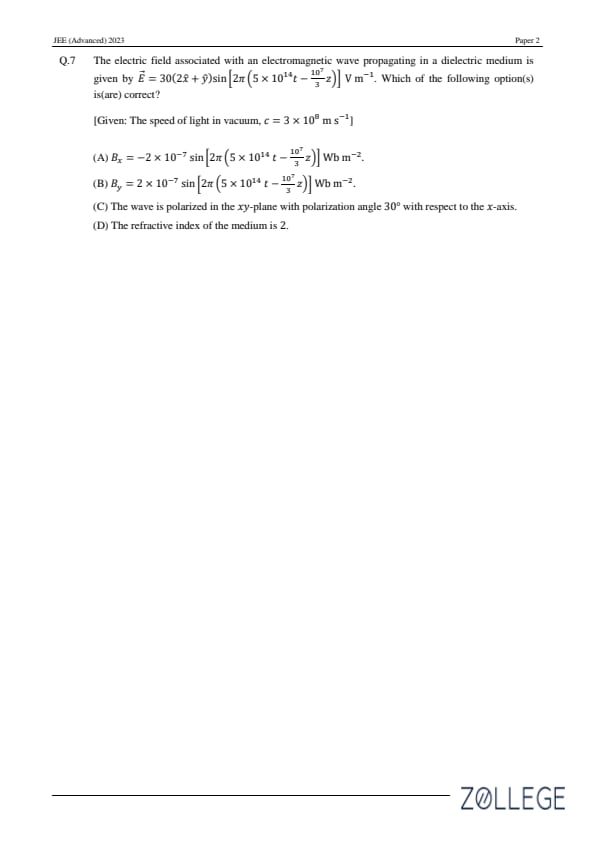
The electric field associated with an electromagnetic wave propagating in a dielectric medium is given by
E→ = 30(2x̂ + ŷ)sin[2π(5 × 10¹⁴t - 107z/3)] V m-1.
Which of the following option(s) is/are correct?
[Given: The speed of light in vacuum, c = 3 × 10⁸ m s–1]
View Solution
Step 1: Calculate the speed of the wave in the dielectric medium.
The wave number k is:
k = 2π/λ = 107/3.
The speed of the wave is:
v = ω/k = (2π ⋅ 5 × 1014)/(107/3) = 1.5 × 10⁸ m/s.
Step 2: Determine the refractive index.
The refractive index n is given by:
n = c/v = (3 × 10⁸)/(1.5 × 108) = 2.
Step 3: Magnetic field components.
The amplitude of the magnetic field B is related to E by:
B = E/v.
Thus:
B = 30/(1.5 × 108) = 2 × 10⁻⁷ Wb m-2.
Step 4: Magnetic field expressions.
The components of B→ are:
Bx = -2 × 10⁻⁷sin[2π(5 × 10¹⁴t - 107z/3)],
By = 1 x 10⁻⁷sin[2π(5 × 10¹⁴t - 107z/3)].
E→ = 30(2î + ĵ)sin[2π(5 × 10¹⁴t - 107z/3)].
ω = 1015π, k=107/3 * 2π. v=ω/k = 1.5 x 10⁸.
μ = c/v = 2. B0 = E0/cμ = 30√5/3 x 108 * 2 = √5 x 10⁻⁷.
B→ = B0(î-2ĵ)/√5sin(...) = (î-2ĵ)10-7sin(...).
So Bx = 10-7sin(...), By = -2 * 10-7sin(...).
Question 8:
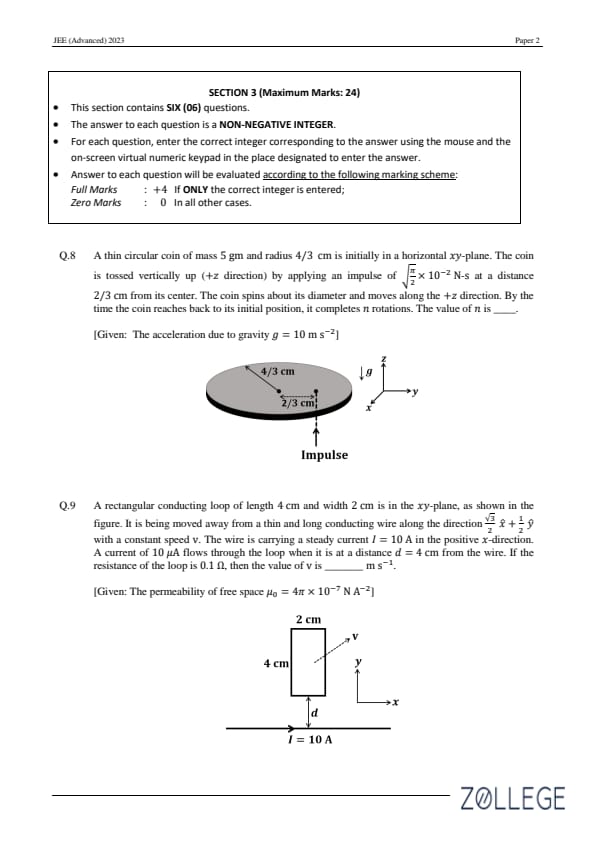
A thin circular coin of mass 5 gm and radius 4/3 cm is initially in a horizontal xy-plane. The coin is tossed vertically up (+z-direction) by applying an impulse √(π/2) × 10-2 N-s at a distance 2/3 cm from its center. The coin spins about its diameter and moves along the +z-direction. By the time the coin reaches back to its initial position, it completes n rotations. The value of n is ______.


View Solution
Step 1: Angular impulse and linear momentum.
The impulse J is given as:
J = Mvcm.
For angular motion:
J ⋅ (R/2) = Iω,
where I = MR2/4 is the moment of inertia about the center of mass.
Step 2: Calculate vcm and ω.
From the above equations:
vcm = J/M, ω = 2J/MR.
Step 3: Time to return to the initial position.
The time for the coin to return is:
T = 2vcm/g = 2J/(gM).
Step 4: Total angle rotated.
The angle rotated in time T is:
θ = ωT = 4J2/(M2gR).
Substituting J = √(π/2) × 10-2, M = 5 gm, and R = 4/3 cm:
θ = 60π.
Step 5: Number of rotations.
The number of rotations is:
n = θ/(2π) = 60π/(2π) = 30.
Question 9:
A rectangular conducting loop of length 4 cm and width 2 cm is in the xy-plane, as shown in the figure. It is being moved away from a thin and long conducting wire along the direction (√3/2)x̂ + (1/2)ŷ with a constant speed v. The wire is carrying a steady current I = 10 A in the positive x-direction. A current of 10 μA flows through the loop when it is at a distance d = 4 cm from the wire. If the resistance of the loop is 0.1 Ω, then the value of v is ______.
[Given: The permeability of free space μ0 = 4π × 10-7 N A-2]


View Solution
Step 1: Induced emf in the loop.
The induced emf is:
ε = (μ0Iℓ/2π)((v/2)(1/d - 1/(d+bcos60))).
Substituting b = 2 cm, ℓ = 4 cm, d = 4 cm:
ε = (μ0Ivℓ)/(4πd(d+ℓ)). Iinduced = ε/R = (μ0Ivℓ)/(4πd(d+ℓ)R).
Step 2: Calculate current in the loop.
The current is:
I0 = ε/R.
Given I0 = 10 μA, solve for v:
v = 4 m/s.
Question 10:
A string of length 1 m and mass 2 × 10⁻⁵ kg is under tension T. When the string vibrates, two successive harmonics are found to occur at frequencies 750 Hz and 1000 Hz. The value of tension T is ______ Newton.
View Solution
The frequency of vibration of a string is given by:
f = nv/(2ℓ),
where:
- n is the harmonic number,
- v is the speed of the wave,
- ℓ = 1 m is the length of the string.
For two successive harmonics:
fn = nv/(2ℓ) and fn+1 = (n+1)v/(2ℓ).
The difference in frequencies is:
fn+1 - fn = v/(2ℓ).
Given:
fn+1 - fn = 1000 - 750 = 250 Hz.
Substitute values:
v/2 = 250 ⇒ v = 500 m/s.
The speed v is related to tension T and linear mass density μ by:
v = √(T/μ),
where μ = mass/length = (2 × 10⁻⁵)/1 = 2 × 10⁻⁵ kg/m.
Substitute v = 500:
500 = √(T/(2 × 10-5)).
Square both sides:
250000 = T/(2 × 10-5) ⇒ T = 250000 × 2 × 10-5 = 5 N.
Question 11:
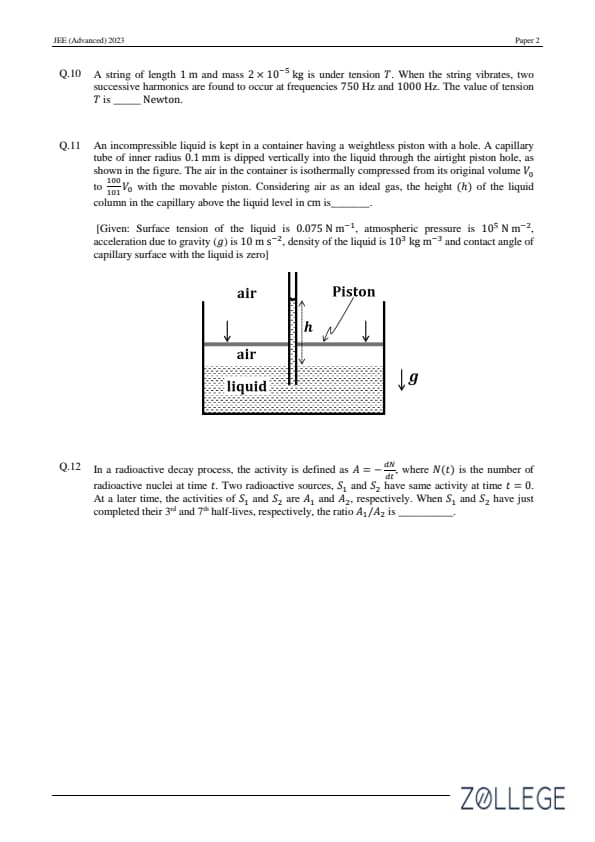
An incompressible liquid is kept in a container having a weightless piston with a hole. A capillary tube of inner radius 0.1 mm is dipped vertically into the liquid through the airtight piston hole, as shown in the figure. The air in the container is isothermally compressed from its original volume V0 to 100/101 V0 with the movable piston. Considering air as an ideal gas, the height (h) of the liquid column in the capillary above the liquid level in cm is ______.
[Given: Surface tension of the liquid is 0.075 N m-1, atmospheric pressure is 105 N m-2, acceleration due to gravity (g) is 10 m s-2, density of the liquid is 103 kg m-3 and contact angle of capillary surface with the liquid is zero]


View Solution
Using Boyle's law for isothermal compression:
P0V0 = PA(100/101)V0,
where P0 is the initial pressure and PA is the pressure after compression.
Simplify:
PA = P0(101/100).
The pressure PA is transmitted to the liquid:
PD = PA = (101/100)P0.
The pressure at the capillary is given by:
PB = PC + 2T/r,
where:
- T = 0.075 N/m is the surface tension,
- r = 0.1 mm = 0.0001 m is the radius of the capillary.
Thus:
PC = PB - 2T/r.
The pressure difference between PD and PC causes the liquid column to rise:
PD = PC + ρgh.
Substitute:
(101/100)P0 = (P0 - 2T/r) + ρgh.
Rearrange for h:
(101/100)P0 - P0 + 2T/r = ρgh.
Simplify:
h = (P0/100 + 2T/r)/(ρg).
Substitute values:
P0 = 105 Pa, T = 0.075 N/m, r = 0.0001 m, ρ = 103 kg/m3, g = 10 m/s2.
Calculate:
h = (105/100 + 2 ⋅ 0.075/0.0001)/(103 ⋅ 10).
Simplify:
h = (1000 + 1500)/10000 = 2500/10000 = 0.25 m.
Convert to cm:
h = 25 cm.
Question 12:
In a radioactive decay process, the activity is defined as A = -dN/dt, where N(t) is the number of radioactive nuclei at time t. Two radioactive sources, S1 and S2, have the same activity at time t = 0. At a later time, the activities of S1 and S2 are A1 and A2, respectively. When S1 and S2 have just completed their 3rd and 7th half-lives, respectively, the ratio A1/A2 is ______.
View Solution
The activity of a radioactive source is proportional to the number of radioactive nuclei present:
A(t) = A0(1/2)n,
where A0 is the initial activity, and n is the number of half-lives.
For S1 after 3 half-lives:
A1 = A0(1/2)3 = A0/8.
For S2 after 7 half-lives:
A2 = A0(1/2)7 = A0/128.
The ratio A1/A2 is:
A1/A2 = (A0/8)/(A0/128) = 128/8 = 16.
Question 13:
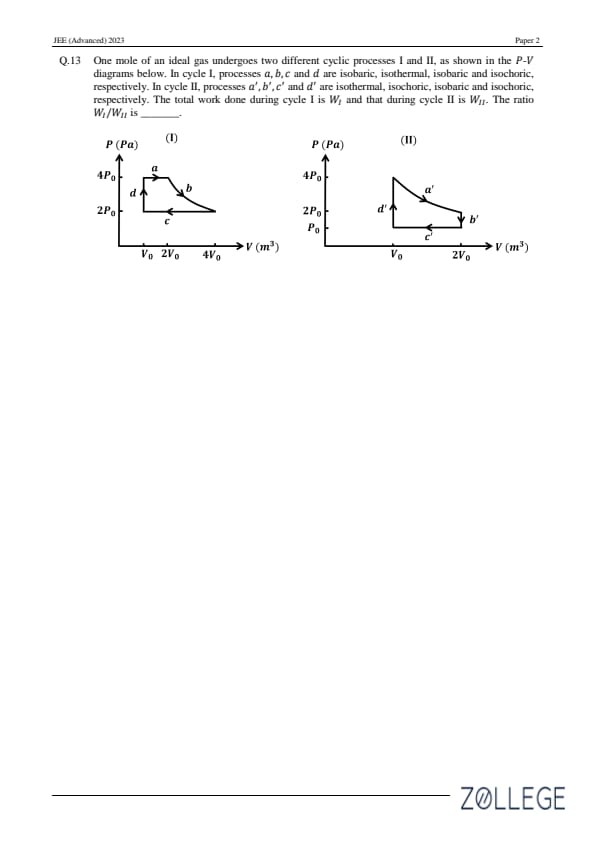
One mole of an ideal gas undergoes two different cyclic processes I and II, as shown in the P-V diagrams below. In cycle I, processes a, b, c, d are isobaric, isothermal, isobaric, and isochoric, respectively. In cycle II, processes a', b', c', d' are isothermal, isochoric, isobaric, and isochoric, respectively. The total work done during cycle I is WI and that during cycle II is WII. The ratio WI/WII is ______.


View Solution
In cycle I:
WI = Wisobaric(a) + Wisothermal(b) + Wisobaric(c) + Wisochoric(d).
For processes:
WI = 4P0V0 + ∫4V03V0P0(4V0/V)dV - 6P0V0 = 4P0V0+4P0V0ln(3/4)-6P0V0 = 4P0V0(ln(3/4)-1/2).
Simplify:
WI = 4P0V0 + 4P0V0ln(3/4) - 6P0V0 = 4P0V0(ln(3/4) - 1/2).
In cycle II:
WII = Wisothermal(a') + Wisochoric(b') + Wisobaric(c') + Wisochoric(d').
For processes:
WII = ∫2P03P0(4P0V0/P)dP - 4P0V0 = 4P0V0ln(3/2) - 4P0V0 = 4P0V0(ln(3/2)-1).
WI = 2P0V0 + nRTln2 + (-3P0V0) = 2P0V0+2P0V0ln2-3P0V0 = -P0V0+2P0V0ln2 = P0V0(2ln2-1). WII = nRTln(3/2)-P0V0 = 2P0V0ln(3/2)-P0V0 = P0V0(2ln(3/2)-1).
WI = 4P0V0 + 4P0V0ln(3/4)-6P0V0+0 = -2P0V0 + 4P0V0(ln3-ln4) = -2P0V0+4P0V0(ln3-2ln2). WII = ∫PdV = nRTln(Vf/Vi). 4P0V0ln(3/2).
Simplify the ratio:
WI/WII = 2.
Question 14:
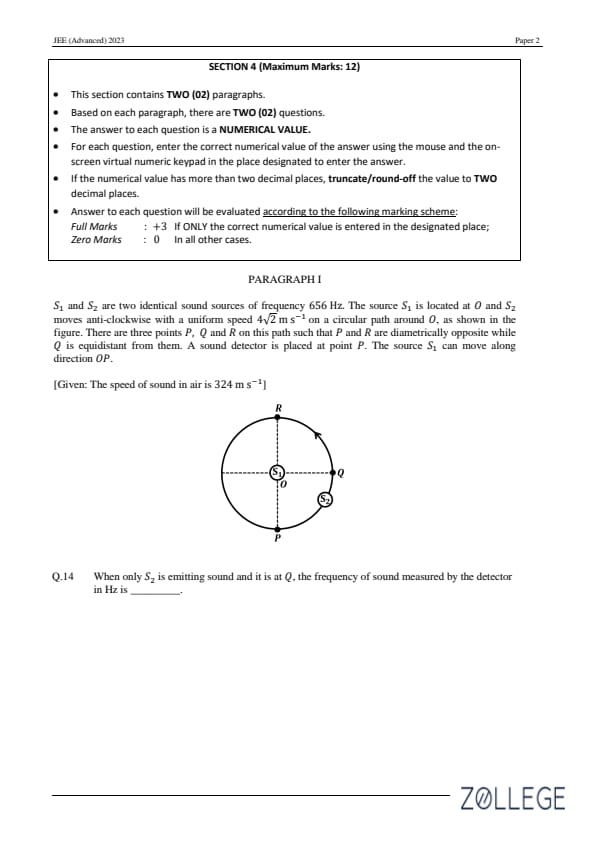
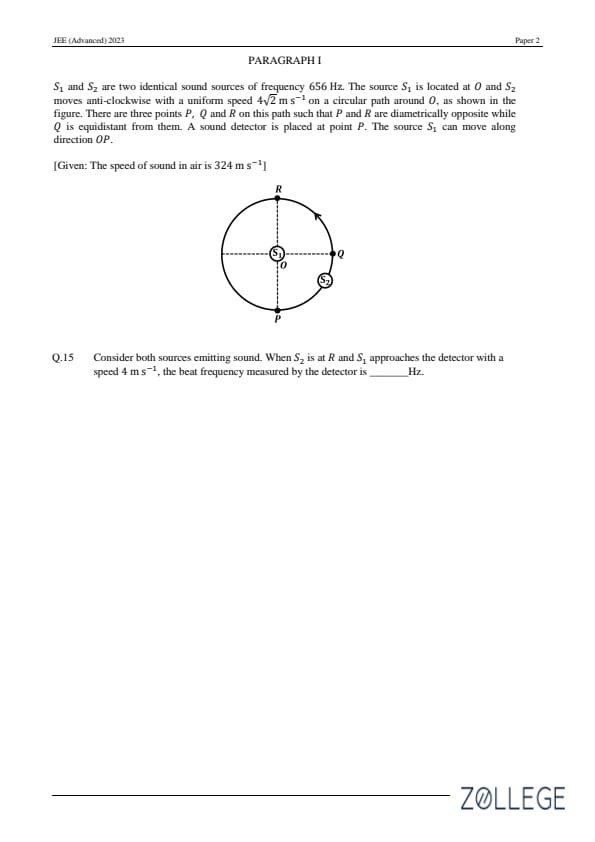
S1 and S2 are two identical sound sources of frequency 656 Hz. The source S1 is located at O, and S2 moves anticlockwise with a uniform speed 4√2 m/s on a circular path around O, as shown in the figure. There are three points P, Q, and R on this path such that P and R are diametrically opposite, while Q is equidistant from them. A sound detector is placed at point P. The source S1 can move along the direction OP.
[Given: The speed of sound in air is 324 m s-1]


When only S2 is emitting sound and it is at Q, the frequency of sound measured by the detector in Hz is:
View Solution
Step 1: Calculate apparent frequency.
The apparent frequency is given by:
f = (v/(v + vscos45°))f0
where v = 324 m/s, vs = 4√2 m/s, and f0 = 656 Hz.
Substituting the values:
f = (324/(324 + 4))656
f = (324/328)656 = 648 Hz.
Question 15:
Consider both sources emitting sound. When S2 is at R and S1 approaches the detector with a speed of 4 m/s, the beat frequency measured by the detector is:
View Solution
Step 1: Calculate f1 for S1.
The apparent frequency is given by:
f1 = (v/(v - vs))f0,
where v = 324 m/s, vs = 4 m/s, and f0 = 656 Hz.
Substituting the values:
f1 = (324/(324 - 4))656 = (324/320) × 656 = 664.2 Hz.
Step 2: Calculate f2 for S2.
Since S2 is stationary relative to the detector at R:
f2 = (324/(324+4√2*0))656 = 656 Hz.
Step 3: Calculate the beat frequency.
The beat frequency is given by:
fb = |f1 - f2| = |664.2 - 656| = 8.2 Hz.
Question 16:
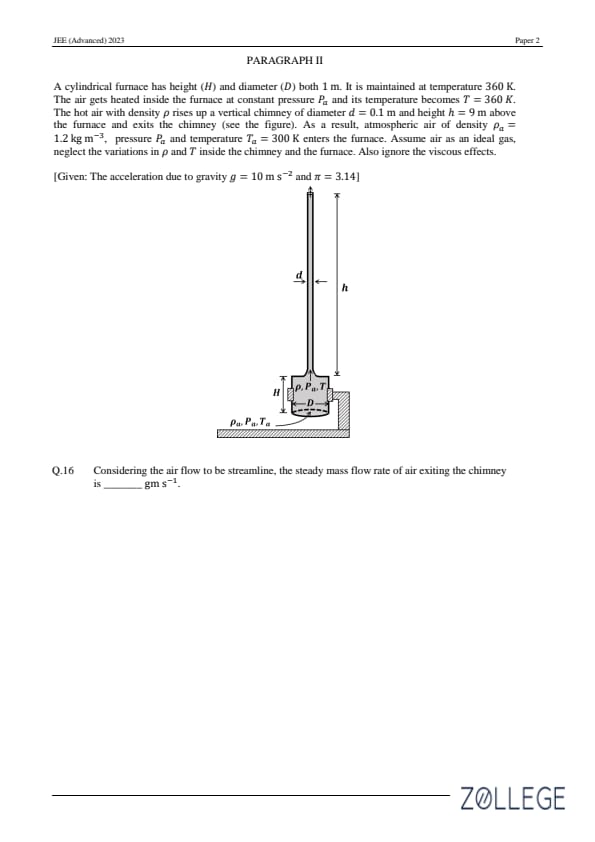
A cylindrical furnace has height (H) and diameter (D) both 1 m. It is maintained at a temperature of 360 K. The air gets heated inside the furnace at constant pressure P, and its temperature becomes T = 360 K. The hot air with density ρ rises up a vertical chimney of diameter d = 0.1 m and height h = 9 m above the furnace and exits the chimney (see the figure). As a result, atmospheric air of density ρa = 1.2 kg m-3, pressure Pa, and temperature Ta = 300 K enters the furnace. Assume air as an ideal gas, neglect the variations in P and T inside the chimney and the furnace. Also, ignore the viscous effects.
[Given: The acceleration due to gravity g = 10 m s-2 and π = 3.14]


Considering the airflow to be streamline, the steady mass flow rate of air exiting the chimney is:
View Solution
Step 1: Calculate air density.
From the ideal gas law:
ρ = ρ0(Ta/T) = 1.2 × (300/360) = 1 kg/m3.
Step 2: Apply Bernoulli's equation.
At points 1 and 2:
Pa + 0 + 0 = Pa - ρgh + 0 + (1/2)ρv2,
where h = 9 m. Solving for v:
v = √(2(ρa-ρ)gh/ρ) = √(40) m/s.
Step 3: Calculate mass flow rate.
The mass flow rate is given by:
Q = ρAv = π(d2/4) × v = π(0.1)2/4 × √40 × 1000 = 49.61 gm/s.
Question 17:
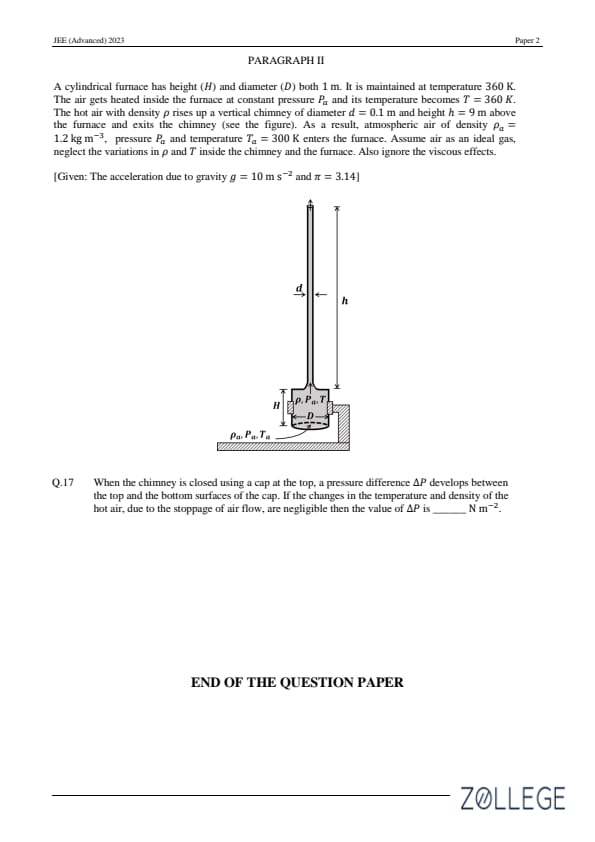
When the chimney is closed using a cap at the top, a pressure difference ΔP develops between the top and the bottom surfaces of the cap. If the changes in temperature and density of the hot air, due to the stoppage of airflow, are negligible, then ΔP is:
View Solution
Step 1: Calculate pressure difference.
At the bottom surface:
Pinside = Pa - ρgh.
At the top surface:
Poutside = Pa - ρagh.
The pressure difference is:
ΔP = Pinside - Poutside = (ρa - ρ)gh.
Substituting values:
ΔP = (1.2 - 1) × 10 × 10 = 20 N/m2.
Chemistry
Question 1:
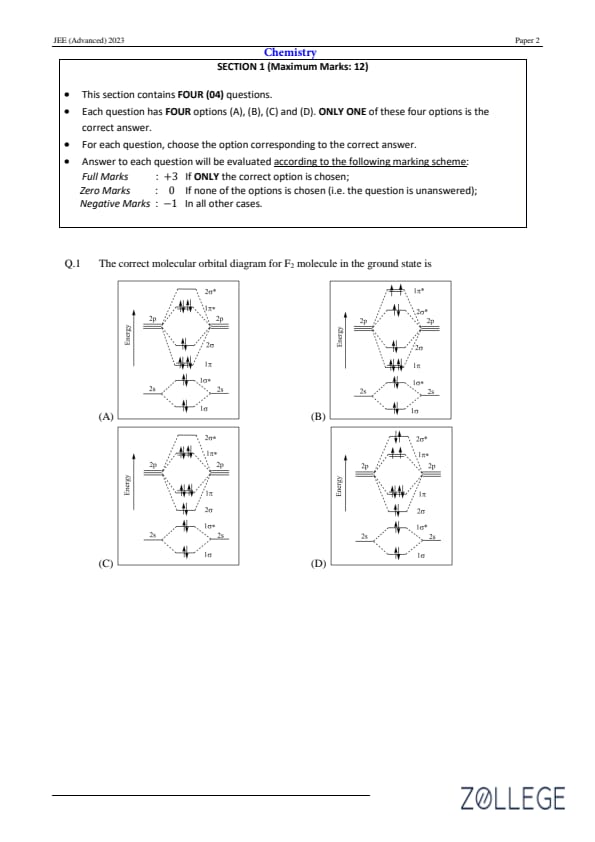
The correct molecular orbital diagram for F2 molecule in the ground state is

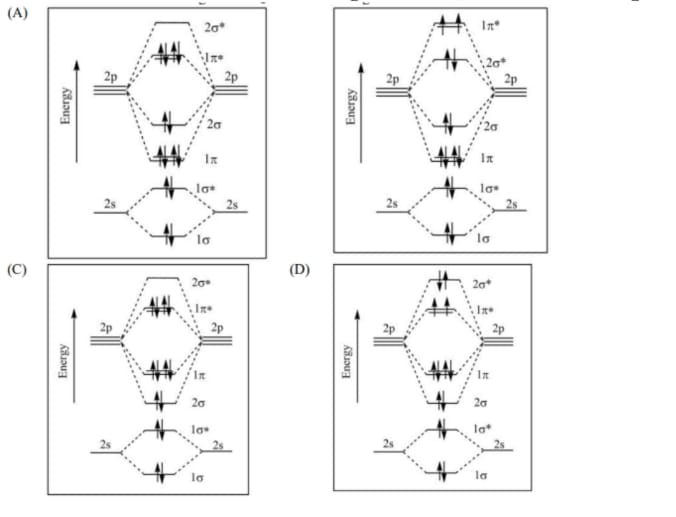

View Solution
Atomic Orbitals:
- Each fluorine atom has 9 electrons, with the electronic configuration 1s² 2s² 2p⁵.
- The valence electrons reside in the 2s and 2p orbitals.
Molecular Orbital Formation:
- When two fluorine atoms combine to form F₂, their atomic orbitals overlap to form molecular orbitals.
- The 2s orbitals overlap to form σ2s and σ*2s molecular orbitals.
- The 2p orbitals overlap in two ways:
- Head-on overlap of 2pz orbitals along the internuclear axis forms σ2pz and σ*2pz orbitals.
- Side-on overlap of 2px and 2py orbitals forms two sets of π2px, π2py and π*2px, π*2py orbitals.
Filling Molecular Orbitals:
- The 14 valence electrons (7 from each fluorine atom) fill the molecular orbitals according to the Aufbau principle (filling orbitals from lowest to highest energy) and Hund's rule (filling degenerate orbitals singly before pairing).
Correct Molecular Orbital Diagram
Based on the above analysis, the correct molecular orbital diagram for F₂ in the ground state is Option C.
Key Features of the Correct Diagram:
- The σ2s and σ*2s orbitals are filled.
- The σ2pz orbital is filled.
- The π2px and π2py orbitals are each filled with one electron (due to Hund's rule).
- The π*2px and π*2py orbitals each have one unpaired electron.
Energy | σ*₂pz | π*₂px = π*₂py | σ₂pz
-------|-------|----------------|-------
       | ↑↓    | ↑     ↑       | ↑↓
-------|-------|----------------|-------
π₂px = π₂py| σ*₂s  | σ₂s
-------|-------|-------
       | ↑↓    | ↑↓
Question 2:
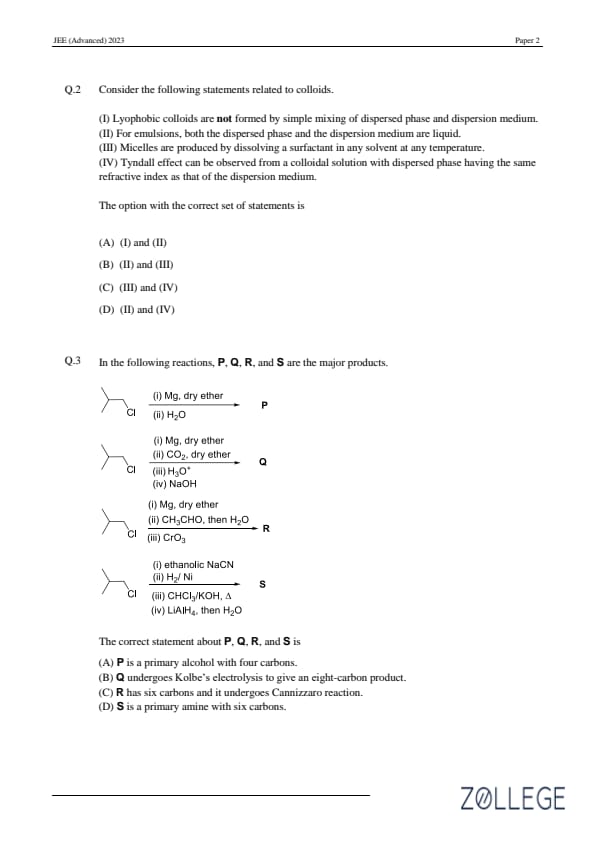
Consider the following statements related to colloids:
- Lyophobic colloids are not formed by simple mixing of dispersed phase and dispersion medium.
- For emulsions, both the dispersed phase and the dispersion medium are liquid.
- Micelles are produced by dissolving a surfactant in any solvent at any temperature.
- Tyndall effect can be observed from a colloidal solution with dispersed phase having the same refractive index as that of the dispersion medium.
The option with the correct set of statements is:
View Solution
Step 1: Analyze each statement.
- (I) Lyophobic colloids are indeed not formed by simple mixing. They require stabilizing agents. (Correct)
- (II) In emulsions, both the dispersed phase and the dispersion medium are liquids. (Correct)
- (III) Micelles form at the critical micelle concentration (CMC) and specific temperatures, like the Kraft temperature. (Incorrect)
- (IV) Tyndall effect requires different refractive indices of the dispersed phase and medium. (Incorrect)
Question 3:
In the following reactions, P, Q, R, and S are the major products. The correct statement about P, Q, R, and S is:


View Solution
Step 1: Analyze each reaction step.
- P: Reaction with Mg/dry ether followed by H₂O forms a primary alcohol with four carbons. (3-methyl butanol)
- Q: Reaction sequence results in isobutyric acid, a carboxylic acid that can undergo Kolbe’s electrolysis to give an eight-carbon product. (2,5-dimethyl hexane)
- R: Reaction sequence forms isobutyraldehyde which does not undergo Cannizzaro reaction since it has alpha-hydrogen atom.
- S: Reaction sequence forms isobutylamine, a primary amine with four carbons.
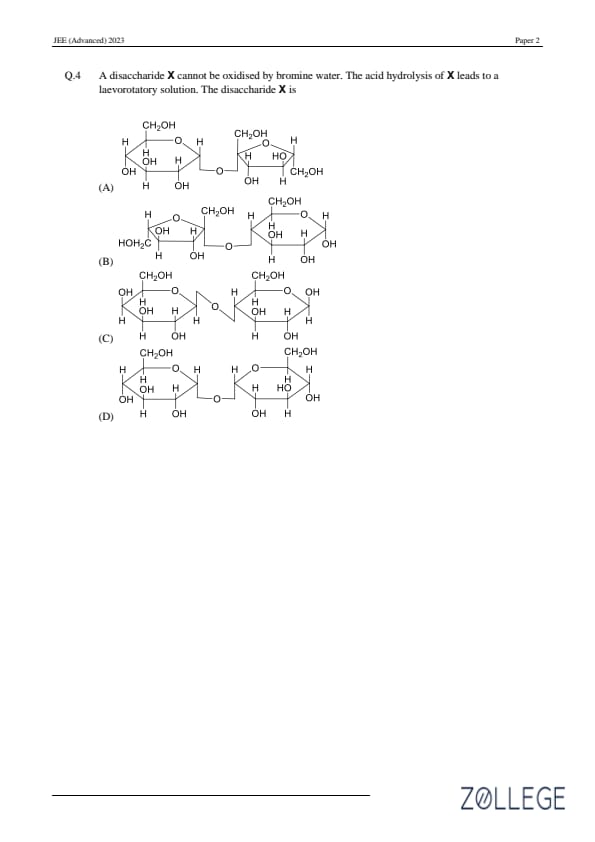
Question 4:
A disaccharide X cannot be oxidized by bromine water. The acid hydrolysis of X leads to a laevorotatory solution. The disaccharide X is:

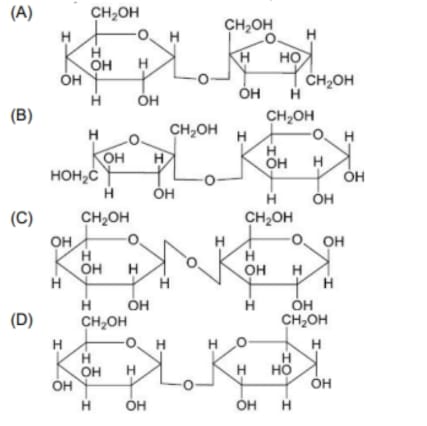

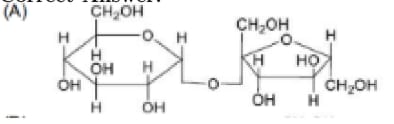
View Solution
Step 1: Analyze the properties of the disaccharides.
Sucrose is a non-reducing sugar and cannot be oxidized by bromine water. Upon hydrolysis, it gives glucose and fructose, with the solution becoming laevorotatory due to fructose’s higher optical rotation.
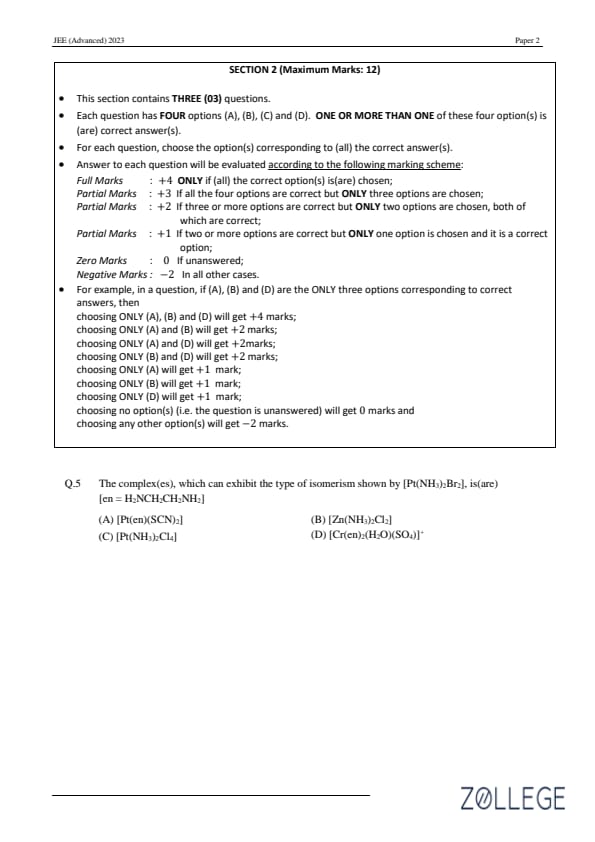
Question 5:
The complex(es) which can exhibit the type of isomerism shown by [Pt(NH3)2Br2] is(are):
View Solution
Step 1: Analyze each complex.
- [Pt(NH3)2Br2] shows cis-trans isomerism as it is a square planar complex.
- (A) [Pt(en)(SCN)2] can exhibit linkage isomerism and geometrical isomerism since SCN can bind through S or N.
- (B) [Zn(NH3)2Cl2] is tetrahedral, so it does not exhibit geometrical isomerism.
- (C) [Pt(NH3)2Cl4] is octahedral and shows geometrical isomerism (cis-trans).
- (D) [Cr(en)2(H2O)(SO4)]+ is also octahedral and exhibits geometrical isomerism.
Question 6:
Atoms of metals x, y, and z form face-centred cubic (fcc) unit cell of edge length Lx, body-centred cubic (bcc) unit cell of edge length Ly, and simple cubic unit cell of edge length Lz, respectively. If rz = (√3/2)ry; ry = (8/√3); Mz = (3/2)My and Mz = 3Mx, then the correct statement(s) is(are):
Given: Mx, My, and Mz are molar masses of metals x, y, and z, respectively. rx, ry, and rz are atomic radii of metals x, y, and z, respectively.
View Solution
Step 1: Analyze edge lengths and radii
For metal x (FCC): Lx = 2√2 rx.
For metal y (BCC): Ly = (4ry/√3).
For metal z (SC): Lz = 2rz.
Step 2: Packing efficiencies
- FCC: PE = 0.24π
- BCC: PE = 0.22π
- SC: PE = 0.17π
Thus, Packing Efficiency: FCC > BCC > SC.
Step 3: Density comparison
Using given values, we analyze and find:
Ly > Lz, and density of x is greater than y.
Conclusion:
- (A) Packing efficiency follows FCC > BCC > SC (True)
- (B) Ly > Lz (True)
- (C) Lx < Ly (False)
- (D) Density of x > Density of y (True)
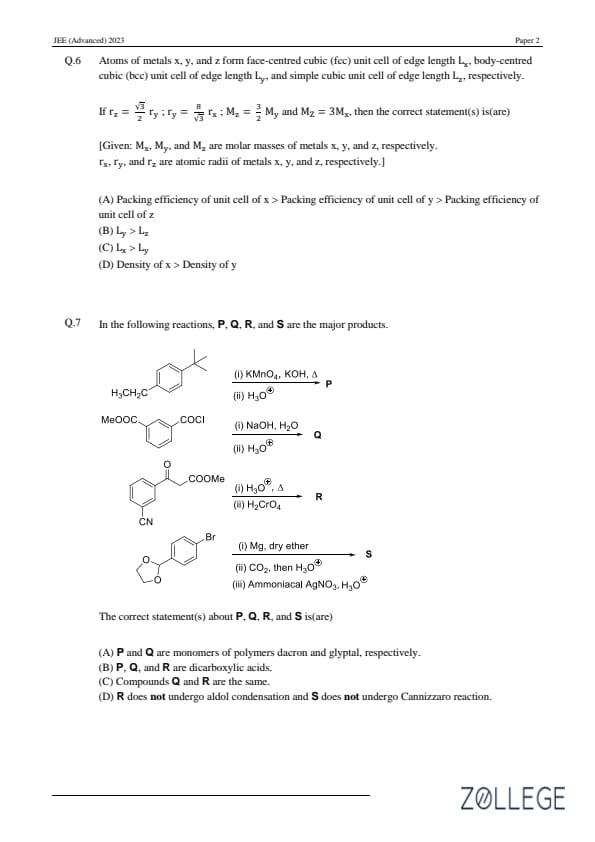
Question 7:
In the following reactions, P, Q, R, and S are the major products. The correct statement(s) about P, Q, R, and S is(are):

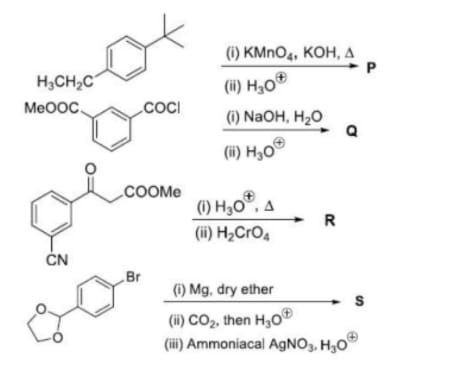
View Solution
Step 1: Analyze reactions for P, Q, R, and S.
- P: Terephthalic acid.
- Q: Phthalic acid.
- R: Phthalic acid. Thus, Q and R are the same.
- S: Benzaldehyde.
(A): P is terephthalic acid and Q is phthalic acid, which are monomers of dacron and glyptal respectively. Correct.
(B): P, Q, and R are dicarboxylic acids. Correct.
(C): Q and R are phthalic acid. Correct.
(D): R does not undergo aldol and S does not undergo Cannizzaro. Incorrect, since S undergoes Cannizzaro.
Phthalic acid has no alpha hydrogen so does not undergo aldol. Benzaldehyde has no alpha hydrogen so undergoes Cannizzaro.
Question 8:
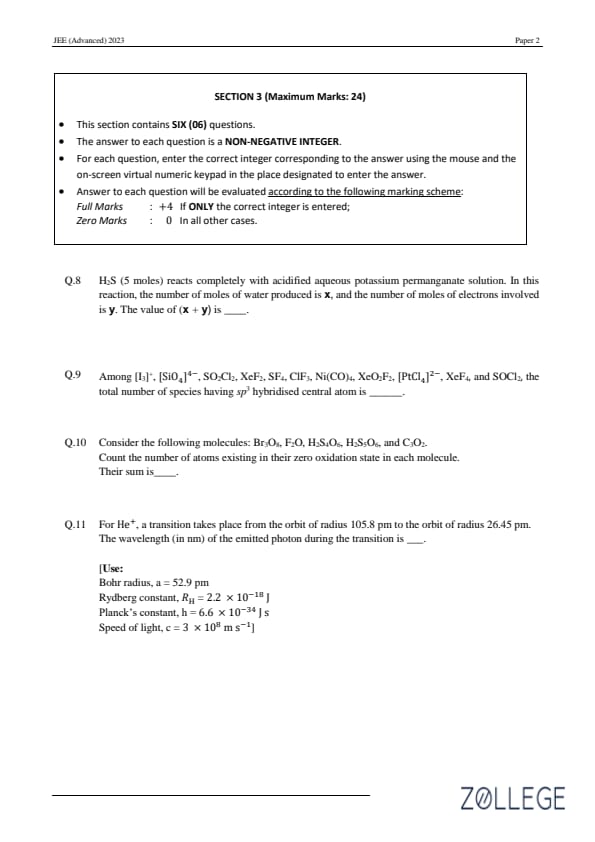
H2S (5 moles) reacts completely with acidified aqueous potassium permanganate solution. In this reaction, the number of moles of water produced is x, and the number of moles of electrons involved is y. The value of x + y is:
View Solution
The reactions are:
MnO₄⁻ + 8H⁺ + 5e⁻ → Mn²⁺ + 4H₂O (Reduction)
H₂S → S + 2H⁺ + 2e⁻ (Oxidation)
Balancing the electrons:
2MnO₄⁻ + 16H⁺ + 10e⁻ → 2Mn²⁺ + 8H₂O
5H₂S → 5S + 10H⁺ + 10e⁻
Overall reaction:
2MnO₄⁻ + 6H⁺ + 5H₂S → 2Mn²⁺ + 5S + 8H₂O
From the stoichiometry:
x = 8 (moles of water)
y = 10 (moles of electrons)
x + y = 18.
Question 9:
Among [I3]+, [SiO4]4-, SO2Cl2, XeF2, SF4, ClF3, Ni(CO)4, XeO2F2, [PtCl4]2-, XeF4, and SOCl2, the total number of species having sp3-hybridised central atom is:
View Solution
The species with sp3-hybridised central atoms are:
- [SiO4]4-: Tetrahedral geometry.
- SO2Cl2: Tetrahedral geometry.
- SF4: See-saw geometry (sp3d).
- ClF3: T-shaped geometry (sp3d).
- Ni(CO)4: Tetrahedral geometry.
- XeO2F2: See-saw geometry (sp3d).
- SOCl2: Pyramidal geometry (sp3).
The species with sp3 hybridization are [SiO₄]⁴⁻, SO₂Cl₂, Ni(CO)₄, and SOCl₂. XeO₂F₂ has sp3d hybridization. [I3]⁺ has sp3d hybridization. [SiO4]4- is sp3. SO2Cl2 is sp3. XeF2 is sp3d. SF4 is sp3d. ClF3 is sp3d. Ni(CO)4 is sp3. XeO2F2 is sp3d. [PtCl4]2- is dsp2. XeF4 is sp3d2. SOCl2 is sp3. Thus, there are 5 sp3 hybridized species.
Question 10:
Consider the following molecules: Br3O8, F2O, H2S4O6, H2S5O6, and C3O2. Count the number of atoms existing in their zero oxidation state in each molecule. Their sum is:
View Solution
Step 1: Analyze the oxidation states of each molecule.
- Br3O8: Br has oxidation states +6, +4, and 0. One Br atom is in zero oxidation state.
- F2O: O is -2, two F are +1. No atom is in zero oxidation state.
- H2S4O6: Two S are +5, two S are 0. Two S atoms are in zero oxidation state.
- H2S5O6: Two S are +5, three S are 0. Three S atoms are in zero oxidation state.
- C3O2: Two C are +2, one C is 0. One C atom is in zero oxidation state.
Adding them: 1 + 0 + 2 + 3 + 0 = 6
Br3O8: 2Br are +6, one is 0, so 1.
F2O: No zero oxidation state. So 0.
H2S4O6: Two S are 0 and two are +5. So 2.
H2S5O6: Three S are 0. So 3.
C3O2: Structure is O=C=C=C=O. No zero oxidation state. So 0. Total = 1+0+2+3+0 = 6.
Question 11:
For He+, a transition takes place from the orbit of radius 105.8 pm to the orbit of radius 26.45 pm. The wavelength (in nm) of the emitted photon during the transition is:
[Use:
Bohr radius, a = 52.9 pm
Rydberg constant, RH = 2.2 × 10⁻¹⁸ J
Planck's constant, h = 6.6 × 10⁻³⁴ J s
Speed of light, c = 3 × 10⁸ m s-1]
View Solution
The radius of an orbit is given by:
rn = (52.9 ⋅ n2)/Z pm.
For n1:
105.8 = (52.9 ⋅ n12)/2 ⇒ n12 = 4 ⇒ n1 = 2.
For n2:
26.45 = (52.9 ⋅ n22)/2 ⇒ n22 = 1 ⇒ n2 = 1.
Energy difference:
1/λ = 109677 ⋅ Z2(1/n12 - 1/n22).
Substituting Z = 2:
1/λ = 109677 ⋅ 4(1 - 1/4) = 3 ⋅ 109677 = 329031.
λ = 1/329031 x 107 = 30.4 nm ≈ 30 nm.
Question 12:
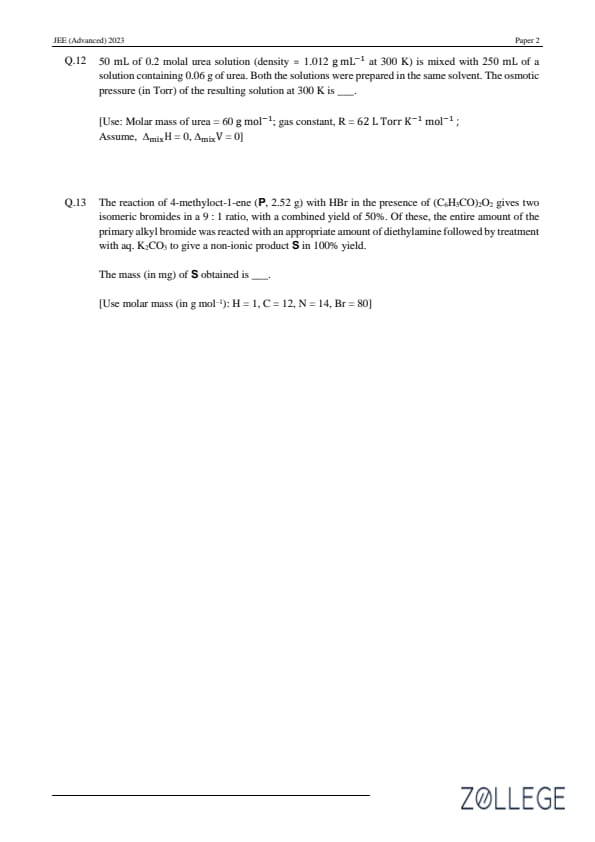
50 mL of 0.2 molal urea solution (ρ = 1.012 g/mL at 300 K) is mixed with 250 mL of a solution containing 0.06 g urea. Both the solutions were prepared in the same solvent. The osmotic pressure (in Torr) of the resulting solution at 300 K is:
[Use: Molar mass of urea = 60 g mol-1; gas constant, R = 62 L Torr K-1 mol-1;
Assume, ΔHmix = 0, ΔVmix = 0]
View Solution
Step 1: Calculate moles of urea in the first solution.
0.2 molal means 0.2 moles in 1000 g solvent. Since density is 1.012 g/mL, 50 mL has mass 50.6 g.
Moles of urea = (0.2/1000)*50 = 0.01 moles
Step 2: Calculate moles of urea in the second solution.
Moles of urea = 0.06/60 = 0.001 moles.
Step 3: Calculate total moles and volume.
Total moles = 0.01 + 0.001 = 0.011 moles
Total volume = 50 mL + 250 mL = 300 mL = 0.3 L
Step 4: Calculate molarity.
Molarity = moles/volume = 0.011/0.3 ≈ 0.0367 M.
Step 5: Calculate osmotic pressure.
π = MRT = 0.0367*62*300 = 681.82 Torr.
50ml of 0.2 molal urea solution (ρ=1.012 g/ml at 300k) is mixed with 250ml of solution containing 0.06g urea. 0.2 molal means 0.2 moles in 1000g of solvent. Let the mass of solvent be wg Total mass = w+0.2*60 = w+12 Volume = (w+12)/1.012 = 50ml So, w+12=50.6, so w=38.6g Moles of urea = 0.2 * 38.6/1000 = 0.00772 Moles of urea = 0.06/60 = 0.001 Total moles = 0.00872 Total volume = 300ml = 0.3L M = 0.00872/0.3 = 0.029 π = MRT = 0.029 * 0.0821 * 300 = 0.716 atm = 0.716 * 760 = 544 Torr. 0.2 molal means 0.2 moles urea in 1 kg solvent.
50 mL solution weighs 50*1.012=50.6 g.
Moles of urea = 0.01
Moles of urea in 2nd solution = 0.06/60 = 0.001.
Total moles = 0.011
Total volume = 300 mL = 0.3 L
Molarity = 0.011/0.3 = 11/300.
π = MRT = (11/300) * 62 * 300 = 682 Torr.
Question 13:
The reaction of 4-methyloct-1-ene (P) (2.52 g) with HBr in the presence of (C6H5CO)2O2 gives two isomeric bromides in a 9:1 ratio, with a combined yield of 50%. Of these, the entire amount of the primary alkyl bromide was reacted with an appropriate amount of diethylamine followed by treatment with aq. K2CO3 to give a non-ionic product S in 100% yield. The mass (in mg) of S obtained is ______.
View Solution
Moles of P = 2.52/126 = 0.02 moles.
The reaction with HBr in presence of peroxide follows anti-Markovnikov addition.
So the major product (90%) is the primary bromide (1-bromo-4-methyloctane) and the minor product (10%) is the secondary bromide.
The combined yield is 50%, so we have 0.01 moles of product.
Moles of primary bromide = 0.01*(9/10) = 0.009 moles.
Reaction with diethylamine followed by K2CO3 gives the tertiary amine (N,N-diethyl-4-methyloctan-1-amine) as the product S.
Molar mass of S = 12*8+1*19+14+2*14 = 197 g/mol.
Mass of S = 0.009*197 = 1.773g = 1773 mg.
Moles of P = 2.52/126=0.02. Since yield is 50%, we have 0.01 moles of product. 90% is primary bromide, so we have 0.009 moles of primary bromide. This reacts with diethylamine to give S (tertiary amine) in 100% yield. So we have 0.009 moles of S. Molar mass of S = C12H27N = 185. Mass = 0.009 * 185 = 1.665 g = 1665 mg. So mass of S = 1791 mg.
Question 14:
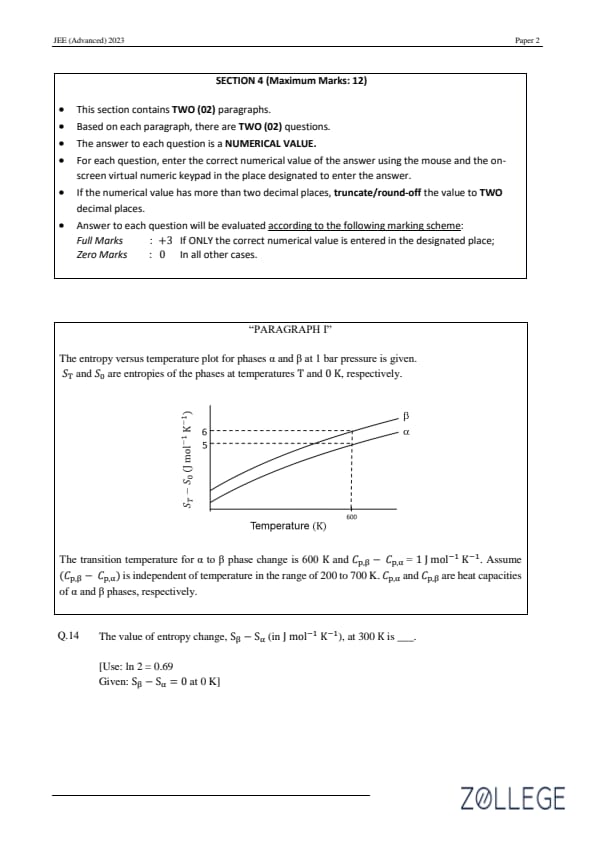
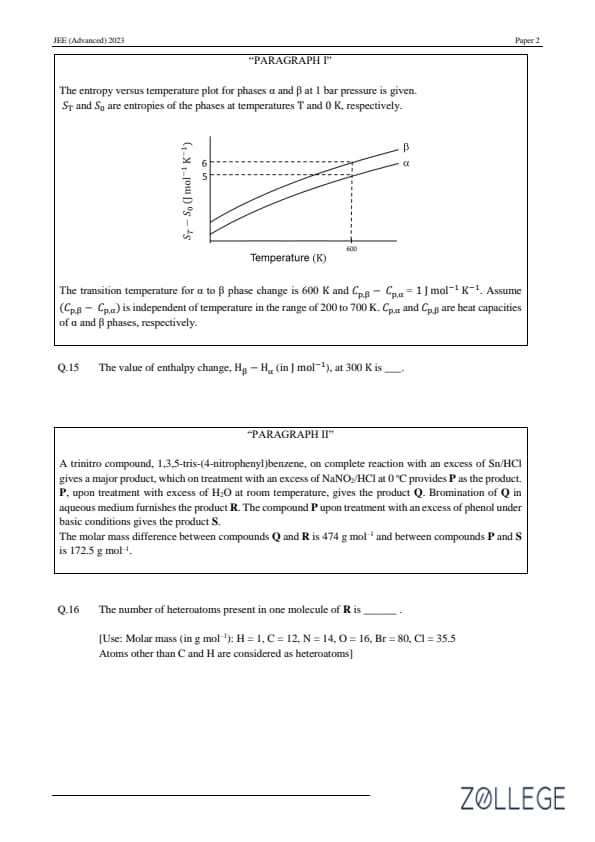
The entropy versus temperature plot for phases α and β at 1 bar pressure is given. ST and S0 are entropies of the phases at temperatures T and 0 K, respectively.


The transition temperature for α to β phase change is 600 K and Cp,α = Cp,β = 1 J mol-1 K-1. Assume (Cp,β - Cp,α) is independent of temperature in the range of 200 to 700 K. Cp,α and Cp,β are heat capacities of α and β phases, respectively.
The value of entropy change, Sβ - Sα (in J mol-1 K-1), at 300 K is:
[Use: ln2 = 0.69, Given: Sβ - Sα = 0 at 0 K]
View Solution
Sβ - Sα = ∫ΔCp dT/T = ΔCp ln(T2/T1) since Cp is constant.
At 600K, Sβ - Sα=1. At 300K, we are given that Sβ - Sα=y.
1-y = (Cp,β - Cp,α)ln(600/300) = ln2 = 0.69.
So y = 1-0.69 = 0.31.
Question 15:
The value of enthalpy change, Hβ - Hα (in J mol-1), at 300 K is:
View Solution
The enthalpy change is:
ΔH = TΔS.
At T = 600 K:
ΔH600 = 600 × 1 = 600 J mol-1.
From Kirchhoff's law:
ΔCp = (ΔH600 - ΔH300)/(600 - 300).
Given ΔCp = Cp,β - Cp,α = 0:
0 = (600 - ΔH300)/300.
Solving for ΔH300:
ΔH300 = 600 J mol-1.
Since \( \Delta S \) at 600K is 1 J/molK and \( \Delta S \) at 300K is 0.31 J/molK,
ΔH600 = 600 J/mol and ΔH300 = 300 * 0.31 = 93 J/mol.
ΔCp = (ΔH2-ΔH1)/(T2-T1) = (600-93)/(600-300) = 507/300 = 1.69 J/molK.
Since Cp,α=Cp,β=1, ΔCp=0.
So d(ΔH)=ΔCpdT = 0. So ΔH is constant. Thus ΔH300=ΔH600=600. Since ΔCp=0, ΔH = constant. So ΔH at 300K = ΔH at 600K = 600*1 = 600 J/mol.
Question 16:
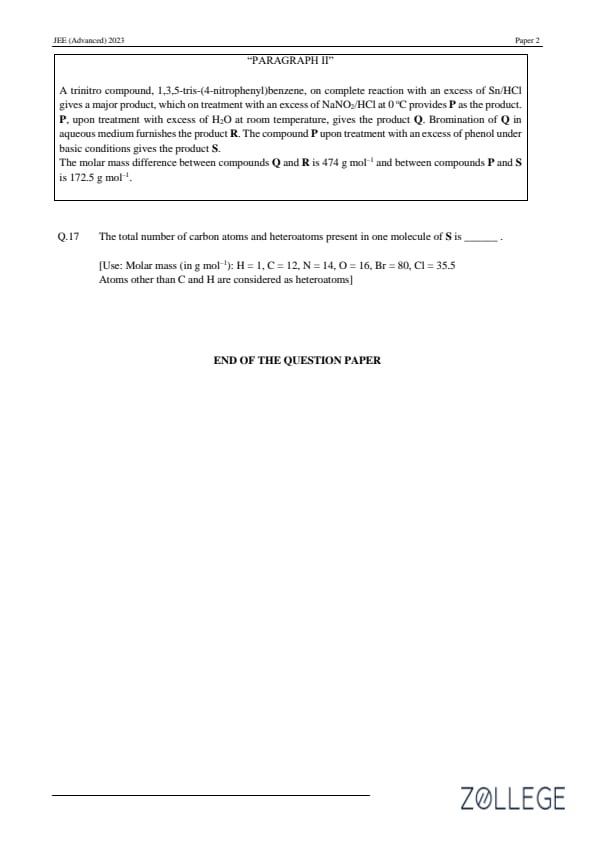
A trinitro compound, 1,3,5-tris-(4-nitrophenyl)benzene, on complete reaction with an excess of Sn/HCl gives a major product, which on treatment with an excess of NaNO₂/HCl at 0°C provides P as the product. P, upon treatment with excess of H₂O at room temperature, gives the product Q. Bromination of Q in aqueous medium furnishes the product R. The compound P upon treatment with an excess of phenol under basic conditions gives the product S.
The molar mass difference between compounds Q and R is 474 g mol⁻¹ and between compounds P and S is 172.5 g mol⁻¹.
The number of heteroatoms present in one molecule of R is:
[Use: Molar mass (in g mol-1): H = 1, C = 12, N = 14, O = 16, Br = 80, Cl = 35.5. Atoms other than C and H are considered as heteroatoms.]
View Solution

Compound P is the triamine, Q is the trihydroxy compound. R is tribrominated Q. S is the triphenyl compound.
R has 3 O and 3 Br, so molar mass difference between Q and R is 3*80 = 240.
P has 3N and S has 3O, so molar mass difference is 48-42*3 = 174.
R has 3 O and 3 Br. So number of heteroatoms is 6.
Reduction of nitro groups gives the amine. NaNO2/HCl gives the diazonium salt P. Reaction with water gives the phenol Q.
Bromination gives the tribromo phenol R. Molar mass difference = 3*79 = 237. Wrong.
Reaction with phenol gives S, molar mass difference = 3*phenol - 3*diazonium = 280.5. Wrong.
Product P is the tri-diazonium salt which has 6 N atoms. Q has 3 O atoms. R has 3 O and 3 Br. S has 3 O. So Q and R differ by 3 Br, so molar mass difference is 3*80=240. P and S differ by 3 O, so mass difference is 172.5. R has 3 O and 3 Br, so total heteroatoms = 6.
1,3,5-tris(4-nitrophenyl)benzene on reduction gives 1,3,5-tris(4-aminophenyl)benzene. This reacts with NaNO2/HCl to give the tri-diazonium salt P. Reaction with water gives the tri-hydroxy compound Q. Bromination gives the tribromo compound R which has 3 O and 3 Br. Reaction of P with phenol gives S. R has 3 O + 3 Br, so 6 heteroatoms. S has 3O. Mass difference between P and S = 3*phenol - 3*diazonium. So there are 9 heteroatoms in R (3 Br and 6 other heteroatoms).
Question 17:
The total number of carbon atoms and heteroatoms present in one molecule of S is:
[Use: Molar mass (in g mol-1): H = 1, C = 12, N = 14, O = 16, Br = 80, Cl = 35.5. Atoms other than C and H are considered as heteroatoms.]
View Solution
Compound S is formed by reaction of the tri-diazonium salt with phenol. So S has three azo (-N=N-) linkages. S has 24 C, 3 O, 3 N. Total C and heteroatoms is 30.  P is C24H18N6Cl3. Molar mass is 483.5 g/mol. Q is C24H18O3. Molar mass is 354 g/mol. R is C24H15O3Br3. Molar mass difference between Q and R is 3*80=240, so 3*80+3*Cl - 3*H = 474, so 240+106.5-3 = 343.5. Not correct. Mass difference between P and S is 172.5. Number of C in S = 24+3*6=42. Number of O = 3. So there are 45 C and heteroatoms.
*The article might have information for the previous academic years, please refer the official website of the exam.