
JEE Advanced 2025 Paper Analysis OUT: Section-wise Analysis, Difficulty Level, Question Paper Download Link

.png?tr=h-55,w-55,c-force)
Content Writer | Updated On - May 18, 2025
JEE Advanced 2025 Paper 1 and Paper 2 analysis is available here after every shift. This year, JEE Advanced 2025 exam was conducted on May 18, 2025 from 9 AM to 12 noon for Paper 1 and 2.30 PM to 5.30 PM for Paper 2. Check the detailed analysis below.
As per the initial reaction of test takers, the difficulty level of Paper 1 was moderate. It was easier compared to last year’s paper. JEE Advanced 2025 Paper 2 was moderate to difficult overall. Paper 2 was tougher and lengthier than Paper 1.
The total number of questions was reduced to 48. Each section has 16 questions.
JEE Advanced 2025 Paper Analysis
A detailed analysis including the marking scheme, negative marking, topics with the highest weightage, and subject-wise difficulty level is given here.
| Exam Shift | Overall Difficulty | Subject-wise Difficulty |
|---|---|---|
| Paper 1 | Moderate | Physics: Moderate |
| Paper 2 | To be Updated | Physics: Difficult Chemistry: Easy to Moderate Mathematics: Moderate |
JEE Advanced 2025 Question Paper
| Exam Shift | Question Paper with Solutions PDF |
|---|---|
| JEE Advanced 2025 Paper 1 Question Paper | |
| JEE Advanced 2025 Paper 2 Question Paper | Download |
Here is a breakdown of the past five years’ JEE Advance paper analysis:
- JEE Advanced 2024 overall difficulty is considered to be moderate for Paper 1. Paper 2 was more difficult than Paper 1.
- JEE Advanced 2023 overall difficulty level was moderate to hard as per test takers.
- JEE Advanced 2022 was considered moderate to difficult as per test takers.
- JEE Advanced 2021 was moderate to difficult as per test takers
- JEE Advanced 2020 Paper 2 was considered difficult by test takers.
Read the article to find previous year's JEE Main Paper Analysis from 2024 to 2017 so that you can formulate an idea of the paper pattern of JEE Advanced.
Table of Content
- JEE Advanced 2024 Paper Analysis
- JEE Advanced 2024 Paper 1 Analysis
- JEE Advanced 2024 Paper 1 Marking Scheme
- JEE Advanced 2024 Paper 2 Analysis
- JEE Advanced 2024 Question Paper PDF
- JEE Advanced 2023 Paper Analysis
- JEE Advanced 2022 Paper Analysis
- JEE Advanced 2021 Paper Analysis
- JEE Advanced 2020 Paper Analysis
JEE Advanced 2024 Paper Analysis
JEE Advanced 2024 paper analysis for Shift 1 and Shift 2 will be updated here with details once the exam is successfully conducted.
| Exam Shift | Overall Difficulty | Subject-wise Difficulty | Paper Analysis |
|---|---|---|---|
| Paper 1 | Moderate to Difficult(Initial Reaction) | Physics: Tough | No. of Questions in Mathematics: 17 (Paper 1) No. of Questions in Physics: 17 (Paper 1) No. of Questions in Chemistry: 17 (Paper 1) |
| Paper 2 | To be Updated | Physics: To Be Updated Chemistry: To Be Updated Mathematics: To Be Updated |
JEE Advanced 2024 Paper 1 Analysis
As per the initial reaction of the test takers, we have curated JEE Advanced 2024 Paper 1 analysis for you in the points below:
JEE Advanced Paper 1 Chemistry Analysis
- Most weightage was given to Organic Chemistry
- In Organic Chemistry, questions were asked from the topics of Amines, Biomolecules, polymers, Oxygen Containing Compounds.
- Most questions in Organic Chemistry were from Amines, Plymers, Biomolecules.
- In Physical Chemistry, most questions came from the chapters of Chemical Equilibrium, Atomic Structure and Thermodynamics, Chemical Kinetics.
- Inorganic Chemistry had questions directly from the NCERT syllabus.
JEE Advanced Paper 1 Physics Analysis
- Weightage was given to the chapters of Kinematics, Modern Physics, Capacitors, Kinetic Theory of Gasesm Current Electricity, Optics, Electrostatics, Electromagnetic Induction.
JEE Advanced Paper 1 Mathematics Analysis
- Mathematics saw questions from Limits, Functions, Statistics and Probability, Definite Integrals, Matrices.
- Students reported some questions to be lengthy.
- Good questions were asked from Permutation and Combination, 3D Geometry, and Circles.
JEE Advanced Paper 1 Marking Scheme
Refer to the table below for JEE Advanced Paper 1 Marking Scheme:
| JEE Advanced Paper 1 | Marking Scheme |
|---|---|
| Total Marks of JEE Advanced Paper 1 | 180 |
| Total Questions | 51 |
| Section-Wise Questions | 17 Questions in Each Section (Physics, Chemistry, and Mathematics) |
| Total Marks of each section | 60 Marks in each section |
| Physics, Chemistry, and Mathematics Marking Scheme | Each Section (Physics, Chemistry, Mathematics) was divided into 4 parts
|
| Section 1 Marking Scheme | Section 1 of Each Part (Mathematics, Physics, Chemistry) had 12 marks maximum
|
| Section II Marking Scheme | Section II of each part (Mathematics, Physics, Chemistry) had 12 marks maximum.
|
| Sec-III Marking Scheme | Section III of each part (Mathematics, Physics, and Chemistry) had 24 marks.
|
| Sec IV Marking Scheme | Section IV of each part (Mathematics, Physics, and Chemistry) had 12 marks.
|
JEE Advanced 2024 Paper 2 Analysis
JEE Advanced Paper 2 is successfully conducted from 2:30 pm to 5:30 pm on May 26, 2024. Refer to the table below for JEE Advanced 2024 Paper 2 review:
| JEE Advanced 2024 Paper 2 | Details |
|---|---|
| Total Marks of JEE Advanced 2024 Paper 1 | 180 |
| Total Questions | 51 |
| Section-Wise Questions | 17 Questions in Each Section (Physics, Chemistry, and Mathematics) |
| Total Marks of each section | 60 Marks in each section |
| Difficulty Level | Mathematics Section was Tough Chemistry Section was Moderate Physics section was Moderate to tough |
JEE Advanced 2024 Question Paper PDF (Link Available)
Find JEE Advanced 2024 Question paper PDF download link below. Find JEE Advanced 2024 question paper pdf link in English and Hindi:
| JEE Advanced 2024 PDF Download | Link |
|---|---|
| JEE Advanced 2024 Paper PDF Download in English and Hindi |
JEE Advanced 2023 Paper Analysis
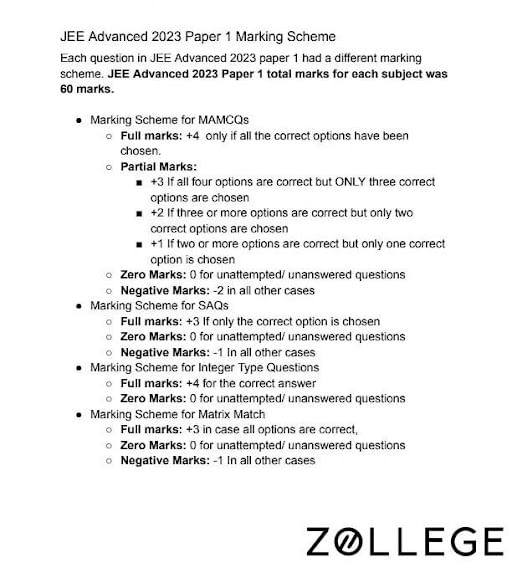
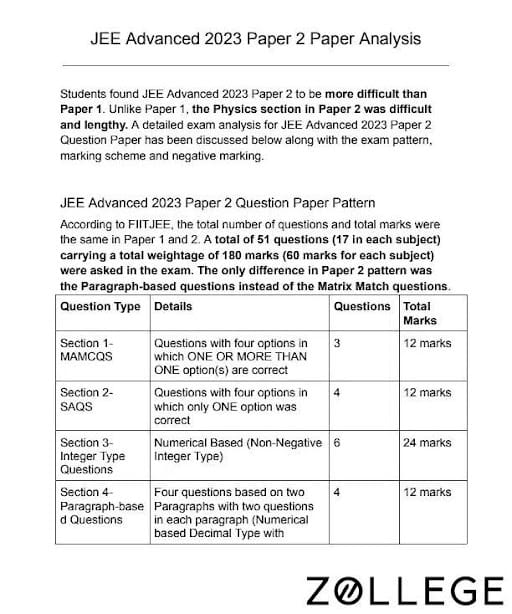
Given below is the paper analysis of JEE Advanced Paper 1 & 2 conducted on 4 June 2023.
| Exam Shift | Overall Difficulty | Subject-wise Difficulty | Paper Analysis |
|---|---|---|---|
| Paper 1 | Moderate to Difficult | Physics: Moderate | Click Here for a Detailed Analysis (Out) |
| Paper 2 | Difficult as compared to Paper 1 | Physics: Difficult and Lengthy Chemistry: Moderate Mathematics: Difficult |
JEE Advanced 2022 Paper Analysis
JEE Advanced 2022 was conducted on August 28, 2022. Refer to the table below for JEE Advanced 2022 Paper Analysis:
| Exam Shift | Overall Difficulty | Subject-wise Difficulty |
|---|---|---|
| Paper 1 | Moderate to Difficult | Physics: Moderate Most questions in Mathematics were from 3D Geometry, Matrices, Probability, Vector, Ellipses, and Complex Numbers |
| Paper 2 | Moderate | Physics: Difficult and Lengthy Chemistry: Easy Most questions in Chemistry were from Mole Concepts, Electrochemistry, Thermodynamics, Surface Chemistry, and Organic Chemistry Mathematics: Difficult and Lengthy |
JEE Advanced 2021 Paper Analysis
Given below is the paper analysis of JEE Advanced Paper 1 and Paper 2 conducted on 3 October 2021.
JEE Advanced 2021 Paper 1 Analysis
According to student’s reactions, In the Chemistry section, questions were equally distributed from class 11th & 12th. While in the Physics section, more questions were asked from class 11th. The Mathematics section was the toughest, more weightage was given to the class 11th syllabus. JEE Advanced Paper 1 was moderate in terms of difficulty level.
The table below represents the detailed difficulty level:-
| Section | Diffculty Level |
|---|---|
| Mathematics | Moderate |
| Physics | Difficult to Moderate |
| Chemistry | Easy to Moderate |
Paper 1: High Weightage Chapters
| Section | High Weightage Chapters |
|---|---|
| Physics | Gravitation, Rotation, Waves, Mechanics |
| Chemistry | Atomic Structure, Organic Chemistry, Chemical Bonding, S,p,d, and f- block elements (5 questions) |
| Mathematics | Integration, Calculus, Geometry, Trigonometry |
Important Links
JEE Advanced 2021 Paper 2 Analysis
JEE Advanced Paper 2 was conducted from 2:30 to 5:30 PM. The overall exam was moderate to tough in terms of difficulty level. In Chemistry section, more weightage were given to class 12th syllabus.
The table below represents the detailed difficulty level of paper 2:-
| Section | Difficulty Level |
|---|---|
| Mathematics | Moderately Tough |
| Physics | Moderate |
| Chemistry | Easy to Moderate |
Paper 2: High Weightage Chapters
| Section | High Weightage Chapters |
|---|---|
| Physics | Electromagnetic Induction, Fluids, Ray Optics, Current Electricity, Rotational Motion, Heat and Thermodynamics |
| Chemistry | Liquid Solutions, Organic chemistry, AAldehydes, p-block elements, and Atomic structure, Mole Concept and Electrochemistry |
| Mathematics | Calculus and Geometry |
JEE Advanced 2020 Paper Analysis
Given below is the paper analysis of JEE Advanced Paper 1 and Paper 2 conducted on 27th September 2020.
JEE Advanced 2020 Paper 1 Analysis
- Shift Timings – 9.00 AM to 12.00 PM.
- Overall Difficulty – Moderate to Difficult
- Majority of candidates reported that Physics was the toughest section. Topics, where students faced difficulty, were – thermodynamics, magnetism and rotation.
- Many students said the Chemistry section was easiest. Questions were based on NCERT pattern.
- Few questions of Inorganic chemistry were tougher than expected.
- Mathematics was moderate. However, questions were time-consuming and required good understanding of concepts.
- Topics like Algebra and Calculus were asked in Maths which students found difficult.
JEE Advanced 2020 Paper 2 Analysis
- Shift Timings – 2:30 PM to 5:30 PM
- Overall Difficulty – Difficult
- Maths and Physics was pretty hard compared to Paper 1. Questions were asked from similar topics only.
- Chemistry was easy in Paper 2. Questions were both numerical and fact-based. All 3 subjects had section 3 with numerical based questions only.
- Students reported that Paper 2 was much more difficult than Paper 1 as Section 1 was completely numerical based (without any options) with a single digit integer answer in all the subjects. In addition to this, a wrong answer here had negative marking too.
JEE Advanced 2019 Paper Analysis
As the JEE Advanced was conducted in online mode (Computer-based test), it was not possible to get an accurate idea of IIT Roorkee’s JEE Advanced Paper Analysis. Although, the candidates had a similar opinion and the same is given below-
- Mathematics was long and difficult for both papers. It was toughest among all of the sections.
- Chemistry was easy compared to others.
- Physics was average but had a few tricky questions.
- Paper 1 was relatively harder than Paper 2
| Subject | Paper 1 Analysis | Paper 2 Analysis |
|---|---|---|
| Physics | The questions asked in the paper were moderately tough. Most of the questions asked were from Chapter 11 and 12. | Difficult |
| Chemistry | Moderate difficulty level. Most of the questions asked were from Inorganic Chemistry. | Moderate |
| Mathematics | The paper was Difficult. Most of the questions asked were from Algebra and Geometry. | Moderately Difficult |
JEE Advanced Paper Analysis 2019: Paper 1 Quick Analysis
- The paper was relatively difficult in comparison to the previous year’s paper.
- Most of the questions asked in Paper 1 were moderate in nature.
- Overall, the Physics portion was comparatively easier than Chemistry and Mathematics.
- Mathematics part was relatively difficult in the examination.
- The level of difficulty in Paper 1 was marked moderate with maximum weightage given to class 12 syllabus.
- The questions asked from Chemistry were not theoretical and were based on calculations and needed rigorous calculations.
| Subject | Easy | Moderate | Difficult | Total |
|---|---|---|---|---|
| Physics | 7 | 9 | 2 | 18 |
| Chemistry | 3 | 8 | 7 | 18 |
| Mathematics | 6 | 4 | 8 | 18 |
| Total | 16 | 21 | 17 | 54 |
JEE Advanced Paper Analysis 2019: Paper 2 Quick Analysis
- The difficulty level of the JEE Advanced Paper- 2 was moderate.
- The questions asked from Physics and Chemistry were relatively easy as compared to Mathematics.
- Mathematics part was tough and lengthy. Most of the questions were asked from Matrices and Differential Equations which made the paper lengthy.
- Physics section was easy to moderate in nature.
- The number of questions asked in Chemistry were from Organic and Inorganic Chemistry. Very few questions were asked from Physical Chemistry.
| Subject | Easy | Moderate | Difficult | Total |
|---|---|---|---|---|
| Physics | 6 | 8 | 4 | 18 |
| Chemistry | 0 | 9 | 9 | 18 |
| Mathematics | 4 | 7 | 7 | 18 |
| Total | 10 | 24 | 20 | 54 |
JEE Advanced 2019 Paper Analysis- Detailed
- JEE Advanced 2019 was conducted by IIT Roorkee on May 27, 2019, and was taken by approximately 1.70 lakh candidates.
- The maximum marks that could be scored by the candidates were 372 marks.
- Students were awarded 4 marks for a correct answer and a mark was deducted for every incorrect answer.
JEE Advanced 2019 Subject-wise Paper Analysis
This section caters to the subject wise analysis of JEE Advanced 2019 Paper.
Chemistry
The Chemistry section was the easiest in both papers 1 and 2. The aim of the paper was to test the concepts of the candidates where the concentration of the question was higher from organic and inorganic chemistry. The least number of questions were asked from the physical chemistry.
Unit-wise Marks Distribution
| Units | No of Questions | Weightage of Marks |
|---|---|---|
| Inorganic Chemistry-I | 4 | 11.29% |
| Chemical Bonding | 1 | 2.42% |
| p-block | 3 | 8.87% |
| Inorganic Chemistry-II | 6 | 16.94% |
| Coordination Compounds | 1 | 2.42% |
| d-block & f-block Elements | 2 | 6.45% |
| Qualitative Analysis | 1 | 2.42% |
| Metallurgy | 2 | 5.65% |
| Organic Chemistry-I | 1 | 2.42% |
| General Organic Chemistry- II | 1 | 2.42% |
| Organic Chemistry-II | 11 | 31.45% |
| Aromatic Compounds | 2 | 5.65% |
| Carbonyl compounds | 3 | 8.06% |
| Organic Reaction Mechanism 4 | 1 | 3.23% |
| Stereoisomerism | 1 | 2.42% |
| Biomolecules | 1 | 3.23% |
| Grignard Reagent, Reduction, Oxidation & Hydrolysis | 2 | 5.65% |
| Polymers | 1 | 3.23% |
| Physical Chemistry-I | 10 | 28.23% |
| Atomic Structure & Nuclear Chemistry | 4 | 11.29% |
| Chemical Bonding | 1 | 3.23% |
| Chemical Equilibrium | 1 | 2.42% |
| Mole Concept | 2 | 4.84% |
| Thermodynamics and Thermochemistry | 1 | 3.23% |
| Gaseous State | 1 | 3.23% |
| Physical Chemistry-II | 4 | 9.68% |
| Chemical Kinetics | 2 | 4.84% |
| Solution & Colligative Properties | 1 | 2.42% |
| Surface Chemistry | 1 | 2.42% |
Physics
The Physics section was moderately difficult but very lengthy. The questions were concept and application-based. The questions had a higher concentration of questions from Thermodynamics, Optics and Thermodynamics and Electrostatics.
Unit-wise Marks Distribution
| Topics | No. of Questions | Weightage of Marks |
|---|---|---|
| Electrodynamics | 8 | 23.39% |
| Capacitance | 2 | 5.65% |
| Electromagnetic Induction | 2 | 5.65% |
| Electrostatics | 3 | 8.87% |
| Current Electricity | 1 | 3.23% |
| Heat and Thermodynamics | 6 | 16.13% |
| KTG and Thermodynamics | 5 | 13.71% |
| Calorimetry & Thermal Expansion | 1 | 2.42% |
| Mechanics | 9 | 25.00% |
| Centre of Mass | 1 | 3.23% |
| Error in Measurement | 1 | 2.42% |
| Gravitation | 1 | 2.42% |
| Right Body Dynamics | 1 | 3.23% |
| Surface Tension | 1 | 3.23% |
| Work, Power and Energy | 1 | 2.42% |
| Electricity & Viscosity | 1 | 2.42% |
| Projectile Motion | 1 | 2.42% |
| Unit & Dimension | 1 | 3.23% |
| Modern Physics | 4 | 10.48% |
| Modern Physics | 2 | 5.65% |
| Nuclear Physics | 2 | 4.84% |
| Optics | 5 | 14.52% |
| Geometrical Optics & Physical Optics | 4 | 11.29% |
| Wave Optics | 1 | 3.23% |
| SHM & Waves | 4 | 10.48% |
| Sound Waves | 1 | 2.42% |
| String Wave | 2 | 4.84% |
| SHM | 1 | 3.23% |
Mathematics
The Mathematics section ranged from moderate to difficult level. The paper was quite lengthy as the section consisted of Algebra, Coordinate Geometry, Integral Calculus. Just a few questions were based on Probability, Quadratic Equations and Sequence & Series.
Unit-wise Marks Distribution
| Units | No. of Questions | Weightage of Marks |
|---|---|---|
| Algebra | 1 | 2.42% |
| Complex Numbers | 2 | 4.84% |
| Coordinate Geometry | 5 | 12.90% |
| Circle | 4 | 9.68% |
| Ellipse | 1 | 3.23% |
| Differential Calculus | 5 | 14.52% |
| Functions | 2 | 4.84% |
| Application of Derivatives | 2 | 6.45% |
| Continuity and Derivability | 1 | 3.23% |
| Integral Calculus | 6 | 16.94% |
| Definite Integration | 5 | 13.71% |
| Different Equation | 1 | 3.23% |
| Matrices and Determinants | 4 | 12.10% |
| Permutations and Combinations | 2 | 4.84% |
| Probability | 2 | 5.65% |
| Quadratic Equation | 1 | 3.23% |
| Sequence and Series | 1 | 2.42% |
| Trigonometry | 3 | 8.87% |
| Solution of Triangle | 1 | 3.23% |
| Inverse Trigonometric Function | 1 | 2.42% |
| Trigonometric ratio and Identities | 1 | 3.23% |
| Vector and 3D | 4 | 11.29% |
JEE Advanced 2018 Paper Analysis
JEE Advanced 2018 was conducted in IIT Kanpur on May 20, 2018. The maximum marks that could be scored by the candidates were 360 marks. Students were awarded 4 marks for a correct answer and a mark was deducted for every incorrect answer. The questions in the Chemistry section were more difficult in comparison to the other two sections.
Class-wise Marks Distribution
The concentration of questions were more from class 12 than class 11. Let us see the marks distribution in the following table.
| Subject | Class 11 | Class 12 | Total number of questions | |||
|---|---|---|---|---|---|---|
| No. of Questions | Marks | No. of Questions | Marks | No. of Questions | Marks | |
| Chemistry | 7 | 23 | 29 | 97 | 36 | 120 |
| Mathematics | 15 | 49 | 21 | 71 | 36 | 120 |
| Physics | 22 | 73 | 14 | 47 | 36 | 120 |
| Total | 44 | 145 | 64 | 215 | 108 | 360 |
JEE Advanced 2018 Paper Analysis – Level of Difficulty
Most of the questions in the JEE Advanced paper 2018 were moderately difficult. Lets see the distribution of the questions and marks in the question paper according to the levels of difficulty.
| Subject | Easy | Moderate | Tough | |||
|---|---|---|---|---|---|---|
| No. of Questions | Marks | No. of Questions | Marks | No. of Questions | Marks | |
| Chemistry | 5 | 16 | 13 | 44 | 18 | 60 |
| Mathematics | 13 | 40 | 11 | 36 | 12 | 44 |
| Physics | 13 | 44 | 13 | 43 | 10 | 33 |
| Total | 31 | 100 | 37 | 123 | 40 | 137 |
JEE Advance 2018 Subject-wise Paper Analysis
This section caters to the subject-wise paper analysis.
Chemistry
The Chemistry section was difficult in both papers 1 and 2. The concentration of the question was higher from organic and physical chemistry. The least number of questions were asked from organic chemistry. Furthermore, various questions were asked out of NCERT books too.
Unit-wise Marks Distribution
| Units | No of Questions | Weightage of Marks |
|---|---|---|
| Inorganic Chemistry-I | 3 | 9.17% |
| Chemical Bonding | 1 | 2.50% |
| p-block | 2 | 6.67% |
| Inorganic Chemistry-II | 7 | 20.00% |
| Coordination Compounds | 5 | 14.17% |
| Qualitative Analysis | 1 | 3.33% |
| Metallurgy | 1 | 2.50% |
| Organic Chemistry-II | 12 | 33.33% |
| Aromatic Compounds | 3 | 9.17% |
| Carbonyl compounds | 1 | 2.50% |
| Organic Reaction Mechanism 4 | 2 | 5.00% |
| Stereoisomerism | 1 | 2.50% |
| Organic Reaction Mechanism 3 | 1 | 3.33% |
| Biomolecules | 1 | 3.33% |
| Carboxylic Acid and their Derivatives | 3 | 7.50% |
| Physical Chemistry-I | 7 | 19.17% |
| Gaseous State | 1 | 2.50% |
| Ionic Equilibrium | 2 | 5.00% |
| Thermodynamics | 3 | 9.17% |
| Equivalent Concept | 1 | 2.50% |
| Physical Chemistry-II | 7 | 18.33% |
| Chemical Kinetics | 2 | 5.83% |
| Electrochemistry | 2 | 5.00% |
| Solid State | 1 | 2.50% |
| Solution and Colligative Properties | 2 | 5.00% |
Physics
The Physics section was moderately difficult. The questions were mostly analytical and application-based in nature.
Unit-wise Marks Distribution
| Units | No. of Questions | Weightage of Marks |
|---|---|---|
| Electrodynamics | 8 | 22.50% |
| Capacitance | 1 | 2.50% |
| Electromagnetic Field | 2 | 5.83% |
| Electromagnetic Induction | 1 | 3.33% |
| Electrostatics | 3 | 8.33% |
| Current Electricity | 1 | 2.50 |
| Heat and Thermodynamics | 4 | 10.83% |
| Heat Transfer | 1 | 2.50% |
| KTG and Thermodynamics | 3 | 8.33% |
| Mechanics | 15 | 41.67% |
| Error in Measurement | 3 | 7.50% |
| Gravitation | 1 | 2.50% |
| Right Body Dynamics | 3 | 8.33% |
| Surface Tension | 1 | 3.33% |
| Work, Power and Energy | 1 | 3.33% |
| Electricity & Viscosity | 2 | 5.83% |
| Unit & Dimension | 2 | 5.00% |
| Circular Motion | 1 | 3.33% |
| Mathematical Tool | 1 | 2.50% |
| Modern Physics | 3 | 8.33% |
| Nuclear Physics | 1 | 3.33% |
| Photoelectric Effect | 1 | 2.50% |
| Bohr Atomic Model | 1 | 2.50% |
| Optics | 2 | 5.83% |
| Geometrical Optics & Physical Optics | 2 | 5.83% |
| SHM & Waves | 3 | 8.33% |
| Sound Waves | 2 | 5.83% |
| SHM | 1 | 2.50% |
| Mathematical Tools | 1 | 2.50% |
| Projectile Motion | 1 | 2.50% |
Mathematics
The difficulty of the Mathematics section was moderate. However, there were some questions that were challenging and time consuming. When compared to the other sections, this section was considered to be the easiest.
Unit-wise Marks Distribution
| Units | No. of Questions | Weightage of Marks |
|---|---|---|
| Algebra | 1 | 2.50% |
| Binomial Theorem | 1 | 2.50% |
| Complex Numbers | 2 | 6.67% |
| Coordinate Geometry | 5 | 14.17% |
| Circle | 3 | 8.33% |
| Hyperbola | 1 | 2.50% |
| Ellipse | 1 | 3.33% |
| Differential Calculus | 5 | 14.17% |
| Functions | 2 | 5.00% |
| Limits, Continuity and Differentiability | 1 | 2.50% |
| Application of Derivatives | 1 | 3.33% |
| Methods of Differentiation | 1 | 3.33% |
| Integral Calculus | 8 | 22.50% |
| Definite Integration | 3 | 7.50% |
| Different Equation | 5 | 15.00% |
| Matrices and Determinants | 2 | 5.83% |
| Permutations and Combinations | 2 | 5.00% |
| Probability | 2 | 5.00% |
| Sequence and Series | 1 | 2.50% |
| Trigonometry | 3 | 8.33% |
| Solution of Triangle | 1 | 3.33% |
| Inverse Trigonometric Function | 1 | 2.50% |
| Trigonometric ratio and Identities | 1 | 2.50% |
| Vector and 3D | 4 | 10.83% |
| Fundamentals of Mathematics | 1 | 2.50% |
JEE Advanced 2017 Paper Analysis
JEE Advanced 2017 was conducted in IIT Madras on May 21, 2017. The maximum marks that could be scored by the candidates were 366 marks. Students were awarded 4 marks for a correct answer and a mark was deducted for every incorrect answer. The question paper was moderate on an average level.
Class-wise Marks Distribution
The concentration of questions were more from class 12 than class 11. Let us see the marks distribution in the following table.
| Class 11 | Class 12 | Total number of questions | ||||
|---|---|---|---|---|---|---|
| Subject | No. of Questions | Marks | No. of Questions | Marks | No. of Questions | Marks |
| Chemistry | 14 | 48 | 22 | 74 | 36 | 122 |
| Mathematics | 14 | 46 | 22 | 76 | 36 | 122 |
| Physics | 17 | 57 | 19 | 65 | 36 | 122 |
| Total | 45 | 151 | 63 | 215 | 108 | 366 |
JEE Advanced 2017 Paper Analysis – Level of Difficulty
Most of the questions in the JEE Advanced paper 2017 were moderately difficult. The physics section was between medium to difficult. The chemistry section was difficult due to application-based questions. The mathematics section was comparatively easier. It is said that the most difficult JEE Advanced Paper was either 2016 or 2017. Lets see the distribution of the questions and marks in the question paper according to the levels of difficulty.
| Subject | Easy | Moderate | Tough | |||
|---|---|---|---|---|---|---|
| No. of Questions | Marks | No. of Questions | Marks | No. of Questions | Marks | |
| Chemistry | 9 | 28 | 10 | 36 | 17 | 58 |
| Mathematics | 12 | 42 | 18 | 58 | 6 | 22 |
| Physics | 16 | 52 | 15 | 53 | 5 | 17 |
| Total | 37 | 122 | 43 | 147 | 28 | 97 |
JEE Advanced 2017 Subject-wise Paper Analysis
This section caters to the subject-wise paper analysis.
Chemistry
The chemistry section was difficult in both papers 1 and 2. The questions were mainly application-based. The concentration of the question was higher in inorganic chemistry.
Unit-wise Marks Distribution
| Units | No of Questions | Weightage of Marks |
|---|---|---|
| Chemical bonding | 6 | 18.03% |
| Coordination Compounds | 1 | 3.28% |
| p-Block | 2 | 4.92% |
| General Organic Chemistry II | 1 | 2.46% |
| d & f Block Elements | 1 | 2.46% |
| Alkyl Halide, Alcohol & Ether | 3 | 9.02% |
| General Organic Chemistry | 1 | 2.46% |
| Carbonyl Compounds | 3 | 8.20% |
| Aromatic Compounds | 3 | 7.38% |
| Atomic and Nuclear Chemistry | 3 | 7.38% |
| IUPAC & Isomerism | 1 | 3.28% |
| Mole Concept | 1 | 2.46% |
| Chemical Equilibrium | 1 | 3.28% |
| Chemical Kinetics | 1 | 3.28% |
| Thermodynamics | 2 | 5.74% |
| Solid State | 1 | 2.46% |
| Electrochemistry | 2 | 4.92% |
| Surface Chemistry | 1 | 3.28% |
| Solution and Colligative Properties | 2 | 5.74% |
Physics
The Physics section was moderately difficult. The questions were conceptual and formula-based. Some questions were time consuming.
Unit-wise Marks Distribution
| Topics | No. of Questions | Weightage of Marks |
|---|---|---|
| Electromagnetic Field | 6 | 16.39% |
| Alternating Current | 2 | 6.56% |
| Electrostatics | 1 | 3.28% |
| Capacitance | 2 | 4.92% |
| Electromagnetic Induction | 1 | 3.28% |
| Centre of Mass | 1 | 3.28% |
| Heat and Thermodynamics | 5 | 13.93% |
| Error in Measurement | 1 | 2.46% |
| Rectilinear Motion and Vectors | 1 | 2.46% |
| Mathematical Tools | 1 | 2.46% |
| Gravitation | 1 | 2.46% |
| Right Body Dynamics | 5 | 13.93% |
| Surface Tension | 1 | 2.46% |
| Rigid Body Dynamics | 5 | 13.93% |
| Optics | 3 | 9.02% |
| Modern Physics | 3 | 7.38% |
| SHM Waves | 2 | 5.74% |
Mathematics
The difficulty of the Mathematics section was moderate. However, some questions were challenging and time-consuming. When compared to the other sections, this section was considered easy. Most of the questions were asked from Calculus and Algebra.
Unit-wise Marks Distribution
| Units | No. of Questions | Weightage of Marks |
|---|---|---|
| Algebra | 1 | 2.46% |
| Complex Numbers | 1 | 3.28% |
| Coordinate Geometry | 6 | 16.39% |
| Differential Calculus | 6 | 18.03% |
| Integral Calculus | 7 | 19.67% |
| Permutations and Combinations | 2 | 4.92% |
| Probability | 2 | 5.74% |
| Sequence and Series | 1 | 2.46% |
| Trigonometry | 1 | 3.28% |
| Quadratic Equation | 2 | 4.92% |
| Matrix and Determinants | 4 | 11.48% |
| Vector and 3D | 3 | 7.38% |
FAQs
Ques. How many marks are required to qualify for admission to IIT Madras?
Ans. IIT Madras cut-off is usually very high. You can check the IIT Madras Cut Off here. This will give you an idea about the expected cut-off for JEE Advanced admissions.
Ques. Which IIT will conduct JEE Advanced 2024?
Ans. IIT Madras will conduct JEE Advanced 2024.
Ques: Will JEE Advanced 2024 be difficult?
Ans: JEE Advanced 2024 will be conducted by IIT Madras on May 26, 2024. As per trends, JEE Advanced 2024 difficulty will be from moderate to tough. JEE Advanced is regarded as one of the toughest examinations in the world and you must prepare thoroughly to score good marks in JEE Advanced.
Ques: Will 150 marks be enough for IIT in JEE Advanced?
Ans: As per trends, marks of 200+ is considered to be very good in JEE Advanced. Usually, CSE is the most sought after branch in IITs. A rank under 7000 with 200+ marks is considered good enough to garner admission in CSE branch in IITs. You will also secure admission with 150 marks depending on the cutoff.
Ques: Which IIT will conduct JEE Advanced 2025?
Ans: As per the pattern followed by JAB, IIT Kanpur will set the paper for JEE Advanced 2025.
Ques: What is the total marks of JEE Advanced 2024 Paper 1?
Ans: The total marks of JEE Advanced 2024 Paper 1 was 180. There were a total of 51`questions with each subject of Physics, Chemistry and Mathematics having 17 questions each.
Ques: Was JEE Advanced 2024 Paper 1 difficult?
Ans: JEE Advanced 2024 Paper 1 difficulty was moderate to hard as per the initial reaction of the test takers. Many students claimed that Physics was the toughest section while Mathematics and Chemistry were of moderate difficulty.
Ques: How many sections were there in JEE Advanced 2024 Paper 1?
Ans: JEE Advanced 2024 Paper 1 had four sections for each subject i.e. Physics, Chemistry, and Mathematics. Section I had a maximum of 12 marks, Section II had a maxium of 12 marks, Section III had a maximum of 24 marks, and Section IV had a maximum of 12 marks,
*The article might have information for the previous academic years, please refer the official website of the exam.
Ask your question
Answered Questions
| Branch Name | Opening Ranks | Closing Ranks |
|---|---|---|
| B.Tech + M.Tech (Dual Degree) Course (5-year) | ||
| Aerospace Engineering | 2220 | 2747 |
| Biotechnology and Biochemical Engineering | 3498 | 3957 |
| Chemical Engineering | 2675 | 2839 |
| Civil Engineering with any of the listed specialization | 2963 | 3186 |
| Computer Science and Engineering | 200 | 344 |
| Electrical Engineering with M.Tech. in any of the listed specialization | 1036 | 1092 |
| Electronics and Electrical Communication Engineering with M.Tech. in any of the listed specialization | 722 | 1015 |
| Mechanical Engineering with M.Tech. in any of the listed specialization | 1543 | 2419 |
| Metallurgical and Materials Engineering | 3180 | 3469 |
| Mining Engineering | 3688 | 3855 |
The important formulas for the Mathematics Trigonometry section is as follows:-
Basic Trigonometric Function Formulas
- sin θ = Opposite Side/Hypotenuse
- cos θ = Adjacent Side/Hypotenuse
- tan θ = Opposite Side/Adjacent Side
- sec θ = Hypotenuse/Adjacent Side
- cosec θ = Hypotenuse/Opposite Side
- cot θ = Adjacent Side/Opposite Side
Reciprocal Identities
- cosec θ = 1/sin θ
- sec θ = 1/cos θ
- cot θ = 1/tan θ
- sin θ = 1/cosec θ
- cos θ = 1/sec θ
- tan θ = 1/cot θ
Periodicity Identities (in Radians)
- sin (π/2 – A) = cos A & cos (π/2 – A) = sin A
- sin (π/2 + A) = cos A & cos (π/2 + A) = – sin A
- sin (3π/2 – A) = – cos A & cos (3π/2 – A) = – sin A
- sin (3π/2 + A) = – cos A & cos (3π/2 + A) = sin A
- sin (π – A) = sin A & cos (π – A) = – cos A
- sin (π + A) = – sin A & cos (π + A) = – cos A
- sin (2π – A) = – sin A & cos (2π – A) = cos A
- sin (2π + A) = sin A & cos (2π + A) = cos A
Cofunction Identities (in Degrees)
- sin(90°−x) = cos x
- cos(90°−x) = sin x
- tan(90°−x) = cot x
- cot(90°−x) = tan x
- sec(90°−x) = cosec x
- cosec(90°−x) = sec x
Sum & Difference Identities
- sin(x+y) = sin(x)cos(y)+cos(x)sin(y)
- cos(x+y) = cos(x)cos(y)–sin(x)sin(y)
- sin(x–y) = sin(x)cos(y)–cos(x)sin(y)
- cos(x–y) = cos(x)cos(y) + sin(x)sin(y)
Inverse Trigonometry Formulas
- sin-1 (–x) = – sin-1 x
- cos-1 (–x) = π – cos-1 x
- tan-1 (–x) = – tan-1 x
- cosec-1 (–x) = – cosec-1 x
- sec-1 (–x) = π – sec-1 x
- cot-1 (–x) = π – cot-1 x
Yes, the JEE Main question paper for all shifts is different in order to prevent the leaking of questions. However, the authorities try to maintain the difficulty level across the slots.
JEE Main question paper will be available in online mode after exam concludes on the official website. Moreover, the exam will also be conducted in online mode.
Hey Ali! As per previous year trends, a score of 150 + in General category may put you in the 96-97 percentile. Although, these are subject to change.
Upcoming exams

Indian Institute of Science - [IISc]
Bangalore, KarnatakaIIT Madras - Indian Institute of Technology - [IITM]
Chennai, Tamil NaduIIT Kharagpur - Indian Institute of Technology - [IITKGP]
Kharagpur, West BengalIndian Institute of Technology - [IITD]
New Delhi, Delhi NCRIndustrial and Management Engineering, IIT Kanpur- [IME IIT]
Kanpur, Uttar Pradesh


