
JEE Advanced 2026 Paper 1 Question Paper with Solution Pdf


| Updated On - Jun 4, 2026
JEE Advanced 2026 Paper 1 Question Paper with Solution PDF is available here for download. IIT Roorkee conducted JEE Advanced Paper 1 on May 17 in first shift from 9 AM to 12 PM in CBT Mode.
The JEE Advanced 2026 Question Paper includes questions from Physics, Chemistry and Mathematics, totalling 180 Marks. The question paper consists of Multiple Choice Questions (MCQs), Multiple Select Questions (MSQs) and Numerical Answer Type (NAT) questions.
JEE Advanced 2026 Paper 1 Question Paper with Solution Pdf is available here for download.
JEE Advanced Paper 1 Question Paper 2026 with Solution PDF
| JEE Advanced Paper 1 Question Paper 2026 | Download PDF | Check Solutions |
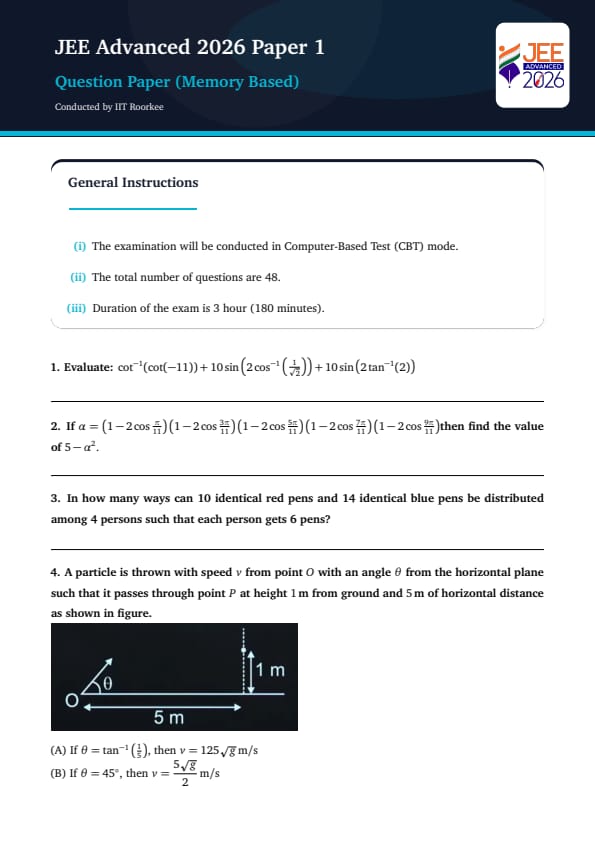
Evaluate: \( \cot^{-1}(\cot(-11)) +10\sin\left(2\cos^{-1}\left(\frac{1}{\sqrt{2}}\right)\right) +10\sin\left(2\tan^{-1}(2)\right) \)
If \(\alpha=\left(1-2\cos\frac{\pi}{11}\right) \left(1-2\cos\frac{3\pi}{11}\right) \left(1-2\cos\frac{5\pi}{11}\right) \left(1-2\cos\frac{7\pi}{11}\right) \left(1-2\cos\frac{9\pi}{11}\right) \)then find the value of \(5-\alpha^2.\)
In how many ways can 10 identical red pens and 14 identical blue pens be distributed among 4 persons such that each person gets 6 pens?
A particle is thrown with speed \(v\) from point \(O\) with an angle \(\theta\) from the horizontal plane such that it passes through point \(P\) at height \(1\,m\) from ground and \(5\,m\) of horizontal distance as shown in figure.
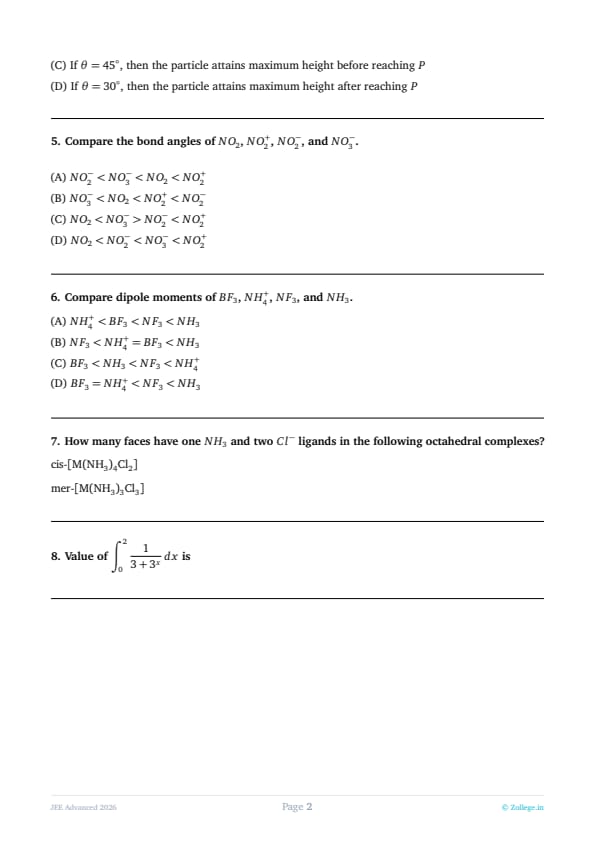
Compare the bond angles of \(NO_2\), \(NO_2^+\), \(NO_2^-\), and \(NO_3^-\).
View Solution
Step 1 : Understanding the Question
This chemical bonding problem requires comparing the bond angles of various nitrogen-oxygen species. Bond angles are primarily influenced by the hybridization of the central atom and the presence of lone pairs or unpaired electrons. By identifying the electron geometry and the magnitude of electron-electron repulsion for each species, we can determine the correct increasing order of their bond angles.
Step 2 : Key Formulas and approach
1. VSEPR Theory: Lone pair (LP) repulsion > Bonding pair (BP) repulsion.
2. Hybridization: \(sp = 180^\circ\), \(sp^2 = 120^\circ\), \(sp^3 = 109.5^\circ\).
3. Unpaired Electrons: A single unpaired electron repels adjacent bonds less than a full lone pair.
Step 3 : Detailed Explanation and Final Answer
Analyzing \(NO_2^+\): The nitronium ion has a positive charge on Nitrogen, resulting in two double bonds and no lone pairs. This leads to \(sp\) hybridization and a linear geometry. The bond angle is exactly \(180^\circ\), the largest in this group.
Analyzing \(NO_2\): This is a neutral radical molecule with one unpaired electron on Nitrogen. It has \(sp^2\) hybridization and a bent shape. Because the single electron repels less than a pair, the angle is slightly compressed to about \(134^\circ\).
Analyzing \(NO_3^-\): The nitrate ion has three resonance-stabilized bonds and no lone pairs on the Nitrogen. It is \(sp^2\) hybridized with a perfect trigonal planar geometry, resulting in a bond angle of exactly \(120^\circ\).
Analyzing \(NO_2^-\): The nitrite ion contains one lone pair on the Nitrogen. This lone pair exerts significant repulsion, compressing the \(sp^2\) angle to approximately \(115^\circ\).
Comparing results: Combining these, we find \(115^\circ (NO_2^-) < 120^\circ (NO_3^-) < 134^\circ (NO_2) < 180^\circ (NO_2^+)\).
Quick Tip: Bond angles generally decrease as the number of lone pair electrons on the central atom increases. For \(sp^2\) systems like these, remember the order of repulsion: Lone Pair > Unpaired Electron > No non-bonding electrons. Linear \(sp\) species will always have the highest angle at \(180^\circ\).
Compare dipole moments of \(BF_3\), \(NH_4^+\), \(NF_3\), and \(NH_3\).
View Solution
Step 1 : Understanding the Question
This problem involves comparing the molecular dipole moments (\(\mu\)) of different molecules and ions. Dipole moment is a vector quantity that accounts for both the bond polarities (due to electronegativity differences) and the geometric arrangement of those bonds. If a molecule is perfectly symmetrical, its bond dipoles may cancel out, resulting in a non-polar molecule (\(\mu = 0\)). For asymmetrical molecules, we must consider the relative directions of bond dipoles and lone pair dipoles.
Step 2 : Key Formulas and approach
1. Dipole Moment \(\vec{\mu} = \sum q \cdot \vec{d}\).
2. Symmetry Rule: For \(sp^2\) (trigonal planar) or \(sp^3\) (tetrahedral) shapes with identical surrounding atoms and no lone pairs, \(\mu = 0\).
3. Electronegativity: Dipoles point from less electronegative to more electronegative atoms.
Step 3 : Detailed Explanation and Final Answer
\(BF_3\) and \(NH_4^+\) Analysis: \(BF_3\) is trigonal planar and \(NH_4^+\) is tetrahedral. Both are perfectly symmetrical with identical outer atoms. Their individual bond dipoles cancel each other out completely, so \(\mu = 0\) for both. Thus, \(BF_3 = NH_4^+\).
\(NH_3\) Analysis: Ammonia is pyramidal with a lone pair. Nitrogen is more electronegative than hydrogen, so bond dipoles point toward nitrogen. The lone pair dipole also points away from nitrogen in the same direction. These vectors add up, resulting in a high dipole moment (\(\approx 1.47 D\)).
\(NF_3\) Analysis: Nitrogen trifluoride is also pyramidal, but fluorine is more electronegative than nitrogen. The \(N-F\) bond dipoles point toward fluorine, while the lone pair dipole points in the opposite direction. This opposing arrangement leads to a much smaller net dipole moment (\(\approx 0.23 D\)).
Ranking: The resulting order is \(BF_3 = NH_4^+ (0) < NF_3 (small) < NH_3 (large)\).
Quick Tip: Always identify symmetrical molecules first as they have zero dipole moment. For pyramidal molecules like \(NH_3\) and \(NF_3\), check if the lone pair dipole and bond dipoles are in the same direction (reinforcing) or opposite directions (cancelling). This determines which one has a higher magnitude.
How many faces have one \(NH_3\) and two \(Cl^-\) ligands in the following octahedral complexes?
\( \mathrm{cis-[M(NH_3)_4Cl_2]} \)
\( \mathrm{mer-[M(NH_3)_3Cl_3]} \)
Value of \(\displaystyle \int_{0}^{2} \frac{1}{3+3^x}\,dx\) is
JEE Advanced 2026 | Most Important Questions
*The article might have information for the previous academic years, please refer the official website of the exam.