
CEED 2023 Question Paper Pdf- Check Solutions with Answer Key Pdf

.jpg?tr=h-55,w-55,c-force)
Content Strategist|Tech-innovator|National Hackathon Winner | Updated On - Jan 17, 2026
CEED 2023 Question Paper for January 22 is available for download. The exam was successfully conducted by IIT Bombay from 9:00 AM to 12:00 PM. As per the students’ initial reactions, CEED 2023 Question Paper for January 22 was reported as Moderate. Part A was considered Moderately Difficult, while Part B was Easy to Moderate.
Candidates can download the CEED 2023 Question Paper with Solution and Answer Key PDFs for January 22 using the link below.
| CEED 2023 January 22 Question Paper with Answer Key |  Download Download |
Check Solution |
Part- A
Question 1:
Imagine a pentagon shaped building. The walls of the building are sides of the pentagon, and there is a watchtower at each vertex. Each watchtower can have guards who can watch two walls connected to the watchtower. What is the minimum number of guards required if each wall needs to be watched by at least 3 guards?
View Solution
The pentagon has 5 walls and 5 vertices. Each wall must be watched by at least 3 guards. Since each guard stationed at a watchtower can watch two walls connected to that vertex, the distribution of guards can be optimized as follows:
- Distribute guards at the vertices so that each wall shared between two vertices is covered by 3 guards.
- By carefully assigning guards, it is possible to achieve the coverage of 3 guards per wall with a total of 8 guards distributed across the vertices.
Conclusion: The minimum number of guards required is 8.
Question 2:
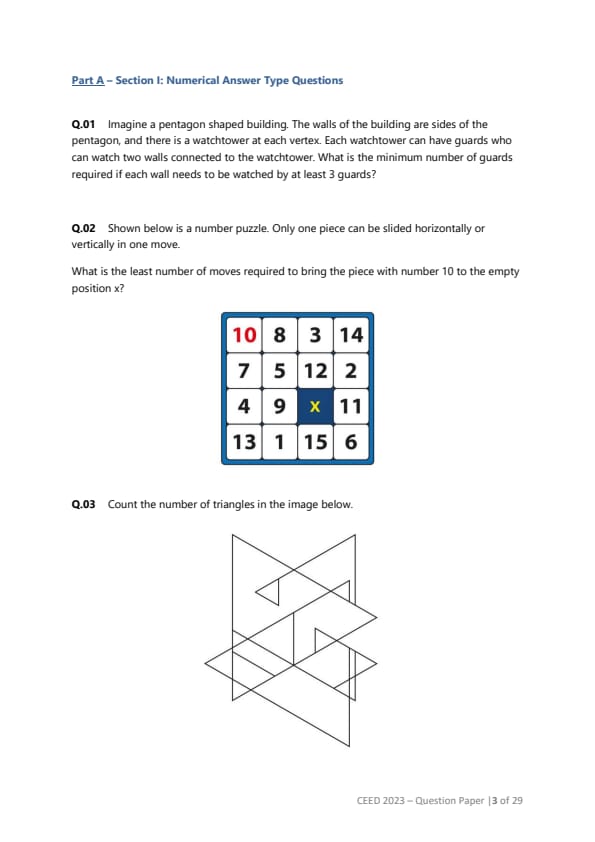
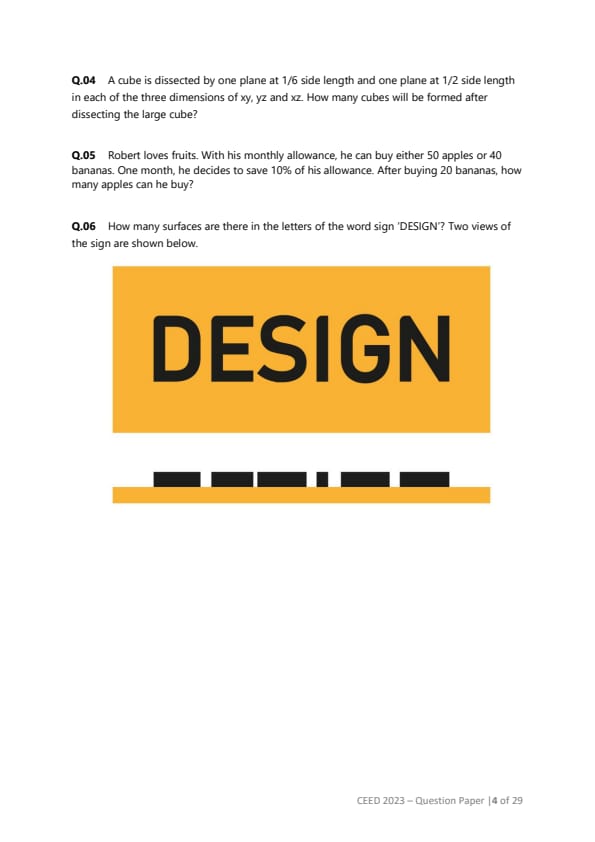
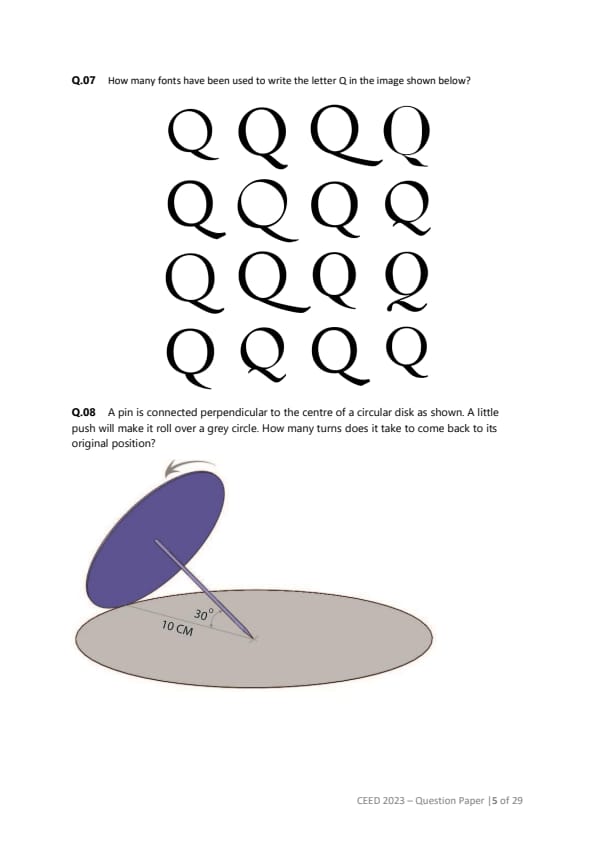
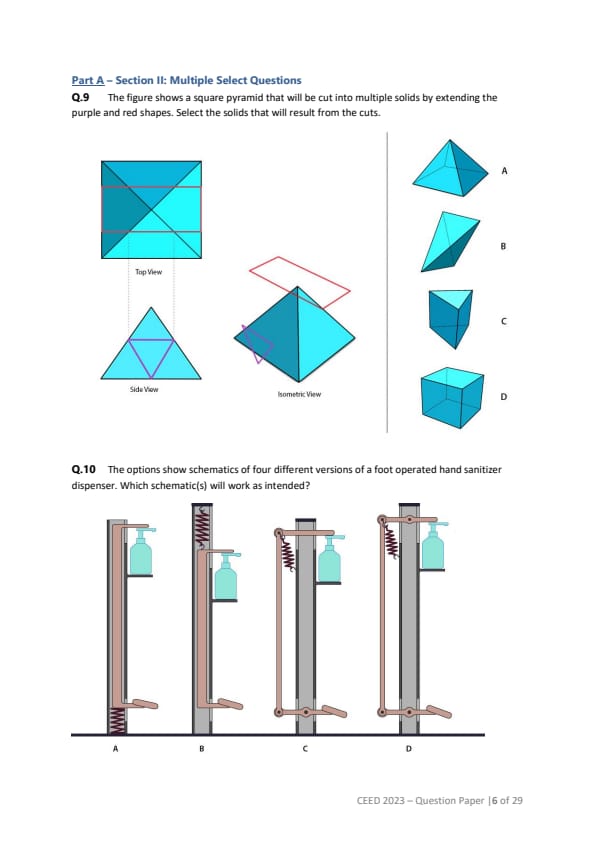
Shown below is a number puzzle. Only one piece can be slid horizontally or vertically in one move. What is the least number of moves required to bring the piece with number 10 to the empty position x?

View Solution
To move the piece numbered 10 to the empty position x, the sequence of moves required is as follows:
- Move adjacent pieces systematically to free up the path for the piece numbered 10.
- Considering the current configuration, a total of 13 moves is required to slide the piece numbered 10 into the empty position x.
Each move shifts one piece either horizontally or vertically toward its target position, ensuring that the empty slot x is aligned with the desired path.
Conclusion: The least number of moves required is 13.
Question 3:
Count the number of triangles in the image below.

View Solution
To count the number of triangles in the given figure, follow these steps systematically:
- Simple triangles: Count all individual triangles formed by intersecting lines.
- Overlapping triangles: Count larger triangles formed by combining smaller ones.
- Hidden triangles: Identify any triangles formed due to overlaps or intersections.
By methodically examining all possible combinations and intersections, the total number of triangles in the image is determined to be 16.
Conclusion: The total number of triangles in the image is 16.
Question 4:
A cube is dissected by one plane at 1/6 side length and one plane at 1/2 side length in each of the three dimensions of xy, yz, and xz. How many cubes will be formed after dissecting the large cube?
View Solution
1. Each plane divides the cube into multiple sections along the given dimension.
2. With the given dimensions, the large cube is divided into 3 parts in total: one along 1/6, one along 1/2, and one remaining piece.
3. Since there are 3 planes in 3 dimensions each giving rise to 3 sections, we have 3 x 3 x 3 divisions.
Conclusion: The cube is divided into 27 smaller cubes.
Question 5:
Robert loves fruits. With his monthly allowance, he can buy either 50 apples or 40 bananas. One month, he decides to save 10% of his allowance. After buying 20 bananas, how many apples can he buy?
View Solution
1. The cost of 50 apples is equal to Robert’s full allowance. Thus, the cost of one apple is:
Cost of one apple = Allowance / 50
Similarly, the cost of one banana is:
Cost of one banana = Allowance / 40
2. Robert saves 10% of his allowance. Thus, the remaining amount he spends is:
Remaining allowance = 0.9 × Allowance
3. After buying 20 bananas, the money spent on bananas is:
Cost of 20 bananas = 20 × (Allowance / 40) = Allowance / 2
4. The remaining money is:
Remaining money after bananas = 0.9 × Allowance - Allowance / 2 = 0.4 × Allowance
5. The number of apples Robert can buy with the remaining money is:
Number of apples = (0.4 × Allowance) / (Allowance / 50) = 20
Conclusion: Robert can buy 20 apples with the remaining money.
Question 6:
How many surfaces are there in the letters of the word sign ‘DESIGN’? Two views of the sign are shown below.

View Solution
To determine the total number of surfaces in the word "DESIGN," follow these steps:
- Each letter is three-dimensional and will have the following surfaces:
- Front and back surfaces: 2
- Top and bottom surfaces: 2
- Two side surfaces: 2
- The word "DESIGN" consists of 7 letters. Hence, the total number of surfaces is:
Total Surfaces = 7 × 6 = 42
Conclusion: The total number of surfaces in the word "DESIGN" is 42.
Question 7:
How many fonts have been used to write the letter Q in the image shown below?
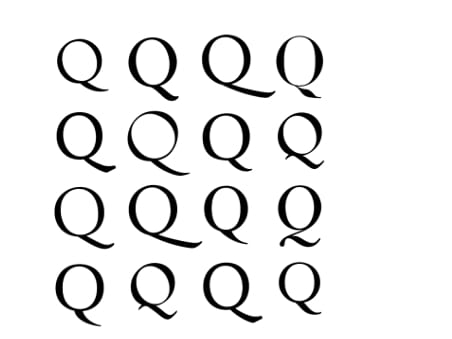
View Solution
The image displays multiple instances of the letter Q, each written in different styles. By closely analyzing the variation in thickness, curvature, and tail design, it can be concluded that 13 distinct fonts have been used in writing the letters.
Conclusion: A total of 13 different fonts have been used to write the letter Q in the given image.
Question 8:
A pin is connected perpendicular to the center of a circular disk as shown. A little push will make it roll over a grey circle. How many turns does it take to come back to its original position?

View Solution
1. The pin attached to the disk creates a tilted plane, and as the disk rolls along the grey circle, the center of the disk traces a circular path.
2. Since the disk is tilted, it completes one full rotation for every turn around the grey circle.
3. To return to its original position, the disk must complete 2 rotations, as the pin's orientation must align with its starting position.
Conclusion: It takes 2 turns for the disk to come back to its original position.
Question 9:
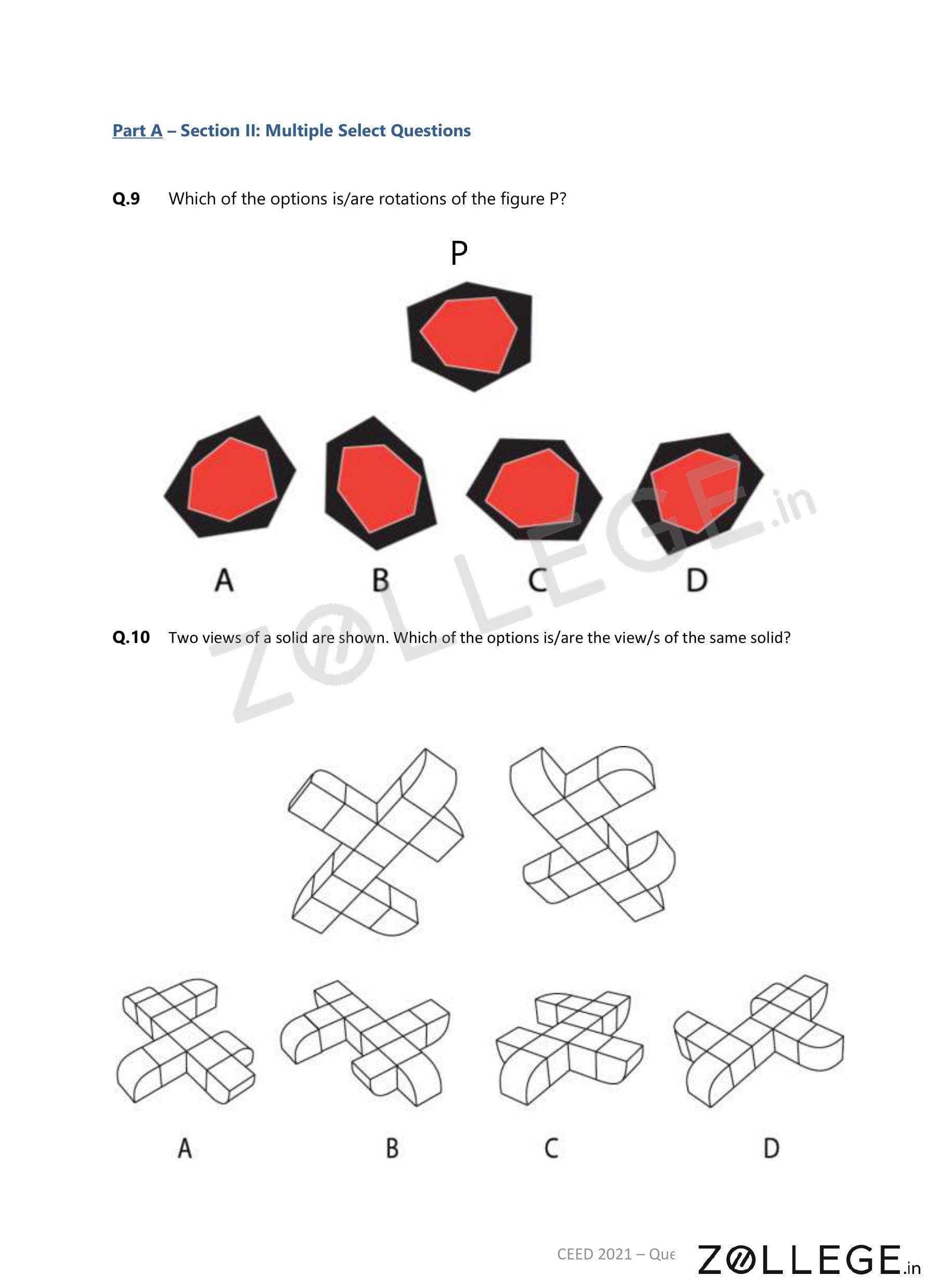
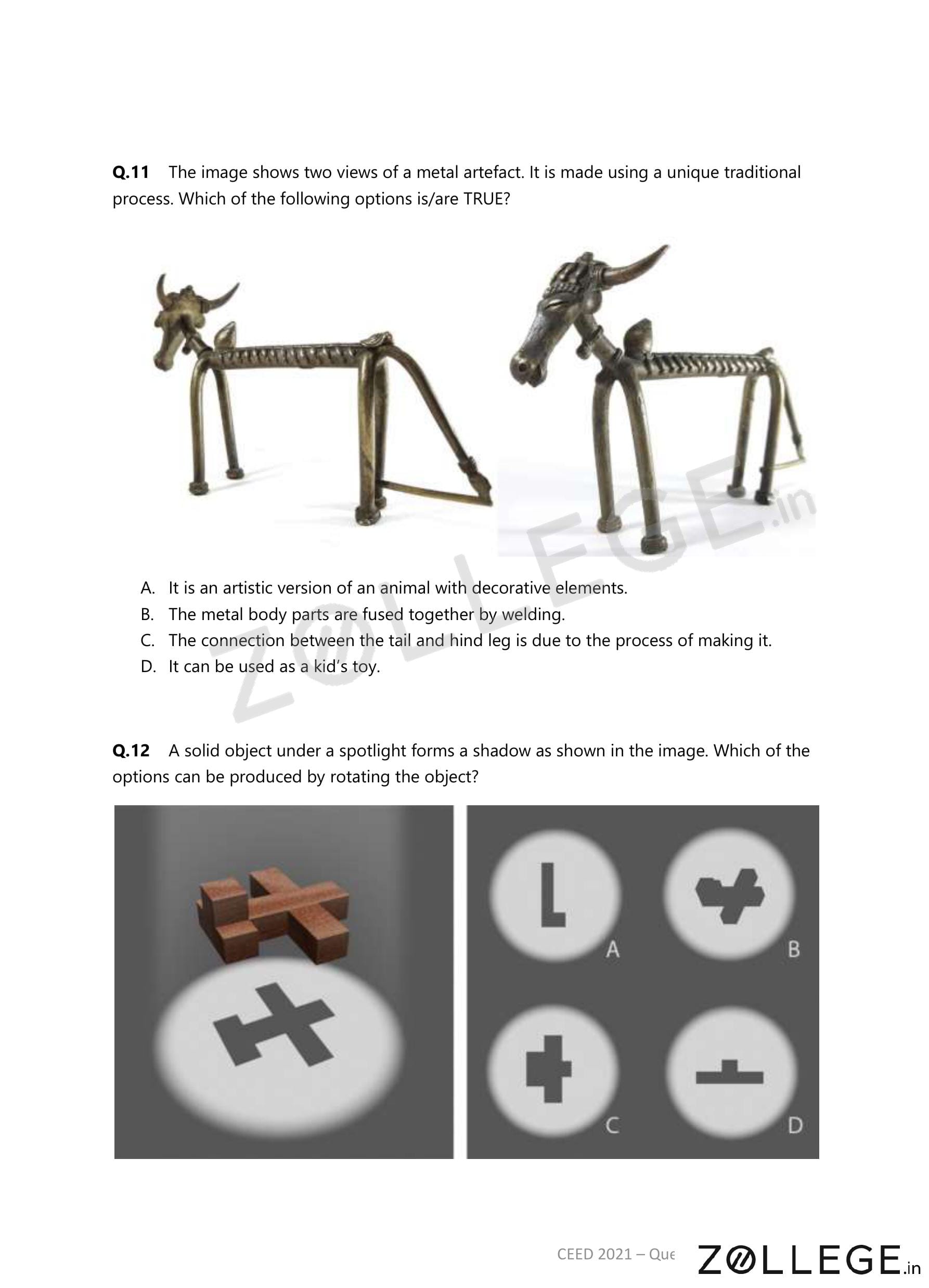
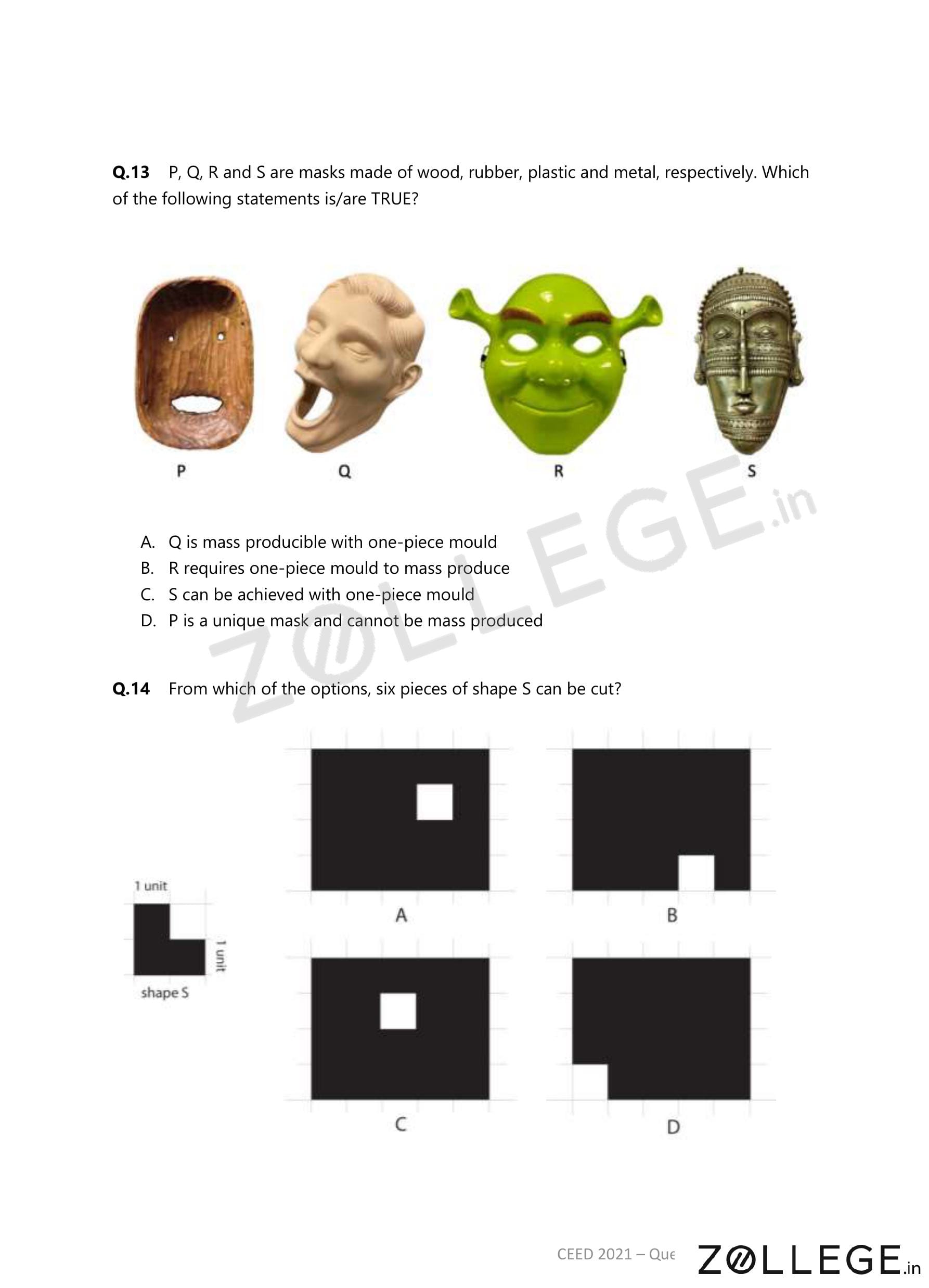
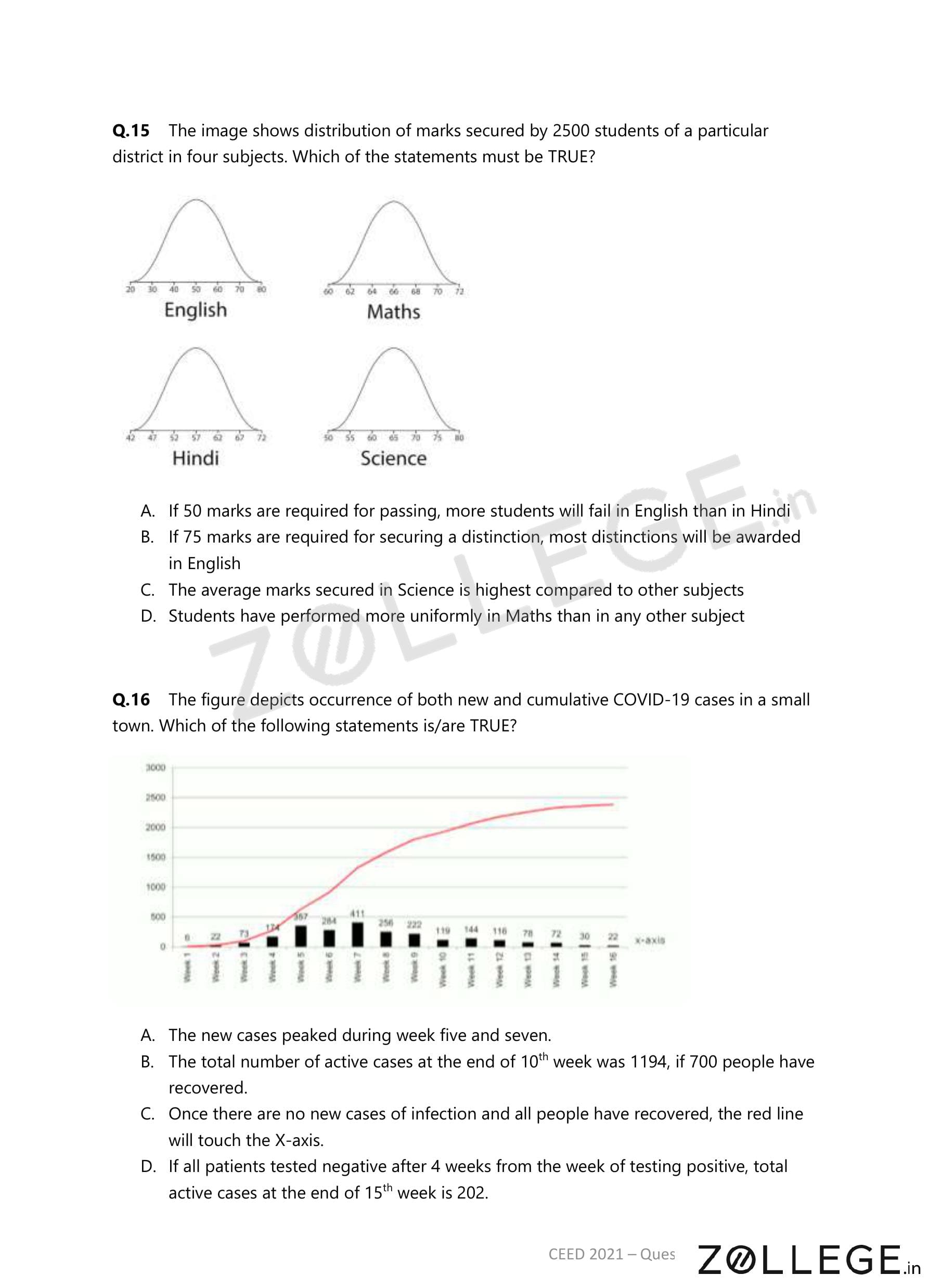
The figure shows a square pyramid that will be cut into multiple solids by extending the purple and red shapes. Select the solids that will result from the cuts.
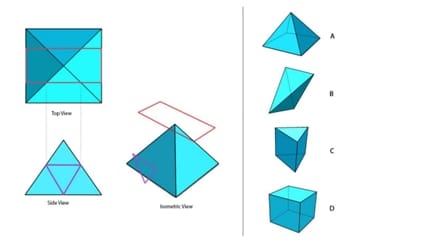
View Solution
1. The given figure represents a square pyramid that is divided into smaller solids by planes corresponding to the purple and red shapes.
2. By analyzing the resulting sections from the top view, side view, and isometric view, we can conclude the following:
- The top cut (purple) produces a triangular prism (B).
- The side cut (red) results in a tetrahedron (A).
- The base section includes part of the pyramid forming another truncated solid resembling a cuboid-like shape (C).
3. Option D represents a complete cube, which does not match any section resulting from the described cuts.
Conclusion: The resulting solids from the cuts are represented by A, B, C.
Question 10:
The options show schematics of four different versions of a foot-operated hand sanitizer dispenser. Which schematic(s) will work as intended?

View Solution
- Option A: The lever mechanism is correctly positioned, and pressing the foot pedal compresses the spring, effectively dispensing the sanitizer. Thus, A works as intended.
- Option B: The spring mechanism is correctly aligned with the foot pedal and the sanitizer dispenser. Pressing the pedal transfers the force upward to dispense the sanitizer. Hence, B works as intended.
- Option C: The schematic shows a misalignment of the lever mechanism. The foot pedal does not transfer the required force to the sanitizer dispenser. Thus, C does not work as intended.
- Option D: The design has a proper lever mechanism and spring alignment. The force from the foot pedal is effectively transferred to dispense the sanitizer. Therefore, D works as intended.
Conclusion: The schematics that work as intended are A, B, D.
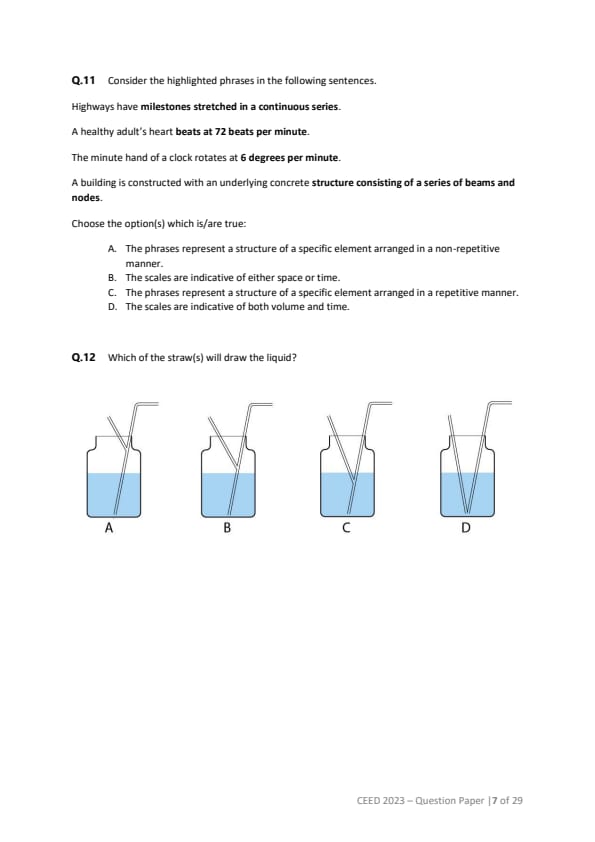
Question 11:
Consider the highlighted phrases in the following sentences:
Highways have milestones stretched in a continuous series.
A healthy adult’s heart beats at 72 beats per minute.
The minute hand of a clock rotates at 6 degrees per minute.
A building is constructed with an underlying concrete structure consisting of a series of beams and nodes.
Choose the option(s) which is/are true:
(B) The scales are indicative of either space or time.
(C) The phrases represent a structure of a specific element arranged in a repetitive manner.
View Solution
1. The milestones, heartbeats, and clock rotations represent repetitive occurrences, while the building structure represents a fixed repetitive arrangement of beams and nodes.
2. The scales described are indicative of either space (highways, beams) or time (heartbeats, clock rotations).
3. Hence:
- Option B is true as the scales are indicative of either space or time.
- Option C is true as the highlighted phrases describe repetitive arrangements or occurrences.
- Option A is false because the structures described are repetitive, not non-repetitive.
- Option D is false because the scales are not indicative of volume.
Conclusion: The correct options are B and C.
Question 12:
Which of the straw(s) will draw the liquid?

View Solution
1. To draw liquid, a straw must create a proper vacuum or suction force to lift the liquid.
2. Analyzing the given straws:
- Straw A: The straw is cut or open at a point above the liquid level, which prevents vacuum formation. Thus, A cannot draw the liquid.
- Straw B: Similar to A, the straw has an opening above the liquid level, disrupting the vacuum. Hence, B cannot draw the liquid.
- Straw C: The straw is fully submerged below the liquid surface, enabling a vacuum to lift the liquid. Therefore, C can draw the liquid.
- Straw D: Similar to C, the straw allows for proper suction due to its design, enabling the liquid to be drawn. Hence, D can draw the liquid.
Conclusion: The straws that will draw the liquid are C and D.
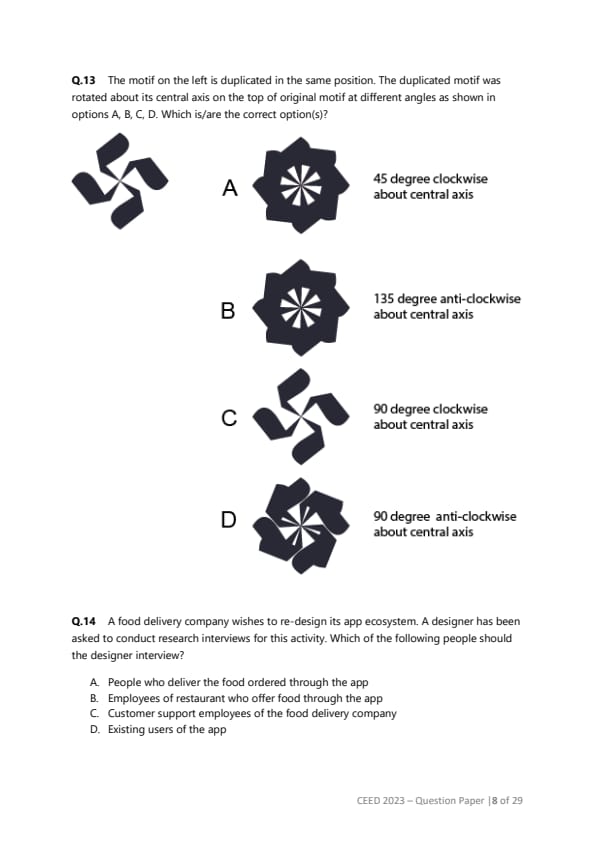
Question 13:
The motif on the left is duplicated in the same position. The duplicated motif was rotated about its central axis on the top of the original motif at different angles as shown in options A, B, C, D. Which is/are the correct option(s)?
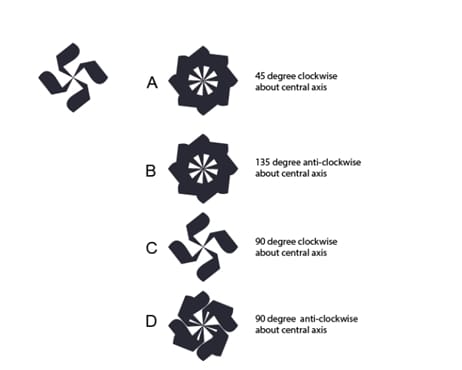
View Solution
- Option A (45 degrees clockwise): The motif in A is correctly rotated 45 degrees clockwise about its central axis, matching the description. Thus, A is correct.
- Option B (135 degrees anti-clockwise): The motif in B is rotated 135 degrees anti-clockwise about its central axis, as described. Hence, B is correct.
- Option C (90 degrees clockwise): The motif in C is rotated 90 degrees clockwise about its central axis, which matches the description. Therefore, C is correct.
- Option D (90 degrees anti-clockwise): While D involves a 90-degree anti-clockwise rotation, it does not align as expected with the original motif, making D incorrect.
Conclusion: The correct options are A, B, C.
Question 14:
A food delivery company wishes to re-design its app ecosystem. A designer has been asked to conduct research interviews for this activity. Which of the following people should the designer interview?
View Solution
1. To effectively redesign the app ecosystem, the designer must consider all stakeholders who interact with the app.
- Option A: People who deliver food through the app provide valuable insights about usability and challenges faced during delivery.
- Option B: Employees of restaurants offering food through the app can share their experience with the app's integration and usage.
- Option C: Customer support employees deal directly with user complaints and technical issues, offering insights into recurring problems and areas for improvement.
- Option D: Existing users are the primary consumers of the app, and their feedback is critical for understanding user experience and expectations.
Conclusion: To gain a holistic view, the designer should interview all the mentioned groups, making the correct options A, B, C, D.
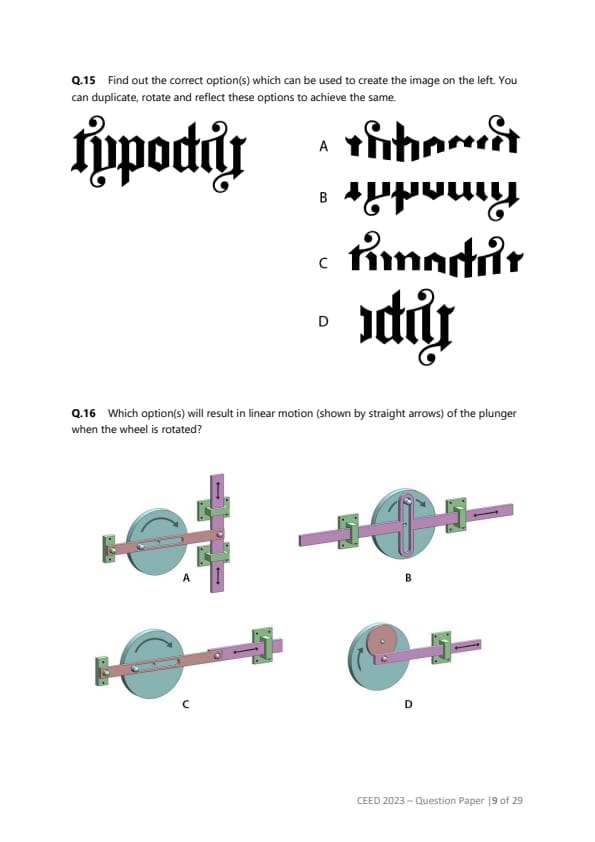
Question 15:
Find out the correct option(s) which can be used to create the image on the left. You can duplicate, rotate, and reflect these options to achieve the same.

View Solution
- Option A: By duplicating and reflecting Option A, the curved elements can be rearranged to recreate parts of the original design on the left. Thus, A is correct.
- Option B: Option B can also be duplicated and reflected to construct elements of the original design, including its symmetrical structure. Hence, B is correct.
- Option C: The structure of C does not align with any part of the original image, even after duplication, rotation, or reflection. Thus, C is incorrect.
- Option D: Option D provides the vertical and angular elements required to complete the original design when combined with other parts. Therefore, D is correct.
Conclusion: The correct options to recreate the design are A, B, D.
Question 16:
Which option(s) will result in linear motion (shown by straight arrows) of the plunger when the wheel is rotated?
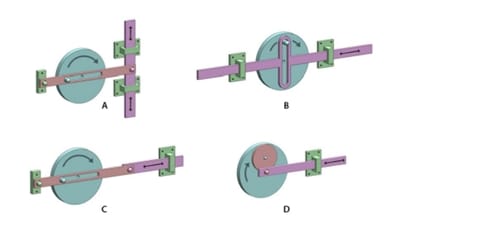
View Solution
- Option A: The mechanism shown in A produces a non-linear motion of the plunger as it is influenced by the curved trajectory of the linkage. Hence, A does not result in linear motion.
- Option B: The linkage in B converts the rotational motion of the wheel into a perfectly linear motion of the plunger due to the constrained straight-line path of the mechanism. Thus, B is correct.
- Option C: Similar to A, the mechanism in C does not produce a purely linear motion because of the pivoting nature of the linkage. Hence, C is incorrect.
- Option D: The mechanism in D involves an angular pivot and does not constrain the plunger to a linear path. Therefore, D is also correct.
Conclusion: The correct option that results in linear motion is B or B, D.
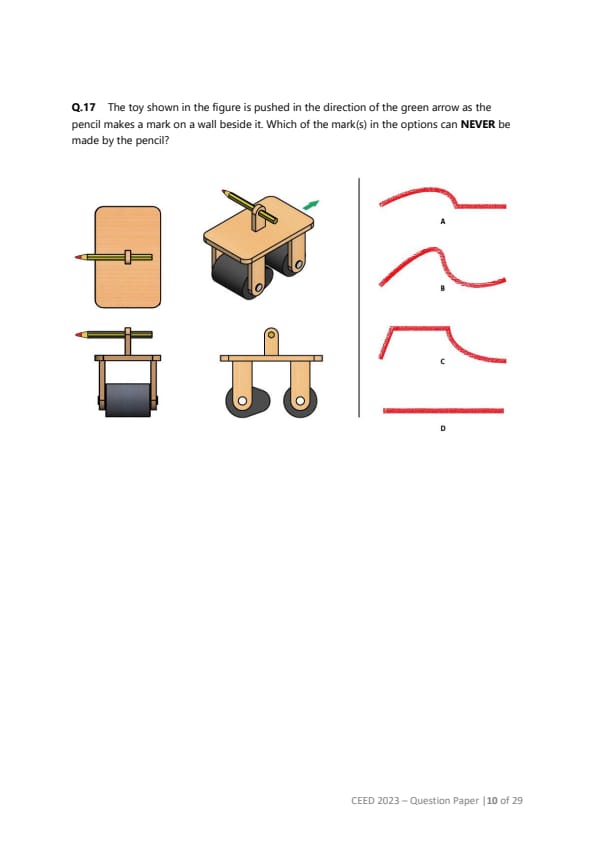
Question 17:
The toy shown in the figure is pushed in the direction of the green arrow as the pencil makes a mark on a wall beside it. Which of the mark(s) in the options can NEVER be made by the pencil?

View Solution
1. The toy moves in a linear fashion as it is pushed along the green arrow. The pencil's motion is determined by the movement of the toy and the rotation of the rollers beneath it.
- Mark A: A smooth curved line like A can be created by consistent rolling motion without abrupt changes. Hence, A is possible.
- Mark B: The sharp, uneven pattern in B indicates sudden stops or changes in direction, which are not possible with the smooth rolling motion of the toy. Thus, B cannot be made.
- Mark C: The sharp, angular pattern in C would require the toy to make an instantaneous and abrupt change in its rolling direction, which is mechanically unfeasible. Hence, C cannot be made.
- Mark D: A straight-line pattern like D is feasible as it reflects the straightforward motion of the toy.
Conclusion: The marks that can NEVER be made by the pencil are B and C.
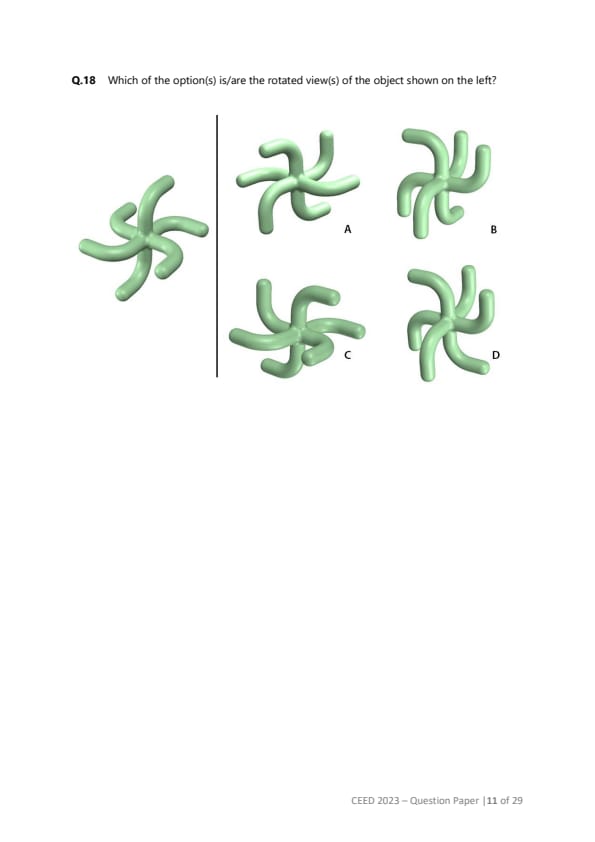
Question 18:
Which of the option(s) is/are the rotated view(s) of the object shown on the left?

View Solution
1. The given object has a symmetrical structure that can be analyzed from different perspectives. By rotating the object, we can match its appearance with the given options:
- Option A: Matches the structure and orientation of the object after a specific rotation. Hence, A is a correct rotated view.
- Option B: Does not align with the rotated structure of the object, as it has a different configuration of its arms. Thus, B is incorrect.
- Option C: Does not match the object’s rotated view due to misaligned arms and curvature. Hence, C is incorrect.
- Option D: Matches the object’s structure after a different rotation. Therefore, D is a correct rotated view.
Conclusion: The rotated views of the object are A and D.
Part-A
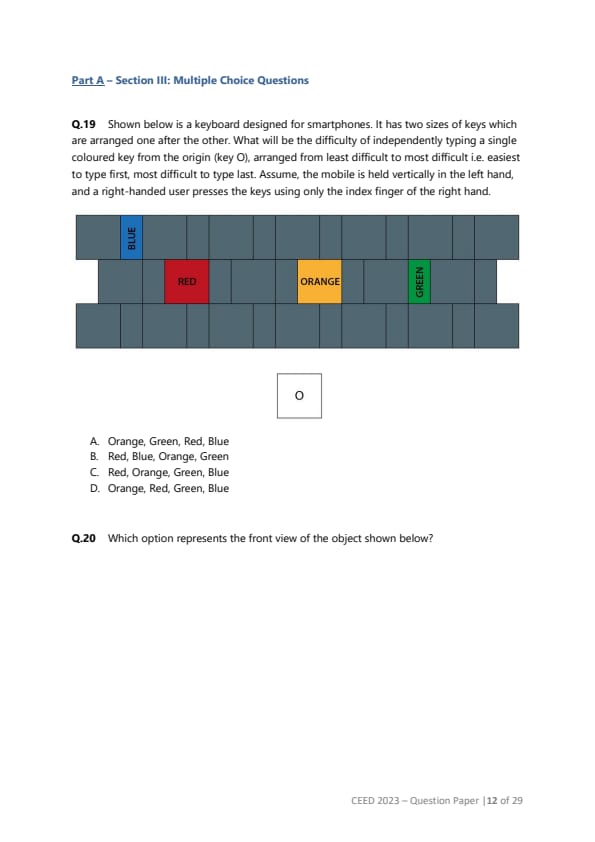
Question 19:
Shown below is a keyboard designed for smartphones. It has two sizes of keys which are arranged one after the other. What will be the difficulty of independently typing a single coloured key from the origin (key O), arranged from least difficult to most difficult i.e. easiest to type first, most difficult to type last? Assume, the mobile is held vertically in the left hand, and a right-handed user presses the keys using only the index finger of the right hand.

View Solution
1. The difficulty of typing each key depends on the distance from the origin (key O) and the ergonomic reachability for a right-handed user.
2. Based on the arrangement of keys:
- Orange is closest to the origin and is the easiest to type.
- Red is slightly farther but still closer than the other two.
- Green is farther than Orange and Red but still easier to reach compared to Blue.
- Blue is the farthest from the origin and the most difficult to type.
3. Thus, the order of difficulty from least to most difficult is: Orange → Red → Green → Blue.
Conclusion: The correct order is D: Orange, Red, Green, Blue.
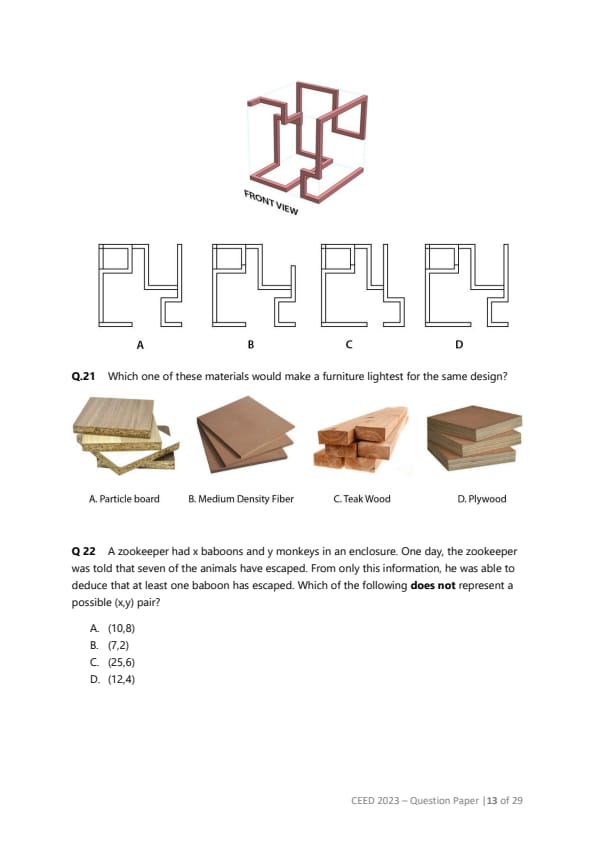
Question 20:
Which option represents the front view of the object shown below?

View Solution
1. The front view of the object is obtained by projecting all visible edges onto a single plane perpendicular to the front face.
2. Analyzing the given object and options:
- Option A: The arrangement of edges in A does not match the front projection of the object.
- Option B: Similar to A, the structure in B is not consistent with the visible edges from the front.
- Option C: While closer, the edges in C fail to capture the complete projection of the object’s front view.
- Option D: The arrangement in D correctly represents the front view of the object, including all visible edges and proportions.
Conclusion: The correct option that represents the front view is D.
Question 21:
Which one of these materials would make a furniture lightest for the same design?

View Solution
- Particle board: This material is made by compressing wood particles and resin. It is lightweight compared to the other options.
- Medium Density Fiber (MDF): MDF is denser than particle board and therefore heavier.
- Teak Wood: As a natural hardwood, teak is significantly denser and heavier.
- Plywood: Plywood is lighter than teak wood but heavier than particle board due to its layered structure.
Conclusion: The lightest material for furniture construction among the given options is A (Particle board).
Question 22:
A zookeeper had x baboons and y monkeys in an enclosure. One day, the zookeeper was told that seven of the animals have escaped. From only this information, he was able to deduce that at least one baboon has escaped. Which of the following does not represent a possible (x, y) pair?
View Solution
1. For the zookeeper to deduce that at least one baboon has escaped, the number of monkeys (y) must be less than 7. This ensures that even if all monkeys escape, some baboons must also have escaped.
2. Analyzing the options:
- Option A (10,8): Here, y = 8 > 7. This means it is possible for all escaped animals to be monkeys, contradicting the zookeeper's conclusion. Hence, A is not possible.
- Option B (7,2): Here, y = 2 < 7. The zookeeper can conclude that at least one baboon escaped. Hence, B is possible.
- Option C (25,6): Here, y = 6 < 7. The zookeeper can deduce that at least one baboon escaped. Hence, C is possible.
- Option D (12,4): Here, y = 4 < 7. The zookeeper can deduce that at least one baboon escaped. Hence, D is possible.
Conclusion: The pair that does not satisfy the condition is A (10,8).
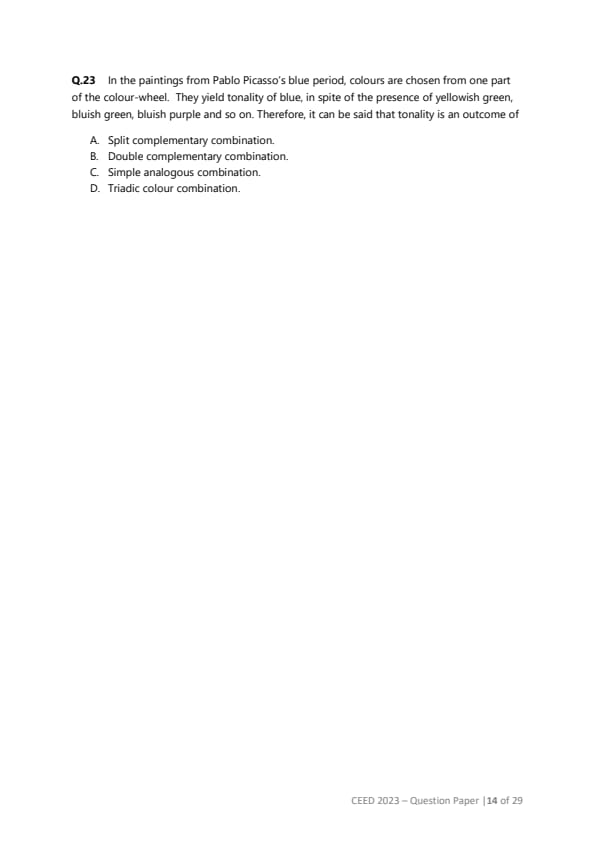
Question 23:
In the paintings from Pablo Picasso’s blue period, colours are chosen from one part of the colour-wheel. They yield tonality of blue, in spite of the presence of yellowish green, bluish green, bluish purple and so on. Therefore, it can be said that tonality is an outcome of:
View Solution
1. Understanding the Blue Period:
- Picasso's blue period predominantly used shades and tones of blue, often accompanied by neighboring colors on the color wheel such as bluish green, bluish purple, and yellowish green.
- These neighboring colors maintain a harmonious tonality, which is a hallmark of an analogous color scheme.
2. Analysis of Color Combinations:
- Option A (Split complementary combination): Involves using one base color and the two colors adjacent to its complementary color. This does not align with the blue period's tonality.
- Option B (Double complementary combination): Involves two complementary color pairs, which is not evident in the paintings.
- Option C (Simple analogous combination): Involves colors adjacent to each other on the color wheel, creating a unified and harmonious tonality. This matches Picasso's blue period perfectly.
- Option D (Triadic color combination): Uses three colors evenly spaced on the color wheel, which does not align with the observed tonality.
Conclusion: The tonality in Picasso’s blue period paintings is an outcome of a simple analogous combination.
Question 24:
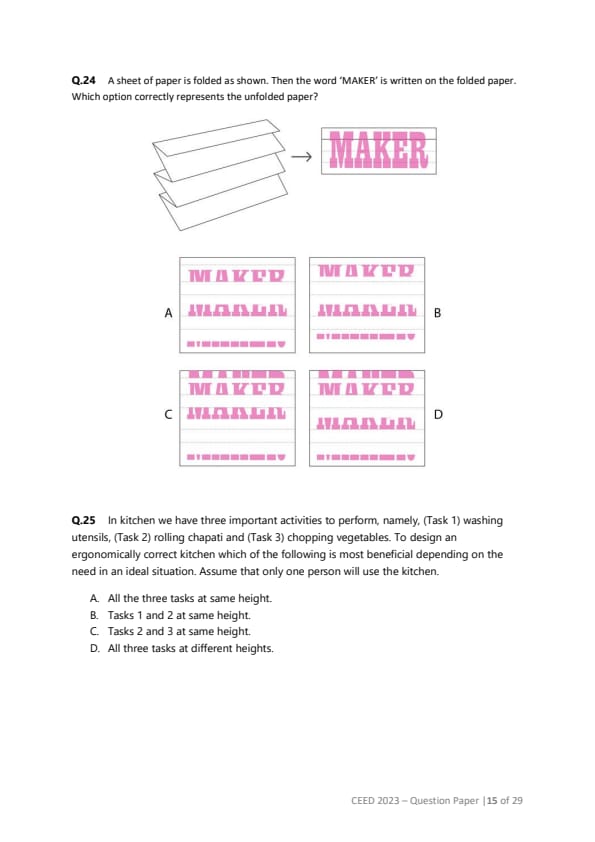
A sheet of paper is folded as shown. Then the word ‘MAKER’ is written on the folded paper. Which option correctly represents the unfolded paper?

View Solution
1. The paper is folded into multiple layers, and the word “MAKER” is written across all layers of the folded paper.
2. Upon unfolding, the letters appear repeated across the unfolded sections corresponding to where they were written on the folded paper.
3. Option A correctly depicts how the word “MAKER” is distributed across the entire unfolded sheet, aligning with the folding pattern.
4. Options B, C, and D do not match the pattern produced by writing on the folded paper and unfolding it.
Conclusion: The correct representation of the unfolded paper is A.
Question 25:
In the kitchen we have three important activities to perform, namely, (Task 1) washing utensils, (Task 2) rolling chapati and (Task 3) chopping vegetables. To design an ergonomically correct kitchen which of the following is most beneficial depending on the need in an ideal situation. Assume that only one person will use the kitchen.
View Solution
1. Each task in the kitchen requires a different height for optimal ergonomics:
- Task 1 (Washing utensils): Should be higher to avoid bending, keeping the sink at elbow height.
- Task 2 (Rolling chapati): Should be at a medium height to allow comfortable rolling, slightly below elbow level.
- Task 3 (Chopping vegetables): Should be at a slightly lower height than Task 2 for better visibility and precision.
2. Keeping all tasks at the same height would lead to discomfort and inefficiency for certain tasks. Hence, options A, B, and C are incorrect.
Conclusion: The most beneficial arrangement is D (all three tasks at different heights).
Question 26:
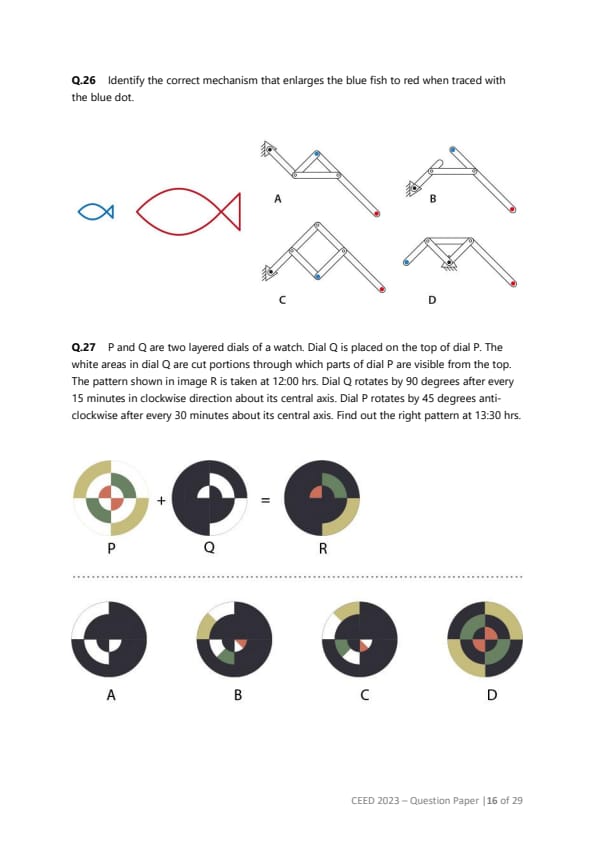
Identify the correct mechanism that enlarges the blue fish to red when traced with the blue dot.

View Solution
1. The correct mechanism for scaling the blue fish to the red fish involves a proportional linkage system that traces and enlarges the shape.
- Option A: The linkage configuration in A does not provide the necessary proportional scaling for accurate enlargement.
- Option B: The structure in B does not maintain proportional alignment for the traced enlargement.
- Option C: The mechanism in C includes a parallelogram linkage that ensures proportional scaling and tracing, making it the correct option.
- Option D: The configuration in D introduces distortions and does not correctly scale the shape proportionally.
Conclusion: The mechanism that enlarges the blue fish to the red fish is C.
Question 27:
P and Q are two layered dials of a watch. Dial Q is placed on the top of dial P. The white areas in dial Q are cut portions through which parts of dial P are visible from the top. The pattern shown in image R is taken at 12:00 hrs. Dial Q rotates by 90 degrees after every 15 minutes in clockwise direction about its central axis. Dial P rotates by 45 degrees anticlockwise after every 30 minutes about its central axis. Find out the right pattern at 13:30 hrs.

View Solution
1. Initial Configuration (12:00 hrs): The pattern R represents the initial configuration of the two dials P and Q at 12:00 hrs.
2. Rotation of Dial Q: Dial Q rotates 90 degrees clockwise every 15 minutes. Between 12:00 hrs and 13:30 hrs (1 hour and 30 minutes), Q completes:
(90 / 15) × 90 = 540 degrees.
Since 540° = 360° + 180°, Q rotates by an effective 180 degrees clockwise.
3. Rotation of Dial P: Dial P rotates 45 degrees anticlockwise every 30 minutes.
Between 12:00 hrs and 13:30 hrs, P rotates:
45° × (90 / 30) = 135 degrees anticlockwise.
4. Combined Rotation Effect: The combined rotations of P and Q determine the visibility pattern. After applying these rotations:
- Q shifts 180 degrees clockwise.
- P shifts 135 degrees anticlockwise.
The resulting pattern aligns with Option C.
Conclusion: The correct pattern at 13:30 hrs is C.
Question 28:
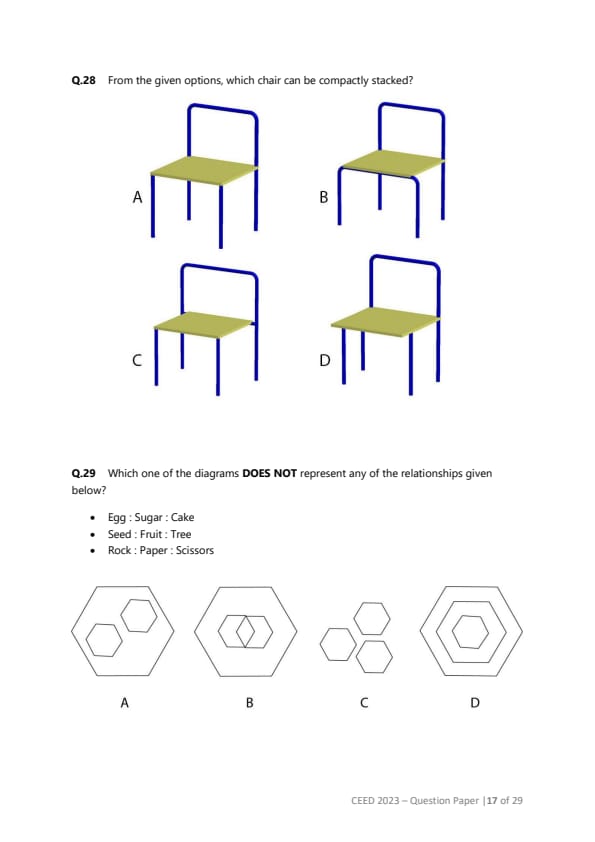
From the given options, which chair can be compactly stacked?

View Solution
1. Compact stacking of chairs requires a design that allows the chair legs and seating platform to fit neatly within or alongside one another when chairs are placed on top of each other.
- Option A: The design of A does not allow for compact stacking because the seat and legs do not align to nest properly.
- Option B: Similar to A, the design of B does not allow for stacking, as the seat and legs create obstructions.
- Option C: The design of C allows for compact stacking due to its nested structure, where the legs and seat align in a way that minimizes space. Hence, C is correct.
- Option D: The design of D does not allow for stacking as the legs and seating platform obstruct nesting.
Conclusion: The chair that can be compactly stacked is C.
Question 29:
Which one of the diagrams DOES NOT represent any of the relationships given below?
- Egg : Sugar : Cake
- Seed : Fruit : Tree
- Rock : Paper : Scissors

View Solution
1. The relationships provided involve hierarchical or causal connections:
- Egg : Sugar : Cake reflects components combining to create a whole.
- Seed : Fruit : Tree represents growth or transformation relationships.
- Rock : Paper : Scissors reflects a cyclical or game-like relationship without hierarchy.
2. Analyzing the diagrams:
- Option A: The separate smaller hexagons within the larger hexagon can represent the component relationship (Egg : Sugar : Cake), where individual parts combine to form a whole. Hence, A represents a valid relationship.
- Option B: The overlapping hexagons suggest a confusing or unclear interaction that does not fit any of the provided relationships. Thus, B does not represent any of the relationships.
- Option C: The disconnected hexagons can represent distinct items in a cyclic relationship like Rock : Paper : Scissors. Hence, C is valid.
- Option D: The nested hexagons represent a growth or hierarchical relationship, like Seed : Fruit : Tree. Hence, D is valid.
Conclusion: The diagram that does not represent any of the relationships is B.
Question 30:
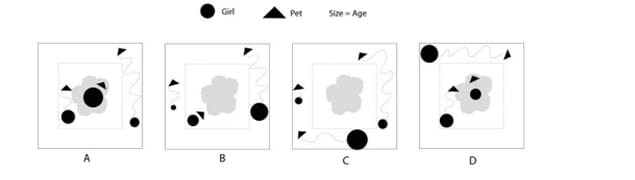
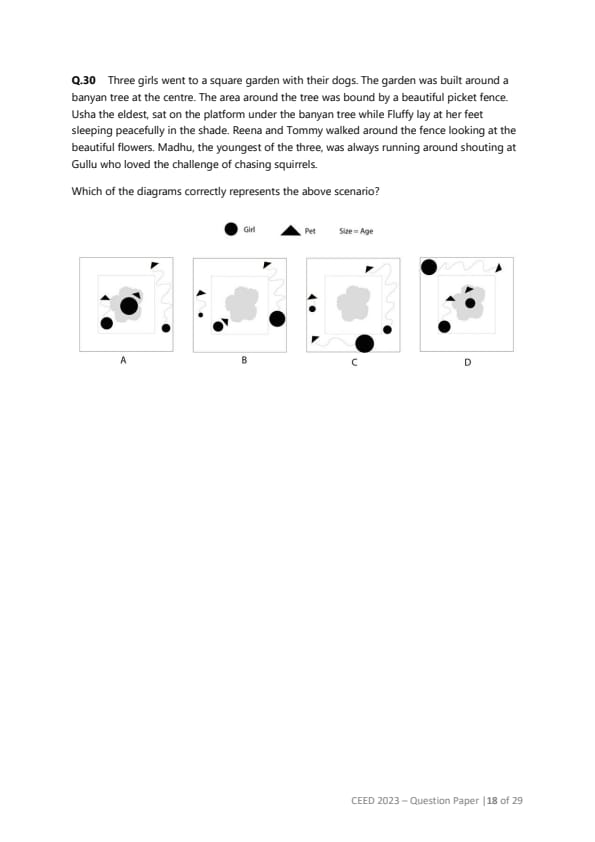
Three girls went to a square garden with their dogs. The garden was built around a banyan tree at the centre. The area around the tree was bound by a beautiful picket fence. Usha, the eldest, sat on the platform under the banyan tree while Fluffy lay at her feet sleeping peacefully in the shade. Reena and Tommy walked around the fence looking at the beautiful flowers. Madhu, the youngest of the three, was always running around shouting at Gullu who loved the challenge of chasing squirrels. Which of the diagrams correctly represents the above scenario?
View Solution
1. Analysis of the Scenario:
- Usha, the eldest, is sitting at the platform under the banyan tree with Fluffy (her dog) sleeping peacefully at her feet. This indicates that the largest circle (Usha) and the largest triangle (Fluffy) are positioned together near the centre of the diagram.
- Reena and Tommy are walking around the fence, suggesting a medium-sized circle (Reena) and triangle (Tommy) moving in a circular path near the boundary of the picket fence.
- Madhu, the youngest, is running around shouting at Gullu, who is actively chasing squirrels. This suggests the smallest circle (Madhu) and triangle (Gullu) are moving erratically near the outer boundary of the garden.
2. Option A: Accurately represents Usha and Fluffy near the banyan tree, Reena and Tommy walking along the picket fence, and Madhu and Gullu moving erratically near the boundary. Hence, A is correct.
3. Option B: Does not depict Usha and Fluffy near the tree and incorrectly places the elements representing Madhu and Gullu.
4. Option C: Misplaces Reena and Tommy and does not represent Madhu and Gullu’s erratic motion near the boundary.
5. Option D: Incorrectly positions Usha and Fluffy, along with the other characters, relative to the described positions in the scenario.
Conclusion: The diagram that correctly represents the scenario is A.
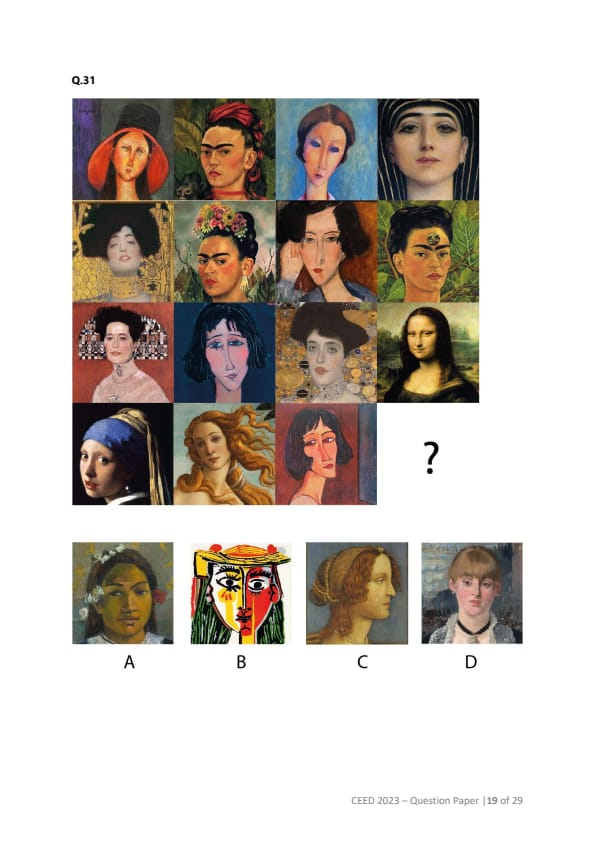
Question 31:


View Solution
1. Analysis of Styles:
- Option A: This artwork exhibits a style influenced by post-impressionist techniques, focusing on bold colors and cultural representation rather than classical Renaissance characteristics.
- Option B: This is a cubist representation, characterized by abstract forms and geometric shapes, associated with Pablo Picasso and modern art, not the Renaissance.
- Option C: This artwork is reminiscent of the Renaissance style, with a focus on naturalism, detailed hair and facial features, and a serene composition, matching classical Renaissance art.
- Option D: This artwork aligns with impressionist or post-impressionist styles, focusing on light, texture, and mood, but it lacks the naturalism and formal composition of the Renaissance.
2. Conclusion: The artwork in C best represents the classical Renaissance style due to its naturalism, attention to detail, and composition.
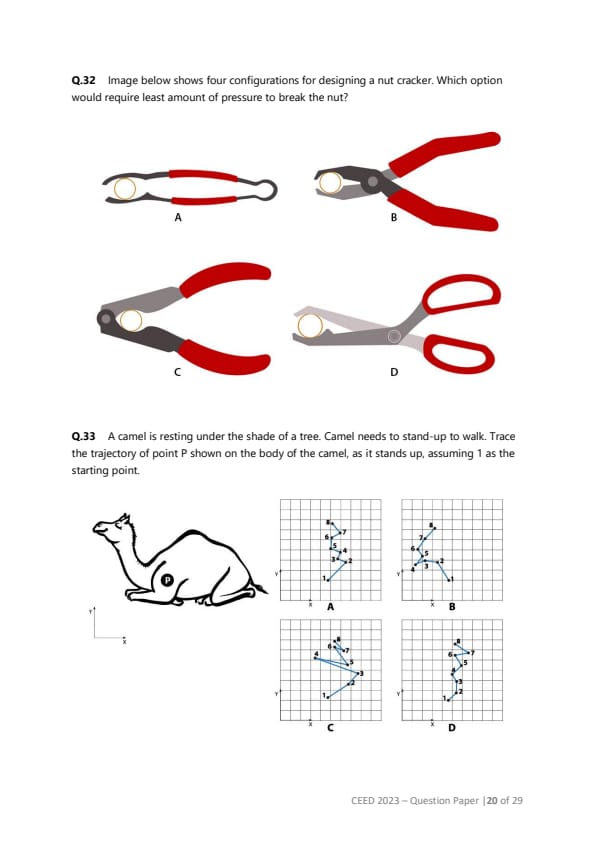
Question 32:
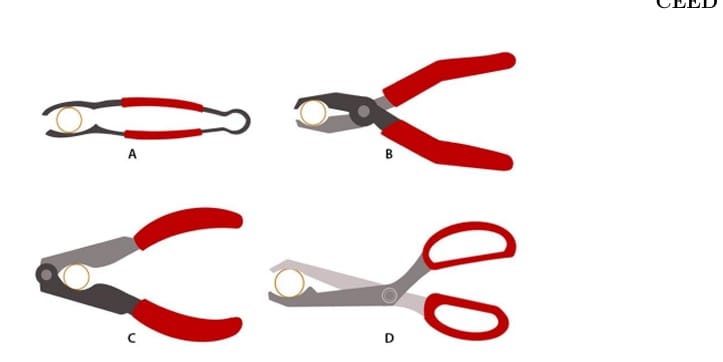
The image below shows four configurations for designing a nut cracker. Which option would require the least amount of pressure to break the nut?
View Solution
1. Analysis of Lever Mechanisms:
- The nut cracker functions as a second-class lever, where the fulcrum, effort, and load positions determine the mechanical advantage.
- Mechanical Advantage (MA): A greater distance between the fulcrum and the effort point reduces the required pressure to break the nut.
2. Options Analysis:
- Option A: The effort point is relatively close to the fulcrum, resulting in lower mechanical advantage and requiring more pressure.
- Option B: Similar to A, the lever arrangement results in moderate mechanical advantage, requiring significant pressure.
- Option C: The effort point is farther from the fulcrum, providing the highest mechanical advantage, reducing the required pressure. Thus, C requires the least amount of pressure.
- Option D: The configuration results in a mechanical advantage lower than C, requiring more pressure than C.
Conclusion: The option requiring the least amount of pressure is C.
Question 33:
A camel is resting under the shade of a tree. The camel needs to stand up to walk. Trace the trajectory of point P shown on the body of the camel, as it stands up, assuming 1 as the starting point.

View Solution
1. Movement Analysis:
- When a camel stands up, its motion involves lifting its hind legs first, followed by the front legs.
- Point P, located on the camel's body, will trace an arc-like trajectory as the camel’s body lifts and shifts forward.
2. Options Analysis:
- Option A: This does not represent the realistic trajectory of P, as it assumes a straight vertical movement.
- Option B: This correctly traces the curved arc movement of P as the camel rises by lifting its hind legs first and then its front legs. Hence, B is correct.
- Option C: This trajectory does not account for the forward movement of the camel during standing.
- Option D: This trajectory is unrealistic, assuming backward movement of the camel during standing.
Conclusion: The correct trajectory of P is represented by B.
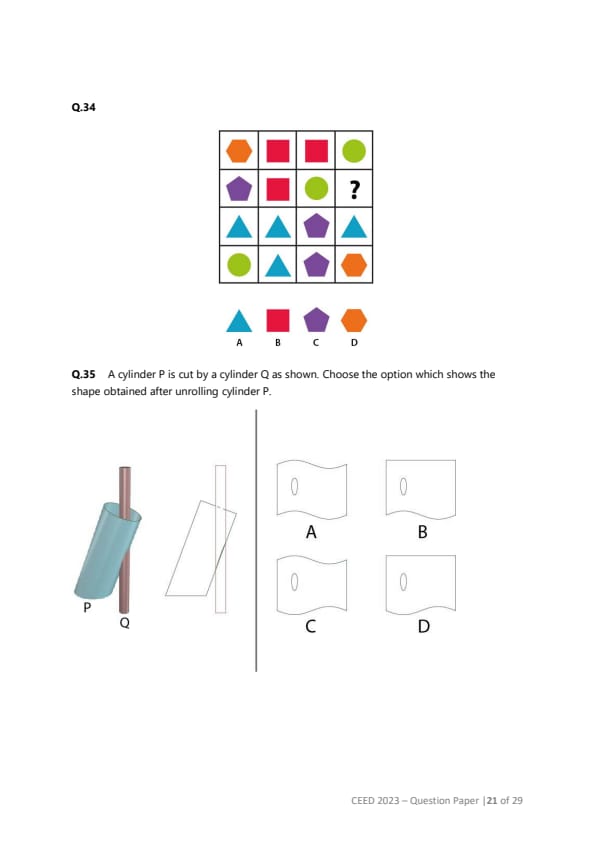
Question 34:

View Solution
1. Pattern Analysis:
- The grid follows a systematic arrangement of shapes and colors across rows and columns.
- Each row and column contains one instance of each shape (hexagon, square, circle, triangle, pentagon), ensuring no repetition within a row or column.
- Additionally, each row and column maintains unique colors for the shapes.
2. Identifying the Missing Shape:
- The missing cell is in the third row and fourth column.
- The third row already contains a hexagon (orange), triangle (blue), and circle (green).
- The fourth column already contains a square (red) and hexagon (orange).
- The missing shape is a pentagon (purple), which fits the pattern and maintains the rules.
Conclusion: The correct shape to replace the question mark is C (Pentagon, Purple).
Question 35:
A cylinder P is cut by a cylinder Q as shown. Choose the option which shows the shape obtained after unrolling cylinder P.

View Solution
1. Analysis of the Cutting Process:
- Cylinder P is intersected by cylinder Q, creating a cut along the surface of P.
- When cylinder P is unrolled into a flat sheet, the intersection with cylinder Q forms a pattern based on the geometry of the cut.
2. Shape of the Cut:
- The intersection of two cylinders forms a curved shape.
- The unrolled surface of P will display a sinusoidal-like wave pattern due to the curved nature of the intersection, as seen in B.
3. Options Analysis:
- Option A: Shows an incorrect pattern that does not match the geometry of the intersection.
- Option B: Accurately represents the sinusoidal-like pattern formed by the intersection, matching the unrolled view of cylinder P.
- Option C: Represents an unrealistic pattern for the given configuration.
- Option D: Does not align with the geometric nature of the intersection.
Conclusion: The correct shape obtained after unrolling cylinder P is shown in B.
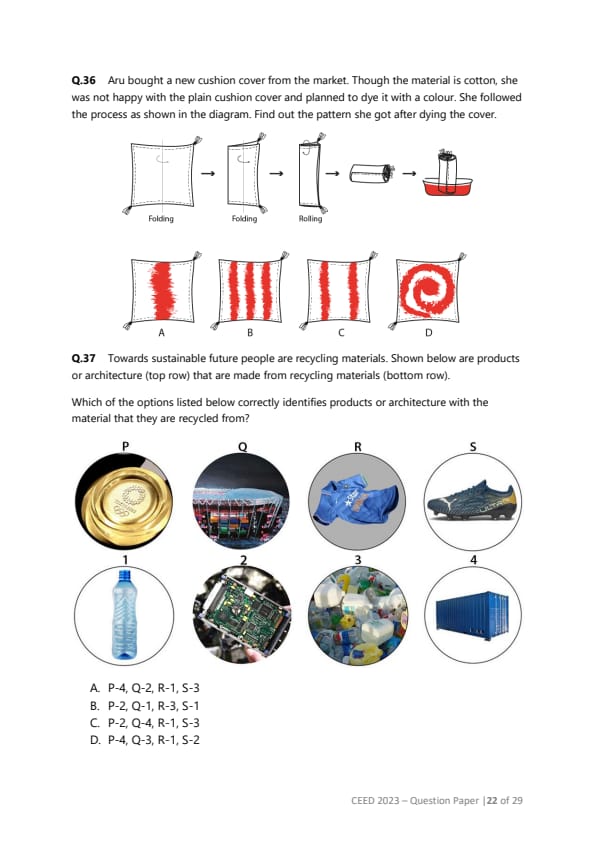
Question 36:
Aru bought a new cushion cover from the market. Though the material is cotton, she was not happy with the plain cushion cover and planned to dye it with a colour. She followed the process as shown in the diagram. Find out the pattern she got after dyeing the cover.

View Solution
1. Dyeing Process Analysis:
- Aru folded the cushion cover twice and then rolled it before dyeing.
- The dye reaches the exposed areas while the folded and rolled sections remain undyed, creating a striped pattern when the cushion cover is unfolded.
2. Pattern Formation:
- The folds create parallel layers, and the rolling ensures the dye forms alternating bands on the surface. When unrolled and unfolded, the pattern results in clean, parallel stripes, as shown in C.
3. Options Analysis:
- Option A: Represents a random dye pattern, inconsistent with the structured folding and rolling process.
- Option B: Suggests a striped pattern, but the orientation and density do not match the described process.
- Option C: Correctly represents the parallel stripes resulting from folding and rolling, aligning with the process shown.
- Option D: Indicates a spiral pattern, which is not feasible given the described folding and rolling process.
Conclusion: The pattern Aru got after dyeing the cover is shown in C.
Question 37:
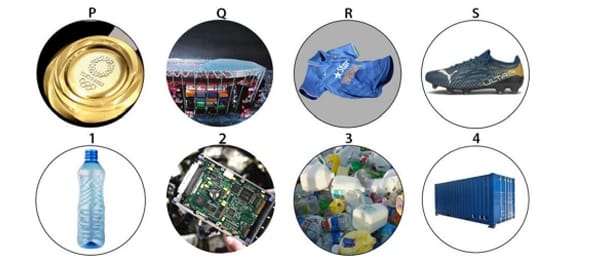
Towards a sustainable future, people are recycling materials. Shown below are products or architecture (top row) that are made from recycled materials (bottom row). Which of the options listed below correctly identifies products or architecture with the material that they are recycled from?
View Solution
1. Material and Product Matching:
- P-2: The first product (P) aligns with recycled material 2 due to its visual and structural similarity.
- Q-4: The second product (Q) is best matched with recycled material 4 based on the specific properties and usage of the recycled material.
- R-1: The third product (R) corresponds to recycled material 1, clearly resembling its texture and origin.
- S-3: The fourth product (S) aligns with recycled material 3 based on its appearance and characteristics.
2. Options Analysis:
- Option A: Incorrect matching of P, Q, R, and S.
- Option B: Incorrect arrangement of materials for P, Q, R, and S.
- Option C: Correctly matches P-2, Q-4, R-1, and S-3, making it the accurate answer.
- Option D: Misplaces one or more materials, making it incorrect.
Conclusion: The correct option that matches the products or architecture with the recycled materials is C.
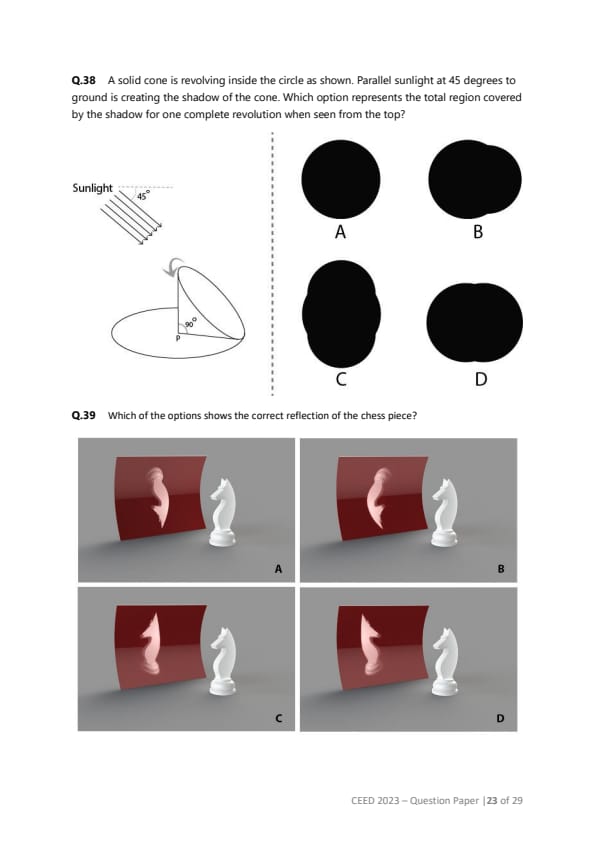
Question 38:
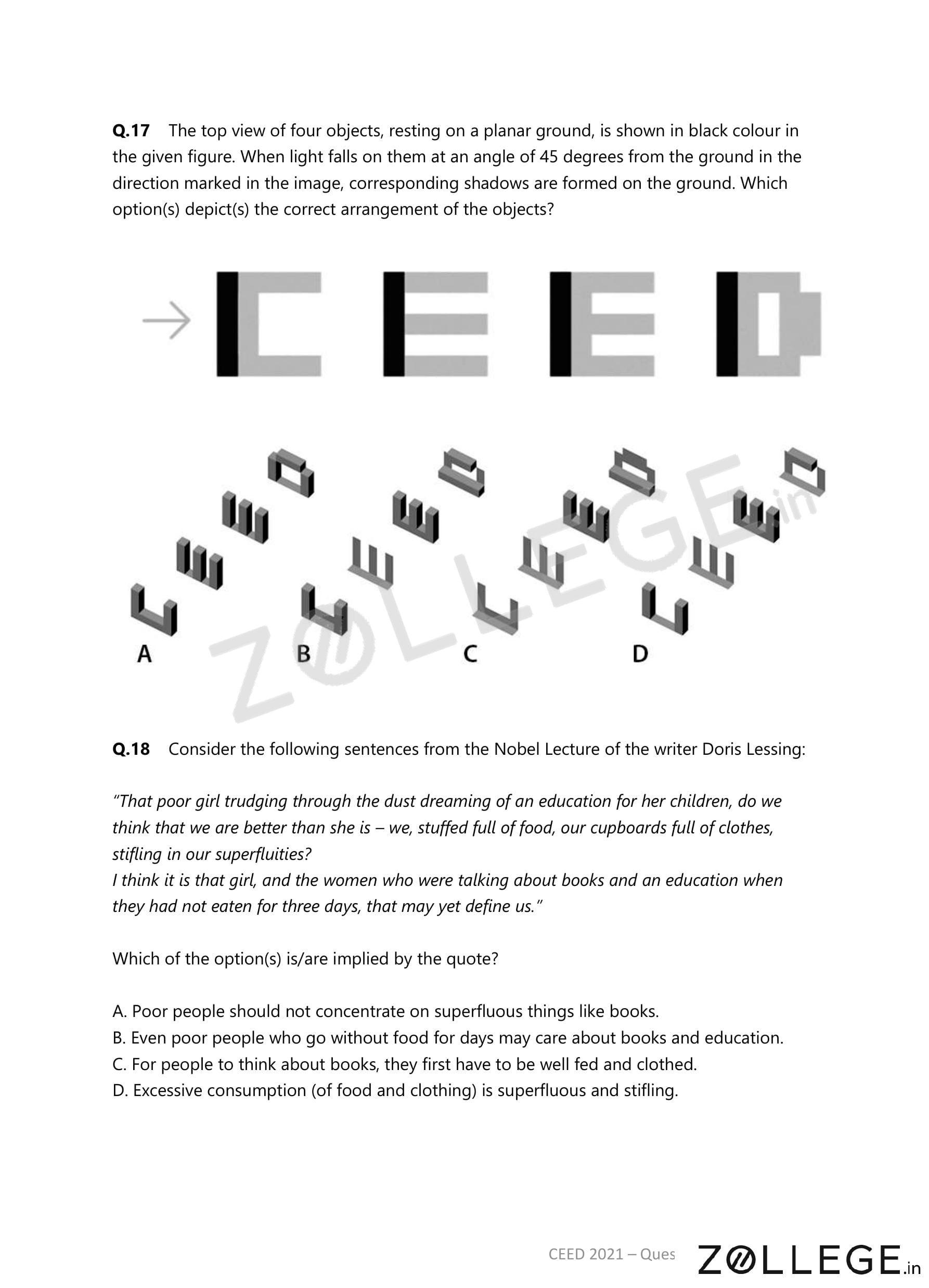
A solid cone is revolving inside the circle as shown. Parallel sunlight at 45 degrees to the ground is creating the shadow of the cone. Which option represents the total region covered by the shadow for one complete revolution when seen from the top?

View Solution
1. Analysis of the Problem:
- The shadow of the cone is determined by the cone's movement during its revolution and the angle of sunlight.
- As the cone revolves, the shadow extends outward and overlaps during the revolution due to the circular motion and the 45-degree angle of sunlight.
2. Pattern of the Shadow:
- The shadow will cover an elliptical region on the ground, and its shape will be influenced by the 45-degree angle of sunlight, resulting in overlapping areas as the cone completes its revolution.
3. Options Analysis:
- Option A: Shows a simple circular shadow, which is incorrect as it does not account for the 45-degree angle of sunlight.
- Option B: Correctly represents the overlapping elliptical shadow resulting from the cone’s revolution and the sunlight angle.
- Option C: Depicts an elongated shape inconsistent with the motion of the cone.
- Option D: Shows a shape that does not accurately reflect the total shadow region during the cone's revolution.
Conclusion: The correct option representing the total region covered by the shadow is B.
Question 39:
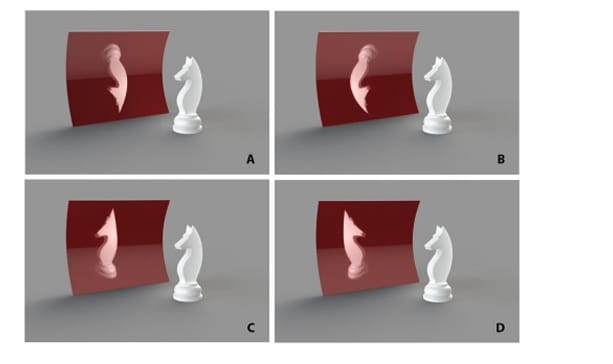
Which of the options shows the correct reflection of the chess piece?
View Solution
1. Understanding Reflection:
- The reflection of the chess piece on a curved surface follows the laws of reflection, where the angle of incidence equals the angle of reflection.
- The shape and orientation of the reflection depend on the curvature of the surface and the position of the chess piece relative to the reflective surface.
2. Analysis of Options:
- Option A: The reflection accurately represents the orientation and proportions of the chess piece based on the curvature of the reflective surface. Hence, A is correct.
- Option B: The reflection in B is distorted and inconsistent with the expected reflection from the curved surface.
- Option C: The reflection in C does not align with the correct orientation and shape of the chess piece.
- Option D: The reflection in D is flipped incorrectly and does not match the geometry of the reflective surface.
3. Conclusion: The correct reflection of the chess piece is shown in A.
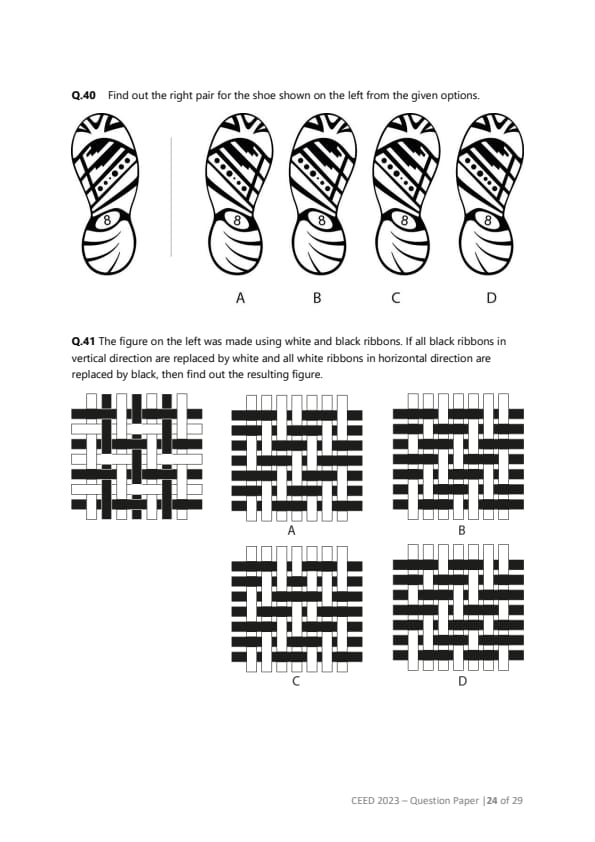
Question 40:
Find out the right pair for the shoe shown on the left from the given options.

View Solution
1. Analysis of the Shoe Pattern:
- The shoe shown on the left represents one side of the pair, and the correct pair must match the design while being its mirrored counterpart.
- Look for details such as the arrangement of patterns, stripes, dots, and orientation of design elements to identify the correct match.
2. Options Analysis:
- Option A: The design is not a mirrored version of the original shoe and does not align with the correct pattern.
- Option B: While partially similar, the orientation of certain design elements does not match the required mirrored counterpart.
- Option C: This option correctly represents the mirrored design of the shoe shown on the left, with all patterns and orientations properly matched. Hence, C is correct.
- Option D: The design differs in certain elements, making it an incorrect match for the given shoe.
3. Conclusion: The correct pair for the shoe shown on the left is C.
Question 41:
The figure on the left was made using white and black ribbons. If all black ribbons in the vertical direction are replaced by white and all white ribbons in the horizontal direction are replaced by black, then find out the resulting figure.

View Solution
1. Understanding the Replacement Rule:
- Black ribbons in the vertical direction: These will be replaced with white ribbons.
- White ribbons in the horizontal direction: These will be replaced with black ribbons.
2. Applying the Replacement:
- By replacing vertical black ribbons with white and horizontal white ribbons with black, the crossing pattern is preserved, but the colors are swapped accordingly.
3. Options Analysis:
- Option A: Correctly represents the resulting pattern with vertical white ribbons and horizontal black ribbons, maintaining the crossing structure.
- Option B: Does not correctly reflect the replacements as per the rules provided.
- Option C: Misplaces the color assignments for the ribbons, leading to an incorrect pattern.
- Option D: Contains errors in ribbon coloring and does not align with the replacement rule.
Conclusion: The resulting figure after applying the replacement rule is A.
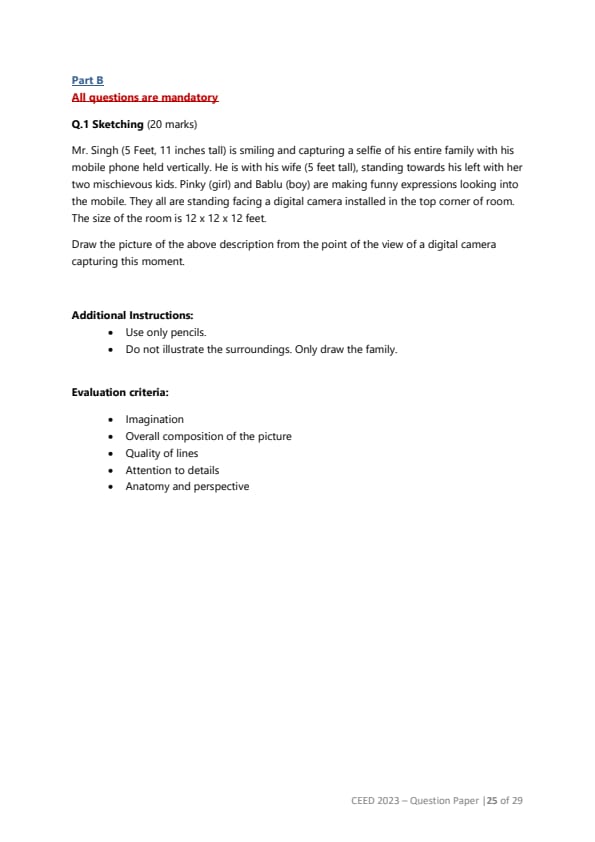
Part- B
Question 1. Sketching (20 marks)
Mr. Singh (5 Feet, 11 inches tall) is smiling and capturing a selfie of his entire family with his mobile phone held vertically. He is with his wife (5 feet tall), standing towards his left with her two mischievous kids. Pinky (girl) and Bablu (boy) are making funny expressions looking into the mobile. They all are standing facing a digital camera installed in the top corner of the room. The size of the room is 12 x 12 x 12 feet.
Draw the picture of the above description from the point of view of a digital camera capturing this moment.
Additional Instructions:
- Use only pencils.
- Do not illustrate the surroundings. Only draw the family.
Evaluation Criteria:
- Imagination
- Overall composition of the picture
- Quality of lines
- Attention to details
- Anatomy and perspective
View Solution
Solution: Below is the sketch drawn as per the given description and instructions:

Note: The above sketch represents Mr. Singh and his family as viewed from the digital camera installed at the top corner of the room. The perspective accounts for the height differences and the positions of each family member.
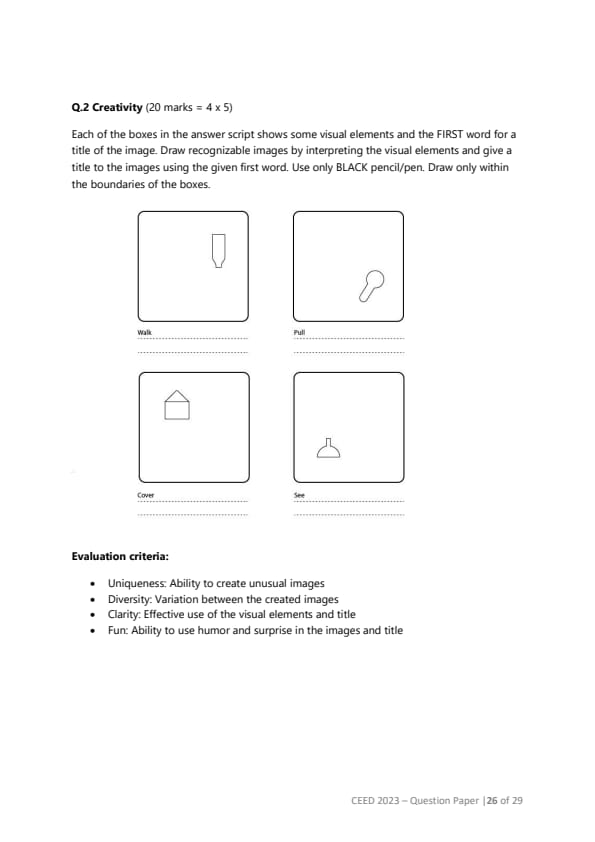
Question 2. Creativity (20 marks = 4 x 5)
Each of the boxes in the answer script shows some visual elements and the FIRST word for a title of the image. Draw recognizable images by interpreting the visual elements and give a title to the images using the given first word. Use only BLACK pencil/pen. Draw only within the boundaries of the boxes.
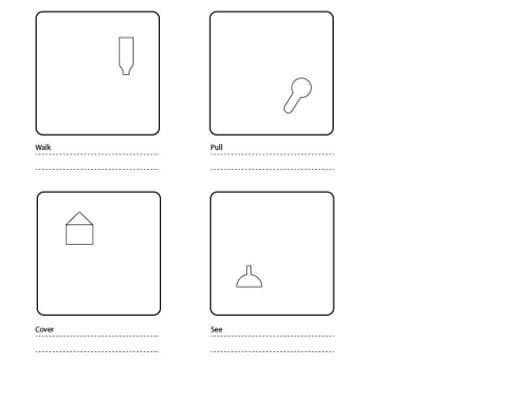
Evaluation Criteria:
- Uniqueness: Ability to create unusual images
- Diversity: Variation between the created images
- Clarity: Effective use of the visual elements and title
- Fun: Ability to use humor and surprise in the images and title
View Solution
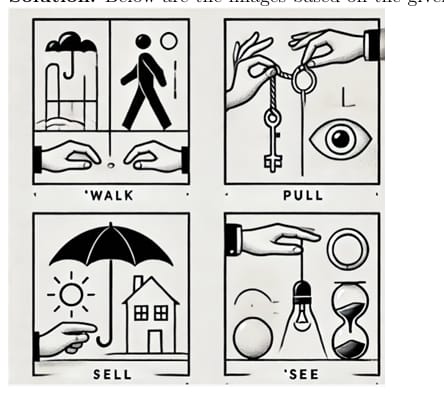
Solution: Below are the images based on the given visual elements and first words:
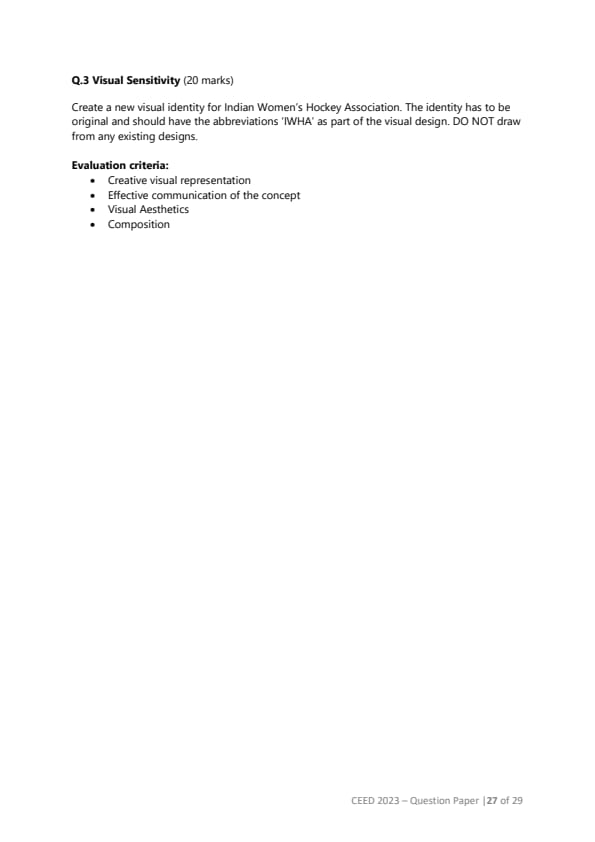
Question 3. Visual Sensitivity (20 marks)
Create a new visual identity for Indian Women’s Hockey Association. The identity has to be original and should have the abbreviations ‘IWHA’ as part of the visual design. DO NOT draw from any existing designs.
Evaluation Criteria:
- Creative visual representation
- Effective communication of the concept
- Visual Aesthetics
- Composition
View Solution
Solution: Below is the proposed visual identity for Indian Women’s Hockey Association (IWHA):

Description:
The visual identity incorporates the following elements:
- Abbreviation (IWHA): Prominently integrated into the design to represent the Indian Women’s Hockey Association.
- Symbolic Elements: The design features hockey sticks, a ball, and a visual motif representing strength, unity, and empowerment, emphasizing the spirit of Indian women in sports.
- Aesthetic Appeal: The composition uses clean lines and harmonious proportions for a visually striking and memorable identity.
- Originality: The design is unique and does not draw from any existing logos or identities.
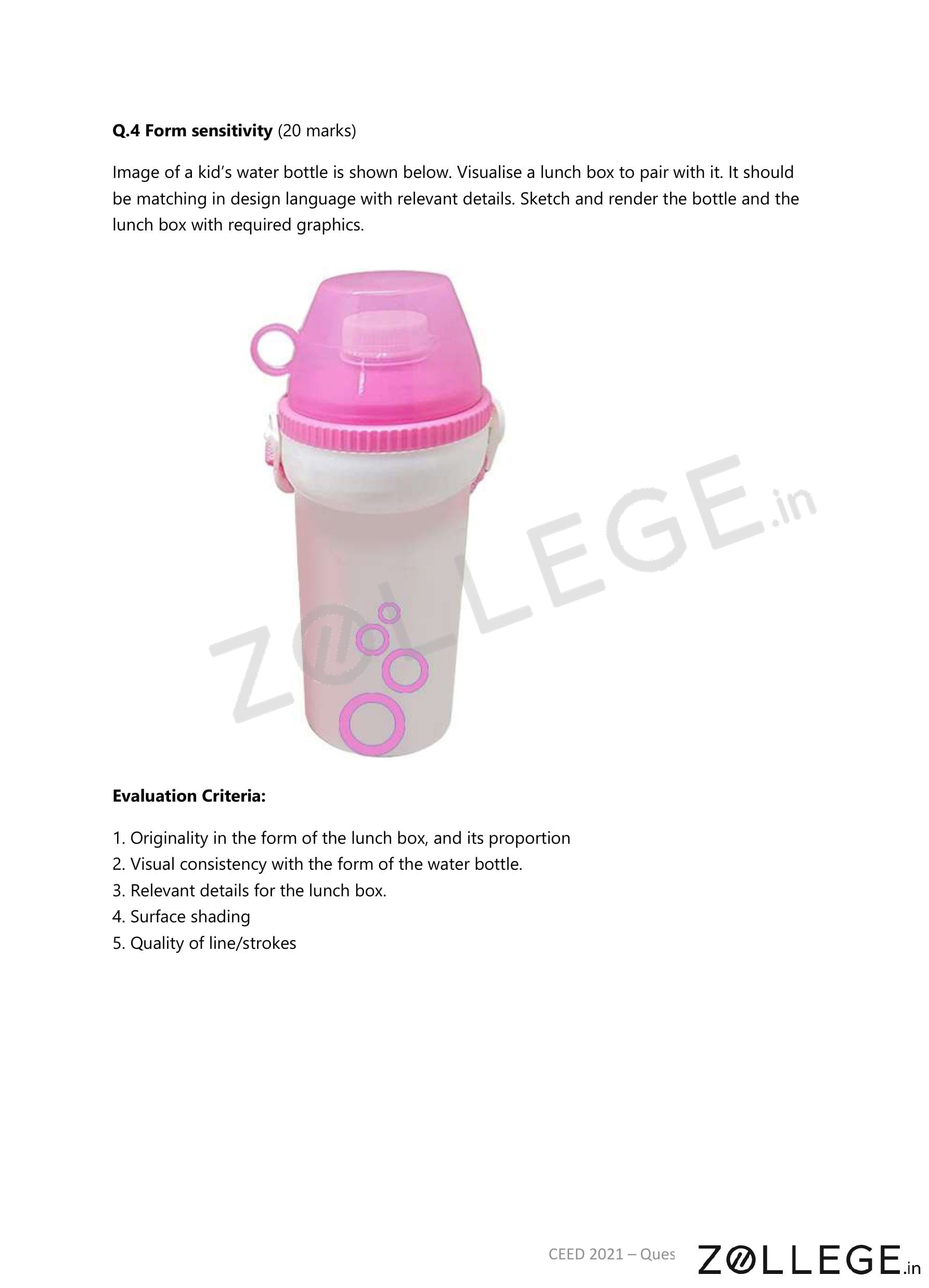
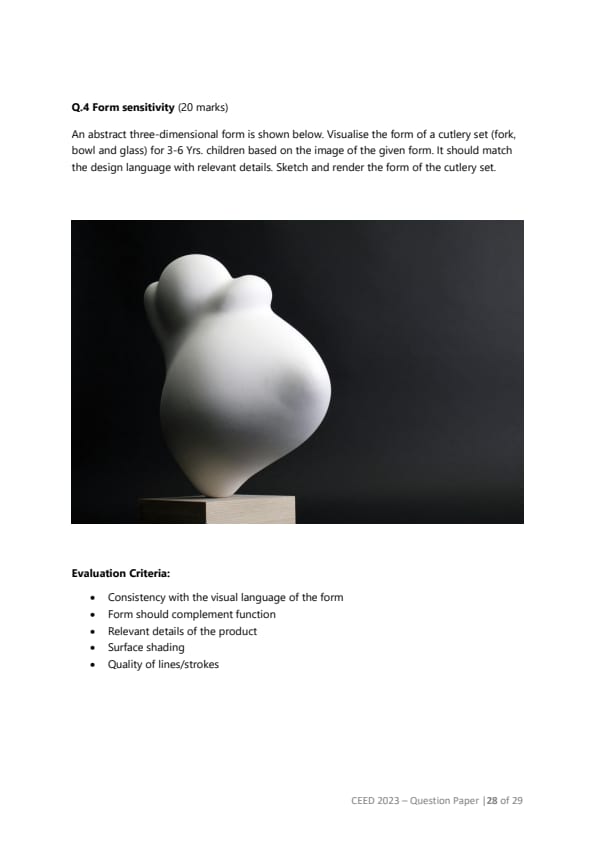
Question 4. Form Sensitivity (20 marks)
An abstract three-dimensional form is shown below. Visualize the form of a cutlery set (fork, bowl, and glass) for 3-6 years old children based on the image of the given form. It should match the design language with relevant details. Sketch and render the form of the cutlery set.

Evaluation Criteria:
- Consistency with the visual language of the form
- Form should complement function
- Relevant details of the product
- Surface shading
- Quality of lines/strokes
View Solution
Solution: Below is the visualized design of the cutlery set (fork, bowl, and glass) for children aged 3-6 years, inspired by the given abstract form:

Description:
- Fork: The fork design follows the curved and smooth contours of the abstract form, ensuring safety and usability for children.
- Bowl: The bowl adopts a rounded and stable structure inspired by the organic form, making it easy to handle and spill-resistant.
- Glass: The glass mimics the overall symmetry and softness of the abstract form, designed to fit comfortably in small hands.
- Material and Surface: All items feature soft edges and non-slip textures to ensure safety and functionality for young children.
Conclusion: The cutlery set aligns with the abstract form's visual language while providing functionality and safety for children aged 3-6 years.
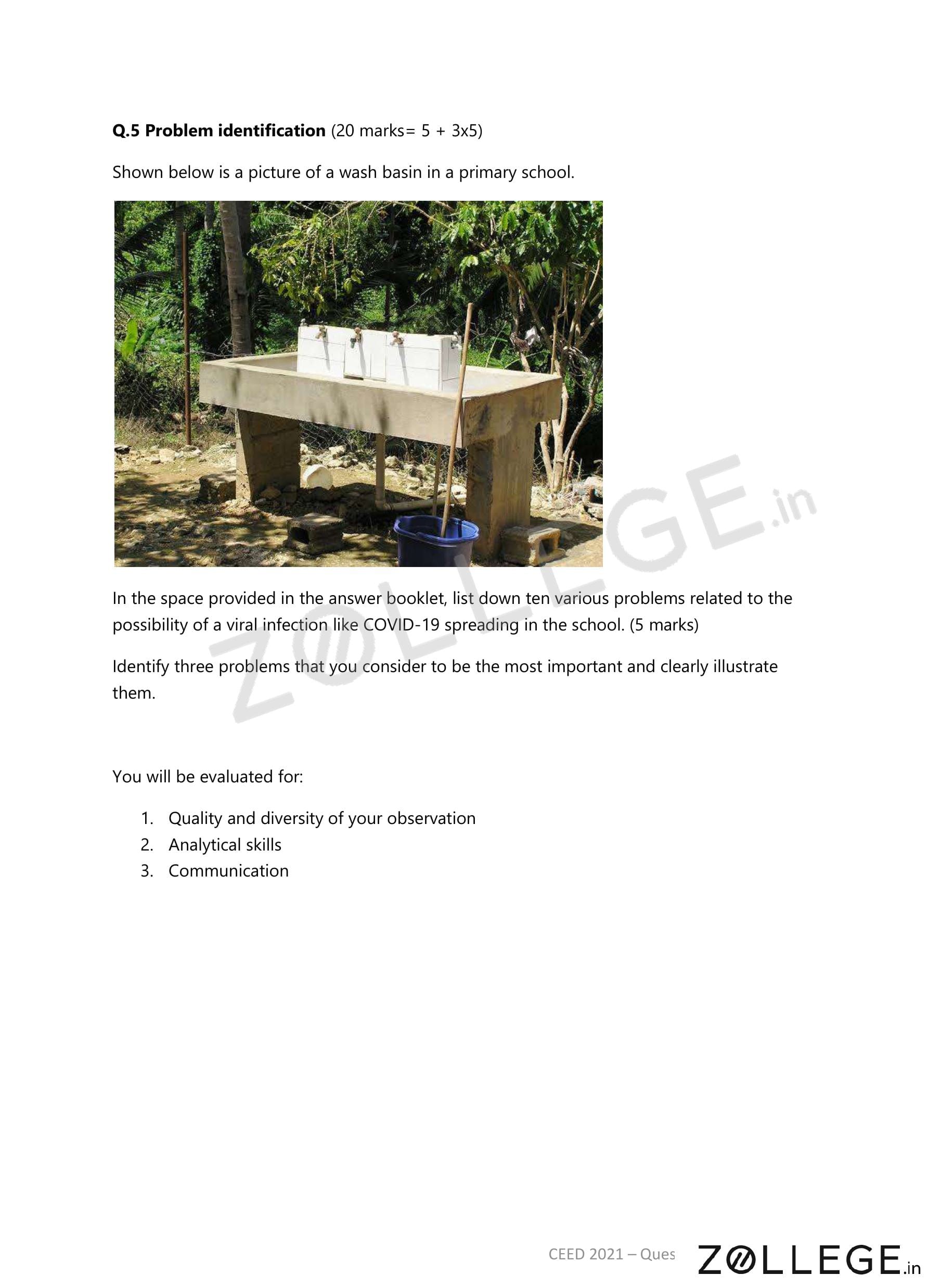
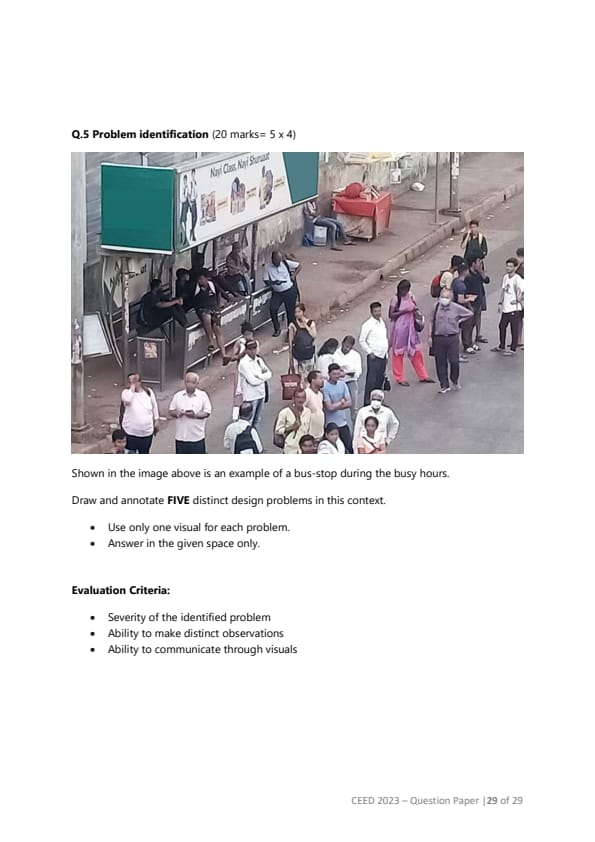
Question 5. Problem Identification (20 marks = 5 x 4)
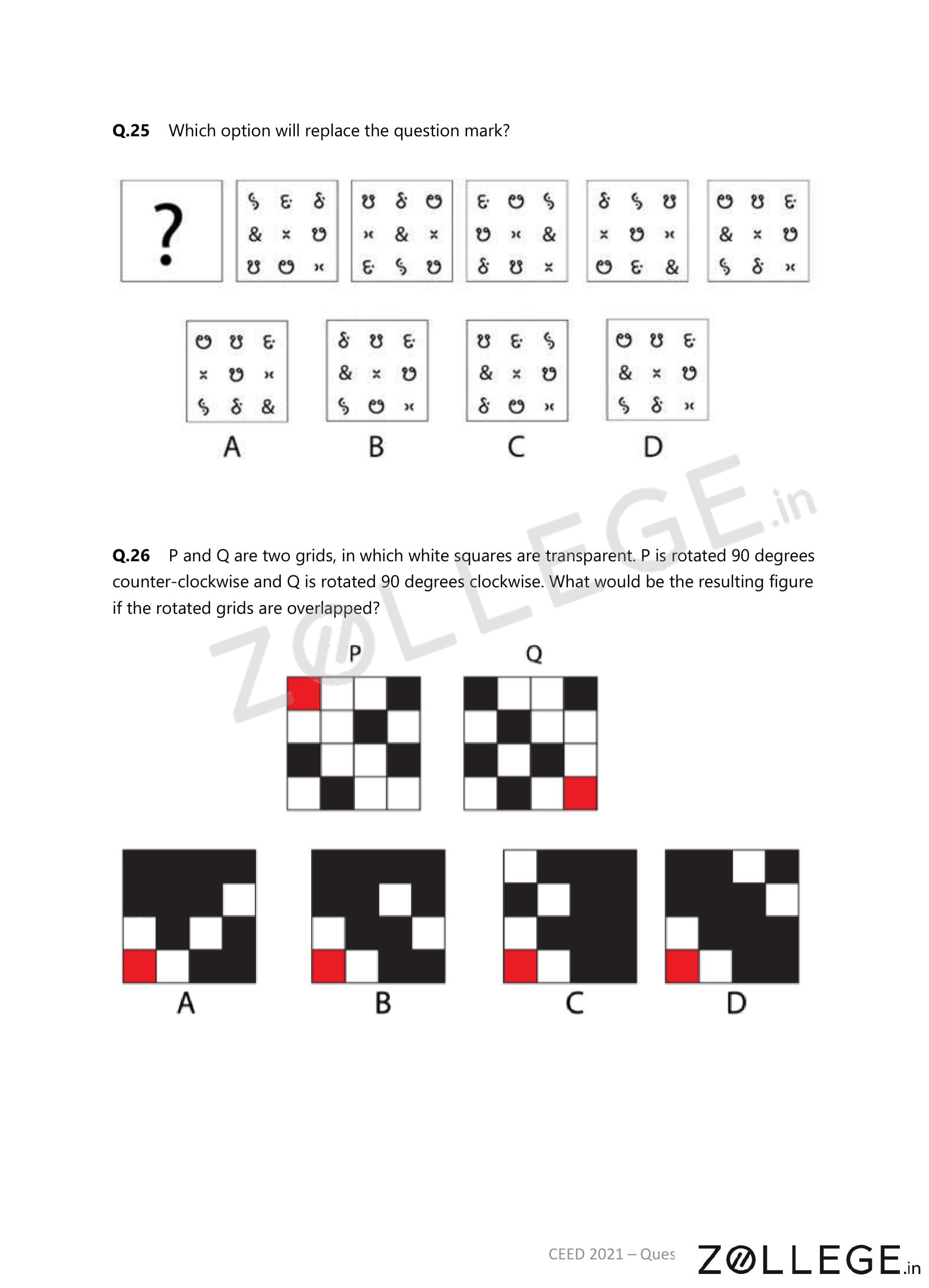
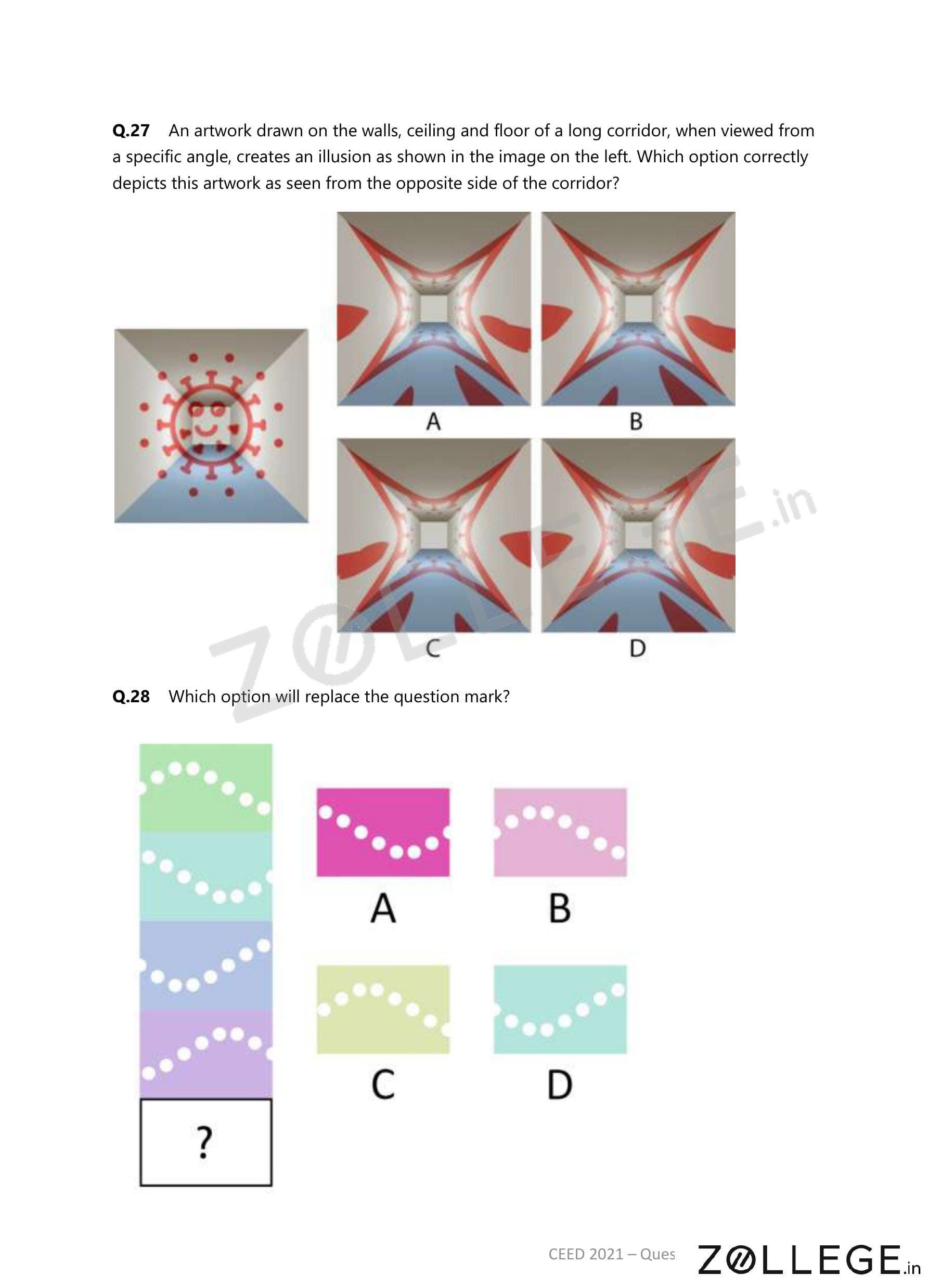
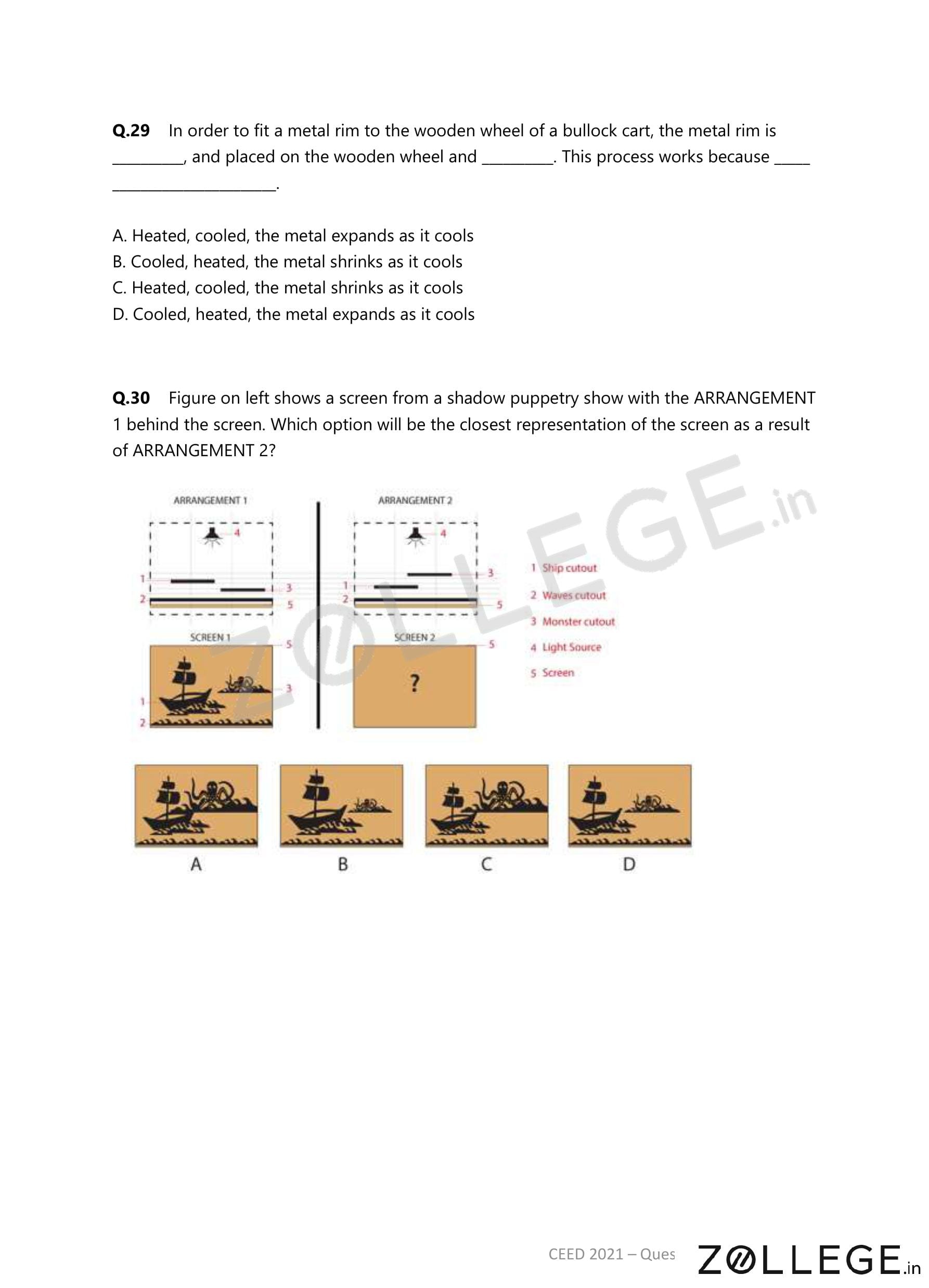
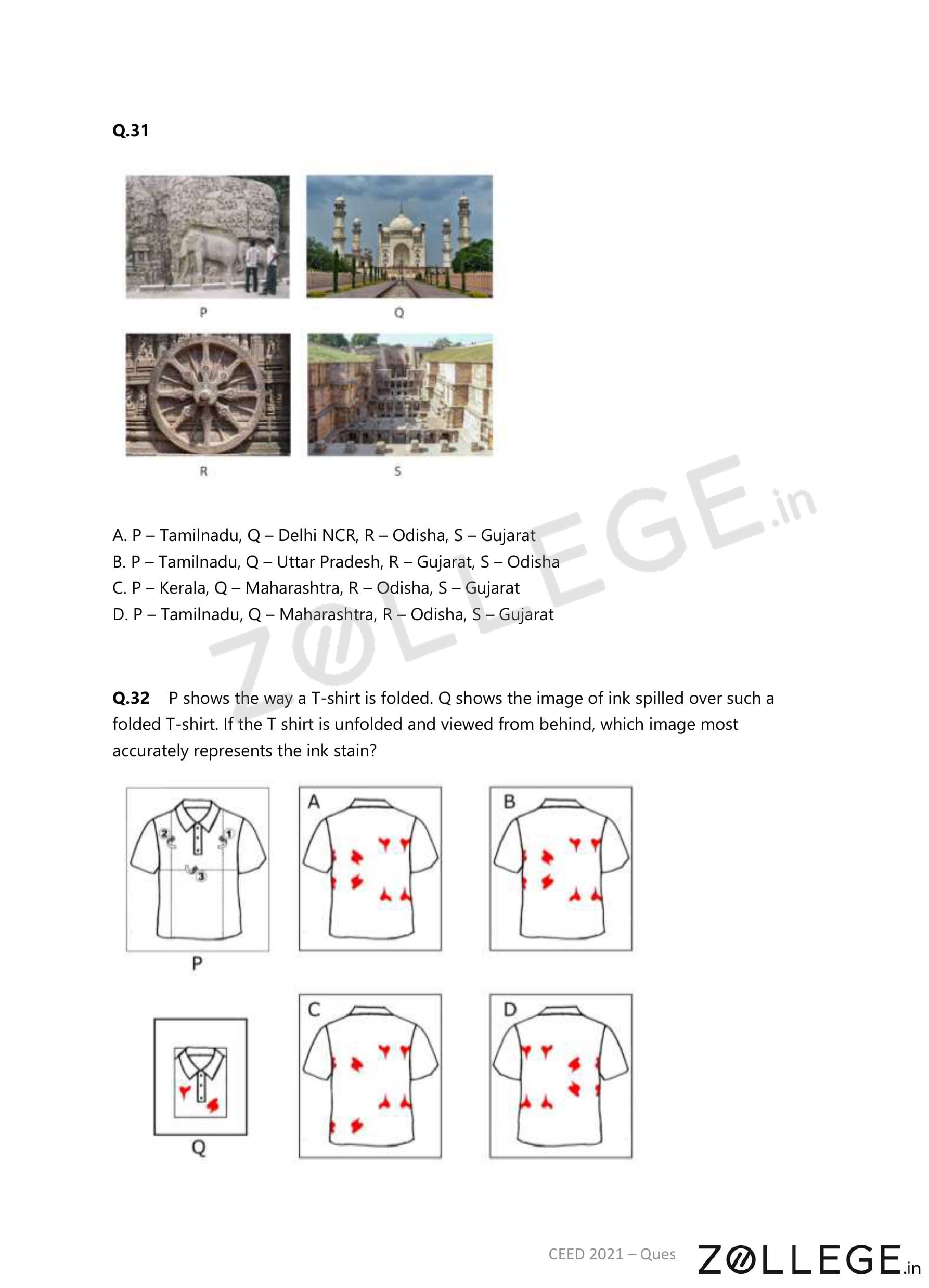
Shown in the image above is an example of a bus stop during the busy hours.
Draw and annotate FIVE distinct design problems in this context.
Additional Instructions:
- Use only one visual for each problem.
- Answer in the given space only.

Evaluation Criteria:
- Severity of the identified problem
- Ability to make distinct observations
- Ability to communicate through visuals
Solution: Below are the identified design problems and corresponding visuals with annotations:

*The article might have information for the previous academic years, please refer the official website of the exam.