
CEED 2024 Question Paper Pdf- Check Solutions with Answer Key Pdf

.jpg?tr=h-55,w-55,c-force)
Content Strategist|Tech-innovator|National Hackathon Winner | Updated On - Jan 18, 2025
CEED 2024 Question Paper for January 21 is available for download. The exam was successfully conducted by IIT Bombay from 9:00 AM to 12:00 PM. As per the students’ initial reactions, CEED 2024 Question Paper for January 21 was reported as Moderate. Part A was considered Moderately Difficult, while Part B was Easy to Moderate.
Candidates can download the CEED 2024 Question Paper with Solution and Answer Key PDFs for January 21 using the link below.
| CEED 2024 January 21 Question Paper with Answer Key |  Download Download |
Check Solution |
Part- A
Question 1:
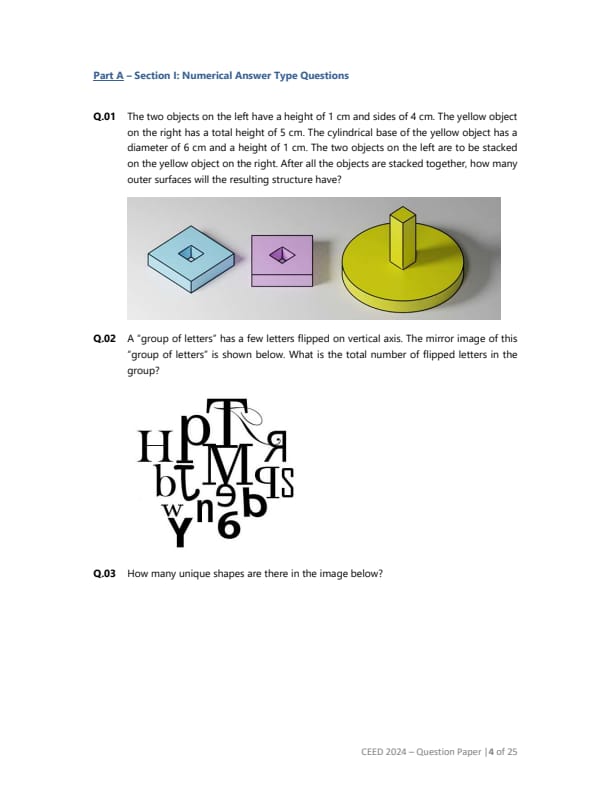
The two objects on the left have a height of 1 cm and sides of 4 cm. The yellow object on the right has a total height of 5 cm. The cylindrical base of the yellow object has a diameter of 6 cm and a height of 1 cm. The two objects on the left are to be stacked on the yellow object on the right. After all the objects are stacked together, how many outer surfaces will the resulting structure have?

View Solution
Step 1: Examine the structure.
- The two cuboids on the left are hollow with a square outer surface and a square hole in the middle. Each cuboid has four vertical sides, one top surface, and one bottom surface. The hole creates four additional inner vertical surfaces.
- The yellow object on the right consists of a cylindrical base and a vertical pillar.
Step 2: Count the visible outer surfaces when the objects are stacked.
- For the two cuboids:
- There are 4 outer vertical surfaces, 4 inner vertical surfaces, 1 top surface, and 1 bottom surface. This gives 10 surfaces per cuboid.
- For both cuboids: 10 × 2 = 20 surfaces.
- For the yellow object:
- The cylindrical base contributes 1 top surface, 1 bottom surface, 1 top surface of the pillar, and 2 vertical sides of the pillar, giving a total of 5 surfaces.
Step 3: Calculate the total visible surfaces.
Adding up all the surfaces:
20 (from the two cuboids) + 5 (from the yellow object) = 25 total visible surfaces.
Question 2:
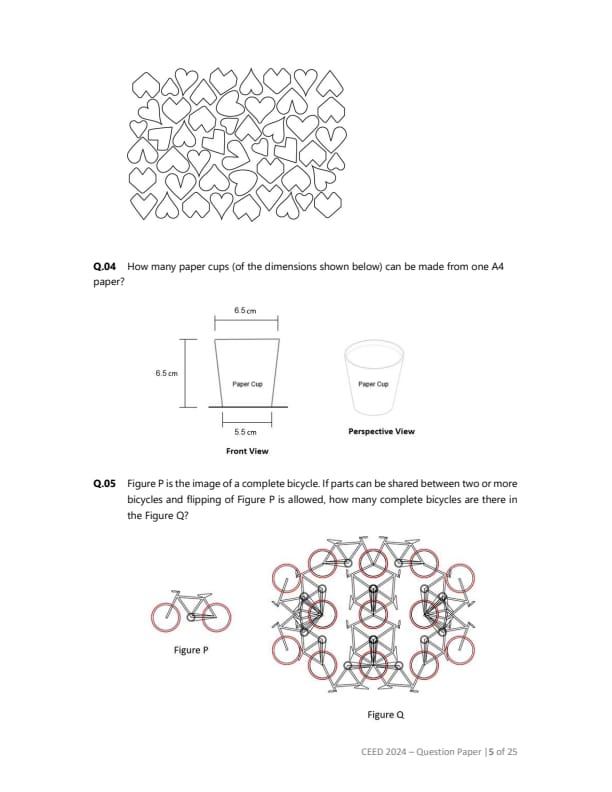
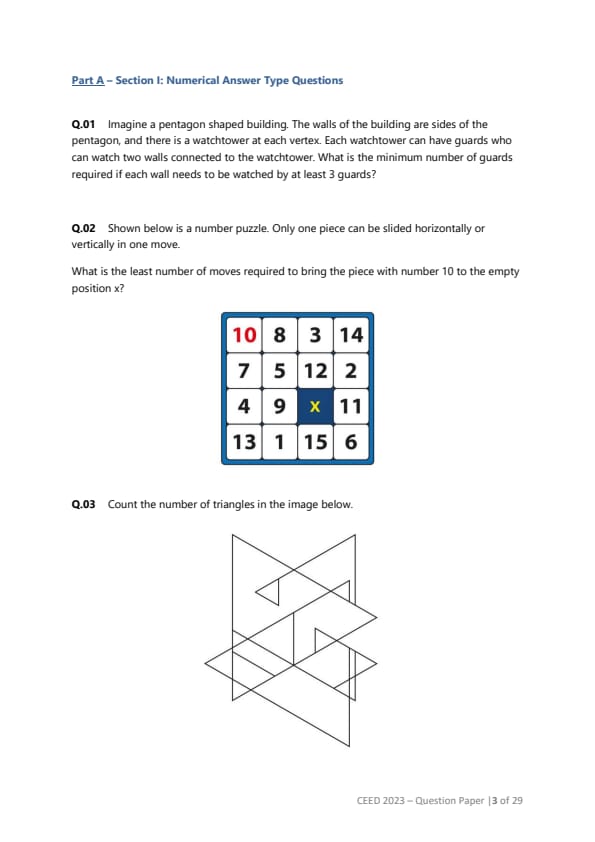
A "group of letters" has a few letters flipped on vertical axis. The mirror image of this "group of letters" is shown below. What is the total number of flipped letters in the group?

View Solution
Step 1: Identify the letters that are flipped along the vertical axis.
The flipped letters are:
p, q, b, d, m, w, n.
This gives a total of 7 flipped letters.
Step 2: Consider potential ambiguities.
It is possible that 6 and y could also be considered flipped due to their visual resemblance, which would add 2 more flipped letters.
Step 3: Final conclusion on the total number of flipped letters.
Thus, the total number of flipped letters could either be: 7 or 9.
Question 3:
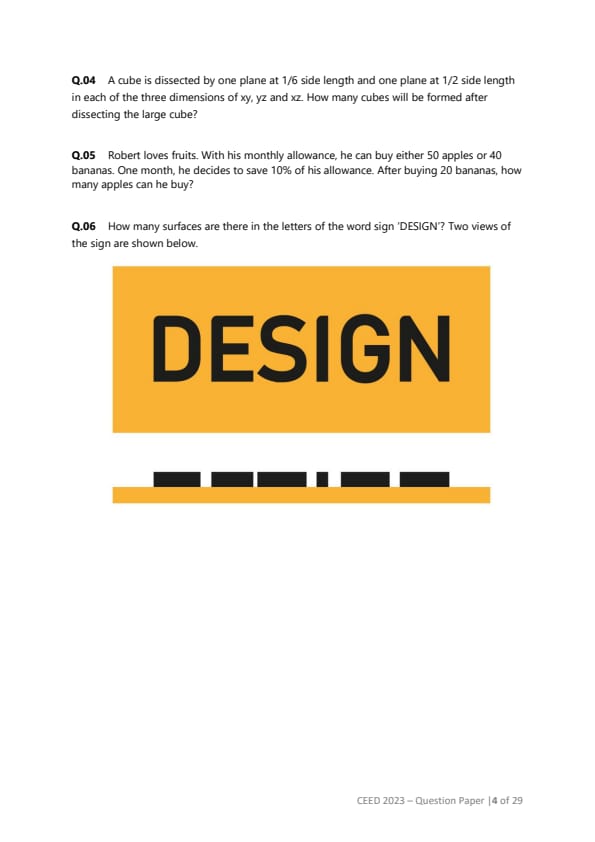
How many unique shapes are there in the image below?

View Solution
Step 1: Examine the shapes in the image.
The image contains a variety of geometric and abstract shapes.
Step 2: Identify the distinct shapes.
After careful inspection, we observe 10 unique shapes in the image. These include different orientations of hearts, diamonds, spades, clubs, and other abstract forms. Rotations or reflections of the same shape are not counted as distinct.
Step 3: Determine the total number of unique shapes.
Thus, the total number of unique shapes is: 10.
Question 4:
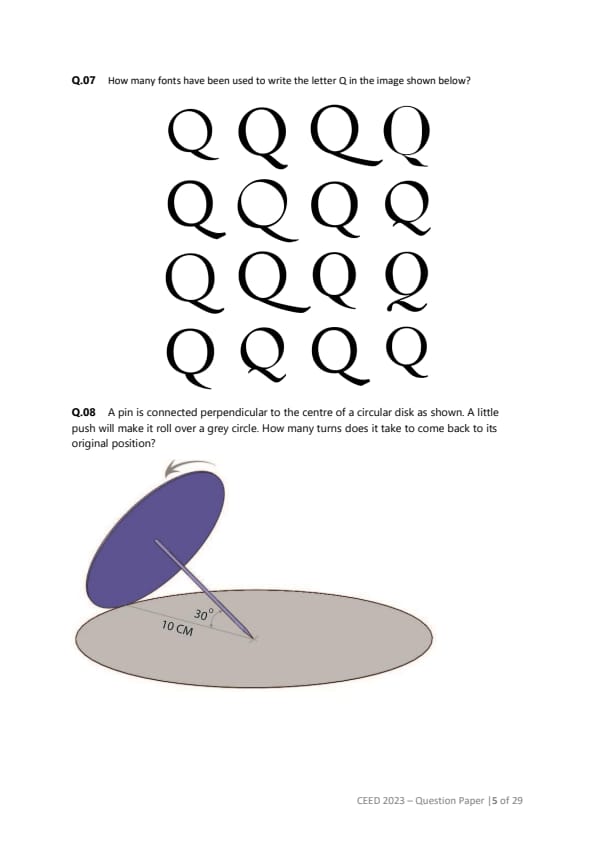
How many paper cups (of the dimensions shown below) can be made from one A4 paper?

View Solution
Step 1: Determine the dimensions of the paper cup.
The paper cup has a frustum shape with a height of 6.5 cm, a top diameter of 6.5 cm, and a bottom diameter of 5.5 cm.
Step 2: Calculate the lateral surface area of the cup.
The lateral surface area of a frustum is calculated using the formula:
Lateral Area = π (r1 + r2) ⋅ l,
where r1 = 3.25 cm, r2 = 2.75 cm, and l = √(6.5)2 + (3.25 - 2.75)2 ≈ 6.52 cm.
Substituting these values gives:
Lateral Area = π (3.25 + 2.75) ⋅ 6.52 ≈ 125.4 cm2.
Step 3: Compare with the area of A4 paper.
The total area of A4 paper is 21 cm × 29.7 cm = 623.7 cm2.
Step 4: Calculate how many cups can be made.
Since each cup requires 125.4 cm2, the number of cups that can be made from the A4 paper is:
Number of cups = 623.7 / 125.4 ≈ 3.
Question 5:
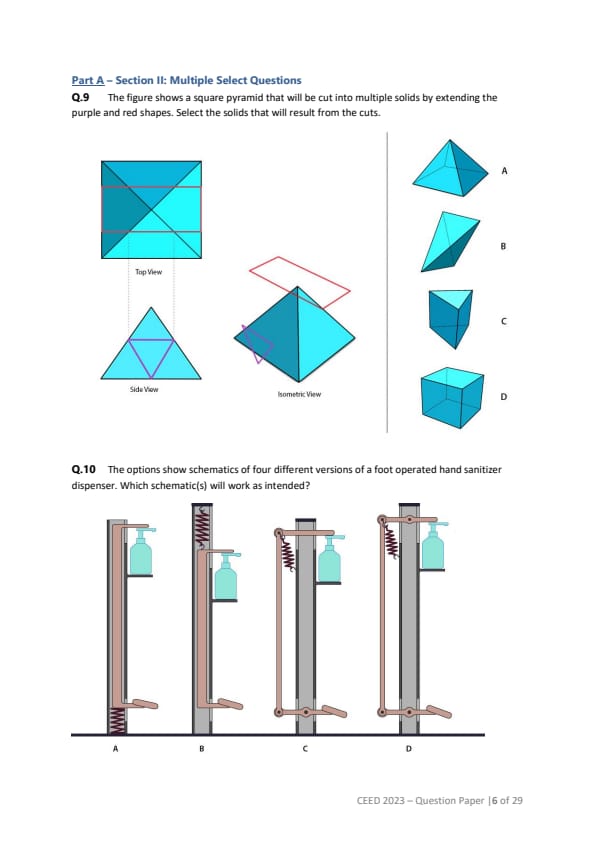
Figure P is the image of a complete bicycle. If parts can be shared between two or more bicycles and flipping of Figure P is allowed, how many complete bicycles are there in Figure Q?

View Solution
Step 1: Identify the shared components in Figure Q.
Each bicycle includes a frame, two wheels, and a set of pedals.
In Figure Q, components such as wheels and frames are shared among multiple bicycles.
Step 2: Calculate the maximum possible number of bicycles.
The total number of wheels in the structure is 32. Since each bicycle requires 2 wheels, we can calculate:
Maximum bicycles from wheels = 32 / 2 = 16.
The total number of frames in the structure is 16, and since each bicycle requires 1 frame, this number is consistent with the number of wheels.
Step 3: Determine the total number of bicycles.
Thus, the total number of complete bicycles that can be assembled is: 16.
Question 6:
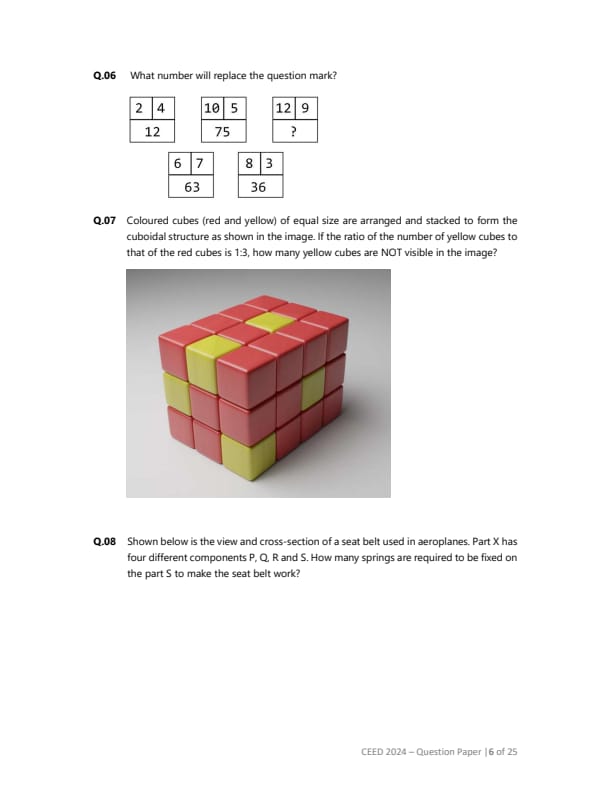
What number will replace the question mark?

View Solution
Step 1: Understand the pattern in the given rows.
Each row follows a relationship where the product of the first two numbers equals the third number in the row.
Step 2: Check the pattern for the first two rows.
For the first row:
2 × 4 = 8, and 12 = 8 × 1.5.
For the second row:
10 × 5 = 50, and 75 = 50 × 1.5.
Step 3: Apply the pattern to the last row to find the missing number.
For the third row:
12 × 9 = 108, and ? = 108 × 1.5 = 162.
Step 4: Finally, the answer:
The number replacing the question mark is: 162.
Question 7:
Coloured cubes (red and yellow) of equal size are arranged and stacked to form the cuboidal structure as shown in the image. If the ratio of the number of yellow cubes to that of the red cubes is 1:3, how many yellow cubes are NOT visible in the image?

View Solution
To get the number of yellow cubes that are not visible, first find the total number of cubes and then apply the given ratio of yellow to red cubes. After this, subtract the visible yellow cubes in the image and subtract this number from the total number of yellow cubes.
Step 1
Count the total number of cubes in the cuboidal structure. The structure is a 3x3x3 cube, so the total number of cubes is 3 × 3 × 3 = 27 cubes.
Step 2
Using the given ratio of yellow cubes to red cubes, which is 1:3, we can determine the number of yellow and red cubes. Let the number of yellow cubes be y and the number of red cubes be r. According to the ratio, y:r = 1:3. Therefore, y = (1/4) × 27 = 6.75 and r = (3/4) × 27 = 20.25. Since the number of cubes must be an integer, we round y to 7 and r to 20.
Step 3
Count the number of visible yellow cubes in the image. From the image, we can see that there are 5 yellow cubes visible.
Step 4
Subtract the number of visible yellow cubes from the total number of yellow cubes to find the number of yellow cubes that are not visible. 7 - 5 = 2.
Step 5
Therefore, the number of yellow cubes that are not visible in the image is 2.
Question 8:
Shown below is the view and cross-section of a seat belt used in aeroplanes. Part X has four different components P, Q, R, and S. How many springs are required to be fixed on the part S to make the seat belt work?

View Solution
Step 1: Understand the function of the seat belt mechanism.
The seat belt system relies on part S to maintain tension and allow controlled movement.
The spring is crucial for enabling the locking and unlocking mechanism of the belt.
Step 2: Examine the function of part S in the diagram.
From the cross-section, it is evident that part S is responsible for retracting the belt to its original position after it is extended.
To perform this function, only one spring is needed to provide the necessary tension.
Step 3: Determine the number of springs.
Therefore, the seat belt mechanism requires: 1 spring on part S.
Part A
Question 9:
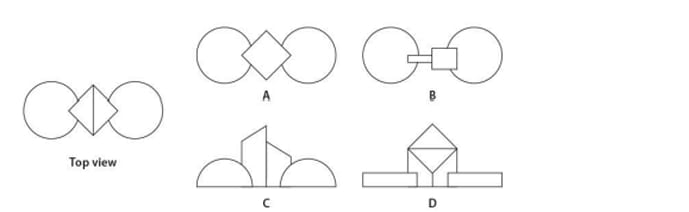
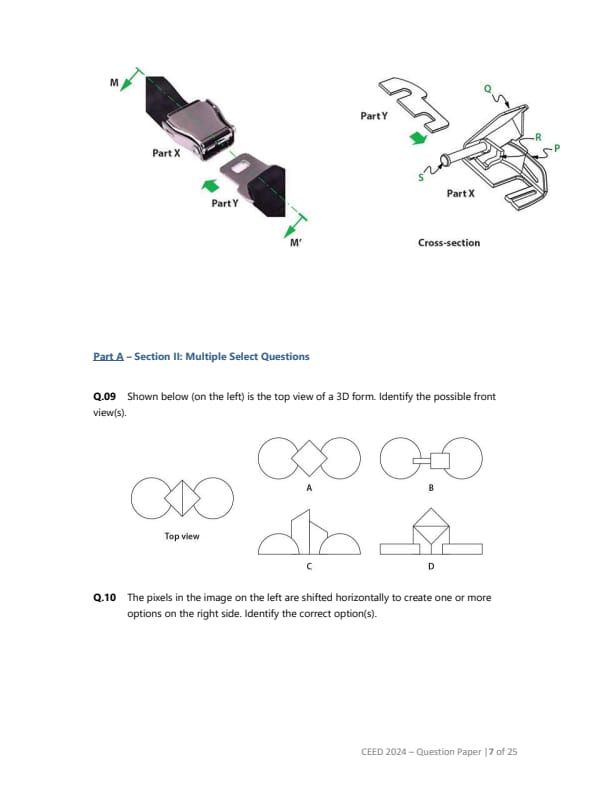
Shown below (on the left) is the top view of a 3D form. Identify the possible front view(s).
View Solution
Step 1: Analyze the top view.
The top view shows two circles with a diamond shape in between. The diamond shape connects the two circles.
Step 2: Match the possible front views.
- Option C: This option depicts a pyramid (representing the diamond in the top view) connecting two semi-circles, which aligns with the structure.
- Option D: This option shows a triangular prism (representing the front of the diamond) connecting two blocks that correspond to the circles.
Step 3: Eliminate incorrect options.
Options A and B do not correctly represent the diamond or the circles when viewed from the front.
Step 4: Conclude the answer.
Therefore, the possible front views are: C and D.
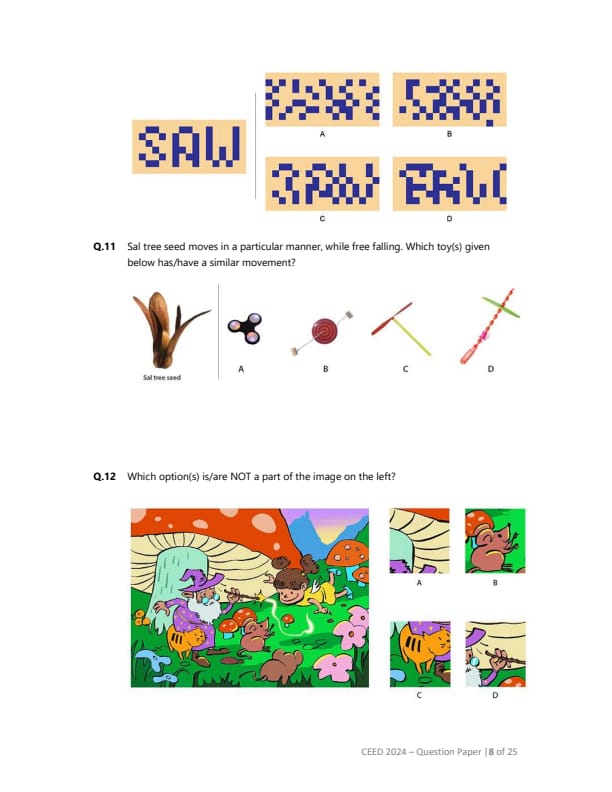
Question 10:
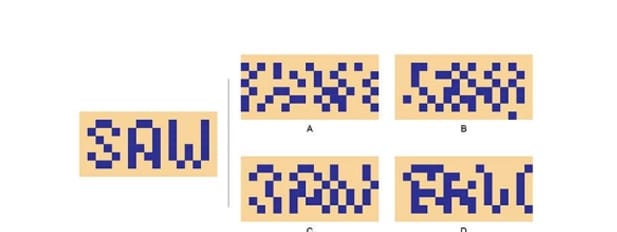
The pixels in the image on the left are shifted horizontally to create one or more options on the right side. Identify the correct option(s)
View Solution
Step 1: Examine the original pixel pattern on the left.
The pattern spells "SAW" using blue pixels, with the letters aligned horizontally.
Step 2: Compare with each option.
- Option A: The pixel arrangement represents "SAW" with minor horizontal shifts, which is correct.
- Option B: The arrangement disrupts the horizontal alignment of "SAW", which is incorrect.
- Option C: The pixels are shifted horizontally but still maintain the shape of "SAW", which is correct.
- Option D: The pixel arrangement does not align with "SAW", which is incorrect.
Step 3: Conclude the answer.
The correct options are: A and C.
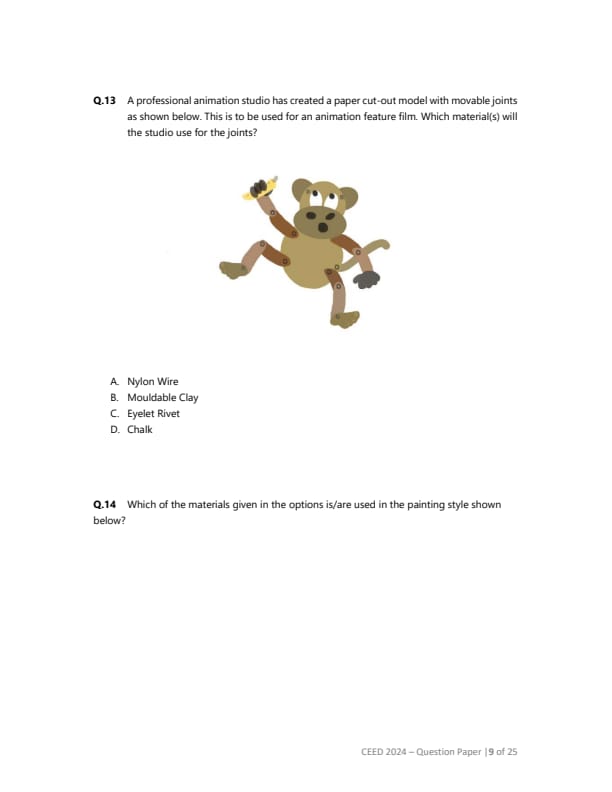
Question 11:
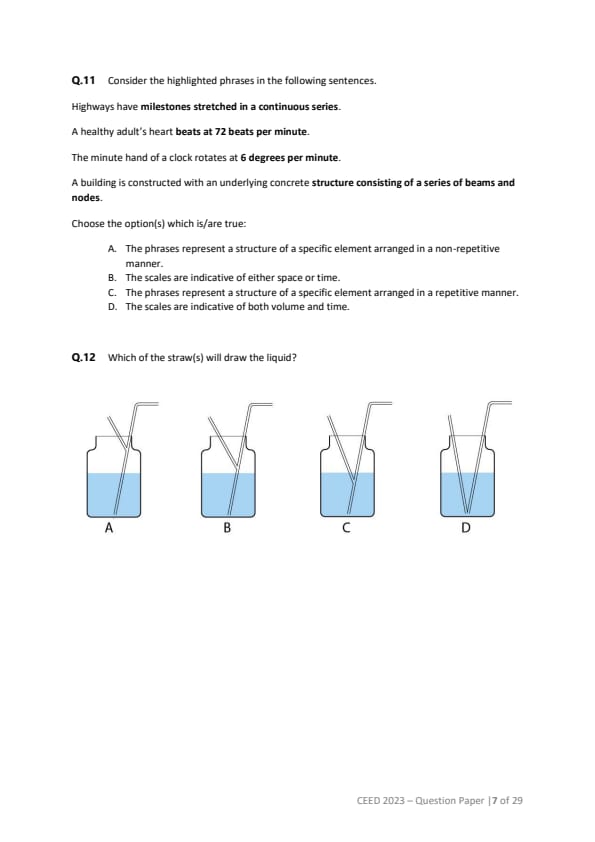
Sal tree seed moves in a particular manner while free falling. Which toy(s) given below has/have a similar movement?

View Solution
Step 1: Understand the movement of a Sal tree seed.
The seed rotates and spirals as it falls due to its wing-like structure.
Step 2: Compare with each toy.
- Option A: Fidget spinner — Does not simulate spiral or winged motion. Incorrect.
- Option B: Spinning top — Spins on a surface, does not replicate free-falling motion. Incorrect.
- Option C: Propeller toy — Rotates and spirals during free fall. Correct.
- Option D: Helical rotor toy — Exhibits spiral motion similar to the seed. Correct.
Step 3: Conclude the answer.
The toys with similar movement are: C and D.
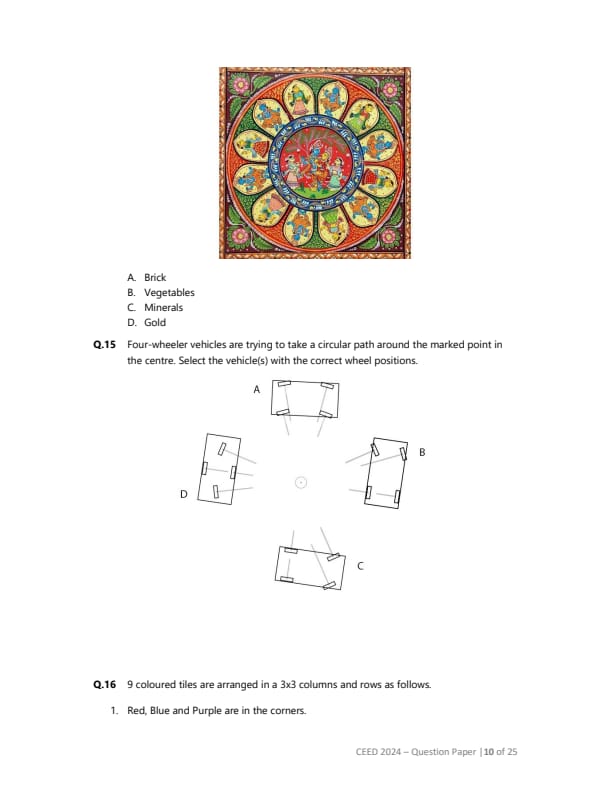
Question 12:
Which option(s) is/are NOT a part of the image on the left?

View Solution
Step 1: Compare each option with the original image.
- Option A: Matches a portion of the mushroom in the top left. Correct.
- Option B: The pink and orange section is not part of the image. Incorrect.
- Option C: Does not match any part of the image. Incorrect.
- Option D: Matches the witch figure in the lower section. Correct.
Step 2: Conclude the answer.
The options not part of the image are: B OR B, C.
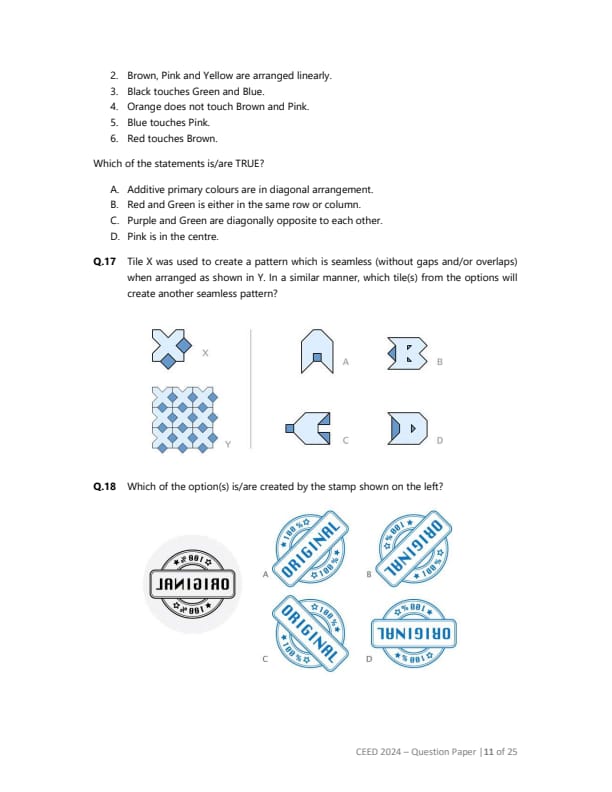
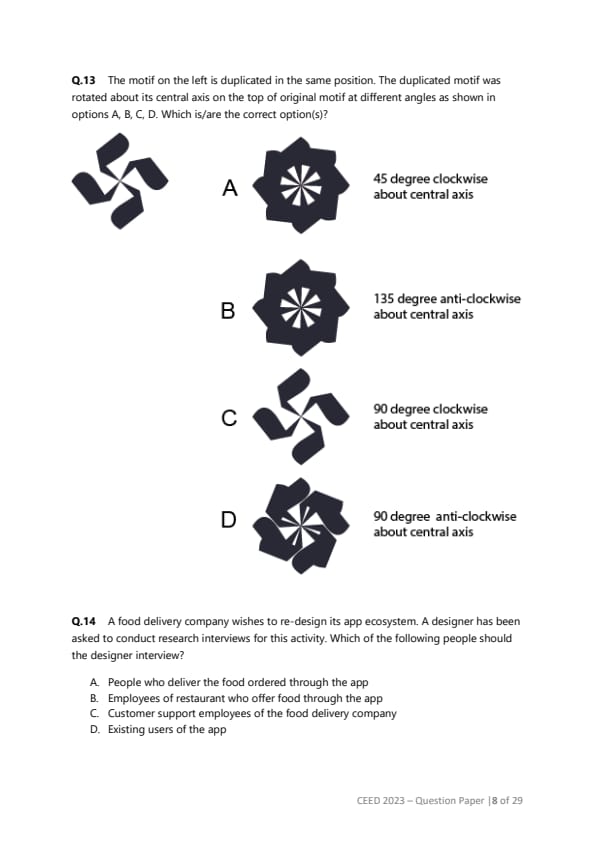
Question 13:
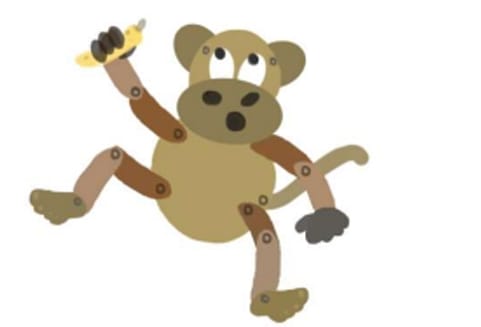
A professional animation studio has created a paper cut-out model with movable joints as shown below. This is to be used for an animation feature film. Which material(s) will the studio use for the joints?
View Solution
1. Analysis of Materials for Movable Joints:
- The material used for joints in a paper cut-out model must ensure flexibility and durability while allowing smooth movement for animation.
2. Options Analysis:
- Option A (Nylon Wire): Nylon wire is flexible, durable, and lightweight, making it ideal for creating movable joints in paper cut-outs.
- Option B (Mouldable Clay): Clay is unsuitable for movable joints as it lacks the required strength and flexibility, making it impractical for this application.
- Option C (Eyelet Rivet): Eyelet rivets are commonly used for movable joints due to their ease of use and ability to securely hold components together while allowing rotation.
- Option D (Chalk): Chalk is brittle and non-functional for creating joints, making it unsuitable for this purpose.
Conclusion: The studio will use A (Nylon Wire) and C (Eyelet Rivet) for the joints in the paper cut-out model.
Question 14:
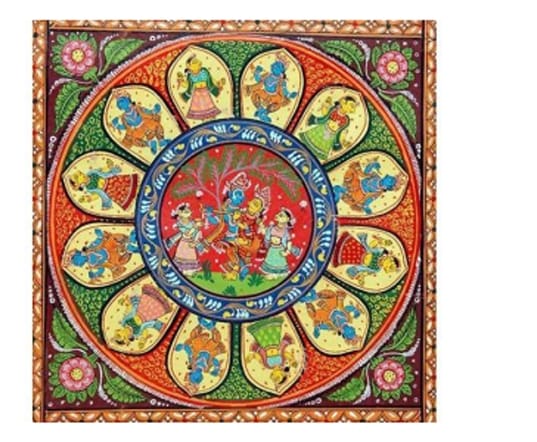
Which of the materials given in the options is/are used in the painting style shown below?
View Solution
1. Analysis of Materials in Traditional Painting Styles:
- Many traditional painting styles incorporate natural and unconventional materials to achieve unique textures and colors.
2. Options Analysis:
- Option A (Brick): Brick powder or fragments are often used in traditional painting for earthy tones and textures.
- Option B (Vegetables): Vegetable-based dyes and extracts have been historically used for creating vibrant, natural colors in paintings.
- Option C (Minerals): Mineral pigments are a common material in traditional painting styles, providing a wide range of colors and durability.
- Option D (Gold): Gold leaf or gold dust has been used in various artistic styles to add brilliance and opulence to paintings.
Conclusion: The materials used in the painting style include A (Brick), B (Vegetables), C (Minerals), and D (Gold).
Question 15:
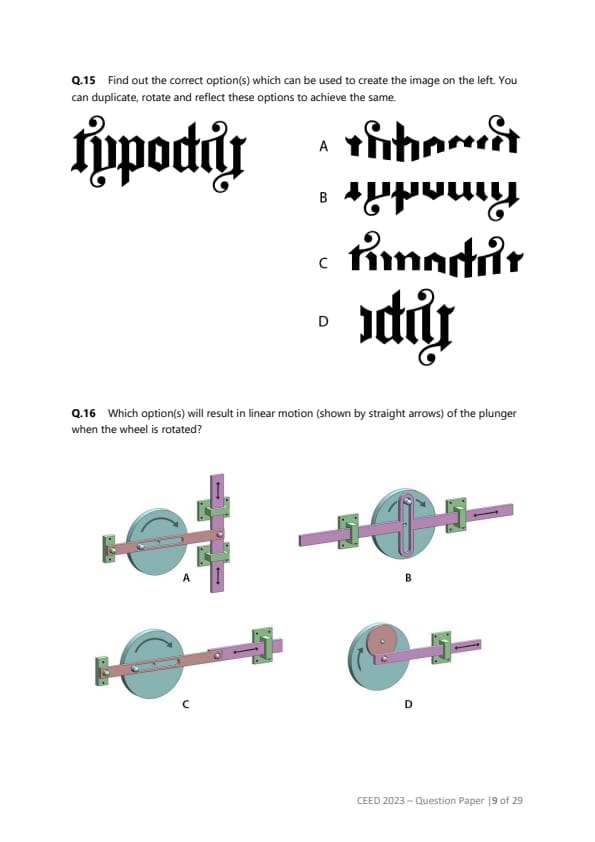
Four-wheeler vehicles are trying to take a circular path around the marked point in the center. Select the vehicle(s) with the correct wheel positions.

View Solution
Step 1: Understand correct wheel alignment for circular motion.
The inner wheels must turn at sharper angles compared to the outer wheels to follow a circular trajectory.
Step 2: Analyze each option.
- Option A: Inner and outer wheels are aligned correctly. Correct.
- Option B: Shows accurate alignment for circular motion. Correct.
- Option C: Incorrect wheel alignment, as the inner and outer wheels do not support circular motion. Incorrect.
- Option D: Correct wheel alignment for circular motion. Correct.
Step 3: Conclude the answer.
The vehicles with correct wheel positions are: A, B, D.
Question 16:
9 coloured tiles are arranged in a 3x3 grid as follows:
- Red, Blue, and Purple are in the corners.
- Brown, Pink, and Yellow are arranged linearly.
- Black touches Green and Blue.
- Orange does not touch Brown and Pink.
- Blue touches Pink.
- Red touches Brown.
Which of the statements is/are TRUE?
View Solution
1. Analyzing the Given Clues:
- Clue 1: Red, Blue, and Purple occupy the corners of the 3x3 grid.
- Clue 2: Brown, Pink, and Yellow are arranged linearly, meaning they are in a row or column.
- Clue 3: Black touches both Green and Blue, so it must be adjacent to both.
- Clue 4: Orange does not touch Brown or Pink, so it must be placed where it avoids both.
- Clue 5: Blue touches Pink, meaning they are adjacent.
- Clue 6: Red touches Brown, so they must be adjacent.
2. Analysis of Statements:
- Statement A: Additive primary colours (Red, Green, Blue) are not in a diagonal arrangement, as Green does not form a diagonal with Red and Blue. This statement is FALSE.
- Statement B: Red and Green are either in the same row or column, as per the logical placement of tiles based on the clues. This statement is TRUE.
- Statement C: Purple and Green are diagonally opposite to each other. Based on their placement in the grid, this is TRUE.
- Statement D: Pink is not in the center, as its placement in the row or column with Brown and Yellow excludes it from the center position. This statement is FALSE.
Conclusion: The statements B and C are TRUE.
Question 17:
Tile X was used to create a seamless pattern. Which tile(s) from the options will also create a seamless pattern?

View Solution
Step 1: Understand the requirements for a seamless pattern.
Seamless patterns must align without gaps or overlaps when repeated.
Step 2: Analyze each tile.
- Option A: Creates a seamless pattern as it aligns perfectly. Correct.
- Option B: Also aligns seamlessly, making it correct.
- Option C: Fails to align seamlessly due to irregular edges. Incorrect.
- Option D: Overlaps and fails the seamless pattern criteria. Incorrect.
Step 3: Conclude the correct answer.
The tiles that create seamless patterns are A and B.
Question 18:
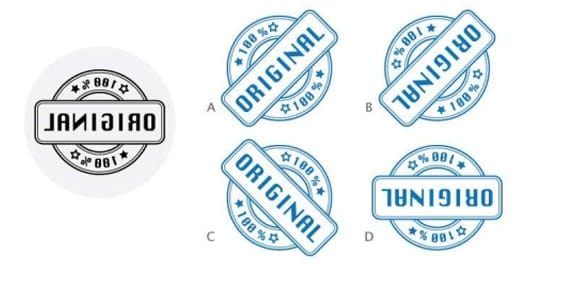
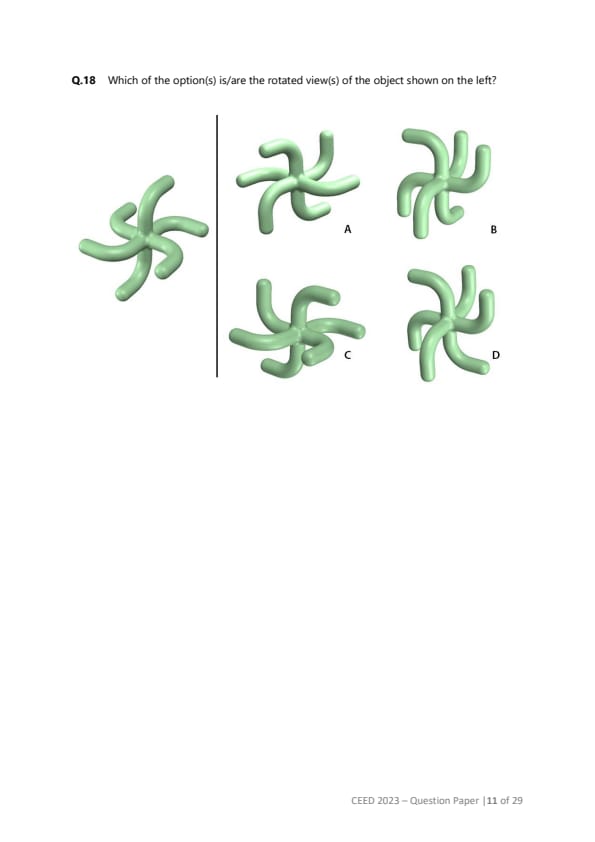
Which of the option(s) is/are created by the stamp shown on the left?
View Solution
Step 1: Know how the stamp imprints work.
The imprint is a mirror image of the stamp design.
Step 2: Match each option with the stamp's imprint.
- Option C: Matches the mirror alignment of the stamp. Correct.
- Option D: Also matches the inverted design of the stamp. Correct.
- Option A and B: Neither matches the stamp's imprint. Incorrect.
Step 3: Finally, the correct answer.
The correct options are C and D.
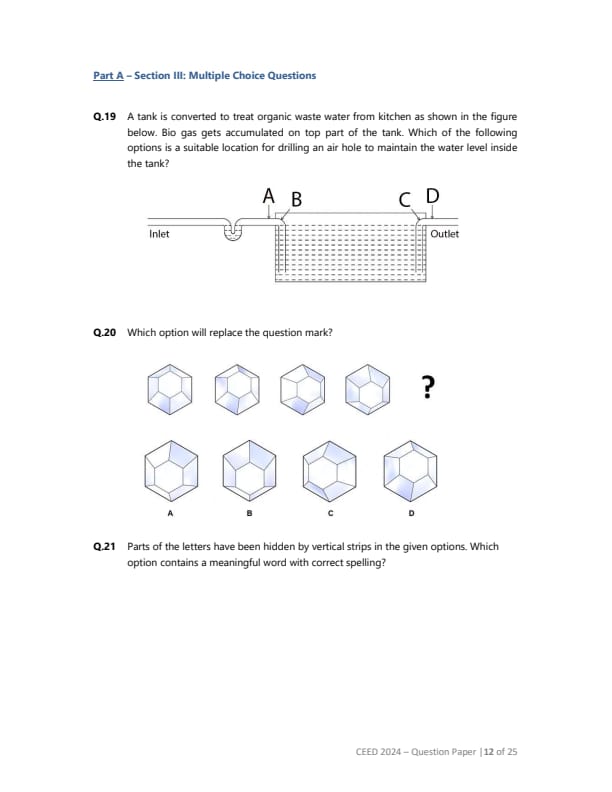
Question 19:
A tank is converted to treat organic waste water from kitchen as shown in the figure below. Biogas gets accumulated on top part of the tank. Which of the following options is a suitable location for drilling an air hole to maintain the water level inside the tank?

View Solution
Step 1: Examine the function of the air hole.
An air hole is needed to release accumulated biogas, which otherwise creates pressure and prevents the proper functioning of the system.
Step 2: Check the correct location for drilling.
The highest point of the tank is ideal for drilling the air hole since biogas collects at the top. This ensures smooth removal of gas and maintains the water level.
Step 3: Finally, the answer.
The suitable location for the air hole is: C - At the highest point of the tank.
Question 20:
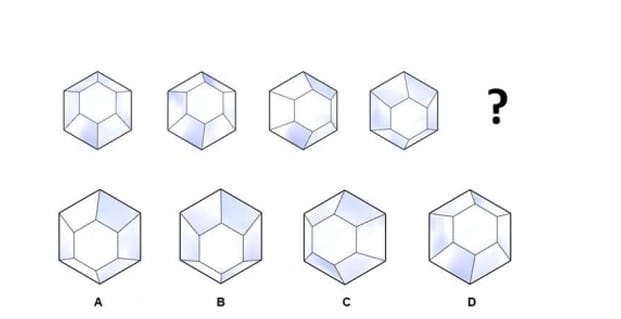
Which option will replace the question mark?
View Solution
Step 1: The pattern alternates between shaded and unshaded faces in a regular sequence. Each rotation creates a new perspective.
Step 2: Join the missing pattern.
Option B correctly aligns the next shape in the sequence by continuing the alternation of shaded faces.
Step 3: The final answer.
The option replacing the question mark is: B.
Question 21:
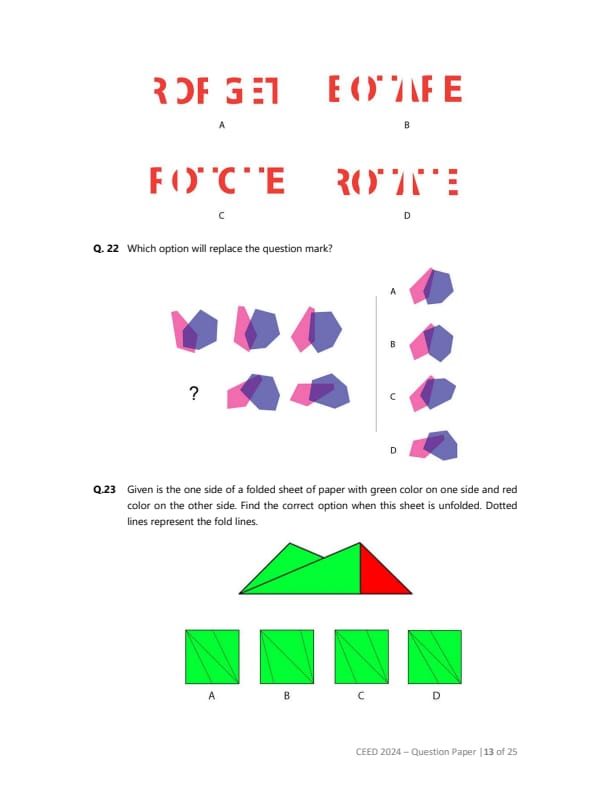
Parts of the letters have been hidden by vertical strips in the given options. Which option contains a meaningful word with correct spelling?

View Solution
Step 1: Examine each option by filling in the hidden parts to form meaningful words.
Step 2: Check each option.
- Option A: No meaningful word. Incorrect.
- Option B: No meaningful word. Incorrect.
- Option C: No meaningful word. Incorrect.
- Option D: Forms "ROUTE," which is meaningful and correctly spelled. Correct.
Step 3: The final answer.
The meaningful word with correct spelling is: D - ROUTE.
Question 22:
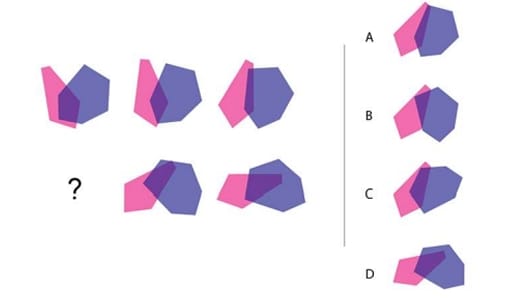
Which option will replace the question mark?
View Solution
Step 1: The sequence alternates between overlapping and separating shapes in a consistent manner.
Step 2: Match the next shape.
Option B continues the sequence by correctly aligning the overlapping purple and pink shapes.
Step 3: The final answer.
The option replacing the question mark is: B.
Question 23:
Given is the one side of a folded sheet of paper with green color on one side and red color on the other side. Find the correct option when this sheet is unfolded. Dotted lines represent the fold lines.

View Solution
Step 1: Analyze the folding and unfolding process.
Upon unfolding, the sheet mirrors the folded design along the dotted lines.
Step 2: Compare the unfolded pattern with each option.
Option C accurately displays the symmetry and correct positioning of the red and green regions.
Step 3: Conclude the answer.
The correct option is: C.
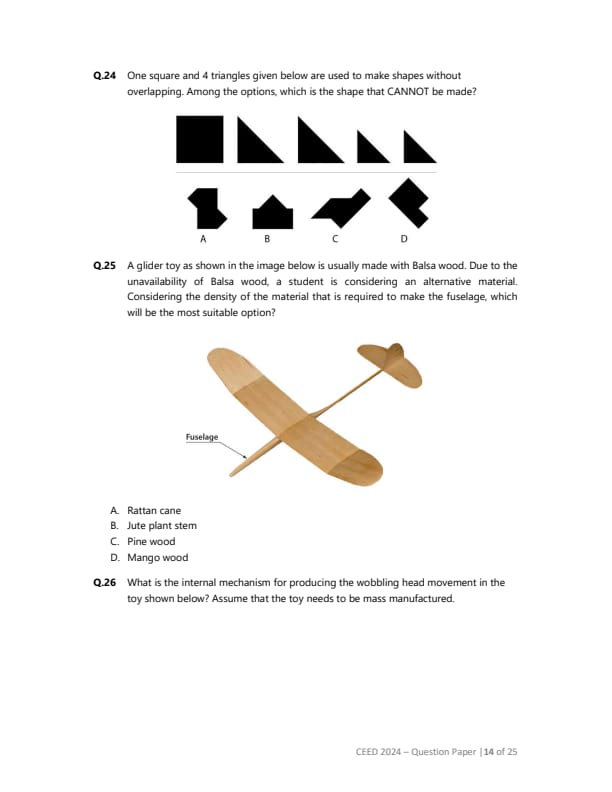
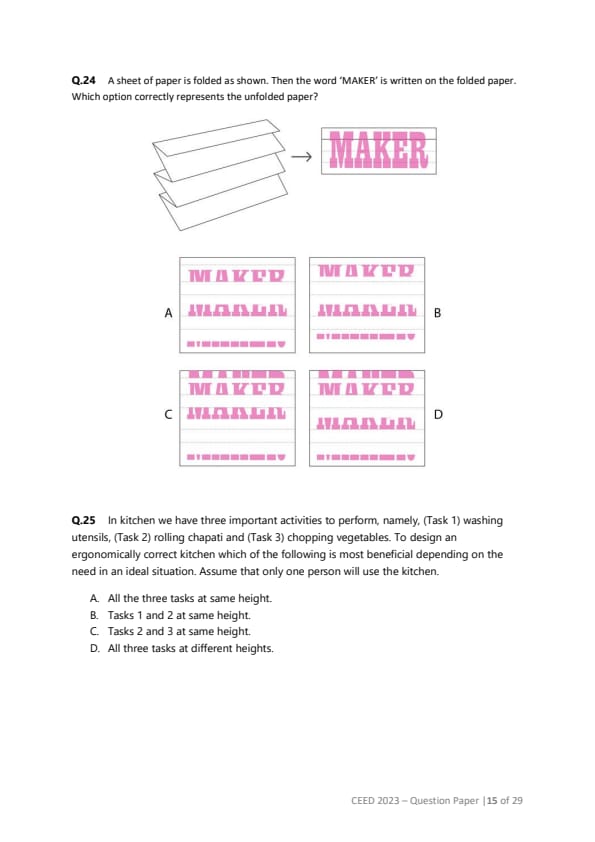
Question 24:
One square and 4 triangles given below are used to make shapes without overlapping. Among the options, which is the shape that CANNOT be made?

View Solution
Step 1: The given components are:
One square and four triangles are available. All shapes must be made without overlapping these components.
Step 2: Understand each option.
- Option A: Possible arrangement using one square and four triangles. Correct.
- Option B: Possible arrangement of components. Correct.
- Option C: Matches the available shapes without overlapping. Correct.
- Option D: Cannot be formed as the given components cannot be arranged to form the shape without overlapping. Incorrect.
Step 3: The final answer-
The shape that CANNOT be made is: D.
Question 25:
A glider toy, as shown in the image below, is usually made with Balsa wood. Due to the unavailability of Balsa wood, a student is considering an alternative material. Considering the density of the material required to make the fuselage, which will be the most suitable option?

View Solution
1. Analysis of the Material Requirements for the Fuselage:
The fuselage of a glider toy needs to be made of lightweight materials to ensure aerodynamic efficiency and good flight performance.
2. Options Analysis:
- Option A (Rattan cane): Although Rattan cane is a natural material, its density is relatively higher compared to the lightweight materials commonly used for gliders.
- Option B (Jute plant stem): Jute plant stem is lightweight and has a density close to that of Balsa wood, making it a suitable alternative for the fuselage.
- Option C (Pine wood): Pine wood is heavier than required and less ideal for constructing lightweight glider parts.
- Option D (Mango wood): Mango wood is dense and not suitable for lightweight structures like the glider fuselage.
Conclusion: The most suitable alternative material for the fuselage of the glider toy is the jute plant stem (Option B).
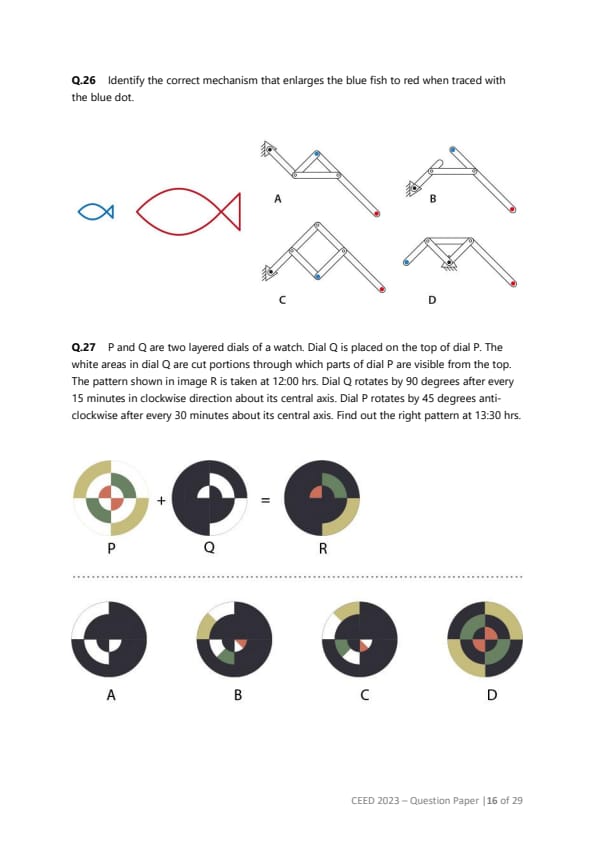
Question 26:
What is the internal mechanism for producing the wobbling head movement in the toy shown below? Assume that the toy needs to be mass manufactured.

View Solution
Step 1: The wobbling mechanism :
The head movement requires flexibility and oscillation to produce the wobbling effect. A spring provides this motion efficiently.
Step 2: Examine each option.
- Spring: Allows smooth wobbling motion and is easy to manufacture. Correct.
- Torsion bar: Not suitable for wobbling motion. Incorrect.
- Pivot mechanism: Provides rotational movement but not wobbling. Incorrect.
- Ball joint: Suitable for rotation but not wobbling. Incorrect.
Step 3: Finally the answer-
The internal mechanism for wobbling is: A - Spring.
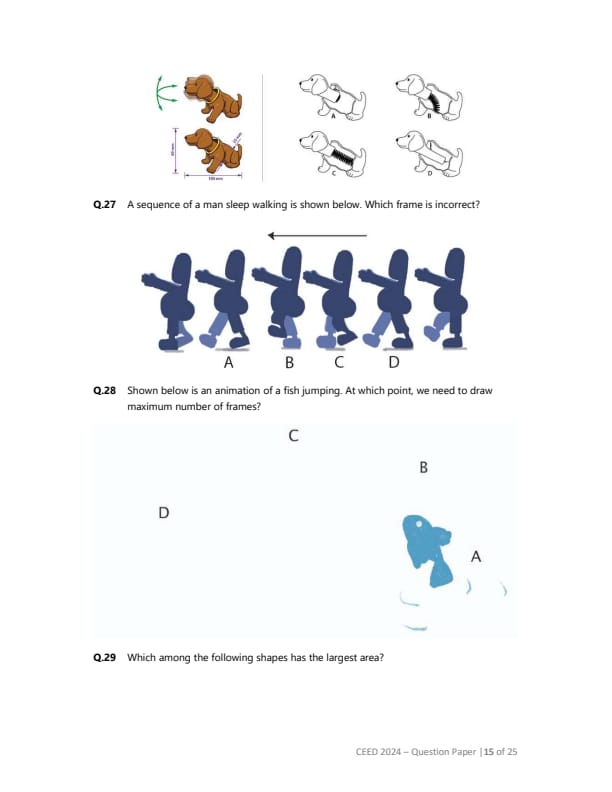
Question 27:
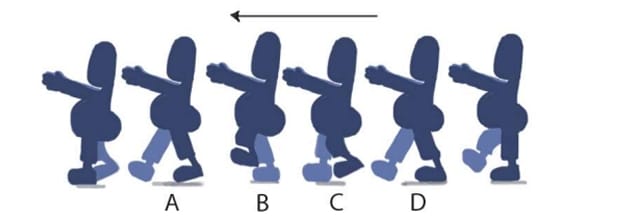
A sequence of a man sleepwalking is shown below. Which frame is incorrect?
View Solution
Step 1: Observe the sequence of movement.
Sleepwalking requires smooth transitions between frames, mimicking realistic walking motion.
Step 2: Check the incorrect frame.
- Frame A disrupts the motion by showing an unrealistic leg position. Correct.
- Frames B, C, and D follow natural movement patterns. Incorrect.
Step 3: Final answer:
The incorrect frame is: A.
Question 28:
Shown below is an animation of a fish jumping. At which point, we need to draw maximum number of frames?

View Solution
Step 1: The motion dynamics is as follows:
Maximum frames are needed at the peak of motion (Point C) to create smooth animation.
Step 2: Examine the movement.
- At Point C, the fish slows down momentarily before descending, requiring more frames for realism. Correct.
- At other points (A, B, D), the motion is faster and requires fewer frames. Incorrect.
Step 3: Final answer:
The point requiring maximum frames is: C.
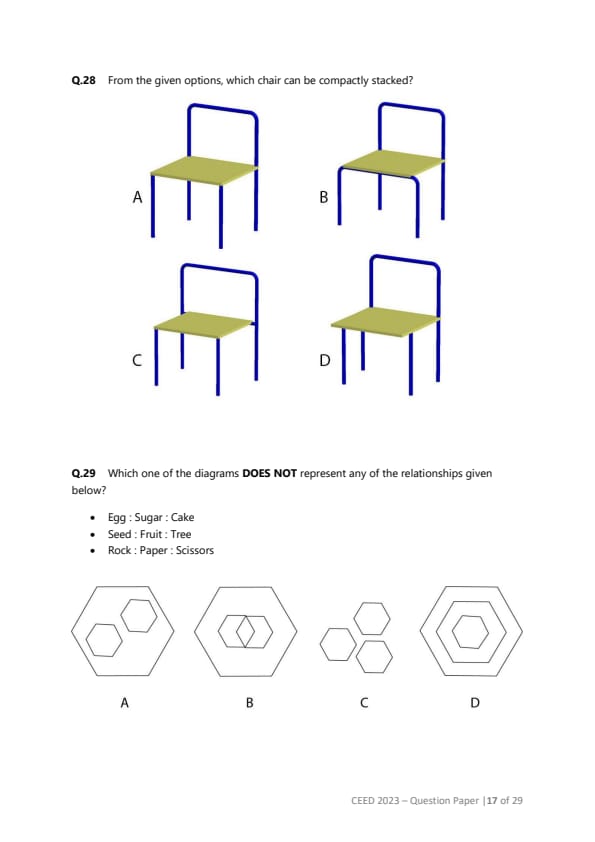
Question 29:
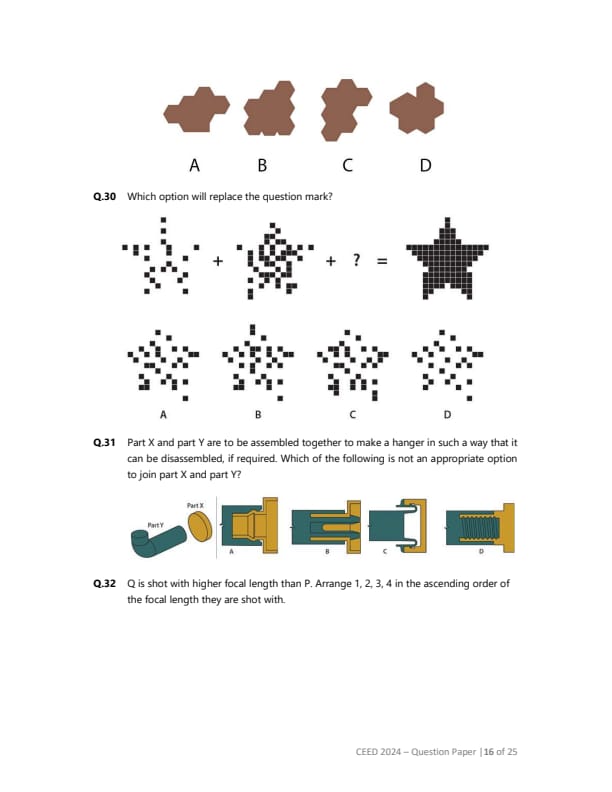
Which among the following shapes has the largest area?

View Solution
Step 1: Comparison between given shapes are :
Each shape is composed of hexagonal units. The area of each shape can be determined by counting the number of hexagonal units.
Step 2: Count the number of hexagons in each shape.
- Option A: 5 hexagons.
- Option B: 7 hexagons.
- Option C: 6 hexagons.
- Option D: 6 hexagons.
Step 3: Conclude the shape with the largest area.
Option B, with 7 hexagons, has the largest area.
Question 30:
Which option will replace the question mark?
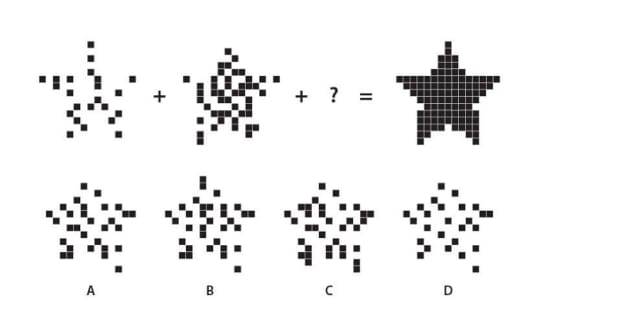
View Solution
Step 1: The question consists of summing shapes by adding blocks to match the final given figure.
Step 2: Examine the shapes:
- The first two shapes combine to form a partial star shape.
- Adding the missing blocks from Option A completes the full star figure.
Step 3: Verify the answer.
Option A provides the correct set of blocks to complete the star. Other options do not match.
Question 31:
Part X and part Y are to be assembled together to make a hanger in such a way that it can be disassembled, if required. Which of the following is not an appropriate option to join part X and part Y?

View Solution
Step 1: The joining mechanisms is as follows :
Joining methods must allow disassembly without damage.
Step 2: Analyze each option.
- Option A: A sliding mechanism, suitable for disassembly. Correct.
- Option B: A rigid joint that cannot be easily disassembled. Incorrect.
- Option C: A snap-fit mechanism, suitable for disassembly. Correct.
- Option D: A threaded joint, suitable for disassembly. Correct.
Step 3: The final answer :
Option B is not appropriate for a disassemblable joint.
Question 32:
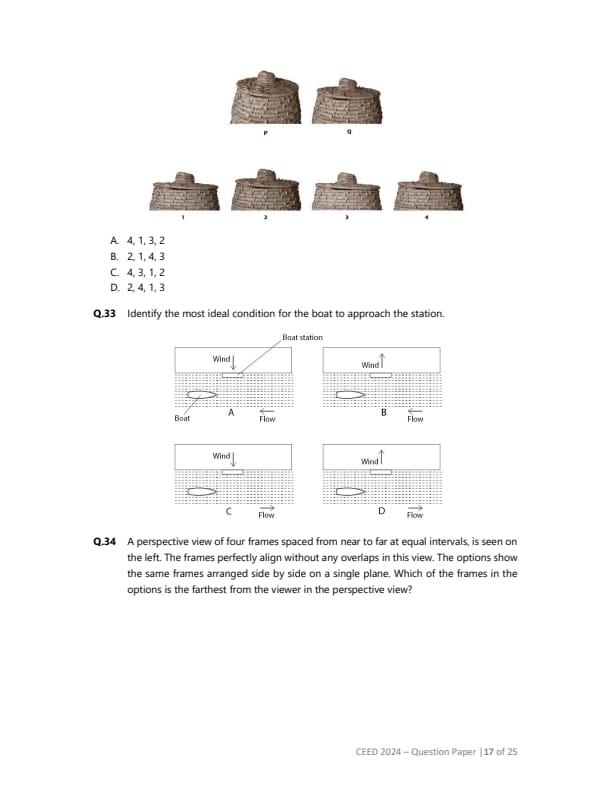
Q is shot with a higher focal length than P. Arrange 1, 2, 3, 4 in ascending order of the focal lengths they are shot with.

View Solution
1. Understanding the Relationship Between Focal Length and Image Properties:
Focal length affects the field of view and magnification. A higher focal length results in a narrower field of view and greater magnification, while a lower focal length provides a wider field of view and lesser magnification.
2. Analysis of the Order Based on Focal Lengths:
Given that Q is shot with a higher focal length than P, and considering the sequence of images 1, 2, 3, 4, we analyze their visual properties (not shown here but assumed) to deduce the relative focal lengths.
Upon analysis, the correct ascending order of the focal lengths used is 2, 4, 1, 3.
Conclusion: The arrangement in ascending order of focal length is 2, 4, 1, 3 (Option D).
Question 33:
Identify the most ideal condition for the boat to approach the station.
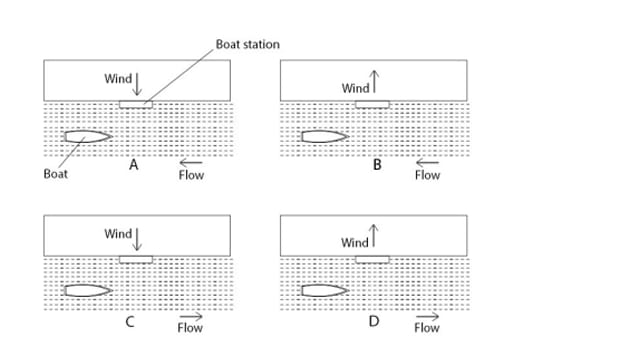
View Solution
Step 1: Analyze the wind and flow direction.
The boat should ideally move against the flow for better control.
Step 2: Examine each option:
- Option A: Wind and flow are aligned, allowing better navigation. Correct.
- Options B, C, D: Other conditions make docking harder due to misaligned forces. Incorrect.
Step 3: Final answer :
A
Question 34:
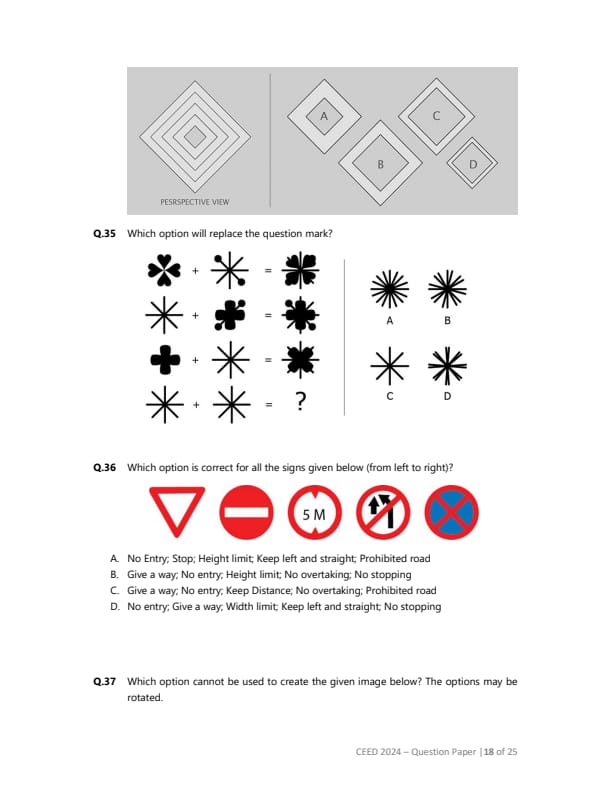
A perspective view of four frames spaced from near to far at equal intervals is seen on the left. The frames perfectly align without any overlaps in this view. The options show the same frames arranged side by side on a single plane. Which of the frames in the options is the farthest from the viewer in the perspective view?
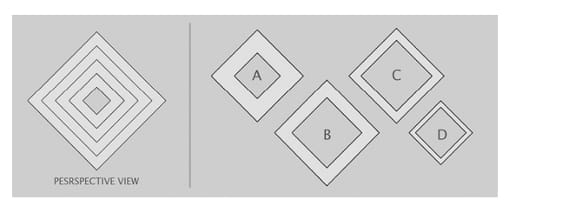
View Solution
Step 1: Examine the perspective view.
The frames are aligned such that the largest frame is nearest to the viewer and the smallest is farthest. The given perspective view shows the smallest frame as the one in the innermost position.
Step 2: Identify the arrangement in the options.
In Option A, the smallest frame is placed at the farthest position, which matches the perspective view. Therefore, Option A is correct.
Question 35:
Which option will replace the question mark? Analyze the given pattern and identify the missing figure.

View Solution
Step 1: Each step involves adding or subtracting elements from the given figures. The pattern in the first two rows shows that combining shapes creates new forms by overlaying their structures.
Step 2: The final figure should be a combination of the star shapes overlayed without additional elements. Option C matches this pattern.
Question 36:
Which option is correct for all the signs given below (from left to right)?

View Solution
1. Identifying the Signs and Their Meanings:
- Sign 1 (Give a way): This sign indicates that the driver must yield to oncoming traffic.
- Sign 2 (No entry): This sign restricts vehicles from entering the marked zone.
- Sign 3 (Height limit): This sign indicates a restriction on vehicle height for passing through.
- Sign 4 (No overtaking): This sign prohibits vehicles from overtaking others in the specified area.
- Sign 5 (No stopping): This sign indicates that vehicles are not allowed to stop in the marked zone.
2. Matching the Correct Sequence of Signs:
Analyzing the options, Option B correctly matches the sequence of signs from left to right.
Conclusion: The correct sequence for the signs is given in Option B: "Give a way; No entry; Height limit; No overtaking; No stopping."
Question 37:
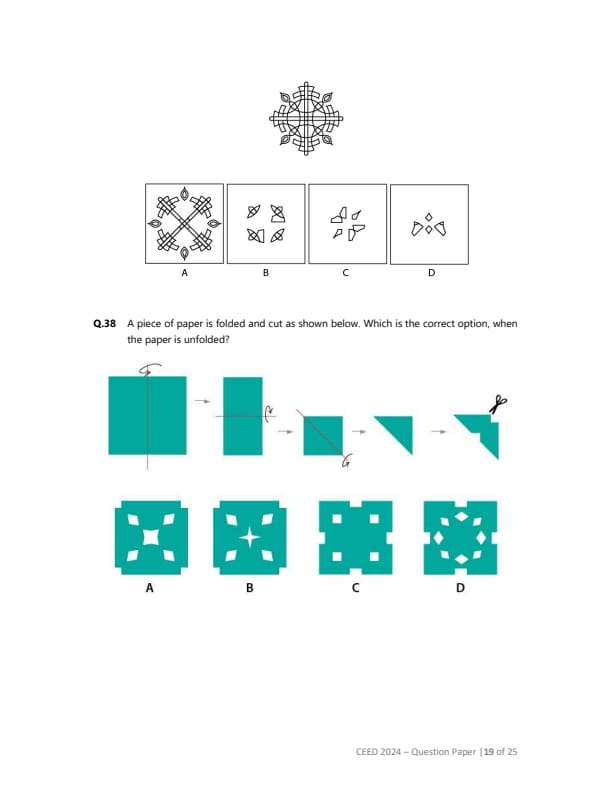
Which option cannot be used to create the given image below? The options may be rotated.
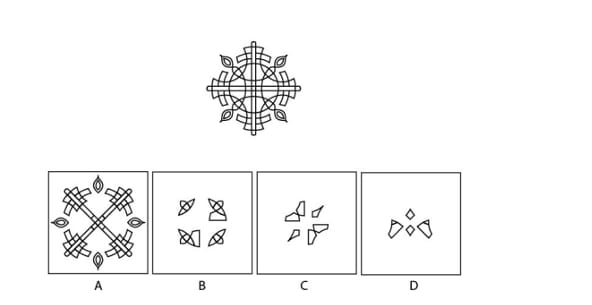
View Solution
Step 1: Decompose the given image into its components.The symmetrical pattern involves elements arranged at equal angles.
Step 2: Option C does not match the symmetry of the given image even after rotation. The other options can recreate the pattern through rotation.
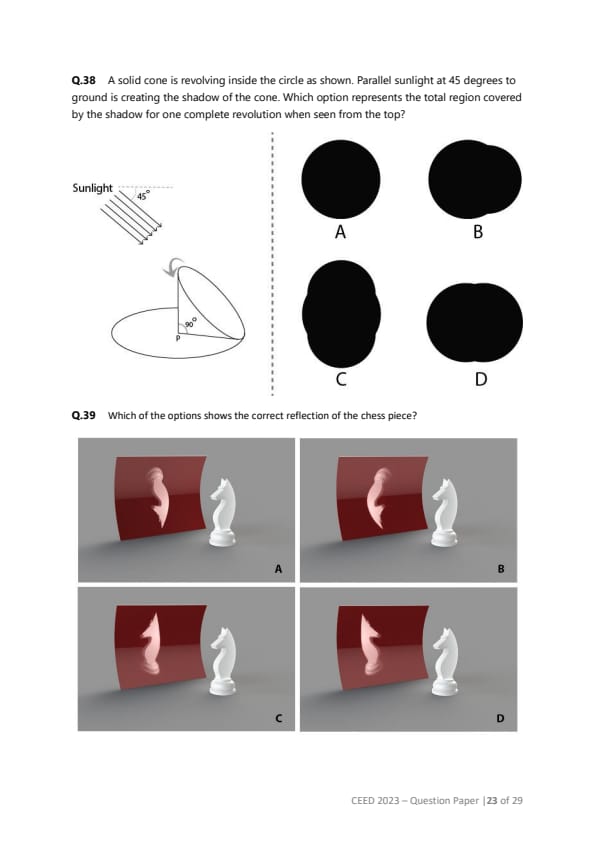
Question 38:
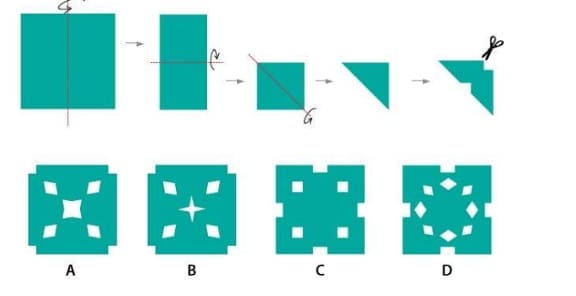
A piece of paper is folded and cut as shown below. Which is the correct option when the paper is unfolded?
View Solution
Step 1: Analyze the folding and cutting process.
The paper is folded twice to form a triangular shape. The cut patterns will be mirrored when unfolded due to the folds.
Step 2: And, the resulting pattern is:
Option C accurately represents the mirrored and repeated cut pattern when the paper is unfolded.
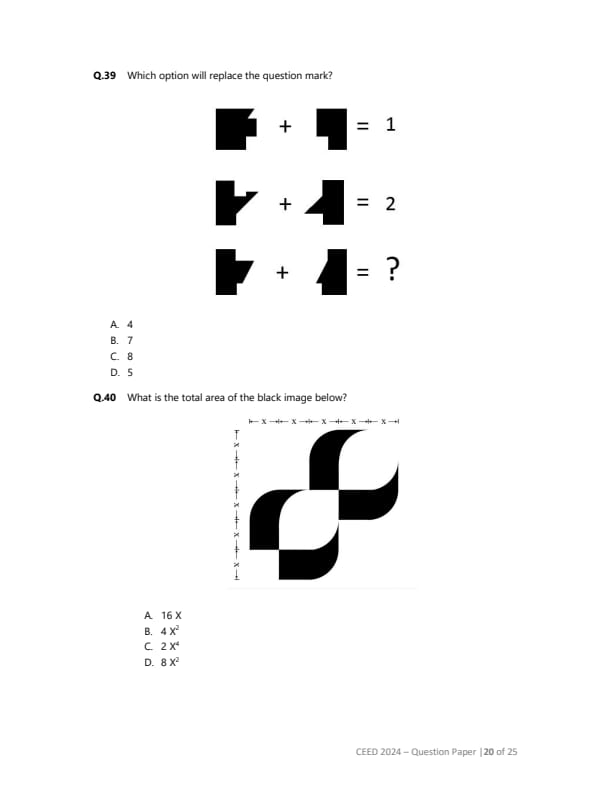
Question 39:
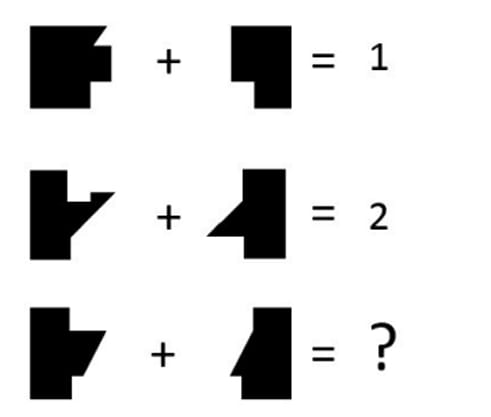
Which option will replace the question mark?
View Solution
Step 1: Examine the first equation. The shapes add up to a single unit.
Step 2: Note that the second equation's shapes equal 2.
Step 3: From the pattern, take the missing sum in the last equation. The left-side shape values sum up to 7.
Question 40:
What is the total area of the black image below?

View Solution
Step 1: The black region is made up of curved segments with dimensions proportional to X2.
Step 2: Total area is derived by summing all segments: 8X2.
Step 3: Simplify and verify calculations for accuracy.
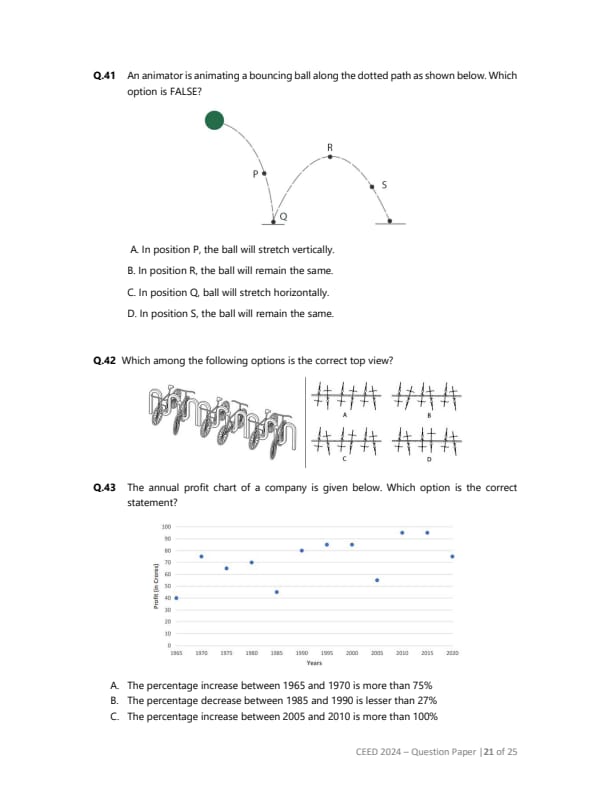
Question 41:
An animator is animating a bouncing ball along the dotted path as shown below. Which option is FALSE?

View Solution
1. Understanding Animation Principles:
In animation, the behavior of a bouncing ball follows the principles of squash and stretch to convey motion and realism.
The ball stretches or squashes depending on its velocity and point of contact.
2. Position Analysis:
- Position P: At this point, the ball is accelerating downward, causing it to stretch vertically due to the speed of motion.
- Position Q: Here, the ball is in contact with the ground and experiences horizontal compression, leading to horizontal stretching.
- Position R: At the peak of its motion, the ball momentarily pauses, retaining its original shape.
- Position S: The ball should stretch vertically as it is accelerating upward after the bounce.
3. Identifying the FALSE Statement:
Option (D) is incorrect because the ball does not remain the same at position S. It stretches vertically as it gains upward momentum.
Conclusion: The FALSE statement is given in Option (D), as the ball stretches vertically at position S.
Question 42:
Which among the following options is the correct top view?
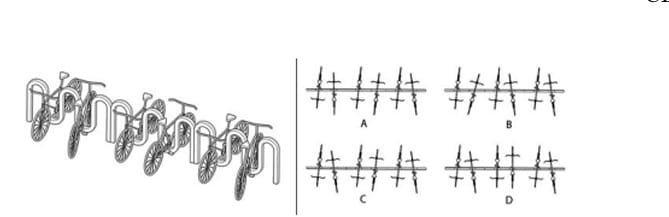
View Solution
Step 1: Carefully examine the perspective diagram.
Step 2: Check the alignment of all the bike racks in the top-down view.
Step 3: Identify the correct alignment to determine C.
Question 43:
The annual profit chart of a company is given below. Which option is the correct statement?

View Solution
Step 1: Calculate profits in 1965 and 1970: 40 and 90, respectively.
Step 2: Percentage increase = (90-40)/40 × 100 = 125%. Thus, it is more than 75%.
Step 3: Check the other statements as well. Only A is correct.
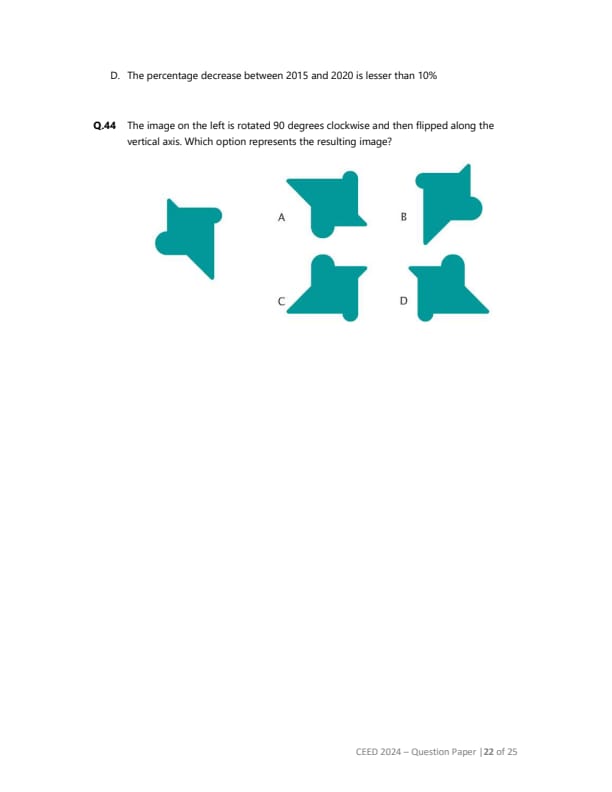
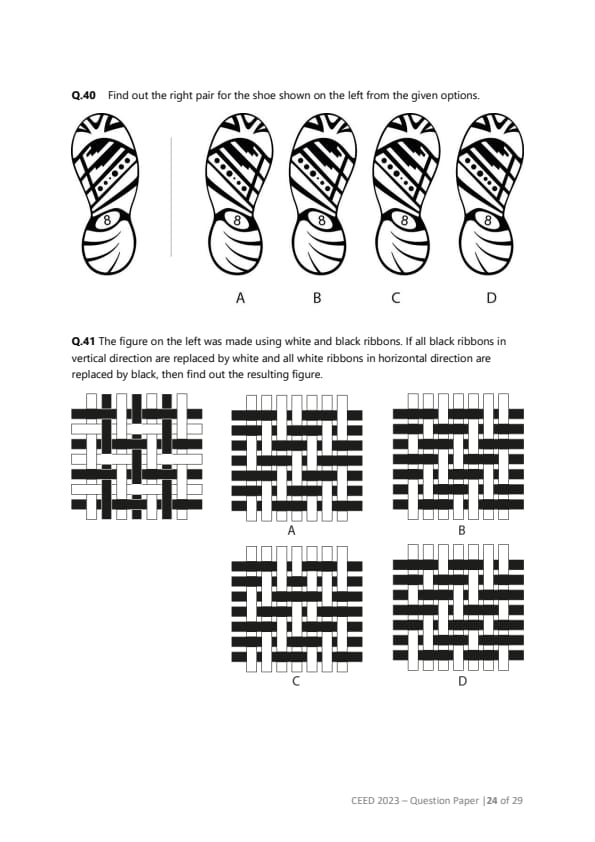
Question 44:
The image on the left is rotated 90° clockwise and then flipped along the vertical axis. Which option represents the resulting image?
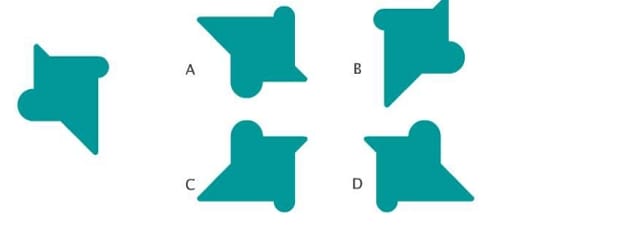
View Solution
Step 1: Rotate the image 90° clockwise.
Step 2: Flip the resulting image along the vertical axis.
Step 3: Match the resulting shape to D.
Part- B
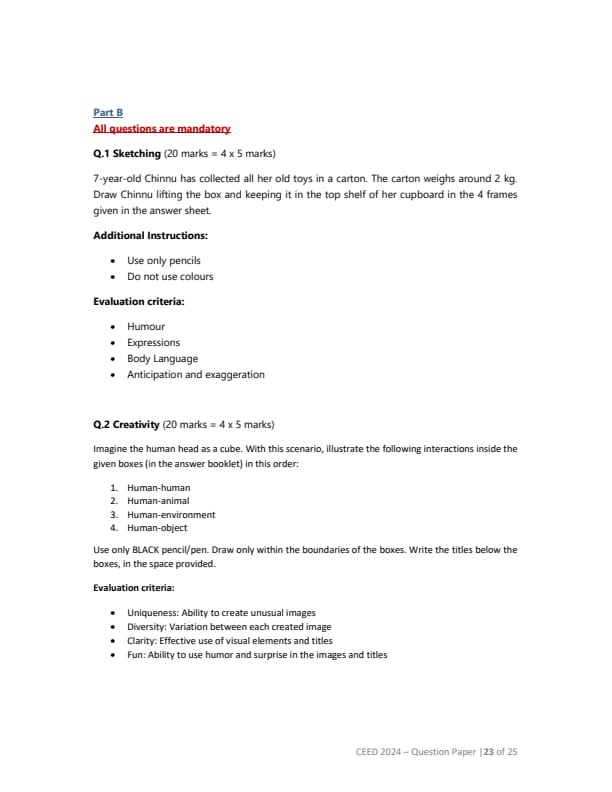
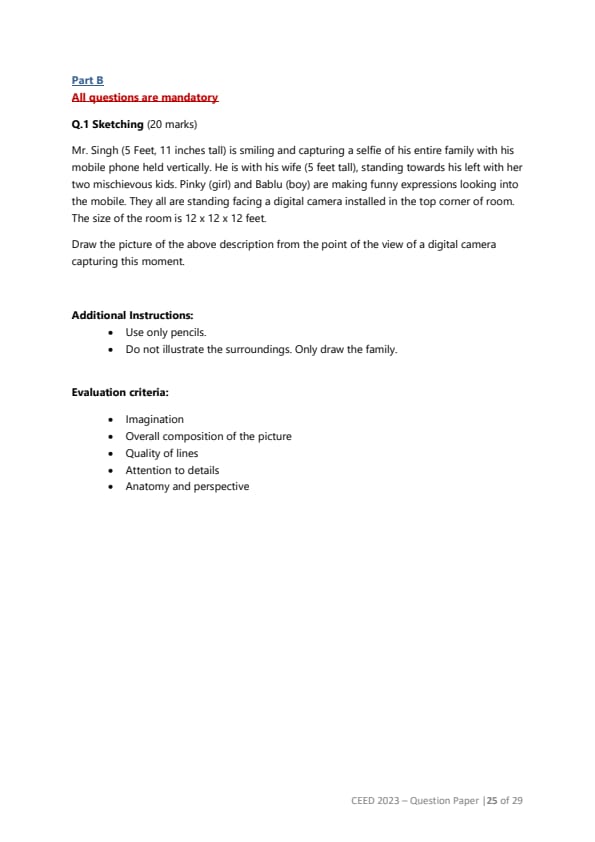
Question 1:
7-year-old Chinnu has collected all her old toys in a carton. The carton weighs around 2 kg. Draw Chinnu lifting the box and keeping it in the top shelf of her cupboard in the 4 frames given in the answer sheet.
Additional Instructions:
- Use only pencils.
- Do not use colours.
Evaluation Criteria:
- Humour.
- Expressions.
- Body Language.
- Anticipation and Exaggeration.
View Solution
Solution: Below is the sketch drawn as per the given description and instructions:

Step 1: Start by drawing Chinnu in a standing pose, preparing to lift the box. Focus on her body posture and facial expression to depict anticipation.
Step 2: Then, in the second frame, draw Chinnu slightly bending down to lift the box, showing the weight of the box through exaggerated arm and back strain.
Step 3: Afterwards in the third frame, sketch Chinnu holding the box halfway, with her body tilted slightly backward for balance. Use expressive face and arm positions to convey effort.
Step 4: Finally, draw Chinnu placing the box on the top shelf of the cupboard, with a relieved expression and her arms stretched upward.
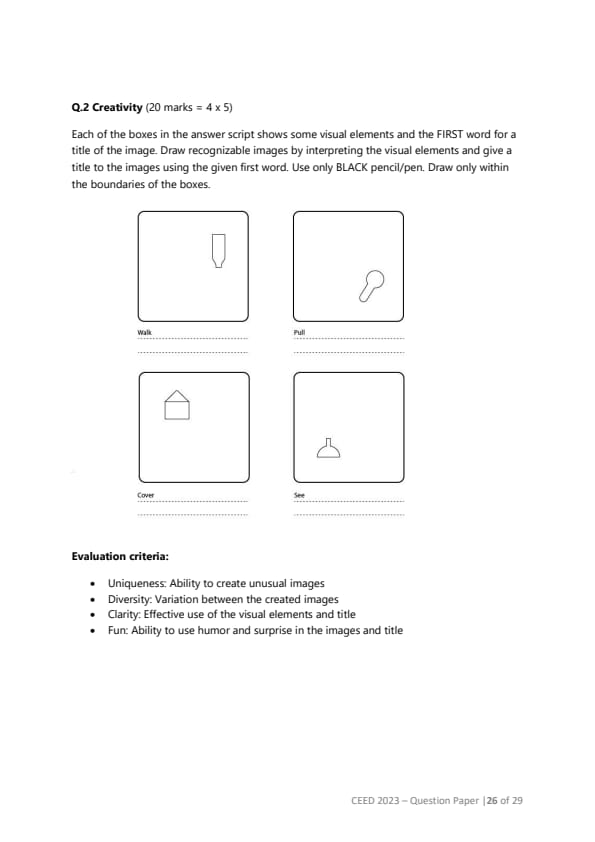
Question 2:
Imagine the human head as a cube. With this scenario, illustrate the following interactions inside the given boxes (in the answer booklet) in this order:
- Human-human.
- Human-animal.
- Human-environment.
- Human-object.
Additional Instructions:
- Use only BLACK pencil/pen. Draw only within the boundaries of the boxes. Write the titles below the boxes, in the space provided.
Evaluation Criteria:
- Uniqueness: Ability to create unusual images.
- Diversity: Variation between each created image.
- Clarity: Effective use of visual elements and titles.
- Fun: Ability to use humor and surprise in the images and titles.
View Solution
Solution: Below are the images based on the given visual elements and first words:

Step 1: Human-Human Interaction
Illustrate two cube-headed humans interacting in a creative way, such as shaking hands, sharing a joke, or engaging in a humorous situation. Focus on expressions and gestures to make the interaction engaging.
Step 2: Human-Animal Interaction
Depict a cube-headed human interacting with an animal, such as petting or playing with a cube-headed dog or cat. Use exaggerated body language to emphasize the bond between them.
Step 3: Human-Environment Interaction
Show a cube-headed human engaging with the environment, such as planting a tree, enjoying a windy day, or watching the sunset. Highlight the connection between the human and their surroundings.
Step 4: Human-Object Interaction
Illustrate a cube-headed human using or interacting with an object, such as lifting a cube-shaped box, playing with a toy, or fixing a machine. Showcase creativity in the interaction and design of the object.
Question 3:
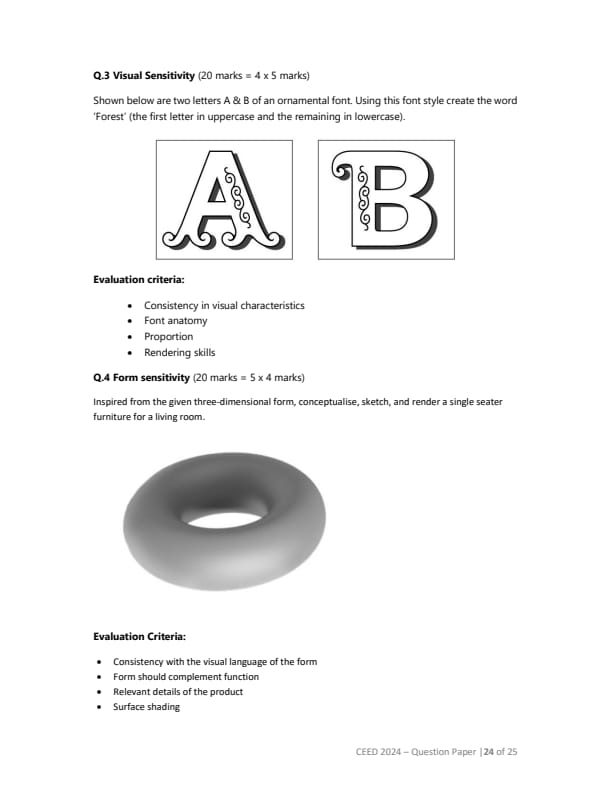
Shown below are two letters A & B of an ornamental font. Using this font style, create the word "Forest" (the first letter in uppercase and the remaining in lowercase).

Evaluation Criteria:
- Consistency in visual characteristics
- Font anatomy
- Proportion
- Rendering skills
View Solution
Solution:

Step 1: Analyze the provided ornamental letters "A" and "B."
Observe the detailed embellishments such as curved decorations, bold strokes, and loops.
Step 2: Design the uppercase letter "F."
Ensure the styling matches the ornamental details, maintaining symmetry and decorative balance.
Step 3: Create the lowercase letters "o, r, e, s, t."
Use proportional scaling to make the letters smaller than the uppercase "F." Maintain a consistent style by incorporating similar curves, loops, and ornamentation.
Step 4: Review and refine the alignment and spacing of the word to ensure visual harmony.
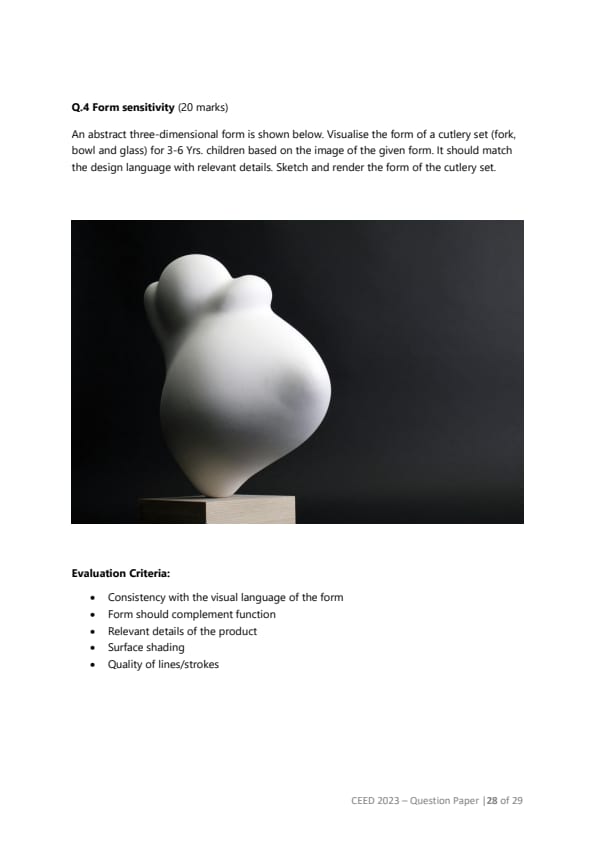
Question 4:
Inspired from the given three-dimensional form, conceptualize, sketch, and render a single-seater furniture for a living room.
Evaluation Criteria:
- Consistency with the visual language of the form
- Form should complement function
- Relevant details of the product
- Surface shading
- Quality of lines/strokes

View Solution
Solution:

Step 1: Examine the 3D Form
The 3D form is a torus (doughnut shape), characterized by its circular symmetry and hollow center. This shape inspires a design that incorporates both functionality and aesthetics.
Step 2: Conceptualizing the Furniture Design
Based on the torus shape, a modern single-seater chair is designed where the circular base provides structural integrity, while ergonomic curves ensure comfort.
Step 3: Adding Practical Features
The base is sturdy and padded to serve as a seat. The curved edges are softened for comfort, and the central hollow can function as storage or aesthetic space. A padded backrest complements the design.
Step 4: Rendering the Design
Using neutral tones (e.g., beige or light gray) enhances the minimalist appeal. The smooth curves and plush texture ensure it fits seamlessly in a modern living room.
Step 5: Finalizing the Sketch and Rendering
The rendered output demonstrates a blend of the torus-inspired shape with practical seating functionality. The focus is on comfort, style, and usability.
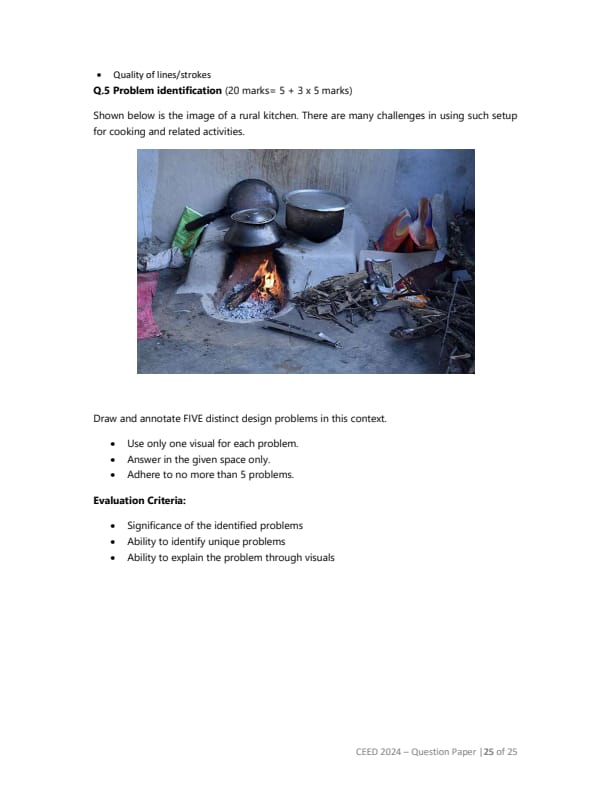
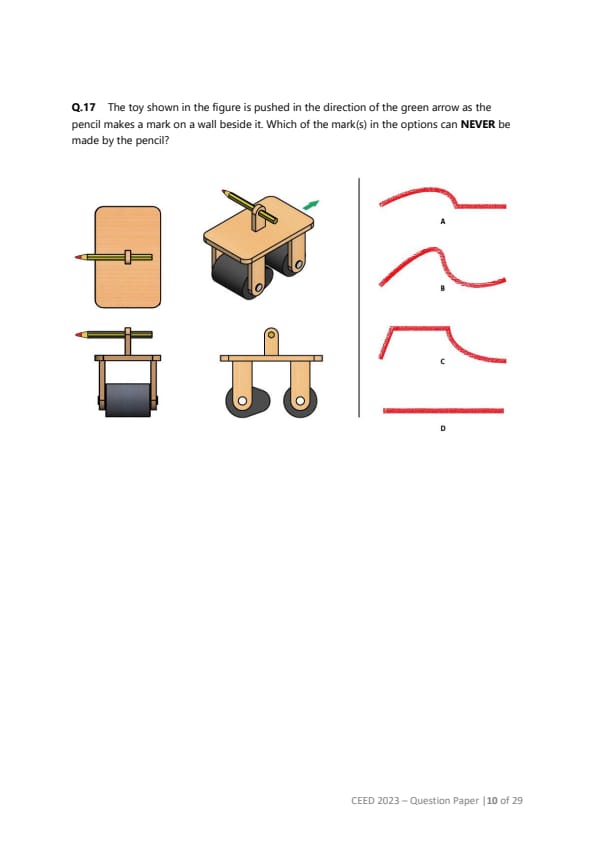
Question 5. Problem Identification
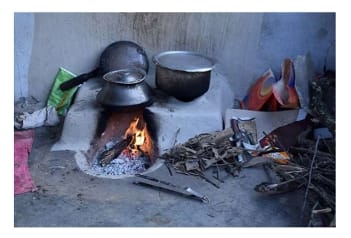
Shown below is the image of a rural kitchen. There are many challenges in using such setup for cooking and related activities. Identify five distinct design problems in this context, annotate them, and provide visual illustrations.
View Solution
Solution:

Step 1: Assess the Rural Kitchen Setup
Examine the kitchen setup to identify key issues impacting usability, safety, and functionality. Focus on areas like cooking safety, storage, ventilation, waste management, and ergonomics.
Step 2: Highlight the Problems
- Open flames without safety measures increase risks of burns and accidental fires.
- Poor ventilation leads to smoke accumulation, causing respiratory and health concerns.
- Disorganized storage creates inefficiency and clutter, reducing functionality.
- Lack of a waste management system contributes to unsanitary conditions.
- Non-ergonomic kitchen design causes physical discomfort during extended use.
Step 3: Annotate and Illustrate
Annotated sketches visually highlight these issues, using clear labels and descriptive visuals to communicate the problems effectively. The focus is on clarity and precision in representing each challenge.
*The article might have information for the previous academic years, please refer the official website of the exam.