
ICSE Board Class 10 Chemistry – Science Paper 2 2026 Question Paper with Solution PDF


| Updated On - Mar 25, 2026
The ICSE Class 10 Chemistry (Science Paper 2) exam for 2026 is conducted on March 11, 2026. The exam is take place from 11:00 AM to 1:00 PM (2 hours) in offline mode. The total marks for the theory paper are 80, with 20 marks for internal assessment. ICSE Class 10 Chemistry – Science Paper 2 Question Paper with Solution PDF is available here for download.
The ICSE Board Class 10 Chemistry – Science Paper 2 covered key topics from chemical reactions, acids, bases and salts, metals and non-metals, and environmental chemistry. The MCQ section tested basic understanding of chemical concepts and reactions, while the descriptive questions required clear explanations, balanced chemical equations, and proper numerical steps. To score well, students should focus on concept clarity, accurate reactions, proper calculations, and presenting well-structured answers.
The official question paper of ICSE Board Class 10 Chemistry – Science Paper 2 Board Exam 2026 is provided below. Students can download the official paper in PDF format for reference.
ICSE Board Class 10 Chemistry – Science Paper 2 2026 Question Paper with Solution PDF
| ICSE Board Class 10 Chemistry – Science Paper 2 2026 Question Paper with Solution PDF | Download PDF | Check Solutions |
A non-metal which reacts with concentrated sulphuric acid to form two gases which turn lime water milky is ______.
Which of the following element pairs will form an ionic bond?

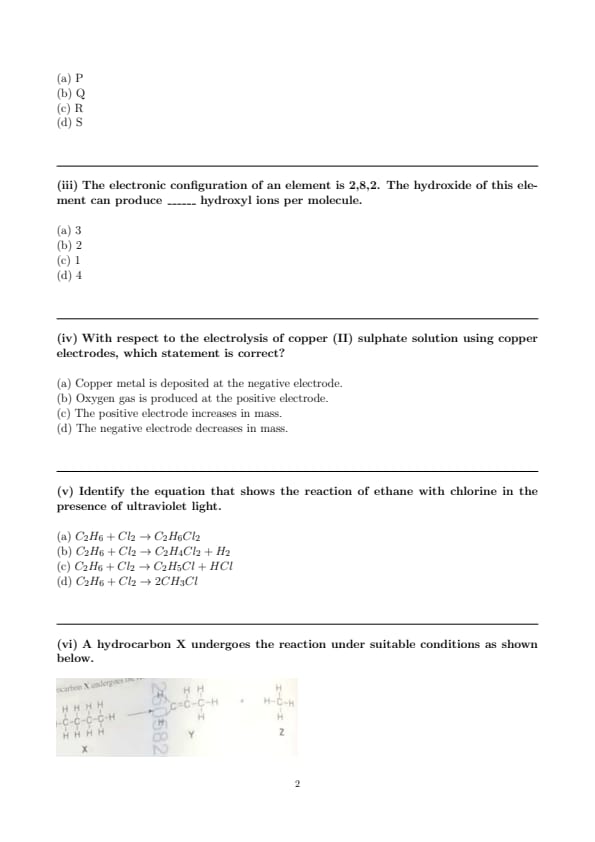
The electronic configuration of an element is 2,8,2. The hydroxide of this element can produce ______ hydroxyl ions per molecule.
With respect to the electrolysis of copper (II) sulphate solution using copper electrodes, which statement is correct?
Identify the equation that shows the reaction of ethane with chlorine in the presence of ultraviolet light.
A hydrocarbon X undergoes the reaction under suitable conditions as shown below.

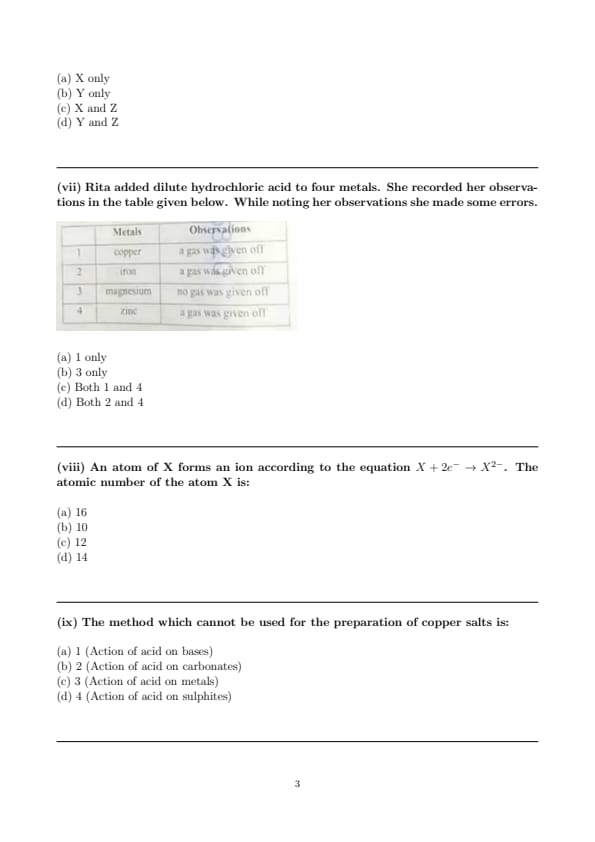
Rita added dilute hydrochloric acid to four metals. She recorded her observations in the table given below. While noting her observations she made some errors.

An atom of X forms an ion according to the equation \( X + 2e^- \rightarrow X^{2-} \). The atomic number of the atom X is:
The method which cannot be used for the preparation of copper salts is:
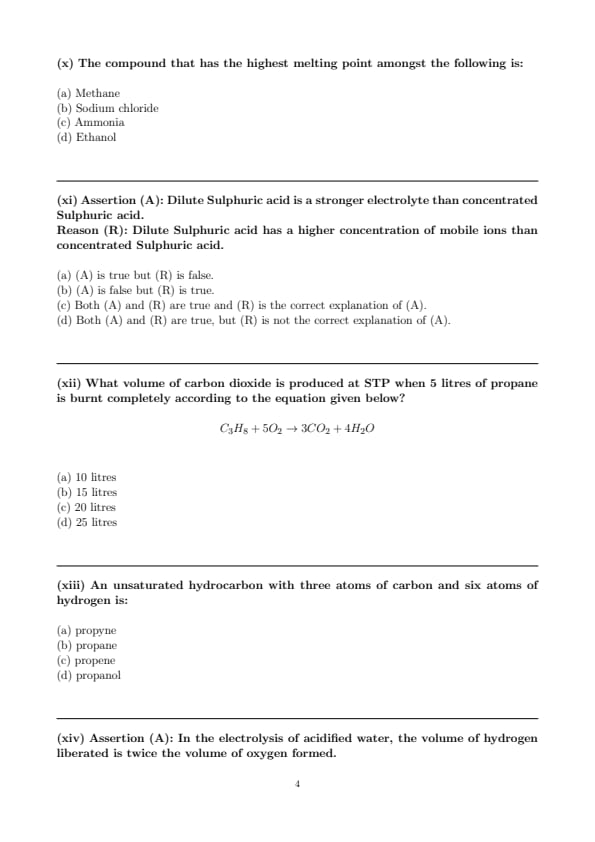
The compound that has the highest melting point amongst the following is:
Assertion (A): Dilute Sulphuric acid is a stronger electrolyte than concentrated Sulphuric acid.
Reason (R): Dilute Sulphuric acid has a higher concentration of mobile ions than concentrated Sulphuric acid.
What volume of carbon dioxide is produced at STP when 5 litres of propane is burnt completely according to the equation given below?
\[ C_3H_8 + 5O_2 \rightarrow 3CO_2 + 4H_2O \]
An unsaturated hydrocarbon with three atoms of carbon and six atoms of hydrogen is:
Assertion (A): In the electrolysis of acidified water, the volume of hydrogen liberated is twice the volume of oxygen formed.
Reason (R): Water has hydrogen and oxygen in the ratio of 1:2 by volume.
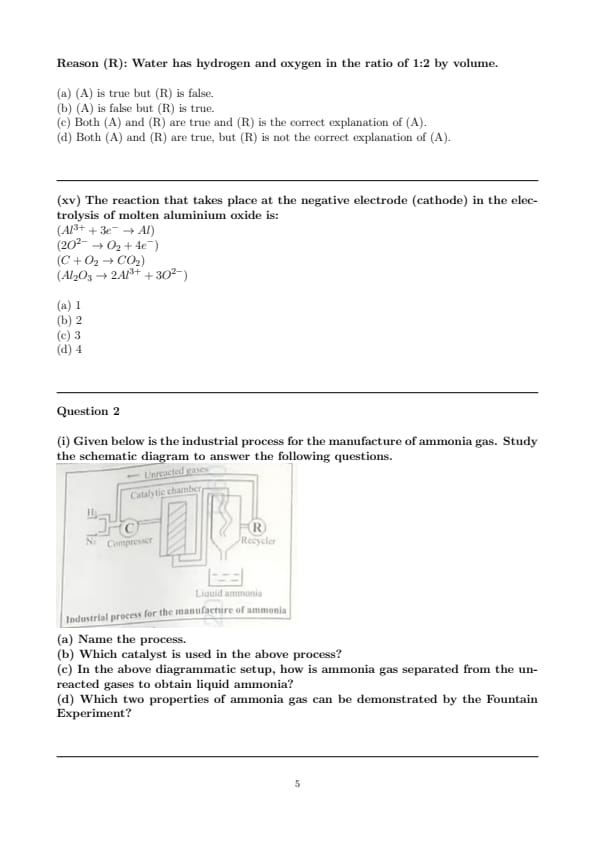
The reaction that takes place at the negative electrode (cathode) in the electrolysis of molten aluminium oxide is:
(\(Al^{3+} + 3e^- \rightarrow Al\))
(\(2O^{2-} \rightarrow O_2 + 4e^-\))
(\(C + O_2 \rightarrow CO_2\))
(\(Al_2O_3 \rightarrow 2Al^{3+} + 3O^{2-}\))
Given below is the industrial process for the manufacture of ammonia gas. Study the schematic diagram to answer the following questions.

(a) Name the process.
(b) Which catalyst is used in the above process?
(c) In the above diagrammatic setup, how is ammonia gas separated from the unreacted gases to obtain liquid ammonia?
(d) Which two properties of ammonia gas can be demonstrated by the Fountain Experiment?
Identify the following terms / compounds:
(a) A compound which reacts with water to give acetylene gas.
(b) The gas evolved when sodium propanoate is heated with soda lime.
(c) A reddish-brown precipitate formed when ferric chloride solution reacts with an alkali.
(d) A pair of electrons present in an atom which is not shared with any other atom during bond formation.
(e) The relative molecular mass of a substance expressed in grams.
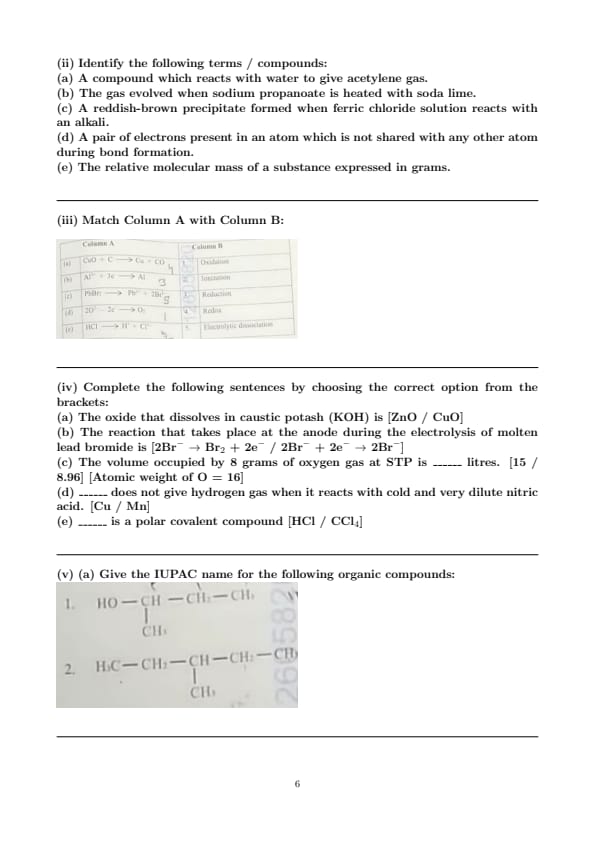
Match Column A with Column B:

Complete the following sentences by choosing the correct option from the brackets:
(a) The oxide that dissolves in caustic potash (KOH) is [ZnO / CuO]
(b) The reaction that takes place at the anode during the electrolysis of molten lead bromide is [2Br\(^-\) \(\rightarrow\) Br\(_2\) + 2e\(^-\) / 2Br\(^-\) + 2e\(^-\) \(\rightarrow\) 2Br\(^-\)]
(c) The volume occupied by 8 grams of oxygen gas at STP is ______ litres. [15 / 8.96] [Atomic weight of O = 16]
(d) ______ does not give hydrogen gas when it reacts with cold and very dilute nitric acid. [Cu / Mn]
(e) ______ is a polar covalent compound [HCl / CCl\(_4\)]
(a) Give the IUPAC name for the following organic compounds:

Draw the structural diagram for each of the following organic compounds:
1. Butanal
2. Pent-2-yne
3. The isomer of n-butane
Alex was given a solution of an unknown salt Y for analysis. He performed the following tests and recorded his observations:
• To a part of the solution Y, he added silver nitrate solution and obtained a white precipitate which was soluble in ammonium hydroxide solution.
• To the remaining solution he added a few drops of sodium hydroxide solution and obtained a pale blue precipitate.
Based on the observations made by Alex, identify:
(a) the anion and
(b) the cation present in salt Y.
Study the reaction given below and answer the questions that follow:
\[ NaNO_3 + H_2SO_4 \xrightarrow{< 200^\circC} NaHSO_4 + HNO_3 \]
(a) Give one reason for maintaining the temperature below 200°C.
(b) Why is concentrated Sulphuric acid used in the above reaction?
Element A belongs to group 15 and period 2 of the Periodic Table.
(a) Identify the element A.
(b) Write the formula of the compound formed when element A combines with hydrogen.
(c) Draw the dot (●) and cross (×) structure of the compound formed in (b) above.
Complete and balance the following equations:
(a) \(C_2H_4Br_2 + 2KOH (alcoholic) \rightarrow\)
(b) \(8NH_3(excess) + 3Cl_2 \rightarrow\)
(c) \(C_{12}H_{22}O_{11} \xrightarrow{conc. H_2SO_4}\)
Differentiate between the following pairs based on the criteria given in the bracket:
(a) Acetic acid and Sulphuric acid (number of replaceable hydrogen ion per molecule)
(b) Electrolyte and Metallic conductor (the particles conducting electricity)
Equal volumes of ammonia gas and chlorine gas are kept in two different containers under the same conditions of temperature and pressure. Find the number of molecules contained in chlorine gas when the mass of ammonia is 34 g. (Atomic weight: Cl = 35.5, H = 1, N = 14)
Elements P, Q, and R are in the same period of the modern periodic table.
• P readily loses its one valence electron to form a stable ion.
• Q shares its electrons in bonding but does not form ions easily.
• R has high electronegativity.
Using suitable chemicals from the box, write balanced chemical equations for the preparation of the following salts: Lead (II) carbonate, Copper (II) chloride, Iron (II) chloride.
An unsaturated hydrocarbon having two carbon atoms was made to react with two moles of hydrogen gas in the presence of a catalyst to give a saturated hydrocarbon. Using the above information, answer the following questions.
(a) The type of reaction that occurred is __________ (addition / substitution)
(b) Name a suitable catalyst which is used in the reaction
(c) Write a balanced chemical equation for the above reaction
During the manufacture of sulphuric acid, a chemist collected the gas formed after catalytic oxidation of sulphur dioxide.
(a) Name the gas collected.
(b) Which acid is formed when the gas collected by the chemist is dissolved directly in water?
(c) Why should we not dissolve this gas directly in water?
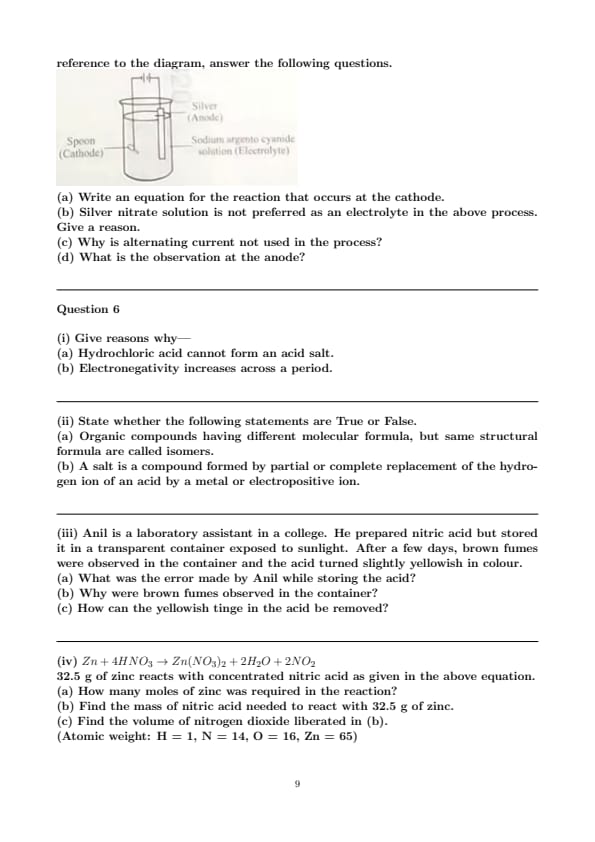
The diagram given below shows the electroplating of a spoon with silver. With reference to the diagram, answer the following questions.

(a) Write an equation for the reaction that occurs at the cathode.
(b) Silver nitrate solution is not preferred as an electrolyte in the above process. Give a reason.
(c) Why is alternating current not used in the process?
(d) What is the observation at the anode?
Give reasons why—
(a) Hydrochloric acid cannot form an acid salt.
(b) Electronegativity increases across a period.
State whether the following statements are True or False.
(a) Organic compounds having different molecular formula, but same structural formula are called isomers.
(b) A salt is a compound formed by partial or complete replacement of the hydrogen ion of an acid by a metal or electropositive ion.
Anil is a laboratory assistant in a college. He prepared nitric acid but stored it in a transparent container exposed to sunlight. After a few days, brown fumes were observed in the container and the acid turned slightly yellowish in colour.
(a) What was the error made by Anil while storing the acid?
(b) Why were brown fumes observed in the container?
(c) How can the yellowish tinge in the acid be removed?
\(Zn + 4HNO_3 \rightarrow Zn(NO_3)_2 + 2H_2O + 2NO_2\)
32.5 g of zinc reacts with concentrated nitric acid as given in the above equation.
(a) How many moles of zinc was required in the reaction?
(b) Find the mass of nitric acid needed to react with 32.5 g of zinc.
(c) Find the volume of nitrogen dioxide liberated in (b).
(Atomic weight: H = 1, N = 14, O = 16, Zn = 65)
Carbon reacts with an acid to form carbon dioxide, water and nitrogen dioxide.
(a) Name the acid used in the reaction.
(b) Write a balanced chemical equation for the reaction that occurs.
Bauxite is the principal ore used in the commercial extraction of aluminium. The Bayer’s process is used to refine bauxite into pure alumina, with caustic soda playing a crucial role in the initial stage of the process. Based on this, answer the following questions:
(a) Explain the reason behind the addition of caustic soda during the Bayer’s process.
(b) Write a balanced chemical equation representing the reaction between bauxite and caustic soda during the Bayer’s process.
Give one relevant observation for the following:
(a) Sodium hydroxide is added dropwise to Calcium nitrate solution.
(b) Dilute Hydrochloric acid is added to Iron (II) sulphide.
(c) An amphoteric metal is added to hot concentrated alkali.
Study the reaction scheme shown below and identify the reactants A, B and C.

5.6 litres of gas Z weighs 32 g at STP. What is the molecular weight and vapour density of Z?
Name the following:
(a) The most electronegative element of Period 2
(b) The largest atom of Period 3
Given below are a few elements: Li, K, Cs, F.
Identify the element which:
(a) has the least atomic radius.
(b) has two valence electrons.
(c) is the most electropositive.
K, L and M are beakers containing three different solutions: [Beaker K: Aqueous acetic acid, Beaker L: Sodium chloride solution, Beaker M: Distilled water]. Name the beaker which:

(a) contains only ions.
(b) contains only molecules.
(c) has pH less than 7.



ICSE 10TH - CHEMISTRY PAPER ANALYSIS | ICSE Boards 2026
*The article might have information for the previous academic years, please refer the official website of the exam.