
ICSE Class 10 2026 English Language Question Paper: Download Solutions PDF


| Updated On - Feb 20, 2026
ICSE Class 10 English Language (English Paper 1) Question Paper 2026 has been made available for students to download. The Council For The Indian School Certificate Examinations (CISCE) successfully conducted the ICSE Class 10 English Language (English Paper 1) examination on February 17, 2026, from 11 AM to 1 PM.
ICSE Class 10 English Language Question Paper 2026 with Solutions
| ICSE Class 10 English Language (English Paper 1) Question Paper 2026 | Download PDF | View Solutions |
Students can use the question paper and detailed solutions PDF to analyze the exam pattern, marking scheme, and important topics covered in the 2026 board examination.

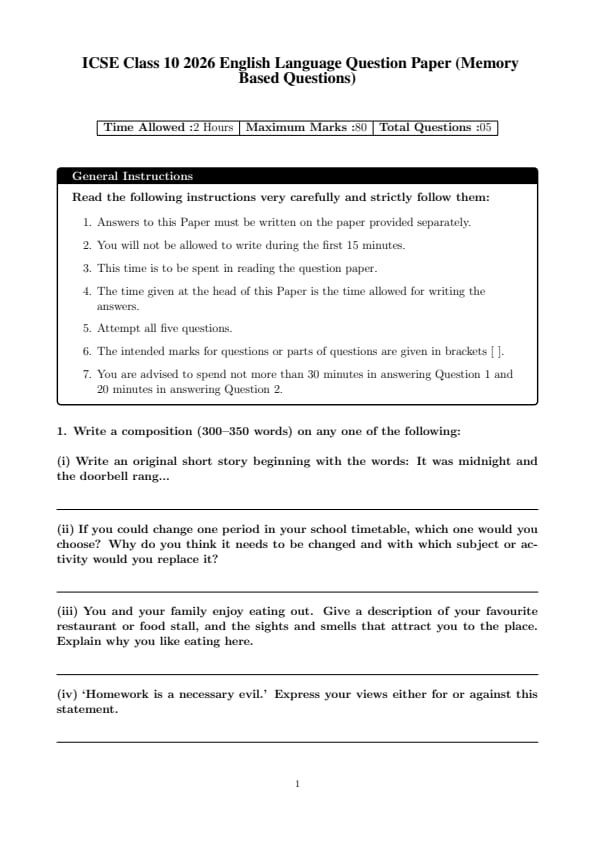
Write an original short story beginning with the words: It was midnight and the doorbell rang...
View Solution
Step 1: Understanding the Concept:
Creative writing requires a strong hook, character development, and a narrative arc (beginning, middle, and end). The prompt sets a suspenseful tone that must be maintained throughout the story.
Step 2: Detailed Explanation:
It was midnight and the doorbell rang. The sound echoed through the hollow silence of the house, sharp and intrusive. I froze in my armchair, the book I was reading slipping from my lap. I wasn't expecting anyone, and at this hour, a visitor usually meant trouble.
Approaching the door, I peered through the tiny glass lens of the peephole. The porch light was flickering, casting long, jagged shadows across a figure standing there—a young boy, no older than ten, shivering despite the mild summer air. He held a weathered wooden box against his chest as if it were made of glass.
When I opened the door, he didn't look up. "My grandfather said you’d know what to do with this," he whispered, thrusting the box toward me. Before I could ask a single question, he turned and vanished into the darkness of the driveway. I stepped back inside, the weight of the box surprisingly heavy. As I lifted the lid, a soft, golden light spilled out, illuminating a collection of clockwork gears and a letter addressed to me in a handwriting I hadn't seen in twenty years. The mystery of my family's lost legacy had just arrived on my doorstep.
Step 3: Final Answer:
The story concludes with a cliffhanger, establishing a sense of mystery and personal connection to the protagonist's past. Quick Tip: To make a story more engaging, use sensory details (the hollow silence, the flickering light) to build atmosphere rather than just stating facts.
If you could change one period in your school timetable, which one would you choose? Why do you think it needs to be changed and with which subject or activity would you replace it?
View Solution
Step 1: Understanding the Concept:
This is a descriptive and argumentative exercise where I must identify a problem (a specific period), provide a logical reason for the change, and suggest a beneficial alternative.
Step 2: Detailed Explanation:
If I could change one period in my school timetable, I would choose the final period of the day, which is currently a heavy academic subject like Mathematics. By the eighth period, students are mentally exhausted and their concentration levels are at their lowest. Solving complex equations at 2:30 PM often results in frustration rather than learning.
I would replace this period with a 'Creative Explorations' or 'Hobbies' hour. This would include activities like photography, coding, gardening, or even guided meditation. Replacing a taxing subject with an engaging activity would allow students to end their day on a positive, productive note. It would foster creativity and reduce the stress associated with the academic grind, making school a more holistic environment.
Step 3: Final Answer:
The final academic period should be replaced with a creative activity to better align with students' energy levels and mental well-being. Quick Tip: When suggesting a change, always focus on the benefit for the group (the students) rather than just personal preference.
You and your family enjoy eating out. Give a description of your favourite restaurant or food stall, and the sights and smells that attract you to the place. Explain why you like eating here.
View Solution
Step 1: Understanding the Concept:
Descriptive writing aims to paint a picture in the reader's mind using vivid adjectives and the five senses: sight, smell, sound, touch, and taste.
Step 2: Detailed Explanation:
My favourite place to eat with my family is a small, bustling Lebanese bistro called 'The Cedar Grove'. As you approach the entrance, you are greeted by the warm, amber glow of Moroccan lanterns hanging from the ceiling. The air is thick and intoxicating with the smell of sizzling lamb, toasted pine nuts, and the sharp, citrusy tang of fresh sumac.
The sight of the open kitchen, where chefs deftly flip flatbreads over a clay oven, creates an atmosphere of organized chaos that is strangely comforting. I love eating here not just for the creamy hummus or the perfectly charred kebabs, but for the sense of community. The tables are close together, filled with the sound of laughter and the clinking of glasses. It is a place where time seems to slow down, allowing us to truly enjoy each other's company over a shared meal.
Step 3: Final Answer:
The Cedar Grove is favoured for its sensory richness and its ability to provide a warm, communal atmosphere for family bonding. Quick Tip: Use "vibrant" adjectives. Instead of saying the food "smells good," say the air is "redolent with the aroma of spices."
‘Homework is a necessary evil.’ Express your views either for or against this statement.
View Solution
Step 1: Understanding the Concept:
An argumentative essay requires a clear stance, logical points backed by reasoning or evidence, and a concluding summary that reinforces the position.
Step 2: Detailed Explanation:
I am expressing my views against the statement that homework is a 'necessary' evil. I believe it is often an unnecessary burden that hinders a child's overall development.
Firstly, a school day already lasts six to seven hours. Expecting children to spend several more hours on schoolwork at home deprives them of essential downtime, physical play, and adequate sleep. Secondly, homework often creates a divide between students; those with educated parents and quiet homes succeed, while others fall behind, making it an unfair assessment tool.
Furthermore, studies show that excessive homework does not necessarily lead to higher academic achievement in primary and middle school. Instead of reinforcing learning, it often leads to burnout and a distaste for education. Learning should happen within the classroom under professional guidance, leaving the home for family life and personal growth.
Step 3: Final Answer:
Homework should be minimized or abolished to ensure children have a balanced life and a genuine love for learning. Quick Tip: In an argumentative essay, always acknowledge the opposing view briefly before debunking it to make your argument more robust.
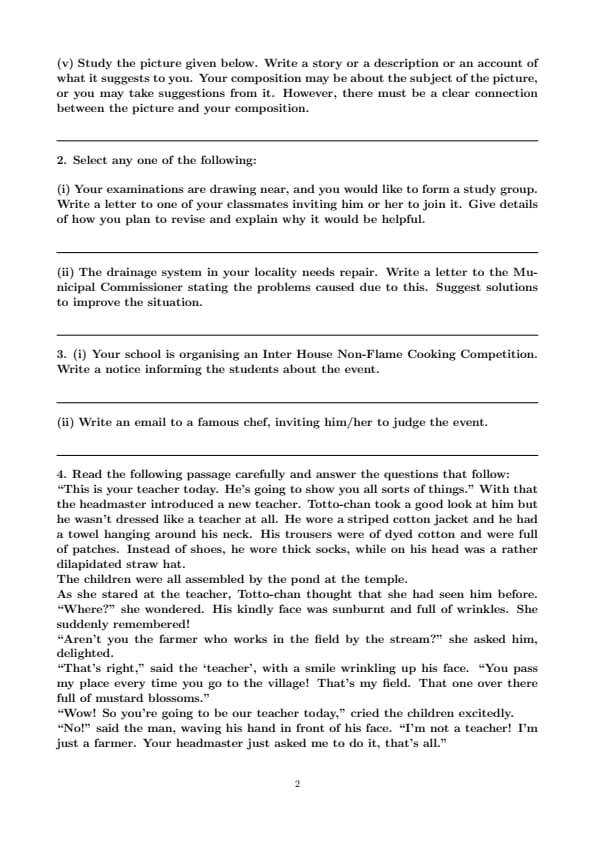
Study the picture given below. Write a story or a description or an account of what it suggests to you. Your composition may be about the subject of the picture, or you may take suggestions from it. However, there must be a clear connection between the picture and your composition.
View Solution
Step 1: Understanding the Concept:
Picture composition involves interpreting visual cues and expanding them into a narrative or descriptive piece. The key is to find a central theme or emotion in the image.
Step 2: Detailed Explanation:
(Assuming the picture depicts a bustling local market scene with various vendors and shoppers)
The marketplace was a kaleidoscope of colour and sound, a living breathing organism that woke up long before the sun. In the center of the frame, an elderly woman sits patiently behind a mountain of vibrant marigolds, her hands moving with the grace of a weaver as she strings garlands. To her left, a fruit seller calls out his prices, his voice a rhythmic chant that cuts through the hum of the crowd.
This picture suggests the beauty of the mundane. It captures the essence of hard work and the intricate web of human interaction. Every person in the frame represents a different story—the tired father buying mangoes, the curious child staring at the sweets, and the silent vendor watching the world go by. It reminds us that while technology advances, these traditional pockets of human connection remain the true heartbeat of our society.
Step 3: Final Answer:
The composition highlights the marketplace as a symbol of human resilience, tradition, and the vibrant energy of daily life. Quick Tip: When writing about a picture, imagine what happened just before the photo was taken or what will happen next to give your description a narrative flow.
Your examinations are drawing near, and you would like to form a study group. Write a letter to one of your classmates inviting him or her to join it. Give details of how you plan to revise and explain why it would be helpful.
View Solution
Step 1: Understanding the Concept:
An informal letter to a friend or classmate should have a warm, personal tone while remaining focused on the specific purpose of the invitation. The structure includes the sender's address, date, salutation, body, and subscription.
Step 2: Detailed Explanation:
12, Green Park Avenue
New Delhi - 110016
February 20, 2026
Dear Rohan,
I hope this letter finds you in high spirits. As our board examinations are just a month away, the pressure is beginning to build up. I was thinking that instead of struggling through the vast syllabus alone, we could form a small study group.
My plan is for us to meet at my house three times a week for two hours. We can focus on our weakest subjects, Mathematics and Physics, by solving previous years' question papers. For revision, we can use the "Feynman Technique"—where one of us explains a complex concept to the other. This will ensure our fundamentals are rock solid.
I believe this would be immensely helpful as we can clear each other's doubts instantly and stay motivated. Studying together will also help us manage our time better and stick to a disciplined schedule. Do let me know if you are interested so we can start from this coming Monday.
Warm regards,
Yours sincerely,
Arjun
Step 3: Final Answer:
The letter clearly outlines the schedule (three times a week), the method (solving papers and peer-teaching), and the benefits (motivation and doubt clearing) to persuade the classmate to join. Quick Tip: In informal letters, use contractions like "I'm" or "don't" to keep the tone conversational, and always end with an affectionate closing.
The drainage system in your locality needs repair. Write a letter to the Municipal Commissioner stating the problems caused due to this. Suggest solutions to improve the situation.
View Solution
Step 1: Understanding the Concept:
A formal letter to an official requires a respectful tone, a clear subject line, and a structured presentation of the problem and proposed solutions. It should follow the formal block format.
Step 2: Detailed Explanation:
B-402, Sunshine Apartments
Sector 12, Dwarka
New Delhi - 110075
February 20, 2026
The Municipal Commissioner
Municipal Corporation of Delhi
Civic Centre, Minto Road
New Delhi - 110002
Subject: Urgent request for repair of the drainage system in Sector 12, Dwarka.
Sir/Madam,
I am writing to bring to your kind attention the dilapidated state of the drainage system in our locality. For the past few weeks, the main sewage lines have been overflowing, leading to the accumulation of stagnant water on the primary roads.
This has caused several problems: the foul smell has made it difficult for residents to step out, and the stagnant water has become a breeding ground for mosquitoes, posing a severe risk of diseases like Dengue and Malaria. Furthermore, the waterlogged streets are causing heavy traffic congestion and damage to the road surface.
To resolve this, I suggest the following solutions:
Immediate desilting of the existing pipes to remove blockages.
Replacement of old, cracked concrete pipes with high-density polyethylene (HDPE) pipes for better durability.
Increasing the number of catch basins to ensure faster water runoff during rains.
I urge you to take immediate action to prevent a major health crisis in our area.
Yours faithfully,
(Signature)
Amit Sharma
(President, Residents' Welfare Association)
Step 3: Final Answer:
The letter identifies the core issues (health risks and traffic) and provides technical suggestions (desilting and pipe replacement) for the Commissioner's consideration. Quick Tip: When writing to an official, use a "Subject" line that is brief and highlights the main issue. This helps the department categorize and prioritize your complaint.
(i) Your school is organising an Inter House Non-Flame Cooking Competition. Write a notice informing the students about the event.
View Solution
Step 1: Understanding the Concept:
A notice is a formal means of communication. Its purpose is to announce an event or provide information to a specific group. It must include the name of the organization, the word 'NOTICE', a descriptive heading, the date of issue, and the details of the event (date, time, venue).
Step 2: Detailed Explanation:
ST. XAVIER’S HIGH SCHOOL, DELHI
NOTICE
February 20, 2026
Culinaria: Inter-House Non-Flame Cooking Competition
This is to inform all students from Classes IX to XII that the school is organizing an Inter-House Non-Flame Cooking Competition. The event aims to encourage culinary creativity and healthy eating habits among students.
The details of the event are as follows:
Date: March 5, 2026
Time: 10:00 AM to 12:30 PM
Venue: School Auditorium
Interested students must form teams of three and register their names with their respective House Captains by February 28, 2026. Participants are required to bring their own ingredients and equipment. Please note that the use of any heating elements or open flames is strictly prohibited.
For further details, contact the undersigned.
(Signature)
Ananya Verma
(Head Girl/Boy)
Step 3: Final Answer:
The notice successfully conveys all necessary logistical information while clearly stating the specific constraints (non-flame) of the competition. Quick Tip: Always put your notice inside a box. Ensure the heading is catchy and the contact person's designation is clearly mentioned at the bottom.
Write an email to a famous chef, inviting him/her to judge the event.
View Solution
Step 1: Understanding the Concept:
A formal email to a professional should be concise and respectful. It must include a clear subject line, a formal salutation, the purpose of the email, details of the event, and a polite closing.
Step 2: Detailed Explanation:
To: chef.vikas@example.com
Subject: Invitation to Judge: Inter-House Non-Flame Cooking Competition at St. Xavier's
Dear Chef Vikas,
I hope this email finds you well.
I am writing to you on behalf of St. Xavier’s High School, Delhi. We have long admired your contribution to globalizing Indian cuisine and your emphasis on the artistry of food. We are organizing an Inter-House Non-Flame Cooking Competition titled ‘Culinaria’ on March 5, 2026, from 10:00 AM to 12:30 PM in our school auditorium.
It would be a great honour for our students to have a culinary icon like yourself judge the event. Your presence would not only inspire our young budding chefs but also provide them with invaluable insights into the world of professional cooking.
We would be delighted to arrange for your transport. We look forward to a positive response from your end.
Yours faithfully,
Ananya Verma
Head Girl, St. Xavier’s High School
Contact: +91-98XXX XXXXX
Step 3: Final Answer:
The email maintains a professional tone, provides the necessary date and time details, and clearly explains why the recipient's presence is valued. Quick Tip: In a formal email, always keep the 'Subject' line descriptive but brief so the recipient knows exactly what the email is about before opening it.
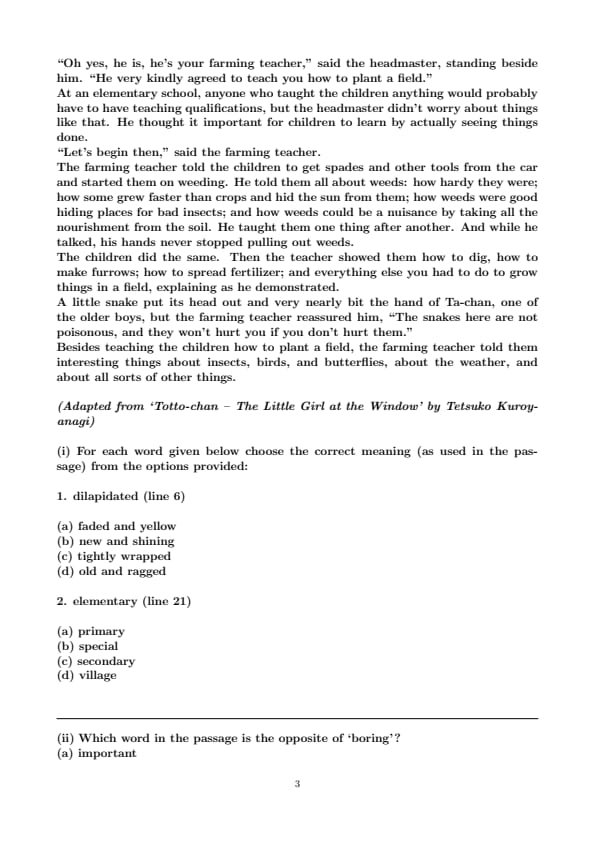
Read the following passage carefully and answer the questions that follow:
“This is your teacher today. He’s going to show you all sorts of things.” With that the headmaster introduced a new teacher. Totto-chan took a good look at him but he wasn’t dressed like a teacher at all. He wore a striped cotton jacket and he had a towel hanging around his neck. His trousers were of dyed cotton and were full of patches. Instead of shoes, he wore thick socks, while on his head was a rather dilapidated straw hat.
The children were all assembled by the pond at the temple.
As she stared at the teacher, Totto-chan thought that she had seen him before. “Where?” she wondered. His kindly face was sunburnt and full of wrinkles. She suddenly remembered!
“Aren’t you the farmer who works in the field by the stream?” she asked him, delighted.
“That’s right,” said the ‘teacher’, with a smile wrinkling up his face. “You pass my place every time you go to the village! That’s my field. That one over there full of mustard blossoms.”
“Wow! So you’re going to be our teacher today,” cried the children excitedly.
“No!” said the man, waving his hand in front of his face. “I’m not a teacher! I’m just a farmer. Your headmaster just asked me to do it, that’s all.”
“Oh yes, he is, he’s your farming teacher,” said the headmaster, standing beside him. “He very kindly agreed to teach you how to plant a field.”
At an elementary school, anyone who taught the children anything would probably have to have teaching qualifications, but the headmaster didn’t worry about things like that. He thought it important for children to learn by actually seeing things done.
“Let’s begin then,” said the farming teacher.
The farming teacher told the children to get spades and other tools from the car and started them on weeding. He told them all about weeds: how hardy they were; how some grew faster than crops and hid the sun from them; how weeds were good hiding places for bad insects; and how weeds could be a nuisance by taking all the nourishment from the soil. He taught them one thing after another. And while he talked, his hands never stopped pulling out weeds.
The children did the same. Then the teacher showed them how to dig, how to make furrows; how to spread fertilizer; and everything else you had to do to grow things in a field, explaining as he demonstrated.
A little snake put its head out and very nearly bit the hand of Ta-chan, one of the older boys, but the farming teacher reassured him, “The snakes here are not poisonous, and they won’t hurt you if you don’t hurt them.”
Besides teaching the children how to plant a field, the farming teacher told them interesting things about insects, birds, and butterflies, about the weather, and about all sorts of other things.
(Adapted from ‘Totto-chan – The Little Girl at the Window’ by Tetsuko Kuroyanagi)
(i) For each word given below choose the correct meaning (as used in the passage) from the options provided:
1. dilapidated (line 6)
View Solution
Step 1: Understanding the Concept:
Contextual vocabulary requires identifying the meaning of a word based on the sentences surrounding it. In this passage, 'dilapidated' describes a straw hat belonging to a working farmer, and 'elementary' refers to a type of school for young children.
Step 2: Detailed Explanation:
1. dilapidated: The passage describes the teacher's clothes as full of patches and his hat as "rather dilapidated." In this context, it suggests the hat is worn out from use. Therefore, "old and ragged" is the correct choice.
2. elementary: The passage mentions "at an elementary school" in the context of teaching children basic skills like weeding and planting. Elementary schools are synonymous with primary schools.
Step 3: Final Answer:
1. (d) old and ragged
2. (a) primary Quick Tip: To find the correct meaning, replace the word in the sentence with your chosen option. If the sentence still makes sense and maintains its tone, you have likely found the right answer.
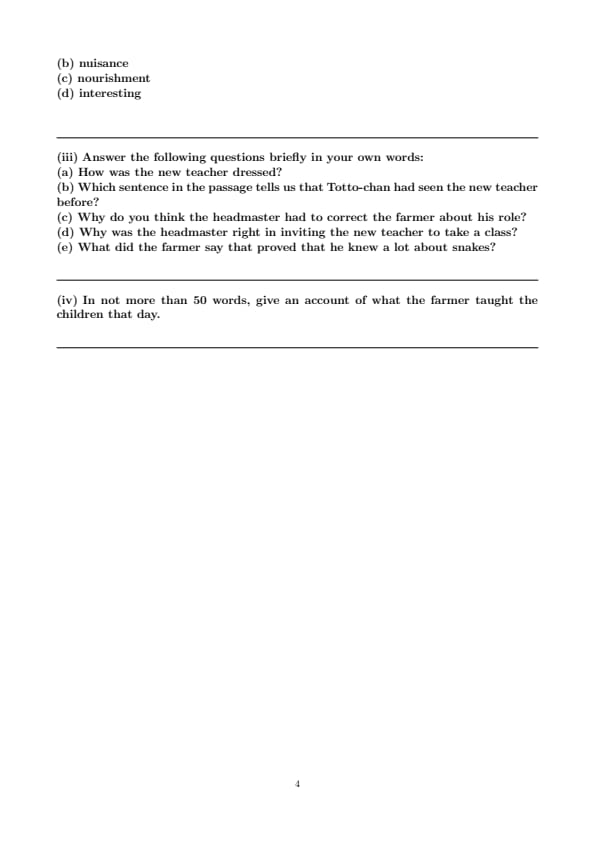
Which word in the passage is the opposite of ‘boring’?
View Solution
Step 1: Understanding the Concept:
Antonyms are words that have opposite meanings. The word 'boring' describes something dull or unexciting, so we need a word that describes something that holds one's attention.
Step 2: Detailed Explanation:
In the penultimate paragraph, the passage mentions that the farmer told the children "interesting things about insects, birds, and butterflies." This implies the information was engaging and not dull.
Step 3: Final Answer:
The opposite of ‘boring’ is (d) interesting. Quick Tip: When looking for antonyms in a passage, look for adjectives that describe the children's or the narrator's positive reaction to an activity.
Answer the following questions briefly in your own words:
(a) How was the new teacher dressed?
(b) Which sentence in the passage tells us that Totto-chan had seen the new teacher before?
(c) Why do you think the headmaster had to correct the farmer about his role?
(d) Why was the headmaster right in inviting the new teacher to take a class?
(e) What did the farmer say that proved that he knew a lot about snakes?
View Solution
Step 1: Understanding the Concept:
Reading comprehension requires extracting specific information from the text and rephrasing it clearly while maintaining the original meaning.
Step 2: Detailed Explanation:
(a) The new teacher was dressed like a typical farmer rather than a traditional educator. He wore a striped cotton jacket, patched dyed-cotton trousers, thick socks instead of shoes, a worn-out straw hat, and had a towel draped around his neck.
(b) The sentence is: "As she stared at the teacher, Totto-chan thought that she had seen him before."
(c) The farmer was being humble and insisted he was not a teacher because he lacked formal qualifications. The headmaster corrected him to validate his expertise, labeling him a "farming teacher" to show the children that his practical skills were a form of specialized knowledge.
(d) The headmaster believed that practical, hands-on learning was more valuable than just theoretical knowledge. By inviting a real farmer, he ensured the children learned through direct observation and actual practice, which is a highly effective educational method.
(e) When a snake appeared, the farmer was able to immediately identify it as non-poisonous. He reassured the children by explaining the snake's behavior—that it would not harm them unless it felt threatened.
Step 3: Final Answer:
The answers provided above summarize the key details of the teacher's appearance, Totto-chan's recognition, the headmaster's educational philosophy, and the farmer's expert knowledge of nature. Quick Tip: When asked to quote a sentence from the passage, ensure you copy it exactly as it appears, including punctuation.
In not more than 50 words, give an account of what the farmer taught the children that day.
View Solution
Step 1: Understanding the Concept:
Précis or summary writing involves condensing the main points of a narrative into a concise paragraph while adhering to a strict word limit.
Step 2: Detailed Explanation:
The farmer taught the children practical farming skills, including weeding, digging furrows, and spreading fertilizer. He explained the nature of weeds and their impact on crops. Additionally, he shared insights about local wildlife, such as insects, birds, and snakes, as well as information about the weather and the environment.
Step 3: Final Answer:
The farmer taught weeding, digging, and fertilizing while explaining soil nourishment. He also shared fascinating knowledge about insects, birds, non-poisonous snakes, and the weather, emphasizing learning through practical demonstration and observation of nature. (36 words) Quick Tip: To stay within the word limit, avoid using introductory phrases like "In this passage, it is said that..." and jump straight into the facts.
*The article might have information for the previous academic years, please refer the official website of the exam.