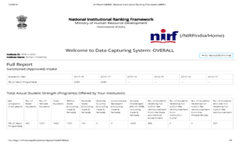
Kolhan University is a state public university founded in 2009 at Chaibasa in Jharkhand’s West Singhbhum district. Constituted under the Jharkhand Universities Act, it is recognised by the University Grants Commission, while the Governor of Jharkhand holds the position of Chancellor. The university received NAAC Grade B in October 2023, and the accreditation remains valid until January 2028. It was not included in the NIRF University ranked list for 2025.
From its headquarters in Chaibasa, the university serves the Kolhan Division, which covers West Singhbhum, East Singhbhum, and Seraikela Kharsawan. Its academic network consists of 20 constituent colleges and 34 affiliated colleges.
- Undergraduate: Students can choose BA Hons in 16 subjects, B.Sc Hons in 8 subjects, B.Com, BBA, BCA, B.Tech in 5 branches, B.Ed, B.Sc Nursing, LLB, and B.P.Ed.
- Postgraduate: The options include MA in 13 subjects, M.Sc in 5 subjects, M.Com, MBA, MCA, M.Tech in 5 branches, and M.Ed.
- Research: PhD programmes cover Humanities, Social Sciences, Basic Sciences, and Commerce and Management.
- Medical (Affiliated): Affiliated medical colleges provide MBBS and MD/MS programmes.
Annual course fees extend from INR 14,000 for MA to INR 3,20,000 for B.Tech. Undergraduate selection uses merit and CUET scores, depending on the programme. A placement cell supports recruitment, and professional programme graduates report average packages between INR 3 and 6 LPA.
- Kolhan University Admission Dates 2027
- Kolhan University Courses and Fees
- Kolhan University Admission Process
- Kolhan University Placements
- Kolhan University Scholarships
- Kolhan University Campus and Infrastructure
- Kolhan University vs Sido Kanhu Murmu University vs Vinoba Bhave University
- Kolhan University FAQs
Kolhan University Admission Dates 2027
The dates below are tentative projections for the 2027 admission cycle. They will require confirmation after the National Testing Agency publishes the CUET UG 2027 schedule.
| Event | Date |
|---|---|
| CUET UG 2027 registration | January 2027 (Tentative) |
| CUET UG 2027 examination | May 2027 (Tentative) |
| Kolhan University 2027 application period | July to August 2027 (Tentative) |
| B.Tech admission through JCECE | After JCECE 2027 results (Tentative) |
| Postgraduate admissions | August to September 2027 (Tentative) |
Subject to revision. Kindly check with the official sources to confirm
Kolhan University Courses and Fees
More than 60 programmes are available in arts, science, commerce, management, technology, law, education, and nursing. The table shows annual general-quota charges at the university level.
| Course | Duration | Annual Fee |
|---|---|---|
| BA Hons (16 subjects) | 3 years | INR 24,000 per year |
| B.Sc Hons (Botany, Chemistry, Physics, Zoology, Maths, Geology, Computer Application, Environmental Science) | 3 years | INR 54,000 per year |
| B.Com | 3 years | INR 30,000 per year |
| BBA | 3 years | INR 1,65,000 per year |
| BCA | 3 years | INR 1,65,000 per year |
| B.Tech (CSE, Civil, Electrical, Mechanical, Mining) | 4 years | INR 3,20,000 per year |
| B.Sc Nursing | 4 years | INR 1,92,000 per year |
| B.Ed | 2 years | INR 1,36,000 per year |
| LLB | 3 years | INR 60,000 per year |
| MA (13 subjects) | 2 years | INR 14,000 per year |
| M.Sc (5 subjects) | 2 years | INR 20,000 per year |
| MBA | 2 years | INR 86,000 to 1,10,000 per year |
| M.Tech (5 branches) | 2 years | INR 1,40,000 per year |
| MCA | 2 years | INR 90,000 per year |
| PhD (Humanities, Sciences, Commerce and Management, Social Sciences) | 3 to 5 years | INR 21,000 per year |
Subject to revision. Kindly check with the official sources to confirm
The five B.Tech branches are Civil Engineering, Computer Science and Engineering, Electrical Engineering, Mechanical Engineering, and Mining Engineering. MA subjects comprise Economics, English, Hindi, History, Geography, Philosophy, Political Science, Psychology, Sanskrit, Sociology, Urdu, Anthropology, and Odia. MBA specialisations are Finance, Marketing, and Human Resource Management.
Affiliated medical colleges also conduct medical programmes. MBBS carries a university-level annual fee of INR 36,000, while each affiliated medical institution decides its complete college fee. MD/MS options include Anaesthesiology, General Medicine, Obstetrics and Gynaecology, Paediatrics, Pathology, Community Medicine, Forensic Medicine, Pharmacology, Physiology, and Dermatology, with university fees of INR 27,000 per year. MS is additionally offered in General Surgery, Orthopaedics, Ophthalmology, and Otorhinolaryngology. Entry to MBBS is through NEET UG, while MD/MS admission uses NEET PG.
The four-year B.P.Ed, or Bachelor of Physical Education, costs INR 62,100 per year. Some constituent colleges also run certificate and vocational courses in information technology, allied health sciences, and vocational trades.
Kolhan University Admission Process
Selection methods vary by course. CUET scores support admission to undergraduate programmes, conventional postgraduate courses use merit based on previous academic marks, and professional or research programmes may require separate entrance tests.
- Choose a programme and check its academic and entrance-test requirements.
- Complete the application at kolhanuniversity.ac.in.
- Upload the required documents and pay an application fee of INR 100 to 500.
- Wait for the relevant merit list, entrance result, counselling, or seat-allotment round.
- If shortlisted, attend document verification and pay the course fee to confirm admission.
Undergraduate Admission
Applicants must meet the following conditions for undergraduate courses:
- General and OBC applicants need 10+2 from a recognised board with at least 45% aggregate marks in the relevant subjects.
- SC, ST, and Persons with Disability candidates require 40% marks in 10+2.
- Admission to BA, B.Sc, B.Com, BBA, BCA, and related courses requires a CUET UG score.
- JCECE scores are used for B.Tech selection.
Postgraduate Admission
Marks in the undergraduate degree and state-level merit determine admission to MA, M.Sc, and M.Com. MBA, MCA, and M.Tech applicants must take the relevant separate entrance examination or hold a valid state-level CET score. A relevant bachelor’s degree with 50% marks is needed for professional postgraduate courses, while MA, M.Sc, and M.Com require 45% marks.
PhD Admission
PhD applicants normally take the university research entrance test and then attend an interview. A valid UGC-NET/JRF or GATE score can provide exemption from the written examination. The minimum requirement is a postgraduate degree with 55% marks, reduced to 50% for SC, ST, and PwD candidates.
B.Ed and LLB
A bachelor’s degree with at least 50% marks is required for B.Ed. The three-year LLB accepts graduates with at least 45% marks. The university or the relevant councils coordinate state-level counselling for both courses.
JCECE for B.Tech
The Jharkhand Combined Entrance Competitive Examination Board conducts JCECE for admission to engineering colleges affiliated with or constituted under Kolhan University. Applicants need 10+2 with Physics, Chemistry, and Mathematics and at least 50% marks. JCECE ranks are used to distribute seats in Civil, CSE, Electrical, Mechanical, and Mining Engineering.
Shortlisted students first fill their choices online through the JCECEB portal. Round-wise seat allotment follows, after which students report for document checks and pay the admission fee. Diploma holders may enter the second year of B.Tech directly through the JCECE lateral-entry route.
Medical Admission
NEET UG governs MBBS entry at affiliated medical colleges. MCC allocates All India quota seats, while the Jharkhand Combined Entrance Competitive Examination Board manages Jharkhand state counselling for the state quota. MD/MS seats are filled through NEET PG counselling. NMC rules and the recognised intake of each affiliated college determine eligibility and seat availability.
Kolhan University Placements
The central placement cell organises recruitment support, mainly for engineering, management, and nursing students. The university largely serves learners from the tribal and semi-urban districts within the Kolhan Division.
| Programme | Typical Placement Pathway | Reported Package Range |
|---|---|---|
| B.Tech | Recruitment drives involving IT, manufacturing, and mining employers | INR 3 to 6 LPA |
| MBA | Finance, marketing, and human resources positions in regional organisations | INR 3 to 5 LPA |
| BCA/MCA | Software development, IT support, and data-entry work | INR 2.5 to 4 LPA |
| BA/MA | Private-sector work and government services through JPSC, SSC, and teaching examinations | As per government pay bands |
| B.Sc Nursing | Government health services and hospitals | INR 2 to 5 LPA |
Engineering and management graduates commonly explore jobs in Jharkhand’s mining corridor, including Jamshedpur, Dhanbad, and Bokaro, as well as the business networks connected with Tata Steel, SAIL, and NMDC. Many BA and MA graduates instead prepare for JPSC, UPSC, SSC, state teaching service commission, and other government examinations.
Kolhan University Scholarships
Students may seek financial support through central, Jharkhand government, and university schemes. Government-funded scholarships provide the main forms of assistance.
| Scholarship | Eligibility | Coverage |
|---|---|---|
| National Scholarship Portal (NSP) Schemes | 10+2 with 80% and parental income up to INR 6 Lakhs | INR 20,000 to 1,20,000 per year, depending on the scheme |
| Jharkhand State Scholarship | SC, ST, or OBC students studying at recognised universities | INR 5,000 to 30,000 per year |
| Merit Scholarship (University Level) | Top-ranking final-year students in BA, B.Sc, and B.Com | Cash award or fee concession |
| Sports Scholarship | Students who represent state or national teams | Partial fee waiver |
| Post-Matric Scholarship for Minorities | Students from minority communities with 50% or more marks | As specified in central scheme guidelines |
Jharkhand’s state ST scholarship schemes support students from Scheduled Tribe communities in West Singhbhum and the wider Kolhan Division. The benefits include tuition-fee coverage and a maintenance allowance. Eligible students must apply through the Jharkhand state scholarship portal and renew their applications every academic year.
Kolhan University Campus and Infrastructure
The main campus is in Chaibasa, the administrative centre of West Singhbhum district. It contains the university offices, major academic departments, central library, central reading room, subject laboratories, computer centres, and seminar halls.
Across Jharkhand’s tribal belt, the university reaches students through 54 colleges, comprising 20 constituent institutions and 34 affiliates. The network serves West Singhbhum, East Singhbhum, and Seraikela Kharsawan. East Singhbhum includes Jamshedpur, one of India’s largest steel cities, while important constituent colleges operate in Chaibasa, Chakradharpur, and nearby tehsils.
Ho, Munda, and Santhali communities form a large part of the region’s population. As the main university serving this area, Kolhan University sees strong demand for B.Ed, nursing, and arts and science courses that prepare students for government examinations. Chaibasa Engineering College, among Jharkhand’s oldest engineering colleges, belongs to the university’s affiliating system and provides B.Tech and M.Tech courses.
The campus offers student hostels, sports grounds, NCC and NSS units, and banking facilities. The university is also near Tata Steel’s Noamundi and Joda iron ore mines, SAIL’s Rourkela operations across the Odisha border, and the NMDC iron ore belt. This location places engineering and mining students close to major industrial employers.
Kolhan University vs Sido Kanhu Murmu University vs Vinoba Bhave University
Students considering public universities in Jharkhand may compare Kolhan University with Sido Kanhu Murmu University in Dumka and Vinoba Bhave University in Hazaribagh. All three serve learners from the state’s tribal and semi-urban regions.
| Parameter | Kolhan University | Sido Kanhu Murmu University | Vinoba Bhave University |
|---|---|---|---|
| Location | Chaibasa (West Singhbhum) | Dumka (Santhal Parganas) | Hazaribagh (Chota Nagpur) |
| Established | 2009 | 1992 | 1992 |
| Type | State Public University | State Public University | State Public University |
| UGC Recognition | Yes | Yes | Yes |
| NAAC Grade | B | B | B |
| B.Tech | Available (5 branches) | Not offered | Available |
| Annual BA Fee | INR 24,000 | State standard fees apply | State standard fees apply |
Kolhan University combines engineering with conventional arts and science education in the Kolhan tribal heartland. SKMU mainly serves the Santhal Pargana tribal belt, whereas VBU has a longer history in engineering and science. Each institution follows CUET UG for undergraduate entry and applies Jharkhand government fee rules.
Kolhan University FAQs
Ques. Does UGC recognise Kolhan University?
Ans. Yes. The University Grants Commission recognises Kolhan University in Chaibasa. It also has NAAC Grade B accreditation that remains valid until January 2028.
Ques. How can a student secure admission to BA Hons at Kolhan University?
Ans. BA Hons selection uses CUET UG scores. Applicants need 10+2 with at least 45% marks, or 40% if they belong to the SC or ST category. Applications must be filed through kolhanuniversity.ac.in.
Ques. How much does Kolhan University charge for B.Tech?
Ans. B.Tech costs INR 3,20,000 per year. Across the four-year course, the total programme fee is INR 12.80 Lakhs.
Ques. Which MBA options are available at Kolhan University?
Ans. The university offers MBA specialisations in Finance, Marketing, and Human Resource Management. Annual charges range from INR 86,000 for HRM to INR 1,10,000 for Finance and Marketing. Selection is through a state-level CET or the university entrance examination.
Ques. Can Kolhan University students apply for hostel accommodation?
Ans. Yes, but the constituent colleges manage their own hostels. Room availability and facilities differ by college, so applicants should confirm the details directly with the college they plan to attend.
Ques. Which scholarships can students use at Kolhan University?
Ans. Available options include National Scholarship Portal schemes, Jharkhand SC, ST, and OBC scholarships, university merit awards, and sports scholarships. State ST schemes can cover tuition fees and provide a maintenance allowance for eligible tribal students from West Singhbhum.
Ques. What employment routes do Kolhan University graduates commonly follow?
Ans. Engineering and management graduates often look for work in the mining and steel corridor covering Jamshedpur, Bokaro, and the wider eastern Indian industrial region. Professional programme graduates report average packages of INR 3 to 6 LPA. Arts and science graduates commonly prepare for JPSC, UPSC, state teaching service, and other government competitive examinations.
Ques. Is CUET used for every Kolhan University programme?
Ans. No. CUET UG applies to BA, B.Sc, B.Com, BBA, BCA, and most other undergraduate courses. JCECE is used for B.Tech, while MBBS selection takes place through NEET UG and Jharkhand state medical counselling. MBA and MCA rely on institute-level or state-level entrance tests. MA and M.Sc admissions are based on undergraduate marks.
Ques. What accreditation grade has Kolhan University received from NAAC?
Ans. NAAC awarded Kolhan University Grade B in October 2023, with validity through January 2028. The UGC-recognised university operates under the Jharkhand Universities Act, 2000.