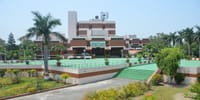
Indian Veterinary Research Institute, Bareilly (IVRI) is a government veterinary research university that was established in 1889. It works under the Indian Council of Agricultural Research (ICAR), has Deemed to be University status and is recognised by UGC. IVRI received a NAAC A+ Grade in July 2025. In NIRF 2025, it secured the 5th position in Agriculture and Allied Sectors with a score of 67.66. Its main campus covers 441 acres in Izatnagar, Bareilly, while regional campuses at Mukteswar and Palampur support research suited to different altitudes.
- The flagship 5.5-year BVSc and AH programme covers Veterinary Science and Animal Husbandry. Students enter through NEET-UG and ICAR Veterinary Education counselling.
- Biotechnology and Dairy Technology are offered as 4-year B.Tech programmes, with admission based on ICAR AIEEA-UG.
- The 2-year MVSc has more than 20 specialisations. These include Veterinary Pathology, Animal Genetics and Breeding, Veterinary Medicine, Animal Nutrition, Epidemiology, Livestock Products Technology and Veterinary Surgery. ICAR AIEEA-PG is used for admission.
- M.Sc. courses are available in Agricultural Economics, Agricultural Statistics and Bioinformatics.
- The institute runs a 2-year MBA in Agribusiness Management.
- PhD study is available in more than 20 disciplines related to veterinary and agricultural sciences. Admission is through ICAR AICE-JRF/SRF(PGS).
The complete BVSc and AH fee is INR 2,20,200, while the four-year B.Tech costs INR 1,68,100. The total charge for the two-year MVSc is INR 92,700. PhD scholars admitted with ICAR-JRF or SRF support receive INR 31,000 to INR 35,000 per month. During 2024-25, 77 of 320 postgraduate students obtained full reimbursement of their tuition fees.
Government veterinary departments, research organisations and higher studies are the main career routes for IVRI students. In 2025, employers recruited 86 postgraduate students, and the median package was INR 14.8 LPA.
- IVRI Bareilly Admission Dates 2027
- IVRI Bareilly Courses and Fees
- IVRI Bareilly Admission Process
- IVRI Bareilly Career Outcomes
- IVRI Bareilly Rankings
- IVRI Bareilly Scholarships and Fellowships
- IVRI Bareilly Campus and Infrastructure
- IVRI Bareilly vs GADVASU Ludhiana vs MAFSU Nagpur
- IVRI Bareilly FAQs
IVRI Bareilly Admission Dates 2027
IVRI admissions follow the central examination and counselling schedules managed by ICAR. The following expected timeline for the 2027 intake is based on ICAR's usual annual calendar.
| Event | Date |
|---|---|
| NEET-UG 2027 registration for BVSc | December 2026 to January 2027 |
| NEET-UG 2027 examination | May 2027 |
| ICAR Veterinary Education counselling for BVSc | July to August 2027 |
| ICAR AIEEA-UG 2027 registration for B.Tech | March to April 2027 |
| ICAR AIEEA-PG 2027 registration for MVSc | March to April 2027 |
| ICAR AIEEA 2027 examination for UG and PG courses | June 2027 |
| ICAR AICE-JRF/SRF(PGS) 2027 examination for PhD admission | June 2027 |
| Expected start of programmes | September to October 2027 |
Subject to revision. Kindly check with the official sources to confirm
Applicants must take the entrance test assigned to their chosen programme and then participate in the relevant ICAR counselling process.
| Programme | Qualifying Exam | Admission Route |
|---|---|---|
| BVSc and AH | NEET-UG | ICAR Veterinary Education counselling |
| B.Tech in Biotechnology or Dairy Technology | ICAR AIEEA-UG | ICAR centralised counselling |
| MVSc in all specialisations | ICAR AIEEA-PG | ICAR centralised counselling |
| M.Sc. | ICAR AIEEA-PG | ICAR centralised counselling |
| MBA in Agribusiness Management | ICAR AIEEA-PG | ICAR centralised counselling |
| PhD in all disciplines | ICAR AICE-JRF/SRF(PGS) | ICAR centralised counselling |
IVRI Bareilly Courses and Fees
Students can study veterinary science, agriculture, biotechnology, dairy technology, bioinformatics and agribusiness at IVRI Bareilly. BVSc and AH is its main undergraduate course. The institute's fees are regulated by the government.
| Course | Duration | Eligibility | Total Fees |
|---|---|---|---|
| BVSc and AH | 5 years and 6 months, including internship | 10+2 with PCB and 50%, with a qualifying NEET-UG score | INR 2,20,200 |
| B.Tech in Biotechnology or Dairy Technology | 4 years | 10+2 with PCB or PCM and 50%, along with ICAR AIEEA-UG | INR 1,68,100 |
| MVSc with more than 20 specialisations | 2 years | BVSc or an equivalent qualification with ICAR AIEEA-PG | INR 92,700 |
| M.Sc. in Agricultural Economics, Agricultural Statistics or Bioinformatics | 2 years | BSc in a relevant subject with ICAR AIEEA-PG | INR 15,300 |
| MBA in Agribusiness Management | 2 years | A bachelor's degree with ICAR AIEEA-PG | INR 4,15,300 |
| PhD in more than 20 disciplines | Minimum 3 years | MVSc or MSc with ICAR AICE-JRF/SRF | INR 1,52,400 |
Subject to revision. Kindly check with the official sources to confirm
MVSc students can choose from areas such as Veterinary Pathology, Animal Genetics and Breeding, Veterinary Medicine, Animal Nutrition, Epidemiology, Animal Biochemistry, Livestock Products Technology, Veterinary Surgery and Radiology, Veterinary Physiology and Veterinary Public Health. Other veterinary disciplines are also offered.
IVRI Bareilly Admission Process
Admission to IVRI Bareilly is based on national entrance tests followed by ICAR counselling. The required examination changes according to the course. Applicants must meet the academic conditions, qualify for the relevant test and complete counselling, seat confirmation and document checks.
BVSc and AH Admission
NEET-UG rank determines admission to BVSc and AH. During ICAR Veterinary Education counselling, seats are allotted according to rank, category, state domicile and the choices submitted by each student. The cutoff changes every year because it depends on the number of available seats and the size of the national applicant pool.
- Applicants need 10+2 Physics, Chemistry and Biology with at least 50% in aggregate. The minimum is 45% for SC, ST and OBC students.
- A qualifying NEET-UG result from the admission year is compulsory.
- The sequence is NEET-UG ranking, ICAR Veterinary counselling, choice filling, seat allotment, document verification and joining.
B.Tech Admission
For B.Tech in Biotechnology or Dairy Technology, students need 10+2 in the PCB or PCM stream with at least 50%. They must also secure a place on the ICAR AIEEA-UG merit list used for admission to B.Tech courses at ICAR-affiliated institutions.
MVSc Admission
ICAR AIEEA-PG is the central entrance examination for postgraduate admission to ICAR institutions. A BVSc or equivalent degree is needed for veterinary specialisations. For non-veterinary MVSc disciplines, applicants may qualify with a relevant BSc. The final allotment depends on ICAR merit rank and the order in which the student lists discipline preferences.
PhD Admission
Students seeking a PhD must take ICAR AICE-JRF/SRF(PGS), which is also used to award research fellowships. An eligible MVSc or MSc holder may apply in the chosen discipline. Selection includes merit ranking and an institute interview. Those who qualify for JRF or SRF receive funding during their doctoral study.
IVRI Bareilly Career Outcomes
Career routes from IVRI reflect its focus on veterinary education and research. BVSc graduates commonly join state veterinary departments, defence services or private practice, while many continue to postgraduate study. The institute does not conduct a standard campus placement drive for undergraduate students.
| Career Pathway | Destinations | Notes |
|---|---|---|
| State government veterinary services | Animal husbandry departments in Uttar Pradesh, Uttarakhand, Madhya Pradesh and other states | The most frequent route for BVSc graduates |
| Defence veterinary services | Army Veterinary Corps, CISF and CRPF | Entry is through competitive selection |
| Research and teaching | ICAR institutes, universities and CSIR laboratories | Mainly chosen by MVSc and PhD graduates |
| Industry roles for postgraduate students | Pharmaceutical, dairy, poultry and animal-feed companies | 86 PG students were placed in 2025, with a median package of INR 14.8 LPA |
| International research | FAO, WHO, foreign universities and CGIAR centres | Chosen by select PhD graduates |
Industry and research organisations hired 86 postgraduate students in 2025 at a median salary package of INR 14.8 LPA. BVSc graduates appointed to government posts generally begin at INR 5 to 7 LPA, according to the applicable central or state pay scale.
IVRI Bareilly Rankings
IVRI Bareilly has consistently remained within the top 10 of the NIRF Agriculture category. Its 2025 results include a national agriculture ranking and an updated accreditation grade.
| Ranking Body | Category | 2025 Result |
|---|---|---|
| NIRF | Agriculture and Allied Sectors | Rank 5, score 67.66 |
| NAAC | Accreditation | A+ Grade, July 2025 |
The institute is also recognised internationally for work in foot-and-mouth disease research, vaccine development and livestock disease surveillance.
IVRI Bareilly Scholarships and Fellowships
ICAR fellowship programmes are the main source of financial assistance for postgraduate and doctoral students at IVRI Bareilly. Full tuition reimbursement was awarded to 77 out of 320 postgraduate students in 2024-25.
| Fellowship/Scholarship | Eligibility | Amount |
|---|---|---|
| ICAR-JRF, Junior Research Fellowship | PhD scholars who qualify for the ICAR AICE-JRF examination | INR 31,000 per month during the JRF stage, plus HRA |
| ICAR-SRF, Senior Research Fellowship | PhD scholars who move to the SRF stage after 2 years | INR 35,000 per month, plus HRA |
| ICAR Institutional Fee Reimbursement | Meritorious postgraduate students selected by ICAR | Complete tuition fee reimbursement |
| PM-Vidyalaxmi Scheme | Students whose parental income is no more than INR 8 lakh per year | Education loan supported by interest subvention |
IVRI Bareilly Campus and Infrastructure
The main IVRI campus occupies 441 acres at Izatnagar in Bareilly, Uttar Pradesh. Facilities include veterinary research laboratories, teaching hospitals, animal houses and livestock research farms. Cattle, buffalo, sheep, goats, poultry and other livestock species are maintained for teaching and research.
IVRI also runs the Mountain Biology Campus at Mukteswar, Uttarakhand, at an altitude of 7,200 feet, as well as a campus in Palampur, Himachal Pradesh. These stations study livestock-rearing conditions and animal diseases in high-altitude areas. At Bareilly, the specialised facilities include the Central Animal Diagnostics Laboratory, Vaccine Production Unit, National Referral Centre for FMD Research and Central Library.
Accommodation is provided through separate hostel blocks for male and female students. IVRI mainly functions as a residential institute for postgraduate and doctoral scholars.
IVRI Bareilly vs GADVASU Ludhiana vs MAFSU Nagpur
Students considering veterinary admission through NEET-UG and ICAR counselling often compare IVRI Bareilly with Guru Angad Dev Veterinary and Animal Sciences University (GADVASU), Ludhiana, and Maharashtra Animal and Fishery Sciences University (MAFSU), Nagpur. The table compares their institutional status, accreditation, ranking, campus and BVSc fees.
| Parameter | IVRI Bareilly | GADVASU Ludhiana | MAFSU Nagpur |
|---|---|---|---|
| Year established | 1889 | 2005 | 1998 |
| Institution type | ICAR Deemed University | State University in Punjab | State University in Maharashtra |
| NAAC grade | A+ in 2025 | A in 2016 | B++ in 2023 |
| NIRF Agriculture rank in 2025 | 5 | Not among the top 10 | Not among the top 10 |
| Campus | 441 acres in Bareilly | City campus in Ludhiana | Nagpur |
| BVSc total fees | INR 2,20,200 | Higher as a state university | Higher as a state university |
Subject to revision. Kindly check with the official sources to confirm
IVRI combines ICAR support with its research facilities and fifth-place NIRF Agriculture ranking. GADVASU has an established regional role in Punjab and is known for clinical training. MAFSU serves a wider Maharashtra applicant base by offering veterinary education through several colleges in the state.
IVRI Bareilly FAQs
Ques. How much does the complete BVSc and AH course at IVRI Bareilly cost?
Ans. The government-regulated fee for the full 5.5-year BVSc and AH programme is INR 2,20,200. The duration consists of five academic years followed by a six-month internship.
Ques. How can a student secure a BVSc seat at IVRI Bareilly?
Ans. Students must qualify for NEET-UG and take part in ICAR's centralised Veterinary Education counselling. They need 10+2 Physics, Chemistry and Biology with at least 50% in aggregate. The minimum requirement for reserved categories is 45%.
Ques. What position did IVRI Bareilly receive in NIRF 2025?
Ans. NIRF 2025 placed IVRI Bareilly at rank 5 in Agriculture and Allied Sectors with a score of 67.66. The institute also held a NAAC A+ accreditation in July 2025.
Ques. Which career routes are common after completing BVSc at IVRI?
Ans. Graduates commonly work in state veterinary services, the Army Veterinary Corps or private veterinary practice. Many continue to MVSc study at ICAR institutions for research or academic careers. A smaller group takes roles in animal health, pharmaceutical and dairy companies.
Ques. Are doctoral courses available at IVRI Bareilly?
Ans. Yes. The institute offers PhD study in more than 20 veterinary and animal science disciplines. Selection is through ICAR AICE-JRF/SRF(PGS). A doctoral student who qualifies for JRF receives INR 31,000 per month during the junior research stage.
Ques. What steps are used for admission to an MVSc specialisation at IVRI?
Ans. An applicant needs a BVSc or equivalent degree and a place on the ICAR AIEEA-PG merit list. During ICAR counselling, the student's merit rank and stated order of discipline preferences decide allotment to IVRI Bareilly and the selected specialisation.
Ques. Can IVRI Bareilly students live in campus hostels?
Ans. Yes. Hostel rooms are available at the 441-acre Izatnagar campus, which is mainly residential for postgraduate and doctoral students. Rooms are limited and allotted according to priority.