
MHT CET 2025 12 April Shift 1 Question Paper (Available): Download Question Paper (PCB) with Solution PDF


| Updated On - Apr 12, 2025
The MHT CET 2025 question paper for April 12 Shift 1 (PCB group) is available here with Solution PDF. The MHT CET 2025 question paper consists of 200 multiple-choice questions (MCQs) totaling 200 marks divided in 4 sections, Physics, Chemistry, Biology (Zoology, Botany) and 50 questions in each subject.
Check: MHT CET Previous Year Question Paper with Solutions
MHT CET 2025 12 April Shift 1 PCB Question Paper PDF Download
| MHT CET 2025 PCB Question Paper With Answer Key | Check Solution |


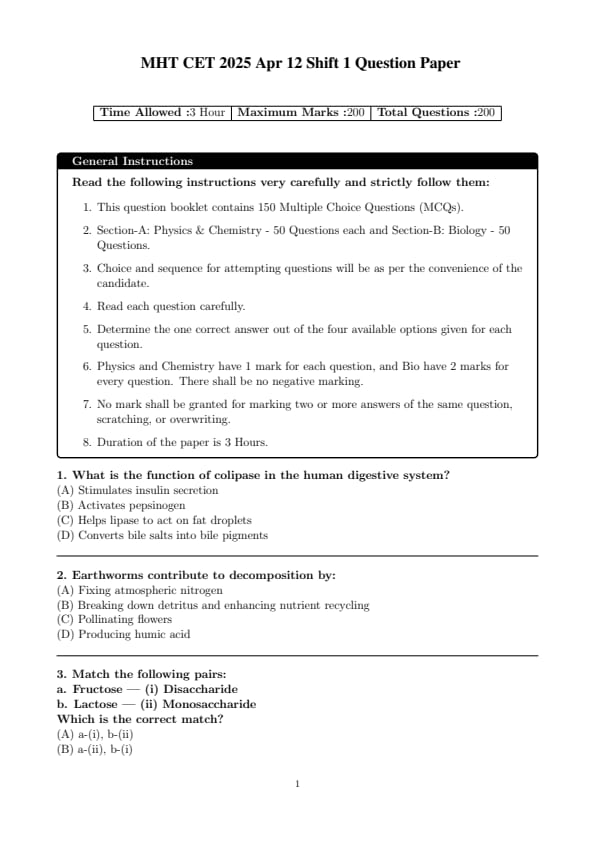
What is the function of colipase in the human digestive system?
View Solution
Colipase is an enzyme that plays a crucial role in the digestion of dietary fats. It aids in the function of lipase, an enzyme that breaks down fat droplets. Colipase binds to the fat droplets and ensures that lipase can effectively hydrolyze the triglycerides in the droplets. Therefore, option (C) is the correct answer. Quick Tip: Colipase is essential for proper fat digestion, as it helps lipase reach the fat droplets for efficient breakdown.
Earthworms contribute to decomposition by:
View Solution
Earthworms are important decomposers in the ecosystem. They break down organic matter, such as dead plants and animals (detritus), and enhance nutrient recycling in the soil. Their digestive system helps in the conversion of organic materials into humus, which improves soil structure and fertility. Therefore, the correct answer is option (B). Quick Tip: Earthworms play a critical role in decomposition by processing organic matter and promoting nutrient cycling in the soil.
Match the following pairs:
a. Fructose — (i) Disaccharide
b. Lactose — (ii) Monosaccharide
Which is the correct match?
View Solution
- Fructose is a monosaccharide, which means it consists of a single sugar unit.
- Lactose is a disaccharide, which consists of two sugar units (glucose and galactose).
Thus, the correct match is:
a-(ii), b-(i).
Therefore, the correct answer is option (B). Quick Tip: Remember that monosaccharides contain a single sugar unit, while disaccharides consist of two sugar units.
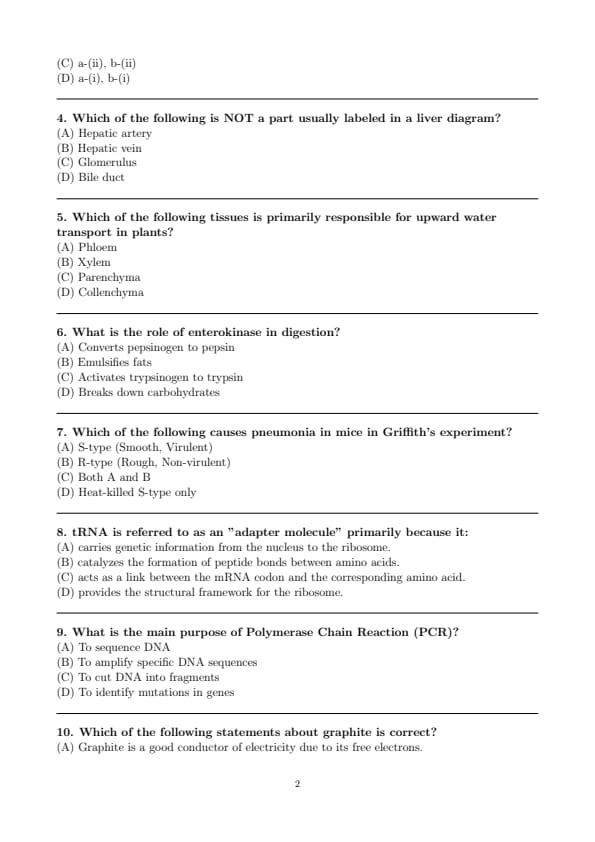
Which of the following is NOT a part usually labeled in a liver diagram?
View Solution
The liver diagram typically includes the following structures:
- Hepatic artery: This is the blood vessel that carries oxygenated blood to the liver, and it is a key structure in liver function.
- Hepatic vein: This vein carries deoxygenated blood from the liver back to the heart, and is also commonly labeled in liver diagrams.
- Bile duct: The bile duct is responsible for carrying bile produced by the liver to the gallbladder and small intestine, aiding in digestion.
However, the glomerulus is part of the kidney, not the liver. The glomerulus is a network of capillaries involved in the filtration of blood to form urine. It is not related to the liver structure, making it the incorrect answer in this context.
Therefore, the correct answer is option (C) Glomerulus. Quick Tip: The liver is part of the digestive system and is associated with the hepatic artery, hepatic vein, and bile duct, while the glomerulus is specific to kidney anatomy and plays a role in filtration.
Which of the following tissues is primarily responsible for upward water transport in plants?
View Solution
The primary function of xylem in plants is the transportation of water and minerals from the roots to the rest of the plant. Xylem vessels conduct water upward through the process of transpiration. This makes xylem the tissue primarily responsible for upward water transport in plants.
On the other hand, phloem is responsible for transporting food (mainly sugars) produced by photosynthesis, not water. Parenchyma and collenchyma are types of ground tissues that play roles in storage and structural support, respectively, but they are not involved in water transport.
Therefore, the correct answer is option (B) Xylem. Quick Tip: In plants, xylem is crucial for the transport of water and minerals, while phloem transports nutrients. Remember the role of each tissue for better understanding of plant functions.
What is the role of enterokinase in digestion?
View Solution
Enterokinase is an enzyme secreted by the duodenum that plays a critical role in protein digestion. It activates trypsinogen, an inactive enzyme, by converting it into trypsin, which then helps in the digestion of proteins in the small intestine.
- Option (A) is incorrect because the conversion of pepsinogen to pepsin is facilitated by acid in the stomach, not by enterokinase.
- Option (B) is incorrect because emulsification of fats is done by bile.
- Option (D) is incorrect as carbohydrate breakdown is facilitated by enzymes like amylase, not enterokinase.
Thus, the correct answer is option (C) Activates trypsinogen to trypsin. Quick Tip: Enterokinase is essential for protein digestion, as it activates trypsinogen, which in turn activates other proteases to break down proteins.
Which of the following causes pneumonia in mice in Griffith's experiment?
View Solution
In Griffith's experiment, he used two strains of Streptococcus pneumoniae bacteria: the S-type (smooth and virulent) and the R-type (rough and non-virulent).
- The S-type is virulent and causes pneumonia in mice.
- The R-type does not cause pneumonia on its own because it is non-virulent.
- Heat-killed S-type did not cause pneumonia by itself, but when mixed with live R-type, it could transfer its virulence to the R-type in a process known as transformation, leading to the development of pneumonia.
Thus, the correct answer is option (A) S-type (Smooth, Virulent). Quick Tip: In Griffith's experiment, the transformation phenomenon was discovered when non-virulent bacteria (R-type) took up genetic material from heat-killed virulent bacteria (S-type), turning into virulent bacteria capable of causing disease.
tRNA is referred to as an "adapter molecule" primarily because it:
View Solution
tRNA (transfer RNA) plays a crucial role in protein synthesis. Its primary function is to act as a bridge between the mRNA codon and the corresponding amino acid. tRNA carries the amino acid and binds to the mRNA at the ribosome during translation. The tRNA has an anticodon that is complementary to the codon of the mRNA, ensuring that the correct amino acid is added to the growing polypeptide chain.
- Option (A) is incorrect because tRNA does not carry genetic information from the nucleus to the ribosome. mRNA is responsible for this task.
- Option (B) is incorrect because the catalysis of peptide bond formation is carried out by the ribosome, not by tRNA.
- Option (D) is incorrect because the structural framework for the ribosome is provided by rRNA, not tRNA.
Therefore, the correct answer is option (C). Quick Tip: tRNA is often referred to as an "adapter" because it helps translate the genetic code from mRNA into a specific sequence of amino acids during protein synthesis.
What is the main purpose of Polymerase Chain Reaction (PCR)?
View Solution
Polymerase Chain Reaction (PCR) is a laboratory technique used to amplify specific DNA sequences. It allows researchers to make millions of copies of a particular DNA segment, making it easier to study in detail. The process involves repeated cycles of DNA denaturation, annealing of primers, and DNA synthesis.
- Option (A) is incorrect because sequencing DNA is typically done through techniques like Sanger sequencing or next-generation sequencing, not PCR.
- Option (C) is incorrect because PCR does not cut DNA into fragments; it amplifies a specific segment of DNA.
- Option (D) is incorrect because PCR is not used specifically to identify mutations, although it can be used as a preliminary step in mutation detection techniques.
Therefore, the correct answer is option (B). Quick Tip: PCR is a powerful tool in molecular biology that helps amplify specific DNA regions for various applications, including cloning, gene expression analysis, and mutation detection.
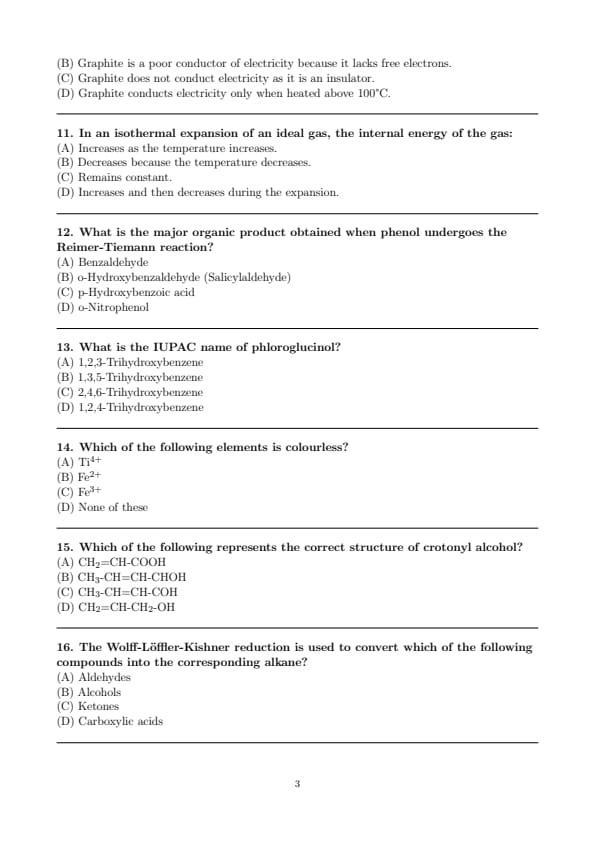
Which of the following statements about graphite is correct?
View Solution
Graphite is an allotrope of carbon where each carbon atom is bonded to three others in a hexagonal lattice, leaving one free electron per atom. These free electrons allow graphite to conduct electricity, making option (A) correct. The other options are incorrect because they contradict the known electrical properties of graphite. Quick Tip: Remember that the ability of graphite to conduct electricity is attributed to its free electrons resulting from its unique bonding structure.
In an isothermal expansion of an ideal gas, the internal energy of the gas:
View Solution
In an isothermal process, the temperature of the system remains constant. Since the internal energy of an ideal gas depends only on temperature (according to the first law of thermodynamics), if the temperature is constant, the internal energy also remains constant. In the case of isothermal expansion, the gas does work on the surroundings, but this energy is provided by the heat absorbed from the surroundings, so the internal energy does not change.
Therefore, the correct answer is option (C). Quick Tip: For an ideal gas undergoing an isothermal process, remember that its internal energy is only a function of temperature. Since temperature remains constant, internal energy remains unchanged.
What is the major organic product obtained when phenol undergoes the Reimer-Tiemann reaction?
View Solution
The Reimer-Tiemann reaction is used to introduce a formyl group (-CHO) at the ortho position to the hydroxyl group on a benzene ring. When phenol undergoes this reaction, the major product formed is o-hydroxybenzaldehyde, also known as salicylaldehyde, which has both a hydroxyl group and an aldehyde group on the aromatic ring.
- Option (A) is incorrect because the reaction does not lead to the formation of benzaldehyde.
- Option (C) is incorrect because p-Hydroxybenzoic acid is not formed in this reaction.
- Option (D) is incorrect as o-Nitrophenol is unrelated to this reaction.
Therefore, the correct answer is option (B). Quick Tip: The Reimer-Tiemann reaction introduces a formyl group (-CHO) to the aromatic ring of phenol at the ortho position, producing o-hydroxybenzaldehyde (salicylaldehyde).
What is the IUPAC name of phloroglucinol?
View Solution
Phloroglucinol is a benzene derivative with three hydroxyl groups (-OH) attached at positions 1, 3, and 5 of the benzene ring. The IUPAC name is 1,3,5-trihydroxybenzene. This name reflects the positions of the hydroxyl groups on the benzene ring.
- Option (A) is incorrect because it does not correspond to the correct positions of the hydroxyl groups.
- Option (C) is incorrect because it corresponds to a different compound with hydroxyl groups at positions 2, 4, and 6.
- Option (D) is incorrect because the positions of the hydroxyl groups do not match the correct structure of phloroglucinol.
Therefore, the correct answer is option (B). Quick Tip: When naming aromatic compounds with multiple functional groups, remember to use the correct numbering to indicate the positions of the substituents on the benzene ring.
Which of the following elements is colourless?
View Solution
The colour of a metal ion in solution is due to the presence of partially filled d-orbitals that can absorb light in the visible region.
- Ti\(^{4+}\) has no d-electrons and therefore does not absorb light in the visible region, making it colourless.
- Fe\(^{2+}\) and Fe\(^{3+}\) both have partially filled d-orbitals, which absorb light in the visible region and give the solutions a colour.
Thus, the correct answer is option (A). Quick Tip: Metal ions with completely filled or empty d-orbitals (like Ti\(^{4+}\)) do not absorb visible light, making them colourless.
Which of the following represents the correct structure of crotonyl alcohol?
View Solution
Crotonyl alcohol is an unsaturated alcohol with the structure where the alcohol group (-OH) is attached to the terminal carbon of the butene chain. The correct structure is CH\(_3\)-CH=CH-COH, where the hydroxyl group is bonded to the -CH\(_2\) group at the end of the chain, and the molecule has a conjugated system with a double bond between the second and third carbons.
- Option (A) is incorrect as it represents crotonic acid, not crotonyl alcohol.
- Option (B) is incorrect because it has the wrong functional group (hydroxyl group on the aldehyde).
- Option (D) is incorrect as it represents 3-buten-1-ol, not crotonyl alcohol.
Therefore, the correct answer is option (C). Quick Tip: Crotonyl alcohol is an alpha, beta-unsaturated alcohol. Remember that the alcohol group (-OH) is attached to the terminal carbon of the chain.
The Wolff-Löffler-Kishner reduction is used to convert which of the following compounds into the corresponding alkane?
View Solution
The Wolff-Löffler-Kishner reduction is a reaction used to reduce carbonyl compounds (like aldehydes and ketones) to the corresponding alkanes. In this reaction, a ketone is treated with hydrazine (H\(_2\)N-NH\(_2\)) in the presence of a strong base (usually potassium hydroxide) under heating conditions. This results in the elimination of the carbonyl group, converting the compound into an alkane.
- Option (A) is incorrect because although aldehydes can undergo similar reductions, the question specifically refers to ketones as the correct reactant for the Wolff-Löffler-Kishner reduction.
- Option (B) is incorrect because alcohols are not typically involved in this reduction.
- Option (D) is incorrect because carboxylic acids require a different type of reduction process, such as the reduction to aldehydes using stronger reagents.
Therefore, the correct answer is option (C). Quick Tip: The Wolff-Löffler-Kishner reduction is a useful method for converting carbonyl compounds, particularly ketones, into alkanes. Be sure to remember the role of hydrazine and a strong base in the reaction.
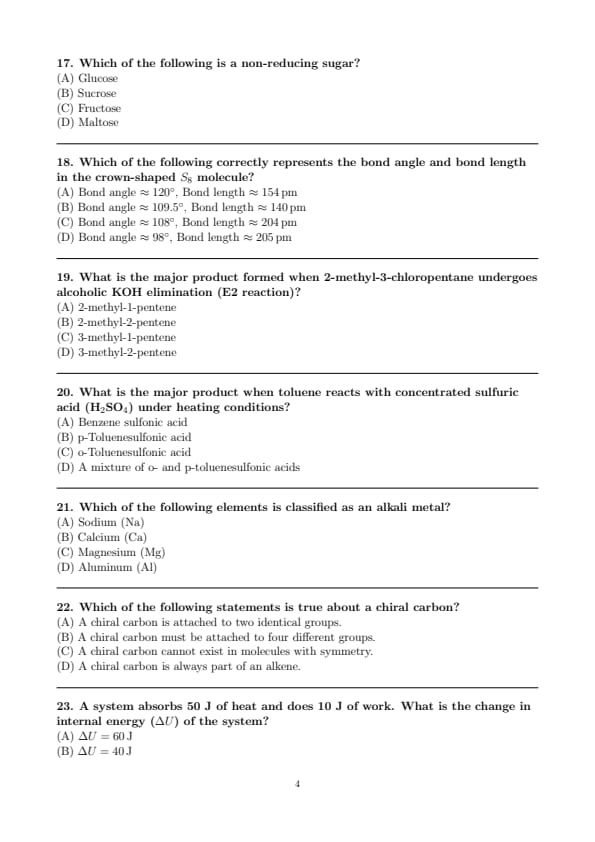
Which of the following is a non-reducing sugar?
View Solution
A non-reducing sugar is one that cannot reduce the Benedict's reagent or Fehling's solution. This is typically due to the fact that both anomeric carbons in the sugar are involved in glycosidic bonds, preventing the formation of an aldehyde or ketone group that can reduce these reagents.
- Sucrose is a disaccharide made up of glucose and fructose, where both the anomeric carbons are involved in the glycosidic bond, making it a non-reducing sugar.
- Glucose, fructose, and maltose all have free aldehyde or ketone groups that can reduce reagents, making them reducing sugars.
Therefore, the correct answer is option (B). Quick Tip: To identify a non-reducing sugar, look for a disaccharide where both anomeric carbons are involved in the glycosidic bond, such as sucrose.
Which of the following correctly represents the bond angle and bond length in the crown-shaped \( S_8 \) molecule?
View Solution
The \( S_8 \) molecule has a crown-shaped structure where sulfur atoms are connected in a puckered ring. The bond angle in this structure is approximately \( 108^\circ \), typical for a bent or puckered structure. The bond length is approximately \( 204 \, pm \), which is typical for sulfur-sulfur single bonds in this molecule.
- Option (A) is incorrect because a bond angle of \( 120^\circ \) is too large for this structure.
- Option (B) is incorrect as the bond length is too short for sulfur atoms in this configuration.
- Option (D) is incorrect because the bond angle \( 98^\circ \) is too small for the \( S_8 \) molecule.
Therefore, the correct answer is option (C). Quick Tip: In crown-shaped molecules like \( S_8 \), bond angles tend to be slightly less than \( 109.5^\circ \), and the bond lengths are typically longer compared to small molecules due to the larger atomic radius of sulfur.
What is the major product formed when 2-methyl-3-chloropentane undergoes alcoholic KOH elimination (E2 reaction)?
View Solution
In an E2 reaction, the elimination of a leaving group and a proton occurs simultaneously. When 2-methyl-3-chloropentane undergoes alcoholic KOH elimination, the base (OH\(^-\)) abstracts a hydrogen atom from the carbon adjacent to the carbon bearing the chlorine (which is in the beta position). This leads to the formation of the double bond. The major product will be 2-methyl-2-pentene, as it is the more stable alkene due to the formation of a more substituted, stable double bond.
- Option (A) is incorrect as the elimination does not result in 1-pentene.
- Option (C) is incorrect because the product will have a double bond between carbon 2 and 3, not between carbon 1 and 2.
- Option (D) is incorrect because the double bond will not form at position 3.
Therefore, the correct answer is option (B). Quick Tip: In an E2 elimination reaction, the most stable alkene (the one with the most substituted double bond) is usually the major product.
What is the major product when toluene reacts with concentrated sulfuric acid (H\(_2\)SO\(_4\)) under heating conditions?
View Solution
When toluene reacts with concentrated sulfuric acid under heating conditions, electrophilic aromatic substitution occurs. The sulfonation reaction typically produces a mixture of ortho- and para- products due to the electron-donating methyl group on the toluene ring. The methyl group directs the sulfonic acid group to the ortho and para positions, making a mixture of o- and p-toluenesulfonic acids as the major products.
- Option (A) is incorrect as toluene has a methyl group that directs substitution to the ortho and para positions, not to the benzene ring.
- Option (B) is incorrect as only the para product is favored, but both ortho and para products are formed.
- Option (C) is incorrect as the ortho product is not the only one produced.
Therefore, the correct answer is option (D). Quick Tip: In electrophilic aromatic substitution reactions with methylated benzene rings (like toluene), the methyl group directs the incoming group to the ortho and para positions.
Which of the following elements is classified as an alkali metal?
View Solution
Alkali metals are elements found in Group 1 of the periodic table. These metals are characterized by having one electron in their outermost shell.
- Sodium (Na) is an alkali metal as it is in Group 1 of the periodic table.
- Calcium (Ca) and Magnesium (Mg) are alkaline earth metals, found in Group 2.
- Aluminum (Al) is a post-transition metal and is found in Group 13.
Therefore, the correct answer is option (A). Quick Tip: The alkali metals are the elements in Group 1 of the periodic table, which include lithium, sodium, potassium, rubidium, cesium, and francium.
Which of the following statements is true about a chiral carbon?
View Solution
A chiral carbon is a carbon atom that is attached to four different groups. This gives rise to chirality, which results in non-superimposable mirror images, or enantiomers. A molecule with a chiral carbon is asymmetric and does not have symmetry.
- Option (A) is incorrect because a chiral carbon cannot be attached to two identical groups, as this would create a plane of symmetry, making the carbon achiral.
- Option (C) is incorrect because chiral carbons can exist in molecules with symmetry, as long as they are attached to four different groups.
- Option (D) is incorrect because a chiral carbon is not always part of an alkene; it can be part of many other types of molecules as well.
Therefore, the correct answer is option (B). Quick Tip: A chiral carbon is defined by its attachment to four different groups. This asymmetry leads to chirality, which is fundamental in stereochemistry.
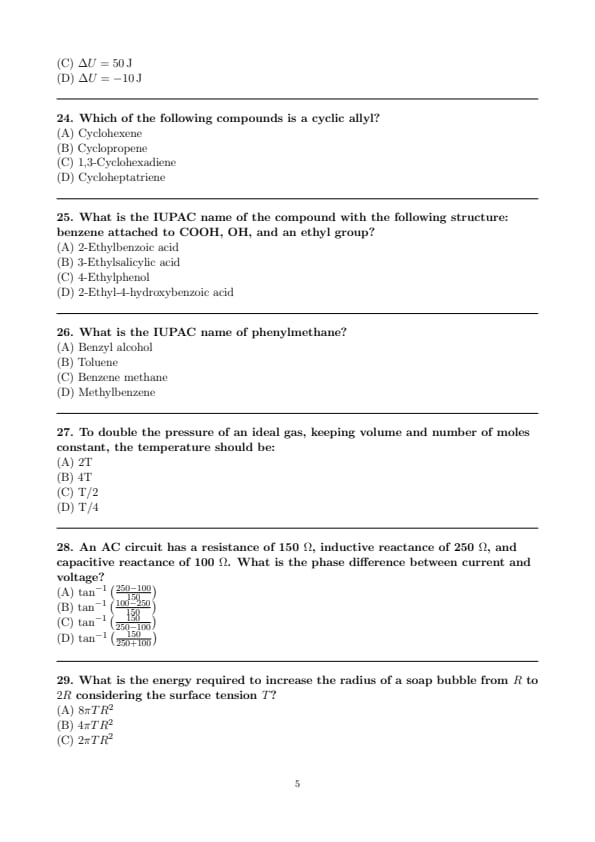
A system absorbs 50 J of heat and does 10 J of work. What is the change in internal energy (\(\Delta U\)) of the system?
View Solution
According to the first law of thermodynamics:
\[ \Delta U = Q - W \]
Where:
- \(\Delta U\) is the change in internal energy,
- \(Q\) is the heat absorbed by the system,
- \(W\) is the work done by the system.
Given:
- \(Q = 50 \, J\) (heat absorbed),
- \(W = 10 \, J\) (work done by the system).
Substitute the values into the equation:
\[ \Delta U = 50 \, J - 10 \, J = 40 \, J \]
Therefore, the change in internal energy is \(40 \, J\). Quick Tip: Remember, the first law of thermodynamics states that the change in internal energy is equal to the heat added to the system minus the work done by the system.
Which of the following compounds is a cyclic allyl?
View Solution
A cyclic allyl is a compound that contains a cyclic structure with a conjugated system of double bonds, where the conjugation involves an allyl group (a structure with a C=C single bond adjacent to another C=C).
- Cyclohexene is an alkene, but it is not a cyclic allyl.
- Cyclopropene is a three-membered ring with one double bond, but it does not form a cyclic allyl.
- 1,3-Cyclohexadiene is a diene, but it is not classified as a cyclic allyl.
- Cycloheptatriene, on the other hand, is a cyclic compound with alternating single and double bonds, fitting the description of a cyclic allyl and is also known as the precursor to the aromatic compound benzene in some reactions.
Therefore, the correct answer is option (D). Quick Tip: Cyclic allyl compounds have a conjugated system of alternating single and double bonds in a ring, which is a defining characteristic for compounds like cycloheptatriene.
What is the IUPAC name of the compound with the following structure: benzene attached to COOH, OH, and an ethyl group?
View Solution
In this compound, the benzene ring has a carboxyl group (-COOH) at position 1, a hydroxyl group (-OH) at position 4, and an ethyl group (C\(_2\)H\(_5\)) at position 2. According to IUPAC nomenclature, the compound is named 2-Ethyl-4-hydroxybenzoic acid, as the position of the substituents are numbered to give the lowest possible numbers in the name.
- Option (A) is incorrect because it does not reflect the correct positions of the substituents.
- Option (B) is incorrect because salicylic acid has a hydroxyl group and carboxyl group at positions 2 and 1, respectively, and does not have an ethyl group.
- Option (C) is incorrect because the compound described has a carboxyl group, not a phenolic group at position 1.
Therefore, the correct answer is option (D). Quick Tip: When naming compounds with multiple substituents, use the lowest possible numbers to give the substituents on the benzene ring, starting with the highest-priority group (in this case, the carboxyl group).
What is the IUPAC name of phenylmethane?
View Solution
Phenylmethane is a simple aromatic compound where a methyl group (CH\(_3\)) is attached to a benzene ring. The IUPAC name for this compound is toluene, as it consists of a methyl group (CH\(_3\)) attached to a benzene ring.
- Option (A) is incorrect because benzyl alcohol has a hydroxymethyl group (-CH\(_2\)OH) attached to the benzene ring, not a methyl group.
- Option (C) is incorrect as "benzene methane" is not the IUPAC name for this compound.
- Option (D) is incorrect because methylbenzene is a less specific name for toluene. Toluene is the correct IUPAC name.
Therefore, the correct answer is option (B). Quick Tip: Toluene is the IUPAC name for phenylmethane. Remember that when a methyl group is attached to a benzene ring, the compound is called toluene.
To double the pressure of an ideal gas, keeping volume and number of moles constant, the temperature should be:
View Solution
For an ideal gas, the relation between pressure, volume, temperature, and number of moles is given by the ideal gas law:
\[ PV = nRT \]
Where:
- \(P\) is the pressure,
- \(V\) is the volume,
- \(n\) is the number of moles,
- \(R\) is the ideal gas constant,
- \(T\) is the temperature.
If the volume and number of moles are constant, the equation becomes:
\[ P \propto T \]
Therefore, to double the pressure, the temperature must also be doubled. Hence, the temperature should be \(2T\).
Therefore, the correct answer is option (A). Quick Tip: Remember, for an ideal gas, pressure and temperature are directly proportional when volume and the number of moles are constant. Doubling the pressure requires doubling the temperature.
An AC circuit has a resistance of 150 \(\Omega\), inductive reactance of 250 \(\Omega\), and capacitive reactance of 100 \(\Omega\). What is the phase difference between current and voltage?
View Solution
In an AC circuit with a resistor, inductor, and capacitor, the phase difference \(\phi\) between the current and voltage is given by:
\[ \tan(\phi) = \frac{X_L - X_C}{R} \]
Where:
- \(X_L\) is the inductive reactance (250 \(\Omega\)),
- \(X_C\) is the capacitive reactance (100 \(\Omega\)),
- \(R\) is the resistance (150 \(\Omega\)).
Substitute the given values:
\[ \tan(\phi) = \frac{250 - 100}{150} = \frac{150}{150} = 1 \]
Thus, the phase difference is:
\[ \phi = \tan^{-1}(1) = 45^\circ \]
Therefore, the correct answer is option (A). Quick Tip: When calculating the phase difference in an RLC circuit, use the formula \(\tan(\phi) = \frac{X_L - X_C}{R}\) to find the angle of phase difference.
What is the energy required to increase the radius of a soap bubble from \( R \) to \( 2R \) considering the surface tension \( T \)?
View Solution
The energy required to increase the radius of a soap bubble is related to the work done against the surface tension. For a soap bubble, the total surface area is \( 4 \pi R^2 \) for a single surface, but there are two surfaces for a bubble (inside and outside), so the total surface area is \( 8 \pi R^2 \). The energy required to increase the radius is given by:
\[ \Delta E = Surface Tension \times \Delta Area \]
Initially, the surface area is \( 8 \pi R^2 \), and finally, it is \( 8 \pi (2R)^2 = 32 \pi R^2 \). The change in surface area is:
\[ \Delta A = 32 \pi R^2 - 8 \pi R^2 = 24 \pi R^2 \]
Thus, the energy required is:
\[ \Delta E = T \times 24 \pi R^2 = 8 \pi T R^2 \]
Therefore, the correct answer is option (A). Quick Tip: The energy required to increase the size of a soap bubble is related to the work done to overcome the surface tension. Always consider the change in surface area when solving these types of problems.
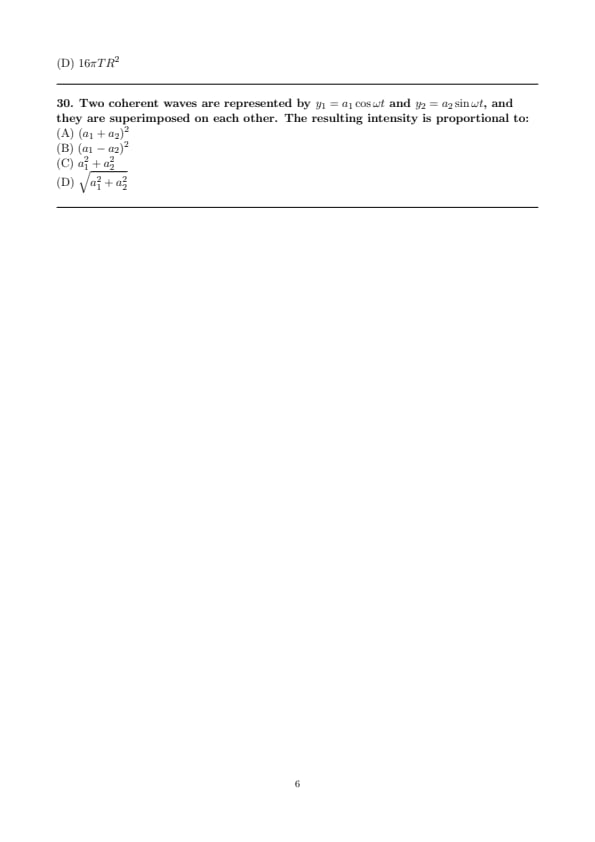
Two coherent waves are represented by \( y_1 = a_1 \cos \omega t \) and \( y_2 = a_2 \sin \omega t \), and they are superimposed on each other. The resulting intensity is proportional to:
View Solution
The intensity \( I \) of a wave is proportional to the square of the amplitude of the wave. When two waves \( y_1 \) and \( y_2 \) are superimposed, their resultant displacement \( y_{result} \) is the sum of the individual displacements. Thus:
\[ y_{result} = y_1 + y_2 = a_1 \cos \omega t + a_2 \sin \omega t \]
The intensity \( I \) is proportional to the square of the amplitude:
\[ I \propto y_{result}^2 = (a_1 \cos \omega t + a_2 \sin \omega t)^2 \]
Expanding this:
\[ I \propto a_1^2 + a_2^2 + 2a_1a_2 \cos(\omega t)\sin(\omega t) \]
Since the intensity is proportional to the square of the amplitude, the correct expression is:
\[ I \propto a_1^2 + a_2^2 \]
Thus, the correct answer is option (C). Quick Tip: When two coherent waves are superimposed, the intensity is proportional to the square of the resultant amplitude, which depends on the square of the individual amplitudes.
MHT CET 2025 PCB Question Paper with Solution PDF
| Exam | Question Paper with Solution PDF |
|---|---|
| 9 April Shift 1 | Check Here |
| 9 April Shift 2 | Check Here |
| 11 April Shift 1 | Check Here |
| 11 April Shift 2 | Check Here |
MHT CET 2025: Marking Scheme
MHT CET 2025 consists of a total of 200 question equally distributed in Physics, Chemistry and Biology. Biology section consists of Botany and Zoology with 50 questions each.
| Section | Total Questions | Total Marks |
|---|---|---|
| Physics | 50 | 50 |
| Chemistry | 50 | 50 |
| Biology | 100 | 100 |
| Total | 200 | 200 |
MHT CET Previous Year Question Papers
*The article might have information for the previous academic years, please refer the official website of the exam.