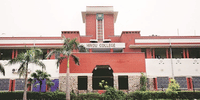
DCAC began operating in 1987 from Netaji Nagar, New Delhi, as a college affiliated with Delhi University. Its undergraduate programmes are taught through the Arts and Commerce faculties. BA (Hons.) Journalism and B.Com are among its major courses.
Admission mainly depends on CUET scores. DCAC also supports students through individual scholarships and government-funded schemes.
DCAC UG Admission
DCAC admits students to its Arts and Commerce undergraduate courses through the CUET examination. The college offers BA, B.Com and B.Com (Hons.), along with BA (Hons.) in 7 specialisations. Journalism is one of its popular BA (Hons.) choices.
| Courses | Specialisations | Eligibility |
|---|---|---|
| BA (Hons.) | Economics English History Journalism Political Science | 10+2 |
| B.Com | - | 10+2 |
| BA | ASPM German HRM Spanish Computer Application | 10+2 |
| B.Com (Hons.) | - | 10+2 |
UG Eligibility Criteria
Students seeking admission to a DCAC undergraduate programme must meet these conditions:
- They must pass 10+2 or an equivalent examination from a recognised school or board.
- B.Com and B.Com (Hons.) applicants must complete 10+2 in the commerce stream.
UG Selection Criteria
CUET performance is used to select students for each undergraduate course listed below.
| Courses | Eligibility | Selection Criteria |
|---|---|---|
| BA (Hons.) | 10+2 | CUET score |
| BA | 10+2 | CUET score |
| B.Com | 10+2 | CUET score |
| B.Com (Hons.) | 10+2 | CUET score |
UG Admission Process
CUET merit determines admission to DCAC undergraduate programmes. Applicants register through the University of Delhi admission portal, complete the online form and include DCAC among their college preferences. They must then upload the required documents and submit the application. The University of Delhi publishes the selection lists, after which shortlisted students complete document verification and pay the admission fee.
Documents Needed for UG Admission
Applicants should keep the following records ready for the admission process:
- Class 10th and 12th marksheets
- Aadhar Card
- Passport-sized photograph
- Transfer certificate
- Migration certificate
- Character certificate
- Category certificate
B.Com Student Experience
A B.Com student who entered DCAC through the CUET 2024 results had not initially placed the college on the preference list. The student later found the course, faculty and atmosphere suitable, describing the environment as calm and relaxed.
- DCAC has more than 9 active societies. These include the Commerce Association, E-cell, Career Development Centre, Enactus, Prakriti and Drift Up.
- The societies help make campus life active and engaging.
- In B.Com (P), the marking pattern includes a 90-mark theory paper and a 70-mark practical paper. Students must pass both examinations separately.
- Faculty members are helpful with internal assessment, while good attendance and regular class participation are rewarded.
- The teaching quality is regarded as good and student-friendly.
DCAC Cutoff
CUET scores form the basis of admission to every DCAC programme. The following table gives the general-category CUET cutoff for 2025.
| Courses | CUET Cutoff 2025 |
|---|---|
| B.Com (General) | 811.33 |
| B.Com (Hons.) | 833.09 |
| BA (Hons.) Economics | 784.30 |
| BA (Hons.) Political Science | 793.36 |
| BA (Hons.) History | 760.31 |
| BA (Hons.) Journalism | 779.36 |
| BA (Hons.) History | 743.04 |
DCAC Scholarship
DCAC students may use government-funded schemes as well as scholarships offered by individual organisations. The Shree Maheshwari Foundation Scholarship for Higher Education assists talented students from financially disadvantaged backgrounds. It covers the cost of undergraduate and professional education, supports academic achievement and helps eligible students continue higher education without the burden of study expenses.
DCAC Admission FAQs
Ques. What steps must students follow to submit a DCAC application?
Ans. Applicants must first register online through the University of Delhi admission portal. They should complete the form, add DCAC to their college preferences, upload the required documents and submit the application. The University of Delhi releases the merit lists used for selection. Students should also check the official DCAC website regularly for admission notices.
Ques. Who can seek admission to a DCAC undergraduate course?
Ans. For the 2025 admission cycle, applicants needed to pass Class 12 from a recognised board and secure the percentage required for their chosen course. The conditions differ for programmes such as B.A., B.Com and B.Sc. Students must also meet the subject requirements set by Delhi University. Reserved-category applicants receive relaxation according to government rules, while the DCAC prospectus provides the detailed eligibility conditions.
Ques. How does DCAC decide which applicants receive admission?
Ans. For the 2025 process, DCAC followed the merit and cutoff lists released by Delhi University. An applicant's marks had to meet the requirement for the selected course. Shortlisted students then completed document verification and paid the applicable fee. Admission became final only after these steps, and the official DCAC website carried the relevant notices.
Ques. Which records should an applicant bring for DCAC verification?
Ans. Students applying in 2025 needed their Class 10 and Class 12 marksheets, transfer certificate, migration certificate and character certificate. Category, EWS or disability certificates were required where applicable. Applicants also needed passport-sized photographs and copies of their Aadhaar card. They had to present original documents along with self-attested photocopies. Missing records could delay admission.
Ques. What determines the opening date of the DCAC admission process?
Ans. DCAC was to begin its 2025 admission process after the University of Delhi announced the admission schedule. Registration was expected during the mid-year admission cycle. Application deadlines, cutoff-list releases and other dates were to appear on the DCAC and Delhi University websites. Applicants needed to follow official announcements and apply on time to remain eligible for a seat.