
SAT EBRW: Test Format, Score, Books and Practice Papers


Content Curator | Updated On - Oct 13, 2023
The SAT EBRW (Evidence-Based Reading and Writing section) is one of the SAT's two main sections. SAT Reading and Writing comprises 54 questions to be answered in 64 minutes(two 32-minute modules). The skills and concepts tested on the Reading and Writing and Language Tests are likely to be ones that candidates learned in English class. The tests themselves are very different. Both sections are scored on a scale of 200-800, and the results are added together to produce a total EBRW score. The EBRW SAT part is intended to measure a student's ability to read, write, and critically analyze material. All of which are required for success in college and beyond.
SAT Evidence-Based Reading and Writing Overview
Instead of separate SAT Writing and Language Test, the digital assessments include a single Reading and Writing part. This change recognises the reciprocal, mutually reinforcing nature of reading and writing abilities and knowledge while enabling more effective measurement of English language arts and content area literacy knowledge and skills. Students will see a greater variety of topics that reflect the kinds of works they'll read in college because the digital SAT Reading and Writing part will consist of numerous shorter readings rather than a few lengthy books. In addition, the text complexity and scholarly discipline rootedness of these condensed portions are maintained to the same extent as in the longer reading passages. Unlike multiple questions associated with some long sections, a single (discrete) question is associated with each passage (or passage pair).
Evidence-Based Reading and Writing SAT Score
The SAT is divided into two sections: Evidence-Based Reading and Writing and Math. Each of these sections is SAT score between 200 and 800, and the overall score out of 1600 is calculated. This means that a candidate's EBRW score accounts for a significant portion of the candidate's entire SAT score—50%, to be exact.
As previously stated, the EBRW SAT score is made up of the Reading Test and the Writing and Language Test. Total SAT score of EBRW is graded on a scale of 10 to 40, and the candidate's success on them determines the candidate's overall EBRW score. We can figure out how candidate's test scores convert to candidate's evidence based reading and writing SAT scores by using the scoring rules from a College Board sample test.
Here's an easy way to calculate SAT EBRW score:
- Add candidate's Writing and Language Test score to candidate's Reading Test score. Let's look at 25 and 29 as examples of test results. When we add them all up, we get 54.
- To acquire an appropriate section score, multiply the sum of candidate's test results by 10. Multiplying 54 by 10 provides a section score of 540 in our previous example.
SAT Digital EBRW Specifications
Questions on the SAT Reading and Writing Section represent one of four content domains. The SAT EBRW with content domain and question distribution is tabulated below:
| Content | Domain | Skills Assessed | No. of Questions |
|---|---|---|---|
| Craft and Structure | Students will analyse texts rhetorically, draw connections between texts that are topically linked, and comprehend and employ high-utility words and phrases in context using their comprehension, vocabulary, analysis, synthesis, and reasoning abilities and knowledge. | Words in Context Text Structure and Purpose Cross-Text Connections | ≈28% / 13-15 questions |
| Information and Ideas | Students will apply their knowledge and abilities in understanding, analysis, and reasoning as well as their search, interpretation, assessment, and integration of concepts from texts and educational graphics. | Central Ideas and Details Command of Evidence
| ≈26% / 12-14 questions |
| Standard English Conventions | Students will apply editing skills and knowledge to make writing comply to Standard English sentence structure, use, and punctuation rules. | Boundaries Form, Structure, and Sense | ≈26% / 11-15 questions |
| Expression of Ideas | Students will apply their ability to edit texts to fulfil particular rhetorical objectives and enhance the efficacy of their written message. | Rhetorical Synthesis Transitions | ≈20% / 8-12 questions |
Evidence-Based Reading and Writing Preparation Tips
SAT evidence based reading and writing practice require different approaches to preparation. There is enough overlap that part of the candidate's SAT preparation will benefit in both portions. The five suggestions below focus on the intersections between Reading and Writing.
Here are some SAT EBRW preparation tips:
Concentrate on Evidence Command
When it comes to question types, College Board employs the category "Command of Evidence" for both Reading and Writing questions. candidate must base candidate's responses for both sections on evidence from the text.
This "eye for evidence" is an important skill in both sections. Reading and Writing evidence-based questions, on the other hand, appear a little different. The Reading part contains explicit evidence-based questions that ask the candidate why the candidate answered a prior question.
Sample for Reading Command of Evidence Question:
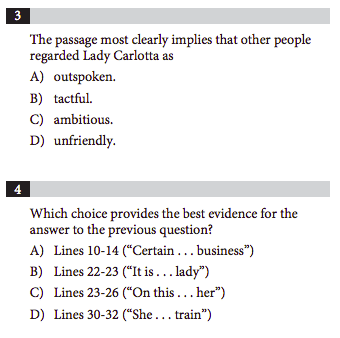
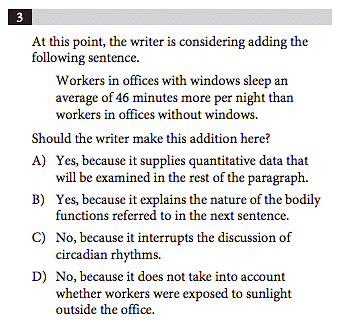
The Writing component assesses the candidate's Command of Evidence in a different way. It typically asks if a candidate should make a certain adjustment to a piece and why.
Sample for SAT Writing:
Examine Words in Context
Another thing that Reading and Writing have in common is that they both ask about words in context. Because all of the questions in both sections are passage-based, all of the vocabulary questions require candidates to understand how a word is used in context.
Sample for vocabulary questions in the Reading Section:
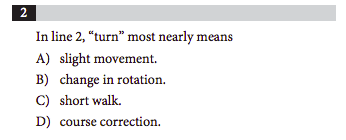
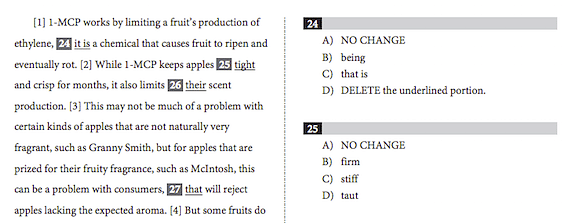
the candidate will get the passage alongside the questions in Writing, so the candidate can go back to a specific word or sentence.
Sample for vocabulary word writing section:
Practice Data Interpretation Questions
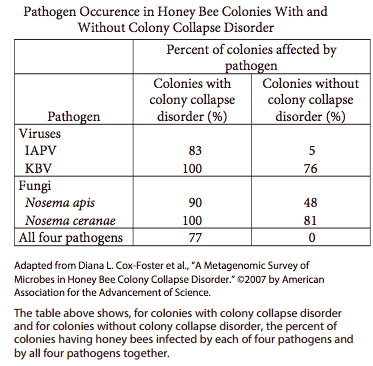
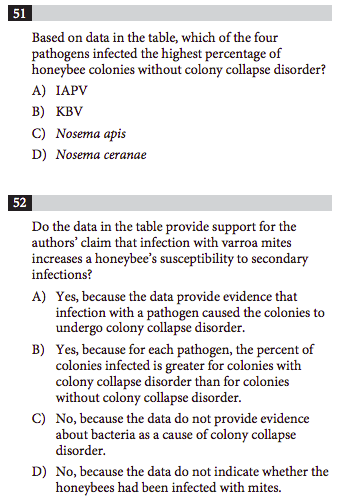
As the candidate can see from the examples above, both portions require candidate to analyze data from charts, tables, and/or graphs. These graphs will be linked to a passage.
Sample of data interpretation questions from the Reading section:
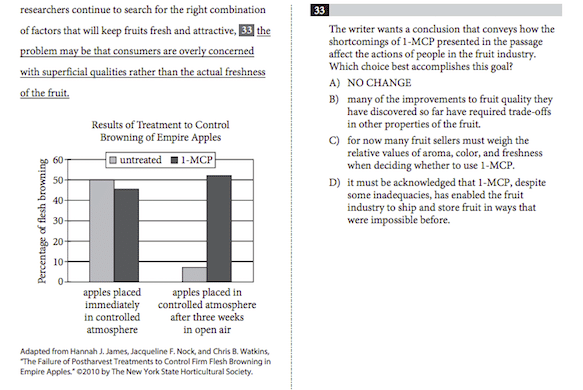
The Writing portion has error-ridden paragraphs, and it frequently asks whether the data in a graphic is appropriately reproduced in its corresponding passage. If a candidate says no, it may ask the candidate how to express it correctly.
Sample for SAT Writing:
Thoroughly Read and Write
Candidates have just seen three distinct instances in which Reading and Writing questions overlap. On a broader level, these portions are identical in that they assess a candidate's command of the English language.
A candidate can considerably improve a candidate's talents by reading widely and writing frequently. As candidates can see, both parts select pieces from various genres, primarily nonfiction and argument-based readings. In order to prepare, candidates should read not only prose but also works from history and science.
Make a Plan for Candidate's Scores
Finally, keep in mind that the candidate's final grade will be half math and half verbal. The candidate cannot separate the Reading and Writing portions because the candidate's performance on both will affect the candidate's overall verbal score.
Remember that both portions count equally towards the candidate's EBRW score. If a candidate routinely performs well in Reading, the candidate may want to devote more time and effort to Writing, or vice versa. Determine candidate's skills and weaknesses, as well as the types of questions candidate may study to increase candidate's overall score.
Evidence-Based Reading and Writing Preparation Books
SAT Subject Test Scores can be used with the help of prep books. These books contain SAT syllabus and previous year questions to ace the SAT scores. Here is the list of SAT preparation books for candidates to ace the SAT EBRW section:
- SAT Reading & Writing Prep: Over 300 Practice Questions + Online
- SAT Reading & Writing Packets (2020 Edition)
- Reading and Writing Workout for the SAT, 4th Edition
- Kaplan Evidence-Based Reading, Writing, and Essay Workbook
SAT EBRW Sample Papers
Candidates can become familiar with the exam's time limits and the types of methods. They will need to utilize to answer questions efficiently and successfully by practicing with SAT sample papers. SAT sample papers are a significant resource for students studying for the SAT exam. These provide excellent practice and assist students in becoming familiar with the test style and material. This can lead to higher scores and increased confidence during SAT preparation.
| SAT EBRW Practice Test 1 | SAT EBRW Practice Test 2 |
| SAT EBRW Practice Test 3 | SAT EBRW Practice Test 4 |
| SAT EBRW Practice Test 5 | SAT EBRW Practice Test 6 |
EBRW stands for Evidence-Based Reading and Writing, and it consists of two parts: Reading and Writing and Language. The SAT EBRW section is scored on a scale of 200-800, and the scores are combined with the Math section to give a student's total SAT score. The SAT score ranges from 400-1600.
FAQs
Ques: What does the SAT Evidence-Based Reading and Writing (EBRW) section test?
Ans: The SAT EBRW section tests your skills in reading comprehension, understanding of words in context, and your ability to analyze and revise written material.
Ques: How many questions are there in the SAT EBRW section?
Ans: The EBRW section of the SAT contains 52 questions in total, which include both reading and writing questions.
Ques: Are there passages from specific subjects in the reading section?
Ans: Yes, the reading section includes passages from various subjects, such as literature, history, social studies, and natural sciences.
Ques: Is there a separate score for the reading and writing sections?
Ans: Yes, you receive separate scores for the reading and writing sections, but these scores are often combined for a total EBRW score.
Ques: How long is the SAT EBRW section?
Ans: The EBRW section is 65 minutes long. This time includes both the reading and writing portions of the test.
Ques: Are calculators allowed in the EBRW section?
Ans: Calculators are not allowed in the EBRW section. They are only permitted in the Math section of the SAT.
Ques: Is there a penalty for guessing on the SAT EBRW section?
Ans: No, there is no penalty for guessing on the SAT. It's advisable to answer every question, even if you're unsure, as there is no deduction for incorrect answers.
Ques: Can I use a dictionary during the EBRW section?
Ans: No, you are not allowed to use a dictionary or any other aids during the SAT EBRW section.
Ques: How is the reading section structured?
Ans: The reading section consists of multiple-choice questions based on passages. There are usually five passages, each followed by several questions.
Ques: Can I bring extra time accommodations for the EBRW section?
Ans: Yes, eligible students can receive extra time accommodations for the SAT, including the EBRW section, if they have been approved through the College Board's services for students with disabilities.
*The article might have information for the previous academic years, please refer the official website of the exam.