
SAT Preparation Time: Check preparation Timetable and Study Plan


Content Curator | Updated On - Apr 20, 2024
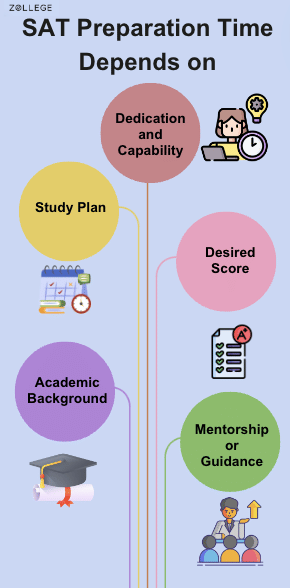
Already selected your desired university, and you are still facing difficulties in managing your SAT preparation time? You should make and follow a structured study plan. Your study plan must contain what and how to start preparing for the SAT. Your strengths and weaknesses in different subjects are the main factors that will decide your SAT exam preparation time. If you have good knowledge of all subjects, you can study for SAT in one month. On average, beginner students require 2 to 3 months of effective SAT preparation time.
Many coaching centers and websites offer a customized study plan depending on your SAT preparation time. Regular practice tests in a real-time exam setting conducted by SAT coaching classes make you familiar with the exam format. You should learn the approaches, SAT scoring calculation, and also exam day tips and strategies. Going through each of the topics from the book, and memorizing the basic math formulas, is important for SAT exam.
If you are looking for self-preparation or want to prepare from home? You should create a study plan, and a preparation timetable, or review the SAT syllabus before starting SAT preparation. The preparation timetable will help you understand how to start SAT preparation. You can consider reading SAT exam books that cover the full syllabus and include the previous year's question papers with sample answers. SAT mock tests from renowned resources provide competitive scores to understand students' progress and weaknesses.
Factors Affecting SAT Exam Preparation Time
You need to understand the various factors that can contribute towards the increase or decrease of SAT preparation time. The factors affecting the preparation time for SAT are:
- Selected University: Every university and colleges have their SAT Cutoff marks. Some universities post the SAT minimum requirements. If you are aiming for a university whose cutoff is more, the SAT preparation time will be more.
- Diagnosing your Skills: This is very important in determining the SAT preparation time. You must understand where you stand in terms of knowledge and preparation. Taking SAT mock test will help in determining the skills.
- Time for SAT preparation: The more time you can devote to SAT preparation in a day, the shorter will be the total preparation time. SAT preparation books can also help reduce the SAT prep time.
- Applying for Scholarship: The SAT score required for scholarship is quite high. If you’re planning to apply for SAT scholarship, then you might have to score higher than even the average SAT cut-offs.
SAT Preparation Timetable
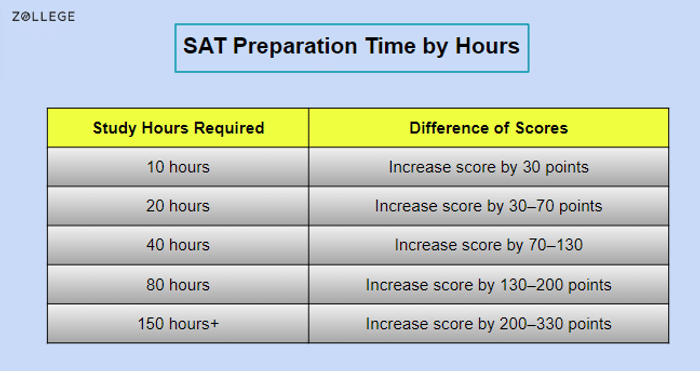
Depending on the above factors, the SAT preparation time can be determined. Students might ask “how to study for SAT in one week”. Based on that time, you can create a SAT preparation timetable or SAT preparation study plan. Depending on the application timeline of the university, you should try to take SAT exam in Sept-Oct of the eleventh class. If the scores are not satisfactory, you can retake SAT in April-May or after the final exams. The SAT practice papers will help you practice and learn more about SAT exams.
SAT 3 Months Study Plan
The SAT 3 month study plan offers a detailed guideline and SAT preparation timetable for the candidates. You might wonder “how to prepare for SAT in 3 months”. It can be prepared by following the subjects and the time needed for practice. Students need to follow the 3 months SAT study plan diligently to ace the SAT exam.
| Month | Week | Modules | Steps to Be Taken |
|---|---|---|---|
| Month 1 | Week 1 | Understanding Exam Pattern. Understanding the Reading and Writing Passages Format. | Go through the entire syllabus for 1.5 hours. Understand the question format for 2 hours. Go through the format of reading passages. Go through the question pattern of writing passages. Research the internet resources to study each of the topics. Collects books to practice each topic. Collect sample papers to strengthen basic math and English concepts. |
| Week 2 | Math:
| Practice each topic from different books, sample papers and online practice papers for 1.5 hours. Analyze and practice reading topics for 2 hours. | |
| Week 3 | Math:
| Learn the basic concepts of those topics from videos. Focus on these topics and practice several questions from books and sample papers for 1.5 hours each. | |
| Week 4 | Math:
| Learn and memorize the basic math formulas. Practice each topic from various practice papers and SAT online resources for 1.5 hours per day. | |
| Month 2 | Week 5 | Math:
| Go through each of the topics from books and sample papers for 1.5 hours each day. Focus on this writing topic for 1.5 hours each per day. |
| Week 6 | Math:
| Learn the concepts of these topics from videos and practice different types of questions from various books and internet resources. Devote 1.5 hours for each topic. | |
| Week 7 | Math:
| Go through the formulas and practice every topic separately for 1.5 hours from sample papers, books and online practice papers. | |
| Week 8 | Math:
| Practice these topics for 1.5 hours each day from SAT preparation books and internet resources. | |
| Month 3 | Week 9 | Math:
| Practice questions related to this math topic and writing topic from books and practice papers to gain concrete knowledge. |
| Week 10 | Understanding weak areas | Attain practice tests to improve weak areas. | |
| Week 11 | Learning Key Strategies | Figure out the key strategies to pace up calculation speed in Math | |
| Week 12 | Tracking Progress | Attempt more and more practice tests from College Board's official website to track the improvement level. |
The SAT preparation time of a candidate can only be understood when you self access your skills. You should always keep a gap of 3–4 months before the admission date. This will help in case the exam needs to be retaken.
FAQs
Ques: How much time should I spend preparing for the SAT?
Ans: There is no specific time for SAT preparation. However, most students need 3-6 months of consistent effort for SAT preparation depending on the starting score, target score, and learning style.
Ques: Is more hours always better?
Ans: Yes, the more you invest, the better. Focused studying for 2-3 hours regularly is more effective than cramming marathon sessions. You should take breaks and prioritize important things.
Ques: Should I start studying early?
Ans: Yes, you should start early in high school (9th-10th grade). This will give you more time to build foundations and avoid last-minute pressure.
Ques: How can I create a study schedule?
Ans: A study plan can be made by breaking down preparation into weekly and daily plans. Allocate time for each section based on your needs and weaknesses.
Ques: What are some effective study methods?
Ans: Effective study materials include combine practice tests, targeted exercises, and error analysis. You can consider joining a prep course or seeking a tutor for personalized guidance.
Ques: How important are practice tests?
Ans: Practice tests are very important for familiarizing yourself with the format, pacing yourself, and identifying areas for improvement. Practice tests helps to understand mistakes and where you stand.
Ques: What should I do in the weeks leading up to the test?
Ans: Focus on reviewing high-yield concepts, managing stress, and practicing relaxation techniques. Don't try to cram new material. Get a good night's sleep before the test.
Ques: What if I run out of time?
Ans: If you run out of time, you must develop time management strategies for each section. Practice skipping difficult questions and coming back to them later if time allows. Prioritize easier or familiar questions to maximize your points.
Ques: What role does my learning style play?
Ans: Learning style plays a very active role. The learning style will impact the time that you need to prepare for. .
Ques: Is it possible to improve my score significantly in a short time?
Ans: Yes, it is possible to improve the score in a short time. Even a few weeks of focused effort can lead to score increases. However, achieving your dream score might require more time and preparation.
*The article might have information for the previous academic years, please refer the official website of the exam.