
TOEFL Reading: Practice Test, Question Types, Score and Books


Content Curator | Updated On - Jan 9, 2024
TOEFL reading section checks how well you can read and understand materials used in an academic environment. The TOEFL exam Reading section has two passages with 10 questions each. The time required to complete the TOEFL reading section is 35 minutes. You will get a total of 20 multiple choice questions in this section.
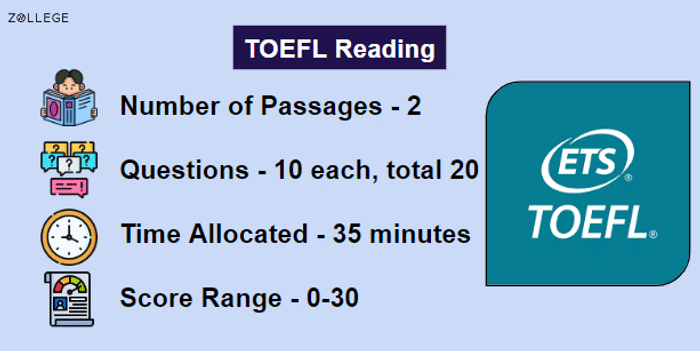
There are multiple types of questions that are associated with the TOEFL new pattern reading passages. The reading test TOEFL ibt score ranges from 0-30. You must try to answer all questions correctly to improve your score. There is no negative marking in TOEFL Reading. The TOEFL reading practise tests will help you prepare for the exam.
- TOEFL Reading Practice Tests
- TOEFL Reading iBT vs PBT
- TOEFL Reading Test Questions
3.1 Factual Information and Negative Factual Information
3.2 Inference Question
3.3 Rhetorical Purpose Questions
3.4 Vocabulary Questions
3.5 Sentence Simplification
3.6 Insert Text Question
3.7 Prose Summary - TOEFL Reading Score
- TOEFL Reading Preparation Tips
- TOEFL Reading Preparation Books
- FAQs
TOEFL Reading Practice Tests
If you are looking for TOEFL reading exercises that can help you score in the exam, you can get many online. There are TOEFL reading mock test available. We have provided a few TOEFL reading topics and practice test here:
TOEFL Reading iBT vs PBT
TOEFL iBT and TOEFL at home are now shorter and consist of 2 passages. Candidates are allotted 35 minutes to complete 20 questions in the new TOEFL exam pattern. The TOEFL PBT has 3-4 passages and 30-40 questions that need to be completed in 54-72 minutes. The differences are:

TOEFL Reading Test Questions
The TOEFL reading test has 6 types of questions in TOEFL exam syllabus. They are designed to assess your reading and information analysis abilities. You must understand each type of question to excel in TOEFL reading section. The types of questions in reading section of TOEFL are:
- Factual Information and Negative Factual Information
- Inference and Rhetorical Purpose
- Vocabulary
- Sentence Simplification
- Insert Text Question
- Prose Summary
Factual Information and Negative Factual Information
You need to have a clear understanding of each statement to improve TOEFL score. It is suggested to read the sentences twice before answering. There will be 4 choices out of which you are required to pick 1 or sometimes 2 correct answers. The sample of TOEFL reading test questions will be framed like:
- According to paragraph 1, which of the following is true about X?
- Paragraph 2 mentions which of the following about Y?
- According to paragraph 3, how did X determine Y?
- According to paragraph 4, why did X do Y?
Negative Factual Question types:
- According to paragraph 1, which of the following is NOT true?
- The author mentions all of the following EXCEPT…
TOEFL Reading Inference Question
You need to analyze the conclusion of the passage and draw an inference. The words such as ‘Infer’, ‘Suggest’ or ‘Imply’ are used in the questions. The reading section of TOEFL question types for TOEFL preparation are:
- Which of the following can be inferred about X?
- Paragraph 3 suggests which of the following about Y?
- What is implied about X?
TOEFL Reading Rhetorical Purpose Questions
Here you need to answer the summary and the reason behind the passage. The author here presents information and you need to understand why that information is provided. Always ask “WHY” and you will be able to get the answer. The sample of TOEFL reading test question will be:
- In paragraph 2, why does the author mention X?
- Why does the author include a description of Y?
- The author mentions X for which of the following reasons?
Vocabulary Questions in TOEFL Reading
Here, you need to understand the meaning of a word or phrase. This will check your vocabulary and understanding of the phrases. You need to select the closest meaning as per the question. The TOEFL reading example questions are:
- The word X in paragraph 3 is similar in meaning to…
- The phrase Y in the passage is closest in meaning to...
Sentence Simplification TOEFL Reading Questions
In this section, your ability to paraphrase and summarize information without changing its meaning is tested. You need to identify a sentence that has the same meaning as the sentence in the question. The types of questions for TOEFL online preparation are:
- Which of the following best expresses the essential information in the highlighted sentence?
- Select the sentence that best expresses the information in the given statement.
TOEFL Reading Insert Text Question
You need to recognize logical and grammatical connections between sentences in TOEFL reading Insert text questions. There are 4 black squares in the passage, which denote the possible locations for the sentence in question. You need to select the correct one. The reading section of TOEFL question types are:
- Where would the sentence best fit? Click on a square to add the sentence to the passage.
Prose Summary TOEFL Reading Questions
You need to select the option that best fits the summary of the given passage. You will be provided with six answer options, out of which you are required to pick three answer options that best summarize the ideas of the given statement. The TOEFL reading example questions are phrased like:
- An introductory sentence with a summary of the passage is provided. Complete the summary by selecting the THREE answer choices that express the most important ideas in the passage.
TOEFL Reading Score
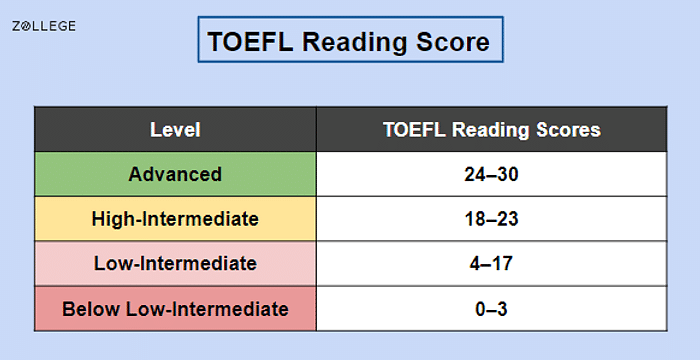
The TOEFL reading scores are measured on a scale of 0-30. The raw scores are converted to scaled scores. The level of scores on how the students are accessed are:
TOEFL Reading Preparation Tips
The TOEFL Reading tips and tricks will help you improve the TOEFL reading scores. The TOEFL reading tips include:
- Increasing Vocabulary: Enhance your collection of words by reading books, magazines, listening to news or watching English videos and movies.
- Understanding passage: Try to figure out the brief and the core ideas in passages. This will help you proceed with the answers faster.
- Take Notes: This is very important to solve the questions faster. Write down important passage points and short heading of each paragraph.
- Solve Crosswords: Try solving crosswords and other puzzles to enhance your vocabulary.
- Practice: The best way to improve yourself is to solve TOEFL practice tests. Practice the TOEFL ibt reading sample that will help you improve the scores.
TOEFL Reading Preparation Books
TOEFL preparation books provide comprehensive study materials, to help candidates in preparation. Top TOEFL books include previous year's TOEFL ibt reading sample and mock tests to help students prepare for the exam.
- TOEFL Official Guide PDF: Check PDF
- Cambridge Preparation for TOEFL: Check PDF
- Barron’s TOEFL iBT, 15th Edition: Check PDF
- Kaplan TOEFL iBT: Check PDF
- Barron’s Essential Words for the TOEFL, 7th Edition: Check PDF
The TOEFL reading is the first part of the TOEFL exam. You must practice multiple reading sample TOEFL and mock tests before the exam. This will help you strengthen your knowledge and gain an upper hand in the TOEFL exam.
FAQs
Ques - How can I practice TOEFL reading?
Ans - You can practice TOEFL reading by learning more vocabulary, building reading skills, mastering questions and answering delivery strategies. You must learn various topics while practicing TOEFL reading.
Ques - Is TOEFL reading difficult?
Ans - Most of the candidates find TOEFL reading as a difficult section. With effective preparation and a good command of English, candidates can achieve a good reading score.
Ques - What should I read for TOEFL exam?
Ans - The Official Guide to the TOEFL iBT Test, Kaplan's "TOEFL iBT Prep Plus, Barron's "TOEFL iBT, 17th Edition, and there are many best books available for TOEFL preparation.
Ques - How can I improve my reading score?
Ans - Identifying the weak areas in reading, improving vocabulary skills, taking practice tests regularly, and practicing saving time in reading passages.
Ques - Is 25 a good score in TOEFL reading?
Ans - A score range between 27-28 in TOEFL reading section is considered as a good TOEFL score. The highest score is 30 and hence, 25 is better than average score.
Ques - What is the syllabus for TOEFL?
Ans - TOEFL syllabus consists of four sections; reading, writing, listening, and speaking sections. And the total score ranges from 0 to 120.
Ques - How to score 30 in TOEFL reading?
Ans - Read every passage in just 3 to 4 minutes, and candidates are required to read every passage multiple times to give proper answers.
Ques - How to calculate TOEFL reading score?
Ans - Total TOEFL score ranges between 0-120. And the reading section is scored between 0-30.
Ques - What are some common mistakes to avoid?
Ans: Some common mistakes are rushing through the passage, focusing on irrelevant details, guessing instead of carefully analyzing options, and being tricked by answer choices that may partially be true but not fully supported by the text.
Ques - What are the topics for TOEFL reading?
Ans - TOEFL reading section consists of science, humanities, art, music, astronomy, geology, communication, chemistry, and biology topics.
Ques - What types of questions are asked?
Ans - The questions in TOEFL reading tests your understanding of main ideas, details, inferences, vocabulary, and author's purpose. There are 6 types of questions Factual Information and Negative Factual Information, Inference and Rhetorical Purpose, Vocabulary, Sentence Simplification, Insert Text Question and Prose Summary
Ques - How important is vocabulary in the Reading section?
Ans - The TOEFL reading vocabulary is very important for all the sections. Strong vocabulary helps, but understanding context and critical thinking are more crucial. With a strong vocabulary, you will be able to solve questions and understand the meaning easily.
Ques - Are there any question types with specific strategies in TOEFL reading?
Ans - Yes, there are specific strategies in TOEFL reading that you must use. You can use context clues and eliminate obviously wrong choices. For inference questions, look for implied meanings and supporting evidence.
Ques - What about summary completion questions in TOEFL reading?
Ans - In summary completion questions, you must understand the brief of the passage. You must carefully read the provided sentence and choose options that accurately and concisely complete the summary, matching the author's main ideas.
Ques - Can I take notes on the TOEFL reading test?
Ans - Yes, you can use the scratch paper provided to jot down key points or keywords. It is important to take notes since you should not waste time reading the passage multiple times.
Ques - Is it better to read the questions before or after the passage?
Ans - Reading the passage before or after the question depends on the choice of the student. Some testers prefer skimming the questions first to focus on key points while reading, while others read the passage first for a holistic understanding. You need to try and experiment to find what works best for you.
Ques - What is the best score you can get in TOEFL reading?
Ans - The best score that you can get in the TOEFL reading section is 30. It is not easy to score a perfect 30 and hence, you need to practice more. However, a score of 25 and above is considered “Advanced” level scores.
Ques - How important is time management?
Ans - Time management is very important in TOEFL reading. You must pace yourself evenly, allocating about 8-10 minutes per passage and remaining questions. Don't get stuck on one question; come back to it if time allows.
Ques - Where can I find practice materials for TOEFL reading?
Ans - You can find the practice materials for TOEFL reading online on various websites. ETS provides official practice tests on their website, and many other resources like test prep books and online websites offer practice questions and strategies.
Ques - Can solving crosswords puzzles help in TOEFL reading?
Ans - Yes, solving crossword puzzles will help to improve the vocabulary in TOEFL reading. You can also read newspapers, watch english videos, and podcasts to improve your vocabulary.
*The article might have information for the previous academic years, please refer the official website of the exam.