
TOEFL Speaking Score: Marking Scheme, Score Conversion, and Percentiles


Content Curator | Updated On - Mar 5, 2024
TOEFL Speaking score tasks are graded manually from a scale of 0 to 4. TOEFL speaking grading then accounts for an average of the scores of all the tasks, and raw scores are credited. Decimals are possible in TOEFL speaking evaluation, as average scores are taken into consideration. The raw TOEFL speaking score, that are achieved upon evaluation and average of all the sections, are converted and reported on a scale of 0 to 30.
TOEFL Speaking section measures your spoken English proficiency in an academic context. TOEFL speaking grading system human raters and AI scoring software evaluate your speaking performance using rubrics that assess fluency, vocabulary, grammar, and pronunciation. You need to do regular practice with the listening practice papers to achieve a higher score.
TOEFL Speaking Score
TOEFL test scorers assess a student’s performance in TOEFL Speaking section based on three components:
- Delivery: It assesses the students’ capability to speak in a comprehensible manner. It emphasizes on the pronunciation, pacing, flow and tone of speech of the students.
- Use of Language: It assesses the students’ ability to express themselves through effective use of vocabulary and grammar.
- Topic Development: It assesses the students’ ability to logically elaborate their thoughts on a topic.
iBT speaking questions test scorers assign each task with a TOEFL score from 0-4 in whole numbers.
The following TOEFL speaking score table provide the official description of each score level along with the corresponding descriptions of each of the above criterions:
TOEFL Speaking Marking Scheme
TOEFL speaking score table mentioned below highlights the marking criteria for TOEFL speaking section and candidates can highlight minimum TOEFL speaking score:
| Score | General Description | Delivery | Language Use | Topic Development |
|---|---|---|---|---|
| 0 | No response from the student OR response received is unrelated to the given topic. | |||
| 1 | Largely incomprehensible speech. Very limited content and/or coherence. | Consistent difficulties in pronunciation and intonation. Choppy delivery with frequent pauses. | Range of vocabulary and grammar severely limits the expression of ideas. | Very limited relevant content is expressed. Inaccurate, vague and repetitive ideas are expressed. |
| 2 | The response satisfies the given task but there is limited development of the topic. Incomprehensible speech might obscure meanings in certain places. | Incomprehensible speech due to awkward intonation and choppy pace. | Range of vocabulary and grammar limit the expression of ideas. Only basic sentences are spoken with fluidity. | The number of ideas expressed is limited. Mostly basic and repetitive content is expressed. |
| 3 | The response appropriately satisfies the given task but it lacks full development. Speech is generally incomprehensible with noticeable lapses in the expression of ideas. | Generally clear expression with some degree of fluidity. Minor difficulties noticed in pronunciation, intonation and pacing of speech. | Fairly effective use of grammar and vocabulary with some inaccurate vocabulary being used in certain places. As a whole, does not interfere with the communication of the message. | The response mostly conveys the relevant ideas. Overall development usually lacks elaboration. |
| 4 | The response completely satisfies the given task. Highly intelligible and coherent speech. | Speech is fluid and clear. Some minor lapses in pronunciation and intonation are noticed which hardly affect the overall intelligibility. | Highly effective use of vocabulary and grammar. Minor errors are noticed but fail to obscure meaning. | The response clearly conveys all the relevant ideas. |
TOEFL Integrated Speaking Rubrics
| Score | General Description | Delivery | Language Use | Topic Development |
|---|---|---|---|---|
| 0 | No response from the student OR response received is unrelated to the given topic. | |||
| 1 | Largely incomprehensible speech. Very limited content and/or coherence. | Consistent difficulties in pronunciation and intonation. Choppy delivery with frequent pauses. | Range of vocabulary and grammar severely limits the expression of ideas. | Very limited relevant content is expressed. Inaccurate, vague and repetitive ideas are expressed. |
| 2 | The response satisfies the given task but there is limited development of the topic. Incomprehensible speech might obscure meanings in certain places. | Incomprehensible speech due to awkward intonation and choppy pace. Might result in obscuring meaning in certain places. | Range of vocabulary and grammar limit the expression of relevant ideas. Only basic sentences are spoken with fluidity. | The number of ideas expressed is limited. Mostly inaccurate, basic and repetitive content is expressed. |
| 3 | The response appropriately satisfies the given task but it lacks full development. Speech is generally incomprehensible with noticeable lapses in the expression of ideas. | Generally clear expression with some degree of fluidity. Minor difficulties noticed in pronunciation, intonation and pacing of speech. | Fairly effective use of grammar and vocabulary with some inaccurate vocabulary being used in certain places. As a whole, does not interfere with the communication of the message. | The response mostly conveys the relevant ideas. Overall development sometimes lacks elaboration and specificity. |
| 4 | The response completely satisfies the given task. Highly intelligible and coherent speech. | Speech is fluid and clear. Some minor lapses in pronunciation and intonation are noticed. Pace might sometimes vary. Overall intelligibility is unaffected. | Highly effective use of vocabulary and grammar. Minor errors are noticed but fail to obscure meaning. | The response clearly conveys all the relevant ideas, despite minor errors. |
Raw Scores to Scaled Score Conversion
The final raw TOEFL speaking points for the speaking section are obtained by calculating the average of the scores obtained in the four tasks. The final TOEFL iBT speaking score is obtained by converting the average raw scores to a Scaled Speaking Score on a scale of 0-30.
The following table illustrates the official Scaled Speaking TOEFL score range with corresponding average raw scores:
| Average Raw Score | Scaled Speaking Score |
|---|---|
| 4.00 | 30 |
| 3.83 | 29 |
| 3.66 | 28 |
| 3.50 | 27 |
| 3.33 | 26 |
| 3.16 | 24 |
| 3.00 | 23 |
| 2.83 | 22 |
| 2.66 | 20 |
| 2.50 | 19 |
| 2.33 | 18 |
| 2.16 | 17 |
| 2.00 | 15 |
| 1.83 | 14 |
| 1.66 | 13 |
| 1.50 | 11 |
| 1.33 | 10 |
| 1.16 | 9 |
| 1.00 | 8 |
| — | 0-6 |
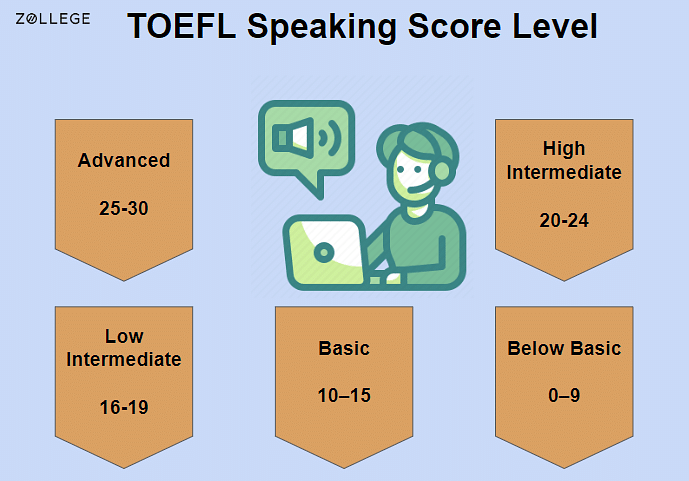
The final performance of students in TOEFL Speaking section is described as follows:
| Level | Scaled Speaking Score Range |
|---|---|
| Advanced | 25-30 |
| High Intermediate | 20-24 |
| Low Intermediate | 16-19 |
| Basic | 10-15 |
| Below Basic | 0-9 |
For more details, check TOEFL Speaking Performance Descriptors
TOEFL Speaking Percentile
TOEFL score speaking percentiles makes the students aware of their competition and indicate the number of test takers that have scored lower or higher than the student.
The percentiles can be calculated for Scaled Score that use a scale of 0-30. The following table illustrates the percentiles for TOEFL Speaking Section:
| Percentile | Scaled Speaking Score |
|---|---|
| 90 | 27 |
| 75 | 24 |
| 50 | 22 |
| 25 | 18 |
| 10 | 15 |
It must be noted that the 50th percentile is the median, which means that, at this scaled speaking score. 50 percent of the test takers have scored lower than you and the remaining 50 percent of the test takers have scored higher than you. Numerically, we can say that a scaled speaking score above 22 can be considered to be good.
Achieving a scaled speaking score of 24 will place you among the top 25 percent of the test takers. Getting a scaled speaking score of 27 will place you among the top 10 percent of the test takers, making it an excellent score.
Getting a scaled speaking score of 18 will place you among the bottom 25 percent of the test takers. Getting a scaled speaking score of 15 will place you among the bottom 10 percent of the test takers, making it a very poor score.
TOEFL Speaking Section: Tips and Strategies
In order to study abroad, the students have to qualify a good TOEFL score. Below are given some tips and strategies that will help you to score better in TOEFL Speaking Section:
- The students should try to give relevant answers and must try to avoid deviating from the given topic.
- In order to strengthen their vocabulary, the students can read books and listen to different podcasts and audiobooks.
- It is advisable for students to seek professional help from experienced TOEFL teachers.
- The students can use body movement while expressing their opinion. This will the students to communicate their message in an enhanced manner.
- The students should try to take down notes upon the main information while listening to the prompt.
- The students must try their best maintain a natural pace and avoid any long pauses during delivery.
Candidates can refer to the tables mentioned above to get an understanding of the TOEFL speaking marks and percentile goal. Moor ever, free TOEFL speaking evaluation is available over the internet that can be accessed by test takers. It is to understand the making scheme in the TOEFL speaking section.
FAQs
Ques: What is the TOEFL Speaking score range?
Ans: TOEFL speaking score ranges from 0 to 30, and achieving a score of 25+ is considered an excellent result.
Ques: How much does the Speaking section contribute to the overall TOEFL score?
Ans: TOEFL total score ranges from 0-120, and each section is scored on 0-30 level. TOEFL speaking score contributed 25% of the total score.
Ques: What are the different levels within the Speaking score range?
Ans: Achieving a listening score of 25-30 is considered an advanced level, and a score between 20-24 is considered a high intermediate-level proficiency.
Ques: What does my TOEFL Speaking score mean?
Ans: TOEFL speaking score reflects your ability to express yourself effectively, organize your ideas, and communicate complex information clearly in English.
Ques: What are some factors influencing the Speaking score?
Ans: TOEFL speaking score is given by considering fluency, vocabulary, pronunciation, grammar, and overall comprehension.
Ques: Is there a specific score required for admission to all universities?
Ans: Every university has its own TOEFL score requirements for the admission process, you can check the cut-off from the university's official website.
Ques: How can I improve my TOEFL Speaking score?
Ans: You should try to give relevant answers and must try to avoid deviating from the given topic. and to strengthen your vocabulary, you can read books and listen to different podcasts and audiobooks.
Ques: Does using complex vocabulary guarantee a higher score?
Ans: Using appropriate vocabulary showcases your proficiency, clarity, and accuracy are equally important. Always focus on natural expression without being overly complex.
Ques: Is a strong accent a disadvantage in the Speaking section?
Ans: If your accent is understandable and doesn't hinder communication, it shouldn't significantly impact your score.
Ques: Can I retake the TOEFL to improve my Speaking score?
Ans: You can take TOEFL as many times as you want, but there must be a 21-day gap between your two attempts.
Ques: Are there alternative ways to demonstrate English speaking proficiency besides the TOEFL?
Ans: There are other English language proficiency tests as well and accepted by universities. TOEFL is a popular exam and is accepted in over 160 countries.
Ques: Do universities consider the Speaking section more important than other TOEFL sections?
Ans: Every section of TOEFL contributes equally to the total score, some universities might prioritize the speaking sections based on their program requirements.
Ques: How can I find universities that accept my TOEFL Speaking score?
Ans: You can check the universities list from educational websites. Check the score requirements from the university’s official website.
Ques: What if my Speaking score is lower than other sections?
Ans: Do effective practice and improve your strategies for the speaking section. You can search universities with lower TOEFL score requirements or explore other ways to demonstrate English-speaking proficiency.
Ques: Is there a minimum time limit for speaking responses?
Ans: The total time to complete the speaking section will be around 16 minutes. You will get 15–30 seconds for preparation before each response. Once you are prepared, you need to speak for 45–60 seconds.
Ques: Can I use notes or aids during the Speaking section?
Ans: Notes or external aids are not allowed during the speaking section, read the exam day rules and regulations before giving the test.
Ques: What happens if I make a mistake during the Speaking section?
Ans: First, come down and acknowledge your mistake and rephrase your sentence correctly.
Ques: How long does the Speaking section of the TOEFL test last?
Ans: The total time to complete the speaking section will be around 16 minutes, and there are 4 questions in total in TOEFL speaking.
Ques: What types of questions are asked in the Speaking section
Ans: There are 4 questions in total in TOEFL speaking. TOEFL Independent speaking section consists of 1 question and the TOEFL Integrated section consists of 3 questions.
Ques: Where can I find more information about the TOEFL Speaking section?
Ans: To find more and verified information about TOEFL speaking section, you can visit the ETS official website. ETS conduct TOEFL exam.
*The article might have information for the previous academic years, please refer the official website of the exam.