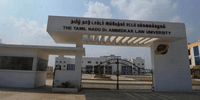
Government Law College, Madurai, was established in 1979 under the Tamil Nadu Department of Legal Studies. The government institution is affiliated with Tamil Nadu Dr. Ambedkar Law University (TNDALU), recognised by the Bar Council of India and holds NAAC A+ accreditation.
The college offers integrated undergraduate, graduate-entry and postgraduate law programmes. Its location near the District Court Complex and the Madurai Bench of Madras High Court allows students to observe live proceedings and gain practical exposure to legal work.
Its alumni include former Union Minister A. Raja, senior advocates and judicial officers in Tamil Nadu. Graduates practise before the Madurai Bench and district courts across the state.
Government Law College Madurai Courses and Fees
The college provides 3 programmes covering integrated law, graduate-entry law and postgraduate specialisation. Government subsidies keep the stated fees among the lowest for legal education in Tamil Nadu and make the programmes accessible within South India.
| Programme | Annual fee | Total programme fee | Duration | Eligibility |
|---|---|---|---|---|
| BA LLB, integrated Arts and Law | INR 1,455 | INR 7,275 | 5 years | 10+2 with at least 45%; 40% for SC/ST |
| LLB | INR 1,405 | INR 4,215 | 3 years | Graduation in any discipline with at least 45%; 40% for SC/ST |
| LLM in Corporate and Intellectual Property Law | INR 1,995 | INR 3,990 | 2 years | Recognised LLB degree |
Subject to revision. Kindly check with the official sources to confirm
Government Law College Madurai Admission Process
Admission follows TNDALU’s centralised counselling process and Bar Council of India norms. BA LLB and LLB selection uses qualifying-examination merit without a separate entrance examination. Postgraduate selection is described as LLB-merit-based through TNDALU counselling; the programme listing also refers to an LLM entrance route where applicable.
| Programme | Qualifying merit | Admission route |
|---|---|---|
| BA LLB | HSC marks | TNDALU counselling; no entrance examination |
| LLB | Undergraduate degree marks | TNDALU counselling; no entrance examination |
| LLM in Corporate and Intellectual Property Law | LLB marks | TNDALU postgraduate counselling; the source lists “no entrance exam or LLM entrance” |
Integrated BA LLB Requirements
Applicants must pass HSC, 10+2 or an equivalent examination from a recognised board with 45% aggregate. The minimum for SC and ST candidates is 40%. Any applicable maximum age requirement is governed by TNDALU’s annual notification.
Graduate-entry LLB Requirements
A recognised bachelor’s degree in any discipline with 45% marks is required, reduced to 40% for SC/ST candidates. The source describes the admission route as TNDALU’s centralised PG and lateral-entry counselling. Eligibility for working professionals and any stated part-time or regular mode depends on the annual notification.
Postgraduate LLM Requirements
Applicants need a three-year LLB or five-year integrated law degree from a BCI-recognised institution. Selection uses LLB marks through postgraduate counselling. Corporate and Intellectual Property Law covers company law, securities regulation, intellectual property rights and commercial litigation.
Application and Counselling Steps
- Apply through the TNDALU portal after publication of the admission notification.
- Complete certificate verification at the designated college or university centre.
- Check the merit list and participate in online counselling.
- Enter college and programme preferences.
- Receive provisional allotment and pay the prescribed fees.
- Report to Government Law College, Madurai, for final admission confirmation.
Tamil Nadu government reservation provisions apply to BC, MBC, SC and ST candidates, along with special categories including ex-servicemen, differently abled applicants and sports-quota candidates.
Government Law College Madurai Campus Facilities
The campus is situated near the District Court Complex and the Madurai Bench of Madras High Court. Students can attend court proceedings as part of their practical legal learning.
Facilities include spacious classrooms, a law library with case-law reporters, statute books and online legal databases, and dedicated moot courtrooms for trial and appellate advocacy practice. Medical services, a cafeteria and sports facilities are also available. The NSS unit conducts community legal-literacy and outreach activities.
There is no on-campus hostel. Students coming from outside Madurai generally arrange private accommodation near the centrally located campus, court complex and city transport connections.
Government Law College Madurai Career Pathways
Advocacy before the Madurai Bench of Madras High Court and district courts is a principal career route for graduates. Access to nearby courts provides practical exposure during study and supports the transition into legal practice.
- Advocacy after enrolment with the Tamil Nadu Bar Council, particularly before the Madurai Bench and district courts.
- Tamil Nadu State Judicial Services, including Civil Judge and Judicial Magistrate roles, through the applicable TNPSC recruitment process.
- Law-firm, corporate legal-department and intellectual property consultancy roles, particularly for Corporate and IP Law postgraduates.
- Legal Officer recruitment in public-sector undertakings, banks and government departments through recruitment examinations.
- Legal-aid and NGO work, including government legal-aid schemes and Tamil Nadu Legal Services Authority engagements.
The source also identifies UPSC and an All India Judicial Service under Article 312 as an intended career direction. This reference should not be read as confirmation of an operational All India Judicial Service recruitment examination.
Notable alumni include A. Raja, senior advocates and judges in the Tamil Nadu judiciary, reflecting the college’s contribution to legal practice in South India.
Government Law Colleges in Madurai, Chennai and Coimbatore
Government Law College, Madurai, Dr. Ambedkar Government Law College, Chennai, and Government Law College, Coimbatore, are government institutions affiliated with TNDALU. They provide comparable law-education options at government fee levels and carry equivalent Bar Council recognition.
| Comparison point | GLC Madurai | Dr. Ambedkar GLC Chennai | GLC Coimbatore |
|---|---|---|---|
| Location | Near the Madurai Bench of Madras High Court | Near Madras High Court, Chennai | Coimbatore city |
| University affiliation | TNDALU | TNDALU | TNDALU |
| Programmes | BA LLB, LLB and LLM | BA LLB, LLB and LLM | BA LLB and LLB |
| Annual LLB fee | INR 1,405 | Government rates | Government rates |
| Nearby courts | Madurai Bench of Madras High Court | Madras High Court Principal Bench | Coimbatore district courts |
| NAAC status | A+ | Accredited | Accredited |
Subject to revision. Kindly check with the official sources to confirm
The Chennai institution suits aspirants interested in the Madras High Court Principal Seat and Chennai’s legal market. Madurai offers proximity to the Madurai Bench and southern Tamil Nadu’s legal community, while Coimbatore serves students from the Kongu region.
Government Law College Madurai FAQs
Ques. What professional recognition and university affiliation does the college hold?
Ans. Government Law College, Madurai, is approved by the Bar Council of India and affiliated with Tamil Nadu Dr. Ambedkar Law University. Its graduates are eligible to seek enrolment as advocates with the Tamil Nadu Bar Council.
Ques. How much do the undergraduate law programmes cost?
Ans. The three-year LLB has an annual fee of INR 1,405, giving a total of INR 4,215. The five-year integrated BA LLB costs INR 1,455 annually.
Ques. How are BA LLB and LLB applicants selected?
Ans. Neither programme requires a separate entrance examination. BA LLB selection uses HSC marks, while LLB selection uses graduation marks. Both follow TNDALU’s centralised merit-based counselling.
Ques. Which NAAC grade is stated for the institution?
Ans. The college holds NAAC A+ accreditation. It is also recognised by the Bar Council of India and affiliated with Tamil Nadu Dr. Ambedkar Law University.
Ques. What postgraduate law specialisation is available?
Ans. The college offers a 2-year LLM in Corporate and Intellectual Property Law. Its annual fee is INR 1,995, and applicants must hold a recognised LLB degree.
Ques. Can students obtain accommodation within the campus?
Ans. No on-campus hostel is available. Outstation students generally arrange private accommodation near the college, which is centrally located close to the court complex and city transport links.
Ques. Which employment routes are described for law graduates?
Ans. Graduates commonly enter advocacy before the Madurai Bench and district courts. Other routes include Tamil Nadu judicial-service recruitment through TNPSC, corporate legal work for LLM graduates and public-sector Legal Officer positions. The source also mentions UPSC-level All India Judicial Services aspirations, which should not be treated as an announced recruitment route.