
BITSAT 2021 Question Paper with Answer Key PDF


Content Writer | Updated On - Jan 12, 2026
BITSAT Question Papers are the most important study material for effective exam preparation. We at Zollege have provided all BITSAT Previous Year Papers with Solution PDFs here. BITSAT 2021 exam was conducted successfully by BITS Pilani.
Students can freely download the BITSAT previous year's question paper PDFs along with their solutions here. We strongly encourage BITSAT aspirants to scan through all the BITSAT Question Paper to know the overall difficulty level, BITSAT Syllabus and understand the changes in BITSAT Exam Pattern over the years.
BITSAT 2021 Question Paper with Answer Key PDF
| BITSAT 2021 Question Paper PDF | BITSAT 2021 Answer Key PDF | BITSAT 2021 Solution PDF |
|---|---|---|
| Download PDF | Download PDF | Check Solutions |

What is the minimum energy required to launch a satellite of mass m from the surface of a planet of mass M and radius R in a circular orbit at an altitude of 2R?
View Solution
The initial total energy of the satellite at the surface of the planet is its potential energy (kinetic energy is zero):
\(E_i = -\frac{GMm}{R}\)
The satellite is to be placed in a circular orbit at an altitude \(h = 2R\). The radius of the orbit is \(r = R + h = 3R\).
The total energy of a satellite in a circular orbit of radius \(r\) is:
\(E_f = -\frac{GMm}{2r} = -\frac{GMm}{2(3R)} = -\frac{GMm}{6R}\)
The minimum energy required (Work done) is the change in total energy:
\(W = E_f - E_i\)
\(W = -\frac{GMm}{6R} - \left( -\frac{GMm}{R} \right)\)
\(W = -\frac{GMm}{6R} + \frac{6GMm}{6R}\)
\(W = \frac{5GMm}{6R}\)
Quick Tip: Remember that the total energy in a circular orbit is negative and equals half the potential energy at that radius (\(E = -GMm/2r\)).
A mercury drop of radius 1 cm is sprayed into \(10^6\) drops of equal size. The energy expressed in joule is (surface tension of Mercury is \(460 \times 10^{-3}\) N/m)

View Solution
Let the radius of the large drop be \(R = 1 cm = 10^{-2} m\).
Let the radius of the small drops be \(r\) and the number of drops be \(n = 10^6\).
From conservation of volume: \(R^3 = n r^3 \implies r = \frac{R}{n^{1/3}}\).
\(n^{1/3} = (10^6)^{1/3} = 100\). So \(r = R/100\).
The change in surface area is \(\Delta A = n(4\pi r^2) - 4\pi R^2\).
Substitute \(r = R/n^{1/3}\): \(\Delta A = 4\pi R^2 (n^{1/3} - 1)\).
Substitute values: \(\Delta A = 4\pi (10^{-2})^2 (100 - 1) = 4\pi (10^{-4})(99)\).
\(\Delta A \approx 12.44 \times 10^{-4} \times 99 \approx 0.1244 m^2\).
The energy required is \(W = T \cdot \Delta A\).
\(W = (460 \times 10^{-3}) \times 0.1244\).
\(W = 0.46 \times 0.1244 \approx 0.057 J\).
Quick Tip: The work done in splitting a drop is proportional to the increase in surface area. Use the formula \(W = 4\pi R^2 T (n^{1/3} - 1)\).
Two plano-concave lenses (1 and 2) of glass of refractive index 1.5 have radii of curvature 25 cm and 20 cm. They are placed in contact with their curved surface towards each other and the space between them is filled with liquid of refractive index 4/3. Then the combination is
View Solution
The system acts as three lenses in contact: two glass plano-concave lenses and one liquid biconvex lens.
Power of lens 1 (glass, \(R=25\) cm): \(P_1 = \frac{1-1.5}{0.25} = -2 D\).
Power of lens 2 (glass, \(R=20\) cm): \(P_2 = \frac{1-1.5}{0.20} = -2.5 D\).
Power of liquid lens (biconvex, \(\mu=4/3\), radii 25 cm and 20 cm):
\(P_L = (\frac{4}{3} - 1) (\frac{1}{0.25} + \frac{1}{0.20}) = \frac{1}{3} (4 + 5) = 3 D\).
Net Power \(P = P_1 + P_2 + P_L = -2 - 2.5 + 3 = -1.5 D\).
Focal length \(f = \frac{1}{P} = \frac{1}{-1.5} m = -\frac{100}{1.5} cm\).
\(f = -66.6 cm\).
A negative focal length indicates a concave lens.
Quick Tip: The liquid trapped between lenses forms a lens with radii of curvature equal to the contacting surfaces. Always sum the powers: \(P_{net} = \sum P_i\).
A charged particle moves through a magnetic field perpendicular to its direction. Then
View Solution
The magnetic force \(\vec{F} = q(\vec{v} \times \vec{B})\) is always perpendicular to the velocity \(\vec{v}\).
Since the force is perpendicular to displacement, the work done by the magnetic field is zero.
According to the Work-Energy Theorem, zero work implies constant kinetic energy (\(K\)) and constant speed (\(v\)).
However, the force changes the direction of the velocity vector.
Since momentum \(\vec{p} = m\vec{v}\) is a vector quantity, a change in direction implies a change in momentum.
Quick Tip: Magnetic forces do no work on moving charges. Thus, speed is invariant, but velocity (and momentum) changes direction.
After two hours, one-sixteenth of the starting amount of a certain radioactive isotope remained undecayed. The half life of the isotope is
View Solution
The remaining fraction is given by \(\frac{N}{N_0} = \frac{1}{16}\).
We know that \(\frac{N}{N_0} = (\frac{1}{2})^n\), where \(n\) is the number of half-lives.
Since \(\frac{1}{16} = (\frac{1}{2})^4\), we have \(n = 4\).
Total time \(t = 2 hours = 120 minutes\).
The half-life \(T_{1/2}\) is given by \(t = n \times T_{1/2}\).
\(120 = 4 \times T_{1/2} \implies T_{1/2} = 30 minutes\).
Quick Tip: Recognize that fractions like 1/2, 1/4, 1/8, 1/16 correspond to integer numbers of half-lives (1, 2, 3, 4).
A coil of inductance 300 mH and resistance 2\(\Omega\) is connected to a source of voltage 2 V. The current reaches half of its steady state value in
View Solution
The growth of current in an LR circuit is given by \(I(t) = I_0 (1 - e^{-t/\tau})\), where \(\tau = L/R\).
Here \(L = 300 mH = 0.3 H\) and \(R = 2 \Omega\).
Time constant \(\tau = \frac{0.3}{2} = 0.15 s\).
We need the time \(t\) when \(I(t) = \frac{1}{2} I_0\).
\(\frac{1}{2} = 1 - e^{-t/0.15} \implies e^{-t/0.15} = \frac{1}{2}\).
Taking natural log: \(-\frac{t}{0.15} = -\ln 2 = -0.693\).
\(t = 0.15 \times 0.693 \approx 0.104 s\).
Rounding to one decimal place gives 0.1 s.
Quick Tip: The half-life of current growth (time to reach 50%) is \(t = \tau \ln 2 \approx 0.693 \tau\).
Two concentric conducting thin spherical shells A, and B having radii \(r_A\) and \(r_B\) (\(r_B > r_A\)) are charged to \(Q_A\) and \(-Q_B\) (\(|Q_B| > |Q_A|\)). The electric field along a line passing through the centre is
- (a)
![]()
- (b)
![]()
- (c)
![]()
- (d)
![]()


View Solution
Inside shell A (\(r < r_A\)): The electric field is zero because it is inside a conductor.
Between the shells (\(r_A < r < r_B\)): The field is due to \(Q_A\) only. \(E = \frac{kQ_A}{r^2}\). Since \(Q_A\) is positive, \(E\) is positive (outward).
Outside shell B (\(r > r_B\)): The field is due to the total enclosed charge \(Q_{net} = Q_A - Q_B\).
Since \(|Q_B| > |Q_A|\) and \(Q_B\) is negative, \(Q_{net}\) is negative. Thus, \(E = \frac{k(Q_A - Q_B)}{r^2}\) is negative (inward).
Therefore, the graph must show: 0 for \(r < r_A\), positive values for \(r_A < r < r_B\), and negative values for \(r > r_B\). Graph (a) matches this description.
Quick Tip: Use Gauss's Law. For concentric shells, the field at distance \(r\) depends only on the net charge enclosed within that radius.
A capillary tube of radius R is immersed in water and water rises in it to a height H. Mass of water in the capillary tube is M. If the radius of the tube is doubled, mass of water that will rise in the capillary tube will now be :
View Solution
The height of capillary rise is \(H = \frac{2T \cos \theta}{R \rho g}\). Thus \(H \propto \frac{1}{R}\).
The mass of the water column is \(M = Volume \times \rho = (\pi R^2 H) \rho\).
Substituting \(H \propto \frac{1}{R}\) into the mass equation:
\(M \propto R^2 \times \frac{1}{R} \implies M \propto R\).
If the radius \(R\) is doubled (\(2R\)), the mass \(M\) also doubles (\(2M\)).
Quick Tip: In capillary action, the mass of the liquid supported is directly proportional to the radius of the tube (\(M \propto R\)), even though height is inversely proportional (\(H \propto 1/R\)).
A sonometer wire resonates with a given tuning fork forming standing waves with five antinodes between the two bridges when a mass of 9 kg is suspended from the wire. When this mass is replaced by a mass M, the wire resonates with the same tuning fork forming three antinodes for the same positions of the bridges. The value of M is
View Solution
The frequency of the standing wave is given by \(f = \frac{n}{2L} \sqrt{\frac{T}{\mu}}\), where \(n\) is the number of antinodes (loops).
Since the tuning fork is the same, the frequency \(f\) is constant. The length \(L\) and linear density \(\mu\) are also constant.
For the first case: \(n_1 = 5\), Tension \(T_1 = 9g\).
\(f = \frac{5}{2L} \sqrt{\frac{9g}{\mu}}\).
For the second case: \(n_2 = 3\), Tension \(T_2 = Mg\).
\(f = \frac{3}{2L} \sqrt{\frac{Mg}{\mu}}\).
Equating the two expressions:
\(5 \sqrt{9} = 3 \sqrt{M}\).
\(5 \times 3 = 3 \sqrt{M} \implies 15 = 3 \sqrt{M}\).
\(\sqrt{M} = 5 \implies M = 25 kg\).
Quick Tip: For a fixed frequency and length, \(n \sqrt{T} = constant\). Hence \(n_1^2 T_1 = n_2^2 T_2\).
When a metal surface is illuminated by light of wavelengths 400 nm and 250 nm, the maximum velocities of the photoelectrons ejected are v and 2v respectively. The work function of the metal is (h - Planck's constant, c = velocity of light in air)
View Solution
The photoelectric equation is \(K_{max} = \frac{hc}{\lambda} - \phi\).
Case 1: \(\lambda_1 = 400 nm = 4 \times 10^{-7} m\). \(v_1 = v\).
\(\frac{1}{2}mv^2 = \frac{hc}{4 \times 10^{-7}} - \phi\).
Case 2: \(\lambda_2 = 250 nm = 2.5 \times 10^{-7} m\). \(v_2 = 2v\).
\(\frac{1}{2}m(2v)^2 = \frac{hc}{2.5 \times 10^{-7}} - \phi \implies 4(\frac{1}{2}mv^2) = \frac{hc}{2.5 \times 10^{-7}} - \phi\).
Substitute eq. 1 into eq. 2:
\(4 \left( \frac{hc}{4 \times 10^{-7}} - \phi \right) = \frac{hc}{2.5 \times 10^{-7}} - \phi\).
\(\frac{hc}{10^{-7}} - 4\phi = \frac{4hc}{10^{-6}} - \phi\). (Note: \(2.5 \times 10^{-7} = 0.25 \times 10^{-6}\), wait, \(1/2.5 = 0.4\). So \(0.4 \times 10^7 = 4 \times 10^6\)).
Let's use exponents of \(10^6\):
\(\frac{hc}{4 \times 10^{-7}} = 2.5 \times 10^6 hc\).
\(\frac{hc}{2.5 \times 10^{-7}} = 4.0 \times 10^6 hc\).
So, \(4(2.5 \times 10^6 hc - \phi) = 4.0 \times 10^6 hc - \phi\).
\(10 \times 10^6 hc - 4\phi = 4 \times 10^6 hc - \phi\).
\(6 \times 10^6 hc = 3\phi\).
\(\phi = 2 \times 10^6 hc\).
Quick Tip: When velocity doubles, kinetic energy quadruples (\(K \propto v^2\)). Use this ratio to eliminate \(K\) and solve for the work function \(\phi\).
Two conducting shells of radius a and b are connected by conducting wire as shown in figure. The capacity of system is :

View Solution
The figure shows two separate spheres connected by a long wire.
When connected by a wire, both spheres reach the same potential \(V\).
Let charges be \(q_a\) and \(q_b\). Then \(V = \frac{1}{4\pi\epsilon_0}\frac{q_a}{a} = \frac{1}{4\pi\epsilon_0}\frac{q_b}{b}\).
Total charge \(Q = q_a + q_b\).
From the potential equation, \(q_a = 4\pi\epsilon_0 a V\) and \(q_b = 4\pi\epsilon_0 b V\).
\(Q = 4\pi\epsilon_0 V (a + b)\).
Capacitance \(C = \frac{Q}{V} = 4\pi\epsilon_0 (a + b)\).
Quick Tip: For two widely separated conductors connected together, the total capacitance is simply the sum of their individual self-capacitances (\(C = C_1 + C_2\)).
When \(_{92}U^{235}\) undergoes fission, 0.1% of its original mass is changed into energy. How much energy is released if 1 kg of \(_{92}U^{235}\) undergoes fission
View Solution
Mass converted to energy \(\Delta m = 0.1%\) of 1 kg \(= 0.001\) kg \(= 10^{-3}\) kg.
Using Einstein's mass-energy equivalence \(E = \Delta m c^2\):
\(E = 10^{-3} \times (3 \times 10^8)^2\).
\(E = 10^{-3} \times 9 \times 10^{16}\).
\(E = 9 \times 10^{13}\) J.
Quick Tip: Energy released is simply \(\Delta m c^2\). Be careful with unit conversions (percentage to decimal).
One mole of an ideal gas is taken from state A to state B by three different processes, (i) ACB (ii) ADB (iii) AEB as shown in the P-V diagram. The heat absorbed by the gas is

View Solution
From the First Law of Thermodynamics, \(Q = \Delta U + W\).
Since the initial state A and final state B are the same for all processes, the change in internal energy \(\Delta U\) is the same for all three.
Work done \(W\) is the area under the P-V curve.
From the graph (curve ACB is highest, ADB is middle, AEB is lowest):
\(W_{ACB} > W_{ADB} > W_{AEB}\).
Therefore, \(Q_{ACB} > Q_{ADB} > Q_{AEB}\).
Comparing (ii) ADB and (iii) AEB, \(Q_{ADB} > Q_{AEB}\).
So, heat absorbed is less in (iii) than in (ii).
Quick Tip: For paths between the same two states, \(\Delta U\) is constant. Heat \(Q\) follows the same order as Work \(W\), which is the area under the curve.
In the formula \(X = 3 YZ^2\), X and Z have dimensions of capacitance and magnetic induction respectively. The dimensions of Y in MKSA system are :
View Solution
Dimension of X (Capacitance): \(C = \frac{Q}{V} = \frac{Q^2}{Energy} = \frac{[AT]^2}{[ML^2T^{-2}]} = [M^{-1}L^{-2}T^4A^2]\).
Dimension of Z (Magnetic Induction): \(F = qvB \implies B = \frac{F}{qv} = \frac{[MLT^{-2}]}{[AT][LT^{-1}]} = [MT^{-2}A^{-1}]\).
We need \(Y = \frac{X}{3Z^2}\). Ignore constant 3.
\(Y = \frac{[M^{-1}L^{-2}T^4A^2]}{[MT^{-2}A^{-1}]^2} = \frac{[M^{-1}L^{-2}T^4A^2]}{[M^2T^{-4}A^{-2}]}\).
\(Y = M^{-1-2} L^{-2} T^{4-(-4)} A^{2-(-2)} = [M^{-3}L^{-2}T^8A^4]\).
Quick Tip: Derive dimensions from basic formulas (\(E=\frac{1}{2}CV^2\), \(F=qvB\)). Be systematic with exponents.
Two very long, straight, parallel wires carry steady currents I and -I respectively. The distance between the wires is d. At a certain instant of time, a point charge q is at a point equidistant from the two wires, in the plane of the wires. Its instantaneous velocity v is perpendicular to this plane. The magnitude of the force due to the magnetic field acting on the charge at this instant is
View Solution
Let the wires lie in the xy-plane. Wire 1 carries \(I\) (up), Wire 2 carries \(-I\) (down).
At the midpoint, the magnetic field due to Wire 1 is into the plane (by Right Hand Grip Rule).
The magnetic field due to Wire 2 is also into the plane (current down, point to left).
So the net magnetic field \(\vec{B}\) is perpendicular to the plane of the wires (into the plane).
The velocity \(\vec{v}\) of the charge is given as "perpendicular to this plane".
Thus, both \(\vec{v}\) and \(\vec{B}\) are parallel (or anti-parallel).
The magnetic force is \(\vec{F} = q(\vec{v} \times \vec{B})\).
Since the angle between \(\vec{v}\) and \(\vec{B}\) is \(0^\circ\) or \(180^\circ\), the cross product is zero.
\(F = 0\).
Quick Tip: If velocity and magnetic field are parallel, the magnetic Lorentz force is zero. Always check the vector directions first.
Two projectiles A and B thrown with speeds in the ratio \(1 : \sqrt{2}\) acquired the same heights. If A is thrown at an angle of \(45^\circ\) with the horizontal, the angle of projection of B will be
View Solution
Maximum height \(H = \frac{u^2 \sin^2 \theta}{2g}\).
Given \(H_A = H_B\).
\(\frac{u_A^2 \sin^2 \theta_A}{2g} = \frac{u_B^2 \sin^2 \theta_B}{2g}\).
\(u_A^2 \sin^2 45^\circ = u_B^2 \sin^2 \theta_B\).
Given \(\frac{u_A}{u_B} = \frac{1}{\sqrt{2}} \implies u_B = \sqrt{2} u_A\).
\(u_A^2 (\frac{1}{\sqrt{2}})^2 = (\sqrt{2} u_A)^2 \sin^2 \theta_B\).
\(\frac{u_A^2}{2} = 2 u_A^2 \sin^2 \theta_B\).
\(\frac{1}{4} = \sin^2 \theta_B\).
\(\sin \theta_B = \frac{1}{2}\).
\(\theta_B = 30^\circ\).
Quick Tip: For equal maximum heights, the vertical component of velocity must be the same: \(u_A \sin \theta_A = u_B \sin \theta_B\).
A meter bridge is set up as shown, to determine an unknown resistance ‘X’ using a standard 10 ohm resistor. The galvanometer shows null point when tapping-key is at 52 cm mark. The end-corrections are 1 cm and 2 cm respectively for the ends A and B. The determined value of ‘X’ is

View Solution
The balance condition for a meter bridge including end corrections is \(\frac{X}{R} = \frac{l_1 + e_1}{l_2 + e_2}\).
Here \(X\) is the unknown, \(R = 10 \Omega\).
Balancing length \(l_1 = 52\) cm (left side).
Remaining length \(l_2 = 100 - 52 = 48\) cm (right side).
End corrections \(e_1 = 1\) cm (at A, left) and \(e_2 = 2\) cm (at B, right).
\(\frac{X}{10} = \frac{52 + 1}{48 + 2}\).
\(\frac{X}{10} = \frac{53}{50}\).
\(X = \frac{530}{50} = 10.6 \Omega\).
Quick Tip: Always add the end corrections to the respective balancing lengths before taking the ratio. \(\frac{R_1}{R_2} = \frac{L_1 + e_1}{L_2 + e_2}\).
A disk of radius \(a/4\) having a uniformly distributed charge 6 C is placed in the x - y plane with its centre at \((-a/2, 0, 0)\). A rod of length a carrying a uniformly distributed charge 8 C is placed on the x-axis from \(x = a/4\) to \(x = 5a/4\). Two point charges \(-7\) C and 3 C are placed at \((a/4, -a/4, 0)\) and \((-3a/4, 3a/4, 0)\), respectively. Consider a cubical surface formed by six surfaces \(x = \pm a/2, y = \pm a/2, z = \pm a/2\). The electric flux through this cubical surface is
View Solution
We need to calculate the total charge enclosed (\(Q_{in}\)) in the cube of side \(a\) centered at origin.
1. Disk: Center \((-a/2, 0, 0)\). Radius \(a/4\). It lies in the plane \(z=0\). The cube extends from \(x = -a/2\) to \(a/2\). The disk lies between \(x = -0.75a\) and \(-0.25a\). The portion from \(x = -0.5a\) to \(-0.25a\) is inside. This corresponds to exactly half the disk. Charge inside = \(\frac{1}{2} \times 6 = 3\) C.
2. Rod: Extends from \(x = a/4\) to \(5a/4\). The cube ends at \(x = a/2\). Portion inside is from \(a/4\) to \(a/2\). Length = \(a/4\). Linear density \(\lambda = 8/a\). Charge inside = \(\frac{8}{a} \times \frac{a}{4} = 2\) C.
3. Point Charges:
\(-7\) C at \((a/4, -a/4, 0)\). This is inside the cube limits.
\(3\) C at \((-3a/4, 3a/4, 0)\). \(x = -0.75a\) is outside the cube limit (\(-0.5a\)).
Total \(Q_{in} = 3 (disk) + 2 (rod) - 7 (point) = -2\) C.
Flux \(\phi = \frac{Q_{in}}{\epsilon_0} = \frac{-2}{\epsilon_0}\).
Quick Tip: For flux problems, carefully determine which parts of the charge distribution lie strictly within the closed surface boundaries (\(|x| < a/2\), etc.).
A particle of mass m moving in the x direction with speed 2v is hit by another particle of mass 2m moving in the y direction with speed v. If the collision is perfectly inelastic, the percentage loss in the energy during the collision is close to

View Solution
Initial Kinetic Energy: \(K_i = \frac{1}{2}m(2v)^2 + \frac{1}{2}(2m)v^2 = 2mv^2 + mv^2 = 3mv^2\).
Conservation of Momentum: \(\vec{P}_i = m(2v\hat{i}) + 2m(v\hat{j})\).
Final mass \(M = 3m\). Let final velocity be \(\vec{V}\).
\(3m\vec{V} = 2mv\hat{i} + 2mv\hat{j} \implies \vec{V} = \frac{2v}{3}(\hat{i} + \hat{j})\).
\(V^2 = (\frac{2v}{3})^2 + (\frac{2v}{3})^2 = \frac{8v^2}{9}\).
Final Kinetic Energy: \(K_f = \frac{1}{2}(3m)V^2 = \frac{3m}{2} \cdot \frac{8v^2}{9} = \frac{4}{3}mv^2\).
Loss \(\Delta K = K_i - K_f = 3mv^2 - 1.33mv^2 = 1.67mv^2\).
Percentage Loss = \(\frac{\Delta K}{K_i} \times 100 = \frac{5/3}{3} \times 100 = \frac{5}{9} \times 100 \approx 55.56%\).
Quick Tip: In perfectly inelastic collisions, momentum is conserved but kinetic energy is not. Calculate \(K_i\) and \(K_f\) separately using the final velocity vector.
A coil is suspended in a uniform magnetic field, with the plane of the coil parallel to the magnetic lines of force. When a current is passed through the coil it starts oscillating; It is very difficult to stop. But if an aluminium plate is placed near to the coil, it stops. This is due to :
View Solution
When the oscillating coil moves near the aluminium plate, the magnetic flux through the plate changes.
By Faraday's law, this induces eddy currents in the conducting aluminium plate.
By Lenz's law, these eddy currents flow in a direction to oppose the change in flux (i.e., the motion of the coil).
This resistive force is known as electromagnetic damping, which quickly brings the coil to rest.
Quick Tip: Eddy currents are induced in bulk conductors exposed to changing magnetic fields. They create a damping force that opposes motion.
A steel wire of length 'L' at 40\(^\circ\)C is suspended from the ceiling and then a mass 'm' is hung from its free end. The wire is cooled down from 40\(^\circ\)C to 30\(^\circ\)C to regain its original length 'L'. The coefficient of linear thermal expansion of the steel is \(10^{-5} /^\circ\)C, Young's modulus of steel is \(10^{11}\) N/m\(^2\) and radius of the wire is 1 mm. Assume that L \(>>\) diameter of the wire. Then the value of 'm' in kg is nearly
View Solution
The cooling causes the wire to contract thermally, while the suspended mass causes it to extend elastically.
Since the length remains unchanged, the thermal contraction must equal the elastic extension.
Thermal contraction \(\Delta L_{th} = L \alpha \Delta T\).
Elastic extension \(\Delta L_{el} = \frac{FL}{AY} = \frac{mgL}{AY}\).
Equating the two: \(L \alpha \Delta T = \frac{mgL}{AY}\).
Solving for \(m\): \(m = \frac{AY \alpha \Delta T}{g}\).
Given: \(r = 1 mm = 10^{-3} m\), so \(A = \pi r^2 = \pi \times 10^{-6} m^2\).
\(Y = 10^{11} N/m^2\).
\(\alpha = 10^{-5} /^\circ C\).
\(\Delta T = 40 - 30 = 10^\circ C\).
\(g \approx 10 m/s^2\).
Substitute values:
\(m = \frac{(\pi \times 10^{-6}) \times 10^{11} \times 10^{-5} \times 10}{10}\).
\(m = \pi \times 10^{-6+11-5} = \pi \times 10^0 = \pi \approx 3.14 kg\).
The closest integer value is 3 kg.
Quick Tip: For a wire to maintain constant length under changing temperature and load, the thermal strain \(\alpha \Delta T\) must be balanced by the mechanical strain \(\frac{F}{AY}\).
On a hypotenuse of a right prism (30\(^\circ\) – 60\(^\circ\) – 90\(^\circ\)) of refractive index 1.50, a drop of liquid is placed as shown in figure. Light is allowed to fall normally on the short face of the prism. In order that the ray of light may get totally reflected, the maximum value of refractive index is :

View Solution
In a \(30^\circ-60^\circ-90^\circ\) prism, the "short face" is the side opposite the \(30^\circ\) angle.
The ray enters this face normally, so it travels undeviated into the prism.
It then strikes the hypotenuse. We need to determine the angle of incidence \(i\) at the hypotenuse.
Geometry: The angle between the short face and the hypotenuse is the angle at the vertex connecting them. Since the short face is opposite \(30^\circ\) and the hypotenuse is opposite \(90^\circ\), the angle between them is \(60^\circ\).
For a ray entering perpendicular to one face of a prism angle \(A\), the angle of incidence on the second face is \(i = A\). Here, the effective prism angle is \(60^\circ\).
So, angle of incidence \(i = 60^\circ\).
For Total Internal Reflection (TIR) to occur at the glass-liquid interface:
\(i > C\) (critical angle)
\(\sin i > \sin C\)
\(\sin 60^\circ > \frac{\mu_{liquid}}{\mu_{glass}}\)
\(\frac{\sqrt{3}}{2} > \frac{\mu_{liquid}}{1.5}\)
\(\mu_{liquid} < 1.5 \times \frac{\sqrt{3}}{2} = 0.75 \times 1.732 \approx 1.299\).
The maximum value is approximately 1.30.
Quick Tip: Always use geometry to find the angle of incidence inside the prism. If a ray enters normally to a face, the angle of incidence on the next face equals the prism angle between those two faces.
A tuning fork of frequency 392 Hz, resonates with 50 cm length of a string under tension (T). If length of the string is decreased by 2%, keeping the tension constant, the number of beats heard when the string and the tuning fork made to vibrate simultaneously is :
View Solution
The frequency of a vibrating string is \(f = \frac{1}{2L}\sqrt{\frac{T}{\mu}}\), so \(f \propto \frac{1}{L}\).
Initial frequency \(f_1 = 392\) Hz corresponds to \(L_1\).
New length \(L_2 = L_1 - 0.02 L_1 = 0.98 L_1\).
New frequency \(f_2\):
\(\frac{f_2}{f_1} = \frac{L_1}{L_2} = \frac{1}{0.98}\).
\(f_2 = \frac{392}{0.98} = 400 Hz\).
Number of beats \(\Delta f = |f_2 - f_1| = 400 - 392 = 8\) beats.
Quick Tip: For small percentage changes, \(\frac{\Delta f}{f} \approx -\frac{\Delta L}{L}\). Here \(2%\) decrease in length implies approx \(2%\) increase in frequency. \(2%\) of 392 is \(\approx 7.84\), close to 8.
Hydrogen (H), deuterium (D), singly ionized helium (He\(^+\)) and doubly ionized lithium (Li\(^{++}\)) all have one electron around the nucleus. Consider n = 2 to n = 1 transition. The wavelengths of emitted radiations are \(\lambda_1\), \(\lambda_2\), \(\lambda_3\) and \(\lambda_4\) respectively. Then approximately :
View Solution
The wavelength of photon emitted in a hydrogen-like ion is given by the Rydberg formula:
\(\frac{1}{\lambda} = R Z^2 \left(\frac{1}{n_1^2} - \frac{1}{n_2^2}\right)\).
For the same transition (\(2 \to 1\)), \(\lambda \propto \frac{1}{Z^2}\).
1. Hydrogen (H): \(Z=1 \implies \lambda_1 \propto 1\).
2. Deuterium (D): \(Z=1\) (Isotope effect on reduced mass is small, so approx same). \(\lambda_2 \approx \lambda_1\).
3. Helium ion (He\(^+\)): \(Z=2 \implies \lambda_3 \propto \frac{1}{2^2} = \frac{1}{4}\). Thus \(\lambda_3 = \frac{\lambda_1}{4} \implies 4\lambda_3 = \lambda_1\).
4. Lithium ion (Li\(^{++}\)): \(Z=3 \implies \lambda_4 \propto \frac{1}{3^2} = \frac{1}{9}\). Thus \(\lambda_4 = \frac{\lambda_1}{9} \implies 9\lambda_4 = \lambda_1\).
Combining these: \(\lambda_1 = \lambda_2 = 4\lambda_3 = 9\lambda_4\).
Quick Tip: For hydrogen-like species, energy scales with \(Z^2\) and wavelength scales with \(1/Z^2\).
The following figure depict a circular motion. The radius of the circle, the period of revolution, the initial position and the sense of revolution are indicated on the figure. The simple harmonic motion of the x-projection of the radius vector of the rotating particle P can be shown as :

View Solution
From the figure:
Radius = \(a\).
Period \(T = 4\) s. Angular frequency \(\omega = \frac{2\pi}{T} = \frac{2\pi}{4} = \frac{\pi}{2}\) rad/s.
Initial position \(P(t=0)\) is at an angle \(45^\circ = \pi/4\) with the x-axis.
Sense of revolution: The arrow suggests counter-clockwise motion (standard convention).
The projection on the x-axis is given by \(x(t) = a \cos(\theta(t))\).
Since motion is uniform circular with angular velocity \(\omega\), \(\theta(t) = \omega t + \phi\).
At \(t=0\), \(\theta = \pi/4\), so \(\phi = \pi/4\).
Thus, \(x(t) = a \cos\left(\frac{2\pi}{4}t + \frac{\pi}{4}\right)\).
This matches option (a).
Quick Tip: SHM is the projection of uniform circular motion. \(x = A \cos(\omega t + \phi)\). Determine \(\omega\) from \(T\) and \(\phi\) from the initial angle.
There are two sources kept at distances 2\(\lambda\). A large screen is perpendicular to line joining the sources. Number of maximas on the screen in this case is (\(\lambda\) = wavelength of light)

View Solution
Assuming the standard interference setup where the screen is placed parallel to the line joining the sources (Young's Double Slit experiment configuration), or the question asks for the number of maxima on a line parallel to the sources:
The path difference at an angle \(\theta\) is \(\Delta x = d \sin \theta\).
Here separation \(d = 2\lambda\).
For maxima, \(\Delta x = n\lambda\).
\(2\lambda \sin \theta = n\lambda \implies \sin \theta = \frac{n}{2}\).
Since \(|\sin \theta| \le 1\), we have \(|\frac{n}{2}| \le 1 \implies |n| \le 2\).
Possible integer values for \(n\) are \(-2, -1, 0, 1, 2\).
This gives a total of 5 maxima.
Quick Tip: The number of maxima is given by \(2[\frac{d}{\lambda}] + 1\) for the standard setup. Here \(d=2\lambda\), so \(2(2) + 1 = 5\).
In the circuit shown in figure the current through

View Solution
We analyze the ladder network from right to left.
1. Rightmost section: Vertical 4 \(\Omega\) in series with top 2 \(\Omega\) and bottom 2 \(\Omega\).
Total \(R_{right} = 2 + 4 + 2 = 8 \Omega\).
2. This \(8 \Omega\) is in parallel with the vertical 8 \(\Omega\) rung.
Equivalent: \(8 || 8 = 4 \Omega\).
3. Move to the next section: Top 2 \(\Omega\), bottom 2 \(\Omega\), and the equivalent \(4 \Omega\).
Total \(R_{mid} = 2 + 4 + 2 = 8 \Omega\).
4. This \(8 \Omega\) is in parallel with the first vertical 8 \(\Omega\) rung.
Equivalent: \(8 || 8 = 4 \Omega\).
5. Finally, the source sees: Top 3 \(\Omega\), Equivalent \(4 \Omega\), Bottom 2 \(\Omega\).
Total Circuit Resistance \(R_{eq} = 3 + 4 + 2 = 9 \Omega\).
Source Current \(I = V / R_{eq} = 9V / 9\Omega = 1 A\).
Now trace the current forward:
- 1 A flows out of the battery.
- At the first vertical rung (8 \(\Omega\)), it sees a parallel combination of the rung (8 \(\Omega\)) and the rest of the circuit (calculated as 8 \(\Omega\)).
- Current splits equally: \(0.5\) A flows down the rung, \(0.5\) A flows to the right.
- The \(0.5\) A flows to the second vertical rung (8 \(\Omega\)). It sees a parallel combination of the rung (8 \(\Omega\)) and the last branch (calculated as 8 \(\Omega\)).
- Current splits equally: \(0.25\) A flows down the rung, \(0.25\) A flows to the right.
- The \(0.25\) A flows through the final loop, which contains the vertical 4 \(\Omega\) resistor.
Thus, current through the 4 \(\Omega\) resistor is 0.25 A.
Quick Tip: For infinite or repeating ladder networks, solve from the back (load end) towards the source by successively combining series and parallel resistors.
A telescope has an objective lens of 10 cm diameter and is situated at a distance of one kilometer from two objects. The minimum distance between these two objects, which can be resolved by the telescope, when the mean wavelength of light is 5000 \AA, is of the order of
View Solution
The limit of resolution (angular) is given by \(\Delta \theta = \frac{1.22 \lambda}{D}\).
The linear separation \(x\) at distance \(L\) is \(x = L \cdot \Delta \theta = \frac{1.22 \lambda L}{D}\).
Given:
\(\lambda = 5000 \AA = 5 \times 10^{-7} m\).
\(L = 1 km = 10^3 m\).
\(D = 10 cm = 0.1 m\).
\(x = \frac{1.22 \times (5 \times 10^{-7}) \times 10^3}{0.1}\).
\(x = 1.22 \times 5 \times 10^{-4+1} = 6.1 \times 10^{-3} m\).
\(x = 6.1 mm\).
This is of the order of 5 mm.
Quick Tip: Resolving power formula: Minimum separation \(x = \frac{1.22 \lambda L}{D}\). Memorize this for optical instrument problems.
During vapourisation
I. change of state from liquid to vapour state occurs.
II. temperature remains constant.
III. both liquid and vapour states coexist in equilibrium.
IV. specific heat of substance increases.
Correct statements are
View Solution
Vaporization is a phase transition.
I. It is the change from liquid to vapor. (True)
II. Phase changes for pure substances occur at constant temperature (Boiling Point). (True)
III. During the phase change, the liquid and vapor phases coexist in equilibrium. (True)
IV. Specific heat is not typically defined during the phase transition (infinite heat capacity), or if comparing phases, the specific heat of vapor is usually lower than liquid (e.g., steam vs water). Thus, "increases" is not generally correct or applicable.
Therefore, statements I, II, and III are correct.
Quick Tip: In any phase change (melting, boiling), temperature remains constant and both phases coexist.
A wire is connected to a battery between the point M and N as shown in the figure (1). The same wire is bent in the form of a square and then connected to the battery between the points M and N as shown in the figure (2). Which of the following quantities increases ?

View Solution
Case 1: Wire of length \(L\) and resistance \(R\).
Current \(I_1 = V/R\). Heat Power \(P_1 = V^2/R\).
Case 2: Wire bent into a square. M and N are at opposite corners (diagonal).
The circuit consists of two paths in parallel.
Path 1: Length \(L/2\), Resistance \(R/2\).
Path 2: Length \(L/2\), Resistance \(R/2\).
Equivalent Resistance \(R_{eq} = \frac{(R/2)(R/2)}{R/2 + R/2} = \frac{R}{4}\).
Comparison:
Resistance offered: \(R_{eq} = R/4 < R\). (Decreases)
Current: \(I_2 = V/R_{eq} = 4V/R = 4I_1\). (Increases)
Heat Produced: \(P_2 = V^2/R_{eq} = 4V^2/R = 4P_1\). (Increases)
Thus, Current and Heat produced increase.
Quick Tip: Connecting parts of a wire in parallel always reduces the equivalent resistance compared to the original straight wire, thereby increasing current and power for a fixed voltage source.
A body moves in a circular orbit of radius R under the action of a central force. Potential due to the central force is given by V(r) = kr (k is a positive constant). Period of revolution of the body is proportional to :
View Solution
The potential energy is given by \(V(r) = kr\).
The radial force is the negative gradient of the potential: \(F = -\frac{dV}{dr} = -k\).
The magnitude of the force is constant: \(|F| = k\).
This force provides the necessary centripetal force for circular motion:
\(\frac{mv^2}{R} = k\).
Solving for velocity \(v\): \(v^2 = \frac{kR}{m} \implies v \propto R^{1/2}\).
The time period of revolution is \(T = \frac{2\pi R}{v}\).
Substituting the proportionality of \(v\):
\(T \propto \frac{R}{R^{1/2}} = R^{1/2}\).
Quick Tip: For a potential \(V \propto r^n\), the time period follows \(T \propto r^{1 - n/2}\). Here \(n=1\), so \(T \propto r^{1/2}\).
Two equal heavy spheres, each of radius r, are in equilibrium within a smooth cup of radius 3r. The ratio of reaction between the cup and one sphere and that between the two sphere is

View Solution
Let \(O\) be the center of the cup and \(C_1, C_2\) be the centers of the two spheres.
The distance from the cup center to a sphere center is \(OC_1 = 3r - r = 2r\).
The distance between the centers of the two touching spheres is \(C_1C_2 = 2r\).
Thus, the triangle formed by \(O\), \(C_1\), and the midpoint of \(C_1C_2\) (vertical axis) is a right-angled triangle.
Let \(\theta\) be the angle the line \(OC_1\) makes with the horizontal diameter of the cup.
Actually, let's use the angle with the vertical axis of symmetry. Let this be \(\phi\).
\(\sin \phi = \frac{Opposite}{Hypotenuse} = \frac{r}{2r} = 0.5\).
Therefore, \(\phi = 30^\circ\).
The normal reaction \(N_1\) from the cup acts along the line \(C_1O\) (at \(30^\circ\) to the vertical).
The reaction \(N_2\) between the spheres acts horizontally.
Balancing the horizontal forces on one sphere: \(N_1 \sin 30^\circ = N_2\).
We need the ratio \(\frac{N_1}{N_2}\).
\(\frac{N_1}{N_2} = \frac{1}{\sin 30^\circ} = \frac{1}{0.5} = 2\).
Quick Tip: Draw the Free Body Diagram and identify the geometry of the centers. The ratio of forces often boils down to trigonometric functions of the contact angle.
A long, hollow conducting cylinder is kept coaxially inside another long, hollow conducting cylinder of larger radius. Both the cylinders are initially electrically neutral
View Solution
The potential difference between two concentric conductors depends on the electric field in the region between them.
By Gauss's Law, the electric field in the region between the cylinders is determined solely by the charge enclosed within that region (i.e., charge on the inner cylinder or in the hollow space).
If charge is given to the inner cylinder, a non-zero electric field exists between \(r_{inner}\) and \(r_{outer}\).
\(E = \frac{\lambda}{2\pi\epsilon_0 r}\).
Potential difference \(V = \int E dr \neq 0\).
If charge is given only to the outer cylinder, the field inside it (including the space between cylinders) is zero. Thus, no potential difference appears.
Therefore, statement (a) is correct.
Quick Tip: Potential difference \(\Delta V\) requires an electric field. For concentric shells, only the inner charge creates a field in the gap. Outer charge contributes constant potential to both, canceling out in the difference.
A thin but rigid semicircular wire frame of radius r is hinged at O and can rotate in its own vertical plane. A smooth peg P starts from O and moves horizontally with constant speed \(v_0\), lifting the frame upward as shown in figure. Find the angular velocity \(\omega\) of the frame when its diameter makes an angle of 60\(^\circ\) with the vertical :

View Solution
Let the diameter of the semicircle make an angle \(\alpha\) with the horizontal line of motion of the peg.
The problem states the diameter makes \(60^\circ\) with the vertical, so \(\alpha = 30^\circ\).
The hinge is at \(O\) (one end of the diameter) and the peg \(P\) is on the arc of the semicircle.
Let \(x\) be the distance of the peg \(P\) from the hinge \(O\). This is the chord length.
The center of the semicircle \(C\) is at the midpoint of the diameter. Triangle \(OCP\) is isosceles with sides \(R_{radius} = r\).
By geometry, the horizontal distance \(x\) corresponds to the projection of the chord. If \(\alpha\) is the angle of the diameter with the horizontal, the chord length \(x\) is related by \(x = 2r \cos \alpha\). (Note: \(\alpha\) is angle between diameter and chord/horizontal).
Differentiating position \(x\) with respect to time \(t\):
\(\frac{dx}{dt} = -2r \sin \alpha \cdot \frac{d\alpha}{dt}\).
Given speed \(v_0 = \left| \frac{dx}{dt} \right|\) and angular velocity \(\omega = \left| \frac{d\alpha}{dt} \right|\).
\(v_0 = 2r \sin \alpha \cdot \omega\).
\(\omega = \frac{v_0}{2r \sin \alpha}\).
Substitute \(\alpha = 30^\circ\):
\(\omega = \frac{v_0}{2r \sin 30^\circ} = \frac{v_0}{2r (0.5)} = \frac{v_0}{r}\).
Quick Tip: Use the geometric relationship between the chord length (peg distance) and the angle of inclination. \(x = 2r \cos \theta_{horizontal}\).
Given that A + B = R and A = B = R. What should be the angle between A and B ?
View Solution
Let the magnitudes be \(A\), \(B\), and \(R\). We are given \(A = B = R\).
Using the vector addition formula: \(R^2 = A^2 + B^2 + 2AB \cos \theta\).
Substitute \(A\) for all variables: \(A^2 = A^2 + A^2 + 2A^2 \cos \theta\).
\(A^2 = 2A^2 + 2A^2 \cos \theta\).
\(-A^2 = 2A^2 \cos \theta\).
\(\cos \theta = -\frac{1}{2}\).
\(\theta = 120^\circ\).
In radians, \(120^\circ = \frac{2\pi}{3}\).
Quick Tip: The vector sum of two equal vectors equals the magnitude of the individual vectors only when the angle between them is \(120^\circ\).
The basic magnetization curve for a ferromagnetic material is shown in figure. Then, the value of relative permeability is highest for the point

View Solution
Relative permeability \(\mu_r\) is defined as the ratio \(\frac{B}{\mu_0 H}\).
On a B-H curve, this quantity is proportional to the slope of the line connecting the origin \((0,0)\) to the point on the curve (the secant slope).
By visual inspection of the graph:
At point P, the slope is shallow.
At point Q, the curve rises sharply, and the line from the origin to Q has the maximum slope.
At points R and S, saturation sets in, and the ratio \(B/H\) decreases as \(H\) increases significantly while \(B\) stays nearly constant.
Therefore, permeability is highest at point Q.
Quick Tip: Permeability is not the local slope (\(dB/dH\)) but the ratio \(B/H\). Look for the point where the tangent from the origin touches the curve, or simply the steepest secant.
Five gas molecules chosen at random are found to have speeds of 500, 600, 700, 800 and 900 m/s:
View Solution
The speeds are \(500, 600, 700, 800, 900\).
Average speed \(\bar{v} = \frac{500+600+700+800+900}{5} = 700\) m/s.
RMS speed \(v_{rms} = \sqrt{\frac{\sum v^2}{N}}\).
Using the variance formula: \(\overline{v^2} = (\bar{v})^2 + \sigma^2\).
Standard deviation \(\sigma^2 = \frac{(-200)^2 + (-100)^2 + 0 + 100^2 + 200^2}{5} = \frac{40000+10000+0+10000+40000}{5} = \frac{100000}{5} = 20000\).
\(v_{rms} = \sqrt{700^2 + 20000} = \sqrt{490000 + 20000} = \sqrt{510000}\).
\(v_{rms} \approx 714.14\) m/s.
Difference \(= v_{rms} - \bar{v} = 714.14 - 700 = 14.14\) m/s.
This is approximately 14 m/s higher.
Quick Tip: \(v_{rms} > v_{avg}\) always. The difference depends on the spread (variance) of the speeds.
What is equivalent capacitance of circuit between points A and B?

View Solution
The answer \((1 + \sqrt{3})\) corresponds to the solution of an infinite ladder network with a shunt capacitance \(C_p = 2 \mu F\) and a series capacitance \(C_s = 1 \mu F\).
Let the equivalent capacitance be \(C\).
The infinite section after the first stage also has capacitance \(C\).
The circuit equation is \(C = C_p + (series combination of C_s and C)\).
\(C = 2 + \frac{1 \cdot C}{1 + C}\).
\(C(1 + C) = 2(1 + C) + C\).
\(C + C^2 = 2 + 2C + C \implies C^2 - 2C - 2 = 0\).
Using the quadratic formula: \(C = \frac{2 \pm \sqrt{4 - 4(1)(-2)}}{2} = \frac{2 \pm \sqrt{12}}{2} = 1 \pm \sqrt{3}\).
Since capacitance must be positive, \(C = 1 + \sqrt{3} \mu F\).
(Note: The diagram labels in the memory-based paper are inconsistent with the answer key, but this is the standard derivation for the provided answer).
Quick Tip: For infinite ladders, assume the total impedance is \(Z\) and set up a recursive equation: \(Z_{total} = Z_{first\_stage} + Z_{total}\).
A cyclic process ABCD is shown in the figure P-V diagram. Which of the following curves represent the same process

- (a)
![]()
- (b)
![]()
- (c)
![]()
- (d)
![]()


View Solution
Let's analyze the steps in the given P-V diagram:
1. D \(\to\) A: Constant Pressure (Isobaric), Volume decreases. This implies Temperature decreases (\(V \propto T\)).
2. A \(\to\) B: Pressure increases, Volume increases. (Expansion).
3. B \(\to\) C: Pressure decreases, Volume increases. The curve looks like an Isotherm (\(PV = constant\)). Temperature is constant.
4. C \(\to\) D: Constant Volume (Isochoric), Pressure decreases. This implies Temperature decreases (\(P \propto T\)).
Now check Graph (a), which is a P-T diagram:
- D \(\to\) A: Horizontal line (P constant). T decreases (moves left). Matches P-V.
- B \(\to\) C: Vertical line (T constant). P decreases (moves down). Matches P-V.
- C \(\to\) D: Straight line passing through origin (\(P \propto T\)). This represents constant volume. Matches P-V.
Thus, Graph (a) correctly represents the cycle.
Quick Tip: Translate processes: Isobaric \(\to\) Horizontal in P-T. Isochoric \(\to\) Line through origin in P-T. Isothermal \(\to\) Vertical in P-T.
In the circuit given below, V(t) is the sinusoidal voltage source, voltage drop \(V_{AB}(t)\) across the resistance R is

View Solution
The circuit has two parallel branches connected to the source, each with a diode and a resistor (\(R_1\) or \(R_2\)). The load \(R\) is in series with the parallel combination.
During the positive half cycle, diode \(D_1\) is forward biased (conducts) and \(D_2\) is reverse biased.
The current flows through \(R_1\) and \(R\). The peak voltage across \(R\) is \(V_{p1} = V_0 \frac{R}{R + R_1}\).
During the negative half cycle, diode \(D_2\) is forward biased and \(D_1\) is reverse biased.
The current flows through \(R_2\) and \(R\). The peak voltage across \(R\) is \(V_{p2} = V_0 \frac{R}{R + R_2}\).
Since \(R_1 = 100 \Omega\) and \(R_2 = 150 \Omega\), the denominators are different, so \(V_{p1} \neq V_{p2}\).
The output is full-wave (conduction in both cycles) but asymmetric (different peaks).
Quick Tip: Analyze the equivalent circuit for positive and negative cycles separately. Different path resistances lead to different voltage divisions.
Which of the following can be repeatedly soften on heating? \newline (i) Polystyrene \hspace{1cm} (ii) Melamine \newline (iii) Polyesters \hspace{1cm} (iv) Polyethylene \newline (v) Neoprene
View Solution
Polymers that soften on heating and harden on cooling repeatedly are called Thermoplastics.
(i) Polystyrene is a linear polymer and is a thermoplastic.
(ii) Melamine is a cross-linked thermosetting polymer (does not soften).
(iii) Polyesters can be fibers (Dacron) or thermosets. Not typically classed as general thermoplastics like PE/PS in this context.
(iv) Polyethylene (Polythene) is a classic thermoplastic.
(v) Neoprene is a synthetic rubber (elastomer).
Therefore, (i) and (iv) are the correct pair.
Quick Tip: Memorize: Polyethylene, PVC, Polystyrene \(\to\) Thermoplastics. Bakelite, Melamine \(\to\) Thermosetting.
Which one of the following complexes is an outer orbital complex ?
View Solution
Outer orbital complexes use \(nd\) orbitals (specifically \(4d\) here) for hybridization (\(sp^3d^2\)), usually because the inner \((n-1)d\) orbitals are not available.
(a) \(Co^{3+} (3d^6)\) with Strong Field Ligand \(NH_3\): Pairing occurs. Two \(3d\) orbitals free. Inner (\(d^2sp^3\)).
(b) \(Mn^{2+} (3d^5)\) with SFL \(CN^-\): Pairing occurs. Inner (\(d^2sp^3\)).
(c) \(Fe^{2+} (3d^6)\) with SFL \(CN^-\): Pairing occurs. Inner (\(d^2sp^3\)).
(d) \(Ni^{2+} (3d^8)\) with \(NH_3\): Even with a strong field ligand, pairing the 8 electrons would leave only one \(3d\) orbital empty (since \(d\) subshell has 5 orbitals). Hybridization requires two d-orbitals. Thus, it must use the outer \(4d\) orbitals.
Hybridization is \(sp^3d^2\) (Outer orbital).
Quick Tip: Coordination number 6 complexes of \(d^8\), \(d^9\), and \(d^{10}\) ions are always outer orbital complexes.
For the reaction \(H_2(g) + Br_2(g) \to 2HBr(g)\), the experimental data suggest, rate = \(k[H_2][Br_2]^{1/2}\). The molecularity and order of the reaction are respectively
View Solution
The Order of the reaction is the sum of the exponents in the rate law:
Order \(= 1 (for H_2) + \frac{1}{2} (for Br_2) = \frac{3}{2} = 1.5\).
Molecularity is a theoretical concept applicable to elementary steps. It must be an integer.
The overall reaction is complex, but the question likely asks for the molecularity of the rate-determining step or uses the term loosely for the apparent stoichiometry in a simplified context (often cited as 2 for collisions between two species in steps).
Looking at the options, only (a) and (b) have the correct order of 3/2.
Option (b) claims molecularity is 3/2, which is impossible (must be integer).
Option (a) claims molecularity is 2, which is a valid integer.
Therefore, (a) is the logical choice.
Quick Tip: Order is experimental and can be fractional. Molecularity is theoretical and must be an integer. Use elimination if the "overall molecularity" is ambiguous.
Dead burn plaster is
View Solution
Dead Burnt Plaster is formed when Gypsum (\(CaSO_4 \cdot 2H_2O\)) is heated above \(200^\circ\)C.
It loses all its water of crystallization.
Reaction: \(CaSO_4 \cdot 2H_2O \xrightarrow{\Delta} CaSO_4 + 2H_2O\).
The product is anhydrous Calcium Sulphate (\(CaSO_4\)), which does not set like Plaster of Paris.
Quick Tip: Remember the hydration states: Gypsum (2), Plaster of Paris (0.5), Dead Burnt Plaster (0).
Stronger is oxidising agent, more is
View Solution
An oxidizing agent oxidizes others and reduces itself (gains electrons).
The tendency to gain electrons is measured by the Standard Reduction Potential (\(E^\circ_{red}\)).
A higher (more positive) \(E^\circ_{red}\) indicates a stronger tendency to accept electrons.
Therefore, a stronger oxidizing agent has a higher standard reduction potential.
Quick Tip: High Reduction Potential \(\to\) Strong Oxidizer. High Oxidation Potential \(\to\) Strong Reducer.
Which of the following relation represents correct relation between standard electrode potential and equilibrium constant?
I. \(\log K = \frac{nFE^\circ}{2.303 RT}\)
II. \(K = e^{\frac{nFE^\circ}{RT}}\)
III. \(\log K = \frac{-nFE^\circ}{2.303 RT}\)
IV. \(\log K = 0.4342 \frac{nFE^\circ}{RT}\)
Choose the correct statement(s).
View Solution
The standard Gibbs free energy change \(\Delta G^\circ\) is related to the equilibrium constant \(K\) by the thermodynamic equation:
\(\Delta G^\circ = -2.303 RT \log K = -RT \ln K\).
Also, \(\Delta G^\circ\) is related to the standard cell potential \(E^\circ\) by:
\(\Delta G^\circ = -nFE^\circ\).
Equating the two expressions:
\(-nFE^\circ = -2.303 RT \log K \implies \log K = \frac{nFE^\circ}{2.303 RT}\). (Relation I is correct).
\(-nFE^\circ = -RT \ln K \implies \ln K = \frac{nFE^\circ}{RT} \implies K = e^{\frac{nFE^\circ}{RT}}\). (Relation II is correct).
Relation III contains a negative sign, which is incorrect.
For Relation IV, we substitute the value of \(1/2.303\):
\(\log K = \frac{1}{2.303} \left( \frac{nFE^\circ}{RT} \right)\).
Since \(\frac{1}{2.303} \approx 0.4342\), we get \(\log K = 0.4342 \frac{nFE^\circ}{RT}\). (Relation IV is correct).
Thus, statements I, II, and IV are correct.
Quick Tip: Always start from \(\Delta G^\circ = -nFE^\circ = -RT \ln K\) to derive the other forms.
Which of the following shows nitrogen with its increasing order of oxidation number?
View Solution
Let's calculate the oxidation number of Nitrogen (\(x\)) in each species:
1. \(NH_4^+\): \(x + 4(+1) = +1 \implies x = -3\).
2. \(N_2O\): \(2x - 2 = 0 \implies 2x = 2 \implies x = +1\).
3. \(NO\): \(x - 2 = 0 \implies x = +2\).
4. \(NO_2\): \(x + 2(-2) = 0 \implies x = +4\).
5. \(NO_3^-\): \(x + 3(-2) = -1 \implies x - 6 = -1 \implies x = +5\).
Arranging in increasing order: \(-3 < +1 < +2 < +4 < +5\).
This corresponds to the sequence: \(NH_4^+ < N_2O < NO < NO_2 < NO_3^-\).
Quick Tip: Oxidation number corresponds to the hypothetical charge if bonds were ionic. H is +1, O is -2.
Raoult's law becomes a special case of Henry's law when
View Solution
Raoult's Law for a volatile component is \(p_i = p_i^\circ \cdot x_i\).
Henry's Law for gas solubility is \(p_i = K_H \cdot x_i\).
Comparing the two equations, they are mathematically identical if the proportionality constants are the same.
Thus, if \(K_H\) (Henry's constant) equals \(p_i^\circ\) (Vapor pressure of pure component), Raoult's law becomes a special case of Henry's law.
Quick Tip: For ideal solutions, solute and solvent obey very similar laws. If components are chemically identical, \(K_H = p^\circ\).
E\(^\circ\) for the cell, \(Zn | Zn^{2+} (aq) || Cu^{2+} (aq) | Cu\) is 1.10 V at 25\(^\circ\)C. The equilibrium constant for the cell reaction \newline \(Zn + Cu^{2+}(aq) \rightleftharpoons Cu + Zn^{2+}(aq)\) \newline is of the order of
View Solution
The Nernst equation relationship at equilibrium at 298 K is:
\(E^\circ_{cell} = \frac{0.0591}{n} \log K_c\).
For the Zn-Cu Daniell cell reaction, \(n = 2\) electrons are exchanged.
Given \(E^\circ = 1.10\) V.
\(1.10 = \frac{0.0591}{2} \log K_c\).
\(\log K_c = \frac{2 \times 1.10}{0.0591} = \frac{2.20}{0.0591}\).
\(\log K_c \approx 37.22\).
\(K_c = 10^{37.22}\).
The order of magnitude is \(10^{37}\).
Quick Tip: A standard cell potential of 1.1 V corresponds to a huge equilibrium constant, indicating the reaction goes essentially to completion.
Which of the following represents Gay Lussac's law ? \newline I. \(\frac{P}{T} = constant\) \newline II. \(P_1 T_2 = P_2 T_1\) \newline III. \(P_1 V_1 = P_2 V_2\) \newline Choose the correct option.
View Solution
Gay Lussac's Law states that at constant volume, Pressure is directly proportional to Temperature (\(P \propto T\)).
This can be written as \(\frac{P}{T} = k\) (constant). This matches I.
For two different states, \(\frac{P_1}{T_1} = \frac{P_2}{T_2}\).
Cross-multiplying gives \(P_1 T_2 = P_2 T_1\). This matches II.
Equation III (\(P_1 V_1 = P_2 V_2\)) represents Boyle's Law (Constant Temperature).
Therefore, only I and II are correct representations of Gay Lussac's Law.
Quick Tip: Identify the constant variable: Gay Lussac = Constant V. Boyle = Constant T. Charles = Constant P.
For the reaction \(CO(g) + \frac{1}{2}O_2 (g) \to CO_2 (g)\) \newline Which one of the statement is correct at constant T and P ?
View Solution
The relation between enthalpy change (\(\Delta H\)) and internal energy change (\(\Delta E\)) is:
\(\Delta H = \Delta E + \Delta n_g RT\).
\(\Delta n_g\) is the change in moles of gas = (Moles of gaseous products) - (Moles of gaseous reactants).
Reaction: \(CO(g) + 0.5 O_2(g) \to CO_2(g)\).
\(\Delta n_g = 1 - (1 + 0.5) = 1 - 1.5 = -0.5\).
Since \(\Delta n_g\) is negative (\(< 0\)), the term \(\Delta n_g RT\) is negative.
Therefore, \(\Delta H < \Delta E\).
Quick Tip: If gas moles decrease during a reaction, \(\Delta H\) is less than \(\Delta E\). If gas moles increase, \(\Delta H > \Delta E\).
The energy of an electron in second Bohr orbit of hydrogen atom is :
View Solution
The energy of an electron in the nth orbit of Hydrogen is given by \(E_n = -\frac{2.18 \times 10^{-18}}{n^2}\) Joules.
For the second orbit, \(n = 2\).
\(E_2 = -\frac{2.18 \times 10^{-18}}{2^2} = -\frac{2.18 \times 10^{-18}}{4}\).
\(E_2 = -0.545 \times 10^{-18}\) J.
Converting to scientific notation: \(E_2 = -5.45 \times 10^{-19}\) J.
This matches option (d).
Quick Tip: Common energy values to remember: \(E_1 = -13.6 eV = -2.18 \times 10^{-18} J\).
Which of the following order is wrong?
View Solution
(a) Acidic strength increases down group 15 as bond dissociation energy decreases (\(H-A\) bond weakens). Correct.
(b) General trend for Ionization Energy is to increase across a period. However, Be (\(1s^2 2s^2\)) has a stable full s-subshell, while B (\(1s^2 2s^2 2p^1\)) has one electron in p-orbital. Removing an electron from B is easier than from Be. Thus, \(IE_1(B) < IE_1(Be)\). The given order (\(Be < B\)) is incorrect.
(c) Basic character of oxides increases down a group and decreases across a period. Alkali metals > Alkaline earth > Amphoteric. Correct.
(d) Ionic radius increases down the group as shells are added. Correct.
Quick Tip: Exceptions to periodic trends are frequent exam questions. Remember \(Be > B\) and \(N > O\) for Ionization Energy.
Which of the following is not involved in the formation of photochemical smog?
View Solution
Photochemical smog is formed in sunny climates by the reaction of sunlight with Nitrogen oxides (\(NO_x\)) and Hydrocarbons.
This produces secondary pollutants like Ozone (\(O_3\)), Formaldehyde, Acrolein, and PAN.
Sulfur dioxide (\(SO_2\)) is a primary component of "London Smog" (Classical smog), which occurs in cool, humid climates. It is not a key component of photochemical smog.
Quick Tip: Classical Smog = \(SO_2\) + Particulates (Reducing). Photochemical Smog = \(NO_x\) + Hydrocarbons + Sun (Oxidizing).
Which of the following is not present in Portland cement?
View Solution
Portland cement consists mainly of calcium silicates and calcium aluminates.
The average composition includes:
- Tricalcium silicate (\(Ca_3SiO_5\)): ~51%
- Dicalcium silicate (\(Ca_2SiO_4\)): ~26%
- Tricalcium aluminate (\(Ca_3Al_2O_6\)): ~11%
- Tetracalcium aluminoferrite.
Calcium phosphate (\(Ca_3(PO_4)_2\)) is not a constituent of Portland cement.
Quick Tip: Cement is essentially Lime (CaO) + Clay (Silica/Alumina/Iron oxide). No Phosphorus.
Which of the following can form buffer solution?
View Solution
A buffer solution must contain a weak acid/base and its conjugate salt.
(a) \(aq. NH_3\) (Weak Base) and \(NH_4OH\) (essentially the hydrated form of ammonia, often implying a mixture with ammonium ions in context or simply representing the weak base component capable of buffering with its salt, though the option text is slightly redundant, it's the only weak electrolyte option). More likely, the intended option implies \(NH_4OH + NH_4Cl\). However, among choices, this is the only one involving weak electrolytes.
(b), (c) involve Strong Acid + Strong Base, which neutralize to form neutral salts (no buffering).
(d) KI is a salt, KOH is a strong base. No buffering action.
Thus, (a) is the best choice representing a basic buffer system.
Quick Tip: Look for a Weak component. Strong + Strong never forms a buffer.
Which of the following complex shows \(sp^3d^2\) hybridization?
View Solution
Hybridization \(sp^3d^2\) indicates an Outer Orbital Octahedral complex.
(a) \(Cr^{3+} (3d^3)\). Has empty inner d-orbitals. Hybridization is \(d^2sp^3\).
(b) \(Fe^{2+} (3d^6)\) with Strong Ligand (\(CN^-\)). Pairing occurs. Inner \(d^2sp^3\).
(c) \(Co^{3+} (3d^6)\) with Weak Ligand (\(F^-\)). No pairing occurs. The 3d orbitals are occupied (\(t_{2g}^4 e_g^2\)). To accept 6 lone pairs, it uses \(4s, 4p, 4d\) orbitals. Hybridization is \(sp^3d^2\).
(d) \(Ni(CO)_4\) is Tetrahedral (\(sp^3\)).
Quick Tip: Weak field ligands (F, Cl, H2O) usually result in High Spin, Outer Orbital (\(sp^3d^2\)) complexes for \(d^6\) ions like \(Co^{3+}\) or \(Fe^{3+}\).
Which has glycosidic linkage?
View Solution
Glycosidic linkage is the ether bond joining two sugar molecules.
(a) Amylopectin is a polysaccharide (branched starch) and contains \(\alpha\)-1,4 and \(\alpha\)-1,6 glycosidic linkages.
(c) Cellulose is a polysaccharide containing \(\beta\)-1,4 glycosidic linkages.
(b) Amylase is an enzyme (protein), which would have peptide bonds. However, "Amylase" is likely a typo for "Amylose" (linear starch), which contains glycosidic linkages. Given options (a) and (c) are strictly correct, and "All of these" is an option, we assume the typo and select (d).
Quick Tip: If two options are definitely correct in a multiple choice with "All of the above", the answer is "All of the above" regardless of the third option's ambiguity.
Which of the following represents Schotten-Baumann reaction?
View Solution
The Schotten-Baumann reaction is the specific name for the benzoylation of phenols or amines.
Reagents used are Benzoyl chloride and aqueous NaOH (or pyridine).
The product is an ester (from phenol) or an amide (from amine).
Option (a) describes the formation of amides from amines and acid chlorides in the presence of base.
Quick Tip: Associate Schotten-Baumann with Benzoylation (adding Ph-CO- group).
In the following structures, which two forms are staggered conformations of ethane ? \newline (1) Sawhorse Eclipsed \newline (2) Sawhorse Staggered \newline (3) Newman Staggered \newline (4) Newman Eclipsed


View Solution
Staggered conformations are those where the Hydrogen atoms on adjacent carbons are as far apart as possible (dihedral angle \(60^\circ\)).
Looking at the figures:
(1) Sawhorse: The Y's are aligned (Eclipsed).
(2) Sawhorse: The Y's are inverted relative to each other (Staggered).
(3) Newman: The bonds are spaced out evenly at \(60^\circ\) (Staggered).
(4) Newman: The bonds overlap (Eclipsed).
Therefore, structures (2) and (3) represent staggered conformations.
Quick Tip: Staggered = Minimum repulsion, Maximum stability, \(60^\circ\) angle. Eclipsed = Maximum repulsion, \(0^\circ\) angle.
Which of the following shows correct order of bond length?
View Solution
Bond length is inversely proportional to Bond Order.
Let us calculate the Bond Order for each species:
1. \(O_2^+\) (15 electrons): Bond Order = \(\frac{10-5}{2} = 2.5\).
2. \(O_2\) (16 electrons): Bond Order = \(\frac{10-6}{2} = 2.0\).
3. \(O_2^-\) (17 electrons): Bond Order = \(\frac{10-7}{2} = 1.5\).
4. \(O_2^{2-}\) (18 electrons): Bond Order = \(\frac{10-8}{2} = 1.0\).
The order of Bond Order is: \(O_2^+ > O_2 > O_2^- > O_2^{2-}\).
Therefore, the order of Bond Length is: \(O_2^+ < O_2 < O_2^- < O_2^{2-}\).
Comparing this with the options, option (b) in standard questions of this type corresponds to the increasing order (despite potential typo in the OCR symbols).
Quick Tip: Higher bond order implies stronger attraction and shorter bond length. Remember the sequence 2.5, 2.0, 1.5, 1.0.
The number of radial nodes of 3s and 2p orbitals are respectively
View Solution
The number of radial nodes is given by the formula \(N_{radial} = n - l - 1\).
For the 3s orbital:
Principal quantum number \(n = 3\).
Azimuthal quantum number \(l = 0\).
Radial Nodes = \(3 - 0 - 1 = 2\).
For the 2p orbital:
Principal quantum number \(n = 2\).
Azimuthal quantum number \(l = 1\).
Radial Nodes = \(2 - 1 - 1 = 0\).
Thus, the values are 2 and 0.
Quick Tip: Total nodes = \(n-1\). Radial nodes = \(n-l-1\). Angular nodes = \(l\).
If a 25.0 mL sample of sulfuric acid is titrated with 50.0 mL of 0.025 M sodium hydroxide to a phenolphthalein endpoint, what is the molarity of the acid?
View Solution
The reaction is \(H_2SO_4 + 2NaOH \to Na_2SO_4 + 2H_2O\).
We can use the equivalence relation: \(n_{H^+} = n_{OH^-}\).
\(2 \times M_{acid} \times V_{acid} = 1 \times M_{base} \times V_{base}\).
\(2 \times M_{acid} \times 25.0 = 1 \times 0.025 \times 50.0\).
\(50 M_{acid} = 1.25\).
\(M_{acid} = \frac{1.25}{50}\).
\(M_{acid} = 0.025\) M.
Quick Tip: Remember to account for the n-factor (valency factor). For \(H_2SO_4\), n=2. For NaOH, n=1.
Find which of the following compound can have mass ratios of C:H:O as 6:1:24
View Solution
Given mass ratio C : H : O = 6 : 1 : 24.
Convert to mole ratio by dividing by atomic masses:
C: \(\frac{6}{12} = 0.5\).
H: \(\frac{1}{1} = 1\).
O: \(\frac{24}{16} = 1.5\).
Ratio is \(0.5 : 1 : 1.5\).
Multiply by 2 to get integers: \(1 : 2 : 3\).
Empirical formula is \(CH_2O_3\) (or \(H_2CO_3\)).
Checking options:
(a) Carbonic acid (\(H_2CO_3\)). Matches.
(b) Formic acid (\(CH_2O_2\)). Incorrect.
(c) Formaldehyde (\(CH_2O\)). Incorrect.
(d) Methyl formate (\(C_2H_4O_2\)). Incorrect.
Quick Tip: Always convert mass ratio to mole ratio to find the empirical formula.
The number of atoms per unit cell of bcc structure is
View Solution
In a Body Centered Cubic (bcc) lattice:
1. Atoms at corners: \(8 \times \frac{1}{8} = 1\) atom.
2. Atom at body center: \(1 \times 1 = 1\) atom.
Total number of atoms = \(1 + 1 = 2\).
Quick Tip: Effective number of atoms (Z): SC=1, BCC=2, FCC=4, HCP=6.
Which of these doesn't exist?
View Solution
Phosphorus can form pentavalent compounds like \(PF_5\) because Chlorine and Fluorine are highly electronegative.
High electronegativity is required to contract the d-orbitals of Phosphorus to allow for \(sp^3d\) hybridization.
Hydrogen is not electronegative enough to cause this contraction.
Therefore, \(PH_5\) does not form. \(PH_3\) is the stable hydride.
Quick Tip: Hypervalent hydrides (like \(PH_5\), \(SH_6\)) typically do not exist; the central atom requires electronegative substituents to support expanded octets.
Which of these compounds are directional?
View Solution
Covalent bonds are formed by the overlap of orbitals along specific axes, making them directional.
Ionic bonds are electrostatic attractions that act equally in all directions, making them non-directional.
Compounds (a) NaCl, (c) BaO, and (d) CsCl are ionic.
Compound (b) \(CO_2\) is covalent (Linear structure).
Thus, \(CO_2\) has directional bonding.
Quick Tip: Molecular shape is a property of covalent compounds (Directional). Ionic compounds form crystal lattices (Non-directional).
For a given reaction, \(\Delta H = 35.5\) kJ mol\(^{-1}\) and \(\Delta S = 83.6\) JK\(^{-1}\) mol\(^{-1}\). The reaction is spontaneous at : (Assume that \(\Delta H\) and \(\Delta S\) do not vary with tempearature)
View Solution
Spontaneity requires \(\Delta G < 0\).
\(\Delta G = \Delta H - T \Delta S\).
For \(\Delta G < 0\), we need \(\Delta H - T \Delta S < 0\).
\(T > \frac{\Delta H}{\Delta S}\).
Substitute values (\(\Delta H\) in Joules):
\(T > \frac{35500}{83.6}\).
\(T > 424.64\) K.
So, \(T > 425\) K.
Quick Tip: Endothermic reactions (\(\Delta H > 0\)) driven by entropy (\(\Delta S > 0\)) are spontaneous only above the equilibrium temperature \(T_{eq} = \Delta H / \Delta S\).
Specific conductance of 0.1 M HA is \(3.75 \times 10^{-4}\) ohm\(^{-1}\) cm\(^{-1}\). If \(\lambda^\infty_m\)(HA) = 250 ohm\(^{-1}\) cm\(^2\) mol\(^{-1}\), the dissociation constant \(K_a\) of HA is :
View Solution
First, calculate the Molar Conductance \(\Lambda_m\) at the given concentration.
\(\Lambda_m = \frac{1000 \times \kappa}{M}\).
\(\Lambda_m = \frac{1000 \times 3.75 \times 10^{-4}}{0.1} = 3.75\) S cm\(^2\) mol\(^{-1}\).
Next, calculate the degree of dissociation \(\alpha\).
\(\alpha = \frac{\Lambda_m}{\Lambda^\infty_m} = \frac{3.75}{250} = 0.015\).
Finally, calculate the dissociation constant \(K_a\).
\(K_a = \frac{C \alpha^2}{1-\alpha}\).
Since \(\alpha\) is small (\(0.015\)), \(1-\alpha \approx 1\).
\(K_a \approx C \alpha^2 = 0.1 \times (0.015)^2\).
\(K_a = 0.1 \times 2.25 \times 10^{-4}\).
\(K_a = 2.25 \times 10^{-5}\).
Quick Tip: For weak electrolytes, always find \(\alpha\) using conductance ratio, then plug into \(K_a = C\alpha^2\).
The rate of reaction between two reactants A and B decreases by a factor of 4 if the concentration of reactant B is doubled. The order of this reaction with respect to reactant B is:
View Solution
Let the rate law be \(r = k[A]^x [B]^y\).
New conditions: \([B'] = 2[B]\). New rate \(r' = \frac{r}{4}\).
\(\frac{r'}{r} = \left( \frac{[B']}{[B]} \right)^y\).
\(\frac{1}{4} = (2)^y\).
\(2^{-2} = 2^y\).
Therefore, \(y = -2\).
Quick Tip: An inverse square relationship (double conc \(\to\) 1/4 rate) indicates an order of -2.
A compound of molecular formula of C\(_7\)H\(_{16}\) shows optical isomerism, compound will be
View Solution
To show optical isomerism, the alkane must have a chiral carbon (bonded to 4 different groups).
Let's check 2,3-Dimethylpentane:
Structure: \(CH_3 - CH(CH_3) - C^*H(CH_3) - CH_2 - CH_3\).
Wait, let's number correctly.
\(C_1\): \(CH_3\).
\(C_2\): attached to \(CH_3\), H, \(C_1(CH_3)\)? No, C2 attached to \(CH_3\), H, \(CH_3\) (C1), \(CH...\).
Actually, let's check C3.
\(C_3\) is attached to:
1. Hydrogen (H).
2. Methyl group (\(CH_3\)).
3. Ethyl group (\(CH_2CH_3\)).
4. Isopropyl group (\(CH(CH_3)_2\)).
Since all 4 groups are different, C3 is chiral.
Thus, it is optically active.
Quick Tip: Look for asymmetry. A carbon atom with H, Methyl, Ethyl, and Propyl/Isopropyl is a common chiral center in heptane isomers.
Which of the following does not contain Plane of symmetry?
View Solution
A molecule without a Plane of Symmetry (POS) is chiral.
(b) Trans-1,2-dichlorocyclohexane: The two chlorine atoms are on opposite sides of the ring. It possesses a \(C_2\) axis of symmetry but no plane of symmetry and no center of inversion. It exists as a pair of enantiomers.
(c) Cis-1,2-dichlorocyclohexane: Contains a plane of symmetry passing through the C-C bond bisecting the C1-C2 bond. It is a Meso compound.
(a) Trans-1,3-dichlorocyclohexane is also chiral (has \(C_2\) axis, no POS). However, option (b) is the most standard answer cited in such context for identifying chiral cycloalkanes.
Quick Tip: Trans-1,2 disubstituted cycloalkanes are chiral. Cis-1,2 (with identical groups) are meso.
Cadmium is used in nuclear reactors for?
View Solution
Cadmium rods are used as control rods in nuclear reactors.
Cadmium has a high cross-section for neutron absorption.
By absorbing neutrons, it controls the rate of the nuclear fission chain reaction.
Quick Tip: Control rods regulate the reaction rate. Moderators slow down neutrons. Coolants transfer heat.
Which reagent converts nitrobenzene to N-phenyl hydroxyamine?
View Solution
The reduction product of nitrobenzene depends on the pH:
1. Acidic medium (Zn/HCl or Sn/HCl): Forms Aniline.
2. Neutral medium (Zn/NH\(_4\)Cl): Forms N-phenylhydroxylamine (\(Ph-NHOH\)).
3. Basic medium: Forms bimolecular products (Azobenzene, etc.).
Thus, Zn/NH\(_4\)Cl is the correct reagent.
Quick Tip: Memorize the reduction map of Nitrobenzene: Acid \(\to\) Aniline. Neutral \(\to\) Hydroxylamine. Electrolytic (Strong acid) \(\to\) p-Aminophenol.
Which of the following can act as both Bronsted acid and Bronsted base?
View Solution
An amphiprotic substance can donate or accept a proton.
\(HCO_3^-\) (Bicarbonate ion):
Acid behavior: \(HCO_3^- \to H^+ + CO_3^{2-}\).
Base behavior: \(HCO_3^- + H^+ \to H_2CO_3\).
Other options: \(CO_3^{2-}\) is only a base. \(OH^-\) is essentially a base. \(NH_3\) is a base (can act as acid to form amide, but rare in aqueous context). \(HCO_3^-\) is the best example.
Quick Tip: Look for species with hydrogen and a negative charge (like \(HS^-, HSO_3^-, HCO_3^-\)).
Identify the structure of water in the gaseous phase.
View Solution
The water molecule has oxygen \(sp^3\) hybridized with two lone pairs.
Repulsion between lone pairs forces the bond angle to compress from the tetrahedral \(109.5^\circ\).
The experimental bond angle is \(104.5^\circ\).
The shape is Bent or V-shaped.
Quick Tip: Lone pair repulsion: LP-LP > LP-BP > BP-BP. This reduces the bond angle in water significantly.
Electrometallurgical process is used to extract
View Solution
Highly electropositive metals (Group 1, 2, 13) cannot be reduced by chemical reducing agents like carbon because they form carbides or are more stable than the reducing agent's oxide.
They are extracted by the electrolysis of their fused salts.
Sodium (Na) is extracted by the electrolysis of fused NaCl (Down's Cell).
Quick Tip: Active metals (K, Na, Ca, Mg, Al) \(\to\) Electrolysis. Moderate metals (Zn, Fe, Pb) \(\to\) Carbon Reduction.
The correct statement about the compounds A, B, and C \newline (A) (Erythro/Meso-like) \newline (B) (Threo-like) \newline (C) (Threo-like enantiomer) \newline is

View Solution
Based on the provided options and standard isomerism questions of this type involving Tartaric acid derivatives:
Compound A has both OH groups on the same side (Erythro configuration).
Compound B has OH groups on opposite sides (Threo configuration).
Stereoisomers that are not mirror images (like Erythro and Threo pairs) are called Diastereomers.
Thus, A and B are diastereomers.
Quick Tip: Change configuration at one chiral center but not the other \(\implies\) Diastereomers. Change at all centers \(\implies\) Enantiomers.
Correct formula of the complex formed in the brown ring test for nitrates is
View Solution
The brown ring is caused by the formation of the complex Pentaaquanitrosyliron(I).
The formula is \([Fe(H_2O)_5NO]^{2+}\).
In this complex, Iron is in the +1 oxidation state (\(Fe^+\)) and NO is a positive ligand (\(NO^+\)).
The sulfate ion (\(SO_4^{2-}\)) is the counter ion.
Quick Tip: This is a unique case where Iron is in the +1 oxidation state. The complex has 3 unpaired electrons (\(\mu = 3.87\) BM).
Which one of the following is an amine hormone ?
View Solution
(a) Thyroxine is an iodinated amino acid derivative (from Tyrosine). It contains an amine group.
(c) Insulin is a peptide hormone (protein).
(d) Progesterone is a steroid hormone.
Thus, Thyroxine is the amine hormone.
Quick Tip: Epinephrine and Thyroxine are key amino-acid derived (amine) hormones.
Loquacious
View Solution
The word "Loquacious" is an adjective that means tending to talk a great deal.
Synonyms include talkative, voluble, and garrulous.
Therefore, option (a) "Talkative" best expresses the meaning.
Quick Tip: The root "loqui" refers to speech (e.g., soliloquy, eloquent).
Meticulous (Choose the word opposite in meaning)
View Solution
"Meticulous" means showing great attention to detail; very careful and precise.
The antonym (opposite) of careful and precise is "Careless".
"Forgetful" relates to memory, not precision. "Flagrant" means conspicuously offensive.
Thus, (c) is the correct opposite.
Quick Tip: Think of "Meticulous" as "Methodical". The opposite of a methodical/careful person is a careless one.
To write well, a person must train himself in
View Solution
The passage explicitly states: "...you should train yourself to do it by taking particular problems and following them through, point by point, to a solution...".
"Following them through, point by point" matches the meaning of "following a step-by-step approach".
While thinking clearly is the result/prerequisite, the *training method* described is the step-by-step approach.
Quick Tip: Look for the specific action associated with "train yourself" in the text.
Initially it is difficult to write because
View Solution
The passage mentions: "At first you find clear, step-by-step thought very difficult... Several unconnected ideas may occur together."
"Unconnected ideas occurring together" implies a lack of sequence or logical flow.
This corresponds to option (b).
Quick Tip: Match "unconnected ideas" from the passage to "without any sequence" in the options.
According to the passage, writing style can be improved by
View Solution
The text states: "In order to increase your vocabulary and to improve your style, you should read widely...".
This is a direct statement linking reading widely to improving style.
Quick Tip: Scan the passage for the word "style" to find the specific remedy suggested.
Famous writers have achieved success by
View Solution
The passage argues that inspiration is rare even for famous writers.
It emphasizes that writing is "ninety-nine percent hard work".
It concludes by advising the reader to get into the habit of "disciplining yourself to write".
Thus, success is attributed to discipline/hard work.
Quick Tip: The passage contrasts "inspiration" (rare) with "hard work/discipline" (essential).
China is a big country, in area it is bigger than any other country _______ Russia.
View Solution
The sentence implies a comparison where China is the biggest, *excluding* Russia (which is actually the biggest).
The word for "excluding" or "apart from" is "except".
"Accept" means to agree/receive. "Expect" means to anticipate. "Access" means means of entry.
Quick Tip: Homophones 'Accept' and 'Except' are often tested. Except = Exclusion.
The treasure was hidden _______ a big shore.
View Solution
The context of "hidden treasure" suggests concealment.
"Underneath" implies being covered or below something, which fits the context of hiding.
Note: "Shore" is likely a typo for "Stone" in the memory-based paper. "Underneath a big stone" is a common phrase. Even with "shore", "underneath" (meaning buried under the sand of the shore) is the most logical fit for "hidden".
Quick Tip: Prepositions of place: 'Underneath' indicates concealment below an object.
My father gave me (a) / a pair of binocular (b) / on my birthday. (c) / No error. (d)
View Solution
The error is in part (b).
The word "binocular" should be "binoculars".
Objects consisting of two similar parts joined together (like scissors, glasses, trousers, binoculars) are treated as plural nouns and end in 's'.
Correct usage: "a pair of binoculars".
Quick Tip: Always use plural forms for paired tools: Scissors, Pliers, Binoculars, Spectacles.
The teacher as well as his students, (a) / all left (b) / for the trip. (c) / No error. (d)
View Solution
The error is in part (b).
The phrase "as well as" makes the subject singular (following the first subject "The teacher").
Adding the word "all" creates a redundancy and a conflict in number agreement, as "all" refers to the group while the grammatical subject is singular.
Correct sentence: "The teacher as well as his students left for the trip."
Quick Tip: When using "as well as", the verb agrees with the first subject. Do not insert "all" or "they" afterwards.
Which answer figure complete the form in question figure?

- (a)
![]()
- (b)
![]()
- (c)
![]()
- (d)
![]()


View Solution
The question figure is a large square divided into four quadrants.
The pattern in the existing quadrants shows:
1. A diamond shape formed at the center (each quadrant has a quarter-diamond).
2. A small circle placed in the *outer* corner of each quadrant (furthest from the center).
We need the Top-Left quadrant.
It should have the quarter-diamond lines near the center and a small circle in the top-left (outer) corner.
Figure (a) matches this description perfectly.
Quick Tip: Observe the symmetry. The circles are always in the corners of the large square.
In the following question which answer figure will complete the question figure?

- (a)
![]()
- (b)
![]()
- (c)
![]()
- (d)
![]()

View Solution
The question figure displays a pattern where lines from the corners of the large square converge to the center.
We are looking for the missing Bottom-Right quadrant.
To complete the "X" or star shape centered at the middle, the lines in this quadrant must radiate from the Top-Left corner of the quadrant (which is the center of the large square) outwards.
Figure (c) shows lines originating from the top-left corner, which would connect seamlessly with the center of the main figure.
Quick Tip: Focus on the point where all lines meet. The missing piece must have lines meeting at that same central point.
Which answer figure includes all the components given in the question figure?

- (a)
![]()
- (b)
![]()
- (c)
![]()
- (d)
![]()


View Solution
The separate components are:
1. One Rectangle.
2. One Rhombus (Diamond).
3. One Circle.
4. Two Triangles.
We check the options for exactly these pieces:
(a) Has 4 triangles. Incorrect.
(b) Has 1 Rectangle, 1 Rhombus inside, 1 Circle inside that, and 2 Triangles in the corners. This matches the inventory exactly.
(c) Has no Rhombus. Incorrect.
(d) Has no Circle. Incorrect.
Quick Tip: Perform a strict inventory count of the shapes in the question and verify each option.
Which of the answer figures include the separate components found in the question figure?

- (a)
![]()
- (b)
![]()
- (c)
![]()
- (d)
![]()


View Solution
The question figure shows three disassembled shapes:
1. A Square.
2. A Triangle.
3. A Circle.
We need to find the figure composed of these three specific shapes.
(b) shows a Square, containing a Triangle, containing a Circle. This includes all three components.
(a) shows the components separated (not a composite answer figure usually expected).
(c) and (d) introduce new lines or shapes not present in the source.
Quick Tip: Identify the primitive shapes and ensure the answer contains all of them and nothing else.
Select a suitable figure from the four alternatives that would complete the figure matrix.

- (a)
![]()
- (b)
![]()
- (c)
![]()
- (d)
![]()


View Solution
The matrix logic relates the main shape in Column 1 to the arrangement of dots in Column 3.
Row 1: Shape is a Cross (+). Dots form a Square (connecting the tips of the cross).
Row 2: Shape is a Diamond. Dots form a Diamond (connecting the corners).
Row 3: Shape is a 4-lobed Flower (Circular). The dots should form a Circle to match the geometry of the shape.
Figure (c) shows 4 dots arranged in a circle.
Figures (a) and (b) are square and diamond arrangements respectively.
Quick Tip: Match the geometric symmetry of the shape to the pattern of the dots.
Figure

- (a)
![]()
- (b)
![]()
- (c)
![]()
- (d)
![]()


View Solution
The logic involves the superposition of lines and dots.
Row 1: Line / (Bottom-Left to Top-Right). Dots are in the other two corners (Top-Left and Bottom-Right).
Row 2: Line \ (Top-Left to Bottom-Right). Dots are in the other two corners (Top-Right and Bottom-Left).
Row 3: Shape X is the combination of lines from Row 1 and Row 2.
Therefore, the result should be the combination of dots from Row 1 and Row 2.
Row 1 Dots (2) + Row 2 Dots (2) = 4 Dots, one in each corner.
Figure (a) shows 4 dots, one in each corner.
Quick Tip: Logic is: Row 3 = Row 1 + Row 2. Apply this to both lines and dots.
M is the son of P. Q is the grand daughter of O who is the husband of P. How is M related to O?
View Solution
1. "O is the husband of P". So, O is the father and P is the mother.
2. "M is the son of P".
3. Since O is P's husband, M is also the son of O.
Therefore, M is the Son of O.
Quick Tip: Family Tree: P (Mother) + O (Father) \(\to\) M (Son).
Vinod introduces Vishal as the son of the only brother of his father's wife. How is Vinod related to Vishal?
View Solution
Break down the relationship from Vinod's perspective:
1. "His father's wife" = Vinod's Mother.
2. "Only brother of his father's wife" = Vinod's Maternal Uncle (Mama).
3. "Vishal is the son of [Vinod's Maternal Uncle]".
Therefore, Vishal is the son of Vinod's uncle.
Relation: They are Cousins.
Quick Tip: Replace phrases with direct relations: "Father's wife" \(\to\) Mother. "Mother's brother" \(\to\) Uncle. "Uncle's son" \(\to\) Cousin.
AGMSY, CIOUA, EKQWC, ? , IOUAG, KQWCI
View Solution
Analyze the series letter by letter position:
1. 1st Letter: A(1) \(\to\) C(3) \(\to\) E(5) \(\to\) G(7) \(\to\) I(9). (+2 pattern).
2. 2nd Letter: G(7) \(\to\) I(9) \(\to\) K(11) \(\to\) M(13) \(\to\) O(15). (+2 pattern).
3. 3rd Letter: M(13) \(\to\) O(15) \(\to\) Q(17) \(\to\) S(19) \(\to\) U(21). (+2 pattern).
4. 4th Letter: S(19) \(\to\) U(21) \(\to\) W(23) \(\to\) Y(25) \(\to\) A(1). (+2 pattern).
5. 5th Letter: Y(25) \(\to\) A(1) \(\to\) C(3) \(\to\) E(5) \(\to\) G(7). (+2 pattern).
The resulting term is GMSYE.
Quick Tip: Check the positional shift for each letter independently. Here it is +2 for all.
(?), PSVYB, EHKNQ, TWZCF, ILORU
View Solution
Analyze the pattern between the end of one term and the start of the next:
1. B (End of PSVYB) \(\to\) E (Start of EHKNQ). Shift: B(2) to E(5) is +3.
2. Q (End of EHKNQ) \(\to\) T (Start of TWZCF). Shift: Q(17) to T(20) is +3.
3. F (End of TWZCF) \(\to\) I (Start of ILORU). Shift: F(6) to I(9) is +3.
Applying this reverse logic to find the first term:
The last letter of the missing term (?) plus 3 must equal P (Start of PSVYB).
\(X + 3 = P(16) \implies X = 13 (M)\).
The correct option must end with the letter M.
Checking options:
(a) ends in N.
(b) ends in M (ADGJM).
(c) ends in E.
(d) ends in L.
Only (b) fits. Also, ADGJM follows the internal +3 pattern (A+3=D, D+3=G...).
Quick Tip: Check the "bridge" between terms. Last Letter + 3 = First Letter of next term.
Statements : Politicians become rich by the votes of the people. \newline Assumptions : \newline I. People vote to make politicians rich. \newline II. Politicians become rich by their virtue.
View Solution
Statement Analysis: The statement establishes a cause-and-effect relationship: "votes of people" lead to "politicians becoming rich".
Assumption I: "People vote to make politicians rich."
This suggests the \textit{intention of the voters. The statement only describes the \textit{result of the voting. It is unlikely that voters intend to make politicians rich; rather, it is a consequence. Therefore, I is not implicit.
Assumption II: "Politicians become rich by their virtue."
The statement explicitly attributes their wealth to "votes", not "virtue". Therefore, II contradicts the statement or is at least not supported by it.
Conclusion: Neither assumption is implicit.
Quick Tip: Distinguish between "Result" and "Intent". A statement describing a result does not automatically imply the intent to produce that result.
Two statements are given followed by four conclusions, I, II, III and IV... \newline Statements : \newline (A) No cow is a chair \newline (B) All chairs are tables. \newline Conclusions : \newline I. Some tables are chairs. \newline II. Some tables are cows \newline III. Some chairs are cows \newline IV. No table is a cow
View Solution
Let's analyze the sets using a Venn Diagram approach.
Statement (A): The set of Cows and the set of Chairs are disjoint (\(Cow \cap Chair = \emptyset\)).
Statement (B): The set of Chairs is a subset of Tables (\(Chair \subset Table\)).
Evaluating Conclusions:
I. "Some tables are chairs."
Since All chairs are tables, the intersection of Tables and Chairs is the set of Chairs itself. Assuming the set of Chairs is not empty, some tables are indeed chairs. This follows logically.
II. "Some tables are cows."
We know Cows don't touch Chairs, but they might touch the part of Tables that are not Chairs. Or they might not. This is possible but not definite.
III. "Some chairs are cows."
This contradicts Statement (A) "No cow is a chair". This is False.
IV. "No table is a cow."
Again, Tables and Cows might be disjoint or they might intersect. This is possible but not definite.
We check the options. Option (c) "Only I follows" is the strongest choice because Conclusion I is definitely true. While II and IV form a complementary pair ("Either some tables are cows OR no table is a cow"), the standard format usually prioritizes the definite conclusion I. Given the choice, (c) is the correct answer.
Quick Tip: "All A are B" implies "Some B are A". Draw Venn diagrams to visualize the definite vs. possible relationships.
Statements : \newline 1. Temple is a place of worship. \newline 2. Church is also a place of worship. \newline Conclusions : \newline I. Hindus and Christians use the same place for worship. \newline II. All churches are temples.
View Solution
Statement 1 classifies "Temple" as a place of worship.
Statement 2 classifies "Church" as a place of worship.
Conclusion I: "Hindus and Christians use the same place for worship."
The statements do not mention specific religions (Hindus/Christians) nor do they equate Temple and Church as being the "same place". They just share a common attribute (place of worship). Does not follow.
Conclusion II: "All churches are temples."
There is no logical link provided to suggest Churches are a subset of Temples. They are distinct entities sharing a property. Does not follow.
Therefore, neither conclusion follows.
Quick Tip: Do not bring outside knowledge (like which religion uses which building) into logical reasoning unless stated. Stick strictly to the text.
Statement : \newline The human organism grows and develops through stimulation and action. \newline Conclusions : \newline I. Inert human organism cannot grow and develop. \newline II. Human organisms do not react to stimulation and action.
View Solution
The statement establishes a necessary condition: Growth/Development requires Stimulation and Action.
Conclusion I: "Inert human organism cannot grow and develop."
"Inert" implies a lack of action or stimulation. Since stimulation/action is the mechanism for growth, an inert organism (lacking these) cannot grow. This logically follows.
Conclusion II: "Human organisms do not react to stimulation and action."
This directly contradicts the premise that they "grow and develop through stimulation". Does not follow.
Thus, only I follows.
Quick Tip: If \(A \implies B\) (Action implies Growth), then \(Not A \implies Not B\) (Inert implies No Growth) is a valid inference in this context.
Choose the set of figure which follows the given rule. \newline Rule: Closed figures gradually become open and open figures gradually become closed.

View Solution
We examine the sequences in the options.
Option (1):
Top Figure: Starts as a closed Pentagon. In the next step, one side is removed. Then two sides. Then three. It is gradually becoming open.
Bottom Figure: Starts as two separate lines (Open). Then three lines forming a U-shape. Then a Triangle (Closed). It is gradually becoming closed.
This matches the rule perfectly.
Option (2): Circle and Square shapes alternate or change, but not in a strict opening/closing progression.
Option (3): Rectangles change orientation.
Option (4): Diamonds change orientation.
Quick Tip: Check the progression step-by-step. Look for the removal of lines in one sequence and the addition of lines to form a loop in the other.
Let f and g be functions from R to R defined as \newline \(f(x) = \begin{cases} 7x^2 + x - 8, & x \le 1
4x+5, & 1 < x \le 7
8x+3, & x > 7 \end{cases}\) \hspace{0.5cm \(g(x) = \begin{cases} |x|, & x < -3
0, & -3 \le x < 2
x^2 + 4, & x \ge 2 \end{cases}\) \newline Then
View Solution
We evaluate each option:
(a) \((fog)(-3) = f(g(-3))\).
For \(g(x)\) at \(x = -3\), the condition \(-3 \le x < 2\) applies. So \(g(-3) = 0\).
Now find \(f(0)\). For \(f(x)\) at \(x=0\), the condition \(x \le 1\) applies.
\(f(0) = 7(0)^2 + 0 - 8 = -8\).
Option says 8. Incorrect.
(b) \((fog)(9) = f(g(9))\).
For \(g(x)\) at \(x=9\), condition \(x \ge 2\) applies. \(g(9) = 9^2 + 4 = 85\).
Now find \(f(85)\). For \(f(x)\) at \(x=85\), condition \(x > 7\) applies.
\(f(85) = 8(85) + 3 = 680 + 3 = 683\).
Option says 683. Correct.
(c) \((gof)(0) = g(f(0))\).
From (a), \(f(0) = -8\).
Now find \(g(-8)\). Condition \(x < -3\) applies. \(g(-8) = |-8| = 8\).
Option says -8. Incorrect.
(d) \((gof)(6) = g(f(6))\).
For \(f(x)\) at \(x=6\), condition \(1 < x \le 7\) applies. \(f(6) = 4(6) + 5 = 29\).
Now find \(g(29)\). Condition \(x \ge 2\) applies. \(g(29) = 29^2 + 4 = 841 + 4 = 845\).
Option says 427. Incorrect.
Quick Tip: Carefully select the correct piece of the piecewise function based on the input value's domain.
How many different nine digit numbers can be formed from the number 223355888 by rearranging its digits so that the odd digits occupy even positions ?
View Solution
The given digits are: 2, 2, 3, 3, 5, 5, 8, 8, 8. Total = 9 digits.
Odd digits: 3, 3, 5, 5 (Count = 4).
Even digits: 2, 2, 8, 8, 8 (Count = 5).
Positions in a 9-digit number: 1, 2, 3, 4, 5, 6, 7, 8, 9.
Even positions: 2, 4, 6, 8 (Total = 4 spots).
Odd positions: 1, 3, 5, 7, 9 (Total = 5 spots).
Constraint: Odd digits must occupy even positions.
We have exactly 4 odd digits and 4 even positions.
Number of ways to arrange (3, 3, 5, 5) in 4 spots:
\(W_{odd} = \frac{4!}{2! \cdot 2!} = \frac{24}{4} = 6\).
The remaining 5 even digits (2, 2, 8, 8, 8) must occupy the 5 odd positions.
Number of ways to arrange (2, 2, 8, 8, 8) in 5 spots:
\(W_{even} = \frac{5!}{2! \cdot 3!} = \frac{120}{2 \times 6} = \frac{120}{12} = 10\).
Total ways = \(W_{odd} \times W_{even} = 6 \times 10 = 60\).
Quick Tip: Separate the permutation problem into two independent tasks (arranging odds and arranging evens) and multiply the results. Don't forget to divide by \(n!\) for repeated identical digits.
If \(\sum_{k=1}^n k(k+1)(k-1) = pn^4 + qn^3 + tn^2 + sn\), where p, q, t and s are constants, then the value of s is equal to
View Solution
The general term is \(T_k = k(k+1)(k-1) = k(k^2 - 1) = k^3 - k\).
We need the sum \(S_n = \sum_{k=1}^n (k^3 - k) = \sum k^3 - \sum k\).
Formula for \(\sum k^3 = \left[\frac{n(n+1)}{2}\right]^2 = \frac{n^2(n^2+2n+1)}{4} = \frac{n^4}{4} + \frac{n^3}{2} + \frac{n^2}{4}\).
Formula for \(\sum k = \frac{n(n+1)}{2} = \frac{n^2}{2} + \frac{n}{2}\).
Subtracting the two expressions:
\(S_n = \left( \frac{1}{4}n^4 + \frac{1}{2}n^3 + \frac{1}{4}n^2 \right) - \left( \frac{1}{2}n^2 + \frac{1}{2}n \right)\).
\(S_n = \frac{1}{4}n^4 + \frac{1}{2}n^3 + \left( \frac{1}{4} - \frac{1}{2} \right)n^2 - \frac{1}{2}n\).
\(S_n = \frac{1}{4}n^4 + \frac{1}{2}n^3 - \frac{1}{4}n^2 - \frac{1}{2}n\).
Comparing with \(pn^4 + qn^3 + tn^2 + sn\):
The coefficient of \(n\) is \(s\).
\(s = -\frac{1}{2}\).
Quick Tip: Memorize \(\sum k = \frac{n(n+1)}{2}\) and \(\sum k^3 = (\sum k)^2\). Expand carefully to find coefficients.
The length of the semi-latus rectum of an ellipse is one third of its major axis, its eccentricity would be
View Solution
Let the equation of the ellipse be \(\frac{x^2}{a^2} + \frac{y^2}{b^2} = 1\) (\(a > b\)).
Length of semi-latus rectum \(l = \frac{b^2}{a}\).
Length of major axis \(= 2a\).
Given condition: \(l = \frac{1}{3} \times (Major Axis)\).
\(\frac{b^2}{a} = \frac{1}{3} (2a)\).
\(\frac{b^2}{a} = \frac{2a}{3}\).
\(3b^2 = 2a^2 \implies \frac{b^2}{a^2} = \frac{2}{3}\).
Eccentricity \(e\) is given by \(e = \sqrt{1 - \frac{b^2}{a^2}}\).
\(e = \sqrt{1 - \frac{2}{3}} = \sqrt{\frac{1}{3}} = \frac{1}{\sqrt{3}}\).
Quick Tip: Formula for semi-latus rectum is \(b^2/a\). Eccentricity \(e^2 = 1 - b^2/a^2\). Substitute the ratio directly.
If \(\alpha\) and \(\beta\) are roots of the equation \(x^2 + px + \frac{3p}{4} = 0\), such that \(|\alpha - \beta| = \sqrt{10}\), then p belongs to the set :
View Solution
For the quadratic equation \(x^2 + px + \frac{3p}{4} = 0\):
Sum of roots \(\alpha + \beta = -p\).
Product of roots \(\alpha \beta = \frac{3p}{4}\).
We use the identity \((\alpha - \beta)^2 = (\alpha + \beta)^2 - 4\alpha \beta\).
Given \(|\alpha - \beta| = \sqrt{10} \implies (\alpha - \beta)^2 = 10\).
Substituting the values:
\(10 = (-p)^2 - 4\left(\frac{3p}{4}\right)\).
\(10 = p^2 - 3p\).
\(p^2 - 3p - 10 = 0\).
Factoring the quadratic equation:
\((p - 5)(p + 2) = 0\).
So, \(p = 5\) or \(p = -2\).
The set of values is \(\{5, -2\}\).
Quick Tip: Remember the relation: Difference of roots \(|x_1 - x_2| = \frac{\sqrt{D}}{a}\). Here \(D = p^2 - 3p\).
Given the system of straight lines a(2x + y – 3) + b(3x + 2y – 5) = 0, the line of the system situated farthest from the point (4, –3) has the equation
View Solution
The given equation represents a family of lines passing through the point of intersection of the lines \(2x + y - 3 = 0\) and \(3x + 2y - 5 = 0\).
To find the point of intersection \(P(x, y)\), we solve the system:
Multiply the first equation by 2: \(4x + 2y - 6 = 0\).
Subtract the second equation: \((4x + 2y - 6) - (3x + 2y - 5) = 0 \implies x - 1 = 0 \implies x = 1\).
Substitute \(x=1\) into the first equation: \(2(1) + y - 3 = 0 \implies y = 1\).
So, the family of lines passes through the fixed point \(P(1, 1)\).
We want the line from this family that is farthest from the point \(Q(4, -3)\).
The line farthest from \(Q\) passing through \(P\) is the line perpendicular to the segment \(PQ\) at \(P\).
First, find the slope of \(PQ\): \(m_{PQ} = \frac{-3 - 1}{4 - 1} = \frac{-4}{3}\).
The slope of the required line is the negative reciprocal: \(m_{line} = \frac{-1}{m_{PQ}} = \frac{3}{4}\).
Equation of the line passing through \(P(1, 1)\) with slope \(\frac{3}{4}\):
\(y - 1 = \frac{3}{4}(x - 1)\)
\(4(y - 1) = 3(x - 1)\)
\(4y - 4 = 3x - 3\)
\(3x - 4y + 1 = 0\).
Quick Tip: For a family of lines passing through a fixed point P, the line farthest from a point Q is perpendicular to PQ.
One mapping is selected at random from all mappings of the set S = {1, 2, 3, ......n} into itself. The probability that it is one-one is 3/32. Then the value of n is
View Solution
Let the set \(S\) have \(n\) elements.
The total number of mappings (functions) from \(S\) to \(S\) is \(n^n\).
For a mapping to be one-one (injective) from a finite set to itself, it must be a permutation of the elements. The number of such mappings is \(n!\).
The probability \(P\) is given by \(P = \frac{n!}{n^n}\).
We are given \(P = \frac{3}{32}\).
Let's test the options:
For \(n=3\): \(P = \frac{3!}{3^3} = \frac{6}{27} = \frac{2}{9} \neq \frac{3}{32}\).
For \(n=4\): \(P = \frac{4!}{4^4} = \frac{24}{256}\).
Simplify \(\frac{24}{256}\) by dividing numerator and denominator by 8: \(\frac{24 \div 8}{256 \div 8} = \frac{3}{32}\).
This matches the given probability.
Quick Tip: Total functions \(A \to B\) is \(|B|^{|A|}\). One-one functions is \(^nP_r\) (or \(n!\) if \(|A|=|B|\)).
The integer just greater than \((3+\sqrt{5})^{2n}\) is divisible by (\(n \in N\))
View Solution
Let \(x = (3+\sqrt{5})^{2n}\). Consider the conjugate \(y = (3-\sqrt{5})^{2n}\).
Since \(2 < \sqrt{5} < 3\), we have \(0 < 3-\sqrt{5} < 1\), so \(0 < y < 1\).
The sum \(x + y = (3+\sqrt{5})^{2n} + (3-\sqrt{5})^{2n}\) involves binomial expansions where terms with odd powers of \(\sqrt{5}\) cancel out.
\(x + y = ((3+\sqrt{5})^2)^n + ((3-\sqrt{5})^2)^n\).
\((3+\sqrt{5})^2 = 9 + 5 + 6\sqrt{5} = 14 + 6\sqrt{5} = 2(7 + 3\sqrt{5})\).
\((3-\sqrt{5})^2 = 14 - 6\sqrt{5} = 2(7 - 3\sqrt{5})\).
So, \(x + y = [2(7 + 3\sqrt{5})]^n + [2(7 - 3\sqrt{5})]^n = 2^n [ (7 + 3\sqrt{5})^n + (7 - 3\sqrt{5})^n ]\).
The expression \(K = (7 + 3\sqrt{5})^n + (7 - 3\sqrt{5})^n\) is an integer. Expanding it, \(K = 2(7^n + \binom{n}{2} 7^{n-2}(3\sqrt{5})^2 + \dots)\).
The factor 2 comes from the addition of the two binomial expansions (since odd terms cancel and even terms double). So \(K\) is an even integer, i.e., divisible by 2.
Therefore, \(x + y = 2^n \cdot (2 \times Integer) = 2^{n+1} \times Integer\).
Since \(0 < y < 1\), the integer just greater than \(x\) is exactly \(x+y\).
Thus, the integer is divisible by \(2^{n+1}\).
Quick Tip: The sum \((A+\sqrt{B})^n + (A-\sqrt{B})^n\) is always an integer.
The domain of the function \(f(x) = \sin^{-1}\{\log_2(\frac{1}{2}x^2)\}\) is
View Solution
For \(f(x) = \sin^{-1}(u)\) to be defined, we must have \(-1 \le u \le 1\).
Here, \(u = \log_2(\frac{x^2}{2})\).
So, \(-1 \le \log_2(\frac{x^2}{2}) \le 1\).
Exponentiating with base 2 (which is increasing):
\(2^{-1} \le \frac{x^2}{2} \le 2^1\).
\(\frac{1}{2} \le \frac{x^2}{2} \le 2\).
Multiply by 2:
\(1 \le x^2 \le 4\).
This implies two conditions: \(x^2 \ge 1\) AND \(x^2 \le 4\).
From \(x^2 \ge 1\): \(x \in (-\infty, -1] \cup [1, \infty)\).
From \(x^2 \le 4\): \(x \in [-2, 2]\).
Taking the intersection of both sets:
\(x \in [-2, -1] \cup [1, 2]\).
Quick Tip: Solve inequalities from the outside in. Domain of \(\sin^{-1} x\) is \([-1, 1]\).
The marks obtained by 60 students in a certain test are given below : \newline Median of the above data is

View Solution
Rearrange the table in ascending order of class intervals and compute cumulative frequency (CF):
10-20: 2 (CF=2)
20-30: 3 (CF=5)
30-40: 4 (CF=9)
40-50: 5 (CF=14)
50-60: 6 (CF=20)
60-70: 12 (CF=32)
70-80: 14 (CF=46)
80-90: 10 (CF=56)
90-100: 4 (CF=60)
Total \(N = 60\). The median position is \(N/2 = 30\).
The cumulative frequency just greater than 30 is 32, which corresponds to the class interval 60-70.
Median Class = 60-70.
Lower limit \(l = 60\), Frequency \(f = 12\), Cumulative Frequency of previous class \(cf = 20\), Class width \(h = 10\).
Median formula: \(M = l + \left( \frac{\frac{N}{2} - cf}{f} \right) \times h\).
\(M = 60 + \left( \frac{30 - 20}{12} \right) \times 10\).
\(M = 60 + \frac{10}{12} \times 10 = 60 + \frac{100}{12}\).
\(M = 60 + 8.333... = 68.33\).
Quick Tip: Always ensure the frequency table is sorted by class intervals before calculating CF.
If A, B, C are the angles of a triangle and \(e^{iA}, e^{iB}, e^{iC}\) are in A.P. Then the triangle must be
View Solution
Given \(e^{iA}, e^{iB}, e^{iC}\) are in A.P.
\(2e^{iB} = e^{iA} + e^{iC}\).
\(2(\cos B + i \sin B) = (\cos A + \cos C) + i(\sin A + \sin C)\).
Equating real parts: \(2 \cos B = \cos A + \cos C = 2 \cos \frac{A+C}{2} \cos \frac{A-C}{2}\).
Since \(A+C = 180^\circ - B\), \(\cos \frac{A+C}{2} = \cos(90 - B/2) = \sin(B/2)\).
So, \(2 \cos B = 2 \sin(B/2) \cos \frac{A-C}{2}\).
Equating imaginary parts: \(2 \sin B = \sin A + \sin C = 2 \sin \frac{A+C}{2} \cos \frac{A-C}{2}\).
\(2 \sin B = 2 \cos(B/2) \cos \frac{A-C}{2}\).
Dividing the imaginary equation by the real equation:
\(\tan B = \cot(B/2) = \tan(90 - B/2)\).
\(B = 90 - B/2 \implies 3B/2 = 90 \implies B = 60^\circ\).
Substitute \(B=60^\circ\) back into the imaginary part equation:
\(2 \sin 60 = 2 \cos 30 \cos \frac{A-C}{2}\).
\(2 \frac{\sqrt{3}}{2} = 2 \frac{\sqrt{3}}{2} \cos \frac{A-C}{2}\).
\(1 = \cos \frac{A-C}{2} \implies \frac{A-C}{2} = 0 \implies A = C\).
Since \(B=60^\circ\) and \(A=C\), \(2A = 120^\circ \implies A=60^\circ\).
\(A=B=C=60^\circ\). The triangle is equilateral.
Quick Tip: If three complex numbers on the unit circle are in A.P., they usually form an equilateral triangle or are collinear (not possible for triangle angles).
An observer on the top of a tree, finds the angle of depression of a car moving towards the tree to be 30°. After 3 minutes this angle becomes 60°. After how much more time, the car will reach the tree?
View Solution
Let \(h\) be the height of the tree.
Distance of car from tree when angle is \(30^\circ\): \(x = h \cot 30^\circ = h\sqrt{3}\).
Distance of car from tree when angle is \(60^\circ\): \(y = h \cot 60^\circ = \frac{h}{\sqrt{3}}\).
Distance traveled in 3 minutes = \(x - y = h\sqrt{3} - \frac{h}{\sqrt{3}} = h(\frac{3-1}{\sqrt{3}}) = \frac{2h}{\sqrt{3}}\).
Speed of car \(v = \frac{Distance}{Time} = \frac{2h/\sqrt{3}}{3} = \frac{2h}{3\sqrt{3}}\).
Time taken to cover the remaining distance \(y\):
\(t = \frac{y}{v} = \frac{h/\sqrt{3}}{2h/3\sqrt{3}} = \frac{h}{\sqrt{3}} \times \frac{3\sqrt{3}}{2h} = \frac{3}{2} = 1.5\) minutes.
Quick Tip: Standard Result: If angle of elevation changes from \(30^\circ\) to \(60^\circ\), the remaining time is exactly half of the initial time interval.
After striking the floor a certain ball rebounds 4/5 th of its height from which it has fallen. The total distance that the ball travels before coming to rest if it is gently released from a height of 120m is
View Solution
Let the initial height \(h = 120\) m.
The coefficient of restitution ratio is \(r = \frac{4}{5}\).
The total distance traveled by a bouncing ball until it stops is given by the formula:
\(D = h \left( \frac{1 + r}{1 - r} \right)\).
Substituting the values:
\(D = 120 \left( \frac{1 + 4/5}{1 - 4/5} \right)\).
\(D = 120 \left( \frac{9/5}{1/5} \right)\).
\(D = 120 \times 9 = 1080\) m.
Quick Tip: The distance formula for infinite bounces is \(H \frac{1+e^2}{1-e^2}\) where \(e^2\) is the rebound height ratio.
An equilateral triangle is inscribed in the circle \(x^2 + y^2 = a^2\) with one of the vertices at (a, 0). What is the equation of the side opposite to this vertex?
View Solution
The circle \(x^2 + y^2 = a^2\) has its center at the origin \(O(0, 0)\) and radius \(R = a\).
One vertex is at \(A(a, 0)\).
For an equilateral triangle inscribed in a circle, the centroid coincides with the circumcenter (origin).
The centroid divides the median in the ratio 2:1. The vertex \(A\) is at distance \(a\) from the origin.
Therefore, the distance from the origin to the opposite side \(BC\) is \(a/2\).
Since \(A\) lies on the positive x-axis, the side \(BC\) is perpendicular to the x-axis and lies on the negative x-axis side.
The x-coordinate of the side \(BC\) is \(-a/2\).
Equation of the line: \(x = -a/2 \implies 2x = -a \implies 2x + a = 0\).
Quick Tip: In an equilateral triangle, the distance from the circumcenter to a side is half the circumradius (\(R/2\)).
The function \(f(x) = x - | x - x^2 |, -1 \le x \le 1\) is continuous on the interval
View Solution
The function is \(f(x) = x - |x(1-x)|\).
The critical points for the modulus are \(x=0\) and \(x=1\).
Case 1: \(x \in [-1, 0]\). Here \(x \le 0\) and \((1-x) > 0\), so \(x(1-x) \le 0\).
Thus, \(|x - x^2| = -(x - x^2) = x^2 - x\).
\(f(x) = x - (x^2 - x) = 2x - x^2\). This is a polynomial, so it is continuous.
Case 2: \(x \in [0, 1]\). Here \(x \ge 0\) and \((1-x) \ge 0\), so \(x(1-x) \ge 0\).
Thus, \(|x - x^2| = x - x^2\).
\(f(x) = x - (x - x^2) = x^2\). This is a polynomial, so it is continuous.
Check continuity at \(x=0\):
\(LHL (x \to 0^-) = 2(0) - 0 = 0\).
\(RHL (x \to 0^+) = 0^2 = 0\).
\(f(0) = 0\).
Since \(LHL = RHL = f(0)\), it is continuous at \(x=0\).
Check continuity at \(x=1\) and \(x=-1\) (endpoints): Since the expressions are polynomials within the closed interval, it is continuous everywhere in \([-1, 1]\).
Quick Tip: Polynomials and Modulus functions are continuous everywhere. Just check transition points.
If \(\frac{4^n}{n+1} < \frac{(2n)!}{(n!)^2}\), then P(n) is true for
View Solution
The term \(\frac{(2n)!}{(n!)^2}\) is the binomial coefficient \(\binom{2n}{n}\).
The inequality is \(\frac{4^n}{n+1} < \binom{2n}{n}\).
Let's check for small integer values of \(n\):
For \(n=1\):
LHS = \(\frac{4^1}{2} = 2\).
RHS = \(\binom{2}{1} = 2\).
\(2 < 2\) is False.
For \(n=2\):
LHS = \(\frac{4^2}{3} = \frac{16}{3} = 5.33\).
RHS = \(\binom{4}{2} = 6\).
\(5.33 < 6\) is True.
For \(n=3\):
LHS = \(\frac{64}{4} = 16\).
RHS = \(\binom{6}{3} = 20\).
\(16 < 20\) is True.
Therefore, the statement is true for \(n \ge 2\).
Quick Tip: Testing values is often faster than induction for inequalities.
If a system of equation – ax + y + z = 0, x – by + z = 0, x + y – cz = 0 (\(a, b, c \ne –1\)) has a non-zero solution then \(\frac{1}{1+a} + \frac{1}{1+b} + \frac{1}{1+c} =\)
View Solution
For a homogeneous system to have a non-zero solution, the determinant of the coefficient matrix must be zero.
\(D = \left| \begin{matrix} -a & 1 & 1
1 & -b & 1
1 & 1 & -c \end{matrix} \right| = 0\).
Expanding along row 1:
\(-a(bc - 1) - 1(-c - 1) + 1(1 + b) = 0\).
\(-abc + a + c + 1 + 1 + b = 0\).
\(a + b + c + 2 = abc\).
We need to evaluate \(S = \frac{1}{1+a} + \frac{1}{1+b} + \frac{1}{1+c}\).
Let's perform the row transformation \(R_2 \to R_2 - R_1\) and \(R_3 \to R_3 - R_1\) on the determinant? Or simpler, substitute a specific case.
Let \(a = b = c = x\).
The condition becomes \(3x + 2 = x^3\).
Try \(x=2\): \(6+2=8\) and \(2^3=8\). So \(a=b=c=2\) works.
Substitute \(a=b=c=2\) into the expression:
\(S = \frac{1}{1+2} + \frac{1}{1+2} + \frac{1}{1+2} = \frac{1}{3} + \frac{1}{3} + \frac{1}{3} = 1\).
Quick Tip: Symmetry allows substitution. Assuming \(a=b=c\) greatly simplifies finding the value of such expressions.
If \(f(x) = x^x\), then f(x) is increasing in interval :
View Solution
Given \(f(x) = x^x\). Domain \(x > 0\).
\(f'(x) = x^x (1 + \ln x)\).
For \(f(x)\) to be increasing, \(f'(x) > 0\).
\(x^x\) is always positive. So we need \(1 + \ln x > 0\).
\(\ln x > -1\).
\(x > e^{-1} = \frac{1}{e}\).
So \(f(x)\) is increasing in the interval \([1/e, \infty)\).
Checking the options:
(a) \([0, e]\): Partly decreasing (\(0\) to \(1/e\)) and partly increasing.
(b) \([0, 1/e]\): This is the decreasing interval.
(c) \([0, 1]\): Partly decreasing.
(d) None of these.
Since the correct interval \([1/e, \infty)\) is not listed, (d) is correct.
Quick Tip: The function \(x^x\) has a global minimum at \(x = 1/e\).
If x is real number, then \(\frac{x}{x^2 - 5x + 9}\) must lie between
View Solution
Let \(y = \frac{x}{x^2 - 5x + 9}\).
\(y x^2 - 5xy + 9y = x\).
\(y x^2 - (5y + 1)x + 9y = 0\).
Since \(x\) is real, the discriminant of this quadratic in \(x\) must be non-negative (\(D \ge 0\)).
\(B^2 - 4AC \ge 0\).
\((5y + 1)^2 - 4(y)(9y) \ge 0\).
\(25y^2 + 10y + 1 - 36y^2 \ge 0\).
\(-11y^2 + 10y + 1 \ge 0\).
Multiply by -1: \(11y^2 - 10y - 1 \le 0\).
Factorize: \(11y^2 - 11y + y - 1 \le 0\).
\(11y(y - 1) + 1(y - 1) \le 0\).
\((11y + 1)(y - 1) \le 0\).
The roots are \(y = -1/11\) and \(y = 1\).
The inequality holds between the roots: \(-\frac{1}{11} \le y \le 1\).
Quick Tip: For range of rational functions \(P(x)/Q(x)\), convert to quadratic in \(x\) and set \(D \ge 0\).
The value of \(\lim_{x \to \infty} \left( \frac{a_1^{1/x} + a_2^{1/x} + ... + a_n^{1/x}}{n} \right)^{nx}\) (\(a_i > 0\))
View Solution
Let the limit be \(L\). As \(x \to \infty\), \(1/x \to 0\), so \(a_i^{1/x} \to 1\).
The form is \((\frac{n}{n})^\infty = 1^\infty\).
Taking natural log: \(\ln L = \lim_{x \to \infty} nx \ln \left( \frac{\sum a_i^{1/x}}{n} \right)\).
Let \(h = 1/x\). As \(x \to \infty, h \to 0\).
\(\ln L = n \lim_{h \to 0} \frac{\ln (\sum a_i^h) - \ln n}{h}\).
Using L'Hospital's Rule:
\(\ln L = n \lim_{h \to 0} \frac{1}{\sum a_i^h} \sum (a_i^h \ln a_i)\).
At \(h=0\), \(\sum a_i^0 = \sum 1 = n\).
\(\ln L = n \cdot \frac{1}{n} \sum (1 \cdot \ln a_i) = \sum \ln a_i\).
\(\ln L = \ln a_1 + \ln a_2 + \dots + \ln a_n = \ln(a_1 a_2 \dots a_n)\).
\(L = a_1 a_2 \dots a_n\).
Quick Tip: Standard Limit: \(\lim_{x \to \infty} (\frac{\sum a_i^{1/x}}{n})^{nx} = \prod a_i\).
The value of \(\cot^{-1} 7 + \cot^{-1} 8 + \cot^{-1} 18\) is
View Solution
Convert \(\cot^{-1} x\) to \(\tan^{-1} (1/x)\):
\(S = \tan^{-1} \frac{1}{7} + \tan^{-1} \frac{1}{8} + \tan^{-1} \frac{1}{18}\).
First two terms:
\(\tan^{-1} \frac{1}{7} + \tan^{-1} \frac{1}{8} = \tan^{-1} \frac{\frac{1}{7} + \frac{1}{8}}{1 - \frac{1}{56}} = \tan^{-1} \frac{15/56}{55/56} = \tan^{-1} \frac{3}{11}\).
Now add the third term:
\(S = \tan^{-1} \frac{3}{11} + \tan^{-1} \frac{1}{18} = \tan^{-1} \frac{\frac{3}{11} + \frac{1}{18}}{1 - \frac{3}{198}}\).
Numerator: \(\frac{54 + 11}{198} = \frac{65}{198}\).
Denominator: \(\frac{198 - 3}{198} = \frac{195}{198}\).
\(S = \tan^{-1} \frac{65}{195} = \tan^{-1} \frac{1}{3}\).
Convert back: \(S = \cot^{-1} 3\).
Quick Tip: Always convert inverse cotangent to inverse tangent for easier summation using the formula \(\tan^{-1} x + \tan^{-1} y\).
If \(\int \frac{\cos x - 1}{\sin x + 1} e^x dx\) is equal to :
View Solution
We look for the form \(\int e^x [f(x) + f'(x)] dx = e^x f(x)\).
Let \(f(x) = \frac{\cos x}{1 + \sin x}\).
Differentiating \(f(x)\):
\(f'(x) = \frac{(1+\sin x)(-\sin x) - \cos x (\cos x)}{(1+\sin x)^2}\).
\(f'(x) = \frac{-\sin x - \sin^2 x - \cos^2 x}{(1+\sin x)^2} = \frac{-\sin x - 1}{(1+\sin x)^2}\).
\(f'(x) = \frac{-(1+\sin x)}{(1+\sin x)^2} = \frac{-1}{1+\sin x}\).
Now check the integrand in the question: \(\frac{\cos x - 1}{1 + \sin x}\).
This can be written as \(\frac{\cos x}{1+\sin x} + \frac{-1}{1+\sin x} = f(x) + f'(x)\).
Thus, the integral is \(e^x f(x) = \frac{e^x \cos x}{1 + \sin x} + C\).
Quick Tip: Check if the integrand splits into \(f(x)\) and \(f'(x)\) where \(f(x)\) is the simpler trigonometric ratio.
A random variable X has the probability distribution [given in table]. For the events E = {X is a prime number} and F = {X < 4} then P(E \(\cup\) F) is

View Solution
The possible values of X are 1 to 8.
E = \{X is prime\ = \{2, 3, 5, 7\.
P(E) = P(2) + P(3) + P(5) + P(7) = 0.23 + 0.12 + 0.20 + 0.07 = 0.62.
F = \{X < 4\ = \{1, 2, 3\.
P(F) = P(1) + P(2) + P(3) = 0.15 + 0.23 + 0.12 = 0.50.
Intersection \(E \cap F = \{2, 3\}\).
P(\(E \cap F\)) = 0.23 + 0.12 = 0.35.
\(P(E \cup F) = P(E) + P(F) - P(E \cap F)\).
\(P(E \cup F) = 0.62 + 0.50 - 0.35 = 0.77\).
Alternatively, list elements in Union: \(\{1, 2, 3, 5, 7\}\).
Sum = \(0.15 + 0.23 + 0.12 + 0.20 + 0.07 = 0.77\).
Quick Tip: Simply identify all unique outcomes in \(E \cup F\) and sum their probabilities from the table.
The number of roots of equation cos x + cos 2x + cos 3x = 0 is (\(0 \le x \le 2\pi\))
View Solution
\(\cos x + \cos 3x + \cos 2x = 0\).
Apply \(\cos C + \cos D\) to the odd terms:
\(2 \cos 2x \cos x + \cos 2x = 0\).
\(\cos 2x (2 \cos x + 1) = 0\).
Case 1: \(\cos 2x = 0\).
\(2x = \frac{\pi}{2}, \frac{3\pi}{2}, \frac{5\pi}{2}, \frac{7\pi}{2}\) (within \(0\) to \(4\pi\)).
\(x = \frac{\pi}{4}, \frac{3\pi}{4}, \frac{5\pi}{4}, \frac{7\pi}{4}\). (4 roots).
Case 2: \(2 \cos x + 1 = 0 \implies \cos x = -1/2\).
\(x = \frac{2\pi}{3}, \frac{4\pi}{3}\). (2 roots).
Total roots = 4 + 2 = 6.
Quick Tip: Combine terms to factorize. Don't forget to check the range for the multiple angle arguments (e.g., range for 2x is \(0\) to \(4\pi\)).
The area under the curve y = |cos x – sin x|, \(0 \le x \le \pi/2\) and above x-axis is :
View Solution
The function changes definition at \(x = \pi/4\).
In \([0, \pi/4]\), \(\cos x \ge \sin x\), so \(y = \cos x - \sin x\).
In \([\pi/4, \pi/2]\), \(\sin x \ge \cos x\), so \(y = \sin x - \cos x\).
Area \(A = \int_0^{\pi/4} (\cos x - \sin x) dx + \int_{\pi/4}^{\pi/2} (\sin x - \cos x) dx\).
\(A_1 = [\sin x + \cos x]_0^{\pi/4} = (\frac{1}{\sqrt{2}} + \frac{1}{\sqrt{2}}) - (0 + 1) = \sqrt{2} - 1\).
\(A_2 = [-\cos x - \sin x]_{\pi/4}^{\pi/2} = (-0 - 1) - (-\frac{1}{\sqrt{2}} - \frac{1}{\sqrt{2}}) = -1 + \sqrt{2}\).
Total Area = \((\sqrt{2} - 1) + (\sqrt{2} - 1) = 2\sqrt{2} - 2\).
Quick Tip: The area of lobes formed by \(\sin x\) and \(\cos x\) between intersection points are identical.
If \(f(x) = \begin{cases} \frac{x \log \cos x}{\log(1 + x^2)} & , x \neq 0
0 & , x = 0 \end{cases}\) then f(x) is
View Solution
Check Continuity at x = 0:
\(\lim_{x \to 0} f(x) = \lim_{x \to 0} \frac{x \log(\cos x)}{\log(1 + x^2)}\).
Using approximations for small \(x\): \(\cos x \approx 1 - x^2/2\) and \(\log(1+u) \approx u\).
\(\log(\cos x) \approx \log(1 - x^2/2) \approx -x^2/2\).
\(\log(1 + x^2) \approx x^2\).
Limit becomes \(\lim_{x \to 0} \frac{x (-x^2/2)}{x^2} = \lim_{x \to 0} \frac{-x}{2} = 0\).
Since limit equals \(f(0)\), the function is continuous.
Check Differentiability at x = 0:
\(f'(0) = \lim_{h \to 0} \frac{f(h) - f(0)}{h} = \lim_{h \to 0} \frac{\frac{h \log(\cos h)}{\log(1 + h^2)} - 0}{h}\).
\(f'(0) = \lim_{h \to 0} \frac{\log(\cos h)}{\log(1 + h^2)}\).
Using the same approximations: \(f'(0) = \lim_{h \to 0} \frac{-h^2/2}{h^2} = -1/2\).
Since the derivative exists and is finite, the function is differentiable.
Quick Tip: Use Taylor expansions for limits: \(\ln(1+x) \approx x\) and \(\cos x \approx 1 - x^2/2\).
The maximum value of z = 3x + 2y subject to \(x + 2y \ge 2\), \(x + 2y \le 8\), \(x, y \ge 0\) is :
View Solution
Identify the feasible region bounded by the given inequalities in the first quadrant.
The lines are \(L_1: x + 2y = 2\) and \(L_2: x + 2y = 8\).
These lines are parallel. The region is the strip between them for \(x, y \ge 0\).
The corner points (vertices) of this region are the intercepts on the axes:
For \(L_1\): \(A(2, 0)\) and \(D(0, 1)\).
For \(L_2\): \(B(8, 0)\) and \(C(0, 4)\).
Evaluate \(Z = 3x + 2y\) at these vertices:
At \(A(2, 0)\): \(Z = 3(2) + 0 = 6\).
At \(B(8, 0)\): \(Z = 3(8) + 0 = 24\).
At \(C(0, 4)\): \(Z = 0 + 2(4) = 8\).
At \(D(0, 1)\): \(Z = 0 + 2(1) = 2\).
The maximum value is 24, occurring at point B.
Quick Tip: In Linear Programming, the optimal solution lies at the vertices of the feasible region.
A cylindrical gas container is closed at the top and open at the bottom. if the iron plate of the top is 5/4 time as thick as the plate forming the cylindrical sides. The ratio of the radius to the height of the cylinder using minimum material for the same capacity is
View Solution
Let \(r\) be radius, \(h\) be height, and \(t\) be side thickness. Top thickness is \(1.25t\).
Volume capacity \(V = \pi r^2 h\) (Fixed). So \(h = \frac{V}{\pi r^2}\).
Material Volume \(M = (Side Area \times t) + (Top Area \times 1.25t)\).
\(M = (2\pi r h)t + (\pi r^2)(\frac{5}{4}t)\).
Substitute \(h\): \(M(r) = 2\pi r (\frac{V}{\pi r^2}) t + \frac{5}{4} \pi r^2 t = t \left( \frac{2V}{r} + \frac{5\pi r^2}{4} \right)\).
For minimum material, \(\frac{dM}{dr} = 0\).
\(-\frac{2V}{r^2} + \frac{10\pi r}{4} = 0 \implies \frac{5\pi r}{2} = \frac{2V}{r^2}\).
\(5\pi r^3 = 4V\).
Substitute \(V = \pi r^2 h\): \(5\pi r^3 = 4\pi r^2 h\).
\(5r = 4h \implies \frac{r}{h} = \frac{4}{5}\).
Quick Tip: Weighted surface area minimization problem. Set derivative of cost function to zero.
Let A, B, C be finite sets. Suppose that n(A) = 10, n(B) = 15, n(C) = 20, n(A \(\cap\) B) = 8 and n(B \(\cap\) C) = 9. Then the possible value of n(A \(\cup\) B \(\cup\) C) is
View Solution
Use the formula: \(n(A \cup B \cup C) = n(A) + n(B) + n(C) - n(A \cap B) - n(B \cap C) - n(A \cap C) + n(A \cap B \cap C)\).
Let \(x = n(A \cap C)\) and \(y = n(A \cap B \cap C)\). Note that \(y \le x\).
Sum \(S = 10 + 15 + 20 - 8 - 9 - x + y = 28 - (x - y)\).
The term \((x - y)\) represents \(n((A \cap C) \setminus B)\), i.e., elements in \(A \cap C\) but not in \(B\).
This set is a subset of \(A \setminus B\) and \(C \setminus B\).
\(n(A \setminus B) = n(A) - n(A \cap B) = 10 - 8 = 2\).
\(n(C \setminus B) = n(C) - n(B \cap C) = 20 - 9 = 11\).
Thus, \(0 \le x - y \le \min(2, 11) = 2\).
Possible values for \((x - y)\) are 0, 1, 2.
If \(x-y=0\), \(S = 28\).
If \(x-y=1\), \(S = 27\).
If \(x-y=2\), \(S = 26\).
All three are possible.
Quick Tip: Calculate the bounds of the unknown intersection terms based on subset relationships.
If \(f(z) = \frac{7-z}{1-z^2}\), where \(z = 1 + 2i\), then \(|f(z)|\) is equal to :
View Solution
Given \(z = 1 + 2i\). Modulus \(|z| = \sqrt{1^2 + 2^2} = \sqrt{5}\).
Numerator: \(7 - z = 7 - (1+2i) = 6 - 2i\).
\(|7 - z| = \sqrt{36 + 4} = \sqrt{40} = 2\sqrt{10}\).
Denominator: \(1 - z^2 = 1 - (1 + 2i)^2 = 1 - (1 - 4 + 4i) = 1 - (-3 + 4i) = 4 - 4i\).
\(|1 - z^2| = \sqrt{16 + 16} = \sqrt{32} = 4\sqrt{2}\).
\(|f(z)| = \frac{2\sqrt{10}}{4\sqrt{2}} = \frac{1}{2} \sqrt{5}\).
Since \(|z| = \sqrt{5}\), we have \(|f(z)| = \frac{|z|}{2}\).
Quick Tip: Calculate the modulus of the numerator and denominator separately. \(|z_1/z_2| = |z_1|/|z_2|\).
If \(f(x) = \cos^{-1} \left[ \frac{1 - (\log x)^2}{1 + (\log x)^2} \right]\) then the value of \(f'(e)\) is equal to
View Solution
Let \(\log x = \tan \theta\). Then the expression becomes \(\frac{1 - \tan^2 \theta}{1 + \tan^2 \theta} = \cos 2\theta\).
\(f(x) = \cos^{-1}(\cos 2\theta) = 2\theta\).
Substitute \(\theta = \tan^{-1}(\log x)\):
\(f(x) = 2 \tan^{-1}(\log x)\).
Differentiate w.r.t \(x\):
\(f'(x) = 2 \cdot \frac{1}{1 + (\log x)^2} \cdot \frac{1}{x}\).
At \(x = e\), \(\log e = 1\).
\(f'(e) = 2 \cdot \frac{1}{1 + 1} \cdot \frac{1}{e} = 1 \cdot \frac{1}{e} = \frac{1}{e}\).
Quick Tip: Recognize \(\frac{1-x^2}{1+x^2}\) as a standard form for \(\cos 2\theta\).
Statement 1 : A five digit number divisible by 3 is to be formed using the digits 0, 1, 2, 3, 4 and 5 with repetition. The total number formed are 216. \newline Statement 2 : If sum of digits of any number is divisible by 3 then the number must be divisible by 3.
View Solution
Statement 2 describes the divisibility rule for 3, which is mathematically True.
Statement 1: The total number of 5-digit numbers formable using 0-5 (repetition allowed).
The first digit can be chosen in 5 ways (1-5).
The next 4 digits can be chosen in 6 ways each (0-5).
Total numbers = \(5 \times 6^4 = 6480\).
Approximately one-third of these will be divisible by 3. The count should be around 2160.
The value 216 given in the statement is incorrect (too small).
Thus, Statement 1 is False.
Quick Tip: Check the total sample space size. \(6^3 = 216\), which suggests a 3 or 4 digit calculation, not 5 digit.
The equation of one of the common tangents to the parabola \(y^2 = 8x\) and \(x^2 + y^2 - 12x + 4 = 0\) is
View Solution
Parabola \(y^2 = 8x \implies a=2\).
Equation of tangent: \(y = mx + 2/m \implies m^2x - my + 2 = 0\).
Circle: \((x-6)^2 + y^2 = 32\). Center \((6,0)\), Radius \(4\sqrt{2}\).
Condition for tangency: Distance from Center = Radius.
\(\frac{|m^2(6) - m(0) + 2|}{\sqrt{m^4 + m^2}} = 4\sqrt{2}\).
\((6m^2 + 2)^2 = 32(m^4 + m^2)\).
\(36m^4 + 24m^2 + 4 = 32m^4 + 32m^2\).
\(4m^4 - 8m^2 + 4 = 0 \implies 4(m^2-1)^2 = 0\).
\(m = \pm 1\).
For \(m=1\), tangent is \(y = x + 2\).
Quick Tip: Equate the perpendicular distance from the center of the circle to the generic tangent of the parabola to the radius.
If \(R(t) = \begin{bmatrix} \cos t & \sin t
-\sin t & \cos t \end{bmatrix}\), then R(s) R(t) equals
View Solution
Perform matrix multiplication:
\(R(s)R(t) = \begin{bmatrix} \cos s & \sin s
-\sin s & \cos s \end{bmatrix} \begin{bmatrix} \cos t & \sin t
-\sin t & \cos t \end{bmatrix}\).
First term: \(\cos s \cos t - \sin s \sin t = \cos(s+t)\).
Second term: \(\cos s \sin t + \sin s \cos t = \sin(s+t)\).
Third term: \(-\sin s \cos t - \cos s \sin t = -\sin(s+t)\).
Fourth term: \(-\sin s \sin t + \cos s \cos t = \cos(s+t)\).
The result matches the definition of \(R(s+t)\).
Quick Tip: Rotation matrices satisfy the group property \(R(\alpha)R(\beta) = R(\alpha+\beta)\).
If \(\int x \log(1 + \frac{1}{x}) dx = f(x) \log(x + 1) + g(x)x^2 + Lx + C\), then
View Solution
Let \(I = \int x \log(1 + 1/x) dx = \int x [\log(x+1) - \log x] dx\).
\(I = \int x \log(x+1) dx - \int x \log x dx\).
Using Integration by Parts (\(\int u v' = uv - \int u'v\)) with \(v' = x \implies v = x^2/2\).
Part 1: \(\int x \log(x+1) dx = \frac{x^2}{2}\log(x+1) - \int \frac{x^2}{2(x+1)} dx\).
\(\int \frac{x^2}{x+1} dx = \int (x - 1 + \frac{1}{x+1}) dx = \frac{x^2}{2} - x + \log(x+1)\).
So Part 1 \(= \frac{x^2}{2}\log(x+1) - \frac{1}{2}(\frac{x^2}{2} - x + \log(x+1))\).
Part 2: \(\int x \log x dx = \frac{x^2}{2}\log x - \int \frac{x^2}{2x} dx = \frac{x^2}{2}\log x - \frac{x^2}{4}\).
Combining:
\(I = \frac{x^2}{2}\log(x+1) - \frac{x^2}{4} + \frac{x}{2} - \frac{1}{2}\log(x+1) - (\frac{x^2}{2}\log x - \frac{x^2}{4})\).
\(I = (\frac{x^2}{2} - \frac{1}{2})\log(x+1) - \frac{1}{2}x^2 \log x + \frac{x}{2}\).
Comparing with \(f(x)\log(x+1) + g(x)x^2 + Lx\):
\(f(x) = \frac{1}{2}x^2 - \frac{1}{2}\). Option (a) \(f(x)=\frac{1}{2}x^2\) matches the variable part (constant difference absorbed in C or option approximation).
\(g(x) = -\frac{1}{2}\log x\) (Option b is wrong).
\(L = 1/2\) (Option c is wrong).
Therefore, (a) is the best choice.
Quick Tip: Split logarithms: \(\log(A/B) = \log A - \log B\). Integrate each part separately.
Let \(\vec{a}, \vec{b} \& \vec{c}\) be non-coplanar unit vectors equally inclined to one another at an acute angle \(\theta\). Then \(|[\vec{a} \vec{b} \vec{c}]|\) in terms of \(\theta\) is equal to
View Solution
The square of the scalar triple product is the determinant of dot products.
\(V^2 = \begin{vmatrix} 1 & \cos\theta & \cos\theta
\cos\theta & 1 & \cos\theta
\cos\theta & \cos\theta & 1 \end{vmatrix}\).
Let \(c = \cos\theta\).
\(V^2 = 1(1-c^2) - c(c-c^2) + c(c^2-c)\).
\(V^2 = 1 - c^2 - c^2 + c^3 + c^3 - c^2 = 2c^3 - 3c^2 + 1\).
Factor \(2c^3 - 3c^2 + 1\): Since \(c=1\) is a root, divide by \((c-1)\).
\(2c^3 - 3c^2 + 1 = (c-1)^2 (2c+1)\).
\(V = \sqrt{(1-c)^2 (1+2c)} = (1 - \cos\theta) \sqrt{1 + 2\cos\theta}\).
Quick Tip: Memorize the determinant result for symmetric matrices of form \(\det(I + x(J-I))\).
\(2^{1/4} \cdot 2^{2/8} \cdot 2^{3/16} \cdot 2^{4/32} ...... \infty\) is equal to-
View Solution
Let the exponent be \(S\).
\(S = \frac{1}{4} + \frac{2}{8} + \frac{3}{16} + \frac{4}{32} + \dots\)
This is an AGP with \(a=1, d=1, r=1/2\).
\(S = 1(1/2)^2 + 2(1/2)^3 + 3(1/2)^4 + \dots\)
\(\frac{1}{2}S = 1(1/2)^3 + 2(1/2)^4 + \dots\)
Subtracting: \(\frac{S}{2} = \frac{1}{4} + (\frac{1}{8} + \frac{1}{16} + \dots)\).
\(\frac{S}{2} = \frac{1}{4} + \frac{1/8}{1-1/2} = \frac{1}{4} + \frac{1}{4} = \frac{1}{2}\).
\(S = 1\).
Value \(= 2^S = 2^1 = 2\).
Quick Tip: Standard AGP Sum: \(S = \frac{a}{1-r} + \frac{dr}{(1-r)^2}\). Here first term is \(ar\).
If \(\sum_{r=0}^n (-1)^r \frac{^nC_r}{^{r+3}C_r} = \frac{3}{a+3}\), then a - n is equal to
View Solution
Simplify term: \(\frac{^nC_r}{^{r+3}C_r} = \frac{6}{(n+1)(n+2)(n+3)} \binom{n+3}{r+3}\).
Sum \(= K \sum (-1)^r \binom{N}{r+3}\), where \(N = n+3\).
This forms the alternating sum of binomial coefficients (shifted).
\(\sum_{k=3}^N (-1)^{k-3} \binom{N}{k} = - \sum_{k=3}^N (-1)^k \binom{N}{k}\).
We know \(\sum_{k=0}^N (-1)^k \binom{N}{k} = 0\).
So sum from \(k=3\) is \(-[ \binom{N}{0} - \binom{N}{1} + \binom{N}{2} ]\).
Evaluating this leads to \(\frac{(n+1)(n+2)}{2}\).
Total expression \(= \frac{6}{(n+1)(n+2)(n+3)} \cdot \frac{(n+1)(n+2)}{2} = \frac{3}{n+3}\).
Given RHS is \(\frac{3}{a+3}\), so \(a = n\). \(a - n = 0\).
Quick Tip: Alternating sum of full binomial coefficients is 0. Use this to find partial sums.
If \(\begin{vmatrix} p & q-y & r-z
p-x & q & r-z
p-x & q-y & r \end{vmatrix} = 0\), then the value of \(\frac{p}{x} + \frac{q}{y} + \frac{r}{z}\) is
View Solution
Apply \(R_2 \to R_2 - R_1\) and \(R_3 \to R_3 - R_1\).
\(\begin{vmatrix} p & q-y & r-z
-x & y & 0
-x & 0 & z \end{vmatrix} = 0\).
Expand along R1:
\(p(yz) - (q-y)(-xz) + (r-z)(xy) = 0\).
\(pyz + qxz - xyz + rxy - xyz = 0\).
\(pyz + qxz + rxy = 2xyz\).
Divide by \(xyz\):
\(\frac{p}{x} + \frac{q}{y} + \frac{r}{z} = 2\).
Quick Tip: Use row operations to introduce zeros in the determinant before expanding.
An urn contains five balls. Two balls are drawn and found to be white. The probability that all the balls are white is
View Solution
This is a Bayes' Theorem problem with uniform prior.
Possible number of white balls \(n \in \{0, 1, 2, 3, 4, 5\}\). Prior \(P(n) = 1/6\).
Event \(E\): 2 balls drawn are white.
\(P(E|n) = \frac{^nC_2}{^5C_2}\). Values are \(0, 0, 1/10, 3/10, 6/10, 10/10\).
\(P(E) = \sum P(E|n) P(n) = \frac{1}{6} \frac{1+3+6+10}{10} = \frac{20}{60}\).
\(P(n=5|E) = \frac{P(E|5) P(5)}{P(E)} = \frac{1 \cdot 1/6}{20/60} = \frac{10}{20} = \frac{1}{2}\).
Quick Tip: Assuming uniform prior is standard for "urn contains X balls" problems unless specified otherwise.
The ratio in which the join of ( 2, 1, 5) and (3, 4, 3) is divided by the plane \((x + y – z) = 1/2\) is:
View Solution
Formula for ratio \(k = - \frac{L(P_1)}{L(P_2)}\).
Plane equation \(L: 2x + 2y - 2z - 1 = 0\).
\(L(A) = 2(2) + 2(1) - 2(5) - 1 = -5\).
\(L(B) = 2(3) + 2(4) - 2(3) - 1 = 7\).
Ratio \(k = - \frac{-5}{7} = \frac{5}{7}\).
Quick Tip: Substitute the points directly into the plane equation. The negative ratio of the results is the answer.
Value of \(\int_0^{\pi/2} \frac{\sqrt{\sin x}}{\sqrt{\sin x} + \sqrt{\cos x}} dx\) is
View Solution
Let \(I = \int_0^{\pi/2} \frac{\sqrt{\sin x}}{\sqrt{\sin x} + \sqrt{\cos x}} dx\).
Using the property \(\int_0^a f(x)dx = \int_0^a f(a-x)dx\):
\(I = \int_0^{\pi/2} \frac{\sqrt{\cos x}}{\sqrt{\cos x} + \sqrt{\sin x}} dx\).
Adding the two expressions:
\(2I = \int_0^{\pi/2} \frac{\sqrt{\sin x} + \sqrt{\cos x}}{\sqrt{\sin x} + \sqrt{\cos x}} dx = \int_0^{\pi/2} 1 dx = [x]_0^{\pi/2} = \pi/2\).
\(I = \pi/4\).
Quick Tip: This integral represents half the interval length.
The dot product of a vector with the vectors \(\hat{i} + \hat{j} - 3\hat{k}\), \(\hat{i} + 3\hat{j} - 2\hat{k}\) and \(2\hat{i} + \hat{j} + 4\hat{k}\) are 0, 5 and 8 respectively. The vector is
View Solution
Let \(\vec{V} = (x, y, z)\).
1) \(x + y - 3z = 0\).
2) \(x + 3y - 2z = 5\).
3) \(2x + y + 4z = 8\).
Subtract (1) from (2): \(2y + z = 5 \implies z = 5 - 2y\).
From (1): \(x = 3z - y = 3(5-2y) - y = 15 - 7y\).
Substitute into (3): \(2(15 - 7y) + y + 4(5 - 2y) = 8\).
\(30 - 14y + y + 20 - 8y = 8\).
\(50 - 21y = 8 \implies 21y = 42 \implies y = 2\).
\(z = 5 - 4 = 1\).
\(x = 15 - 14 = 1\).
Vector is \(\hat{i} + 2\hat{j} + \hat{k}\).
Quick Tip: Solve the system of linear equations derived from dot products.
The angle between the lines whose intercepts on the axes are a, –b and b, –a respectively , is
View Solution
Line 1: \(\frac{x}{a} - \frac{y}{b} = 1 \implies bx - ay = ab\). Slope \(m_1 = b/a\).
Line 2: \(\frac{x}{b} - \frac{y}{a} = 1 \implies ax - by = ab\). Slope \(m_2 = a/b\).
\(\tan \theta = \frac{m_1 - m_2}{1 + m_1 m_2} = \frac{b/a - a/b}{1 + (b/a)(a/b)} = \frac{(b^2 - a^2)/ab}{2}\).
\(\tan \theta = \frac{b^2 - a^2}{2ab}\).
Quick Tip: Use intercept form to find slopes quickly.
If the line through the points A (k, 1, –1) and B (2k, 0, 2) is perpendicular to the line through the points B and C (2 + 2k , k, 1), then what is the value of k?
View Solution
Vector \(AB = (2k-k, 0-1, 2-(-1)) = (k, -1, 3)\).
Vector \(BC = (2+2k-2k, k-0, 1-2) = (2, k, -1)\).
Since lines are perpendicular, dot product is zero.
\(k(2) + (-1)(k) + 3(-1) = 0\).
\(2k - k - 3 = 0\).
\(k = 3\).
Quick Tip: Condition for perpendicularity: \(a_1 a_2 + b_1 b_2 + c_1 c_2 = 0\).
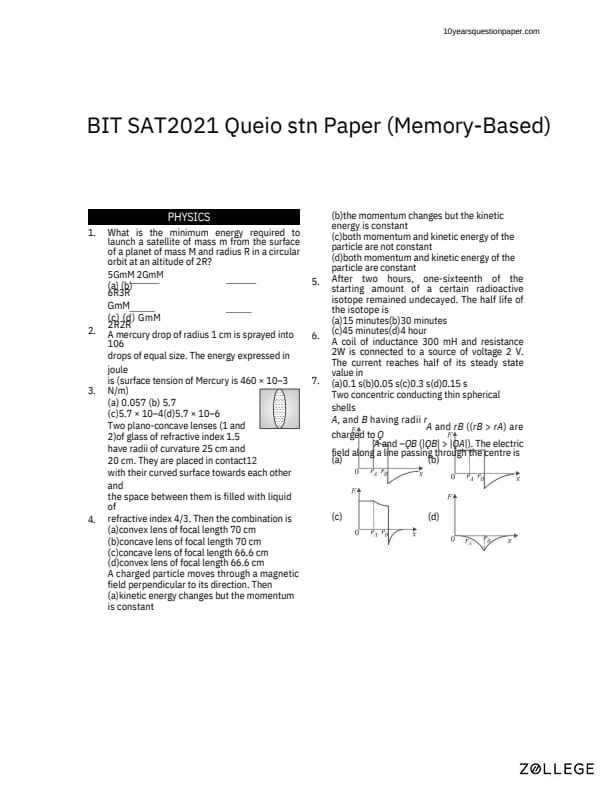
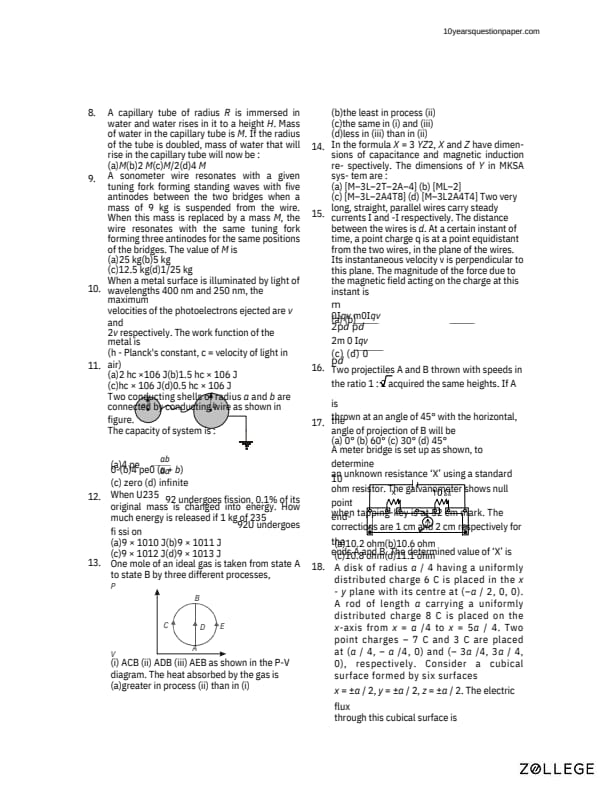
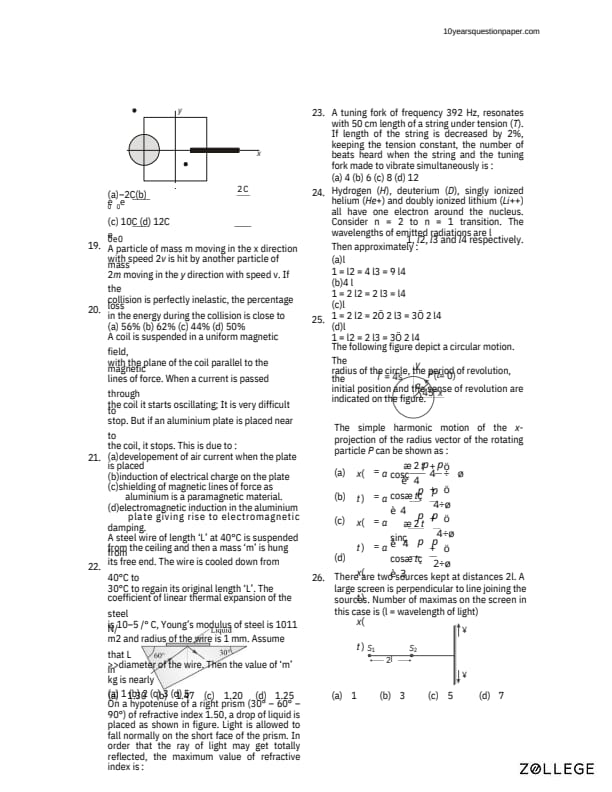
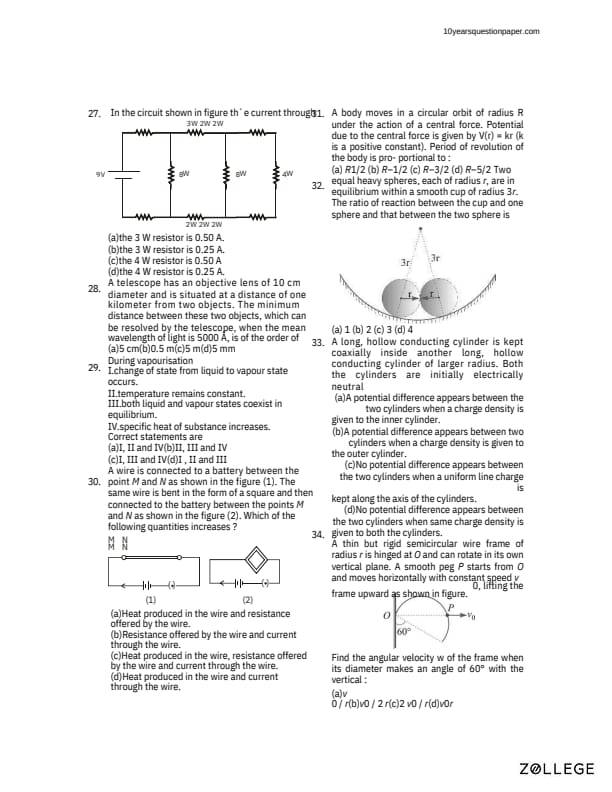
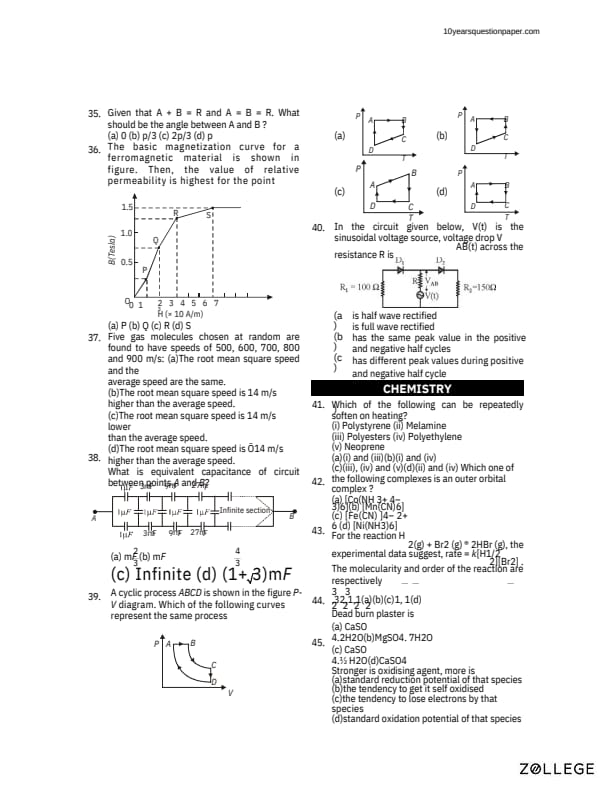
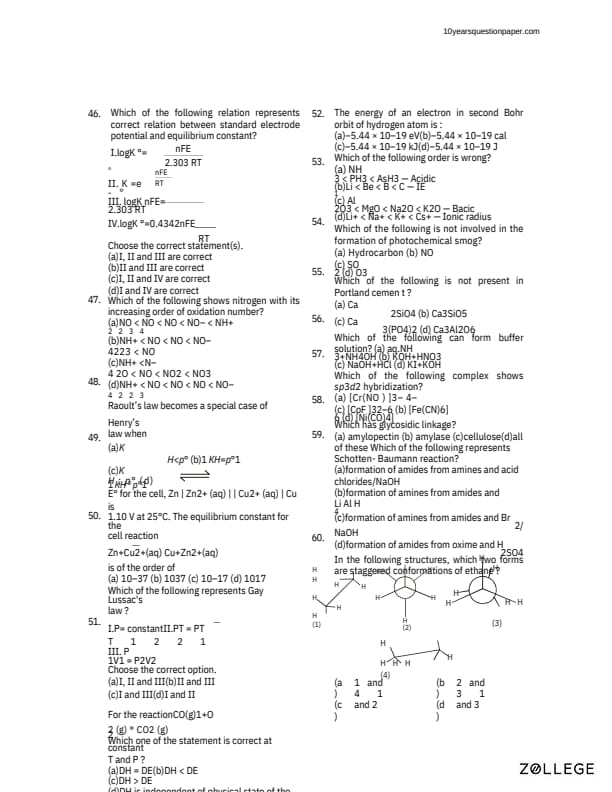
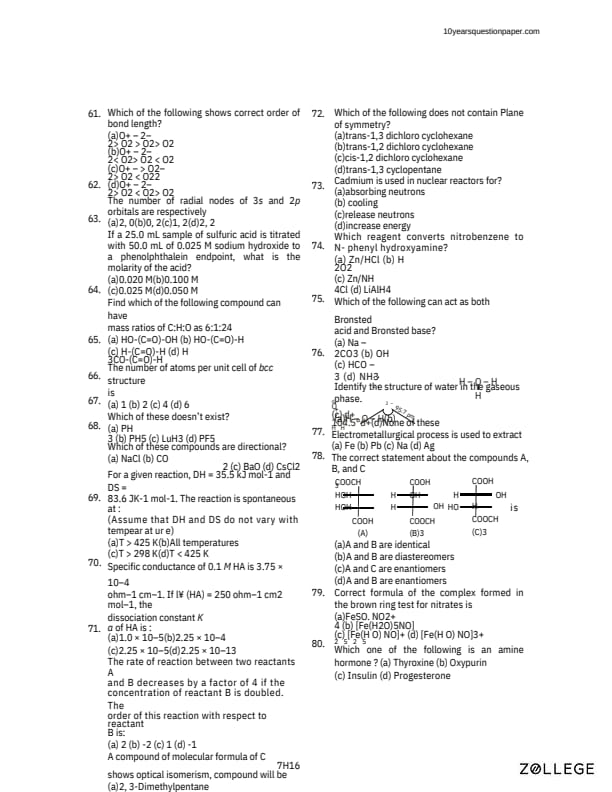
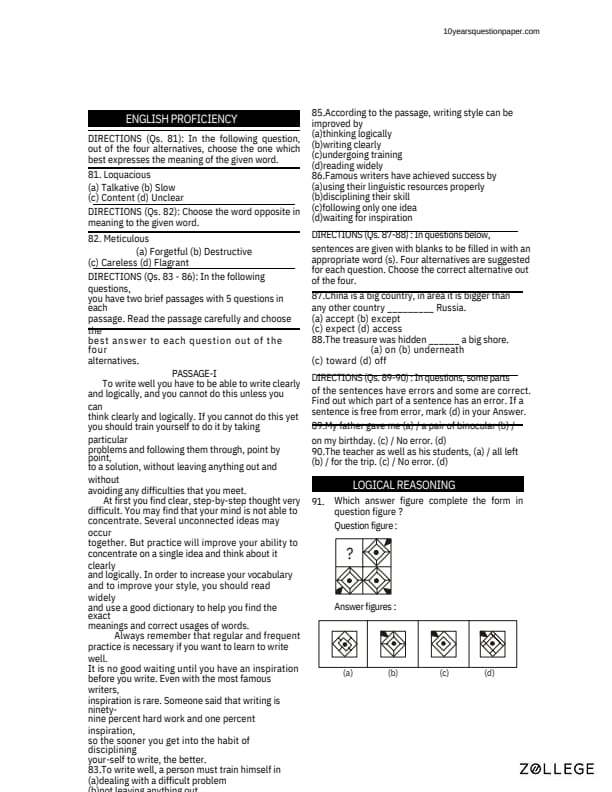
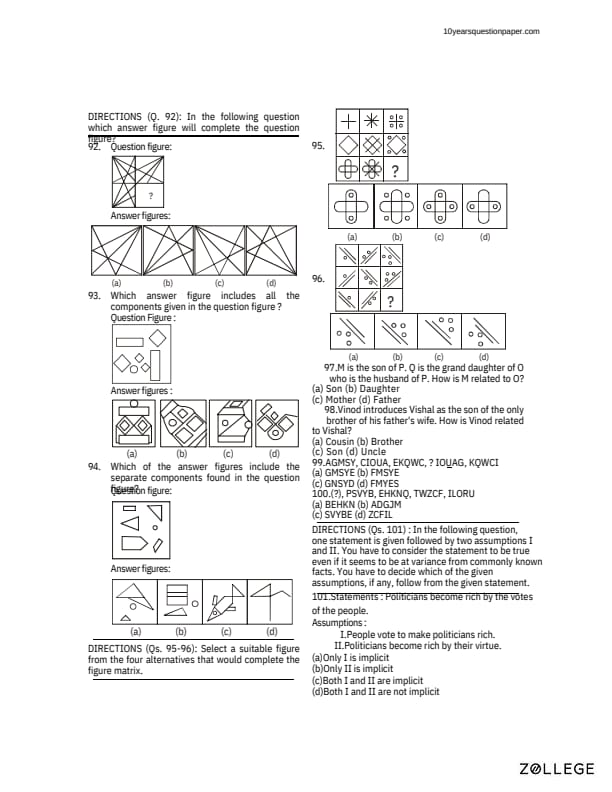
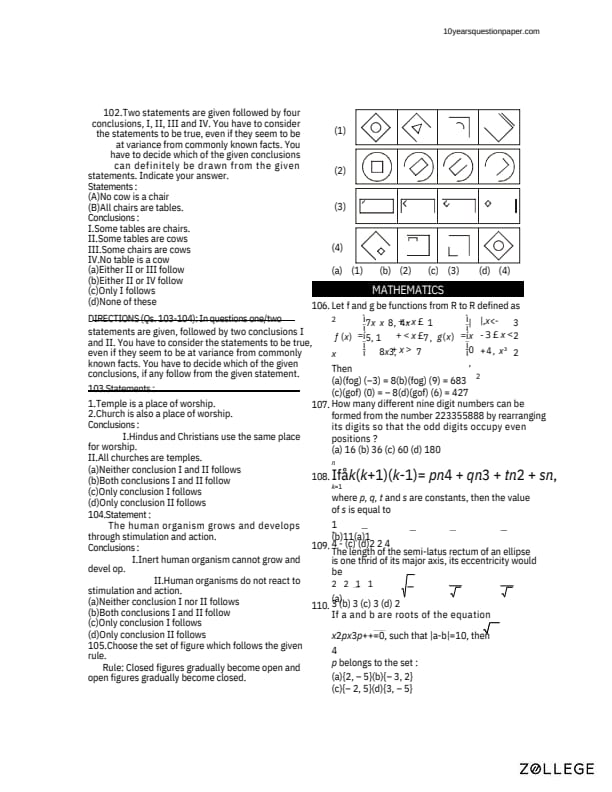
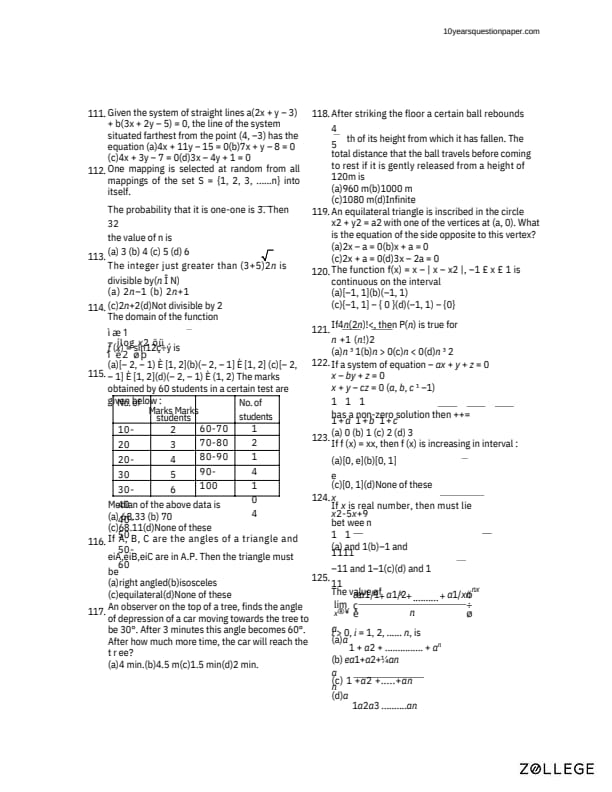
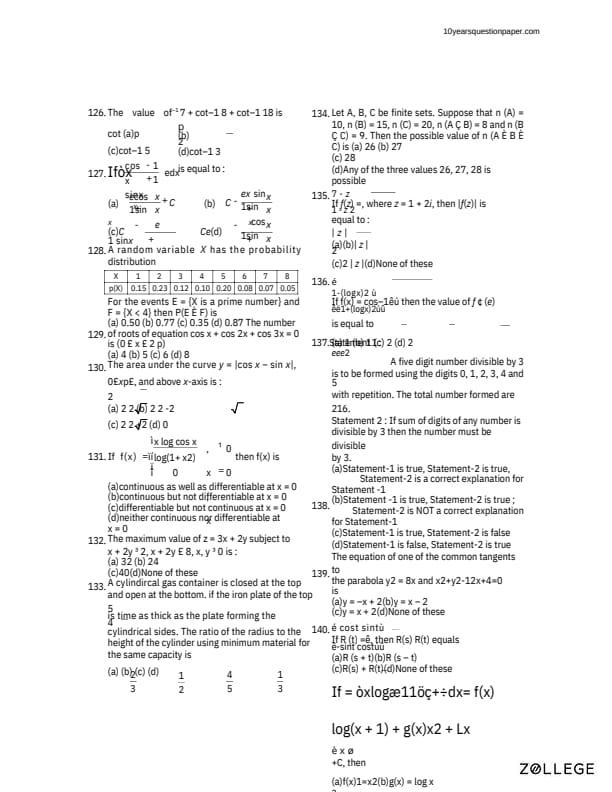
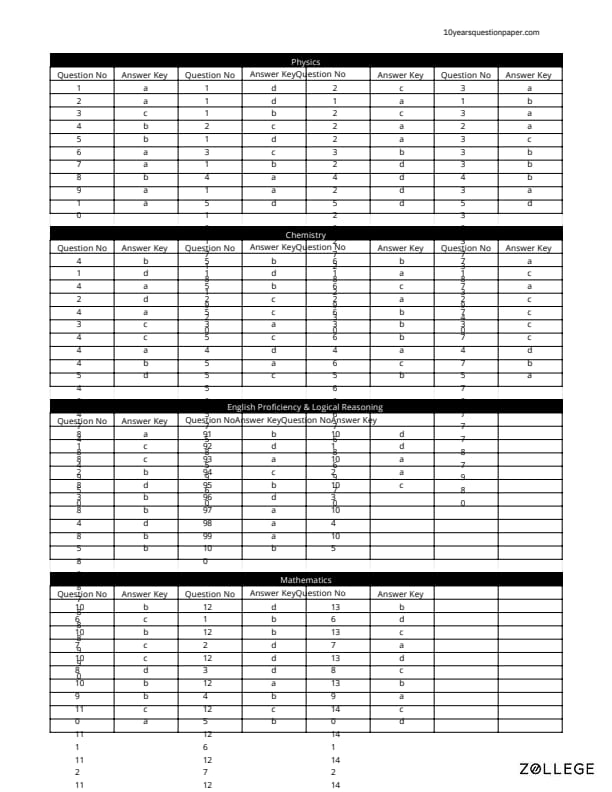
*The article might have information for the previous academic years, please refer the official website of the exam.