15 April 2026: BITSAT 2026 Session 1 Slot-Wise Question Papers Available. Download Here

BITSAT Physics Syllabus 2026: Syllabus PDF Download, Chapter-Wise Topics & Preparation Guide


Content Writer | Updated On - Apr 15, 2026
What's New In BITSAT 2026?
BITSAT 2026 Physics syllabus has been officially released by BITS Pilani and is available on the official admissions portal of BITS Pilani.
-
The BITSAT physics syllabus 2026 is primarily based on the NCERT curriculum of Classes 11 and 12, with no changes announced for 2026 compared to 2025.
- The physics section of the BITSAT syllabus carries 30 questions with 90 marks.
- BITSAT Physics tests a candidate’s conceptual understanding, numerical problem-solving, and application-based questions.
- BITSAT 2025 saw the Physics section to be moderately challenging due to a shift from usual numerical-based questions to theory-based, conceptual questions. The section was more time-consuming compared to other sections.
- Some high-weightage topics from the BITSAT Physics syllabus 2026 are Modern Physics, Electrostatics, Current Electricity, and Heat & Thermodynamics.
Related Articles:
BITSAT Physics Syllabus 2026: Chapter-Wise Topics
Chapter-wise important Physics topics for BITSAT 2026 are given in the table below:
| Chapters | Key Topics |
|---|---|
| Units & Measurement | Systems of units Precision and significant figures Fundamental measurements (Vernier calipers, screw gauge, Physical balance etc.) |
| Kinematics | Properties of vectors Projectile motion Uniform circular motion |
| Newton's Laws of Motion | Newton's laws (free body diagram, resolution of forces) Motion on inclined plane Blocks with pulley systems Circular motion |
| Impulse & Momentum | Definition of impulse & momentum Conservation of momentum Collisions Momentum of system of particles |
| Work and Energy | Work done by force Kinetic energy & work-energy theorem Power |
| Rotational Motion | Angular displacement |
| Gravitation | Newton's law of gravitation Gravitational potential energy Escape velocity Kepler's laws |
| Mechanics of Solids and Fluids | Elasticity Archimedes’ principle Viscosity & Surface Tension Bernoulli’s theorem |
| Oscillations | Kinematics of SHM |
| Waves | Progressive sinusoidal waves Standing waves in strings & pipes Superposition of waves Doppler Effect |
| Heat and Thermodynamics | Kinetic theory of gases Thermal equilibrium & temperature Specific heat, Heat Transfer Work, heat & 1st law, 2nd law, Carnot engine |
| Electrostatics | Coulomb’s law Electric field Electrostatic potential & PE Gauss’ law & applications |
| Current Electricity | Ohm’s law Joule heating DC circuits Electrical Resistance |
| Magnetic Effect of Current | Biot-Savart’s law Ampere’s law Lorentz force on current-carrying conductors Magnetic moment of current loop |
| Electromagnetic Induction | Faraday’s lawLenz’s laweddy currents Self & mutual inductance Transformers & generators, AC circuits |
| Optics | Laws of reflection & refraction Lenses & mirrors Optical instruments Interference and EM waves & spectrum |
| Modern Physics | Dual nature Atomic models Hydrogen spectrum Radioactivity Nuclear reactions |
| Electronic Devices | Energy bands in solids Semiconductor diode Junction transistor Logic gates |
A Reddit user talks about deleted JEE Physics topics (highlighted in pink) which still feature in the BITSAT 2026 Physics Syllabus. The post breaks the myth for candidates relying heavily on the JEE syllabus for BITSAT preparation.
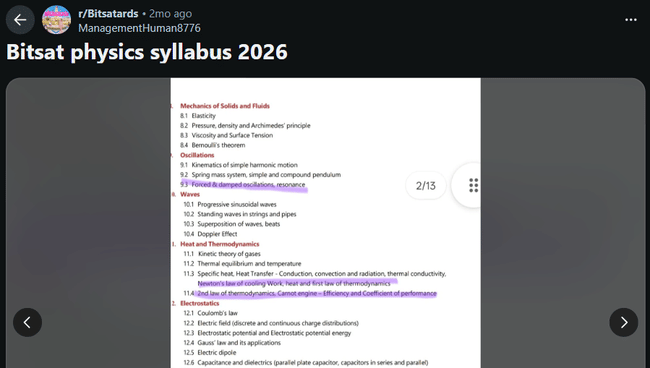
Source: Reddit
Also Check:
Ques: Does BITSAT have Physics?
Ans. Yes. The BITSAT exam has a dedicated Physics section, which usually carries 30 questions. According to the previous year's trend, questions were mostly theory-based, with a mix of numericals.
BITSAT Physics Syllabus 2026: Chapter-wise Weightage
Some Physics high-weightage topics for BITSAT 2026, based on recent syllabus trends and expert analyses, are given in the table below:
| Topics | Expected Weightage |
|---|---|
| Current Electricity and Electrostatics | 18% |
| Waves, Optics and SHM | 13-17% |
| Modern Physics | 10-12% |
| Heat and Thermodynamics | 8-10% |
| Magnetism and EMI | 8-10% |
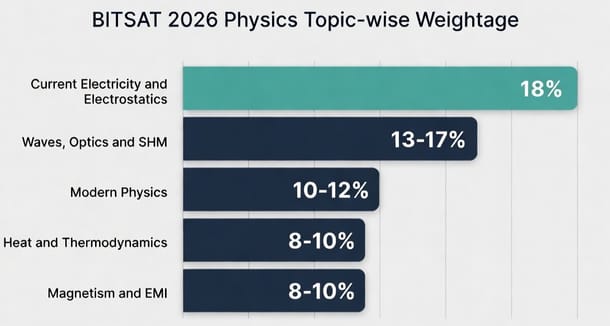
Source: YouTube
Preparation Strategy and Tips for BITSAT 2026 Physics
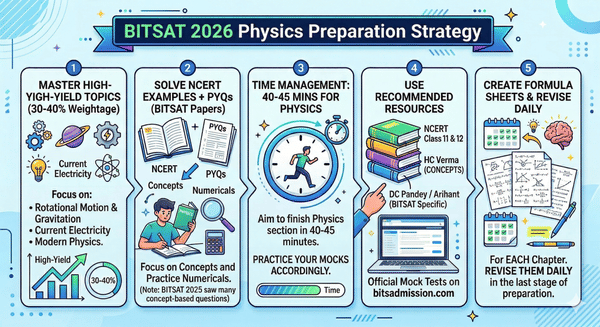
- Master high-yield topics such as Rotational Motion & Gravitation, Current Electricity, and Modern Physics, since these topics have a weightage of roughly 30-40%.
- Solve NCERT examples + previous years’ BITSAT papers. Focus on concepts and practice numericals since BITSAT 2025 saw many concepts based questions.
- Aim to finish Physics in 40-45 minutes during the exam, and practice your mocks accordingly.
- Use NCERT textbooks (Class 11 & 12), HC Verma for concepts, DC Pandey or Arihant BITSAT-specific books, and official mock tests on bitsadmission.com.
- Create formula sheets for each chapter and revise them daily in the last stage of your preparation.
Read More:
Is BITSAT Physics Easier than NEET Physics?
The Physics section of BITSAT exam is considered slightly easier than NEET Physics due to the NEET’s lengthy calculations and tricky numericals. However, both exams need a thorough understanding of various Physics topics and better time management.
Here is a detailed comparison of the Physics sections of BITSAT and NEET exams for a better understanding of this debate:
| Parameter | BITSAT Physics (30 questions) | NEET Physics (45–50 questions) | Which is Easier? |
|---|---|---|---|
| Difficulty Level | Easy to Moderate (mostly NCERT + slight application) | Moderate to Difficult (many lengthy & calculation-heavy) | BITSAT |
| Conceptual Depth | Moderate (concept + formula based) | Higher (more reasoning + multi-step) | BITSAT |
| Calculation Intensity | Lower (quicker numericals) | Higher; time-consuming calculations | BITSAT |
| Time Pressure | High speed needed (30 Qs in ~40-45 min ideal) but overall exam is flexible | Very high (45 Qs in ~1 hour, often feels rushed) | NEET feels harder |
| Question Type | More direct application, some tricky but solvable quickly | More indirect, assertion-reason style, graph-based | BITSAT |
| Syllabus Overlap | Almost identical (NCERT 11+12) | Almost identical | Tie |
| High-Weightage Topics | Thermodynamics, Magnetic Effect, Electrostatics, Current Electricity, Modern Physics, Rotational Motion, Waves, Optics | Current Electricity, Ray Optics, Electrostatics, Magnetism, Modern Physics, Mechanics | - |
| Scoring Potential | Easier to score, 70-80 marks with good practice | Harder to score above 120–140/180 | BITSAT |
Read More:
BITSAT Physics Syllabus 2026 FAQs
Ques: How to download the official BITSAT Physics syllabus PDF?
Ans: Candidates can download the official BITSAT 2026 Physics syllabus PDF by following the below steps:
- Visit official BITSAT 2026 website @admissions.bits-pilani.ac.in/BITSAT_LP/index.html
- Click on “Download the Brochure”
- Then scroll down and click on the “BITSAT Syllabus” button to download the PDF.
Ques: Should I read NCERT only or extra books for BITSAT Physics syllabus?
Ans: NCERT is mandatory (examples + exercises) for the BITSAT Physics section. However, for better depth and conceptual understanding, candidates can follow the below given books:
- HC Verma for concepts
- DC Pandey / Arihant BITSAT books for practice
Many students say NCERT + previous year BITSAT papers are sufficient for 20+ marks.
Nonetheless, extra books help with better speed and application.
Ques: Is the BITSAT Physics syllabus 2026 different from 2025?
Ans: No. The BITSAT Physics syllabus 2026 is the same as that of the Physics syllabus for 2025. Unlike JEE Main 2025 syllabus, there is no deletion or addition of any topics in BITSAT 2026 syllabus for Physics.
Ques: Which topics are in BITSAT Physics but deleted from JEE Mains 2026?
Ans: JEE Main syllabus for 2025 saw many reductions in the Physics syllabus and JEE Main 2026 syllabus remained unchanged from 2025, featuring some deleted Physics topics which still appear in BITSAT 2026 as mentioned below:
- Newton’s Law of Cooling
- Carnot Engine
- Doppler Effect in Sound
- Junction Transistor, Transistor as an Amplifier
- Electromagnetic Waves
*The article might have information for the previous academic years, please refer the official website of the exam.
Ask your question
Answered Questions
a
ZT
The Fee for the B.Tech Computer Science and Engineering at VIT University is INR 1.73 Lakhs with an INR 3k caution deposit which is refundable and a One-time payment only.
...Show More
a
R
To get admission to most undergraduate courses at CSJMU, you must have a CUET-UG score or merit in the last qualifying exam.
...Show More
a
R
Pandit Ravishankar Shukla University (PRSU) in Raipur, Chhattisgarh, India conducts admission processes for undergraduate programs based on merit and entrance exams.
For undergraduate programs, candidates must submit the scores of the last qualifying exams from their previous education. The selection process may also include a Common Entrance Test (CET) or Merit Basis in the 10+2 examination or equivalent.
Candidates can apply to PRSU online or offline. Some documents that may be required for application include:
- Declaration as stated in the application form, duly supported by an Affidavit on Rs. 10/- stamp paper attested by Notary
- Curriculum vitae (in MS Word or PDF)
- Motivation letter (in MS Word or PDF)
- Copy of academic documents (all levels, scanned)
- Copy of IELTS certificate/other English language proficiency test results (scanned if required)
PRSU also conducts entrance exams for admission to PG and integrated courses. For admission to MBA courses, PRSU accepts valid scores of CMAT/ MAT/ CAT/ XAT/ ATMA entrance exams.
...Show More


