15 April 2026: BITSAT 2026 Session 1 Slot-Wise Question Papers Available. Download Here

BITSAT Syllabus 2026: Subject-Wise Syllabus, Official Syllabus PDF Download, Best Resources


Content Writer | Updated On - Apr 15, 2026
What's New In BITSAT 2026?
BITS Pilani has released the official BITSAT 2026 Syllabus on its official website.
- According to the BITSAT syllabus 2026, there will be 4 sections in the exam, namely Physics, Chemistry, Mathematics & Biology and English & LR.
- There is no change in the syllabus for BITSAT 2026 compared to 2025.
- The syllabus still relies heavily on Class 11 and 12 NCERT books, nearly 90-95% for Physics, Maths, Biology and Chemistry though candidates will need reference resources for English and LR preparation.
Candidates can download the PDF for official BITSAT Syllabus 2026 through the below given link:
Table of Contents
- BITSAT 2026 Subject-Wise Syllabus PDFs
- Official BITSAT 2026 Syllabus
2.1 BITSAT Physics Syllabus 2026
2.2 BITSAT Chemistry Syllabus 2026
2.3 Chemistry Topic-Wise Weightage
2.4 BITSAT English Proficiency Syllabus 2026
2.5 BITSAT Logical Reasoning Syllabus 2026
2.6 BITSAT Mathematics Syllabus 2026
2.7 BITSAT Biology Syllabus 2026
- BITSAT 2026 Exam Pattern & Marking Scheme
- BITSAT 2026 Last 20 Days Strategy
- NCERT vs Reference Books: What Really Works for BITSAT?
- BITSAT 2026 Syllabus FAQs
BITSAT 2026 Subject-Wise Syllabus PDFs
Given below are detailed and subject-wise syllabus PDFs for BITSAT 2026:
Official BITSAT 2026 Syllabus
As per the official BITSAT Syllabus 2026, there is no change in the syllabus and syllabus is still based on NCERT.
Given below are subject-wise syllabus for the BISAT 2026 exam:
BITSAT Physics Syllabus 2026
| Chapters | Key Topics |
|---|---|
| Units & Measurement | Systems of units Precision and significant figures Fundamental measurements (Vernier calipers, screw gauge, Physical balance etc.) |
| Kinematics | Properties of vectors Projectile motion Uniform circular motion |
| Newton's Laws of Motion | Newton's laws (free body diagram, resolution of forces) Motion on inclined plane Blocks with pulley systems Circular motion |
| Impulse & Momentum | Definition of impulse & momentum Conservation of momentum Collisions Momentum of system of particles |
| Work and Energy | Work done by force Kinetic energy & work-energy theorem Power |
| Rotational Motion | Angular displacement velocity Constant angular acceleration Moment of inertia Torque & angular momentum |
| Gravitation | Newton's law of gravitation Gravitational potential energy Escape velocity Kepler's laws |
| Mechanics of Solids and Fluids | Elasticity Archimedes’ principle Viscosity & Surface Tension Bernoulli’s theorem |
| Oscillations | Kinematics of SHM Spring-mass system simple & compound pendulum Forced & damped oscillations |
| Waves | Progressive sinusoidal waves Standing waves in strings & pipes Superposition of waves Doppler Effect |
| Heat and Thermodynamics | Kinetic theory of gases Thermal equilibrium & temperature Specific heat, Heat Transfer Work, heat & 1st law, 2nd law, Carnot engine |
| Electrostatics | Coulomb’s law Electric field Electrostatic potential & PE Gauss’ law & applications |
| Current Electricity | Ohm’s law Joule heating DC circuits Electrical Resistance |
| Magnetic Effect of Current | Biot-Savart’s law Ampere’s law Lorentz force on current-carrying conductors Magnetic moment of current loop |
| Electromagnetic Induction | Faraday’s law Lenz’s law eddy currents Self & mutual inductance Transformers & generators, AC circuits |
| Optics | Laws of reflection & refraction Lenses & mirrors Optical instruments Interference and EM waves & spectrum |
| Modern Physics | Dual nature Atomic models Hydrogen spectrum Radioactivity Nuclear reactions |
| Electronic Devices | Energy bands in solids Semiconductor diode Junction transistor Logic gates |
BITSAT Chemistry Syllabus 2026
| Chapter | Key Topics |
|---|---|
| 1. States of Matter | Measurement Chemical reactions & stoichiometry Three States of matter |
| 2. Atomic Structure | Subatomic particles Thomson & Rutherford models Bohr model & limitations Quantum mechanics, Hund’s rule |
| 3. Periodicity and Bonding | Periodic table trend Ionic & covalent bonds Dipole moments Hydrogen bond |
| 4. Thermodynamics | Systems state functions 1st law (ΔU, ΔH, Hess’s law), 2nd law and 3rd law |
| 5. Physical and Chemical Equilibria | Concentration units Solutions, Chemical equilibrium, Ionic equilibria (pH, buffers, solubility product) |
| 6. Electrochemistry | Redox reactions electrode potentials Nernst equation EMF and Faraday’s laws |
| 7. Chemical Kinetics | Rate, order, molecularity Integrated rate laws Collision theory Surface chemistry |
| 8. Hydrogen and s-block elements | Hydrogen Alkali & alkaline earth metals |
| 9. p-, d- and f-block elements | Group 13–18 trends & compounds d-block and f-block, Coordination compounds |
| 10. Principles of Organic Chemistry and Hydrocarbons | Classification & nomenclature reaction types Alkanes, alkenes, alkynes aromatic hydrocarbons Haloalkanes & haloarenes |
| 11. Stereochemistry | Conformations (ethane) Geometrical isomerism |
| 12. Organic Compounds with Functional Groups (O & N) | Alcohols, phenols, ethers, aldehydes, carboxylic acids, nitro compounds Reactivity of α-hydrogen |
| 13. Biological, Industrial and Environmental chemistry | Carbohydrates, proteins, nucleic acids, vitamins, polymers Pollution Chemicals in medicine & food |
| 14. Theoretical Principles of Experimental Chemistry | Volumetric & qualitative analysis Physical chemistry experiments Purification methods Organic qualitative analysis |
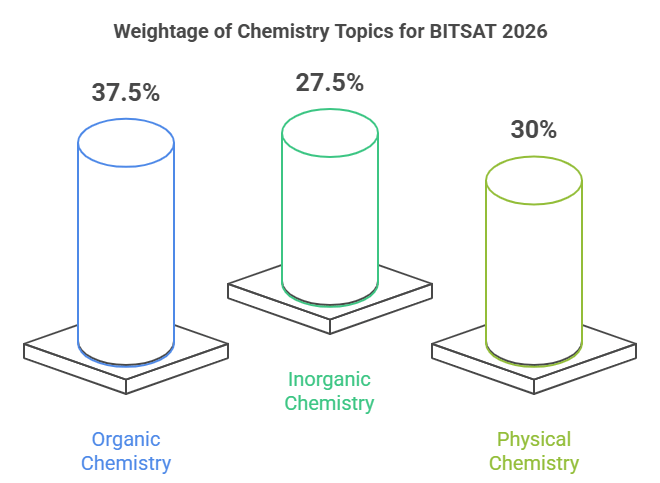
Chemistry Topic-Wise Weightage
| Topics | Weightage |
|---|---|
| Organic Chemistry | 35-40% |
| Inorganic Chemistry | 25-30% |
| Physical Chemistry | 30% |
Source: YouTube
BITSAT English Proficiency Syllabus 2026
| Topics | Key Ttopics |
|---|---|
| Grammar | Determiners Prepositions Modals Adjectives Relative Pronouns Agreement Time and Tense |
| Vocabulary | Odd Word One Word Spelling & Word Formation Homophones Contextual Meanings of Vocabulary Synonyms & Antonyms. |
| Reading Comprehension | Content/Ideas Vocabulary (Metaphors and Similes; Select Cloze) Summary Jigsaw Reading |
| Composition | Rearrangement Paragraph & Unity (Identifying the Correct Topic Sentence;) Linkers/Connectives. |
BITSAT Logical Reasoning Syllabus 2026
| Topics | Key Topics |
|---|---|
| Verbal Reasoning | Analogy Classification Series Completion Logical Deduction Reading Passage |
| Non-Verbal Reasoning | Pattern Perception Figure Formation and Analysis Paper Cutting Figure Matrix. |
BITSAT Mathematics Syllabus 2026
| Topics | Subtopics |
|---|---|
| Algebra | Complex Numbers Quadratic Equations Progressions Logarithms Exponential Series Permutations & Combinations |
| Trigonometry | Measurement of Angles Trigonometric Equations Inverse Trigonometric Functions |
| 2D Coordinate Geometry | Cartesian Coordinates Straight Lines Circles Conic Sections |
| 3D Coordinate Geometry | Coordinate Axes and Planes direction cosines Angle Between Lines Planes |
| Differential Calculus | Domain and Range of Functions Derivatives of Functions Increasing/Decreasing Functions Rolle’s Theorem & MVT. |
| Integral Calculus | Indefinite Integrals Methods of Integration Definite Integrals areas under curves |
| Ordinary Differential Equations | Order and Degree Homogeneous Differential Equations Linear First-Order Differential Equations |
| Probability | Terminology and Approaches Conditional Probability Independent Events Discrete Random Variables |
| Vectors | Vector Operations Dot and Cross Products Scalar Triple Product |
| Statistics | Measures of Dispersion Frequency Distributions |
| Linear Programming | Formulation of Linear Programming Problems Solution Using Graphical Method |
| Mathematical Modeling | Applying mathematics to real-world problems. |
BITSAT Biology Syllabus 2026
| Topics | Key Topics |
|---|---|
| Diversity in Living World | Meaning of Biology System of nomenclature Two-kingdom system Five-kingdom system Plant kingdom Animal kingdom |
| Cell | Cell wall Cell membrane Endomembrane system Mitochondria Plastids Ribosomes Cilia and Flagella, |
| Genetics and Evolution | Mendelian inheritance Chromosome theory of inheritance Gene interaction Multiple alleles Linkage and Crossing over blood groups in humans & DNA modern Darwinism |
| Structure and Function – Plant | Morphology of a flowering plant Tissues & tissue systems in plants Anatomy and function of root Types of fruit Absorption and movement of water and of nutrients Mineral nutrition, Photosynthesis, Respiration |
| Structure and Function - Animals | Human Physiology Respiratory system Body fluids and circulation Excretion system Locomotion & movement Control and co-ordination endocrine glands |
| Reproduction, Growth & Movement in Plants | Asexual methods of reproduction Sexual Reproduction Growth & Movement Apical dominance |
| Reproduction and Development in Humans | Male and female reproductive systems Menstrual cycle Fertilisation Implantation & Embryo Pregnancy and parturition Birth control and contraception |
| Ecology and Environment | Ecology terms Ecological levels of organization Characteristics of Species Population and Ecosystem Biodiversity and Environmental Issues |
| Biology and Human Welfare | Animal husbandry Major animal diseases Human pathogens & diseases Adolescence, drug/alcohol abuse Immunology Plant Breeding |
| Biotechnology and its Application | Microbes in biotechnology Microbial technology Recombinant DNA Insulin, vaccines, gene therapy, GM crops |
Ques: What are the high weightage topics for BITSAT 2026?
Ans: Some of the most important topics having high weightages for BITSAT 2026 exam are given in the table below:
| Subjects | Important Topics |
|---|---|
| Mathematics | Calculus, Coordinate Geometry, and Vectors |
| Physics | Heat & Thermodynamics, Magnetic Effects, and Modern Physics |
| Chemistry | Organic Chemistry, Chemical Bonding, and Equilibrium |
| Logical Reasoning & English | Verbal reasoning, Analogy, Puzzles, Reading comprehension, Vocabulary, Sentence correction |
BITSAT 2026 Exam Pattern & Marking Scheme
BITSAT 2026, scheduled to be held from April 15 to April 16, 2026(session 1), will consist of 130 questions in MCQ form.
- BITSAT 2026 will be conducted in online form across 73 centers in India and abroad.
- Students can appear for both the sessions of the exam, in such a case, best marks out of both sessions will be considered.
- Each correct question will award 3 marks while one incorrect answer will deduct 1 mark.
- The duration of the exam will be 3 hours, giving students roughly 1.38 minutes per question.
- Candidates who complete 130 questions before the stipulated time can attempt bonus 12 questions.
Subject-wise distribution of questions for BITSAT exam is given in the table below:
| Subject | Number of Questions |
|---|---|
| Physics | 30 |
| Chemistry | 30 |
| English Proficiency & Logical Reasoning | 30 |
| Mathematics (for B.E./M.Sc.) OR Biology (for B.Pharm) | 40 |
| Total | 130 |
BITSAT 2026 Last 20 Days Strategy
With BITSAT 2026 session 1 is just several days away, a candidate needs a dedicated and efficient strategy to polish their preparation. A dedicated preparation plan to score 280 to 310+ marks is given in the table below:
| Phase | Time Period | Daily Schedule | Goals & Mock Targets | Activities & Resources |
|---|---|---|---|---|
| Intensive Coverage + Speed Build | 26 Mar – 5 Apr | - Morning (2.5-3 hrs): Full mock every alternate day OR timed sectional (Physics/Chemistry/Math) | Finish weak topics Mock Avg: 220 → 280+ by 5 Apr | - Revise NCERT (Physics + Chemistry core) - High-weightage topic focus - Solve 4-6 past BITSAT papers (Arihant/MTG) - Daily 20-30 Reasoning + Vocab/Grammar |
| Accuracy + Stamina | 6 Apr – 12 Apr | - Morning (3 hrs): 1 Full Mock daily - Afternoon (2-3 hrs): Deep mock analysis (classify errors: concept/silly/calculation/time) - Evening (2-3 hrs): Targeted revision (only weak areas + formulas) - Night (30 min): English/LR practice | Build consistency under time pressure Mock Avg: 280 → 310+ | - Use Embibe / MathonGo / Arihant full mocks - Master 10-15 page formula sheet - Fixed attempt order: Chem → Phys → Math → Eng/LR - Keep 10-15 min for review |
| Final Polish + Rest | 13 Apr – 14 Apr | - 13 Apr: 1 light mock + quick revision (max 4-5 hrs) - 14 Apr: Very light revision only (2-3 hrs) – formulas, short notes, previous errors - Relax, 8+ hrs sleep, light walk & proper food | Relax & avoid burnout | - No new topics - Revise error bank + high-weightage recurring questions |
Subject-wise targets for BITSAT 2026 are given in the table below:
| Subject | High-Impact Focus Topics | Speed Tip | Target Marks |
|---|---|---|---|
| Physics | Mechanics, Electrostatics/Current, Thermo, Modern | Formula + quick numericals | 75-90 |
| Chemistry | Organic, p-block/Coord, Equilibrium/Kinetics | NCERT lines + exceptions memorize | 80-90 |
| Math | Algebra, Calculus, Vectors/3D, Coordinate | 40 Q in 60-70 min consistent practice | 100-120 |
| English + LR | Vocab: Synonyms/Antonyms, Grammar, Comprehension + Series/Analogy/Puzzles | Daily timed 20-25 min practice | 25-28 |
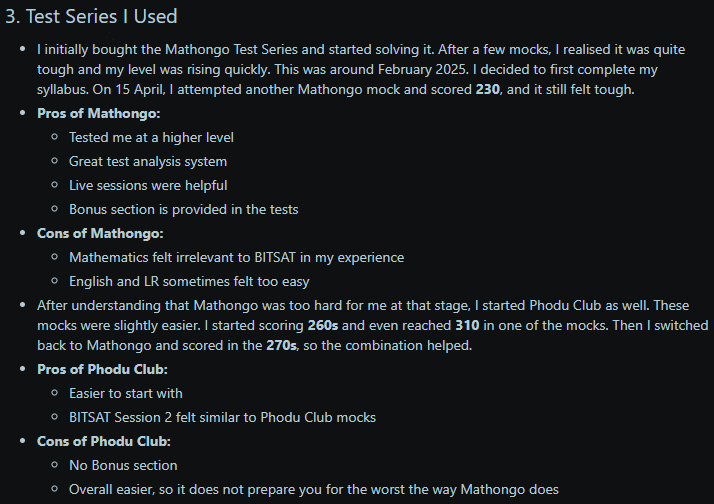
A user in a Reddit Post talks about how attempting mocks is important for the BITSAT exam and what are the pros and cons of the popular BITSAT mock series such as Mathongo and Phodu Club and how they improved their scores gradually.
The user also talks about what not to do while preparing for BITSAT, saying “Do not think of BITSAT as an escape from JEE or as a backup so soon. Do not switch resources unnecessarily. After two years of prep, you already know what pace and teaching style suits you.”
Source: Reddit
Ques: Is scoring 300 marks in BITSAT easy?
Ans: No. Scoring 300 marks in BITSAT is not easy and needs a dedicated study plan which covers all the important topics in time and includes ample practice to polish the preparation. You can watch this video by Phodu Club for a strategy to score 300+ marks in BIITSAT 2026.
NCERT vs Reference Books: What Really Works for BITSAT?
As reported by several users across the platforms such as Reddit and Quora and expert videos on YouTube, NCERT is non-negotiable for BITSAT exam preparation.
- NCERT is enough to cover 70% to 80% of the BITSAT exam.
- However, reference books and mock tests are needed if candidates want to score 300+ marks.
- Reference books such as Arihant/MTG, D.C. Pandey (Arihant), H.C. Verma, O.P. Tandon is generally recommended.
- Users also report that NCERT alone is enough for Chemistry, with 85-90% of questions being direct or come with slight twists.
| Score Range | Strategy Used | % of Students (Community Reports) | Key Insight |
|---|---|---|---|
| 320-380+ | NCERT (thorough) + 1 BITSAT-specific guide (Arihant/MTG) + 60-80 mocks | ~65% of 300+ scorers | “NCERT line-by-line + Arihant BITSAT book = game changer” (multiple Reddit toppers) |
| 280-320 | NCERT + Exemplar + some JEE PYQs | ~25% | Good for safe admission but not top branches |
| Below 280 | Only NCERT / incomplete reference books | - | “NCERT alone is not enough for speed in Maths/Physics” |
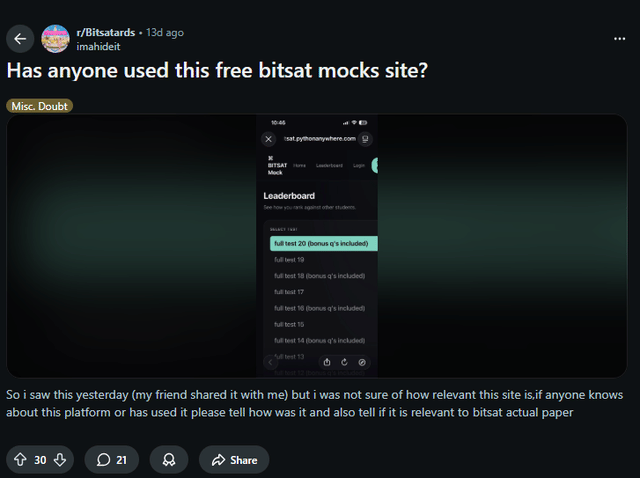
A Reddit user talks about a website providing free mock tests. The website namely bitsat.pythonanywhere.com has 20 free mock tests which one can attempt without logging in.
Source: Reddit
BITSAT 2026 Syllabus FAQs
Ques: Which JEE deleted topics still appear in BITSAT 2026?
Ans: NTA deleted several topics from JEE Main in 2024 but they still appear in BITSAT 2026 syllabus and ignoring them can result in deduction of 20-30 marks as reported by Reddit users.
Subject-wise JEE deleted topics which still appear in BITSAT 2026 syllabus is given in the table below:
| Subjects | Deleted JEE Topics Appearing in BITSAT |
|---|---|
| Physics | Newton’s Law of Cooling Carnot Engine Doppler Effect in Sound Transistor as a Switch Electromagnetic Waves |
| Chemistry | Environmental Chemistry Polymers Chemistry in Everyday Life s-Block Elements Surface Chemistry States of Matter |
| Mathematics | Mathematical Reasoning Linear Programming Mathematical Induction Triangle Inequality |
Ques: Has BITSAT 2026 syllabus changed from 2025 or any reductions announced?
Ans: No. According to the official BITSAT syllabus PDF, there is no change in the exam’s syllabus for 2026 when compared with 2025’s syllabus.
Ques: Who is eligible for BITSAT 2026?
Ans: A candidate who has passed their 10+2 with minimum 75% marks in PCM or PCB and a minimum of 60% marks in each subject is eligible for BITSAT 2026. Additionally, there is no age limit for appearing in BITSAT 2026 and the students who passed or appeared in their 12th class in the current academic year and who passed their 12th class in the previous academic year are only eligible.
Ques: What are the best resources for BITSAT preparation?
Ans: According to several Reddit users, here are some top resources which can help in the BITSAT exam preparation
- Arihant BITSAT Guide
- NCERT and JEE Standard Books
- MathonGo
- Eduniti
- Pankaj Sir’s Lectures
- Allen and Embibe test series
*The article might have information for the previous academic years, please refer the official website of the exam.
Ask your question
Answered Questions
a
ZT
The Fee for the B.Tech Computer Science and Engineering at VIT University is INR 1.73 Lakhs with an INR 3k caution deposit which is refundable and a One-time payment only.
...Show More
a
R
To get admission to most undergraduate courses at CSJMU, you must have a CUET-UG score or merit in the last qualifying exam.
...Show More
a
R
Pandit Ravishankar Shukla University (PRSU) in Raipur, Chhattisgarh, India conducts admission processes for undergraduate programs based on merit and entrance exams.
For undergraduate programs, candidates must submit the scores of the last qualifying exams from their previous education. The selection process may also include a Common Entrance Test (CET) or Merit Basis in the 10+2 examination or equivalent.
Candidates can apply to PRSU online or offline. Some documents that may be required for application include:
- Declaration as stated in the application form, duly supported by an Affidavit on Rs. 10/- stamp paper attested by Notary
- Curriculum vitae (in MS Word or PDF)
- Motivation letter (in MS Word or PDF)
- Copy of academic documents (all levels, scanned)
- Copy of IELTS certificate/other English language proficiency test results (scanned if required)
PRSU also conducts entrance exams for admission to PG and integrated courses. For admission to MBA courses, PRSU accepts valid scores of CMAT/ MAT/ CAT/ XAT/ ATMA entrance exams.
...Show More


