15 April 2026: BITSAT 2026 Session 1 Slot-Wise Question Papers Available. Download Here

BITSAT Mathematics Syllabus 2026: High-Weightage Topics, Best Books and Preparation Tips


Content Writer | Updated On - Apr 15, 2026
What's New In BITSAT 2026?
If you are aiming to get into BITS Pilani or any BITS campus for engineering, you know Mathematics is a huge part of the BITSAT Exam. BITSAT Mathematics Syllabus 2026 will be soon published by BITS Pilani in its official BITSAT 2026 Brochure.
- This year no major changes are expected. You can check previous years’ BITSAT syllabus for now to prepare for BITSAT 2026.
- The BITSAT Mathematics Syllabus 2026 is structured in line with the Class 11 and 12 NCERT curriculum.
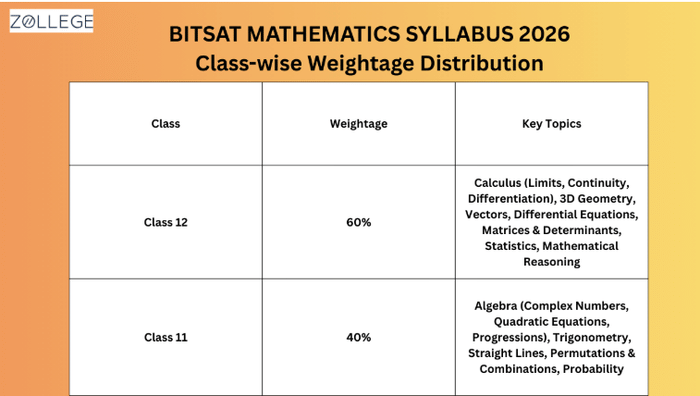
- The BITSAT Maths syllabus carries 40% weightage from Class 11 and 60% weightage from Class 12 topics.
- The important topics of BITSAT Mathematics syllabus include Algebra, Integral Calculus, Geometry, Probability and Complex Numbers.
Note: The last date to apply for BITSAT 2026 is 16 March, 2026. For more details, Check Here : BITSAT 2026 Application
Also check:
Key Summary
|
What is BITSAT Mathematics Syllabus 2026?
The BITSAT Mathematics Syllabus 2026 is designed in a way to analyse student’s analytical thinking, mathematical precision and problem-solving ability. The unit-wise breakdown of BITSAT Mathematics Syllabus 2026 is tabulated below:
| Unit No. | Unit Name | Detailed Topics Covered |
|---|---|---|
| 1 | Algebra | Complex numbers (operations, conjugate, polar form, modulus, argument, roots, geometry), Fundamental Theorem of Algebra; Quadratic equations (real & complex); Arithmetic & Geometric Progressions and Series (finite & infinite); Logarithms; Exponential series; Permutations & Combinations; Binomial Theorem and Pascal’s Triangle; Matrices & Determinants (order 2 & 3, inverse, adjoint, linear equations, row/column operations, types, area of triangle); Sets, Relations & Functions (mappings, composition, inverse, real-valued functions); Mathematical Reasoning (logic, statements, implications, contradiction, converse, contrapositive, induction); Linear Inequalities (one variable – algebraic, two variables – graphical) |
| 2 | Trigonometry | Angle measurement (degrees & radians); Trigonometric ratios & identities; Graphs of trigonometric functions; Solution of trigonometric equations; Inverse trigonometric functions |
| 3 | Two-Dimensional Coordinate Geometry | Cartesian coordinates; Distance & section formula; Shift of origin; Straight lines & pair of straight lines (various forms, angle between lines, distance from a point, angle bisectors, concurrent lines); Circles (standard & parametric forms); Conic sections (parabola, ellipse, hyperbola – eccentricity, directrix, focus) |
| 4 | Three-Dimensional Coordinate Geometry | Coordinate axes & planes; Distance & section formula in space; Direction ratios & cosines; Equation of a line in space; Skew lines; Angle between two lines; Shortest distance between two lines; Equation of a plane; Distance of a point from a plane; Coplanarity of lines; Angle between planes; Angle between a line and a plane |
| 5 | Differential Calculus | Domain & range; Limits & continuity of functions; Differentiability; Derivatives of algebraic, trigonometric, inverse trigonometric, exponential, logarithmic & implicit functions; Rules of differentiation; Chain rule; Parametric differentiation; Tangents & normals; Increasing/decreasing functions; Maxima & minima; Rolle’s Theorem; Mean Value Theorem; Intermediate Value Theorem |
| 6 | Integral Calculus | Integration as inverse of differentiation; Standard indefinite integrals; Methods of integration (substitution, parts, partial fractions, trigonometric identities); Definite integrals & properties; Fundamental Theorem of Integral Calculus; Area under curves; Areas bounded by simple curves |
| 7 | Ordinary Differential Equations | Order & degree; Formation of differential equations; Variables separable method; Homogeneous first-order differential equations; Linear first-order differential equations |
| 8 | Probability | Probability terminology; Axiomatic approach; Addition & multiplication rules; Conditional probability; Total probability; Bayes’ theorem; Independent events; Discrete random variables; Probability distributions; Mean & variance |
| 9 | Vectors | Direction ratios & cosines; Vector addition & scalar multiplication; Position vector; Section formula; Dot & cross product; Projection of a vector; Scalar triple product & geometric interpretation |
| 10 | Statistics | Measures of dispersion; Comparison of frequency distributions with equal means but different variances |
| 11 | Linear Programming | Terminology & formulation of LPP; Graphical solution; Feasible & infeasible regions; Optimal feasible solution (up to three non-trivial constraints) |
| 12 | Mathematical Modeling | Formulation of real-life problems; Solutions using matrices, calculus, and linear programming |
Source: BITSAT Mathematics Syllabus - 2025 Brochure
BITSAT Mathematics Syllabus 2026: High-Weightage Topics
There is no official weightage distribution pattern for BITSAT Mathematics Syllabus. However, past years’ trend analysis shows that there are some topics which are more prevalent than others. Refer to the table below for most asked topics that can help you to score more in the BITSAT exam:
| Chapter / Topic | Approximate Weightage |
|---|---|
| Calculus (Differentiation, Integration & Applications) | 12%–14% |
| Coordinate Geometry (Straight Lines, Circles, Conic Sections) | 10%–12% |
| Vectors & 3D Geometry | 9%–10% |
| Complex Numbers & Quadratic Equations | 7%–8% |
| Probability & Statistics | 6%–8% |
| Matrices & Determinants | 6% |
| Trigonometric Functions & Equations | 5%–6% |
| Sequences & Series | 4%–5% |
| Binomial Theorem | 3%–4% |
| Limits, Continuity & Differentiability | 3%–5% |
| Mathematical Reasoning & Logic | 3% |
| Sets, Relations & Functions | 2%–3% |
Check this Reddit Post where some experienced aspirants have mentioned that topics like Limits, AP and GP were barely asked in recent years, while Linear Programming or Statistics showed up more, highlighting the unpredictable nature of the exam.

Source: Reddit.com
Ques: Has BITS Pilani reduced the BITSAT Mathematics Syllabus 2026?
Ans: There is no official announcement for such reduction. You are advised to check the official website regularly for any updates.
Ques: Which chapter is the toughest in BITSAT Mathematics Syllabus?
Ans: As per past years’ trend, Calculus and Coordinate Geometry are rated as the toughest one due to the questions based on conceptual depth. Apart from Calculus the other toughest chapters are mentioned below:
- 3D Geometry and Vectors
- Complex Numbers
- Probability and Statistics
Also check:
BITSAT Mathematics vs. JEE Main Mathematics Difficulty
- BITSAT Mathematics syllabus is easier than JEE Main but requires relatively faster calculations.
- In BITSAT, speed is more important than depth, so focus on shortcuts, mental math, and approximation techniques.
- Direct formula-based Questions are asked in the BITSAT Maths section, while JEE MAIN requires some logical thinking.
- If you prepare well for JEE main, you are already well prepared for BITSAT 2026.
| Aspect | BITSAT Mathematics | JEE Main Mathematics |
|---|---|---|
| Overall Difficulty (Out of 100) | 60-65 | 75-80 |
| Conceptual Depth | Moderate (Formula-based, direct questions) | High (Application-based, tricky problems) |
| Speed & Accuracy Needed | Very High (Fast calculations are key) | High (Conceptual clarity & problem-solving) |
| Question Type | Direct, formula-based, fast-solving required | Conceptual, and logical, require deep understanding |
| Number of Math Questions | 40 Questions (out of 130 total) | 30 Questions |
| Topic Focus | Algebra, Coordinate Geometry, Calculus, Trigonometry | Algebra, Calculus, Coordinate Geometry, Vector 3D |
| Formula Dependency | High (Quick recall needed) | Moderate (Application-based formulas) |

Source: Reddit
BITSAT Previous Years Question Papers
Practicing Previous Year question papers is a great way to familiarise yourself with the BITSAT exam pattern, type of questions and topic-wise weightage. Check the BITSAT previous year papers from the link provided below:
| BITSAT Question Paper Link | Solutions PDF |
|---|---|
| BITSAT 2024 Question Paper | Check Solutions |
| BITSAT 2023 Question Paper | Check Solutions |
| BITSAT 2022 Question Paper | Check Solutions |
Also Read: BITSAT PYQ
Ques: What is the good score in the BITSAT Mathematics section?
Ans: Out of 40, aiming for 30+ questions with high accuracy is important to score high and be in the safe zone. To gain an extra edge, you should target 35-40 questions. With 35-40 marks, you can expect 95-99+ percentile, while with 28-34 marks, you can expect 90-94 percentile.
Ques: How many marks can be scored from easy chapters in BITSAT Maths paper?
Ans: You can score around 50-60 marks easily by focusing on easy chapters like Matrices, Probability, Binomial Theorem, Statistics etc. These topics contribute significantly around 35-40% to the Maths section and can yield high returns for overall score.
Best Books for BITSAT Mathematics Preparation 2026
The most important book for covering BITSAT Mathematics syllabus is NCERT of Class 11 and 12. Experienced candidates have given advice to not ignore NCERTs to score high in this exam. The core and other recommended books for BITSAT Mathematics Syllabus are as follows:
| Preparation Stage | Resource | Why It’s Useful |
|---|---|---|
| Foundation & Theory | NCERT Mathematics (Class 11 & 12) | Essential for building strong concepts, understanding formulas, and covering the core syllabus |
| Practice & Advanced Problems | Arihant BITSAT Mathematics / Complete Guide | Designed specifically for BITSAT with exam-level questions and full-length mock tests |
| Cengage Mathematics (G. Tewani) | Ideal for deep conceptual clarity and advanced problem-solving, widely used for JEE prep | |
| R.D. Sharma – Objective Mathematics | Helpful for practicing a wide variety of objective and application-based questions | |
| Problems Plus in Mathematics (A. Das Gupta) | Best suited for high-level and challenging problems | |
| Coaching Institute Modules (FIITJEE, Vibrant, etc.) | Provide structured coverage, mixed difficulty levels, and exam-relevant practice | |
| Mock Tests & PYQs | BITSAT Explorer – MTG | Offers concise theory, practice exercises, and BITSAT-style mock tests |
| BITSAT Chapterwise & Topicwise Solved Papers (Arihant) | Useful for self-assessment and understanding topic-wise performance | |
| JEE Main Previous Year Questions (Last 5 Years) | Helps identify recurring patterns and improves speed and accuracy |
BITSAT Mathematics Syllabus: Preparation Tips 2026
To score 350+ in BITSAT 2026 with PCM subjects, you need to score very well in the Mathematics section. Mentioned below are some tips to score good marks in BITSAT Mathematics section:
| BITSAT Maths Strategy | How It Helps in the Exam |
|---|---|
| Prioritise high-weightage topics like Calculus, Vectors, and 3D Geometry | Helps secure 30–40 marks from frequently asked and predictable chapters |
| Solve previous year questions (PYQs) and take topic-wise mock tests | Builds familiarity with repeated question formats and improves solving speed |
| Revise formulas, identities, and shortcut techniques daily | Improves accuracy and saves 10–15 valuable minutes during the paper |
| Attempt conceptual and direct formula-based questions first | Reduces early time loss and boosts confidence in the initial phase |
| Follow a structured 3-round attempt strategy (easy → moderate → difficult) | Ensures complete paper coverage with minimal blind guessing |
| Maintain a target time of ~1.2–1.4 minutes per question | Prevents over-spending time on single questions |
| Skip lengthy calculations in the first round | Preserves time for scoring questions and reduces mental fatigue |
| Practice mental maths and approximation techniques | Speeds up numerical calculations and improves efficiency |
| Analyse mock tests after every attempt | Helps identify weak areas and improves score consistency |
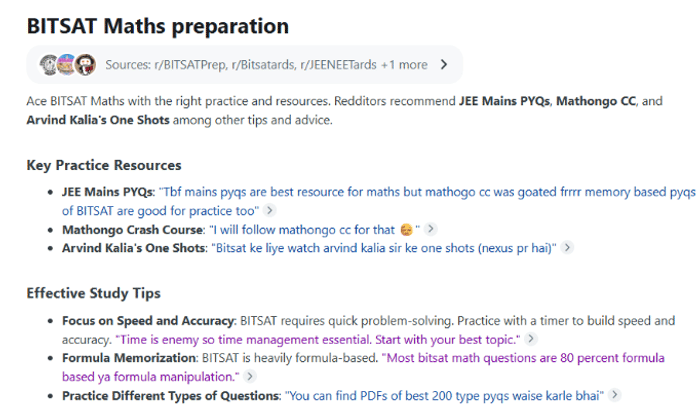
You can check this Reddit Post where candidates have shared key practice resources and study tips for covering BITSAT Mathematics Syllabus 2026.
Frequently Asked Questions
Ques: Does Mathematics have more weightage in the BITSAT exam?
Ans: In the BITSAT exam, Maths has comparatively higher weightage(40 Questions) than Physics and Chemistry (30 Questions each).
| Subject | No. of Questions | Total Marks | Weightage Level |
|---|---|---|---|
| Mathematics / Biology | 40 | 120 | Highest |
| Physics | 30 | 90 | High |
| Chemistry | 30 | 90 | High |
| Logical Reasoning | 20 | 60 | Moderate |
| English Proficiency | 10 | 30 | Lowest |
Ques: Does BITS provide an official model question paper for BITSAT 2026 preparation and practice?
Ans: No. BITS does not provide any official model question paper.
Ques: Does BITSAT Syllabus 2026 the same as JEE Main?
Ans: Yes, the BITSAT and JEE Main syllabus overlaps, but BITSAT also includes English Proficiency and Logical Reasoning which is not there in JEE Mains.
Ques: How can I improve my Speed and Accuracy in BITSAT 2026 Preparation ?
Ans: Since BITSAT is a time bound examination, students have to master speed and accuracy. Here are some tips you can consider during the examination.
- Use a stopwatch while preparing for the BITSAT 2026 examination.
- Set targets while solving numerical.
- Manage time accordingly in the exam, give 60 minutes to the Biology or Mathematics section as it is the most time consuming section, give the next 60 minutes to the Physics and chemistry section ,30 minutes to the English section and retain the last 10 minutes to revise.
Ques: Can I switch between sections during the BITSAT 2026 Exam?
Ans: Yes. Candidates are allowed to switch between the sections as there is no sectional timing for any of the 4 sections. Candidates can also review and change their answers anytime before submitting the test. However, if candidates choose to attempt 12 extra questions, then they cannot go back and change any of the answers from the attempted 130 questions.
Ques: What are the expected BITSAT 2026 cutoffs?
Ans: BITSAT cutoffs vary based on difficulty and number of applicants. Based on recent years’ trend, the expected BITSAT 2026 cutoff is mentioned below:
| Campus & Branch | BITSAT 2026 Cutoff (approx) |
|---|---|
| Pilani – Computer Science | 320–330 |
| Pilani – Electronics & Comm. | 300–310 |
| Goa – Computer Science | 290–300 |
| Hyderabad – Computer Science | 280–290 |
| Pilani – Mechanical | 245–255 |
Ques: When will the BITSAT 2026 admit card be released?
Ans: The admit card is expected to be released in April 2026 for BITSAT Session 1 and in May 2026 for Session 2.
Ques: When will BITSAT 2026 counselling start?
Ans: The counselling and iteration rounds for BITSAT 2026 will begin from July 2026 onwards.
*The article might have information for the previous academic years, please refer the official website of the exam.
Ask your question
Answered Questions
a
ZT
The Fee for the B.Tech Computer Science and Engineering at VIT University is INR 1.73 Lakhs with an INR 3k caution deposit which is refundable and a One-time payment only.
...Show More
a
R
To get admission to most undergraduate courses at CSJMU, you must have a CUET-UG score or merit in the last qualifying exam.
...Show More
a
R
Pandit Ravishankar Shukla University (PRSU) in Raipur, Chhattisgarh, India conducts admission processes for undergraduate programs based on merit and entrance exams.
For undergraduate programs, candidates must submit the scores of the last qualifying exams from their previous education. The selection process may also include a Common Entrance Test (CET) or Merit Basis in the 10+2 examination or equivalent.
Candidates can apply to PRSU online or offline. Some documents that may be required for application include:
- Declaration as stated in the application form, duly supported by an Affidavit on Rs. 10/- stamp paper attested by Notary
- Curriculum vitae (in MS Word or PDF)
- Motivation letter (in MS Word or PDF)
- Copy of academic documents (all levels, scanned)
- Copy of IELTS certificate/other English language proficiency test results (scanned if required)
PRSU also conducts entrance exams for admission to PG and integrated courses. For admission to MBA courses, PRSU accepts valid scores of CMAT/ MAT/ CAT/ XAT/ ATMA entrance exams.
...Show More


