
BITSAT 2023 Question Paper with Solution PDF for (May 21 - Shift 1)


Content Writer | Updated On - Jan 13, 2026
BITSAT 2023 May 21 Question Paper is now made available here. BITSAT question paper consists of 130 multiple-choice questions (MCQs) with a total weightage of 390 marks.
BITSAT 2023 May 21 Question Paper is divided into four sections: Physics, Chemistry, Mathematics/Biology, and English Proficiency and Logical Reasoning. The Physics and Chemistry sections consist of 30 questions each, while the Mathematics/Biology section contains 40 questions. The English Proficiency section includes 10 questions, and the Logical Reasoning section consists of 20 questions.
Also Check: BITSAT 2023 Paper Analysis
BITSAT 2023 May 21 Question Paper PDF
| BITSAT 2023 May 21 Shift 1 Question Paper | Download PDF | Check Solutions |

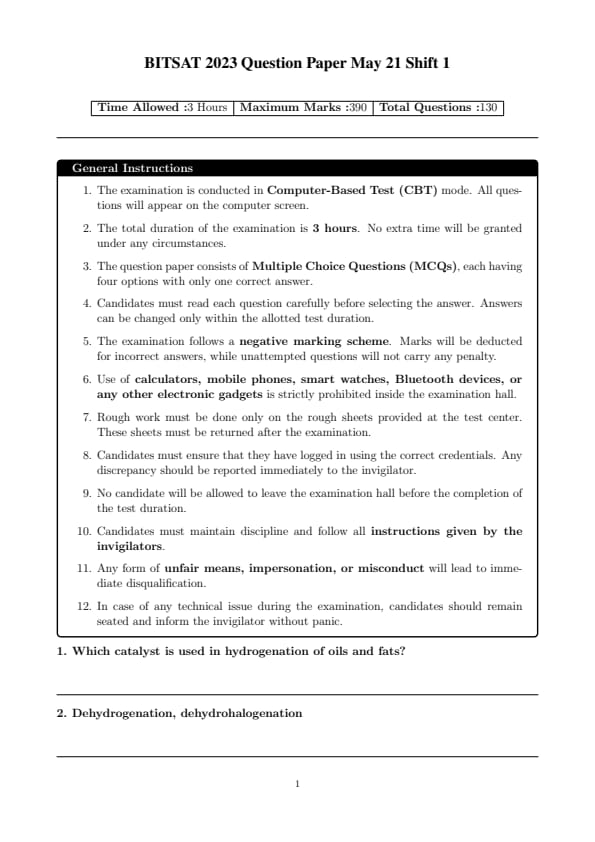
Which catalyst is used in hydrogenation of oils and fats?
View Solution
The hydrogenation of vegetable oils (liquid) to form fats (solid or semi-solid) involves the addition of dihydrogen gas (\(H_2\)).
This reaction involves the reduction of unsaturated fatty acid chains.
Finely divided Nickel (Ni) is commercially used as the catalyst for this process, typically at elevated temperatures.
Therefore, Nickel is the correct answer.
Quick Tip: The process is known as hardening of oils (e.g., manufacture of vanaspati ghee).
Dehydrogenation, dehydrohalogenation
View Solution
Dehydrogenation is a chemical reaction that involves the removal of hydrogen (\(H_2\)) from a molecule.
For example, \(CH_3CH_2OH \xrightarrow{Cu/573K} CH_3CHO + H_2\).
Dehydrohalogenation involves the removal of a hydrogen atom and a halogen atom (forming a hydrogen halide, \(HX\)) from a substrate.
For example, Alkyl halide + Alcoholic KOH \(\rightarrow\) Alkene + \(KX\) + \(H_2O\).
Thus, the key difference is the species eliminated (\(H_2\) vs \(HX\)).
Quick Tip: Alcoholic KOH causes elimination (dehydrohalogenation), while aqueous KOH causes substitution.
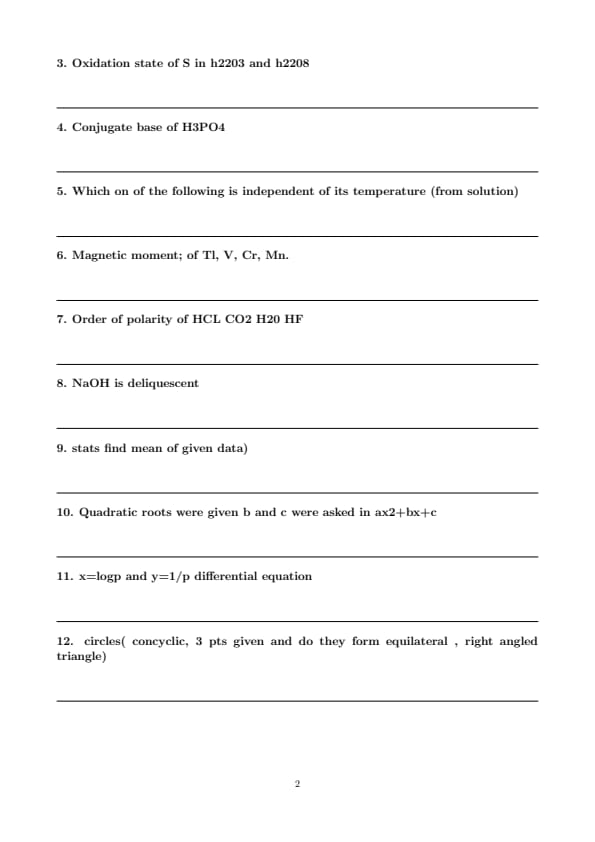
Oxidation state of S in h2203 and h2208
View Solution
For \(H_2S_2O_3\) (Thiosulfuric acid):
Using the average oxidation state method: \(2(+1) + 2(S) + 3(-2) = 0\).
\(2 + 2S - 6 = 0 \Rightarrow 2S = 4 \Rightarrow S = +2\).
For \(H_2S_2O_8\) (Peroxydisulfuric acid):
This molecule contains a peroxide linkage (\(-O-O-\)). Structure: \(HO_3S-O-O-SO_3H\).
Calculation: \(2(+1) + 2(S) + 6(-2)_{oxide} + 2(-1)_{peroxide} = 0\).
\(2 + 2S - 12 - 2 = 0 \Rightarrow 2S = 12 \Rightarrow S = +6\).
Quick Tip: The maximum oxidation state of Sulphur is \(+6\). Any calculated value higher than \(+6\) implies the presence of peroxide bonds.
Conjugate base of H3PO4
View Solution
A conjugate base is formed by removing one proton (\(H^+\)) from the acid.
Reaction: \(H_3PO_4 \rightleftharpoons H^+ + H_2PO_4^-\).
The species formed after the loss of the proton is the Dihydrogen phosphate ion, \(H_2PO_4^-\).
Thus, \(H_2PO_4^-\) is the conjugate base of \(H_3PO_4\).
Quick Tip: \(Conjugate Base = Acid - H^+\).
Which on of the following is independent of its temperature (from solution)
View Solution
Concentration terms involving volume (Molarity, Normality, \(% w/v\)) are temperature-dependent because the volume of liquid changes with temperature.
Concentration terms involving only mass (Molality, Mole Fraction, \(% w/w\)) are temperature-independent because mass is constant.
Molality (\(m\)) is defined as moles of solute per kilogram of solvent.
Therefore, Molality is independent of temperature.
Quick Tip: Molality is preferred in colligative property calculations (like boiling point elevation) because it doesn't change with temperature.
Magnetic moment; of Tl, V, Cr, Mn.
View Solution
(Note: 'Tl' in the memory-based text is likely a typo for 'Ti' (Titanium) in the context of 3d transition metals).
The spin-only magnetic moment is given by \(\mu = \sqrt{n(n+2)}\) BM, where \(n\) is the number of unpaired electrons.
For divalent ions (\(M^{2+}\)):
\(Ti^{2+} (3d^2) \Rightarrow n=2\).
\(V^{2+} (3d^3) \Rightarrow n=3\).
\(Cr^{2+} (3d^4) \Rightarrow n=4\).
\(Mn^{2+} (3d^5) \Rightarrow n=5\).
Since the magnetic moment increases with the number of unpaired electrons, the order is \(Mn > Cr > V > Ti\).
Quick Tip: For \(d^1\) to \(d^5\) configurations, magnetic moment corresponds directly to the number of d-electrons.
Order of polarity of HCL CO2 H20 HF
View Solution
Polarity depends on the net dipole moment (\(\mu\)).
\(CO_2\): Linear structure (\(O=C=O\)), dipoles cancel out. \(\mu = 0\).
\(HCl\): Polar bond, \(\mu \approx 1.03\) D.
\(HF\): Highly polar bond (F is very electronegative), \(\mu \approx 1.78\) D.
\(H_2O\): Bent structure with two lone pairs. The vector sum of bond moments and lone pair moments results in a very high dipole. \(\mu \approx 1.85\) D.
Thus, the order is \(H_2O > HF > HCl > CO_2\).
Quick Tip: Water is more polar than HF despite F being more electronegative because the two lone pairs in water contribute significantly to the net vector sum.
NaOH is deliquescent
View Solution
Deliquescence is the property of a substance to absorb moisture from the air to the extent that it dissolves in the absorbed water and forms a liquid solution.
Sodium Hydroxide (\(NaOH\)) is a highly deliquescent solid.
When exposed to humid air, \(NaOH\) pellets absorb water vapor, become wet, and eventually dissolve completely to form a concentrated alkaline solution.
Therefore, the statement is correct.
Quick Tip: This distinguishes it from hygroscopic substances (like CaO or Conc. \(H_2SO_4\)) which absorb water but do not dissolve in it.
stats find mean of given data)
View Solution
The mean (average) of a data set is calculated by dividing the sum of all observations by the total number of observations.
Let the data points be \(x_1, x_2, x_3, ..., x_n\).
Formula: \(\bar{x} = \frac{x_1 + x_2 + ... + x_n}{n}\).
Since the specific numerical values were not provided in the memory-based text, apply this formula to the given numbers to find the answer.
Quick Tip: If the data represents an Arithmetic Progression (e.g., 2, 4, 6, 8, 10), the mean is simply the middle term.
Quadratic roots were given b and c were asked in ax2+bx+c
View Solution
Consider the quadratic equation \(ax^2 + bx + c = 0\).
Let the given roots be \(\alpha\) and \(\beta\).
The relationship between the roots and coefficients is:
Sum of roots (\(\alpha + \beta\)) = \(-\frac{b}{a}\).
Product of roots (\(\alpha \beta\)) = \(\frac{c}{a}\).
To find \(b\): \(b = -a(\alpha + \beta)\).
To find \(c\): \(c = a(\alpha \beta)\).
If the leading coefficient \(a\) is 1, then \(b = -(Sum)\) and \(c = Product\).
Quick Tip: The quadratic equation can be reconstructed directly as \(x^2 - (\alpha + \beta)x + \alpha\beta = 0\).
x=logp and y=1/p differential equation
View Solution
We are given \(x = \log p\), which implies \(p = e^x\).
We are also given \(y = \frac{1}{p}\).
Substitute \(p = e^x\) into the equation for \(y\):
\(y = \frac{1}{e^x} = e^{-x}\).
Now, differentiate \(y\) with respect to \(x\):
\(\frac{dy}{dx} = \frac{d}{dx}(e^{-x}) = -e^{-x}\).
Since \(y = e^{-x}\), we can substitute \(y\) back into the derivative:
\(\frac{dy}{dx} = -y\).
Rearranging gives the differential equation: \(\frac{dy}{dx} + y = 0\).
Quick Tip: Eliminating the parameter (\(p\)) first is often the fastest way to solve parametric differential equations.
circles( concyclic, 3 pts given and do they form equilateral , right angled triangle)
View Solution
Any 3 non-collinear points are concyclic (a unique circle passes through them). The question likely asks to identify the type of triangle formed by these 3 points to determine properties of that circle.
Let the points be \(A, B, C\). Calculate the squared side lengths using the distance formula:
\(AB^2 = (x_2-x_1)^2 + (y_2-y_1)^2\), \(BC^2\), and \(AC^2\).
1. If \(AB^2 = BC^2 = AC^2\), the triangle is Equilateral.
2. If the sum of any two squared sides equals the third (e.g., \(AB^2 + BC^2 = AC^2\)), the triangle is Right Angled.
(Note: For a right-angled triangle, the hypotenuse is the diameter of the circumcircle).
Quick Tip: If the triangle is right-angled, the center of the circumcircle is the midpoint of the hypotenuse.
BITSAT 2023 Marking Scheme
| Sections | Subjects | No. of questions | Total Marks | Marks for Each Correct Answer | Marks for Each Wrong Answer |
| Part I | Physics | 40 | 120 | +3 | -1 |
| Part II | Chemistry | 40 | 120 | +3 | -1 |
| Part III | English Proficiency | 15 | 45 | +3 | -1 |
| Logical Reasoning | 10 | 30 | +3 | -1 | |
| Part IV | Mathematics/Biology (B.Pharma) | 45 (Each) | 135 | +3 | -1 |
| Total | 150 Questions | 450 Marks | -- | -- | |
*The article might have information for the previous academic years, please refer the official website of the exam.