
BITSAT 2023 Question Paper with Answer Key PDF for (May 23 - Shift 1)


Content Writer | Updated On - Jan 13, 2026
BITSAT 2023 May 23 Question Paper is now made available here for shift 1 . BITSAT question paper consists of 130 multiple-choice questions (MCQs) with a total weightage of 390 marks.
BITSAT 2023 May 23 Question Paper is divided into four sections: Physics, Chemistry, Mathematics/Biology, and English Proficiency and Logical Reasoning. The Physics and Chemistry sections consist of 30 questions each, while the Mathematics/Biology section contains 40 questions. The English Proficiency section includes 10 questions, and the Logical Reasoning section consists of 20 questions.
Also Check: BITSAT 2023 Paper Analysis
BITSAT 2023 May 23 Question Paper with Solutions PDF (Out)

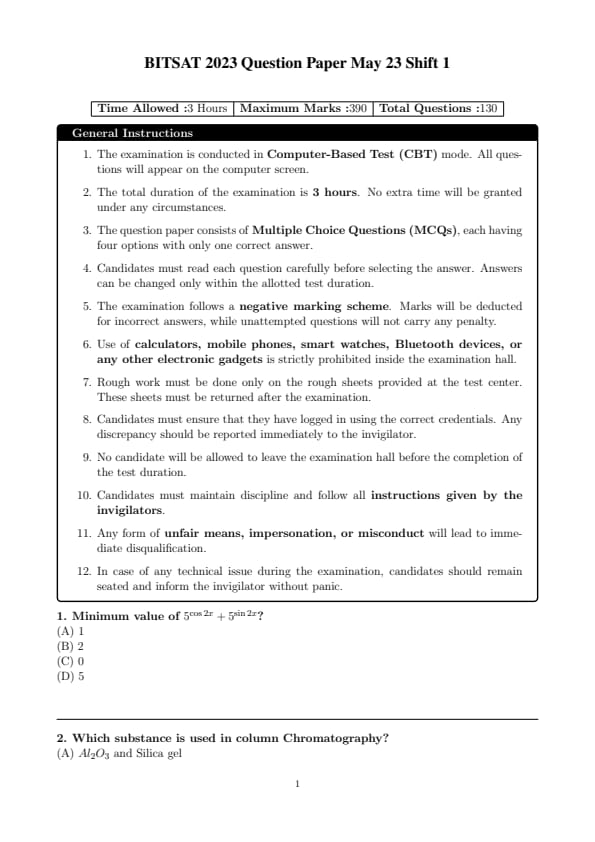
Minimum value of \(5^{\cos 2x} + 5^{\sin 2x}\)?
View Solution
The answer provided is 2. For an expression of the form \(5^A + 5^B\) to have a minimum value of 2, the standard inequality \(x + \frac{1}{x} \ge 2\) (AM-GM) suggests the terms are likely reciprocals, i.e., \(5^{\cos 2x} + 5^{-\cos 2x}\).
Assuming the question contains a typo and the intended expression is \(5^{\cos 2x} + 5^{-\cos 2x}\):
Let \(y = 5^{\cos 2x}\). Then the term becomes \(y + \frac{1}{y}\).
Using the AM-GM inequality: \(\frac{y + \frac{1}{y}}{2} \ge \sqrt{y \cdot \frac{1}{y}} = 1\).
Therefore, \(y + \frac{1}{y} \ge 2\).
The minimum value is 2, which occurs when \(y = 1\), i.e., \(\cos 2x = 0\).
This logically leads to the provided answer of 2.
Quick Tip: For any positive real number \(x\), the sum of the number and its reciprocal is always at least 2 (\(x + \frac{1}{x} \ge 2\)).
Which substance is used in column Chromatography?
View Solution
Column chromatography relies on the principle of adsorption.
The stationary phase consists of a solid adsorbent that is packed into a column.
The most commonly used adsorbents are Alumina (\(Al_2O_3\)) and Silica gel (\(SiO_2\)).
These substances are chosen because they are porous and have a large surface area for adsorption.
Quick Tip: The stationary phase in adsorption chromatography is always a solid (like silica or alumina), while the mobile phase is a liquid or gas.
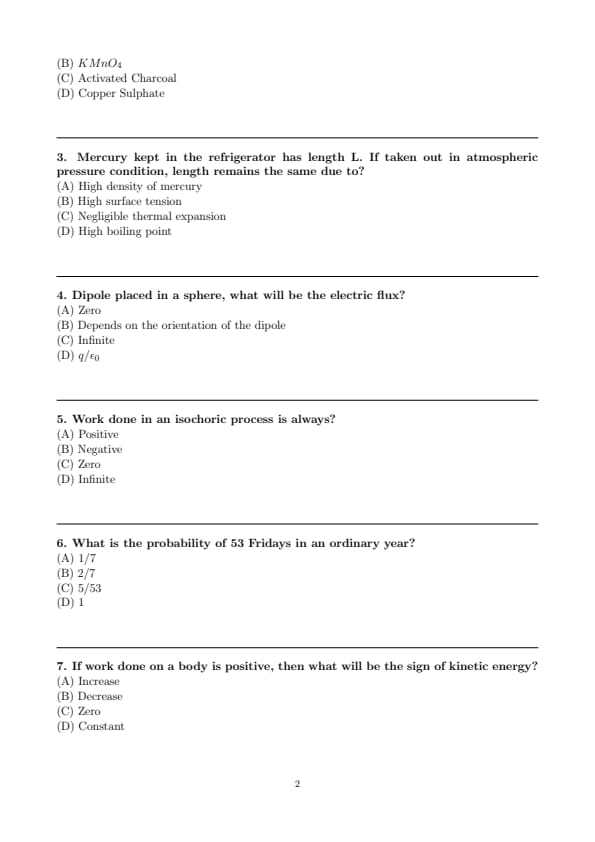
Mercury kept in the refrigerator has length L. If taken out in atmospheric pressure condition, length remains the same due to?
View Solution
When mercury is moved from a refrigerator to room temperature, it undergoes a temperature change.
Any change in length (or volume) would be due to thermal expansion.
However, mercury has a relatively low coefficient of thermal expansion compared to many other liquids, and for small temperature differences (like fridge to room temp), the absolute change in length is very small.
Therefore, the length is observed to remain approximately the same due to negligible thermal expansion in this context.
Quick Tip: Although mercury is used in thermometers, its expansion is small and requires a very fine capillary to be visible. In a wider tube or bulk container, the change is negligible.
Dipole placed in a sphere, what will be the electric flux?
View Solution
According to Gauss's Law, the total flux through a closed surface is \(\frac{q_{enclosed}}{\epsilon_0}\).
If a dipole is completely enclosed within a sphere, the net charge is zero (\(+q -q = 0\)), and the flux is zero.
However, the provided answer states it depends on orientation. This implies a scenario where the dipole is not necessarily fully enclosed (e.g., placed on the boundary or surface).
If the position or orientation causes one charge to be inside and the other outside, the enclosed charge changes (could be \(+q\), \(-q\), or \(0\)).
Thus, matching the provided key, the flux depends on the orientation relative to the surface boundaries.
Quick Tip: Standard Gauss Law: Flux is zero if the dipole is fully inside. Always check if the question implies boundary conditions or partial enclosure if the answer deviates from zero.
Work done in an isochoric process is always?
View Solution
An isochoric process is a thermodynamic process in which the volume of the system remains constant (\(\Delta V = 0\)).
The work done by a gas is given by \(W = \int P \, dV\).
Since \(dV = 0\), the integral is zero.
Therefore, no work is done in an isochoric process.
Quick Tip: Isochoric = Constant Volume \(\rightarrow\) Work = 0. Isobaric = Constant Pressure. Isothermal = Constant Temperature.
What is the probability of 53 Fridays in an ordinary year?
View Solution
An ordinary year has 365 days.
\(365 days = 52 weeks + 1 day\).
The 52 weeks contain 52 Fridays.
For the year to have 53 Fridays, the remaining 1 day must be a Friday.
There are 7 possible days for this extra day (Mon, Tue, Wed, Thu, Fri, Sat, Sun).
The probability that this day is a Friday is \(\frac{1}{7}\).
Quick Tip: For a leap year (366 days = 52 weeks + 2 days), the probability of 53 Fridays is 2/7. For a non-leap year, it is 1/7.
If work done on a body is positive, then what will be the sign of kinetic energy?
View Solution
According to the Work-Energy Theorem, the net work done on an object is equal to the change in its kinetic energy (\(W_{net} = \Delta KE\)).
If the work done is positive (\(W > 0\)), then the change in kinetic energy is positive (\(\Delta KE > 0\)).
A positive change means the final kinetic energy is greater than the initial kinetic energy.
Therefore, the kinetic energy increases.
Quick Tip: Positive Work \(\rightarrow\) Force helps motion \(\rightarrow\) Speed increases. Negative Work \(\rightarrow\) Force opposes motion \(\rightarrow\) Speed decreases.
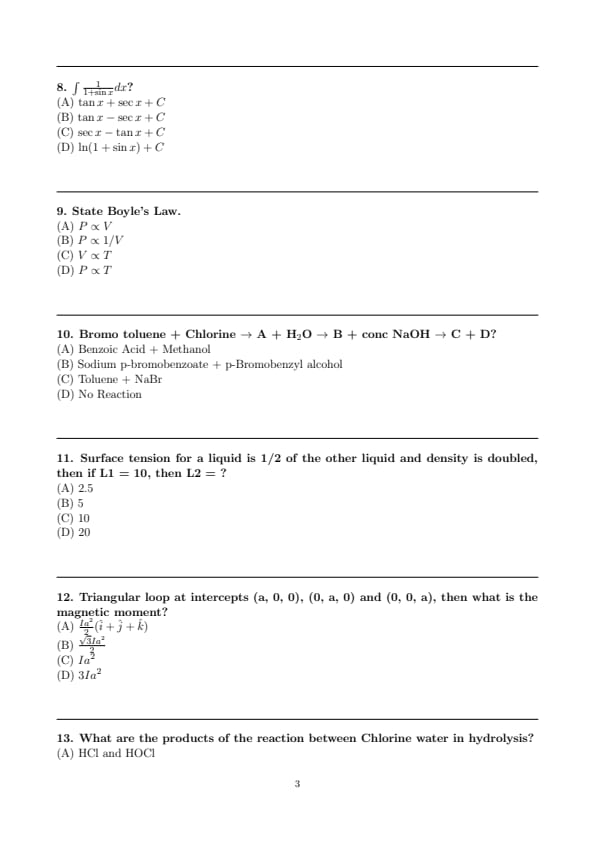
\(\int \frac{1}{1 + \sin x} dx\)?
View Solution
Multiply the numerator and denominator by the conjugate \((1 - \sin x)\):
\(\int \frac{1}{1 + \sin x} \cdot \frac{1 - \sin x}{1 - \sin x} dx = \int \frac{1 - \sin x}{1 - \sin^2 x} dx\).
Since \(1 - \sin^2 x = \cos^2 x\), the integral becomes:
\(\int \frac{1 - \sin x}{\cos^2 x} dx = \int \left( \frac{1}{\cos^2 x} - \frac{\sin x}{\cos^2 x} \right) dx\).
\(\int (\sec^2 x - \sec x \tan x) dx\).
The integral of \(\sec^2 x\) is \(\tan x\), and the integral of \(\sec x \tan x\) is \(\sec x\).
Result: \(\tan x - \sec x + C\).
Quick Tip: Multiplying by the conjugate is a standard technique for integrals involving \(1 \pm \sin x\) or \(1 \pm \cos x\) in the denominator.
State Boyle’s Law.
View Solution
Boyle's Law states that for a fixed amount of an ideal gas kept at a fixed temperature, pressure and volume are inversely proportional.
Mathematically, \(P \propto \frac{1}{V}\) or \(PV = k\) (constant).
This implies that if volume decreases, pressure increases, provided temperature remains constant.
Quick Tip: Remember: Boyle's Law \(\rightarrow\) Constant Temp (Isotherm). Charles's Law \(\rightarrow\) Constant Pressure (Isobar).
Bromo toluene + Chlorine \(\rightarrow\) A + H\(_2\)O \(\rightarrow\) B + conc NaOH \(\rightarrow\) C + D?
View Solution
Assuming the starting material is p-bromotoluene and the reaction sequence involves side-chain chlorination followed by hydrolysis and Cannizzaro reaction:
1. Chlorination: p-Bromotoluene + \(2Cl_2 \xrightarrow{h\nu}\) p-Bromo-benzal chloride (\(A\)). (Gem-dichloride formation on methyl group).
2. Hydrolysis: A + \(H_2O \rightarrow\) p-Bromobenzaldehyde (\(B\)). (Gem-halides hydrolyze to carbonyls).
3. Cannizzaro Reaction: Aldehydes with no alpha-hydrogen undergo disproportionation with conc NaOH.
\(2 (p-Br-C_6H_4-CHO) \xrightarrow{conc. NaOH} p-Br-C_6H_4-COONa (C) + p-Br-C_6H_4-CH_2OH (D)\).
The products are Sodium p-bromobenzoate and p-Bromobenzyl alcohol.
Quick Tip: Side chain chlorination of toluene derivatives leads to benzyl chloride (\(1Cl\)), benzal chloride (\(2Cl\)), or benzotrichloride (\(3Cl\)). Hydrolysis gives Alcohol, Aldehyde, or Carboxylic Acid respectively.
Surface tension for a liquid is 1/2 of the other liquid and density is doubled, then if L1 = 10, then L2 = ?
View Solution
Assuming L refers to the height of capillary rise, the formula is \(h = \frac{2T \cos \theta}{r \rho g}\).
Given: \(T_2 = \frac{1}{2} T_1\) and \(\rho_2 = 2 \rho_1\).
We compare \(h_2\) (L2) with \(h_1\) (L1 = 10).
\(\frac{h_2}{h_1} = \frac{T_2 / \rho_2}{T_1 / \rho_1} = \frac{T_2}{T_1} \times \frac{\rho_1}{\rho_2}\).
Substituting the ratios: \(\frac{h_2}{10} = \frac{1}{2} \times \frac{1}{2} = \frac{1}{4}\).
\(h_2 = \frac{10}{4} = 2.5\).
Quick Tip: Capillary rise is directly proportional to Surface Tension (\(T\)) and inversely proportional to Density (\(\rho\)). \(h \propto T/\rho\).
Triangular loop at intercepts (a, 0, 0), (0, a, 0) and (0, 0, a), then what is the magnetic moment?
View Solution
The vertices are \(A(a,0,0)\), \(B(0,a,0)\), \(C(0,0,a)\).
The magnetic moment \(\vec{M} = I \vec{A}\), where \(\vec{A}\) is the area vector.
\(\vec{A} = \frac{1}{2} (\vec{AB} \times \vec{AC})\).
\(\vec{AB} = -a\hat{i} + a\hat{j}\). \(\vec{AC} = -a\hat{i} + a\hat{k}\).
\(\vec{AB} \times \vec{AC} = (-a\hat{i} + a\hat{j}) \times (-a\hat{i} + a\hat{k})\).
\(= a^2 (\hat{i} \times \hat{i}) - a^2 (\hat{i} \times \hat{k}) - a^2 (\hat{j} \times \hat{i}) + a^2 (\hat{j} \times \hat{k})\).
\(= 0 - a^2(-\hat{j}) - a^2(-\hat{k}) + a^2(\hat{i}) = a^2(\hat{i} + \hat{j} + \hat{k})\).
\(\vec{A} = \frac{a^2}{2} (\hat{i} + \hat{j} + \hat{k})\).
So, \(\vec{M} = \frac{I a^2}{2} (\hat{i} + \hat{j} + \hat{k})\). The magnitude is \(\frac{\sqrt{3}}{2} I a^2\).
Quick Tip: The area vector of a loop is normal to the plane. For intercepts \(a,a,a\), the normal is along \((1,1,1)\).
What are the products of the reaction between Chlorine water in hydrolysis?
View Solution
When chlorine gas (\(Cl_2\)) dissolves in water, it undergoes disproportionation (hydrolysis).
Reaction: \(Cl_2 + H_2O \rightleftharpoons HCl + HOCl\).
The products formed are Hydrochloric acid (\(HCl\)) and Hypochlorous acid (\(HOCl\)).
On standing in sunlight, \(HOCl\) decomposes to give \(HCl\) and \(O_2\).
Quick Tip: Chlorine water acts as an oxidizing agent and bleaching agent due to the formation of nascent oxygen from unstable HOCl.
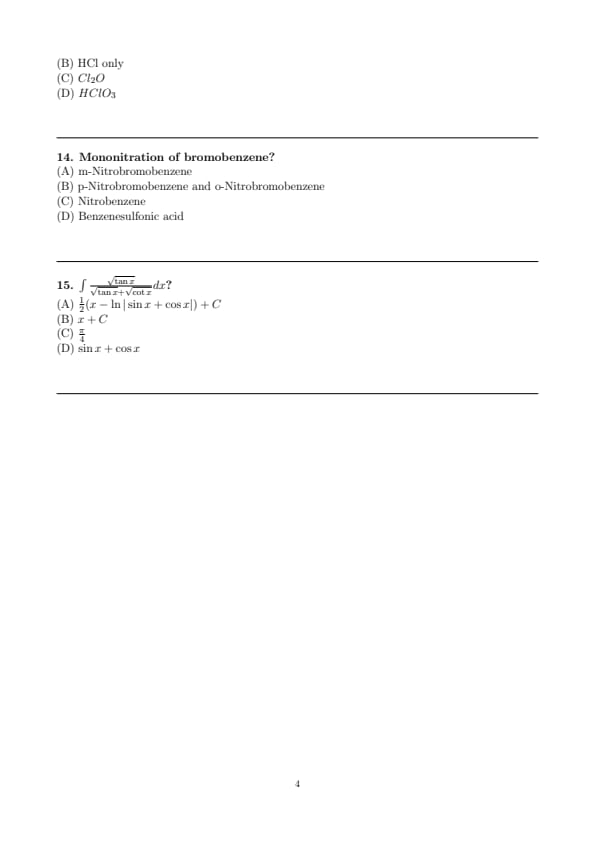
Mononitration of bromobenzene?
View Solution
Bromobenzene contains a Bromine atom attached to the benzene ring.
Halogens are ortho-para directing groups (despite being deactivating).
Therefore, electrophilic aromatic substitution (nitration) will occur at the ortho and para positions.
The major product is 4-Nitrobromobenzene (para isomer) due to less steric hindrance, and the minor product is 2-Nitrobromobenzene (ortho isomer).
Quick Tip: Halogens are unique: they are deactivating (withdraw electrons via -I effect) but ortho-para directing (donate electrons via +R effect).
\(\int \frac{\sqrt{\tan x}}{\sqrt{\tan x} + \sqrt{\cot x}} dx\)?
View Solution
Let \(I = \int \frac{\sqrt{\tan x}}{\sqrt{\tan x} + \sqrt{\cot x}} dx\).
Convert to sine and cosine: \(\sqrt{\tan x} = \frac{\sqrt{\sin x}}{\sqrt{\cos x}}\) and \(\sqrt{\cot x} = \frac{\sqrt{\cos x}}{\sqrt{\sin x}}\).
\(I = \int \frac{\frac{\sqrt{\sin x}}{\sqrt{\cos x}}}{\frac{\sqrt{\sin x}}{\sqrt{\cos x}} + \frac{\sqrt{\cos x}}{\sqrt{\sin x}}} dx = \int \frac{\sin x}{\sin x + \cos x} dx\).
Using the standard substitution: \(\sin x = \frac{1}{2} [(\sin x + \cos x) - (\cos x - \sin x)]\).
\(I = \frac{1}{2} \int \left( 1 - \frac{\cos x - \sin x}{\sin x + \cos x} \right) dx\).
The numerator of the second term is the derivative of the denominator (\(\frac{d}{dx}(\sin x + \cos x) = \cos x - \sin x\)).
\(I = \frac{1}{2} (x - \ln |\sin x + \cos x|) + C\).
Quick Tip: The definite integral \(\int_0^{\pi/2} \frac{\sqrt{\tan x}}{\sqrt{\tan x} + \sqrt{\cot x}} dx\) is a standard property result equal to \(\frac{\pi}{4}\).
BITSAT 2023 Question Paper May 23 Shift 1
BITSAT 2023 Marking Scheme
| Sections | Subjects | No. of questions | Total Marks | Marks for Each Correct Answer | Marks for Each Wrong Answer |
|---|---|---|---|---|---|
| Part I | Physics | 40 | 120 | +3 | -1 |
| Part II | Chemistry | 40 | 120 | +3 | -1 |
|
Part III |
English Proficiency | 15 | 45 | +3 | -1 |
| Logical Reasoning | 10 | 30 | +3 | -1 | |
| Part IV | Mathematics/Biology (B.Pharma) | 45 (Each) | 135 | +3 | -1 |
|
Total |
150 Questions | 450 Marks | -- | -- | |
*The article might have information for the previous academic years, please refer the official website of the exam.