
BITSAT 2025 June 22 Shift 2 Question Paper with Solutions Pdf


Content Writer | Updated On - Nov 24, 2025
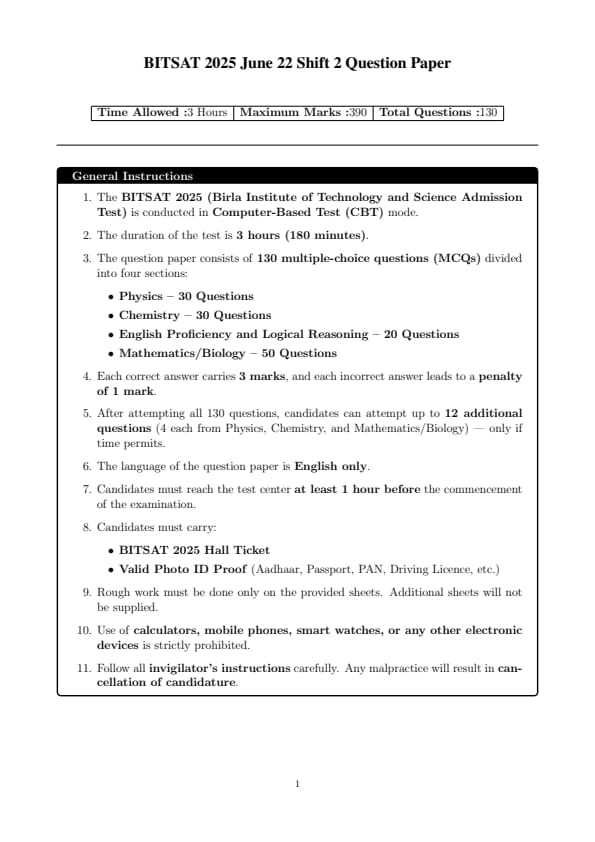
BITSAT 2025 Question Paper with Solutions is now available for download. The Birla Institute of Technology and Science (BITS) conducted the BITS Admission Test for a total duration of 3 hours, and the examination carried a total of 390 marks.
BITSAT 2025 JUNE 22 SHIFT 2 Question Paper with Solutions
| BITSAT 2025 JUNE 22 SHIFT 2 Question Paper | Download PDF | Check Solutions |

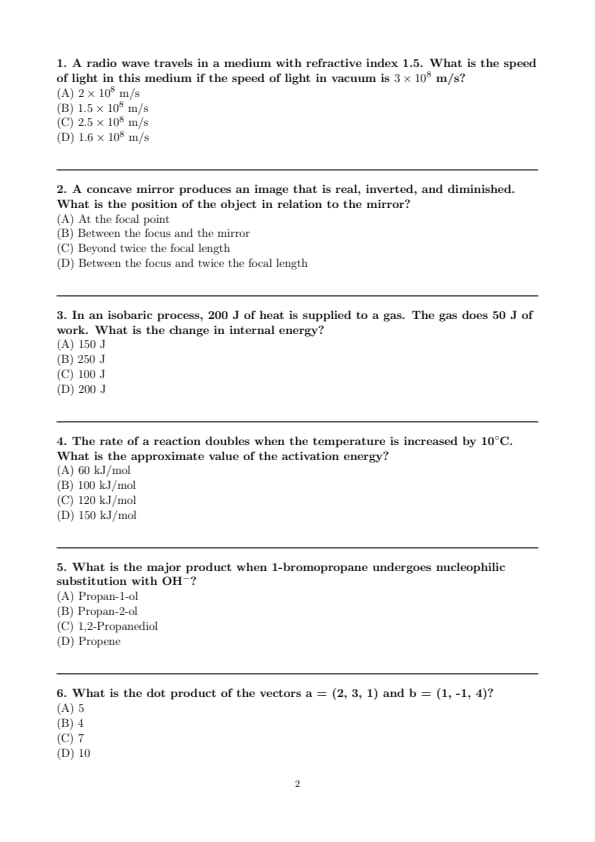
A radio wave travels in a medium with refractive index 1.5. What is the speed of light in this medium if the speed of light in vacuum is \(3 \times 10^8\) m/s?
View Solution
Step 1: Understanding the Concept:
The refractive index (\(n\)) of a medium is a dimensionless quantity that describes how fast light travels through that medium. It is defined as the ratio of the speed of light in a vacuum (\(c\)) to the speed of light in the medium (\(v\)).
Step 2: Key Formula or Approach:
The formula that connects the refractive index, the speed of light in a vacuum, and the speed of light in a medium is:
\[ n = \frac{c}{v} \]
To find the speed of light in the medium (\(v\)), we can rearrange the formula:
\[ v = \frac{c}{n} \]
Step 3: Detailed Explanation:
We are given the following values:
- The refractive index of the medium, \(n = 1.5\).
- The speed of light in a vacuum, \(c = 3 \times 10^8\) m/s.
Now, we substitute these values into the rearranged formula:
\[ v = \frac{3 \times 10^8 m/s}{1.5} \] \[ v = 2 \times 10^8 m/s \]
Step 4: Final Answer:
The speed of the radio wave (which is a form of light) in the medium is \(2 \times 10^8\) m/s. Therefore, option (A) is the correct answer.
Quick Tip: Remember that light always slows down when it enters a medium from a vacuum. This means the refractive index \(n\) will always be greater than or equal to 1 (it's 1 for a vacuum). Consequently, the speed of light in the medium (\(v\)) will always be less than or equal to \(c\). This can help you quickly eliminate options that are greater than \(3 \times 10^8\) m/s.
A concave mirror produces an image that is real, inverted, and diminished. What is the position of the object in relation to the mirror?
View Solution
Step 1: Understanding the Concept:
This question deals with image formation by a concave mirror. The properties of the image (real/virtual, erect/inverted, magnified/diminished) depend on the position of the object relative to the mirror's focal point (\(F\)) and center of curvature (\(C\)). The center of curvature is at a distance of twice the focal length (\(2f\)) from the mirror.
Step 2: Detailed Explanation:
Let's analyze the image characteristics for different object positions for a concave mirror:
- Object at infinity: The image is real, inverted, and highly diminished (point-sized) at the focal point (\(F\)).
- Object beyond the center of curvature (\(C\) or \(2f\)): The image is formed between \(F\) and \(C\). The image is real, inverted, and diminished.
- Object at the center of curvature (\(C\) or \(2f\)): The image is formed at \(C\). The image is real, inverted, and the same size as the object.
- Object between the center of curvature (\(C\)) and the focal point (\(F\)): The image is formed beyond \(C\). The image is real, inverted, and magnified.
- Object at the focal point (\(F\)): The image is formed at infinity (parallel rays emerge).
- Object between the focal point (\(F\)) and the mirror (pole): The image is formed behind the mirror. The image is virtual, erect, and magnified.
Step 3: Final Answer:
The question states that the image is real, inverted, and diminished. Based on the analysis above, this occurs only when the object is placed beyond the center of curvature, which is at a distance of twice the focal length from the mirror. Therefore, option (C) is correct.
Quick Tip: A useful mnemonic for concave mirrors: As the object moves from infinity towards the mirror, the real image moves away from the focal point towards infinity, and it gets larger. The "same size" point is at \(C\) (\(2f\)). If the object is outside \(C\), the image is inside and smaller. If the object is inside \(C\) (but outside \(F\)), the image is outside and larger.
In an isobaric process, 200 J of heat is supplied to a gas. The gas does 50 J of work. What is the change in internal energy?
View Solution
Step 1: Understanding the Concept:
This problem applies the First Law of Thermodynamics, which is a statement of the conservation of energy for a thermodynamic system. It relates the change in internal energy (\(\Delta U\)) of a system to the heat added to the system (\(Q\)) and the work done by the system (\(W\)). The process is described as isobaric (constant pressure), but this information is not needed to calculate the change in internal energy directly from the given heat and work values.
Step 2: Key Formula or Approach:
The First Law of Thermodynamics is expressed as:
\[ \Delta U = Q - W \]
Where:
- \(\Delta U\) is the change in the internal energy of the system.
- \(Q\) is the net heat transferred to the system (positive if heat is added, negative if heat is removed).
- \(W\) is the net work done by the system (positive if the system does work on the surroundings, negative if work is done on the system).
Step 3: Detailed Explanation:
We are given the following values:
- Heat is supplied to the gas, so \(Q = +200\) J.
- The gas does work, so \(W = +50\) J.
Now, we substitute these values into the formula:
\[ \Delta U = 200 J - 50 J \] \[ \Delta U = 150 J \]
Step 4: Final Answer:
The change in the internal energy of the gas is 150 J. Therefore, option (A) is correct.
Quick Tip: Always be careful with the sign conventions in thermodynamics. Heat supplied \textbf{to} the system is \(+Q\). Heat leaving the system is \(-Q\). Work done \textbf{by} the system (expansion) is \(+W\). Work done \textbf{on} the system (compression) is \(-W\). Getting the signs right is the most critical part of solving these problems.
The rate of a reaction doubles when the temperature is increased by 10\(^{\circ}\)C. What is the approximate value of the activation energy?
View Solution
Step 1: Understanding the Concept:
The relationship between the rate of a reaction, temperature, and activation energy (\(E_a\)) is described by the Arrhenius equation. A common rule of thumb in chemistry is that for many reactions near room temperature, the rate doubles for every 10\(^{\circ}\)C increase in temperature. This problem requires us to find the activation energy that corresponds to this rule.
Step 2: Key Formula or Approach:
The Arrhenius equation in its two-point form is used to relate the rate constants (\(k_1\) and \(k_2\)) at two different temperatures (\(T_1\) and \(T_2\)):
\[ \ln\left(\frac{k_2}{k_1}\right) = \frac{E_a}{R} \left(\frac{1}{T_1} - \frac{1}{T_2}\right) \]
Where:
- \(k_1, k_2\) are the rate constants at temperatures \(T_1, T_2\).
- \(E_a\) is the activation energy.
- \(R\) is the ideal gas constant (\(8.314 J/mol\cdotK\)).
- \(T_1, T_2\) are the absolute temperatures in Kelvin.
Step 3: Detailed Explanation:
We are given that the reaction rate doubles, which means \(k_2 = 2k_1\), or \(\frac{k_2}{k_1} = 2\).
The temperature increases by 10\(^{\circ}\)C. Let's assume this change happens near room temperature. Let \(T_1 = 25^{\circ}\)C = 298 K.
Then \(T_2 = 35^{\circ}\)C = 308 K.
Substitute these values into the Arrhenius equation:
\[ \ln(2) = \frac{E_a}{8.314 J/mol\cdotK} \left(\frac{1}{298 K} - \frac{1}{308 K}\right) \]
First, calculate the term in the parenthesis:
\[ \left(\frac{1}{298} - \frac{1}{308}\right) = \left(\frac{308 - 298}{298 \times 308}\right) = \frac{10}{91784} \approx 1.0895 \times 10^{-4} K^{-1} \]
We know that \(\ln(2) \approx 0.693\).
Now, substitute back into the equation:
\[ 0.693 = \frac{E_a}{8.314} (1.0895 \times 10^{-4}) \]
Rearrange to solve for \(E_a\):
\[ E_a = \frac{0.693 \times 8.314}{1.0895 \times 10^{-4}} \] \[ E_a \approx 52884 J/mol \]
Convert this to kJ/mol by dividing by 1000:
\[ E_a \approx 52.9 kJ/mol \]
Step 4: Final Answer:
The calculated activation energy is approximately 53 kJ/mol. Among the given options, 60 kJ/mol is the closest value. This rule of thumb is an approximation, and the value often quoted is between 50 and 60 kJ/mol. Therefore, option (A) is the most reasonable answer.
Quick Tip: This is a very common approximation in chemical kinetics. It's useful to remember that the "doubling of reaction rate for a 10\(^{\circ}\)C rise" corresponds to an activation energy of roughly 50-60 kJ/mol around room temperature. This can save you calculation time in an exam.
What is the major product when 1-bromopropane undergoes nucleophilic substitution with OH\(^-\)?
View Solution
Step 1: Understanding the Concept:
This question involves a nucleophilic substitution reaction. We need to identify the type of substrate (alkyl halide), the nucleophile, and the likely reaction mechanism (SN1 or SN2) to predict the major product.
Step 2: Detailed Explanation:
1. Identify the Substrate: The substrate is 1-bromopropane (CH\(_3\)CH\(_2\)CH\(_2\)Br). The bromine atom is attached to a primary carbon (a carbon atom bonded to only one other carbon atom). Therefore, 1-bromopropane is a primary alkyl halide.
2. Identify the Nucleophile: The nucleophile is the hydroxide ion (OH\(^-\)). It is a strong nucleophile and also a strong base.
3. Determine the Mechanism:
- Primary alkyl halides are sterically unhindered, so they strongly favor the SN2 (bimolecular nucleophilic substitution) mechanism. The SN1 mechanism is disfavored because it would require the formation of a very unstable primary carbocation.
- While OH\(^-\) is also a strong base, which could lead to an elimination (E2) reaction to form propene, substitution (SN2) is generally the major pathway for primary alkyl halides with unhindered strong nucleophiles like OH\(^-\) at moderate temperatures.
4. Predict the Product: In an SN2 reaction, the nucleophile (OH\(^-\)) attacks the carbon atom bearing the leaving group (Br) from the back side, in a single concerted step. The bromide ion (Br\(^-\)) is displaced, and the OH group takes its place.
The reaction is:
CH\(_3\)CH\(_2\)CH\(_2\)Br + OH\(^-\) \(\rightarrow\) CH\(_3\)CH\(_2\)CH\(_2\)OH + Br\(^-\)
The product formed is Propan-1-ol.
Step 3: Final Answer:
The major product of the nucleophilic substitution of 1-bromopropane with hydroxide is Propan-1-ol. Option (A) is correct. Propene (D) would be a minor product from the competing elimination reaction. Propan-2-ol (B) would require a carbocation rearrangement, which does not happen in an SN2 mechanism.
Quick Tip: For substitution/elimination reactions, analyze the substrate and the reagent: \textbf{Substrate:} Primary (\(1^{\circ}\)) \(\rightarrow\) Favors SN2. Secondary (\(2^{\circ}\)) \(\rightarrow\) SN1/SN2/E1/E2 mix. Tertiary (\(3^{\circ}\)) \(\rightarrow\) Favors SN1/E1 (weak base/nuc) or E2 (strong base). \textbf{Reagent:} Strong Nucleophile/Strong Base (e.g., OH\(^-\), OR\(^-\)) \(\rightarrow\) Favors SN2 on \(1^{\circ}\), E2 on \(2^{\circ}\) and \(3^{\circ}\). Here we have \(1^{\circ}\) substrate + strong nucleophile \(\rightarrow\) major product is SN2.
What is the dot product of the vectors a = (2, 3, 1) and b = (1, -1, 4)?
View Solution
Step 1: Understanding the Concept:
The dot product (or scalar product) is an algebraic operation that takes two equal-length sequences of numbers (usually coordinate vectors) and returns a single number. Geometrically, it is the product of the Euclidean magnitudes of the two vectors and the cosine of the angle between them.
Step 2: Key Formula or Approach:
For two three-dimensional vectors \(\mathbf{a} = (a_1, a_2, a_3)\) and \(\mathbf{b} = (b_1, b_2, b_3)\), the dot product is calculated as:
\[ \mathbf{a} \cdot \mathbf{b} = a_1b_1 + a_2b_2 + a_3b_3 \]
Step 3: Detailed Explanation:
We are given the vectors:
- \(\mathbf{a} = (2, 3, 1)\)
- \(\mathbf{b} = (1, -1, 4)\)
We apply the dot product formula by multiplying the corresponding components and then summing the results:
\[ \mathbf{a} \cdot \mathbf{b} = (2)(1) + (3)(-1) + (1)(4) \] \[ \mathbf{a} \cdot \mathbf{b} = 2 - 3 + 4 \] \[ \mathbf{a} \cdot \mathbf{b} = 3 \]
Step 4: Final Answer:
The calculated dot product is 3. However, 3 is not among the given options (A) 5, (B) 4, (C) 7, (D) 10. This indicates a likely error in the question or the provided options. Based on the provided vectors, none of the choices is correct.
Quick Tip: The dot product calculation is straightforward: multiply corresponding components and add. Be very careful with negative signs, as they are a common source of error. If your answer does not match any option, quickly re-calculate to ensure you haven't made a simple arithmetic mistake. If the calculation is correct, the question itself may be flawed.
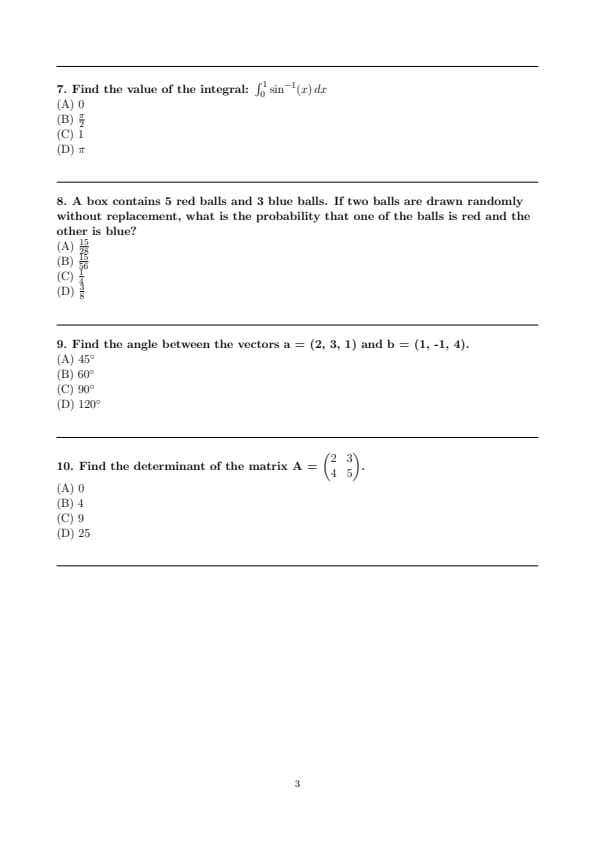
Find the value of the integral: \( \int_{0}^{1} \sin^{-1}(x) \,dx \)
View Solution
Step 1: Understanding the Concept:
This question requires evaluating a definite integral of an inverse trigonometric function. Since the integral of \(\sin^{-1}(x)\) is not a standard elementary function, we must use a technique like Integration by Parts.
Step 2: Key Formula or Approach:
The formula for Integration by Parts is:
\[ \int u \,dv = uv - \int v \,du \]
We need to choose \(u\) and \(dv\) from the integrand \(\sin^{-1}(x) \,dx\). A good strategy is to choose \(u\) as the function that simplifies upon differentiation. Here, \(u = \sin^{-1}(x)\) is a good choice.
Step 3: Detailed Explanation:
Let's first find the indefinite integral \(\int \sin^{-1}(x) \,dx\).
Choose:
- \(u = \sin^{-1}(x) \implies du = \frac{1}{\sqrt{1 - x^2}} \,dx\)
- \(dv = dx \implies v = x\)
Apply the Integration by Parts formula:
\[ \int \sin^{-1}(x) \,dx = x \sin^{-1}(x) - \int x \cdot \frac{1}{\sqrt{1 - x^2}} \,dx \]
To solve the remaining integral, \(\int \frac{x}{\sqrt{1 - x^2}} \,dx\), we use a substitution. Let \(w = 1 - x^2\), then \(dw = -2x \,dx\), which means \(x \,dx = -\frac{1}{2} \,dw\).
\[ \int \frac{x}{\sqrt{1 - x^2}} \,dx = \int \frac{1}{\sqrt{w}} \left(-\frac{1}{2} \,dw\right) = -\frac{1}{2} \int w^{-1/2} \,dw = -\frac{1}{2} \frac{w^{1/2}}{1/2} = -w^{1/2} = -\sqrt{1 - x^2} \]
So, the indefinite integral is:
\[ \int \sin^{-1}(x) \,dx = x \sin^{-1}(x) - (-\sqrt{1 - x^2}) = x \sin^{-1}(x) + \sqrt{1 - x^2} \]
Now, we evaluate the definite integral from 0 to 1:
\[ \int_{0}^{1} \sin^{-1}(x) \,dx = \left[ x \sin^{-1}(x) + \sqrt{1 - x^2} \right]_{0}^{1} \] \[ = \left( 1 \cdot \sin^{-1}(1) + \sqrt{1 - 1^2} \right) - \left( 0 \cdot \sin^{-1}(0) + \sqrt{1 - 0^2} \right) \] \[ = \left( 1 \cdot \frac{\pi}{2} + \sqrt{0} \right) - \left( 0 + \sqrt{1} \right) \] \[ = \frac{\pi}{2} - 1 \]
Step 4: Final Answer:
The exact value of the integral is \(\frac{\pi}{2} - 1 \approx 1.57 - 1 = 0.57\). This value is not among the options. There is a high probability of a typo in the question or options. A very similar and common integral is \(\int_{0}^{1} \frac{1}{\sqrt{1-x^2}} \,dx\), whose value is \([\sin^{-1}(x)]_{0}^{1} = \sin^{-1}(1) - \sin^{-1}(0) = \frac{\pi}{2}\). Given the options, it is likely that this was the intended question. Therefore, we select (B) as the most plausible answer under the assumption of an error.
Quick Tip: For integrals involving inverse trigonometric functions or logarithms, Integration by Parts is the go-to method. Always choose the inverse trig/log function as \(u\) and the polynomial part (like \(dx\)) as \(dv\). If a calculated answer doesn't match the options in a multiple-choice test, look for a similar, more standard problem that would yield one of the answers.
A box contains 5 red balls and 3 blue balls. If two balls are drawn randomly without replacement, what is the probability that one of the balls is red and the other is blue?
View Solution
Step 1: Understanding the Concept:
This is a probability problem involving dependent events because the balls are drawn "without replacement." The outcome of the second draw depends on the outcome of the first. We want to find the probability of getting one ball of each color. This can happen in two mutually exclusive ways: drawing a red ball then a blue ball, or drawing a blue ball then a red ball.
Step 2: Key Formula or Approach:
We can solve this in two ways: by considering the sequence of events or by using combinations.
Method 1: Sequential Probability
P(One R and one B) = P(First is R AND Second is B) + P(First is B AND Second is R)
P(One R and one B) = P(R1) \(\times\) P(B2|R1) + P(B1) \(\times\) P(R2|B1)
Method 2: Combinations
P(One R and one B) = \(\frac{Number of ways to choose 1 red AND 1 blue}{Total number of ways to choose 2 balls}\)
Step 3: Detailed Explanation:
Using Method 1 (Sequential Probability):
Total balls = 5 Red + 3 Blue = 8 balls.
- Probability of drawing Red first, then Blue:
P(R1) = \(\frac{5}{8}\). After drawing one red ball, there are 7 balls left (4R, 3B).
P(B2|R1) = \(\frac{3}{7}\).
P(R1 and B2) = \(\frac{5}{8} \times \frac{3}{7} = \frac{15}{56}\).
- Probability of drawing Blue first, then Red:
P(B1) = \(\frac{3}{8}\). After drawing one blue ball, there are 7 balls left (5R, 2B).
P(R2|B1) = \(\frac{5}{7}\).
P(B1 and R2) = \(\frac{3}{8} \times \frac{5}{7} = \frac{15}{56}\).
- Total probability is the sum of these two cases:
P(Total) = \(\frac{15}{56} + \frac{15}{56} = \frac{30}{56}\).
Simplifying the fraction gives \(\frac{30 \div 2}{56 \div 2} = \frac{15}{28}\).
Using Method 2 (Combinations):
- Total number of ways to choose 2 balls from 8:
\( C(8, 2) = \frac{8!}{2!(8-2)!} = \frac{8 \times 7}{2 \times 1} = 28 \).
- Number of ways to choose 1 red ball from 5 AND 1 blue ball from 3:
\( C(5, 1) \times C(3, 1) = 5 \times 3 = 15 \).
- The probability is the ratio of favorable outcomes to total outcomes:
P(One R and one B) = \(\frac{15}{28}\).
Step 4: Final Answer:
Both methods yield the same result. The probability of drawing one red and one blue ball is \(\frac{15}{28}\). Option (A) is correct.
Quick Tip: For problems asking for a specific combination of items (like "one red and one blue") where the order doesn't matter, using the combinations formula is often faster and less prone to errors than listing out all the possible sequences.
Find the angle between the vectors a = (2, 3, 1) and b = (1, -1, 4).
View Solution
Step 1: Understanding the Concept:
The angle \(\theta\) between two non-zero vectors can be found using the formula derived from the definition of the dot product: \(\mathbf{a} \cdot \mathbf{b} = ||\mathbf{a}|| \cdot ||\mathbf{b}|| \cos(\theta)\).
Step 2: Key Formula or Approach:
The formula to find the angle \(\theta\) between vectors \(\mathbf{a}\) and \(\mathbf{b}\) is:
\[ \cos(\theta) = \frac{\mathbf{a} \cdot \mathbf{b}}{||\mathbf{a}|| \cdot ||\mathbf{b}||} \]
We need to calculate three quantities: the dot product \(\mathbf{a} \cdot \mathbf{b}\), the magnitude of \(\mathbf{a}\), and the magnitude of \(\mathbf{b}\).
Step 3: Detailed Explanation:
Given vectors: \(\mathbf{a} = (2, 3, 1)\) and \(\mathbf{b} = (1, -1, 4)\).
1. Calculate the dot product:
\[ \mathbf{a} \cdot \mathbf{b} = (2)(1) + (3)(-1) + (1)(4) = 2 - 3 + 4 = 3 \]
2. Calculate the magnitude of \(\mathbf{a}\):
\[ ||\mathbf{a}|| = \sqrt{2^2 + 3^2 + 1^2} = \sqrt{4 + 9 + 1} = \sqrt{14} \]
3. Calculate the magnitude of \(\mathbf{b}\):
\[ ||\mathbf{b}|| = \sqrt{1^2 + (-1)^2 + 4^2} = \sqrt{1 + 1 + 16} = \sqrt{18} = 3\sqrt{2} \]
4. Calculate \(\cos(\theta)\):
\[ \cos(\theta) = \frac{3}{\sqrt{14} \cdot 3\sqrt{2}} = \frac{1}{\sqrt{14} \cdot \sqrt{2}} = \frac{1}{\sqrt{28}} = \frac{1}{2\sqrt{7}} \]
The value \(\frac{1}{2\sqrt{7}}\) does not correspond to any of the standard angles given in the options (cos(45\(^{\circ}\)) = \(\frac{1}{\sqrt{2}}\), cos(60\(^{\circ}\)) = \(\frac{1}{2}\), cos(90\(^{\circ}\)) = 0, cos(120\(^{\circ}\)) = \(-\frac{1}{2}\)).
Analysis of Probable Error:
Given that the options are standard angles, it is highly likely there is a typo in the vector components. A common exam question is to identify orthogonal (perpendicular) vectors. Vectors are orthogonal if their dot product is 0, which means the angle between them is 90\(^{\circ}\).
Let's see if a small change to vector \(\mathbf{b}\) makes the dot product zero. If \(\mathbf{b}\) were \((1, -1, 1)\) instead of \((1, -1, 4)\), the dot product would be:
\[ \mathbf{a} \cdot \mathbf{b} = (2)(1) + (3)(-1) + (1)(1) = 2 - 3 + 1 = 0 \]
If the dot product is 0, then \(\cos(\theta) = 0\), which means \(\theta = 90^{\circ}\). This seems to be the most plausible intended question.
Step 4: Final Answer:
Based on the high likelihood of a typo in the question aiming for a standard answer, we conclude the vectors were intended to be orthogonal. Therefore, the angle is 90\(^{\circ}\). Option (C) is the most probable correct answer.
Quick Tip: When asked to find the angle between vectors and the options are standard angles (0, 30, 45, 60, 90, etc.), first calculate the dot product. If it's zero, the angle is 90\(^{\circ}\) and you're done. If not, proceed with calculating magnitudes. If the final \(\cos(\theta)\) is not a standard value, re-check your math and then consider a likely typo in the problem statement.
Find the determinant of the matrix A = \( \begin{pmatrix} 2 & 3
4 & 5 \end{pmatrix} \).
View Solution
Step 1: Understanding the Concept:
The determinant is a scalar value that can be computed from the elements of a square matrix. For a 2x2 matrix, it represents the scaling factor of the area of a parallelogram spanned by the column vectors of the matrix.
Step 2: Key Formula or Approach:
For a general 2x2 matrix \( A = \begin{pmatrix} a & b
c & d \end{pmatrix} \), the determinant, denoted as det(A) or \(|A|\), is calculated as:
\[ \det(A) = ad - bc \]
Step 3: Detailed Explanation:
We are given the matrix:
\[ A = \begin{pmatrix} 2 & 3
4 & 5 \end{pmatrix} \]
Here, \(a = 2\), \(b = 3\), \(c = 4\), and \(d = 5\).
Applying the formula:
\[ \det(A) = (2)(5) - (3)(4) \] \[ \det(A) = 10 - 12 \] \[ \det(A) = -2 \]
Step 4: Final Answer:
The calculated determinant of the given matrix is -2. This result is not among the options provided (0, 4, 9, 25), which strongly suggests an error in the question or the options.
Let's consider a possible typo. If the element \(c=4\) was instead \(c=2\), the matrix would be \( A = \begin{pmatrix} 2 & 3
2 & 5 \end{pmatrix} \).
The determinant would then be:
\[ \det(A) = (2)(5) - (3)(2) = 10 - 6 = 4 \]
This matches option (B). Given the simplicity of the calculation and the discrepancy, it's reasonable to assume this was the intended question. Thus, based on a probable typo, the answer would be 4.
Quick Tip: The determinant of a 2x2 matrix is simply the "product of the main diagonal minus the product of the off-diagonal". Always write out the calculation `(a*d) - (b*c)` to avoid sign errors. If your answer is not in the options for such a simple calculation, a typo in the question's numbers is very likely.
*The article might have information for the previous academic years, please refer the official website of the exam.