
BITSAT 2025 June 23 Shift 1 Question Paper with Solutions Pdf


Content Writer | Updated On - Nov 20, 2025
BITSAT 2025 Question Paper with Solutions is now available for download. The Birla Institute of Technology and Science (BITS) conducted the BITS Admission Test for a total duration of 3 hours, and the examination carried a total of 390 marks.
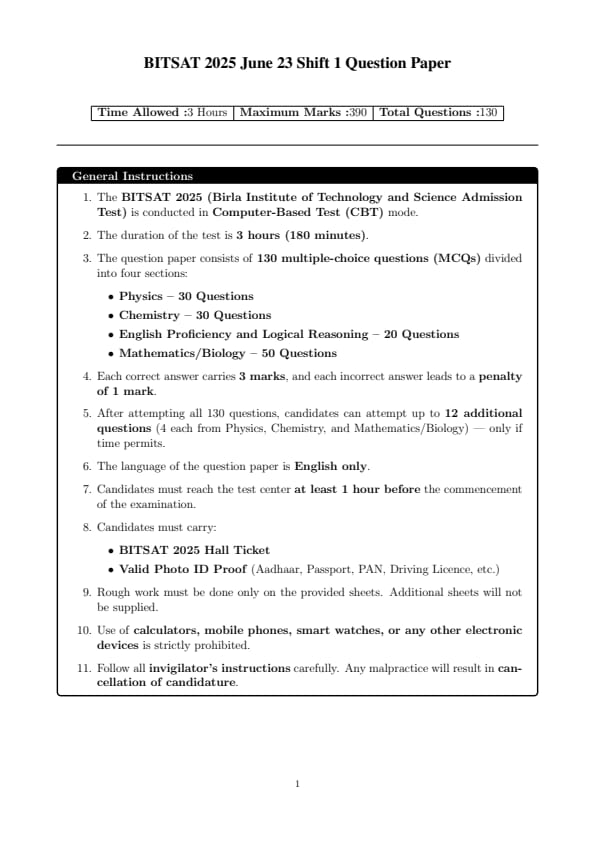
BITSAT 2025 JUNE 23 SHIFT 1 Question Paper with Solutions
| BITSAT 2025 JUNE 23 SHIFT 1 Question Paper | Download PDF | Check Solutions |

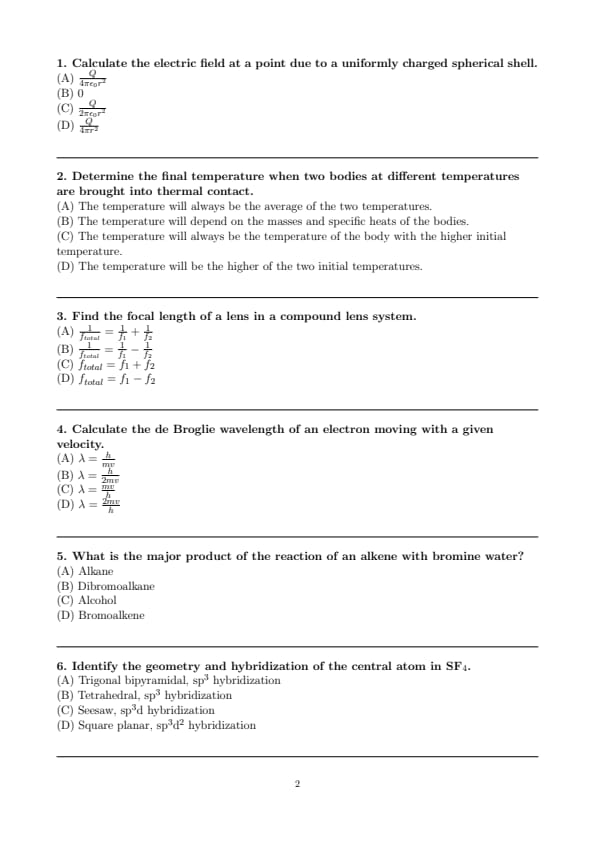
Calculate the electric field at a point due to a uniformly charged spherical shell.
View Solution
Step 1: Understanding the Concept:
This question requires the application of Gauss's Law to find the electric field produced by a uniformly charged spherical shell. Gauss's Law relates the electric flux through a closed surface to the net charge enclosed by that surface. The law is given by \( \oint \vec{E} \cdot d\vec{A} = \frac{Q_{enc}}{\epsilon_0} \). The electric field depends on the location of the point (either inside or outside the shell).
Step 3: Detailed Explanation:
We need to consider two cases for the point P where the electric field is to be calculated. Let R be the radius of the spherical shell and Q be the total charge uniformly distributed on its surface.
Case 1: Point P is inside the spherical shell (r \(<\) R)
To find the electric field inside the shell, we construct a Gaussian surface in the form of a concentric sphere of radius r (where r \(<\) R). According to Gauss's Law, the total electric flux through this surface is proportional to the charge enclosed within it. Since the charge is uniformly distributed on the *surface* of the shell, the charge enclosed by our Gaussian surface (which is inside the shell) is zero.
\[ Q_{enc} = 0 \]
Applying Gauss's Law:
\[ \oint \vec{E} \cdot d\vec{A} = \frac{Q_{enc}}{\epsilon_0} = 0 \]
By symmetry, the electric field \(\vec{E}\) must be radial and have the same magnitude at all points on the Gaussian surface. Thus, \( \oint \vec{E} \cdot d\vec{A} = E \oint dA = E(4\pi r^2) \).
\[ E(4\pi r^2) = 0 \]
This implies that \( E = 0 \) for any point inside the shell.
Case 2: Point P is outside the spherical shell (r \(>\) R)
For a point outside the shell, we construct a Gaussian surface as a concentric sphere of radius r (where r \(>\) R). This surface encloses the entire spherical shell. Therefore, the total charge enclosed is Q.
\[ Q_{enc} = Q \]
Applying Gauss's Law:
\[ E(4\pi r^2) = \frac{Q}{\epsilon_0} \] \[ E = \frac{Q}{4\pi\epsilon_0 r^2} \]
This is the same as the electric field of a point charge Q located at the center of the shell. This corresponds to option (A).
Step 4: Final Answer:
The question asks for "the electric field" without specifying the location. However, the zero electric field inside a uniformly charged shell is a unique and fundamental property that is frequently tested. Options (A) and (B) represent the field outside and inside, respectively. Given that "0" is an option, it is highly probable that the question is probing the special case of the field inside the shell. Thus, we select 0 as the answer.
Quick Tip: For any spherically symmetric charge distribution, Gauss's Law is the easiest tool to use. Remember, for a conducting shell or a uniformly charged shell, the electric field inside is always zero. Outside, it behaves just like a point charge concentrated at the center.
Determine the final temperature when two bodies at different temperatures are brought into thermal contact.
View Solution
Step 1: Understanding the Concept:
This question relates to the principle of thermal equilibrium and calorimetry. When two objects at different temperatures are in thermal contact, heat energy flows from the hotter object to the colder object. This process continues until both objects reach the same final temperature, a state known as thermal equilibrium. The total energy of the isolated system is conserved.
Step 2: Key Formula or Approach:
The principle of calorimetry states that, in an isolated system, the heat lost by the hotter body is equal to the heat gained by the colder body.
Heat Lost = Heat Gained
The heat \(Q\) transferred is calculated using the formula \(Q = mc\Delta T\), where \(m\) is the mass, \(c\) is the specific heat capacity, and \(\Delta T\) is the change in temperature.
Step 3: Detailed Explanation:
Let's consider two bodies, Body 1 and Body 2.
- Let the mass, specific heat, and initial temperature of Body 1 be \(m_1\), \(c_1\), and \(T_1\).
- Let the mass, specific heat, and initial temperature of Body 2 be \(m_2\), \(c_2\), and \(T_2\).
- Assume \(T_1 > T_2\). Heat will flow from Body 1 to Body 2.
- Let the final equilibrium temperature be \(T_f\).
Heat lost by Body 1: \(Q_{lost} = m_1 c_1 (T_1 - T_f)\).
Heat gained by Body 2: \(Q_{gained} = m_2 c_2 (T_f - T_2)\).
According to the principle of calorimetry:
\[ m_1 c_1 (T_1 - T_f) = m_2 c_2 (T_f - T_2) \]
To find the final temperature \(T_f\), we can rearrange the equation:
\[ m_1 c_1 T_1 - m_1 c_1 T_f = m_2 c_2 T_f - m_2 c_2 T_2 \] \[ m_1 c_1 T_1 + m_2 c_2 T_2 = m_1 c_1 T_f + m_2 c_2 T_f \] \[ m_1 c_1 T_1 + m_2 c_2 T_2 = T_f (m_1 c_1 + m_2 c_2) \] \[ T_f = \frac{m_1 c_1 T_1 + m_2 c_2 T_2}{m_1 c_1 + m_2 c_2} \]
This derived expression for \(T_f\) clearly shows that the final temperature depends on the initial temperatures (\(T_1, T_2\)), the masses (\(m_1, m_2\)), and the specific heat capacities (\(c_1, c_2\)) of the two bodies.
Step 4: Final Answer:
Option (A) is incorrect because the final temperature is the average only if the heat capacities (\(m \times c\)) of the two bodies are equal. Options (C) and (D) are incorrect because the final temperature will always be between the two initial temperatures. Option (B) correctly states that the final temperature depends on the masses and specific heats of the bodies.
Quick Tip: Remember that the final temperature is a weighted average of the initial temperatures, where the weights are the heat capacities (\(mc\)) of the bodies. The body with the larger heat capacity will have a greater influence on the final temperature.
Find the focal length of a lens in a compound lens system.
View Solution
Step 1: Understanding the Concept:
A compound lens system consists of two or more lenses placed together. To analyze the system, it's often convenient to find an equivalent single lens that would produce the same effect. The question asks for the formula for the equivalent focal length of such a system, specifically for two thin lenses in contact.
Step 2: Key Formula or Approach:
The power of a lens is defined as the reciprocal of its focal length, \(P = 1/f\). When thin lenses are placed in contact, their powers add up algebraically to give the total power of the combination.
\[ P_{total} = P_1 + P_2 + P_3 + \dots \]
For a system of two thin lenses in contact with focal lengths \(f_1\) and \(f_2\), the total power \(P_{total}\) is the sum of their individual powers, \(P_1\) and \(P_2\).
Step 3: Detailed Explanation:
Let the powers of the two lenses be \(P_1\) and \(P_2\), and their focal lengths be \(f_1\) and \(f_2\).
By definition, \(P_1 = \frac{1}{f_1}\) and \(P_2 = \frac{1}{f_2}\).
The total power of the combination when the lenses are in contact is:
\[ P_{total} = P_1 + P_2 \]
Let the equivalent focal length of the combination be \(f_{total}\). Then the total power can also be written as:
\[ P_{total} = \frac{1}{f_{total}} \]
Substituting the expressions for power into the equation:
\[ \frac{1}{f_{total}} = \frac{1}{f_1} + \frac{1}{f_2} \]
This formula gives the reciprocal of the equivalent focal length as the sum of the reciprocals of the individual focal lengths.
Step 4: Final Answer:
Comparing this derived formula with the given options, option (A) is the correct expression. The other options are incorrect representations of how focal lengths combine. For instance, option (C) is incorrect because focal lengths themselves do not add directly.
Quick Tip: Remember that lens power (in diopters, if f is in meters) is additive for lenses in contact. This is a much simpler concept to remember than the formula for focal lengths. Also, be careful with sign conventions: for a convex (converging) lens, f is positive, and for a concave (diverging) lens, f is negative.
Calculate the de Broglie wavelength of an electron moving with a given velocity.
View Solution
Step 1: Understanding the Concept:
This question is about the de Broglie hypothesis, a fundamental concept in quantum mechanics. In 1924, Louis de Broglie proposed that all matter exhibits wave-like properties. He postulated that any particle, such as an electron, has a characteristic wavelength associated with its momentum. This is known as wave-particle duality.
Step 2: Key Formula or Approach:
The de Broglie wavelength (\(\lambda\)) of a particle is given by the equation:
\[ \lambda = \frac{h}{p} \]
where:
- \(h\) is Planck's constant (\( \approx 6.626 \times 10^{-34} \) J·s).
- \(p\) is the momentum of the particle.
Step 3: Detailed Explanation:
For a particle of mass \(m\) moving with a velocity \(v\), its classical momentum \(p\) is given by the product of its mass and velocity:
\[ p = mv \]
Now, we substitute this expression for momentum into the de Broglie wavelength equation:
\[ \lambda = \frac{h}{mv} \]
This formula allows us to calculate the de Broglie wavelength for an electron (or any other particle) if its mass and velocity are known.
Step 4: Final Answer:
Comparing this derived formula with the given options:
- (A) \( \lambda = \frac{h}{mv} \) is the correct formula.
- (B) \( \lambda = \frac{h}{2mv} \) is incorrect.
- (C) \( \lambda = \frac{mv}{h} \) is the reciprocal of the correct formula.
- (D) \( \lambda = \frac{2mv}{h} \) is incorrect.
Therefore, the correct option is (A).
Quick Tip: The de Broglie wavelength is inversely proportional to the momentum (\(p=mv\)) of the particle. This means that faster or more massive particles have shorter wavelengths. This concept is crucial for understanding electron microscopy and electron diffraction.
What is the major product of the reaction of an alkene with bromine water?
View Solution
Step 1: Understanding the Concept:
This question asks about the electrophilic addition reaction of an alkene with bromine water (\(Br_2(aq)\)). An alkene is a hydrocarbon containing a carbon-carbon double bond (\(C=C\)), which is a region of high electron density. Bromine water is a solution of bromine in water. The reaction involves the addition of atoms across the double bond.
Step 3: Detailed Explanation:
The reaction proceeds via a two-step mechanism:
1. Formation of a cyclic bromonium ion: The electron-rich double bond of the alkene attacks a bromine molecule (\(Br_2\)), which becomes polarized. This results in the breaking of the \(Br-Br\) bond and the formation of a three-membered ring called a cyclic bromonium ion, with the release of a bromide ion (\(Br^-\)).
\[ R-CH=CH-R + Br_2 \rightarrow [Cyclic Bromonium Ion]^+ + Br^- \]
2. Nucleophilic attack: The reaction mixture contains two nucleophiles: the bromide ion (\(Br^-\)) and water molecules (\(H_2O\)). Since water is the solvent, it is present in a much higher concentration than the bromide ion. Therefore, a water molecule is much more likely to attack the cyclic bromonium ion. The water molecule attacks one of the carbon atoms of the ring from the side opposite to the bromine, causing the ring to open.
\[ [Cyclic Bromonium Ion]^+ + H_2O \rightarrow [Intermediate Oxonium Ion] \]
Finally, a deprotonation step (loss of \(H^+\) from the attached water molecule) yields the final product, which is a halohydrin (specifically, a bromoalcohol). A bromoalcohol is a molecule containing both a bromine atom and a hydroxyl (-OH) group on adjacent carbon atoms.
\[ Major Product: A Bromoalcohol \]
A small amount of dibromoalkane is also formed when the bromide ion (\(Br^-\)) acts as the nucleophile, but it is the minor product.
Step 4: Final Answer:
The major product is a bromoalcohol. Looking at the options, "Alcohol" (C) is the class of compound to which a bromoalcohol belongs. "Dibromoalkane" (B) is the minor product in this reaction (it would be the major product if the solvent were inert, like \(CCl_4\)). "Alkane" (A) and "Bromoalkene" (D) are incorrect products for this addition reaction. Therefore, the best description among the choices for the major product is Alcohol.
Quick Tip: Pay close attention to the reagent specified. "Bromine" (\(Br_2\)) in an inert solvent like \(CCl_4\) or \(CH_2Cl_2\) gives a dibromoalkane. "Bromine water" (\(Br_2/H_2O\)) gives a bromoalcohol (halohydrin) as the major product because water acts as the nucleophile. This is an example of a halohydrin formation reaction.
Identify the geometry and hybridization of the central atom in SF\(_4\).
View Solution
Step 1: Understanding the Concept:
To determine the molecular geometry and hybridization of a molecule, we use the Valence Shell Electron Pair Repulsion (VSEPR) theory and the concept of orbital hybridization. VSEPR theory states that electron pairs around a central atom will arrange themselves to be as far apart as possible to minimize repulsion.
Step 3: Detailed Explanation:
1. Find the central atom: In \(SF_4\), Sulfur (S) is the central atom as it is less electronegative than Fluorine (F).
2. Count valence electrons:
- Sulfur (S) is in Group 16, so it has 6 valence electrons.
- Fluorine (F) is in Group 17, so each of the 4 F atoms has 7 valence electrons.
- Total valence electrons = 6 + 4(7) = 6 + 28 = 34.
3. Determine the number of electron domains (Steric Number) around the central atom:
- We draw the Lewis structure. S is bonded to 4 F atoms. This uses \(4 \times 2 = 8\) electrons for bonding.
- Remaining electrons = \(34 - 8 = 26\). These are placed as lone pairs on the terminal F atoms first (\(4 \times 6 = 24\)).
- Electrons left = \(26 - 24 = 2\). These 2 electrons are placed on the central S atom as one lone pair.
- Alternatively, using the steric number formula for the central atom S:
- Number of bonding pairs = 4 (since S is bonded to 4 F atoms).
- Number of lone pairs on S = \( \frac{1}{2} \)[(Valence e\(^-\) of S) - (Number of bonds)] = \( \frac{1}{2} \)[6 - 4] = \( \frac{2}{2} \) = 1.
- Steric Number = (Number of bonding pairs) + (Number of lone pairs) = 4 + 1 = 5.
4. Determine the Electron Geometry and Hybridization:
- A steric number of 5 corresponds to a trigonal bipyramidal electron geometry.
- The hybridization required for 5 electron domains is sp\(^3\)d.
5. Determine the Molecular Geometry:
- The molecule has the form \(AX_4E_1\) (4 bonding pairs, 1 lone pair).
- In a trigonal bipyramidal arrangement, the lone pair occupies an equatorial position to minimize repulsions (lone pair-bond pair repulsions are minimized at 120\(^\circ\) rather than 90\(^\circ\)).
- With the lone pair in an equatorial position, the four F atoms occupy the other two equatorial and two axial positions. This arrangement results in a seesaw shape.
Step 4: Final Answer:
The molecular geometry is seesaw, and the hybridization of the central sulfur atom is sp\(^3\)d. This matches option (C).
Quick Tip: For VSEPR, always determine the steric number first. This gives the electron geometry and hybridization. Then, consider the number of lone pairs to find the final molecular geometry. Remember that lone pairs occupy positions that minimize repulsion, e.g., equatorial positions in a trigonal bipyramid.
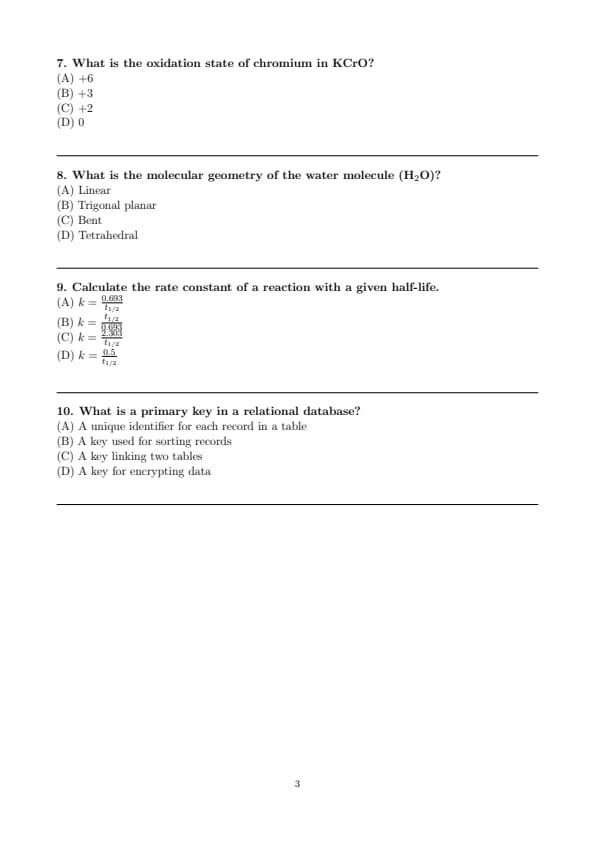
What is the oxidation state of chromium in KCrO?
View Solution
Step 1: Understanding the Concept:
The oxidation state (or oxidation number) of an atom in a compound is the hypothetical charge that atom would have if all bonds to atoms of different elements were 100% ionic. We can calculate it using a set of established rules. The sum of the oxidation states of all atoms in a neutral compound must be zero.
Step 3: Detailed Explanation:
The chemical formula "KCrO" as written is unusual and likely contains a typographical error. Common, stable potassium-chromium-oxygen compounds include potassium chromate (\(K_2CrO_4\)) and potassium dichromate (\(K_2Cr_2O_7\)). In both of these common compounds, chromium exhibits its highest and most common oxidation state. Let's assume the question intended to ask for one of these.
Assumption: The compound is Potassium Chromate (\(K_2CrO_4\))
1. The oxidation state of an alkali metal (Group 1) like Potassium (K) in a compound is always +1.
2. The oxidation state of Oxygen (O) in most of its compounds is -2.
3. Let the oxidation state of Chromium (Cr) be \(x\).
4. The overall charge of the compound \(K_2CrO_4\) is 0. Therefore, the sum of the oxidation states must be zero.
\[ (2 \times Oxidation state of K) + (Oxidation state of Cr) + (4 \times Oxidation state of O) = 0 \] \[ (2 \times (+1)) + (x) + (4 \times (-2)) = 0 \] \[ 2 + x - 8 = 0 \] \[ x - 6 = 0 \] \[ x = +6 \]
So, the oxidation state of chromium in potassium chromate is +6. This is one of the available options.
Step 4: Final Answer:
Given the options and the high frequency with which chromate (\(CrO_4^{2-}\)) appears in chemistry problems, it is almost certain that the intended compound was \(K_2CrO_4\). In this compound, the oxidation state of chromium is +6. Option (B) +3 is also a common state for chromium (e.g., in \(KCrO_2\)), but +6 is the most common in oxoanions like chromate. Therefore, +6 is the most plausible answer.
Quick Tip: When you encounter an unfamiliar chemical formula in a multiple-choice question, consider the possibility of a typo. Try to identify a common, related compound whose properties match one of the options. For transition metals like chromium, knowing their common oxidation states (+2, +3, +6 for Cr) can help you deduce the intended question.
What is the molecular geometry of the water molecule (H\(_2\)O)?
View Solution
Step 1: Understanding the Concept:
The molecular geometry (or shape) of a molecule describes the three-dimensional arrangement of its atoms. It is determined using the Valence Shell Electron Pair Repulsion (VSEPR) theory, which focuses on minimizing repulsion between electron pairs (both bonding and non-bonding/lone pairs) around the central atom. Note that the question in the OCR has a typo "HO?", which should be H\(_2\)O.
Step 3: Detailed Explanation:
1. Identify the central atom: In H\(_2\)O, Oxygen (O) is the central atom as it is more electronegative than Hydrogen (H) and is bonded to both H atoms.
2. Determine the number of electron domains around the central atom:
- Oxygen is in Group 16, so it has 6 valence electrons.
- It forms two single bonds, one with each Hydrogen atom.
- Number of bonding pairs = 2.
- Number of lone pairs on O = \( \frac{1}{2} \)[(Valence e\(^-\) of O) - (Number of bonds)] = \( \frac{1}{2} \)[6 - 2] = \( \frac{4}{2} \) = 2.
- Total electron domains (Steric Number) = (Bonding pairs) + (Lone pairs) = 2 + 2 = 4.
3. Determine the Electron Geometry:
- With 4 electron domains, the electron pairs arrange themselves in a tetrahedral geometry to minimize repulsion. The ideal angle between them would be 109.5\(^\circ\).
4. Determine the Molecular Geometry:
- Molecular geometry only describes the arrangement of the atoms, not the lone pairs.
- The molecule has the VSEPR form \(AX_2E_2\) (2 bonding pairs, 2 lone pairs).
- The two lone pairs on the oxygen atom repel the two bonding pairs (O-H bonds) more strongly than the bonding pairs repel each other.
- This strong repulsion pushes the two hydrogen atoms closer together, and the shape formed by the three atoms (H-O-H) is not linear, but bent or V-shaped. The H-O-H bond angle is approximately 104.5\(^\circ\), which is less than the ideal tetrahedral angle of 109.5\(^\circ\) due to the extra repulsion from the lone pairs.
Step 4: Final Answer:
The arrangement of atoms in a water molecule is bent. Option (D) Tetrahedral describes the arrangement of the electron pairs (the electron geometry), not the atoms (the molecular geometry). Therefore, (C) is the correct answer.
Quick Tip: It is crucial to distinguish between electron geometry and molecular geometry. Electron geometry includes all electron domains (bonding and lone pairs), while molecular geometry considers only the positions of the atoms. For water, the electron geometry is tetrahedral, but the molecular geometry is bent.
Calculate the rate constant of a reaction with a given half-life.
View Solution
Step 1: Understanding the Concept:
This question asks for the relationship between the rate constant (\(k\)) and the half-life (\(t_{1/2}\)) of a chemical reaction. The half-life is the time required for the concentration of a reactant to decrease to half of its initial value. This relationship depends on the order of the reaction. However, the formula provided in option (A) is specific and very common for a particular reaction order.
Step 2: Key Formula or Approach:
Let's derive the formula for a first-order reaction, as it is the most common context for this question. The integrated rate law for a first-order reaction is:
\[ \ln[A]_t = -kt + \ln[A]_0 \]
where \([A]_0\) is the initial concentration, \([A]_t\) is the concentration at time \(t\), and \(k\) is the rate constant.
Step 3: Detailed Explanation:
By the definition of half-life (\(t = t_{1/2}\)), the concentration at this time is half of the initial concentration:
\[ [A]_{t_{1/2}} = \frac{1}{2}[A]_0 \]
Substitute this into the first-order integrated rate law:
\[ \ln\left(\frac{1}{2}[A]_0\right) = -kt_{1/2} + \ln[A]_0 \]
Using the property of logarithms \( \ln(a/b) = \ln(a) - \ln(b) \):
\[ \ln[A]_0 - \ln(2) = -kt_{1/2} + \ln[A]_0 \]
The \( \ln[A]_0 \) terms on both sides cancel out:
\[ -\ln(2) = -kt_{1/2} \] \[ \ln(2) = kt_{1/2} \]
Now, we can solve for the rate constant \(k\):
\[ k = \frac{\ln(2)}{t_{1/2}} \]
The natural logarithm of 2 (\(\ln(2)\)) is approximately 0.693.
\[ k = \frac{0.693}{t_{1/2}} \]
This formula shows that for a first-order reaction, the half-life is independent of the initial concentration. This is a unique and important characteristic.
Step 4: Final Answer:
The derived relationship \( k = \frac{0.693}{t_{1/2}} \) matches option (A) exactly. The other options are incorrect. Option (B) is the inverse. Option (C) uses 2.303, which is related to converting natural log to base-10 log, but the formula is incorrect. Since this specific formula is provided as an option, the question is implicitly about a first-order reaction.
Quick Tip: For exams, you should memorize the half-life equations for zero, first, and second-order reactions. The half-life for a first-order reaction (\(t_{1/2} = 0.693/k\)) is constant. For a zero-order reaction, it's proportional to the initial concentration, and for a second-order reaction, it's inversely proportional to the initial concentration.
What is a primary key in a relational database?
View Solution
Step 1: Understanding the Concept:
This question asks for the definition of a primary key, which is a fundamental concept in the design of relational databases. A relational database organizes data into tables, which consist of rows (records) and columns (attributes).
Step 3: Detailed Explanation:
Let's analyze the core properties of a primary key and evaluate the given options.
A primary key has two main properties:
1. Uniqueness: It must uniquely identify each record (row) in a table. No two rows can have the same primary key value. For example, in a table of students, the `StudentID` would be a good primary key because each student has a unique ID.
2. Non-null: A primary key column cannot have NULL (empty) values. Every record must have a value for its primary key.
Now let's evaluate the options based on this definition:
- (A) A unique identifier for each record in a table: This statement perfectly describes the main purpose of a primary key. It serves as the unique handle for every row in the table.
- (B) A key used for sorting records: While tables are often sorted or indexed by their primary key to speed up data retrieval, this is not its defining purpose. Any column can be used to sort data.
- (C) A key linking two tables: The key used to establish a link between two tables is called a foreign key. A foreign key in one table refers to the primary key in another table. While a primary key is part of this relationship, its definition is about identification within its own table.
- (D) A key for encrypting data: This describes a cryptographic key, which is used for data security and is completely unrelated to the structural concepts of relational database management.
Step 4: Final Answer:
Based on the analysis, option (A) provides the most accurate and fundamental definition of a primary key in a relational database. It is the attribute or set of attributes that uniquely identifies each record.
Quick Tip: Remember the key distinction: A \textbf{Primary Key} ensures unique records within a single table. A \textbf{Foreign Key} creates a link between two tables by referencing a primary key. Think of a primary key as a person's unique national ID number and a foreign key as that ID number being used in another database (like a hospital's) to refer to that specific person.
*The article might have information for the previous academic years, please refer the official website of the exam.